

Submitted:
06 February 2024
Posted:
08 February 2024
You are already at the latest version
Abstract
The global energy transition is motivated largely by the need to combat climate change. Other reasons include limits to available fossil fuels, energy-related environmental impacts of many kinds, and societal goals such as equity and providing sustainable energy for the poor. This transition will significantly change the world both technically, economically and socially. It is taking shape with characteristics which prioritise certain types of policy, interventions and solutions, as well as certain actors and institutional forces. More fundamentally, it embodies underlying assumptions about what constitutes a desirable type of economy and society. Briefly stated, the energy transition is being geared to a conventional economic growth-focused type of development; including the not unchallenged concept of green growth.
Not everyone, however, would agree on those priorities or the underlying assumptions. We point out various constraints and limitations which this approach places on the energy transition. Whilst much of the change being initiated is positive, we argue that different views, which lie closer to discourses such as strong sustainability (1), deep ecology (2) and ecological economics (3, 4) might prioritise differently and offer both necessary and desirable outcomes. Given the predominant focus on energy and climate, equally essential goals such as equity and eradication of poverty appear to be at particular risk of being missed. Building on examples and recent experience we argue that achieving global sustainable energy, not least the societal goals, remains unlikely within socio-political frameworks permeated by the imperatives of market-driven growth, the commodification of resources, and intense competitive dynamics. Technology and economics, the themes of this issue, have far-reaching societal implications and outcomes. We argue that it is essential that they be considered within the broad context discussed here.
Keywords:
Energy transition
; energy policy
; energy economy
; sustainable energy
; ecological economics
; green economy
; energy justice
; sustainable development goals
; wellbeing
1. Introduction: Energy, Limits and Goals
This paper addresses, necessarily in brief form, critical observations regarding the energy transition. As others have stated: “numerous studies have already estimated and analyzed the litany of co-benefits offered by low-carbon transitions, but very few (if any at all) have carefully calculated the injustices, or the dis-benefits” (5).
The past century saw a great escalation in energy consumption and consequent climate emissions, mirroring the expansion of economies. Global utilization of fossil fuels is the predominant anthropogenic factor driving climate change. The research now indicates an increasingly probable planetary temperature rise of more than the desired maximum of 1,5C (6). This would entail grievous ramifications for both humans and ecosystems.
Addressing global environmental crisis has long been on the agenda. The 1972 Club of Rome report Limits to Growth (7) raised much debate and is still seen as having formulated a basically valid warning (8). Subsequent decades added climate change to the question of planetary “limits”. Whilst this crisis is now acknowledged worldwide and is being addressed, if both inadequately and slowly, many argue that there are major systemic issues driving it, not least that the existing economic-industrial system forms one of the obstacles to sustainability. The above and similar studies recognised the need for rethinking economics but did not propose alternatives to the prevailing development paradigm (9).
Energy transition is thus now a top priority; yet solutions have existed for many years. To recapitulate briefly: in 1985 four of the world’s leading scientists published the One Kilowatt per Capita study (10). This was followed by the book Energy for a Sustainable World (11). These showed that the goal of sustainable energy for all (SE4all), championed much later by the World Bank (12) and many others, was achievable – with the technology of 1985. This was before the climate agenda had received wide attention, though already noted in those studies.
We recall that the goal of those energy studies was not only technical, but equitable global development. The core finding was that there is enough for all, if the high consumption groups reduce their energy use from present levels of typically 5-10 kilowatts per capita to around one kilowatt per capita; enabling the poor to raise theirs from typically 100-200 watts to around one kilowatt. The research examined all sectors – heating, cooling, transport, industries, agriculture – and illustrated how one kilowatt per capita could provide a good standard of living even with 1985-level technical efficiencies.
Similar studies by Lovins in the USA (13), Norgaard in Denmark (14) and others led to publications such as Factor Four: Doubling Wealth, Halving Resource Use (15), with much the same message. It was also argued that vastly increased efficiency as regards energy and materials offers greater profitability. These studies gradually led to widespread adoption of an overall goal for richer nations of reducing greenhouse gas emissions by a factor of around 10 (16). Similar studies describe a 2000-watt scenario (17).
The focus of this issue is the “encounter between research from technological fields and that coming from economics” in the transition towards sustainable energy – which is SDG 7 of the 17 Sustainable Development Goals (18). The SDGs provide a holistic framework of the goals of global society. Whilst climate change is a principal concern, the SDGs affirm many societal goals such as providing energy amenities for the poor, improving health, strengthening communities and achieving global equity. These are just as significant for the future of society as the challenges of energy and climate. Hence, whilst a key thrust of the energy transition is obviously technological, i.e. to phase out fossil fuels in favour of renewable energy, this must be done in ways that ensure those societal goals.
Energy is fundamental in society, whether seen in terms of wellbeing, costs, environment or climate. There is reason today to query how the energy transition is both conceived and implemented. We ask the following questions: to what extent do the underlying assumptions and priorities of the current energy transition, centered around conventional economic growth and green growth, hinder the realization of sustainability goals, particularly the societal objectives? How might alternative approaches rooted in strong sustainability, deep ecology, and ecological economics, offer preferable outcomes and solutions in the energy transition?
The technical and economic challenges of the energy transition are clearly enormous. One may ask whether it can be achieved given the vast needs for financing, and political action, in particular sufficient resources and attention to the societal goals. We argue that whilst current policies and interventions contain much that is positive, they tend to ignore or undervalue other approaches. They may neglect or even hinder several of the SDG goals. There is reason to question whether achieving the required reductions in energy impacts and carbon emissions, and the societal goals, is likely within socio-political frameworks permeated by imperatives of conventional economic-industrial growth, albeit “greened”, the commodification of resources, and intense competitive dynamics. Given the profound global changes involved, we urge a critical questioning of the underlying assumptions and development model itself.
2. Method and Approach
Our focus is differing energy transition approaches and their potential or probable outcomes. To do this we highlight key features of prevailing and alternative views, necessarily in brief since this involves a multidisciplinary approach. We select some few concrete examples of current transition discourse, policies and practices, as well as of alternatives. A key concern is to draw on social sciences research which as yet receives limited attention in the fields of technology and economics, and to illustrate how essential these insights are to the energy transition debate.
Alternative discourses are typically quite critical of top-down, technocratic and market focused mechanisms. They focus especially on social issues and “values-driven” approaches to energy transition. We outline some of the objections to the conventional development model or paradigm as it pertains to energy, consumption and wellbeing, and highlight the interest of (and in our view urgent need for) other options in the transition process, such as degrowth, reduced consumption, energy saving and non-commodified solutions.
This study thus offers a comparative perspective on narratives that address the same problem from deeply differing viewpoints. This enables us to highlight our central concern with the underlying assumptions; and what we argue are important weaknesses or omissions. It offers a critical scientific discussion which poses questions, not answers, as to optimal pathways in the energy transition.
To elaborate on these challenges we have organized the paper as follows. Our introductory section briefly recapitulated the emerging awareness about climate, energy and planetary limits. Firstly we now outline what we perceive as four problematic features of how the transition is currently framed and implemented. This includes a brief look at typical transition discourse. Secondly we discuss selected technical, economic and social issues; with cases to exemplify these.
Thirdly, we present questions formulated in ecological economics as to scale, distribution and allocation. We refer to emerging fields such as wellbeing studies and consumption research. This too is necessarily brief and cannot involve a full review of the theoretical and indeed philosophical basis of those approaches. The intent is to highlight advantages that they offer, both for reducing climate emissions and in particular as regards societal goals in the energy transition.
Lastly, we note the debate about whether the current development paradigm is itself fundamentally flawed; it is being seriously questioned today not only by critics but by its own proponents. Since that paradigm largely determines policies and interventions, this debate must we argue be encouraged within the research community.
These complex and interrelated issues require a multidisciplinary approach. The most problematic issues lie arguably in the realm of social values and goals for a sustainable future, including civil society agency, energy justice and equity. In today’s energy transition, innovative technologies as well as economic instruments are pioneered by engineers, economists and policymakers often with limited attention to their potential social implications and outcomes. There is a need for cross-cutting discussions which relate policies and solutions to their societal consequences and which utilise the growing body of research in fields such as ecological economics, sustainable consumption, behavioural sciences and wellbeing studies. In concluding we summarise the need to redirect, modify and improve energy transition discourse, policy and practice.
3. The Energy Transition: Four Questions
Together with Information Technology and Artificial Intelligence, the energy transition is one of the major phenomena that will reshape the world in coming decades. The focus of energy transition is firstly, on a major and eventually complete shift of energy supply from fossil fuels to renewable sources; secondly, on increased efficiency of resource and materials throughput, including increased circularity in the economy; and thirdly, on good living quality and social equity, that is energy justice and accessibility for all. How is this transition being conceived and implemented, on the basis of what assumptions, with what mechanisms, and guided by what ideas about development processes in society?
Whilst very much about technological change, energy transition also demands many institutional and governmental changes. These may greatly affect what kind of society emerges. Who decides, who implements, who controls? The energy transition will affect political systems and power relations ranging from individual rights or democracy up to the national and geopolitical levels (21). The following are four critical questions.
Firstly, the extent and scope of energy systems transformation is seen as demanding expert-driven and large-scale interventions, with planning and control by international institutions and financial corporations. The urgency of climate action is seen as lending justification to this, though it reinforces what many see as their problematic hegemony in world affairs. Public finances being often strained, there is also increasing reliance on private sector investment – including “philanthropic capitalism” (22) – or public-private partnerships, where the profit motive of private actors often bears considerable influence on decisions. These “top heavy” characteristics can impact negatively on local initiative, democracy, and the entire role and agency of civil society.
Secondly, the energy transition is closely aligned with the bigger picture of an overall move towards a green economy. Whilst increased recycling and greener products are certainly positive, an assumed new circularity in a “green economy” is problematic and is, in the view of many, in conflict with ever-increasing production and consumption (23). We return to this below. The green economy view also – see our next point – tends to overlook the many aspects of global informal economies and their potential role in a transition.
Thirdly, the energy transition is largely framed in terms of markets and commodities. Many of these are “new” – such as renewable energy devices – in other words new objects of industrial production and sale. Achieving energy equity is thereby in some doubt since market-based solutions prioritise consumer groups who are able to pay, potentially excluding the most defavourised. Equally important, it tends to exclude demand-side energy reductions and energy saving (and any not-for-profit actions), which typically do not entail commodification. It tends to neglect energy and resource solutions that are based on self-help, local production and informal economy – such as growing one’s own firewood, energy cooperatives or low-cost cooking stoves – solutions especially relevant if not essential for those without purchasing power. As Vandana Shiva stated: “the global economy defines people as poor if they consume the food they have produced themselves rather than buying commercial junk food” (24). The market is certainly an essential component of the transition; but commodification tends to bypass – or indeed impede – downstream, profitless, behavioural solutions such as saving energy and reducing or altering consumption. Examples below illustrate these issues.
Fourthly, the massive transition to renewables, as well as efficiency measures, are widely seen as a primarily technological shift. Technological innovation is a key; but it can be over-focused at the expense of non-technical solutions. And, what kinds of technology? The case of community energy initiatives, discussed below, exemplifies this problem. Qualities of inclusiveness, participation, production and control risk being neglected. Technical innovation at a large, international scale, is not necessarily well adapted to the global variety of cultural contexts, in particular poor country contexts. We return below to the longstanding topic of “appropriate technology”.
The above four issues reappear throughout the brief examples below.
4. The Transition Discourse
Whilst energy transition discourse comprehensively addresses technical, financial and quantitative requirements for renewable energy and emission reductions, there is less debate about what constitutes a desirable future (and climate safe) society. Current approaches reflect and support existing economic frameworks and actors, to the broad exclusion of others, perhaps preferable but less favourable to existing interests. We underline that this is not to question the vital role of business. There is reason to query firstly, the absence of other, arguably better and more value-centred approaches and secondly, whether applying the conventional frameworks is not, to use the common phrase, indeed attempting to solve a problem without addressing the causes of that problem.
The following – from official institutions and business respectively – are simple examples illustrative of conventional energy transition discourse. Again, this is not to belittle such work but to note how it excludes or omits other approaches. This is remarkable in view of the extensive knowledge as well as real-life practice which have shown the potential that lies in other paths including energy saving, behavioural change and downscaling.
Firstly, a large International Energy Agency report (25) on financing clean energy transitions contains no mention at all of energy descent, downscaling or behavioural change. Typical quotes are that “private capital does not yet see the right balance of risk and reward in clean energy” (p.3); or that “as incomes rise, access to electricity improves and prosperity becomes more widespread, air conditioning is becoming affordable for more people” (p.152).
Notably, this last quote relates to the rapid increase in cooling energy, with huge new markets for cooling appliances. It assumes rising incomes; and there is no mention of the well-studied issues of cultural influences on cooling habits (26); that cooling may often be quite unnecessary, or can instead be largely avoided by better buildings and city design (27).
Secondly, the Forbes business group notes that “The physical problem involves the difficulty of accelerating investment in renewables, electric vehicles and/or nuclear. Given that much of this is done by top-down planning …” (28). This business angle takes as given the top-down approach; and the focus is again on technical and largely supply-side (read: sales-enhancing) options. The potential of energy saving, behavioural or degrowth solutions is simply omitted. Again, we do not question the usefulness of such studies but note the remarkable absence of what in our view are other essential agendas in the energy transition.
Such quotes are typical of energy transition discourse in mainstream sources. The underlying assumption is that the prevailing paradigm of industrial-economic growth is the right and only road to follow. But according to others such as Zadek, (29), to understand and solve real challenges it is essential to ask critical questions about the arrangements governing the relationship between market players and politics in its broadest sense.
This commodification and market orientation is being cemented into policy and legislation: it has real energy consequences. A case in point is community energy initiatives. The past three decades saw a proliferation of local, community-led initiatives for renewable energy, in many parts of the world. Whilst not without their own challenges, these have generally been based on a commitment to social justice and empowering civil society with an active role in the transition to a low carbon future (30). But recent legislation in the European Union, whilst on paper supportive of local community energy, has effectively stifled this type of activity – in particular by a strong neoliberal marketisation approach and by phasing out feed-in tariffs (FITs). Opponents argue that marketization is intrinsically hostile to values-driven community involvement in the energy transition: “community energy that is expected to “compete” as a “market actor” has no future” (32, p.18). Community-type energy initiatives have declined sharply (31).
To pursue this example: Denmark and Germany have been noted as pioneers for local, democratic and ecologically sustainable energy initiatives. Community-led contributions to the transition are important even though not sufficient: large actors are needed too. But as regards the large scale, it is argued that a “public goods” energy utility approach, based on real public ownership, away from profit-driven processes, can promote local engagement, energy conservation and efficiency, and is “the best possible vehicle for broad-based and sustained involvement of individuals, communities, cities and regions in the formidable challenges of the energy transition” (33). This stands in stark contrast to prevailing thinking and policies.
We recall the UN’s Agenda 21 declaration that sustainability cannot succeed unless it is understood, adopted and owned locally (34).
Beyond concerns about civil society agency and inclusion, however, it appears that the marketisation approach may itself be failing. The policy to remove FITS in favour of competitive auctions has led to a drastic decrease in the rate of new renewable energy capacity. Europe is now dominated by a very small number of large private companies – in particular EDF, RWE, E.ON, ENEL, and ENGIE – who now face a “utility death spiral” caused by falling profits, rising debt and downgraded credit ratings (35). Prevailing levels of investor risk render it doubtful whether the ambitious climate targets can be reached based on this marketisation pathway.
The above is a specific case of prevailing policy with problematic outcomes. Whether or not current policies can achieve the technical climate targets is an issue in itself; but today’s energy transition can tend to avoid, indeed at times hinder in particular the societal goals. Is this in the best interests of a speedy as well as equitable response to the climate issue?
We now review some key issues within the technological and economic fields – with a focus throughout especially on social issues and implications. We first highlight four technical issues: indirect energy, “hidden” carbon, the conundrum of efficiency versus conservation, and electrification. These also address some widespread misconceptions about energy.
5. Direct and Indirect Energy
Energy and climate calculations are complex but simply put, annual per capita climate emissions in OECD countries are around 6 to 10 tons of carbon equivalent; in poor societies the figure is often far below 0.5 tons (36). But this is not only direct energy use. Typically at least half of the energy we use (and associated climate emissions) is in indirect form (37). We consume energy directly mostly in the form of space heating and cooling, electrical appliances and transport fuels. The rest is the less “visible” or embodied energy involved in the production of what we consume and in all the services we use. It includes both goods – from vehicles to clothes to food – as well as services such as haircuts, police, roads, libraries or the internet.
Current energy transition discourse, however, largely addresses direct energy, and hence places much focus on the supply side, i.e. new energy technologies. It does to some extent encompass indirect energy to include the energy used by farms, factories and other production processes and their efficiencies. But in both cases this technical focus largely skirts the demand side of energy consumption and lifestyle – of how and why energy is used and whether much of the problem, as well as many solutions, lie on the demand side.
Demand side solutions are in many cases not ones that require technology but behavioural as well as structural changes in the ways society is designed and organised. Evident examples are energy efficient city planning, car-pooling or modified diets. The first question has to be: how much energy do we really need, for what, and of what kind? Significant parts of our energy needs and especially those related to indirect energy do not need commercial, commodified technology. The demand side approach to energy, often less attractive to business, contains a very large potential for achieving energy and climate targets. It is well known but requires far higher priority. Hence, whilst energy itself as a commodity is a major component in the energy transition, we must look well beyond energy in its direct form and the less recognised area of indirect energy requires more attention.
6. The ”Hidden” Face of Energy
A second key point in the broader energy picture is that much of the energy use in richer societies is now in the form of imports. Most approaches to climate (Kyoto Protocol, IPCC, COP …) have employed a production-based model where emissions are allocated to the country where energy is used to produce goods. It is now recognized that this provides an insufficient and misleading picture. Much of the “dirty” high impact production has been relocated to developing countries in the global south. Reasons have included cheaper labour costs and fewer environmental restrictions. When what we consume is produced in China, for example, then the energy and emissions to produce those goods occur far away; but they are caused by our demand. It is thus, in terms of responsibility, not China’s emissions but ours (38, 39).
Amongst many studies, a European example is that no less than 60 percent of a typical Swede’s carbon footprint now comes from carbon “imports” (40). This global perspective is increasingly important for understanding energy consumption – and how to address it. The recent development of consumption-based carbon accounting (CBCA) is essential for consumer-oriented approaches (41, 42) insofar as CBCA shows the hidden or indirect impacts, especially in imports. It must be added that these impacts are not only energy- and carbon-related but also societal, such as pollution-related deaths or child labour in far-off countries.
This “hidden” agenda is important not least because it skews perceptions about the energy transition. Half or more of our climate emissions do not involve direct energy use, and are not seen as caused by “us”, because they occur somewhere else. The negative societal impacts are also far away and most often in poor countries. At worst this amounts to “dumping” the impacts of our energy consumption. The energy transition must be understood in this global context, and addressed from a perspective of global responsibilities and equity. A situation where the richer nations continue to export negative impacts of their energy use to the Global South – including as noted below, debt – is not sustainable.
7. Energy Efficiency and Energy Saving
A third question concerns the fundamental difference between energy efficiency and energy saving. Technological innovation and efficiency are central to the energy transition; but efficiency improvements are not enough to combat climate change (43, 44). There are also limits to what is achievable in industrial and other processes. Hydropower systems already have over 90% efficiency[ gas turbines are twice as efficient as a generation ago but are now near the absolute thermodynamic limit of what is possible.
Efficiency improvements reduce the energy needed by an item of technology to produce one unit of a useful energy service, such as heat or movement. Energy saving (or energy conservation) on the other hand means reducing the amount of energy activity, i.e. using less of something, whatever the efficiency. One may exchange an old 300 litre fridge for a more efficient 300 litre one, or exchange it for a 150 litre one. One may buy an energy efficient hot water geyser, or keep the old one and shower for five minutes instead of 15. To keep warm one may instal lots of technology such as solar panels, or turn down the thermostat from 22 to 19 degrees and put on a pullover. The first of the above alternatives all involve more purchases; the second do not – and are often cost free.
Further, technological advances do not necessarily lead to positive change. A “consumerist” problem noted in many countries has been the rebound effect (45, 46) where consumers take out energy savings in the form of increased consumption. In Norway the promotion of heat pumps led to almost no overall energy savings, with consumers for example raising indoor temperatures to 22 degrees or more; and even using heat pumps as air-conditioning in summer – creating an entirely new and unnecessary energy “need”. Enthusiasm for new technology took precedence over common sense or demand-side and even cost-free solutions.
To return to the case of cooling: people in hot climates who have for generations accepted temperatures of around 30 degrees as comfortable, are now encouraged to “expect” 22 degrees – and buy “efficient” air-conditioning. A new market “need” has been created. Energy saving options require a frugal and economical mindset; that tradition is being largely replaced by consumerism. Understanding energy consumption is the domain of social sciences research into lifestyles, transition dynamics and social change (47, 48, 49, 50). These should be central in all energy discourse.
Conventional economic growth with increasing consumption is meaningful in poorer societies. They need far more energy; and they cannot be expected to “save” what little energy they consume. But if all the poor have access to more energy, the volume of new energy use quickly outweighs all efficiency gains (51). In richer societies by contrast, both efficiency gains and energy saving are possible. Downscaling, energy saving and lifestyle change are essential too if the poorer societies in particular are to attain the SDG goals. In brief: improved efficiency is always positive, but not enough; we need efficiency as well as reduced use. This latter demands far more attention.
8. Electrification
Fourthly: a very high priority in current energy transition policy is electrification; including for much direct energy such as for space climatization and electric transports. This too is a technological policy decision with far reaching implications. For example electrification implies commodification, mainly by large, often international companies: as well as consumers who can pay. An equity concern with solar electricity, already much noted in rich countries too (52) is that it is only accessible for those with significant purchasing power as well as excluding those who rent and do not own their dwelling.
However, half and often more of our energy needs are not for electricity, but for heat. This applies to many industrial processes as well as to space heating, cooking, washing and other activities (the term heat includes low temperatures for cooling). Electricity, a high exergy energy carrier, is not always optimal; solar water heaters for example are twice as efficient as solar electric generation with photovoltaics (53). Heat in contrast to electricity can often be provided with fairly simple solutions, including local, non-commercial ones such as firewood, biomass and simple solar devices: as well as by energy-saving design such as exploiting passive solar heating in buildings as opposed to the technology of active solar systems. Indeed, in the now widely successful “passivhaus” type buildings (54), almost no heating technology at all is needed even in very cold climates. The rapidly growing sector of space cooling can similarly be largely addressed by passive architecture as opposed to costly air-conditioning, which is again based on electricity.
The point of these brief examples is to illustrate how the technological and in particular electricity-focused approach to energy transition tends to commodify energy needs which can often be solved without or with minimal technology. Electrification appears in many cases far from ideal in terms of costs, inclusivity or equity.
Electrification is also problematic for remote, poor communities. Even though microgrid solutions exist, avoiding the need for huge grid networks, delivering such solutions to rural settlements with little or no income is both difficult and costly. Such solutions also require operation and maintenance skills which those communities may not have.
Transitioning to electric mobility is another pillar of conventional energy transition discourse. However, it is evident that rapid transitioning to electric mobility in many poor countries appears close to impossible in view of the planning, costs and structural changes required.
The social sciences are essential for successful delivery of solutions. As Wilhite stated: “Energy needs Anthropology” (55). The topic of appropriate technology is noted below; studies of electrification have shown how it can lead to disempowerment of local communities as well as gender issues. In an example from Africa (56), whereas women were in control of the firewood based energy, it is the men who took control of the electricity, both because ‘technology is the man’s domain’ and because it is the men who control interaction with electricity officialdom and administrators – women being culturally excluded from doing so. Many similar examples can be found where cultural and social issues turn out to pose a far bigger challenge than the engineering or the economics.
The above are four technical issues where brief examples and references highlight how all of them need close attention in order to ensure successful transition outcomes.
9. Economic Issues
Economic challenges include consideration of three conditions (57): the physical imperative of balancing throughput – the flow of matter-energy from ecosystems and back to the ecosystems; equitable distribution of resources and wealth as an imperative for society to flourish; and optimised allocation of resource flows among alternative products and uses. We now focus on three economic issues: the problematic topics of green growth, employment, and debt. These too are inseparably linked to the social issues including civil society agency, poverty alleviation and global equity.
10. Green Growth
There are many critics of green growth (58, 59, 60). “Greener” and less polluting production is positive; but to keep “growing” implies producing and consuming more and more green products. Consuming and then recycling twice as many products however green can result in just as much total energy use and emissions. In the words of Jackson: “At first sight, green growth itself seems mildly contradictory. Growth means more throughput. More throughput means more impact” (59).
Recycling and circular economy are now key topics (62, 63) and already being widely adopted in political goals (63). The circular economy aim is important – but with reservations. Every recycling requires at least some energy and emissions. Recycling some products, such as concrete and plasterboard, can even require more energy than is needed to make new (64). We pass by the issue that many claimed green products may not reduce emissions at all – for example bamboo straws and some recyclable plastics have been widely debated. This is often confusing for consumers and is a complex field requiring detailed life cycle assessments.
Whereas if we consume less, basically we are diminishing economic growth. Simply stated, if a factory produces really long-lasting shoes, we will only buy a new pair every 20 years. The factory will go bankrupt. There are well-known stories from the past: the nylon stocking that doesn’t ladder, the re-usable match. Following the logic of economic growth they were never put on the market. Instead we have the recognised phenomenon of planned obsolescence: as with mobile phones (and much else) where one has to buy a new one every few years. Producing things that last a long time, repairing things, or using less, undermines economic “growth”, even though it is by far the most sensible “green” thing to do. Green growth has yet to address this contradiction.
This returns us to the fundamental issue of rising consumption. The goal of “decoupling” (19) is to break the historically close link between economic growth and growth in energy use. However, whilst increased efficiencies do lead to some decoupling from GNP growth, there is no fall in overall impacts (absolute decoupling), excepting a few cases where economic growth itself has fallen. Some decoupling may be achieved in the richer economies – assuming some downscaling too – but in poor countries, eradication of poverty and increase in living standards imply a huge increase in the volume of goods and services. This increased volume in the developing world implies more climate impacts.
Nor does replacement of fossil fuels with renewables eliminate the environmental impacts of vastly increased throughput of materials and resources in the economy (51). To simplify: four times as many “sustainable” electric cars might have as much impact as the present fleet of fossil-fuel vehicles. Neither solar panels nor the batteries to store wind and solar power are impact free – far from it. The production of materials to replace all the world’s tin and cardboard slums with decent small houses would hugely increase climate emissions. In short: eradication of global poverty implies increases in global emissions however efficient or green the technologies.
Hence whilst green growth sounds positive, a closer analysis is needed of the unsustainable nature of consumerism, and of the impacts – both climatic and economic – of providing a good level of energy and amenities to the poorer world, however green the technologies.
11. Economics and Employment
Employment is a key factor of development. Automation has long led to job losses, and AI is predicted to replace millions more. This applies equally in the energy sector. Must the energy transition mean fewer jobs? This too depends on the chosen development paradigm and kinds of technology. The energy transition, we argue, is not currently being designed with a view to maximising employment – especially considering the millions of poor and relatively unskilled workers in developing countries.
New technologies such as solar result in new jobs (65) which partly replace jobs in the fossil fuel sector. As currently planned and promoted however, renewable technologies are mostly advanced and increasingly automated, often at a large scale, with relatively little and mainly skilled labour. Whilst a natural part of the picture, this is not the only possible approach. The approach of choosing technologies that require a maximum of workplaces – preferably decentralised – is absent from mainstream energy discourse. Formerly championed by economists such as E.F Schumacher (66) this is generically referred to as Intermediate or Appropriate Technology (AT) (67). It demands very different policy, planning and design. In mainstream engineering, economies of scale and increasing sophistication are seen as self-evident for “progress”. Yet as Schumacher stated: it takes a good engineer to make something larger and more complicated – but a brilliant engineer to make it smaller and simpler. Examples of labour-intensive solutions including in the field of energy have indeed shown that one can design solutions – in some, not all cases – that employ more people yet are competitive in cost (68).Meaningful work is also a key factor of social stability, security and wellbeing. It can also the large costs associated with unemployment, rural decline, migration and so on.
AT was developed primarily with poor countries in mind, where labour is plentiful, cheap, and urgently needed. The goal is equally that such solutions be closely attuned to local cultures and needs, require small capital investments, and be environmentally benign. It explicitly addresses employment, poverty and social concerns. This author (CB) employed AT solutions to build a hospital in Bhutan; creating local jobs, using local materials, and producing roof tiles at a far lower cost than the usual imported galvanised iron roofing sheets (69). In sum: there is evidence that automation and economies of scale need not always be the rule. In the field of energy such examples again show how the transition is selective in its pathway, and not necessarily most favourable for a vital concern such as employment.
12. Energy, Debt and Credit
Thirdly, the energy transition requires enormous financing, not least for the poorer nations. “Given major economies’ already-strained balance sheets, it is unrealistic to expect substantial climate financing for developing countries” (70). In practice, credit and debt mean that we are living off the future; off value that has not yet been created. This may or may not be “sustainable”; an extra strain being times of economic hardship such as caused by the Covid pandemic or the Ukraine conflict. The standard theory is that given renewed economic growth one will be able to “catch up” and pay off debt down to what are considered healthy levels.
Investment in the energy transition depends on the global finance system. As presently configured this means enormous amounts of credit, on which interest must be paid – whether by countries or individuals. Financing the energy transition aggravates the debt situation; and it confers even more power on global financial institutions. Poor countries, who cannot access the lowest interest rates, suffer most. Whilst a certain level of debt is acceptable, the poorest countries are already spending 15% or more of their total budget in order to service the interest on – not pay off – their debt. “This is equivalent to the typical developing country’s combined health care and education budgets” (71).
In addition, developing countries’ investment needs include major infrastructures such as sewage works, hospitals, bridges and more which cannot be repaid from any subsequent income. These also imply huge increases in indirect, embodied emissions. The same applies to energy infrastructures; if provided for the poor there is again no market incentive in such projects. Large, internationally financed energy projects are certainly part of the solution but here again it is surely imperative to prioritise wherever possible, energy solutions which minimise or avoid debt. Energy saving, AT, behavioural change and downscaling are such avenues.
The green growth model, employment and debt are three major economic concerns which appear particularly problematic in the context of the energy transition. Other types of technology, and financing, may be more appropriate and equitable.
13. Paradigms: Growth, Enough, Degrowth?
Above we have with brief examples highlighted criticisms of the paradigm which underlies current transition policies and choices. Drawing on what is a large body of thought and research, we here highlight the interest of (and in our view urgent need for) other options such as degrowth, reduced consumption and energy saving. We also offer two brief examples of alternative approaches: that of Bhutan, and the Value Mapping method.
A central thesis is that consumption, particularly in richer countries, must be both reduced, and radically changed. The reasons for this include both the ecological planetary limits, including emissions, and the social goals of equity and wellbeing. This includes the key concept of energy justice, which provides “a normative framework for appraising the ways in which energy systems and transitions may inadvertently create or entrench unfairness or inequities within society” (72).
In the words of Nobel laureate and economist Joseph Stiglitz: “If we measure the wrong thing, we will do the wrong thing” (73). Whilst we can measure production and consumption, the ultimate goal is not consumption but wellbeing. The paradigm of endless growth (on a finite planet) has resulted in a pervasive global consumer culture, led by ever increasing industrial production and maximum profit. In the words of Jackson, “We are trapped in an iron cage of consumerism. But the cage is of own making. We are locked in the myth of growth” (59).
Stated in more philosophical terms: sages have said that happiness is easiest found if one’s needs and desires are small. That would also offer wellbeing for the environment. However, the word satisfaction – from the Latin satis, meaning enough or sufficient – finds no place in the world of unlimited economic growth and consumption. Historically speaking, this is quite recent; a very different culture of frugality characterised the 19th century in western countries and has been a central tenet in many religions and cultures.
How, then, might we approach policies in a more holistic manner? The following offers an example of how one may reframe decision-making. We have developed Value Mapping as a tool to refocus on a wellbeing approach and to do so with the above multi-level perspective (74, 75). The Consumption Value Map provides a basis (for both individuals and policy makers) to consider decisions towards sustainability, such as regarding energy. In the value maps, one fills out each segment – from 0 = poor to 5 = excellent. The resulting “star”, large or small, illustrates how weak or positive the chosen activity is esteemed to be, and in what areas. Value mapping provides a holistic method to compare different options.. The intuitive graphic form is simple to use, compels active reflection, and fosters integrated thinking. Note how this process shifts the basis of decision-making from purely technical or cost-benefit to social and qualitative considerations – yet also incorporates the objective, quantifiable factors such as emissions, costs, resource use.
Figure 1.
Value Mapping: Energy and other Consumption may be assessed on three levels: personal, local and global. Source: (Butters and Jakobsen 2023).
Figure 1.
Value Mapping: Energy and other Consumption may be assessed on three levels: personal, local and global. Source: (Butters and Jakobsen 2023).
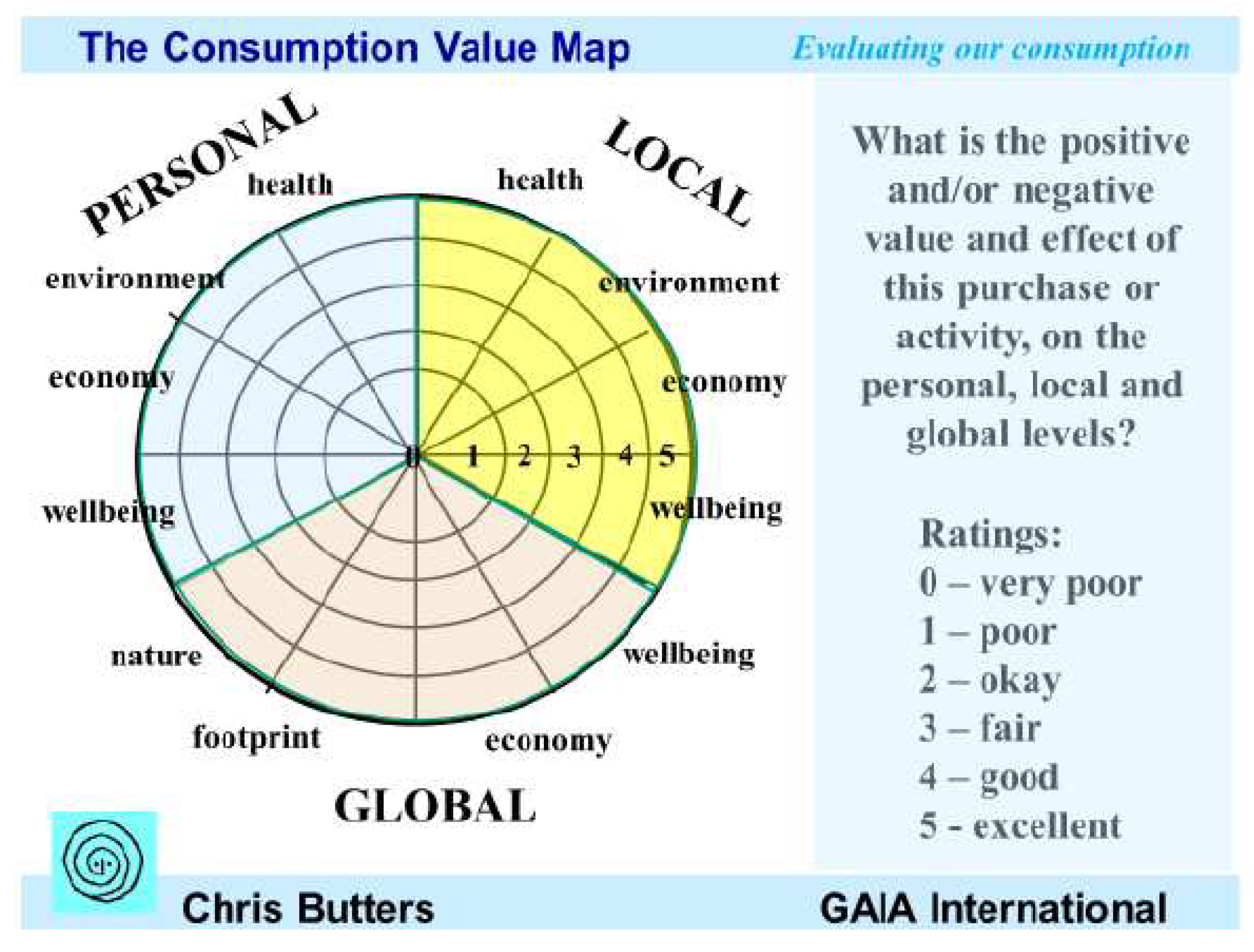
As simplified examples of how this may function in decision-making: Buying a car has positive effects for our own wellbeing – convenience, time saving – but many negative impacts such as noise (local) and on climate emissions (global). Buying long-life products, or re-using things, is ecologically positive but negative for economic growth. Cycling is positive on many counts including health (individual), pollution (local) and climate (global). But to underline again the relativity of context, cycling in the heavily polluted air of Mexico city is not such a good idea.
Importantly, this approach ensures that in addition to all three aspects of sustainability, all three levels – personal, local and global – are brought into consideration.
Broadly speaking, rich and poor nations comprise different categories. Economic growth in its conventional form of rising incomes and increased production of goods and services is truly beneficial when poor societies certainly need more in the sense of basic needs: energy, transport, houses, food. But richer societies are now arguably beyond “enough”; using far more energy than needed, and exceeding the planetary limits. We have written elsewhere about the concept of “Overdevelopment” (76). Terms such as “Peak Oil” and “Peak Soil” are common. We recall the hierarchies of human needs as developed by Max-Neef, Seligman and others (77, 78). By around the mid-1970s the richer nations enjoyed most basic amenities; in material terms quite “enough”. As illustrated by Easterlin-type surveys however (79, and see below), there are not necessarily increases in wellbeing.
A further key criticism of the conventional development paradigm is that the benefits of progress in the more advanced countries have not “trickled down” to the poorer world, as is still often claimed. As recent authoritative analyses have shown, global poverty has not decreased at all in the last 30 years – if we exclude that one huge case, China, from the statistics (80).
There is thus not a blanket critique against economic growth, but against a narrow conception of what is meant by growth as opposed to meaningful human and social development. Nor is it to reject economics tools such as GNP; they are useful for many purposes. Most economists are well aware of these shortcomings, as well as the need to include environmental and other externalities; nevertheless the energy transition is framed and implemented within the dominant paradigm.
We recall Daly’s notion of the common good (57). Ct discourse does not question what “enough” might be. The fundamental goal of economics is not consumption but wellbeing – of both people and planet – on a long-term basis – with as little effort, cost or negative impacts as possible. Similarly, the goal of the energy transition is both environmental and social: to drastically reduce climatic impacts as well as to ensure useful energy for all – with as little effort, cost or impacts as possible.
Hence, these challenges could be reformulated in accordance with the classical triad in ecological economics for long term sustainability (20): total use of resources to be within the carrying capacity of ecosystems; societal equity; and selection of optimal products, activities and services for wellbeing. These three relate to scale, distribution and allocation.
14. Scale: Reducing Energy Production and Consumption
Although ideas regarding energy descent and degrowth are spreading, there is as yet little substance as to how such an economy would actually function. However, as the studies noted in our introduction showed and much research since, a good quality of life is possible with far, far less energy.
The key challenge of limits has been noted. Emblematic of the prevailing paradigm is the notion of an ever-ascending “growth curve” as something positive. However, the well-known Easterlin paradox (81) has (briefly stated) shown in many studies that people’s happiness does not increase above a certain middle class income level. Yet the quest for ever “more”, even though ecologically impossible, still tends to pervade energy discussions. Scenarios for drastically reduced energy use and emissions have existed for several decades; but both business and politicians tend to avoid messages about changing habits or reducing consumption; it is unpopular to propose what many believe means constricting their lifestyle. Yet there is ample evidence that reduced consumption can lead to increased, not decreased wellbeing. This positive message needs to be far more widely disseminated.
We select one concrete study to illustrate this thesis about the advantages of reduced energy consumption or downscaling; the Swedish One Tonne Life study (82). An average Swedish family was provided with an energy efficient house and car and asked to see over a six-month period how much they could reduce their climate emissions. They reduced emissions by around three quarters – without significant feelings of a loss of life quality or wellbeing. In addition, with solutions such as less travel, more cycling, less meat, they both saved money and experienced better health.
Hence in the case of energy, both direct energy and indirect: the priority question must be, how little energy do we need? Further: which solutions are most positive and least negative; in both ecological, economic and social terms? The question must, moreover, be posed on three levels: is this energy use positive for myself as individual – for my community – for the planet? Sustainable energy consumption needs to be considered on all these three levels.
Further: in the case of energy, the benefit of reducing consumption also applies to renewables. It is not as simple as “the more renewables the better”. Renewables also have environmental impacts, technical problems and costs. An extremely energy efficient house may require just five solar panels instead of 20, or very little of any technology at all. As GAIA’s Rolf Jacobsen pointedly states: the only kind of energy technology which is free, has no environmental impacts, and cannot break down, is the kind you do not need at all and can do without (83). Reducing energy needs, of all kinds, is, where possible, favourable on all counts except as regards economic growth.
There is as noted indeed a growing understanding that especially for richer societies, demand-side degrowth and reduction pathways are essential ingredients for a sustainable energy transition. Nevertheless, energy saving, lifestyle change and downscaling receive far less attention or finance than new, commodified forms of energy supply – such as solar photovoltaics – as opposed to reduced use of energy or of the indirect energy in consumption. The benefits of the latter approaches demand to be better recognised.
15. Distribution: Energy and Equity
We return to social aspects of the energy transition with brief examples. Problematic implications of renewables are observed in both rich and poor countries (84). A recent thesis on the energy transition in Sri Lanka (85) exemplifies poor societal outcomes of energy transitions as currently conceived. This research like many others focuses on the topic of energy justice. The setting is a post-conflict state which in addition to a weak economy and institutions has unresolved regional and ethnic tensions. Sri Lanka has agreed to climate ambitions in line with international trends: but given these weaknesses, in practice external and geopolitical forces play a powerful role. The agenda of those forces is to maximise their own geopolitical influence and/or profit. Renewables projects (solar and wind) have been executed with little or no local consultation or participation, and the energy goes to the centralised grid. Both the technical choices and financial instruments largely favour the external actors. Various new conflicts have been created. Local democracy and equity are weakened by the kind of energy transition being implemented. Further, despite its climate commitments, lack of finance in Sri Lanka as in many countries has led to increased, not decreased, reliance on the cheapest options such as coal. This then takes the conventional form of large-scale power plants with centralised control of energy. Interventions towards energy saving, non-commercial energy, community initiatives and local empowerment are hardly on the agenda.
A similar scenario is emerging in South Africa, where a Just Energy Transition plan (JETS) (86) does claim to address both renewables as well as equity. However, the energy supply system is in crisis with daily blackouts having huge impacts on the economy and on wellbeing. Coal, a major local resource, again becomes the short- and medium-term priority. There are also strong external pressures towards large nuclear and gas facilities, even though these imply debt dependency and are now far from the cheapest options. Large international contracts have also provided opportunities for massive corruption. By contrast, local initiatives by small groups and municipalities to produce their own renewable energy have not been enabled by legislation nor encouraged. The approach here too tends to be top-down, centralised and geared to the conventional paradigm of marketisation, economic growth and ever-rising consumption.
In poorer societies, lack of direct energy amenities such as lighting, heating, cooking fuel and vehicles impacts deeply on human wellbeing (87). But as noted, eradication of poverty also implies the need for many new public amenities, where the construction and operation of these also implies a vast increase in energy use and emissions. This again underlines the importance of the indirect energy / emissions picture. The climate issue is global and whilst the rich can downscale, the poor need more resources. Favourable international loans are in short supply and may entail various conditionalities, whilst for private investor capital there is often little return and high risk in projects aimed at the poorest. Hence, as regards economic distribution, given these conditions energy justice and equity appear almost certain to be low priorities.
16. Allocation: Wellbeing under Capitalism?
Critics query what conventional economics means by benefits. A large part of GNP as seen by standard economics consists of disbenefits. We recognize the absurdity that car accidents, dental bills and waste treatment all help to raise GNP; they are at best repairs to damage caused by unwise or faulty consumption. Many other “goods” are decidedly negative since their consumption (at least beyond a point) impedes human or environmental wellbeing: such as meat, alcohol, sugars, and beauty products; and there are many consumption activities which may enhance individual wellbeing whilst being harmful to others, or to the environment, such as foxhunting or tourist travel. And there are many “services” which a well-functioning society would need less of: such as waste management, bureaucracy or police.
Further, the question of allocation, in energy as elsewhere, concerns not only the “what” but also the “who” and the “how”. Energy transition involves not only the quantity, type, and distribution of global energy but equally, the modalities and agencies of decision making and control. Here again we encounter underlying assumptions. They inevitably raise the controversial question, formulated by Jeff Rudin as: “should we cap, or decapitate, capitalism?”” (88). Can that paradigm provide an ecologically and socially optimal energy transition? Opponents argue that the basic drivers of competition, maximum profit and ever-increasing production and consumption are an obstacle (89, 90). Others argue that we only need to improve today’s destructive and inequitable brand of rogue capitalism through a more “caring” version, with tighter regulation and other adjustments. Thus the “philanthropic capitalism” (91) of billionaires such as Bill Gates and Warren Buffett, or Collier’s The Future of Capitalism, assert that “capitalism must be constrained, rather than be allowed to operate unfettered” (92, 93). They add the proviso (vague at best) that we need to care more for each other – as states, businesses or individuals. There remains the risk of the immense power, in transition decisions, of a few extremely wealthy corporations and individuals (all benevolent?) compared to that of governments and of civil society itself.
More radical directions such as Eco-socialism (94, 95, 96) face the well-known criticisms of socialist economics. But today’s China, much like the former Soviet Union, has followed the same economic-industrial growth path – if in theory with a more distributive goal. The Scandinavian social-democratic model offers perhaps some kind of a balance. Ecological economics for its part seeks to exit the left-right dichotomy altogether as passé, and poses a more fundamental system critique (97). In Korten’s words “to create an economic system that works for all, we need a different design grounded in different understanding of wealth, our human nature, and the sources of human happiness and well-being” (98). And according to Piketty “The current economic system, based on the uncontrolled circulation of capital, goods, and services, without social or environmental objectives, is akin to a neocolonialism that benefits the wealthiest” (99). We do not here engage further on that debate; but these questions are essential in the energy transition debate.
17. Transition Goals and Wellbeing
We have noted that the choice of neoliberal type development is explicitly stated, is implanted in legislation and financial policy, and often bypasses or even hinders some qualitative, social goals. Although energy transition discourse includes stated equity and wellbeing goals, these risk being neglected or even damaged in practice (100). Lennon for example concludes that citizens remain locked out of the decision-making processes of the energy transition and discusses “examples of how extended stakeholder perspectives can improve procedural justice” (101). This returns us to the social sciences, in particular the field of wellbeing studies (57, 78, 102). Indicator sets for wellbeing are now many (103, 104, 105). These often highlight solutions that are behavioural or involve moderating rather than increasing consumption, including of energy (106). They redirect the transition focus towards the ultimate goals of consumption and development. Keywords are social capital, community initiative, cooperation and non-monetary solutions (107).
These newer frameworks introduce qualitative criteria, embracing a broader view of economics. As a final example we note the one country implementing a Wellbeing approach in their planning: Bhutan (where author CB worked for 10 years), whose model is now much discussed worldwide (108, 109). Bhutan has replaced the GNP focus with GNH – Gross National Happiness. GNH adopts a more values-focused stance and has been developed into an entire approach to national budgets, accounting and economic policy.
Figure 2.
Bhutan’s Gross National Happiness model. Source: Butters after Ura (107).
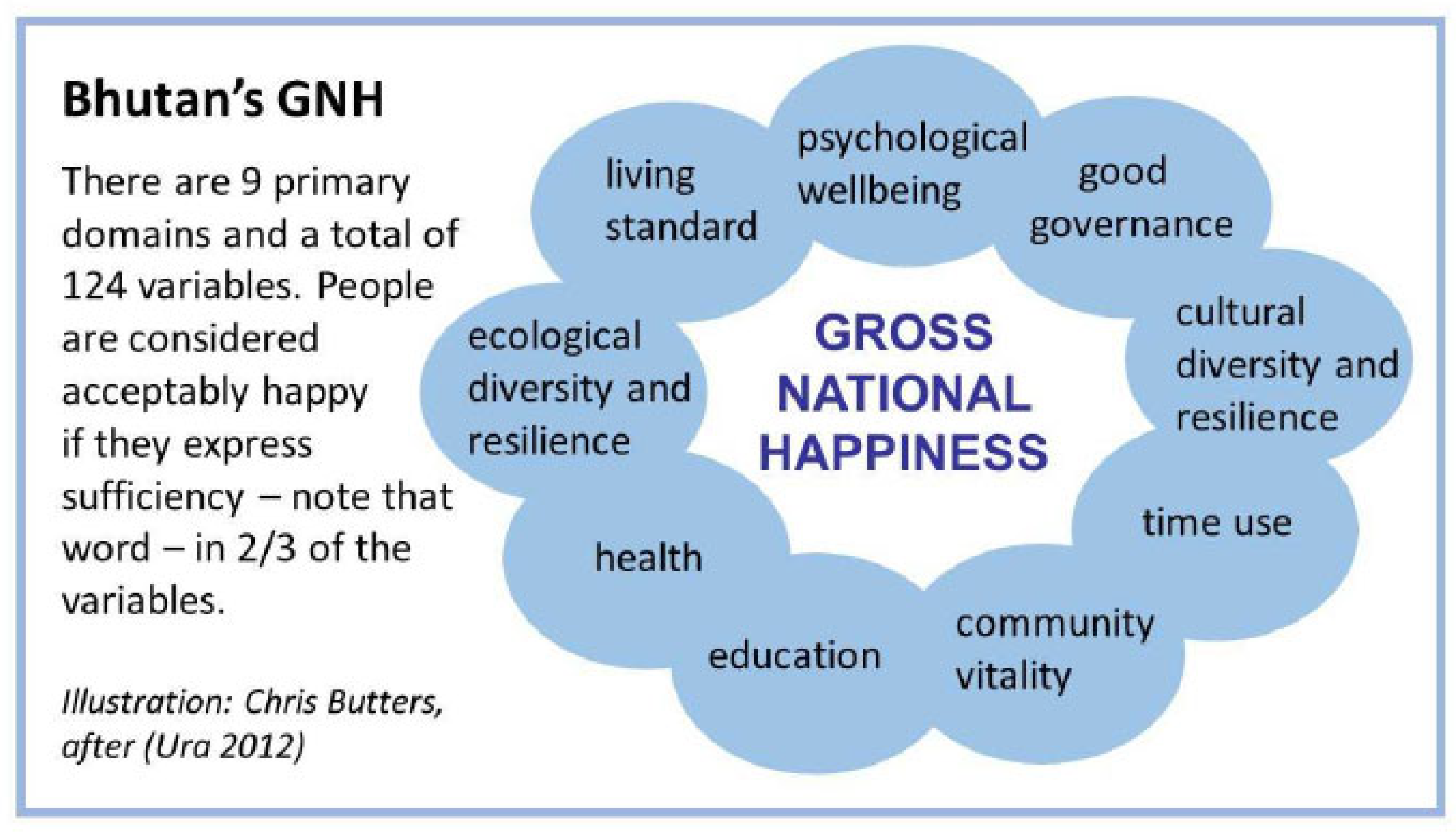
In conventional terms Bhutan is a very poor country. However if, as in Bhutan, most basic needs – food, shelter etc – are covered, as well as free basic services such as education and health care – and social qualities such as good governance, safety and cultural identity – then they are not poor. It has been shown in surveys that some quite “poor” countries such as Bhutan and Costa Rica have remarkably high levels of wellbeing (110). As illustrated, GNH includes common living standard metrics such as income, education and health, and the need for conventional economic development is fully recognised. It thus addresses human and social development in a broad, meaningful framework which is in line with the all-encompassing spectrum of the SDG goals. The overarching focus of GNH is to achieve wellbeing and social equity as well as sustainable economic activity and environmental quality, including meeting global climate targets. The social sciences and wellbeing research provide key insights towards successful policies, technological and economic choices in the energy transition.
18. Conclusions
Reviewing the ongoing energy transition raises questions as to the often unspoken, underlying assumptions about what kind of development – what kind of society – is being promoted. The prevailing discourse may be briefly summarised as the “business as usual” model of global market-based capitalism, in a “new, green” form, which does not appear to address flaws which many capitalists themselves are now querying. We have discussed critical aspects of the energy transition, particularly the challenges and implications of scale, distribution, and allocation. The need for a shift towards reduced production and consumption is emphasized, supported by examples demonstrating improved well-being with much lower energy use, highlighting positive effects of reduced consumption on individual, community, and planetary levels. Social justice and equity problems in the energy transition are examined through case studies in Sri Lanka and South Africa.
Failure in the climate challenge in some nations or categories implies global failure. At stake in particular are issues associated with civil society, local determination, poverty and global equity. The energy transition is framed and implemented in ways that largely support and reinforce the conventional development paradigm. The marketisation focus tends to disempower local and community-based energy/climate solutions. It often weakens civil society agency. It excludes or directly hinders important – we argue essential – avenues of energy saving, behavioural change and degrowth, despite evidence that these latter offer in many cases greener and cleaner solutions, at lower and in some cases zero cost, and often with demonstrable positive effects on wellbeing. These options are in addition more easily tailored to varied cultural contexts especially in poorer contexts. The paradigm underlying the energy transition is also capital-intensive, favourable to the most powerful financial interests as well as rendering poorer countries and population groups liable to an increasing debt trap.
Paramount is a realisation that energy technology and efficiency alone will not be sufficient to ensure the needed reductions in climate emissions, as well as global poverty eradication. Whilst we do advise a profound critique of the current paradigm, our focus here has been to note how the energy transition is currently directed in what are not necessarily the most effective, or equitable, or even most cost-effective, directions. We have suggested a range of shortcomings and omissions in current transition theory and practice. Whilst many of the energy transition initiatives are unquestionably positive, the societal vision and underlying development paradigm need to be challenged. If not, the transition risks falling short of both its climatic and its social goals.
References
- Jeronen, E. Strong Sustainability. In Encyclopedia of Sustainable Management; Idowu, S., Schmidpeter, R., Capaldi, N., Zu, L., Del Baldo, M., Abreu, R., Eds; Springer: Cham. 2020. [CrossRef]
- Næss, A.; Sessions, G. Basic Principles of Deep Ecology. 1984. Available online: www.theanarchistlibrary.org (accessed on 1 July 2021).
- Gare, A. Ecological Economics and Human Ecology. In Handbook of Whiteheadian Process Thought; Michel Weber and Will Desmond, Ed.; Volume 1,Ontos Verlag: De Gruyter, Frankfurt, 2008; pp. 161–176. [Google Scholar]
- Capra, F.; Jakobsen, O. A conceptual framework for ecological economics based on systemic principles of life. International Journal of Social Economics 2017, 44. [Google Scholar] [CrossRef]
- Sovacool, B.; Martiskainen, M.; Hook, A.; Baker, L. Decarbonization and its discontents: a critical energy Justice perspective on four low-carbon transitions. Climatic Change 2019, 155, 581–619. [Google Scholar] [CrossRef]
- IPCC. Climate Change 2023: Synthesis Report; IPCC: Geneva, Switzerland, 2023. [Google Scholar] [CrossRef]
- Meadows, D.H.; Randers, J.; Meadows, D.L.; Behrens, W.W. The Limits to Growth; Universe Books: New York, NY, USA, 1972. [Google Scholar]
- Meadows, D.H.; Randers, J.; Meadows, D.L. Limits to Growth: the 30-year Update; 2004 Chelsea Green Publishing: Vermont, USA, 2004. [Google Scholar]
- Jackson, T. Prosperity Without Growth: Economics for a Finite Planet Earthscan, UK, 2009.
- Goldemberg, J.; Johansson, T.; Reddy, A.; Williams, R. Basic Needs and Much More with One Kilowatt per Capita’ Ambio; Royal Swedish Academy of Science: Stockholm, 1984. [Google Scholar]
- Goldemberg, J.; Johansson, T.; Reddy, A.; Williams, R. Energy for a Sustainable World; Wiley: New Delhi, 1988. [Google Scholar]
- World Bank 2022. Sustainable Energy for All, Washington. Sustainable Energy for All (worldbank.org) or. Available online: https://datacatalog.worldbank.org/search/dataset/0041706.
- Lovins, A. Soft Energy Paths: Towards a Durable Peace; Harper & Row: New York, 1979. [Google Scholar]
- Nørgård, J.S.; Xue, J. From green growth towards a sustainable real economy: The myth of decoupling, rebound effects, and the 𝑰=𝑷∙𝑨∙𝑻 equation. 2017. [Google Scholar]
- Weizsacker, E.; Lovins, A.; Lovins, H. Factor Four – Doubling Wealth, Halving Resource Use; Earthscan: London, 1997. [Google Scholar]
- Schmidt-Bleek, F. Factor 10: The future of stuff. Sustainability: Science, Practice and Policy; Taylor and Francis: Abingdon, UK, 2008. [Google Scholar] [CrossRef]
- Morosini, M. A 2000-Watt Society in 2050: A Realistic Vision? ETH: Zurich, Switzerland. 2010. Available online: https://www.stadt-zuerich.ch/portal/en/index/portraet_der_stadt_zuerich/2000-watt_society.html (accessed on 9 June 2021).
- United Nations 2020. Transforming our world: the 2030 Agenda for Sustainable Development | Department of Economic and Social Affairs (un.org).
- Basu, S.; Ogawa, T.; Ishihara, K. The methods and factors of decoupling energy usage and economic growth. In Waste-to-Energy Approaches Towards Zero Waste; Ch.10; Elsevier: Amsterdam, The Netherlands, 2022; pp. 269–313. [Google Scholar]
- Daly, H. Beyond Growth – The economics of a sustainable development; Boston Beacon Press: 1996.
- Wilhite, H. The Political Economy of Low Carbon Transformation – Breaking the habits of capitalism; Earthscan/Routledge, 2016. [Google Scholar]
- Bishop, M.; Michael Green, M. Philanthrocapitalism: How the rich can save the world; Bloomsbury: USA, 2008. [Google Scholar]
- Spash, C. The shallow or the deep ecological economics movement? Ecological Economics 93 Sept.2013 351-362. 2013.
- Shiva, V. Earth Democracy; Justice, Sustainability, and Peace; South End Press: 2005; ISBN 0-89608-745-X.
- IEA. Financing Clean Energy Transitions in Emerging and Developing Economies; IEA Publications International Energy Agency: Paris, 2021. [Google Scholar]
- Wilhite, H. Energy consumption as cultural practice: implications for the theory and policy of sustainable energy use. In Cultures of Energy: Power, Practices, Technologies; Centre for Development and the Environment (SUM): Oslo, Norway, 2013. [Google Scholar]
- Cheshmehzangi, A.; Butters, C. (Eds.) Designing Cooler Cities. Energy, Cooling and Urban Form: The Asian Perspective; Palgrave MacMillan: Singapore, 2018. [Google Scholar]
- Lynch, M. The Unfocussed Energy Transition. 2023. Available online: https://www.forbes.com/sites/michaellynch/2023/06/07/the-unfocussed-energy-transition/?sh=2680c17c4577.
- Zadek, S. The Civil Corporation; Routledge, 2019. [Google Scholar]
- Friends of the Earth Europe, Greenpeace EU, REScoop.eu, Energy Cities, and Friends of the Earth Spain and Hungary 2019. “Unleashing the power of community renewable energy,” 14 February 2019. 14 February. Available online: https://www.foeeurope.org/unleashing-power-community-energy.
- European Commission 2016. Clean Energy for All Europeans – unlocking Europe’s growth potential. Available online: https://ec.europa.eu/commission/presscorner/detail/en/IP_16_4009 See these and many other data at. https://ourworldindata.org/co2-emissions.
- Sweeney, S.; Treat, J.; et al. TUED, Trade Unions for Energy Democracy, New York, 20. Transition in Trouble? The Rise and Fall of Community Energy in Europe - RLS-NYC (rosalux.nyc)CB Hille Indirect Energy. 2020. 20 March.
- Weghmann, V. Going Public: A Decarbonised, Affordable and Democratic Energy System for Europe; PSIRU, University of Greenwich, 19. 2019. Available online: https://www.epsu.org/article/going-public-decarbonised-affordable-and-democratic-energy-system- europe-new-epsu-report.
- United Nations. Agenda 21. UNCED. 1992. Available online: https://sdgs.un.org/publications/agenda21.
- Tomas, S. Corporate performance of the Seven Brothers of the European energy market: Then there were five,” Utilities Policy, Volume 50, 18, Pages 164-174. 2018. Available online: https://www.sciencedirect.com/science/article/abs/pii/S0957178717301534.
- See these and many other data at. Available online: https://ourworldindata.org/co2-emissions.
- Butters, C. Indirect Energy; ISS UiO: Oslo, Norway, 2019. [Google Scholar]
- Peters, G.; Hertwich, E. The importance of imports for household environmental impacts. Journal of Industrial Ecology 2006, 10, 89–109. [Google Scholar] [CrossRef]
- Ivanova, D.; Vita, G.; Steen-Olsen, K.; et al. Mapping the carbon footprint of EU regions, Environmental Research Letters. 2017.
- Nilsson, A. Consumption-based Carbon Accounting for households in Sweden and Stockholm EIO-LCA; [Pdf] Department of Industrial Ecology, KTH: Stockholm, 2012. [Google Scholar]
- Peters, G. From production-based to consumption-based national emission inventories. Ecological Economics 2008, 65, 13–23. [Google Scholar] [CrossRef]
- Steininger, W.; Munoz, P.; Karstensen, J.; et al. Austria’s consumption-based greenhouse gas emissions: Identifying sectoral sources and destinations. Global Environmental Change 2018, 48, 226–242. [Google Scholar] [CrossRef]
- Lovins, L.; King, W. Energy Efficiency: Spoiler or Enabler. The relationship between energy efficiency and renewable energy; AAAS, The Natural Capitalism Group: 2003.
- Wilhite, H.; Norgaard, J.S. Equating Efficiency with Reduction: a Self-deception in Energy Policy. Energy & Environment 2004, 15. [Google Scholar]
- Vivanco, D.; Freire-González, J.; Galvin, R.; et al. Rebound effect and sustainability science: A review. Journal of Industrial Ecology 2022, 26. [Google Scholar] [CrossRef]
- Brockway, P.; Sorrell, S.; Semieniuk, G.; et al. Energy efficiency and economy-wide rebound effects: A review of the evidence and its implications. Renewable and Sustainable Energy Reviews 2021, 141. [Google Scholar] [CrossRef]
- O’Brien, K.; Sygna, L. Responding to Climate Change: The Three Spheres of Transformation. Proc. Transform. Chang. Clim. 2013.
- Skirbekk, Gunnar. Epistemic Challenges in a Modern World; Lit Verlag, 2019. [Google Scholar]
- Shove, E. Beyond the ABC: Climate Change Policy and Theories of Social Change. Environ. Plan. Econ. Space 2010, 42, 1273–1285. [Google Scholar] [CrossRef]
- Raskin, P. Journey to Earthland – The Great Transition to Planetary Civilization; Tellus Institute: USA, 2016. [Google Scholar]
- Nørgård, J.S.; Jin, X. From green growth towards a sustainable real economy1 The myth of decoupling, rebound effects, and the 𝑰=𝑷∙𝑨∙𝑻 equation. 2017.
- Belleflamme, E. Towards a decentralized renewable energy transition: Participation of incumbent and new energy actors in policy process in Wallonia; Centre for Development and Environment, University of Oslo: Norway, 2019. [Google Scholar]
- Grupp, M.; Balmer, M.; Butters, C.; et al. Time to Shine. Applications of Solar Energy Technology; Wiley: USA, 2012. [Google Scholar]
- Butters, C. ; Bente Nuth Leland. Fra passivhus til sunne hus. Arkitektur, miljø og helhet; GAIA Agenda Forlag: Oslo, 2012. [Google Scholar]
- Wilhite, H. Why energy needs Anthropology. Anthropology Today, 05 vol 21.3. 2005. 20 June.
- Winther, T. Electricity's effect on gender equality in rural Zanzibar, Tanzania : case study for Gender and Energy World Development Report Background Paper. ENERGIA, Oslo. 2011.
- Daly, H.; Cobb, J.B. For the Common Good, Redirecting the Economy toward Community, the Environment, and a Sustainable Future; Beacon Press: Boston, MA, USA, 1989. [Google Scholar]
- Jakobsen, O. Transformative Ecological Economics – Process Philosophy, Ideology and Utopia, RoutledgJackson, T. 2021: Post-Growth – Life after Capitalism; Polity Press: Cambridge UK, 2019. [Google Scholar]
- Korten, D. Agenda for a New Economy – From Phantom Wealth to Real Wealth; Berrett Koehler Publ: 2010.
- Schröder, E.; Storm, S. Economic Growth and Carbon Emissions: The Road to ‘Hothouse Earth’ is Paved with Good Intentions In INET Working Papers; Institute for New Economic Thinking: New York, 2018. [Google Scholar]
- Raworth, K. Doughnut Economics: Seven Ways to Think Like a 21st-Century Economist; Penguin: UK, 2017. [Google Scholar]
- Ingebrigtsen, S.; Jakobsen, O. Circulation Economics – Theory and Practice, Peter Lang. 2007.
- EU. A new Circular Economy Action Plan - For a cleaner and more competitive Europe EUR-Lex - 52020DC0098 - EN - EUR-Lex (europa.eu). 2020.
- Gao, W.; Ariyama, T.; Ojima, T.; et al. Impacts of recycling disassembly material in residential buildings. Energy and Buildings 2001, 33, 553–562. [Google Scholar] [CrossRef]
- IEA. World Energy Employment, 2022 Report. 2022. Available online: https://www.iea.org/reports/world-energy-employment.
- Schumacher, E. Small is Beautiful. Economics as if People Mattered; Random House: New York, 1973. [Google Scholar]
- Practical Action UK. Available online: www.practicalaction.org (accessed on 30 June 2021). AND/OR Sanjit Bunker, R. The Barefoot College in Tilonia. Indira Gandhi National Centre for the Arts, New Delhi. Available online: www.barefootcollege.org (accessed on 13 July 2019).
- McRobie, G. Small is Possible; Colophon Books: Harper, UK, 1981. [Google Scholar]
- Butters, C. The Punakha Hospital: Traditional Architecture – a premise for intelligent energy use; UNEP/GRID Arendal: Norway. 2009.
- Stiglitz, J. Our Debt to Future Generations. Project Syndicate. 2023. Available online: https://www.project-syndicate.org/commentary/debt-government-spending-climate-change-places-greatest-burden-on-children-by-joseph-e-stiglitz-2023-06.
- Granville, B. The Debt Question Today. Project Syndicate 16.06.2023. 2023. Available online: https://www.project-syndicate.org/.
- Jenkins, K.; McCauley, D.; Heffron, R.; Stephan, H.; Rehner, R. Energy justice: A conceptual review. Energy Research and Social Science 2016, 11, 174–182. [Google Scholar] [CrossRef]
- Stiglitz, J.; Sen, A.; Fitoussi, J.-P. Report of the High Level Expert Group on the Measurement of Economic Performance and Social Progress. In Proceedings of the 6th OECD World Forum on Statistics, Knowledge and Policy, Paris; 2018. [Google Scholar]
- Butters, C. Sustainable Urbanism and Beyond; ‘A Holistic Method of Evaluating Sustainability’ in Haas, T, Ed.; Wiley: USA, 2012. [Google Scholar]
- Butters, C.; Jakobsen, O. Value Mapping: Practical Tools for Sustainable Consumption. In Sustainable Consumption and Everyday Life; Hansen, A., Nielsen, K.B., Eds.; ch.11, Palgrave MacMillan. Value Mapping: Practical Tools for Wellbeing and Sustainable Consumption | SpringerLink. 2023. [CrossRef]
- Butters, C. Development and overdevelopment. In Ten Years in Bhutan; Capetown: 2022; ISBN 978-0-6397-1660-2.
- Max-Neef, M. Human Scale Development; Apex Press: USA, 1991. [Google Scholar]
- Seligman, M. Authentic Happiness: Using the New Positive Psychology to Realize Your Potential for Lasting Fulfillment; Atria Books, Simon & Schuster: New York, 2004. [Google Scholar]
- Easterlin, R. Will Raising the Incomes of All Increase the Happiness of all. J. Econ. Behav. Organ. 1995, 27, 35–48. [Google Scholar] [CrossRef]
- Hickel, J. The true extent of global poverty and hunger: questioning the good news narrative of the Millennium Development Goals; Taylor and Francis: 2016.
- Easterlin, R. Does Economic Growth Improve the Human Lot? Some Empirical Evidence, In Nations and Households in Economic Growth: Essays in Honor of Moses Abramovitz; David, P., Reder, M., Eds.; Academic Press: New York, 1994. [Google Scholar]
- A-Hus, V.V.; One Tonne Life, Final Report. Stockholm. Available online: www.onetonnelife.se (accessed on 22 May 2022).
- Jakobsen, R. (personal communications) GAIA architects, Norway. 2010. Available online: www.gaiaarkitekter.no.
- Korsnes, M.; Loewen, B.; Dale, R.F.; Steen, M. Paradoxes of Norway’s energy transition: controversies and justice. Climate Policy 2023, 23, 1132–1150. [Google Scholar] [CrossRef]
- Theiventhran, G. Energy Transition in Post-War Sri Lanka: Policy pathways, geopolitical dynamics and the question of equity. Ph.D dissertation, Department of Sociology and Human Geography, University of Oslo, Norway, 2023. [Google Scholar]
- Presidential Climate Commission of South Africa. Just Energy Transition Investment Plan (JET IP). 2022. Available online: https://www.climatecommission.org.za/south-africas-jet-ip.
- Smith, P.; Max-Neef, M. Economics Unmasked – From power and greed to compassion and the common good; Totnes, Green Books, 2011. [Google Scholar]
- Rudin, J. (2021). The climate crisis calls for an immediate capping - not decapitating - of capitalism. https://www.dailymaverick.co.za/article/2021-05-03-the-climate-crisis-calls-for-an-immediate-capping-not-decapitating-of-capitalism.
- Lietaer, B. The Future of Money: Beyond Greed and Scarcity; Random House: New York, NY, USA, 2001. [Google Scholar]
- Hansen, A. Consuming development: Capitalism, economic growth and everyday Life, Developing Economics. Centre for Development and the Environment (SUM), Oslo. 2018. Available online: https://www.researchgate.net/publication/322961814.
- Bishop MAnd Green, M. Philanthrocapitalism: How the Rich Can Save the World; Bloomsbury Press, 2008. [Google Scholar]
- Collier, P. The Future of Capitalism: Facing the New Anxieties; Penguin Books, 2019. [Google Scholar]
- Gates, Bill, The Guardian. 2013. Available online: Https://www.theguardian.com/commentisfree/2013/mar/15/bill-gates-capitalism-attacks.
- Bookchin, M. The Ecology of Freedom – The Emergence and Dissolution of Hierarchy; AK Press, 2005. [Google Scholar]
- Subramanian, A. Anti-Neoliberalism as if the Poor Mattered. Jun 13, 2023; Watson Institute (brown.edu): 2023.
- Costanza, R. Stewardship for a full world, Current History, 08/107. document › 583564312. 2008. Available online: https://www.scribd.com.
- Jakobsen, O. Anarchism and Ecological Economics – A Transformative Approach to a Sustainable Future; Routledge, 2019. [Google Scholar]
- Korten David, C. Change the story, change the future – A living economy for a living earth; Berrett-Koeler Publishers, 2015. [Google Scholar]
- Piketty, T. Capital and Ideology; Harvard University Press. OR Piketty, T. 2021. Brief History of Equality, Harvard University Press: 2020. 2020. [Google Scholar]
- Avelino, F.; Wittmayer, J.M. Shifting power relations in sustainability transitions: a multi-actor perspective. J Environ Policy Plan 2016, 18, 628–649. [Google Scholar] [CrossRef]
- Lennon, B.; Dunphy, N.P.; Sanvicente, E. Community acceptability and the energy transition: a citizens’ perspective. Energy, Sustainability and Society 2019, 9, 35. [Google Scholar] [CrossRef]
- Guillen-Royo, M.; Wilhite, H. Wellbeing and sustainable consumption. In Global Handbook of Well-being and Quality of Life; Glatzer, W., Ed.; Springer: Frankfurt, 2015. [Google Scholar]
- New Economics Foundation, NEF. Wellbeing: New Economics Foundation: Measuring our Progress – the power of wellbeing’, UK. 2019. Available online: www.neweconomics.org.
- Canadian Index of Wellbeing. Available online: https://uwaterloo.ca/canadian-index-wellbeing/.
- Gallup Wellbeing. Available online: https://www.gallup.com/topic/category-wellbeing.aspx.
- Reisch, L.; Thogersen, J. (Eds.) Handbook of Research on Sustainable Consumption; Edward Elgar Publishing: Cheltenham, UK, 2015. [Google Scholar]
- Wilhite, H.; Lutzenhiser, L. Integrating social science in energy research. Energy Res Soc Sci 2015, 6, 95–99. [Google Scholar] [CrossRef]
- Ura, K.; Alkire, S.; Zangmo, T.; Wangdi, K. A Short Guide to Gross National Happiness Index; The Centre for Bhutan Studies: Thimphu., Bhutan, 2012. [Google Scholar]
- Di Tella, R.; MacCulloch, R. Gross national happiness as an answer to the Easterlin Paradox. Journal of Development Economics 2008, 86, 22–42. [Google Scholar] [CrossRef]
- Berkeley Economic Review. Beyond GDP: Economics and Happiness. 2018. Available online: https://econreview.berkeley.edu/beyond-gdp-economics-and-happiness/.
Disclaimer/Publisher’s Note: The statements, opinions and data contained in all publications are solely those of the individual author(s) and contributor(s) and not of MDPI and/or the editor(s). MDPI and/or the editor(s) disclaim responsibility for any injury to people or property resulting from any ideas, methods, instructions or products referred to in the content. |
© 2024 by the authors. Licensee MDPI, Basel, Switzerland. This article is an open access article distributed under the terms and conditions of the Creative Commons Attribution (CC BY) license (http://creativecommons.org/licenses/by/4.0/).
Copyright: This open access article is published under a Creative Commons CC BY 4.0 license, which permit the free download, distribution, and reuse, provided that the author and preprint are cited in any reuse.


