

Submitted:
23 December 2025
Posted:
25 December 2025
You are already at the latest version
Abstract
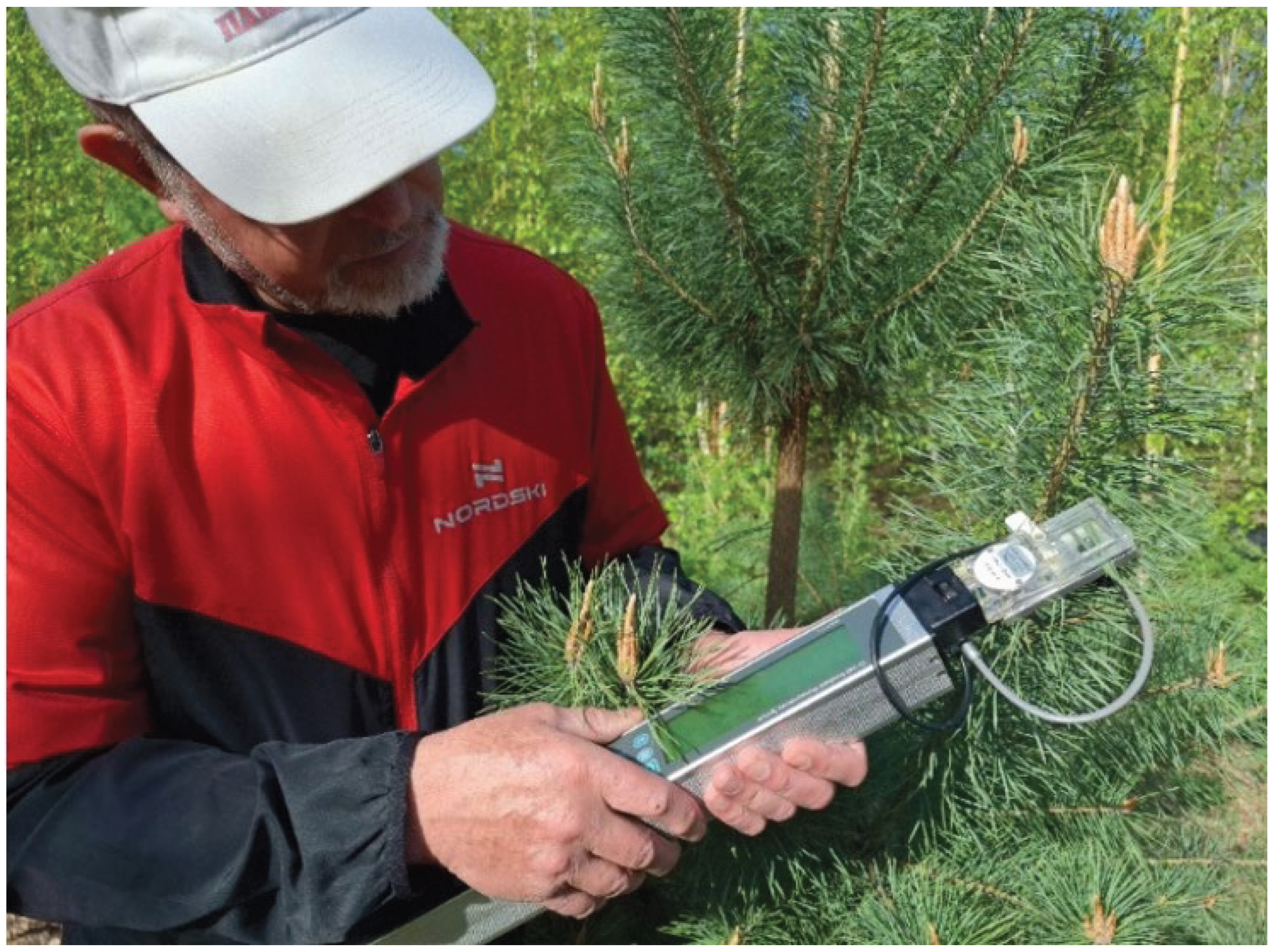
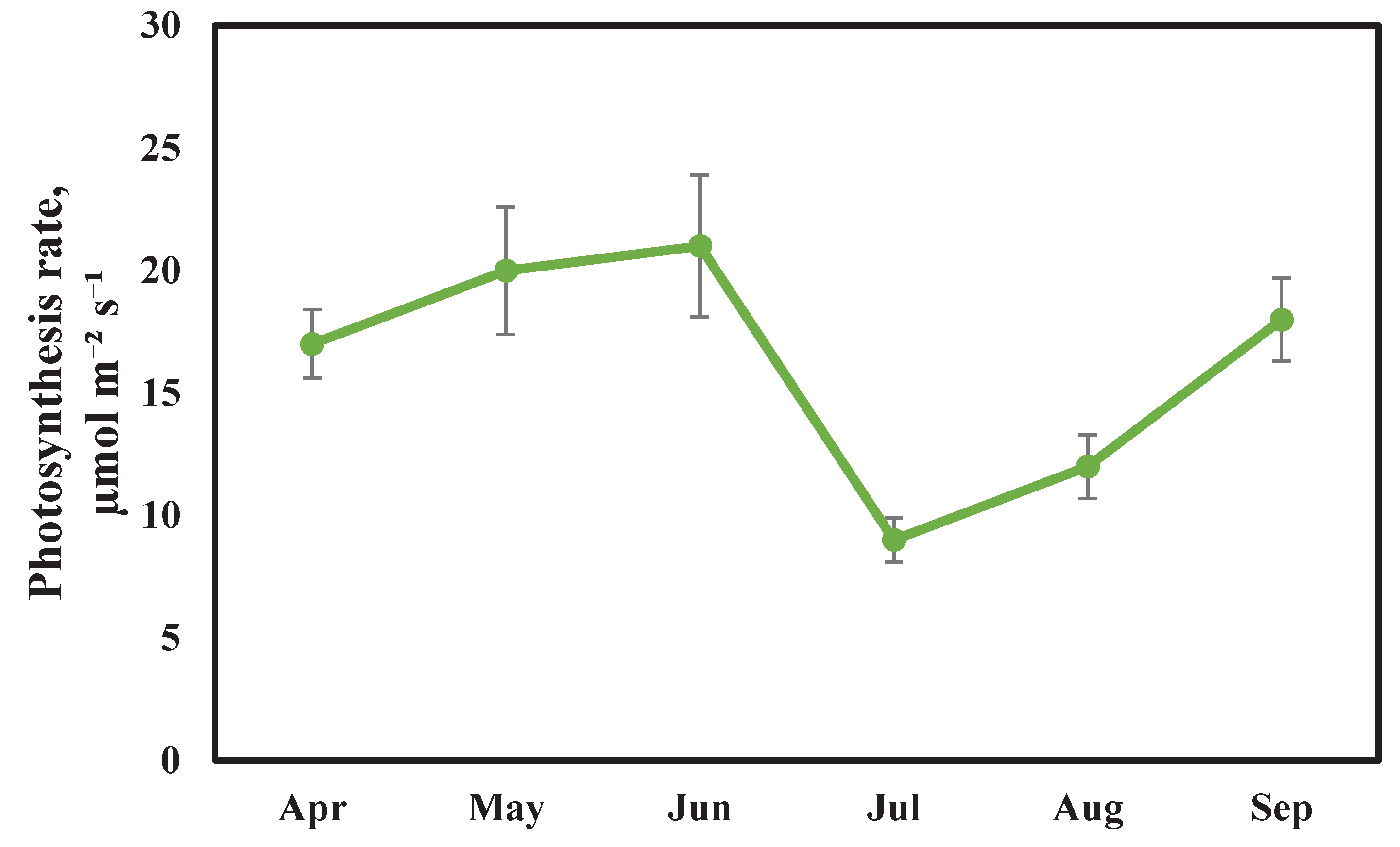
Conducting a comprehensive study of the photosynthesis aspects of the most common tree species will allow us to select the most promising species for afforestation and assess the contribution of the main forest-forming species to the absorption of carbon dioxide. This study investigates the seasonal dynamics of photosynthetic activity in Scots pine (Pinus sylvestris L.) needles in the central region of European Russia during the 2024 growing season. The research aimed to determine the dependence of photosynthesis intensity, transpiration, and stomatal conductance on meteorological conditions, such as temperature and irradiance. Measurements were carried out using a portable gas exchange system and meteorological station data, covering the growing season from April to September. The photosynthetic activity was found to exhibit a bimodal dynamic with peaks in June (20.8 μmol/m²/s) and September (18.0 μmol/m²/s), while the minimum value was observed in July during a drought period. The analysis of the results suggests a high adaptability of Scots pine to stressful conditions, attributed to the "drought memory" effect and the xeromorphic structure of the needles. The obtained data help to identify optimal conditions for reforestation activities and underscore the significant role of pine forests in the carbon balance of ecosystems.
Keywords:
1. Introduction
2. Materials and Methods
3. Results
4. Conclusions
Author Contributions
Funding
References
- K. Springer, P. Manning, A.L. Boesing et al., Identifying the stand properties that support both high biodiversity and carbon storage in German forests. For. Ecol. Manag. 572, 122328 (2024). [CrossRef]
- L. Alexander, S. Allen, N. Bindoff et al., Climate change 2013: The physical science basis, in Contribution of Working Group I to the Fifth Assessment Report of the Intergovernmental Panel on Climate Change, Cambridge University Press, Cambridge, United Kingdom and New York, NY, USA (2013).
- J.-F. Bastin et al., Erratum for the Report: "The global tree restoration potential" and for the Technical Response "Response to Comments on 'The global tree restoration potential'". Science 368, eabc8905 (2020). [CrossRef]
- Order of the Ministry of Science and Higher Education of the Russian Federation No. 74 of February 5, 2021 "On Testing Grounds for the Development and Testing of Carbon Balance Control Technologies", Official Internet Portal of Legal Information (2021), Retrieved October 7, 2025, from https://minobrnauki.gov.ru.
- E.A. Shvarts, A.O. Kokorin, A.V. Ptichnikov, A.N. Krenke, Cross-Border Carbon Regulation and Forests in Russia: From Expectations and Myth to Realization of Interests. Econ. Policy 17, 54 (2022). [CrossRef]
- E.O. Baksheeva, T.A. Matveeva, G.A. Ivanova, Fundamentals of Forestry, (SibSTU, Krasnoyarsk, 2016).
- C.I. Sazeides, A. Christopoulou, N.M. Fyllas, Coupling Photosynthetic Measurements with Biometric Data to Estimate Gross Primary Productivity (GPP) in Mediterranean Pine Forests of Different Post-Fire Age. Forests 12, 1256 (2021). [CrossRef]
- H. Dang, X. Zhang, H. Han, S. Chen, M. Li, Water Use by Chinese Pine Is Less Conservative but More Closely Regulated Than in Mongolian Scots Pine in a Plantation Forest, on Sandy Soil, in a Semi-Arid Climate. Front. Plant Sci. 12, 635022 (2021). [CrossRef]
- G.G. Suvorova, Conifer Photosynthesis in Siberian Conditions, (Akademicheskoe Izdatel'stvo Geo, Novosibirsk, 2009).
- G.G. Suvorova and E.V. Popova, Photosynthetic Productivity of Coniferous Forests in the Irkutsk Region, (Akademicheskoe Izdatel'stvo Geo, Novosibirsk, 2015).
- S. Trueba, G. Théroux-Rancourt, J.M. Earles, T.N. Buckley, D. Love, D.M. Johnson, C. Brodersen, The three-dimensional construction of leaves is coordinated with water use efficiency in conifers. New Phytol. 233, 851 (2022). [CrossRef]
- L.P. Rysin and L.I. Saveljeva, Pine Forests of Russia, (Rossiiskaya Akademiya Nauk, Moscow, 2008).
- L.V. Zarubina, R.S. Khamitov, Seasonal Growth of Scots Pine under the Conditions of Water-Logged Soils of the North. Les. Zh. [Russ. For. J.], 2021, no. 3, pp. 86-100.
- Y. Wang, J. Wang, R. Sarwal et al., Research progress on the physiological response and molecular mechanism of cold response in plants. Front. Plant Sci. 15, 1334913 (2024).
- R. Rehschuh, N.K. Ruehr, Diverging responses of water and carbon relations during and after heat and hot drought stress in Pinus sylvestris. Tree Physiol. 42, 1532 (2022).
- M. Lévesque, M. Saurer, R. Siegwolf et al., Drought response of five conifer species under contrasting water availability suggests high vulnerability of Norway spruce and European larch. Glob. Change Biol. 19, 3184 (2013).
- H.K. Lichtenthaler, A. Ač, M.V. Marek, J. Kalina, O. Urban, Differences in pigment composition, photosynthetic rates and chlorophyll fluorescence images of sun and shade leaves of four tree species. Plant Physiol. Biochem. 45, 577 (2007).
- G.E. Jackson, J. Irvine, J. Grace, Xylem cavitation in two mature Scots pine forests growing in a wet and a dry area of Britain. Plant Cell Environ. 18, 1411 (1995).
- R. Rehschuh, A. Cecilia, M. Zuber et al., Drought-induced xylem embolism limits the recovery of leaf gas exchange in Scots pine. Plant Physiol. 184, 852 (2020). [CrossRef]
- P.M. Evlakov, V.S. Ryzhkova, T.A. Grodatskaya, Assessment of carbon dioxide absorption in juvenile Scots pine (Pinus sylvestris L.). Lesotekh. Zh. [For. Eng. J.] 14, 22 (2024). [CrossRef]
- C.I. Sazeides, A. Christopoulou, N.M. Fyllas, Coupling photosynthetic measurements with biometric data to estimate gross primary productivity (GPP) in Mediterranean pine forests of different post-fire age. Forests 12, 1256 (2021).
- F.A. Guedes, P.E. Menezes-Silva, F.M. DaMatta, M. Alves-Ferreira, Using transcriptomics to assess plant stress memory. Theor. Exp. Plant Physiol. 31, 47 (2019).
- P.E. Menezes-Silva, L.M. Sanglard, R.T. Ávila et al., Photosynthetic and metabolic acclimation to repeated drought events play key roles in drought tolerance in coffee. J. Exp. Bot. 68, 4309 (2017).
- M.B. Abdallah, K. Methenni, I. Nouairi, M. Zarrouk, N.B. Youssef, Drought priming improves subsequent more severe drought in a drought-sensitive cultivar of olive cv. Chétoui. Sci. Hortic. 221, 43 (2017).

| Month |
Irradiance (PAR), µmol m⁻² s⁻¹ |
Leaf Temperature, °C |
Net Photosynthetic Rate, µmol m⁻² s⁻¹ |
Transpiration rate, mmol m⁻² s⁻¹ |
Stomatal conductance, mmol m⁻² s⁻¹ |
Water use efficiency (WUE) |
| Apr | 1465±184 | 26±1.4 | 17±1.4 | 3.1±0.21 | 205±24 | 5.5 |
| May | 1889±204 | 28±1.3 | 20±2.6 | 5.4±0.64 | 296±36 | 3.7 |
| Jun | 2230±261 | 31±1.9 | 21±2.9 | 7.0±0.91 | 331±39 | 3.0 |
| Jul | 1337±144 | 29±1.5 | 9±0.9 | 3.3±0.22 | 186±16 | 2.7 |
| Aug | 1280±136 | 36±1.5 | 12±1.3 | 4.1±0.34 | 73±11 | 2.9 |
| Sep | 1500±163 | 30±2.4 | 18±1.7 | 2.3±0.47 | 121±15 | 7.8 |
Disclaimer/Publisher’s Note: The statements, opinions and data contained in all publications are solely those of the individual author(s) and contributor(s) and not of MDPI and/or the editor(s). MDPI and/or the editor(s) disclaim responsibility for any injury to people or property resulting from any ideas, methods, instructions or products referred to in the content. |
© 2026 by the authors. Licensee MDPI, Basel, Switzerland. This article is an open access article distributed under the terms and conditions of the Creative Commons Attribution (CC BY) license.


