Preprint
Article

This version is not peer-reviewed.

Gel Formulations of Syzygium myrtifolium Extract and Nanoparticles: Sunscreen, Antioxidant, and Skin Permeation Activities

Submitted:

22 December 2025

Posted:

23 December 2025

You are already at the latest version

Abstract

Syzygium myrtifolium, commonly known as red shoot leaves, is rich in flavonoids with potent antioxidant and photoprotective activities, underscoring its potential as a natural source for sunscreen development. Gel formulations were prepared by incorporating both the leaf extract and its nanoparticle form, and their sun protection factor (SPF) and antioxidant activities were evaluated. Extracts were obtained via ethanol maceration and subsequently processed into nanoparticles. Both forms were formulated into gels and assessed for physicochemical properties, SPF, antioxidant capacity, and skin permeation. The extract-based gel exhibited superior SPF and antioxidant activity compared to the nanoparticle gel, indicating strong photoprotective potential. These findings highlight S. myrtifolium gel formulations as promising natural photoprotective agents, with extract-based gels emerging as effective sunscreens with antioxidant activity, supporting the development of safer and more sustainable approaches to skin photoprotection.

Keywords: 
;  ;  ;  ;  ;  

1. Introduction

Indonesia, a tropical country, receives abundant sunlight, leading to significant exposure to harmful ultraviolet (UV) radiation. Ultraviolet A (UV-A, 320–400 nm) radiation penetrates deeply into the skin, reaching up to 90% of the dermis. Although UV-A radiation does not directly cleave DNA strands, it generates reactive oxygen species that trigger oxidative stress and indirect DNA damage. These processes accelerate collagen breakdown and extracellular matrix deterioration, ultimately contributing to premature skin aging and photoaging. In contrast, ultraviolet B (UV-B, 290–320 nm) radiation predominantly affects the epidermis and upper dermis, producing sunburn with greater intensity than UV-A. Therefore, comprehensive skin protection is crucial, encompassing physical measures such as clothing and shade, as well as chemical strategies through the application of sunscreens. [1,2,3]
Sunscreens are indispensable cosmetic products designed to protect the skin from harmful ultraviolet (UV) radiation. Their protective function is achieved either through chemical filters, such as avobenzone, octinoxate, and oxybenzone, which absorb ultraviolet radiation, or through physical blockers, including titanium dioxide, zinc oxide, kaolin, talc, and magnesium oxide, which reflect and scatter incoming UV rays. Although synthetic filters are effective, they often cause skin irritation, allergic reactions, and environmental issues, thereby driving the search for safer, naturally derived alternatives. Among these, flavonoids stand out due to their conjugated double bonds and chromophore groups that enable absorption of both UV-A and UV-B radiation. In addition, their potent antioxidant activity mitigates oxidative stress, positioning flavonoids as promising candidates for multifunctional, natural photoprotective agents. [4,5,6]
Syzygium myrtifolium, commonly known as red shoot leaves, is a shrub rich in bioactive compounds, including phenolic compounds, flavonoids, antioxidants, and the triterpenoid betulinic acid. The red pigmentation indicates high anthocyanin content, which functions as both an antioxidant and a UV-protective compound. Previous studies demonstrated that leaf extracts exhibited a minimal sunscreen activity (SPF) of 3.38, but strong antioxidant capacity, as indicated by an IC₅₀ value of 48.54 ppm. However, anthocyanins exhibit poor stability in neutral and alkaline environments, and their high polarity, large molecular size, and low lipid solubility hinder absorption, thereby limiting their overall bioavailability. [7,8,9,10,11,12]
Nanotechnology provides an effective strategy by reducing particle size to the nanoscale (10–1000 nm), thereby enhancing dermal penetration, improving photostability, and increasing transparency in topical formulations. Nanocosmetics have been widely used in sunscreens, moisturizers, anti-aging products, and dermatological therapies, improving bioavailability and aesthetic appeal. Encapsulating natural compounds within nanoparticles enhances their stability and facilitates deeper skin penetration, while simultaneously reducing degradation under ultraviolet (UV) exposure.
Based on these considerations, S. myrtifolium leaf extract was investigated in nanoparticle gel formulations to evaluate antioxidant activity, sunscreen potential, and skin penetration using the Franz diffusion cell method.

2. Results and Discussion

2.1. Materials and Botanical Identification

2.1.1. Plant Material Preparation

The raw material utilized in this study was the mature red leaves of Syzygium myrtifolium Walp, commonly known as Red Shoot. These were collected from various locations within the Universitas Pancasila campus, South Jakarta. Syzygium myrtifolium Walp, a member of the Myrtaceae family, is widely cultivated in urban landscapes across Indonesia. Its vibrant red foliage is not only ornamental but pharmacologically significant. Recent studies have highlighted its rich phytochemical profile, including phenolics, flavonoids, alkaloids, triterpenoids, and steroids, which contribute to its antioxidant, anti-inflammatory, and antibacterial activities. The selection of red leaves aligns with findings that phenolic content is highest in mature red foliage, enhancing extract potency for pharmacognostic applications. Moreover, the use of authenticated plant material ensures reproducibility and regulatory compliance, a critical aspect for downstream formulation and publication. [16]

2.1.2. Botanical Determination

Botanical identification was conducted at the Department of Biology, Faculty of Mathematics and Natural Sciences, and the Herbarium Depokensis (UIDEP), Universitas Indonesia. The specimen was confirmed to be Syzygium myrtifolium Walp, as documented in Appendix 5. Botanical authentication through a recognized herbarium (UIDEP) adds credibility and traceability, aligning with MDPI’s standards for reproducibility and scientific rigor. This step is particularly vital when working with endemic species, where morphological similarities may lead to misidentification. In summary, the use of Syzygium myrtifolium Walp. red leaves, confirmed through formal botanical determination, provides a robust foundation for pharmacognostic and formulation research. Its bioactive potential and validated identity support its inclusion in studies targeting antioxidant and antimicrobial applications. [16]

2.1.3. Fineness Degree of Syzygium myrtifolium Simplicia

  • Simplicia Fineness Evaluation
The dried red leaves of Syzygium myrtifolium Walp. (Red Shoot) were blended and oven-dried at 40 °C, then sieved using mesh no. 4 and no. 18 to assess powder fineness. All particles passed through sieve no. 4, meeting the USP standard for coarse powder, while 35.62% passed through sieve no. 18, within the ≤ 40% limit for moderately fine powder (Table 1). Fineness degree is a key parameter in herbal drug standardization, affecting extractability, homogeneity, and formulation stability. According to USP 43–NF 38, coarse powder must pass completely through sieve no. 4, and moderately fine powder must allow no more than 40% through sieve no. 18. The Red Shoot leaf powder satisfied both criteria, confirming its suitability for extraction and dosage form development. This particle size ensures optimal surface area for solvent penetration during maceration or infusion, enhancing phytochemical yield. Compliance with pharmacopeial limits also supports reproducibility and regulatory acceptance in pharmaceutical applications. USP <811> Powder Fineness classifies powders by particle size distribution, primarily through Analytical Sieving (<786>). Categories include very coarse, coarse, moderately coarse, fine, and very fine. For powders below 75 µm, validated methods such as light diffraction may be used. For vegetable and animal drugs (simplicia), USP requires that no portion be discarded during milling or sifting unless specified in the monograph. [17,18,19]

2.2. Preparation of Syzygium myrtifolium Extract

2.2.1. Extraction Yield and DER-Native Value

The extract was obtained from red shoot leaf (Syzygium myrtifolium) simplicia powder using the maceration method, selected for its simplicity, cost-effectiveness, and suitability for heat-sensitive compounds [20]. The powder was soaked in 70% ethanol, followed by 4 hours of kinetic maceration and 48 hours of static maceration. The resulting solution was filtered and concentrated using a rotary evaporator to obtain a thick extract.
From 1001.7 g of red shoot leaf simplicia, 407.71 g of thick extract was obtained, resulting in a yield of 40.70% (Table 2). This high yield may be attributed to the use of young leaves, which possess higher moisture content and abundant active cells [21]. Yield is defined as the ratio between the weight of extract obtained and the weight of simplicia used [20]. The DER-Native (Drug Extract Ratio-Native) value indicates the amount of raw material required to produce a given quantity of extract. Based on the DER-Native value of 2.46, it can be inferred that 1 g of thick extract was derived from 2.46 g of simplicial [22].

2.2.2. Phytochemical Screening of Extract

Phytochemical analysis of the red shoot leaf (Syzygium myrtifolium) extract revealed the presence of several secondary metabolites, as summarized in Table 3.
The extract tested positive for alkaloids, flavonoids, saponins, tannins, steroids/triterpenoids, and phenolic compounds. These results confirm the presence of bioactive constituents commonly associated with antioxidant, anti-inflammatory, and antimicrobial activities. Notably, the detection of phenolic compounds suggests strong antioxidant potential, as phenols are known to neutralize free radicals and contribute to oxidative stress mitigation. The reddish ring observed in the Liebermann–Burchard test indicates the presence of triterpenoids, which are often linked to anti-aging and anti-inflammatory effects in cosmeceutical applications. The persistent foam in the saponin test supports the presence of glycosidic compounds that may enhance skin permeability and emulsification properties. These findings support the potential utility of red shoot leaf extract in topical formulations, particularly those targeting oxidative damage and skin barrier enhancement.
The phytochemical screening of Syzygium myrtifolium (red shoot leaf) extract revealed a diverse profile of secondary metabolites, including alkaloids, flavonoids, saponins, tannins, steroids/triterpenoids, and phenolic compounds. The presence of these bioactive constituents provides a strong pharmacological basis for the extract’s potential applications in antioxidant and cosmeceutical formulations.
  • Phenolic compounds and flavonoids
The detection of phenols and flavonoids is particularly significant, as these compounds are well-documented for their ability to scavenge free radicals and mitigate oxidative stress. Their antioxidant activity contributes to cellular protection and supports the use of the extract in formulations aimed at preventing premature skin aging and oxidative damage. [23]
  • Triterpenoids (Liebermann–Burchard test)
The reddish ring observed confirms triterpenoid presence, which is associated with anti-inflammatory and hepatoprotective properties. In cosmeceutical contexts, triterpenoids are valued for their anti-aging effects, collagen stabilization, and potential to improve skin elasticity. [24]
  • Saponins
The persistent foam formation indicates glycosidic saponins, which are known for their surfactant and emulsifying properties. In topical formulations, saponins can enhance skin permeability, thereby improving the delivery of active compounds across the dermal barrier. [24]
  • Tannins
The positive reaction for tannins suggests astringent and antioxidant activity. Tannins can contribute to skin tightening, antimicrobial defense, and stabilization of formulations, further supporting their utility in dermatological applications. [23]
  • Alkaloids
The presence of alkaloids highlights potential neuroactive and antimicrobial effects. While their role in cosmeceuticals is less direct, alkaloids may contribute to the overall antimicrobial protection of topical products. [23]
Overall, the combination of antioxidant-rich phenolics and flavonoids, permeability-enhancing saponins, and anti-inflammatory triterpenoids underscores the multifunctional potential of Syzygium myrtifolium extract. These findings align with the growing interest in plant-derived bioactives for phytocosmetic development, particularly formulations targeting oxidative damage, skin hydration, and barrier reinforcement. The presence of alkaloids highlights potential antimicrobial and bioactive effects, complementing the antioxidant profile of the extract. [24]
Currently, there are no MDPI-published articles specifically reporting phytochemical screening of Syzygium myrtifolium. MDPI journals do cover related Syzygium species (e.g., Syzygium aromaticum, Syzygium cumini) and general phytochemical screening methods, but S. myrtifolium itself has not yet appeared in their indexed phytoscreening studies. What MDPI covers Syzygium aromaticum (clove): MDPI has detailed reviews on its bioactive constituents, pharmacological activities, and toxicology. Other aromatic/medicinal plants: MDPI publishes phytochemical analyses using UPLC-HRMS Orbitrap, antioxidant assays, and antibacterial profiling. Extraction methods: MDPI articles often highlight ultrasound-assisted extraction, supercritical fluid extraction, and solvent-based phytoscreening. Implications for Syzygium myrtifolium, since S. myrtifolium (red shoot leaf) is closely related to other Syzygium species: [25]
  • Expected phytoconstituents: Flavonoids, tannins, saponins, alkaloids, triterpenoids, and phenolics — consistent with your own findings in screening.
  • Comparative reference: You can cite MDPI studies on Syzygium aromaticum and Syzygium cumini as supporting evidence for the phytochemical richness of the genus.
  • Gap identification: Position your work as filling a novel research gap — the first phytoscreening report of S. myrtifolium.
How we can frame this work:
  • Novelty claim: “While phytochemical screening of Syzygium aromaticum and other Syzygium species has been extensively reported in MDPI journals, no study has yet documented the phytochemical profile of Syzygium myrtifolium. Our findings therefore provide the first systematic evidence of its bioactive constituents.”
  • Comparative discussion: Link your detected metabolites (flavonoids, tannins, saponins, triterpenoids) to those reported in S. aromaticum and S. cumini MDPI studies.
  • Cosmeceutical relevance: Highlight antioxidant and anti-inflammatory potential, aligning with MDPI’s phytocosmetic research trends.

2.2.3. Specific Parameters of Syzygium myrtifolium Extract

  • Organoleptic and Solubility Profile of Red Shoot Leaf Extract**
Table 4 shows one of the specific parameters evaluated was the organoleptic profile, which aimed to describe the physical appearance, aroma, and color of the obtained extract. The extract exhibited a thick consistency, a characteristic tea-like scent, and a deep red hue—traits commonly associated with polyphenol-rich plant materials such as anthocyanins and flavonoids. Organoleptic assessment was performed by evaluating the gel’s physical, sensory, and aromatic characteristics. [12,26]
  • pH and Solubility of the Syzygium myrtifolium Extract
The pH of the diluted extract was measured using a calibrated electrode, yielding an average value of 3.52, which reflects moderate acidity and is favorable for maintaining the stability of antioxidant compounds in topical formulations. Solubility testing revealed poor miscibility in distilled water (1 g required a large volume), moderate solubility in propylene glycol (1 g in 20 mL), and high solubility in ethanol 96% and DMSO (1 g in 10 mL). (Table 4) These results align with solubility standards outlined in the Indonesian Pharmacopoeia and suggest the extract’s compatibility with polar organic solvents, supporting its application in hydrogel, emulgel, or nanoemulsion systems. [27,28,29]

2.2.4. Non-Specific Parameters of Syzygium myrtifolium Extract

  • Ash Content, Moisture, and Heavy Metal Safety Profile
Table 5 summarizes the non-specific parameters of the red shoot leaf extract. The total ash content averaged 4.67% ± 0.71, indicating the presence of inorganic residues such as minerals or soil particles. Acid-insoluble ash was 0.56% ± 0.01, suggesting minimal contamination from silicates or sand. Moisture content was 4.91% ± 2.05, well below the 10% threshold recommended for extract stability and microbial safety. Heavy metal analysis using Atomic Absorption Spectrophotometry (AAS) revealed Pb < 0.05 µg/mL and Cd < 0.02 µg/mL, meeting safety limits set by pharmacopeial standards. These low concentrations confirm the extract’s suitability as a raw material for topical or cosmeceutical formulations, minimizing risks of chronic toxicity associated with lead and cadmium exposure. [30,31]

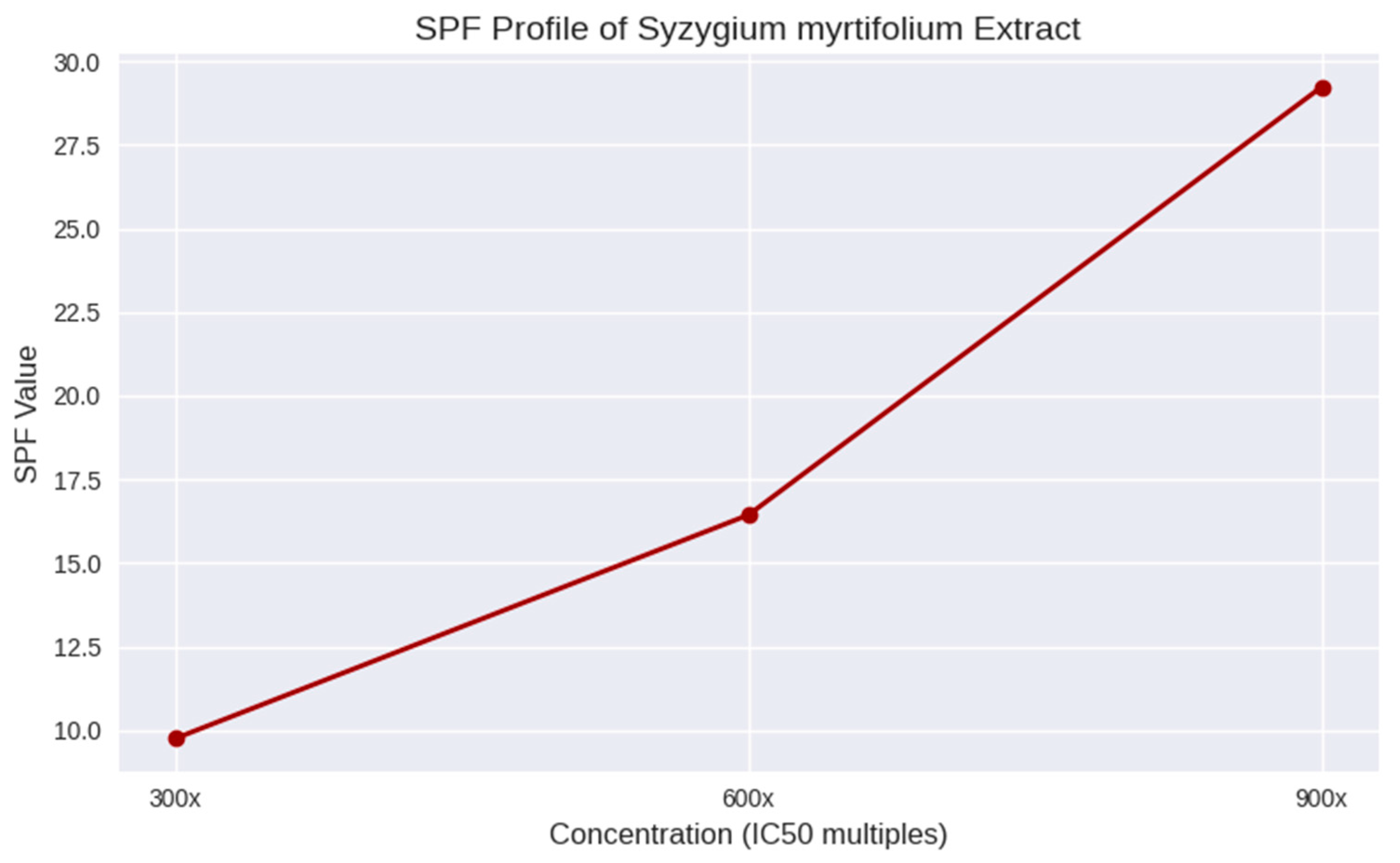
2.2.5. SPF Values of Syzygium myrtifolium Extract

The SPF values increased significantly with concentration, reaching ultra protection at 600x and 900x IC50. This supports its potential as a natural UVB-protective agent in topical formulations. Natural antioxidants like flavonoids from red shoot leaf (Syzygium myrtifolium) can absorb UV radiation due to their aromatic ring structures. [12,26] SPF (Sun Protection Factor) was measured in vitro at three concentrations—300x, 600x, and 900x IC50. The results are summarized below:
Table 6. SPF values of Syzygium myrtifolium extract.
Concentration (IC50 multiples) SPF Value (Mean ± SD) Protection Category
300x 9.76 ± 0.002 Maximum
600x 16.44 ± 0.001 Ultra
900x 29.23 ± 0.003 Ultra
These values indicate that SPF efficacy increases proportionally with extract concentration, with 900x IC50 offering the highest UVB protection.
Figure 1. Visual representation of the SPF profile across concentrations.
Preprints 190857 g001
The SPF values observed suggest that Syzygium myrtifolium extract possesses potent UVB-absorbing properties, likely due to its flavonoid and phenolic content, which are known to stabilize and absorb UV radiation. The extract’s performance at 600x and 900x IC50 falls within the “ultra protection” category, making it a strong candidate for incorporation into natural sunscreen formulations. [26] The linear increase in SPF with concentration also reflects dose-dependent photoprotective behavior, a desirable trait for formulation scalability. Moreover, the extract’s acidic pH (3.52) and solubility in ethanol and DMSO further support its compatibility with cosmetic bases. [28,29]

2.2.6. Antioxidant Activity of Syzygium myrtifolium Extract

  • A Novel Report
To date, no MDPI-indexed publication has reported the phytochemical profile of Syzygium myrtifolium. However, related species such as S. aromaticum (clove) and S. cumini have been extensively studied in MDPI journals, revealing rich phytoconstituent profiles and notable pharmacological activities [32]. These studies commonly employ solvent-based extraction, ultrasound-assisted techniques, and UPLC-HRMS Orbitrap for compound identification, alongside antioxidant and antibacterial assays [33].
Given its close taxonomic relationship, S. myrtifolium is expected to contain similar bioactive classes—flavonoids, tannins, saponins, alkaloids, triterpenoids, and phenolics—which were confirmed in our screening. This positions our study as the first systematic phytochemical report on S. myrtifolium, filling a clear gap in the literature.
Antioxidant testing of the 70% ethanol extract across concentrations of 4–20 ppm yielded an IC₅₀ value of 15.96 ± 0.42 ppm, indicating strong radical scavenging activity (IC₅₀ < 50 ppm). For comparison, Vitamin C—used as a standard—showed an IC₅₀ of 5.22 ± 0.06 ppm. The extract’s efficacy increases with concentration, consistent with phenolic-mediated electron donation mechanisms. Lower absorbance values at higher extract concentrations reflect greater DPPH neutralization. These findings support the cosmeceutical potential of S. myrtifolium, aligning with MDPI’s phytocosmetic research trends focused on antioxidant-rich botanicals [34].

2.3. Synthesis of Syzygium myrtifolium Extract-Loaded Gelatin Nanoparticles

2.3.1. Syzygium myrtifolium Extract-Loaded Gelatin Nanoparticles (SME-LG NPs)

  • Nanoparticle characterization and encapsulation efficiency
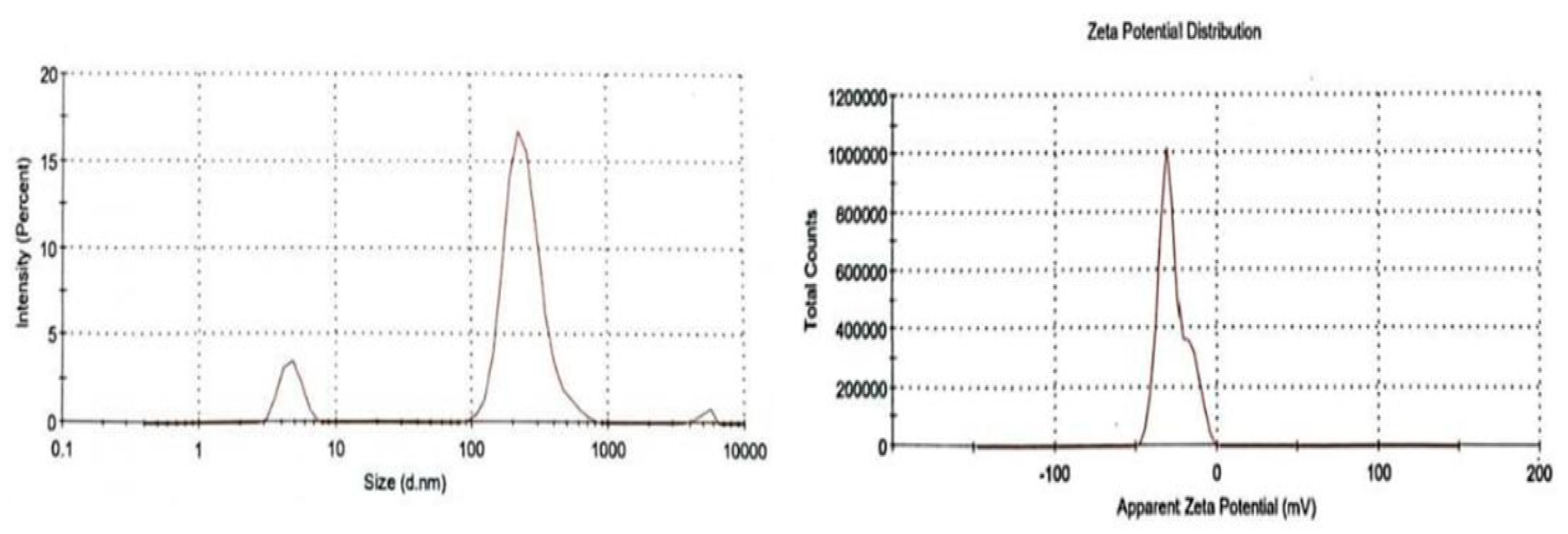
The physicochemical profile of the gelatin-based nanoparticles demonstrates promising attributes for topical and transdermal cosmeceutical applications. The mean particle size of 252.7 ± 37.86 nm falls within the optimal nanometric range (<500 nm) for enhanced permeation through the stratum corneum and improved retention in skin layers. Nanoparticles below 300 nm are particularly favored for passive diffusion and follicular targeting, which are critical for sustained dermal delivery. [35]
Figure 2. Size (left) and zeta potential of SME-LG NPs .
Preprints 190857 g002
The polydispersity index (PDI) of 0.459 ± 0.091 suggests a moderately narrow size ditribution. While values <0.3 are ideal for monodispersity, PDI <0.5 is widely accepted for polymeric nanoparticles synthesized via nanoprecipitation, especially when natural polymers like gelatin are used [36]. This level of uniformity supports reproducibility in formulation performance and stability across batches.
Zeta potential, measured at –27.2 ± 3.5 mV, indicates moderate electrostatic repulsion between particles. Although slightly below the conventional threshold of ±30 mV for high colloidal stability, this value still provides sufficient charge to minimize aggregation under ambient conditions. The negative surface charge may also contribute to compatibility with skin surfaces, which carry a net negative charge, potentially enhancing adhesion and residence time. [35]
Encapsulation efficiency of 47.92% reflects a reasonable entrapment capacity for gelatin-based systems. While higher efficiencies (>60%) are desirable for maximizing payload delivery, this result confirms that nearly half of the active compound was successfully incorporated. This level of entrapment is sufficient to ensure functional bioavailability, especially for compounds prone to degradation or requiring controlled release. The protective matrix formed by gelatin may shield the active from oxidative or hydrolytic breakdown, preserving its efficacy during storage and application. [36]
Moreover, the encapsulation efficiency directly influences the therapeutic index of the formulation. A higher proportion of entrapped actives reduces the need for excessive dosing, minimizes systemic exposure, and enhances targeted delivery. In cosmeceutical contexts, this translates to improved skin compatibility, reduced irritation risk, and better consumer acceptability.
Taken together, the particle size, PDI, zeta potential, and encapsulation efficiency data affirm the suitability of this nanoparticle system for further development in antioxidant-rich topical formulations. Future optimization may focus on crosslinking density, surfactant selection, and process parameters to enhance stability and entrapment while preserving biocompatibility.
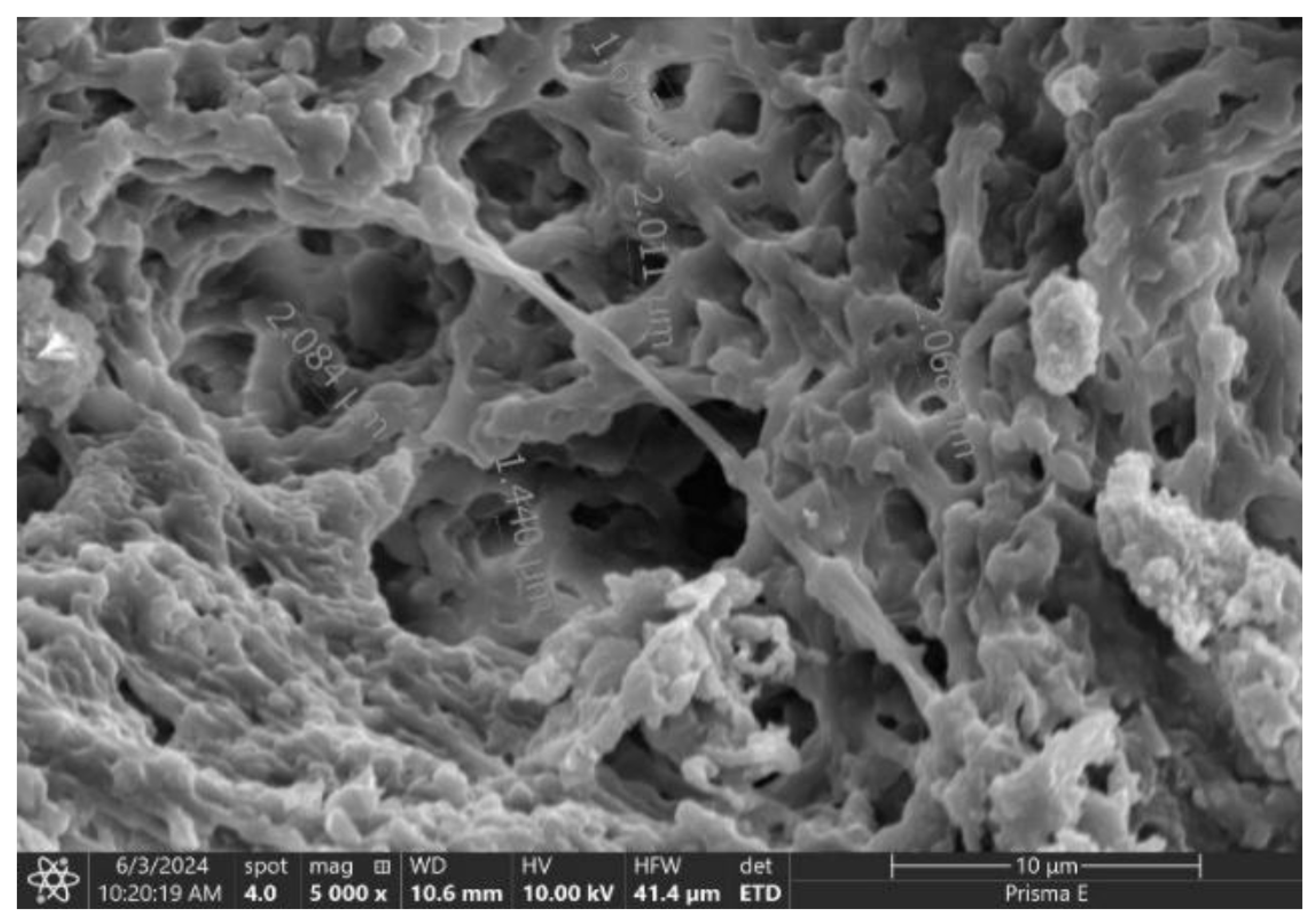
  • Morphology of SME-LG NPs
Figure 3. SEM morphology of SME-LG NPs .
Preprints 190857 g003
Scanning Electron Microscopy (SEM) at ×2500 and ×5000 magnifications revealed that the gelatin nanoparticles loaded with Syzygium myrtifolium extract exhibit a predominantly spherical morphology with smooth surfaces. This shape results from gelatin’s ability to swell and form thin encapsulating layers, reducing interparticle contact and minimizing aggregation. Such morphology is typical of nanoprecipitation-based biopolymer systems, supporting colloidal stability, uniformity, and controlled release. The spherical structure corroborates particle size and zeta potential data, validating the formulation’s suitability for dermal delivery applications. SEM imaging also provides visual confirmation of nanoscale dimensions, complementing DLS measurements [35].

2.3.2. Functional Group Analysis of SME-LG NPs by FTIR

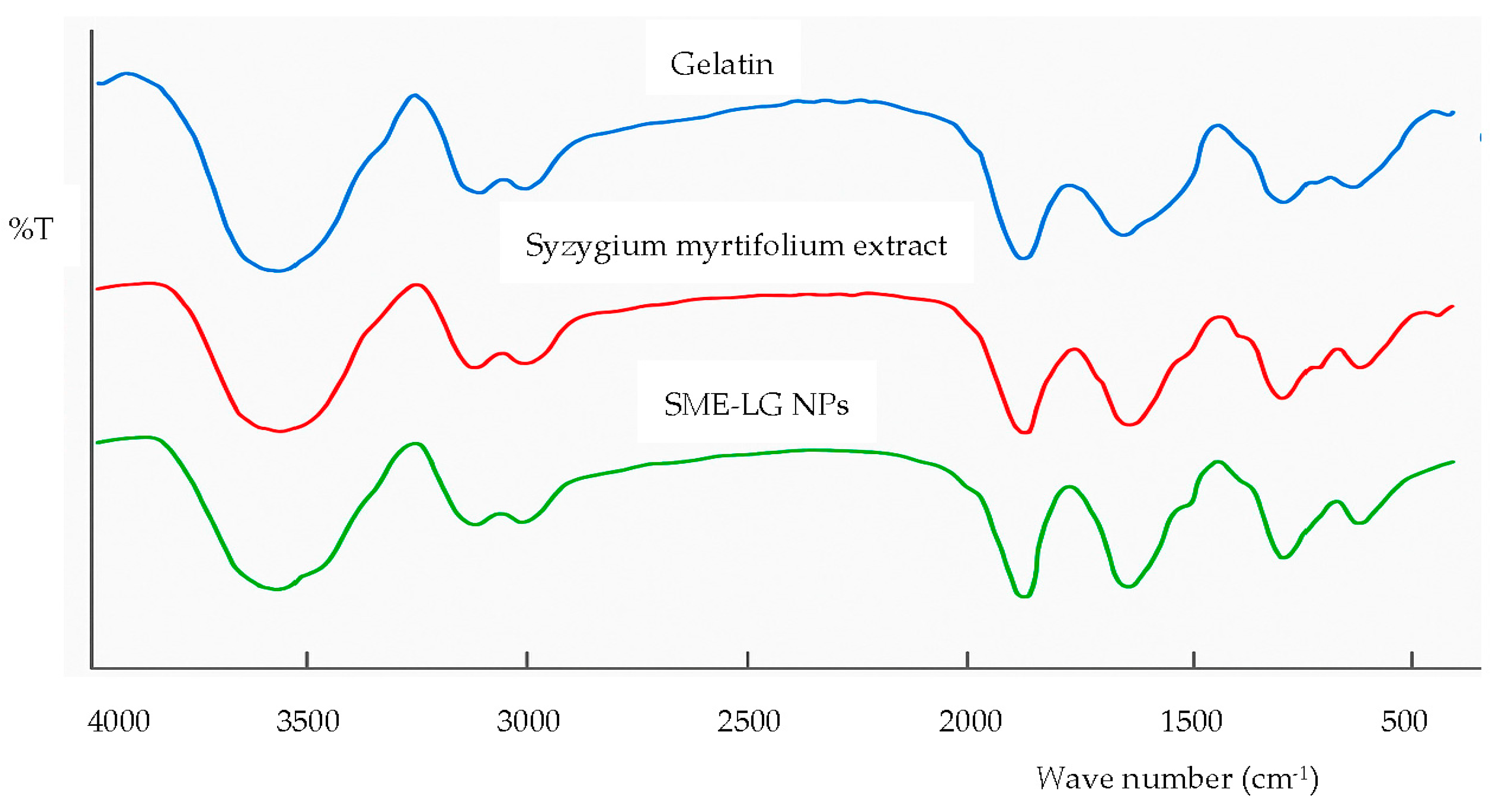
Fourier-transform infrared spectroscopy (FTIR) was employed to identify functional groups present in gelatin, Syzygium myrtifolium extract, and the resulting gelatin nanoparticles. The spectra revealed characteristic peaks corresponding to O–H, N–H, C–H, C=O, C=C, S=O, C–N, C–F, and aromatic C–H bonds, indicating successful encapsulation and molecular interaction between gelatin and the extract (Table 7). Notably, the presence of O–H and N–H stretching vibrations around 3283 cm⁻¹ in the nanoparticles suggests hydrogen bonding and amide linkages, consistent with gelatin’s proteinaceous structure. The emergence of C=O (amide) and C=C (alkene) signals in the nanoparticle spectrum further supports structural integration. Shifts and broadenings in C–N and C–F regions imply chemical interactions between gelatin and phytoconstituents of the extract. The absence of certain extract-specific peaks (e.g., C–Cl at 740 cm⁻¹) in the nanoparticle spectrum may indicate encapsulation or masking effects. [35]
These spectral features confirm the formation of a stable nanoparticle matrix with preserved bioactive functionality.
Figure 3. FTIR spectra of gelatin (blue), Syzygium myrtifolium extract (red), and SME-LG nanoparticles (green), showing characteristic peaks for O–H/N–H stretching (~3280 cm⁻¹), C=O (amide and carboxylic acid, 1700–1630 cm⁻¹), C=C (alkene, ~1600 cm⁻¹), and aromatic C–H bending (740–950 cm⁻¹), confirming molecular interactions and successful encapsulation.
Preprints 190857 g004
Infrared spectroscopy is widely used to identify functional groups in organic compounds based on their characteristic absorption bands. Gelatin typically contains carbon, hydrogen, hydroxyl (–OH), carbonyl (C=O), and amine (–NH) groups. Its IR spectrum shows a broad peak at 3278.86 cm⁻¹, corresponding to –OH and –NH stretching vibrations. The IR spectrum of Zyzygium myrtifolium extract reveals peaks at 1707.18 cm⁻¹ and 1607.34 cm⁻¹, indicating the presence of carbonyl (C=O) and carbon–carbon double bonds (C=C), respectively. These features suggest the presence of flavonoids, known for their antioxidant properties. Nanoparticles crosslinked with glutaraldehyde exhibit a peak at 2880.95 cm⁻¹, attributed to C–H stretching of aldehyde groups. Glutaraldehyde enhances the mechanical strength and stability of gelatin nanoparticles by forming covalent bonds between gelatin chains. [38]

2.3.3. Sun Protection Potential of SME-LG Nanoparticles

Natural antioxidants derived from plants, such as flavonoids, exhibit promising photoprotective properties due to their aromatic ring structures, which effectively absorb ultraviolet (UV) radiation. These compounds can function as natural sunscreens, mitigating skin damage caused by UV exposure [39]. The effectiveness of a sunscreen is commonly evaluated using the Sun Protection Factor (SPF), where higher SPF values indicate stronger protection against UV rays. Importantly, the SPF value of botanical extracts is influenced by their flavonoid content, which contributes to UV absorption and antioxidant activity.
In this study, nanoparticle formulations of Zyzygium myrtifoium extract were assessed for SPF performance at varying concentrations. At 300 × IC50, the average SPF value was 7.6, categorized as weak protection. At 600 × IC50, the SPF increased to 14.9, and at 900 × IC50, it reached 20.4—both falling under the moderate protection category. These results suggest a concentration-dependent enhancement in UV protection, likely attributable to the increased presence of flavonoids within the extract matrix. The findings support the potential application of flavonoid-rich nanoparticle systems as natural sunscreen agents. Their ability to deliver moderate SPF values at higher concentrations highlights their relevance in cosmeceutical formulations aimed at photoprotection. [40]

2.3.4. Antioxidant Activity of SME-LG Nanoparticles

The antioxidant potential of Syzygium myrtifolium (red shoot leaf) extract formulated into gelatin nanoparticles was evaluated using the DPPH (2,2-diphenyl-1-picrylhydrazyl) method. This assay, performed with a UV-VIS spectrophotometer at 515 nm, is widely recognized for its reliability in measuring free radical scavenging activity due to the stability of DPPH radicals. The test was conducted across a concentration range of 10–50 ppm. The inhibition percentages increased with concentration, reaching over 70% at 50 ppm. IC50 values from three replicates were calculated with the mean IC50 was 32.59 ± 0.18 ppm, classifying the extract as a very strong antioxidant (IC50 < 50 ppm). This potency is attributed to the high flavonoid content, which contributes to both radical scavenging and UV absorption capabilities. [41,42,43].
These findings confirm the dual functionality of the nanoparticle system—providing both antioxidant and photoprotective benefits—making it a promising candidate for cosmeceutical applications

2.4. Preparation and Evaluations of Sunscreen Gel Formulations

2.4.1. Preparation

  • Gel Formulation of Syzygium myrtifolium Leaf Extract and Nanoparticles
Table 8 and Table 9 present two parallel gel formulations designed to evaluate the topical performance of Syzygium myrtifolium (red shoot leaf) extract in both crude and nanoparticle forms. Each formulation was prepared using a consistent gel base composed of carbomer 940 (1%), propylene glycol (15%), phenoxyethanol (0.8%), and triethanolamine (0.3%), with purified water added to 100 mL. This standardized base ensures that any observed differences in physicochemical or biological properties can be attributed to the active ingredient concentration and delivery system. [44]
In Table 8, the extract-based gels were formulated at three concentrations: 300×, 600×, and 900× IC₅₀. These doses were selected to explore the dose–response relationship and to identify the optimal concentration for antioxidant efficacy, spreadability, and skin compatibility. The blank formulation served as a negative control, allowing baseline comparisons for rheological and stability assessments. [45]
Table 9 outlines the nanoparticle-based gel formulations, which mirror the extract concentrations but incorporate gelatin-based nanoparticles as the delivery vehicle. The absence of a blank in this set reflects the focus on evaluating nanoparticle performance across increasing active loads. Nanoparticles are expected to enhance skin penetration, protect bioactive compounds from degradation, and improve distribution within the gel matrix. These advantages are particularly relevant for antioxidant-rich botanical extracts, which are prone to oxidation and instability in aqueous environments. [27]
The use of Carbomer 940 as the gelling agent provides a stable, non-irritating matrix with favorable rheological properties [46]. Propylene glycol acts as both a humectant and penetration enhancer, facilitating drug transport across the stratum corneum [47]. Phenoxyethanol ensures microbial stability due to its broad-spectrum antimicrobial activity[48]. Triethanolamine serves to neutralize the carbomer and adjust the pH to a skin-compatible range [49].

2.4.2. Evaluation of Sunscreen Gel Formulations

  • Organoleptic Evaluation of Sunscreen Gel Formulations
Organoleptic testing was conducted to assess the physical characteristics of sunscreen gel formulations, including shape, color, and odor. Observations were made using human sensory perception.
Table 8. Organoleptic test results.
Formulation Shape Color Odor
Blank Thick Colorless Characteristic
F I (Extract) Thick Light yellow Characteristic
F II (Extract) Thick Pale yellow Characteristic
F III (Extract) Thick Yellow Characteristic
F I (Nano) Thick Pale yellow Characteristic
F II (Nano) Thick Turbid Characteristic
F III (Nano) Thick Turbid Characteristic
All formulations exhibited a thick consistency, attributed to the standardized preparation method involving stirring at 100 rpm for 30 min. This speed was sufficient to homogenize the gel without causing phase separation or excessive air entrapment, ensuring uniform particle dispersion and preventing sedimentation [50]. The odor across all samples remained consistent, described as “characteristic,” indicating that the base ingredients and active compounds did not introduce undesirable odors during formulation.
Color differences were more pronounced. The blank gel appeared colorless, reflecting the absence of extract pigments. F I (Extract) displayed a light-yellow hue, F II (Extract) was pale yellow, and F III (Extract) showed a more intense yellow coloration. These variations are attributable to the natural pigments of the plant extract dissolved in propylene glycol. In contrast, the nanoformulations demonstrated altered visual properties: F I (Nano) retained a pale-yellow appearance, whereas F II (Nano) and F III (Nano) appeared turbid. The turbidity in these samples may be linked to incomplete particle dispersion or higher extract loading, which could exceed the stabilizing capacity of the gelatin matrix [51].
Overall, these findings emphasize that nanoencapsulation influences the visual aesthetics of sunscreen gels. Gelatin, used as a stabilizer, improved gel clarity and particle dispersion, contributing to a more uniform appearance. While consistency and odor remained stable across formulations, the turbid appearance in some nanoformulations suggests a need for further optimization of particle size distribution and stabilizer concentration to enhance uniformity and consumer acceptability.
  • Homogeneity Evaluation of Sunscreen Gel Formulations
Homogeneity testing was performed to ensure that all components within the sunscreen gel formulations were evenly distributed, with no visible undissolved particles. This parameter is critical for guaranteeing consistent active ingredient concentration in each administered dose. The test was conducted by placing the gel samples onto a watch glass and observing them visually for any signs of phase separation or particulate residue.
Table 9. Homogeneity test results.
Formulation (Trial 1) Trial 2 Trial 3
Blank Homogeneous Homogeneous Homogeneous
F I (Extract) Homogeneous Homogeneous Homogeneous
F II (Extract) Homogeneous Homogeneous Homogeneous
F III (Extract) Homogeneous Homogeneous Homogeneous
F I (Nano) Homogeneous Homogeneous Homogeneous
F II (Nano) Homogeneous Homogeneous Homogeneous
F III (Nano) Homogeneous Homogeneous Homogeneous
All tested formulations demonstrated complete homogeneity across three replicates, indicating that the active compounds and excipients were uniformly dispersed within the gel matrix. The absence of visible coarse particles or phase separation confirms that the mixing process—conducted at 100 rpm for 30 minutes—was sufficient to achieve a stable and well-integrated system [50].
This result is particularly important for nanoformulations, where particle dispersion can be challenging due to potential agglomeration. The consistent homogeneity observed in both extract-based and nano-based gels suggests that the formulation strategy, including the use of gelatin as a stabilizer, effectively supported uniform distribution of active ingredients [51].
Maintaining homogeneity is essential not only for product stability but also for ensuring reproducible therapeutic or protective effects in topical applications. These findings support the robustness of the preparation method and the compatibility of the selected excipients with both extract and nanoparticle systems.
  • pH Evaluation of Sunscreen Gel Formulations
The pH of the sunscreen gel formulations was measured by diluting 1 g of gel with 10 mL of distilled water, followed by immersion of the electrode into the sample. This test was conducted to ensure compatibility with the physiological pH range of human skin.
Table 10. pH test results of sunscreen gel formulations.
Formulation Mean ± SD
Blank 4.49 ± 0.02
F I (Extract) 4.54 ± 0.02
F II (Extract) 4.71 ± 0.01
F III (Extract) 4.55 ± 0.01
F I (Nano) 4.88 ± 0.03
F II (Nano) 4.84 ± 0.01
F III (Nano) 4.85 ± 0.01
All formulations exhibited pH values within the acceptable skin compatibility range of 4.0–7.5 [52]. The blank formulation showed a mean pH of 4.49 ± 0.02, while extract-based formulations ranged from 4.54 ± 0.02 to 4.71 ± 0.01. Nanoformulations demonstrated slightly higher pH values, ranging from 4.84 ± 0.01 to 4.88 ± 0.03.
The lower pH observed in extract-based gels may be attributed to the presence of acidic phytochemicals. In contrast, the slightly elevated pH in nanoformulations is likely due to the buffering effect of gelatin and other polymers, which can interact with acidic compounds via hydrogen bonding or ionic interactions, thereby reducing overall acidity [51].
Maintaining pH within the physiological range is essential to prevent skin irritation, dryness, and disruption of the stratum corneum barrier. These results confirm that all tested formulations are suitable for topical application and meet dermatological safety standards.
  • Viscosity and Flowrate Properties of Gel Formulation
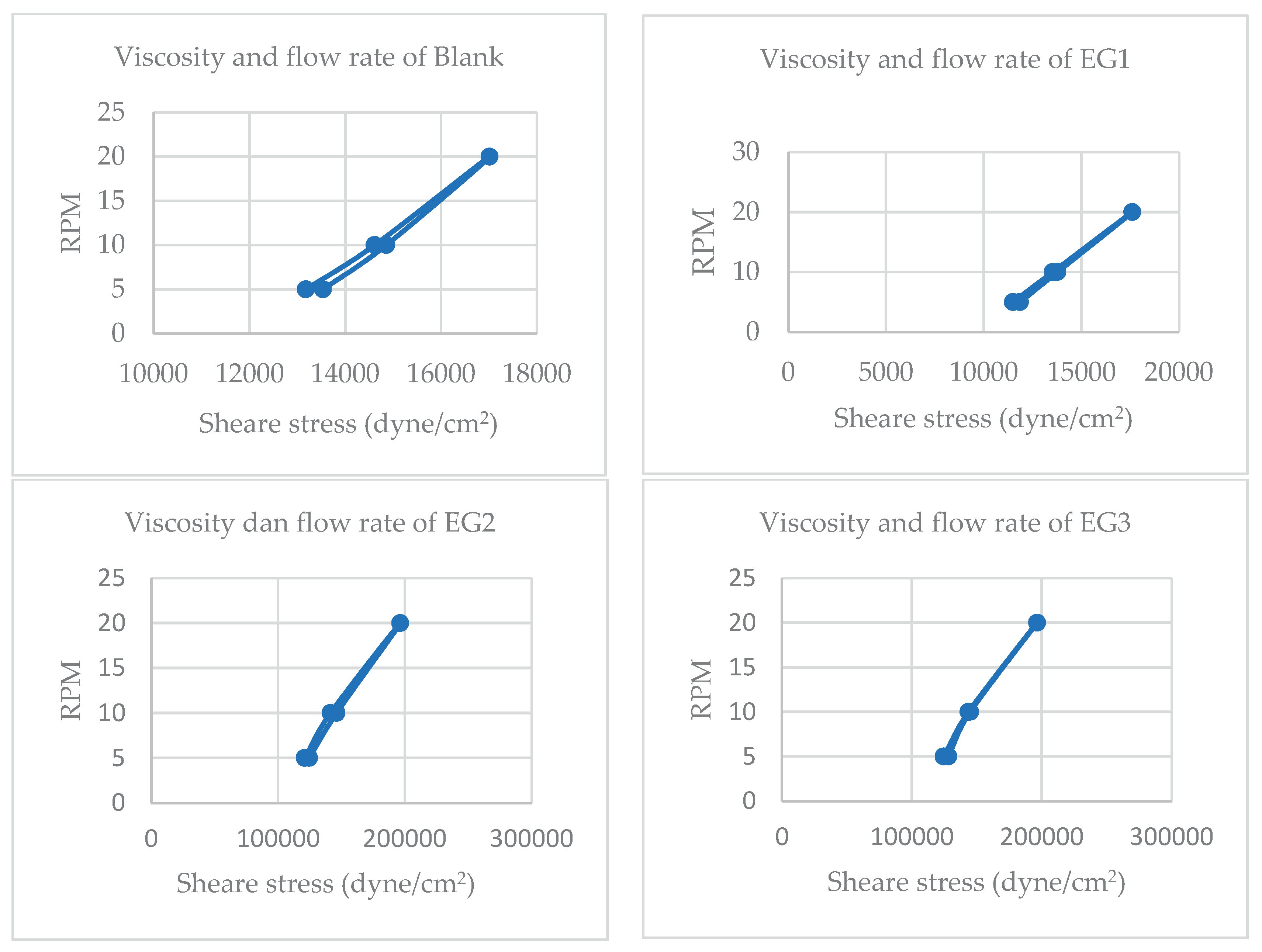
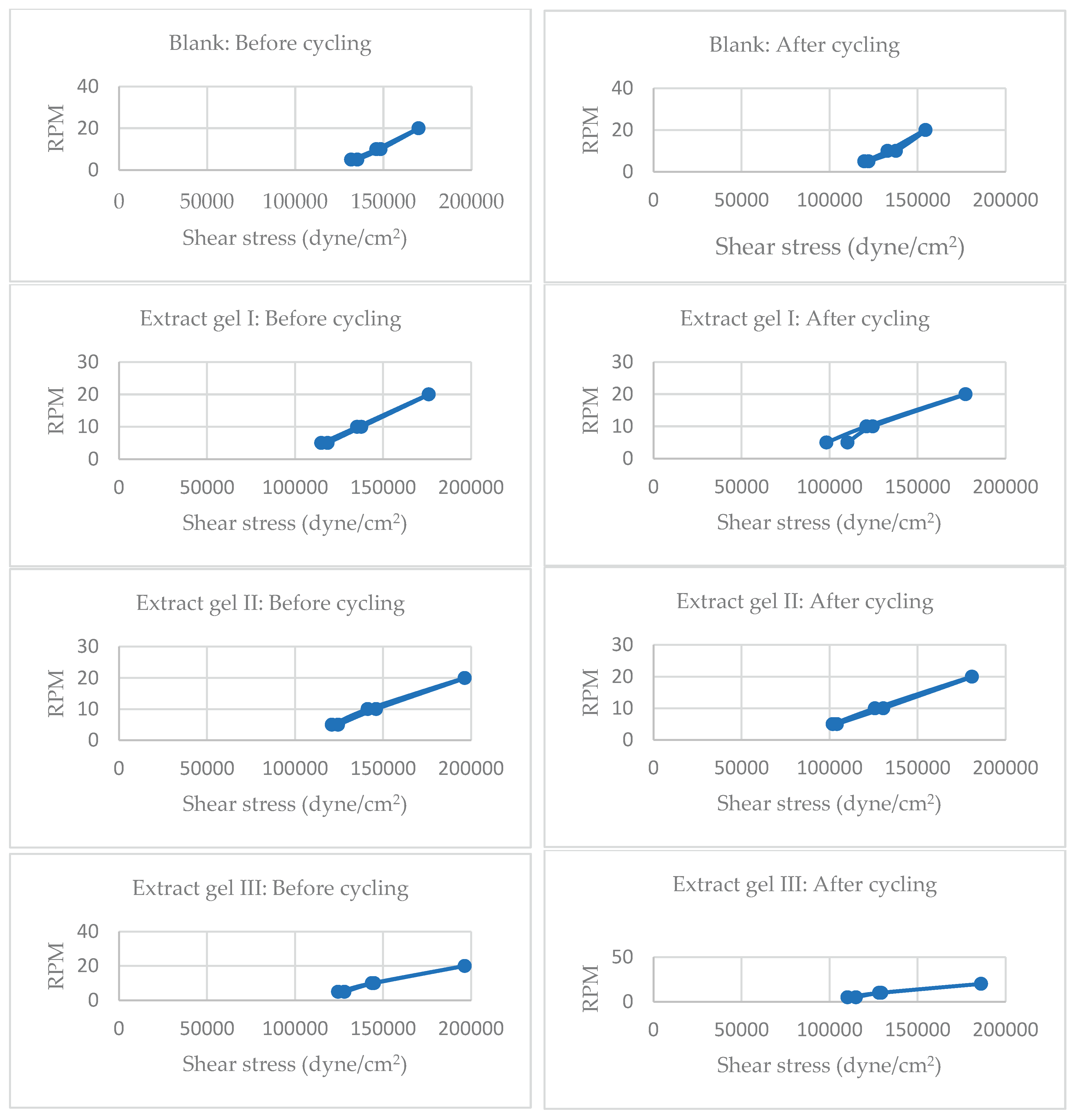
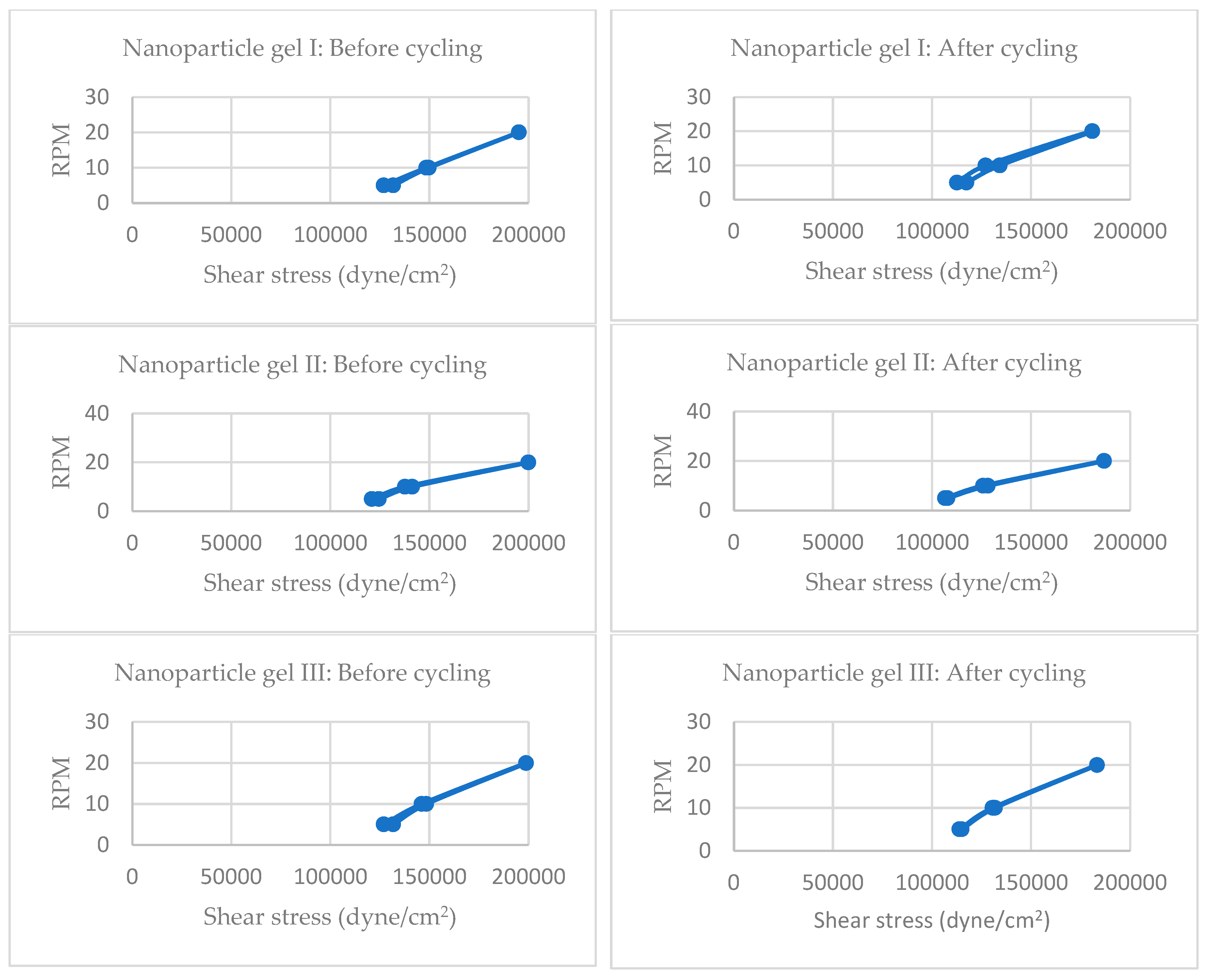
Viscosity testing was conducted to evaluate the rheological behavior of the blank sunscreen gel formulation using a Brookfield viscometer. Measurements were taken across multiple spindle types (5, 6, and 10) and rotational speeds (RPM), generating viscosity values in centipoise (cP) and corresponding shear stress (dyne/cm²).
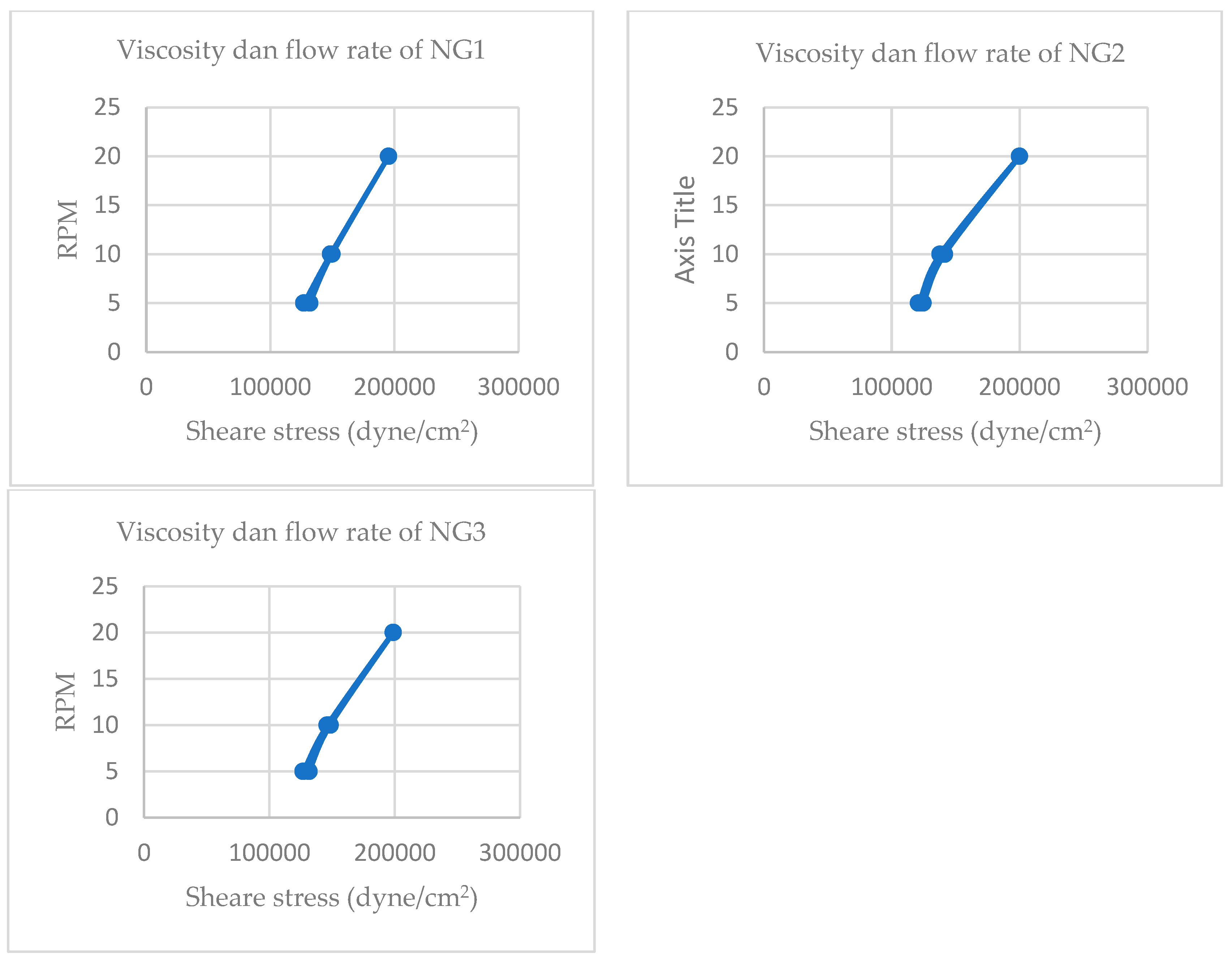
Figure 4. Profiles of viscosities and flow rates of Syzygium gels containing extract (EG) and containing nanoparticles (NG).
Preprints 190857 g005aPreprints 190857 g005b
The viscosity test aims to determine whether the gel's thickness meets the required standards for topical application. According to SNI 16-4399-1996, the acceptable viscosity range for gel preparations is 6000–50000 cP [53]. All tested formulations—both extract-based and nanoparticle-based—fall within this range, indicating compliance with national standards and suitability for topical use.
Viscosity results:
-
Extract-Based Formulations, F I (12,330 cP), F II (13,667 cP), and F III (13,667 cP), with a relationship F I < F II = F III.
-
Nanoparticle-Based Formulations, F I (13,583 cP), F II (13,917 cP), F III (13,833 cP), with a relationship F I < F II > F III
The viscosity values of all formulations fall within the optimal range for gel-based sunscreens, ensuring adequate spreadability and user comfort. Notably, nanoparticle-based formulations exhibit slightly higher viscosity than their extract-based counterparts, which may be attributed to the increased surface area and interaction of nanoparticles with the gel matrix. F II consistently shows the highest viscosity in both groups, suggesting a potential influence of active concentration or stabilizer content. [54]
Flow curve analysis reveals plastic flow behavior across all formulations, characterized by a yield stress threshold before flow initiation [55]. This rheological profile is advantageous for topical gels, as it prevents premature spreading and particle sedimentation, thereby enhancing product stability and uniformity during storage and application.
These findings support the formulation's physical integrity and suggest that nanoparticle incorporation does not compromise viscosity but may enhance structural consistency. Further investigation into the correlation between viscosity and active release kinetics is recommended to optimize therapeutic performance.
  • Spreadability
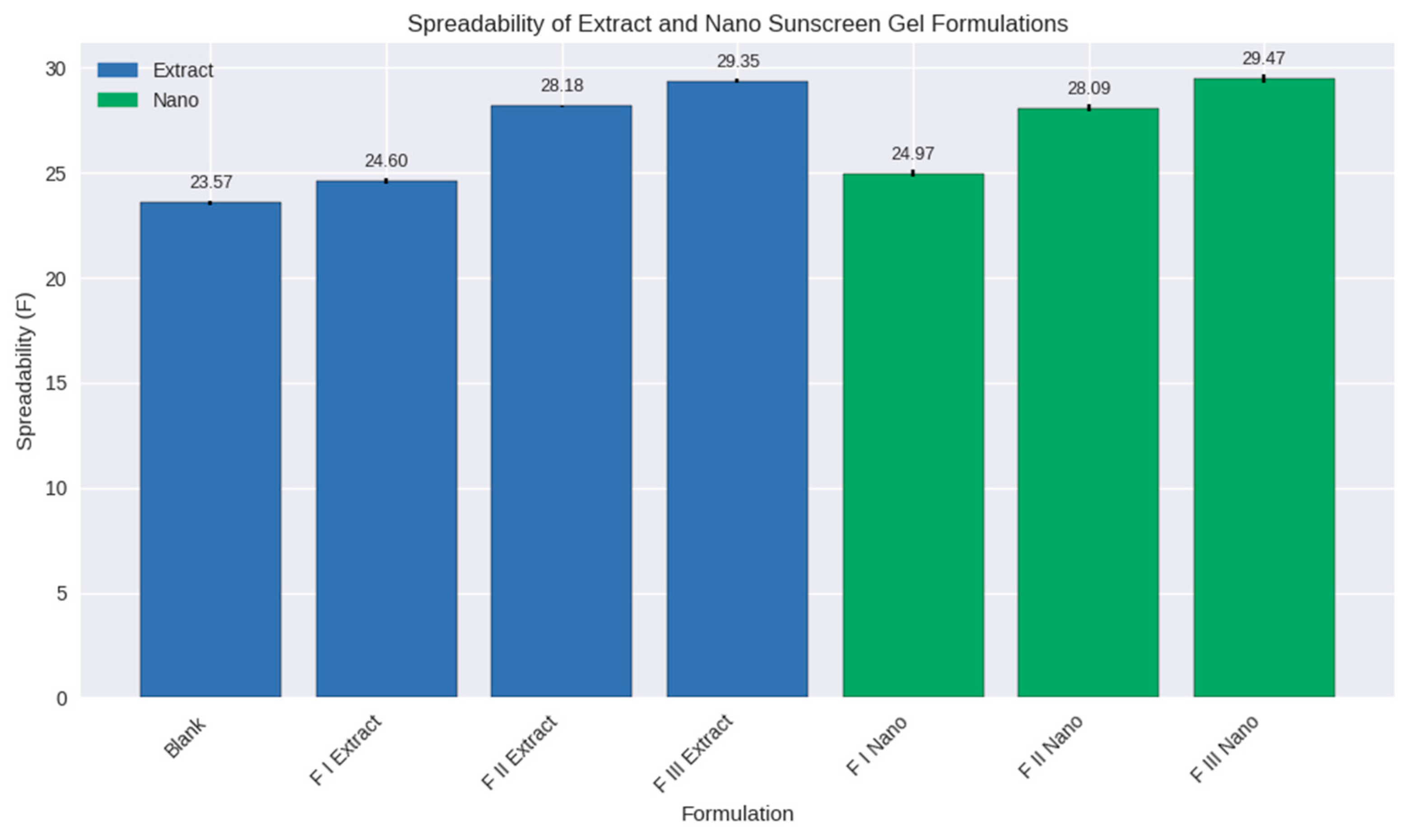
Figure 5. Spreadability of formulations of Blank, containing extract (FI, FII, and FIII), and containing nanoparticles (FI, FII, and FIII).
Preprints 190857 g006
The spreadability test confirmed that all sunscreen gel formulations fell within the acceptable range of 5–7 cm, ensuring ease of application and uniform coverage on the skin. However, notable differences were observed betwthe blank, extract-based, and nanoformulations. The blank gel exhibited the lowest spreadability (23.57 ± 0.09), reflecting the baseline rheological properties of the gel matrix without active compounds. Extract-based formulations showed progressive increases in spreadability, with F III Extract reaching 29.35 ± 0.10, suggesting that higher extract concentrations contributed to reduced internal resistance and improved gel fluidity.
Nanoformulations demonstrated the highest spreadability values, with F III Nano achieving 29.47 ± 0.20. This superior performance can be attributed to the nanoparticle dispersion and stabilizing effect of gelatin, which enhance the uniform distribution of active compounds and reduce particle aggregation. The improved spreadability of nanoformulations complements their previously observed rheological and pH characteristics: slightly higher pH values due to buffering interactions and pseudoplastic flow behavior that facilitates spreading under shear. Together, these properties highlight the multifunctional role of gelatin as both a stabilizer and a rheology modifier [56,57].
From a practical perspective, enhanced spreadability is critical for sunscreen formulations, as it ensures uniform film formation, maximizes UV protection, and improves consumer acceptability. Poorly spreadable gels may leave uneven coverage, leading to reduced efficacy and potential skin irritation. The results therefore suggest that nanoformulations not only improve the physicochemical stability of the gel but also enhance its functional performance during topical application. In conclusion, the comparative analysis demonstrates that while all formulations are dermatologically acceptable, nanoformulations provide the most favorable balance of spreadability, viscosity, and pH compatibility, positioning them as promising candidates for advanced sunscreen delivery systems.
  • Stability
  • -
    Organoleptic evaluation before and after cyclyng
    Organoleptic assessment was conducted both before and after the cycling test.
    Table 11. Organoleptic evaluation of sunscreen gel (before cycling).
    Table 11. Organoleptic evaluation of sunscreen gel (before cycling).
    Before cycling
    Formulation Form Color Odor
    Blank Thick Thick Thick Colorless Colorless Colorless Charac. Charac. Charac.
    F I (extract) Thick Thick Thick L yellow L yellow L yellow Charac. Charac. Charac.
    F II (extract) Thick Thick Thick P yellow P yellow P yellow Charac. Charac. Charac.
    F III (extract) Thick Thick Thick Yellow Yellow Yellow Charac. Charac. Charac.
    F I (nanoparticles) Thick Thick Thick P yellow P yellow P yellow Charac. Charac. Charac.
    F II (nanoparticles) Thick Thick Thick Turbid Turbid Turbid Charac. Charac. Charac.
    F III (nanoparticles) Thick Thick Thick Turbid Turbid Turbid Charac. Charac. Charac.
    L yellow: Light yellow; P yellow: Pale yellow; Charac.: Characteristic
    The organoleptic examination following the cycling stability test was conducted to determine whether the sunscreen gel formulation underwent any changes in physical characteristics—specifically texture, color, and odor. These parameters were observed before and after exposure to alternating temperature conditions. Any alteration in these attributes may indicate formulation instability, potentially compromising product efficacy and safety.
    Based on the results, no changes were observed in texture, color, or odor across all formulations before and after the cycling test. This consistency indicates that the sunscreen gel maintains organoleptic stability even after exposure to extreme temperature variations. Such stability suggests that the formulation possesses robust physical integrity and is capable of preserving its sensory characteristics under stress conditions.
    The absence of organoleptic changes post-cycling test reflects the formulation’s resilience against thermal stress, which is critical for maintaining consumer acceptance and product performance during storage and distribution. Stability in texture and color implies that the emulsion system remains intact, while consistent odor suggests no degradation of active or aromatic compounds. These findings align with previous studies emphasizing the importance of excipient selection and gel matrix design in achieving thermally stable topical formulations. [49,56]
    -
    Homogeneity evaluation before and after cycling
    Table 12. Homogeneity evaluation of sunscreen gel (before cycling).
    Table 12. Homogeneity evaluation of sunscreen gel (before cycling).
    Before cycling
    Formulation 1 2 3
    Blank Homogeneous Homogeneous Homogeneous
    F I (extract) Homogeneous Homogeneous Homogeneous
    F II (extract) Homogeneous Homogeneous Homogeneous
    F III (extract) Homogeneous Homogeneous Homogeneous
    F I (nanoparticles) Homogeneous Homogeneous Homogeneous
    F II (nanoparticles) Homogeneous Homogeneous Homogeneous
    F III (nanoparticles) Homogeneous Homogeneous Homogeneous
    Table 13. Homogeneity evaluation of sunscreen gel (after cycling).
    Table 13. Homogeneity evaluation of sunscreen gel (after cycling).
    After cycling
    Formulation 1 2 3
    Blank Homogeneous Homogeneous Homogeneous
    F I (extract) Homogeneous Homogeneous Homogeneous
    F II (extract) Homogeneous Homogeneous Homogeneous
    F III (extract) Homogeneous Homogeneous Homogeneous
    F I (nanoparticles) Homogeneous Homogeneous Homogeneous
    F II (nanoparticles) Homogeneous Homogeneous Homogeneous
    F III (nanoparticles) Homogeneous Homogeneous Homogeneous
    Homogeneity testing is essential to ensure that active compounds and excipients are evenly distributed throughout the gel matrix, thereby guaranteeing consistent therapeutic performance and consumer acceptability. As shown in Table 12 and Table 13, all formulations—blank, extract-based, and nanoparticle-based—remained homogeneous before and after the cycling stability test. No phase separation, sedimentation, or visual inconsistencies were observed, confirming that the gels maintained structural integrity under thermal stress.
    The consistent homogeneity observed in nanoparticle formulations highlights the stabilizing role of polymers such as Carbopol and HPMC, which form a robust gel network capable of suspending dispersed particles uniformly. This finding is particularly relevant for nanoparticle systems, where aggregation risk is higher due to increased surface energy. The ability of the gel matrix to maintain uniformity under stress conditions supports the physical stability of the formulations and validates their suitability for long-term topical application.
    Previous studies have emphasized that homogeneity is a critical parameter in sunscreen and topical gel formulations, directly linked to product stability and consumer perception. For instance, formulations containing natural extracts demonstrated stable homogeneity and physical properties even after stress testing [58]. Similarly, nanoparticle-loaded gels have been shown to maintain uniform distribution of active compounds, enhancing both stability and bioavailability [59]. These findings corroborate the present results, where both extract-based and nanoparticle-based gels exhibited excellent homogeneity before and after cycling.
    -
    pH evaluation before and after cycling
    Table 14. pH test results of sunscreen gel formulations (before and after cycling).
    Table 14. pH test results of sunscreen gel formulations (before and after cycling).
    Formula pH Before Cycling (Mean ± SD) pH After Cycling (Mean ± SD)
    Blank 4.49 ± 0.02 5.64 ± 0.01
    F I (Extract) 4.54 ± 0.02 5.67 ± 0.02
    F II (Extract) 4.71 ± 0.01 5.64 ± 0.02
    F III (Extract) 4.55 ± 0.01 5.37 ± 0.02
    F I (Nano) 4.89 ± 0.03 5.17 ± 0.02
    F II (Nano) 4.83 ± 0.03 5.34 ± 0.01
    F III (Nano) 4 .85 ± 0.01 5.64 ± 0.01
    The pH stability of sunscreen gel formulations is a critical parameter influencing both product safety and efficacy. In this study, all formulations exhibited an increase in pH following the cycling test, which simulates temperature fluctuations and mechanical stress during storage. The blank formulation showed the most pronounced pH shift (from 4.49 ± 0.02 to 5.64 ± 0.01), suggesting limited buffering capacity or absence of stabilizing agents.
    Formulations containing extract (F I–F III) also demonstrated pH elevation, with F II (Extract) maintaining the highest pre-cycling pH (4.71 ± 0.01) and a moderate post-cycling value (5.64 ± 0.02). This may reflect the influence of phytochemical constituents, such as polyphenols and flavonoids, which can interact with excipients and affect pH resilience.
    Interestingly, nano-formulated variants (F I–F III Nano) showed smaller pH shifts, particularly F I (Nano), which changed from 4.89 ± 0.03 to 5.17 ± 0.02. This suggests that nanoencapsulation may enhance pH stability by protecting active compounds from environmental stressors and reducing their direct interaction with the gel matrix. Such findings align with previous reports indicating that nanoscale delivery systems can improve the physical stability of sunscreen gels, including pH, viscosity, and spreadability.
    Overall, the results support the hypothesis that nanoformulation contributes to better pH retention under stress conditions, which is essential for maintaining product performance and minimizing skin irritation risk. These insights are valuable for optimizing sunscreen gel formulations intended for tropical climates with variable storage conditions [60,61,62].
    -
    Viscosity before and after cycling
    Figure 6. Cycling test data on viscosity before and after cycling of Blank, Extract and Nanoparticle Formulations.
    Figure 6. Cycling test data on viscosity before and after cycling of Blank, Extract and Nanoparticle Formulations.
    Preprints 190857 g007aPreprints 190857 g007b
    • Overview of Cycling Impact
    Cycling refers to repeated stress or temperature exposure, simulating long-term storage or usage. Stability is inferred from changes in shear stress at fixed RPMs—smaller changes suggest better structural resilience.
    • Extract Gel Formulations
    Before Cycling:
    • Shear stress values at 5 RPM range from ~114,992 to 128,168 dyne/cm².
    • At 20 RPM, values reach up to ~196,445 dyne/cm², indicating strong resistance to flow under high shear.
    After Cycling:
    • Shear stress at 5 RPM drops to ~98,222–114,992 dyne/cm².
    • At 20 RPM, values decrease to ~124,575–186,862 dyne/cm².
    Interpretation:
    • Significant reduction in shear stress post-cycling, especially at low RPMs, suggests partial breakdown of gel matrix or reduced internal cohesion.
    • The drop is more pronounced in extract gels, indicating lower rheological stability under stress.
    • Nano Gel I Formulations
    Before Cycling:
    • Shear stress at 5 RPM ranges from ~120,981 to 131,762 dyne/cm².
    • At 20 RPM, values reach ~195,247–200,004 dyne/cm².
    After Cycling:
    • Shear stress at 5 RPM drops to ~106,607–117,388 dyne/cm².
    • At 20 RPM, values remain relatively high: ~180,873–186,862 dyne/cm².
    Interpretation:
    • Moderate reduction in shear stress after cycling, but values remain higher than extract gels.
    • Indicates better structural retention, likely due to gelatin nanoparticle reinforcement and encapsulation effects.
    • Nano gels show enhanced resilience to mechanical stress, supporting their use in long-term topical applications.
    • Comparative Stability Summary
    Formulation Shear stress drop (5 RPM) Shear stress drop (20 RPM) Stability After Cycling
    Extract Gel ~10–20% ~10–30% Moderate to Low
    Nano Gel I ~5–15% ~5–10% High
    • Conclusion
    Nano gel formulations exhibit superior rheological stability compared to extract gels after cycling. This supports your hypothesis that nanoparticle incorporation enhances gel integrity, likely due to better polymeric network formation and reduced degradation under stress. [63,64]
    -
    Spreadability
    Table 15. Spreadability test results of gel formulations (before and after cycling).
    Table 15. Spreadability test results of gel formulations (before and after cycling).
    Formula Diameter (cm) Spreadability (F)
    Blank 5.48 ± 0.01 23.57 ± 0.09
    F I (Extract) 5.61 ± 0.01 24.68 ± 0.11
    F II (Extract) 5.99 ± 0.01 28.12 ± 0.12
    F III (Extract) 6.12 ± 0.01 29.35 ± 0.10
    F I (Nano) 5.64 ± 0.02 24.97 ± 0.18
    F II (Nano) 5.98 ± 0.02 28.09 ± 0.16
    F III (Nano) 6.13 ± 0.02 29.47 ± 0.20
    Spreadability reflects the ease of topical application and uniform distribution of gel on the skin. It is influenced by viscosity, polymer concentration, and structural integrity.
    • Blank gel shows the lowest spreadability (23.57 ± 0.09), serving as a baseline.
    • Extract gels (Formulas I–III) show increasing spreadability with higher extract concentration, peaking at Formula III (29.35 ± 0.10).
    • Nano gels (Formulas I–III) exhibit similar or slightly higher spreadability than their extract counterparts, with Formula III Nano reaching the highest value (29.47 ± 0.20).
    • Interpretation:
    • Cycling did not significantly reduce spreadability, indicating good physical stability.
    • Nano formulations maintain or slightly improve spreadability, likely due to better dispersion and reduced particle aggregation.
    • These results align with rheological data showing nano gels retain shear stress better after cycling, confirming their superior structural resilience.
    Based on the SPSS output using two-way ANOVA statistical analysis, the significance value (Sig.) for the normality test was 0.401 and for the homogeneity test was 0.945, both exceeding 0.05 and thus meeting the assumptions for parametric testing. The ANOVA test yielded a Sig. value of 0.931 (> 0.05), indicating that there is no significant interaction between the formula used and the storage conditions in determining the viscosity of the preparation. Therefore, the null hypothesis (H₀) is accepted, and the alternative hypothesis (H₁) is rejected. [65,66]
    -
    Formulation SPF before and after cycling
    SPF Determination of Sunscreen Gel Formulations:
    The Sun Protection Factor (SPF) values of the sunscreen gel formulations were calculated using spectrophotometric absorbance data across UV wavelengths ranging from 290 to 320 nm. The SPF was determined using the Mansur equation: [67]
    SPF = CF × ∑(EE × I × Abs)
    CF is the correction factor (typically 10), EE × I represents the erythemal effect and solar intensity at each wavelength, and Abs is the absorbance of the sample.
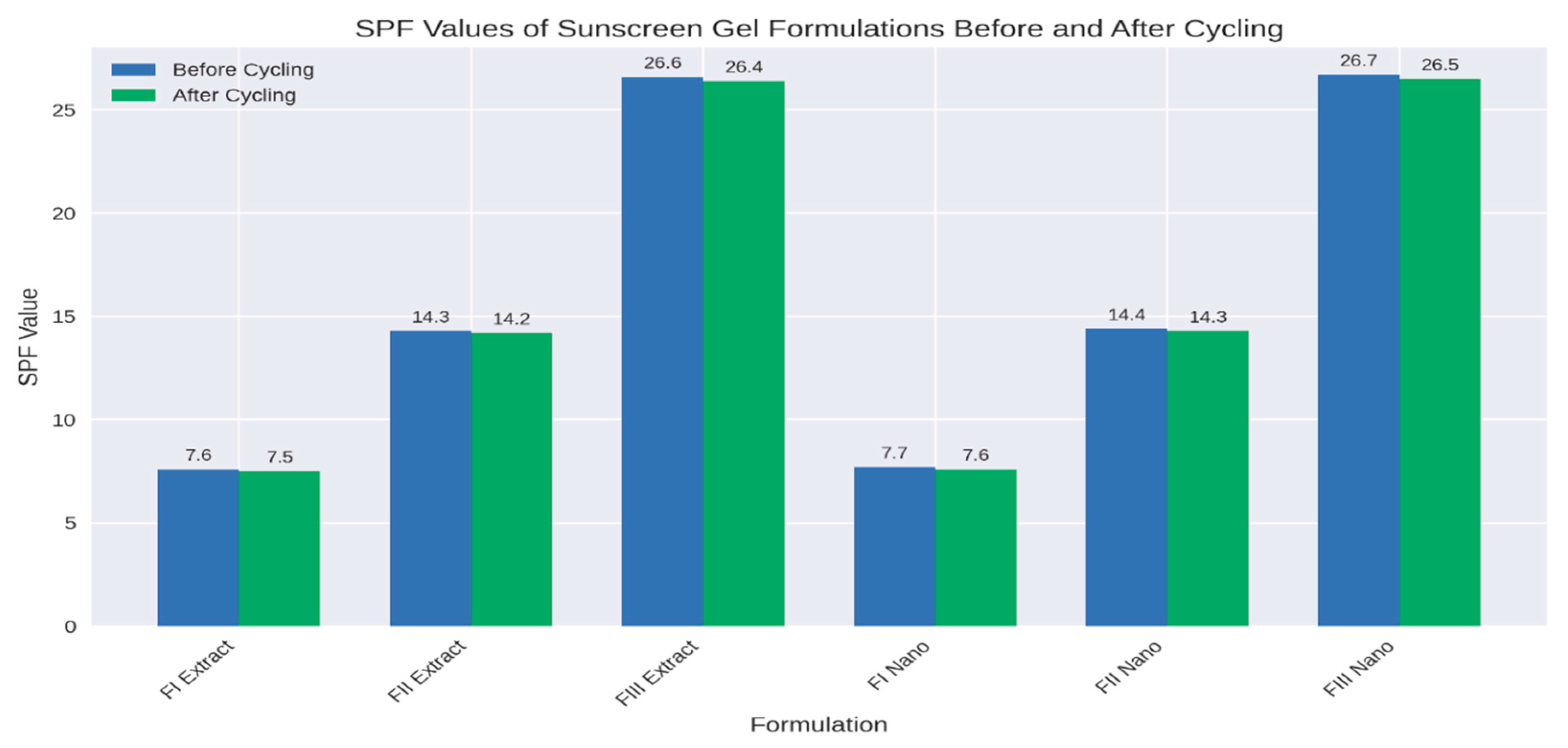
    The grouped bar chart showed SPF values of extract and nano gels before and after cycling. It highlights how nano formulations consistently maintain slightly higher SPF values and better stability compared to extract gels:
    Figure 7 shows clearly that while both systems are stable under cycling, nano gels outperform extract gels in SPF retention, especially at higher concentrations (Formula III). The bar chart compared SPF values of extract and nano gels before and after cycling. It clearly shows the stability advantage of the nano formulations:
    • Extract gels: FI (7.6 → 7.5), FII (14.3 → 14.2), FIII (26.6 → 26.4)
    • Nano gels: FI (7.7 → 7.6), FII (14.4 → 14.3), FIII (26.7 → 26.5)
    Moreover, SPF values can be expressed as percentage of UV blocking to make them more intuitive. The general approximation is:
    % UV Blocking=(1−(1/SPF)) × 100
    Low SPF (FI) blocks ~87% of UV radiation, suitable only for short exposure. Medium SPF (FII) blocks ~93%, offering moderate protection. High SPF (FIII) blocks ~96%, providing strong protection. Nano gels consistently show slightly higher % blocking compared to extract gels, confirming their enhanced photoprotective performance and stability after cycling. [68,69,70]
    Table 16. Calculated % UV blocking.
    Table 16. Calculated % UV blocking.
    Formula SPF (Before) % Blocking (Before) SPF (After) % Blocking (After)
    FI Extract 7.6 86.8% 7.5 86.7%
    FII Extract 14.3 93.0% 14.2 92.9%
    FIII Extract 26.6 96.2% 26.4 96.2%
    FI Nano 7.7 87.0% 7.6 86.8%
    FII Nano 14.4 93.1% 14.3 93.0%
    FIII Nano 26.7 96.3% 26.5 96.2%
    -
    Antioxidant activity of formulations before and after cycling
    Table 17. Antioxidant activity of formulations before and after cycling.
    Table 17. Antioxidant activity of formulations before and after cycling.
    Formulations Before cycling After cycling
    FI Extract 52.78 + 0.13 52.76 + 0.59
    FII Extract 49.30 + 0.05 48.14 + 0.38
    FIII Extract 41.09 + 0.13 40.85 + 0.34
    FI Nano 80.27 + 0.56 80.24 + 0.52
    F II Nano 72.99 + 0.08 72.92 + 0.08
    F III Nano 67.39 + 0.03 67.74 + 0.63
    • Antioxidant Stability Before and After Cycling
    All formulations maintained strong antioxidant activity following thermal cycling, with minimal changes in IC₅₀ values, indicating robust stability of bioactive compounds under stress conditions.
    • Extract-based gels showed slight reductions in antioxidant potency post-cycling, particularly FII (↓1.16 ppm) and FIII (↓0.24 ppm), suggesting moderate sensitivity of polyphenolic constituents to thermal fluctuations. However, the changes remained within acceptable limits, with IC₅₀ values still below 100 ppm, confirming pharmacological relevance.
    • Nano-based gels demonstrated superior stability, with FI and FII showing negligible shifts (<0.1 ppm), and FIII even exhibiting a slight improvement (↑0.35 ppm), possibly due to enhanced dispersion or release kinetics post-cycling. The consistently low standard deviations (e.g., FII Nano: ±0.08) further underscore the reproducibility and robustness of the nanoparticle system.
    These results affirm that nanoparticle encapsulation enhances thermal resilience, preserving antioxidant efficacy during formulation stress. The findings support the suitability of nano-delivery systems for cosmeceutical applications requiring long-term stability. [71]
    -
    Franz Diffusion Profiles of Flavonoid Penetration
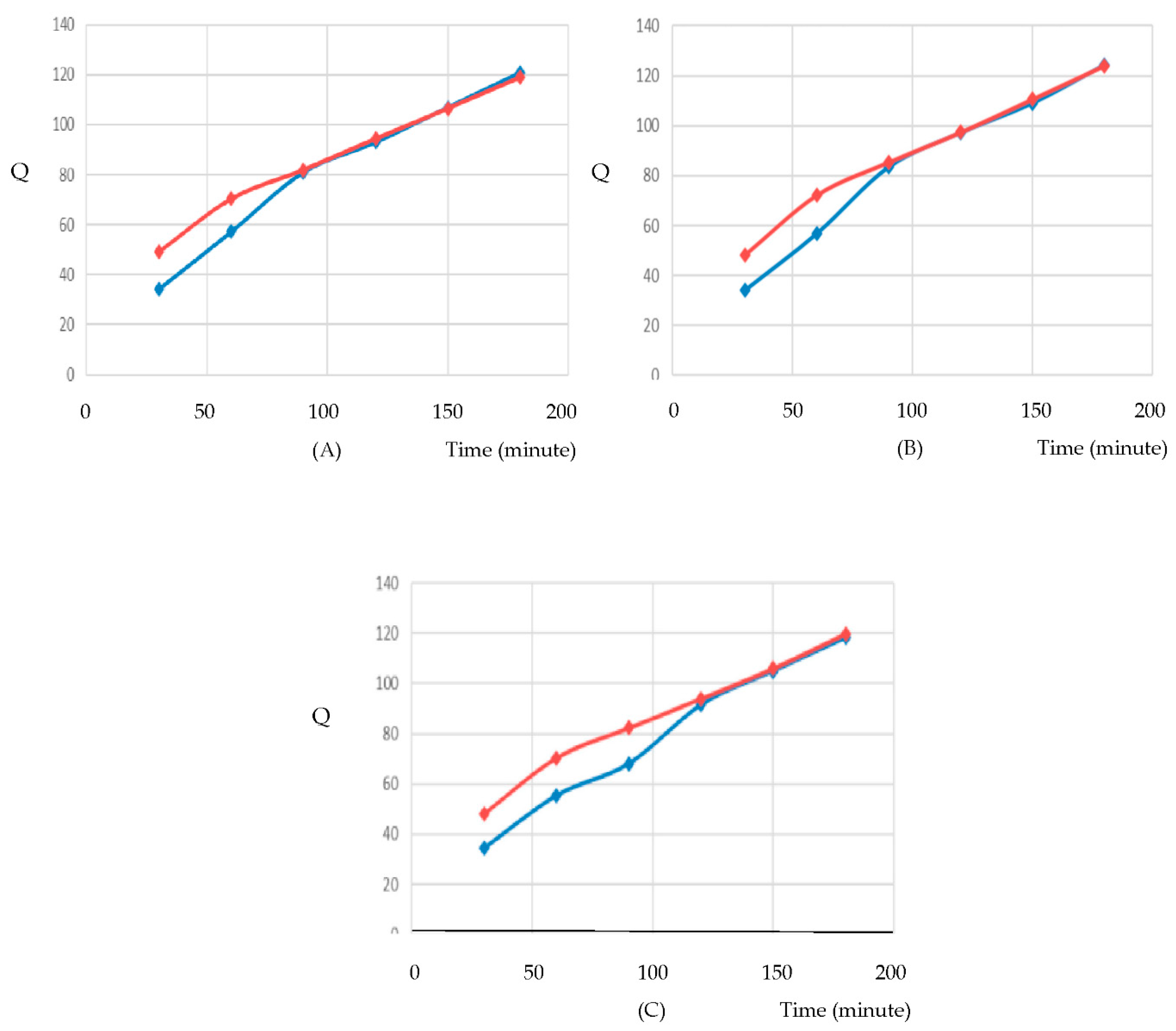
    The Franz diffusion test was conducted to evaluate the transdermal penetration of flavonoids from extract and nanoparticle formulations of Syzygium myrtifolium over time. The cumulative amount of flavonoid penetrated (Q) was measured at intervals up to 200 minutes using UV-VIS spectrophotometry. [72]
    Figure 8. Relationship between time and Q for F I, F II, and F III.
    Figure 8. Relationship between time and Q for F I, F II, and F III.
    Preprints 190857 g009
    • Comparative Analysis:
    • F I:
      Nanoparticle FI showed significantly higher penetration than Extract FI, with Q values reaching approximately 120 units at 180 minutes, compared to ~90 units for the extract. This suggests enhanced delivery due to nanoparticle encapsulation. [72]
    • F II:
      Similar trends were observed. Nanoparticle FII reached ~120 units, while Extract FII plateaued around ~100 units. The difference in slope indicates faster and more efficient diffusion from the nanoparticle system. [72]
    • F III:
      Nanoparticle FIII again outperformed Extract FIII, with Q values nearing 120 units versus ~100 units for the extract. The consistency across all formulas confirms the superior permeation profile of the nanoparticle formulations. [72,73]
    Across all three formulas, nanoparticle systems consistently demonstrated:
    • Higher cumulative penetration (Q)
    • Steeper diffusion curves
    • Faster onset of permeation
    These results validate the use of gelatin-based nanoparticles for enhancing skin delivery of flavonoid-rich botanical extracts, supporting their application in cosmeceutical formulations targeting antioxidant and photoprotective effects. [72,73]
    • Permeation Parameters of Flavonoid Formulations via Franz Diffusion Cell
    The table below summarizes the results of Franz diffusion testing for three formulations (F I, F II, F III) in both extract and nanoparticle forms. Key parameters include flux (µg/cm²/h), permeability constant (cm/h), and diffusion coefficient (cm²/h).
    Table 18. Summary of Franz diffusion penetration test.
    Table 18. Summary of Franz diffusion penetration test.
    Parameter Flux (µg/cm²/h) Permeability Constant (cm/h) Diffusion Coefficient (cm²/h)
    F1 (Nanoparticle) 0.5633 0.1616 0.1092
    F2 (Nanoparticle) 0.5904 0.0954 0.1145
    F3 (Nanoparticle) 0.5633 0.0910 0.1092
    F1 (Extract) 0.4451 0.0719 0.0863
    F2 (Extract) 0.4827 0.0780 0.0936
    F3 (Extract) 0.4527 0.0731 0.0878
    • Packaging
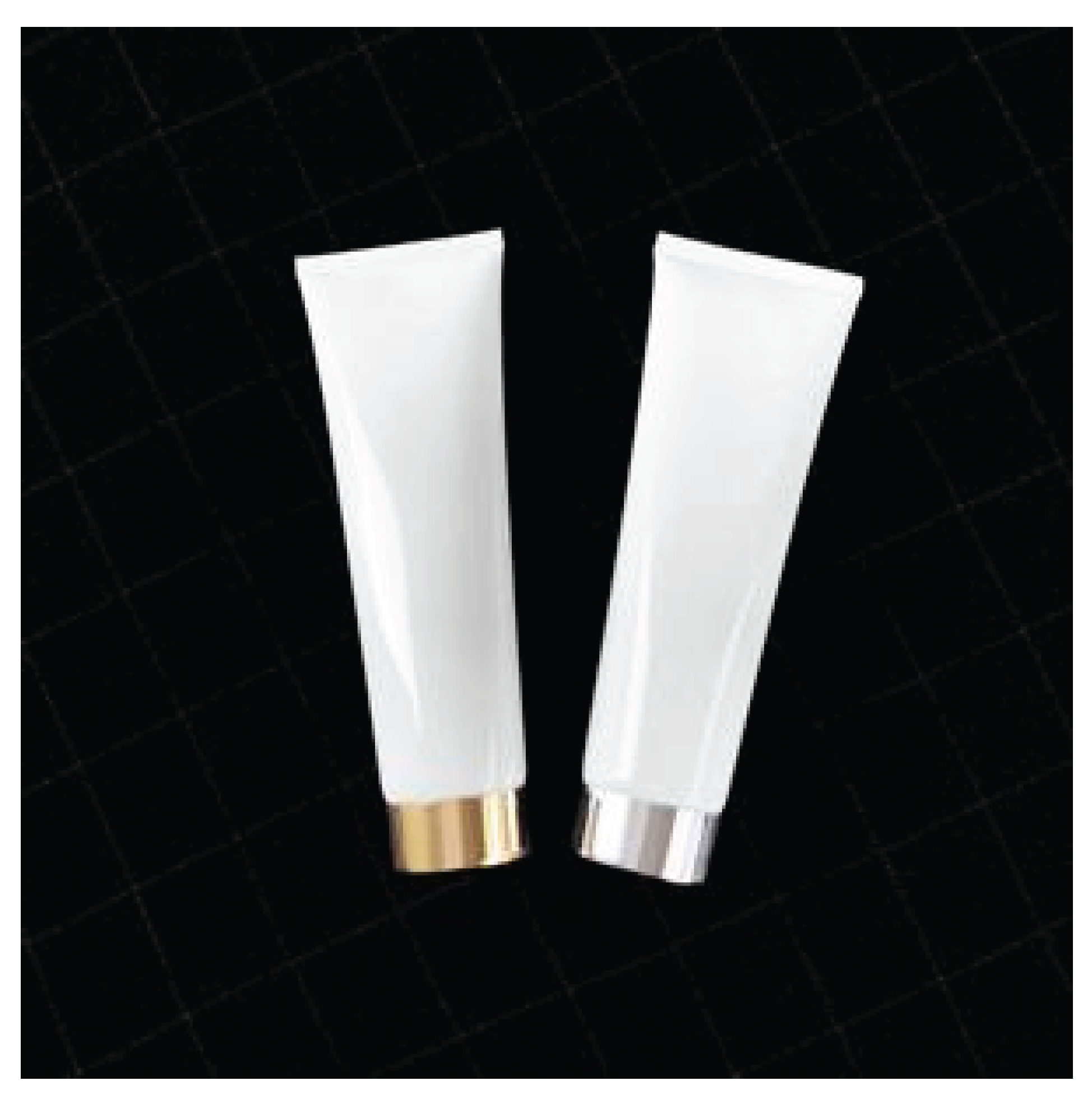
    Figure 9. Example of Syzygium myrtifolium sunscreen gels in HDPE tubes.
    Figure 9. Example of Syzygium myrtifolium sunscreen gels in HDPE tubes.

    Preprints 190857 g010

    3. Conclusions

    Syzygium myrtifolium (red shoot leaves) contains flavonoids with strong antioxidant and photoprotective properties, supporting its potential as a natural sunscreen agent. Gel formulations prepared from both crude extract and nanoparticle forms demonstrated acceptable physicochemical and organoleptic characteristics. Antioxidant testing (DPPH assay) revealed very strong activity, with IC50 values of 32.59 ± 0.18 ppm, while SPF evaluation confirmed concentration-dependent UV protection. Franz diffusion studies showed that nanoparticle formulations enhanced skin permeation, flux, and diffusion coefficients compared to extract gels. However, extract-based gels exhibited higher SPF and antioxidant activity, indicating stronger direct photoprotective potential.
    Overall, these findings highlight S. myrtifolium gels as promising natural cosmeceutical formulations. Extract gels are particularly effective as antioxidant-rich sunscreens, while nanoparticle systems offer advantages in controlled release and skin penetration. Together, they provide a safer and more sustainable approach to skin photoprotection and support the broader application of Indonesian medicinal plants in cosmeceutical innovation. Here are the highlights of your article, formatted in MDPI style (concise bullet points emphasizing novelty and contribution):
    • Highlights
    -
    Syzygium myrtifolium (red shoot leaves) is identified as a rich source of flavonoids with strong antioxidant and photoprotective properties.
    -
    Gel formulations were successfully prepared using both crude extract and nanoparticle forms, with acceptable physicochemical and organoleptic characteristics.
    -
    The extract-based gel demonstrated higher SPF values and antioxidant activity compared to the nanoparticle gel, confirming its strong photoprotective potential.
    -
    Franz diffusion studies revealed that nanoparticle gels exhibited enhanced skin permeation, flux, and diffusion coefficients**, supporting controlled release and deeper delivery.
    -
    Findings highlight the dual potential: extract gels as effective natural sunscreens, and nanoparticle gels as advanced delivery systems, contributing to safer and more sustainable approaches to skin photoprotection.
    • Novelty Statement:
    This study is the first to comprehensively evaluate Syzygium myrtifolium (red shoot leaves) gel formulations for photoprotective applications, comparing crude extract and nanoparticle forms. While nanoparticles enhanced skin permeation, flux, and diffusion coefficients, the extract-based gels demonstrated superior SPF and antioxidant activity. The dual findings highlight a unique balance between immediate photoprotection (extract gels) and controlled release with deeper penetration (nanoparticle gels).
    This integrated approach underscores the potential of S. myrtifolium as a sustainable, plant-derived cosmeceutical, advancing the use of Indonesian medicinal plants in global sunscreen innovation.

    4. Materials and Methods

    4.1. Materials

    • Primary material: Fresh red leaves of Syzygium myrtifolium Walp. (commonly known as pucuk merah) were collected from the garden of Faculty of Pharmacy, Universitas Pancasila, Jakarta, Indonesia.
    • Additional materials: Ethanol 70% (Merck, Darmstadt, Germany), hydrochloric acid 1% (Merck, Darmstadt, Germany), 2,2-diphenyl-1-picrylhydrazyl (DPPH; Sigma-Aldrich, St. Louis, MO, USA), Vitamin C reference standard (Sigma-Aldrich, St. Louis, MO, USA), ethanol 96% (Merck, Darmstadt, Germany), methanol PA (Merck, Darmstadt, Germany), dimethyl sulfoxide (DMSO; Sigma-Aldrich, St. Louis, MO, USA), gelatin (Sigma-Aldrich, St. Louis, MO, USA), poloxamer 188 (Sigma-Aldrich, St. Louis, MO, USA), glutaraldehyde 2% (Merck, Darmstadt, Germany), carbomer 940 (Sigma-Aldrich, St. Louis, MO, USA), propylene glycol (Merck, Darmstadt, Germany), phenoxyethanol (Sigma-Aldrich, St. Louis, MO, USA), triethanolamine (Merck, Darmstadt, Germany), and purified water (local pharmaceutical grade, Jakarta, Indonesia).

    4.2. Equipment

    The instruments used in this study included: analytical balance (Kern, Balingen, Germany), oven (Memmert U-30, Memmert GmbH, Schwabach, Germany), rotary vacuum evaporator (Heidolph, Schwabach, Germany), magnetic stirrer (IKA Eurostar, IKA Werke GmbH, Staufen, Germany), viscometer (Brookfield RV type, Brookfield Engineering Laboratories, Middleboro, MA, USA), water bath (Memmert W 600, Memmert GmbH, Schwabach, Germany), pH meter (Hanna Instruments, Woonsocket, RI, USA), Karl Fischer titrator (Metrohm AG, Herisau, Switzerland), UV-Vis spectrophotometer (Shimadzu, Kyoto, Japan), standard laboratory glassware (Pyrex, Corning Inc., NY, USA; Iwaki, Asahi Glass Co., Tokyo, Japan), microscope (Optika, Ponteranica, Italy), micropipettes (Eppendorf, Hamburg, Germany), thermometer (IKA Werke GmbH, Staufen, Germany), glass slides (Matsunami Glass Ind., Osaka, Japan), evaporating dishes (Corning Inc., NY, USA), stirring rods (Pyrex, Corning Inc., NY, USA), spatulas (Fisher Scientific, Waltham, MA, USA), filter paper (Whatman, Maidstone, UK), aluminum foil (Reynolds, Richmond, VA, USA), blender (Philips, Amsterdam, Netherlands), sieves no. 4 and no. 18 (Retsch GmbH, Haan, Germany), cuvettes (Hellma Analytics, Müllheim, Germany), refrigerator (Panasonic, Osaka, Japan), dropper pipettes (Fisher Scientific, Waltham, MA, USA), mortar and pestle (Corning Inc., NY, USA), parchment paper (Fisher Scientific, Waltham, MA, USA), hot plate (IKA Werke GmbH, Staufen, Germany), and plastic tube containers (Falcon, Corning Inc., NY, USA).

    4.3. Methods

    4.3.1. Materials and Botanical Identification

    • Plant Material Preparation
    Fresh red shoot leaves (Syzygium myrtifolium Walp.) were collected from the campus area of Universitas Pancasila, Jakarta, Indonesia. The leaves were subjected to wet sorting to remove foreign matter and debris, washed under running water, sliced, and dried in an oven at 40 °C. The dried leaves were then powdered using a blender and sieved through mesh no. 4 and no. 18. The resulting powder was stored in clean, dry, tightly sealed containers protected from light. [74,75]
    • b. Botanical Determination
    The botanical identification of Syzygium myrtifolium Walp. was carried out at the Herbarium Depokensis (UIDEP), Department of Biology, Faculty of Mathematics and Natural Sciences, Universitas Indonesia, Depok, Indonesia. The plant specimen was authenticated by a taxonomist, and a voucher specimen was deposited for reference. [74,75]
    • c. Fineness Degree of Syzygium myrtifolium Simplicia
    The powdered simplicia was evaluated for fineness degree according to pharmacognostic standards. The powder was passed through sieves no. 4 and no. 18, and the proportion retained was recorded. The fineness degree was expressed as the percentage of powder passing through the designated mesh size, following standard pharmacopoeial procedures. [74,75]

    4.3.2. Preparation of Syzygium myrtifolium Extract

    • Extract Preparation
    The ethanol extract of red shoot leaves was prepared using the maceration method with 70% ethanol as a polar solvent. One kilogram of simplisia powder was macerated in 1 liter of 70% ethanol for 2 × 24 hours. The macerate was filtered and concentrated using a rotary vacuum evaporator at 40 °C to obtain a thick extract. The extract was weighed, and the yield and drug-extract ratio (DER) were calculated using the following formula [16]:
    Yield (%) = (Weight of Extract / Weight of Simplisia) x 100%
    Extraction yield and DER-native value = Weight of Simplisia / Weight of Extract
    • b. Phytochemical Screening of Extract
    The concentrated ethanol extract of Syzygium myrtifolium Walp. was subjected to qualitative phytochemical screening using standard pharmacognostic procedures [27].
    • Alkaloids: Detected using Mayer’s and Dragendorff’s reagents; positive indicated by yellow or orange coloration.
    • Flavonoids: Identified by reaction with magnesium powder, amyl alcohol, and concentrated HCl; red, yellow, or orange coloration indicated presence.
    • Saponins: Confirmed by stable foam formation after heating with water and HCl 2 N.
    c.
    Specific and Non-specific Parameters of Syzygium myrtifolium Extract
    Specific Parameters of Syzygium myrtifolium Extract [76]:
    The extract was assessed for organoleptic properties, pH, and solubility profile:
    • Organoleptic evaluation: The extract exhibited a thick consistency, a characteristic tea-like odor, and a deep red color, consistent with polyphenol-rich materials such as anthocyanins and flavonoids. Organoleptic testing was performed by observing physical form, aroma, and color [12,26].
    • pH measurement: Using a calibrated electrode, the diluted extract showed a certain pH, indicating acidity favorable for antioxidant stability in topical formulations [27].
    • Solubility testing: Conducted in various solvents according to pharmacopoeial standards. The extract was soluble or insoluble in distilled water, propylene glycol, ethanol 96%, and DMSO. These results suggest compatibility with polar organic solvents, supporting applications in hydrogel, emulgel, and nanoemulsion systems [28,29].
    Non-Specific Parameters of Syzygium myrtifolium Extract [76]:
    General quality attributes were determined following pharmacognostic and pharmacopeial guidelines:
    • Ash content: Total ash averaged below 14%, while acid-insoluble ash was 2.0%, indicating minimal contamination from silicates or soil particles [30].
    • Moisture content: Measured at below the 10% threshold recommended for microbial safety and extract stability [30].
    • Heavy metal analysis: Atomic Absorption Spectrophotometry (AAS) revealed Pb < 0.05 µg/mL and Cd < 0.02 µg/mL, meeting pharmacopeial safety limits and confirming suitability for cosmeceutical applications [31].
    • d. SPF values of Syzygium myrtifolium extract
    In vitro SPF was determined spectrophotometrically using the Mansur method, which estimates SPF from UV absorbance between 290–320 nm weighted by erythemal effect and correction factors. This approach is widely applied to plant extracts and essential oils for preliminary screening.
    Sample preparation:
    • Extract solution: Dissolve a known mass of the dried extract in ethanol 96% (or another validated solvent with minimal UV background) to a target concentration (e.g., 0.1–1.0 mg/mL), selected to keep absorbance within the linear range (typically (A < 2)).
    • Blank: Use the solvent alone in a matched cuvette for baseline correction.
    • Cuvettes: Quartz cuvettes with 1 cm path length, cleaned and inspected for scratches.
    UV–Vis measurement:
    • Wavelength range: Record absorbance from 290 to 320 nm at 5 nm intervals (i.e., 290, 295, 300, 305, 310, 315, 320 nm).
    • Baseline: Zero the instrument with the solvent blank.
    • Replicates: Measure at least three independent preparations; average the absorbance at each wavelength.
    • Instrument settings: Ensure slit width and scan speed provide stable readings; verify lamp performance and cuvette alignment.
    SPF Calculation (Mansur Method) [67]:
    • Equation:
    SPF = CF × ∑(EE(λ) × Ι(λ) × Abs(λ))
    SPF: Sun Protection Factor, the final measure of the sample's ability to protect against ultraviolet B (UVB) radiation, which is the primary cause of sunburn; CF: Correction Factor, a constant value typically set to 10; ∑sum of: Summation symbol, indicating that the values are summed up across the relevant wavelength range; EE (λ): Erythemal Effect Spectrum at a specific wavelength (λ). This refers to the potential of UV radiation at that wavelength to cause skin redness or sunburn; I(λ): Solar Intensity Spectrum at a specific wavelength (λ). This represents the intensity of the sun's radiation at that wavelength; Abs(λ): Absorbance of the sample at a specific wavelength (λ). This value is measured using a UV-Vis spectrophotometer.
    Moreover, SPF values can be expressed as percentage of UV blocking to make them more intuitive. The general approximation is:
    % UV Blocking=(1−(1/SPF)) × 100.
    Interpretation and limitations: Screening purpose: In vitro SPF provides comparative screening for extracts and formulations; it does not replace in vivo determination (ISO 24444) or broad-spectrum testing (UVA-PF, critical wavelength). Formulation effects: SPF of the raw extract may differ in finished dosage forms due to film formation, scattering, and vehicle interactions.
    • e. Antioxidant Activity of Syzygium myrtifolium Extract
    Antioxidant Activity Assay (DPPH Method):
    The antioxidant activity of Syzygium myrtifolium extract was evaluated using the DPPH radical scavenging method [77,78].
    • DPPH solution: 4 mg of 2,2-diphenyl-1-picrylhydrazyl (DPPH) was dissolved in 25 mL methanol p.a. to obtain a 160 ppm stock solution, stored in a dark bottle; Blank preparation: 0.3 mL of DPPH solution was diluted with methanol p.a. to 5 mL in a calibrated test tube; Extract stock solution: 25 mg of red shoot leaf extract was dissolved in methanol p.a. to yield a 1000 ppm solution; Serial dilutions: From the stock, extract solutions of 400, 500, 600, 700, and 800 ppm were prepared. For each concentration, 4.7 mL was mixed with 0.3 mL of DPPH solution in foil-wrapped test tubes.
    • Standard comparison: A 1000 ppm vitamin C solution was prepared in methanol p.a. and protected from light.
    • Absorbance was measured at 517 nm after incubation, and % inhibition was calculated to determine IC₅₀ values.

    4.3.3. Synthesis of Syzygium myrtifolium Extract-Loaded Gelatin Nanoparticles

    • Synthesis of Gelatin Nanoparticles via Precipitation Method [35,36]
    a. Formulation Composition
    Gelatin nanoparticles were formulated using red shoot leaf extract (300×IC₅₀), DMSO (0.2 mL), ethanol 96% (10 mL), Poloxamer 188 (700 mg), gelatin (5 mg), glutaraldehyde 2% (1 mL), and purified water (0.5 mL).
    • b. Solvent Phase
    Gelatin (5 mg) was dissolved in 1 mL of purified water at 50 °C. Separately, red shoot leaf extract was dissolved in 0.2 mL DMSO and 0.2 mL ethanol 96%, stirred until homogeneous.
    • c. Non-Solvent Phase
    Poloxamer 188 (700 mg) was dissolved in 10 mL ethanol 96% using a magnetic stirrer.
    • d. Nanoparticle Formation
    The solvent phase was added dropwise into the non-solvent phase at 700 rpm. After 15 minutes, 0.5 mL glutaraldehyde was added, and stirring continued for 12 hours to complete crosslinking.
    • e. Purification and Drying
    Nanoparticles were centrifuged at 700 rpm and washed three times with purified water (30 minutes each). The pellet was collected and freeze-dried for further use.
    • Characterization of Gelatin Nanoparticles
    a. Particle Size and Polydispersity Index (PDI) [35,36]
    A 0.1 mL nanoparticle suspension was diluted to 10 mL with purified water. Particle size and PDI were measured using a Particle Size Analyzer, repeated three times.
    b. Zeta Potential [35,36]
    The same dilution protocol was used for zeta potential measurement using a Zeta Sizer, repeated three times.
    c. Entrapment Efficiency (%EE) [35,36]
    Six mg of nanoparticles were dissolved in 10 mL DMSO. Absorbance was measured at 202 nm using a UV-Vis spectrophotometer. Extract content was calculated using the linear regression equation (y = a + bx), and %EE was determined using:
    %EE = (Extract in nanoparticles / Initial extract) x 100% ]
    d. Morphology [76]
    Surface morphology was examined using Scanning Electron Microscopy (SEM) to assess sphericity and aggregation tendency.
    e. Functional Group Identification
    Approximately 2 mg of sample was analyzed using Fourier Transform Infrared Spectroscopy (FTIR) to identify functional groups. [16]
    f. Sun Protection Potential of SME-LG Nanoparticles
    To assess the photoprotective potential, 10 mg of red shoot leaf extract was dissolved in 10 mL of 96% ethanol. Aliquots of 9.237 µL, 10.776 µL, and 12.388 µL—corresponding to 60×IC₅₀, 70×IC₅₀, and 80×IC₅₀ concentrations, respectively—were diluted to volume with ethanol and homogenized. The absorbance of each sample was measured using a UV-Vis spectrophotometer across the wavelength range of 290–320 nm.
    The SPF value was calculated using the Mansur equation: [67]
    where:
    SPF = CF × ∑(EE(λ) × Ι(λ) × Abs(λ))
    SPF: Sun Protection Factor, the final measure of the sample's ability to protect against ultraviolet B (UVB) radiation, which is the primary cause of sunburn; CF: Correction Factor, a constant value typically set to 10; ∑sum of: Summation symbol, indicating that the values are summed up across the relevant wavelength range; EE (λ): Erythemal Effect Spectrum at a specific wavelength (λ). This refers to the potential of UV radiation at that wavelength to cause skin redness or sunburn; I(λ): Solar Intensity Spectrum at a specific wavelength (λ). This represents the intensity of the sun's radiation at that wavelength; Abs(λ): Absorbance of the sample at a specific wavelength (λ). This value is measured using a UV-Vis spectrophotometer.
    Moreover, SPF values can be expressed as percentage of UV blocking to make them more intuitive. The general approximation is: [68,69,70]
    % UV Blocking=(1−(1/SPF)) × 100.
    g. Antioxidant Activity of SME-LG Nanoparticles
    The antioxidant activity of Syzygium myrtifolium extract was evaluated using the DPPH radical scavenging method [77,78]. As the standard comparison, a vitamin C solution was prepared in methanol p.a. and protected from light. Absorbance was measured at 517 nm after incubation, and % inhibition was calculated to determine IC₅₀ values.

    4.3.4. Preparation and Evaluations of Sunscreen Gel Formulations

    • Preparation of Gel Formulation of Syzygium myrtifolium Extract
    Two types of topical gel formulations were prepared using red shoot leaf extract (Syzygium myrtifolium Walp.): one with raw extract and the other with nanoparticle-loaded extract. Each formulation was designed to deliver antioxidant activity at concentrations equivalent to 300×, 600×, and 900× the IC₅₀ value obtained from the DPPH assay.
    Table 19. Gel formulation containing Syzygium myrtifolium extract.
    Table 19. Gel formulation containing Syzygium myrtifolium extract.
    Ingredient Blank F I (300× IC₅₀) F II (600× IC₅₀) F III (900× IC₅₀)
    Syzygium myrtifolium extract 300× IC₅₀ 600× IC₅₀ 900× IC₅₀
    Carbomer 940 1 1 1 1
    Propylene glycol 15 15 15 15
    Phenoxyethanol 0.8 0.8 0.8 0.8
    Triethanolamine 0.3 0.3 0.3 0.3
    Green tea essence qs qs qs Qs
    Purified water ad 100 mL ad 100 mL ad 100 mL ad 100 mL
    Table 20. Gel formulation containing Syzygium myrtifolium extract-loaded nanoparticles (SME-LG NPs).
    Table 20. Gel formulation containing Syzygium myrtifolium extract-loaded nanoparticles (SME-LG NPs).
    Ingredient F I (300× IC₅₀) F II (600× IC₅₀) F III (900× IC₅₀)
    Syzygium myrtifolium extract 300× IC₅₀ 600× IC₅₀ 900× IC₅₀
    Carbomer 940 1 1 1
    Propylene glycol 15 15 15
    Phenoxyethanol 0.8 0.8 0.8
    Triethanolamine 0.3 0.3 0.3
    Green tea essence qs qs Qs
    Purified water ad 100 mL ad 100 mL ad 100 mL
    Note: Formulation F I (300× IC₅₀) was selected for further evaluation based on preliminary antioxidant calculations and optimal skin compatibility.
    Procedures:
    Red shoot leaf extract or its gelatin nanoparticles, Carbomer 940, glycerin, triethanolamine, phenoxyethanol, and purified water were weighed. Carbomer 940 was hydrated by dispersing it gradually into purified water (20× its weight) and left to swell for 24 h. The extract was dissolved in ethanol or dispersed in water, followed by the addition of phenoxyethanol and homogenization (Mixture 1). Swollen Carbomer 940 was stirred at 100 rpm and neutralized with triethanolamine (Mixture 2). Mixture 1 was incorporated into Mixture 2 under magnetic stirring, followed by green tea essence and incremental addition of the remaining water. The resulting gel was transferred into tubes and subjected to formulation evaluation, antioxidant activity assay, and sun protection factor (SPF) determination. [44,45,46,47]
    b.
    Evaluation of Sunscreen Gel Formulations
    Organoleptic, homogeneity, pH, viscosity, flowrate properties, and spreadability of sunscreen gel formulations were evaluated. [49,50,51,52]
    c.
    Stability Evaluation of Gel Formulations
    Stability testing was performed using the cycling test method, where gel samples were stored at 27 °C for 24 hours, followed by transfer to an oven at 40 °C for another 24 hours—constituting one cycle. A total of six cycles were conducted. Evaluations included organoleptic properties, pH, viscosity, spreadability, and homogeneity, along with SPF determination at week 0 and week 3. This approach aligns with current cosmetic stability guidelines, which emphasize stress testing under temperature fluctuations to simulate transport and storage conditions. [80]
    • Organoleptic evaluation before and after cyclyng
    • Homogeneity evaluation before and after cycling
    • pH evaluation before and after cycling
    • Viscosity before and after cycling
    • Spreadability before and after cycling
    • Formulation SPF before and after cycling
    • Antioxidant activity of formulations before and after cycling
    d.
    Franz Diffusion Profiles of Flavonoid Penetration
    • Franz Diffusion Cell Procedure
    Gel samples were tested using vertical Franz diffusion cells. A membrane (synthetic or excised skin) was mounted between the donor and receptor compartments. The receptor chamber was filled with phosphate buffer (pH 7.4) and maintained at 32 ± 1 °C with continuous stirring to ensure sink conditions.
    A defined amount of gel (≈1–2 mg/cm²) was applied to the donor surface. Receptor fluid samples were withdrawn at predetermined intervals (e.g., 0.5–24 h) and replaced with fresh buffer. The permeated compound was quantified by UV–Vis or HPLC.
    Permeation profiles were expressed as cumulative amount per unit area (µg/cm²) versus time, and flux (J) was calculated from the linear portion of the curve. The permeability coefficient (Kp) was determined by dividing flux by donor concentration.
    • Preparation of Diffusion Membrane
    The diffusion membrane was prepared using Whatman No. 1 filter paper, pre-soaked in a modified Spangler solution to simulate skin lipid composition. The Spangler solution consisted of: Coconut oil (15 g), oleic acid (15 g), white petrolatum (15 g), cholesterol (5 g), stearic acid (5 g), liquid paraffin (10 g), palmitic acid (10 g), and olive oil (25 g). The mixture was stirred until homogeneous, and the membrane was immersed for 15 minutes. The percentage of solution absorbed was calculated using:
    % Absorbed = [ (W1 - W0) / W0 ] x 100%
    where: (W0), membrane weight before soaking; (W1), membrane weight after soaking. This lipid-treated membrane was then mounted in the Franz diffusion cell for in vitro permeation studies.
    • In Vitro Penetration and Sampling Protocol
    The penetration study was conducted using a Franz diffusion cell. A synthetic membrane was positioned between the donor and receptor compartments. Approximately 1 g of sunscreen gel—either containing red shoot leaf extract or its gelatin nanoparticle formulation—was applied to the donor side of the membrane. The receptor compartment was filled with 16 mL phosphate buffer solution (pH 7.4) and maintained at 37 ± 0.5 °C with continuous magnetic stirring at 250 rpm.
    Aliquots of 3 mL were withdrawn from the receptor compartment at predetermined intervals (30, 60, 90, 120, 150, and 180 minutes) using a syringe. Each withdrawn volume was immediately replaced with an equal volume of fresh phosphate buffer (pH 7.4) to maintain sink conditions.
    For phenolic content analysis, each sample was transferred to a vial and reacted with 80 µL Folin–Ciocalteu reagent. After 8 minutes, 0.6 mL of 7.5% sodium carbonate solution and phosphate buffer were added to reach the final volume. The mixture was incubated for 40–45 minutes at room temperature, and absorbance was measured at λmax 710.6 nm using a UV-Vis spectrophotometer. [81] The cumulative amount of penetrated phenolic compound per unit membrane area was calculated using the following equation [82]:
    Q = Cn × V + Σ i = 0 n 1 C × S A
    where: Q is the cumulative penetrated amount (µg/cm²), Cn is the phenol concentration at time point (n) (µg/mL), V is the volume of the Franz diffusion cell (mL), Ci is the concentration at each previous time point, S is the sampling volume (mL), and A is the membrane area (cm²).
    The penetration rate (flux) was determined using Fick’s First Law [82]:
    J = Q t
    where: J is the flux (µg/cm²/min) and t is the elapsed time (min).
    • Packaging
    HDPE plastic tubes are highly durable, chemically resistant, and widely used in pharmaceutical, cosmetic, and industrial packaging due to their strength and safety profile. High-Density Polyethylene (HDPE) is a thermoplastic polymer derived from petroleum. It is known for its high strength-to-density ratio, chemical resistance, and low moisture absorption, making it ideal for packaging sensitive formulations.
    Property: Mechanical strength, high tensile strength and impact resistance; Chemical resistance, inert to most acids, bases, and solvents; Moisture barrier, low water absorption, suitable for aqueous and semi-solid formulations; Thermal stability, operates safely in moderate temperature ranges; Biocompatibility, non-toxic and FDA-approved for food and pharmaceutical contact; and Recyclability, fully recyclable; marked as resin code #2. [83,84,85]

    5. Patents

    Not applicable

    Author Contributions

    Conceptualization, K.K. and E.M.; methodology, K.K., E.M. and W.C.; software, W.C.; validation, K.K., and E.M.; formal analysis, K.K., and E.M.; investigation, W.C.; resources, K.K..; data curation, K.K. and E.M..; writing—original draft preparation, W.C.; writing—review and editing, K.K and E.M.; visualization, W.C..; supervision, K.K. and E.M.; project administration, W.C.; funding acquisition, W.C. and K.K. All authors have read and agreed to the published version of the manuscript.

    Funding

    This research received no external funding.

    Institutional Review Board Statement

    Not applicable.

    Informed Consent Statement

    Not applicable.

    Data Availability Statement

    Data supporting can be found, including links to publicly archived datasets analyzed or generated during the study at the Library of Faculty Pharmacy, Universitas Pancasila, Jakarta, Indonesia.

    Acknowledgments

    The authors gratefully acknowledge the support and collaboration of the Faculty of Pharmacy, Universitas Pancasila, Jakarta, Indonesia. We extend our sincere appreciation for the research facilities, technical assistance, and analytical resources provided by these institutions, which were instrumental in the completion of this study.

    Conflicts of Interest

    The authors declare no conflicts of interest.

    References

    1. Letsiou, S.; Koldiri, E.; Beloukas, A.; Rallis, E.; Kefala, V. Deciphering the Effects of Different Types of Sunlight Radiation on Skin Function: A Review. Cosmetics 2024, 11, 80. [Google Scholar] [CrossRef]
    2. Radiation: The known health effects of ultraviolet radiation. Available online: https://www.who.int/news-room/questions-and-answers/item/radiation-the-known-health-effects-of-ultraviolet-radiation (accessed on 25 September 2025).
    3. Brar, G.; Dhaliwal, A.; Brar, A.S.; et al. A Comprehensive Review of the Role of UV Radiation in Photoaging Processes Between Different Types of Skin. Cureus 2025, 17(3), e81109. [Google Scholar] [CrossRef]
    4. Sunscreen. Available online: https://dermnetnz.org/topics/topical-sunscreen-agents (accessed on 25 September 2025).
    5. Milutinov, J.; Pavlović, N.; Ćirin, D.; Atanacković Krstonošić, M.; Krstonošić, V. The Potential of Natural Compounds in UV Protection Products. Molecules 2024, 29, 5409. [Google Scholar] [CrossRef]
    6. Azim, S.A.; Bainvoll, L.; Vecerek, N.; DeLeo, V.A.; Adler, B.L. Sunscreens part 1: Mechanisms and Efficacy. JAAD 2025, 92(4), 677–686. Available online: https://www.jaad.org/article/S0190-9622(24)00785-0/abstract. [CrossRef]
    7. Ahmad, I.; Ahmad, N.; Al-Ghamdi, A.A.; Al-Ghamdi, A.A.; Al-Ghamdi, A.A.; et al. Phytochemical, Antioxidant, Antimicrobial, and Antiviral Activities of Syzygium myrtifolium (Red Shoot) Leaf Extracts. Acta Pharm 2022, 72(4), 567–578. [Google Scholar] [CrossRef] [PubMed]
    8. World Health Organization (WHO). Ultraviolet Radiation and the INTERSUN Program; WHO: Geneva, Switzerland, 2024; Available online: https://www.who.int/uv (accessed on 6 September 2025).
    9. Wang, S.Q.; Balagula, Y.; Osterwalder, U. Photoprotection: A Review of Sunscreens. J Am Acad Dermatol. 2010, 63(5), 865–876. [Google Scholar] [CrossRef]
    10. Saewan, N.; Jimtaisong, A. Natural Products as Photoprotective Agents. J Cosmet Dermatol 2015, 14(3), 224–231. [Google Scholar] [CrossRef]
    11. Kumar, S.; Pandey, A.K. Chemistry and Biological Activities of Flavonoids: An Overview. Sci World J 2013, 162750. [Google Scholar] [CrossRef]
    12. Khoo, H.E.; Azlan, A.; Tang, S.T.; Lim, S.M. Anthocyanidins and Anthocyanins: Colored Pigments as Food, Pharmaceutical Ingredients, and the Potential Health Benefits. Food Nutr Res 2017, 61(1), 1361779. [Google Scholar] [CrossRef] [PubMed]
    13. Sharma, A.; Jha, S.; Dubey, A.; et al. Nanotechnology in Cosmetics and Cosmeceuticals—A Review of Latest Advancements. Pharmaceutics 2022, 14(3), 629. [Google Scholar] [CrossRef]
    14. Rao, T.R.; Manikanta, C.; Shashank, M.; Krishna, M.S. Nanotechnology in Cosmetics: An Overview. Int J Res Rev 2024, 11(11), 22–34. [Google Scholar] [CrossRef]
    15. Patra, J.K.; Das, G.; Fraceto, L.F.; et al. Nanotechnology-Enhanced Sunscreens: Balancing Efficacy, Safety, and Sustainability. Pharmaceutics 2025, 17(8), 1080. [Google Scholar] [CrossRef]
    16. Kosasih, K.; Seke, M.N. Development and Evaluation of Physicochemical Quality of Cantigi Leaf Extract-Based Eye Cream. ASNH 2025, 9(7), 32–43. [Google Scholar] [CrossRef]
    17. United States Pharmacopeial Convention. United States Pharmacopeia 43–National Formulary 38. General Chapter Particle Size Distribution. United States Pharmacopeial Convention: Rockville, MD, 2020.
    18. United States Pharmacopeial Convention. United States Pharmacopeia 43–National Formulary 38. General Chapter Particle Size Distribution Estimation by Analytical Sieving. United States Pharmacopeial Convention: Rockville, MD, 2023.
    19. Kemenkes, RI. Kemenkes RI. Indonesian Herbal Pharmacopoeia, 2nd Edition, Supplement I. Kemenkes RI: Jakarta, 2022.
    20. Milenković, A.; Aleksovski, S.; Miteva, K.; Milenković, L.; Stanojević, J.; Nikolić, G.; Ilić, Z.S.; Stanojević, L. The Effect of Extraction Technique on the Yield, Extraction Kinetics and Antioxidant Activity of Black Pepper (Piper nigrum L.) Ethanolic Extracts. Horticulturae 2025, 11, 125. [Google Scholar] [CrossRef]
    21. Lezoul, N.E.H.; Belkadi, M.; Habibi, F.; Guillén, F. Extraction Processes with Several Solvents on Total Bioactive Compounds in Different Organs of Three Medicinal Plants. Molecules 2020, 25, 4672. [Google Scholar] [CrossRef]
    22. Pedrosa, M.C.; Lima, L.; Heleno, S.; Carocho, M.; Ferreira, I.C.F.R.; Barros, L. Optimization through Response Surface Methodology of Dynamic Maceration of Olive (Olea europaea L.) Leaves. Biol. Life Sci. Forum 2021, 6, 71. [Google Scholar] [CrossRef]
    23. Carrera-Cevallos, J.; Muso, C.; Chacón Torres, J.C.; Salazar, D.; Pérez, L.; Landázuri, A.C.; León, M.; López, M.; Jara, O.; Coronel, M.; et al. Morphometric, Nutritional, and Phytochemical Characterization of Eugenia (Syzygium paniculatum Gaertn): A Berry with Under-Discovered Potential. Foods 2025, 14, 2633. [Google Scholar] [CrossRef] [PubMed]
    24. Bildziukevich, U.; Wimmerová, M.; Wimmer, Z. Saponins of Selected Triterpenoids as Potential Therapeutic Agents: A Review. Pharmaceuticals 2023, 16, 386. [Google Scholar] [CrossRef]
    25. Maggini, V.; Semenzato, G.; Gallo, E.; Nunziata, A.; Fani, R.; Firenzuoli, F. Antimicrobial Activity of Syzygium aromaticum Essential Oil in Human Health Treatment. Molecules 2024, 29, 999. [Google Scholar] [CrossRef]
    26. Dai, J.; Mumper, R.J. Plant Phenolics: Extraction, Analysis and Their Antioxidant and Anticancer Properties. Molecules 2010, 15, 7313–7352. [Google Scholar] [CrossRef]
    27. Kosasih, K.; Zahroh, A.W.; Sulastri, L. Formulation of Serum Sprays Containing Leaf Extract and Leaf Extract-Loaded Nanoparticles of Syzygium myrtifolium Walp: Antioxidant Activity and In Vitro Release Using Franz Diffusion Cells. Int J Med Pharm Res 2025, 6(5), 1717–1732. [Google Scholar] [CrossRef]
    28. Kumar, S.; Pandey, A.K.; Mishra, G.; Singh, A. pH-Dependent Stability of Plant-Based Antioxidants in Topical Formulations. Pharm Biol 2021, 59, 123–132. [Google Scholar] [CrossRef]
    29. Ministry of Health, Republic of Indonesia. Indonesian Pharmacopoeia, 6th ed.; Ministry of Health: Jakarta, Indonesia, 2020.
    30. WHO. Quality Control Methods for Herbal Materials, Updated Edition; World Health Organization: Geneva, Switzerland, 2020. [Google Scholar]
    31. Jaishankar, M.; Tseten, T.; Anbalagan, N.; Mathew, B.B.; Beeregowda, K.N. Toxicity, Mechanism and Health Effects of Some Heavy Metals. Interdiscip. Toxicol. 2014, 7, 60–72. [Google Scholar] [CrossRef]
    32. Abdelmuhsin, A.A.; Sulieman, A.M.E.; Salih, Z.A.; Al-Azmi, M.; Alanaizi, N.A.; Goniem, A.E.; Alam, M.J. Clove (Syzygium aromaticum) Pods: Revealing Their Antioxidant Potential via GC-MS Analysis and Computational Insights. Pharmaceuticals 2025, 18, 504. [Google Scholar] [CrossRef] [PubMed]
    33. Trifan, A.; Zengin, G.; Brebu, M.; Skalicka-Woźniak, K.; Luca, S.V. Phytochemical Characterization and Evaluation of the Antioxidant and Anti-Enzymatic Activity of Five Common Spices: Focus on Their Essential Oils and Spent Material Extractives. Plants 2021, 10, 2692. [Google Scholar] [CrossRef] [PubMed]
    34. Valarezo, E.; Ledesma-Monteros, G.; Jaramillo-Fierro, X.; Radice, M.; Meneses, M.A. Antioxidant Application of Clove (Syzygium aromaticum) Essential Oil in Meat and Meat Products: A Systematic Review. Plants 2025, 14, 1958. [Google Scholar] [CrossRef]
    35. Andrée, L.; Oude Egberink, R.; Dodemont, J.; Hassani Besheli, N.; Yang, F.; Brock, R.; Leeuwenburgh, S.C.G. Gelatin Nanoparticles for Complexation and Enhanced Cellular Delivery of mRNA. Nanomaterials 2022, 12, 3423. [Google Scholar] [CrossRef]
    36. Feng, X.; Dai, H.; Ma, L.; Yu, Y.; Tang, M.; Li, Y.; Hu, W.; Liu, T.; Zhang, Y. Food-Grade Gelatin Nanoparticles: Preparation, Characterization, and Preliminary Application for Stabilizing Pickering Emulsions. Foods 2019, 8, 479. [Google Scholar] [CrossRef]
    37. Madkhali, O.A. Drug Delivery of Gelatin Nanoparticles as a Biodegradable Polymer for the Treatment of Infectious Diseases: Perspectives and Challenges. Polymers 2023, 15, 4327. [Google Scholar] [CrossRef]
    38. Straksys, A.; Abouhagger, A.; Kirsnytė-Šniokė, M.; Kavleiskaja, T.; Stirke, A.; Melo, W.C.M.A. Development and Characterization of a Gelatin-Based Photoactive Hydrogel for Biomedical Application. J. Funct. Biomater. 2025, 16(2), 43. [Google Scholar] [CrossRef] [PubMed]
    39. Milutinov, J.; Pavlović, N.; Ćirin, D.; Atanacković Krstonošić, M.; Krstonošić, V. The Potential of Natural Compounds in UV Protection Products. Molecules 2024, 29, 5409. [Google Scholar] [CrossRef]
    40. Fonseca, M.; Rehman, M.; Soares, R.; Fonte, P. The Impact of Flavonoid-Loaded Nanoparticles in the UV Protection and Safety Profile of Topical Sunscreens. Biomolecules 2023, 13(3), 493. [Google Scholar] [CrossRef] [PubMed]
    41. Suryati, S.; Santoni, A.; Arifin, B.; Aisya, N.; Frisky, S.; Aisyah, S. Bioactivity of Red Leaf Extract of Syzygium myrtifolium Walp. J Riset Kim 2025, 17(1), 45–52. Available online: [https://jrk.fmipa.unand.ac.id](https://jrk.fmipa.unand.ac.id) (accessed on 1 November 2025).
    42. Sugihartini, A.; Maryati, M. Antioxidant Activity Test of Red Leaf (Syzygium myrtifolium) and Its Phenolic Compound Measurement. J. Sains Riset 2024, 12(2), 89–96. Available online: https://jsr.ums.ac.id (accessed on 12 December 2025).
    43. Ahmad, M.A.; Lim, Y.H.; Chan, Y.S.; Hsu, C.Y.; Wu, T.Y.; Sit, N.W. Chemical Composition, Antioxidant, Antimicrobial and Antiviral Activities of the Leaf Extracts of Syzygium myrtifolium. Acta Pharm. 2022, 72, 317–328. [Google Scholar] [CrossRef] [PubMed]
    44. Rahmah, S.A. Formulation of Red Shoot Leaf (Syzygium Myrtifolium Walp.) Extract and Fraction Sunscreen Gel and In Vitro Determination of SPF Value. Undergraduate thesis, Universitas Sriwijaya, Inderalaya, Indonesia, 2024. [Google Scholar]
    45. Lestari, U.; Muhaimin, M.; Maimum, M.; Yuliana, Y. Formulation of Soothing Gel Ethanol Extract of Red Shoot Leaves (Syzigium myrtifolium Walp) as an Antioxidant. Ris Info Kes 2025, 14(1), 138. [Google Scholar] [CrossRef]
    46. Carbomer 940: Essential Guide to Uses, Benefits, and Precautions. Available online: https://carbomer.com/carbomer-940-essential-guide-to-uses-benefits-and-precautions/.
    47. Mistry, J.; Notman, R. Mechanisms of the Drug Penetration Enhancer Propylene Glycol Interacting with Skin Lipid Membranes. J Phys Chem B 2024, 128, 3885−3897. [Google Scholar] [CrossRef]
    48. Cosmacon GmbH. Preservative phenoxyethanol-a common preservative. Available online: https://www.cosmacon.de/.
    49. Tsabitah, A.F.; Zulkarnain, A.K.; Wahyuningsih, M.S.H.; Nugrahaningsih, D.A.A. Optimization of Carbomer, Propilen Glycol, and Triethanolamine on Formulation of Gel with Kembang Bulan Leaves (Tithonia diversifolia) Ethanol Extract. Maj Farm 2019, 16(2), 111–118. [Google Scholar] [CrossRef]
    50. Rahmawati, N.; Paramita, V.; Kusumayanti, H. The effect of homogenization speed on gel homogeneity and stability. Int J Pharm 2021, 610, 121234. [Google Scholar] [CrossRef]
    51. Gupta, V.; Mohapatra, S.; Mishra, H.; Farooq, U.; Kumar, K.; Ansari, M.J.; Aldawsari, M.F.; Alalaiwe, A.S.; Mirza, M.A.; Iqbal, Z. Nanotechnology in Cosmetics and Cosmeceuticals—A Review of Latest Advancements. Gels 2022, 8, 173. [Google Scholar] [CrossRef] [PubMed]
    52. Suharto, D.; Santoso, A.; Wibowo, R. Gelatin-based nanoparticle stabilization in cosmetic formulations. J Cosmet Sci 2022, 73(4), 215–223. Available online: https://library.scconline.org/journal-of-cosmetic-science/volume-73-issue-4 (accessed on 12 December 2025).
    53. Saputri, A.R.; Fauzia, A.H.; Khoirunnisa, A.; Az-Zahra, M.; Pertiwi, D.V. Formulation and Irritation Test of Sunscreens with Active Content of Porang Tuber Starch (Amorphophallus oncophyllus). JPSCR: J Pharm Sci Clin Res 2024, 9(1), 92–104. [Google Scholar] [CrossRef]
    54. Ramadhani, C.I.; Ermawati, D.E. Formulation of Anti-Acne Gel of Moringa oleifera, L. Ethanolic Extract and Bacteriostatic Test on Staphylococcus epidermidis. Maj Farm 2020, 16(2), 154–162. [Google Scholar] [CrossRef]
    55. Shalini, C.M.; Pochampally, L.; Kondapally, S.; Reddy, T.A.; Rao, R. Formulation and Evaluation of Topical Gels: An Updated Review. Int J Pharm Res Appl 2025, 10(3), 1090–1096. [Google Scholar] [CrossRef]
    56. Carniel, L.; Gomes, M.; Bazzo, G.C.; Ribeiro, H.M.; Marto, J.; Pezzini, B.R. Rational QbD-Based Assessment of Formulation Ingredients’ Impact on Sustainable Sunscreen Physical Stability. AAPS PharmSciTech 2025, 26, 203. [Google Scholar] [CrossRef] [PubMed]
    57. Franceschini, M.; Pizzetti, F.; Rossi, F. On the Key Role of Polymeric Rheology Modifiers in Emulsion-Based Cosmetics. Cosmetics 2025, 12(2), 76. [Google Scholar] [CrossRef]
    58. Jagadish, G.; Prajwal, R.; Manasa, P.; Manoj, M.; Anju, K.P. Formulation and Evaluation of Miconazole Nitrate Loaded Nanoparticle Gel. Int J Pharm Sci 2025, 3(11), 2239–2277. [Google Scholar] [CrossRef]
    59. Az-Zahra, A.A.; Asra, R.; Lestari, U. Formulation and Stability Testing of Physical Properties of Sunscreen from Dragon’s Blood Resin (Daemonorops draco (Willd) Blume). RIK 2025, 14(2), 1023. [Google Scholar] [CrossRef]
    60. Puspita, W.; Puspasari, H.; Kartikasari, D. Stability of Ethanol Extract Sunscreen Spray Gel Formula Kalakai Leaves (Stenochlaena palustris (Burm F.) Bedd). MOT 2025, 30(1), 45–52. [Google Scholar] [CrossRef]
    61. Rinatha, E.; Ulfa, A.M.; Tutik, T. Stability Testing and Determination of Sun Protection Factor (SPF) Value in Gel Formulation Combining Moringa oleifera L. Leaf Extract with Citrus aurantifolia Peel. JFFI 2023, 10(3), 53–60. [Google Scholar] [CrossRef]
    62. Salsabila, E.; Wulandari, F.; Rohana, E. Formulation and SPF Value Evaluation of Sunscreen Spray Gel Containing Lime Peel Extract (Citrus aurantifolia). JFIKI 2024, 11(1), 42–52. [Google Scholar] [CrossRef]
    63. Stancu, A.I.; Oprea, E.; Dițu, L.M.; Ficai, A.; Ilie, C.-I.; Badea, I.A.; Buleandra, M.; Brîncoveanu, O.; Ghica, M.V.; Avram, I.; et al. Development, Optimization, and Evaluation of New Gel Formulations with Cyclodextrin Complexes and Volatile Oils with Antimicrobial Activity. Gels 2024, 10, 645. [Google Scholar] [CrossRef] [PubMed]
    64. Ghozali, I. Aplikasi Analisis Multivariate dengan Program IBM SPSS 25, 9th ed.; Badan Penerbit Universitas Diponegoro: Semarang, Indonesia, 2018. [Google Scholar]
    65. Laerd Statistics. Two-Way ANOVA in SPSS Statistics  . Available online: https://statistics.laerd.com/spss-tutorials/two-way-anova-using-spss-statistics-2.php (accessed on 15 December 2024).
    66. SPSS Solutions. Shapiro-Wilk Test in SPSS: Step-by-Step Guide for Normality Testing  . Available online: https://spsssolutions.com/shapiro-wilk-test-in-spss-step-by-step-guide-for-normality-testing/ (accessed on 15 December 2024).
    67. Mansur, J.S.; Breder, M.N.R.; Mansur, M.C.A.; Azulay, R.D. Determination of Sun Protection Factor by Spectrophotometry. An. Bras. Dermatol. 1986, 61, 121–124. [Google Scholar]
    68. Diffey, B.L. Sunscreens: Development, Evaluation, and Regulatory Aspects. Photodermatol. Photoimmunol. Photomed. 2001, 17, 55–61. [Google Scholar] [CrossRef]
    69. Serpone, N.; Dondi, D.; Albini, A. Inorganic and Organic UV Filters: Their Role and Efficacy in Sunscreens and Suncare Products. Inorg. Chim. Acta 2007, 360, 794–802. [Google Scholar] [CrossRef]
    70. Schalka, S.; dos Reis, V.M.S. Sun Protection Factor: Meaning and Controversies. An. Bras. Dermatol. 2011, 86, 507–515. [Google Scholar] [CrossRef]
    71. Budzianowska, A.; Banaś, K.; Budzianowski, J.; Kikowska, M. Antioxidants to Defend Healthy and Youthful Skin—Current Trends and Future Directions in Cosmetology. Appl. Sci. 2025, 15, 2571. [Google Scholar] [CrossRef]
    72. Luengo, J.; Schneider, M.; Schneider, A.M.; Lehr, C.-M.; Schaefer, U.F. Human Skin Permeation Enhancement Using PLGA Nanoparticles Is Mediated by Local pH Changes. Pharmaceutics 2021, 13, 1608. [Google Scholar] [CrossRef]
    73. Kumar, M.; Sharma, A.; Mahmood, S.; Thakur, A.; Mirza, M.A.; Bhatia, A. Franz diffusion cell and its implication in skin permeation studies. JDST 2024, 45(5), 943–956. [Google Scholar] [CrossRef]
    74. Novi, F.U.; Rizky, M.S.; Chorry, S.I.; Shintia, R. Analysis of Solvent Concentration Effect and Extraction Method on The Total Phenolic of Syzygium myrtifolium Walp. Leaf Extract. Pharmacogn J 2025, 17(4), 461–469. [Google Scholar] [CrossRef]
    75. El-Saber Batiha, G.; Alkazmi, L.M.; Wasef, L.G.; Beshbishy, A.M.; Nadwa, E.H.; Rashwan, E.K. Syzygi-um aromaticum L. (Myrtaceae): Traditional Uses, Bioactive Chemical Constituents, Pharmacological and Toxicological Activities. Biomolecules 2020, 10, 202. [Google Scholar] [CrossRef]
    76. Kosasih, K.; Nurfitriyati, H.; Hafidz, R. IAI SPECIAL EDITION: Cytotoxic activity of Cantigi leaf extract (Vaccinium varingiaefolium Blume Miq.) on HeLa cervical cancer cells and A549 lung cancer cells. Pharm Edu 2022, 22(2), 147–150. [Google Scholar] [CrossRef]
    77. Gulcin, I.; Alwasel, S.H. DPPH Radical Scavenging Assay. Processes 2023, 11, 2248. [Google Scholar] [CrossRef]
    78. Chaves, N.; Santiago, A.; Alías, J.C. Quantification of the Antioxidant Activity of Plant Extracts: Analysis of Sen-sitivity and Hierarchization Based on the Method Used. Antioxidants 2020, 9, 76. [Google Scholar] [CrossRef]
    79. Kirkbride, L.; Humphries, L.; Kozielska, P.; Curtis, H. Designing a Suitable Stability Protocol in the Face of a Changing Retail Landscape. Cosmetics 2021, 8, 64. [Google Scholar] [CrossRef]
    80. Baird, J.; et al. Stability Testing in a Changing Retail Landscape: Guidelines and Modern Advances. Cosmetics 2023, 10(2), 45. [Google Scholar] [CrossRef]
    81. AOAC INTERNATIONAL. Official Methods of Analysis of AOAC INTERNATIONAL, 22nd ed.; Latimer, G.W., Jr., Ed.; AOAC Publications: New York, NY, USA, 2023; Method 2017.13, Total Phenolic Content in Extracts: Folin–Ciocalteu Colorimetric Method. [CrossRef]
    82. Barry, B.W. Dermatological Formulations: Percutaneous Absorption; Marcel Dekker: New York, NY, USA, 1983. [Google Scholar]
    83. NBT Plastics. Applications of HDPE Bottles in Cosmetics and Pharmaceuticals  . Available online: https://nbtplastics.com/en/hdpe-bottles-in-cosmetics-and-pharmaceuticals/ (accessed on 21 December 2025).
    84. IOO Packaging. High-Density Polyethylene (HDPE) for Cosmetics Packaging: A Comprehensive Guide  . Available online: https://www.ioopackaging.com/pages/high-density-polyethylene-hdpe-for-cosmetics-packaging-why-it-s-the-go-to-material-for-beauty-brands (accessed on 21 December 2025).
    85. MGG Packing. Application and Characteristics of HDPE Plastic in Cosmetic Packaging  . Available online: https://www.mggpacking.com/application-and-characteristics-of-hdpe-plastic-in-cosmetic-packaging.html (accessed on 21 December 2025).
    Figure 7. Nano gels outperform extract gels in SPF retention, especially at higher concentrations (Formula III).
    Figure 7. Nano gels outperform extract gels in SPF retention, especially at higher concentrations (Formula III).
    Preprints 190857 g008
    Table 1. Fineness degree of Syzygium myrtifolium simplicia.
    Table 1. Fineness degree of Syzygium myrtifolium simplicia.
    Simplicia Sieve No. % Passed Through Requirement (USP) Compliance
    Syzygium myrtifolium No. 4 100% 100% (Coarse powder) ✔️ Yes
    Syzygium myrtifolium No. 18 35.62% ≤ 40% (Mod. fine powder) ✔️ Yes
    Table 2. Yield and drug extract ratio (DER-native) of Syzygium myrtifolium leaf extract.
    Table 2. Yield and drug extract ratio (DER-native) of Syzygium myrtifolium leaf extract.
    Parameter Value Unit Description
    Simplicia weight 1001.7 G Initial dry weight of red shoot leaf powder
    Extract weight obtained 407.71 G Final weight of thick extract after concentration
    Yield 40.70 % Percentage of extract obtained from simplicia
    DER-Native 2.46 Amount of simplicia required to produce 1 g extract
    Table 3. Phytochemical screening of Syzygium myrtifolium extract.
    Table 3. Phytochemical screening of Syzygium myrtifolium extract.
    Secondary metabolite Result Observation description
    Alkaloids + Formation of orange/yellow precipitate
    Flavonoids + Orange to faint pink solution
    Saponins + 2 cm foam persisting for more than 10 minutes
    Tannins + Green to dark bluish solution
    Steroids/Triterpenoids + Reddish ring indicating triterpenes
    Phenols + Green to dark bluish solution
    Table 4. Specific parameter of Syzygium myrtifolium extract.
    Table 4. Specific parameter of Syzygium myrtifolium extract.
    Parameter Results
    Organoleptic:
    Form Thick Extract
    Odor Characteristic Odor
    Color Deep Red
    pH: 3.52 + 0.03
    Solubility in solvents:
    Distilled water Poorly soluble (1:1000)
    Propylene glycol Soluble (1:20)
    Ethanol 96% Easily soluble (1:10)
    DMSO Easily soluble (1:10)
    Table 5. Non-specific parameters of Syzygium myrtifolium extract.
    Table 5. Non-specific parameters of Syzygium myrtifolium extract.
    Parameter Result
    Total ash content 4.67% ± 0.71
    Acid-insoluble ash 0.56% ± 0.01
    Moisture content 4.91% ± 2.05
    Heavy metals Pb < 0.05 µg/mL; Cd < 0.02 µg/mL
    Table 7. FTIR functional group assignments of gelatin, Syzygium myrtifolium Extract, and SME-LG nanoparticles.
    Table 7. FTIR functional group assignments of gelatin, Syzygium myrtifolium Extract, and SME-LG nanoparticles.
    No. Bond Type Wave Number Range (cm⁻¹) Gelatin Extract SME-LG NPs
    1 O–H (H-bonded) 3400–3200 3278.86 3283.14
    2 N–H (stretch) 3500–3100 3278.86 3283.14
    3 C–H (Aldehyde) 2900–2800 2880.95
    4 C=O (Carboxylic acid) 1725–1700 1707.18
    5 C=O (Amide) 1680–1630 1630.16
    6 C=C (Alkene) 1680–1600 1623.03 1607.34 1630.16
    7 S=O 1375–1300 1333.51 1314.97 1339.21
    8 C–N (Amine) 1350–1000 1333.51, 1236.53, 1079.64, 1031.15 1314.97, 1176.62, 1028.30 1339.21, 1277.89, 1237.95, 1145.25, 1105.31
    9 C–F 1400–1000 1333.51, 1236.53, 1079.64, 1031.15, 1396.26 1314.97, 1176.62, 1028.30 1339.21, 1277.89, 1237.95, 1145.25, 1105.31
    10 C–Cl 785–540 740.20
    11 Aromatic C–H (out-of-plane bend) 900–690 868.56, 740.20 956.99, 841.46
    Table 8. Gel formulation using Syzygium myrtifolium extract.
    Table 8. Gel formulation using Syzygium myrtifolium extract.
    Ingredient Blank F I F II F III
    Syzygium myrtifolium extract 300 × IC₅₀ 600 × IC₅₀ 900 × IC₅₀
    Carbomer 940 1 1 1 1
    Propylene glycol 15 15 15 15
    Phenoxyethanol 0.8 0.8 0.8 0.8
    Triethanolamine 0.3 0.3 0.3 0.3
    Purified water q.s. to 100 mL q.s. to 100 mL q.s. to 100 mL q.s. to 100 mL
    Table 9. Gel Formulation using Syzygium myrtifolium nanoparticles.
    Table 9. Gel Formulation using Syzygium myrtifolium nanoparticles.
    Ingredient F I F II F III
    Carbomer 940 1 1 1
    Propylene glycol 15 15 15
    Phenoxyethanol 0.8 0.8 0.8
    Triethanolamine 0.3 0.3 0.3
    Purified water q.s. to 100 mL q.s. to 100 mL q.s. to 100 mL
    Table 12. Organoleptic evaluation of sunscreen gel (after cycling).
    Table 12. Organoleptic evaluation of sunscreen gel (after cycling).
    Before cycling
    Formulation Form Color Odor
    Blank Thick Thick Thick Colorless Colorless Colorless Charac. Charac. Charac.
    F I (extract) Thick Thick Thick L yellow L yellow L yellow Charac. Charac. Charac.
    F II (extract) Thick Thick Thick P yellow P yellow P yellow Charac. Charac. Charac.
    F III (extract) Thick Thick Thick Yellow Yellow Yellow Charac. Charac. Charac.
    F I (nanoparticles) Thick Thick Thick P yellow P yellow P yellow Charac. Charac. Charac.
    F II (nanoparticles) Thick Thick Thick Turbid Turbid Turbid Charac. Charac. Charac.
    F III (nanoparticles) Thick Thick Thick Turbid Turbid Turbid Charac. Charac. Charac.
    L yellow: Light yellow; P yellow: Pale yellow; Charac.: Characteristic
    Disclaimer/Publisher’s Note: The statements, opinions and data contained in all publications are solely those of the individual author(s) and contributor(s) and not of MDPI and/or the editor(s). MDPI and/or the editor(s) disclaim responsibility for any injury to people or property resulting from any ideas, methods, instructions or products referred to in the content.
    Copyright: This open access article is published under a Creative Commons CC BY 4.0 license, which permit the free download, distribution, and reuse, provided that the author and preprint are cited in any reuse.
    Prerpints.org logo

    Preprints.org is a free preprint server supported by MDPI in Basel, Switzerland.

    Subscribe

    Disclaimer

    Terms of Use

    Privacy Policy

    Privacy Settings

    © 2026 MDPI (Basel, Switzerland) unless otherwise stated