

Submitted:
22 December 2025
Posted:
23 December 2025
You are already at the latest version
Abstract
This work develops the transfer mechanism by which fluctuations of a light spectator scalar field carrying long-range correlation structure are converted into observable curvature perturbations during inflation. It serves as the theoretical companion to recent falsification-oriented viability studies (A Quantum Memory Field: Inflationary Local-Like Non-Gaussianity and Non-Markovian Coherence Recovery), providing the explicit modulation mechanism underlying the phenomenological signatures tested there. Using a $\delta N$ background-modulation framework combined with quasi-single-field mode coupling, it is shown that derivative spectator couplings can yield squeezed-enhanced, local-like non-Gaussianity when the spectator field remains light and its correlations persist beyond horizon exit. The resulting bispectrum is local-like but not identical to the pure local template, motivating the conservative use of existing observational constraints as proxies rather than exact shape-matched bounds. The analysis clarifies the assumptions underlying parameter viability scans and provides a consistent transfer picture linking memory-bearing spectator dynamics to curvature perturbations.
Keywords:
inflation
; primordial non-Gaussianity
; local-type bispectrum
; effective field theory
; spectator fields
; non-Markovian quantum dynamics
; open quantum systems
; spin-boson model
; a quantum memory field: inflationary local-like non-Gaussianity and non-Markovian coherence recovery
; a falsification-oriented effective-field program across cosmology and open quantum dynamics
1. Introduction
Primordial non-Gaussianity remains one of the most direct probes of physics beyond the simplest single-field slow-roll inflationary paradigm. In particular, bispectra enhanced in the squeezed limit are conventionally interpreted as evidence for additional light degrees of freedom or nontrivial super-horizon dynamics [1,2]. Such squeezed-limit enhancement is naturally produced when additional light fields modulate the inflationary background, as in curvaton, modulated reheating, and quasi-single-field scenarios [3,4].
Recent work has proposed that a light spectator scalar field with long-lived correlation structure can act as a memory-bearing environment, generating falsifiable signatures both in inflationary cosmology and in open quantum dynamics. In that context, parameter viability studies have shown that derivative couplings between such a spectator field and the inflaton can produce local-like bispectrum amplitudes consistent with current observational bounds, while remaining empirically testable.
The purpose of the present paper is not to extend those phenomenological results, but to address a specific mechanistic question left deliberately open: how are fluctuations of the spectator field transferred into the observable curvature perturbation ζ? Clarifying this transfer is necessary to justify the application of existing local non-Gaussianity constraints and to delineate the limits of their interpretation.
This paper therefore focuses exclusively on the transfer mechanism, remaining agnostic about broader unification claims or quantum analogies. The analysis is conservative, drawing on established tools such as the formalism and quasi-single-field inflation, and is intended to complement—not replace—previous falsification-oriented studies.
2. Spectator Field Setup and Assumptions
The paper considers an inflationary background driven by a canonical inflaton field , accompanied by a real scalar spectator field M with Lagrangian
and interaction
The key assumptions are:
- The spectator field is light during inflation, , so that its fluctuations persist on super-horizon scales.
- The coupling g is weak enough to justify perturbative treatment.
- The spectator field is not responsible for ending inflation and does not dominate the background energy density.
No assumption is made that M corresponds to a specific particle species across all energy scales. Instead, it represents a universality class of light scalar degrees of freedom capable of carrying long-wavelength correlation structure.
3. Background Modulation and the Transfer
3.1. Long-Wavelength Modulation
On scales larger than the Hubble radius, fluctuations of the spectator field freeze to approximately constant values,
where varies only over super-horizon distances.
Through the interaction in Eq. (2), this long-wavelength background modulates the effective kinetic structure experienced by the inflaton. To leading order, this modulation alters the local expansion history by inducing spatial variations in the number of e-folds,
The curvature perturbation is then given by the relation
establishing a direct transfer from spectator fluctuations to curvature perturbations. Physically, this transfer occurs during inflation through modulation of the inflaton’s kinetic evolution. The interaction in Eq. (2) modifies the effective kinetic energy density, inducing a local shift in the rolling speed . Since the total number of e-folds is given by , spatial variations in the long-wavelength background translate directly into variations in the duration of inflation. Within the separate-universe picture [3,5], regions characterized by different background values of M follow slightly displaced trajectories and reach the end-of-inflation hypersurface at different times, generating .
3.2. Implications for the Bispectrum
Because varies on scales much larger than the short-wavelength inflaton modes, this mechanism naturally produces correlations between long and short modes. In Fourier space, this corresponds to enhancement in squeezed triangle configurations,
This transfer channel is formally identical to the modulation mechanisms appearing in curvaton and modulated reheating scenarios, even though the physical origin differs. Crucially, the resulting bispectrum shape is local-like, independent of the derivative nature of the microscopic interaction.
4. Mode Coupling at Horizon Crossing
Beyond pure background modulation, additional contributions arise at horizon crossing when short-wavelength inflaton modes evolve in a locally modulated background set by M.
In this regime, the spectator field behaves as a quasi-single-field degree of freedom: light enough to fluctuate, but not dominant. Its perturbations couple to inflaton fluctuations via the interaction Hamiltonian derived from Eq. (2), producing mixed correlators.
Because the spectator field is light, its mode functions decay slowly outside the horizon, avoiding the exponential suppression that enforces Maldacena’s consistency relation in strictly single-field inflation [1]. The consistency relation is therefore not violated, but rather rendered inapplicable due to the presence of an additional light degree of freedom.
This mechanism generates subleading intermediate-shape contributions that interpolate between the pure local and equilateral limits, while preserving squeezed-limit dominance. While the background modulation dominates the squeezed limit, additional contributions arise from mode coupling at horizon crossing when the spectator field participates dynamically. In quasi-single-field-like scenarios, the exchange of a light but massive mode can generate shape corrections that interpolate between the pure local and equilateral limits, often exhibiting power-law scaling in momentum ratios rather than a strict squeezed divergence.
The paper refers to this sub-dominant contribution generically as an intermediate or QSF-like shape component, to distinguish it from both the pure local template and from folded shapes associated with non–Bunch–Davies initial states. These corrections do not alter the squeezed-limit dominance used in the present viability analysis, but may affect detailed template matching in refined bispectrum estimators.
5. Resulting Bispectrum Structure
Combining background modulation and horizon-crossing mode coupling, the curvature bispectrum takes the schematic form
where the leading coefficient scales as
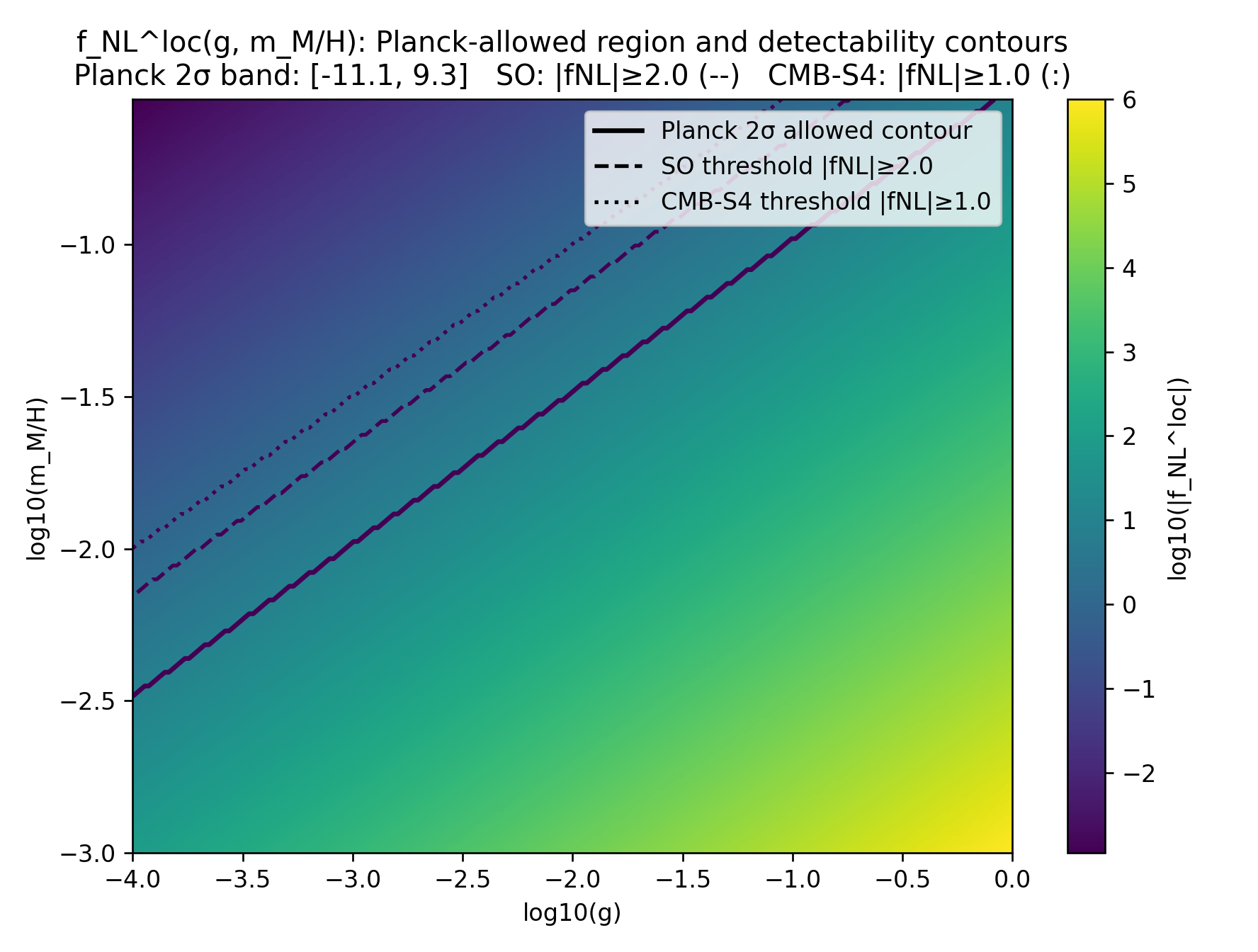
The bispectrum is therefore local-like but not identical to the pure local template. Existing observational constraints on [6] should therefore be interpreted as conservative bounds on the amplitude of the squeezed-enhanced component. This justifies the use of current constraints as proxies in parameter viability scans, while motivating refined estimators in future work.
6. Relation to Falsification-Oriented Viability Studies
Previous viability analyses employed the scaling
as an operational mapping between theory and observation. The present work clarifies that this mapping implicitly assumes:
- Super-horizon persistence of spectator fluctuations,
- Background modulation transfer to ,
- Dominance of squeezed-limit correlations.
Under these assumptions, null results forcing with high precision would falsify the underlying mechanism. Deviations from a pure local template, however, would refine rather than invalidate the scenario.
7. Discussion
The transfer mechanism developed here shows that derivative spectator couplings are fully compatible with local-like non-Gaussianity, provided the spectator field remains light and its fluctuations persist beyond horizon exit. The key ingredient is not the microscopic form of the coupling, but the existence of a super-horizon modulation channel.
This framework places the model squarely within the class of quasi-single-field inflationary scenarios, while preserving distinctive features associated with memory-bearing spectator dynamics. It also clarifies the interpretation of observational constraints used in falsification-oriented studies.
8. Conclusion
This paper has provided an explicit transfer mechanism by which fluctuations of a light spectator field with long-lived correlations are converted into observable curvature perturbations. Using background modulation and horizon-crossing mode coupling, this paper has shown how local-like non-Gaussianity arises without violating single-field consistency relations.
The analysis justifies the conservative use of existing local non-Gaussianity bounds as proxies for viability studies, while highlighting directions for refined bispectrum estimation. Together with complementary phenomenological analyses, this work completes the mechanistic foundation required to assess memory-bearing spectator fields in inflationary cosmology.
References
- Maldacena, J.M. Non-Gaussian features of primordial fluctuations in single field inflationary models. Journal of High Energy Physics 2003, 2003, 013. [Google Scholar] [CrossRef]
- Komatsu, E.; Afshordi, N.; Bartolo, N.; Baumann, D.; Byrnes, C.T.; Creminelli, P.; Fergusson, J.R.; Liguori, M.; Meerburg, P.D.; Regan, D.; et al. Primordial Non-Gaussianity in the Cosmic Microwave Background. Advances in Astronomy 2010, 2010, 565248. [Google Scholar] [CrossRef]
- Lyth, D.H.; Rodriguez, Y. The Inflationary prediction for primordial non-Gaussianity. Physical Review Letters 2005, 95, 121302. [Google Scholar] [CrossRef] [PubMed]
- Chen, X.; Wang, Y. Quasi-Single Field Inflation and Non-Gaussianities. Journal of Cosmology and Astroparticle Physics 2010, arXiv:hep-th/0911.33802010, 027. [Google Scholar] [CrossRef]
- Sasaki, M.; Stewart, E.D. A General analytic formula for the spectral index of the density perturbations produced during inflation. Progress of Theoretical Physics 1996, 95, 71–78. [Google Scholar] [CrossRef]
- Planck Collaboration; Akrami, Y.; Arroja, F.; Ashdown, M.; Aumont, J.; Baccigalupi, C.; Banday, A.J.; Barreiro, R.B.; Bartolo, N.; Benabed, K.; et al. Planck 2018 results. IX. Constraints on primordial non-Gaussianity. Astronomy & Astrophysics 2020, arXiv:astro-ph.CO/1905.05697641, A9. [Google Scholar] [CrossRef]
Disclaimer/Publisher’s Note: The statements, opinions and data contained in all publications are solely those of the individual author(s) and contributor(s) and not of MDPI and/or the editor(s). MDPI and/or the editor(s) disclaim responsibility for any injury to people or property resulting from any ideas, methods, instructions or products referred to in the content. |
© 2025 by the authors. Licensee MDPI, Basel, Switzerland. This article is an open access article distributed under the terms and conditions of the Creative Commons Attribution (CC BY) license (http://creativecommons.org/licenses/by/4.0/).
Copyright: This open access article is published under a Creative Commons CC BY 4.0 license, which permit the free download, distribution, and reuse, provided that the author and preprint are cited in any reuse.


