
Submitted:
21 December 2025
Posted:
22 December 2025
You are already at the latest version
Abstract
Addressing contemporary sustainability challenges requires higher education institutions to adopt integrative approaches that align education, research, and societal engagement. While service learning is widely recognized as an experiential pedagogical approach, its potential role in systematically integrating education and research for sustainable development remains underexplored. This study adopts conceptual research design and synthesizes prior literature on Education for Sustainable Development (ESD), service learning, and sustainability-oriented research. Based on this synthesis, the paper proposes an integrative conceptual framework that positions service learning as a central mechanism linking educational practices, research activities, and community engagement. The framework explains how service-learning fosters sustainability competencies, enhances civic engagement, and improves research relevance, thereby contributing to sustainability outcomes aligned with the United Nations Sustainable Development Goals (SDGs). By clarifying key mechanisms and pathways, this study advances theoretical understanding of sustainability-oriented service learning and offers practical insights for educators, researchers, institutions, and policymakers. The paper further outlines directions for future empirical research to test and refine the proposed framework.
Keywords:
service learning
; education for sustainable development
; sustainability
; higher education
; community engagement
; experiential learning
; sustainable development goals
1. Introduction
Sustainability has become one of the most critical global challenges of the twenty-first century, encompassing environmental degradation, climate change, biodiversity loss, social inequality, and economic instability. These interconnected challenges threaten the well-being of present and future generations and require systemic and transformative responses rather than isolated technical solutions [1,2,3]. Sustainability-related problems are increasingly characterized as complex and “wicked,” involving uncertainty, interdependence, and competing values, which necessitate integrative approaches that combine knowledge creation, ethical reasoning, civic engagement, and collective action [4,5,6].
Within this global context, higher education institutions (HEIs) are widely recognized as key actors in advancing sustainable development. Universities play a dual role by educating future professionals and leaders while generating research that informs policy and societal practice [7,8]. Over the past two decades, sustainability has been progressively embedded in higher education through curriculum reform, interdisciplinary research, campus sustainability initiatives, and community engagement activities [9,10,11]. These developments are closely aligned with the global agenda of Education for Sustainable Development (ESD), which emphasizes the role of education in empowering individuals to contribute actively to sustainable societies [12].
ESD extends beyond traditional content-based instruction by emphasizing the development of sustainability-oriented competencies, values, and behaviors. It promotes holistic and systems-based thinking, participatory and learner-centered pedagogies, and action-oriented learning that enables learners to address complex sustainability challenges in real-world contexts [13,14,15]. The adoption of the United Nations Sustainable Development Goals (SDGs) has further strengthened the relevance of ESD by providing a shared framework through which education and research activities can be aligned with global sustainability priorities [16,17].
Despite substantial progress, important limitations remain in current sustainability education and research practices. Sustainability-related courses often remain largely theoretical, with limited opportunities for learners to engage in real-world problem-solving or community-based action [18,19]. Similarly, sustainability research has been criticized for being fragmented, discipline-bound, and insufficiently connected to societal needs and practical implementation [20,21,22]. This persistent gap between knowledge generation and real-world application has been widely identified as a major barrier to achieving meaningful and lasting sustainability outcomes.
In response to these challenges, scholars increasingly emphasize the importance of experiential and community-engaged learning approaches that link academic learning with societal problem-solving [23,24,25]. Among these approaches, service learning has received growing attention. Service learning integrates academic instruction with organized service activities that address community-identified needs, supported by structured reflection to enhance learning, civic responsibility, and social awareness [26,27,28]. Through reciprocal partnerships between universities and communities, service learning enables students to apply theoretical knowledge in authentic contexts while contributing to social and environmental well-being.
An expanding body of research highlights the potential of service learning to support sustainability education by fostering student engagement, ethical awareness, systems thinking, and civic responsibility [29,30,31]. Sustainability-focused service learning initiatives have been applied across diverse domains, including environmental management, public health, social justice, urban development, and climate action. These studies suggest that service learning can play a critical role in advancing ESD by enabling learners to develop sustainability competencies through experiential and reflective processes.
However, the existing literature on service learning remains predominantly pedagogy-centered, with a strong focus on short-term student learning outcomes at the course or program level [32,33]. Comparatively limited attention has been paid to the systematic integration of service learning with research activities, institutional sustainability strategies, and long-term community impact. In practice, many service-learning initiatives are short-term, instructor-dependent, and weakly connected to broader research agendas or institutional sustainability goals [34,35]. Consequently, challenges related to continuity, scalability, evaluation, and sustained impact remain insufficiently addressed.
Recent scholarship has therefore called for stronger integration between education, research, and societal engagement to address sustainability challenges more effectively [36,37]. From this perspective, service learning holds significant potential not only as a pedagogical approach but also as a mechanism for knowledge co-production, applied research, and sustainability-oriented innovation. When aligned with research objectives, service learning can enhance the relevance, legitimacy, and impact of sustainability research while strengthening long-term university–community partnerships [38,39,40].
Against this backdrop, the MDPI Sustainability Special Issue “Advancing Sustainable Futures: Integrating Service Learning in Education and Research” provides a timely platform to advance understanding of how service learning can be systematically embedded within sustainability-oriented education and research. Addressing this need, the present paper develops a conceptual framework that explains how integrating service learning across the educational and research functions of higher education institutions can contribute to sustainable futures.
1.1. Aim and Contributions of the Study
The aim of this paper is to conceptualize service learning as an integrative mechanism linking education, research, and community engagement in support of sustainable development. Specifically, the paper proposes a framework illustrating how service learning integration fosters sustainability competencies, enhances research relevance, and generates societal impact aligned with the SDGs.
This study contributes to the literature in four ways. First, it integrates ESD and service learning scholarship by explicitly incorporating research processes into sustainability-focused service learning. Second, it clarifies the mechanisms through which service learning may lead to sustainability outcomes beyond short-term learning effects. Third, it offers institutionally relevant insights for designing scalable and evaluable service learning initiatives. Finally, it outlines a future research agenda to guide empirical investigation and methodological advancement in sustainability education and research.
1.2. Structure of the Paper
The remainder of this paper is organized as follows. Section 2 reviews Education for Sustainable Development and sustainability competencies in higher education. Section 3 examines service learning as an experiential and community-engaged approach relevant to sustainability. Section 4 presents the proposed conceptual framework integrating service learning into education and research. Section 5 discusses implications for educators, researchers, institutions, and policymakers. Section 6 outlines future research directions, and Section 7 concludes the paper.
2. Education for Sustainable Development and Sustainability Competencies
Education for Sustainable Development (ESD) has become a central concept in global efforts to address sustainability challenges through education and research. ESD is grounded in the idea that education should not only transmit knowledge but also empower individuals to contribute actively to sustainable social, environmental, and economic development [41,42]. Internationally, ESD has been promoted as a transformative approach capable of reshaping learning processes, institutional practices, and societal engagement to support long-term sustainability goals [43].
The role of ESD has been further reinforced through global policy frameworks, particularly those led by UNESCO and the United Nations. The United Nations Decade of Education for Sustainable Development (2005–2014) and the subsequent Global Action Programme on ESD emphasized the integration of sustainability principles across all levels of education [44,45]. More recently, the UN Sustainable Development Goals (SDGs)—especially SDG 4 on quality education—have positioned ESD as a key mechanism for achieving broader sustainability objectives [16,45]. Within higher education, ESD is increasingly viewed as a strategic priority that aligns teaching, research, and societal engagement with global sustainability agendas [12,14,15,41,42].
2.1. Core Principles of Education for Sustainable Development
ESD is distinguished by a set of pedagogical and philosophical principles that differentiate it from conventional education models. One core principle is holistic and systems-based thinking, which emphasizes the interconnectedness of environmental, social, and economic dimensions of sustainability [42]. This perspective encourages learners to move beyond linear cause–effect reasoning and to consider complex interactions, feedback loops, and unintended consequences.
Another defining feature of ESD is its emphasis on participatory and learner-centered pedagogies. Rather than positioning learners as passive recipients of information, ESD promotes active engagement, dialogue, collaboration, and critical reflection [12,14,15,41,42]. These approaches are designed to foster deeper learning and to support the development of agency and responsibility among learners.
ESD also prioritizes action-oriented learning, encouraging learners to apply knowledge in practical contexts and to engage with real-world sustainability challenges [16]. This action orientation is closely linked to values-based education, as ESD seeks to cultivate ethical awareness, social justice, and intergenerational responsibility [42]. Together, these principles underscore the need for educational approaches that connect theory with practice and learning with societal transformation.
2.2. Sustainability Competencies in Higher Education
A key focus of ESD scholarship has been the identification and development of sustainability competencies—integrated combinations of knowledge, skills, attitudes, and values that enable individuals to address sustainability challenges effectively [6]. Among the most widely cited frameworks is the competency model proposed by Wiek et al., which identifies core competencies necessary for sustainability problem-solving [14].
These competencies typically include systems thinking competence, defined as the ability to understand and analyze complex systems and interdependencies [6]. Anticipatory competence refers to the capacity to consider future scenarios, risks, and long-term consequences of decisions [6]. Normative competence involves the ability to reflect on values, ethics, and norms underlying sustainability challenges and solutions [5,6]. Strategic competence relates to designing and implementing interventions that contribute to sustainable change [6].
In addition to these, scholars emphasize the importance of collaboration and interpersonal competence, which supports stakeholder engagement, teamwork, and conflict resolution in sustainability contexts [6,38]. Critical thinking and self-reflection are also essential, enabling learners to question assumptions, evaluate evidence, and reflect on their own roles in sustainability transitions [5,14]. Collectively, these competencies highlight the multidimensional nature of sustainability learning and the need for educational environments that support experiential and reflective learning processes [23,25].
2.3. Challenges in Implementing ESD in Higher Education
Despite widespread recognition of its importance, the implementation of ESD in higher education remains uneven and challenging. Many ESD initiatives are limited to individual courses or programs and rely heavily on motivated faculty members rather than institutional strategies [9,10,14,37]. As a result, sustainability education efforts are often fragmented and lack coherence across disciplines and organizational structures [11,37].
Another challenge concerns assessment and evaluation. While sustainability competencies are widely discussed, measuring their development and long-term impact remains methodologically complex [18,19]. Assessment practices often prioritize cognitive outcomes, such as knowledge acquisition, while giving less attention to behavioral change, civic engagement, or community-level impact [18,19].
Furthermore, ESD initiatives frequently struggle to bridge the gap between academic learning and societal needs. Without meaningful engagement with external stakeholders, sustainability education risks remaining abstract and disconnected from real-world challenges [20,21]. These limitations have prompted calls for pedagogical approaches that integrate learning, research, and community engagement more effectively [36,37].
2.4. The Need for Experiential and Community-Engaged Approaches
To address these challenges, scholars increasingly advocate for experiential and community-engaged pedagogies within ESD [23,25,29]. Such approaches enable learners to engage directly with sustainability issues, collaborate with community partners, and apply theoretical knowledge in practice [29,30]. Importantly, they also facilitate knowledge co-production, where academic and community knowledge inform one another [20,21,34].
Within this context, service learning has been identified as a particularly promising approach for advancing ESD objectives. By integrating academic learning with meaningful service activities and structured reflection, service learning aligns closely with ESD principles of action-oriented, participatory, and values-based education [23,24,25,26]. When connected to research activities, service learning further offers opportunities to enhance research relevance, societal impact, and institutional sustainability strategies [20,21,34,36].
3. Service Learning as an Experiential and Community-Engaged Approach
Service learning has been widely recognized as an experiential and community-engaged educational approach that integrates academic learning with meaningful service activities addressing community-identified needs. Unlike traditional volunteerism or internships, service learning is intentionally designed to link service experiences with academic objectives and structured reflection, thereby enhancing learning outcomes while contributing to societal well-being [24,25,26]. Through reciprocal partnerships between higher education institutions and communities, service learning emphasizes mutual benefit, shared responsibility, and sustained engagement [24,25].
Over the past several decades, service learning has gained increasing attention within higher education as institutions seek pedagogical approaches that foster civic responsibility, ethical awareness, and applied problem-solving skills [25,27,28]. Its relevance has become particularly salient in the context of sustainability, where complex challenges require learners to engage directly with real-world issues, collaborate with diverse stakeholders, and reflect on the social and environmental implications of their actions [29,30]
3.1. Defining Service Learning and Its Core Characteristics
Service learning is commonly defined as a pedagogical approach that combines academic instruction with organized service activities that respond to community needs and include opportunities for reflection to enhance learning and civic engagement [24,25,26]. Key characteristics distinguish service learning from related experiential learning approaches. First, service learning is curriculum-integrated, meaning that service activities are directly linked to course objectives and learning outcomes. Second, it is community-oriented, with projects designed in collaboration with community partners to ensure relevance and reciprocity. Third, structured reflection is a central component, enabling learners to connect experience with theory, critically examine assumptions, and internalize learning [23,25].
These characteristics align closely with experiential learning theory, which conceptualizes learning as a cyclical process involving concrete experience, reflective observation, abstract conceptualization, and active experimentation [23]. By engaging learners in this cycle, service learning supports deeper cognitive, effective and behavioral learning outcomes compared to more passive instructional methods [25,27].
3.2. Educational Benefits of Service Learning
A substantial body of empirical research documents the educational benefits of service learning across disciplines. Studies consistently report positive effects on student engagement, motivation, and academic achievement [27,32]. Service learning has also been shown to enhance critical thinking, problem-solving abilities, and the capacity to apply theoretical knowledge in practical contexts [25,27].
Beyond cognitive outcomes, service learning plays a significant role in fostering civic responsibility, ethical awareness, and social sensitivity [25,28]. Through direct interaction with community members and exposure to real-world challenges, learners develop a deeper understanding of social inequalities, environmental issues, and the broader consequences of policy and organizational decisions. These outcomes are particularly relevant to sustainability education, which seeks to cultivate not only knowledge but also values and dispositions supportive of sustainable development [18,19].
3.3. Service Learning and Sustainability Education
The alignment between service learning and sustainability education has been widely acknowledged in the literature. Sustainability challenges are inherently interdisciplinary, context-specific, and value-laden, making them well suited to experiential and community-engaged pedagogies [29,30,31]. Service learning enables learners to engage with sustainability issues such as environmental management, public health, urban planning, social inclusion, and climate adaptation in authentic settings [29,30].
Research suggests that sustainability-focused service learning can effectively support the development of sustainability competencies, including systems thinking, collaboration, ethical reasoning, and strategic action [6,29,30]. By working with community partners on real sustainability challenges, learners gain insight into the complexity of sustainability transitions and the need for stakeholder collaboration and long-term commitment [20,21].
Furthermore, service learning provides a practical mechanism for operationalizing the United Nations Sustainable Development Goals (SDGs) within higher education. Many service learning projects are explicitly aligned with SDG targets, allowing institutions to translate global sustainability agendas into locally meaningful actions [16,17]. This alignment strengthens the relevance of sustainability education and enhances institutional accountability for societal impact [37,44,45].
3.4. Service Learning as a Bridge Between Education and Research
While the pedagogical value of service learning is well established, its potential role in supporting sustainability-oriented research has received comparatively less attention. Traditionally, service learning initiatives have been implemented at the course level, with limited integration into broader research agendas or institutional sustainability strategies [33,37]. As a result, opportunities to leverage service learning for applied research, knowledge co-production, and long-term impact are often underutilized [20,21].
Recent scholarship on community-engaged research and the scholarship of engagement highlights the potential for service learning to function as a bridge between education and research [34,35,36]. When service learning projects are aligned with research objectives, they can generate context-rich data, support participatory research designs, and enhance the societal relevance of academic research. In sustainability contexts, such integration is particularly valuable, as it enables researchers to co-create knowledge with stakeholders and to address real-world problems in situ [20,21,38].
3.5. Limitations and Challenges of Service Learning in Sustainability Contexts
Despite its potential, service learning also faces several challenges, particularly when applied to sustainability education and research. One major limitation concerns scalability and continuity. Many service-learning projects are short-term and dependent on individual instructors, making it difficult to sustain partnerships or achieve long-term sustainability outcomes [33,35].
Another challenge relates to assessment and evaluation. Measuring the impacts of service learning on sustainability competencies, community outcomes, and research relevance remains methodologically complex [18,19,27]. Additionally, power imbalances between universities and community partners can undermine reciprocity if not carefully managed, potentially leading to extractive or symbolic engagement [28,40].
These challenges underscore the need for integrative frameworks that embed service learning within institutional strategies, research agendas, and sustainability policies. Addressing these issues is essential for realizing the full potential of service learning as a driver of sustainable futures [36,37].
4. Integrating Service Learning in Education and Research: A Proposed Conceptual Framework
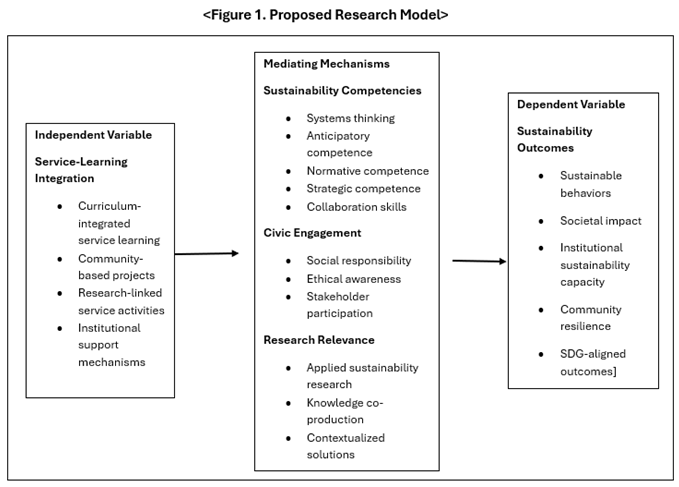
While Education for Sustainable Development (ESD) and service learning have each been widely discussed in the sustainability literature, their systematic integration across education and research functions of higher education institutions remains underdeveloped. Addressing sustainability challenges requires approaches that move beyond fragmented pedagogical initiatives toward institutionalized models that align teaching, research, and community engagement [36,37]. Building on prior work on ESD, experiential learning, and community-engaged scholarship, this section proposes a conceptual framework that positions service learning as a central mechanism for integrating education and research in support of sustainable futures. Figure 1. Conceptual framework illustrating the integration of service learning into education and research for advancing sustainable futures. Service-learning integration functions as a central mechanism linking educational practices and sustainability-oriented research with community engagement. Through the mediating roles of sustainability competencies, civic engagement, and research relevance, integrated service learning contributes to sustainability outcomes at individual, institutional, and community levels aligned with the United Nations Sustainable Development Goals (SDGs).
4.1. Conceptual Rationale
Sustainability challenges are complex, context-specific, and value-driven, requiring solutions that are co-created with stakeholders rather than produced solely within academic settings [20,21]. Traditional research approaches, while valuable for theory development, often struggle to translate findings into actionable outcomes, particularly in community and policy contexts [22]. Similarly, sustainability education initiatives may succeed in raising awareness but fall short of producing sustained behavioral change or societal impact when learning is disconnected from practice [18,19].
Service learning offers a unique opportunity to bridge these gaps by embedding experiential learning, research activities, and community engagement within a single integrative approach. When aligned with institutional strategies, service learning can function as a platform for knowledge co-production, applied research, and sustainability-oriented innovation [38]. This perspective is consistent with broader calls for universities to act as agents of sustainability transitions by aligning their core missions with societal needs [36,40].
4.2. Core Components of the Framework
The proposed framework (Figure 1) conceptualizes service-learning integration as the central enabling mechanism linking education, research, and sustainability outcomes. The framework consists of three interrelated components: (i) service-learning integration, (ii) mediating mechanisms, and (iii) sustainability outcomes.
4.2.1. Service-Learning Integration
At the core of the framework is service-learning integration, defined as the intentional and systematic embedding of service learning within curricula, research agendas, and institutional sustainability strategies. This integration extends beyond isolated course-based projects to include long-term partnerships with communities, alignment with research objectives, and institutional support structures [34,35].
Key features of service-learning integration include:
- Alignment of service learning projects with sustainability-focused learning outcomes and SDGs;
- Collaboration between educators, researchers, students, and community partners;
- Integration of service activities with applied and participatory research designs;
- Institutional mechanisms that support continuity, evaluation, and scalability.
By embedding service learning at multiple levels, institutions can create coherent pathways that connect education and research with societal impact.
4.2.2. Mediating Mechanisms
The framework identifies three key mediating mechanisms through which service learning integration contributes to sustainable futures: sustainability competencies, civic engagement, and research relevance.
Sustainability competencies refer to the development of systems thinking, anticipatory, normative, strategic, and interpersonal competencies among learners and researchers [6,14]. Through experiential engagement and reflection, service learning provides opportunities to apply sustainability knowledge in real-world contexts, thereby deepening competency development [23,29,30].
Civic engagement reflects the extent to which individuals develop a sense of social responsibility, ethical awareness, and commitment to collective action [25,28]. Service learning fosters civic engagement by exposing participants to community challenges and encouraging reflective consideration of power, equity, and responsibility in sustainability transitions [28,40].
Research relevance captures the degree to which research activities address real-world sustainability challenges and generate knowledge that is actionable and socially meaningful [20,21,38]. When service learning is linked to research objectives, it can enhance the contextual relevance, legitimacy, and impact of sustainability research through stakeholder involvement and knowledge co-production [20,21,34,36].
These mediating mechanisms operate at individual and institutional levels and interact dynamically to support sustainability outcomes.
4.3. Sustainability Outcomes
The framework conceptualizes sustainability outcomes as multi-level and multidimensional, encompassing individual, institutional, and community-level impacts. At the individual level, outcomes include enhanced sustainability literacy, ethical awareness, and long-term pro-sustainability behaviors [18,19]. At the institutional level, outcomes may involve strengthened university–community partnerships, increased alignment of research and teaching with SDGs, and enhanced institutional capacity for sustainability action [11,37,44,45].
At the community level, sustainability outcomes include improved problem-solving capacity, locally relevant knowledge, and progress toward environmental and social sustainability goals [16,17,20,21]. Importantly, these outcomes are not viewed as linear or immediate but as emergent properties of sustained engagement, learning, and collaboration over time.
4.4. Feedback Loops and Dynamic Relationships
Consistent with systems-based perspectives on sustainability, the proposed framework incorporates feedback loops that connect outcomes back to service learning integration and mediating mechanisms. Positive sustainability outcomes can reinforce institutional commitment, strengthen partnerships, and inform curriculum and research design, thereby enhancing the effectiveness of future service learning initiatives [5,6].
These dynamic relationships highlight the importance of longitudinal and adaptive approaches to sustainability education and research. Rather than viewing service learning as a one-off intervention, the framework emphasizes its role as a continuous and evolving process embedded within institutional sustainability strategies [36,37].
4.5. Implications of the Framework
The proposed conceptual framework provides a foundation for both practice and research. For educators and administrators, it offers guidance on designing integrated service learning initiatives that align with sustainability goals and institutional missions. For researchers, the framework identifies key constructs and relationships that can be empirically tested using quantitative, qualitative, or mixed-methods approaches.
By positioning service learning as a central mechanism for integrating education and research, the framework responds directly to calls for more impactful, engaged, and sustainability-oriented higher education practices [11,36,37]. It also aligns closely with the aims of the MDPI Sustainability Special Issue by advancing understanding of how service learning can contribute to sustainable futures through integrated educational and research approaches.
5. Implications for Education, Research, Institutions and Policy
The proposed conceptual framework has important implications for multiple stakeholders involved in sustainability education and research. By positioning service learning as an integrative mechanism linking education, research, and community engagement, the framework provides guidance for educators, researchers, higher education institutions, and policymakers seeking to advance sustainable development in a systematic and impactful manner.
5.1. Implications for Education and Teaching Practice
For educators, the framework highlights the need to move beyond isolated, course-based sustainability initiatives toward intentionally designed service-learning experiences that are aligned with Education for Sustainable Development (ESD) principles. Integrating service learning into sustainability education can enhance learner engagement, deepen understanding of complex sustainability challenges, and foster the development of sustainability competencies such as systems thinking, ethical reasoning, and collaboration [6,29,30].
Educators are encouraged to design curricula that embed service learning across programs and disciplines rather than confining it to elective or capstone courses. Such integration can support continuity in learning and provide students with repeated opportunities to apply sustainability knowledge in real-world contexts [9,10,14]. Structured reflection should be emphasized as a core pedagogical element to ensure that experiential activities are meaningfully connected to theoretical learning and sustainability values [23,25].
5.2. Implications for Sustainability-Oriented Research
For researchers, the framework underscores the potential of service learning to enhance the relevance, legitimacy, and impact of sustainability research. By aligning service learning projects with research objectives, scholars can engage in applied and participatory research that addresses real-world sustainability challenges in collaboration with community stakeholders [20,21,38].
Such integration supports the co-production of knowledge, where academic expertise and local knowledge are combined to generate context-sensitive and actionable insights [20,21,34]. Moreover, service learning–based research can contribute to methodological innovation by supporting mixed-methods, longitudinal, and participatory research designs [34,36].
5.3. Institutional Implications for Higher Education Institutions
At the institutional level, the framework highlights the importance of embedding service learning within broader sustainability strategies and governance structures. Sustainable integration requires institutional support mechanisms, including recognition of service learning in faculty workload models, incentives for community-engaged research, and dedicated units or platforms for coordinating partnerships [34,35].
Higher education institutions are encouraged to align service-learning initiatives with their sustainability missions, SDG commitments, and research priorities [11,37,44,45]. Additionally, long-term partnerships with community organizations are essential for ensuring continuity, trust, and mutual benefit [33,35].
5.4. Implications for Policy and Governance
From a policy perspective, the framework suggests that education and research policies should explicitly support the integration of service learning within sustainability agendas. Policymakers can promote such integration by incorporating service learning and community engagement into accreditation standards and funding criteria [44,45].
Policy support is also critical for fostering cross-sector collaboration among universities, government agencies, industry, and civil society organizations [36,40]. Furthermore, aligning service-learning initiatives with the SDGs can support monitoring and reporting of progress toward sustainability targets [16,17].
5.5. Addressing Challenges and Ensuring Quality
While the integration of service learning offers significant benefits, it also requires careful attention to challenges related to quality, equity, and ethics. Institutions must ensure that community partnerships are reciprocal and avoid extractive practices [28,40]. Capacity-building for faculty and community partners is also critical to support high-quality implementation [14,35].
6. Future Research Directions
While this paper advances understanding of how service learning can be integrated into education and research to support sustainable futures, significant opportunities remain for future scholarly inquiry. Building on the proposed conceptual framework, this section outlines key directions for future research that can deepen theoretical understanding, strengthen empirical evidence, and enhance practical implementation of sustainability-focused service learning.
6.1. Empirical Testing of the Conceptual Framework
A priority for future research is the empirical validation of the proposed conceptual framework. Quantitative studies could examine the relationships between service-learning integration, mediating mechanisms (e.g., sustainability competencies, civic engagement, and research relevance), and sustainability outcomes using survey-based designs and structural equation modeling [18,19,34,36]. Such studies would allow researchers to test the strength and direction of proposed pathways and to assess the relative importance of different mediators.
In addition, qualitative and mixed-methods approaches could provide deeper insight into how these mechanisms operate in practice. Case studies, interviews, and participatory observation can help unpack contextual factors that influence the effectiveness of service learning integration across disciplines and institutional settings [20,21,38].
6.2. Longitudinal and Impact-Oriented Research
Much of the existing service learning literature focuses on short-term educational outcomes, often measured at the end of a course or program [32,33]. Future research should adopt longitudinal designs to examine the durability of sustainability competencies, civic engagement, and behavioral change over time. Such studies are particularly important for understanding whether service learning contributes to sustained pro-sustainability practices among graduates and professionals [18,19].
Long-term research is also needed to assess community-level and institutional impacts, including changes in community capacity, policy influence, and organizational practices resulting from sustained service learning partnerships [20,21,36,37]. Developing robust indicators and evaluation frameworks for these outcomes remains a critical research challenge.
6.3. Measurement and Assessment Development
Another important research direction involves the development and validation of measurement instruments for sustainability competencies, civic engagement, and research relevance within service learning contexts. While several competency frameworks have been proposed, there is limited consensus on standardized measures that are applicable across disciplines and cultural contexts [6,14,18].
Future studies should focus on refining existing scales or developing new tools that capture both cognitive and non-cognitive outcomes, including values, attitudes, and behaviors. Combining self-reported measures with behavioral indicators and third-party assessments may enhance validity and reliability [18,19]
6.4. Cross-Cultural and Comparative Studies
Sustainability challenges and educational contexts vary widely across regions and cultures, underscoring the need for cross-cultural and comparative research. Future studies could compare service learning integration across countries, institutional types, and socio-economic contexts to identify enabling conditions, barriers, and culturally specific practices [9,10,16].
6.5. Digital and Technology-Enhanced Service Learning
The growing role of digital technologies in education and research presents new opportunities for sustainability-focused service learning. Future research should explore how technology-enhanced and virtual service-learning models can support sustainability objectives, particularly in contexts where face-to-face engagement is constrained [23,29].
Digital platforms may facilitate collaboration, data collection, reflection, and knowledge sharing across geographic boundaries, enabling more inclusive and scalable service-learning initiatives. However, research is needed to examine the effectiveness, equity implications, and ethical considerations of such approaches in sustainability contexts [18,40].
6.6. Institutional and Policy-Oriented Research
Finally, future research should examine institutional and policy-level factors that enable or constrain the integration of service learning into sustainability education and research. Studies could investigate governance structures, incentive systems, funding mechanisms, and accreditation frameworks that support or hinder service-learning integration [34,44].
Policy-oriented research is particularly important for understanding how national and international education policies influence the adoption of ESD and service-learning practices. Such work can inform evidence-based policymaking and contribute to the scaling of successful models across higher education systems [36,45].
7. Conclusions
Addressing contemporary sustainability challenges requires educational and research approaches that move beyond disciplinary silos and theoretical abstraction toward meaningful engagement with real-world problems. This paper has argued that service learning, when systematically integrated into both education and research, offers a powerful mechanism for advancing sustainable futures. By bridging academic learning, sustainability-oriented research, and community engagement, service learning can support the transformative objectives of Education for Sustainable Development (ESD) and contribute to progress toward the United Nations Sustainable Development Goals (SDGs).
Building on existing literature in sustainability education, experiential learning, and community-engaged scholarship, this study proposed a conceptual framework that positions service learning as a central integrative mechanism within higher education institutions. The framework highlights how service-learning integration fosters sustainability competencies, strengthens civic engagement, and enhances research relevance, thereby generating sustainability outcomes at individual, institutional, and community levels. In doing so, the paper responds to calls for more coherent and impact-oriented approaches to sustainability in higher education.
The findings of this conceptual analysis underscore several key insights. First, service learning should be understood not merely as a pedagogical tool, but as a strategic approach capable of aligning teaching and research with societal sustainability needs. Second, sustained and institutionalized integration—rather than isolated, course-based initiatives—is essential for achieving long-term impact and scalability. Third, the effectiveness of sustainability-focused service learning depends on reciprocal partnerships, structured reflection, and alignment with institutional and policy frameworks.
While this paper offers a theoretical contribution, it also acknowledges limitations inherent in conceptual research. The proposed framework has not been empirically tested and should therefore be viewed as a foundation for future investigation rather than a definitive model. Nevertheless, by articulating key constructs, relationships, and impact pathways, the framework provides a valuable starting point for empirical research, institutional experimentation, and policy development.
In conclusion, integrating service learning into education and research represents a promising pathway for advancing sustainable futures. As higher education institutions seek to strengthen their societal relevance and sustainability impact, service learning offers a means of translating sustainability knowledge into action, fostering responsible citizenship, and co-creating solutions with communities. Through continued research, institutional commitment, and supportive policy environments, service learning can play a pivotal role in shaping more sustainable and resilient societies.
Author Contributions
Conceptualization, U.R.; methodology, U.R.; formal analysis, U.R.; investigation, U.R.; writing—original draft preparation, U.R.; writing—review and editing, U.R.; visualization, U.R.; supervision, U.R. All authors have read and agreed to the published version of the manuscript.
Funding
This research received no external funding.
Data Availability Statement
Not applicable. This study is conceptual in nature and did not involve the collection or analysis of empirical data.
Conflicts of Interest
The author declares no conflict of interest.
Abbreviations
The following abbreviations are used in this manuscript:
| MDPI | Multidisciplinary Digital Publishing Institute |
| DOAJ | Directory of open access journals |
| TLA | Three letter acronym |
| LD | Linear dichroism |
References
- World Commission on Environment and Development (WCED). Our Common Future; Oxford University Press: Oxford, UK, 1987. [Google Scholar]
- Rockström, J.; Steffen, W.; Noone, K.; et al. A safe operating space for humanity. Nature 2009, 461, 472–475. [Google Scholar] [CrossRef]
- Sachs, J.D. The Age of Sustainable Development; Columbia University Press: New York, NY, USA, 2015. [Google Scholar]
- Rittel, H.W.J.; Webber, M.M. Dilemmas in a general theory of planning. Policy Sci. 1973, 4, 155–169. [Google Scholar] [CrossRef]
- Sterling, S. Transformative learning and sustainability: Sketching the conceptual ground. Learn. Teach. High. Educ. 2010, 5, 17–33. [Google Scholar]
- Wiek, A.; Withycombe, L.; Redman, C.L. Key competencies in sustainability: A reference framework for academic program development. Sustain. Sci. 2011, 6, 203–218. [Google Scholar] [CrossRef]
- Cortese, A.D. The critical role of higher education in creating a sustainable future. Plan. High. Educ. 2003, 31, 15–22. [Google Scholar]
- Lozano, R.; Lukman, R.; Lozano, F.J.; Huisingh, D.; Lambrechts, W. Declarations for sustainability in higher education: Becoming better leaders, through addressing the university system. J. Clean. Prod. 2013, 48, 10–19. [Google Scholar] [CrossRef]
- Leal Filho, W.; Shiel, C.; Paço, A. Implementing and operationalising integrative approaches to sustainability in higher education. J. Clean. Prod. 2015, 106, 349–365. [Google Scholar]
- Aleixo, A.M.; Azeiteiro, U.M.; Leal Filho, W. Are the sustainable development goals being implemented in the Portuguese higher education formative offer? Int. J. Sustain. High. Educ. 2021, 22, 129–148. [Google Scholar] [CrossRef]
- Trencher, G.; Yarime, M.; McCormick, K.; Doll, C.; Kraines, S. Beyond the third mission: Exploring the emerging university function of co-creation for sustainability. Sci. Public Policy 2014, 41, 151–179. [Google Scholar] [CrossRef]
- UNESCO. Education for Sustainable Development Goals: Learning Objectives; UNESCO: Paris, France, 2017. [Google Scholar]
- Tilbury, D. Education for sustainable development: An expert review of processes and learning. UNESCO Rep., 2011. [Google Scholar]
- Barth, M.; Rieckmann, M. Academic staff development as a catalyst for curriculum change toward education for sustainable development. J. Clean. Prod. 2012, 26, 28–36. [Google Scholar] [CrossRef]
- Sterling, S.; Maxey, L.; Luna, H. The Sustainable University: Progress and Prospects; Routledge: London, UK, 2013. [Google Scholar]
- United Nations. Transforming Our World: The 2030 Agenda for Sustainable Development; UN: New York, NY, USA, 2015. [Google Scholar]
- Leal Filho, W.; et al. The role of higher education institutions in sustainability initiatives at the local level. J. Clean. Prod. 2020, 233, 1004–1015. [Google Scholar] [CrossRef]
- Shephard, K. Higher education for sustainability: Seeking affective learning outcomes. Int. J. Sustain. High. Educ. 2008, 9, 87–98. [Google Scholar] [CrossRef]
- Barth, M.; Michelsen, G. Learning for change: An educational contribution to sustainability science. Sustain. Sci. 2013, 8, 103–119. [Google Scholar] [CrossRef]
- Lang, D.J.; et al. Transdisciplinary research in sustainability science. Sustain. Sci. 2012, 7, 25–43. [Google Scholar] [CrossRef]
- Polk, M. Transdisciplinary co-production: Designing and testing a transdisciplinary research framework. Futures 2015, 65, 110–122. [Google Scholar] [CrossRef]
- Trencher, G.; et al. Evaluating core competencies development in sustainability-focused higher education. Int. J. Sustain. High. Educ. 2018, 19, 167–185. [Google Scholar]
- Kolb, D.A. Experiential Learning: Experience as the Source of Learning and Development; Prentice Hall: Englewood Cliffs, NJ, USA, 1984. [Google Scholar]
- Bringle, R.G.; Hatcher, J.A. Implementing service learning in higher education. J. Higher Educ. 1996, 67, 221–239. [Google Scholar] [CrossRef]
- Eyler, J.; Giles, D.E. Where’s the Learning in Service-Learning? Jossey-Bass: San Francisco, CA, USA, 1999. [Google Scholar]
- Furco, A. Service-learning: A balanced approach to experiential education. Expanding Boundaries 2002, 1, 25–38. [Google Scholar]
- Celio, C.I.; Durlak, J.; Dymnicki, A. A meta-analysis of the impact of service-learning on students. J. Exp. Educ. 2011, 34, 164–181. [Google Scholar]
- Mitchell, T.D. Traditional vs. critical service-learning. Mich. J. Community Serv. Learn. 2008, 14, 50–65. [Google Scholar]
- Brundiers, K.; Wiek, A. Educating students in real-world sustainability research. Int. J. Sustain. High. Educ. 2011, 12, 308–324. [Google Scholar]
- Sipos, Y.; Battisti, B.; Grimm, K. Achieving transformative sustainability learning. Int. J. Sustain. High. Educ. 2008, 9, 68–86. [Google Scholar] [CrossRef]
- Leal Filho, W.; et al. Experiential learning and sustainability outcomes. Sustainability 2018, 10, 1–19. [Google Scholar]
- Eyler, J. The power of experiential education. Liberal Educ. 2009, 95, 24–31. [Google Scholar]
- Disterheft, A.; et al. Sustainability science and education for sustainable development. Int. J. Sustain. High. Educ. 2016, 17, 15–34. [Google Scholar]
- Hall, B.; et al. Knowledge mobilization and engaged scholarship. Higher Educ. 2014, 67, 1–15. [Google Scholar]
- Boyer, E.L. The scholarship of engagement. J. Public Serv. Outreach 1996, 1, 11–20. [Google Scholar] [CrossRef]
- Wiek, A.; et al. Challenges of transdisciplinary research. Sustain. Sci. 2012, 7, 5–14. [Google Scholar] [CrossRef]
- Lozano, R.; et al. Universities as drivers of sustainable development. Int. J. Sustain. High. Educ. 2019, 20, 134–153. [Google Scholar]
- Reed, M.S. Stakeholder participation for environmental management. Biol. Conserv. 2008, 141, 2417–2431. [Google Scholar] [CrossRef]
- Mitchell, T.D.; et al. Civic engagement outcomes of service learning. Innov. High. Educ. 2016, 41, 1–15. [Google Scholar]
- Glass, C.R.; Bringle, R.G. Research ethics and community engagement. J. Higher Educ. Outreach Engagem. 2018, 22, 9–34. [Google Scholar]
- UNESCO. Global Action Programme on Education for Sustainable Development; UNESCO: Paris, France, 2015. [Google Scholar]
- Rieckmann, M. Learning to transform the world. Int. J. Sustain. High. Educ. 2017, 18, 1–14. [Google Scholar]
- Sterling, S. Sustainable education—Re-visioning learning and change; Green Books, 2001. [Google Scholar]
- Leal Filho, W.; et al. ESD in higher education institutions. Sustainability 2021, 13, 1–18. [Google Scholar]
- Aleixo, A.M.; Leal Filho, W.; Azeiteiro, U.M. Sustainability practices in universities. J. Clean. Prod. 2018, 172, 1667–1681. [Google Scholar]
Disclaimer/Publisher’s Note: The statements, opinions and data contained in all publications are solely those of the individual author(s) and contributor(s) and not of MDPI and/or the editor(s). MDPI and/or the editor(s) disclaim responsibility for any injury to people or property resulting from any ideas, methods, instructions or products referred to in the content. |
© 2025 by the authors. Licensee MDPI, Basel, Switzerland. This article is an open access article distributed under the terms and conditions of the Creative Commons Attribution (CC BY) license (http://creativecommons.org/licenses/by/4.0/).
Copyright: This open access article is published under a Creative Commons CC BY 4.0 license, which permit the free download, distribution, and reuse, provided that the author and preprint are cited in any reuse.


