

Submitted:
24 September 2024
Posted:
25 September 2024
You are already at the latest version
Abstract
This work aims to integrate the circular economy (CE) into learning experiences to enhance learning outcome development in Higher Education (HE). Building on existing active learning research, this work aligns CE initiatives—particularly waste reduction and elimination— with the Sustainable Development Goals (SDGs). The study proposes an experiential learning framework to cultivate citizenship commitment, sustainability impact, and engineering learning outcomes through realistic problem-solving in the supply chains of small and medium enterprises (SMEs). Using the ADDIE instructional design model and Kolb’s experiential learning cycle, the approach is illustrated in a case study within an undergraduate industrial engineering module. Based on student opinion surveys and achievement metrics, results indicate that the experience significantly enhanced student engagement and motivation. This research contributes to the broader dissem-ination of CE concepts in HE and supports the advancement of SDG #4 Quality Education and #12 Sustainable Consumption and Production. Future research will explore the application of this learning experience across diverse industries and assess its impact on student learning outcomes in various educational contexts.
Keywords:
Circular Economy
; Educational Innovation
; Engineering Education
; Experiential Learning
; Higher Education
; Quality Education
; Small and Medium Enterprises
; Responsible Consumption and Production
; Supply Chain Management
; Sustainable Development
1. Introduction
This work refers to circular economy (CE) learning experiences in Higher Education —specifically in industrial and systems engineering— to provide students with relevant and engaging activities that increase their motivation and interest. This view links to the need to provide sustainability education for future professionals in the discipline.
The role of industrial and systems engineering in contributing to a more sustainable and efficient use of resources is demonstrated through supply chain management (SCM). This idea is based on the systemic contributions of supply chain operations to solid waste generation and other adverse sustainability effects such as carbon footprint, energy use, and increased traffic congestion in goods transportation and distribution. A supply chain is a linked network of suppliers, production facilities, and distribution centres that deal with logistics, production, distribution, and delivery processes on which materials and products flow upstream and downstream [1]. Accordingly, SCM is at the core of gaining a competitive advantage through efficient operations [2]. However, the need to address resource scarcity and environmental issues leads towards the inclusion of CE requirements in SCM [3]. The CE aspires to achieve zero waste by circulating resources through biological (e.g., natural decomposition) and technical (e.g., reuse, remanufacturing, refurbishing, and recycling) cycles to overcome the extraction–consumption–disposal logic of the linear economy [4]. Moreover, the CE has been recently proposed as a new paradigm for socio-economic development and a promising base for achieving the Sustainable Development Goals (SDG) [5]. The CE concept is crucial to address the environmental challenges posed by traditional linear economic models. This perspective aims to create a regenerative and sustainable approach to economic activities by promoting resource efficiency, waste reduction, and closed-loop systems.
Consequently, different stakeholders such as companies, universities, institutions, and civil society have called to contribute to supply chains’ transformation toward a circular configuration. However, despite the relevance of the CE, there is a gap between research and CE practice for SCM [3]. There is also pending work to include CE concepts in Higher Education programmes and courses [6,7].
One critical aspect of transitioning to a CE is to provide relevant and impactful education for this purpose. Understanding how to reduce difficulties in offering pertinent education in CE is vital for fostering a skilled and knowledgeable workforce —and citizens—capable of driving sustainable practices. By providing relevant education in CE for supply chain design, future professionals can identify opportunities for resource recovery, recycling, and reusing materials, leading to reduced environmental impact and greater resource security [7,8]. Moreover, educating future professionals on CE for supply chain design can promote industry-wide adoption, accelerating the shift towards sustainable practices.
Higher Education Institutions (HEIs) are pivotal in leading the transition towards a CE in line with SDG #4 Quality Education and SDG #12 Sustainable Consumption and Production [7,9,10]. To achieve this, it is essential to provide learning experiences that encompass a deep conceptual understanding and practical application, facilitated through reflective practice and engagement with real-world projects.
However, despite the significance of the CE in SCM, there remains a pressing need to develop effective instructional designs that enhance learning in this domain [7]. This work research problem is thus twofold: first, it is necessary to explore appropriate learning experiences related to circular supply chains that enhance sustainability education, and second, it is essential to identify effective pedagogical approaches that can operationalise these learning experiences.
Accordingly, it is necessary to adopt CE concepts in academic programs beyond theoretical notions to engage students in hands-on supply chain redesign to achieve a zero-waste generation. As suggested by Del Vecchio et al. [11], experiential learning activities can develop the necessary competencies and mindset towards CE. Referring to Kolb [6], experiential learning points to the process whereby knowledge is created through experience transformation—through reflective thinking and active engagement. It is claimed that experiential learning enables students to develop a deeper understanding of what they are learning, and why they are doing it, and apply their learned concepts to practical experiences in real-world scenarios [12,13].
The SCM discipline is commonly linked to industrial engineering programs in Higher Education. The BSc in Industrial and Systems Engineering is one of the most popular undergraduate programs as the labour market highly appreciates it because of its professional versatility across industries and business sectors [14]. In general, as engineering education involves complex subjects from different disciplines, a lack of engagement and relevance exposes students to the risk of demotivation [15]. In this sense, an experiential learning approach can engage students in solving complex realistic problems whilst encouraging them to take responsibility for their education [16].
Therefore, this work addresses the importance of engaging industrial and systems engineering students towards CE by designing circular supply chains in reflective and active learning settings. Accordingly, the following research question (RQ) is elaborated:
How can experiential learning activities, regarding CE and SCM, enhance sustainability-related learning outcome growth and relevance in industrial engineering education?
Thus, the research aim of this work is to develop a framework for instructional design to support this effort and exemplify its application through a case study. We can foster innovation, conserve resources, mitigate climate change, and promote economic growth by equipping engineering students with the knowledge and skills to embrace circular principles,
To advance in answering the RQ, this article unfolds as follows. Section 2 sheds light on the relationship between SCM and CE for disciplinary and educational purposes. This section also provides the conceptual framework and pedagogical approach to engage students in CE education for SCM. Furthermore, this section covers this work’s fundamental assumptions and provides the necessary concepts and tools for developing the proposed framework and method. Section 3 presents an application case study to exemplify an active learning experience regarding CE issues in small and medium enterprises' supply chains. Section 4 discusses the results and identifies this work’s main findings, limitations, and future work. Lastly, Section 5 presents the conclusions and contributions of this work.
2. Background
2.1. Circular Economy, SMEs and Supply Chains
The CE represents a transformative approach that shifts away from the traditional linear model of extract–produce–dispose towards a more sustainable reduce–reuse–recycle structure [4]. This model aims to minimise waste, decrease resource consumption, and promote regenerative industrial practices. It seeks to change mindsets and rethink existing structures, retaining economic value while benefiting the environment [17]. It emphasises the use of a systemic perspective for closing material, energy, and information loops by designing products for longevity, recovering resources, and reducing waste.
Industrial and systems engineering, which focuses on optimising business processes, improving efficiency and dealing with potential side effects, is crucial in this transition. It involves managing the circular flow of materials, products, and information to maximise resource recovery and minimise environmental and social impacts. This is particularly important in supply chains, where both forward and reverse flows must be managed to mitigate economic losses and reduce adverse social and environmental effects [18,19].
Incorporating CE principles into business practices can offer significant benefits, including cost savings, revenue generation, and competitive advantages. However, implementing these practices is challenging due to technological, economic, regulatory, and organisational barriers. There is still work to fully understand the role of operational practices related to the CE in achieving the Sustainable Development Goals (SDGs) [20].
In the case of SMEs, these face unique challenges when integrating CE principles into their supply chains. Unlike larger companies, SMEs often operate with limited financial resources, lack specialised technical expertise, and have restricted access to broader markets. However, despite these barriers, adopting CE principles and practices offers significant economic, environmental, and social benefits for SMEs (and their communities), which requires practical strategies [21]. SMEs can start by adopting small-scale circular practices in their take, make, distribute, use, and recover operations before expanding to more comprehensive strategies. By rethinking their supply chains, SMEs can reduce costs by reusing materials, refurbishing products, and minimising resource consumption and waste to make their processes and energy consumption more efficient [22]. They can also enhance their brand reputation by offering unique, eco-friendly products and services that differentiate themselves in the marketplace. Furthermore, SMEs can ensure compliance with increasingly demanding environmental regulations by proactively adopting circular practices to avoid potential fines or sanctions. Governments, industry bodies, and larger corporations can also play a critical role by providing support, resources, and incentives for SMEs to transition to a CE.
Figure 1 presents a framework to explore CE practice developments in SME supply chains and their operations. This framework highlights a supply chain modelling using the SCOR model (Supply Chain Operations Reference model), which is widely used for managing and evaluating supply chain performance [23]. The SCOR model provides a comprehensive methodology for improving and optimising supply chain operations. It integrates business processes, performance metrics, practices, and people skills into a unified structure that helps organisations streamline their supply chain activities.
The SCOR model facilitates specific supply chain mapping involving business processes using Levels I (process types) and II (process categories). The mapping process begins at Level I, where the process types in a supply chain under study (source, make, deliver, plan, and return) are identified, going from supplier to customer processes. Later, process categories are specified (e.g., return process categories such as refuse, rethink and reuse) along the supply chain. Consequently, the SCOR model mapping can help describe relevant supply chain processes and solutions —ranging from R1 to R9— within a particular SME for CE improvement.
In Higher Education, these challenges and opportunities of CE practices adoption in SMEs create a platform for responsible management education. By integrating sustainability, CE principles, and the SDGs into learning experiences, educational institutions can equip students with the knowledge and skills needed to drive future change, in line with the Principles of Responsible Management Education (PRME) [24,25]. Accordingly, a suitable pedagogical approach is required to link the real-world SME challenges and opportunities of adopting CE practices to enhance students’ learning relevance, motivation, and interest in industrial engineering education.
2.2. Experiential Learning
HEI can increase their relevance by including the practical application of CE concepts in experiential learning activities [7,8]. However, integrating CE in Higher Education is incipient and mostly limited to particular courses or programmes. A specific approach for conceptualising and further exemplifying experiential learning activities is needed for purposeful CE learning activities.
Experiential learning is a constructivist learning theory that highlights how learners construct knowledge in their activities to achieve their intended learning outcomes [26]. From this view, teaching is not about broadcasting information but engaging students in active and reflective learning, building their knowledge in terms of what they already understand to modify behaviours and select new experiences [27,28,29]. This type of learning considers a recursive circle of a concrete experience, reflective observation, abstract conceptualisation, and active experimentation [30,31].
Concrete experience refers to a new situation which triggers a stimulus to actively engage in a task rather than merely watching or listening. Reflective observation involves contemplating the new situation and recognising discrepancies or gaps between the learner’s understanding and experience. Abstract conceptualisation concerns new ideas or modified thoughts coming out from the reflection. It also includes interpreting and updating experiences from new knowledge. Last, active experimentation refers to what the learner applies to act and behave in the outer world. It is also known as the testing stage to apply conclusions to new experiences [28]. Each cycle’s stage depends on its predecessor and follows a continuous logical pattern step by step.
According to Kolb and Fry [29], learning naturally occurs as part of a continuous meaning-making process through both personal and environmental experiences in which the learner perceives, reflects, creates, and acts in a situation. By conducting experiential learning activities, learners are claimed to increase their interest, motivation, and engagement through different situational choices or paths [32,33]. Therefore, experiential learning increases learning relevance by making stronger connections between learners’ involvement, practices, and applications [34,35,36,37]. This perspective advocates assessing students’ knowledge, skills, and abilities in contexts that reflect real-world tasks, emphasising self-directed learning and cognitive challenges.
The experiential learning theory can assist learners in engaging in practical problem-solving, decision-making, and policy-making activities [38,39]. This proposition covers situational observation, problem assessment, solution design, and validation, which requires effective action in contrived scenarios or the real world [40]. This perspective is particularly useful in engineering education for implementing immersive hands-on interventions and simulations involving the development of technological solutions. (see, for instance [41,42,43,44]). In contrast, some arguments against experiential learning arise because of claims of insufficient attention to cultural differences, the contextual conditions, and environments of learners and educators, peoples' emotions, learning modes and types, knowledge acquisition, and whether learning occurs in identifiable stages [45,46] However, scholars also recognise its popularity and wide use in teaching practice [45,47]. Accordingly, it is out of the scope of this work to tackle every argument against experiential learning, but we considered them in the design of the proposed framework.
2.3. Circular Supply Chains in SMEs for Experiential Learning
The education of circular operations management necessitates pedagogical strategies that foster practical application, reflection, critical thinking, active participation, innovation, creativity, and holistic thinking [9]. Consequently, active pedagogical methods, particularly experiential learning, are well-suited to these educational objectives [6,48,49,50]. According to the Principles for Responsible Management Education (PRME), students should be involved in both the conceptualisation and implementation of learning experiences that support experiential learning aligned with the Sustainable Development Goals (SDGs) [24,25]. Therefore, the primary aim of this study is to design educational activities for circular SCM from the experiential learning perspective.
This work considers a recursive experiential learning circle of a concrete experience, reflective observation, abstract conceptualisation, and active experimentation, concerning circular supply chains. Following the experiential learning cycle:
- A concrete experience might consist of learners perceiving and interacting with supply chains (and their relevant stakeholders) in a real-world situation involving issues, challenges or problems related to waste generation or the linear economy in organisations. These activities might be accomplished by field visits, talking to guest speakers, simulations, or hands-on activities in immersive experiences.
- The reflective observation takes place by critically assessing CE-related scenarios within SCM. This is to comprehensively understand the underlying principles, identify potential barriers and challenges, and consider the possible implications. Effective pedagogical approaches include class discussions, group reflections, and self-assessments, where students analyse and interpret their experiences, identifying key insights and lessons learned through SCM and CE models and frameworks application. This is the case of the SCOR [23] and the Ellen McArthur butterfly models [4] for the biochemical restoration or the maintenance, reuse/redistribution, refurbishment/remanufacturing, and recycling of materials, components or parts in manufacturing, production or service processes.
- Abstract conceptualisation involves students generating new ideas, establishing connections, and developing innovative solutions for supply chain challenges within the CE. This approach may include designing CE strategies for specific supply chain operations scenarios, developing circular design solutions, proposing CE performance metrics, reconfiguring supply chains, or creating circular business models to achieve zero waste and minimise social and economic impact.
- Active experimentation entails engagement and encourages students to design, test, and validate CE strategies in real-world contexts. This active involvement can manifest as implementation plans, demonstrations, practical applications, presentations, debates, role-plays, or simulations. The objective is to enable learners to evaluate their proposals, obtain feedback, and reach a consensus on feasible solutions in supply chain practice.
- Accordingly, this work looks at learning experiences based on experiential learning to achieve educational objectives, cover specific disciplinary contents, and develop specific learning outcomes. However, these learning experiences require an instructional design to undertake their particular activities.
3. Methodology
In this work, the ADDIE model for instructional design was selected to guide the conceptualisation of learning experiences concerning their analysis, design, development, implementation, and evaluation, as presented in the following section as a case study.
The ADDIE model is a framework for instructional design, which is claimed to create effective and efficient learning experiences[51,52,53]. The acronym ADDIE stands for analysis, design, development, implementation, and evaluation, representing the five core phases of the instructional design process. Each phase is interconnected, providing a structured approach to developing instructional materials and courses that meet learners' needs and achieve specific learning objectives.
The first phase, analysis, involves identifying the learning problem or challenge, defining the instructional goals and learning outcomes, and understanding learning requirements and target students. The analysis phase aims to understand instructional goals and objectives. In the design phase, the instructional designers create a detailed blueprint for the learning experience. This includes outlining the learning content, choosing appropriate instructional strategies, and designing the content structure.
The development phase is where the instructional resources are created based on the design plan. This involved developing the necessary instructional content, including text, graphics, multimedia, assessments, and other learning resources. The implementation phase includes carrying out the learning experience. This phase includes preparing the learners and instructors, setting up the learning environment and instructional format, providing student support, and distributing the course content.
The final phase, evaluation, assesses the effectiveness of the overall learning experience. This commonly involves formative and summative assessments of students’ learning outcomes, achievements, whether the instructional goals were met, and areas for further improvement.
Consequently, the ADDIE model is incorporated into the research methodology, considering the following steps.
- Define what to study relative to the research question (RQ), using the underlying theories and concepts concerning the RQ, the research aim, and the ADDIE model.
- Develop an instructional design and select an instance of a learning experience as an exploratory single case study to advance in answering the RQ. The case study illustrates the instructional design of a learning experience using an in-depth exploration based on the proposed framework. A case study has been selected for this work as it applies to unique situations or explains the implementation of new methods and techniques where there is only one or a small number of occurrences or instances. Therefore, no comparisons are made with control groups to develop inferences or generalisations on instances or situations [54,55,56,57]. The ADDIE model was applied in this work to guide the development of a circular supply chain learning experience for an undergraduate industrial engineering course at Tecnologico de Monterrey in Mexico City, involving a group of SMEs from diverse backgrounds and industries. The ADDIE structure of the learning experience is presented in Table 1.
- Collect data and construct formulations and statements to answer the RQ. This considers a mixed method approach for data collection and analysis, which helps build formulations and statements on the RQ. Students’ and instructors’ reports on the instructional design and learning experiences were collected as primary data. This data provides the necessary background information using the ADDIE model. Additionally, secondary data was collected on institutional and course academic documents such as the syllabus, assignment briefs, and course materials. Students’ examinations were also collected to inform about the numeric evaluations of their learning results (formative or summative), such as exams and reports, assessments of disciplinary and SCM-related learning outcomes, and an assessment of student opinions on the course and the learning experience. Some of this data (i.e., student opinions on the learning experience) are collected through a longitudinal process with an intervening period during an academic term. Later, collected data is analysed by using descriptive statistics (i.e., mean, standard deviation, mode, and interquartile range).
- Evaluate and interpret results against the supporting theories, and redefine or discard statements and claims. If results differ from the theories and claims, these statements will require a redefinition (or being discarded) or further actions (i.e., implementing improvements) on further learning experiences.
- Report findings and decide on further actions using the results. This step refers to the discussion of research findings, including limitations, and future work on further instances of learning experiences, which may require going back to step 2 in a continuous cycle. If claims and statements do not change or vary over further instances of learning experiences, results might be transferred and applied or used to improve future cases.
In summary, the presented methodology concerns a research design, a model to design learning experiences, and the elaboration of a case study. Accordingly, the following section presents the results of the methodology application to describe its implementation regarding a learning experience of circular supply chains in SMEs.
4. Results
This section describes a circular supply chain learning experience as a case study to illustrate the ideas of this work. The case unfolds in three subsections. First, the learning experience introduction and justification regarding the study of circular supply chains in SMEs in an undergraduate industrial engineering course. Second, a description of the learning experience following the structure of the ADDIE model for instructional design. And third, the development of the learning experience and results concerning students’ achievements.
4.1. The Learning Experience
The IN3037 Design and Improvement of Logistic Systems course at Tecnologico de Monterrey in Mexico City is an industrial and systems engineering seventh-semester module that involves analysing and designing supply chains using optimisation methods, considering different stakeholder perspectives. However, the course lacks a link to sustainable development requirements and their implications for supply chains. Thus, IN3037 was selected to develop CE-related learning outcomes in the context of SMEs.
In previous learning experiences, the teaching team designed and implemented learning activities involving SMEs as academic partners. Thus, involving SMEs in the new learning experience gave students real-world challenges for reflective and practical learning.
Accordingly, fifty-six students of two cohorts from two campuses in the Mexico City metropolitan area enrolled in IN3037 to carry out a learning experience on circular supply chains in SMEs to reduce/eliminate waste, enhance environmental/social impact, and increase operational efficiency. Students were organised into eleven groups to study one SME partner each. A total of two instructors were involved in teaching, mentoring and coaching students in their learning activities.
4.2. The Learning Experience Instructional Design According to the ADDIE Model
4.2.1. Analysis
- The course selection: This course refers to the IN3037 Design and Improvement of Logistics Systems, an intermediate course that provides students with advanced concepts of logistics systems, focusing on their analysis and design. Moreover, this course contributes to the ABET accreditation process and the development of engineering student outcomes for undergraduate programs [58]. Finally, this course also incorporates a transdisciplinary competence according to the university educational model to build committed, sustainable and supportive solutions to social problems and needs, through strategies that strengthen democracy and the common good, at the regional and national level. To build these solutions, it relies on theories related to citizenship, social responsibility, and social sciences in general, as well as in research methodologies of social development, which links to the problem it aims to solve.
- Problem situation/challenge definition: This points to sustainability challenges in SME’s supply chains in the aftermath of the global COVID-19 pandemic concerning the CE. SMEs have been disproportionately impacted in their operations by the pandemic at this time, highlighting their vulnerability during such sanitary crises. In the case of Mexico, SMEs are often referred to as the backbone of the Mexican economy, contributing significantly to its Gross Domestic Product (GDP)—approximately 52%—and generating 70% of its formal employment. However, during the pandemic, the Latin-American Association of Small and Medium Enterprises (ALAMPYME) reported in March 2020 that approximately 4.5 million SMEs in the region were navigating through uncertainty and had incurred losses nearing 30,000 million Mexican pesos [59]. The ALAMPYME also highlighted that 77% of SMEs were at risk of ceasing operations, 25% had to lay off employees, 47% were struggling with customers’ receivables, and 87% were facing declines in sales, customers, and new projects. Therefore, Mexican SMEs' limited resources can hinder the integration of sustainable practices into their supply chains. Consequently, challenging learning experiences can play a crucial role in SMEs adopting circular supply chain practices as part of their academic-industrial partnerships, which have turned out mutually beneficial in previous collaborations. Nevertheless, sustainability-related practices require a shift in mindset from short-term profit maximisation to long-term value creation, encompassing environmental and social dimensions. This shift can be challenging in SMEs where the culture may be deeply rooted in traditional businesses. Therefore, a learning experience where industrial engineering students addressed CE issues in SME´s supply chains was relevant and appropriate within the IN3037 Design and Improvement of Logistics Systems course.
- Learning objectives: The IN3037 Design and Improvement of Logistic Systems course aims to teach students to model, design and improve logistic systems, and determine relevant operations costs and appropriate configurations to achieve supply chain integration. The learning content comprises mathematical and conceptual modelling, simulation techniques and technologies, and planning models. Moreover, the learning objective extends to include CE practices within the supply chain design to develop circular supply chain solutions for Mexican SMEs.
- Learning outcomes: This course considers the definition of the Accreditation Board for Engineering and Technology (ABET) of engineering student learning outcome (K), and the university’s ethical commitment and citizenship student outcomes as follows:
- Learning outcome (K) engineering practice as “the ability to use the techniques, skills, and modern engineering tools necessary for engineering practice”.
- Citizenship commitment is “the ability to create committed, sustainable, and supportive solutions to social problems and needs through strategies that strengthen democracy and the common good”.
- Format: The learning experience required an immersive study where students had to observe and collect data directly from SME supply chains. All the course contents were delivered on campus at two different campus locations. In total, eleven SMEs were selected by the instructors involved and assigned to each team of students; the teams varied in size between four to five students each. All SMEs were located in the Mexico City metropolitan area.
- Target learners: Fifty-six seventh-semester industrial and systems engineering students of two cohorts on two different campuses.
4.2.2. Design
- Knowledge acquisition:
- Fundamental SCM and CE concepts to understand the need for circular supply chains;
- Advanced mathematical modelling of supply chain networks for process optimisation;
- Supply Chain Operations Reference (SCOR) model processes and metrics to first diagnose the supply chain “as it is” and then to propose a “to be” design including CE solutions [59]. The activities were as follows:
- A preliminary formulation of the situation using the SCOR [46] model to map the current SME´s supply chain configuration (As Is) and collect data (using a questionnaire) on the existing waste generation at each company;
- The elaboration and agreement of a project charter (with the SME executives) showing milestones, deliverables and roles;
- Quantification of SCOR model metrics and generated waste;
- The elaboration and validation of CE proposals for SME’s supply chain and/or business model redesign to reduce/eliminate waste.
- Teaching and learning approach: Experiential learning.
- (Experiential) learning activities: The learning experience intends students to carry out their activities according to the experiential learning cycle. Table 2 summarises the experiential learning activities concerning the CE and SCOR model. These activities involved disciplinary studies linked to SCM and customer engagement content. These also involved addressing problem situations through synchronous and asynchronous individual and collaborative work among students.
4.2.3. Development
- Educational resources: This course required educational resources involving:
- A syllabus informing students about the learning objectives, learning outcomes, content, learning activities, assessment criteria, learning materials, a reading list, and a bibliography.
- A web-based learning platform in Canvas © to facilitate remote mentoring and virtual collaborative work.
- SCM and CE slide packs and reading lists in the virtual learning platform.
4.2.4. Implementation
- Course module execution: The module was carried out simultaneously on two campuses through regular classroom lectures. This course’s execution of the learning experience occurred over sixteen weeks throughout a semester term. The course involved three-hour teaching sessions plus three hours of on-demand mentoring per week. In addition, students were to conduct three hours of asynchronous collaborative work per week. Accordingly, four teaching sessions dedicated to the learning experience covered:
- An introduction to the study situation, justification, objective, assessment and learning outcomes;
- An exploration of the study situation of SMEs in which supply chain processes impact waste generation. This session aimed at concluding with the concrete experience stage;
- A presentation and discussion of relevant CE and SCM work addressing waste generation in SMEs, this session relates to the reflective observation stage;
- A session regarding alternative solutions to address the current situation using CE and SCM principles, methodologies, and techniques. This session related to the abstract conceptualisation stage.
- A presentation and discussion of students' proposals, implications, limitations and future work. This session related to active experimentation.
- Students’ learning results: Table 3 summarises students’ CE-proposed solutions for the SMEs under study. The proposed solutions were mapped according to the SCOR process types and categories (Return, Source, Make and Deliver). Students initially mapped the supply chain configuration at the present state (not included in this manuscript) and later proposed changes in a future state configuration as summarised in Table 3. These changes included adding or changing suppliers' practices, return processes, and new production/delivery processes. Proposals show proposed changes according to the existing literature in CE, ranging from packaging reduction or elimination to material return and recycling.
4.2.5. Evaluation
- Learning outcomes and experience evaluation: The learning experience covered three categories of evaluations and assessments. First, —summative and formative— evaluations of students’ learning results. Second, a learning outcome assessment of citizenship commitment. Third, a course and learning experience’s student opinion assessment—through the institutional student feedback survey. The specific student evaluations covered:
- Two partial exams and one final exam for summative evaluations;
- Two project partial reports as formative evaluations;
- A project report for a summative evaluation.
Table 4 exhibits the results of exams and project reports for the fifty-nine students. Table 5 reports the results of the student learning outcomes engineering practice (K) and citizenship commitment. Finally, Table 6 contains the results of the institutional student opinion survey (encuesta de opinion de alumnos (ECOA) —in Spanish) about the course. The ECOA summarises descriptive statistics based on student answers from the academic administration. Table 4, Table 5 and Table 6 present descriptive statistics to describe the data distribution, such as the means, standard deviations (Std Dev), medians, and interquartile ranges (IQR).
The results show that the students achieved a 90.34% passing rate based on their evaluation, and 100% obtained a minimum acceptance level in engineering practice (K) and citizenship commitment to social transformation. The ECOA survey results reveal that all values exceeded the targets (+9.0 on a 0–10 scale).
The notation for Table 5 is as follows.
- MET—Teaching methodology and learning activities (0 = Very poor and 10 = Exceptional);
- PRA—Concept comprehension based on practical applications (0 = Very poor and 10 = Exceptional);
- ASE—Tutoring (0 = Very poor and 10 = Exceptional);
- EVA—Evaluation and feedback (0 = Very poor and 10 = Exceptional);
- RET—Intellectual challenge (0 = Very poor and 10 = Exceptional);
- APR—Instructor support and commitment (0 = Very poor and 10 = Exceptional);
- DOM—Knowledge proficiency (of the instructor) (0 = Definitively no and
- 10 = Definitively yes);
- REC—Course recommendation (0 = Definitively no and 10 = Definitively yes);
- COM—Students’ comments.
Overall, the results from the learning experience show adequate passing rates, student learning outcome assessment, and the institutional student opinion survey. All comments from students were positive.
5. Discussion
5.1. Findings
This study explored the outcomes of implementing experiential learning in a higher education module focused on circular supply chains. Through this approach, this work illustrates the pedagogical design, learning activities, course achievements, and student feedback, all while meeting the specific course objectives. The results highlighted strengths, weaknesses, opportunities, and challenges in integrating CE concepts into SCM learning activities. Table 7 summarises these ideas.
The learning experience leveraged experiential learning, fostering hands-on, contextualised, and reflective learning through customised CE solutions in SME supply chains. It benefited from strong partnerships with SME partners, faculty experience, and a carefully chosen study topic relevant to both company operations and learning objectives. High student engagement and interdisciplinary topic integration further enhanced students’ learning and marks. Students grew relevant sustainability-related learning outcomes through their active problem-solving engagement in SME real-world environments.
Weaknesses include limited formal time for sustainability topics, and requiring extra effort from faculty for the learning experience planning and execution. The project lacks precise assessments of student learning outcomes, linking CE learning activities to student achievements. Additionally, a limited budget restricted the scope of student activities.
There is significant potential to explore additional sustainability topics and extend the study to other engineering courses. Training other teachers in sustainability education and establishing ongoing collaborations with local companies can further enrich the research initiative. Additionally, there are opportunities to strengthen the development of students' soft and hard skills, such as problem-solving and decision-making.
The primary challenges include engaging and coordinating with SMEs, which can be complex and time-consuming. Additionally, reducing extra planning time and effort beyond regular workload allocations poses a significant challenge for faculty. Achieving results that align with the intended learning objectives requires careful planning and execution, ensuring the educational goals are met. Moreover, maintaining a safe and inclusive learning environment for students in real-world settings is crucial, necessitating thorough preparation and ongoing attention to student well-being and inclusivity.
Furthermore, the learning experience had positive course passing rates, project marks, and student opinions. Students achieved higher mean marks on the project compared to the final exam, with a smaller standard deviation and interquartile range (IQR). These findings align with previous research on experiential learning experiences [7,37]. Course marks and survey results indicate that students effectively met their learning objectives.
According to the student opinion survey, the learning experience was highly valued, with a median score of 9.38 for course recommendation (REC), 9.41 for intellectual challenge (RET), and 9.5 for concept comprehension in practice (PRA). It is worth mentioning other positive results concerning the teaching methodology (MET), tutoring (ASE), and instructor support and commitment (APR), Additionally, 100% of student comments reflected satisfaction, clarity of explanations, and instructors' knowledge and support. These high scores demonstrate students’ excellent appreciation for the course and the learning experience. Finally, regarding engineering practice (K) and citizenship commitment, assessment results show a 100% achievement above the level 2 (meet expectations) target whereas 72.72% and 63.6% respectively attained level 3 (exceed expectations).
Concerning the CE-related student work, solutions demonstrated students’ understanding and ability to develop alternatives to address CE issues in SME processes and operations. Students’ marks on the final project achieved a 98.8 average result (0-100 scale), showing high acceptance from the SME staff and tutors. These results show their learning objectives achievement and positive learning outcomes development.
Summing up, students successfully explored solid waste issues in practice through the experiential learning cycle application. This experience allowed them to integrate real-world CE challenges with industrial engineering content and a practical problem-solving process. Consequently, students engaged in experiential learning that benefited their personal development and educational partners. This learning experience demonstrated how undergraduate students can learn beyond the classroom and expand application cases for SCM education.
This research contributes to education by expanding the development of experiential learning cases in Higher Education, particularly integrating sustainability and CE concepts into SCM education. The innovative pedagogical design led to positive outcomes beyond traditional disciplinary boundaries.
Overall, the findings support the effectiveness of experiential learning in promoting sustainable practices and engaging students. This study provides valuable insights for educators aiming to create relevant learning experiences, fostering students’ commitment to sustainability and advancing towards a CE. The ADDIE model provided the framework for this pedagogical development.
5.2. Limitations
This work has several limitations regarding the pedagogical approach. Experiential learning can be ambitious, requiring students to tackle complex, real-world problems. This can lead to broad or unfocused projects, making it difficult for students to achieve concrete learning outcomes. This definition turns difficult especially when reaching agreements with SME learning partners. Therefore, this demands clear, realistic, and manageable scopes for challenges according to course timelines. Each SME required specific scope definitions and agreements, significantly increasing the planning and follow-up efforts.
In addition, tutors must be adequately prepared or trained to facilitate experiential learning effectively. The shift from traditional teaching methods to a facilitator role requires a different skill set and mindset. However, tutors in this case were appropriately trained, underscoring the need to secure this aspect in future developments.
Moreover, experiential learning can require significant resources and workload, including time and access to real-world environments. This can be a barrier for HEI with limited funding or for large-scale classes. Focusing on small-scale challenges might be a feasible option. In this case, the effort required a teaching team (two instructors) to support and guide students during the challenge. However, an extra instructor became necessary to alleviate student support demand.
Another limitation is the methodology, as this research is based on a single learning experience. This restricts the transferability and validity of the conclusions but provides valuable insights for similar future initiatives. Additionally, student opinion surveys or student skills assessments may be influenced by subjective viewpoints. This difficulty demands clear and consistent rubrics and criteria, incorporating qualitative and quantitative measures of student achievements. While the student survey results were compared with course feedback for validation, both consistently yielded high scores.
Finally, there were also limitations regarding the assessment and evaluation tools tailored to this learning experience. Future work should develop specific instruments to collect data on student learning effectiveness, satisfaction, engagement, and course recommendation.
5.2. Future Work
Further developments in circular supply chain challenges are needed to enhance sustainability education. Though experiential learning is well-known, it requires additional implementations and exemplifications to produce new insights and recommendations. Future work should also focus on developing new instances across different businesses, industries, and operational contexts. This is the case of food and fast fashion chains, which heavily generate waste and harm the environment.
Additionally, addressing the limitations of the research methodology is crucial. This includes improving data collection methods and analysis instruments to explore new study variables, especially student engagement, motivation, learning effectiveness and skills development. There is also a need for further investigation into the impact of course design on specific learning outcomes to ensure alignment with intended goals.
While this study focuses on experiential learning, other active approaches like project or problem-based learning could be explored for circular supply chain education in future efforts. Nevertheless, these pedagogies involve different assumptions and understandings of student learning and real-world engagement. Therefore, other types of learning experiences might be created.
Finally, exploring additional sustainability topics in supply chains could provide valuable insights into developing learners’ sustainability awareness. Sustainability challenges might involve food security, gas emissions, energy consumption, and social inclusion, creating vast possibilities to enrich learning experiences.
6. Conclusions
The CE offers a highly relevant opportunity to create innovative practical learning experiences within SCM education, effectively engaging students in achieving their disciplinary and sustainability-related intended learning outcomes. Educators can create impactful study scenarios by connecting real-world sustainability issues with pressing business operational challenges. CE topics, such as solid waste generation and economic value loss, can be seamlessly integrated into key SCM areas like product design, inventory management, production, transportation, and warehousing.
The primary contribution of this work lies in its pedagogical approach, which is deeply rooted in Kolb’s experiential learning theory and the ADDIE model. The study proposes activities for each stage of Kolb’s experiential learning cycle: providing students with concrete experiences related to solid waste generation in SMEs’ business processes and operations, facilitating reflective observation to understand the underlying causes of waste, encouraging abstract conceptualisation to devise CE-based solutions, and enabling active experimentation through presenting and validating proposals with business executives. The ADDIE model allowed for incorporating experiential learning activities into an actionable pedagogical design structure.
A case study —involving eleven SMEs’ supply chains— was used to illustrate these concepts, offering valuable insights into further creating novel learning experiences. The main goal was to develop highly relevant applicability through problem-solving across various business industries. The use of CE concepts, the SCOR model and SCM represented a highly useful approach. However, further research is necessary to fully assess the effectiveness of these learning experiences and their contribution to enriching students’ learning attainments. Additional case studies should be developed to validate and refine the approaches and statements presented in this work.
Author Contributions
Conceptualization, D.E.S.-N. and J.A.P.-M.; methodology, D.E.S.-N.; validation D.E.S.-N., J.A.P.-M. and E.V.-P.; formal analysis, D.E.S.-N.; investigation, D.E.S.-N. and J.A.P.-M.; resources, D.E.S.-N., J.A.P.-M.; data curation, D.E.S.-N. and J.A.P.-M.; writing—original draft preparation, D.E.S.-N. and J.A.P.-M..; writing—review and editing, D.E.S.-N., J.A.P.-M., and E-V.-P.; visualization, D.E.S.-N. and J.A.P.-M.; supervision, D.E.S.-N.; project administration, D.E.S.-N., J.A.P.-M.; funding acquisition, D.E.S.-N. All authors have read and agreed to the published version of the manuscript.
Funding
This research received no external funding.
Institutional Review Board Statement
Ethical review and approval were waived for this study due to the review board deeming it “Research without risk,” i.e., studies using retrospective documentary research techniques and methods, as well as those that do not involve any intervention or intended modification of physiological, psychological, and social variables of study participants, among which the following are considered: questionnaires, interviews, review of clinical records, and others, in which they are not identified or sensitive aspects of their behaviour are not addressed.
Informed Consent Statement
Not applicable.
Data Availability Statement
The data presented in this study are available on request from the corresponding author. The data are not publicly available due to personal data protection and confidentiality reasons.
Conflicts of Interest
The authors declare no conflict of interest. The funders had no role in the design of the study; in the collection, analyses, or interpretation of data; in the writing of the manuscript; or in the decision to publish the results.
References
- Ballou, R.H. Business Logistics/Supply Chain Management : Planning, Organizing, and Controlling the Supply Chain.; Prentice Hall, 2004; ISBN 0-13-123010-7.
- Palma-Mendoza, J.A.; Neailey, K.; Roy, R. Business Process Re-Design Methodology to Support Supply Chain Integration. International Journal of Information Management 2014, 34, 167–176. [Google Scholar] [CrossRef]
- Zhang, A.; Wang, J.X.; Farooque, M.; Wang, Y.; Choi, T.-M. Multi-Dimensional Circular Supply Chain Management: A Comparative Review of the State-of-the-Art Practices and Research. Transportation Research Part E: Logistics and Transportation Review 2021, 155, 102509. [Google Scholar] [CrossRef]
- Ellen MacArthur Foundation Towards the Circular Economy Vol. 1: An Economic and Business Rationale for an Accelerated Transition; Ellen MacArthur Foundation, 2013;
- Centobelli, P.; Cerchione, R.; Chiaroni, D.; Del Vecchio, P.; Urbinati, A. Designing Business Models in Circular Economy: A Systematic Literature Review and Research Agenda. Bus Strat Env 2020, 29, 1734–1749. [Google Scholar] [CrossRef]
- de la Torre, R.; Onggo, B.S.; Corlu, C.G.; Nogal, M.; Juan, A.A. The Role of Simulation and Serious Games in Teaching Concepts on Circular Economy and Sustainable Energy. Energies 2021, 14, 1138. [Google Scholar] [CrossRef]
- Salinas-Navarro, D.E.; Arias-Portela, C.Y.; González De La Cruz, J.R.; Vilalta-Perdomo, E. Experiential Learning for Circular Operations Management in Higher Education. Sustainability 2024, 16, 798. [Google Scholar] [CrossRef]
- Mendoza, J.M.F.; Gallego-Schmid, A.; Azapagic, A. Building a Business Case for Implementation of a Circular Economy in Higher Education Institutions. Journal of Cleaner Production 2019, 220, 553–567. [Google Scholar] [CrossRef]
- Aming’a, M.; Marwanga, R.; Marendi, P. Circular Economy Educational Approaches for Higher Learning Supply Chains: A Literature Review. In Rethinking Management and Economics in the New 20’s; Santos, E., Ribeiro, N., Eugénio, T., Eds.; Springer Proceedings in Business and Economics; Springer Nature Singapore: Singapore, 2023; pp. 197–217. ISBN 978-981-19848-4-6. [Google Scholar]
- Garcia-Saravia Ortiz-de-Montellano, C.; Samani, P.; Van Der Meer, Y. How Can the Circular Economy Support the Advancement of the Sustainable Development Goals (SDGs)? A Comprehensive Analysis. Sustainable Production and Consumption 2023, 40, 352–362. [Google Scholar] [CrossRef]
- Del Vecchio, P.; Secundo, G.; Mele, G.; Passiante, G. Sustainable Entrepreneurship Education for Circular Economy: Emerging Perspectives in Europe. IJEBR 2021, 27, 2096–2124. [Google Scholar] [CrossRef]
- Chiang, C.; Wells, P.K.; Xu, G. How Does Experiential Learning Encourage Active Learning in Auditing Education? Journal of Accounting Education 2021, 54, 100713. [Google Scholar] [CrossRef]
- Prince, M. Does Active Learning Work? A Review of the Research. J of Engineering Edu 2004, 93, 223–231. [Google Scholar] [CrossRef]
- Gliń, W.; Nitkiewicz, T.; Chattinnawat, W. Demand for Competences of Industrial Engineering Graduates in the Context of Automation of Manufacturing Processes. Quality Production Improvement - QPI 2019, 1, 193–200. [Google Scholar] [CrossRef]
- Laguador, J.M.; Dotong, C.I. Engineering Students’ Challenging Learning Experiences and Their Changing Attitude towards Academic Performance. EUROPEAN J ED RES 2020, volume–9–2020, 1127–1140. [CrossRef]
- Vodovozov, V.; Raud, Z.; Petlenkov, E. Challenges of Active Learning in a View of Integrated Engineering Education. Educ. Sci. 2021; 11, 43. [Google Scholar]
- Barros, M.V.; Salvador, R.; do Prado, G.F.; de Francisco, A.C.; Piekarski, C.M. Circular Economy as a Driver to Sustainable Businesses. Cleaner Environmental Systems 2021, 2, 100006. [Google Scholar] [CrossRef]
- Ivan Kurniawan; Yudi Fernando CIRCULAR ECONOMY SUPPLY CHAIN FOR SUSTAINABLE DEVELOPMENT GOALS (SDGS): A REVIEW AND FUTURE OPPORTUNITIES. IJIM 2023, 17, 32–39. [CrossRef]
- Montag, L. Circular Economy and Supply Chains: Definitions, Conceptualizations, and Research Agenda of the Circular Supply Chain Framework. Circ.Econ.Sust. 2023, 3, 35–75. [Google Scholar] [CrossRef] [PubMed]
- Hidalgo-Carvajal, D.; Picanço-Rodrigues, V.; Mejía-Argueta, C.; Salinas-Navarro, D.E. A Systems Perspective on Social Indicators for Circular Supply Chains. In The Social Dimensions of the Circular Economy; de Souza Campos, L.M., Vázquez-Brust, D.A., Eds.; Greening of Industry Networks Studies; Springer International Publishing: Cham, 2023; Volume 10, pp. 27–52. ISBN 978-3-031-25435-2. [Google Scholar]
- Dey, P.K.; Malesios, C.; Chowdhury, S.; Saha, K.; Budhwar, P.; De, D. Adoption of Circular Economy Practices in Small and Medium-Sized Enterprises: Evidence from Europe. International Journal of Production Economics 2022, 248, 108496. [Google Scholar] [CrossRef]
- Dey, P.K.; Malesios, C.; De, D.; Budhwar, P.; Chowdhury, S.; Cheffi, W. Circular Economy to Enhance Sustainability of Small and Medium-sized Enterprises. Bus Strat Env 2020, 29, 2145–2169. [Google Scholar] [CrossRef]
- APICS Supply Chain Operations Reference Model SCOR Version 12.0 2017.
- PRME PRME Principles for Responsible Management Education. Available online: https://www.unprme.org/ (accessed on 1 March 2023).
- Responsible Management Education: The PRME Global Movement; Morsing, M., Ed.; Routledge: London New York, NY, 2022; ISBN 978-1-03-203029-6.
- Biggs, J.; Tang, C. Teaching for Quality Learning at University; McGraw-Hill Education: Maidenhead, UNITED KINGDOM, 2011; ISBN 978-0-335-24276-4. [Google Scholar]
- Kolb, A.; Kolb, D. Eight Important Things to Know about The Experiential Learning Cycle. AEL 40 2018.
- Kolb, D. Experiential Learning: Experience as the Source of Learning and Development; Prentice-Hall: Englewood Cliffs, N.J, 1984; ISBN 978-0-13-295261-3.
- Kolb, D.A.; Fry, R. Towards an Applied Theory of Experiential_Learning. In Theories of Group Process.; Cooper, C., Ed.; John Wiley.: London, 1975; pp. 33–57.
- Akella, D. Learning Together: Kolb’s Experiential Theory and Its Application. Journal of Management & Organization 2010, 16, 100–112. [Google Scholar] [CrossRef]
- Healey, M.; Jenkins, A. Kolb’s Experiential Learning Theory and Its Application in Geography in Higher Education. Journal of Geography 2000, 99, 185–195. [Google Scholar] [CrossRef]
- Kong, Y. The Role of Experiential Learning on Students’ Motivation and Classroom Engagement. Front. Psychol. 2021, 12, 771272. [Google Scholar] [CrossRef] [PubMed]
- Albrecht, J.R.; Karabenick, S.A. Relevance for Learning and Motivation in Education. The Journal of Experimental Education 2018, 86, 1–10. [Google Scholar] [CrossRef]
- Salas, E.; Wildman, J.L.; Piccolo, R.F. Using Simulation-Based Training to Enhance Management Education. AMLE 2009, 8, 559–573. [Google Scholar] [CrossRef]
- Salinas-Navarro, D.E.; Pacheco-Velazquez, E.; Da Silva-Ovando, A.C. (Re-)Shaping Learning Experiences in Supply Chain Management and Logistics Education under Disruptive Uncertain Situations. Front. Educ. 2024, 9, 1348194. [Google Scholar] [CrossRef]
- Salinas-Navarro, D.E.; Rodríguez Calvo, E.Z. Social Lab for Sustainable Logistics: Developing Learning Outcomes in Engineering Education. In Operations Management for Social Good; Leiras, A., González-Calderón, C.A., de Brito Junior, I., Villa, S., Yoshizaki, H.T.Y., Eds.; Springer International Publishing: Cham, 2020; pp. 1065–1074 ISBN 978-3-030-23815-5.
- Salinas-Navarro, D.E.; Mejia-Argueta, C.; Montesinos, L.; Rodriguez-Calvo, E.Z. Experiential Learning for Sustainability in Supply Chain Management Education. Sustainability 2022, 14, 13133. [Google Scholar] [CrossRef]
- Boggu, A.T.; Sundarsingh, J. An Experiential Learning Approach to Fostering Learner Autonomy among Omani Students. JLTR 2019, 10, 204. [Google Scholar] [CrossRef]
- Benkert, C.; van Dam, N. Experiential Learning: What’s Missing in Most Change Programs. Operations 2015. [Google Scholar]
- Reyes, A.; Zarama, R. The Process of Embodying Distinctions - a Re-Construction of the Process of Learning. Cybern. Hum. Knowing 1998, 5, 19–33. [Google Scholar]
- Alves, C.; Putnik, G. Experiential Learning of CAD Systems Interoperability in Social Network-Based Education. Procedia CIRP 2019, 84, 209–214. [Google Scholar] [CrossRef]
- Masse, C.; Martinez, P.; Mertiny, P.; Ahmad, R. A Hybrid Method Based on Systems Approach to Enhance Experiential Learning in Mechatronic Education. In Proceedings of the 2019 7th International Conference on Control, Mechatronics and Automation (ICCMA); 2019; pp. 403–407.
- Al-Shammari, M.M. An Exploratory Study of Experiential Learning in Teaching a Supply Chain Management Course in an Emerging Market Economy. JIEB 2022, 15, 184–201. [Google Scholar] [CrossRef]
- Abdulwahed, M.; Nagy, Z.K. Applying Kolb’s Experiential Learning Cycle for Laboratory Education. J of Engineering Edu 2009, 98, 283–294. [Google Scholar] [CrossRef]
- Bergsteiner, H.; Avery, G.C.; Neumann, R. Kolb’s Experiential Learning Model: Critique from a Modelling Perspective. Studies in Continuing Education 2010, 32, 29–46. [Google Scholar] [CrossRef]
- Morris, T.H. Experiential Learning – a Systematic Review and Revision of Kolb’s Model. Interactive Learning Environments 2020, 28, 1064–1077. [Google Scholar] [CrossRef]
- Bergsteiner, H.; Avery, G.C. The Twin-Cycle Experiential Learning Model: Reconceptualising Kolb’s Theory. Studies in Continuing Education 2014, 36, 257–274. [Google Scholar] [CrossRef]
- Atstāja, D.; Purviņš, M.; Butkevičs, J.; Uvarova, I.; Cudečka-Puriņa, N. Developing E-Learning Course “Circular Economy” in the Study Process and Adult Education. E3S Web Conf. 2023, 371, 05025. [Google Scholar] [CrossRef]
- Giannoccaro, I.; Ceccarelli, G.; Fraccascia, L. Features of the Higher Education for the Circular Economy: The Case of Italy. Sustainability 2021, 13, 11338. [Google Scholar] [CrossRef]
- Kirchherr, J.; Piscicelli, L. Towards an Education for the Circular Economy (ECE): Five Teaching Principles and a Case Study. Resources, Conservation and Recycling 2019, 150, 104406. [Google Scholar] [CrossRef]
- Peterson, C. Bringing ADDIE to Life: Instructional Design at Its Best. Journal of Educational Multimedia and Hypermedia 2003, 12, 227–241. [Google Scholar]
- Molenda, M. In Search of the Elusive ADDIE Model. Perf. Improv. 2003, 42, 34–36. [Google Scholar] [CrossRef]
- Morales González, B. Instructional Design According to the ADDIE Model in Initial Teacher Training. Ap 2022, 14, 80–95. [Google Scholar] [CrossRef]
- Eisenhardt, K.M. Building Theories from Case Study Research. The Academy of Management Review 1989, 14, 532. [Google Scholar] [CrossRef]
- Yin, R.K. Case Study Research: Design and Methods; Applied social research methods; 4th ed.; Sage Publications: Los Angeles, Calif, 2009; ISBN 978-1-4129-6099-1.
- Tharenou, P.; Donohue, R.; Cooper, B. Case Study Research Designs. In Management Research Methods; Cambridge University Press, 2007; pp. 72–87.
- Rashid, Y.; Rashid, A.; Warraich, M.A.; Sabir, S.S.; Waseem, A. Case Study Method: A Step-by-Step Guide for Business Researchers. International Journal of Qualitative Methods 2019, 18, 160940691986242. [Google Scholar] [CrossRef]
- ABET 2022-2023 Criteria for Accrediting Engineering Programs 2021.
- Maraboto Moreno, M. El Efecto COVID-19 en las PYMES. Available online: https://expansion.mx/opinion/2020/06/12/el-efecto-covid-19-en-las-pymes (accessed on 18 September 2024).
Figure 1.
SCOR Supply Chain Mapping for CE in SMEs (authors’ elaboration).
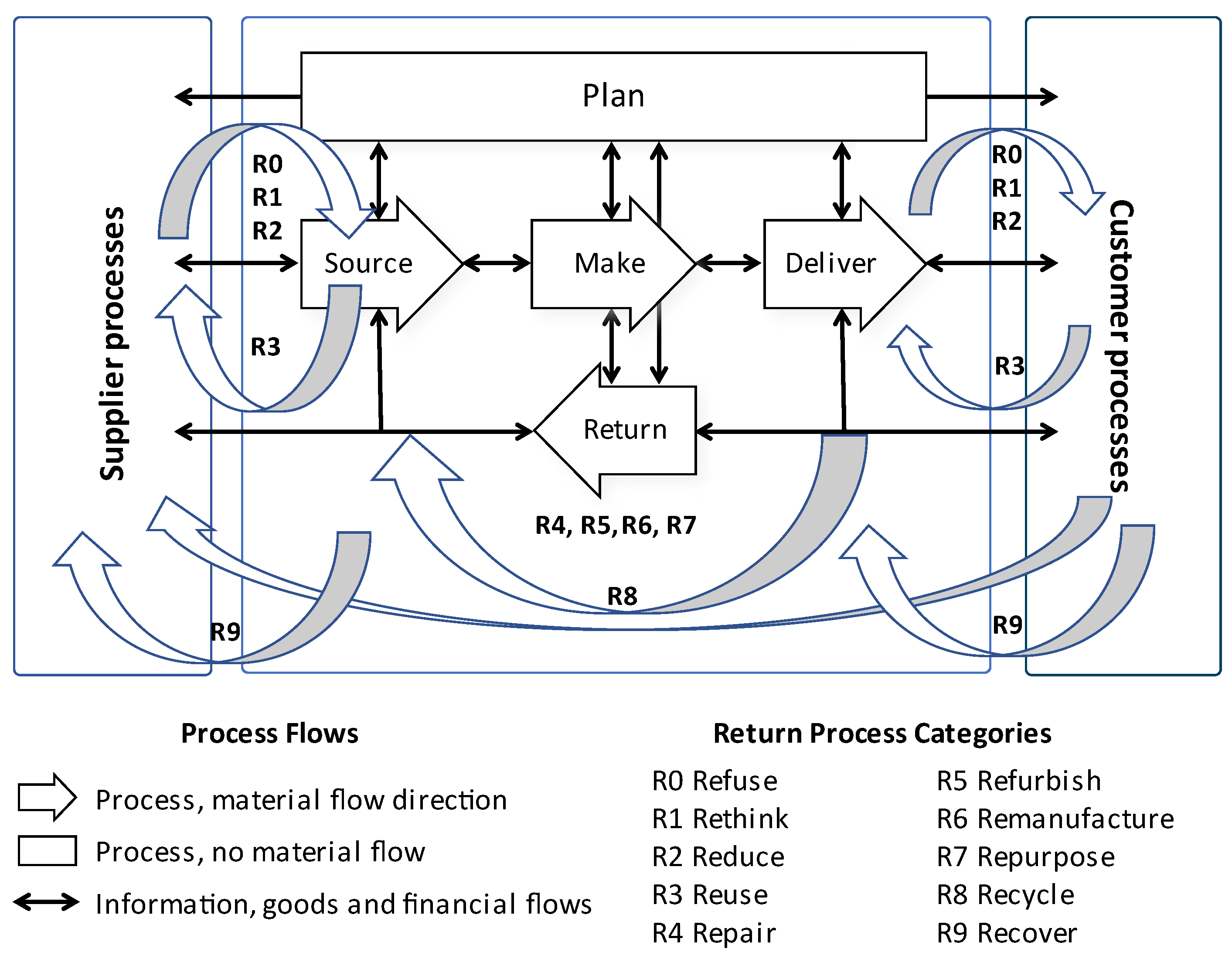

Table 1.
ADDIE model-based framework for learning experience design.
| Stage | Description |
|---|---|
| Analysis | 1. Module/Course selection. Choose a module or course covering SCM and CE topics for industrial engineering in Higher Education. 2. Problem situation/challenge definition. Select real-world situations concerning the impact of SME´s supply chain operations on sustainability. 3. Disciplinary learning objectives. Define learning objectives regarding the impact of supply chains on sustainability in SMEs. 4. Learning outcomes and competencies. Determine disciplinary learning outcomes and competencies regarding: The design and development of CE solutions for SCM in SMEs. 5. Format. Select instructional formats for presence, online, blended, or hybrid learning experiences. 6. Target learners. Set learning experiences based on the study level, academic discipline, and academic program. |
| Design | 7. Knowledge acquisition. Define disciplinary topics in SCM related to CE and SMEs. 8. Teaching and learning approach/strategy. Choose experiential learning as the leading instructional approach. 9. (Experiential) Learning activities. Design and describe learning activities amid Kolb’s experiential learning cycle. |
| Development | 10. Educational resources. Prepare educational resources and materials for the course/module. |
| Implementation | 11. Course/Module execution. Carry out the learning experience through lectures, seminars, and other interactions, and obtain students’ learning results. |
| Evaluation | 12. Learning outcomes and experience evaluation. Provide coursework rubrics and student evaluation instruments; Conduct student surveys to obtain feedback on the learning experience and the course. |
Table 2.
Experiential learning activities.
| Experiential learning | Activity description | Method steps |
|---|---|---|
| Concrete experience |
Collect quantitative/qualitative data regarding SME supply chain processes and key performance indicators (KPIs) using the SCOR model; Collect and classify qualitative/qualitative data about SME waste generation and management practices. |
Formulation of the situation |
| Reflective observation |
Examine key supply chain processes affecting waste generation; Map supply chain processes at the configuration level. Quantify level 1 and 2 SCOR metrics; Diagnose a problem or issue of concern about supply chain processes waste generation; Relate the problem or issue of concern to CE theory. |
Diagnose |
| Abstract conceptualisation |
Identify waste elimination, reduction or minimisation strategies; Identify changes to the supply chain configuration; Elaborate supply chain improvement proposals. |
Elaboration of proposals |
| Active experimentation |
Evaluate/Validate CE solution proposals considering waste quantification using SCOR KPIs. | Evaluation |
Table 3.
Students’ CE proposed solutions for SMEs’ supply chains.
| SCOR processes | |||||||
|---|---|---|---|---|---|---|---|
| SMEs | Return process with suppliers | Source | Make | Deliver | Return process with clients | CE strategies (9Rs) | |
| SME 1: Toy retailing | Improvement of forecast accuracy to reduce inventories. Usage of in-house transport |
Bicycle deliveries for local online sales. Packaging material recycling |
Return process of carton board packaging materials | Reuse (R3) and recycle (R8) of packaging materials |
|||
| SME 2: Fuel distribution and sale | Paper waste reduction and recycling from administrative support processes through digital solutions. | Vehicle tyre recycling in fuel transportation. | Reduction (R2) of paper waste. Recycle (R8) of paper Recycle (R8) of tires |
||||
| SME 3: Bakery | Elaboration of compost from organic waste such as fruit peel and eggshell | Introduction of reusable and biodegradable packages and cutlery | Recycle (R8) and reuse (R3) of production materials and packages |
||||
| SME 4: Coffee shop | Packaging material reuse | Packaging material replacement in customer deliveries | Reuse (R3) of packaging materials Reduce (R2) of packaging waste |
||||
| SME 5: Home decoration retail | Change in product design to reduce material waste | Reuse of ornamental plant containers to replace plants at the end of their life | Reduce (R2) of production waste through product design Reuse (R8) of containers |
||||
| SME 6: Tableware retail | Packaging materials reuse | Reduce (R2) of packaging waste Reuse (R3) of packaging materials |
|||||
| SME 7: Beverage syrups production and retail | Replacement of cardboard using reusable plastic boxes in a supply chain return process configuration | Reduce (R2) of packaging waste Reuse (R3) of packaging materials |
|||||
| SME 8: Ice-cream shop | Local supplier utilisation to reduce transport time and emissions | Compost elaboration from organic waste generated in cream production. | Waste reduction in packaging and cutlery switching to biodegradable materials and promoting customers’ container reuse | Reduce (R2) of ice-cream production transportation time. Reduce (R2) of packaging waste Reuse (R3) of packaging materials Repurpose (R7) of organic waste onto compost |
|||
| SME 9: Scaffolding supply | Special paint usage in scaffoldings after customers’ return | Welding reduction in scaffold joints through mechanical clamp use. Production material recycling in new products and spare parts | Scaffold and recyclable plastic cover reduction for tyres and joints |
Reduce (R2) of packaging waste Reuse (R3) of packaging materials Recycling (R8) and repurpose (R7) of production materials |
|||
| SME 10: Sports product retail | Packaging material, cardboard and pallet use reduction | Reduce (R2) of packaging waste. Reuse (R3) of packaging materials. |
|||||
| SME 11: Plastic bottle manufacturing | Plastic material reduction in bottle redesign | Reduce (R2) of material through changes in product design. |
|||||
Table 4.
Student learning evaluations.
| Evaluation | 1st partial Exam | 2nd partial exam | Final exam |
Partial project report 1 | Partial project report 2 | Final project |
Final score/ grade |
|---|---|---|---|---|---|---|---|
| Mean (0-100 scale) | 90 | 93.95 | 89.96 | 97.13 | 98.53 | 98.8 | 90.34 |
| Standard Deviation | 7.20 | 3.18 | 15.17 | 3.95 | 1.78 | 2.4 | 1.32 |
Table 5.
Assessment of learning outcomes.
| Student learning outcome | Engineering practice (K) | Citizenship commitment (1 below, 2 meets, 3 exceeds expectations) scale |
|---|---|---|
| Median | 3 | 3 |
| Min | 2 | 2 |
| Max | 3 | 3 |
| Q1 | 2.5 | 2 |
| Q3 | 3 | 3 |
| Interquartile Range (IQR) | 0.5 | 1 |
| Achievement level 2 or above | 100% | 100% |
| Achievement level 3 | 72.72% | 63.60% |
Table 6.
Institutional student opinion survey (ECOA) results.
| Institutional Student Opinion Survey # student answers (49 out of 56) |
1. MET | 2. PRA | 3. ASE | 4. EVA | 5. RET | 6. APR | 7. DOM | 8. REC | 9. COM (student comments) |
| Mean (0-10 scale) | 9.25 | 9.5 | 9.56 | 9.55 | 9.41 | 9.52 | 9.76 | 9.38 | 100% of comments highlight satisfaction, clarity of explanations and instructors' knowledge proficiency |
| Standard Deviation |
0.91 | 0.91 | 0.67 | 0.61 | 0.93 | 0.81 | 0.68 | 0.85 |
Table 7.
Strengths, Weaknesses, Opportunities and Challenges.
| Category | Details |
|---|---|
| Strengths | a. Integration of experiential learning into the ADDIE model as the guiding pedagogical approach. |
| b. Relationship with SMEs as educational partners providing operations and process information. | |
| c. Faculty's pedagogical experience in active learning. | |
| d. Selection of a relatable study topic for both company operations and students' intended learning. | |
| e. High student participation and interest in real-world CE business activities. | |
| f. Students conducting independent research and situated reflective and hands-on learning. | |
| g. Interdisciplinary topic integration (CE, SCOR model, and SCM) to address real-world challenges. | |
| h. CE-related learning in alignment with SDG #4 Quality Education. | |
| Weaknesses | a. Limited study time to address CE topics—just a semester academic period. |
| b. Extra resource allocation to execute the learning experience. | |
| c. No precise impact evaluation of student learning outcomes, knowledge, and skills attainment. | |
| d. No follow-up of CE solutions’ implementations. | |
| Opportunities | a. Exploring additional sustainability topics like gas emissions and energy consumption. |
| b. Expanding the study of CE-related topics to other engineering courses. | |
| c. Transferring this approach and methodology to other instructors. | |
| d. Establishing knowledge exchange partnerships with other local companies. | |
| e. Further explore other disciplinary and interpersonal skills and learning outcomes. | |
| Challenges | a. SME engagement and coordination. |
| b. Reducing extra planning time and effort beyond regular workload allocation. | |
| c. Attaining challenge-expected results in line with intended learning objectives. | |
| d. Maintaining a safe and inclusive learning environment for students in real-world settings. |
Disclaimer/Publisher’s Note: The statements, opinions and data contained in all publications are solely those of the individual author(s) and contributor(s) and not of MDPI and/or the editor(s). MDPI and/or the editor(s) disclaim responsibility for any injury to people or property resulting from any ideas, methods, instructions or products referred to in the content. |
© 2024 by the authors. Licensee MDPI, Basel, Switzerland. This article is an open access article distributed under the terms and conditions of the Creative Commons Attribution (CC BY) license (http://creativecommons.org/licenses/by/4.0/).
Copyright: This open access article is published under a Creative Commons CC BY 4.0 license, which permit the free download, distribution, and reuse, provided that the author and preprint are cited in any reuse.


