

Submitted:
19 December 2025
Posted:
22 December 2025
You are already at the latest version
Abstract
Mechatronics developed under the influence of the Third Industrial Revolution and was a discipline that provided methods and tools for the development of industrial robots, advanced machine tools, mobile phones, and automobiles, among other sophis-ticated products. With the emergence of Industry 4.0 in 2011, mechatronics has be-come indispensable, as traditional production systems are being transformed into cyber-physical systems (CPS), some of which are composed of sophisticated technolo-gies such as Digital Twins (DT) and sophisticated robots, among others. In 2020, the Fifth Industrial Revolution began, giving rise to so-called Human Cyber-Physical Sys-tems and promoting the use of Cobots in industries. Because today's industrial world is influenced by three active industrial revolutions and two transitions, it is possible to find machines and production systems that were designed with different principles and for different purposes, making it necessary to propose a classification that allows each system to be located according to the premises of its respective industrial revolu-tion. This article analyzes the evolution of mechatronics and proposes a classification of machines and production systems based on the premises of each industrial revolu-tion. The objective is to determine the influence of mechatronics on the different types of machines that exist today and analyze its implications.
Keywords:
mechatronics
; industrial revolutions
; industry 4.0
; human cyber-physical systems
; machines 4.0
1. Introduction
Due to the radical changes and transformations taking place in industries and human activities in general, over the last decade the topic of the Fourth Industrial Revolution or Industry 4.0 has been the subject of study in various universities, companies, industries, and economic spheres around the world. Academics, researchers, professionals, and politicians debate in various forums and conferences the implications of the new industrial paradigm, which has new technologies as its fundamental component [1]. The concept of “Industry 4.0” evolves every day and does so in the same direction, at the same speed and to the same extent as the disruptive technologies that underpin it, and it grows stronger as businesses and companies around the world gain experience in its applications. In general terms, the Fourth Industrial Revolution is a concept used or applied to outline the current state and trend of automation and data exchange in manufacturing in general and in various sectors of the economy [2]. Industry 4.0 drives and promotes the applications of various existing disruptive technologies, such as advanced industrial robots, the Industrial Internet of Things (IIoT), Cloud Computing, Big Data, and Artificial Intelligence (AI), among others, to ensure that production systems in industries and companies operate optimally, efficiently, securely, and interconnected to the network. The Fourth Industrial Revolution (4IR) integrates 35 disruptive technologies that are causing radical transformations in industries, companies, and businesses, 13 of which are considered the most important and nine of which form its pillars [3]. The effects and transformations of Industry 4.0 are also noticeable in the fields of health, agriculture, energy, mining, and education, among others.
The implementation of Industry 4.0-oriented projects requires the application of specialized fields of knowledge and strategies and methods that favor multidisciplinary engineering, such as multimedia, electromechanics, and mechatronics, among others [4]. In fact, multidisciplinary engineering skills are essential, necessary, and mandatory in any project related to Industry 4.0. A specialized field of study that is essential for implementing 4RI-oriented programs and projects is Mechatronics Engineering (MI), as it integrates four fields of study: mechanics, electronics, computing, and control, for the development of technology projects [5].
Currently, MI is associated with some of the disruptive technologies of Industry 4.0 to develop sophisticated machines, systems, devices, and products whose design and operation are oriented toward the new industrial paradigm. Cyber-physical systems (CPS) and digital twins (DT) are two of the highly sophisticated technologies of the 4IR that are based on MI. The relationships between MI and Industry 4.0 are so important that some authors have stated that mechatronic thinking has led to CPS [6] and that MI led innovation during the Fourth Industrial Revolution [7].
On the other hand, in 2020, the Fifth Industrial Revolution [8] began because: 1) the hyper-automation promoted by Industry 4.0 is displacing workers from production centers, 2) sustainable practices are not common in Industry 4.0, and 3) the wealth generated by the 4IR is concentrated in a few individuals. The Fifth Industrial Revolution (5IR) or Industry 5.0 drives and promotes collaboration between workers and intelligent machines, with the aim of seeking benefits and opportunities for society, improving the economy, and promoting sustainable practices as a priority objective [9]. In technological terms, the 5IR inherits the technologies of Industry 4.0 and integrates others such as 5G networks, edge computing, and the Internet of Everything, among others [10]. It is worth mentioning that MI is a fundamental discipline for the implementation of 5RI because it proposes technological integration: “Software/Hardware” [11,48], which is the fundamental basis for industrial automation and for the development of various machines and production systems, including intelligent systems and collaborative systems between humans and machines.
Currently, the 4IR and 5IR are being developed in various companies around the world. However, the influence of the Third Industrial Revolution (3IR) or Industry 3.0 is still felt today. There are a large number of companies that have not migrated to the 4IR, and others are in transition under support models called “Industry 3.5,” which promote migration from the 3IR to Industry 4.0 [12]. Similarly, “Industry 4.5” is driving the transition from Industry 4.0 to 5IR [13], so it is possible to say that today's industrial world is under the influence of three active industrial revolutions and two transitions, which implies the existence of a diversity of machines and production systems that have design and operating premises from three different industrial revolutions. For its part, MI not only came into being with the 3IR, but is also essential to supporting industrial migrations.
In general terms, mechatronics provides essential technological integration based on the relationship between software and hardware, which is essential for the design and operation of machines and production systems conceived under the premises of 3IR, 4IR, and 5IR.
Mechatronics has been a multidisciplinary field of engineering necessary for technological development over the last five decades and has been one of the fundamental pillars of the last three industrial revolutions. Therefore, it is necessary to understand the history and evolution of MI, as well as its relationship with each industrial paradigm. In addition, it is necessary to establish a systematic classification of currently existing machines and production systems based on the premises of the three active industrial revolutions and their relationships with MI. This classification will help to recognize each machine or production system found in industries according to its design and operating principles and its relationships with MI.
This article studies the origin and evolution of mechatronics with the aim of understanding its influence on technological development over the last five decades, and analyzes mechatronics in terms of its influence on the three active industrial revolutions and their transitions. Finally, it proposes and describes a classification of machines and production systems based on the premises of each industrial revolution.
2. Materials and Methods
The methodology used to develop this research was descriptive-qualitative [14], as it studied the history of mechatronics and the last three industrial revolutions. The following databases were used to consult relevant information: Google Scholar, SpringerLink, Scopus, and Web of Science. The research was divided into three sections: the first describes the generalities of the industrial revolutions, while the second analyzes the roadmap of mechatronic engineering and its relationship with the industrial revolutions. Finally, the third section describes a classification of machines and production systems in terms of the premises of the last three industrial revolutions and mechatronics.
2.1. Industrial Revolutions
This section describes the industrial revolutions that have been documented in modern human history. The last three industrial revolutions are analyzed in greater depth, as well as their technological transitions, because the disruptive technologies that support them are related to mechatronic engineering.
2.1.1. History of Industrial Revolutions.
Industrial revolutions are global events that cause dynamic changes in the form and substance of production systems in companies and societies in general, mainly due to the technological advances of each era. These changes have driven humanity toward profound innovations, increased productivity in industries, and improved the economies of countries [15]. To date, five industrial revolutions have been documented, beginning in 1782 with the First Industrial Revolution [16] and continuing through 2020, which marked the beginning of the Fifth Industrial Revolution [17]. Each of these industrial paradigms was accompanied by a set of technologies, among which disruptive technologies stand out. These are technologies capable of influencing drastic transformations in the operations and processes of the public sector, companies, and businesses [18]. In fact, disruptive technologies have the capacity to transform or change markets as a whole or on their own.
Among the technologies that have been developed since the first documented industrial revolution to date, we can identify the core or disruptive technologies that represent the heart of each industrial paradigm and cause profound changes in society. An example of this type of technology was the steam engine, which was the core or disruptive technology of the First Industrial Revolution, also known as Industry 1.0 [16,17,19]. The steam engine, together with industrial mechanization, drastically transformed production, the economy, and social systems at the end of the 18th century and brought about a profound change in humanity by promoting a radical transformation from rural to industrial societies.
During the 18th century, ideas and inventions related to electricity were developed, but it was not until 1900 that this technology became disruptive [11,19]. Also, in the last two decades of the 18th century, the automobile was developed, but it was not until the early 19th century that the assembly line for automobile production was patented. Electricity and Ford's assembly line were the two main disruptive technologies that led to the Second Industrial Revolution or Industry 2.0 [16,17,20].
The first half of the 19th century saw inventions and technological developments related to electronics, such as the transistor and integrated circuits. Similarly, computing had already made great strides and progress. By 1970, information and communication technologies and electronics had become disruptive and triggered the Third Industrial Revolution [19,21]. With the development of the PLC (Programmable Logic Controller) and the onset of digitization, industrial automation was enhanced and it became possible to develop industrial robots, among other technologies.
In the first decade of the 2000s, various technologies were developed that reached such a level of disruption that in 2011 they led to the Fourth Industrial Revolution or Industry 4.0 [19]. Collaborative robotics, biotechnology, artificial intelligence, blockchain, the Internet of Things, and nanotechnology, among others, produced a new industrial paradigm [22]. Although all these technologies were responsible for Industry 4.0, the core technology of the Fourth Industrial Revolution is the “Cyber-Physical System” [23], which integrates physical assets with computational assets generally connected to the cloud. In general terms, a cyber-physical system (CPS) is the result of the seamless integration of computers and physical systems [24]. Industry 4.0 is known as the driver of the era of mass digitization, and its goal is the development of smart factories whose operation must be highly automated and operated by machines and robots without human presence.
In 2020, the Fifth Industrial Revolution or Industry 5.0 began, due to the fact that the automation of Industry 4.0 was displacing workers from the center of production and the limited application of sustainable practices in the design, manufacture, and operation of machines and production systems [19,25]. The objectives of Industry 5.0 are to promote human-machine integration, the mandatory promotion of sustainable practices, and the pursuit of a more equitable economy. The Fifth Industrial Revolution promotes cooperation between humans and machines and seeks to use human experience and creativity in conjunction with the capabilities of intelligent machines to generate efficient solutions to manufacturing problems. Industry 5.0 is a human-centered paradigm that proposes the creation and application of human cyber-physical systems and cobots in industrial production centers. These types of robots are designed to operate and collaborate with workers in a shared workplace in businesses and companies [26].
The Sixth Industrial Revolution, or Industry 6.0, is projected to begin in 2050 [27,28]. This futuristic industrial paradigm will be customer-oriented, create sophisticated infrastructure for smart manufacturing, have anti-fragility characteristics, and be driven by the development and industrial applications of quantum computing and the mass production of humanoid robots, both of which are projected to be the disruptive technologies underlying Industry 6.0 [19].
It should be noted that the six industrial revolutions described above are characterized by being cumulative, that is, the Second Industrial Revolution inherited all the technological development and industrial improvements of the First Industrial Revolution, and the same process continues for the following industrial paradigms. The common feature that can be described of industrial revolutions is the presence of a diversity of emerging technologies, some of which become disruptive and others not. It should be mentioned that there is no exact date for the start of each of the industrial revolutions or for the period in which they were at their peak. Furthermore, the periods are not consecutive. For example, the First Industrial Revolution began in England between 1750 and 1760 and ended between 1820 and 1840 [29], while the Second Industrial Revolution took place between 1870 and 1914 [30].
Figure 1 shows the timeline of the industrial revolutions, their peak periods, and their main disruptive technologies.
2.2. Industrial Revolutions and Mechatronics.
This section provides a description of mechatronics and its relationship with Industries 3.0, 4.0, and 5.0, with the aim of understanding its history and evolution over time.
2.2.1. Mechatronics and Industry 3.0
The Third Industrial Revolution began in the late 1960s and was a consequence of the technological developments of the time, led by electronics, information and communication technologies, industrial automation, PLCs, computers, and industrial robots, among other emerging technologies. This industrial paradigm drove the development of computing, telecommunications, biotechnology, and renewable energy. Mechatronics originated during this technological explosion, with the concept first being introduced in 1969 [31,32]. The term mechatronics was coined by the Japanese and referred mainly to the formal integration of electronic engineering and mechanical engineering (see Figure 2).
At first, the concept of mechatronics was not particularly striking or new, as there were already various products and machines that had been developed using electronic and mechanical theories. The term “mechatronics” referred more to a multidisciplinary and comprehensive vision of product development and production systems. Mechatronics was seen as a discipline that would represent new developments in sophisticated machinery, industrial robots, and intelligent mechanisms whose applications would be found in a variety of environments, such as factory, home, and office automation [33]. Figure 3 shows the environments of mechatronics in terms of automation.
Mechatronics did not reach its peak in the 1970s, but rather gained popularity in the 1980s, when it became clear that its design method was much better than traditional methods for the development of certain products. This was also due to substantial improvements in computers, which made it possible to design and manufacture a variety of complex mechatronic products and systems of different sizes. In the 1990s, IEEE/ASME Transactions on Mechatronics presented a definition of the term mechatronics [34]: Mechatronics is the synergistic integration of mechanical engineering with electronics and intelligent computer control in the design and manufacture of industrial products and processes.
This definition proposed the field of computing as a third component and gave rise to the typical integration of Mechanics, Electronics, and Computing (see Figure 4) as it is known today [35].
Currently, there is a new concept of mechatronics comprising four disciplinary fields that considers control (see Figure 5).
In its early days, the application of mechatronics focused on the development of typically more electromechanical systems such as cameras, automatic doors, washing machines, and some mechatronic systems for manufacturing, such as computer numerical control (CNC) machine tools, industrial robots, and the automation of various metalworking factories [34,37,38]. Later, in the 1980s, mechatronics evolved due to the technological developments of the time, and it became possible to greatly improve sophisticated mechatronic products such as industrial robots. In addition, automotive applications such as anti-lock braking systems, airbag systems, and vibration control systems, among others, were developed [34].
In the 1990s, mechatronics evolved and diversified. Microelectromechanical systems (MEMS), whose origins date back to the late 1960s, became popular and improved. These systems are integrated into a single platform by micromechanical structures, microactuators, microsensors, and micro power sources, as well as high-performance integrated electronic devices, and have various applications [39]. In this context, micromechatronics is understood as the application of mechatronics principles to microfabricated devices and systems [40]. In addition, during this period, various intelligent functions in the designed mechatronic systems and in the products generated were improved and increased, allowing for better interaction between computers and humans. Likewise, virtual prototypes and computer simulation were introduced, which led to a reduction in product design time [41].
In the 2000s, mechatronics achieved status as a discipline in engineering sciences, and its applications diversified into various fields of knowledge such as biotechnology, intelligent systems, and nanotechnology, among others [42]. Information and communication technologies drove advances in mechatronics by providing support for seamless integration and communication between various components. The infrastructure of information and communication technologies and their relationship with mechatronics enabled the development of intelligent, interconnected systems that supported greater functionality and better adaptability [43].
From its emergence in 1969 until the 2000s, mechatronics evolved from a proposal to integrate mechanics with electronics to become a mature, comprehensive discipline comprising four fields of knowledge, including computing and control. The teaching of mechatronics in universities became increasingly formalized. In addition, its applications spread to various fields of knowledge. Similarly, mechatronics products became more specialized and provided significant competitive advantages over other products. As a result, various companies took advantage of Industry 3.0 technologies and sophisticated mechatronics products such as robots, CNC machines, and automated systems to increase productivity, raise efficiency, and improve production quality.
The evolution of mechatronics was the result of developments and applications in its primary fields of knowledge, as well as the creation of various methodologies that enabled integration and synergy, and technological developments originating from Industry 3.0. In this sense, it is possible to differentiate between three stages or generations of mechatronics from 1969 to 2010 as follows:
- (1)
- First generation: The beginning of mechatronics with little integration between mechanics and control (development of electromechanical systems: basic robotic manipulators, automatic doors, washing machines, CNC machine prototypes, etc. [37,38]).
- (2)
- Second generation: Strengthening of the integration of mechanics, computing, and electronics (microprocessor applications and use of digital information processing units, development of MEMS, rapid prototypes, etc. [39]).
- (3)
- Third generation: Formalization of the concept of mechatronics, integrating mechanics, electronics, control, and digitization (recognition of mechatronics as an engineering discipline, development of nanotechnology and biotechnology, development of intelligent systems, etc. [44]).
- (4)
- Fourth generation: Intelligent, connected, resilient, and eco-mechatronics (development of cyber-physical systems, digital twins, cobots, etc.).
Figure 6 shows the evolution of the three generations of mechatronics mentioned above.
In historical context, mechatronics and the Third Industrial Revolution emerged at practically the same time and have accompanied each other throughout history. Various technological developments were generated in the 1970s and 1980s, based mainly on the application of new design methodologies such as concurrent engineering [46]. The new design requirements for mechatronic products did not adhere to the traditional sequential methodologies of that time. Concurrent engineering had an approach in which designers had to take into account the elements and processes of the product life cycle that required the application of simultaneous design and analysis procedures. Some advantages offered by this methodology are the reduction of costs and time, a considerable increase in product quality, and increased reliability and competitiveness, which are essential for the design and development of mechatronic products. This methodology is currently used under the name Concurrent Mechatronic Design [47,48]. By taking into account the new design methodologies of the 1980s and integrating computing as a discipline in mechatronics, it was possible to develop mechatronic systems. A typical mechatronic system is characterized by the interrelationships between a mechanical system, a computational system, and an electrical/electronic system (see Figure 5). A diagram of a mechatronic system is shown in Figure 7 [49].
With the introduction of computing into mechatronics, it also became possible to develop hardware/software integration, which formed the basis of products and processes designed under the vision of mechatronic engineering [50]. In this way, hardware (i.e., components) and software (information-based functions and operations), operating in an integrated manner, gave rise to mechatronic systems. In the 1980s, so-called embedded systems, whose origins date back to the 1960s, were improved. In general terms, an embedded system is a computer system designed to perform specific or limited specialized computer functions and operations in a reliable and economical manner, or an embedded system is conceived as an electronic/electromechanical system created to perform a specific function and is a combination of hardware and software [51]. Figure 8 shows a diagram of an embedded system.
Mechatronics was one of the fundamental pillars of the Third Industrial Revolution, and the hardware/software relationship that gave rise to mechatronic systems continues to be functional and important for the development and consolidation of Industry 4.0 and 5.0.
2.1.2. Mechatronics and Industry 4.0
The Fourth Industrial Revolution, or Industry 4.0, was triggered by the development and application of new disruptive technologies, such as Big Data, cloud computing, and the Internet of Things, among others, and began in 2011 [19,22]. This new industrial paradigm drove large-scale digitization (applied computing) in companies and promoted hyper-automation at all levels, generating concepts such as intelligent automation, self-optimization, self-configuration, and self-diagnosis/prognosis [53]. Industry 4.0 drives the development of dark factories or smart factories where the presence of operators and engineers will be almost nil, as hyperautomation, hyperconnectivity, and Artificial Intelligence will lead to the development and operation of autonomous production systems that will require minimal human presence. Industry 4.0 is associated with 35 disruptive technologies [3], nine of which represent its pillars (see Figure 7).
Figure 9.
Nine pillars of Industry 4.0 (Taken from [54]).
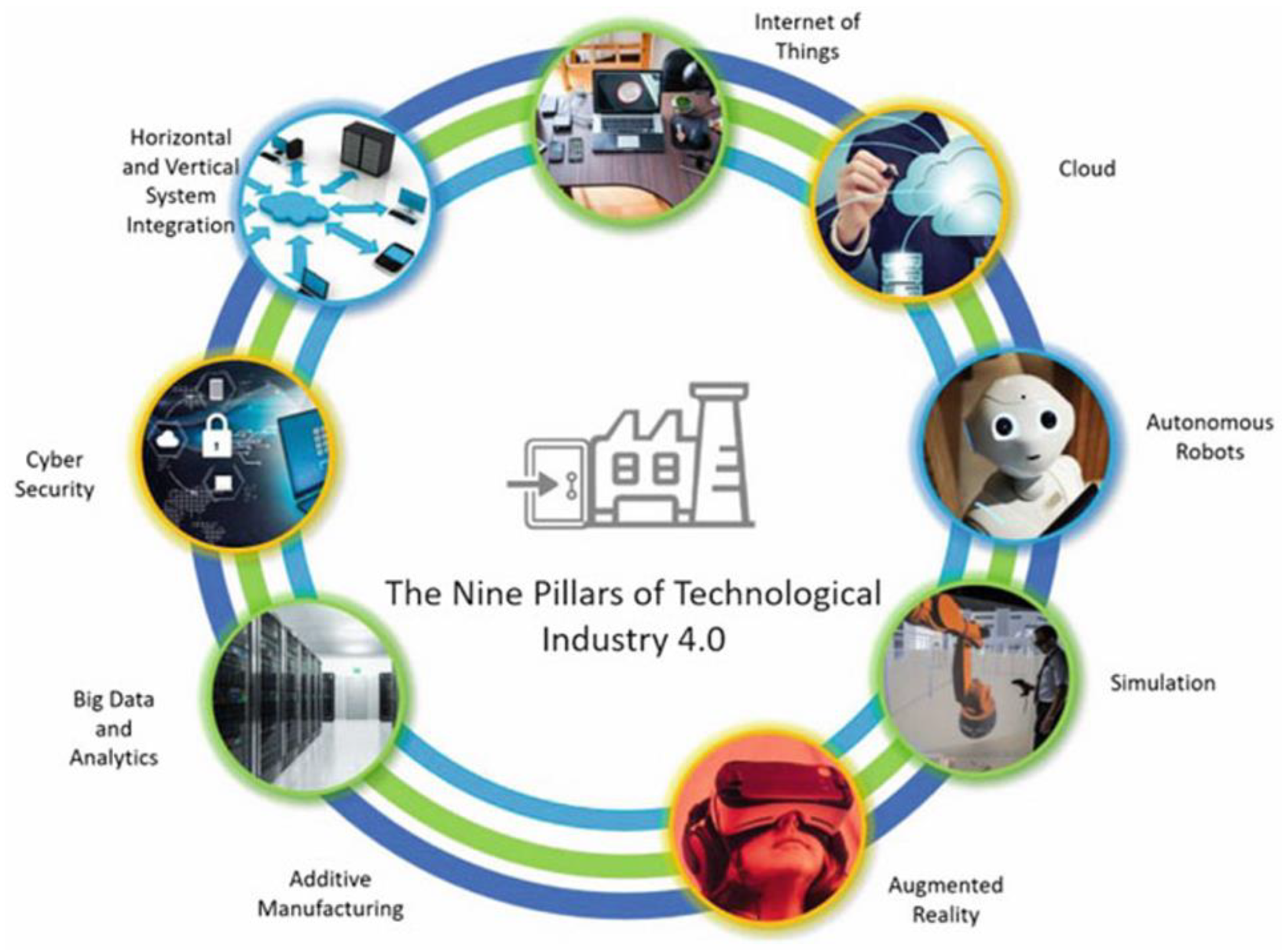
In the context of technological advances brought about by Industry 4.0, mechatronics engineering has taken on a highly relevant role, as it is a discipline used to design and develop a wide variety of industrial machinery and systems. Some of this equipment or physical assets form the basis for the development and operation of cyber-physical systems and digital twins. Mechatronics engineering is fundamental to the design and development of various smart devices, systems, and appliances [55].
In this sense, Industry 4.0 and mechatronics engineering have been integrated to exploit connectivity technologies, information and communication technologies, and the various smart systems available to drive smart manufacturing. This integration has not only led to significant improvements in production systems, but is also revolutionizing and transforming manufacturing companies from the ground up. This profound technological revolution has been made possible because, while mechatronics provides the integration of software with hardware (mechatronic systems and embedded systems) that represents the basis for the control and automation of production lines, Industry 4.0 and disruptive technologies (Internet of Things, Big Data, cloud computing, and Artificial Intelligence) offer the possibility of connectivity and advanced data processing, achieving real-time control of processes and efficient monitoring and supervision of operations [56]. With this integration between mechatronics and Industry 4.0, it is possible to develop advanced systems such as intelligent machines, cyber-physical systems, digital twins, advanced robots, and smart products, and to enhance smart manufacturing. Figure 10 shows a conceptualization of the integration of mechatronics with Industry 4.0.
On the other hand, mechatronics and industrial automation are two fields of knowledge that have been part of the formalization of interactions between companies' industrial processes (business systems) and manufacturing systems (control systems). These interactions have been formulated by standards, one of which is ISA95, which was developed by the International Society of Automation with the purpose of generating an automated interface to link control (manufacturing) systems with industrial (business) systems [57]. This standard proposes a functional hierarchy of production based on five levels: 1) production process, 2) process sensing and manipulation, 3) monitoring and supervision, 4) manufacturing operations management, and 5) business planning and logistics [58]. The schematization of this hierarchy was called the “automation pyramid.”
Mechatronics and automation have been essential in the first two levels of the hierarchy, as mechatronic and embedded systems (hardware/software integration) were of great importance in automated manufacturing in the 1990s and continue to be so today. At level 1, the various physical assets used for production are associated with mechatronic systems and signaling elements that describe the operating states of the machines, while at level 2, the information from the sensors is processed and controlled by various electronic devices, such as PLCs and microprocessors (see Figure 11). The processed information is monitored by SCADA systems. Thus, mechatronics and automation are strongly related to levels 1 and 2 of the hierarchy.
A modification to the automation pyramid has recently been proposed, taking into account the new technologies of Industry 4.0, and it has been called the “intelligent automation pyramid” [59]. The new pyramid allows for the exchange of information and enables interaction between the various elements and components related to the hierarchical levels associated with an industrial process and some Industry 4.0 technologies such as networks, advanced computing, and cloud computing, as well as various smart devices or appliances [60]. Figure 11 shows the intelligent automation and mechatronics pyramid.
Mechatronics is also related to the development of cyber-physical systems, which is one of the fundamental technologies of Industry 4.0 for the development of smart factories and applications in general. Some authors have proposed that cyber-physical systems are a kind of complex mechatronic system enhanced by software, characterized by deep integration between computer systems, communication systems, and physical assets, which interact dynamically with each other in real time [61,62]. Other authors describe both the concept of mechatronics and that of cyber-physical systems as two perspectives or visions of the general or global concept called “system.” The concept of mechatronics is more associated with hardware design, while the concept of cyber-physical systems is related to software design [63,64]. Mechatronics can be related to cyber-physical systems considering that physical assets (mechanical, electromechanical, mechatronic, and cyber-physical) and their control are tasks specific to mechatronics [19]. Another view points out that cyber-physical systems are evolutions of Information and Communication Technologies and are systems that have a fundamental or deep collaboration and integration with computing, communications, and control technologies [65]. A convergence between mechatronic engineering and its three fields of knowledge and cyber-physical systems in terms of their core technologies (computing, communication, and control) is shown in Figure 12.
According to Figure 12, mechatronics is an evolution of electromechanical products, while cyber-physical systems are evolutions of cyber systems. Furthermore, in this view, mechatronics tends more toward hardware and cyber-physical systems toward software.
On the other hand, in recent years, mechatronics engineering has been associated with other disruptive technologies of Industry 4.0, such as augmented reality and virtual reality, which are used in staff training and the development of immersive experiences.
Finally, in response to the demand for more specialized and customized products, mechatronics has made it possible to increase their quality while improving process efficiency and reducing failures in smart manufacturing [67]. Mechatronics is fundamental to Industry 4.0 because its multidisciplinary structure and methods enable it to shape a variety of modern engineering and technology projects.
2.1.3. Mechatronics and Industry 5.0
According to some authors, the Fifth Industrial Revolution began between 2020 and 2021 [19,25] and was triggered by the fact that the vision and technologies of Industry 4.0 minimized the role of humans in industrial production centers and even replaced them with highly automated, intelligent, and interconnected systems [68]. Industry 5.0 seeks to return humans to the center of industrial production with an enhanced role, seeking to share and leverage the experience generated on production lines symbiotically with intelligent machines, so that highly customized manufacturing is possible under a zero-defects and zero-waste approach [69].
Industry 5.0 promotes a more sustainability-focused approach than Industry 4.0, as experience has shown that this industrial paradigm did not address many sustainability concerns, despite the fact that its disruptive technologies facilitated the implementation of various sustainable practices in companies, industries, and businesses [70]. Industry 5.0 has four essential objectives: sustainability, environmental management, human centrality, and social benefits [71].
The Fifth Industrial Revolution does not necessarily emerge from the development of new disruptive technologies, but rather is an approach that seeks to improve certain aspects of Industry 4.0, particularly the implementation of mandatory sustainable practices in industries and the orientation of Artificial Intelligence towards improving human skills and enhancing human-machine symbiosis. Therefore, the vision of Industry 5.0 promotes the use of most of the disruptive technologies of Industry 4.0 and integrates others (edge computing, blockchain, and 6G networks, among others). Figure 13 shows some enabling technologies for Industry 5.0.
The vision, technologies, and needs of Industry 5.0 bring new challenges for mechatronics engineering, as sustainability and synergy between humans and machines require new technical requirements. The digitization of production processes and the high automation of Industry 4.0 factories must be complemented by new technological and psychological elements that enable a new integration of humans and machines at the heart of production. In addition, sustainability methods and techniques (renewable energy systems and resource-efficient processes) must be integrated into the design and operation of production systems. These tasks can be performed by mechatronics to meet the vision and needs of Industry 5.0. Mechatronics is a field of engineering that has the capacity to technologically integrate collaboration and synergy between machines and people [73].
Mechatronics is integrated into Industry 5.0 for the development and control of robotic systems that interact and collaborate with humans on production lines. These systems are called cobots, which operate collaboratively and synergistically with workers [74]. Cobots are robotic systems that interact safely and smoothly with operators using advanced communication systems (5G and 6G networks) and sophisticated mechatronic technologies. The development of Cobots, collaboration with humans, and their applications in smart manufacturing require the use of Artificial Intelligence (Machine Learning, Deep Learning, etc.) and the Internet of Things, among other technologies, to process data and information, significantly improve performance, and make decisions.
One of the technologies associated with Industry 5.0 is the digital twin (see Figure 13). This technological development originated in 1970 with the Apollo 13 project, and it was not until 2017 that it came to be considered a key technology in industry. In fact, the digital twin can make a competitive difference between companies, as it can be used to solve complex and unpredictable problems because it has the ability to combine the physical world with the digital world dynamically or in real time [75]. The digital twin can be described as a virtual (digital) copy of a physical object or system that can be observed, analyzed, and controlled dynamically or in real time [76]. This technology can be applied to optimization problems, manufacturing time reduction, predictive maintenance programs, and cost reduction, among others.
The relationship between digital twins and mechatronics is described in different ways, the most common being those in which mechatronics forms part of the digital twin, especially in the operation of physical assets [19], and the other view is associated with the idea that digital twins form part of a mechatronic system [77]. The digital twin and mechatronics have a functional relationship, especially in the operation of physical assets that are represented by the digital replica. When physical assets are in operation, signaling elements placed at strategic points generate and send signals that are processed in the digital twin, and the feedback information is then sent back to the physical asset, where instructions for changing or improving the system are applied either manually or automatically. Mechatronics plays a very important role in this entire process, as it generates and controls the operating states of the physical assets and provides feedback on the system improvements that were processed by the digital replica (digital asset).
Figure 14 shows a diagram of a digital twin whose physical assets can be machines, processes, systems, sensors, cameras, measuring instruments, and controllers, among others, and a virtual asset that offers a range of services such as modeling, artificial intelligence, data management, data analysis, and predictive maintenance, among others. To represent the digital twin, a CNC machine has been used as the physical asset and two analysis programs (predictive maintenance and artificial intelligence) as the virtual asset. The information and feedback between both assets is generally processed with IIoT elements and systems in real time.
In the Fifth Industrial Revolution, digital twins have specialized in human digital twins, which are made up of physical representations and virtual models of human beings, and whose function is to track and demonstrate with high precision certain capabilities of workers operating in production systems, such as movement, control, perception, integration, decision-making, and manipulation, among others [78]. These technological systems enable alignment and interrelation between humans and intelligent machines. Industry 5.0 also promotes the development of human cyber-physical systems, which are integrations between workers and traditional cyber-physical systems and are being built to overcome the disadvantages of both parties. Human cyber-physical systems embody socio-technical systems integrated by humans, cyberspace, and physical assets, which are designed and developed to improve and optimize the processes generated throughout a product's life cycle and to achieve benefits for participants associated with the product-related value chain [79]. Human cyber-physical systems help workers operate in high value-added activities and expand the impact of their work on production and productivity through the use of intelligent systems such as specialized machines and collaborative robots.
Mechatronics is also related to human cyber-physical systems and human digital twins, as it provides control and automation through the hardware/software integration of machines and intelligent systems that operate in manufacturing systems. It also develops systems in conjunction with the Internet of Things that allow for the monitoring of human physical assets and the design of various specialized devices that provide essential information about people's activities.
Another essential feature of Industry 5.0 is the resilience of cyber-physical systems, which consists of the ability to anticipate, resist, adapt, recover, and evolve in the face of internal and external disturbances to the system. This capacity of cyber-physical systems allows the fundamental operations of the system to continue functioning despite disturbances. The resilience of cyber-physical systems is based on three principles: 1) redundancy, adaptability, and recoverability [80]. Resilient cyber-physical systems are tolerant of continuous changes and failures and are even capable of fixing or repairing them. They also have the ability to maintain themselves, which is only possible if they integrate an independent or autonomous configuration enabled by redundancy at the state, behavior, or function levels. Resilient cyber-physical systems must be framed within cybersecurity systems. Problems related to security issues in cyber-physical systems can be solved through the design and development of intrusion detection and prevention systems and through the generation of security metrics for risk assessment [81]. Resilience can be transferred to various smaller systems within a cyber-physical system, such as machines and robots. For example, in one experiment, a resilient consensus control was developed so that a group of robots could reach an agreement or leader-follower consensus within their workspace, despite actuator failures and deception attacks affecting the signals exchanged [82].
The integration of mechatronics and Industry 5.0 also encompasses Industry 4.0 technologies. This integration enables the development of human-machine systems such as cobots, human cyber-physical systems, human digital twins, resilient systems, and optimal and efficient systems for smart and sustainable manufacturing. Figure 15 shows a general diagram relating mechatronics to Industry 4.0 and 5.0.
2.1.4. Evolution of Mechatronics
The previous sections of this chapter described the relationships between mechatronics and Industries 3.0, 4.0, and 5.0. This section presents a conceptual map of the five documented industrial revolutions and their relationships with the evolution of mechatronic engineering. The origin of mechatronics began in the First Industrial Revolution or Industry 1.0, where machines were designed with mechanical systems, as electricity did not exist as a source of energy. From 1900 onwards, machines incorporated essential electromechanical systems due to the emergence of electricity, which gave rise to Industry 2.0. It was not until 1970 that, with the introduction of electronics and computing, mechatronics was formed and Industry 3.0 began. In 2011, Industry 4.0 was launched, and mechatronics had matured into the study of mechatronic systems. In 2020, the Fifth Industrial Revolution began, and mechatronics joined forces with the Internet of Things and cloud computing to create connected mechatronic systems. Figure 16 shows the evolution of mechatronics and the industrial revolutions.
2.2. Mechatronics and Machines 3.0, 4.0, and 5.0
This section presents a classification of machines and production systems in terms of their characteristics related to the last three industrial revolutions, based on the idea that the industrial world is currently influenced by Industries 3.0, 4.0, and 5.0 and two transitions.
2.2.1. Mechatronics and Machines 3.0.
Mechatronics and Industry 3.0 began at almost the same time around 1970. The transformation of certain emerging technologies into disruptive technologies initiated the Third Industrial Revolution, which brought innovations to companies, while mechatronics arose as a result of the need to automate processes and improve the efficiency of machines and production systems. Information and communication technologies and electronics were the main drivers of the industrial changes and transformations that gave rise to systems such as PLCs, industrial robots, and the systematization of automation in general. The strong influence of Industry 3.0 extended into the 1990s and generally developed under the following premises [83,84,85,86,87]:
- (1)
- Mass production gave way to flexible production.
- (2)
- Companies began digitizing their processes with the help of computers (computerization of industry).
- (3)
- Production systems adopted programmable automation.
- (4)
- Mechanical and analog electronic technology gave way to digital electronics.
- (5)
- Companies began to use renewable energies and developed energy efficiency programs.
- (6)
- Industry began a process of decentralization.
- (7)
- Globalization and the development of large corporations began.
The design and development of devices, machines, and production systems derived from the premises and considerations of the Third Industrial Revolution have essential characteristics that differentiate them from other machines designed with different premises.
For the purposes of this work, a “Machine 3.0 (M3.0)” is defined as a device or machine designed and operated under the premises of Industry 3.0. Similarly, a “Production System 3.0 (PS3.0)” is a production system developed and operated under the premises of the Third Industrial Revolution.
There are several examples of M3.0 whose design and configuration are associated with mechatronic engineering. For example, a computer that integrates a hard disk is a classic example of M3.0. The hard disk itself is a high-precision mechatronic system where the position error tolerance limit is nanometers (see Figure 17). Mechatronics played a very important role in the design of hard disks and in reducing costs [88].
Another example of an M3.0 is the robot, whose introduction into manufacturing systems revolutionized industrial production. The robot is considered a mechatronic system [35] as it is composed of mechanical, electronic, and computational systems. During the period of influence of Industry 3.0, various devices, systems, and M3.0s were developed for different fields of application. Figure 18 shows some M3.0s associated with manufacturing and related to mechatronic engineering.
The intelligent M3.0 shown in Figure 18 refers to the use of basic artificial intelligence models such as the application of genetic algorithms, fuzzy logic, and neural networks [89] and the introduction of sensing systems so that M3.0 can understand its environment and make decisions.
On the other hand, PS3.0 production systems are manufacturing systems made up of M3.0 machines. A reconfigurable manufacturing system is an example of an PS3.0, as it integrates hardware/software systems through which it can change its structure to adjust production capacity and functionality [90]. Figure 19 shows some PS3.0-type production systems.
Mechatronics engineering is implicit in the development, management, and operation of PS3.0 production systems, as it is used for various tasks such as automation, control, and the development of various devices used in the production systems environment.
In general, M3.0 machines and PS3.0 production systems are characterized by integrating: 1) advanced automation, 2) moderate digitization and limited data analysis, 3) application for mass production, 4) low or no intelligence, 5) flexibility and reconfigurability, 5) generally use manual configurations for programming (fixed and sequential), and 6) are not connected to the cloud.
2.2.2. Mechatronics and Machines 4.0.
The period of influence of the Fourth Industrial Revolution was from 2011 to the present, although there is no exact date or period since the technological innovations that define an industrial revolution are generally already in place before the declaration of the start of an industrial paradigm. The introduction of emerging or disruptive technologies such as Big Data, the Internet of Things, cloud computing, and artificial intelligence [22] into industrial processes gave rise to Industry 4.0.
The premises of the Fourth Industrial Revolution are summarized below:
- (1)
- Production processes have moved from moderate digitization to high digitization (total digitization of the value chain).
- (2)
- Factories with advanced conventional automation have been transformed into smart factories.
- (3)
- Manufacturing systems are fully integrated (horizontally and vertically) and operations are carried out in real time.
- (4)
- Artificial Intelligence focuses on improving and increasing the efficiency of machines and production systems.
- (5)
- Production systems went from conventional automation to smart, optimized automation.
- (6)
- Production is customized.
- (7)
- Traditional connectivity gave way to hyperconnectivity (interconnectivity and interoperability in production systems).
- (8)
- Production is optimized and highly energy efficient.
Some researchers have proposed some basic principles for Industry 4.0, which are shown in Figure 11 [91,92].
Figure 20.
Industry 4.0 design principles. Taken and improved from [91,92].
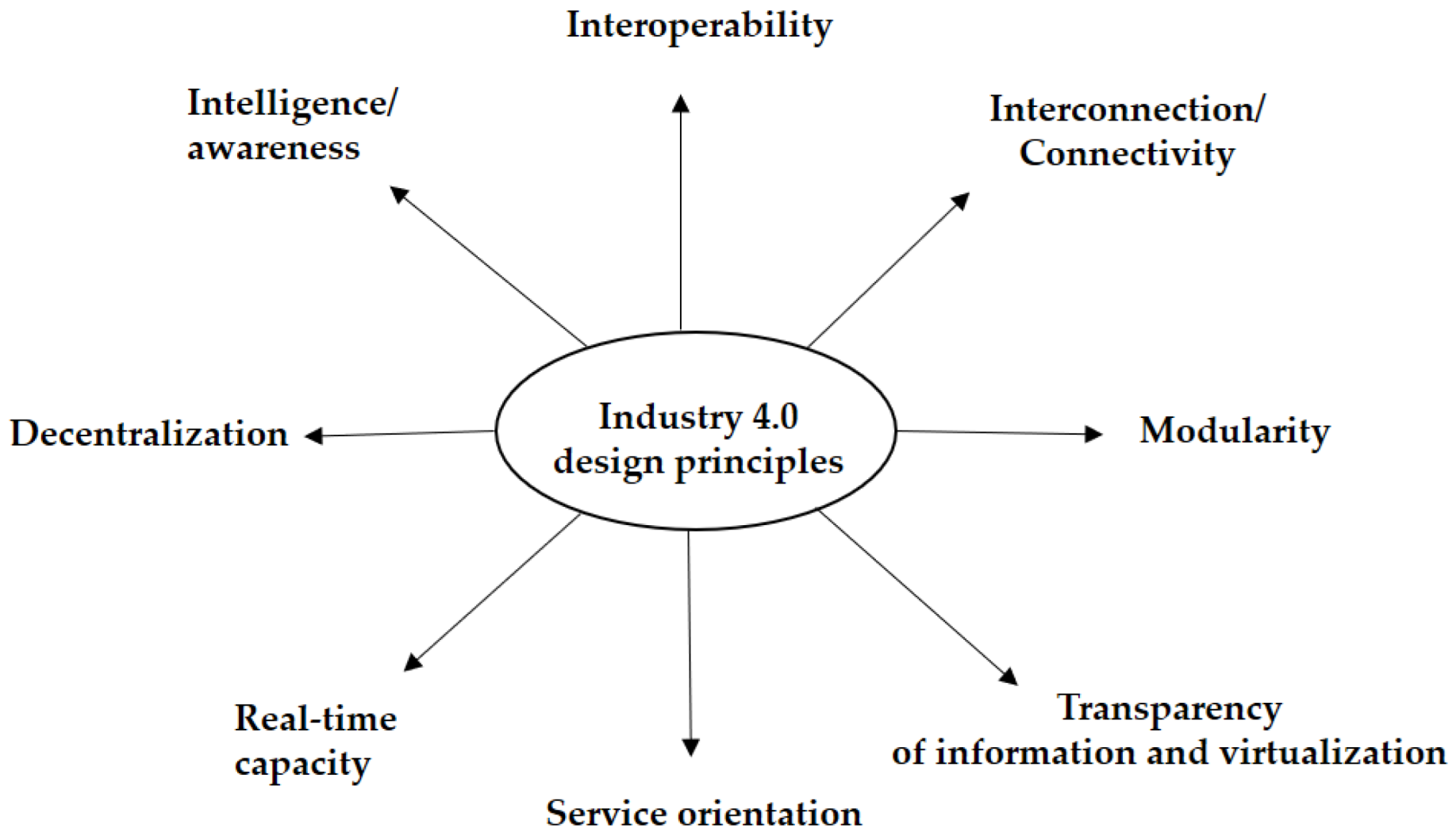
For the purposes of this research, a Machine 4.0 (M4.0) is defined as a machine designed and operated under the objectives, principles, and premises of Industry 4.0. Similarly, a Production System 4.0 (PS4.0) is a manufacturing system that can be integrated with Machines 4.0 and is designed according to the objectives, premises, and principles of Industry 4.0.
Intelligent and collaborative robots that learn on their own and operate in industries are examples of M4.0 machines. Some of these robots work in teams and are operated by complex controls, the Industrial Internet of Things, and the Cloud [93,94]. The following figure shows two robots learning automotive operations.
Figure 21.
Learning robots. Taken from [94].
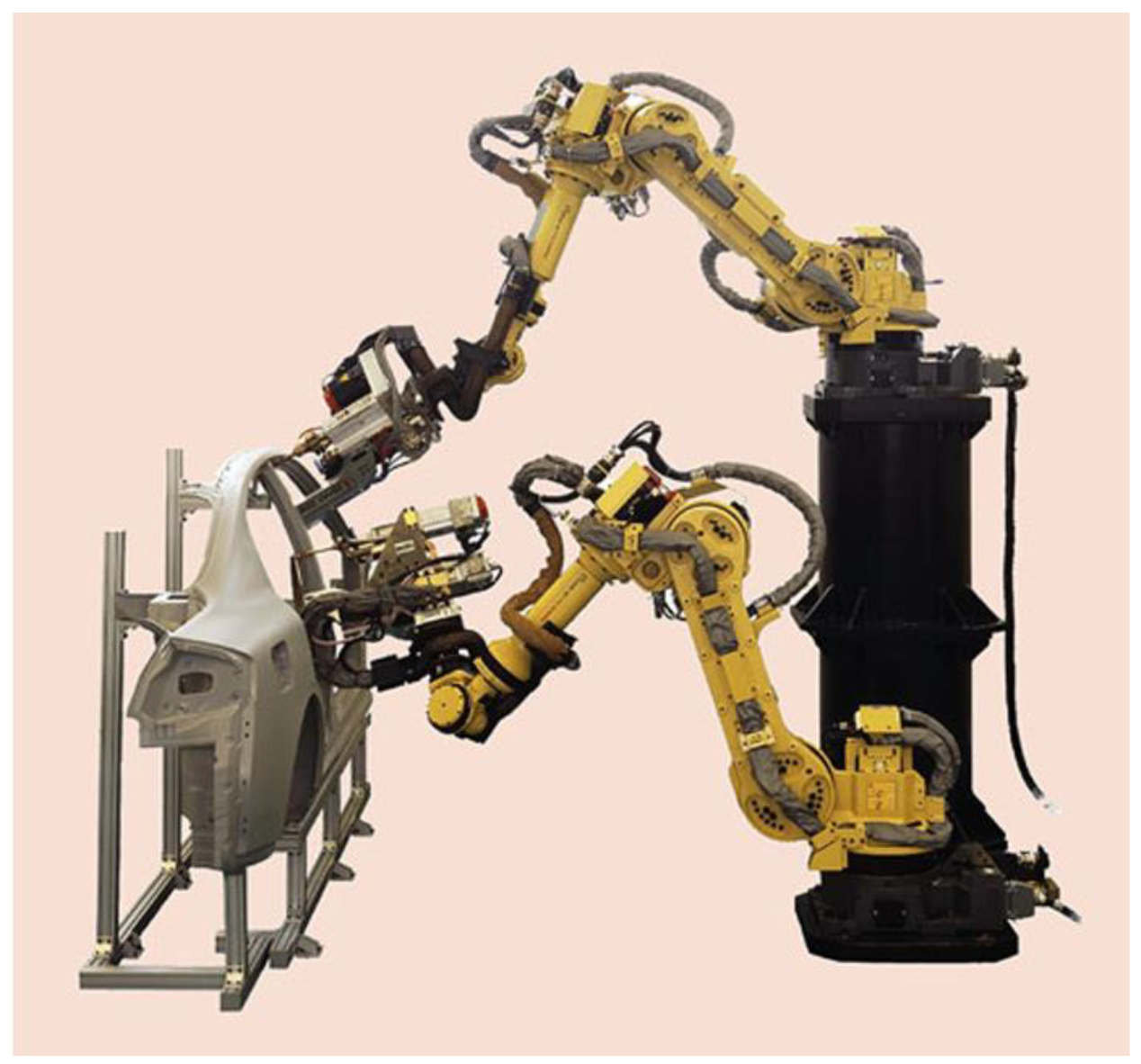
Another example of M4.0 machines are AGVs (Automated Guided Vehicles) that operate in conjunction with other automated systems under the cloud [95]. There is even a system called the Internet of Robotic Things, which represents a conglomerate of different technologies (the Internet of Things, the Cloud, artificial intelligence, and robots, among others) used to enhance the services provided by robots based on compatible, known, and emerging information and communication technology applications [96].
One technology that has been associated with Industry 4.0 is the Digital Twin, which is broadly defined as a digital representation or model of a physical asset that has the ability to simulate or mimic the structure, behavior, and physical context of its real-world twin [97]. A Digital Twin can be considered a system related to M4.0 machines. This advanced technology has the ability to predict the behavior of physical assets, optimize processes, and perform real-time monitoring functions.
A Digital Twin can be associated with various physical assets, such as a CNC machine, an industrial robot, or a 3D printing machine, among others, giving rise to M4.0 machines. Figure 12 shows a Digital Twin and a robotic system that drills holes in parts [78].
Figure 22.
Digital twin of an industrial robot. Taken from [98].
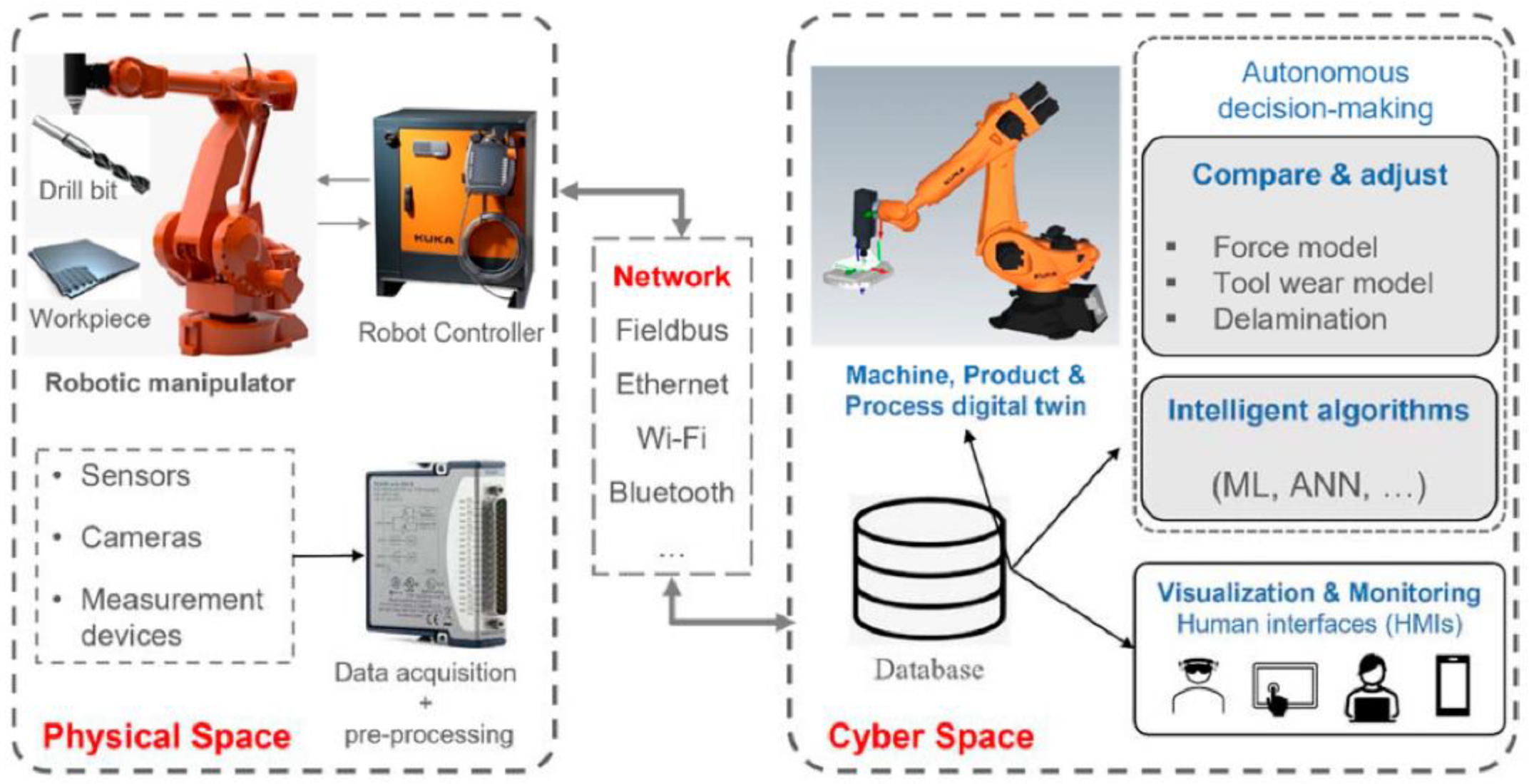
Recent technological advances that have given rise to the cyber-physical world, cloud technology, artificial intelligence, big data, and wireless technologies, among others, have led to a review of the design, manufacture, and control of mechatronic systems [99]. These technologies, together with mechatronic engineering, form the basis of M4.0 machines in Industry 4.0-oriented factories. Mechatronic objects such as geometry, kinematics, dynamics, electricity, identification, system properties, communication, control, and visualization, among others, are essential for the design and operation of digital twins and cyber-physical systems [100].
On the other hand, an PS4.0 production system is a manufacturing system made up of M4.0 machines. Generally, an PS4.0 system in Industry 4.0 is associated with a cyber-physical system. These systems are made up of physical components or systems, sensors, and cybernetic systems, and their purpose is to monitor, supervise, and control the real world, among other functions [101].
The physical systems of cyber-physical systems are known as physical assets [11,19]. These assets can be classified as: 1) mechanical, 2) electromechanical, mechatronic, and cyber-physical. Figure 23 shows the different assets that make up a cyber-physical system. A cyber-physical asset can be a digital twin or a cyber-physical system.
In general, M4.0 machines and PS4.0 systems are characterized by being: 1) highly digitized, 2) connected to the cloud and industrial networks, 3) customized production, 4) hyper-automated, 5) self-configuring, 6) collaborative, 7) operating in real time, 8) apply virtualization and simulation, 9) develop intelligent actions, 10) can be subject to predictive maintenance, 11) are sustainable, 12) can self-optimize, and 13) can self-diagnose [53].
2.2.3. Mechatronics and 5.0 Machines.
The Fifth Industrial Revolution began in 2020 and originated mainly because humans were displaced from the center of production due to: 1) intelligent automation, 2) low expectations regarding sustainable practices in Industry 4.0, and 3) social inequality in the distribution of wealth, as the digital economy promotes a winner-takes-all economic model [102]. Industry 5.0 does not necessarily involve the introduction of a set of disruptive technologies into industrial production centers, but rather can be considered an evolution of Industry 4.0 towards a production model that is fairer to humans and more environmentally friendly. Therefore, the following premises of Industry 5.0 can be considered:
- (1)
- Artificial Intelligence is oriented towards humans and human-machine synergy.
- (2)
- Production systems are hyperconnected (they have high connectivity and real-time communication).
- (3)
- Production systems are hyperpersonalized.
- (4)
- Cognitive systems are integrated into production systems.
- (5)
- Automation is intelligent and has the ability to make decisions autonomously.
- (6)
- Manufacturing systems are highly digitized.
- (7)
- They inherit technical characteristics from Industry 4.0 (enabling technologies such as IIoT, cobots, augmented reality, etc.).
- (8)
- Manufacturing becomes resilient.
- (9)
- Sustainable practices in manufacturing processes are mandatory.
The design principles of Industry 5.0 are largely the same as those of Industry 4.0, but others are added, such as the principles of sustainability, human-centeredness, and industrial resilience. Figure 24 shows the principles of Industry 5.0.
A Machine 5.0 (M5.0) is defined as a machine designed under the premises, objectives, and principles of Industry 5.0. Similarly, a Production System 5.0 (PS5.0) is a production system designed and operated under the objectives of Industry 5.0. An example of an M5.0 machine is the Cobot. This robotic system is capable of integrating control techniques, real-time environmental recognition of object locations, and user-friendly programming to interact safely with humans [103]. Figure 25 shows a cobot.
Another example of an M5.0 machine is the Human Digital Twin. This type of system considers humans as physical assets and has a virtual twin associated with them, which are linked and synchronized through reliable connections [105]. Human Digital Twins can interact within factories with digital twins of machines. A Human Digital Twin represents humans within a virtual environment. An example of this type of system is shown in Figure 26.
Mechatronics engineering is associated with the development and operation of Human Digital Twins because, together with the IoT, it provides automation, control, and communication between the physical part (human in general) and its virtual twin.
On the other hand, Human Cyber-Physical Systems are an example of PS5.0 production systems. These systems represent an integration between humans, various physical objects, and cybersecurity systems that operate in an integrated manner to facilitate various processes such as digitization, analysis, information control, and decision-making in production systems. Artificial Intelligence, Augmented Reality, and Virtual Reality, as well as the Industrial Internet of Things, have enabled the integration of humans into traditional cyber-physical systems [107]. Figure 27 shows a human cyber-physical system.
Mechatronics is essential in the design and operation of M5.0 machines and PS5.0 systems because of its ability to connect automation and humans, and to generate mechatronic data from various systems that make up a human cyber-physical system for its operation and control. In general, M5.0 machines and PS5.0 production systems inherit many characteristics from M4.0 machines and PS4.0 systems, with others related to Industry 5.0 being added. These include the following: 1) machines and production systems operate in collaboration and synergy with other machines and with humans, 2) production systems are designed to be cognitive and resilient, 3) machines and production systems are designed and operated with sustainability and energy efficiency criteria, and 4) production systems are intelligent.
2.3. Mechatronics and Technological Transitions
This section describes and analyzes the two active transitions related to the migration from Industry 3.0 to Industry 4.0, known as Industry 3.5, and from Industry 4.0 to Industry 5.0, known as Industry 4.5, and their relationship with mechatronics [12,13].
2.2.1. Mechatronics and Industry 3.5
To be more competitive, many companies around the world are migrating from the vision of the Third Industrial Revolution to Industry 4.0. However, this transition presents various technical and economic challenges that are leading companies to seek strategies that allow them to use and transform 3.0 machines into 4.0 machines and 3.0 production systems into cyber-physical systems or 4.0 production systems. One such strategy is known as Industry 3.5 [12].
This vision promotes the improvement of SP3.0 production systems so that they can operate under the objectives of Industry 4.0. Consequently, it is possible to define 3.5 machines as those devices, systems, and machines designed and operated under the premises and objectives of the Third Industrial Revolution that are improved and connected to the network to perform tasks specific to Industry 4.0. Similarly, PS3.5 Production Systems can be defined as those production systems that originated in Industry 3.0 and are reconditioned to perform cyber-physical system functions.
M3.5 machines and PS3.5 systems are transformed by improving their digitization and automation and are connected to the cloud, becoming intermediate cyber-physical systems, but they do not reach the level of Industry 4.0 cyber-physical systems and do not have the necessary level for intelligent integration (systematic conversion of traditional production systems to intelligent systems through the integrated use of digital technologies). M3.5 machines and PS3.5 production systems must be upgraded taking into account the principles of digital transformation and sustainable resource management [109].
One technique used for the technological upgrading or conversion of machines and production systems (M3.0 and PS3.0) towards the objectives of Industry 4.0 is known as “Smart Retrofitting” [110,111,112]. With the application of this technique, it is possible to convert 3.0 machines into emerging assets (M3.5) of Industry 4.0. Smart Retrofitting is understood as the use of innovative practices on legacy machines (3.0 machines), including the design of a sensing system capable of providing real-time information on the operational status of machinery and production, a system that transforms and sends sensor signals to an information processing and analysis system that aims to provide valuable data or useful information to be used for various Industry 4.0 objectives (predictive maintenance, 24/7 monitoring, optimization, simulation, etc.).
The application of Smart Retrofitting to legacy systems requires technical knowledge and the use of technologies such as networks, sensors, IIoT, big data, and cloud computing, among others. This technique is divided into: 1) traditional retrofitting, which is understood as the conversion of machines with improvements in their systems and operating mechanisms, and 2) digital retrofitting, which refers to the adaptation of sensors to machines and the processing of sensor signals, as well as the incorporation of software (conversion and interoperability) and connection to the cloud.
It should be noted that the Smart Retrofitting technique is directly related to mechatronics, since various activities within the technological upgrade require modifications to the hardware/software system and the electromechanical systems of legacy machines. In addition, the installation of signaling elements in machines, signal processing in PLCs and microprocessors, software migration, and mechatronic data management are all tasks and activities of mechatronics.
2.3.2. Mechatronics and Industry 4.5
The transition from Industry 4.0 to the Fifth Industrial Revolution is more of a reorientation than a technological conversion. Industry 4.5 represents a technological management model that seeks to associate collaborative systems between humans and machines and apply sustainable practices (Industry 5.0 vision) to production systems operating under the Industry 4.0 technological platform without replacing machines. For the purposes of this paper, a Machine 4.5 (M4.5) is a system, device, or machine 4.0 that has been technologically upgraded to meet Industry 5.0 objectives. Similarly, a Production System 4.5 (PS4.5) is an PS4.0-type manufacturing system that has been reoriented to meet the vision of the Fifth Industrial Revolution.
The Smart Retrofitting technique is also used to orient Industry 4.0 machines towards Industry 5.0 objectives. The central idea behind Smart Retrofitting is to transform 4.0 machines into 4.5 machines and promote the inclusion of humans and sustainable practices in existing Industry 4.0 operating platforms, so that these platforms can be converted into more humane, intelligent, resilient, and personalized production systems. In this phase of smart industrial reconversion, mechatronics takes on an important role, since the reincorporation and integration of operators into production systems requires the redesign of software/hardware systems so that interaction between humans and machines is possible in a symbiotic way, giving rise to the generation of human cyber-physical systems and human digital twins.
Figure 28 shows a diagram that relates mechatronics to the three active industrial revolutions and their transitions.
3. Results
The results obtained in this research show the intrinsic relationships between mechatronic engineering and the last three industrial revolutions. The following sections describe the results of this work.
3.1. Industrial Revolutions.
The study identified five paradigms or industrial revolutions from 1782 to 2024, with Industry 5.0 being the most recent industrial paradigm. It found that each industrial revolution generated global social, economic, and technological changes, and that each industrial paradigm is cumulative (inheriting the technological advances of its predecessors). The disruptive technologies that made the industrial revolutions possible were found to be: 1) the steam engine and mechanization (Industry 1.0, which began in 1782), 2) electricity and the assembly line (Industry 2.0, which began in 1900), 3) electronics and information and communication technologies (Industry 3.0, which began in 1970), 4) enabling technologies (Internet of Things, Artificial Intelligence, Cloud Computing, etc.) and cyber-physical systems (Industry 4.0, which began in 2011), and 5) technologies focused on human-machine symbiosis (Industry 5.0, which began in 2020). It was found that the Sixth Industrial Revolution or Industry 6.0 is projected to begin in 2050, driven by quantum computing.
3.2. Industrial Revolutions and Mechatronics.
It was found that mechatronics is the basis of Industries 3.0, 4.0, and 5.0, and that, together with these industrial paradigms, it forms a strong link in the development of technology. The following sections show the most significant findings of this research:
3.2.1. The Third Industrial Revolution and Mechatronics.
Research conducted on the relationship between mechatronics and Industry 3.0 revealed that both the Third Industrial Revolution and mechatronics began around 1969. It was found that, due to the introduction of disruptive technologies such as electronics and information and communication technologies, digitization was promoted and important electronic devices such as PLCs were developed, as well as industrial robots, which were essential technologies for driving large-scale industrial automation. In addition, electronics and information and communication technologies were important in the development of the first mechatronic products and specialized mechanisms used in the automation of manufacturing systems. It was found that mechatronics was initially more oriented towards home, office, and industrial automation, and its applications focused more on developing washing machines, robots, and cameras, among other products. In the following decades, it expanded to the development of MEMS and intelligent systems.
Mechatronics accompanied Industry 3.0 from 1969 to 2000 (the approximate period of the peak of the Third Industrial Revolution) in industrial automation and the development of specialized and competitive products. It was found that throughout this period and with the consolidation of computing, mechatronics evolved into the discipline we know today. It was possible to identify four generations of mechatronics within the period from 1969 to 2020: 1) beginning with little integration between mechanics and electronics, 2) formalization of the concept of mechatronics and development of MEMS, 3) recognition of mechatronics as a discipline, and 4) intelligent and connected mechatronics.
3.2.2. The Fourth Industrial Revolution and Mechatronics.
It was found that during the period from 2000 to 2020, mechatronics and Industry 4.0 made smart manufacturing possible through the hardware/software relationship (mechatronic systems) and enabling technologies such as Artificial Intelligence, cloud computing, Big Data, and the Internet of Things, among others, which provided data processing and connectivity. It was revealed that, as a result of this relationship, it was possible to develop highly digitized and automated production systems, such as cyber-physical systems and digital twins, which are technologies capable of operating in real time and can be connected to the cloud and cyberspace. It was determined that mechatronics is part of the intelligent automation that governs the production systems of the Fourth Industrial Revolution. It was found that the relationship between mechatronics, automation, and Industry 4.0 formalized the concept of the “smart factory,” whose operation does not require humans. It was revealed that mechatronics has been associated with some technologies that form the pillars of Industry 4.0, such as Virtual and Augmented Reality, to promote training under immersive practices for operators. It was determined that the comprehensive and multidisciplinary approach of mechatronics improves efficiency, effectiveness, and quality in modern production processes and minimizes failures in intelligent manufacturing.
3.2.3. The Fifth Industrial Revolution and Mechatronics.
It was found that the Fifth Industrial Revolution began in 2020, with a vision and focus on human centrality, sustainability, economic equity, and resilience. It was found that human-machine symbiosis is promoted by Industry 5.0 and that this approach seeks to reinsert workers into production centers under a new vision in which intelligent machines work collaboratively with humans to enhance the skills of both and to improve and streamline production processes. It was revealed that, in this new industrial paradigm, mechatronics continues to provide hardware/software integration, and Industry 4.0 offers enabling technologies (artificial intelligence, Internet of Things, big data, cloud computing, etc.) to design machines and production systems capable of interacting directly with humans, such as cobots, human digital twins, and human cyber-physical systems. It was determined that Industry 5.0 promotes the implementation of mandatory sustainable practices in production systems, seeking to optimize energy resources. It was found that mechatronics contributes to the implementation of sustainable practices, as it improves the operational and energy efficiency of machines and production systems. Industry 5.0 was found to promote cybersecurity and resilience in the design and operation of manufacturing systems, seeking to ensure that the system can recover and operate safely in the face of environmental disturbances. It was revealed that Industry 4.0 technologies, mechatronics, automation, and Industry 5.0 technologies (blockchain, 6G, edge computing, etc.) enable sustainable, connected, intelligent, and resilient manufacturing, where humans and machines integrate symbiotically to improve the competitiveness of industries.
3.2.4. Roadmap for Mechatronics.
It was found that mechatronics originated in the First Industrial Revolution, as the steam engine powered various machines whose design and control were purely mechanical. It was found that, for the Second Industrial Revolution, machines evolved into electromechanical systems with the introduction of electricity. It was revealed that the Third Industrial Revolution originated in parallel with mechatronics, and a series of machines were developed that combined mechanics, electronics, and computing in their design and operation. It was found that the Fourth Industrial Revolution and its enabling technologies allowed for the development of cyber-physical systems and digital twins that operate connected to the cloud and in real time, and are related to mechatronics engineering as a disciplinary field. Finally, it was found that, in the Fifth Industrial Revolution, mechatronics joined the enabling technologies of Industry 4.0 to develop intelligent, resilient production machines and systems with high human-machine integration.
3.3. Classification of Machines.
It was found that the industrial world is currently influenced by the last three industrial revolutions and their transitions, so a classification of machines and production systems was proposed based on the premises of each industrial revolution. The results of this research are summarized below:
3.3.1. Machines 3.0.
It was found that mechatronics and Industry 3.0 initiated the development of sophisticated machinery and automated production systems, based on the application of disruptive technologies such as electronics and information and communication technologies. It was revealed that technological development between 1970 and 2000 was guided by premises such as: the digitization of processes, programmable automation, the replacement of analog electronics with digital electronics, the use of renewable energies, globalization, and industrial decentralization, among others. Definitions of Machine 3.0 and Production System 3.0 were proposed with the aim of recognizing the technical characteristics of devices, apparatus, machines, and manufacturing systems that have been and continue to be developed today, whose design and operation are based on the premises of the Third Industrial Revolution or Industry 3.0. It was found that mechatronics was and has been fundamental to the development of Machines 3.0 and Production Systems 3.0, since under its methodology and hardware/software integration, it was possible to develop and build machines and production systems such as industrial robots, automatic washing machines, CNC machines, coordinate measuring machines, intelligent systems, reconfigurable manufacturing systems, flexible manufacturing systems, and CIM systems, among others, whose technical characteristics are: moderate digitization, advanced automation, high flexibility and reconfigurability, generally sequential programming, moderate artificial intelligence, and no connection to the cloud, among others.
3.3.2. Machines 4.0.
It was found that from 2010 to date, mechatronics and Industry 4.0 enabling technologies have been integrated to develop a new generation of machines and production systems, whose design and operation are based on the following premises: factories are intelligent, manufacturing systems are fully integrated, machines and production systems operate in real time, artificial intelligence is applied to develop machine capabilities and streamline processes, production is customized, and production systems operate connected to the cloud, among others. A classification of Industry 4.0 machines and production systems called Machine 4.0 and Production System 4.0 was proposed, which is guided by the premises of the Fourth Industrial Revolution. The fundamental characteristics of these technologies are: high digitization, customized, collaborative, hyper-automated, self-configurable, connected to the cloud, real-time operation, and self-optimizing, among others. Some machines and production systems that meet these characteristics are collaborative robots, digital twins, 3D printing machines, and cyber-physical systems, among others.
3.3.3. Machines 5.0.
Industry 5.0, launched in 2020, was found to represent an approach in which humans take a leading role in production centers, operating symbiotically with intelligent machines. It was revealed that this new vision promotes a new generation of machines and production systems capable of interacting safely and collaboratively with humans, and can leverage human capabilities and those of intelligent machines to achieve better performance and efficiency, as well as greater efficiency in production systems. It was found that mechatronics is essential for the development of machines and production systems that are designed and operated under the premises of Industry 5.0, which are: artificial intelligence is geared towards enhancing human capabilities, production is hyper-personalized, manufacturing systems are sustainable and resilient, automation is intelligent, and some of the premises of Industry 4.0 are inherited for the design of machines. The concepts of Machine 5.0 and Production System 5.0 were defined to identify the manufacturing systems and machinery that are designed and operated under the premises of Industry 5.0. Human digital twins, cobots, and human cyber-physical systems are some examples of these technologies and have the following technical characteristics: they operate collaboratively, incorporate cognitive systems, are highly efficient, connect to the cloud, are developed using sustainable practices, are resilient, and possess high intelligence, among others. 3.3.4
Machines 3.5 and 4.5.
It was found that there are two active technological transitions that function as technology management systems to systematize the migration of production systems from one industrial revolution to another. It was determined that Industry 3.5 is responsible for applying management models so that companies migrate from Industry 3.0 to Industry 4.0, while Industry 4.5 manages the transformation of machines and production systems from Industry 4.0 to Industry 5.0. Machines 3.5 and production systems 3.5 were defined as representing the technological conversion of machines 3.0 and production systems 3.0 to meet the objectives of Industry 4.0. 3.5 machines are improved versions of 3.0 machines that function as cyber-physical systems but do not have the intelligence and full integration capabilities of Industry 4.0. Industry 4.5, on the other hand, is an approach that seeks to relocate humans in intelligent production systems. Machines 4.5 and the production system 4.5 were defined as those reconditioned systems used to develop the objectives of the Fifth Industrial Revolution. It was found that one of the techniques that allows the development of machines 3.5 and 4.5 is Smart Retrofitting. This method is applied to technically improve a machine with the help of various methodologies and tools, including mechatronics, to subsequently sensorize it, process the information, and connect the machine to the cloud. Mechatronics was found to be an essential discipline for Smart Retrofitting, which seeks to transform and adapt legacy systems to operate in line with the objectives of Industry 4.0 and 5.0.
4. Discussion
Mechatronics and industrial revolutions are and have been linked to technological development. The following sections describe the main discussions of the research carried out:
4.1. Industrial Paradigms.
The brief historical study carried out in this work on industrial revolutions or paradigms revealed, in broad terms, the technological development generated from 1782 to the present day, which is characterized by five industrial revolutions and the projection of the Sixth Industrial Revolution to begin in 2050. Each industrial paradigm was driven by the incorporation of disruptive technologies into production systems, which caused and continue to cause radical changes in industries and the economy, with global social implications. Thus, the steam engine and mechanization, electricity and the assembly line, electronics and information and communication technologies, cyber-physical systems, and human centrality were and are the disruptive technologies that characterize the First, Second, Third, Fourth, and Fifth Industrial Revolutions. In the case of the Sixth Industrial Revolution, quantum computing is projected to be its core technology. A fundamental characteristic of each of these industrial paradigms is that they are cumulative. This explanation summarizes and systematizes the evolution over time and the general characteristics of documented industrial revolutions, emphasizing their disruptive technologies, productive and social impacts, and the cumulative continuity of high-impact technological innovations over time.
4.2. Mechatronics Engineering and Industries 3.0, 4.0, and 5.0.
Since 1969, mechatronics and the last three industrial revolutions have led to large-scale industrial automation and digitization, the design of various mechatronic systems and products, the development of intelligent and connected production systems, and the conception of production systems that integrate human-machine symbiosis. The most relevant aspects of mechatronics and Industries 3.0, 4.0, and 5.0 are discussed below.
Mechatronics and Industry 3.0 originated in 1969, and disruptive technologies such as electronics and communication and information technologies made possible the development of industrial robots, PLCs, and industrial automation. From its emergence until 2000, mechatronics accompanied the technological development of Industry 3.0 and evolved from its initial configuration, conceived as the integration of mechanics and electronics, to what it is known as today: a disciplinary field of engineering that combines mechanics, electronics, computing, and control for applications in various fields of knowledge. During this period, mechatronics developed automation applications for homes, offices, and industry, and later developed household appliances, cameras, and hard drives for computers, moving on to the design and manufacture of MEMS and intelligent systems, among other developments, consolidating mechatronic engineering as an essential and necessary discipline for fine and competitive industrial production.
During the period from 2000 to 2020, mechatronics was combined with enabling technologies such as artificial intelligence, the Internet of Things, cloud computing, and big data, which gave rise to the Fourth Industrial Revolution in 2011. This revolution led to the development of more sophisticated devices, machines, and production systems, facilitating smart manufacturing and creating cyber-physical systems. The development of Industry 4.0 in conjunction with mechatronics enabled smart automation and the promotion of dark factories (Smart Factories), which operate with minimal human intervention. In this way, mechatronics shared mechatronic systems (hardware/software integration) with the data processing and connectivity provided by Industry 4.0 enabling technologies to develop autonomous and highly digitized machines and production systems. Mechatronics has strengthened efficiency and quality, as well as reducing failures in modern production processes, making it an essential multidisciplinary discipline for the implementation of Industry 4.0.
From 2020 to date, Industry 5.0 has been promoted, with a vision focused on human centrality, complementing some of the gaps in Industry 4.0, such as the absence of mandatory sustainable practices in production processes, inequality in the distribution of economic wealth, and the displacement of humans from production centers. This new paradigm promotes human-machine interaction to enhance the capabilities of both entities and improve industrial productivity. Mechatronics (which shares hardware/software integration), together with the enabling technologies of Industry 4.0 that allow for processing and connectivity, and the requirements of Industry 5.0, have developed sophisticated, intelligent, connected, secure, resilient, sustainable, and capable machines and production systems that operate under human-machine symbiosis. Cobots, human digital twins, and human cyber-physical systems are some examples of machines and production systems designed under the Fifth Industrial Revolution approach.
On the other hand, the genesis of mechatronics has its origins in Industry 1.0, where machines and production systems were designed and controlled using mechanical engineering. Later, with the discovery of electricity and its introduction into production processes, machines were developed that integrated electromechanical systems characterized by operating in Industry 2.0 manufacturing and assembly systems. The emergence of electronics and computing gave rise to Industry 3.0, mechatronic machines, and the automation of production systems. By 2000, enabling technologies (Internet of Things, Artificial Intelligence, Cloud Computing, etc.) and mechatronics gave rise to the development of cyber-physical systems that represent the heart of Industry 4.0. In 2020, the Fifth Industrial Revolution, Industry 4.0, and mechatronics came together to develop intelligent, sustainable, resilient, and collaborative production systems, with humans at the center of production. The evolution of mechatronics and the industrial revolutions allows us to understand technological development from 1782 to the present day and the adaptations that mechatronics made to achieve the status of a disciplinary engineering field. 4.3 Classification of technology
Technological development from 1970 to the present day involves three industrial revolutions and two transitions, each with its own premises and technical characteristics. In general terms, today's industrial world is influenced by Industries 3.0, 4.0, and 5.0, as well as by their transitions characterized by Industries 3.5 and 4.5. In order to characterize the devices, machines, and production systems that exist today, it is necessary to develop a systematic classification of technology. Thus, machines whose design and operation are based on the premises of the Third Industrial Revolution were assigned the name Machine 3.0, and manufacturing systems were called Production System 3.0. This technology has characteristics such as: advanced automation, use in mass production, moderate digitization, reconfigurability and flexibility, few intelligent actions, and no connection to the cloud (e.g., industrial robots, CNC machines, flexible manufacturing systems, etc.).
Similarly, production technology designed and operated under the premises of Industry 4.0 was called Machines 4.0 and Production System 4.0. These technologies are characterized by performing intelligent actions, being customized, connected to the cloud, operating in real time, being highly digitized, and self-diagnostic, among other features (e.g., digital twins, cyber-physical systems, collaborative robots, etc.).
The names Machine 5.0 and Production System 5.0 were assigned to production technology whose design and operation are based on the premises of Industry 5.0. Human cyber-physical systems and human digital twins are two examples of Production Systems 5.0 and Machine 5.0, which are characterized by being highly collaborative (symbiotic human-machine integration), hyper-personalized, connected to the cloud, resilient, and sustainable, among other features.
For their part, Industry 3.5 and 4.5 are technology management models that represent the transition from Industry 3.0 machines and production systems to technologies that operate under Industry 4.0 objectives, and from Industry 4.0 machines and production systems to the Industry 5.0 vision, respectively. Thus, a 3.5 Machine and a 3.5 Production System represent 3.0 Machines and Production Systems that have been redesigned to perform tasks for Industry 4.0 without becoming fully 4.0 systems. Machines 4.5 and Production Systems 4.5 represent Industry 4.0 technology that has been modified and oriented to operate under the Industry 5.0 approach. The method used for technological conversions is called Smart Retrofitting. Thus, a 3.5 machine is a technological upgrade (refurbishment) of a 3.0 machine. Smart Retrofitting transforms restored or partially modified machines into operational machinery for Industry 4.0 or Industry 5.0 through sensing, connection, human integration, and cloud-based information processing.
Mechatronics has been essential in the development of Machines 3.0, 4.0, and 5.0 and is the basis for the development of Machines 3.5 and 4.5. The methodology of mechatronics and its interdisciplinarity, as well as the contribution of hardware/software integration, have been and continue to be crucial for the consolidation of industrial revolutions and their transitions.
Finally, it should be noted that the classification discussed above demonstrates how technological development and mechatronics have been essential drivers of technological evolution from initial digitization to today's smart and collaborative factories, allowing us to understand the challenges and opportunities for present and future industrial innovation.
5. Conclusions
This research analyzed the evolution of mechatronics engineering from its emergence in the late 1960s to the present day and discussed its relationship with the last three industrial paradigms. It also carried out a technical categorization of machines and production systems in the context of Industries 3.0, 4.0, and 5.0. The main conclusions are summarized in the following points:
- The journey taken through the evolution of mechatronics was essential to understanding the contributions of this field of engineering to Industries 3.0, 4.0, and 5.0. Mechatronics has been linked to much of the technological development from 1970 to the present, making it an essential field of knowledge for the development of industries.
- Mechatronics provides hardware/software integration and its integrative methodology for the development of Industry 4.0 and 5.0 technologies. Cyber-physical systems, human digital twins, and cobots are examples of modern technologies based on mechatronics.
- Mechatronics accompanied Industry 3.0 for 30 years and, at the same time, evolved from its conception, which integrated mechanics and electronics, to the sophisticated applications that are currently being developed under its current disciplinary approach. Mechatronics has established itself as one of the disciplinary pillars of Industries 4.0 and 5.0.
- Currently, the industry is influenced by three active industrial revolutions and two transitions. This situation made it necessary to propose a classification of machines and production systems based on the premises of each industrial paradigm, in order to understand the technical, operational, and design characteristics of industrial production technology. Machines 3.0, 4.0, and 5.0 were defined to identify the machinery related to each premise of each industrial revolution, and mechatronics is related to each of the classified machines and production systems.
- Various companies around the world are migrating from one industrial revolution to another. Industries 3.5 and 4.5 represent the transitions from Industry 3.0 to Industry 4.0 and from Industry 4.0 to Industry 5.0. One of the techniques used to carry out these transitions is Smart Retrofitting. In this way, a 3.5 machine is a 3.0 machine that has been reconditioned to perform Industry 4.0 tasks.
Author Contributions
Conceptualization and writing, E.J.L.; analysis and writing, O.L.C; literature review, J.E.P.R.; proofreading and editing, F.M.; research, L.A.G.V.; supervision, J.G.C.L.; analysis and editing, E.J.L. and O.L.C. All authors have read and agreed to the published version of the manuscript.
Funding
This research received no external funding.
Institutional Review Board Statement
Not applicable.
Informed Consent Statement
Not applicable.
Data Availability Statement
The original contributions presented in the study are included in the article, further inquiries can be directed to the corresponding author.
Acknowledgments
The authors of this work would like to thank the Instituto Tecnológico Superior de Cajeme and La Salle Noroeste University, for the facilities provided for the development of this research.
Conflicts of Interest
The authors declare no conflict of interest.
Abbreviations
The following abbreviations are used in this manuscript:
| PS4.0 | Production System 4.0 |
| AI | Artificial Intelligence |
| M3.0 | Machine 3.0 |
| IIoT | Industrial Internet of Things |
References
- Elnadi, M.; Abdallah, Y.O. Industry 4.0: critical investigations and synthesis of key findings. Manag Rev Q, 2024, 74, 711–744.
- Soori, M.; Arezoo, B.; Dastres, R. Virtual manufacturing in industry 4.0: A review. Data Sci and Manag, 2024, 7(1), 47-63.
- Bongomin, O.; Ocen, G.G.; Oyondi, E.; Musinguzi, A.; Omara, T. Exponential Disruptive Technologies and the Required Skills of Industry 4.0. J. Eng. 2020, 2020, 4280156.
- Stankovski, S.; Ostojic, G.; Zhang, X; Baranovski, I.; Tegeltija, S.; Horvat, S. Mechatronics, Identification Technology, Industry 4.0 and Education. In IEEE 2019 18th International Symposium INFOTEH-JAHORINA (INFOTEH), Sarajevo, Bosnia. 20-22 March, 2019; pp. 1-4. [CrossRef]
- Samanta, B. Introduction to mechatronics: an integrated approach. Springer Nature Switzerland AG, 2023. [CrossRef]
- Kuru, K.; Yetgin, H. Transformation to advanced mechatronics systems within new industrial revolution: A novel framework in automation of everything (AoE). IEEE Access, 2019, 7, 41395-41415.
- Rahman, M.; Rahman, M.M.; Sohel, M.R.; Farhan, A.; Huq, E.; Mahbub, F. Conclusion and Future Trends of Mechatronics. In: Rahman, M.M., Mahbub, F., Tasnim, R., Saleheen, R.U. (eds) Mechatronics. Emerging Trends in Mechatronics. Springer, Singapore. 2024. [CrossRef]
- George, A. S.; George, A. H. Industrial revolution 5.0: the transformation of the modern manufacturing process to enable man and machine to work hand in hand., 2020, 15 (9), 1525-68128.
- Dhakal, S.P. Fifth industrial revolution and the future of education and employment. Qual Quant, 2025. [CrossRef]
- Nasir, V.; Hosseini, A.; Binfield, L.; Hasani, N.; Ghotb, S.; Diederichs, V.; O Fox, G.; McCann, A.J.; Riggio, M.; Chandler, K.; Hansen, E. (2025). Human-centric Industry 5.0 manufacturing: a multi-level framework from design to consumption within Society 5.0. Int. J. Sustain. Eng., 2025, 18(1), 2551000. [CrossRef]
- Ryalat, M.; Franco, E.; Elmoaqet, H.; Almtireen, N.; Al-Refai, G. The Integration of Advanced Mechatronic Systems into Industry 4.0 for Smart Manufacturing. Sustainability, 2024, 16, 8504. [CrossRef]
- Chen, C.; Tzu, H.; Hong, G. A Conceptual Framework for “Industry 3.5” to Empower Intelligent Manufacturing and Case Studies. Procedia Manuf. 2017, 11, 2009–2017.
- Xu, X.; Lu, Y.; Vogel-Heuser, B.; Wang, L. Industry 4.0 and Industry 5.0—Inception, conception and perception. J. Manuf. Syst., 2021, 61, 530-535.
- Junlapeeya, P.; Lorga, T.; Santiprasitkul, S.; Tonkuriman, A. A Descriptive Qualitative Study of Older Persons and Family Experiences with Extreme Weather Conditions in Northern Thailand. Int. J. Environ. Res. Public Health, 2023, 20, 6167. [CrossRef]
- Hamad, M.; and Jawad, K. The Fourth Industrial Revolution: A Historical and Conceptual Review, J. ECONOM. ADM. SCI, 2024, 30(141), 154–172. [CrossRef]
- Malik, A.; Sharma, S.; Batra, I.; Sharma, C.; Kaswan, M. S.; Garza-Reyes, J. A. Industrial revolution and environmental sustainability: an analytical interpretation of research constituents in Industry 4.0. Int. J. Lean Six Sigma, 2024, 15(1), 22-49.
- Musarat, M.A.; Irfan, M.; Alaloul, W.S.; Maqsoom, A.; Ghufran, M. A Review on the Way Forward in Construction through Industrial Revolution 5.0. Sustainability, 2023, 15, 13862. [CrossRef]
- Wimmer, M.A.; Viale Pereira, G.; Ronzhyn, A.; Spitzer, V. Transforming Government by Leveraging Disruptive Technologies. JeDEM—Ejournal Edemocracy Open Gov. 2020, 12, 87–113.
- Jiménez, E.; Limón, P.A.; Ambrosio, A.; Ochoa, F.J.; Delfín, J.J.; Lucero, B..; Martínez, V.M. Mechanics 4.0 and Mechanical Engineering Education. Machines, 2024, 12, 320. [CrossRef]
- Ziatdinov, R.; Atteraya, M.S.; Nabiyev, R. The Fifth Industrial Revolution as a Transformative Step towards Society 5.0. Societies, 2024, 14, 19. [CrossRef]
- Mhlanga, D. Stakeholder Capitalism, the Fourth Industrial Revolution (4IR), and Sustainable Development: Issues to Be Resolved. Sustainability, 2022, 14, 3902. [CrossRef]
- . Islam, M. M.; Hossain, I.; Martin, M. H. H. The role of iot and artificial intelligence in advancing nanotechnology: a brief review. Control Syst. Optimization Lett., 2024, 2(2), 204-210.
- Mokwana, D. R.; van der Poll, J. A. Towards a Framework for Fourth Industrial Revolution (4IR) Cyber Physical Systems (CPSs). Strategic Alliance Between, 2022, 189.
- Lee, E.A. The Past, Present and Future of Cyber-Physical Systems: A Focus on Models. Sensors, 2015, 15, 4837-4869. [CrossRef]
- Grabowska, S.; Saniuk, S.; Gajdzik, B. Industry 5.0: improving humanization and sustainability of Industry 4.0. Scientometrics, 2022, 127(6), 3117-3144.
- George, A. S.; George, A. H. Industrial revolution 5.0: the transformation of the modern manufacturing process to enable man and machine to work hand in hand. Journal of Seybold Report, 2020, 15 (9), 214-234.
- Yadav, R.; Arora, S.; Dhull, S. A path way to Industrial Revolution 6.0. Int. J. Mech. Eng. 2022, 7, 1452–1459.
- Chourasia, S.; Tyagi, A.; Pandey, S. M.; Walia, R. S.; Murtaza, Q. Sustainability of Industry 6.0 in global perspective: benefits and challenges. Mapan, 2020, 37(2), 443-452.
- Mohajan, H. The First Industrial Revolution: Creation of a New Global Human Era. Int. J. Soc. Sci. 2019, 5 (4), 377-387.
- Mokyr, J.; Strotz, R. H. The second industrial revolution, 1870-1914. Storia dell’economia Mondiale, 1998, 21945(1), 219-245.
- Nnodim, T. C.; Arowolo, M. O.; Agboola, B. D.; Ogundokun, R. O.; Abiodun, M. K. (2021). Future trends in mechatronics. Int. J. Robot Autom., 2021, 1(10), 24. [CrossRef]
- Pannaga, N., Ganesh, N., & Gupta, R. Mechatronics—an introduction to mechatronics. Int. J. Eng, 2013, 2, 128-134.
- Hunt, V.D. Introduction to Mechatronics. In: Mechatronics: Japan’s Newest Threat. Springer, Boston, MA. 1988. [CrossRef]
- Harashima, F.; Tomizuka, M.; Fukuda, T. Mechatronics – What is ist, why and how? An editorial, IEEE/ASME Trans. Mechatron, 1996, 1, 1–4.
- Isermann, R. Mechatronic systems: concepts and applications. Transactions of the Institute of Measurement and Control, 2000, 22(1), 29-55.
- Shimoga, G.; Kim, T.-H.; Kim, S.-Y. An Intermetallic NiTi-Based Shape Memory Coil spring for Actuator Technologies. Metals, 2021, 11, 1212. [CrossRef]
- Milecki, A. 45 Years of Mechatronics – History and Future. In: Szewczyk, R., Zieliński, C., Kaliczyńska, M. (eds) Progress in Automation, Robotics and Measuring Techniques. ICA 2015. Advances in Intelligent Systems and Computing, vol 350. Springer, Cham. 2015. [CrossRef]
- Bradley, D.; Dawson, D.; Burd, D.; Loader, A. Mechatronics electronics in products and processes. Chapman & Hall, London. 1991.
- Hou, Y.; Li, Q.; Zhang, C.; Lu, G.; Ye, Z.; Chen, Y.; Cao, D. (2021). The state-of-the-art review on applications of intrusive sensing, image processing techniques, and machine learning methods in pavement monitoring and analysis. Engineering, 2021, 7(6), 845-856.
- Friedrich, C.R.; Fang, J.; Warrington, R.O. (1997). Micromechatronics and the miniaturization of structures, devices, and systems. IEEE Trans. Compon. Packag. Manuf. Technol. Part C: 1997, 20(1), 31–38. [CrossRef]
- Habib, M.K. Mechatronics Engineering the Evolution, the Needs and the Challenges. In IEEE IECON 2006 - 32nd Annual Conference on IEEE Industrial Electronics - Paris, France, 06-10 November, 2006; pp. 4510–4515. [CrossRef]
- Zaeh, M.; Gao, R. Mechatronics. In: Laperrière, L., Reinhart, G. (eds) CIRP Encyclopedia of Production Engineering. Springer, Berlin, Heidelberg, 2014. [CrossRef]
- Ryalat, M.; Franco, E.; Elmoaqet, H.; Almtireen, N.; Al-Refai, G. The Integration of Advanced Mechatronic Systems into Industry 4.0 for Smart Manufacturing. Sustainability, 2024, 16, 8504. [CrossRef]
- Habib, M. K. Mechatronics - A unifying interdisciplinary and intelligent engineering science paradigm," in IEEE Ind. Electron. Mag., 2007, 1(2),12-24. [CrossRef]
- Tomizuka, M. Mechatronics: from the 20th to 21st century. Control Eng. Pract, 2022, 10(8), 877-886.
- Winner, R.I., Pennel, J.P., Bertrand, H.E., and Slusarczuk, M.M.G. The role of concurrent engineering in weapons system acquisition. IDA Report R-388, Institute of Defense Analysis, Alexandra, Virginia, USA. 1988.
- Morales-Cruz, C.; Ceccarelli, M.; Portilla-Flores, E.A. An Innovative Optimization Design Procedure for Mechatronic Systems with a Multi-Criteria Formulation. Appl. Sci. 2021, 11, 8900. https:// doi.org/10.3390/app11198900.
- De Oliveira, L. P. R.; Da Silva, M. M.; Sas, P.; Van Brussel, H.; Desmet, W. Concurrent mechatronic design approach for active control of cavity noise. J. Sound. Vib., 2008 314(3), 507-525.
- Mamilla, V. R., Rao, C. S., Rao, G. L. N., Venkatesh, V. Integration of mechanical and electronic systems in mechanical engineering. In International Conference on Multi Body Dynamics 2011 Vijayawada, India, 24-26 february, 2011; pp. 493–501.
- Isermann, R. (2009). Mechatronic Systems – A Short Introduction. In: Nof, S. (eds) Springer Handbook of Automation. Springer Handbooks. Springer, Berlin, Heidelberg. 2009. [CrossRef]
- Shibu K.V. Introduction to Emdedded Systems. Mc Graw Hilll Education. New Delhi. India, 2009.
- Khatri, A. R. Implementation, verification and validation of an OpenRISC-1200 Soft-core Processor on FPGA. Int. J. Adv. Comput. Sci. Appl., 2019, 10(1), 480-487. [CrossRef]
- Liagkou, V.; Stylios, C.; Pappa, L.; Petunin, A. Challenges and Opportunities in Industry 4.0 for Mechatronics, Artificial Intelligence and Cybernetics. Electronics, 2021, 10, 2001. [CrossRef]
- Hernandez, G.M.; Habib, L.; Garcia, F.A.; Montemayor, F. Industry 4.0 and Engineering Education: An Analysis of Nine Technological Pillars Inclusion in Higher Educational Curriculum. In Best Practices in Manufacturing Processes, 1st ed.; García, J., Rivera, L., González, R., Leal, G., Chong, M., Eds.; Springer: Cham, Switzerland, 2019, 525–543.
- Farhan, A.; Barua, P.; Saleheen, R.U.; Tasnim, R.; Rahman, M.M.; Rahman, M. Introduction to Mechatronics. In Mechatronics. Emerging Trends in Mechatronics, 1st ed., Rahman, M.M., Mahbub, F., Tasnim, R., Saleheen, R.U. (eds). Springer, Singapore. 2024, 1-19. [CrossRef]
- Ryalat, M.; Franco, E.; Elmoaqet, H.; Almtireen, N.; Al-Refai, G. The Integration of Advanced Mechatronic Systems into Industry 4.0 for Smart Manufacturing. Sustainability, 2024, 16, 8504. [CrossRef]
- Ugarte, B.S.D.; Artiba, A.; Pellerin, R. Manufacturing execution system—a literature review. Prod. Plan Control, 2009, 20(6), 525–539.
- Sadik, A.R.; Urban, B. Combining Adaptive Holonic Control and ISA-95 Architectures to Self-Organize the Interaction in a Worker-Industrial Robot Cooperative Workcell. Future Internet, 2017, 9, 35. [CrossRef]
- Ryalat, M.; Franco, E.; Elmoaqet, H.; Almtireen, N.; Al-Refai, G. The Integration of Advanced Mechatronic Systems into Industry 4.0 for Smart Manufacturing. Sustainability, 2024, 16, 8504. [CrossRef]
- Ryalat, M.; ElMoaqet, H.; AlFaouri, M. Design of a Smart Factory Based on Cyber-Physical Systems and Internet of Things towards Industry 4.0. Appl. Sci. 2023, 13, 2156. [CrossRef]
- Ragavan, S. K. V.; Shanmugavel, M. Engineering cyber-physical systems—Mechatronics wine in new bottles?. In 2016 IEEE International Conference on Computational Intelligence and Computing Research (ICCIC), Chennai, India,15-17 December, 2016, pp. 1-5.
- Neema, S.; Simko, G.; Levendovszky, T.; Porter, J.; Agrawal, A.; J. Sztipanovits. J. Formalization of software models for cyber-physical systems. In Proceedings of the 2nd FME Workshop on Formal Methods in Software Engineering, Hyderabad India, 3 June, 2014: pp. 45–51.
- Guerineau, B.; Bricogne, M.; Durupt, A.; Rivest, L. Mechatronics vs. cyber physical systems: Towards a conceptual framework for a suitable design methodology. In Mechatronics (MECATRONICS)/17th International Conference on Research and Education in Mechatronics (REM), Compiegne, France, 15-17 June, 2016; pp. 314-320.
- Escobar, L.; Carvajal, N.; Naranjo, J.; Ibarra, A.; Villacís, C.; Zambrano, M.; Galárraga, F. Design and implementation of complex systems using Mechatronics and Cyber-Physical Systems approaches. In 2017 IEEE International Conference on Mechatronics and Automation (ICMA), Takamatsu, Japan, 06-09 August, 2017; pp. 147-154.
- Liu, Y.; Peng, Y.; Wang, B.; Yao, S.; Liu, Z. Review on cyber-physical systems. IEEE/CAA J. Autom. Sin., 2017, 4(1), 27-40.
- Guerineau, B.; Bricogne, M.; Durupt, A.; Rivest, L. Mechatronics vs. cyber physical systems: Towards a conceptual framework for a suitable design methodology. In 2016 11th France-Japan & 9th Europe-Asia Congress on Mechatronics (MECATRONICS)/17th International Conference on Research and Education in Mechatronics (REM), IEEE, Compiegne, France, 15-17 June, 2016; pp. 314-320.
- Saleheen, R.U.S., Farhan, A., Ramesha, N.Z., Tasnim, R., Erin, M.T.U.R., Shahria, S. Emerging Applications of Mechatronics. In Mechatronics, 1st ed., Rahman, M.M., Mahbub, F., Tasnim, R., Saleheen, R.U. (eds). Springer, Singapore. 2024, 143–160. [CrossRef]
- Lou, S.; Hu, Z.; Zhang, Y.; Feng, Y.; Zhou, M.; Lv, C. Human-cyber-physical system for Industry 5.0: A review from a human-centric perspective. IEEE Trans. Autom. Sci. Eng., 2024, 22, 494-511.
- Zeb, S.; Mahmood, A.; Khowaja, S. A.; Dev, K.; Hassan, S. A.; Gidlund, M.; Bellavista, P. Towards defining industry 5.0 vision with intelligent and softwarized wireless network architectures and services: A survey. J. Netw. Comput. Appl., 2024, 223, 103796. [CrossRef]
- Olah, ´ J.; Aburumman, N.; Popp, J.; Khan, M.A.; Haddad, H.; Kitukutha, N. Impact of industry 4.0 on environmental sustainability. Sustainability, 2020, 12 (11). https://doi. org/10.3390/su12114674.
- Pizoń, J.; Gola, A. Human–Machine Relationship—Perspective and Future Roadmap for Industry 5.0 Solutions. Machines, 2023, 11, 203. [CrossRef]
- Maddikunta, P. K. R.; Pham, Q. V.; Deepa, N.; Dev, K.; Gadekallu, T. R.; Ruby, R.; Liyanage, M. Industry 5.0: A survey on enabling technologies and potential applications. J. Ind. Inf. Integr., 2022, 26, 100257. [CrossRef]
- Habib, M. K. Mechatronics in industry 4.0 and 5.0: advancing synergy, innovations, sustainability, and challenges. Mechatronics Tech. 2025, 1: 0002. [CrossRef]
- Rahman, M. M.; Khatun, F.; Jahan, I.; Devnath, R.; Bhuiyan, M. A. A. Cobotics: The Evolving Roles and Prospects of Next-Generation Collaborative Robots in Industry 5.0. J. Robot, 2024,1: 2918089.
- Parrott, A.; Warshaw, L. Industry 4.0 and the Digital Twin: Manufacturing Meets its Match. Deloitte University Press: New York, NY, USA, 2017, 1–17.
- Menon, D.; Anand, B.; Chowdhary, C. L. Digital Twin: Exploring the Intersection of Virtual and Physical Worlds, IEEE Access, 2023. [CrossRef]
- Rosen, R.; Fischer, J.; Boschert, S. Next generation digital twin: An ecosystem for mechatronic systems? IFAC-Pap., 2019, 52(15), 265-270.
- Wang, B., Zhou, H., Yang, G., Li, X., & Yang, H. Human digital twin (HDT) driven human-cyber-physical systems: Key technologies and applications. Chin. J. Mech. Eng., 2022, 35(1): 11. [CrossRef]
- Lou, S., Hu, Z., Zhang, Y., Feng, Y., Zhou, M., & Lv, C. Human-cyber-physical system for Industry 5.0: A review from a human-centric perspective. IEEE Trans Autom. Sci. Eng., 2024, 22, 494-511.
- Salvi, A.; Spagnoletti, P.; Noori, N.S. Cyber-resilience of Critical Cyber Infrastructures: Integrating digital twins in the electric power ecosystem. Comput. Secur., 2022, 1,112:102507. [CrossRef]
- Haque, M.A.; Shetty, S.; Gold, K.; Krishnappa, B. Realizing Cyber-Physical Systems Resilience Frameworks and Security Practices. In Security in Cyber-Physical Systems. Studies in Systems, Decision and Control, 1st ed., Awad, A.I., Furnell, S., Paprzycki, M., Sharma, S.K. (eds), Springer, Cham. 2021, 1-37. [CrossRef]
- Nguyen, V. T.; Ngo, V. T.; Phan, D. H.; Tan, P. X. Resilient consensus control for networked robotic manipulators under actuator faults and deception attacks. ISA Trans., 2025, 159, 22-31.
- Kaplinsky, R. Technological Revolution’ and the International Division of Labour in Manufacturing: A Place for the Third World?, Eur. J. Dev. Res., 1989, 1(1), 5-37.
- Zhang, C.; Yang, J. Third Technological Revolution. In: A History of Mechanical Engineering. 1st ed., Springer, Singapore. 2020, 299-349. [CrossRef]
- Nitzan, R. Programmable industrial automation. IEEE Trans. Comput., 1976, 100(12), 1259-1270.
- Taalbi, J. Origins and Pathways of Innovation in the Third Industrial Revolution. Ind. Corp. Change, 2019, 28 (5), 1125-1148.
- Altenpohl, D. G. Informatization of industry and society: The third industrial revolution. Int. J. Technol. Manag., 1986, 1(3), 327-340.
- Al M.A.; Guo, G.; Bi, C. Hard disk drive: mechatronics and control. CRC press. 2017.
- Roberts, G. (1998). Intelligent mechatronics. Control Eng. Pract., 1988, 9(6), 257-264.
- Dashchenko, A. I. Reconfigurable manufacturing systems and transformable factories. Berlin, Springer, 2006.
- Hermann, M.; Pentek, T.; Otto, B. Design principles for industrie 4.0 scenarios. In 2016 49th Hawaii international conference on system sciences (HICSS). IEEE. 2016, 3928-3937.
- Cañas, H.; Mula, J.; Díaz-Madroñero, M.; Campuzano-Bolarín, F. Implementing industry 4.0 principles. Comput. Ind. Eng., 2021, 158, 107379.
- Zafar, M. H.; Langås, E. F.; Sanfilippo, F. Exploring the synergies between collaborative robotics, digital twins, augmentation, and industry 5.0 for smart manufacturing: A state-of-the-art review. Robot. Comput.-Integr. Manuf., 2024, 89, 102769.
- Yamaguchi, K.; Inaba, K. Intelligent and Collaborative Robots. In: Nof, S.Y. (eds) Springer Handbook of Automation. Springer Handbooks. Springer, Cham. 2023. [CrossRef]
- Zhang, X.; Gong, W.; Xiang, H.; Chen, Y.; Li, D.; Wang, Y. Cloud-Based AGV Control System. In: Zhang, X., Liu, G., Qiu, M., Xiang, W., Huang, T. (eds) Cloud Computing, Smart Grid and Innovative Frontiers in Telecommunications. CloudComp SmartGift 2019. Lecture Notes of the Institute for Computer Sciences, Social Informatics and Telecommunications Engineering, vol 322. Springer, Cham. 2020. [CrossRef]
- Sayeed, A.; Verma, C.; Kumar, N.; Koul, N.; Illés, Z. Approaches and Challenges in Internet of Robotic Things. Future Internet, 2022, 14, 265. [CrossRef]
- Iranshahi, K.; Brun, J.; Arnold, T.; Sergi, T.; Müller, U. C. Digital Twins: Recent Advances and Future Directions in Engineering Fields. Intell. Syst. Appl. , 2025, 200516.
- Farhadi, A.; Lee, S.K.H.; Hinchy, E.P.; O’Dowd, N.P.; McCarthy, C.T. The Development of a Digital Twin Framework for an Industrial Robotic Drilling Process. Sensors, 2022, 22, 7232.
- Kuru, K.; Yetgin, H. Transformation to advanced mechatronics systems within new industrial revolution: A novel framework in automation of everything (AoE). IEEE Access, 2019, 7, 41395-41415.
- Bergert, M.; Kiefer, J. Mechatronic data models in production engineering. IFAC Proceedings Volumes, 2010, 43(4), 60-65.
- Alguliyev, R.; Imamverdiyev, Y.; Sukhostat, L. Cyber-physical systems and their security issues. Comput. Ind., 2018, 100, 212-223.
- Zizic, M.C.; Mladineo, M.; Gjeldum, N.; Celent, L. From Industry 4.0 towards Industry 5.0: A Review and Analysis of Paradigm Shift for the People, Organization and Technology. Energies, 2022, 15, 5221. [CrossRef]
- Taesi, C.; Aggogeri, F.; Pellegrini, N. COBOT Applications—Recent Advances and Challenges. Robotics, 2023, 12, 79. [CrossRef]
- Méndez, J. B.; Perez, C.; Heras, J. V. S.; Pérez, J. J. Robotic pick-and-place time optimization: Application to footwear production. IEEE Access, 2020, 8, 209428-209440.
- Okegbile, S. D.; Cai, J.; Niyato, D.; Yi, C. Human digital twin for personalized healthcare: Vision, architecture and future directions. IEEE Netw. , 2022, 37(2), 262-269.
- Löcklin, A.; Jung, T.; Jazdi, N.; Ruppert, T.; Weyrich, M. Architecture of a human-digital twin as common interface for operator 4.0 applications. Procedia CIRP, 2021, 104, 458-463.
- Bousdekis, A.; Apostolou, D.; Mentzas, G. A human cyber physical system framework for operator 4.0–artificial intelligence symbiosis. Manuf. Lett., 2020, 25, 10-15.
- Zhou, J.; Zhou, Y.; Wang, B.; Zang, J. Human–cyber–physical systems (HCPSs) in the context of new-generation intelligent manufacturing. Engineering, 2019, 5(4), 624-636.
- Ozkan-Ozen, Y. D.; Kazancoglu, Y.; Mangla, S. K. Synchronized barriers for circular supply chains in industry 3.5/industry 4.0 transition for sustainable resource management, Resour. Conserv. Recycl., 2020, 161, 104986.
- Jimenez, E.; Luna, G.; Lucero, B.; Ochoa, F.J.; Muñoz, F.; Delfin, J.J.; Cuenca, F. General guidance for the realization of smart retrofitting in legacy systems for Industry 4.0. In Proceedings of the 3rd IFSA Winter Conference on Automation, Robotics & Communications for Industry 4.0/5.0 (ARCI’ 2023), Chamonix-Mont-Blanc, France, 22–24 February, 2023; pp. 132–137.
- Adamenko, D. Synthesis of the Holistic Smart Retrofit Process of Machines and Plants. In: Ivanov, V., Silva, F.J.G., Trojanowska, J., Pinto, A.M.G. (eds) Advances in Design, Simulation and Manufacturing VIII. DSMIE 2025. Lecture Notes in Mechanical Engineering. Springer, Cham. 2025. [CrossRef]
- Pietrangeli, I.; Mazzuto, G.; Ciarapica, F.E.; Bevilacqua, M. Smart Retrofit: An Innovative and Sustainable Solution. Machines, 2023, 11, 523. [CrossRef]
Figure 1.
Timeline of industrial revolutions and their transitions.
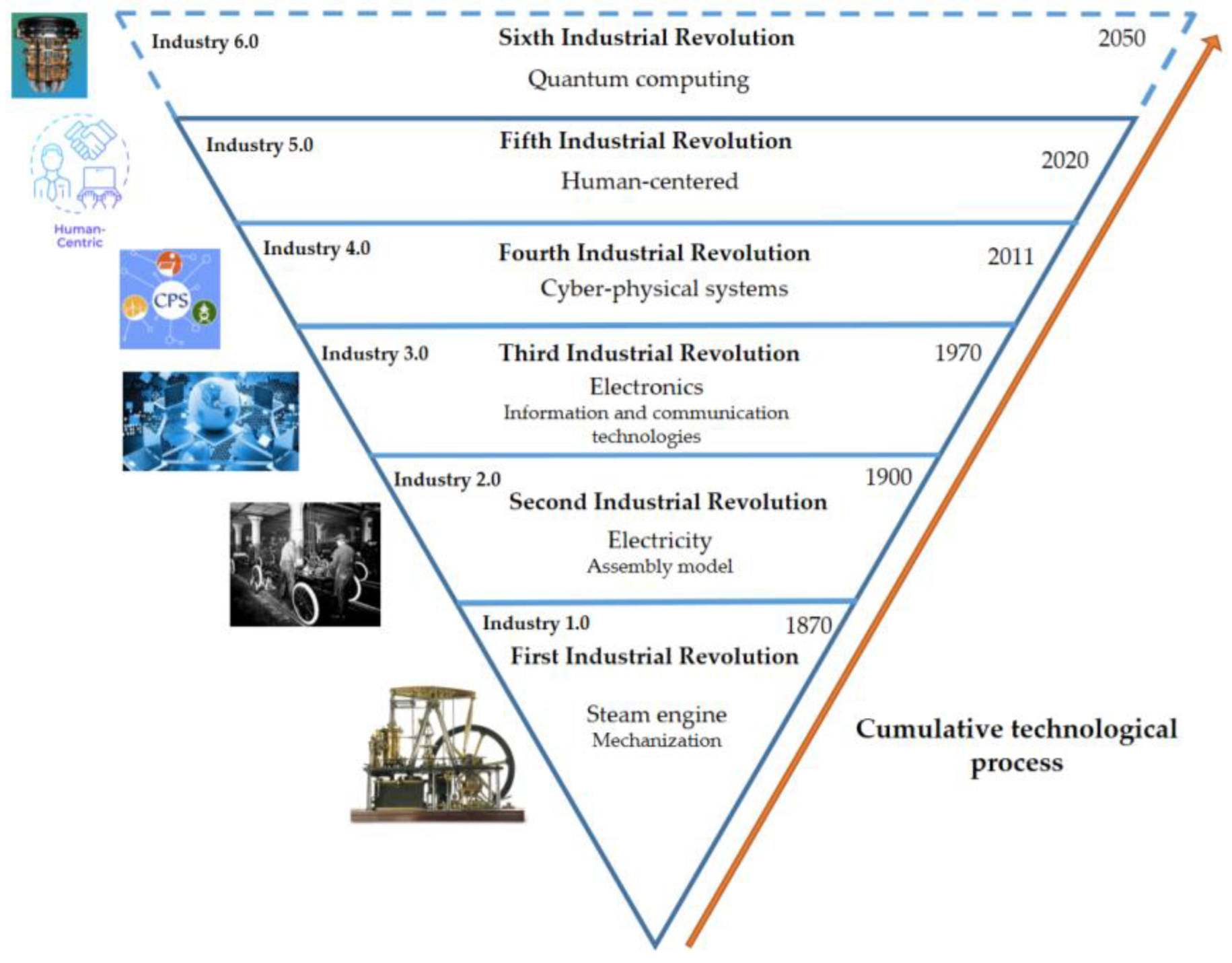
Figure 2.
Initial concept of mechatronics.
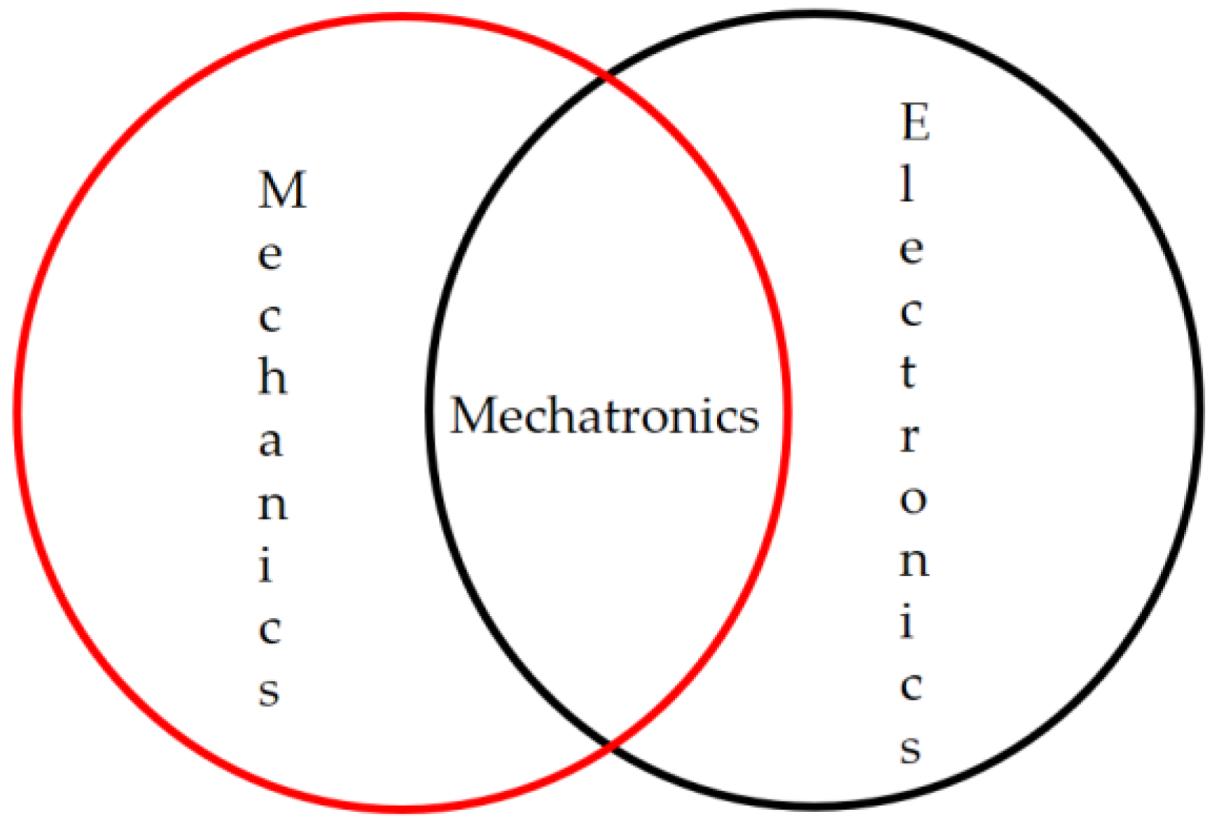
Figure 3.
Mechatronic Environments. (Taken and improved from [33]).
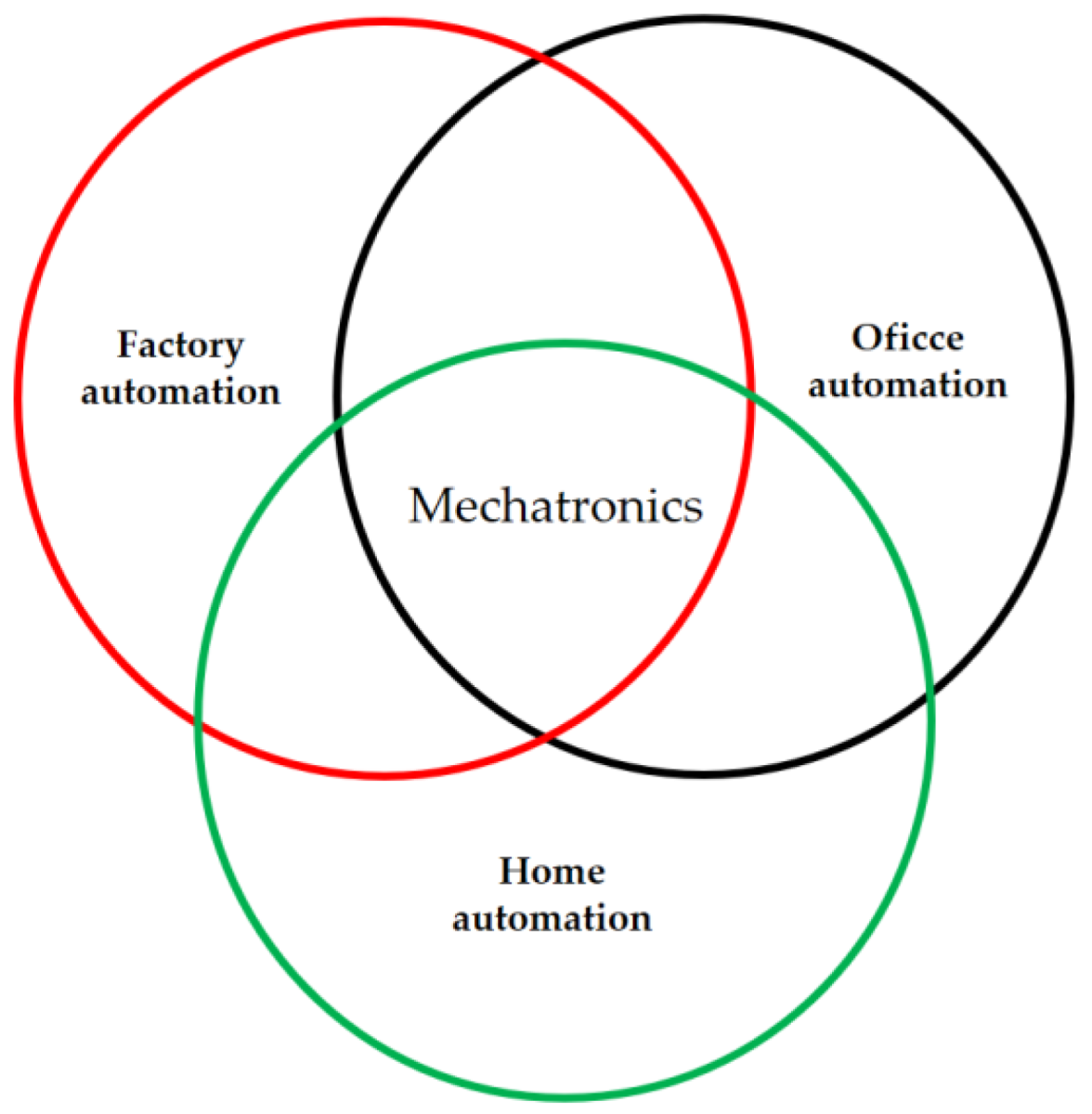
Figure 4.
Mechatronics: synergetic integration of different disciplines. (Taken and improved from [35]).
Figure 4.
Mechatronics: synergetic integration of different disciplines. (Taken and improved from [35]).
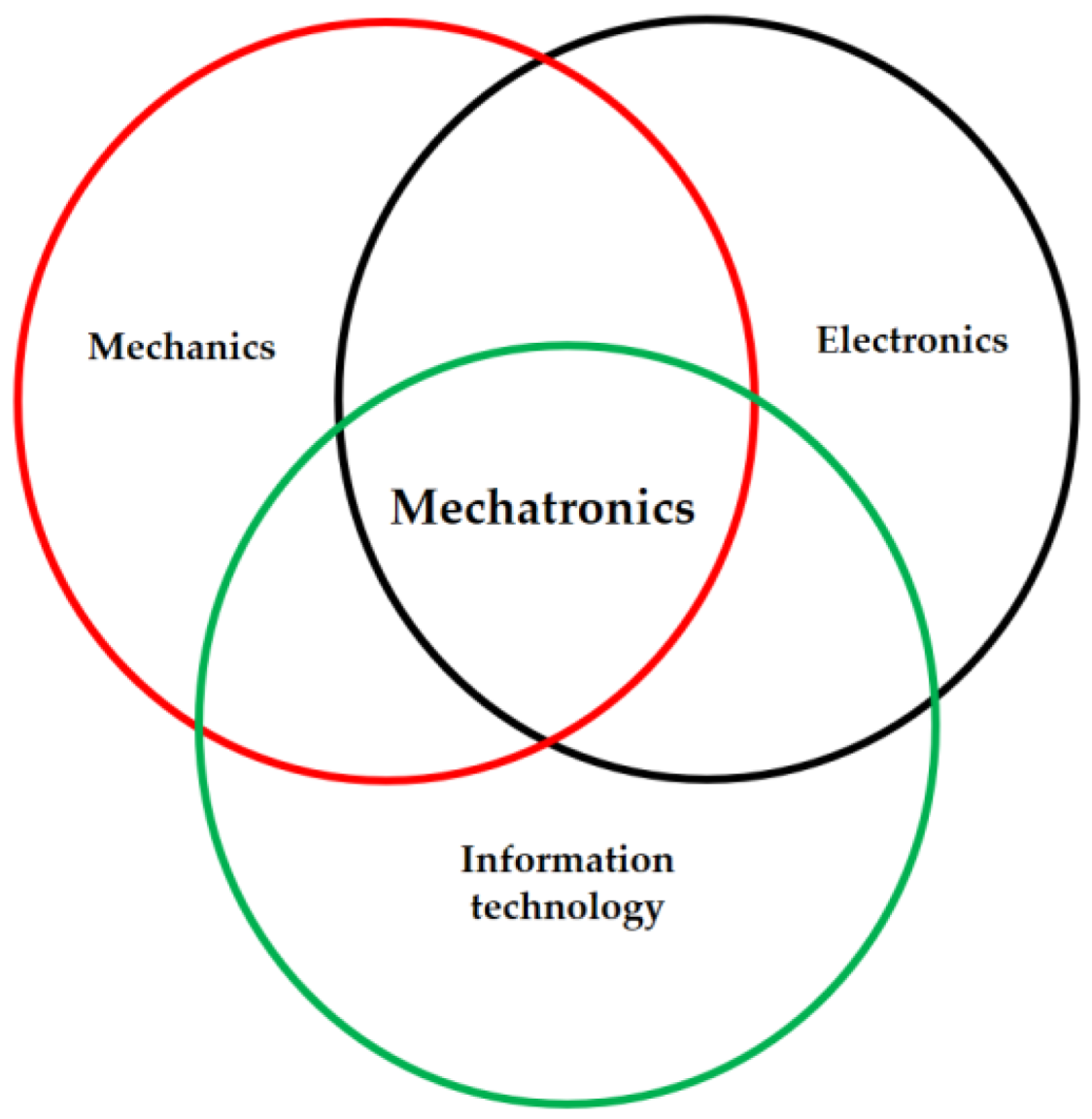
Figure 5.
Euler diagram representation of mechatronics and its interdisciplinary branches of engineering. Taken from [36]).
Figure 5.
Euler diagram representation of mechatronics and its interdisciplinary branches of engineering. Taken from [36]).
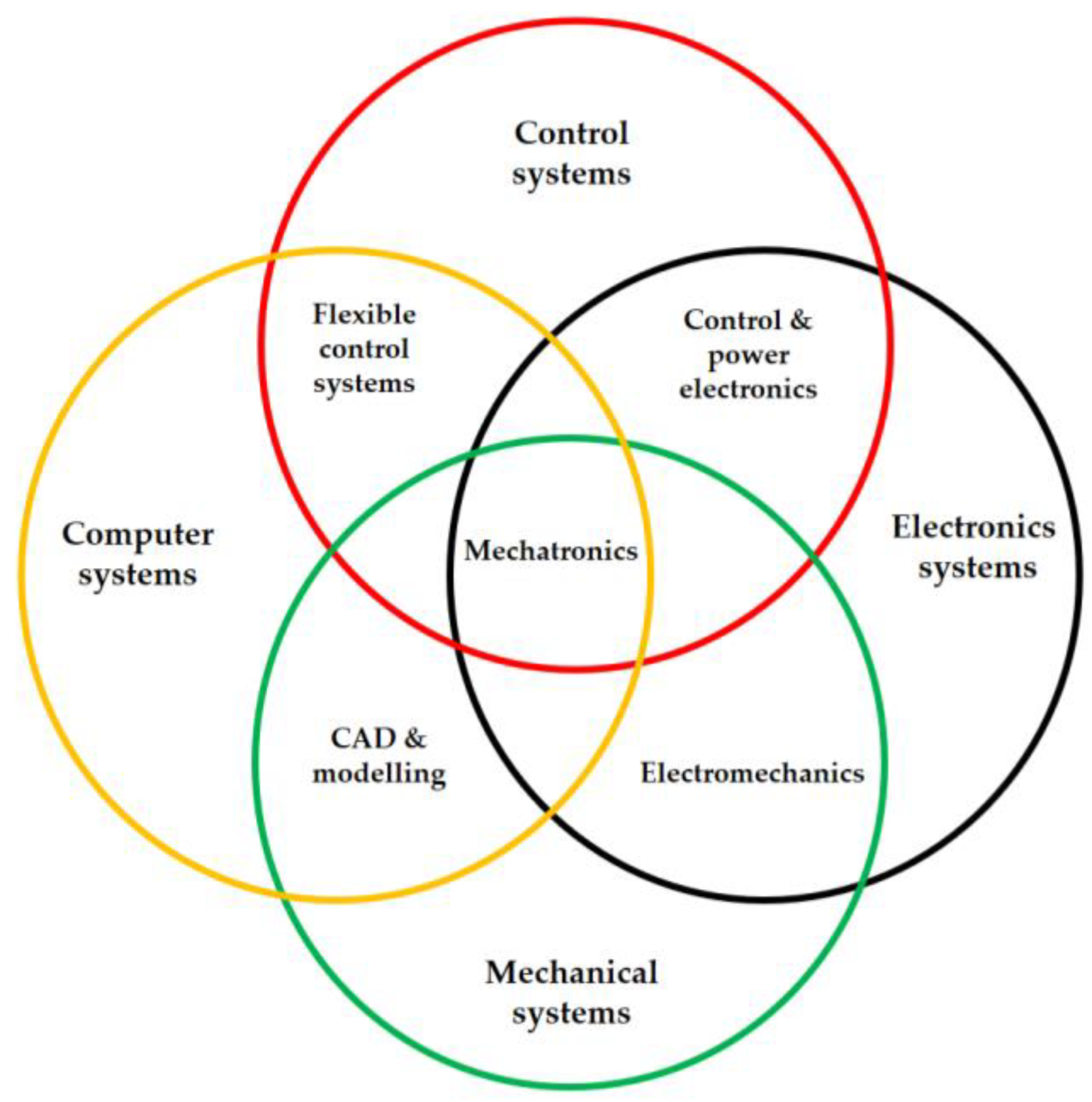
Figure 6.
Generations of mechatronics. (Taken and improved from [45]).
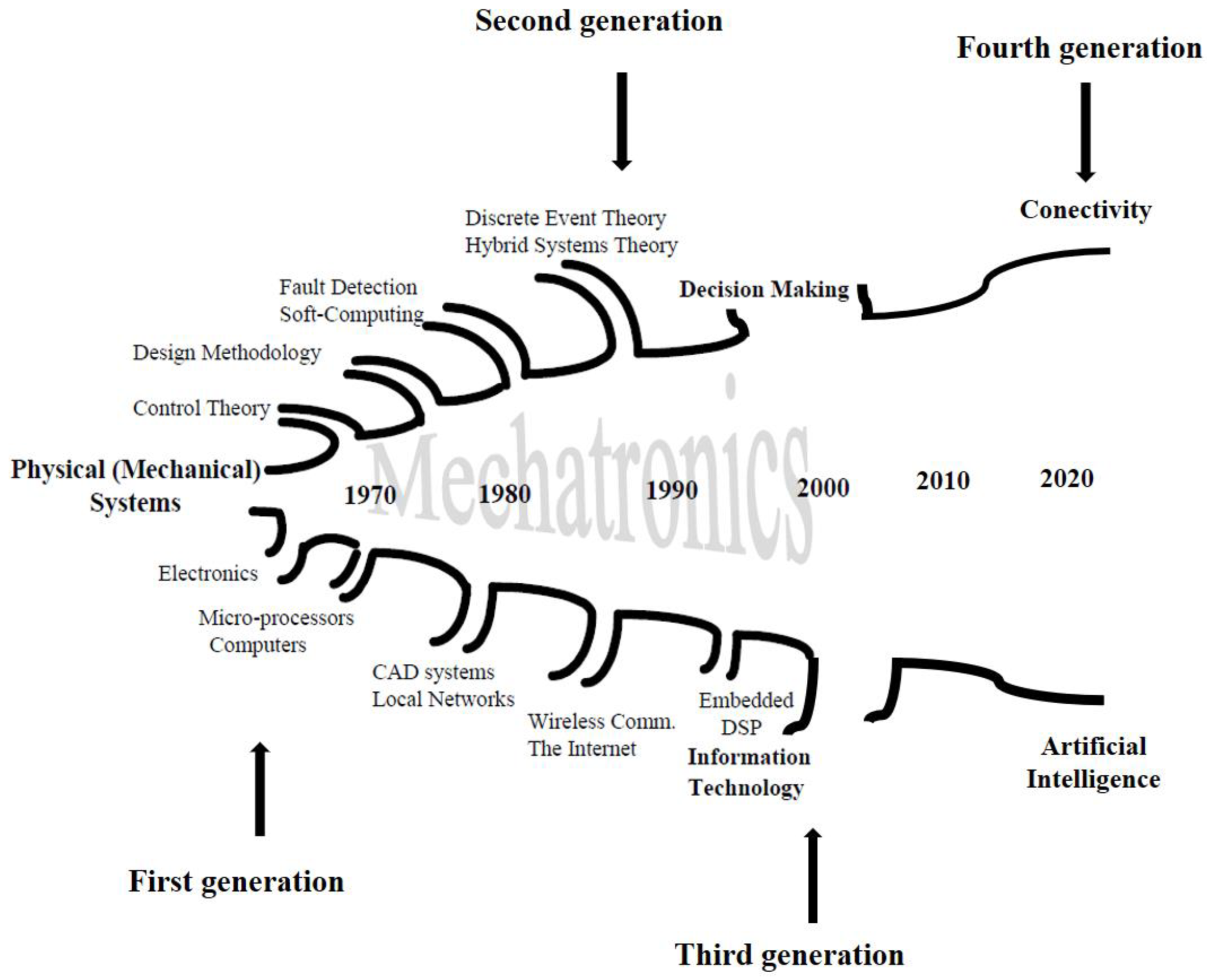
Figure 7.
Diagram of a typical mechatronic system (Taken from [49]).
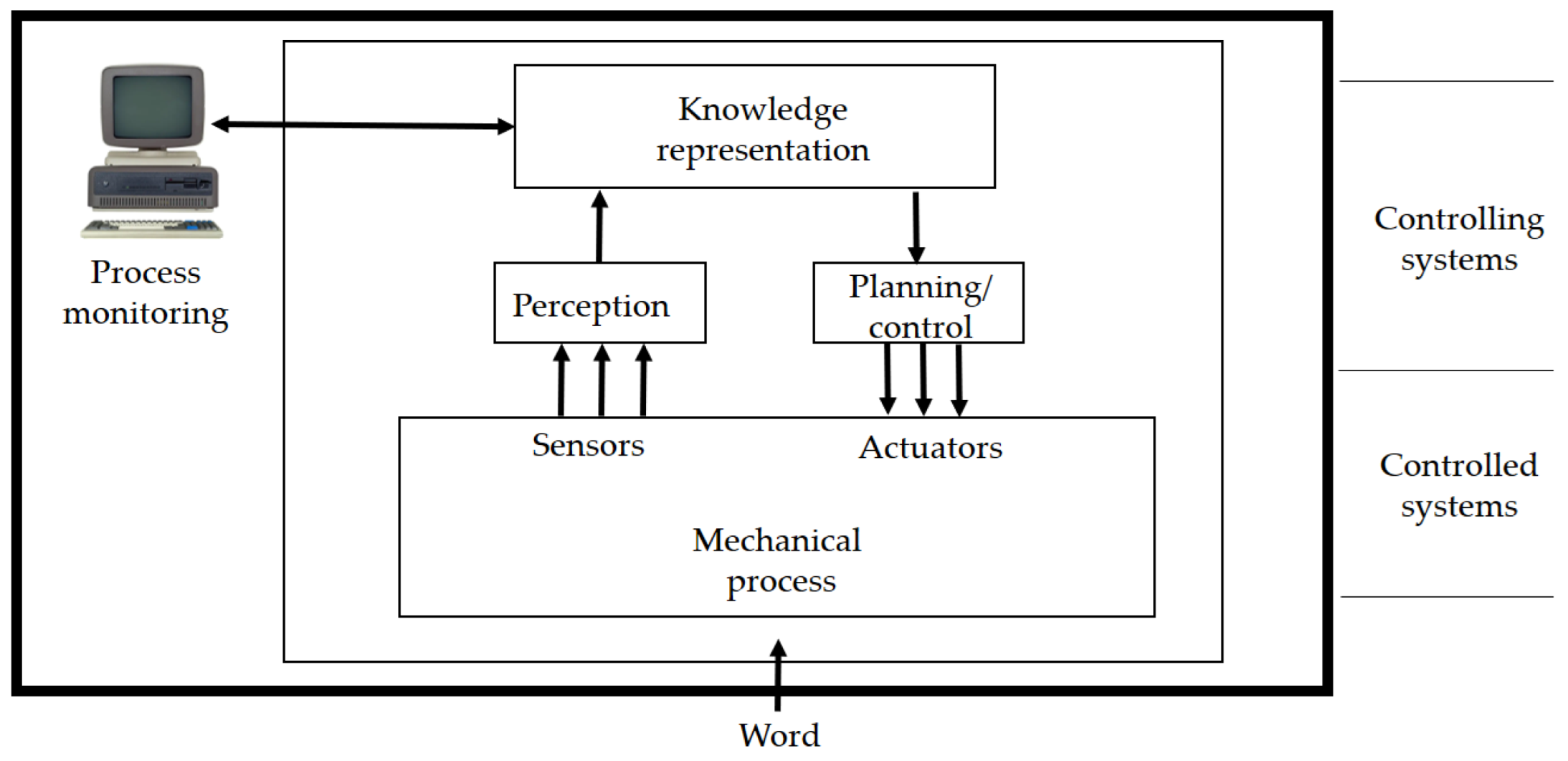
Figure 8.
Diagram of an embedded system (Taken from [52]).
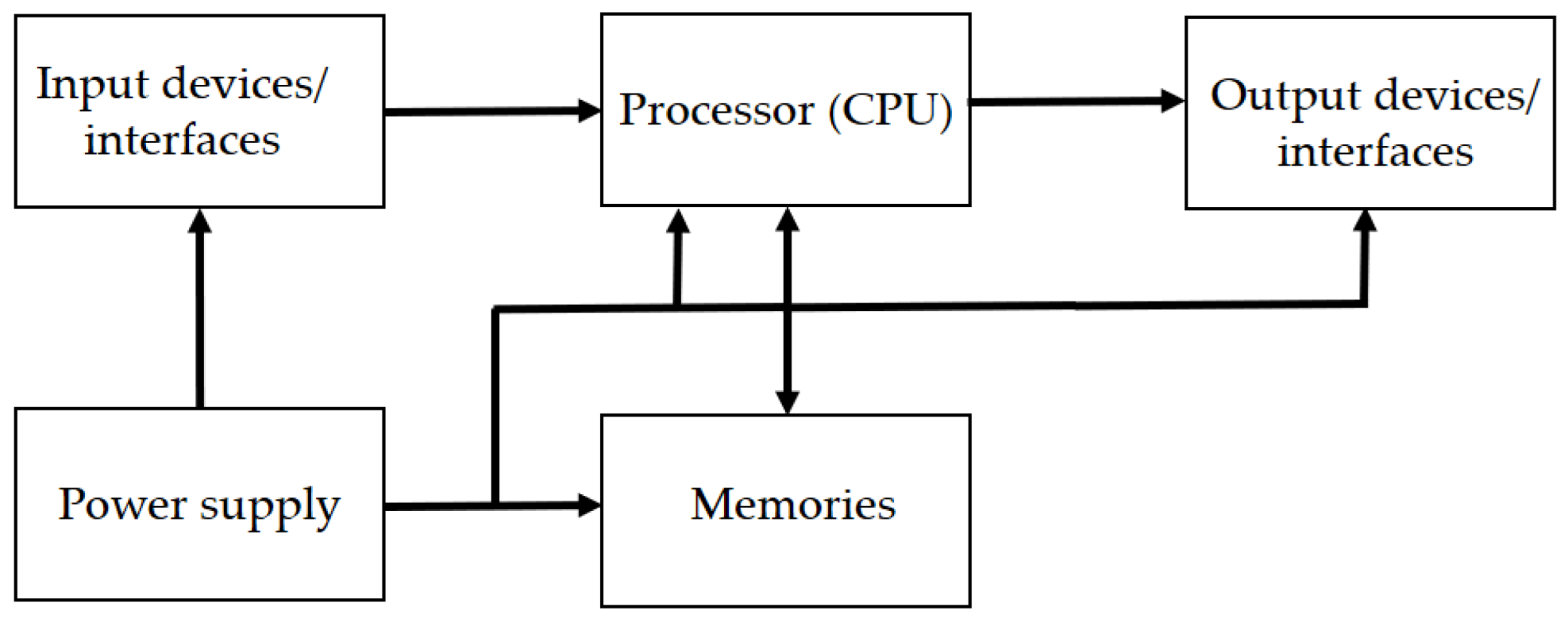
Figure 10.
Mechatronics and Industry 4.0.
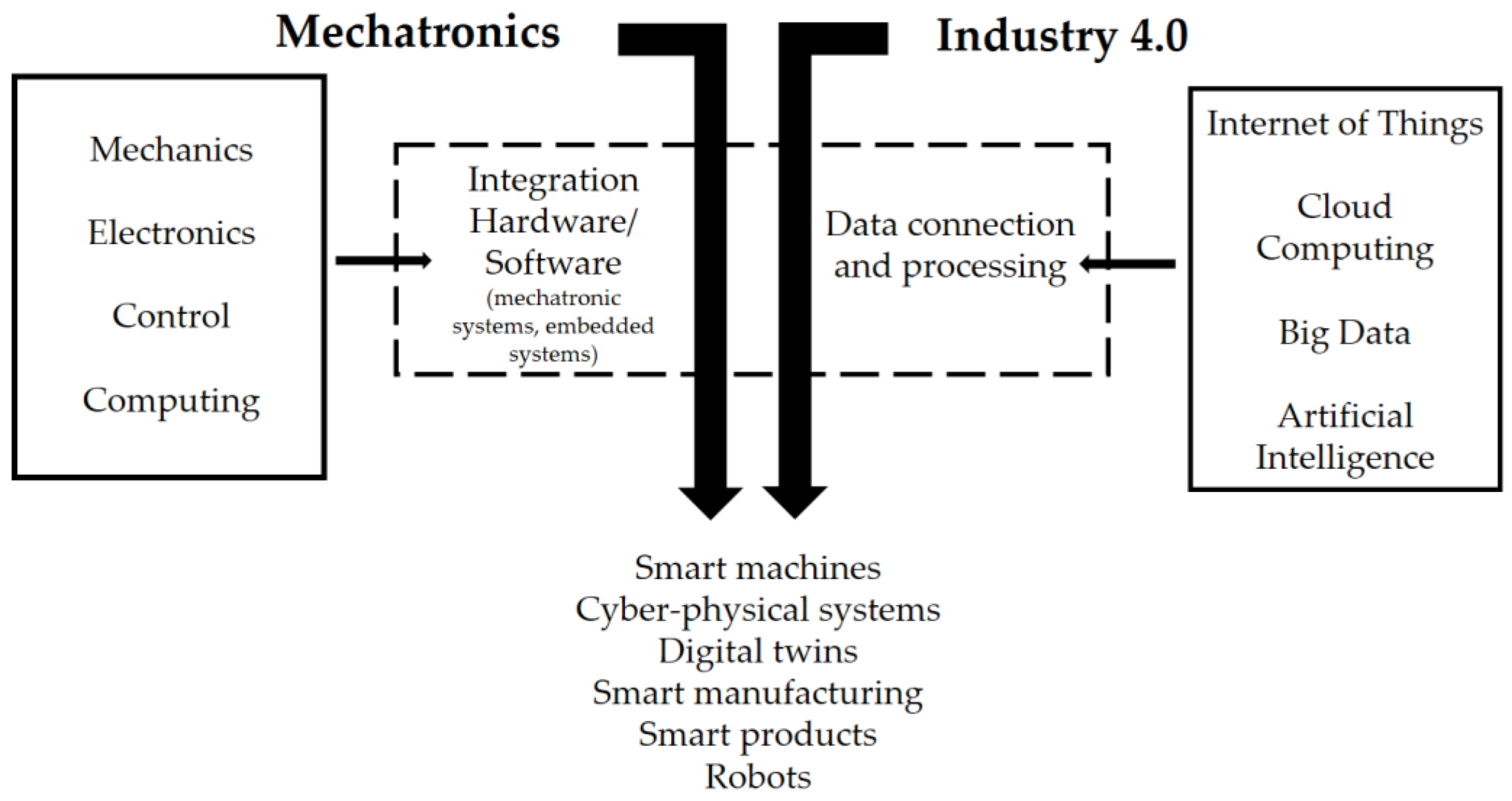
Figure 11.
Pyramid of intelligent automation and mechatronics. Taken and adapted from [58,59,60].
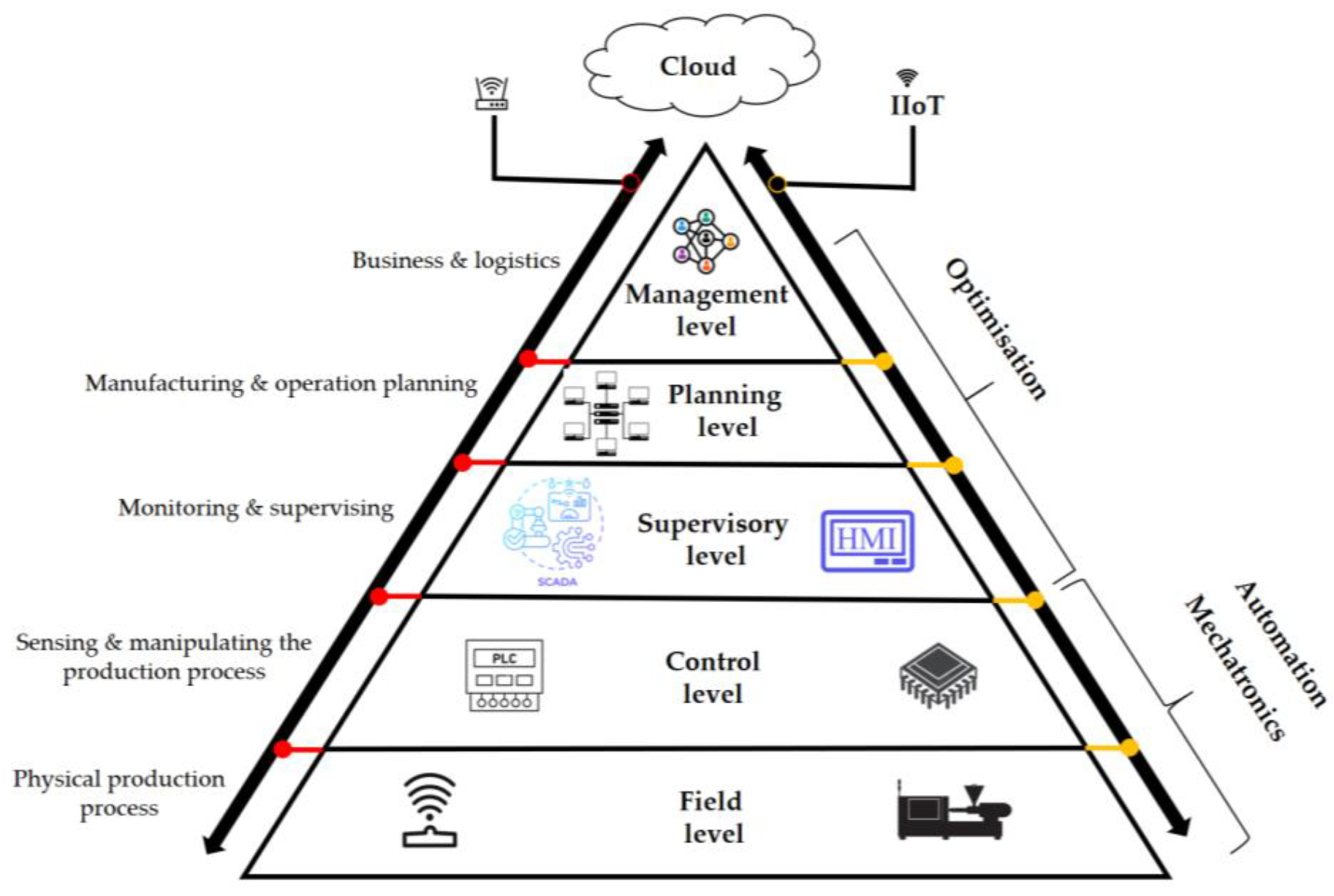
Figure 12.
Concurrence between mechatronics and cyber-physical systems. Taken from [66].
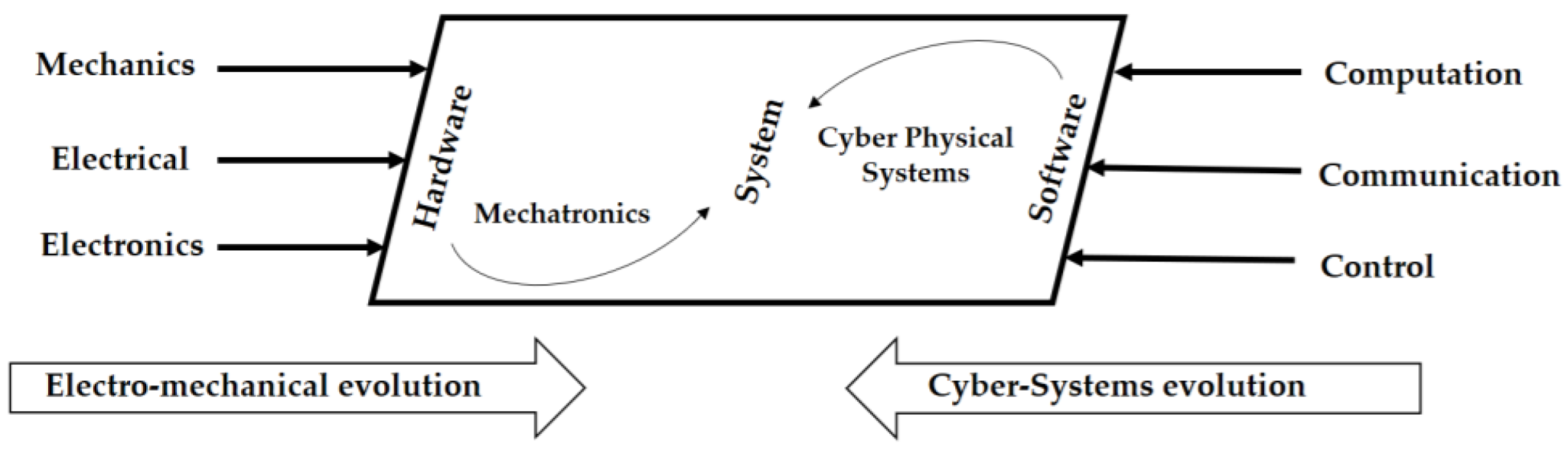
Figure 13.
Industry 5.0 Technologies. Taken from [72].
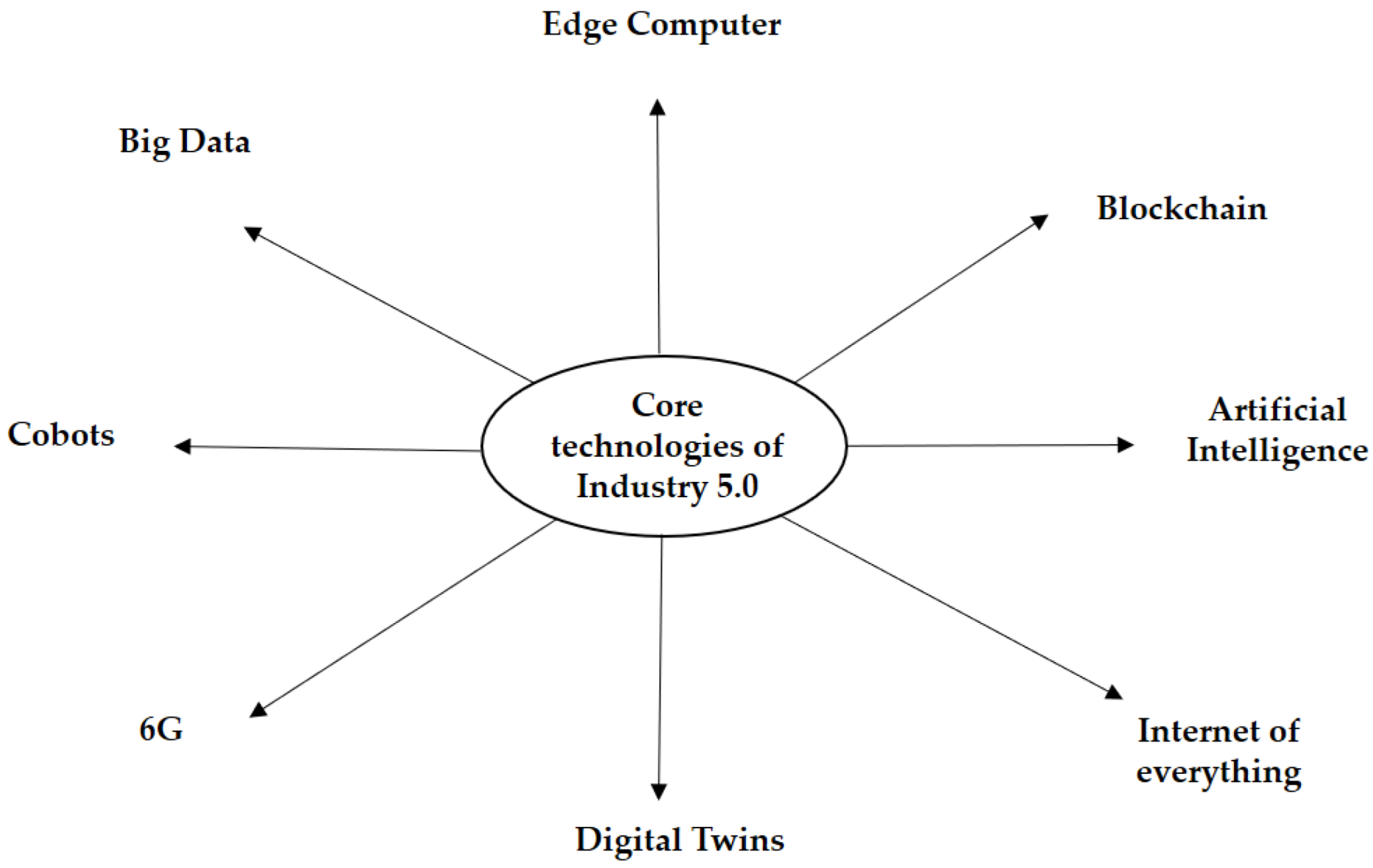
Figure 14.
Example of a digital twin and mechatronic systems.
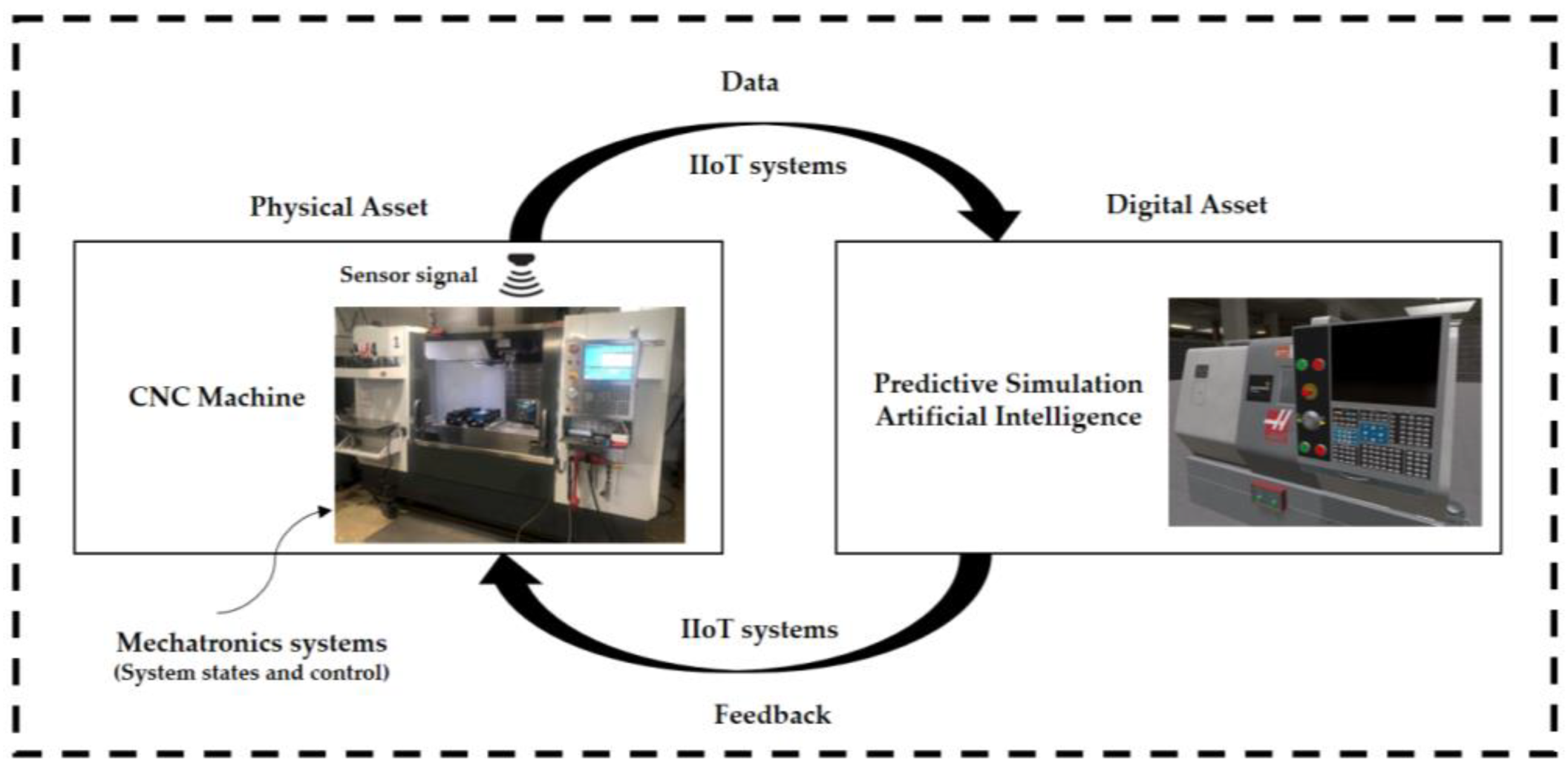
Figure 15.
Mechatronics and its relationship with Industry 4.0 and 5.0.
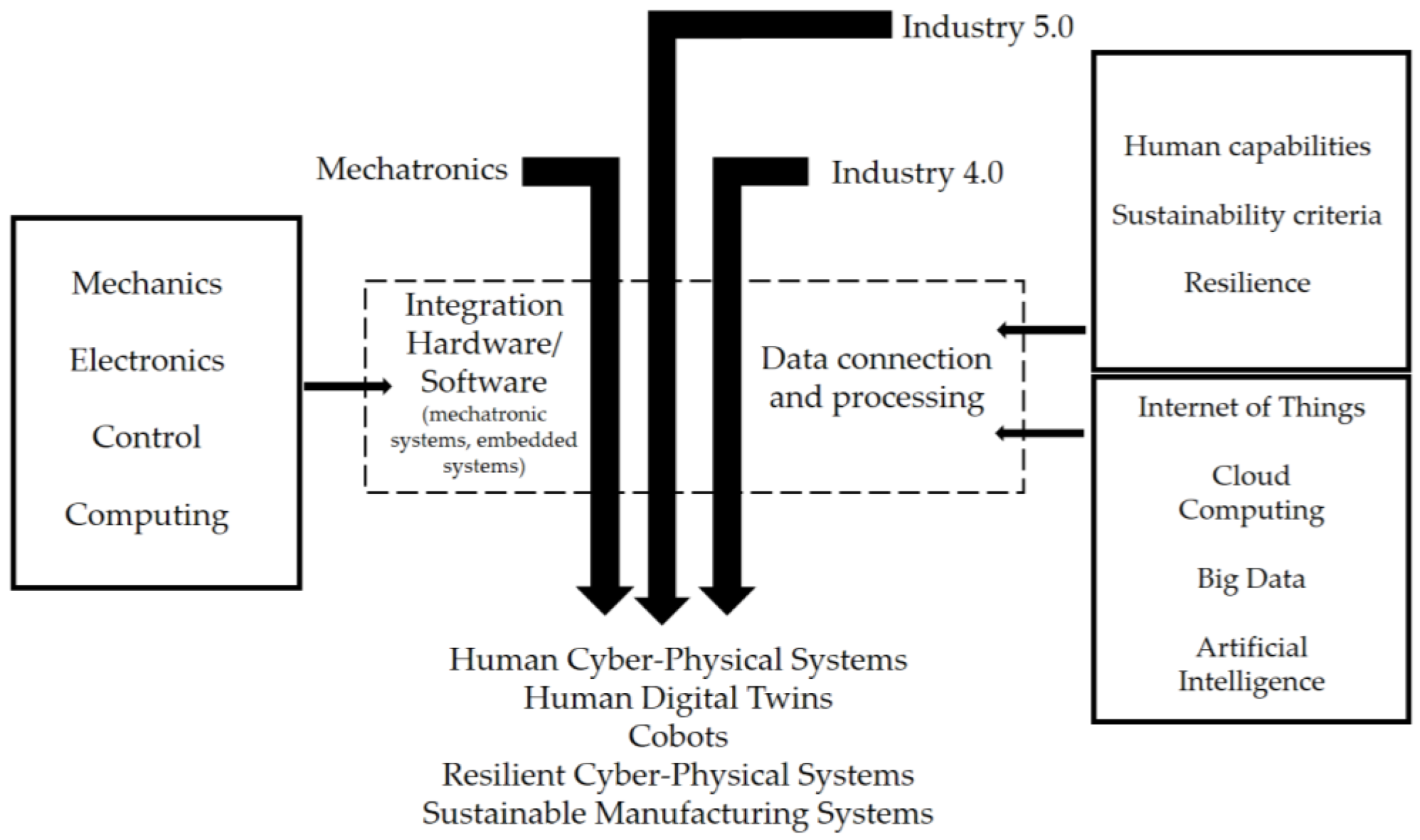
Figure 16.
Evolution of mechatronics in relation to industrial revolutions. Taken and improved from [19,55].
Figure 16.
Evolution of mechatronics in relation to industrial revolutions. Taken and improved from [19,55].
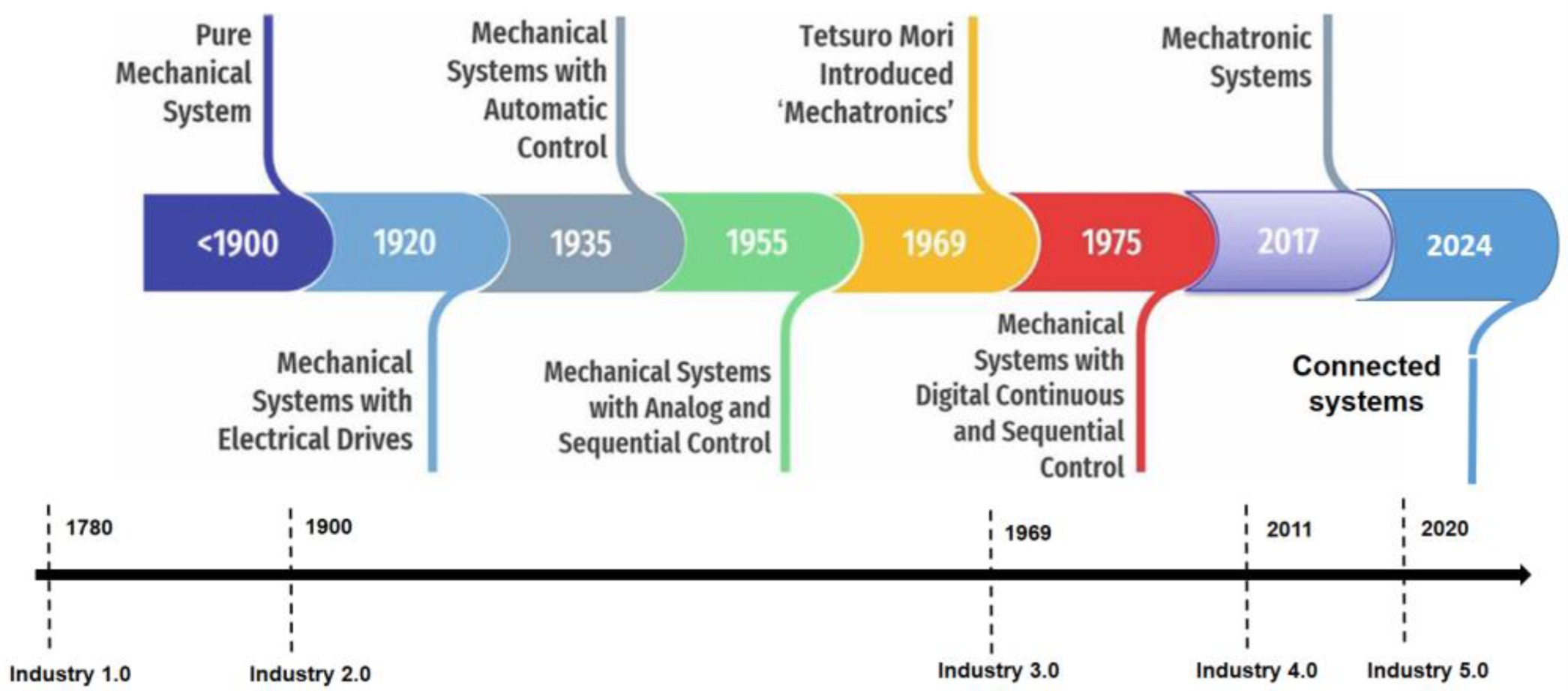
Figure 17.
Typical components of a hard disk drive. Taken from [88].
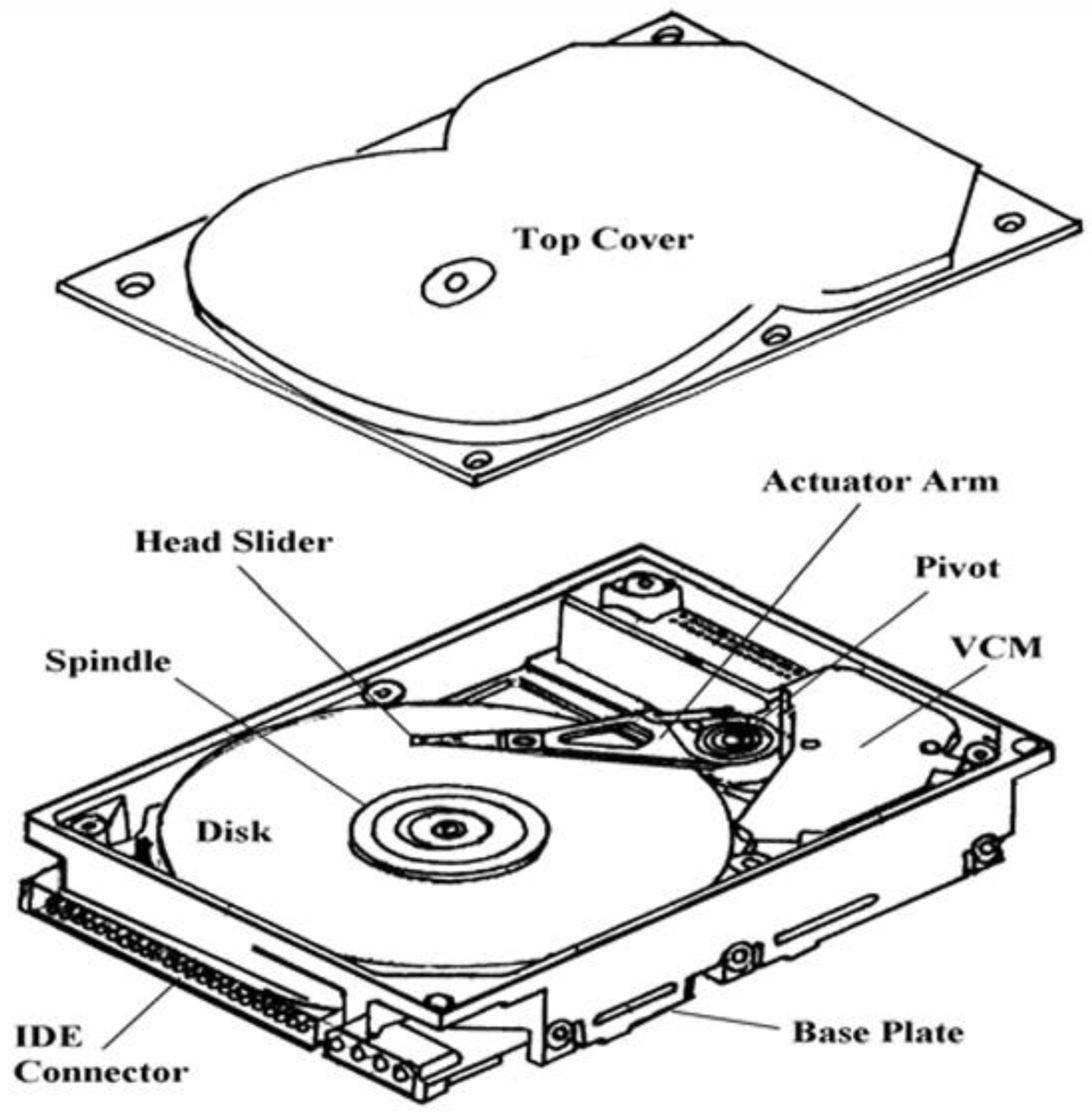
Figure 18.
Examples of M3.0 with applications in manufacturing.
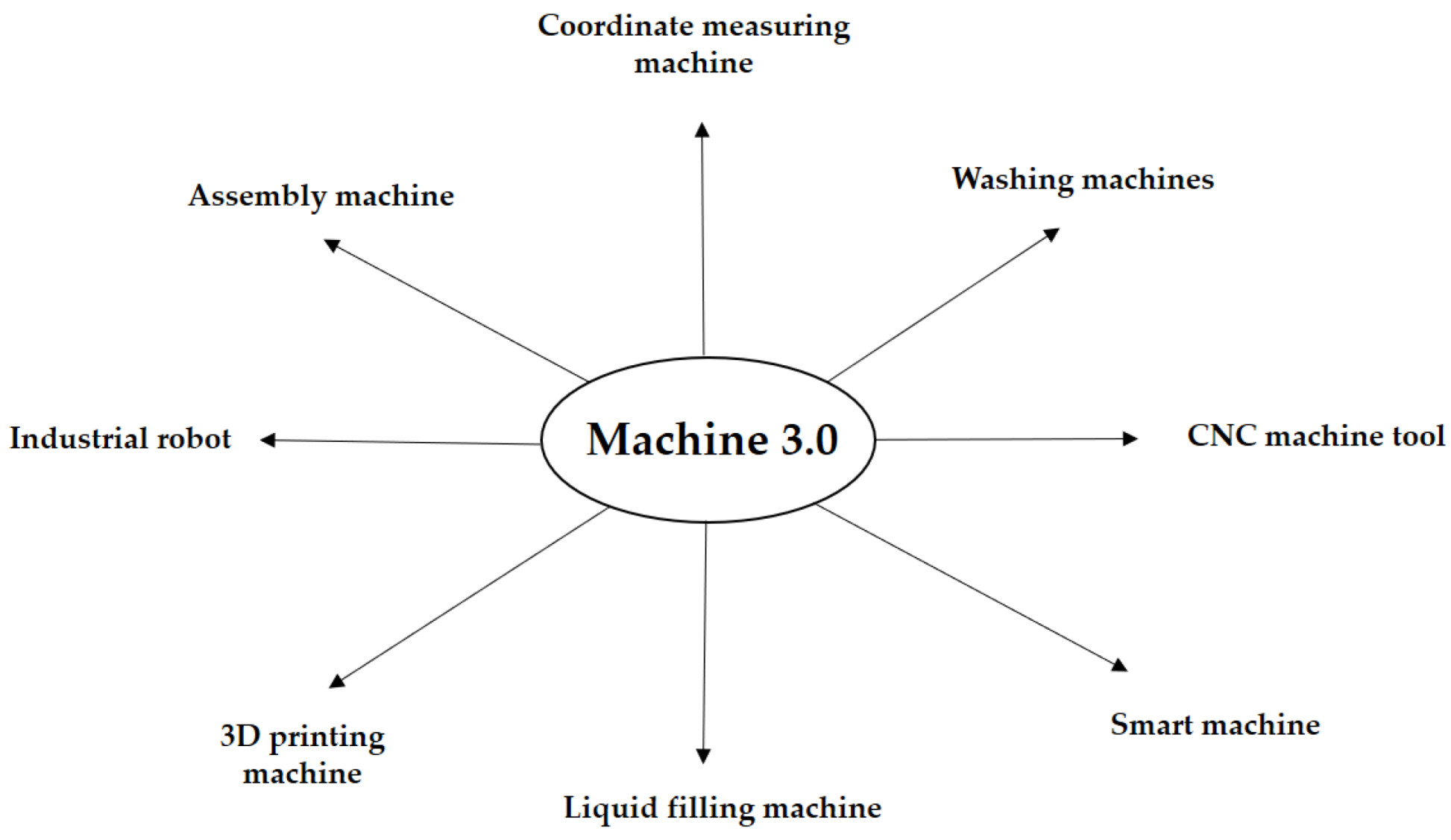
Figure 19.
Examples of PS3.0 production systems.
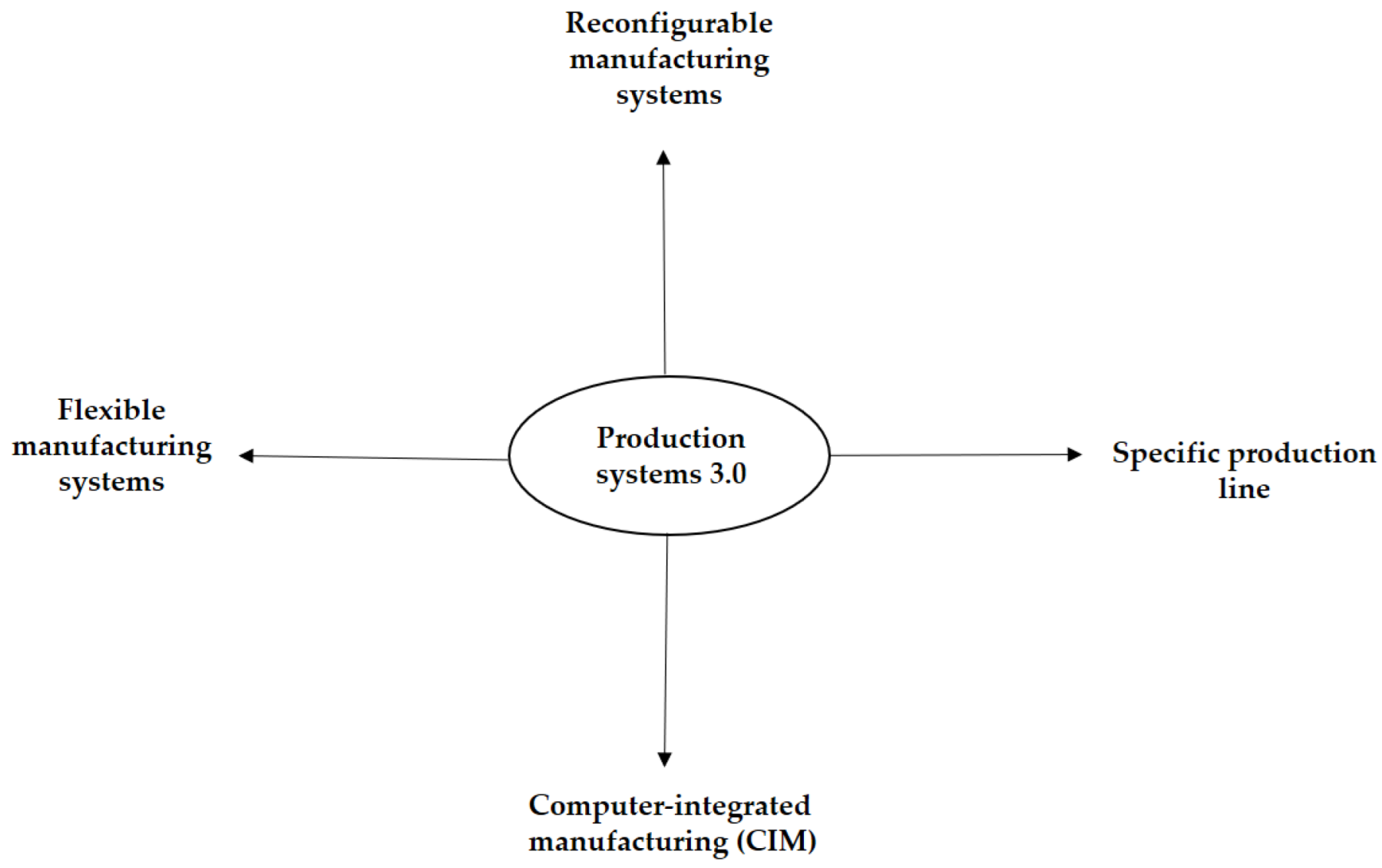
Figure 23.
Assets that make up a cyber-physical system. Taken from [19].
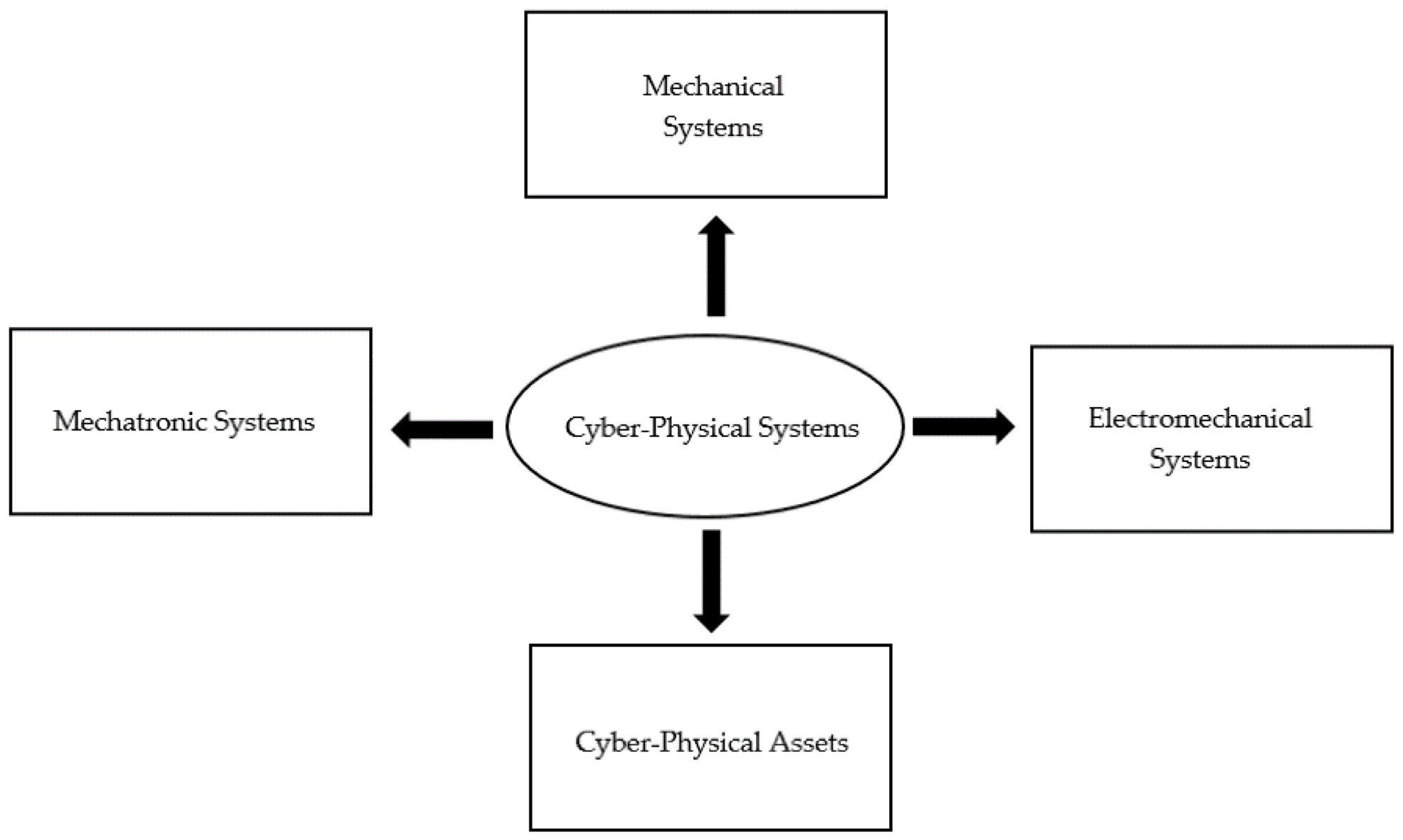
Figure 24.
Industry 5.0 design principles.
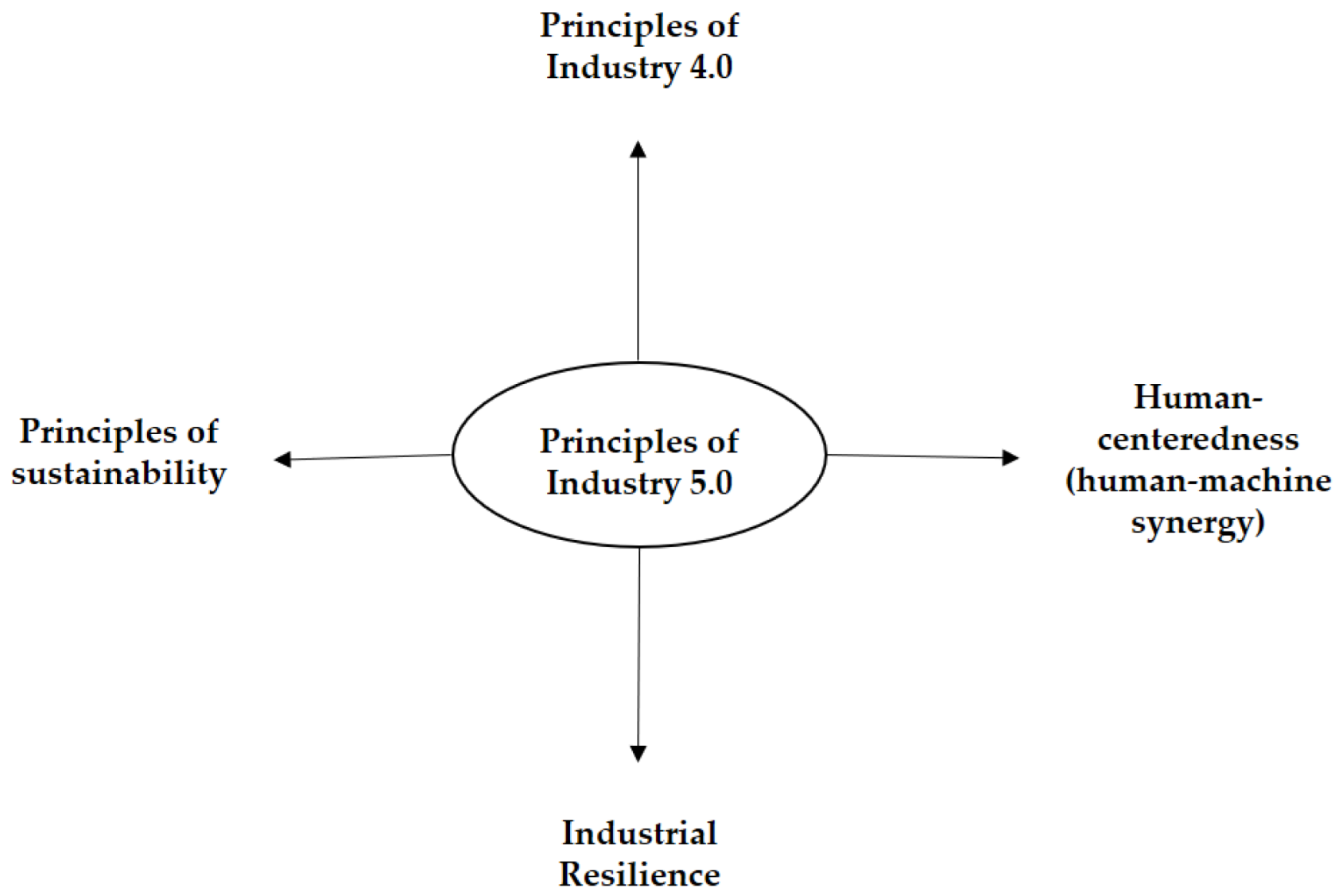
Figure 25.
ABB Yumi IRB 1400 cobot, as an example of an M5.0 machine. Taken from [104].
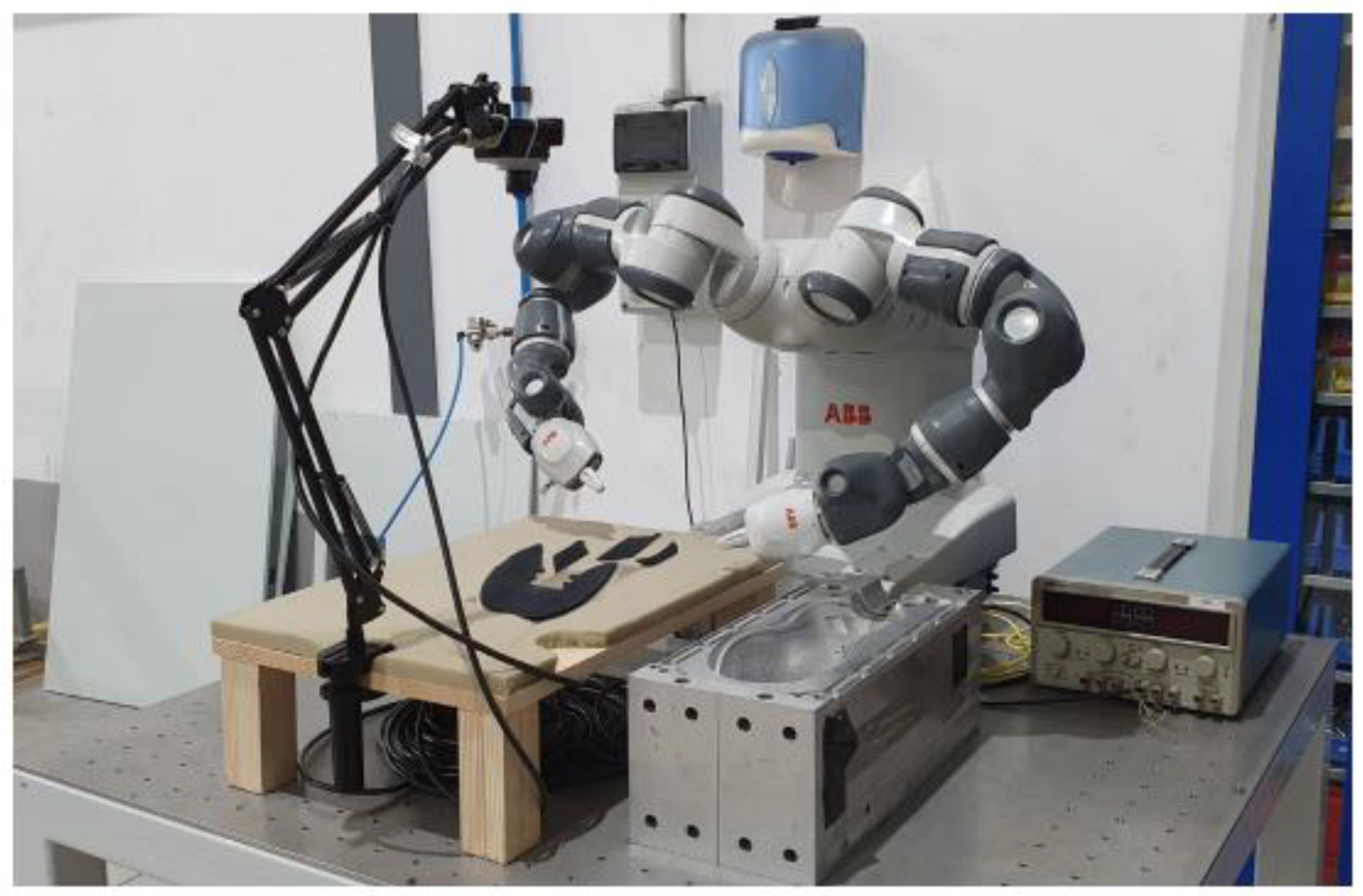
Figure 26.
Human digital twin and its interaction with a machine digital twin, as an example of an M5.0 machine. Taken from [106].
Figure 26.
Human digital twin and its interaction with a machine digital twin, as an example of an M5.0 machine. Taken from [106].
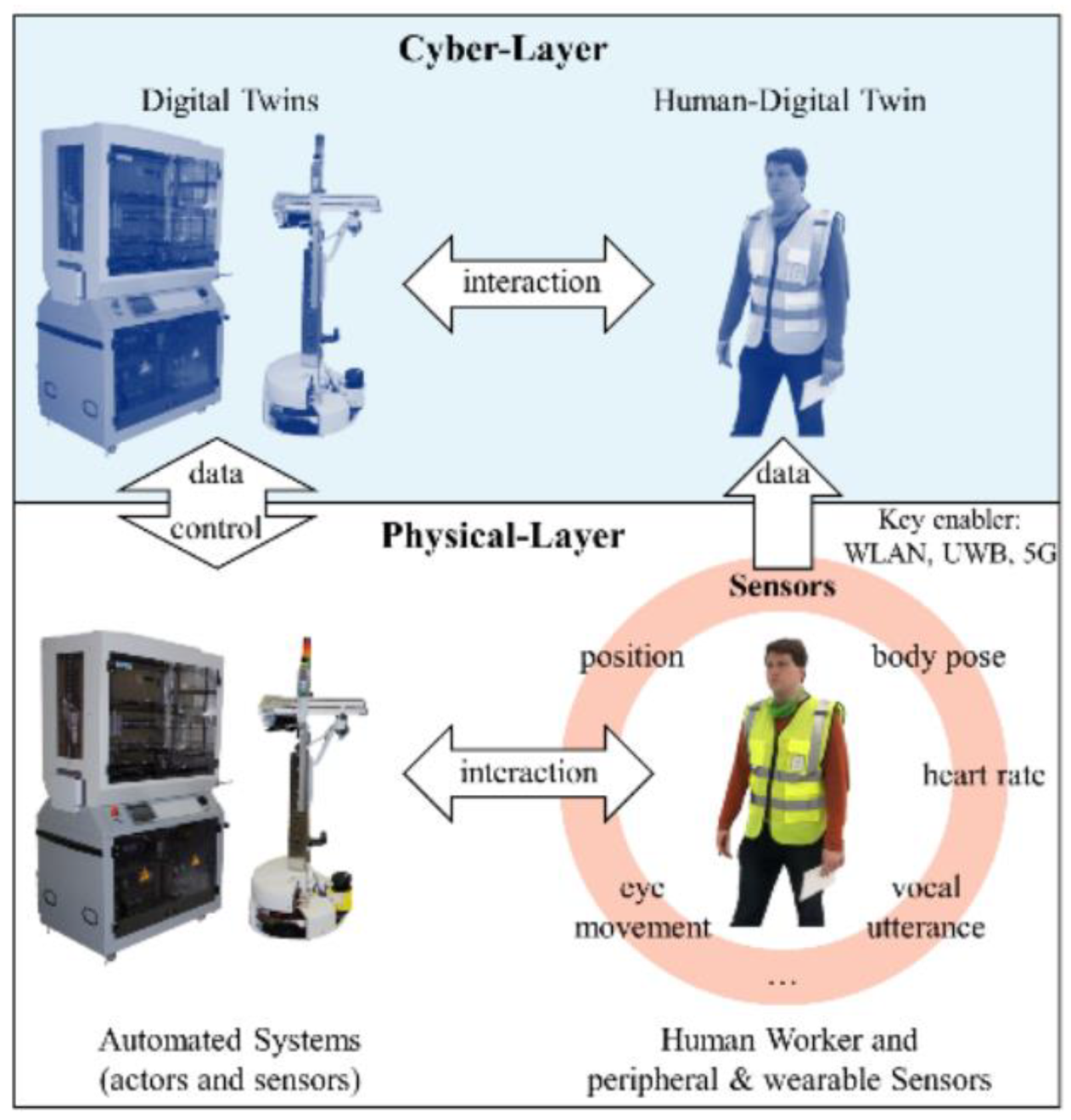
Figure 27.
Human cyber-physical system, as an example of an SP5.0 system. Taken from [108].
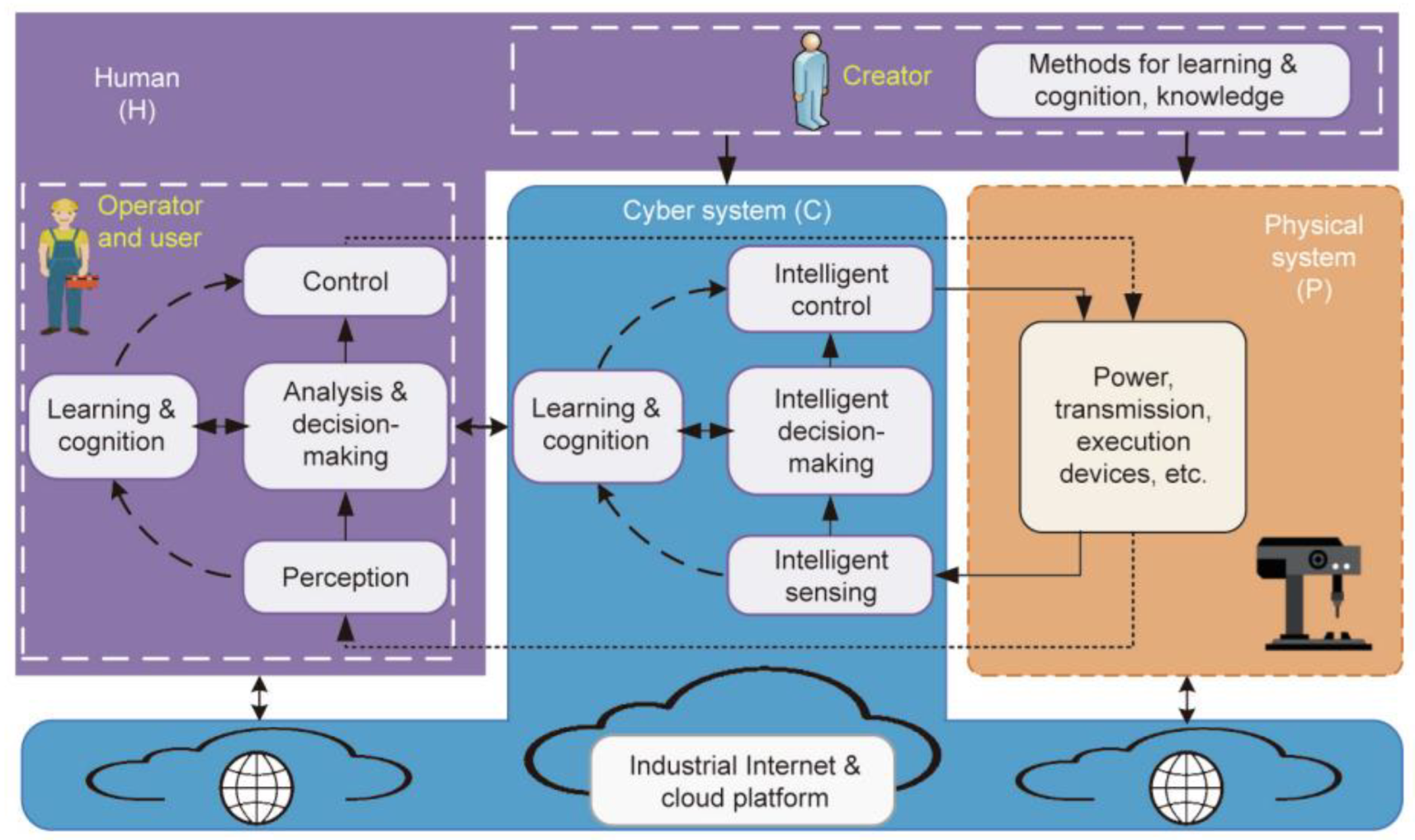
Figure 28.
Relationships between mechatronics, smart retrofitting, and active industrial revolutions and their transitions.
Figure 28.
Relationships between mechatronics, smart retrofitting, and active industrial revolutions and their transitions.
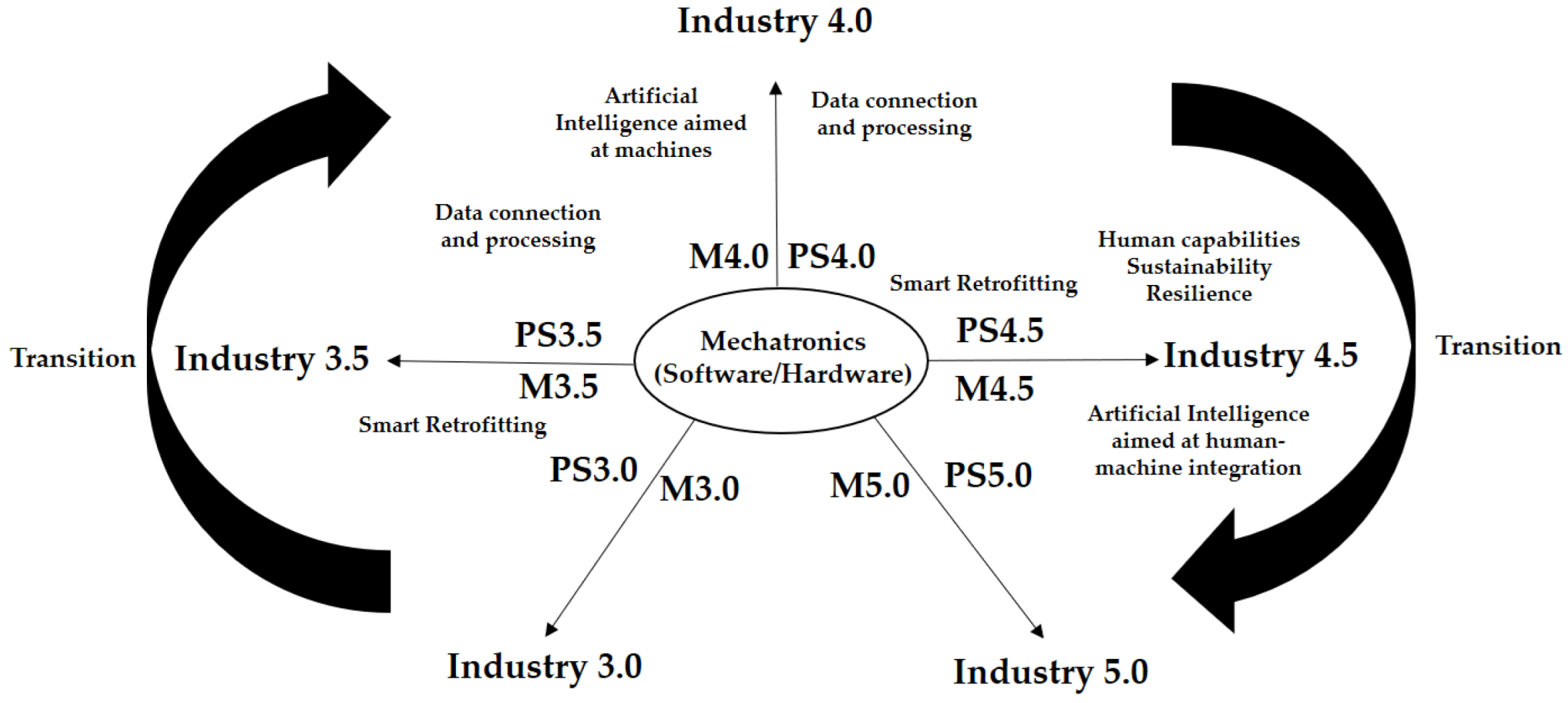
Disclaimer/Publisher’s Note: The statements, opinions and data contained in all publications are solely those of the individual author(s) and contributor(s) and not of MDPI and/or the editor(s). MDPI and/or the editor(s) disclaim responsibility for any injury to people or property resulting from any ideas, methods, instructions or products referred to in the content. |
© 2025 by the authors. Licensee MDPI, Basel, Switzerland. This article is an open access article distributed under the terms and conditions of the Creative Commons Attribution (CC BY) license (http://creativecommons.org/licenses/by/4.0/).
Copyright: This open access article is published under a Creative Commons CC BY 4.0 license, which permit the free download, distribution, and reuse, provided that the author and preprint are cited in any reuse.


