

Submitted:
20 December 2025
Posted:
22 December 2025
You are already at the latest version
Abstract
The ongoing environmental challenges posed by soil degradation and desertification are of particular concern. This situation is particularly alarming in agricultural and pastoral areas in communities in northern Senegal, as it compromises the food security of human communities. Considering this situation, composting is regarded as a pivotal instrument within agrosystems, facilitating the utilization of organic livestock and agricultural waste for the purpose of transforming it into fertilizer for crop cultivation. Development cooperation projects sometimes involve the transfer of scientific knowledge to develop products adapted to the conditions of the area targeted by the intervention. The study aims to examine the basic properties of the soils, analyse the composting process and the compost, and evaluate the effect of the compost obtained on the soil within the framework of a development cooperation project. Sampling has been carried out in several agro-livestock communities in Northern Senegal; physical and chemical parameter analyses were carried out on materials in the composting phase, compost, soils, and soils amended with compost and manure. The results indicate that the soil dedicated to cultivation in the areas studied are characterized by a predominantly sandy texture and exhibit significantly low levels of nitrogen and organic matter. The resulting compost has contributed significantly to improving the soils where it has been applied and therefore improve crop production, thereby highlighting the Kanel region.
Keywords:
composting
; local communities
; soil properties
; PTE
1. Introduction
Senegal, a West African nation, is named after its most significant geographical feature, the Senegal River. It lies between two critical environmental regions: the Sahara Desert to the northeast and the African savannah to the south, with the Atlantic Ocean bordering the west.
The country is situated in the Sahel ecoregion, characterized by a seasonal rainfall pattern and a long dry season with extreme temperatures. The dry season, lasting from 6 to 10 months, occurs due to the absence of the humid monsoon flow, which determines the onset of both the wet and dry seasons. These seasonal changes lead to a distinct transition from the dry conditions of the Sahara Desert in the north to the wetter savannah in the south. Precipitation varies significantly across the country, ranging from 100 to 600 mm annually, with summer temperatures reaching as high as 50 °C. In contrast, winter temperatures are milder but show considerable daily variation, exceeding 20 °C. This climate variability, combined with soil moisture, plays a critical role in precipitation dynamics and the potential for sustainable agricultural practices (Larbi, 2023; Aleman, 2025; Fall, 2003).
Agriculture and livestock have long been the backbone of Senegal’s economy, with 40% of the workforce historically engaged in agricultural activities. However, this proportion has drastically decreased to 22% in recent years (TheGlobalEconomy.com, 2022). Despite this decline, agriculture still accounts for 17% of the GDP, and 60% of the rural population depends directly on it for their livelihood (Bank, 2023). A significant portion of cultivated land—about one-third—is less than one hectare in size, indicative of subsistence farming. Senegal remains a deeply rural country, yet its agricultural system was heavily impacted by French colonial policies that promoted the cultivation of cash crops and international trade, undermining traditional farming practices and exacerbating environmental degradation. (Directorate of Analysis, 2020; Fernández, 2024). The country’s agricultural system is now at the forefront of the battle against climate change, with rising temperatures, decreased rainfall, and increasing evapotranspiration threatening crop productivity and water availability. Arid conditions are expected to spread, turning currently dry subhumid areas into arid zones, increasing the risk of desertification (Tall et al., 2017; Fernández, 2024; Trisos et al., 2022; Barros, 2014). The impacts of these changes affect agricultural productivity and therefore food security. Forecasts for 2035 and 2050 indicate an increase in the negative effects already observed in this country (Faye et al., 2021).
The need for climate change mitigation and adaptation strategies across all sectors, especially in agriculture, is critical. A fundamental aspect of this effort involves the role of agriculture and livestock farming in carbon sequestration through soil management practices, such as waste management and composting (Bationo et al., 2007).
Composting, a controlled aerobic and thermophilic process that transforms biodegradable organic materials into stabilized organic matter, has been recognized as a promising solution in sub-Saharan Africa. The process involves five key phases: the initial latent phase, the mesophilic phase, the thermophilic phase, the cooling phase, and the final maturation phase. (Real Decreto 506/2013; Policastro & Cesaro, 2022). In Senegal, composting methods vary, with open-air mounds requiring more water due to exposure to wind, and composting pits demanding less water. Composting practices are often determined by economic factors and the availability of materials, with methods using local resources like clay or cement being common. Recent studies have shown that combining different organic waste types, such as slaughterhouse waste, domestic waste, and tree leaves, can reduce water demand and improve the nutrient content of the resulting compost, making it more suitable for crop production. (Kaboré et al., 2010), (Bissala & Payne, 2006), (Bissala & Payne, 2006), (Gómez-Rico Núñez de Arenas, 2008).
Soil quality in Senegal is a key factor in agricultural productivity. Senegal’s soils are often sandy, with low nutrient content and poor water retention (Nathan & Amadou, 2005). However, organic matter plays a crucial role in improving soil structure, increasing the cation exchange capacity (CEC), enhancing soil resistance to erosion, and improving water infiltration rates (Bationo et al., 2007) (Yavitt et al., 2021). These benefits are particularly important in the context of increasing rainfall intensity due to climate change. By improving soil structure and supporting soil fauna, such as microorganisms, organic amendments like compost contribute to better plant nutrition and help mitigate soil degradation (Hotfbauer et al., 2023). Compost application, in addition to improving soil properties, also increases the soil's capacity to store organic carbon, serving as a carbon sink and thus contributing to climate change mitigation. However, carbon sequestration potential is highly variable, depending on factors like temperature and humidity, which influence the dynamics of composting in drier climates (Rajat Kumar et al., 2022). The sustainability of agricultural production systems depends on maintaining and improving the level of organic matter (OM) in agricultural soils, which is one of the main challenges of agriculture and is vital for improving soil quality and agricultural productivity. The application of compost and residues contributes to an increase in soil organic matter.
In Senegal, agroecology has emerged as a key approach to improving sustainability in agriculture. Defined by the FAO as both a scientific discipline and a set of practices, agroecology focuses on optimizing the interactions within agroecosystems and promoting farming systems that are socially just, economically viable, and environmentally sustainable (FAO, n.d.). The foundation of agroecology is organic farming, which aims to produce high-quality food by following natural cycles and excluding synthetic chemicals. Traditional farming practices, such as leaving land fallow to replenish soil nutrients, were once common but are no longer sufficient in a rapidly growing population with limited access to chemical fertilizers. As a result, new strategies for increasing soil fertility have been implemented, often using locally available materials such as household waste and compost. (Batjes, 2001).
Several successful examples of agroecological systems in Senegal demonstrate the benefits of organic amendments and waste management in enhancing soil fertility. In Dior, located in the Peanut Basin, farmers have used compost made from household waste to fertilize less fertile land, leading to increased crop yields of peanuts and millet. Similarly, in Casamance, different composting methods incorporating rice straw and domestic waste have been shown to improve germination rates and reduce soil carbon losses (Nathan & Amadou, 2005). A study conducted in Burkina Faso demonstrated that compost application significantly boosted sorghum yields, highlighting the positive effects of compost on soil properties and crop productivity (Ouédraogo et al., 2001).
Senegal also has various livestock management systems, some of which combine animal husbandry with crop farming, while others are primarily focused on livestock. Transhumant livestock farming, where pastoralists move between rural communities, is common, and this model emphasizes the integration of livestock and agriculture in a way that can help ensure sustainability and adaptation to climate change.
Agroecological practices, such as composting, are essential in addressing the challenges of land degradation, food insecurity, and climate change, helping to foster a more resilient and sustainable agricultural system in Senegal.
Development cooperation is essential to achieving the United Nations Sustainable Development Goals (OECD 2023; United Nations 2019). Knowledge transfer and dissemination are part of many international cooperation projects that involve workshops, training and awareness campaigns (Suchá, et al., 2024).
The aim of this study was to apply composting techniques in agricultural and livestock communities in northern Senegal in order to obtain compost that can be applied to horticultural crop to improve soil properties and, therefore, fertility and soil health within the framework of a development cooperation project.
This work is the result of development cooperation projects carried out by the Musol Foundation and funded by the Valencian Regional Government and the Spanish Agency for International Cooperation. The aim of these projects is to enable small farming and herding communities in northern Senegal to learn how to compost their waste and use the resulting product on their farmland, thereby improving crop production and soil health and contributing to carbon storage.
2. Materials and Methods
2.1. Study Area and Sampling Campaigns
This study was focused in twelve communities from two departments (Kanel and Podor) in the north-east of Senegal (Figure 1).
The study was conducted in along campaigns: in 2023, 2024, and 2025. In the 2023 campaign, soil was sampled from all the communities in Kanel, and from Podor in the communities of Nagrane, Rignadé, Boulone, Boké, and Baala. In addition, it was determined that starting materials for the composting process could be used in each of the communities, and the design of the composter was explained, as well as how to carry out the composting process and its monitoring to the women of these communities.
In the 2024 campaign, soil was sampled from Podor in Toulde Galle, Nianga Edy and Thielwel Awgaly, the physicochemical parameters and nutrients in the soil were analysed. Also, material in the composting phase from Boké (Podor), and Nayki Mango and Gnarowel Abdi (Kanel) were also analysed, no samples were taken in other communities due to technical problems (such as a lack of water to moisten the the blend to compost or the non-construction of composters)
In 2025, control soil (with added manure) and soil with compost were sampled from all communities in Kanel (except Nayki Samba Houleye) and in Podor from the communities of Rignadé, Boulone, Boké, and Baala, in addition, the compost that was applied to the soil was also sampled. In all these cases, the physicochemical parameters, nutrients were analysed, both in the compost applied and in the soils with the treatments. The Table 1 shows the coordinates of each community, and Figure S1 show spatial images of the different comunities. The amount of compost applied to the cultivated soil varies between 14-20 tonnes/hectare, but this is only an approximation as the application was carried out by people living in the communities (Figure S2). Furthermore, No information is available on the amount of manure applied, but the doses are very low. The depth at which it was applied to the soil is approximately 5 cm.
The material composting, compost and soil analyses were carried out in the soil science laboratory at the University of València (UV).
2.2. Composter Design and Composting Methodology
Composting was carried out in livestock farming communities, two amendments were used together to make compost: i) animal wastes (manure) from sheep, goats or cattle. ii) agricultural waste, such as millet straw, and woody parts of plants
The process begins by receiving and chopping the waste into 1-5 cm pieces to aid ventilation and composting (Mager-Mendiguren et al., 2012; Saña & Soliva, 2006). A 1:1 ratio of animal /agricultural waste is used to achieve a C/N ratio between 25 and 30, which is ideal for composting (Mager Mendiguren et al., 2012). The composting materials were mixed manually by community residents with the support of the Senegalese Non-Governmental Organization 3D (NGO 3). The information provided by the NGO-3D technicians indicates that the mixtures were made with millet residues and goat excrement (Gnarouwel Abdi, Nayki Mango, Nayki Darou Nema); residues from various crops and cow excrement (Boke); millet residues, unspecified plants, goat manure and cow excrement (Boulone); vegetable harvest residues, millet stalks and cow excrement (Baala); millet residues, unspecified plant debris, and cow excrement (Ringade).
The composters were constructed following the design of Aluí et al. (2020), to this model, we have incorporated a system of PVC pipes in the base to facilitate passive aeration of the blend to be composted, as this author does not consider this. (Figure S3). Each composter measured 2 x 1.2 m base and a height of 0.8 m, and was built with bricks and cement. Digital thermometers are also included to monitor temperatures daily. (Figure S3). Temperature and humidity monitoring during the composting process was carried out by technical staff from the Senegalese NGO 3D and by community residents.
2.3. Analysis of Waste Samples, Composting Material, Soil and Compost
2.3.1. Sampling and Pre-Treatment of the Sample
Soil sampling was carried out at a depth of 0-5 cm. A systematic sampling was carried out following a zig-zag pattern. In each study plot a six sub-samples to obtain an integrated total mass of 500 g per plot. The compost was sampled directly from the well-mixed compost piles.
Both soil and compost samples were air-dried in the UV laboratory. The sample aggregates were then crushed with a wooden roller and sieved (2 mm) following the UNE-EN ISO 13040 standard (UNE, 2008). In the case of compost and composting material, once it was dry, it was shredded with a blade grinder.
All the results were expressed in dry weigh (d.w.).
2.3.2. Fresh and Dry Moisture Content
The dry matter and moisture content of soil, compost, composting material was determined according to the UNE-EN 13040 guideline (UNE, 2008).
2.3.3. Total Organic Matter
The total organic matter (TOM) was determined in the compost samples following the sample combustion method UNE-EN-ISO 13039 guideline. A 5 grams aliquot of compost or composting material was poured in a capsule and accurately weighed. It was then placed in the cold muffle furnace, the temperature was gradually raised over one hour to 475 °C and maintained at this temperature for 6 hours. Finally, the capsule and sample were left to cool in the desiccator and weighed on the precision balance (UNE, 2012).
2.3.4. pH and Electrical Conductivity
Soil pH was measured using a 1:2.5 soil–water suspension (10 g soil + 25 mL distilled water), shaken for 5 min, settled 30 min, and read with a calibrated pH meter (Porta et al., 1986). Electrical conductivity (EC) in soil was determined with a 1:5 suspension (10 g soil + 50 mL water), shaken 30 min, filtered (110 mm), and measured with a conductivity meter, noting temperature. For compost pH and CE, a 1:5 suspension (5 mL sample + 25 mL water) was shaken 1 h before measurement (UNE, 2012).
2.3.5. Texture
The soil texture was determined according the method of Day (1965). Briefly, a 30 g soil sample was mixed with 200 mL distilled water and 100 mL of 5% sodium hexametaphosphate, which disperses soil aggregates into sand, silt, and clay fractions. A blank sample without soil was prepared for comparison. The mixtures were mechanically agitated for 24 hours, then transferred to 1 L test tubes and filled to volume with distilled water. Amyl alcohol was added to remove foam. The suspension was mixed with a plunger, and density and temperature were recorded at 30 s, 1 min, 3 min, 1 h, 6 h, and 24 h intervals.
2.3.6. Oxidisable Organic Carbon and Soluble Carbon
The oxidisable organic carbon was determined following the method developed by Porta et al. (1986). Soil was pulverized in an agate mortar, while compost, waste, or composting materials were ground in a coffee grinder. Then, 0.05 g of soil (or 0.8 g of compost) was placed in a 0.5 L Erlenmeyer flask, mixed with 10 mL potassium dichromate and 20 mL sulphuric acid with silver, and left to react 10 minutes. After cooling, 10 mL orthophosphoric acid and 4 drops of orthophenanthroline indicator were added, followed by titration with Mohr’s salt until the color shifted from turquoise blue to dark green. Two blank controls were used for correction, and final carbon content was calculated by backtracking the reaction.
2.3.7. Carbon/Nitrogen
Total carbon and nitrogen were determined for soils, compost, composting material. The dried samples were combusted in a Thermo Fisher FlashSmart elemental analyser (Thermo Fisher Scientific Inc., Massachusetts, USA) based on UNE-EN-ISO 77321:2003 (UNE, 2003) and UNE-EN-ISO 77325:2003 (UNE, 2003).
2.3.8. Nutrients and Potential Toxics Elements
The method for elemental analyses on soil, compost, and composting material samples used was EPA (2007) modified were used by. Pre-digestion was carried out for 24 h by adding 0.2 g of dry, crushed sample to 50 ml Teflon beakers, pipetting 1 ml of hydrogen peroxide (H2O2) with a concentration of 36% and 9 mL of nitric acid (HNO3) with a concentration of 65%. Teflon® beakers were then placed in a MARS 6 microwave oven (CEM Corporation, North Carolina, USA) for 20 minutes at 200 °C. At the end of the time, the digested material was filtered using qualitative filter paper (Prat Dumas, France, Ref. A110600) and the extract was diluted with Mili-Q™ water in a 25 mL flask. Finally, an ICP-OES Thermo iCAP 6500 Duo (Thermo Fisher Scientific Inc., Massachusetts, USA) was used to analyse the elemental content of the extract.
2.3.9. Statistical Analysis
All measurements were done in triplicate (n=3) with the standard deviation (SD) associated to the median. Significance between treatments was based in ANOVA the T-student. Data collected were statistically analyzed using SPSS 21 software (IBM).
3. Results and Discussion
3.1. Characteristics of Materials Undergoing Composting and Compost
During 2024 , the monitoring of composting process carried out by the technicians of the NGO 3D they reported that all the piles reached temperatures above 45 °C for several weeks, even exceeding 60 °C on some days. These data indicate that the process has passed through the sanitation stage and has achieved the temperatures necessary for the resulting compost to be sanitized (Roca-Perez et al., 2009).
The results of the analyses of the physicochemical parameters, nutrients of the material undergoing composting for the communities of Nayki Mango, Gnarowel Abdi and Boké sampled in May 2024 are presented in the Table 2.
The pH is high and the electrical conductivity (EC) is moderate for this type of material. These values are similar to those achieved by Lu et al. (2021) in the composting process of goat manure and rapeseed residue. The ammonification process during the early stages of composting process that increases the pH, and at the same time, the salt content increases due to the degradation of organic matter (Giche, 2020).The nitrogen (N) content is lower in Boke, similar in Nayki Mango, or slightly higher in Gnarouwel Abdi than that found in the literature (Jusoh et al., 2013; Lu et al., 2021), while the phosphorus content in the communities is slightly lower or similar to that obtained by Jusoh et al. (2013). When compared to the range of values for compost in general (García-Serrano et al. 2010), the phosphorus (P), magnesium (Mg) and calcium (Ca) contents are slightly below the lower limit of the range. Specifically, the phosphorus and potassium values are similar to those reported by Washaya and Washaya (2023) in fresh goat manure. In relation to the content of potentially toxic elements (Cu and Zn), organic materials are classified as class A and therefore have no restrictions on their application to agricultural soils, according to Spanish standards (García-Serrano et al., 2010). It should be noted that the lower content of oxidisable organic carbon (Coox), total organic matter (TOM), and the nutrients analysed in Boke, when compared to those obtained in Gnarouwel Abdi and Nayki Mango, indicates that this material in the composting phase has been mixed with a higher proportion of the mineral fraction of the soil during turning; On the other hand, the greater amount of soil reduces the nutrient and TOT content, as the mineral fraction of the soil does not contribute these elements and compounds to the mixture. In summary, we can conclude that the material being composted in Boke would not be the one with the best characteristics compared to that of Gnarouwel Abdi and Nayki Mango, as it has a higher proportion of soil mixture.
Physicochemical parameters of the final compost in the communities of departments of the Kanel and Podor sampling in the 2025 are showed in the Table 3.
In the communities studied composts pH is slightly basic to strongly basic, and the electrical conductivity (EC) is moderate to low for this type compost. Both the pH and EC values are similar to or lower than those reported by Lu et al. (2021) in the composting process of goat manure and rapeseed residue. The high pH value could be related to the presence of ammonia, which could increase the pH of the compost (Liang et al., 2006; Sawyer & P.L., 1978), From an agronomic point of view, Bustamante et al. (2013) propose that pH values in compost between 6-8.5 are suitable for application to agricultural soil, so the compost obtained in communities would be within this range or slightly above it. The compost obtained has electrical conductivity (EC) values between 6.53 and 0.77 dS/m, if the values are higher than 5 dS m-1, the application of this compost to crops sensitive to salinity would be limited (Albrecht, 2007). Therefore, the communities of Nayki Darou Nema and Gnarowel Abdi should apply this compost in low doses.
The total amount of organic matter in most cases it is below 35 %, except Nayki Mango, Gnarowel Abdi and Rignadé; which would not satisfy European standards for compost produced from manure (RD 506/2013). Communities with lower total organic matter content have higher iron concentrations. This could be related to the fact that when turning the compost, the material is removed from the composters and is usually mixed with the soil, favoring the dilution effect of the soil on the total organic matter content. In most compost, the moisture content is above 40%, which is the maximum moisture content that compost can have according to European standards (RD 506/2013)
Table 4 shows the analysis of nutrients in the compost sampled in January 2025 in Kanel and Podor. The nitrogen (N) content is slightly higher or similar to that obtained in goat manure composting experiments (Jusoh et al., 2013; Lu et al., 2021), while the phosphorus content is similar or higher, and specifically in the case of Gnarowel Abdi, higher than the values obtained by Jusoh et al. (2013) for this nutrient. When compared to the range of average values for compost in general (García-Serrano et al., 2010), the P, Mg (only in Kanel compost), and K (only in Podor compost) contents are within the usual range for compost, while Ca and Mg (Podor) have values below the lower limit of the range. however, K (in Kanel compost) is higher than the established average values. In relation to the content of potentially toxic elements (Cu and Zn), organic materials are classified as class A and therefore have no restrictions on their application to agricultural soils (García-Serrano et al., 2010, Royal Decree 506/2013). These values are consistent, as there are no sources of metal contamination near these populations and animal excrement does not contribute to contamination due to extensive livestock farming.
The C/N ratio is below 20 (Sneh et al., 2005), values that indicate that the compost is mature and has an optimal ratio for addition to the soil.
3.2. Soil Characteristics
Table 5 shows the results of the analyses of the physicochemical parameters of the soil sampled in May 2023 in Kanel and Podor.
The results of the analyses of the physicochemical properties of the soil in Kanel and Podor highlight that these are very coarse-textured soils, with a very high sand content and a very low clay content. In addition, soil electrical conductivity (CE) levels are higher than the range of values obtained in soils in eastern and southeastern Senegal (Hernández et al., 2021), but the soil analysed have more than 10 times less EC than saline soils in Djilor district of Senegal (Thiam et al., 2019). The high electrical conductivity of Gnarowel Abdi stands out, which may pose problems for crop development, while the rest of the soils are slightly saline but without problems for crop ( Porta et al., 1986). The organic matter content in Kanel department is around 2-3% and therefore at good levels, while in Podor the levels are low but normal for the area, at around 1%. These values are higher than those obtained by Hernández et al. (2021), which could be related to the application of cow or goat manure to the communities' farmland. The pH of studied soil is neutral or slightly acidic, and the values are within the range of values obtained by Hernández et al. (2021) in soils in eastern and southeastern Senegal.
Nitrogen values are generally low (Diack et al., 2017), although they are slightly higher in Kanel. The results clearly showed the need to develop a proposal to improve soil condition and crop yields, and this was achieved through the application of compost. Table 6 shows the nutrient content in soils of the communities in the departments of Kanel and Podor. The levels of P, Ca, K, Mg, and S vary between 9-21, 0.06-0.59, 0.12-0.45, 29-77, and 5-33 mg/100g, respectively. According to the Canadian environmental quality guidelines, Cu and Zn levels do not exceed the values indicated for contaminated soils (CCME, 2007).
3.3. Application of Compost to the Soil
Figure 2 shows the total organic matter content in cultivated soils where manure (goat or cow) and compost produced by residents has been applied in the communities studied. In Kanel notable increase in organic matter in the soil with compost compared to the control (with goat manure), except Nayki Mango; this is attributed to the high amount of manure applied to the control soil, which was observed to be very large in the sampling. For the communities of Podor, there is also a general increase in organic matter in soils with compost compared to the control, except in Boké, where there is a decrease. The case of Baala stands out because, although there is an increase in organic matter, the levels are much lower than in the rest.
Table 6 presents the results of the pH and EC analyses for both the control soil (soil+manure)and the soil with compost in Kanel and Podor. The pH analysis shows a very large increase compared to previous campaigns and to bibliographic values for Senegal (Hernández et al., 2021). This increase is justified by several factors or the combined action of all of them, including the application of basic compost or irrigation with carbonated water. During this last visit, the soil had just been fertilised and irrigated, which generates processes that can cause some results to vary, as is the case here. As seen above, the pH of the compound was high, which may indicate the presence of ammonia. When ammonia is incorporated into the soil under basic conditions such as those given, it can be transformed into ammonium ions by capturing protons from the soil, thus increasing the pH (Liang et al., 2006; Sawyer & P.L., 1978). The increase in pH is not attributed to the exclusive application of the compost, because it increases similarly in both composted and control soils. Therefore, it is attributed to the presence of ammonium resulting from the organic materials that has been used in both the control soil (with manure) and the compost. In addition, the decomposition of organic matter can form bicarbonates due to microbial respiration and contribute calcium and magnesium, which can increase soil pH (Klopp, 2023). It may be that some other type of management by farmers in the area has caused this increase in pH.
Electrical conductivity in the Kanel region is high in the Nayki Mango community and in the Nayki Darou Nema control soil, exceeding 0.2 dS/m (Porta et al., 1986), and therefore may present salinity problems. In the other communities, the EC is close to the threshold value but is considered normal due to the recent application of compound, which can increase it. For the Podor region, all soils are below 0.2 dS/m or very close to it, therefore it is considered that there are no EC problems.
Table 7 shows the results of the nutrient analyses sampled in January 2025 in Kanel and Podor. The Mg and Mn levels are within the normal range for sandy soils (Mengel et al., 2001; Obeng et al., 2024) but it is noteworthy that higher manganese values are found in Kanel than in Podor, as could already be predicted in the analysis of nutrients in the compost (Table 4), where higher magnesium and manganese values were observed in Kanel than in Podor, despite the fact that they are also higher in the control soil. Furthermore, in Kanel, there is an increase in both nutrients in the soils where the compost has been applied compared to the control, while in Podor we find very similar values for the two treatments. On the other hand, the P and K values are higher than those found in other areas of the country (Hernández et al., 2021; Tomislav et al., 2017), where the high values of Nayki Mango stand out. In the communities of Kanel, the application of compost has improved the phosphorus, potassium and sulphur values compared to the control soil, while in Podor, in some cases, the concentration of these nutrients is higher in the control soil than where compost has been applied. This result could be predicted in the nutrient analysis of the compost (Table 4), where potassium values were much higher in compost from Kanel than in Podor.
Neither treatment in any of the communities where it has been applied exceeds the maximum levels zinc or copper for considering the soil to be contaminated (CCME, 2007). Therefore, it is considered that there is no contamination, but it should be noted that the application of compost has increased copper levels in both Kanel and Podor. It has also increased zinc levels in Kanel, which, although not problematic, must be monitored, as perhaps long-term application of compound could accumulate higher levels of these contaminants and cause problems. The Figure 3 shows the results of the total nitrogen analysis for Podor and Kanel.
An increase in nitrogen content is observed in soils treated with compost compared to control soils in the Kanel region, but no improvements are observed in Podor, where the high content in the control soil in Baala stands out. The lower nitrogen content of the soils could be due to the lower nitrogen content of the fertilisers, as shown in Table 4. However, it could also be due to agricultural practices, and soil and climate conditions that consumed or did not favour the maintenance of nitrogen in the soil, or a combination of both factors.
5. Conclusions
The design of the composters and the composting process have been adequate in most communities, as the temperatures required for sanitization have been reached. The compost obtained has basic pH, electrical conductivity, and nitrogen values comparable to other composts, and normal-low phosphorus and potassium levels. In general, soils studied have sandy textures and medium to low organic matter content. They therefore have low fertility, justifying the need for improvement measures. Furthermore, none of the soils studied show Cu and Zn contamination. The application of the compost obtained has improved soil properties. At Podor, an increase in total organic matter and oxidisable organic carbon levels has been observed. Meanwhile, at Kanel, notable improvements have been observed in the parameters of total organic matter, total nitrogen, potassium, phosphorus, magnesium and manganese, with an overall improvement in soil health and therefore crop production.
Supplementary Materials
The following supporting information can be downloaded at: Preprints.org, Figure S1. Spatial images of the different communities obtained from Google Earth. The red polygons show the study plots. Scale Bars = 100 m. Figure S2. Photographs of the study plots where the obtained compost was applied. Figure S3. Photographs of the composters from Nayki Mango (A), Rignadé (B), and Baala (C, D). E) shows the interior view of the PVC pipes of Baala´s composter, and F) shows a top view of the empty composter of Nayki Darou Nema. Panel G shows the digital thermometer of Gnarouwel Abdi.
Author Contributions
Conceptualization, O.A.-S. and L.R-P.; methodology, L.R.-P.; validation, L.R.-P and R.B.; sampling, J.M.-B., E.G.-M. and L.R.-P.; formal analysis, E.G-F., A.A.-C.; investigation, O.A-S., J.M.-B., E.G.-M., L.R.-P.; resources, L.R.-P.; data curation, J.M.-B., E.G.-M., L.R.-P. ; writing—original draft preparation, O.A-S., J.M.-B., F.G.; writing—review and editing, O.A-S., J.M.-B., E.G.-M.; visualization, O.A-S., J.M.-B., E.G.-M., L.R.-P.; supervision, L.R.-P., R.B.; project administration, L.R.-P.; funding acquisition, L.R.-P., O.A.-S. All authors have read and agreed to the published version of the manuscript.
Funding
This research was funded by Generalitat Valenciana and the Spanish Agency for International Cooperation, granted to the Musol Foundation
Institutional Review Board Statement
Not applicable.
Informed Consent Statement
Not applicable.
Data Availability Statement
Data are available upon request
Acknowledgments
The authors would like to thank the Musol Foundation (www.musol.org) for its assistance during the sampling campaigns in Senegal. The authors are also very grateful to Ferrán Gasso for his valuable collaboration in sample analysis.
Conflicts of Interest
The authors declare no conflicts of interest.
References
- Aguilar-Paredes, A., Valdés, G., Araneda, N., Valdebenito, E., Hansen, F., & Nuti, M. (2023). Microbial Community in the Composting Process and Its Positive Impact on the Soil Biota in Sustainable Agriculture. agronomy, 13(2). [CrossRef]
- Aïssatou, N., Khadim, D., & Mansour, D. (2023). Spatial Distribution of Climate Risk. Comprehensive action for climate change initiative(06) https://akademiya2063.org/publications/CACCI%20Field%20Notes/CACCI%20Field%20Notes%20No.%2006.pdf.
- Aleman, S. M. (Febrero / 2025). DatosMundial.com. https://www.datosmundial.com/africa/senegal/clima.php.
- Alui, K. A., Yao, S. D., N'guessan, K. A., BLE, P. A., Kouame, N. M., & DIARRASSAOUBA, N. (2020). Réussir le compostage en fosses dans un système intégré (culture/élevage) à l’environnement des parcs à karité au Nord de la Côte d’Ivoire. Journal of Applied Biosciences 148. https://www.ajol.info/index.php/jab/article/view/233976.
- Anwarul Islam Mondol, A., Hossain Chowdhury, M., Ahmed, S., & Alam , M. (2024). Nitrogen dynamics from conventional organic manures as influenced by different temperature regimes in subtropical conditions. Nitrogen, 5(3), 746-762. [CrossRef]
- Bahadur, S., Maurya, S., Bikrmaditya, Singh, R., & Shankar, S. (2022). Green manuring for sustainable crop production. Mahima Research Foundation and Social Welfare, 108-113. https://www.researchgate.net/publication/363091545_GREEN_MANURING_FOR_ SUSTAINABLE_CROP_PRODUCTION.
- Bank, W. (2023). TRANDING ECONOMICS. Senegal - Agriculture, Value Added (% Of GDP): https://tradingeconomics.com/senegal/agriculture-value-added-percent-of-gdp- wb-data.html.
- Barros, V. F. (2014). limate Change 2014: Impacts, Adaptation, and Vulnerability. Part B:Regional Aspects. Contribution of Working Group II to the Fifth AssessmentReport of the Intergovernmental Panel on Climate Change. Cambridge, United Kingdom and New York. https://www.ipcc.ch/site/assets/uploads/2018/02/WGIIAR5-PartB_FINAL.pdf.
- Bationo, A., Kihara, J., Vanlauwe, B., Waswa, B., & Kimetu, J. (2007). Soil organic carbon dynamics, functions and management in west African agro-ecosystems. Agricultural Systems, 94(1), 13-25. [CrossRef]
- Batjes, N. H. (Març / 2001). Options for increasing carbon sequestration in west african soils: an exploratory study with special focus on Senegal. Land Degradation and Development, 12(2), 131-142. [CrossRef]
- Bissala, Y., & Payne, W. (23 / Maig / 2006). Effect of pit floor material on compost quality in semiarid west Africa. Soil Science Society of America Journal, 1140-1444. [CrossRef]
- CCME. (2007). Canadian Council of Ministers of the Environment. Canadian soil quality guidelines for the protection of environmental and human health: summary tables. Canadian environmental quality guidelines.
- CE 889/2008. (05 / Setembre / 2008). por el que se establecen disposiciones de aplicación del Reglamento (CE) no 834/2007 del Consejo sobre producción yetiquetado de los productos ecológicos, con respecto a la producción ecológica, su etiquetado y su control. REGLAMENTO (CE) nº 889/2008 DE LA COMISIÓN. Unió Europea. https://eur-lex.europa.eu/legal-content/ES/TXT/HTML/?uri=CELEX%3A32008R0889.
- Climate Data. (2023). Climate Data. (C. C. Service, Editor, & ECMWF, Productor) Clima Podor (Senegal): https://es.climate-data.org/africa/senegal/podor/podor-32284/.
- Climate Data. (2023). Dakar Climate (Senegal). (C. C. information, Editor, & ECMWF, Productor) Retrieved Maig / 2025, from Climate Data: https://en.climate- data.org/africa/senegal/dakar/dakar-521/.
- Day, P. (1965). Particle fractionation and particle-size analysis. In Methods of Soil Analisis: Part 1 Physical and Mineralogical Properties, Including statistics of Measurement and Sampling. American society of Agronomy, 545-567.
- Diack, M., Diom, F., Sow, K., & Sène, M. (2017). Soil Characterization and Classification of the Koutango Watershed in the Semi-Arid Southern Peanut Basin of Senegal. International Journal of Plant & Soil Science, 1-13. [CrossRef]
- Directorate of Analysis, F. a. (2020). Food and Agriculture Organization of the United States. Agricultural integrated survey programme (AGRISurvey): https://www.fao.org/in-action/agrisurvey/news/news-detail/senegal-published- the-annual-agricultural-survey-2019-2020-report--providing-data-and- information-on-the-country-s-agricultural-sector/en.
- DOGC 153/2019. (03 / Juliol / 2019). DECRET 153/2019, de 3 de juliol, de gestió de la fertilització del sòl i de les dejeccions ramaderes i d'aprovació del programa d'actuació a les zones vulnerables en relació amb la contaminació per nitrats que procedeixen de fonts agràries. Catalunya. https://portaljuridic.gencat.cat/eli/es- ct/d/2019/07/03/153.
- EPA. Microwave assisted acid digestion of sediments, sludges, soils, and oils. In 2007. Accessed: October 7, 2025, from https://www.epa.gov/sites/default/files/2015-12/documents/3051a.pdf.
- Fall, S. (2003). SPATIOTEMPORAL CLIMATE VARIABILITY OVER SENEGAL. 229.
- FAO. Plataforma de conocimientos sobre agricultura familiar. Accessed: 07 / Juny / 2025, from Organización de las Naciones Unidas para la Alimentación y la Agricultura: https://www.fao.org/family-farming/themes/agroecology/es/.
- FAO (1977). Soil map of the world (Vol. VI). Italia. https://openknowledge.fao.org/server/api/core/bitstreams/5379e5cb-24e7-4674- b6b5-0cdd3a730379/content.
- Faye, A., Dièye, m., Bilal Diakhaté, P., Bèye, A., Sall, M., Diop, M. (2021). Senegal – Land, climate, energy, agriculture and development. A study in the Sudano-Sahel Initiative for Regional Development, Jobs, and Food Security. ZEF Working Paper Series, ISSN 1864-6638 Center for Development Research, University of Bonn.
- Fernández, L. R. (2024). DESERTIFICACIÓN EN SENEGAL: UN ANÁLISIS DESDE LA AGRICULTURA COLONIAL Y LA ACCIÓN ACTUAL.https://dialnet.unirioja.es/servlet/libro?codigo=976977.
- García-Serrano, P., Lucena, JJ., Ruano S., Nogales M. Guía práctica de la fertilización racional de los cultivos en España. Ministerio de Medio Ambiente y Medio Rural y Marino. 2010. ISBN 978-84-491-0997-3.
- Giche, Y. H. (2020). Evaluation of Some Physicochemical Parameters of Compost Produced from Coffee Pulp and Locally Available Organic Matter at Dale District, Southern Ethiopia. American Journal of Bioscience and Bioengineering, 8(2), 17-26. [CrossRef]
- Gómez-Rico Núñez de Arenas, M. F. (2008). Estudio de contaminantes orgánicos en el aprovechamiento de lodos de depuradora de aguas residuales urbanas. https://rua.ua.es/dspace/bitstream/10045/7719/1/tesis_doctoral_francisca_gome z.pdf.
- Habanabakize, E., Ba, K., & Corniaux, C. (2022). A typology of smallholder livestock production systems reflecting the impact of the development of a local milk collection industry: Case study of Fatick region, Senegal. Pastoralism. [CrossRef]
- Hernández, C. M., Faye, A., Ousseynou Ly, M., Stewart, Z. P., Vara Prasad, P., Mendes Bastos, L., . . . Ciampitti, I. A. (2021). Soil and Climate Characterization to Define Environments for Summer Crops in Senegal. Sustainability, 13(21). [CrossRef]
- Hotfbauer, M., Kincl, D., Vopravil, J., Kabelka, D., & Vráblík, P. (11 / Gener / 2023). Preferential Erosion of Soil Organic Carbon and Fine-Grained Soil Particles—An Analysis of 82 Rainfall Simulations. Agronomy, 13(1). [CrossRef]
- Ibañez Bobadilla, C. (2021). Comparación entre enmiendas orgánicas y lombricompost en el mejoramiento de propiedades del suelo. Agroinformativo Mayor, 1(2). [CrossRef]
- Jusoh, M.L.C., Manaf, L.A. & Latiff, P.A. Composting of rice straw with effective microorganisms (EM) and its influence on compost quality. J Environ Health Sci Engineer 10, 17 (2013). [CrossRef]
- Kaboré, T. W.-T., Houot, S., Hien, E., Zombré , P., Hien, V., & Masse, D. (2010). Effect of the raw materials and mixing ratio of composted wastes on the dynamic of organic matter stabilization and nitrogen availability in composts of Sub-Saharan Africa. Bioresource Technology, 101(3), 1002-1013. [CrossRef]
- Klopp, H. (28 / Novembre / 2023). Soil Carbon Cycle and Laboratory Measurements of Carbon Related to Soil Health. South Dakota State University Extension: https://extension.sdstate.edu/soil-carbon-cycle-and-laboratory-measurements- carbon-related-soil-health.
- Larbi, G. (2023). The natural and Climatic Characteristics of the African Sahel Region and Their Repercussions on the Population. Almuqadimah of Human and Studies Journal Volume (8) Issue (2). https://asjp.cerist.dz/en/article/238745.
- Liang, Y., Leonard, J., Feddes, J., & McGill, W. (2006). Influence of carbon and buffer amendment on ammonia volatilization in composting. Bioresource Technology, 97(5), 748-761. [CrossRef] [PubMed]
- Liu, X., Shi, Y., Kong, L., Tong, L., Cao, H., Zhou, H., & Lv, Y. (2022). Long-Term Application of Bio-Compost Increased Soil Microbial Community Diversity and Altered Its Composition and Network. microorganisms, 10(2). [CrossRef]
- Llavors d´aci. (n.d.). L'agricultura ecològica. Retrieved 07 / Juny / 2025, from LLAVORS d'ACÍ: https://llavorsdaci.org/conservar-la-biodiversitat/lagricultura- ecologica/.
- Lu, J.;Wang, J.; Gao, Q.; Li, D.; Chen, Z.;Wei, Z.; Zhang, Y.;Wang, F. Effect of Microbial Inoculation on Carbon Preservation during Goat Manure Aerobic Composting. Molecules 2021, 26, 4441. [CrossRef]
- Mager Mendiguren, U., Ibarretxe Anuntzibai, L., Legarzegi Irazabal, X., Mayora Sarasua, H., Escudero Olabuenaga, A., Artetxe Arrien, A., & Ruiz de Arkaute Rivero, R. (2012). Compostaje de estiercoles en ganaderia ecológica. https://www.biolur.eus/documentos/descargas/Guia_de_compostaje_final_cast.pdf.
- Mengel, K., A. Kirkby, E., Kosegarten, H., & Appel, T. (2001). Magnesium. Spinger Nature, 541-552. https://link.springer.com/chapter/10.1007/978-94-010-1009-2_12.
- Mohd Lokman Che Jusoh, Latifah Abd Manaf and Puziah Abdul Latiff. Composting of rice straw with effective microorganisms (EM) and its influence on compost quality. Iranian Journal of Environmental Health Sciences & Engineering 2013, 10:17.
- Nathan, C. M., & Amadou, M. D. (2005). Soil fertility management and compost use in Senegal’s Peanut Basin. NTERNATIONAL JOURNAL OF AGRICULTURAL SUSTAINABILITY, 3(2). [CrossRef]
- Negro, M. J., Villa, F., Aibar, J., Aracón, R., Ciria, P., Cristóbal, M. V., . . . Zarago. (2000). Producción y gestión del compost. DIGITAL.CSIC, 31. https://digital.csic.es/handle/10261/16792.
- Nomadseason. (2024). Monthly climate in Kanel, Matam, Senegal. (C. C. Service, Editor, & Copernicus Atmosphere Monitoring Service) nomadseason: https://nomadseason.com/climate/senegal/matam/kanel.html.
- Obeng, S. K., Kulhánek, M., Balík, J., Černý, J., & Sedlář, O. (2024). Manganese: From Soil to Human Health-A Comprehensive Overview of Its Biological and Environmental Significance. Nutrients. [CrossRef]
- OECD (2023) Achieving SDG results in development co-operation—a comparative assessment. https://one.oecd.org/document/DCD(2023)29/en/pdf.
- Ouédraogo, E., Mando, A., & Zombré, N. (Maig / 2001). Use of compost to improve soil properties and crop productivity under low input agricultural system in West Africa. Agriculture, Ecosystems & Environment, 84(3), 259-266. [CrossRef]
- Policastro, G., & Cesaro, A. (2022). Composting of Organic Solid Waste of Municipal Origin: The Role of Research in Enhancing Its Sustainability. International Journal of Environmental Research and Public Health. [CrossRef]
- Porta, J. C., Lopez-Acevedo, M. R., & Rodriguez, R. O. (1986). Tecnicas y experimentos en edafologia (Vol. 1). Barcelona.
- Rajat Kumar, Y., Kaushal, S., Kaur, G., & Gulati, D. (Maig / 2022). Effect of soil organic matter on physical properties of soil. JUST AGRICULTURE, 1(2). https://www.researchgate.net/publication/360560644_Effect_of_soil_organic_mat ter_on_physical_properties_of_soil.
- Ramos Mompó, C., & Palomares García, F. (2009). GUÍA PRÁCTICA DE LA FERTILIZACIÓN RACIONAL DE LOS CULTIVOS EN ESPAÑA. 23 Abonado de los cultivos Hortícolas. https://www.mapa.gob.es/es/agricultura/publicaciones/01_FERTILIZACI%C3%93 N(BAJA)_tcm30-57890.pdf.
- Real Decreto 506/2013. (28 / Juny / 2013). Real Decreto 506/2013, de 28 de junio, sobre productos fertilizantes. BOE-A-2013-7540. Boletín Oficial del Estado. https://www.boe.es/eli/es/rd/2013/06/28/506/con.
- Real Decreto 9/2005. (2005). Real Decreto 9/2005, de 14 de enero, por el que se establece la relación de actividades potencialmente contaminantes del suelo y los criterios y estándares para la declaración de suelos contaminados. BOE-A-2005-895. Boletín Oficial del Estado. https://www.boe.es/buscar/doc.php?id=BOE-A-2005-895.
- Roca-Pérez, L., Martínez, C., Marcilla, P., & Boluda, R. (2009). Composting rice straw with sewage sludge and compost effects on the soil-plant system. Chemosphere, 75(6), 781–787. [CrossRef] [PubMed]
- Rutunga, V., Karanja, N., & Gachene, C. (2008). ix month-duration Tephrosia vogelii Hook.f. and Tithonia diversifolia (Hemsl.) A.Gray planted-fallows for improving maize production in Kenya. Biotechnology, Agronomy and Society and Environment, 267-278.
- Rynk, R., Van de Kamp, M., Singley, M., & Willson, G. (Juny / 1992). On-Farm Composting Handbook. Northeast Regional Agricultural Engineering Service. https://www.researchgate.net/publication/238283750_On- Farm_Composting_Handbook.
- Saña, J., & Soliva, M. (2006). Condiciones para el compostaje in situ de deyecciones ganaderas sólidas. Universitat Politècnica de Catalunya. https://upcommons.upc.edu/bitstream/handle/2117/9747/Soliva%20compost_fe ms_es.pdf.
- Sawyer, C., & P.L., M. (1978). Chemistry for Environmental Engineering, 3rd Edition. Ammonia Odors: https://compost.css.cornell.edu/odors/ammonia.html#2.
- Sneh, G., S.K., D., & K.K., K. (2005). Chemical and biological changes during composting of different organic wastes and assessment of compost maturity. Bioresource Technology, 96(14), 1584-1591. [CrossRef]
- Suchá, L., Dušková, L., Leventon, J. et al. Knowledge based interventions for sustainable development cooperation: insights from knowledge systems mapping in Zambia. Sustain Sci 19, 1543–1559 (2024). [CrossRef]
- Tall, M., Bamba Sylla, M., Diallo, I., & S. Pal, J. (2017). Projected impact of climate change in the hydroclimatology of Senegal with a focus over the Lake of Guiers for the twenty-first century. Theoretical and Applied Climatology. [CrossRef]
- Tappan, G., Sall, M., Wood, E., & Cushing, M. (2004). Ecoregions and land cover trends in Senegal. Journal of Arid Environments, 427-462. https://www.sciencedirect.com/science/article/abs/pii/S0140196304000783.
- The University of MAINE. (sense data). Compost Report Interpretation Guide. https://umaine.edu/soiltestinglab/wp-content/uploads/sites/227/2016/07/Compost-Report-Interpretation-Guide.pdf.
- TheGlobalEconomy.com. (2022). Senegal, Employment in agriculture: https://www.theglobaleconomy.com/senegal/Employment_in_agriculture/.
- Tomislav, H., Leenaars, J. G., Keith, D., Markus, G., Gerard, B., Tekaligno, M., . . . Matthew, C. (2017). oil nutrient maps of Sub-Saharan Africa: assessment of soil nutrient content at 250 m spatial resolution using machine learning. Nutrient Cycling in Agroecosystems, 109, 77-102. [CrossRef]
- Tovohery, R., Kalimuthu, S., Jean-Martial, J., Ali, I., Job, K., Andrew, S., & Kazuki, S. (2023). Estimating nutrient concentrations and uptake in rice grain in sub-Saharan Africa using linear mixed-effects regression. Fiel Crops Res. [CrossRef]
- Trisos, C., I.O., A., E., E., A., A., J., E., A. Gemeda, . . . S. Zakieldeen. (2022). Africa. In: Climate Change 2022: Impacts, Adaptation and Vulnerability. Contribution of Working Group II to the Sixth Assessment Report of the Intergovernmental Panel on Climate Change. 1285–1455. [CrossRef]
- UNE-EN 77309:2001. Soil quality. Determination of specific electrical conductivity.
- UNE-EN 77321:2003. Soil quality. Determination of organic carbon and total carbon by dry combustion (elemental analysis).
- UNE-EN 77325:2003. Soil quality. Determination of total nitrogen content by dry combustion ("elemental analysis").
- UNE-EN 13040:2008. Soil improvers and growing media, preparation of the sample for physical and chemical tests, determination of dry matter content, moisture content and apparent density compacted in the laboratory.
- UNE-EN 13037:1012. Soil improvers and growing media. Determination of pH.
- UNE-EN 13038:2012. Soil improvers and growing media. Determination of electrical conductivity.
- UNE-EN 13039:2012. Soil improvers and growing media. Determination of organic matter and ash content.
- Unidas, N. (n.d). Objetivos de desarrollo sostenible. Sustaiable development: https://www.un.org/sustainabledevelopment/es/objetivos-de-desarrollo- sostenible/.
- United Nations (2019). United Nations sustainable development cooperation framework. https://unsdg.un.org/resources/united-nations-sustainable-development-cooperation-framework-guidance.
- Wang, Q., Li, Y., Klassen, W., & Hanlon Jr, E. (2022). Sunn Hemp—A Promising Cover Crop in Florida. Agricultural and Horticultural Enterprises. [CrossRef]
- Washaya S., Washaya D. Benefits, concerns and prospects of using goat manure in sub-Saharan Africa. Pastoralism (2023) 13:28. [CrossRef]
- Yavitt, J., T. Pipes, G., Olmos, E., Zhang, J., & Shapleigh, J. (08 / Febrer / 2021). oil Organic Matter, Soil Structure, and Bacterial Community Structure in a Post-Agricultural Landscape. Frontiers in Earth Science, 9. [CrossRef]
- Yongshan, C., Camps-Arbestain, M., Qinhua, S., Singh, B., & Cayuela, M. L. (2018). The long-term role of organic amendments in building soil nutrient fertility: a meta- analysis and review. Nutr Cycl Agroecosyst, 111, 103-125. [CrossRef]
Figure 1.
Location on the map of the departments where the communities under study are situated.
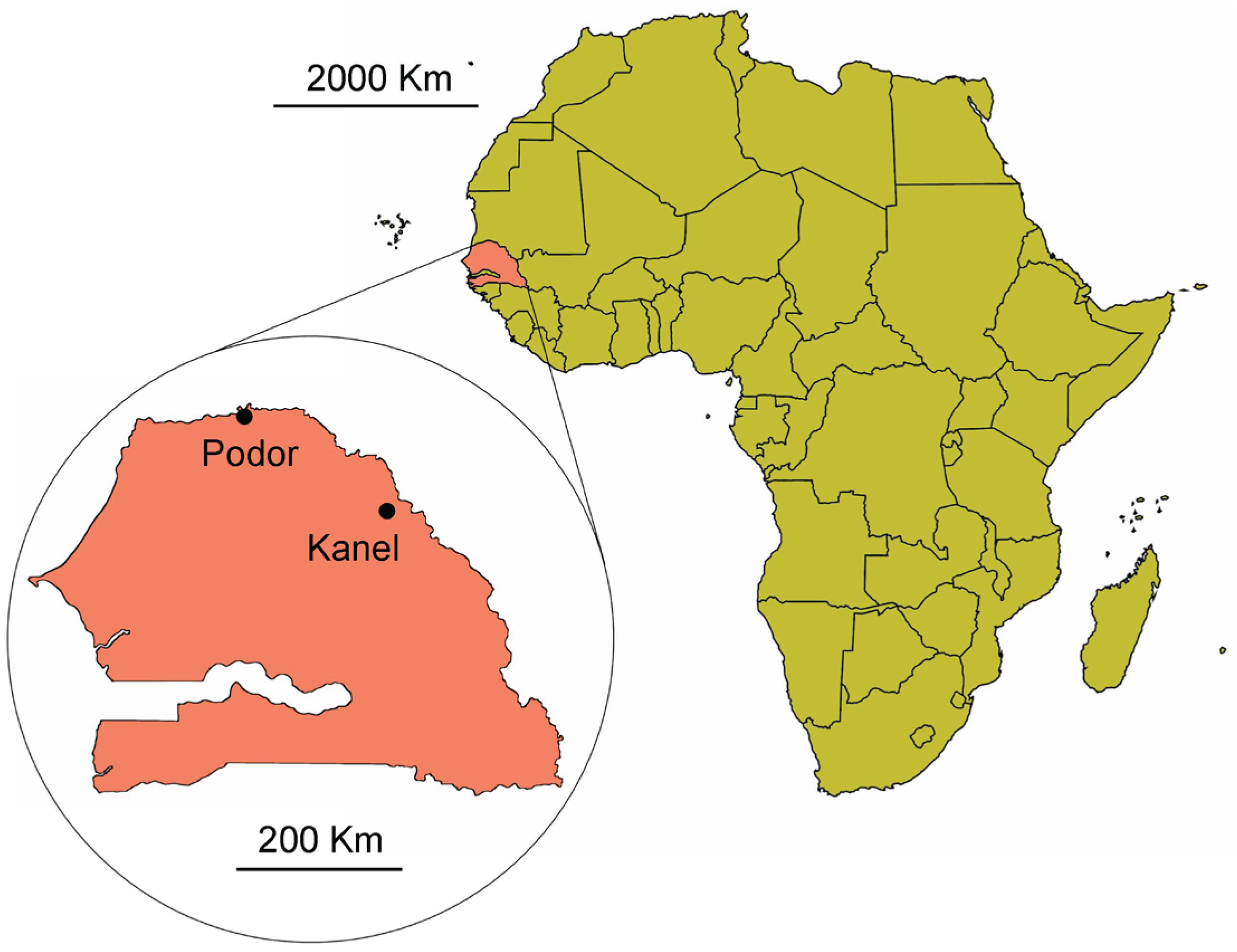
Figure 2.
Total organic matter for both the control (soil+manure) soil and the soil with compost sampled in January 2025 in Kanel and Podor. Values represent the mean ± SE (n = 3.
Figure 2.
Total organic matter for both the control (soil+manure) soil and the soil with compost sampled in January 2025 in Kanel and Podor. Values represent the mean ± SE (n = 3.
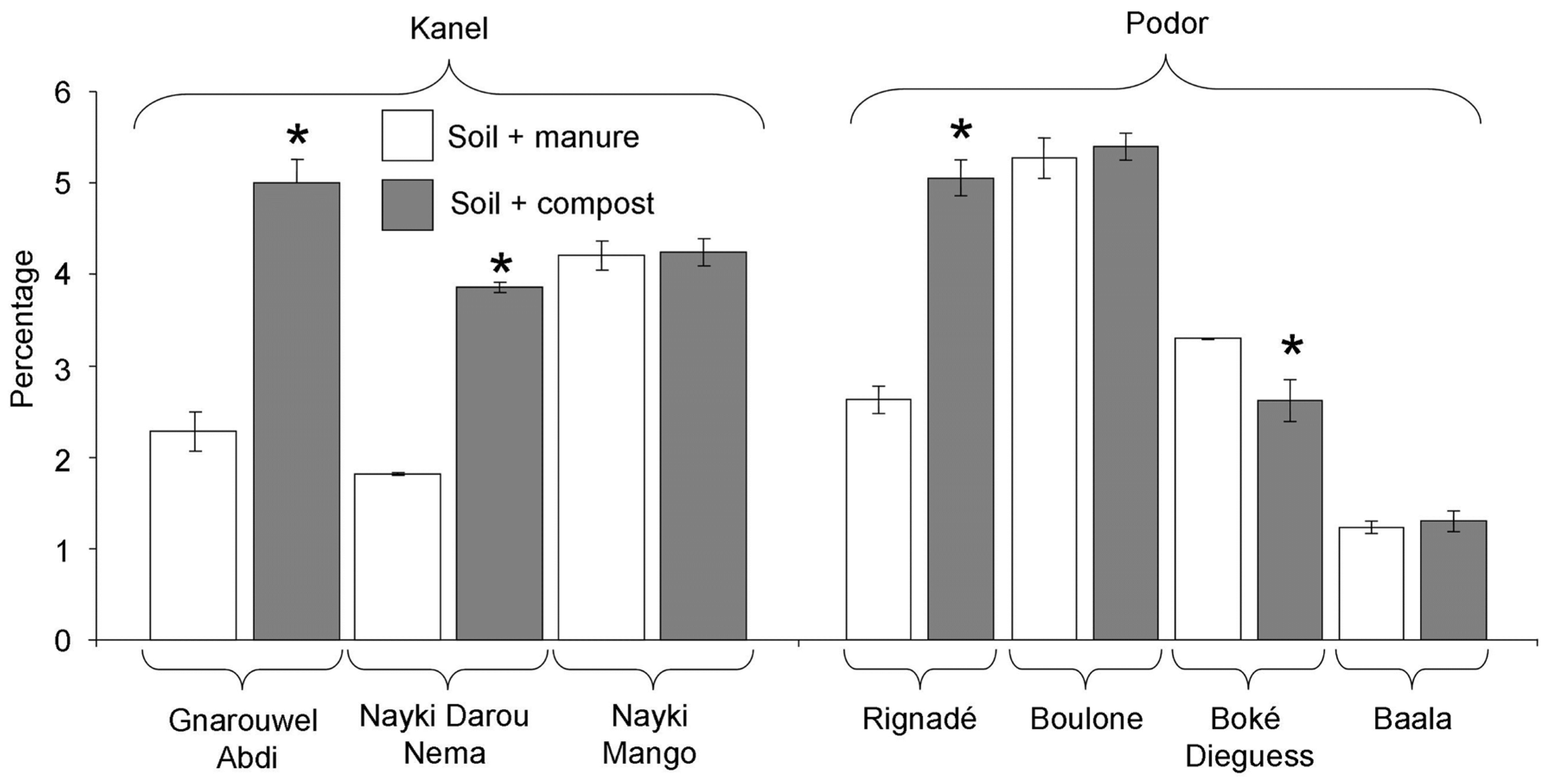
Figure 3.
Total nitrogen analysis for Podor and Kanel. Asterisks indicate significant differences between the control (soil + manure) and soil with compost. Values represent the mean ± SE (n = 3).
Figure 3.
Total nitrogen analysis for Podor and Kanel. Asterisks indicate significant differences between the control (soil + manure) and soil with compost. Values represent the mean ± SE (n = 3).
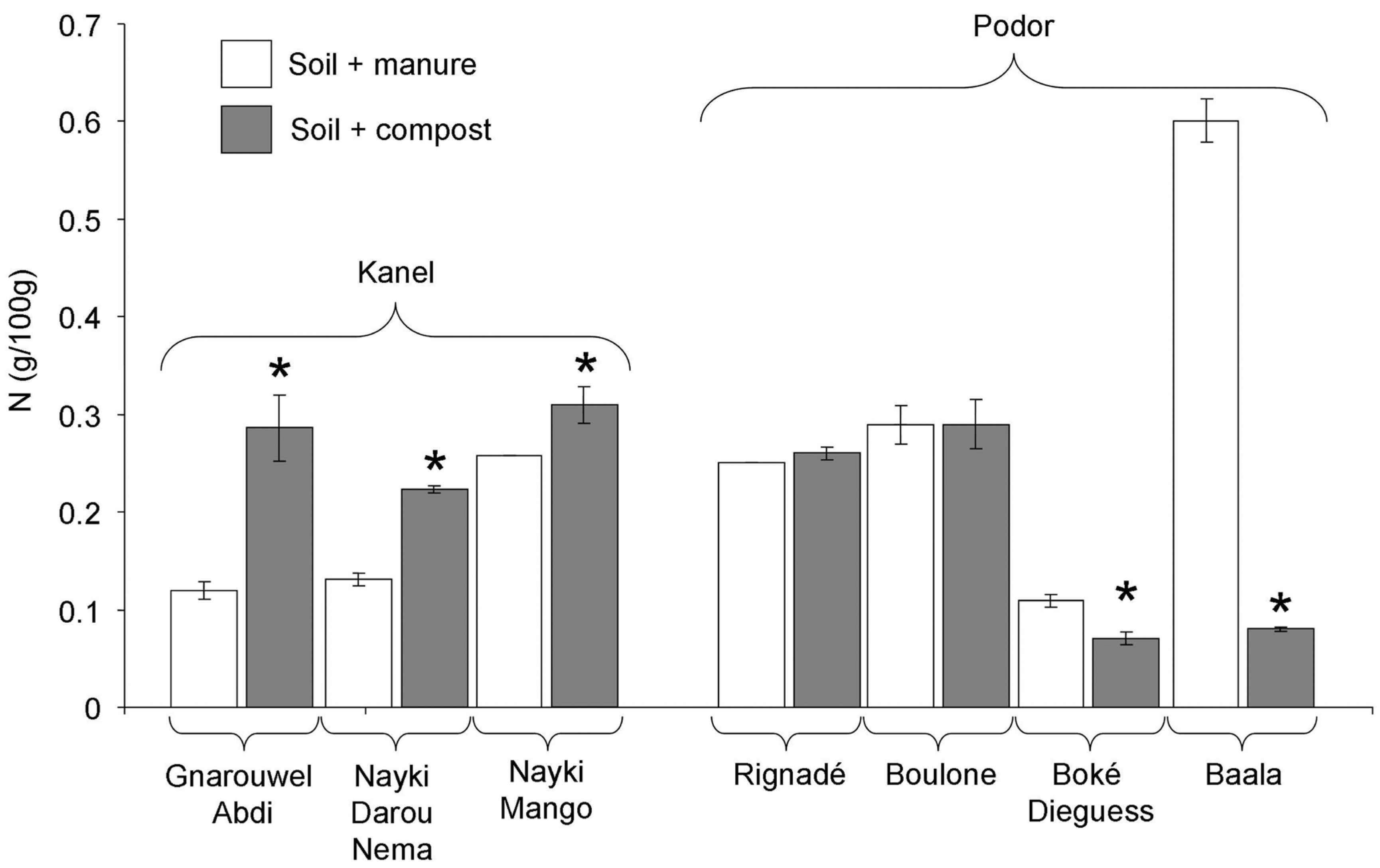

Table 1.
UTM coordinates and elevation of the different communities where the work was carried out, organised by Department.
Table 1.
UTM coordinates and elevation of the different communities where the work was carried out, organised by Department.
| Department | Community | UTM coordinates (UTM zone, Easting, Northing) |
Elevation (metres above sea level) |
|---|---|---|---|
| Kanel | Gnarouwel Abdi | 28N, 666224, 1675187 | 63 |
| Nayki Darou Nema | 28N, 661115, 1669201 | 66 | |
| Nayki Mango | 28N, 660550, 1670009 | 63 | |
| Podor | Rignadé | 28N, 606240, 1768765 | 45 |
| Boulone | 28N, 598377, 1773367 | 41 | |
| Boké Dieguess | 28N, 604496, 1775703 | 34 | |
| Baala | 28N, 603985, 1771850 | 31 |
Table 2.
Results of the analyses of the material undergoing composting for the communities of Nayki Mango and Gnarowel Abdi in the 2024 campaign. Values represent the mean ± SE (n = 3). EC, electrical conductivity; COOx, oxidisable organic carbon; TOM, total organic matter; Csol, soluble carbon; Ct, total carbon; Nt, total nitrogen; C/N, Ct/Nt.
Table 2.
Results of the analyses of the material undergoing composting for the communities of Nayki Mango and Gnarowel Abdi in the 2024 campaign. Values represent the mean ± SE (n = 3). EC, electrical conductivity; COOx, oxidisable organic carbon; TOM, total organic matter; Csol, soluble carbon; Ct, total carbon; Nt, total nitrogen; C/N, Ct/Nt.
| Parameter | Kanel | Podor | ||
|---|---|---|---|---|
| Gnarouwel Abdi | Nayki Mango | Boké Dieguess | ||
| pH | 9.40 ± 0.06 | 8.97 ± 0.03 | 8.40 ± 0.02 | |
| EC (dS/m) | 3.35 ± 0.48 | 3.03 ± 0.02 | 2.16 ± 0.15 | |
| COOx (%) | 34.07 ± 0.33 | 23.67 ± 0.60 | 12.38 ± 0.79 | |
| TOM (%) | 75.03 ± 0.89 | 53.64 ± 1 35 | 26.69 ± 0.63 | |
| Csol (%) | 2.15 ± 0 11 | 2.27 ± 0.03 | 0.62 ± 0.01 | |
| Ct (%) | 43.50 ± 1 20 | 34.28 ± 4.17 | 18.97 ± 3.72 | |
| Nt (%) | 2.82 ± 0.11 | 2.34 ± 0.19 | 1.32 ± 0.33 | |
| C/N | 15 | 15 | 14 | |
| K2O (g/100g) | 2.47 ± 0.14 | 1.68 ± 0.28 | 0.61 ± 0.15 | |
| P2O5 (g/100g) | 0.59 ± 0.02 | 0.48 ± 0.05 | 0.44 ± 0.07 | |
| MgO (g/100g) | 1.25 ± 0.05 | 0.84 ± 0.12 | 0.47 ± 0.11 | |
| CaO (g/100g) | 3.18 ± 0.12 | 2.53 ± 0.33 | 1.86 ± 0.38 | |
| S (g/100g) | 0.40 ± 0.02 | 0.27 ± 0.02 | 0.17 ± 0.04 | |
| Mn (mg/kg) | 1112 ± 40 | 817 ± 114 | 163 ± 28 | |
| Cu (mg/kg) | 18.28 ± 4.79 | 14.96 ± 2.47 | 13 ± 3.07 | |
| Zn (mg/kg) | 70.15 ± 20.17 | 71.57 ± 8.15 | 89 ± 13 | |
Table 3.
Physicochemical parameters of the final compost in the communities of departments of the Kanel and Podor sampling in the 2025 campaign. Values represent the mean ± SE (n = 3). EC, electrical conductivity; COOx, oxidisable organic carbon; TOM, total organic matter; Csol, soluble carbon.
Table 3.
Physicochemical parameters of the final compost in the communities of departments of the Kanel and Podor sampling in the 2025 campaign. Values represent the mean ± SE (n = 3). EC, electrical conductivity; COOx, oxidisable organic carbon; TOM, total organic matter; Csol, soluble carbon.
| Parameter | Kanel | Podor | |||||
|---|---|---|---|---|---|---|---|
| Gnarouwel Abdi |
Nayki Darou Nema |
Nayki Mango | Rignadé | Boulone | Boké Dieguess | Baala | |
| pH | 8.88 ± 0.02 | 8.78 ± 0.07 | 7.71 ± 0.06 | 7.86 ± 0.02 | 8.92 ± 0.01 | 8.82 ± 0.06 | 7.33 ± 0.05 |
| EC (dS/m) | 6.53 ± 0.04 | 5.05 ± 0.11 | 3.35 ± 0.06 | 2.10 ± 0.01 | 0.77 ± 0.03 | 1.10 ± 0.07 | 2.20 ± 0.03 |
| COOx (%) | 22.18 ± 1.01 | 28.41 ± 2.08 | 13.29 ± 0.18 | 17.32 ± 0.33 | 15.73 ± 0.47 | 12.43 ± 0.32 | 13.15 ± 0.31 |
| TOM (%) | 49.20 ± 2.24 | 63.04 ± 4.62 | 29.48 ± 0.40 | 38.43 ± 0.74 | 34.91 ± 1.03 | 27.59 ± 0.70 | 29.18 ± 0.69 |
| Csol (%) | 0.93 ± 0.14 | 1.01 ± 0.13 | 0.56 ± 0.025 | 0.67 ± 0.02 | 0.35 ± 0.06 | 0.41 ± 0.18 | 0.56 ± 0.17 |
|
Moisture content fresh (%) |
54.95 ± 4.27 | 33.63 ± 2.46 | 52.79 ± 0.94 | 44.89 ± 0.64 | 47.28 ± 0.48 | 48.27 ± 0.42 | 33.81 ± 1.71 |
Table 4.
Total nutrient analyses in compost in the communities of departments of the Kanel and Podor sampling in the 2025 campaign. Values represent the mean ± SE (n = 3). Ct, total carbon; Nt, total nitrogen; C/N, Ct/Nt.
Table 4.
Total nutrient analyses in compost in the communities of departments of the Kanel and Podor sampling in the 2025 campaign. Values represent the mean ± SE (n = 3). Ct, total carbon; Nt, total nitrogen; C/N, Ct/Nt.
| Elements | Kanel | Podor | |||||
|---|---|---|---|---|---|---|---|
| Gnarouwel Abdi | Nayki Darou Nema | Nayki Mango | Rignadé | Boulone | Boké Dieguess | Baala | |
| Ca (g/100g) | 2.22 ± 0.21 | 2.12 ± 0.09 | 2.24 ± 0.17 | 1.42 ± 0.09 | 1.27 ± 0.09 | 1.14 ± 0.07 | 0.99 ± 0.06 |
| K (g/100g) | 1.47 ± 0.11 | 1.15 ± 0.13 | 0.97 ± 0.12 | 0.58 ± 0.04 | 0.63 ± 0.04 | 0.47 ± 0.04 | 0.34 ±0.02 |
| Mg (g/100g) | 0.932 ± 0.88 | 0.81 ± 0.66 | 0.662 ± 0.41 | 0.36 ± 0.02 | 0.47 ± 0.02 | 0.34 ± 0.02 | 0.23 ±0.01 |
| Mn (mg/kg) | 1699.08 ± 23.54 | 1840.79 ± 10,29 | 1178.52 ± 9,97 | 306.69 ± 27.13 | 283.10 ± 12.99 | 264.40 ± 31.27 | 213.76 ± 15.42 |
| S (g/100g) | 0.410 ± 0.36 | 0.39 ± 0.041 | 0.28 ± 0.03 | 0.22 ± 0.01 | 0.30 ± 0.01 | 0.26 ± 0.02 | 0.16 ± 0.01 |
| P (g/100g) | 0.38 ± 0.03 | 0.28 ± 0.018 | 0.27 ± 0.03 | 0.22 ± 0.01 | 0.26 ± 0.01 | 0.23 ± 0.03 | 0.16 ± 0.01 |
| Ct (%) | 28.17 ± 3.25 | 34.94 ± 2.74 | 22.47 ± 0.19 | 22.18 ± 0.16 | 22.64 ± 1.55 | 23.94 ± 1.23 | 18.41 ± 1.29 |
| Nt (%) | 2.95 ± 0.19 | 3.42 ± 0.25 | 2.21 ± 0.14 | 1.69 ± 0.06 | 1.67 ± 0.18 | 1.84 ± 0.24 | 1.48 ± 0.09 |
| C/N | 9.55 ± 0.79 | 10.22 ± 0.98 | 10.17 ± 1.54 | 13.11 ± 0.99 | 13.52 ± 0.93 | 12.99 ± 0.99 | 12.41 ± 0.96 |
| Fe (g/Kg) | 3.83 ± 0.15 | 3.43 ± 0.25 | 8.62 ± 0.59 | 4.91 ± 0.38 | 4.87 ± 0.51 | 11.23 ± 0.99 | 4.34 ± 0.25 |
| Cu (mg/kg) | 18.02 ± 1.27 | 15.95 ± 1.22 | 17.06 ± 1.11 | 14.23 ± 0.97 | 16.29 ± 1.11 | 17.57 ± 0.09 | 10.09 ± 0.08 |
| Zn (mg/kg) | 86.17 ± 0.71 | 80.93 ± 7.52 | 83.72 ± 0.95 | 67.69 ± 0.38 | 78.38 ± 0.43 | 85.51 ± 7.41 | 48.70 ± 2.33 |
Table 5.
Physicochemical parameters of soils sampled in 2023 in the regions of Kanel and Podor. For pH, EC, TOM, and Nt, the values represent the mean ± SE (n = 3). EC, electrical conductivity; TOM, total organic matter; Nt, total nitrogen.
Table 5.
Physicochemical parameters of soils sampled in 2023 in the regions of Kanel and Podor. For pH, EC, TOM, and Nt, the values represent the mean ± SE (n = 3). EC, electrical conductivity; TOM, total organic matter; Nt, total nitrogen.
| Department | Community | pH | EC (dS/m) |
TOM (%) | Nt (%) | Sand (%) | Silt (%) | Clay (%) |
|---|---|---|---|---|---|---|---|---|
| Kanel | Gnarouwel Abdi | 7.85 ± 0.08 | 0.685 ± 0.002 | 3.44 ± 0.12 | 0.13 ± 0.010 | 63 | 27 | 10 |
| Nayki Darou Nema | 7.33 ± 0.06 | 0.190 ± 0.003 | 2.49 ± 0.02 | 0.05 ± 0.002 | 75 | 20 | 5 | |
| Nayki Mango | 7.66 ± 0.04 | 0.292 ± 0.08 | 2.60 ± 0.05 | 0.09 ± 0.006 | 53 | 70 | 25 | |
| Podor | Rignadé | 7.46 ± 0.04 | 0.212 ± 0.004 | 1.13 ± 0.05 | <0.03 | 96 | 0 | 4 |
| Boulone | 7.62 ± 0.05 | 0.442 ± 0.005 | 1.64 ± 0.09 | 0.07 ± 0.004 | 90 | 6 | 4 | |
| Boké Dieguess | 7.87 ± 0.04 | 0.092 ± 0.001 | 1.22 ± 0.02 | <0.03 | 90 | 5 | 5 | |
| Baala | 7.85 ± 0.03 | 0.152 ± 0.006 | 1.53 ± 0.03 | 0.04 ± 0.002 | 95 | 5 | 0 |
Table 6.
Results of pH and electrical conductivity analyses for control soils and soils with compost from the Kanel and Podor regions. Values represent the mean ± SE (n = 3). EC, electrical conductivity.
Table 6.
Results of pH and electrical conductivity analyses for control soils and soils with compost from the Kanel and Podor regions. Values represent the mean ± SE (n = 3). EC, electrical conductivity.
| Department | Community | Treatment | pH | EC (dS/m) |
|---|---|---|---|---|
| Kanel | Gnarouwel Abdi | Soil + manure | 7.93 ± 0.07 | 0.2 ± 0.01 |
| Soil + compost | 8.21 ± 0.02 | 0.22 ± 0.04 | ||
| Nayki Darou Nema | Soil + manure | 8.07 ± 0.04 | 0.29 ± 0.00 | |
| Soil + compost | 8.61 ± 0.02 | 0.21 ± 0.01 | ||
| Nayki Mango | Soil + manure | 8.81 ± 0.09 | 0.34 ± 0.01 | |
| Soil + compost | 8.06 ± 0.02 | 0.33 ± 0.05 | ||
| Podor | Rignadé | Soil + manure | 8.5 ± 0.00 | 0.17 ± 0.01 |
| Soil + compost | 8.8 ± 0.01 | 0.14 ± 0.00 | ||
| Boulone | Soil + manure | 8.28 ± 0.00 | 0.23 ± 0.01 | |
| Soil + compost | 8.72 ± 0.05 | 0.13 ± 0.01 | ||
| Boké Dieguess | Soil + manure | 8.76 ± 0.08 | 0.12 ± 0.00 | |
| Soil + compost | 8.59 ± 0.07 | 0.12 ± 0.00 | ||
| Baala | Soil + manure | 8.23 ± 0.00 | 0.07 ± 0.00 | |
| Soil + compost | 8.84 ± 0.11 | 0.08 ± 0.01 |
Table 7.
Analysis of nutrients and elements in soil sampled in January 2025 in Kanel and Podor. Values represent the mean ± SE (n = 3). EC, electrical conductivity.
Table 7.
Analysis of nutrients and elements in soil sampled in January 2025 in Kanel and Podor. Values represent the mean ± SE (n = 3). EC, electrical conductivity.
| Department | Community | Treatment | Ca (g/100g) |
K (g/100g) |
Mg (g/100g) |
Mn (mg/kg) |
S (g/100g) |
P (g/100g) |
Cu (mg/kg) | Zn (mg/kg) |
|---|---|---|---|---|---|---|---|---|---|---|
| Kanel | Gnarouwel Abdi | Soil + manure | 0.25 ± 0.015 | 0.095 ± 0.008 | 0.081 ± 0.004 | 101.48 ± 9.37 | 0.019 ± 0.01 | 0.022 ± 0.001 | 4.69 ± 0.25 | 13.73 ± 0.98 |
| Soil + compost | 0.30 ± 0.04 | 0.168 ± 0.011 | 0.125 ± 0.009 | 181.65 ± 20.45 | 0.040 ± 0.005 | 0.050 ± 0.002 | 6.10 ± 0.58 | 22.51 ± 1.73 | ||
| Nayki Darou Nema | Soil + manure | 0.16 ± 0.012 | 0.086 ± 0.0071 | 0.072 ± 0.006 | 130.31 ± 10.87 | 0.021 ± 0.001 | 0.016 ± 0.002 | 4.14 ± 0.65 | 12.80 ± 1.90 | |
| Soil + compost | 0.19 ± 0.011 | 0.103 ± 0.009 | 0.075 ± 0.006 | 180.79 ± 12.74 | 0.024 ± 0.002 | 0.028 ± 0.003 | 5.98 ± 0.35 | 24.41 ± 1.87 | ||
| Nayki Mango | Soil + manure | 0.24 ± 0.19 | 0.219 ± 0.018 | 0.125 ± 0.011 | 213.27 ± 18.28 | 0.034 ± 0002 | 0.039 ± 0.003 | 5.99 ± 0.41 | 22.63 ± 2.21 | |
| Soil + compost | 0.33 ± 0.025 | 0.316 ± 0.025 | 0.167 ± 0.012 | 305.59 ± 27.94 | 0.037 ± 0.007 | 0.056 ± 0.002 | 10.66 ± 0.91 | 54.02 ± 2.77 | ||
| Podor | Rignadé | Soil + manure | 0.55 ± 0.043 | 0.093 ± 0.007 | 0.152 ± 0.013 | 107.63 ± 8.71 | 0.034 ± 0.002 | 0.041 ± 0.003 | 4.21 ± 0.37 | 15.29 ± 1.12 |
| Soil + compost | 0.35 ± 0.014 | 0.078 ± 0.005 | 0.118 ± 0.087 | 108.52 ± 7.88 | 0.032 ± 0.001 | 0.039 ± 0.007 | 4.46 ± 0.21 | 15.44 ± 0.99 | ||
| Boulone | Soil + manure | 0.41 ± 0.027 | 0.102 ± 0.015 | 0.134 ± 0.032 | 75.53 ± 8.91 | 0.037 ± 0.006 | 0.053 ± 0.002 | 4.43 ± 0.63 | 17.77 ± 1.54 | |
| Soil + compost | 0.44 ± 0.026 | 0.083 ± 0.007 | 0.134 ± 0.009 | 77.04 ± 4.48 | 0.035 ± 0.004 | 0.052 ± 0.003 | 4.09 ± 0.54 | 17.11 ± 1.33 | ||
| Boké Dieguess | Soil + manure | 0.17 ± 0.04 | 0.061 ± 0.003 | 0.089 ± 0.007 | 106.48 ± 9.22 | 0.020 ± 0.001 | 0.023 ± 0.004 | 3.30 ± 0.31 | 13.16 ± 1.25 | |
| Soil + compost | 0.15 ± 0.017 | 0.043 ± 0.002 | 0.070 ± 0.015 | 50.90 ± 5.38 | 0.014 ± 0.001 | 0.017 ± 0.002 | 2.76 ± 0.29 | 9.17 ± 0.71 | ||
| Baala | Soil + manure | 0.12 ± 0.009 | 0.032 ± | 0.053 ± 0.002 | 58.29 ± 6.63 | 0.008 ± 0.001 | 0.010 ± 0.001 | 2.14 ± 0.19 | 7.94 ± 0.62 | |
| Soil + compost | 0.14 ± 0.008 | 0.052 ± 0.003 | 0.065 ± 0.008 | 75.15 ± 6.22 | 0.011 ± 0.002 | 0.017 ± 0.001 | 2.71 ± 0.10 | 8.88 ± 0.49 |
Disclaimer/Publisher’s Note: The statements, opinions and data contained in all publications are solely those of the individual author(s) and contributor(s) and not of MDPI and/or the editor(s). MDPI and/or the editor(s) disclaim responsibility for any injury to people or property resulting from any ideas, methods, instructions or products referred to in the content. |
© 2025 by the authors. Licensee MDPI, Basel, Switzerland. This article is an open access article distributed under the terms and conditions of the Creative Commons Attribution (CC BY) license (http://creativecommons.org/licenses/by/4.0/).
Copyright: This open access article is published under a Creative Commons CC BY 4.0 license, which permit the free download, distribution, and reuse, provided that the author and preprint are cited in any reuse.


