

Submitted:
18 December 2025
Posted:
19 December 2025
You are already at the latest version
Abstract
Background: Wastewater occupies a critical nexus at the confluence of human activity, environmental change, and microbial evolution. This review synthesizes the emerging role of wastewater as a mirror of community health and a driver of microbial and resistome restructuring across environmental compartments. Wastewater systems harbor diverse biological and chemical markers, including pathogens, antimicrobial resistance genes (ARGs), pharmaceuticals, and nutrients, reflecting dynamic population health, agricultural practices, and socioeconomic activities. Advanced metagenomic approaches reveal that wastewater treatment plants (WWTPs) are global hotspots for the selection and spread of resistant bacteria, mobile genetic elements, and opportunistic pathogens, even after secondary or tertiary treatment. Main Body: The reuse of treated wastewater for irrigation enhances soil fertility and crop yields, particularly in water-scarce regions, but also facilitates the introduction and persistence of ARGs and contaminants in soils, crops, and food animal microbiomes. Downstream, this microbial restructuring influences nutrient cycling, crop productivity, animal gut health, and economic resilience—ultimately affecting food safety, pharmaceutical efficacy, and international trade dynamics. The multilevel interactions highlighted in this review support a One Health framework, integrating human, animal, and environmental perspectives for comprehensive risk assessment and management. Wastewater-based surveillance now emerges as a valuable, cost-effective tool for early warning of antimicrobial resistance trends and for informing policy interventions beyond conventional clinical monitoring. However, balancing the resource benefits of wastewater reuse with the risks posed by microbial contaminants and resistance determinants remains a major challenge. Conclusion: This review advocates multi-faceted actions: optimizing WWTP operations and effluent quality; guiding agricultural and livestock practices using reclaimed-water profiles; implementing robust microbiome and resistome surveillance; and harmonizing policy frameworks at local and global scales. Collaborative efforts are needed to transform wastewater from a source of risk into a strategic resource for resilient agriculture, sustainable water management, and global public health in the face of escalating water scarcity and antimicrobial resistance. Bringing together mechanistic microbiome insights, quantitative risk modeling, and translational policy guidance, this synthesis highlights wastewater’s pivotal role in shaping environmental microbiomes and resilience within rapidly changing socioecological systems.
Keywords:
wastewater microbiome
; resistome
; ARGs
; one health
; metagenomics
; agricultural sustainability
; soil
; aquaculture
; global threats
; sustainability
Background:
Wastewater acts as a true mirror of the community, much like a collective “urine sample” that captures the clinical, economic, and environmental fingerprints of a population [1,2]. It contains a wealth of biological and chemical markers—from pathogens, antimicrobial resistance genes, and pharmaceuticals to nutrient loads, industrial chemicals, and environmental contaminants—reflecting human health, consumption patterns, and socio-economic activities. By analyzing these signals, wastewater-based epidemiology can reveal public health trends, track infectious disease outbreaks, monitor the spread of antimicrobial resistance, and assess the impact of societal behaviors on environmental quality, offering a non-invasive and cost-effective surveillance tool for entire populations.
Beyond human health, wastewater provides valuable insights into livestock farming, agricultural practices, and aquaculture performance, detecting veterinary drugs, pesticides, and ecological stressors that shape food safety and environmental sustainability. This evidence can forecast future challenges—such as emerging zoonoses, ecosystem degradation, and resource scarcity—enabling policymakers to design targeted interventions for improved environmental management. Integrating these findings within the One Health framework bridges human, animal, and ecosystem health, promoting strategies that simultaneously enhance disease control, safeguard food systems, and protect natural resources for a resilient future.
The preceding insights have been the center of attention in much of the literature, where most studies examine specific links in isolation—for example, wastewater and Antibiotic Resistance Genes (ARGs) dissemination, wastewater and pathogen burdens, or wastewater and nutrient cycling—yet the evidence now points to an integrated picture in which these threads interact across environmental compartments and sectors. This review connects wastewater-driven microbial restructuring to outcomes in agriculture, livestock, trade, human health, and pharmaceuticals. In soils, ARG-enriched effluents and biosolids can shift nutrient cycling, reduce fertility, and depress crop yields. In animals, exposure to resistant dysbiotic microbiota can weaken gut function, lower feed conversion efficiency, and raise production costs. Pharmaceuticals are part of the same loop. Active ingredients and co-selecting contaminants in wastewater can accelerate resistance, shortening the useful lifespan of antibiotics and inflating research and development (R&D) and stewardship costs.
The review’s contribution is to link pooled wastewater surveillance to targeted interventions that protect soil fertility and yields, improve animal conversion rates, safeguard trade integrity, and slow resistance pressure on the pharmaceutical pipeline—turning monitoring into practical risk management across sectors. It also combines mechanistic evidence, metagenomic surveillance, and quantitative risk assessments across municipal, industrial, and agricultural contexts to derive actionable indicators and intervention points, with attention to low- and middle-income countries and high-income countries (LMIC–HIC) contrasts and feasibility.
Main Text
1. Wastewater as a Mirror of Community Health and Sustainability:
Wastewater represents a complex mixture of human and animal waste, detergents, pharmaceuticals, and microorganisms, placing it at the interface between human society and the environment [3,4,5,6,7,8,9,10,11,12,13]. The wastewater microbiome, composed of bacteria of environmental, animal, and human origin, frequently carries ARGs, making it a valuable proxy for assessing community health [2,14,15,16,17,18]. Monitoring raw sewage is particularly advantageous as it provides pooled signatures from large populations and therefore enables large-scale AMR surveillance with fewer resources than traditional clinical monitoring [1,2,19,20,21]. By complementing clinical data, wastewater surveillance reflects regional resistance trends and can serve as an early warning system for the appearance or spread of rare resistance determinants [20,21,22,23,24,25].
Beyond its health implications, wastewater management also has critical economic and sustainability dimensions. With escalating water scarcity, particularly in arid and semi-arid regions, reclaimed water or treated wastewater (TWW) has become indispensable for irrigation [26,27,28,29,30,31,32]. Reusing wastewater conserves freshwater supplies, improves soil fertility, enhances crop yields, and sustains agricultural productivity through nutrient supplementation [26,33,34,35,36,37,38,39,40,41,42,43,44,45]. However, its safety is strongly determined by microbial quality [26,32]. Conventional treatment does not eliminate ARGs, antibiotic-resistant bacteria (ARB), heavy metals, or pathogens, and irrigation with TWW can increase the prevalence of ARGs in soil ecosystems [46,47,48,49,50,51,52,53,54]. This dissemination pathway poses considerable health risks through the food chain and places constraints on sustainable reuse initiatives [18,49,50,51,55,56,57,58].
Wastewater can thus be conceptualized as a mirror of community health and economics: its microbial and chemical signatures reflect not only the burden of infection and resistance within populations but also the vulnerabilities of agriculture, livestock, pharmaceuticals, and trade [59,60,61]. Wastewater-associated microbiomes shape food safety, enhance livestock productivity, and influence the effectiveness and lifespan of pharmaceuticals, thereby serving as key determinants of national economic outcomes [62,63]. Recognizing wastewater as a reservoir for economic risk offers an integrative perspective that complements the health-centric emphasis in most AMR surveillance initiatives.
Through globalization, contaminated goods, human travel, and shipping trade routes serve as vectors of microbiome restructuring. ARGs harbored in wastewater-derived organisms can thus disseminate worldwide, undermining localized mitigation efforts. This dimension underscores wastewater not only as a community-level mirror but also as a lens into the globalized vulnerability of health systems and economies.
2. Microbial Dynamics in Wastewater Treatment Plants:
Untreated wastewater represents a complex and ubiquitous microecosystem that functions both as a source and reservoir for diverse microorganisms. It provides valuable insights into ambient environmental bacteria, human gut microbiota, and pressing issues such as antibiotic resistance [54,64,65]. Untreated and partially treated wastewater can contain pathogenic microorganisms that pose potential risks to public health. Wastewater treatment plants (WWTPs) play a critical role in mitigating these risks by reducing pathogen loads and antibiotic resistance dissemination [66,67]. These aspects highlight the vital importance of studying microbial communities in wastewater to optimize treatment processes, safeguard environmental and public health, and advance sustainable water management.
Wastewater treatment systems are crucial in removing pollutants to mitigate the adverse effects of human activities [66,68]. Biological wastewater treatment is the most widely used method, exploiting intricate microbial communities to convert harmful pollutants into less toxic or inert compounds, making it the cornerstone of wastewater purification [68,69] . Among biological treatments, activated sludge systems are the most common and widely implemented worldwide [70]. These systems harbor diverse and dynamic microbial populations responsible for key functions such as organic matter degradation, nitrification, and denitrification [66]. They consist of activated sludges, typically dominated by Proteobacteria, Nitrospirae, Bacteroidetes, and Actinobacteria, while anaerobic digesters are populated by Firmicutes, Cloacimonetes, Proteobacteria, and archaeal taxa [16,18,54,71]
The composition and metabolic activity of these communities are critical determinants of treatment efficacy, influencing effluent quality and environmental protection. Furthermore, the dynamics and resilience of microbial communities contribute to system stability and recovery from disturbances, which is essential for reliable operational performance [66].
WWTPs are complex ecosystems where physicochemical parameters play a critical role in shaping the microbial community structure and function. Factors such as pH, temperature, dissolved oxygen (DO), nutrient concentrations (e.g., nitrogen (N), phosphorus (P)), organic load (Biochemical Oxygen Demand (BOD), Chemical Oxygen Demand (COD)), and the presence of metals and other chemical contaminants directly influence microbial diversity, abundance, and metabolic activities within these systems [69,72,73,74].
pH is a major environmental parameter affecting microbial growth and enzymatic activities. Optimal pH ranges in treatment reactors promote the proliferation of beneficial bacteria responsible for nutrient removal, while deviations can lead to community shifts favoring acid- or alkali-tolerant organisms, potentially impairing treatment efficiency [75]. Similarly, nutrient availability, particularly N and P species, influences microbial community assembly by selecting for taxa capable of specific metabolic pathways such as nitrification and denitrification [73].
Organic matter concentration, expressed as BOD or COD, serves as a carbon and energy source for heterotrophic microbes. High organic loads typically increase microbial biomass and diversity, but can also create anaerobic niches, promoting growth of facultative or obligate anaerobes, which may affect the overall process stability [69]. Metals and emerging contaminants, present either naturally or due to industrial discharge, can exert selective pressure, altering microbial community composition by inhibiting sensitive taxa and enriching metal-resistant or opportunistic bacteria [73].
Antibiotics at sub-inhibitory levels create selective pressure that maintains ARGs and promotes horizontal gene transfer (HGT) within microbial communities [7,76,77]. Additionally, heavy metals, biocides, and other emerging contaminants further contribute to co-selection of resistance, while mobile genetic elements (MGEs) like plasmids, integrons, and transposons serve as effective vectors for ARG mobility within complex microbial ecosystems [54,78]. WWTPs are increasingly seen as hotspots for the selection, growth, and spread of ARGs and ARB in urban water systems [7,49,79,80]. Their microbial communities are influenced by high biomass levels, abundant nutrients, and selective pressures caused by the presence of antibiotic and metal residues [18,46,54]. Although secondary treatment reduces overall microbial loads by one to two log-units and lowers ARG abundance, many resistance determinants remain — and some even become more prevalent — during processes like anaerobic digestion [81,82,83,84,85,86,87]. However, restructuring driven by selective pressure also increases resistome risks. The buildup and persistence of ARB and ARGs during treatment processes, and their subsequent spread into soil, crops, animals, and humans, pose serious health and economic threats [88,89]. Therefore, microbial changes in wastewater are a double-edged sword: while partly necessary and beneficial, they also carry the risk of resistance amplification that requires careful management and mitigation.
It is important to recognize that microbial restructuring in wastewater systems is not inherently negative. Beneficial restructuring underpins the very purpose of treatment plants, where microbial consortia are directed toward removing pollutants, suppressing pathogens, and stabilizing effluents [90,91]. Wastewater irrigation can, under controlled conditions, enhance soil fertility, nutrient cycling, and even crop productivity, while ameliorating degraded soils [92].
Beyond pollutant removal, these microbial communities provide ecological services such as nutrient recycling, biogas generation, and hold potential for innovative biotechnological applications, including resource recovery [68,70,93]. Monitoring microbial community structure and function enables early detection of treatment failures, pathogen emergence, and antibiotic resistance spread, thereby directly supporting operational management and public health protection [94].
Given these interactions, monitoring and managing physicochemical conditions in WWTPs are vital not only for optimizing treatment performance but also for mitigating associated public health risks. Advanced molecular tools such as high-throughput sequencing coupled with physicochemical analyses provide comprehensive insights into community-environment relationships, enabling more targeted intervention strategies.
3. Impactful Overview of the Restructuring of Microbial Communities and ARGs:
3.1. Public Health Implications:
The growing emphasis on environmental sustainability highlights an urgent global need to secure safe and uncontaminated water resources. Wastewater, continuously discharged from municipal and industrial sources, contains a complex and dynamic mixture of chemical contaminants and diverse microbial populations whose unpredictable interactions contribute significantly to public and ecological health risks [95]. Epidemiological studies and risk assessments emphasize that inadequately TWW acts as a reservoir for pathogenic microorganisms responsible for diseases such as cholera, typhoid, dysentery, and hepatitis, posing serious public health threats [96]. Globally, diarrhea accounts for an estimated 829,000 deaths annually, with approximately 361,000 of these occurring in children under five years of age [97]. For instance, in the United States alone, waterborne infections impose an estimated annual economic burden of approximately $1 billion, reflecting significant healthcare costs and productivity losses [98] (Figure 1A).
Beyond microbial pathogens, wastewater contains a growing number of emerging chemical contaminants, including pharmaceuticals, endocrine-disrupting compounds, microplastics, and personal care products, which pose chronic health and environmental risks through bioaccumulation and ecotoxicity [99,100].These contaminants are often resistant to conventional wastewater treatment processes and can lead to subtle yet significant adverse effects on human health and aquatic biota [101,102].
Wastewater also plays a critical role in the global dissemination of antibiotic resistance, identified by the WHO and the European Center for Disease Prevention and Control (ECDC) as a pressing public health challenge of the 21st century [103]. This issue is particularly acute in LMIC, where inadequate sanitation and unsafe water supplies exacerbate infectious disease prevalence and facilitate the spread of resistant microbes [104]. The widespread and often inappropriate use of antibiotics further accelerates the emergence of microbial resistance in affected populations. Consequently, effective stewardship of antibiotic administration in clinical settings, alongside strategies minimizing environmental release, is essential for mitigating the proliferation of resistance genes [104]. ARGs and ARBs persist through HGT mechanisms within microbial communities, facilitating their environmental dissemination [105,106].
The dissemination of ARGs and ARB from wastewater into human populations occurs through multiple environmental routes [107,108]. Irrigated crops, the application of sewage sludge and manure, contamination of livestock, exposure of fish in aquaculture, and the use of contaminated groundwater and surface water all provide direct pathways [8,109]. Once ingested, resistant bacteria or their genetic material can transfer into the human gut microbiota through horizontal gene transfer, thereby amplifying resistance potential in human populations [8,110].
Within both environmental and human microbial communities, HGT mechanisms actively facilitate the dissemination of resistance genes [105,106]. Antibiotic resistance is widely acknowledged as a significant global public health threat; however, the distribution, diversity, and fate of ARGs and ARBs within wastewater systems remain poorly understood [111]. The emergence and spread of multidrug-resistant (MDR) bacteria are further driven by the clinical administration and environmental presence of advanced-generation antibiotics, underscoring the interconnected challenges of antibiotic use and environmental contamination [105].
Vulnerable populations, including children, immunocompromised individuals, and communities with limited access to safe sanitation, face disproportionate health burdens from wastewater-related pathogens and antibiotic resistance, driving social inequities in public health outcomes [112,113]. Addressing these disparities is crucial for advancing global health equity and is aligned with achieving the Sustainable Development Goals (SDGs), particularly Goal 6 on clean water and sanitation.
WWTPs process large volumes of sewage daily, containing elevated levels of specific nutrients, chemicals, metals, and bacteria derived from hospital, human, and animal sources [114]. They represent critical interfaces where public health risks converge due to the influx of pathogenic MDR bacteria [105,106]. WWTPs are considered the primary source of hotspots for ARB, ARGs, and associated MGEs [115]. Although the concentrations of ARGs and ARBs are markedly reduced in TWW compared to untreated influent, wastewater treatment processes in WWTPs do not fully eliminate them, resulting in their release and spread into environmental recreational waters [116]. Moreover, the treated effluents from WWTPs are frequently reused for irrigation, agriculture, and, in some cases, as sources of drinking water, presenting additional pathways for human and environmental exposure [117].
Environmental persistence of ARGs and ARBs extends beyond wastewater treatment plant effluents, with resistant genes and bacteria detected in soils, surface waters, and fauna, posing ecological risks and potential reservoirs for further resistance spread [14,46]. These dynamics highlight the need to consider environmental reservoirs in antibiotic resistance management strategies.
AMR constitutes a critical global crisis that transcends medical boundaries, impacting multiple sectors worldwide. The World Health Organization (WHO) has identified AMR among the top ten threats to global public health. Current estimates attribute approximately 1.27 million deaths annually directly to drug-resistant infections, with millions more affected indirectly. Without urgent intervention, this figure could escalate to 10 million deaths per year by 2050 [113]. The projected economic burden is equally profound, with anticipated global losses exceeding $100 trillion by mid-century due to healthcare expenditures, impacts on agriculture, and diminished productivity [118]. These alarming trends underscore the imperative for comprehensive strategies addressing AMR on a global scale.
The implications extend beyond clinical infections. The human gut microbiota, often described as a metabolic organ, performs essential functions in digestion, immune defense, detoxification, and neuroendocrine regulation [119,120,121,122,123,124]. Disruptions to microbial balance, whether induced by resistant strains or environmental pollutants, are increasingly associated with chronic non-communicable diseases [120,125]. Dysbiosis has been linked with obesity, metabolic syndrome, cardiovascular disease, psychiatric disorders, and even certain cancers, such as colorectal carcinoma [120,126,127,128] (Figure 1A). Given these associations, wastewater-derived ARGs and ARB serve not only as a direct infectious disease risk but also as a potential contributor to broader public health problems. The infiltration of ARGs and ARB into agriculture and aquaculture systems represents a key route for the dissemination of resistance elements beyond wastewater treatment infrastructure [49,129,130,131]. Application of wastewater effluents and biosolids to agricultural land introduces resistance directly into soils and food crops, and aquaculture species are exposed to these determinants via contaminated water bodies (Figure 1B). Marine bacteria from farming sites have been found to harbor ARGs, highlighting the universal reach of this process [1,2].
Sewage thus provides a powerful sentinel tool for public health monitoring. By capturing community-level microbial and resistance patterns, wastewater-based surveillance complements traditional clinical systems and offers anticipatory insights into resistance burdens, including emerging gene variants that may otherwise remain undetected until established in clinical settings [2,132,133].
Collectively, Quantitative microbial risk assessments (QMRAs) and predictive models increasingly provide data-driven insights into exposure risks, infection probabilities, and economic impacts of wastewater-associated hazards, informing policy and operational decisions to safeguard public health.
3.2. Economic Implications, Food Digestion Efficiency, Aquaculture, Soil
Livestock production systems are particularly vulnerable. Animal productivity is intimately linked to the structure, diversity, and function of the gut microbiome, which is responsible for nutrient absorption, immune regulation, and energy metabolism [134]. Recent research provides robust evidence that the composition and function of the gut microbiome significantly influence animal production traits, especially feed efficiency and productivity outcomes [134,135,136]. The gut microbiota, widely known as a "forgotten organ," forms a complex ecosystem whose metabolic activities underlie both animal health and productive performance [137,138]. Fermentation of fiber and resistant starch by gut microbes generates short-chain fatty acids (SCFAs), including acetate, propionate, and butyrate, which are central to maintaining host energy balance and regulating digestive processes [139]. Optimal animal performance is dependent on the maintenance of a dynamic and beneficial microbial balance.
Experimental studies further underscore this relationship. For example, fecal microbiota transplantation (FMT) experiments in poultry demonstrate that early-life transfer of microbiota from high-efficiency donors can significantly improve feed conversion in recipients, directly linking microbial composition to productive efficiency [140]. In ruminants, the rumen microbiome is fundamental in the breakdown of complex polysaccharides such as cellulose, and distinct community structures have been associated with either favorable feed efficiency and higher SCFA production, or increased methane emissions and reduced conversion rates [141]. Heritable features of the rumen microbial community, measured by indices such as Residual Feed Intake (RFI), also show clear connections with feed utilization efficiency [142] (Figure 1C).
This link has direct national economic implications. Lower feed conversion rates in poultry and ruminants translate into reduced egg, milk, and meat production. Countries relying heavily on imported feed or livestock often note that the same breeds achieve higher productivity in their country of origin compared to local environments [143]. Such disparities suggest that environmental predisposing factors, including water microbiome exposure and ARG contamination, play critical roles in shaping gut microbial efficiency [139]. Wastewater-linked ARG dissemination to farms may therefore diminish productivity and weaken national agricultural economies.
In aquaculture, resistant bacteria not only increase fish mortality but also compromise export opportunities. Marine bacteria harboring ARGs can enter seafood supply chains, triggering trade restrictions and undermining competitiveness in global markets [144]. These processes demonstrate that wastewater restructuring is not confined to local health outcomes but directly intersects with international trade and economic resilience.
Soil–plant interactions also extend this risk. Irrigation with ARG-rich wastewater alters the soil microbiome, not only enriching resistance but also modifying nutrient cycling [26]. Disrupted microbial processes can impair absorption of key elements such as N, P, or trace minerals while enhancing uptake of others [26,145]. This imbalance selects certain crops over others and may reduce agricultural biodiversity and resilience under climate stress (Figure 1D, 1E).
Soil–plant–animal interactions form another pivotal axis of risk and opportunity. The use of reclaimed wastewater for irrigation changes the soil microbiome, often increasing microbial biomass and stimulating nutrient cycling processes, particularly those involving N transformations that support crop productivity [33,146]. However, these beneficial dynamics can be undermined when restructuring is driven by selective pressures from contaminants such as antibiotics and heavy metals, facilitating the amplification and spread of ARGs through environmental compartments and ultimately into animal hosts [109].
It is vital to recognize that not all microbial restructuring is inherently harmful; context determines consequence. Beneficial restructuring is harnessed in engineered systems—such as the intentional shifts within WWTPs that remove organic and biological pollutants—and in agricultural contexts where irrigation with nutrient-rich water supports crop growth [33,147]. Similarly, targeted dietary or prebiotic interventions can purposefully modulate the animal gut microbiome toward improved energy regulation and metabolic health [134,135,136,148]. By contrast, restructuring becomes detrimental when it escalates the abundance of resistance mechanisms or favors the dominance of pathogenic taxa[89]. WWTPs, when exposed to high concentrations of antibiotics and heavy metals, can become hotspots for enhanced ARG and ARB propagation, with documented instances of increased abundance of resistant Acinetobacter species in effluents [149,150,151]. The environmental dissemination of these communities not only perpetuates resistance in soils and plants but may also contribute to dysbiosis in the animal gut, compromising overall animal health and production efficiency.
The enrichment and dissemination of ARGs contribute directly to global economic and societal costs. Rising resistance shortens the useful lifespan of existing antibiotics, escalates healthcare expenses, and drives intensive investment in drug R&D [144,152] (Figure 1F).
The pharmaceutical sector bears one of the heaviest burdens. Every new antibiotic approved requires billions of dollars in R&D investment; yet the global circulation of wastewater-derived ARGs accelerates the obsolescence of these agents [152] (Figure 1G). Each time a resistance gene already present in wastewater nullifies a new antibiotic, the effective “life span” of that drug in the market is shortened [8,9,153]. This not only squanders resources but also diverts funds away from other health innovations, reducing long-term sustainability of biomedical R&D.
In livestock sectors, AMR reduces productivity through uncontrolled infections, elevating mortality and undermining conversion efficiency [144]. On a broader scale, contaminated agricultural produce poses risks to international trade stability as resistant bacteria enter global food chains [109,144]. The need for advanced wastewater treatment systems and tighter waste control policies further increases financial burdens for municipalities, industries, and agricultural sectors.
In summary, the interplay between wastewater-derived resistance, agricultural practices, and animal gut health is central to understanding the economic and biological consequences of the wastewater resistome. While many forms of microbial restructuring are beneficial and crucial for maintaining ecosystem services and productivity, anthropogenically driven restructuring events—especially those linked to contamination and selective pressures—carry significant risks, including environmental contamination, amplification of resistance, and reduced animal health and productivity. Appreciating the context-dependent effects of microbial restructuring is essential for designing strategies that maximize benefits while minimizing hazards within integrated “One Health” frameworks.
4. Approaches for Characterization of Wastewater Microbial Communities:
Traditional methods for analyzing microbial diversity in WWTPs, including physiological profiling, plate counts, and fatty acid analysis, have limitations, primarily because they rely on culture-dependent techniques that capture only a fraction of the microbial diversity present[68,154,155,156] . The advent of culture-independent molecular methods, especially high-throughput sequencing, has revolutionized our understanding by enabling direct examination of Deoxyribonucleic acid (DNA) from environmental samples, revealing a far greater diversity and complexity of microbial taxa, including many previously uncultured organisms [70]. These advances have greatly improved knowledge of microbial interactions and their functional roles in both natural ecosystems and engineered wastewater treatment systems [157,158]. Unlike cultivation-based techniques, metagenomics sequences nucleotide fragments directly extracted from wastewater, capturing both cultivated and uncultivated organisms, and thus facilitating a more accurate characterization of community structure and ecological roles [73].
Numerous global studies underscore this progress [159,160,161,162,163,164,165,166]. Dueholm et al. conducted the most comprehensive bacterial community analysis to date across 740 WWTPs, documenting 1,530 species from 966 genera and elucidating their roles in key functions such as nitrification, polyphosphate accumulation, and glycogen storage [159]. Similarly, Cao et al. characterized microbial diversity in eight Chinese WWTPs, identifying 51 bacterial phyla and categorizing dominant genera based on functional potential, including denitrifiers, fermenters, and nitrite-oxidizing bacteria [160]. Studies by Chen et al. and Gao et al. further reveal microbial diversity and functional gene profiles in diverse WWTP settings, highlighting the crucial role of these communities in pollutant degradation and biogeochemical cycling [161,162].
The characterization of bacterial communities in complex environments such as wastewater cannot be reliably performed using culture-based methods, as these capture only a limited fraction of the microbial diversity due to the specific growth requirements of many organisms. Instead, sequencing-based approaches have become the standard for microbial community analysis, providing a culture-independent and high-resolution view of diversity. Among these, shotgun metagenomic sequencing offers comprehensive coverage of microbial genomes, facilitating both taxonomic and functional insights; however, it is often limited by its higher cost and computational demands [167]. Alternatively, sequencing of the 16S ribosomal Ribonucleic acid (16S rRNA) gene remains widely used given its cost-effectiveness and established bioinformatic frameworks. This can be done either by targeting the full-length 16S rRNA gene using long-read platforms such as PacBio or Oxford Nanopore, or by amplifying specific hypervariable regions via short-read platforms like Illumina, with the latter being the most common due to affordability and high throughput [168,169,170,171,172]. The 16S rRNA gene contains nine hypervariable regions (V1–V9), each differing in its ability to resolve bacterial taxa [173,174,175]. The choice of which region to amplify plays a critical role in determining taxonomic resolution and community composition outcomes [175]. For example, studies often target regions such as V3–V4 or V4 alone because they provide a balance between read length compatibility with Illumina sequencing and classification accuracy [176]. Notably, a comparative study evaluating V2–V3 versus V3–V4 regions using paired-end Illumina MiSeq reads demonstrated that the V2–V3 region delivers higher resolution at lower taxonomic ranks, such as genus and species levels, which is crucial for detailed microbial community analyses [177]. Despite these findings, the selection of hypervariable regions in many studies remains influenced by convention rather than empirical evaluation tailored to the studied environment or community [169,170,171,178,179,180,181].
Several factors determine the optimal hypervariable region for microbial community profiling, including the desired taxonomic resolution at lower ranks, the ecological niche and structure of the microbial community, the reference databases employed for taxonomic assignment, and the constraints posed by specific sequencing platforms [176,182]. For example, some regions perform better for particular environments, such as soil, gut, or wastewater microbiomes, due to differences in community complexity and dominant taxa [182]. Reference databases such as SILVA, Greengenes, and the Ribosomal Database Project (RDP) also vary in the coverage and curation of sequences corresponding to different hypervariable regions, impacting classification reliability [183]. Furthermore, Illumina-based short-read technology limits amplicon length to about 250–300 bp per read, favoring shorter regions, while long-read sequencing technologies can recover near full-length 16S sequences, enhancing phylogenetic resolution but at increased cost and lower throughput [184].
Despite the critical importance of hypervariable region selection, there remains a paucity of systematic studies comparing their performance across diverse environmental settings, particularly in applied contexts like wastewater treatment systems, where microbial community function is highly relevant. This methodological gap means that many studies may overlook biases or limitations intrinsic to their chosen region, potentially affecting the interpretation and reproducibility of microbial diversity and functional potential analyses. Highlighting these limitations and advocating for environment-specific evaluation of hypervariable regions is essential before discussing the ecological roles and significance of bacterial communities in wastewater environments.
Addressing the AMR challenge requires comprehensive monitoring and interventions aligned with the One Health paradigm. Wastewater surveillance offers a cost-effective tool for dual assessment of population-level resistance (using influent samples) and environmental dissemination risk (using effluent samples) [2,185]. Systematic monitoring of ARG abundance, MGE prevalence, and selective pressures, supported by metagenomics, quantitative Polymerase Chain Reaction (qPCR), and culture-based assays, provides the foundation for early detection and targeted response.
5. Water Scarcity as a Driver for Wastewater Treatment and Reuse:
The SDGs represent the latest worldwide effort to encourage collaboration between governments, businesses, and organizations at all levels, all with the aim of elevating living standards for billions of people everywhere. These goals serve as a bold and comprehensive roadmap for better “people, planet, and prosperity” through 2030 [186]. Among the 17 objectives, the sixth SDG stands out: it’s dedicated to making sure everyone has safe water and reliable sanitation in a sustainable way. Reaching even part of this target would lead to major improvements for societies around the globe, since access to clean water is fundamental to economic progress, health, and protecting the environment [187].
In 2000, the Millennium Development Goals (MDGs) aimed to reduce by half the number of people without reliable access to safe drinking water and sanitation by 2015. While ambitious, these goals didn’t address critical issues like water quality or proper wastewater management, which ultimately limited their effectiveness [188]. The SDGs closed this gap with Goal 6, which focuses on securing clean water and sanitation for all through sustainable practices. This goal highlights the importance of treating more wastewater, increasing recycling, and ensuring safe reuse of water worldwide. By taking these steps, not only does the supply of clean water grow, but there are also significant improvements in sanitation and wastewater management [187].
Clean water, effective sanitation, and responsible wastewater management are all fundamentally linked. For any community, big or small, ensuring safe water means also addressing how waste is handled, treated, and disposed of. Without strong systems for sanitation and wastewater treatment, it's impossible to provide genuinely clean water for people or maintain a healthy environment [187]. Water management's heart is a delicate balance between technical solutions and community engagement.
Water scarcity now affects billions worldwide and is intensifying due to population growth, climate change, and poor resource management. Treating and reusing wastewater is vital for conserving limited water supplies, protecting public health, and building resilience against mounting shortages and waterborne disease [187,189].
Water shortage is not solely a result of natural factors, but also a consequence of human activities. Currently, over 700 million people live in areas experiencing chronic water shortages, a situation that is projected to worsen [187,189,190]. The United Nations forecasts that by 2025, nearly 1.8 billion people will face water scarcity [191,192]. Climate change, exacerbated by human actions, is a significant contributor, pushing more than half the global population into regions with limited water supply [190,192,193]. Sub-Saharan Africa is particularly at risk, with estimates suggesting that between 70 and 250 million people there could encounter severe water shortages [190,194,195,196].
Water scarcity is a complex global issue intensified by climate change-driven alterations in the water cycle, groundwater depletion, and pollution, which collectively reduce freshwater availability and threaten ecosystems and human well-being[197]. These environmental stresses cascade into profound social and economic impacts, undermining food security, livelihoods, and development, especially in vulnerable populations. Agriculture, as the dominant water consumer, is particularly affected, placing global food production and poverty reduction efforts at risk [198,199,200,201,202,203]. Addressing these interconnected challenges requires sustainable water management and equitable access to safeguard health, ecosystems, and socio-economic progress.
Water management critically shapes economic and social well-being, as inadequate access to safe water and sanitation constrains productivity, reinforces poverty, and deepens inequality [204,205]. Sen’s entitlement approach underscores that scarcity stems not only from limited supply but from unequal accessibility and affordability, often leading to competition and conflict over rights [202,206,207]. Water insecurity undermines health, livelihoods, and education, particularly among marginalized groups, contributing to preventable diseases and lost opportunities [200,208,209]. Reliable access enhances well-being, boosts school attendance, empowers women, and supports economic growth, whereas scarcity reduces life expectancy, raises healthcare costs, and weakens productivity across generations [210,211,212,213,214,215,216,217,218,219,220,221,222,223].
LMICs, such as Egypt, face significant challenges in wastewater treatment and reuse due to rapid population growth, limited water resources, and increasing water demand from various sectors, such as agriculture, municipal, and industrial activities. The country’s water scarcity is exacerbated by environmental pollution caused by the uncontrolled discharge of untreated or partially TWW into water bodies, which affects lakes, rivers, drainage systems, and ultimately groundwater quality [224,225]. Many municipal wastewater treatment processes in Egypt are traditional and have limited capacity and efficiency. There is a need to evaluate and develop modern and effective wastewater treatment technologies suitable for Egyptian conditions [224]. Atalla et al. (2025) provided the first detailed characterization of microbial communities in Egyptian WWTPs, revealing functional limitations and pathogen persistence linked to current treatment inefficiencies[226]. Sludge management remains underdeveloped, with high contaminant loads and insufficient investment delaying progress in wastewater infrastructure and water quality improvement [224,227,228,229].
Using untreated or insufficiently treated wastewater for irrigation and other purposes poses serious microbial, chemical, and environmental hazards, threatening farmers' health and contaminating groundwater [225,230]. The reuse of TWW is hindered by a lack of stringent water quality standards, inadequate regulatory frameworks, and limited monitoring capacity to ensure compliance and public safety. Social acceptance of TWW reuse is low, and public education efforts are necessary to mitigate perceptions and encourage responsible usage [231]. Additionally, there is a growing concern about environmental impacts, such as the accumulation of pollutants in soils and aquifers. Studies show that mixing TWW with fresh water is a strategy to reduce contamination risks [225].
Wastewater treatment and reuse in developing countries remain critical yet complex challenges due to environmental, technical, economic, and social factors. Addressing these issues requires improved infrastructure investments, adoption of innovative technologies, policy reforms, public education, and careful management to safeguard public health and environmental sustainability while mitigating acute water scarcity [224,225,229,231].
Given the urgency of water scarcity and environmental health concerns in developing countries, concerted efforts from governments, industries, and communities are essential to overcome existing barriers and realize the full potential of wastewater treatment and reuse.
6. Overview of Wastewater Treatment Processes and Effluent Quality:
The typical wastewater treatment approaches encompass several main stages, including primary treatment, secondary (biological) treatment, disinfection, and sludge treatment. The processes implemented at major WWTPs begin with bar screening, which mechanically removes large floating or suspended solids, such as plastics, from the influent stream. This is followed by grit and oil removal, where wastewater passes through grit chambers, while oils and greases are skimmed from the surface. In primary settling tanks, a significant portion of settleable organic and inorganic solids is removed by sedimentation, along with floating materials [75,232,233].
Biological treatment then takes place. Among the various treatment stages, biological treatment is especially crucial as it transforms organic pollutants into stable compounds. Common biological methods used include biological filters, rotating biological contactors, activated sludge, extended aeration, and oxidation ponds. The activated sludge process is the most widely used due to its high efficiency; it involves recycling settled sludge to maintain microbial activity and optimize treatment performance [75].
The biomass generated in the biological treatment stage is separated into secondary settling tanks, effectively reducing suspended and organic matter levels. Following this, the treated effluent is disinfected to minimize microbial contamination before being discharged into the drainage system [75].
The concept of wastewater effluent quality centers on the degree to which a treatment process effectively eliminates harmful substances from wastewater before discharge or reuse. High-quality effluent is achieved by reducing the concentrations of suspended solids, organic matter, nutrients, and pathogenic microorganisms to levels that are safe for the environment and public health [234,235,236,237].
Robust wastewater treatment is essential not only for preventing the pollution of water bodies and ecosystems but also for protecting communities from outbreaks of waterborne diseases by ensuring that pathogens are removed from the effluent. Ultimately, the assurance of effluent quality represents a fundamental safeguard, promoting environmental sustainability and maintaining public health through the effective removal of contaminants from TWW [234,235].
Effluent quality is measured through a range of key indicators that reflect its physical, chemical, and biological characteristics [236,237,238,239,240]. One primary parameter is the BOD, which shows the amount of oxygen microorganisms need to break down organic matter [235,237,239]. High BOD indicates significant organic pollution in the effluent [235,237,238,239]. Another critical measure is COD, which accounts for the total oxygen required to chemically oxidize both organic and inorganic substances [235,238].
Nutrient levels, particularly N and P, are important due to their role in promoting eutrophication in aquatic systems, which can lead to harmful algal blooms and oxygen depletion [235,237,238]. The content of total suspended solids (TSS) reflects particulate matter that causes turbidity and can harm aquatic life [235,238,239].
Assessing pathogen presence is vital, as these microorganisms may pose health risks [235,237,239]. Common microbial indicators include fecal coliforms, E. coli, and enterococci, and advanced molecular techniques increasingly aid in their detection and monitoring [235,238,239]. Finally, emerging contaminants like pharmaceuticals, microplastics, and industrial chemicals are gaining attention due to potentially unknown impacts on ecosystems and human health [235,238,239,241].
Together, monitoring these parameters provides a comprehensive evaluation of effluent quality, ensuring the water is safe for environmental discharge or reuse, and helps guide wastewater treatment strategies to protect public health and ecosystems.
Effluent quality is governed by a range of standards and regulations designed to protect both environmental and public health. Globally, several regulatory frameworks set benchmarks for effluent quality. The Wastewater Engineering: Treatment and Resource Recovery guidelines are widely accepted in engineering practice, providing design and operational standards for effluent quality and resource recovery in treatment processes [75]. The EU Council Directive 91/271/EEC establishes binding standards for the discharge of municipal wastewater within the European Union, specifying limits for BOD, COD, TSS, N, P, and microbial contaminants for various reuse and discharge scenarios [242]. The Food and Agriculture Organization (FAO) 1992 guidelines detail effluent standards for unrestricted and restricted use of TWW in irrigation, emphasizing concentrations of key parameters such as electrical conductivity (EC), sodium adsorption ratio (SAR), BOD, and nutrients to ensure crop safety and soil health [243].
In LMICs, such as Egypt, the limits for the discharge of TWW are established by Egyptian Law 48/1982 [244]. This law prescribes the maximum allowable concentrations for key pollutants such as BOD, COD, TSS, nutrients, heavy metals, and pathogens, although its biological guidance is limited to fecal and total coliform indicators. Its guidelines are regularly referenced in research evaluating compliance at Egyptian WWTPs [245,246].
International frameworks, such as those established by the EU Council Directive 91/271/EEC, the FAO 1992 guidelines, and recommendations from the World Health Organization, often require or recommend monitoring for specific pathogens such as E. coli and enterococci, in addition to general coliforms, for more robust public health protection [242,243,244]. By incorporating direct pathogen measurements, these standards aim to address the risks posed by a broader range of waterborne microbes and provide more comprehensive safeguards for downstream uses and communities. These differences matter practically because broader and more specific microbial monitoring can better prevent disease outbreaks and ensure safer reuse or discharge of treated wastewater, thereby enhancing public health outcomes.
Despite treatment, effluents and biosolids remain significant reservoirs of resistance [78]. Resistance determinants against multiple classes of antibiotics, including fluoroquinolones, tetracyclines, beta-lactams, macrolides, sulfonamides, aminoglycosides, glycopeptides, and carbapenems, are commonly detected [54,247]. Opportunistic pathogens such as Acinetobacter baumannii and other Acinetobacter species frequently dominate effluents and display resistance profiles enriched compared to the influent [248,249]. The quantities of resistant bacteria released are substantial, with effluents containing an estimated 10⁹–10¹² Colony Forming Unit (CFU) per inhabitant equivalent per day, of which up to 10¹⁰ may be resistant [49,250]. The continuous environmental release of this microbial load enriches the environmental resistome and poses an ongoing risk for the clinical emergence of resistance.
7. Global Perspectives on Wastewater Treatment, Reuse, and Sustainable Management Strategies:
Proactively implementing effective solutions is crucial to mitigating the severe impacts of water scarcity. Among the most promising approaches is wastewater treatment, which transforms a potential pollutant into a valuable resource. Proper treatment and reuse of wastewater can significantly alleviate pressure on freshwater supplies, support agricultural productivity, and safeguard public health [251].
The extensive use of freshwater in everyday activities generates a significant volume of wastewater. Wastewater is a complex term encompassing a wide range of compositions. Essentially, it consists of about 99% water, with the remaining 1% primarily suspended solids [252]. The sources of wastewater are diverse, and its composition varies constantly, posing challenges for effective management. There is no universally accepted definition for wastewater; it is generally described as water discharged from domestic, industrial, commercial, and institutional operations [253,254]. Traditionally, wastewater is classified as either domestic wastewater (commonly known as sewage) or industrial wastewater, although municipal wastewater usually combines both types [255].
Household water, used in sinks, showers, bathtubs, dishwashers, toilets, and washing machines, is typically directed through a network of pipes to sewage treatment facilities [194,196,256]. Wastewater generated by industrial activities, including manufacturing and cooling processes, frequently contains chemicals and suspended solid materials [195]. Commercial entities, such as hotels and restaurants, generate considerable volumes of wastewater, which require effective treatment to enable their safe reuse or disposal [251]. Regardless of its origin, wastewater can be defined as water that has been altered physically, chemically, or biologically, making it unsafe for its intended uses [257].
Effective wastewater management is crucial not only for protecting public health and the environment but also for conserving precious water resources, making TWW an asset for sustainable water use in agriculture, industry, and communities.
Significant advances have been made in wastewater treatment technologies, alongside concerted efforts to promote the reuse of TWW in response to growing global water demand. The proliferation of WWTPs accelerated notably after the introduction of the first large-scale activated sludge process in Finland in the early 1970s [258]. Historically, wastewater treatment has primarily focused on removing organic pollutants, such as BOD and COD, as well as nutrients like N and P, and TSS to mitigate environmental pollution [259]. Nonetheless, treatment performance exhibits substantial variability across countries and regions, influenced by differing global, regional, national, and economic contexts [253]. The selection of sustainable wastewater treatment technologies remains a highly complex endeavor, necessitating the integration of economic, environmental, and social considerations in the design and construction of WWTP systems [260].
The complexity of WWTP construction further demands attention to factors such as governance structures, technical requirements, and effluent quality standards when choosing suitable technologies [261,262]. Additionally, the rising industrial interest in resource recovery has become a pivotal consideration in the development of new WWTPs [263]. Green wastewater treatment technologies have recently emerged, aiming to seamlessly integrate sustainability with ecological and environmental objectives. New treatment facilities must be robust, sustainable, efficient, and reliable to adequately serve communities [264]. While numerous remediation technologies exist to treat wastewater and facilitate water reuse [255]Challenges persist in identifying and deploying technologies that maximize resource recovery [265]. Advanced treatment methods are increasingly expected to improve effluent quality by targeting emerging pollutants such as microplastics [266]. With continuous technological innovation and enhanced management practices, a paradigm shift is underway in the wastewater reuse sector, beginning with the conceptualization of wastewater as a valuable renewable resource [265].
Preventive strategies demand action across key sectors. In pharmaceutical manufacturing, regulating emissions, mandating effluent treatment, and pursuing environmentally safer drug designs are essential [1,267]. In animal production, the worldwide ban of antibiotics for growth promotion and stricter regulation of prophylactic use are critical measures, supported by coordinated WHO–Office International des Epizooties (OIE)–FAO monitoring frameworks [144,152]. Agricultural irrigation with reclaimed wastewater should be based on stringent microbial safety criteria, and advanced treatment (e.g., ozonation, activated carbon) should be incorporated to minimize environmental release of ARGs and ARB [50,267]. Additional approaches, such as vaccine development targeting resistant pathogens or the exploration of bacteriophage therapies, may further reduce dependency on antibiotics [144].
Innovation should include vaccines blocking ARG HGT between bacteria or at least interrupting plasmid transmission pathways [144]. This complements pathogen-targeted vaccines and provides a forward-looking strategy to preserve drug efficacy. Likewise, designing antibiotics with reduced environmental persistence could help mitigate ARG selection pressures within WWTPs.
These strategies are closely aligned with the United Nations SDGs. Ensuring effective treatment and reuse of wastewater contributes directly to SDG 6 (Clean Water and Sanitation) while combating diseases and AMR supports SDG 3 (Good Health and Well-being) [185]. Agricultural safeguards and sustainable microbiome management also advance goals relating to food security, life on land, and sustainable economies [145].
Effective wastewater treatment and reuse present vital opportunities to alleviate water scarcity while protecting public health and supporting SDGs.
The reuse of TWW is widely recognized as a sustainable response to increasing water scarcity, offering significant opportunities to supplement freshwater supplies, especially in agriculture, industry, and environmental management. Internationally, several organizations have established guidelines and standards to ensure that wastewater reuse is carried out safely and effectively, balancing resource recovery with public health and environmental protection.
The WHO is a leading authority on health-related aspects of wastewater reuse [268]. Its guidelines emphasize a risk-based framework, focusing on treatment requirements, microbial quality standards, and continuous monitoring to minimize human health risks [268,269]. WHO advocates tailoring treatment levels and reuse practices according to the intended application, ranging from unrestricted agricultural irrigation to non-potable urban uses, thereby promoting safe and socially acceptable reuse [270]. These guidelines underscore the importance of coupling technological solutions with community engagement and governance structures to ensure sustainable implementation.
The FAO provides detailed standards that address the quality requirements of TWW for agricultural reuse [271]. These standards consider parameters such as microbial contamination, salinity, heavy metals, and organic pollutants to protect soil health, crop safety, and food quality [271,272]. The FAO distinguishes between unrestricted and restricted use scenarios, allowing flexibility to accommodate varying local conditions and water scarcity challenges [243]. Studies highlight the critical need to control salts and emerging contaminants to minimize negative impacts on crops and soils, especially in arid environments [233,271].
In the European Union, the Urban Wastewater Treatment Directive sets legally binding effluent quality requirements that protect water bodies and human health [273]. The directive stipulates limits for BOD, COD, nutrient levels, pathogenic microorganisms, and emerging pollutants, reflecting an integrated approach to safeguarding environmental and public health [274,275]. The directive also includes provisions on monitoring and reporting to ensure compliance, and supports various reuse scenarios, particularly irrigation and industrial applications [242]. Recent assessments reveal challenges in fully meeting these standards due to emerging contaminants and the need for advanced tertiary treatments [273,274].
Contemporary frameworks promoted by the International Water Association (IWA) and the United Nations Environment Program (UNEP) advocate for a circular water economy paradigm, where wastewater is valorized as a renewable resource. These frameworks encourage the adoption of innovative treatment technologies, resource recovery methods, including energy and nutrient capture, and integrated water management approaches [276,277]. They emphasize that wastewater reuse should be embedded within broader sustainability and climate resilience strategies, fostering collaboration among stakeholders and enabling policy innovation [278,279].
Collectively, international recommendations promote a holistic, risk-informed approach that balances maximizing water reuse benefits with minimizing risks to human health and ecosystems. Tailoring these guidelines to national and local socio-economic and environmental contexts is essential to develop effective regulatory frameworks and infrastructure for TWW reuse. This approach is particularly relevant for water-scarce countries like Egypt, where TWW reuse holds promise for augmenting water supplies while ensuring safety and sustainability.
8. Actionable Strategies for Stakeholders and Application of Review Insights:
As illustrated in Figure 2, the integrative analysis of wastewater treatment data strongly supports a systems-based approach to microbiome management, antimicrobial resistance mitigation, and sustainable agricultural development. Stakeholders—including microbiologists, agrarian scientists, public health officials, and policymakers—are encouraged to leverage the following key action points derived from this framework:
- Develop and implement probiotic-enriched products and evidence-based livestock feeding strategies to reinforce community microbiome resilience and improve feed conversion, reducing antibiotic reliance and resistance pressure.
- Establish site-specific, reclaimed-water quality–guided soil fertility programs and select locally optimized wastewater treatment technologies to safeguard agricultural productivity and environmental health.
- Prioritize crop management protocols that integrate microbiome and resistome surveillance, enabling adaptive, data-driven decision-making for yield and safety.
- Utilize wastewater signals for drug discovery prioritization as well as trade and travel control measures to intercept emerging resistance threats at both local and international levels.
- Initiate vaccination campaigns targeting key ARGs-transmission mechanisms and employ epidemiological mapping informed by wastewater data to identify disease hotspots and direct resources where most needed.
- Advocate for the restructuring and harmonization of guideline policies by international bodies, grounding regulatory frameworks in robust, real-world wastewater analytics to address the dynamic nature of resistance transmission and environmental change.
Implementing these multi-dimensional strategies will help bridge fundamental scientific research and real-world policy, fostering global progress toward One Health goals, effective antimicrobial stewardship, and resilient food systems.
Conclusion:
Wastewater microbiomes play a crucial role as sentinels for the spread of antimicrobial resistance, emerging pathogens, and environmental stressors. Wastewater treatment plants not only help remove pollutants but also act as hotspots for the persistence and dissemination of resistance genes and opportunistic microbes. Recycling wastewater for irrigation can enhance soil quality and crop productivity, yet may also introduce antibiotic resistance genes and contaminants. This highlights the importance of balancing the benefits of wastewater reuse with robust microbial monitoring and risk management measures. A One Health approach—integrating human, animal, and ecological health—is essential to address the interconnected challenges outlined in this review. Effective interventions, advanced treatment, and harmonized policies are needed to ensure water safety, food security, and health equity. Leveraging surveillance of wastewater microbial dynamics and resistomes will bolster public health preparedness and advance sustainable development. Turning wastewater from a risk into a strategic resource requires cross-disciplinary collaboration and context-sensitive solutions.
Author Contributions
A.G.A: writing the manuscript. Sh.A.: Principal investigator, Concepts, writing, revision, and submission.
Funding
The authors received no specific funding for this work.
Data Availability Statement
Not applicable
Acknowledgements
The perplexity platform is used to refine the English language of this manuscript https://www.perplexity.ai/.
Conflicts of Interest
The authors declare that they have no competing interests.
Ethics approval and consent to participate
Not applicable
Consent for publication
Not applicable
List of abbreviations:
Antibiotic Resistance Genes (ARGs), Research and Development (R&D), Low- and Middle-Income Countries and High-Income Countries (LMIC–HIC), Antimicrobial Resistance (AMR), Antibiotic-Resistant Bacteria (ARB), Treated Wastewater (TWW), Wastewater Treatment Plants (WWTPs), Dissolved Oxygen (DO), Nitrogen (N), Phosphorus (P), Biochemical Oxygen Demand (BOD), Chemical Oxygen Demand (COD), Horizontal Gene Transfer (HGT), mobile genetic elements (MGEs), European Center for Disease Prevention and Control (ECDC), Multidrug-Resistant (MDR), Sustainable Development Goals (SDGs), World Health Organization (WHO), Quantitative microbial risk assessments (QMRAs), Short-Chain Fatty Acids (SCFAs), Fecal Microbiota Transplantation (FMT), Residual Feed Intake (RFI), Deoxyribonucleic acid (DNA), 16S ribosomal Ribonucleic acid (16S rRNA), Hypervariable regions (V), Ribosomal Database Project (RDP), quantitative Polymerase Chain Reaction (qPCR), Millennium Development Goals (MDGs), Total Suspended Solids (TSS), electrical conductivity (EC), sodium adsorption ratio (SAR), The Food and Agriculture Organization (FAO), Colony Forming Unit (CFU), Office International des Epizooties (OIE), International Water Association (IWA), United Nations Environment Programme (UNEP).
References
- Larsson, DGJ; Flach, CF. Antibiotic resistance in the environment. Nat Rev Microbiol 2022, 20, 257–269. [Google Scholar] [CrossRef]
- Larsson, DGJ; Flach, CF; Laxminarayan, R. Sewage surveillance of antibiotic resistance holds both opportunities and challenges. Nat Rev Microbiol 2023, 21, 213–214. [Google Scholar] [CrossRef]
- Tchobanoglus, G; Burton, F; Stensel, HD. Wastewater engineering: treatment and reuse. American Water Works Association Journal 2003, 95, 201. [Google Scholar]
- Rizzo, L; Manaia, C; Merlin, C; Schwartz, T; Dagot, C; Ploy, MC; Michael, I; Fatta-Kassinos, D. Urban wastewater treatment plants as hotspots for antibiotic resistant bacteria and genes spread into the environment: A review. Science of The Total Environment 2013, 447, 345–360. [Google Scholar] [CrossRef]
- Köck-Schulmeyer, M; Villagrasa, M; López de Alda, M; Céspedes-Sánchez, R; Ventura, F; Barceló, D. Occurrence and behavior of pesticides in wastewater treatment plants and their environmental impact. Science of The Total Environment 2013, 458–460, 466–476. [Google Scholar] [CrossRef]
- Henze, M. Biological wastewater treatment : principles, modelling and design; IWA Pub, 2008. [Google Scholar]
- Karkman, A; Do, TT; Walsh, F; Virta, MPJ. Antibiotic-Resistance Genes in Waste Water. Trends Microbiol 2018, 26, 220–228. [Google Scholar] [CrossRef] [PubMed]
- Wellington, EMH; Boxall, ABA; Cross, P; Feil, EJ; Gaze, WH; Hawkey, PM; Johnson-Rollings, AS; Jones, DL; Lee, NM; Otten, W; Thomas, CM; Williams, AP. The role of the natural environment in the emergence of antibiotic resistance in Gram-negative bacteria. Lancet Infect Dis 2013, 13, 155–165. [Google Scholar] [CrossRef]
- Von Wintersdorff, CJH; Penders, J; Van Niekerk, JM; Mills, ND; Majumder, S; Van Alphen, LB; Savelkoul, PHM; Wolffs, PFG. Dissemination of antimicrobial resistance in microbial ecosystems through horizontal gene transfer. Front Microbiol 2016, 7. [Google Scholar] [CrossRef] [PubMed]
- Sarmah, AK; Meyer, MT; Boxall, ABA. A global perspective on the use, sales, exposure pathways, occurrence, fate and effects of veterinary antibiotics (VAs) in the environment. Chemosphere 2006, 65, 725–759. [Google Scholar] [CrossRef] [PubMed]
- Martínez-Piernas, AB; Plaza-Bolaños, P; Agüera, A. Assessment of the presence of transformation products of pharmaceuticals in agricultural environments irrigated with reclaimed water by wide-scope LC-QTOF-MS suspect screening. J Hazard Mater 2021, 412, 125080. [Google Scholar] [CrossRef]
- Rachmadi, AT; Azizkhan, ZM; Hong, P-Y. Enteric virus in reclaimed water from treatment plants with different multi-barrier strategies: Trade-off assessment in treatment extent and risks. Science of The Total Environment 2021, 776, 146039. [Google Scholar] [CrossRef]
- Solaiman, S; Micallef, SA. Aeromonas spp. diversity in U.S. mid-Atlantic surface and reclaimed water, seasonal dynamics, virulence gene patterns and attachment to lettuce. Science of The Total Environment 2021, 779, 146472. [Google Scholar] [CrossRef]
- Martinez, JL. Environmental pollution by antibiotics and by antibiotic resistance determinants. Environmental Pollution 2009, 157, 2893–2902. [Google Scholar] [CrossRef]
- Berendonk, TU; Manaia, CM; Merlin, C; Fatta-Kassinos, D; Cytryn, E; Walsh, F; Bürgmann, H; Sørum, H; Norström, M; Pons, M-N; Kreuzinger, N; Huovinen, P; Stefani, S; Schwartz, T; Kisand, V; Baquero, F; Martinez, JL. Tackling antibiotic resistance: the environmental framework. Nat Rev Microbiol 2015, 13, 310–317. [Google Scholar] [CrossRef]
- Manaia, CM; Rocha, J; Scaccia, N; Marano, R; Radu, E; Biancullo, F; Cerqueira, F; Fortunato, G; Iakovides, IC; Zammit, I; Kampouris, I; Vaz-Moreira, I; Nunes, OC. Antibiotic resistance in wastewater treatment plants: Tackling the black box. Environ Int 2018, 115, 312–324. [Google Scholar] [CrossRef]
- Sekizuka, T; Itokawa, K; Tanaka, R; Hashino, M; Yatsu, K; Kuroda, M. Metagenomic Analysis of Urban Wastewater Treatment Plant Effluents in Tokyo. Infect Drug Resist 2022, 15, 4763–4777. [Google Scholar] [CrossRef] [PubMed]
- Onalenna, O; Rahube, TO. Assessing bacterial diversity and antibiotic resistance dynamics in wastewater effluent-irrigated soil and vegetables in a microcosm setting. Heliyon 2022, 8, e09089. [Google Scholar] [CrossRef]
- Huijbers, PMC; Flach, C-F; Larsson, DGJ. A conceptual framework for the environmental surveillance of antibiotics and antibiotic resistance. Environ Int 2019, 130, 104880. [Google Scholar] [CrossRef] [PubMed]
- Flach, C-F; Hutinel, M; Razavi, M; Åhrén, C; Larsson, DGJ. Monitoring of hospital sewage shows both promise and limitations as an early-warning system for carbapenemase-producing Enterobacterales in a low-prevalence setting. Water Res 2021, 200, 117261. [Google Scholar] [CrossRef]
- Böhm, M-E; Razavi, M; Marathe, NP; Flach, C-F; Larsson, DGJ. Discovery of a novel integron-borne aminoglycoside resistance gene present in clinical pathogens by screening environmental bacterial communities. Microbiome 2020, 8, 41. [Google Scholar] [CrossRef]
- Hendriksen, RS; Munk, P; Njage, P; van Bunnik, B; McNally, L; Lukjancenko, O; Röder, T; Nieuwenhuijse, D; Pedersen, SK; Kjeldgaard, J; Kaas, RS; Clausen, PTLC; Vogt, JK; Leekitcharoenphon, P; van de Schans, MGM; Zuidema, T; de Roda Husman, AM; Rasmussen, S; Petersen, B; Bego, A; Rees, C; Cassar, S; Coventry, K; Collignon, P; Allerberger, F; Rahube, TO; Oliveira, G; Ivanov, I; Vuthy, Y; Sopheak, T; Yost, CK; Ke, C; Zheng, H; Baisheng, L; Jiao, X; Donado-Godoy, P; Coulibaly, KJ; Jergović, M; Hrenovic, J; Karpíšková, R; Villacis, JE; Legesse, M; Eguale, T; Heikinheimo, A; Malania, L; Nitsche, A; Brinkmann, A; Saba, CKS; Kocsis, B; Solymosi, N; Thorsteinsdottir, TR; Hatha, AM; Alebouyeh, M; Morris, D; Cormican, M; O’Connor, L; Moran-Gilad, J; Alba, P; Battisti, A; Shakenova, Z; Kiiyukia, C; Ng’eno, E; Raka, L; Avsejenko, J; Bērziņš, A; Bartkevics, V; Penny, C; Rajandas, H; Parimannan, S; Haber, MV; Pal, P; Jeunen, G-J; Gemmell, N; Fashae, K; Holmstad, R; Hasan, R; Shakoor, S; Rojas, MLZ; Wasyl, D; Bosevska, G; Kochubovski, M; Radu, C; Gassama, A; Radosavljevic, V; Wuertz, S; Zuniga-Montanez, R; Tay, MYF; Gavačová, D; Pastuchova, K; Truska, P; Trkov, M; Esterhuyse, K; Keddy, K; Cerdà-Cuéllar, M; Pathirage, S; Norrgren, L; Örn, S; Larsson, DGJ; Heijden, T; Van der; Kumburu, HH; Sanneh, B; Bidjada, P; Njanpop-Lafourcade, B-M; Nikiema-Pessinaba. SC, Levent B, Meschke JS, Beck NK, Van CD, Phuc N Do, Tran DMN, Kwenda G, Tabo D, Wester AL, Cuadros-Orellana S, Amid C, Cochrane G, Sicheritz-Ponten T, Schmitt H, Alvarez JRM, Aidara-Kane A, Pamp SJ, Lund O, Hald T, Woolhouse M, Koopmans MP, Vigre H, Petersen TN, Aarestrup FM (2019) Global monitoring of antimicrobial resistance based on metagenomics analyses of urban sewage. Nat Commun 2019, 10, 1124. [Google Scholar] [CrossRef]
- Pärnänen, KMM; Narciso-da-Rocha, C; Kneis, D; Berendonk, TU; Cacace, D; Do, TT; Elpers, C; Fatta-Kassinos, D; Henriques, I; Jaeger, T; Karkman, A; Martinez, JL; Michael, SG; Michael-Kordatou, I; O’Sullivan, K; Rodriguez-Mozaz, S; Schwartz, T; Sheng, H; Sørum, H; Stedtfeld, RD; Tiedje, JM; Giustina, SV; Della; Walsh, F; Vaz-Moreira, I; Virta, M; Manaia, CM. Antibiotic resistance in European wastewater treatment plants mirrors the pattern of clinical antibiotic resistance prevalence. Sci Adv 2019, 5. [Google Scholar] [CrossRef]
- Kwak, Y-K; Colque, P; Byfors, S; Giske, CG; Möllby, R; Kühn, I. Surveillance of antimicrobial resistance among Escherichia coli in wastewater in Stockholm during 1 year: does it reflect the resistance trends in the society? Int J Antimicrob Agents 2015, 45, 25–32. [Google Scholar] [CrossRef]
- Wongprommoon, A; Chomkatekaew, C; Chewapreecha, C (). Monitoring pathogens in wastewater. Nat Rev Microbiol 2024, 22, 261. [Google Scholar] [CrossRef]
- Moulia, V; Ait-Mouheb, N; Lesage, G; Hamelin, J; Wéry, N; Bru-Adan, V; Kechichian, L; Heran, M. Short-term effect of reclaimed wastewater quality gradient on soil microbiome during irrigation. Science of the Total Environment 2023, 901. [Google Scholar] [CrossRef]
- Partyka, ML; Bond, RF. Wastewater reuse for irrigation of produce: A review of research, regulations, and risks. Science of The Total Environment 2022, 828, 154385. [Google Scholar] [CrossRef]
- Jones, ER; van Vliet, MTH; Qadir, M; Bierkens, MFP. Country-level and gridded estimates of wastewater production, collection, treatment and reuse. Earth Syst Sci Data 2021, 13, 237–254. [Google Scholar] [CrossRef]
- Ait-Mouheb, N; Mayaux, P-L; Mateo-Sagasta, J; Hartani, T; Molle, B. Water reuse: A resource for Mediterranean agriculture. In Water Resources in the Mediterranean Region; Elsevier, 2020; pp. pp 107–136. [Google Scholar]
- Shan, X; Liu, C; Song, L; Huan, H; Chen, H. Risk characteristics of resistome coalescence in irrigated soils and effect of natural storage of irrigation materials on risk mitigation. Environmental Pollution 2023, 338, 122575. [Google Scholar] [CrossRef]
- Brienza, M; Sauvêtre, A; Ait-Mouheb, N; Bru-Adan, V; Coviello, D; Lequette, K; Patureau, D; Chiron, S; Wéry, N. Reclaimed wastewater reuse in irrigation: Role of biofilms in the fate of antibiotics and spread of antimicrobial resistance. Water Res 2022, 221, 118830. [Google Scholar] [CrossRef]
- Gatica, J. Cytryn E Impact of treated wastewater irrigation on antibiotic resistance in the soil microbiome. Environmental Science and Pollution Research 2013, 20, 3529–3538. [Google Scholar] [CrossRef]
- Mola, M; Kougias, PG; Statiris, E; Papadopoulou, P; Malamis, S; Monokrousos, N. Short-term effect of reclaimed water irrigation on soil health, plant growth and the composition of soil microbial communities. Science of the Total Environment 2024, 949. [Google Scholar] [CrossRef]
- Singh, G; Nagora, PR; Haksar, P; Chauhan, AR. Utilizing treated wastewater in tree plantation in Indian desert: part I – species suitability, plant growth and biomass production. Int J Phytoremediation 2022, 24, 1014–1024. [Google Scholar] [CrossRef]
- Campi, P; Navarro, A; Palumbo, AD; Modugno, F; Vitti, C; Mastrorilli, M. Energy of biomass sorghum irrigated with reclaimed wastewaters. European Journal of Agronomy 2016, 76, 176–185. [Google Scholar] [CrossRef]
- El-Nahhal, Y; Tubail, K; Safi, M; Safi, J. Effect of Treated Waste Water Irrigation on Plant Growth and Soil Properties in Gaza Strip, Palestine. Am J Plant Sci 2013, 4, 1736–1743. [Google Scholar] [CrossRef]
- Mohammad Rusan, MJ; Hinnawi, S; Rousan, L. Long term effect of wastewater irrigation of forage crops on soil and plant quality parameters. Desalination 2007, 215, 143–152. [Google Scholar] [CrossRef]
- Phogat, V; Mallants, D; Cox, JW; Šimůnek, J; Oliver, DP; Pitt, T; Petrie, PR. Impact of long-term recycled water irrigation on crop yield and soil chemical properties. Agric Water Manag 2020, 237, 106167. [Google Scholar] [CrossRef]
- Elfanssi, S; Ouazzani, N; Mandi, L. Soil properties and agro-physiological responses of alfalfa (Medicago sativa L.) irrigated by treated domestic wastewater. Agric Water Manag 2018, 202, 231–240. [Google Scholar] [CrossRef]
- Ben Hassena, A; Zouari, M; Trabelsi, L; Khabou, W; Zouari, N. Physiological improvements of young olive tree ( Olea europaea L. cv. Chetoui) under short term irrigation with treated wastewater. Agric Water Manag 2018, 207, 53–58. [Google Scholar] [CrossRef]
- Leogrande, R; Pedrero, F; Nicolas, E; Vitti, C; Lacolla, G; Stellacci, AM. Reclaimed Water Use in Agriculture: Effects on Soil Chemical and Biological Properties in a Long-Term Irrigated Citrus Farm. Agronomy 2022, 12, 1317. [Google Scholar] [CrossRef]
- GUO, W; Andersen, MN; QI, X; LI, P; LI, Z; FAN, X; ZHOU, Y. Effects of reclaimed water irrigation and nitrogen fertilization on the chemical properties and microbial community of soil. J Integr Agric 2017, 16, 679–690. [Google Scholar] [CrossRef]
- Li, B; Cao, Y; Guan, X; Li, Y; Hao, Z; Hu, W; Chen, L. Microbial assessments of soil with a 40-year history of reclaimed wastewater irrigation. Science of The Total Environment 2019, 651, 696–705. [Google Scholar] [CrossRef]
- Chen, W; Lu, S; Pan, N; Wang, Y; Wu, L. Impact of reclaimed water irrigation on soil health in urban green areas. Chemosphere 2015, 119, 654–661. [Google Scholar] [CrossRef]
- Lyu, S; Wu, L; Wen, X; Wang, J; Chen, W. Effects of reclaimed wastewater irrigation on soil-crop systems in China: A review. Science of The Total Environment 2022, 813, 152531. [Google Scholar] [CrossRef]
- Berendonk, TU; Manaia, CM; Merlin, C; Fatta-Kassinos, D; Cytryn, E; Walsh, F; Bürgmann, H; Sørum, H; Norström, M; Pons, MN; Kreuzinger, N; Huovinen, P; Stefani, S; Schwartz, T; Kisand, V; Baquero, F; Martinez, JL. Tackling antibiotic resistance: The environmental framework. Nat Rev Microbiol 2015, 13, 310–317. [Google Scholar] [CrossRef]
- Rodriguez-Mozaz, S; Chamorro, S; Marti, E; Huerta, B; Gros, M; Sànchez-Melsió, A; Borrego, CM; Barceló, D; Balcázar, JL. Occurrence of antibiotics and antibiotic resistance genes in hospital and urban wastewaters and their impact on the receiving river. Water Res 2015, 69, 234–242. [Google Scholar] [CrossRef]
- Xu, J; Xu, Y; Wang, H; Guo, C; Qiu, H; He, Y; Zhang, Y; Li, X; Meng, W. Occurrence of antibiotics and antibiotic resistance genes in a sewage treatment plant and its effluent-receiving river. Chemosphere 2015, 119, 1379–1385. [Google Scholar] [CrossRef]
- Rizzo, L; Manaia, C; Merlin, C; Schwartz, T; Dagot, C; Ploy, MC; Michael, I; Fatta-Kassinos, D. Urban wastewater treatment plants as hotspots for antibiotic resistant bacteria and genes spread into the environment: a review. Sci Total Environ 2013, 447, 345–60. [Google Scholar] [CrossRef]
- Michael, I; Rizzo, L; McArdell, CS; Manaia, CM; Merlin, C; Schwartz, T; Dagot, C; Fatta-Kassinos, D. Urban wastewater treatment plants as hotspots for the release of antibiotics in the environment: A review. Water Res 2013, 47, 957–995. [Google Scholar] [CrossRef]
- Schwartz, T; Kohnen, W; Jansen, B; Obst, U. Detection of antibiotic-resistant bacteria and their resistance genes in wastewater, surface water, and drinking water biofilms. FEMS Microbiol Ecol 2003, 43, 325–335. [Google Scholar] [CrossRef]
- Czekalski, N; Berthold, T; Caucci, S; Egli, A; Bürgmann, H. Increased Levels of Multiresistant Bacteria and Resistance Genes after Wastewater Treatment and Their Dissemination into Lake Geneva, Switzerland. Front Microbiol 2012, 3. [Google Scholar] [CrossRef]
- Novo, A; André, S; Viana, P; Nunes, OC; Manaia, CM. Antibiotic resistance, antimicrobial residues and bacterial community composition in urban wastewater. Water Res 2013, 47, 1875–1887. [Google Scholar] [CrossRef]
- Guo, J; Li, J; Chen, H; Bond, PL; Yuan, Z. Metagenomic analysis reveals wastewater treatment plants as hotspots of antibiotic resistance genes and mobile genetic elements. Water Res 2017, 123, 468–478. [Google Scholar] [CrossRef]
- Vaz-Moreira, I; Nunes, OC; Manaia, CM. Bacterial diversity and antibiotic resistance in water habitats: searching the links with the human microbiome. FEMS Microbiol Rev 2014, 38, 761–778. [Google Scholar] [CrossRef]
- Tackling antibiotic resistance from a food safety perspective in Europe; World Health Organization, 2011.
- Ding, D; Wang, B; Zhang, X; Zhang, J; Zhang, H; Liu, X; Gao, Z; Yu, Z. The spread of antibiotic resistance to humans and potential protection strategies. Ecotoxicol Environ Saf 2023, 254, 114734. [Google Scholar] [CrossRef]
- Ying, G-G; He, L-Y; Ying, AJ; Zhang, Q-Q; Liu, Y-S; Zhao. J-L China Must Reduce Its Antibiotic Use. Environ Sci Technol 2017, 51, 1072–1073. [Google Scholar] [CrossRef]
- Singh, S; Ahmed, AI; Almansoori, S; Alameri, S; Adlan, A; Odivilas, G; Chattaway, MA; Salem, S; Bin; Brudecki, G; Elamin, W. A narrative review of wastewater surveillance: pathogens of concern, applications, detection methods, and challenges. Front Public Health 2024, 12. [Google Scholar] [CrossRef]
- Daughton, CG. Monitoring wastewater for assessing community health: Sewage Chemical-Information Mining (SCIM). Science of The Total Environment 2018, 2024(619–620), 748–764. [Google Scholar] [CrossRef]
- Picó, Y; Barceló, D. Identification of biomarkers in wastewater-based epidemiology: Main approaches and analytical methods. TrAC Trends in Analytical Chemistry 2021, 145, 116465. [Google Scholar] [CrossRef]
- Kasprzyk-Hordern, B; Béen, F; Bijlsma, L; Brack, W; Castiglioni, S; Covaci, A; Martincigh, BS; Mueller, JF; van Nuijs, ALN; Oluseyi, T; Thomas, K V. Wastewater-based epidemiology for the assessment of population exposure to chemicals: The need for integration with human biomonitoring for global One Health actions. J Hazard Mater 2023, 450, 131009. [Google Scholar] [CrossRef]
- Zhu, L; Lin, X; Di, Z; Cheng, F; Xu, J. Occurrence, Risks, and Removal Methods of Antibiotics in Urban Wastewater Treatment Systems: A Review. Water (Basel) 2024, 16, 3428. [Google Scholar] [CrossRef]
- Singh, KS; Paul, D; Gupta, A; Dhotre, D; Klawonn, F; Shouche, Y. Indian sewage microbiome has unique community characteristics and potential for population-level disease predictions. Science of The Total Environment 2023, 858, 160178. [Google Scholar] [CrossRef]
- Hendriksen, RS; Munk, P; Njage, P; van Bunnik, B; McNally, L; Lukjancenko, O; Röder, T; Nieuwenhuijse, D; Pedersen, SK; Kjeldgaard, J; Kaas, RS; Clausen, PTLC; Vogt, JK; Leekitcharoenphon, P; van de Schans, MGM; Zuidema, T; de Roda Husman, AM; Rasmussen, S; Petersen, B; Bego, A; Rees, C; Cassar, S; Coventry, K; Collignon, P; Allerberger, F; Rahube, TO; Oliveira, G; Ivanov, I; Vuthy, Y; Sopheak, T; Yost, CK; Ke, C; Zheng, H; Baisheng, L; Jiao, X; Donado-Godoy, P; Coulibaly, KJ; Jergović, M; Hrenovic, J; Karpíšková, R; Villacis, JE; Legesse, M; Eguale, T; Heikinheimo, A; Malania, L; Nitsche, A; Brinkmann, A; Saba, CKS; Kocsis, B; Solymosi, N; Thorsteinsdottir, TR; Hatha, AM; Alebouyeh, M; Morris, D; Cormican, M; O’Connor, L; Moran-Gilad, J; Alba, P; Battisti, A; Shakenova, Z; Kiiyukia, C; Ng’eno, E; Raka, L; Avsejenko, J; Bērziņš, A; Bartkevics, V; Penny, C; Rajandas, H; Parimannan, S; Haber, MV; Pal, P; Jeunen, G-J; Gemmell, N; Fashae, K; Holmstad, R; Hasan, R; Shakoor, S; Rojas, MLZ; Wasyl, D; Bosevska, G; Kochubovski, M; Radu, C; Gassama, A; Radosavljevic, V; Wuertz, S; Zuniga-Montanez, R; Tay, MYF; Gavačová, D; Pastuchova, K; Truska, P; Trkov, M; Esterhuyse, K; Keddy, K; Cerdà-Cuéllar, M; Pathirage, S; Norrgren, L; Örn, S; Larsson, DGJ; Heijden, T; Van der; Kumburu, HH; Sanneh, B; Bidjada, P; Njanpop-Lafourcade, B-M; Nikiema-Pessinaba. SC, Levent B, Meschke JS, Beck NK, Van CD, Phuc N Do, Tran DMN, Kwenda G, Tabo D, Wester AL, Cuadros-Orellana S, Amid C, Cochrane G, Sicheritz-Ponten T, Schmitt H, Alvarez JRM, Aidara-Kane A, Pamp SJ, Lund O, Hald T, Woolhouse M, Koopmans MP, Vigre H, Petersen TN, Aarestrup FM Global monitoring of antimicrobial resistance based on metagenomics analyses of urban sewage. Nat Commun 2019, 10, 1124. [Google Scholar] [CrossRef]
- Jiang, X-T; Ye, L; Ju, F; Wang, Y-L; Zhang, T. Toward an Intensive Longitudinal Understanding of Activated Sludge Bacterial Assembly and Dynamics. Environ Sci Technol 2018, 52, 8224–8232. [Google Scholar] [CrossRef]
- Qin, H; Ji, B; Zhang, S; Kong, Z. Study on the bacterial and archaeal community structure and diversity of activated sludge from three wastewater treatment plants. Mar Pollut Bull 2018, 135, 801–807. [Google Scholar] [CrossRef]
- Wu, L; Ning, D; Zhang, B; Li, Y; Zhang, P; Shan, X; Zhang, Q; Brown, MR; Li, Z; Van Nostrand, JD; Ling, F; Xiao, N; Zhang, Y; Vierheilig, J; Wells, GF; Yang, Y; Deng, Y; Tu, Q; Wang, A; Zhang, T; He, Z; Keller, J; Nielsen, PH; Alvarez, PJJ; Criddle, CS; Wagner, M; Tiedje, JM; He, Q; Curtis, TP; Stahl, DA; Alvarez-Cohen, L; Rittmann, BE; Wen, X; Zhou, J; Acevedo, D; Agullo-Barcelo, M; Alvarez, PJJ; Alvarez-Cohen, L; Andersen, GL; de Araujo, JC; Boehnke, KF; Bond, P; Bott, CB; Bovio, P; Brewster, RK; Bux, F; Cabezas, A; Cabrol, L; Chen, S; Criddle, CS; Deng, Y; Etchebehere, C; Ford, A; Frigon, D; Sanabria, J; Griffin, JS; Gu, AZ; Habagil, M; Hale, L; Hardeman, SD; Harmon, M; Horn, H; Hu, Z; Jauffur, S; Johnson, DR; Keller, J; Keucken, A; Kumari, S; Leal, CD; Lebrun, LA; Lee, J; Lee, M; Lee, ZMP; Li, Y; Li, Z; Li, M; Li, X; Liu, Y; Luthy, RG; Mendonça-Hagler, LC; de Menezes, FGR; Meyers, AJ; Mohebbi, A; Nielsen, PH; Ning, D; Oehmen, A; Palmer, A; Parameswaran, P; Park, J; Patsch, D; Reginatto, V; de los Reyes, FL; Rittmann, BE; Noyola, A; Rossetti, S; Shan, X; Sidhu, J; Sloan, WT; Smith, K; de Sousa, OV; Stahl, DA; Stephens, K; Tian, R; Tooker, NB; Tu, Q; Van Nostrand, JD; Vasconcelos, DD los C; Vierheilig, J; Wakelin, S; Wang, B; Weaver, JE; Wells, GF; West, S; Wilmes, P; Woo, SG; Wu, L; Wu, JH; Wu, L; Xi, C; Xiao, N; Xu, M; Yan, T; Yang, Y; Yang, M; Young, M; Yue, H; Zhang, B; Zhang, P; Zhang, Q; Zhang, Y; Zhang, T; Zhang, Q; Zhang, W. Zhang Y, Zhou H, Zhou J, Wen X, He Q, He Z, Brown MR. Global diversity and biogeography of bacterial communities in wastewater treatment plants. Nat Microbiol 2019, 4, 1183–1195. [Google Scholar] [CrossRef]
- Wu, G; Yin, Q. Microbial niche nexus sustaining biological wastewater treatment. NPJ Clean Water 2020, 3, 33. [Google Scholar] [CrossRef]
- Zhang, Y; Deng, Y; Wang, C; Li, S; Lau, FTK; Zhou, J; Zhang, T. Effects of operational parameters on bacterial communities in Hong Kong and global wastewater treatment plants. mSystems 2024, 9. [Google Scholar] [CrossRef]
- Marano, RBM; Cytryn, E. The Mobile Resistome in Wastewater Treatment Facilities and Downstream Environments. In Antimicrobial Resistance in Wastewater Treatment Processes; Wiley, 2017; pp. pp 129–155. [Google Scholar]
- Ju, F; Zhang, T. Bacterial assembly and temporal dynamics in activated sludge of a full-scale municipal wastewater treatment plant. ISME Journal 2015, 9, 683–695. [Google Scholar] [CrossRef]
- Chen, G; Bai, R; Zhang, Y; Zhao, B; Xiao, Y. Application of metagenomics to biological wastewater treatment. Science of The Total Environment 2022, 807, 150737. [Google Scholar] [CrossRef]
- Kimbrel, JA; Ballor, N; Wu, YW; David, MM; Hazen, TC; Simmons, BA; Singer, SW; Jansson, JK. Microbial community structure and functional potential along a hypersaline gradient. Front Microbiol 2018, 9. [Google Scholar] [CrossRef]
- Metcalf; Eddy, Inc. Wastewater Engineering: Treatment and Resource Recovery, 5th ed.; McGraw-Hill Education, 2013. [Google Scholar]
- Manaia, CM; Rocha, J; Scaccia, N; Marano, R; Radu, E; Biancullo, F; Cerqueira, F; Fortunato, G; Iakovides, IC; Zammit, I; Kampouris, I; Vaz-Moreira, I; Nunes, OC. Antibiotic resistance in wastewater treatment plants: Tackling the black box. Environ Int 2018, 115, 312–324. [Google Scholar] [CrossRef]
- Jutkina, J; Rutgersson, C; Flach, C-F; Joakim Larsson, DG. An assay for determining minimal concentrations of antibiotics that drive horizontal transfer of resistance. Science of The Total Environment 2016, 548–549, 131–138. [Google Scholar] [CrossRef]
- Carey, DE; Zitomer, DH; Hristova, KR; Kappell, AD; McNamara, PJ. Triclocarban Influences Antibiotic Resistance and Alters Anaerobic Digester Microbial Community Structure. Environ Sci Technol 2016, 50, 126–134. [Google Scholar] [CrossRef]
- Szczepanowski, A; Kurz, R; Schneiker, N; Krahn, S.I. A Erythromycin Resistance-Conferring Plasmid pRSB105, Isolated from a Sewage Treatment Plant, Harbors a New Macrolide Resistance Determinant, an Integron-Containing Tn 402 -Like Element, and a Large Region of Unknown Function. Appl Environ Microbiol 2007, 73, 1952–1960. [Google Scholar] [CrossRef]
- Dröge, M; Pühler, A; Selbitschka, W. Phenotypic and molecular characterization of conjugative antibiotic resistance plasmids isolated from bacterial communities of activated sludge. Mol Gen Genet 2000, 263, 471–482. [Google Scholar] [CrossRef]
- Seyoum, MM; Lichtenberg, R; Orlofsky, E; Bernstein, N; Gillor, O. Antibiotic resistance in soil and tomato crop irrigated with freshwater and two types of treated wastewater. Environ Res 2022, 211, 113021. [Google Scholar] [CrossRef]
- Liu, Y; Neal, AL; Zhang, X; Fan, H; Liu, H; Li, Z. Cropping system exerts stronger influence on antibiotic resistance gene assemblages in greenhouse soils than reclaimed wastewater irrigation. J Hazard Mater 2022, 425, 128046. [Google Scholar] [CrossRef]
- Chen, C; Li, J; Chen, P; Ding, R; Zhang, P; Li, X. Occurrence of antibiotics and antibiotic resistances in soils from wastewater irrigation areas in Beijing and Tianjin, China. Environmental Pollution 2014, 193, 94–101. [Google Scholar] [CrossRef]
- Wang, F-H; Qiao, M; Lv, Z-E; Guo, G-X; Jia, Y; Su, Y-H; Zhu, Y-G. Impact of reclaimed water irrigation on antibiotic resistance in public parks, Beijing, China. Environmental Pollution 2014, 184, 247–253. [Google Scholar] [CrossRef]
- Zhang, Y; Liu, C; Chen, H; Chen, J; Li, J; Teng, Y. Metagenomic insights into resistome coalescence in an urban sewage treatment plant-river system. Water Res 2022, 224, 119061. [Google Scholar] [CrossRef]
- Zhang, G; Guan, Y; Zhao, R; Feng, J; Huang, J; Ma, L; Li, B. Metagenomic and network analyses decipher profiles and co-occurrence patterns of antibiotic resistome and bacterial taxa in the reclaimed wastewater distribution system. J Hazard Mater 2020, 400, 123170. [Google Scholar] [CrossRef]
- Liu, C; Shan, X; Zhang, Y; Song, L; Chen, H. Microcosm experiments revealed resistome coalescence of sewage treatment plant effluents in river environment. Environmental Pollution 2023, 338, 122661. [Google Scholar] [CrossRef]
- Evoung Chandja, WB; Onanga, R; Mbehang Nguema, PP; Lendamba, RW; Mouanga-Ndzime, Y; Mavoungou, JF; Godreuil, S. Emergence of Antibiotic Residues and Antibiotic-Resistant Bacteria in Hospital Wastewater: A Potential Route of Spread to African Streams and Rivers, a Review. Water (Switzerland) 2024, 16. [Google Scholar] [CrossRef]
- Liu, Y; Shan, X; Liu, C; Chen, H. Microcosm experiments deciphered resistome coalescence, risks and source-sink relationship of antibiotic resistance in the soil irrigated with reclaimed water. J Hazard Mater 2025, 488. [Google Scholar] [CrossRef]
- Chen, W; Lu, S; Pan, N; Wang, Y; Wu, L. Impact of reclaimed water irrigation on soil health in urban green areas. Chemosphere 2015, 119, 654–661. [Google Scholar] [CrossRef]
- Cui, E; Fan, X; Li, Z; Liu, Y; Neal, AL; Hu, C; Gao, F. Variations in soil and plant-microbiome composition with different quality irrigation waters and biochar supplementation. Applied Soil Ecology 2019, 142, 99–109. [Google Scholar] [CrossRef]
- García-Valverde, M; Aragonés, AM; Andújar, JAS; García, MDG; Martínez-Bueno, MJ; Fernández-Alba, AR. Long-term effects on the agroecosystem of using reclaimed water on commercial crops. Science of The Total Environment 2023, 859, 160462. [Google Scholar] [CrossRef]
- Shen, Y; Linville, JL; Urgun-Demirtas, M; Mintz, MM; Snyder, SW. An overview of biogas production and utilization at full-scale wastewater treatment plants (WWTPs) in the United States: Challenges and opportunities towards energy-neutral WWTPs. Renewable and Sustainable Energy Reviews 2015, 50, 346–362. [Google Scholar] [CrossRef]
- Liao, H; Yu, K; Duan, Y; Ning, Z; Li, B; He, L; Liu, C. Profiling microbial communities in a watershed undergoing intensive anthropogenic activities. Science of The Total Environment 2019, 647, 1137–1147. [Google Scholar] [CrossRef]
- Bej, S; Swain, S; Bishoyi, AK; Mandhata, CP; Sahoo, CR; Padhy, RN. Wastewater-Associated Infections: A Public Health Concern. Water Air Soil Pollut 2023, 234, 444. [Google Scholar] [CrossRef]
- Rath, S. Microbial Contamination of Drinking Water. In Water Pollution and Management Practices; Springer Singapore: Singapore, 2021; pp. pp 1–17. [Google Scholar]
- Magana-Arachchi, DN; Wanigatunge, RP. Ubiquitous waterborne pathogens. In Waterborne Pathogens; Elsevier, 2020; pp. pp 15–42. [Google Scholar]
- Sheahan, M; Gould, CA; Neumann, JE; Kinney, PL; Hoffmann, S; Fant, C; Wang, X; Kolian, M. Examining the Relationship between Climate Change and Vibriosis in the United States: Projected Health and Economic Impacts for the 21st Century. Environ Health Perspect 2022, 130. [Google Scholar] [CrossRef]
- Aib, H; Parvez, MS; Czédli, HM. Pharmaceuticals and Microplastics in Aquatic Environments: A Comprehensive Review of Pathways and Distribution, Toxicological and Ecological Effects. Int J Environ Res Public Health 2025, 22 . [Google Scholar] [CrossRef]
- Boro, D; Chirania, M; Verma, AK; Chettri, D; Verma, AK. Comprehensive approaches to managing emerging contaminants in wastewater: identification, sources, monitoring and remediation. Environ Monit Assess 2025, 197. [Google Scholar] [CrossRef]
- Garwal, Dilip; Srivastava, Bhawna; Reddy, P. B Ecotoxicological impacts of Microplastic (MP) Pollution in Fish. World Journal of Biology Pharmacy and Health Sciences 2025, 21, 628–635. [Google Scholar] [CrossRef]
- Yang, W; Bu, Q; Shi, Q; Zhao, R; Huang, H; Yang, L; Tang, J; Ma, Y. Emerging Contaminants in the Effluent of Wastewater Should Be Regulated: Which and to What Extent? Toxics 2024, 12. [Google Scholar] [CrossRef]
- Versporten, A; Bolokhovets, G; Ghazaryan, L; Abilova, V; Pyshnik, G; Spasojevic, T; Korinteli, I; Raka, L; Kambaralieva, B; Cizmovic, L; Carp, A; Radonjic, V; Maqsudova, N; Celik, HD; Payerl-Pal, M; Pedersen, HB; Sautenkova, N; Goossens, H. Antibiotic use in eastern Europe: a cross-national database study in coordination with the WHO Regional Office for Europe. Lancet Infect Dis 2014, 14, 381–387. [Google Scholar] [CrossRef]
- Pruden, A; Larsson, DGJ; Amézquita, A; Collignon, P; Brandt, KK; Graham, DW; Lazorchak, JM; Suzuki, S; Silley, P; Snape, JR; Topp, E; Zhang, T; Zhu. Y-G Management Options for Reducing the Release of Antibiotics and Antibiotic Resistance Genes to the Environment. Environ Health Perspect 2013, 121, 878–885. [Google Scholar] [CrossRef]
- Gillespie, JH. Genetic Drift in an Infinite Population: The Pseudohitchhiking Model. Genetics 2000, 155, 909–919. [Google Scholar] [CrossRef]
- Acar Kirit, H; Lagator, M; Bollback, JP. Experimental determination of evolutionary barriers to horizontal gene transfer. BMC Microbiol 2020, 20, 326. [Google Scholar] [CrossRef]
- Zhu, Y-G; Zhao, Y; Zhu, D; Gillings, M; Penuelas, J; Ok, YS; Capon, A; Banwart, S. Soil biota, antimicrobial resistance and planetary health. Environ Int 2019, 131, 105059. [Google Scholar] [CrossRef]
- Larsson, DGJ. Flach C-F Antibiotic resistance in the environment. Nat Rev Microbiol 2022, 20, 257–269. [Google Scholar] [CrossRef]
- Liu, Y; Chen, H; Liu, C; Wang, R; Zhang, Z. Effects and mechanisms of reclaimed water irrigation and tillage treatment on the propagation of antibiotic resistome in soil. Science of the Total Environment 2025, 968. [Google Scholar] [CrossRef]
- Blum, WEH; Zechmeister-Boltenstern, S; Keiblinger, KM. Does soil contribute to the human gut microbiome? Microorganisms 2019, 7. [Google Scholar] [CrossRef]
- Munck, C; Albertsen, M; Telke, A; Ellabaan, M; Nielsen, PH; Sommer, MOA. Limited dissemination of the wastewater treatment plant core resistome. Nat Commun 2015, 6, 8452. [Google Scholar] [CrossRef]
- Hutton, G; Varughese, M. The Costs of Meeting the 2030 Sustainable Development Goal Targets on Drinking Water, Sanitation, and Hygiene; World Bank: Washington, DC, 2016. [Google Scholar]
- WHO. Antimicrobial resistance; 2023. [Google Scholar]
- Lood, R; Ertürk, G; Mattiasson, B. Revisiting Antibiotic Resistance Spreading in Wastewater Treatment Plants – Bacteriophages as a Much Neglected Potential Transmission Vehicle. Front Microbiol 2017, 8. [Google Scholar] [CrossRef]
- Ju, F; Li, B; Ma, L; Wang, Y; Huang, D; Zhang, T. Antibiotic resistance genes and human bacterial pathogens: Co-occurrence, removal, and enrichment in municipal sewage sludge digesters. Water Res 2016, 91, 1–10. [Google Scholar] [CrossRef]
- Guo, J; Li, J; Chen, H; Bond, PL; Yuan, Z. Metagenomic analysis reveals wastewater treatment plants as hotspots of antibiotic resistance genes and mobile genetic elements. Water Res 2017, 123, 468–478. [Google Scholar] [CrossRef]
- Fahrenfeld, N; Ma, Y; O’Brien, M; Pruden, A. Reclaimed water as a reservoir of antibiotic resistance genes: distribution system and irrigation implications. Front Microbiol 2013, 4. [Google Scholar] [CrossRef]
- Center for Global Development. Forecasting the Fallout from AMR: Economic Impacts of Antimicrobial Resistance in Humans. 2024. [Google Scholar]
- Pires, L; Gonzalez-Paramás, AM; Heleno, SA; Calhelha, RC. Gut Microbiota as an Endocrine Organ: Unveiling Its Role in Human Physiology and Health. Applied Sciences (Switzerland) 2024, 14. [Google Scholar] [CrossRef]
- Lindell, AE; Zimmermann-Kogadeeva, M; Patil, KR. Multimodal interactions of drugs, natural compounds and pollutants with the gut microbiota. Nat Rev Microbiol 2022, 20, 431–443. [Google Scholar] [CrossRef]
- Fan, Y; Pedersen, O. Gut microbiota in human metabolic health and disease. Nat Rev Microbiol 2021, 19, 55–71. [Google Scholar] [CrossRef]
- Fung, TC; Olson, CA; Hsiao, EY. Interactions between the microbiota, immune and nervous systems in health and disease. Nat Neurosci 2017, 20, 145–155. [Google Scholar] [CrossRef]
- Hooper, L V.; Littman, DR; Macpherson, AJ. Interactions Between the Microbiota and the Immune System. Science (1979) 2012, 336, 1268–1273. [Google Scholar] [CrossRef]
- Kamada, N; Chen, GY; Inohara, N; Núñez, G. Control of pathogens and pathobionts by the gut microbiota. Nat Immunol 2013, 14, 685–690. [Google Scholar] [CrossRef]
- Vijay, A; Valdes, AM. RETRACTED ARTICLE: Role of the gut microbiome in chronic diseases: a narrative review. Eur J Clin Nutr 2022, 76, 489–501. [Google Scholar] [CrossRef]
- Carding, S; Verbeke, K; Vipond, DT; Corfe, BM; Owen, LJ. Dysbiosis of the gut microbiota in disease. Microb Ecol Health Dis 2015, 26. [Google Scholar] [CrossRef]
- Tremlett, H; Bauer, KC; Appel-Cresswell, S; Finlay, BB; Waubant, E. The gut microbiome in human neurological disease: A review. Ann Neurol 2017, 81, 369–382. [Google Scholar] [CrossRef]
- Gilbert, JA; Blaser, MJ; Caporaso, JG; Jansson, JK; Lynch, S V; Knight, R. Current understanding of the human microbiome. Nat Med 2018, 24, 392–400. [Google Scholar] [CrossRef] [PubMed]
- Han, XM; Hu, HW; Shi, XZ; Wang, JT; Han, LL; Chen, D; He, JZ. Impacts of reclaimed water irrigation on soil antibiotic resistome in urban parks of Victoria, Australia. Environmental Pollution 2016, 211, 48–57. [Google Scholar] [CrossRef] [PubMed]
- Michael, I; Rizzo, L; McArdell, CS; Manaia, CM; Merlin, C; Schwartz, T; Dagot, C; Fatta-Kassinos, D. Urban wastewater treatment plants as hotspots for the release of antibiotics in the environment: A review. Water Res 2013, 47, 957–995. [Google Scholar] [CrossRef]
- Czekalski, N; Gascón Díez, E; Bürgmann, H. Wastewater as a point source of antibiotic-resistance genes in the sediment of a freshwater lake. ISME J 2014, 8, 1381–1390. [Google Scholar] [CrossRef]
- Larsson, DGJ. Flach C-F Antibiotic resistance in the environment. Nat Rev Microbiol 2022, 20, 257–269. [Google Scholar] [CrossRef]
- Huijbers, PMC; Flach, C-F; Larsson, DGJ. A conceptual framework for the environmental surveillance of antibiotics and antibiotic resistance. Environ Int 2019, 130, 104880. [Google Scholar] [CrossRef] [PubMed]
- Monteiro, HF; Zhou, Z; Gomes, MS; Peixoto, PMG; Bonsaglia, ECR; Canisso, IF; Weimer, BC; Lima, FS. Rumen and lower gut microbiomes relationship with feed efficiency and production traits throughout the lactation of Holstein dairy cows. Sci Rep 2022, 12. [Google Scholar] [CrossRef]
- O’hara, E; Neves, ALA; Song, Y; Guan, LL. The Role of the Gut Microbiome in Cattle Production and Health: Driver or Passenger. ? AV08CH09_Guan ARjats.cls 2025, 12, 35. [Google Scholar] [CrossRef]
- Liu, L; Wu, P; Guo, A; Yang, Y; Chen, F; Zhang, Q. Research progress on the regulation of production traits by gastrointestinal microbiota in dairy cows. Front Vet Sci 2023, 10. [Google Scholar] [CrossRef]
- Choct M Managing gut health through nutrition. Br Poult Sci 2009, 50, 9–15. [CrossRef]
- O’Hara, AM; Shanahan, F. The gut flora as a forgotten organ. EMBO Rep 2006, 7, 688–693. [Google Scholar] [CrossRef]
- Chen, S; Luo, S; Yan, C. Gut microbiota implications for health and welfare in farm animals: A review. Animals 2022, 12. [Google Scholar] [CrossRef]
- Donaldson, EE; Stanley, D; Hughes, RJ; Moore, RJ. The time-course of broiler intestinal microbiota development after administration of cecal contents to incubating eggs. PeerJ 2017, 5, e3587. [Google Scholar] [CrossRef]
- Mizrahi, I; Wallace, RJ; Moraïs, S. The rumen microbiome: balancing food security and environmental impacts. Nat Rev Microbiol 2021, 19, 553–566. [Google Scholar] [CrossRef]
- Li, F; Li, C; Chen, Y; Liu, J; Zhang, C; Irving, B; Fitzsimmons, C; Plastow, G; Guan, LL. Host genetics influence the rumen microbiota and heritable rumen microbial features associate with feed efficiency in cattle. Microbiome 2019, 7, 92. [Google Scholar] [CrossRef]
- Van Eenennaam, AL. Addressing the 2050 demand for terrestrial animal source food. Proc Natl Acad Sci U S A 2024, 121. [Google Scholar] [CrossRef]
- Laxminarayan, R; Duse, A; Wattal, C; Zaidi, AKM; Wertheim, HFL; Sumpradit, N; Vlieghe, E; Hara, GL; Gould, IM; Goossens, H; Greko, C; So, AD; Bigdeli, M; Tomson, G; Woodhouse, W; Ombaka, E; Peralta, AQ; Qamar, FN; Mir, F; Kariuki, S; Bhutta, ZA; Coates, A; Bergstrom, R; Wright, GD; Brown, ED. Cars O Antibiotic resistance-the need for global solutions. Lancet Infect Dis 2013, 13, 1057–1098. [Google Scholar] [CrossRef]
- Wang, W; Wang, Z; Ling, H; Zheng, X; Chen, C; Wang, J; Cheng, Z. Effects of Reclaimed Water Irrigation on Soil Properties and the Composition and Diversity of Microbial Communities in Northwest China. Sustainability (Switzerland) 2025, 17. [Google Scholar] [CrossRef]
- Liang, P; Jingan, X; Liying, S. The effects of reclaimed water irrigation on the soil characteristics and microbial populations of plant rhizosphere. Environmental Science and Pollution Research 2022, 29, 17570–17579. [Google Scholar] [CrossRef]
- Begmatov, S; Dorofeev, AG; Kadnikov, V V.; Beletsky, A V.; Pimenov, N V.; Ravin, N V.; Mardanov, A V. The structure of microbial communities of activated sludge of large-scale wastewater treatment plants in the city of Moscow. Sci Rep 2022, 12, 3458. [Google Scholar] [CrossRef]
- Yáñez-Ruiz, DR; Abecia, L; Newbold, CJ. Manipulating rumen microbiome and fermentation through interventions during early life: a review. Front Microbiol 2015, 6. [Google Scholar] [CrossRef]
- Kozińska, A; Paździor, E; Pękala, A; Niemczuk, W. Acinetobacter johnsonii and Acinetobacter lwoffii - the emerging fish pathogens. Bulletin of the Veterinary Institute in Pulawy 2014, 58, 193–199. [Google Scholar] [CrossRef]
- Zhang, C; Qiu, S; Wang, Y; Qi, L; Hao, R; Liu, X; Shi, Y; Hu, X; An, D; Li, Z; Li, P; Wang, L; Cui, J; Wang, P; Huang, L; Klena, JD; Song, H. Higher Isolation of NDM-1 Producing Acinetobacter baumannii from the Sewage of the Hospitals in Beijing. PLoS One 2013, 8, e64857. [Google Scholar] [CrossRef]
- Zhang, Y; Marrs, CF; Simon, C; Xi, C. Wastewater treatment contributes to selective increase of antibiotic resistance among Acinetobacter spp. Science of The Total Environment 2009, 407, 3702–3706. [Google Scholar] [CrossRef]
- Church, NA; Mckillip, JL. Antibiotic resistance crisis: challenges and imperatives. Published. 2021. [CrossRef]
- Campion, EW; Morrissey, S. A Different Model — Medical Care in Cuba. New England Journal of Medicine 2013, 368, 297–299. [Google Scholar] [CrossRef]
- Shade A Diversity is the question, not the answer. ISME J 2017, 11, 1–6. [CrossRef]
- Kirk, JL; Beaudette, LA; Hart, M; Moutoglis, P; Klironomos, JN; Lee, H; Trevors, JT. Methods of studying soil microbial diversity. J Microbiol Methods 2004, 58, 169–188. [Google Scholar] [CrossRef]
- Edet, U; Antai, S; Brooks, A; Asitok, A; Enya, O; Japhet, F. An Overview of Cultural, Molecular and Metagenomic Techniques in Description of Microbial Diversity. J Adv Microbiol 2017, 7, 1–19. [Google Scholar] [CrossRef]
- Yu, X; Polz, MF; Alm, EJ. Interactions in self-assembled microbial communities saturate with diversity. ISME J 2019, 13, 1602–1617. [Google Scholar] [CrossRef]
- Wang, Y; Niu, Q; Zhang, X; Liu, L; Wang, Y; Chen, Y; Negi, M; Figeys, D; Li, Y-Y; Zhang, T. Exploring the effects of operational mode and microbial interactions on bacterial community assembly in a one-stage partial-nitritation anammox reactor using integrated multi-omics. Microbiome 2019, 7, 122. [Google Scholar] [CrossRef]
- Dueholm, MKD; Nierychlo, M; Andersen, KS; Rudkjøbing, V; Knutsson, S; Arriaga, S; Bakke, R; Boon, N; Bux, F; Christensson, M; Chua, ASM; Curtis, TP; Cytryn, E; Erijman, L; Etchebehere, C; Fatta-Kassinos, D; Frigon, D; Garcia-Chaves, MC; Gu, AZ; Horn, H; Jenkins, D; Kreuzinger, N; Kumari, S; Lanham, A; Law, Y; Leiknes, T; Morgenroth, E; Muszyński, A; Petrovski, S; Pijuan, M; Pillai, SB; Reis, MAM; Rong, Q; Rossetti, S; Seviour, R; Tooker, N; Vainio, P; van Loosdrecht, M; Vikraman, R; Wanner, J; Weissbrodt, D; Wen, X; Zhang, T; Nielsen, PH; Albertsen, M; Nielsen, PH. MiDAS 4, A global catalogue of full-length 16S rRNA gene sequences and taxonomy for studies of bacterial communities in wastewater treatment plants. Nat Commun 2022, 13, 1908. [Google Scholar] [CrossRef]
- Cao, J; Zhu, Q; Zhang, T; Wu, Y; Zhang, Q; Fu, B; Fang, F; Feng, Q; Luo, J. Distribution patterns of microbial community and functional characteristics in full-scale wastewater treatment plants: Focusing on the influent types. Chemosphere 2021, 281, 130899. [Google Scholar] [CrossRef]
- Chen, W; Wei, J; Su, Z; Wu, L; Liu, M; Huang, X; Yao, P; Wen, D. Deterministic mechanisms drive bacterial communities assembly in industrial wastewater treatment system. Environ Int 2022, 168, 107486. [Google Scholar] [CrossRef]
- Gao, L; Wang, S; Xu, X; Zheng, J; Cai, T; Jia, S. Metagenomic analysis reveals the distribution, function, and bacterial hosts of degradation genes in activated sludge from industrial wastewater treatment plants. Environmental Pollution 2024, 340, 122802. [Google Scholar] [CrossRef]
- Petrovski, S; Rice, DTF; Batinovic, S; Nittami, T; Seviour, RJ. The community compositions of three nitrogen removal wastewater treatment plants of different configurations in Victoria, Australia, over a 12-month operational period. Appl Microbiol Biotechnol 2020, 104, 9839–9852. [Google Scholar] [CrossRef]
- Tang, J; Bu, Y; Zhang, X-X; Huang, K; He, X; Ye, L; Shan, Z; Ren, H. Metagenomic analysis of bacterial community composition and antibiotic resistance genes in a wastewater treatment plant and its receiving surface water. Ecotoxicol Environ Saf 2016, 132, 260–269. [Google Scholar] [CrossRef]
- Zhang, B; Ning, D; Van Nostrand, JD; Sun, C; Yang, Y; Zhou, J; Wen, X. Biogeography and Assembly of Microbial Communities in Wastewater Treatment Plants in China. Environ Sci Technol 2020, 54, 5884–5892. [Google Scholar] [CrossRef]
- Zhang, B; Yu, Q; Yan, G; Zhu, H; Xu, X; yang; Zhu, L. Seasonal bacterial community succession in four typical wastewater treatment plants: correlations between core microbes and process performance. Sci Rep 2018, 8, 4566. [Google Scholar] [CrossRef]
- Quince, C; Walker, AW; Simpson, JT; Loman, NJ; Segata, N. Shotgun metagenomics, from sampling to analysis. Nat Biotechnol 2017, 35, 833–844. [Google Scholar] [CrossRef]
- Numberger, D; Ganzert, L; Zoccarato, L; Mühldorfer, K; Sauer, S; Grossart, H-P; Greenwood, AD. Characterization of bacterial communities in wastewater with enhanced taxonomic resolution by full-length 16S rRNA sequencing. Sci Rep 2019, 9, 9673. [Google Scholar] [CrossRef]
- Oluseyi Osunmakinde, C; Selvarajan, R; Mamba, BB; Msagati, TAM. Profiling Bacterial Diversity and Potential Pathogens in Wastewater Treatment Plants Using High-Throughput Sequencing Analysis. Microorganisms 2019, 7, 506. [Google Scholar] [CrossRef]
- Tyagi, I; Tyagi, K; Ahamad, F; Bhutiani, R; Kumar, V. Assessment of Bacterial Community Structure, Associated Functional Role, and Water Health in Full-Scale Municipal Wastewater Treatment Plants. Toxics 2025, 13. [Google Scholar] [CrossRef]
- Masrahi, AS. Effect of long-term influx of tertiary treated wastewater on native bacterial communities in a dry valley topsoil: 16S rRNA gene-based metagenomic analysis of composition and functional profile. PeerJ 2023, 11. [Google Scholar] [CrossRef]
- Yasir M Analysis of Microbial Communities and Pathogen Detection in Domestic Sewage Using Metagenomic Sequencing. Diversity (Basel) 2020, 13, 6. [CrossRef]
- Janda, JM; Abbott, SL. 16S rRNA Gene Sequencing for Bacterial Identification in the Diagnostic Laboratory: Pluses, Perils, and Pitfalls. J Clin Microbiol 2007, 45, 2761–2764. [Google Scholar] [CrossRef]
- Woese, CR; Kandler, O; Wheelis, ML. Towards a natural system of organisms: proposal for the domains Archaea, Bacteria, and Eucarya. Proceedings of the National Academy of Sciences 1990, 87, 4576–4579. [Google Scholar] [CrossRef] [PubMed]
- Abellan-Schneyder, I; Matchado, MS; Reitmeier, S; Sommer, A; Sewald, Z; Baumbach, J; List, M. Neuhaus K Primer, Pipelines, Parameters: Issues in 16S rRNA Gene Sequencing. mSphere 2021, 6. [Google Scholar] [CrossRef] [PubMed]
- Klindworth, A; Pruesse, E; Schweer, T; Peplies, J; Quast, C; Horn, M; Glöckner, FO. Evaluation of general 16S ribosomal RNA gene PCR primers for classical and next-generation sequencing-based diversity studies. Nucleic Acids Res 2013, 41. [Google Scholar] [CrossRef]
- Bukin, YS; Galachyants, YP; Morozov, I V.; Bukin, S V.; Zakharenko, AS; Zemskaya, TI. The effect of 16s rRNA region choice on bacterial community metabarcoding results. Sci Data 2019, 6. [Google Scholar] [CrossRef]
- Hidalgo, KJ; Saito, T; Silva, RS; Delforno, TP; Duarte, ICS; de Oliveira, VM; Okada, DY. Microbiome taxonomic and functional profiles of two domestic sewage treatment systems. Biodegradation 2021, 32, 17–36. [Google Scholar] [CrossRef]
- Lee, B; Lee, SH; Lee, J; Kim, NK; Kim, I; Park, S; Kim, S; Ham, SY; Park, HD; Im, D; Kim, HS. Influence of wastewater type on the distribution of microbial community compositions including pathogenic bacteria within wastewater treatment processes. Sustainable Environment Research 2025, 35. [Google Scholar] [CrossRef]
- Jurvansuu, J; Länsivaara, A; Palmroth, M; Kaarela, O; Hyöty, H; Oikarinen, S; Lehto, KM. Machine learning-based identification of wastewater treatment plant-specific microbial indicators using 16S rRNA gene sequencing. Sci Rep 2025, 15. [Google Scholar] [CrossRef]
- de Celis, M; Belda, I; Ortiz-Álvarez, R; Arregui, L; Marquina, D; Serrano, S; Santos, A. Tuning up microbiome analysis to monitor WWTPs’ biological reactors functioning. Sci Rep 2020, 10. [Google Scholar] [CrossRef]
- Yang, B; Wang, Y; Qian, PY. Sensitivity and correlation of hypervariable regions in 16S rRNA genes in phylogenetic analysis. BMC Bioinformatics 2016, 17. [Google Scholar] [CrossRef]
- Quast, C; Pruesse, E; Yilmaz, P; Gerken, J; Schweer, T; Yarza, P; Peplies, J; Glöckner, FO. The SILVA ribosomal RNA gene database project: Improved data processing and web-based tools. Nucleic Acids Res 2013, 41. [Google Scholar] [CrossRef]
- Callahan, BJ; Wong, J; Heiner, C; Oh, S; Theriot, CM; Gulati, AS; McGill, SK; Dougherty, MK. High-throughput amplicon sequencing of the full-length 16S rRNA gene with single-nucleotide resolution. Nucleic Acids Res 2019, 47, E103. [Google Scholar] [CrossRef] [PubMed]
- Abdool Karim, Q; Abdool Karim, SS. Infectious diseases and the Sustainable Development Goals: progress, challenges and future directions. Nat Rev Microbiol 2023, 21, 626–627. [Google Scholar] [CrossRef] [PubMed]
- UNGA. 70/1. Transforming our world: the 2030 Agenda for Sustainable Development Transforming our world: the 2030 Agenda for Sustainable Development Preamble. 2015. [Google Scholar]
- Tortajada, C. Contributions of recycled wastewater to clean water and sanitation Sustainable Development Goals. NPJ Clean Water 2020, 3, 22. [Google Scholar] [CrossRef]
- Bain, R; Gundry, S; Wright, J; Yang, H; Pedley, S; Bartram, J. Accounting for water quality in monitoring access to safe drinking-water as part of the Millennium Development Goals: lessons from five countries. Bull World Health Organ 2012, 90, 228–235. [Google Scholar] [CrossRef]
- Al-Juaidi, AE; Kaluarachchi, JJ; Mousa, AI. Hydrologic-Economic Model for Sustainable Water Resources Management in a Coastal Aquifer. J Hydrol Eng 2014, 19. [Google Scholar] [CrossRef]
- Dutta, D; Arya, S; Kumar, S. Industrial wastewater treatment: Current trends, bottlenecks, and best practices. Chemosphere 2021, 285, 131245. [Google Scholar] [CrossRef]
- Awad, H; Gar Alalm, M; El-Etriby, HKh. Environmental and cost life cycle assessment of different alternatives for improvement of wastewater treatment plants in developing countries. Science of The Total Environment 2019, 660, 57–68. [Google Scholar] [CrossRef]
- Baskar, A V.; Bolan, N; Hoang, SA; Sooriyakumar, P; Kumar, M; Singh, L; Jasemizad, T; Padhye, LP; Singh, G; Vinu, A; Sarkar, B; Kirkham, MB; Rinklebe, J; Wang, S; Wang, H; Balasubramanian, R; Siddique, KHM. Recovery, regeneration and sustainable management of spent adsorbents from wastewater treatment streams: A review. Science of The Total Environment 2022, 822, 153555. [Google Scholar] [CrossRef]
- Canaj, K; Mehmeti, A; Morrone, D; Toma, P; Todorović, M. Life cycle-based evaluation of environmental impacts and external costs of treated wastewater reuse for irrigation: A case study in southern Italy. J Clean Prod 2021, 293, 126142. [Google Scholar] [CrossRef]
- Chu, J; Chen, J; Wang, C; Fu, P. Wastewater reuse potential analysis: implications for China’s water resources management. Water Res 2004, 38, 2746–2756. [Google Scholar] [CrossRef]
- Capodaglio, AG. Fit-for-purpose urban wastewater reuse: Analysis of issues and available technologies for sustainable multiple barrier approaches. Crit Rev Environ Sci Technol 2021, 51, 1619–1666. [Google Scholar] [CrossRef]
- Chojnacka, K; Witek-Krowiak, A; Moustakas, K; Skrzypczak, D; Mikula, K; Loizidou, M. A transition from conventional irrigation to fertigation with reclaimed wastewater: Prospects and challenges. Renewable and Sustainable Energy Reviews 2020, 130, 109959. [Google Scholar] [CrossRef]
- Debaere, P. D’Odorico P The Water Cycle, Climate Change, and (Some of) Their Interactions. SSRN Electronic Journal 2017. [Google Scholar] [CrossRef]
- Taheripour, F; Tyner, WE; Sajedinia, E; Aguiar, A; Chepeliev, M; Corong, E; De Lima, CZ; Haqiqi, I. Water in the balance: the economic impacts of climate change and water scarcity in the Middle East. 2020. [Google Scholar]
- Food and Agriculture Organization of the United Nations (FAO); FAO. Water. 2025. Available online: https://www.fao.org/land-water/water/en/ (accessed on 29 Aug 2025).
- Kaczan, D; Ward, J. Water statistics and poverty statistics in Africa: do they correlate at national scales? Water Int 2011, 36, 283–294. [Google Scholar] [CrossRef]
- Boretti, A; Rosa, L. Reassessing the projections of the World Water Development Report. NPJ Clean Water 2019, 2, 15. [Google Scholar] [CrossRef]
- Barker, R; van Koppen, B; Shah, T. Give to AgEcon Search.
- Redhu, S; Jain, P. Unveiling the nexus between water scarcity and socioeconomic development in the water-scarce countries. Environ Dev Sustain 2023, 26, 19557–19577. [Google Scholar] [CrossRef]
- WWAP UNWWAP/ U-W. The United Nations World Water Development Report: Water for a Sustainable World. UNESCO, 2015. Available online: https://unesdoc.unesco.org/ark:/48223/pf0000231823 (accessed on 25 Oct 2025).
- Van Bavel, JJ; Baicker, K; Boggio, PS; Capraro, V; Cichocka, A; Cikara, M; Crockett, MJ; Crum, AJ; Douglas, KM; Druckman, JN; Drury, J; Dube, O; Ellemers, N; Finkel, EJ; Fowler, JH; Gelfand, M; Han, S; Haslam, SA; Jetten, J; Kitayama, S; Mobbs, D; Napper, LE; Packer, DJ; Pennycook, G; Peters, E; Petty, RE; Rand, DG; Reicher, SD; Schnall, S; Shariff, A; Skitka, LJ; Smith, SS; Sunstein, CR; Tabri, N; Tucker, JA; Linden, S; van der; van Lange, P; Weeden, KA; Wohl, MJA; Zaki, J; Zion, SR; Willer, R. Using social and behavioural science to support COVID-19 pandemic response. Nat Hum Behav 2020, 4, 460–471. [Google Scholar] [CrossRef] [PubMed]
- Mehta L Water and Human Development. World Dev 2014, 59, 59–69. [CrossRef]
- Anand, S. Sen A Human Development and Economic Sustainability. World Dev 2000, 28, 2029–2049. [Google Scholar] [CrossRef]
- United Nations Development Programme (UNDP). Water Governance for Poverty Reduction: Key Issues and the UNDP Response to Millennium Development Goals; UNDP, 2004. [Google Scholar]
- UNICEF. Water, Sanitation and Hygiene. 2021. [Google Scholar]
- Khawas V Human Development Report 2005-2006. Soc Change 2006, 36, 245–246. [CrossRef]
- Hutton, G; Varughese, M. The costs of meeting the 2030 sustainable development goal targets on drinking water, sanitation, and hygiene. 2016. [Google Scholar]
- World Health Organization (WHO). Global Health Observatory (GHO) data: Water, Sanitation and Hygiene (WASH) access in health care facilities. 2019. [Google Scholar]
- United Nations Educational S and CO (UNESCO). Education for all Global Monitoring Report 2012, Youth and Skills—Putting Education to Work; 2012. [Google Scholar]
- Kazianga, Hanan; Wahhaj, Zafiris. Water scarcity and child health: The role of women’s resource availability in rural Nepal. J Health Econ 2013, 32, 759–772. [Google Scholar]
- Dinesh Kumar, M; Shah, Z; Mukherjee, S; Mudgerikar, A. Water, human development and economic growth: some international perspectives; 2008. [Google Scholar]
- Kharraz, J; El; El-Sadek, A; Ghaffour, N; Mino, E. Water scarcity and drought in WANA countries. Procedia Eng 2012, 33, 14–29. [Google Scholar] [CrossRef]
- Koolwal, G; van de Walle, D. Access to Water, Women’s Work, and Child Outcomes. Econ Dev Cult Change 2013, 61, 369–405. [Google Scholar] [CrossRef]
- Duflo, E; Udry, C. Time spent collecting water and women’s productivity: Evidence from a water supply project in rural Zambia. Econ Dev Cult Change 2004, 52, 605–647. [Google Scholar]
- Sachs, JD; Schmidt-Traub, G; Mazzucato, M; Messner, D; Nakicenovic, N; Rockström, J. Six Transformations to achieve the Sustainable Development Goals. Nat Sustain 2019, 2, 805–814. [Google Scholar] [CrossRef]
- Damania, R; Desbureaux, S; Rodella, A-S; Russ, J; Zaveri, E. Quality Unknown: The Invisible Water Crisis; World Bank: Washington, DC, 2019. [Google Scholar]
- Choudhuri, P; Desai, S. Lack of access to clean fuel and piped water and children’s educational outcomes in rural India. World Dev 2021, 145, 105535. [Google Scholar] [CrossRef]
- Schultz, TP. Productive Benefits of Health: Evidence from Low-Income Countries. In Health and Economic Growth; The MIT Press, 2005; pp. pp 257–286. [Google Scholar]
- Duflo, E. Schooling and Labor Market Consequences of School Construction in Indonesia: Evidence from an Unusual Policy Experiment. American Economic Review 2001, 91, 795–813. [Google Scholar] [CrossRef]
- Gabr, M. Environmentally Friendly Wastewater Treatment in Egypt: Opportunities and Challenges. Journal of Engineering Research 2023, 7, 100–107. [Google Scholar] [CrossRef]
- Abd-Elaty, I; Abd-Elmoneem, SM; Abdelaal, GM; Vrána, J; Vranayová, Z; Abd-Elhamid, HF. Groundwater Quality Modeling and Mitigation from Wastewater Used in Irrigation, a Case Study of the Nile Delta Aquifer in Egypt. Int J Environ Res Public Health 2022, 19, 14929. [Google Scholar] [CrossRef]
- Atalla, AG; Ismail, EM; Abdelmalek, S. High-Resolution 16S rRNA and Metagenomics Reveal Taxonomic, Functional Restructuring and Pathogen Persistence in Egyptian Treated Wastewater. 2025. [Google Scholar]
- Shalaby, EA. Prospects of effective microorganisms technology in wastes treatment in Egypt. Asian Pac J Trop Biomed 2011, 1, 243–248. [Google Scholar] [CrossRef]
- Ayoub, M; Gar, I; Rashed, A-A; El-Morsy, A. Energy Production from Sewage Sludge in a Proposed Wastewater Treatment Plant. 2016. [Google Scholar] [CrossRef]
- Elkhazragy, ML; Matta, ME; Abdalla, KZ. Watershed Management, A Tool for Sustainable Safe Reuse Practice, Case Study: El-Salam Canal; 2019. [Google Scholar] [CrossRef]
- Mahgoub, SA. Microbial Hazards in Treated Wastewater: Challenges and Opportunities for Their Reusing in Egypt 2018, pp 313–336.
- Zziwa, A; Matsapwe, D; Ssempira, EJ; Kizito, SS. Transforming Agriculture: Innovations in Sustainable Wastewater Reuse – A review. International Journal Of Scientific Advances 2023, 4. [Google Scholar] [CrossRef]
- Ali, OS; Hozayen, WG; Almutairi, AS; Edris, SA; Abulfaraj, AA; Ouf, AA; Mahmoud, HM. Metagenomic Analysis Reveals the Fate of Antibiotic Resistance Genes in a Full-Scale Wastewater Treatment Plant in Egypt. Sustainability 2021, 13, 11131. [Google Scholar] [CrossRef]
- El-Feky, AM; Saber, M; Abd-El-Kader, MM; Kantoush, SA; Sumi, T; Alfaisal, F. Abdelhaleem A Comprehensive environmental impact assessment and irrigation wastewater suitability of the Arab El-Madabegh wastewater treatment plant, Assiut City, Egypt. PLoS One 2024, 19. [Google Scholar] [CrossRef]
- Yadav, P; Chandra, M; Fatima, N; Sarwar, S; Chaudhary, A; Saurabh, K; Yadav, BS. Predicting Influent and Effluent Quality Parameters for a UASB-Based Wastewater Treatment Plant in Asia Covering Data Variations during COVID-19, A Machine Learning Approach. Water (Switzerland) 2023, 15. [Google Scholar] [CrossRef]
- Englande, AJ; Krenkel, P; Shamas, J. Wastewater Treatment &Water Reclamation☆. In Reference Module in Earth Systems and Environmental Sciences; Elsevier, 2015. [Google Scholar]
- Abualhaija, M. Applying the quality and pollution indices for evaluating the wastewater effluent quality of Kufranja wastewater treatment plant, Jordan. Water Conservation and Management 2023, 7, 6–11. [Google Scholar] [CrossRef]
- Osuolale, O; Okoh, A. Assessment of the physicochemical qualities and prevalence of Escherichia coli and vibrios in the final effluents of two wastewater treatment plants in South Africa: Ecological and public health implications. Int J Environ Res Public Health 2015, 12, 13399–13412. [Google Scholar] [CrossRef]
- Szklarek, S; Kiedrzyńska, E; Kiedrzyński, M; Mankiewicz-Boczek, J; Mitsch, WJ; Zalewski, M. Comparing ecotoxicological and physicochemical indicators of municipal wastewater effluent and river water quality in a Baltic Sea catchment in Poland. Ecol Indic 2021, 126. [Google Scholar] [CrossRef]
- Sathya, K; Nagarajan, K; Carlin Geor Malar, G; Rajalakshmi, S; Raja Lakshmi, P. A comprehensive review on comparison among effluent treatment methods and modern methods of treatment of industrial wastewater effluent from different sources. Appl Water Sci 2022, 12. [Google Scholar] [CrossRef] [PubMed]
- Atalla, AG; Ismail, EM; Tork, IM; Abdelmalek, S. Spatial Evaluation of Wastewater Treatment Efficacy in Five Egyptian Regions: Implications for Water Scarcity. Veterinary Medical Journal (Giza) 2025, 71, 126–147. [Google Scholar] [CrossRef]
- Lawrence, J; Giurea, R; Bettinetti, R. Preliminary correlations between climate change and wastewater treatment plant parameters. WIT Transactions on Ecology and the Environment 2024, 262, 957–967. [Google Scholar] [CrossRef]
- Council of the European Communities. Council Directive 91/271/EEC of 21 May 1991 concerning urban waste-water treatment. 1991. [Google Scholar]
- Food and Agriculture Organization of the United Nations. Wastewater Treatment and Use in Agriculture. 1992. [Google Scholar]
- Government of Egypt. Law No. 48 of 1982 concerning the protection of the Nile River and waterways from pollution and its Executive Regulations No. 92 of 2013 (Article 52). Egypt, 2013. [Google Scholar]
- Osman, HEM; Abdel-Hamed, EMW; Al-Juhani, WSM; Al-Maroai, YAO; El-Morsy, MHE-M. Bioaccumulation and human health risk assessment of heavy metals in food crops irrigated with freshwater and treated wastewater: a case study in Southern Cairo, Egypt. Environmental Science and Pollution Research 2021, 28, 50217–50229. [Google Scholar] [CrossRef] [PubMed]
- Mahmoud, MEM; Abd El-Razek, TAM; Abd El-Rahman, HS; Saad, MA. 2021) 50); Iss. (10); No. (4).
- Szczepanowski, R; Linke, B; Krahn, I; Gartemann, K-H; Gützkow, T; Eichler, W; Pühler, A; Schlüter, A. Detection of 140 clinically relevant antibiotic-resistance genes in the plasmid metagenome of wastewater treatment plant bacteria showing reduced susceptibility to selected antibiotics. Microbiology (N Y) 2009, 155, 2306–2319. [Google Scholar] [CrossRef]
- Zhang, Y; Marrs, CF; Simon, C; Xi, C. Wastewater treatment contributes to selective increase of antibiotic resistance among Acinetobacter spp. Science of The Total Environment 2009, 407, 3702–3706. [Google Scholar] [CrossRef]
- Guardabassi, L; Lo Fo Wong, DMA; Dalsgaard, A. The effects of tertiary wastewater treatment on the prevalence of antimicrobial resistant bacteria. Water Res 2002, 36, 1955–1964. [Google Scholar] [CrossRef]
- Novo, A; Manaia, CM. Factors influencing antibiotic resistance burden in municipal wastewater treatment plants. Appl Microbiol Biotechnol 2010, 87, 1157–1166. [Google Scholar] [CrossRef]
- Silva, JA. Wastewater Treatment and Reuse for Sustainable Water Resources Management: A Systematic Literature Review. Sustainability (Switzerland) 2023, 15. [Google Scholar] [CrossRef]
- Hanjra, MA; Blackwell, J; Carr, G; Zhang, F; Jackson, TM. Wastewater irrigation and environmental health: Implications for water governance and public policy. Int J Hyg Environ Health 2012, 215, 255–269. [Google Scholar] [CrossRef]
- Malik, OA; Hsu, A; Johnson, LA; de Sherbinin. A A global indicator of wastewater treatment to inform the Sustainable Development Goals (SDGs). Environ Sci Policy 2015, 48, 172–185. [Google Scholar] [CrossRef]
- Odlare, M. Introductory Chapter for Water Resources. In Reference Module in Earth Systems and Environmental Sciences; Elsevier, 2014. [Google Scholar]
- Carolin, CF; Kumar, PS; Saravanan, A; Joshiba, GJ. Naushad Mu Efficient techniques for the removal of toxic heavy metals from aquatic environment: A review. J Environ Chem Eng 2017, 5, 2782–2799. [Google Scholar] [CrossRef]
- Fito, J; Van Hulle, SWH. Wastewater reclamation and reuse potentials in agriculture: towards environmental sustainability. Environ Dev Sustain 2021, 23, 2949–2972. [Google Scholar] [CrossRef]
- Amoatey, P; Bani, R. Wastewater management programs. Metal Finishing 2011, 100, 87. [Google Scholar] [CrossRef]
- Su, X; Chiang, P; Pan, S; Chen, G; Tao, Y; Wu, G; Wang, F; Cao, W. Systematic approach to evaluating environmental and ecological technologies for wastewater treatment. Chemosphere 2019, 218, 778–792. [Google Scholar] [CrossRef]
- Rodriguez-Narvaez, OM; Peralta-Hernandez, JM; Goonetilleke, A; Bandala, ER. Treatment technologies for emerging contaminants in water: A review. Chemical Engineering Journal 2017, 323, 361–380. [Google Scholar] [CrossRef]
- Paruch, AM; Mæhlum, T; Eltun, R; Tapu, E; Spinu, O. Green wastewater treatment technology for agritourism business in Romania. Ecol Eng 2019, 138, 133–137. [Google Scholar] [CrossRef]
- Molinos-Senante, M; Gómez, T; Caballero, R; Hernández-Sancho, F; Sala-Garrido, R. Assessment of wastewater treatment alternatives for small communities: An analytic network process approach. Science of The Total Environment 2015, 532, 676–687. [Google Scholar] [CrossRef] [PubMed]
- Ponce-Robles, L; Oller, I; Polo-López, MI; Rivas-Ibáñez, G; Malato, S. Microbiological evaluation of combined advanced chemical-biological oxidation technologies for the treatment of cork boiling wastewater. Science of The Total Environment 2019, 687, 567–576. [Google Scholar] [CrossRef]
- Puyol, D; Batstone, DJ; Hülsen, T; Astals, S; Peces, M; Krömer, JO. Resource Recovery from Wastewater by Biological Technologies: Opportunities, Challenges, and Prospects. Front Microbiol 2017, 7. [Google Scholar] [CrossRef] [PubMed]
- Sawaf, MB; Al; Karaca, F. Different stakeholders’ opinions toward the sustainability of common textile wastewater treatment technologies in Turkey: A Case study Istanbul province. Sustain Cities Soc 2018, 42, 194–205. [Google Scholar] [CrossRef]
- Diaz-Elsayed, N; Rezaei, N; Guo, T; Mohebbi, S; Zhang, Q. Wastewater-based resource recovery technologies across scale: A review. Resour Conserv Recycl 2019, 145, 94–112. [Google Scholar] [CrossRef]
- Talvitie, J; Mikola, A; Koistinen, A; Setälä, O. Solutions to microplastic pollution – Removal of microplastics from wastewater effluent with advanced wastewater treatment technologies. Water Res 2017, 123, 401–407. [Google Scholar] [CrossRef]
- Aydin, S; Aydin, ME; Ulvi, A; Kilic, H. Antibiotics in hospital effluents: occurrence, contribution to urban wastewater, removal in a wastewater treatment plant, and environmental risk assessment. Environmental Science and Pollution Research 2019, 26, 544–558. [Google Scholar] [CrossRef]
- Yalin, D; Craddock, HA; Assouline, S; Ben Mordechay, E; Ben-Gal, A; Bernstein, N; Chaudhry, RM; Chefetz, B; Fatta-Kassinos, D; Gawlik, BM; Hamilton, KA; Khalifa, L; Kisekka, I; Klapp, I; Korach-Rechtman, H; Kurtzman, D; Levy, GJ; Maffettone, R; Malato, S; Manaia, CM; Manoli, K; Moshe, OF; Rimelman, A; Rizzo, L; Sedlak, DL; Shnit-Orland, M; Shtull-Trauring, E; Tarchitzky, J; Welch-White, V; Williams, C; McLain, J. Cytryn E Mitigating risks and maximizing sustainability of treated wastewater reuse for irrigation. Water Res X 2023, 21. [Google Scholar] [CrossRef]
- Mañas, P; Castro, E; De Las Heras, J. Risks for Human Health of Using Wastewater for Turf Grass Irrigation. 2012. [Google Scholar] [CrossRef]
- WHO. Guidelines for the safe use of wastewater, excreta and greywater in agriculture and aquaculture; World Health Organization, 2006. [Google Scholar]
- Shoushtarian, F; Negahban-Azar, M. World wide regulations and guidelines for agriculturalwater reuse: A critical review. Water (Switzerland) 2020, 12. [Google Scholar]
- Hashem, MS; Qi, X. Bin Treated wastewater irrigation-a review. Water (Switzerland) 2021, 13. [Google Scholar] [CrossRef]
- Berbel, J; Mesa-Pérez, E; Simón, P. Challenges for Circular Economy under the EU 2020/741 Wastewater Reuse Regulation. Global Challenges 2023, 7. [Google Scholar] [CrossRef]
- Yalin, D; Craddock, HA; Assouline, S; Ben Mordechay, E; Ben-Gal, A; Bernstein, N; Chaudhry, RM; Chefetz, B; Fatta-Kassinos, D; Gawlik, BM; Hamilton, KA; Khalifa, L; Kisekka, I; Klapp, I; Korach-Rechtman, H; Kurtzman, D; Levy, GJ; Maffettone, R; Malato, S; Manaia, CM; Manoli, K; Moshe, OF; Rimelman, A; Rizzo, L; Sedlak, DL; Shnit-Orland, M; Shtull-Trauring, E; Tarchitzky, J; Welch-White, V; Williams, C; McLain, J. Cytryn E Mitigating risks and maximizing sustainability of treated wastewater reuse for irrigation. Water Res X 2023, 21. [Google Scholar] [CrossRef]
- Yang, J; Monnot, M; Ercolei, L; Moulin, P. Membrane-based processes used in municipal wastewater treatment for water reuse: State-of-the-art and performance analysis. Membranes (Basel) 2020, 10, 1–56. [Google Scholar] [CrossRef]
- Guerra-Rodríguez, S; Oulego, P; Rodríguez, E; Singh, DN; Rodríguez-Chueca, J. Towards the implementation of circular economy in the wastewater sector: Challenges and opportunities. Water (Switzerland) 2020, 12. [Google Scholar] [CrossRef]
- Duque, AF; Campo, R; Del Rio, AV; Amorim, CL. Wastewater valorization: Practice around the world at pilot-and full-scale. Int J Environ Res Public Health 2021, 18. [Google Scholar]
- IWA. 2025. Available online: https://www.iwa-network.org/news/iwa-launches-new-cluster-on-nature-based-solutions-for-climate-resilient-water-and-sanitation-management (accessed on 25 Oct 2025).
- UNEP. Wastewater - Turning Problem to Solution. 2023. [Google Scholar]
Figure 1.
This figure illustrates the cyclical nature of wastewater treatment and its multifaceted impacts on environmental and agricultural systems. Central to the diagram is the wastewater treatment (WWT) cycle, highlighting how wastewater microbial communities and antimicrobial resistance genes (ARGs) interact with various ecological and human health components. Panel A shows the restructuring of the gut microbiome influenced by downstream exposure to wastewater effluents, potentially altering host health. Panel B shows the impact on aquaculture. Panel C highlights the impact on livestock feed conversion ratios (FCR), indicating a decline potentially linked to altered microbial communities and resistome expansion. Panels D and E depict the effects on soil quality and crop variability, respectively, demonstrating how reclaimed water usage can modify plant-associated microbial ecosystems with implications for soil fertility and crop productivity. Panel F underscores the economic consequences through the spread of ARGs, reflected in the declining return on investment (ROI) in pharmaceutical development, driven by increasing antimicrobial resistance. Panel G illustrates the global transmission of ARGs, emphasizing international connectivity and the widespread dissemination of resistance determinants. Created in BioRender. Gamal, A. (2025) https://BioRender.com/9npege3.
Figure 1.
This figure illustrates the cyclical nature of wastewater treatment and its multifaceted impacts on environmental and agricultural systems. Central to the diagram is the wastewater treatment (WWT) cycle, highlighting how wastewater microbial communities and antimicrobial resistance genes (ARGs) interact with various ecological and human health components. Panel A shows the restructuring of the gut microbiome influenced by downstream exposure to wastewater effluents, potentially altering host health. Panel B shows the impact on aquaculture. Panel C highlights the impact on livestock feed conversion ratios (FCR), indicating a decline potentially linked to altered microbial communities and resistome expansion. Panels D and E depict the effects on soil quality and crop variability, respectively, demonstrating how reclaimed water usage can modify plant-associated microbial ecosystems with implications for soil fertility and crop productivity. Panel F underscores the economic consequences through the spread of ARGs, reflected in the declining return on investment (ROI) in pharmaceutical development, driven by increasing antimicrobial resistance. Panel G illustrates the global transmission of ARGs, emphasizing international connectivity and the widespread dissemination of resistance determinants. Created in BioRender. Gamal, A. (2025) https://BioRender.com/9npege3.
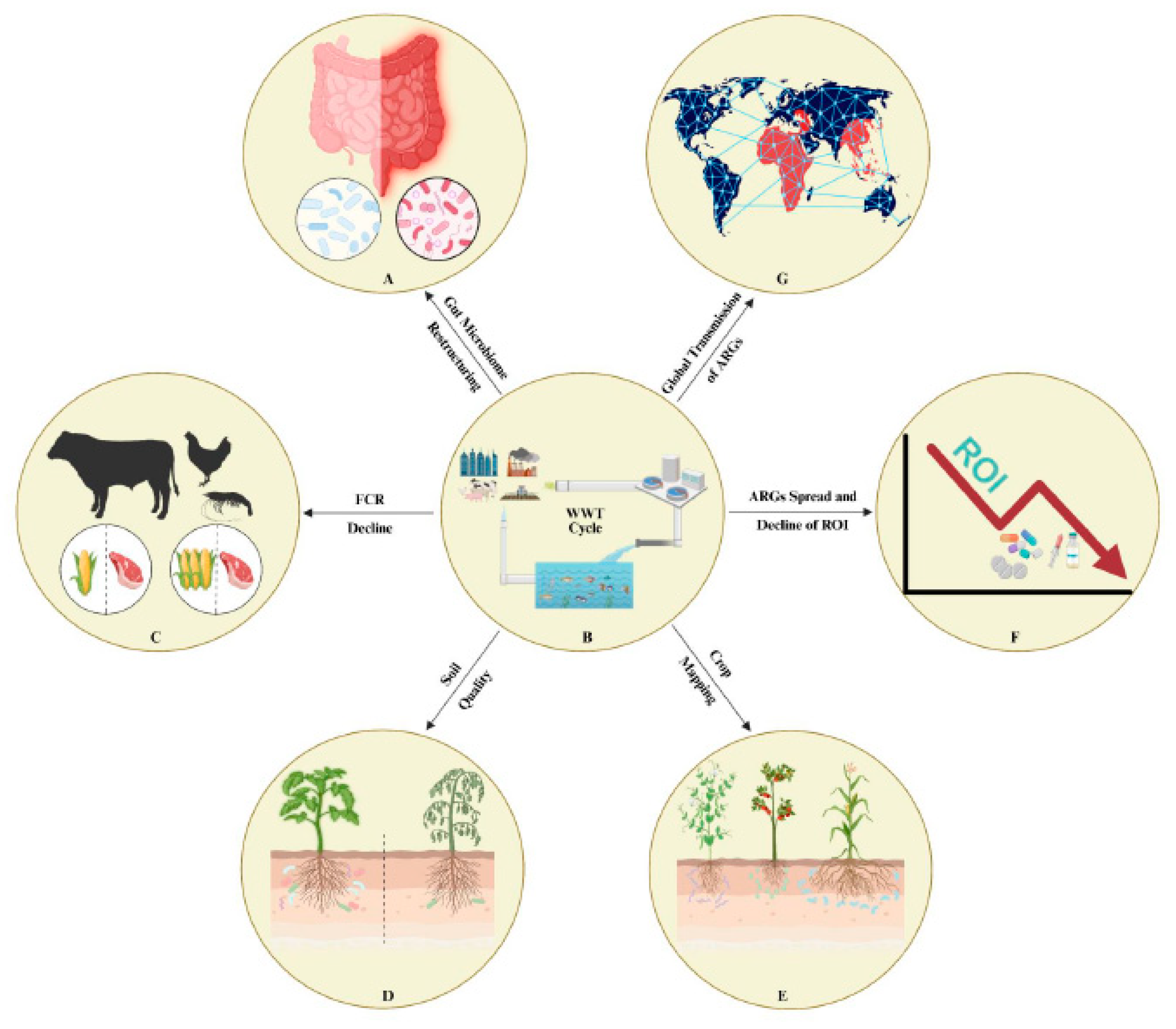
Figure 2.
This diagram summarizes the key insights revealed by wastewater treatment data analysis and their implications for environmental, agricultural, pharmaceutical, and global health strategies. At the top, wastewater treatment analysis generates actionable information that cascades into seven core domains identified below. Probiotic-enriched products and evidence-based livestock ration formulation are highlighted as interventions to promote resilient microbiomes and improve feed conversion, enhancing agricultural efficiency and food safety. Adjacent is the guidance of soil fertility programs by reclaimed-water quality profiles, together with the selective use of wastewater technologies matched to local site-specific conditions—both supporting sustainable soil management and environmental health. Optimization of crop management practices, underscoring the value of microbiome-informed approaches for maximizing crop yield and plant health. Wastewater signals also inform drug discovery strategies, while trade and travel controls are shown as mechanisms for regulating the spread of emerging contaminants and resistance determinants across regions. Vaccination efforts targeting antimicrobial resistance gene (ARG) transmission blockers, alongside epidemiological mapping, are presented as critical public health tools for controlling disease hotspots and mitigating the mobility of resistant pathogens. Finally, the diagram calls attention to the need for dynamic restructuring of international policies—driven by real-world wastewater analytics and constructed by policymakers—to better address global challenges linked to resistance, water reuse, and microbial health. Altogether, this integrative framework links wastewater data to multidisciplinary solutions, illustrating how microbial surveillance and evidence-based interventions can support One Health goals, inform guideline development, and drive progress across interconnected sectors. Created in BioRender. Gamal, A. (2025) https://BioRender.com/cky394i.
Figure 2.
This diagram summarizes the key insights revealed by wastewater treatment data analysis and their implications for environmental, agricultural, pharmaceutical, and global health strategies. At the top, wastewater treatment analysis generates actionable information that cascades into seven core domains identified below. Probiotic-enriched products and evidence-based livestock ration formulation are highlighted as interventions to promote resilient microbiomes and improve feed conversion, enhancing agricultural efficiency and food safety. Adjacent is the guidance of soil fertility programs by reclaimed-water quality profiles, together with the selective use of wastewater technologies matched to local site-specific conditions—both supporting sustainable soil management and environmental health. Optimization of crop management practices, underscoring the value of microbiome-informed approaches for maximizing crop yield and plant health. Wastewater signals also inform drug discovery strategies, while trade and travel controls are shown as mechanisms for regulating the spread of emerging contaminants and resistance determinants across regions. Vaccination efforts targeting antimicrobial resistance gene (ARG) transmission blockers, alongside epidemiological mapping, are presented as critical public health tools for controlling disease hotspots and mitigating the mobility of resistant pathogens. Finally, the diagram calls attention to the need for dynamic restructuring of international policies—driven by real-world wastewater analytics and constructed by policymakers—to better address global challenges linked to resistance, water reuse, and microbial health. Altogether, this integrative framework links wastewater data to multidisciplinary solutions, illustrating how microbial surveillance and evidence-based interventions can support One Health goals, inform guideline development, and drive progress across interconnected sectors. Created in BioRender. Gamal, A. (2025) https://BioRender.com/cky394i.
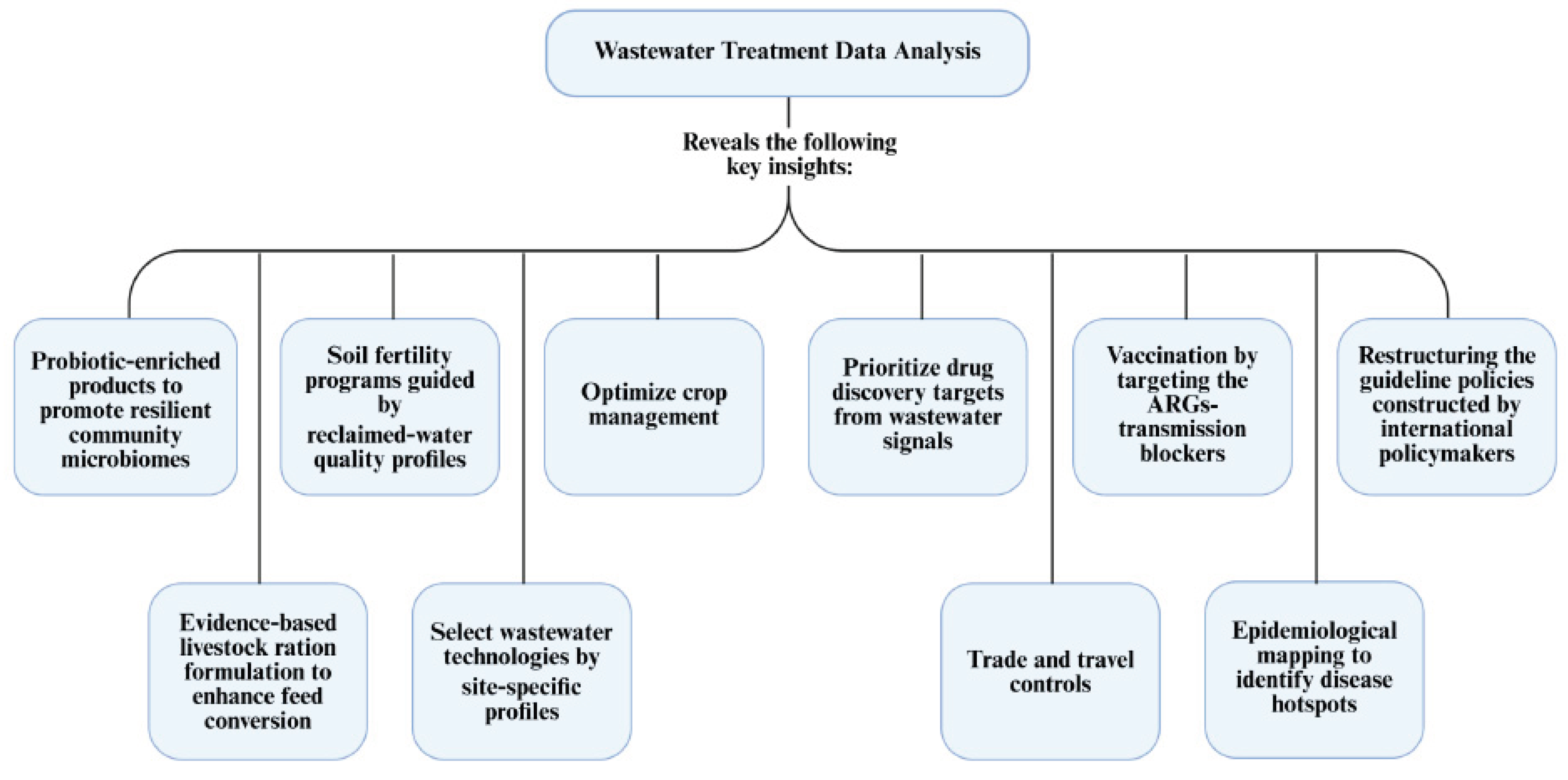
Disclaimer/Publisher’s Note: The statements, opinions and data contained in all publications are solely those of the individual author(s) and contributor(s) and not of MDPI and/or the editor(s). MDPI and/or the editor(s) disclaim responsibility for any injury to people or property resulting from any ideas, methods, instructions or products referred to in the content. |
© 2025 by the authors. Licensee MDPI, Basel, Switzerland. This article is an open access article distributed under the terms and conditions of the Creative Commons Attribution (CC BY) license (http://creativecommons.org/licenses/by/4.0/).
Copyright: This open access article is published under a Creative Commons CC BY 4.0 license, which permit the free download, distribution, and reuse, provided that the author and preprint are cited in any reuse.


