

Submitted:
18 December 2025
Posted:
18 December 2025
You are already at the latest version
Abstract
Very Low Earth Orbit (VLEO) satellites, operating at altitudes below 450km, provide tremendous potential in the domain of remote sensing. Their proximity to Earth of-fers high resolution, low latency, and rapid revisit rates, allowing continuous moni-toring of dynamic systems and real-time delivery of vertically integrated earth ob-servation products. Nonetheless, the application of VLEO is not yet fully realized due to numerous complexities associated with VLEO satellite development, considering atmospheric drag, short satellite lifetimes, and social, political and legal regulatory fragmentation.
This paper reviews the recent technological developments supporting sustainable VLEO operations with regards to aerodynamic satellite design, atomic oxygen barriers, and atmospheric-breathing electric propulsion (ABEP). Furthermore, the paper pro-vides an overview of the identification of regulatory and economic barriers that extort additional costs for VLEO ranging from frequency band allocation and space traffic management to life-cycle cost and uncertain commercial demand opportunities. Nevertheless, the commercial potential of VLEO operations is widely acknowledged, and estimated to lead to an economic turnover in the order of 1.5 B$ by 2030.
Learning from the literature and prominent past experiences such as the DISCOVERER and the CORONA program, the study identifies key gaps and proposes a roadmap to sustainable VLEO development.
The proposed framework emphasizes modular and serviceable satellite platforms, hy-brid propulsion systems, and globally harmonized governance in space. Ultimately, public-private partnerships and synergies across sectors will determine whether VLEO systems become part of the broader space infrastructure unlocking new capabilities for near-Earth services, environmental monitoring, and commercial innovation at the edge of space.
Keywords:
Very Low Earth Orbit (VLEO)
; Atmospheric-Breathing Electric Propulsion (ABEP)
; aerodynamic satellite design
; remote sensing
; sustainable space systems
; VLEO business
1. Introduction
Earth observation and remote sensing technologies have transitioned within the past sixty years from experimental tools to essential capabilities for applications across the science, economic, environmental, and commercial sectors. Remote sensing has become recognized for its central role within climate change observance, natural hazard management, environmental forecasting, food security planning, terrain mapping, and natural resources identification (Roberts et al., 2019, 2020). The commercialization of satellite Earth observation has expanded considerably in all sectors, with measurable growth realized in industries such as mining, energy, agriculture, and infrastructure monitoring. Estimates indicate that overall revenue from these services will grow from USD 1,5 billion nowadays to USD 2.4 billion by 2028 as the demand for higher-resolution images continues to grow (Crisp et al., 2020).
Satellites for remote sensing have been operated in a variety of orbits and orbital regimes each with distinct limitations and advantages. Geostationary Earth Orbit (GEO) provides broad coverage and real-time, continuous observation but with high latency due to its high altitude (Rani S et al., 2014). Medium Earth Orbit (MEO), used for navigation and communications satellite constellations offer global coverage but is less responsive to rapidly changing terrestrial conditions, and Low Earth Orbit (LEO), which is typically operated between 450 -2000km, provides satisfactory revisit frequencies, higher spatial resolution, and lower latency making it well suited for applications in Earth observation (Rani S et al., 2014). Growing need for ultra-high resolution, low latency, and near-real-time data has prompted the development of alternate orbital solutions such as the VLEO. An overview of the different characteristics per orbit is given in Table 1.
Very Low Earth Orbit (VLEO) has been defined as orbits between 180km and 450km (LaMarca, 2025). VLEO is an attractive option for remote sensing, as it provides solutions to challenges that currently limit higher altitude observation systems such as data handling inefficiencies, signal latency, and delayed target revisit period compared to LEO orbits (Abolghasemi Najafabadi and Kazemi, 2024). Furthermore, VLEO adds a crucial network layer to today's space architecture, supplementing the existing LEO, MEO, and GEO regimes. VLEO satellites, which are closer to Earth, improve the overall space-based network by enabling new modes of connectivity, such as direct satellite-to-ground links, satellite-to-satellite communications via inter-satellite links (ISLs) between spacecraft in the same and different orbital shells, and complete integration with the global ground station (GS) network layer which are vital for remote sensing and other space applications as illustrated in Figure 1 below.
In VLEO a wide range of applications can provide improved capacity for accurate sensing, particularly when combined with Synthetic Aperture Radar (SAR) systems or compact optical payloads. Such configurations enable significant improvement in environmental monitoring, precision agriculture, and disaster management. As shown in Figure 2, the addition of VLEO enriches the multilayered orbital ecosystem by enabling higher-resolution remote sensing, lower latency, and improved inter-orbital networking. However, compared to higher orbital regimes, VLEO necessitates a bigger constellation of satellites to obtain comparable coverage. We shall mention here as well a recent and promising proposal to use a SAR based constellation at 350km with considerable advantages described and discussed by the authors (Yang, 2025).
While the benefits of VLEO are tremendous, some challenges also counterbalance the benefits. Satellites are typically expected to be in orbits where the atmospheric density is very low. At VLEO, there is loading from a higher atmospheric density, which together with residual atmospheric drag and solar activity, limit mission life and require constant propulsion needs to sustain a very low Earth orbit. Recent studies have concentrated on orbital decay and de-orbiting operations, highlighting the increased interest in this field (Sannino, 2025). There are also challenges from a material degradation perspective, as the payload must maintain good protection from atomic oxygen. Adequate protective materials and coatings will therefore be required. Further to these problems, there are numerous operational and regulatory problems, including competing for spectrum, traffic management regulations, and policies not being developed yet (Sweeting, M., 2018).
This review is fundamentally framed around the question: how can VLEO satellite systems be sustainably embedded into the global space infrastructure to support, besides remote sensing, also communications, navigation, and Internet of Things (IoT) applications. It considers enabling technologies like hybrid propulsion, draft management, thermal control, and all the collaborative, regulatory, commercial, and governance processes. It is worth noting here that the increasing interest in VLEO related technologies led recently to a 2nd symposium dedicated to VLEO missions, which took place at the University of Stuttgart in January 2025. The book of abstracts (University of Stuttgart, 2025) highlights the large number of planned VLEO projects and constellations worldwide, emphasizing mission and system design, specific propulsion concepts and VLEO specific orbital control aspects.
This paper is organized in the following way. Section 2 details the main technological and operational issues associated with VLEO constellations. Section 3 identifies new technologies that are intended to resolve these constraints. Section 4 considers various integration strategies to improve resilience and scalability. Section 5 reviews business models and dual use applications. Section 6 reviews collaboration and harmonization of policies. Section 7 discusses the findings and recommendations for further studies, concluding with a call for coordinated global action.
3. Emerging Technologies in VLEO
Recent developments in spacecraft design, propulsion, communication, and thermal management systems focus on maximizing satellite lifetime and performance to reduce operational and environmental constraints in VLEO. The following sections summarize notable advancements in technologies reducing or allowing for increased drag-caused performance limits related to atmospheric drag, long-term degradation of materials, communication delay, and systems interoperability. Each of the solutions being developed contributes to a comprehensive solution that permits operation into a sustainable VLEO concept, avoiding orbital debris.
3.1. Aerodynamic Shaping and Drag Causing Performance Reduction
From the technologies proposed for sustainable operation in VLEO, aerodynamic shaping is perhaps the most important. Optimized surface geometries, e.g., shallow-angled surfaces and convex or rounded surfaces, simplify the flow of air around the object, reduce turbulence, and drag. Designs that include lift-producing shapes can increase orbit stability and maneuverability without full reliance on propulsion.
Uncertain or variable forward-facing geometries with deflective ability have been shown to significantly reduce drag based on recent studies and experimentation in wind tunnels. The DISCOVERER project validated the use of aerodynamic shaping to reduce the drag experienced on a satellite while continuing to accommodate attitude control. A graphical sketch of a slender design is illustrated in Figure 4.
3.2. Advanced Materials and Surface Engineering
In the effort to lessen atomic oxygen erosion, there is ongoing research in testing alternative materials such as coated composites, polyimide films, and erosion-resistant surfaces made from carbon. This research reveals that self-healing composites that restore surface integrity post-exposure may ultimately be a viable option. Wang et al. (2023) suggest the potential solution that an effective combination of geometry and new unique materials offers maximum durability and minimal degradation of performance. The goal is to improve and increase the structures or a structural and functional reliability in the face of the highly reactive dense VLEO atmosphere.
3.3. Hybrid Atmospheric Breathing Electric Propulsion (ABEP)
There are several hybrid propulsion systems under development to combine electric and chemical engines in order to manage orbit maintenance and maneuverability on demand. In the case of the VLEO orbit option, the Atmospheric Breathing Electric Propulsion (ABEP) has high potential for the VLEO area by harvesting residual atmospheric gases for in-situ propellants. Crisp et al., (2021) showed that, by implementing the ABEP systems, the overall fuel consumption and dependance on stored fuel was significantly less when compared to other propulsion systems, making them therefore very suitable for long-duration VLEO missions. Such ABEP systems, as schematically shown in Figure 5, provide sustainable drag compensation and provide the capacity of extending mission life without mass penalties.
An interesting application of ABEP propulsion is discussed by Yue et al (2023) proposing VLEO for elliptical orbits, reaching a perigee as low as 150 Km.
3.4. Thermal Control Systems
Due to the considerable frequency of eclipse periods and various temperature levels, a VLEO satellite will require various new thermal management systems. Active thermal control is generally comprised of heaters and heat pipes, and passive control relies on radiative coatings and phase-change-type materials. Abolghasemi Najafabadi and Kazemi (2024) discussed active and passive system integrations for temperature maintenance. These technologies are active components that help preserve survivability and continuous operation under high rates of temperatures in terms of heating and cooling.
3.5. High-Frequency Communication Equipment and Inter-Satellite Links
Like fifth generation (5G) IoT services, Ka-band Radio Frequency (RF) systems and optical laser communications are being explored to provide high throughput and low latency in the VLEO environment. Although optical systems can offer significantly higher bandwidth, they also face challenges such as line-of-sight stability and atmospherics interference. Moreover, Wu et al. (2024) investigate ISLs, which have the potential to provide uninterrupted data relay. They describe ISLs as a continuous communication mode which is particularly important for VLEO operations over oceans and remote regions, where ground stations are sparse.
3.6. Ground Segment Assimilations and Modularity
The ground segment will need to adapt to support future large-scale deployments of VLEO satellites. This includes modifying existing networks of ground stations and developing new ones that may incorporate Software-Defined Radios (SDRs) and phased-array antennas. Station automation can be designed to enable automatic handovers, frequency agility, data prioritization, and other advanced capabilities. Katona et al. (2020) proposed modular antenna systems with dynamic beam steering to enhance VLEO tracking and reception. Such flexibility will be important for all VLEO missions and constellations, improving overall reliability of service. If these emerging technologies are developed and deployed together, they could significantly enhance the feasibility of long-term, commercially viable, and operationally resilient VLEO constellations and services.
The next section will focus on how these emerging technologies cope with larger system-level approaches and sustainability frameworks for deployment on a large scale.
4. Bridging Challenges in VLEO Satellite Constellations
The operational sustainability of VLEO satellites is based upon the ability to address existing challenges related to drag compensation, structural degradation, latency in communications, and space traffic management. More VLEO satellites will gradually become active, necessitating the ability to maintain efficient, dependable, and long-life operations. This section gives an overview of solutions that address technical and systemic challenges utilizing recent research and mission architecture.
4.1. Orbital Replacement and End-of-Life Considerations
Atmospheric drag will deorbit VLEO satellites within a few weeks to months if there are no re-boost measures in place. This means cost-effective, modular satellite platforms must be created that rely heavily on real-time tracking and automated end-of-life deorbiting actions as mandated by international agreements (Santamaria Hernández, 2023). Reusable orbital transfer vehicle and in-orbit servicing platforms are being considered as a method of prolonging mission life and subsequent cost of replacement. These platforms must be robust and autonomous, taking into consideration the operational parameters for the VLEO environment.
4.2. Collision Risk Reduction and Space Debris
The proximity of VLEO activities to the upper layers of Earth’s atmosphere, where atmospheric density is significantly higher than conventional LEO altitudes, increases the likelihood of collisions and may contribute to future debris generation. ADR systems capabilities (i.e. robotics collectors, drag-enhanced deorbit kits) are necessary to avert Kessler Syndrome-type scenarios in VLEO. Globally, regulatory compliance concerning passivation, deorbit timelines, and end-of-life disposal are at present inconsistent. A multilateral approach (i.e., UN COPUOS or IADC frameworks) leading to the harmonization of these provisions could alleviate orbital congestion.
4.3. Resilient Infrastructure and Satellite Hardening
VLEO satellites will need to consider survivability against rapid thermal cycling and the corrosive effects of atomic oxygen as part of their design. The implementation of smart coatings, shielding materials, and redundant electronics is altering survivability paradigms. In addition, autonomous health checking and self-healing materials are being investigated for a damage-tolerant approach (Roberts, 2020). This has the potential to increase both Mean Time Between Failure (MTBF) and mission uptime, especially for constellations servicing critical infrastructure e.g., disaster response or secure mainly financial communications.
4.4. Regulation, Coordination, and Interoperability
The deployment of VLEO systems in the international orbital traffic management systems will require addressing interoperability standards for satellite identification, licensing, and communications. Current policies consider LEO, MEO, and GEO while leaving a gap for VLEO-specific requirements (Rodriguez-Donaire et al., 2022) The first steps towards developing registry and notification systems for satellite movements, similar to air traffic control systems, are underway. These will become important tools, once the number of satellites in VLEO constellations increase in complexity and number.
4.5. Constellation Scalability and Finances
VLEO has an economic challenge to long-term viability. The high capital expenditure due to short operational life and launch frequency will challenge the economic business models. Any large-scale constellation of satellites is ideally established on economies of scale for manufacturing, flexible plugging and playing of systems, and government financing or commercial financing. There will likely be cooperation between private sectors, space agencies, and public actors (e.g., ESA’s Phantom, DARPA’s SabreSat) to develop partnerships that share infrastructure and risk.
Overall, the solutions above outline a path forward to a sustainable VLEO architecture that provides high-throughput, low-latency services. In the following section, we emphasize the business aspects.
5. Business in the Very Low Earth Orbit Industry
The progression of VLEO satellites, from ocular reconnaissance instruments for securing defense supply and applications to commercial space vehicles, is group-defining their economic potential forward. Interest, both from public and private stakeholders, has emerged across many sectors of VLEO, including Earth Observation, telecommunications, and in-orbit manufacturing. This section presents a historical development of VLEO and offers and efforts that link dual-use application to operational civilian services.
5.1. Historical Development
First interest in the VLEO environment was purely scientific. As an example, we can refer to studies on the behavior of early near-earth satellites and the observed effects of drag (interesting enough these satellites were referred to with their scientific names such as 1957β, 1958δ1 and1958δ2 instead of the Sputnik) (King-Hele, 1958). Emphasis was placed on better knowledge of the atmosphere and geomagnetic fields in that layer.
Later, the obvious advantages of higher resolution earth observations raised increasing interest, with first space-based reconnaissance program using VLEO such as CORONA. Development of this program started in 1957, leading to the development of dedicated cameras for this purpose. After some failures, the first successful VLEO observation flight took place on August 10, 1960 (Muszynski-Sulima, 2023). The series of satellites were labeled as KH (Key-Hole), whereas the scientific aspect was referred to by different names for the same type of satellites.
Technical details on this program reveal that the platform used was in fact the upper stage of a THOR rocket, called Agena. The initial cameras were especially developed with an f/5.0 aperture and a 61 cm focal length, which was quite advanced at that time and allowed for a resolution of 7.5 meter. The satellites reported operated at a height of less than 150 Km and evidently the cameras were constantly improved over the succeeding 12 years of operations, reaching eventually a resolution of reportedly better than 1,5 meters (Perry, 1973).
It is important to mention here that the recent interest from e.g. DARPA in VLEO still illustrates the high interest and potential, developing and testing air-breathing platforms with novel electrical propulsion and with a dedicated platform under development, labeled SabreSat (Redwire,2024). Also, CASIC, a Chinese space contractor, is reported to have a VLEO dedicated operational launch site ready for orbits between 150-300 Km. (SpaceNews, 2023). In addition to this, EDA has equally started activities in this field. An interesting EDA project is LEO2VLEO, allowing a LEO satellite to be put in VLEO in case of need but to be maneuvered back to LEO to extend its lifetime (EDA, 2024).
Evidently, these positive experiences triggered scientific and civil interest, initially in the field of Earth Observation but gradually also in other space domains. Examples are the European Phantom platform (see Figure 6), presently commissioned by ESA, the European Space Agency, as well as previous scientific missions such as INSPIRESAT, performing measurement of drag effects, ionospheric measurements and effects of atomic oxygen (Srivastava, 2019). We shall also mention here the scientific GOCE mission (Gravity field and Steady-State Ocean Circulation Explorer) launched in 2013, which operated down to 229 km altitude to gain increased knowledge of the Earth’s gravity field considerably and provided important results on the Earth’s magnetic field (Steiger et al., 2014).
Beyond the scientific interests related to atmospheric physics and space weather, operating in lower orbits naturally opens the door to a wide range of commercial opportunities:
- Remote sensing: being closer to the Earth’s surface significantly improves spatial resolution, enabling unprecedented detail for applications such as urban planning, precision agriculture, environmental monitoring, and disaster assessment.
- Telecommunications: shorter signal paths through the atmosphere reduce signal loss and latency, which is critical for real-time transactions, emergency response services, and high-speed data links. This also enables improved communication in challenging environments such as tunnels, mines, or dense urban areas.
But we should also not ignore other potential applications, such as
- Navigation and positioning: lower orbit systems can enhance the accuracy and reliability of geolocation services, benefiting everything from autonomous vehicles to surveying and location-based services.
- Emerging applications: a range of innovative uses is currently in early academic exploration. As new constellations become operational, entirely new markets and technologies will inevitably emerge, driven by the unique advantages of low-orbit infrastructure.
At the same time, from a business perspective, several equipment costs can be reduced as well as other cost savings
- As far as the ground segment is concerned smaller antennas can be used on earth
- Reduced radiation can lead to the use of cheaper satellite components
- The launch cost can be reduced either by using adapted launchers (e.g. two stages only) or less propellant.
In a study comparing the different VLEO applications in terms of business potential (Bilash, 2023), different VLEO applications were evaluated in terms of business potential (see Table 2).
Using weighting factors for the different criteria represented in Table 2, the study (Bilash, 2023) concludes that the most probable areas for VLEO business are:
- Remote sensing optical systems
- SAR
- Mobile high speed internet access
- LiDAR
- High-speed internet access through terminals.
It is therefore no surprise that several supporting technological programs are initiated, such as the European Commission DISruptive teChnOlogies for VERy low Earth oRbit (DISCOVERER) program and the DARPA OTTER program, to provide research knowledge for companies working in the field of VLEO. At the same time companies such as Thales Alenia Space, Redwire, Albedo, Earth Observer, Orbion Space Technologies, Viridian, Kreios Space and Deepsat, just to name a few, are actively involved in VLEO applications and resulting business opportunities (Space Ambition, 2024)
This wide range of potential applications and opinions brings us to the quasi-impossibility of predicting the market for VLEO applications, as many potential applications are still at a feasibility stage.
As a benchmark we can refer to a recent forecast report (QYResearch, 2024) which analyzed data from 2019 to 2024 in the field of VLEO and examines the competitive landscape and growth potential. The global VLEO market in 2024 is estimated in the report to be 7.59 million USD and expected to grow by 2030 to 1.48 B$ (which represents an important CAGR (Compound Annual Growth Rate) of more than 140%). Another forecast report (Juniper, 2024) estimates the growth for the same period (2024-2030) at 66%.
Although these growth forecasts may look very optimistic, we shall consider that the figures are largely based upon new telecommunication applications, evidently the largest market in the present space economy.
In order to illustrate this, besides the obvious remote sensing potential which will undoubtedly be the main VLEO driver, a number of potential telecommunication applications and their VLEO advantages are described in detail in a study (Berthoud, 2022) and can be summarized as per Table 3.
To put this VLEO growth potential in an economic context:
- The World Economic Forum estimates that the space turnover will be over 1,000 B$ in 2030 (considering a new calculation approach proposed by McKinsey) (WEF, 2024)
- This would result in a space application market in the range of 250-300 B$ in 2030.
The aforementioned 1.48 B$ of new VLEO business in 2030 (Juniper, 2024) is therefore surely feasible within this > 250 B$ space applications envelope and illustrates that VLEO operations represent a very viable business case for the coming five years.
5.2. Enablers and Cost Drivers
Key factors enabling VLEO business scalability therefore include:
- Use of smaller antennas on Earth (due to reduced slant range).
- COTS components (less radiation exposure and thus potentially cheaper).
- Rapidly lowering cost of launch (two-party launchers, air-breathing)
Simultaneously, the ultimate and financial success of the VLEO business activity will depend on the risks associated with uncertainty in the policy environment, lifecycle management approaches, and possible mutual dual-use agreement for components that will reduce capital risk and duplication of new infrastructure.
In conclusion, VLEO has emerged from surveillance technology but is now developing into a new frontier of business innovation. This transfer is driven by its unique orbital physics operating environment, technology momentum, and increasing demands to deploy similar systems from the existing substantial use cases from EO and telecom. The next chapter discusses how international policies, governance, and harmonization for the domain can facilitate integrating VLEO into this ecosystem and scaling some of these new risks and ambiguities.
6. Governance, Regulation, and Policy Harmonization
For sustainable development of VLEO satellite constellations, technical development and commercial sustainability are insufficient; appropriate international regulations are required as well. Spectrum rights, STM and debris management impose jurisdictional governance challenges that require coordination to avoid fragmentation and ensure equal access for operators.
6.1. Fragmentation
The current space policy framework is derived mainly for higher-altitude orbits (LEO, MEO, GEO) and lacks provisions attributable to VLEO. As a result, licensing inconsistencies, duplicative processes, and uncertainty are considerable obstacles for an operator proceeding with multi-jurisdictional licensing coordination. In the VLEO spectrum allocations, operators face the greatest difficulty because frequency competition and conservative processes still exist in the allocation of rights. The ITU’s own allocation process is a time-consuming method, in addition to lacking the required low-latency provisions required for VLEO networks.
6.2. Shortcomings of STM
As VLEO activities increase, there will be increasing risks associated with congestion and possible collisions in various, close, orbits. As approaches for coordination, countries may rely only upon national-level tracking assets (e.g., the US Space Surveillance Network) and have protocols for voluntary coordination. Through developing harmonized, near-real-time STM, both commercial and global, and including new and emerging space jurisdiction, these risks need to be mitigated, in analogy with present civil aviation air traffic control procedures. Standardized protocols for maneuver notifications, a protocol for inter-operational tracking, and legally binding commitments for collision avoidance, will have to be put in place.
6.3. Debris Mitigation and End-of-Life Standards
Although VLEO satellites will typically deorbit more rapidly than their higher orbit counterparts, their density and scale may contribute to higher debris rates. The absence of binding deorbiting and passivation standards creates ambiguity when it comes to liability and cleanup obligations. Organizations like the Inter-Agency Space Debris Coordination Committee (IADC) have suggested voluntary guidelines for the deorbiting of space debris. However, this needs to be developed under a binding regulatory framework. Codes of national space laws could be developed that require the operator to abide to end-of-life disposal standards, with considerations for deorbit deceleration design standards.
6.4. Gaps Related to Liability, Risk, and Insurance
Liability for satellite failures, damage to third-party property, and collisions remains ambiguously defined, The Outer Space Treaty and the Liability Convention provide general norms for actors in space; however, practical mechanisms for liability are limited. Operators face difficulty in obtaining adequate coverage and premiums because of underdefined liability allocation and risk-sharing arrangements. The development of multilateral insurance pools could be market-driven with flexible liability coverage and lower premiums, leading to greater economic stability.
6.5. Geopolitical and Export Restrictions
Export control mechanisms (such as ITAR in the US) and equivalent national export control regimes constrain cross-border technology sharing and create complications for satellite launches. Export regulations may lead to delays in VLEO deployments or, to a minimum, inhibit international partnerships, especially when determining the use of dual-use items. Global space governance organizations need to find ways to create frameworks that still allow for national interests while realizing the benefits of joint international collaborations. Regardless of the negotiations, open standards for data formats, interoperability between platforms, and shared STM platforms can lead to confidence building.
6.6. The Path Towards an Integrative Global Framework
To achieve full VLEO integration in a sustainable way, international space law needs to evolve to include governance instruments specifically for VLEO. Potential solutions could include:
- An international VLEO mission registry
- Allocated frequency for ultra-low latency constellations.
- Legally binding debris remediation protocols
- Access protocols for shared low-altitude corridors
- An appropriate governance structure.
Organizations such as the UNOOSA, ITU, IADC, and regional consortia need to collaborate to develop legally binding, sufficiently amendable policies. Without progress to modernize regulations, the potential for the VLEO evolution may be limited due to regulatory delays, apprehension within the marketplace, and citizen safety risks. Thus, policy harmonization is a key enabler for unlocking VLEO commercialization and responsible stewardship of the orbit.
7. Discussion and Suggestions for Further Work
This research identifies and consolidates an extensive range of technological, regulatory, commercial, and operational solutions required for the VLEO satellite systems to be accepted in the broader space ecosystem. The study had the following major findings and recommendations:
- There is potential for significant drag reduction, and therefore lifetime enhancement, by utilizing improved materials, such as atomic oxygen-resistant coatings and self-healing composites and utilizing shape to achieve aerodynamic form. While wind tunnel testing Computational Fluid Dynamics data suggests actual improvements were observed, studies are still needed to assess durability in the VLEO environment.
- Development of hybrid propulsion architectures, such as ABEP, will allow the capability to sustain altitude with lighter, and more sustainable systems, that require less onboard propellant. These systems collectively offer a scalable approach to cost effective and long-term VLEO operations.
- It is critical to scale ground capability to maintain real-time contact with VLEO satellites. Wide-scale adoption of SDRs, phased array antenna, and ISLs should be employed to maintain continuous connectivity, increase data throughput, and expand the effective data reach of ground stations.
- It will require internationally collaborative efforts to harmonize regulations for spectrum assignments, on-orbit congestion management, and STM, and to adopt updated legal instruments that will help classify the liability regime and mandate deorbiting plans.
- Public-private partnerships (PPPs) will play a key role in funding infrastructures, launching constellations, and de-risking research and development for long-term sustainability, in addition to using modular satellite designs that can allow for more flexibility on multiple mission profiles.
- It will be important to institutionalize active debris removal systems and plans for decommission. Technological solutions such as in-orbit servicing, robotic repairs, and recycling systems will aim to improve the efficiency of spacecraft lifecycles.
- The market potential for VLEO applications is considerable. From a remote sensing point of view the enhanced resolution will be driven initially by dual-use applications and then gradually transfer to civil applications. In addition to this, a number of promising telecommunication applications will create additional markets.
These are not just isolated technical issues to solve but interconnected solutions that need to be executed. Each part fits into a comprehensive architecture that will allow for VLEO missions to operate alongside their support of remote sensing, communications, navigation, and new commercial derivatives.
Conclusion
VLEO satellites may represent a paradigm shift to next-generation space infrastructure. Their proximity to Earth allows landing strategies that provide higher image resolution, ultra-low-latency communications, and better revisit rates that are necessary for real-time applications like remote sensing, disaster response, and secure communications. However, realizing these benefits is challenged by significant barriers such as high atmospheric drag, limited operational lifetime, and a fragmented regulatory landscape. This study indicated that several newly developed material science, propulsion, thermal control, and ground communication technologies can overcome those challenges.
The business case for VLEO systems is compelling, particularly with, besides remote sensing dual-use missions, telecommunications, and scientific payloads. Indeed, several predictions foresee a VLEO market potential of some 1.5 B$ by 2030. The industry forecasts exponential market growth if standardized governance, scalable infrastructure, and coordinated international policies are developed and implemented. Moving forward, VLEO systems must not be considered as a stand-alone project but, rather, as a strategic component of a global space infrastructure. Coordinated activities between academia, government, business, and multilateral institutions will be required. If undertaken responsibly, with elements of sustainability and equitable policy and approaches, VLEO satellites can serve as the dependable workhorses of the 21st century orbital economy at low, near-Earth, altitude.
It is of paramount importance to stress that the current research is limited to the academic fields of aerospace engineering, commercial space studies, remote sensing, and space policy. The findings are intended for beneficial remote sensing applications, such as urban planning, disaster monitoring, climate monitoring, smart agriculture, and industry innovation, and do not pose a threat to public health or national security.
The authors acknowledge the dual-use potential of research involving satellite technologies and remote sensing capabilities and confirm that all necessary precautions have been taken to prevent potential misuse. All information presented is derived from open-source, publicly accessible literature, and no sensitive technical details, classified data, or operational methods are disclosed.
As an ethical responsibility, the authors strictly adhere to all relevant national and international laws and guidelines concerning Dual-Use Research of Concern (DURC), export control regulations, and space technology governance. The authors advocate for responsible deployment, ethical considerations, regulatory compliance, and transparent reporting to mitigate misuse risks and foster beneficial scientific and societal outcomes.
Funding
No external funding was received for this paper.
Acknowledgments
Part of this paper is based upon a Master study paper (MSS25 at ISU) assigned to Sradha Udayakumar entitled ‘Embedding Very Low Earth Orbit Satellites into the Global Space Infrastructure’. Nina Velimirovic ISU MSS26 student contributed with CAD design of the images used for this paper. .
Conflicts of Interest
The authors declare that there is no Conflict of Interest.
List of Abbreviations
| ABEP | Atmospheric Breathing Electric Propulsion System |
| ADCS | Attitude Determination and Control System |
| ADR | Active Debris Removal |
| AO | Atomic Oxygen |
| CASC | China Aerospace and Technology Cooperation |
| COPUOS (UN) | Committee on the Peaceful Uses of Outer Space |
| DARPA (US) | Defense Advanced Research Projects Agency |
| DISCOVERER | DISruptive teChnOlogies for VERy low Earth oRbit platforms |
| EDA | European Defense Agency |
| ESA | European Space Agency |
| GEO | Geostationary Orbit |
| GPS | Global Navigation Positioning System |
| IADC | Inter-Agency Space Debris Coordination Committee |
| IoT | Internet of Things |
| ITU | International Telecommunication Union |
| LIDAR | Light Detection and Radar |
| LEO | Low Earth Orbit |
| MEO | Medium Earth Orbit |
| MTBF | Mean Time Between Failures |
| R&D | Research and Development |
| RF | Radio Frequency |
| SAR | Synthetic Aperture Radar |
| SDR | Software-Defined Radio |
| STM | Space Traffic Management |
| TRL | Technology Readiness Level |
| TV | Television |
| VLEO | Very Low Earth Orbit |
References
- Abolghasemi Najafabadi, M., & Kazemi, I. (2024). Systemic design of the very-high-resolution imaging payload of an optical remote sensing satellite for launch into the VLEO using a small launch vehicle. Heliyon, 10(6), e27404. Available at: https://doi.org/10.1016/j.heliyon.2024.e27404 (Last accessed Nov 18, 2025). [CrossRef]
- Berthoud, L., Hills, R., Bacon, A. et al. (2022). Are Very Low Earth Orbit (VLEO) satellites a solution for tomorrow’s telecommunication needs? CEAS Space J 14, 609–623 (June 2022). Available at: https://doi.org/10.1007/s12567-022-00437-0 (Last accessed April 12, 2025). [CrossRef]
- Bilash, D., (2023). VLEO Business Opportunities (ISU Research Paper, 2023), ISU Library, unpublished, France.
- Cañas Muñoz, V., Roberts, P. C. E., Bevilacqua, R., & García-Almiñana, D. (2020). Attitude control for satellites flying in VLEO using aerodynamic surfaces. JBIS, 73(3), 103–112.
- Chen, S., Athreya, K., & Lansard, E. (2023). Orbit Manoeuvre Strategies for Very Low Earth Orbit (VLEO) Satellites. Paper presented at IAC2023, Bakhu, Azerbaijan, 2-6 October 2023. Available at: https://www.researchgate.net/publication/375027798_Orbit_Manoeuvre_Strategies_for_Very_Low_Earth_Orbit_VLEO_Satellites (Last accessed Nov 16, 2025).
- Crisp, N. H., Roberts, P. C. E., Livadiotti, S., Oiko, V. T. A., Edmondson, S., Haigh, S. J., Huyton, C., Sinpetru, L. A., Smith, K. L., Worrall, S. D., Becedas, J., Domínguez, R. M., González, D., Hanessian, V., Mølgaard, A., Nielsen, J., Bisgaard, M., Chan, Y.-A., Fasoulas, S. & Schwalber, A. (2020). The benefits of very low earth orbit for earth observation missions. Progress in Aerospace Sciences, 117, 100619. Available at: https://doi.org/10.1016/j.paerosci.2020.100619 (Last accessed Nov 18, 2025). [CrossRef]
- Crisp, N. H., Roberts, P. C. E., Romano, F., Smith, K. L., Oiko, V. T. A., Sulliotti-Linner, V., Hanessian, V., Herdrich, G. H., García-Almiñana, D., Kataria, D., & Seminari, S. (2021). System modelling of very low Earth orbit satellites for Earth observation. Acta Astronautica, 187, 475–491. Available at: https://doi.org/10.1016/j.actaastro.2021.07.004 (Last accessed Nov 16, 2025). [CrossRef]
- EDA (2024). European satellite constellation for very low earth orbit to launch in two years. (EDA, News Release, March 06, 2024). Available from:, https://defence-industry.eu/european-satellite-constellation-for-very-low-earth-orbit-to-launch-in-two-years/ (Last accessed Oct 24, 2025).
- Emmert, J. T. (2015). Thermospheric mass density: A review. Advances in Space Research, 56(5), 773–824.
- Ferringer, M., et al. (2021). LEO mega-constellations for broadband communications. Acta Astronautica, 189, 108–123.
- Fortescue, P., Swinerd, G., & Stark, J. (2011). Spacecraft systems engineering (4th ed.). Wiley and Sons Online Library Bookshop, pp. 634-678. Available at: https://doi.org/10.1002/978119971008. [CrossRef]
- Hild, F., Traub, C., Pfeiffer, M., Beyer, J., & Fasoulas, S. (2022). Optimisation of satellite geometries in Very Low Earth Orbits for drag minimisation and lifetime extension. Acta Astronautica, 201, 340–352.
- Holmes, B. E. A., Oiko, V. T. A., & Roberts, P. C. E. (2023). A review of satellite-based atomic oxygen sensing methods. Progress in Aerospace Sciences, 137, 100886. Available at: https://doi.org/10.1016/j.paerosci.2023.100886. [CrossRef]
- Juniper, (2024). Global VLEO Satellites Market: 2024-2030 ( Juniper Research, Hampshire, UK, June 2024). Available at: https://www.juniperresearch.com/research/iot-emerging-technology/space-technology/vleo-satellites-research-report/ (Last accessed Oct 26 , 2025).
- Katona, Z., Gräßlin, M., Donner, A., Kranich, N., Brandt, H., Bischl, H., & Brück, M. (2020). A flexible LEO satellite modem with Ka-band RF frontend for a data relay satellite system. International Journal of Satellite Communications and Networking, 38(3), 301–313.
- King-Hele, D., and Walker, D. An Irregularity in the Atmospheric Drag Effects on Sputniks 2 and 3 (Satellites 1957β, 1958δ1 and 1958δ2). Nature 182, 860–861 (1958). Available at: https://doi.org/10.1038/182860a0. [CrossRef]
- La Marca, T.A., Graziano, M.D., Grassi, M. et al. (2025). Mission and system design for the Earth Next CubeSat VLEO mission. CEAS Space J (2025). Available at: https://doi.org/10.1007/s12567-025-00663-2. [CrossRef]
- Luo, X., Chen, H.-H., & Guo, Q. (2024). LEO/VLEO Satellite Communications in 6G and Beyond Networks–Technologies, Applications, and Challenges. IEEE Network, 38(5), 273–285. Available at: https://doi.org/10.1109/MNET.2024.3353806. [CrossRef]
- Macario-Rojas, A., Smith, K. L., Crisp, N. H., & Roberts, P. C. E. (2018). Atmospheric interaction with nanosatellites from observed orbital decay. Advances in Space Research, 61(12), 2972–2982. Available at: https://doi.org/10.1016/j.asr.2018.02.022. [CrossRef]
- Muszynski-Sulima, W,. (2023). Cold War in Space: Reconnaissance Satellites and US-Soviet Security Competition. European Journal of American Studies 18(2), 2023. Available at: https://journals.openedition.org/ejas/20427 (Last accessed, Dec 12, 2025).
- Pardini, C., Anselmo, L., Moe, K., & Moe, M. M. (2010). Drag and energy accommodation coefficients during sunspot maximum. Advances in Space Research, 45(5), 638–650. Available at: https://doi.org/10.1016/j.asr.2009.08.034. [CrossRef]
- Perry, R., (1973). A History of Satellite Reconnaissance (1973), Report SC-2017-00006. (NRO, 1973, Chantilly, Virginia).
- QYResearch, (2024). Global Very Low Earth Orbit (VLEO) Satellite Market Insights, Forecast to 2030. Report 1609537, (December 11,2024) (EMEA, Brussels). Available at: https://www.marketresearch.com/QYResearch-Group-v3531/Global-Low-Earth-Orbit-VLEO-39070681/ (Last accessed Dec 11, 2025).
- Rani, S., & Malhotra, S. (2014). Comparative Study Of LEO, MEO & GEO Satellites, vol-1, issue9, ISSN2348-6848. International Journal of Research. 1181-1186. Available at: https://journals.pen2print.org/index.php/ijr/article/viewFile/768/715/ (Last accessed, Nov 15, 2025).
- Redwire, (2024). Redwire Awarded DARPA Prime Contract for SabreSat Spacecraft Very Low-Earth Orbit Demonstration (Redwire, Press Release, June 17, 2024). Available at: https://redwirespace.com/newsroom/redwire-awarded-darpa-prime-contract-for-sabresat-spacecraft-very-lw-earth-orbit-demonstration/ (Last accessed Oct 24, 2025).
- Roberts, P., Crisp, N., Oiko, V. T. A., Edmondson, S., Haigh, S., Huyton, C., Livadiotti, S., Lyons, R., Smith, K., Sinpetru, L., Straker, A., Worrall, S., & Al, E. (2019). Keynote: DISCOVERER – Making Commercial Satellite Operations in Very Low Earth Orbit a Reality. 70th International Astronautical Congress (Washington D.C., 219). Available at: https://research.manchester.ac.uk/en/publications/keynote-discoverer-making-commercial-satellite-operations-in-very/ (Last accessed, Dec 11, 2025).
- Roberts, P., Crisp, N. H., Edmondson, S., Haigh, S., Holmes, B., Livadiotti, S., Rojas, A. M., Oiko, V. T. A., Smith, K., Sinpetru, L., Becedas, J., Dominguez, R. M., Sulliotti-Linner, V., Christensen, S., Jensen, T. K., Nielsen, J., Bisgaard, M., Chan, Y.-A., Herdrich, G. H. & Schwalber, A. (2020). DISCOVERER: Developing Technologies to Enable Commercial Satellite Operations in Very Low Earth Orbit. 71st International Astronautical Congress (IAC) – The CyberSpace Edition, 12-14 October 2020. Available at: https://research.manchester.ac.uk/en/publications/discoverer-developing-technologies-to-enable-commercial-satellite (Last accessed Oct 20, 2025).
- Rodriguez-Donaire, S., Garcia-Almiñana, D., Garcia-Berenguer, M., Roberts, P. C. E., Crisp, N. H., Herdrich, G. H., Kataria, D., Hanessian, V., Becedas, J., & Seminari, S. (2022). Strategic similarities between earth observation small satellite constellations in very low earth orbit and low-cost carriers by means of strategy canvas. CEAS Space Journal, 14(4), 767–784. Available at: https://doi.org/10.1007/s12567-022-00462-z. [CrossRef]
- Romano, F., Binder, T., Herdrich, G., Fasoulas, S., & Schönherr, T. (2015). Air-Intake Design Investigation for an Air-Breathing Electric Propulsion System. Joint Conference of the 30th International Symposium on Space Technology and Science (ISTS), 34th International Electric Propulsion Conference (IEPC) and 6th Nano-satellite Symposium, Hyogo-Kobe, Japan, July 4–10, 2015. Paper IEPC-2015-90524 / ISTS-2015-b-90524. Available at: https://doi.org/10.13140/RG.2.1.2500.4646. [CrossRef]
- Sannino, A.; De Prisco, D.; Cassese, S.; Mungiguerra, S.; Cecere, A.; Savino, (2025). R. Re-Entry Comparison of a Spacecraft in Low Earth Orbit: Propulsion-Assisted vs. Non-Propulsive Configurations. Aerospace 2025, 12, 79. Available at: https://doi.org/10.3390/aerospace12020079. [CrossRef]
- Santamaria Hernández, I. (2023). Design of a business roadmap methodology: Application in materials technology for Very Low Earth Orbits (VLEO) missions [Bachelor thesis, Universitat Politècnica de Catalunya]. Available at: https://upcommons.upc.edu/handle/2117/396242 (Last accessed, Oct 20, 2025).
- Space Ambition, (2024). The New Space Frontier: Why VLEO is an Emerging Trend. Issue 104 (November 22, 2024). Available at: https://spaceambition.substack.com/p/the-new-space-frontier-why-vleo-is (last accessed Nov 14, 2025).
- SpaceNews, (2023). Chinese defense contractor to begin launching VLEO satellites. (SpaceNews March 30, 2023). Available at: https://spacenews.com/chinese-defense-contractor-to begin-launching -vleo-satellites/.
- Srivastava, S., Anant K., Telikicherla K. & Gacal, G. F. (2019). INSPIRESAT-4/ARCADE : a VLEO mission for atmospheric temperature measurements and ionospheric plasma characterization. 33rd Annual AIAA/USU Conference on Small Satellites, SSC19-VIII-05. Available at: https://hdl.handle.net/10356/148434 (Last accessed Nov 16, 2025).
- Steiger, C., Romanazzo, M., Emanuelli, P., Floberghagen, R. & Fehringer, M., (2014). The Deorbiting of ESA’s Gravity Mission GOCE - Spacecraft Operations in Extreme Conditions, Conference paper, 13th International Conference on Space Operations, (May 2014). Available at: https://doi.org/10.2514/6.2014-1934. [CrossRef]
- Sweeting, M. N. (2018). Modern Small Satellites-Changing the Economics of Space. Proceedings of the IEEE, 106(3), 343–361. Available at: https://doi.org/10.1109/JPROC.2018.2806218. [CrossRef]
- University of Stuttgart (2025). The 2nd International Symposium on Very Low Orbit Missions and Technologies (Stuttgart, January 2025). Available at: https://www.sfb1667.uni-stuttgart.de/VLEOsymposium/ (Last accessed Oct 16, 2025).
- Vallado, D. A. (2013). Fundamentals of astrodynamics and applications (4th ed.). Springer.
- Wang, W., Xiang, Y., Yu, J., & Yang, L. (2023). Development and Prospect of Smart Materials and Structures for Aerospace Sensing Systems and Applications. Sensors, 23(3), Article 3. Available at: https://doi.org/10.3390/s23031545. [CrossRef]
- WEF, (2024). Space: The $1.8 Trillion Opportunity for Global Economic Growth (WEF, in knowledge partnership with McKinsey & Company, Geneva, April 2024).
- Wertz, J. R., Everett, D. F., & Puschell, J. J. (2011). Space mission engineering: The new SMAD. Microcosm Press.
- Wu, C., Han, S., Chen, Q., Wang, Y., Meng, W., & Benslimane, A. (2024). Enhancing LEO Mega-Constellations with Inter-Satellite Links: Vision and Challenges (No. arXiv:2406.05078). arXiv. Available at: https://doi.org/10.48550/arXiv.2406.05078. [CrossRef]
- Yang, S.; Sun, J.; Lu, H.; Cheng, S.; Wang, S.; Sun, W. Advantage Analysis of Spaceborne SAR Imaging in Very Low Earth Orbit: A Case Study of Haishao-1. Remote Sens. 2025, 17(22), 3700. Available at: https://www.mdpi.com/2072-4292/17/22/3700.
- Yue, Y., Geng, J., Feng, G., and Li, W. (2023). Elliptical Orbit Design Based on Air-Breathing Electric Propulsion Technology in Very-Low Earth Orbit Space. Aerospace 2023, 10, 899. Available at: https://doi.org/10.3390/aerospace10100899. [CrossRef]
Figure 1.
Remote sensing orbit layers and data relaying communication networks.
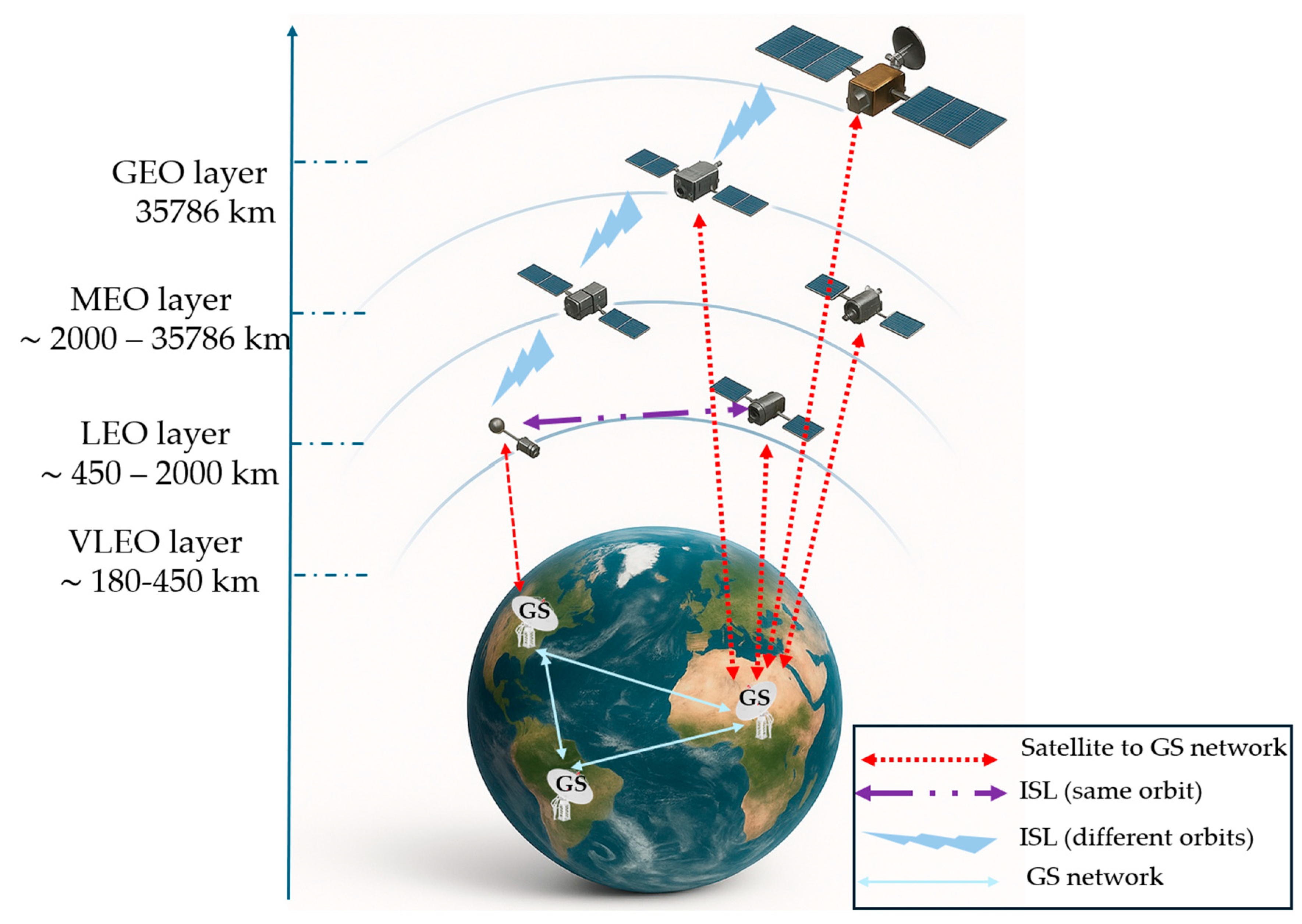
Figure 2.
Coverage comparison between VLEO, LEO, MEO and GEO satellites.
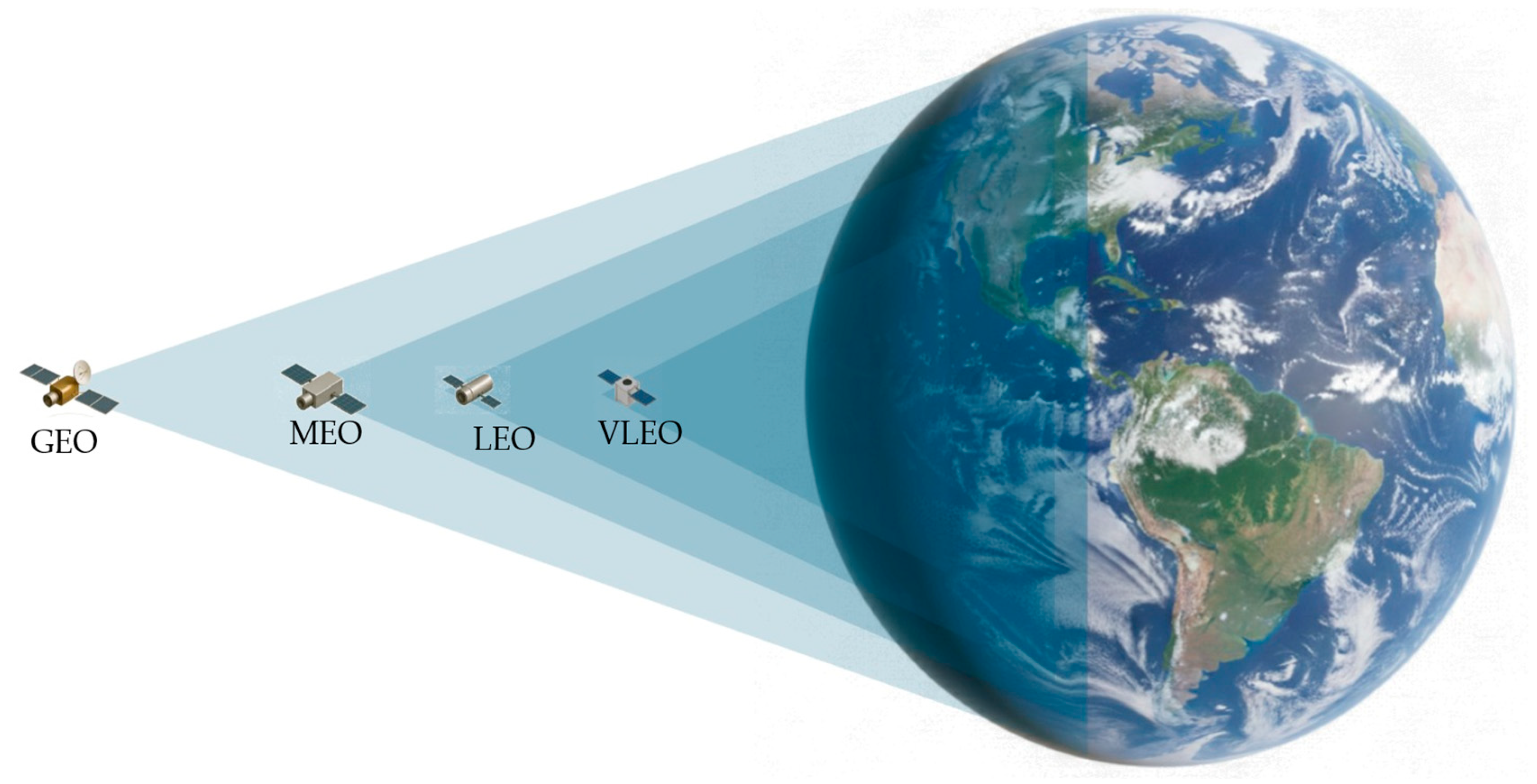
Figure 3.
Damage to an ISS solar array blanket box caused by atomic oxygen exposure (Adapted from Holmes et al., 2023).
Figure 3.
Damage to an ISS solar array blanket box caused by atomic oxygen exposure (Adapted from Holmes et al., 2023).
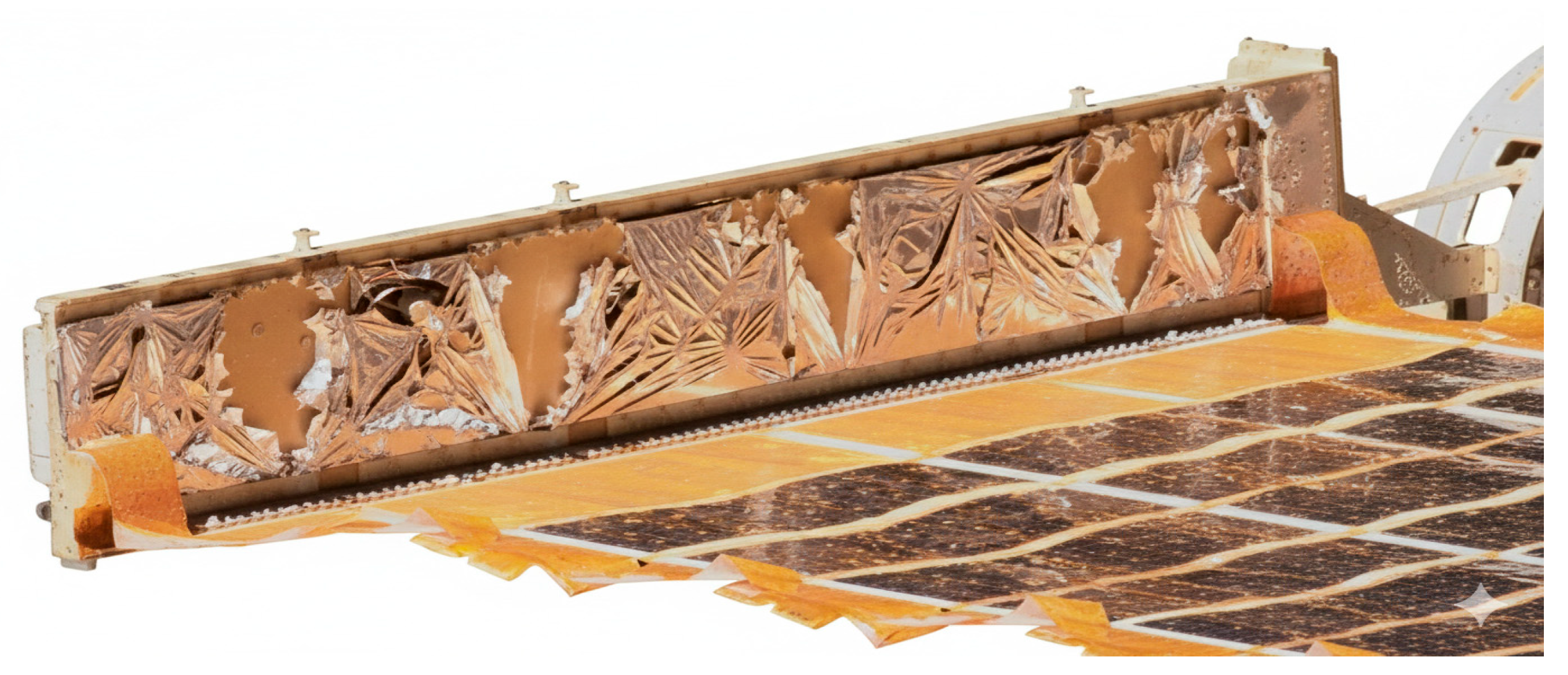
Figure 4.
Sleek slender design preferred for VLEO (adapted from Crisp et al., 2021; Romano et al., 2015).
Figure 4.
Sleek slender design preferred for VLEO (adapted from Crisp et al., 2021; Romano et al., 2015).
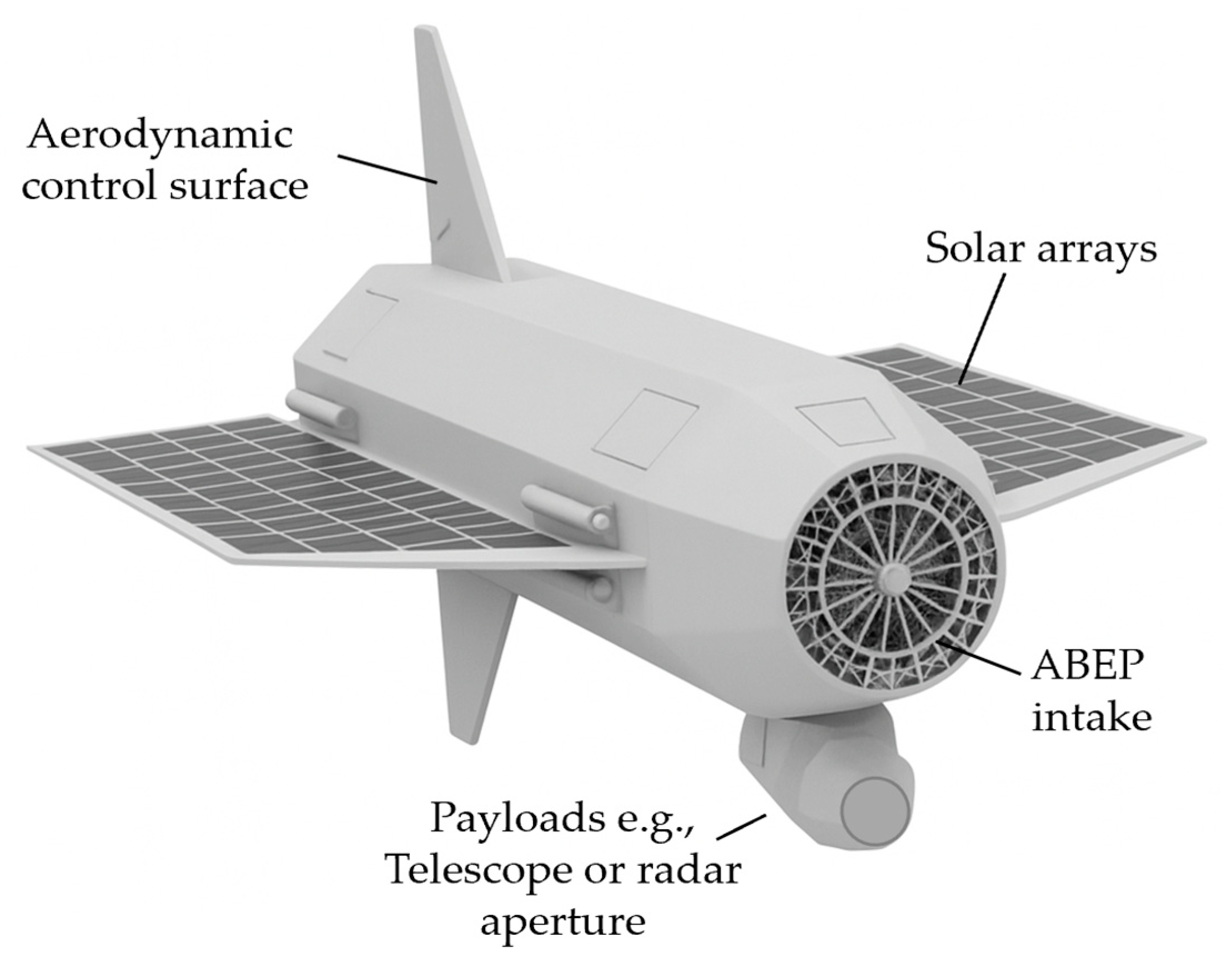
Figure 5.
Visual representation of ABEP system (adapted from Crisp et al., 2020; Romano et al., 2015).
Figure 5.
Visual representation of ABEP system (adapted from Crisp et al., 2020; Romano et al., 2015).
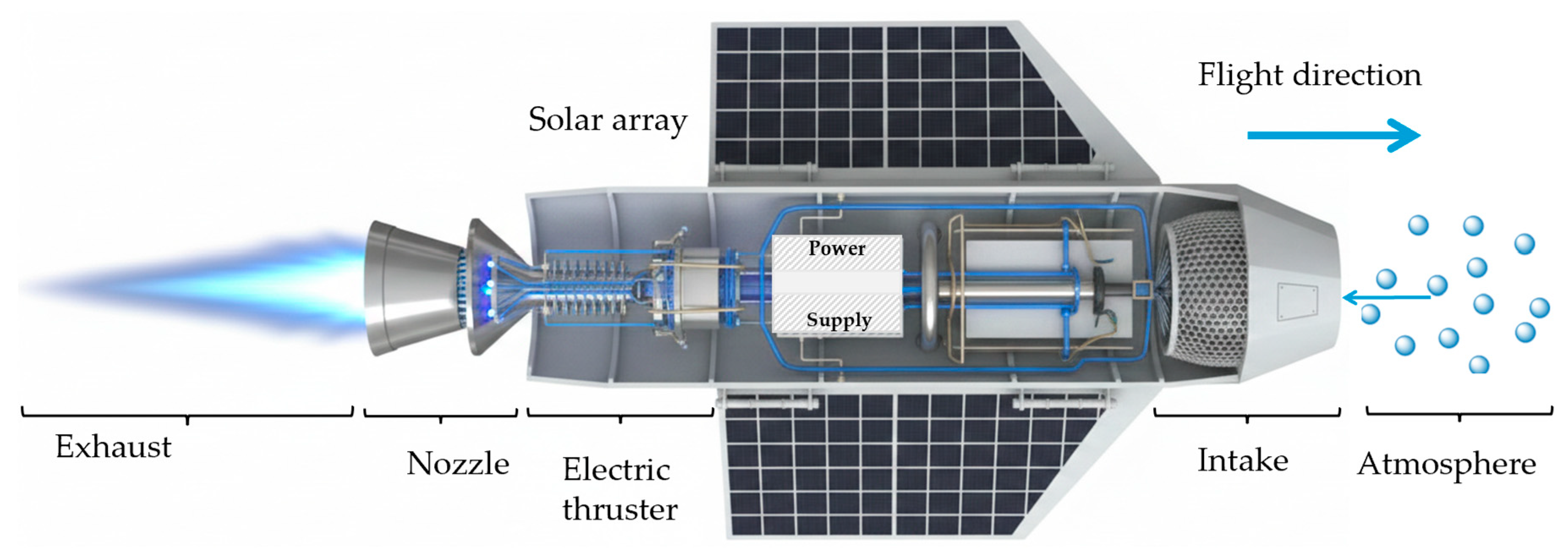
Figure 6.
Artist impression of Redwire’s Phantom European VLEO Platform (Courtesy: Redwire, Europe).
Figure 6.
Artist impression of Redwire’s Phantom European VLEO Platform (Courtesy: Redwire, Europe).
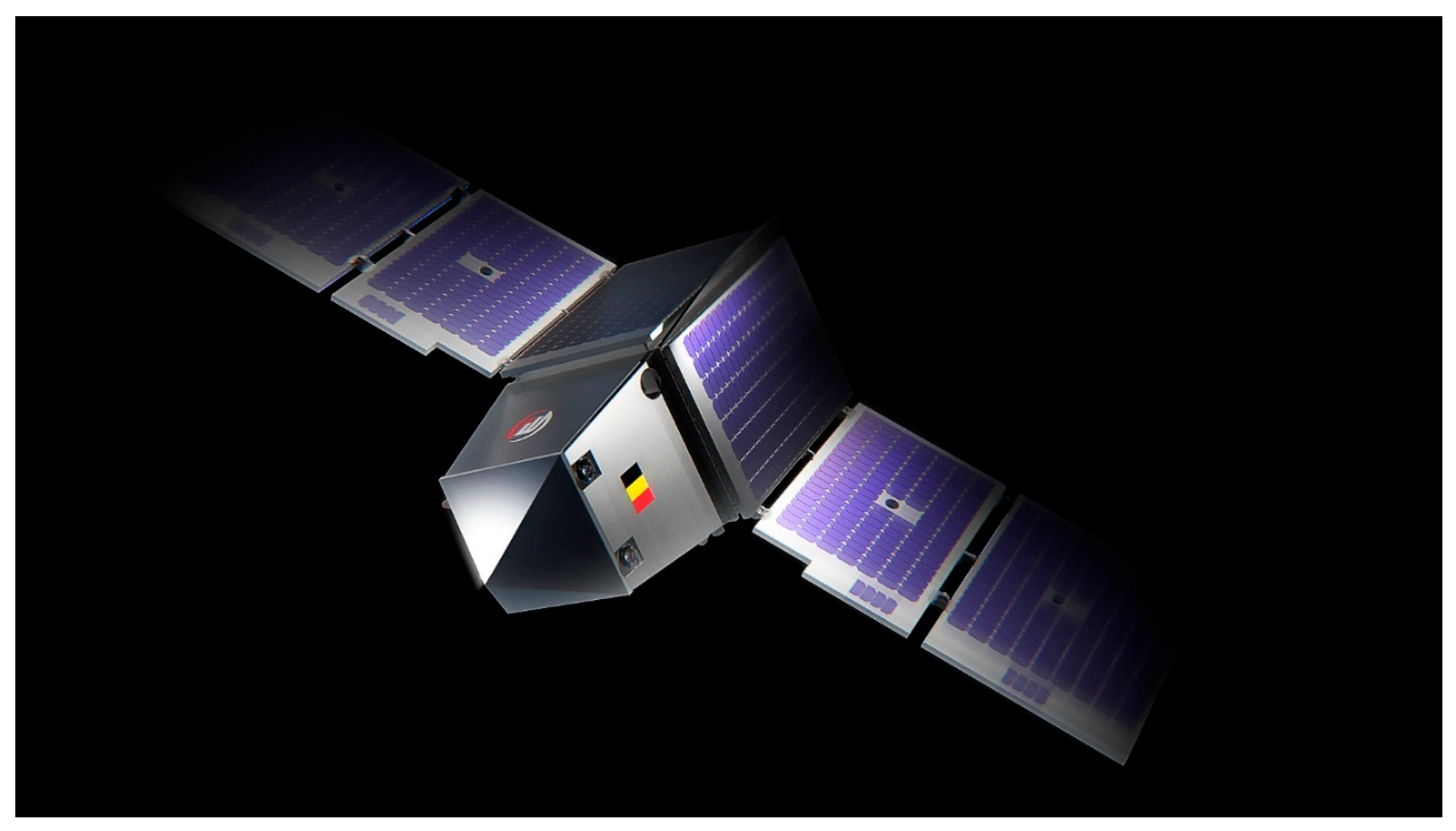

Table 1.
Comparison of orbital parameters across different orbital regimes (Crisp et al., 2020; Crisp et al., 2021; Vallado, 2013; Ferringer et al., 2021; Wertz et al., 2011; Fortescue et al., 2011; NASA, 2021).
Table 1.
Comparison of orbital parameters across different orbital regimes (Crisp et al., 2020; Crisp et al., 2021; Vallado, 2013; Ferringer et al., 2021; Wertz et al., 2011; Fortescue et al., 2011; NASA, 2021).
| Parameter | VLEO | LEO | MEO | GEO |
| Altitude | < 450 km | 450 – 2000 km | 2000 – 35786 km | 35786 km |
| Orbital period | ~ 90 minutes or less | ~ 90 – 120 minutes | ~2 – 24 hours | ~ 24 hours |
| Speed | ~7.7 km/s | ~7.7– 6.9 km/s | ~6.9 – 3.1 km/s | ~3.1 km/s |
| Application | Earth observation, technology demonstration |
Earth observation, communications, IoT, science | Navigation (e.g., GPS, Galileo etc.), communications | Weather monitoring, TV broadcast, long range telecommunication |
| Lifetime | Weeks– months | ~ 1– 7years | 10 – 15 years | 15 plus years |
| Orbital decay | High, due to atmospheric drag | Moderate | Low | Negligible |
| Launch cost | Low | Relatively low | Moderate | High |
|
Communication latency |
~1 –5 ms | ~5 – 20 ms | ~50 – 100 ms | ~240ms |
| Coverage area | Narrow swath | Moderate | Wide | Covers ~1/3 of Earth’s surface |
| RF link-budget Efficiency | High (proximity to Earth) | High | Moderate | Low (requires powerful transmitters) |
Table 2.
Potential VLEO applications and business success evaluation (adapted from (Bilash, 2023)).
| Potential VLEO Applications | Criteria for Business success |
|
|
Table 3.
Potential VLEO telecommunication applications and benefits (adapted from (Berthoud, 2022)).
Table 3.
Potential VLEO telecommunication applications and benefits (adapted from (Berthoud, 2022)).
| Telecommunication Application | VLEO Benefit |
| Underground Communications | Low frequency communications |
| High-speed Internet access for mobile applications | Latency reduction |
| Direct-to-handheld broadband communications | Better link budget |
| Store and forward data transmissions | High data rates thanks to better link budgets |
| Critical and cyber secure transmissions | Low latency |
| Quantum Key Distribution (QKD) | Low range and smaller areas |
| Aeronautical communications | Smaller areas reducing interference |
Disclaimer/Publisher’s Note: The statements, opinions and data contained in all publications are solely those of the individual author(s) and contributor(s) and not of MDPI and/or the editor(s). MDPI and/or the editor(s) disclaim responsibility for any injury to people or property resulting from any ideas, methods, instructions or products referred to in the content. |
© 2025 by the authors. Licensee MDPI, Basel, Switzerland. This article is an open access article distributed under the terms and conditions of the Creative Commons Attribution (CC BY) license (http://creativecommons.org/licenses/by/4.0/).
Copyright: This open access article is published under a Creative Commons CC BY 4.0 license, which permit the free download, distribution, and reuse, provided that the author and preprint are cited in any reuse.


