Preprint
Communication

This version is not peer-reviewed.

SiO2 Electret Formation by Electrode-Free Electrochemical Nanolithography: A Chemophysical Surface Functionalisation

Submitted:

09 December 2025

Posted:

18 December 2025

You are already at the latest version

Abstract

This work introduces a new method for creating patterned SiO₂ electrets using Electrode-Free Electrochemical Nanolithography (EFEN), enabling surface functionalisation without direct electrode contact. EFEN applies an alternating current through capacitive coupling between a conductive stamp and an insulating substrate in high-humidity conditions, forming a nano-electrochemical cell that drives localised reactions. Using thermally grown SiO₂ films, we achieve submicrometre patterning with minimal topographical impact but significant electronic alterations. Characterisation via Kelvin Probe Force Microscopy and Electric Force Microscopy confirms the formation of charged regions replicating the stamp pattern, with adjustable surface potential shifts up to –1.7 V and charge densities reaching 300 nC·cm⁻². The process can be scaled to areas of 1 cm² and is compatible with conventional laboratory equipment, offering a high-throughput alternative to scanning-probe lithography. EFEN combines simplicity, accuracy, and scalability, opening new opportunities for patterned electret production and functional surface engineering.
Keywords: 
;  ;  ;  ;  

1. Introduction

SiO₂ is one of the most widely used dielectric materials in modern technology, serving both passive and active roles. Beyond its established use as an insulating layer in silicon-based electronics, SiO₂ can acquire active functionalities by surface functionalization. These include charge trapping [1,2,3], optical sensing [4], enhancing charge transport in organic semiconductors [5], regenerable resistive switching [6] and controlled material growth or assembly [7]. These capabilities extend its relevance from microelectronics to emerging fields including organic electronics [5], memories [6] and surface sensing [4].
Here, we demonstrate the formation of SiO2 electrets through a novel approach that enables precise submicrometre patterning.
Electrets, known for over a century, are often considered the electrostatic analogues of permanent magnets. [8] Their ability to produce persistent electric fields has enabled a broad spectrum of applications [9,10], including microphones [11], nanoxerography, [12] magnetic [13] and pressure [14] photo sensors [15], actuators, [16] energy harvesting systems [17], soft electronics, [18] and silicon-based photovoltaic technologies [10,19]. Many of these applications rely on precise spatial control of charge localisation. Common inorganic electrets include SiO₂ [1,3,19,20], Si₃N₄ [21], and transition metal oxides [22], while organic electrets are typically polymers or molecular compounds [18]. However, despite their technological importance, electret materials are poorly studied, and the diversity of materials and methods for fabricating electrets remains limited. Conventional approaches rely on strong electric fields to induce dipole alignment or structural changes, such as local amorphisation, reduction, or doping [20]. Spatial control is usually achieved using techniques like scanning probe lithography [22] or electrified microcontact printing [18].
In this work, we introduce a novel strategy for the formation of SiO₂ electrets introducing Electrode-Free Electrochemical Nanolithography. This method enables precise submicrometer patterning without direct electrode contact by applying alternating current via capacitive coupling between an electrified probe and a conductive thin film on an insulating substrate. The resulting chemophysical surface functionalisation was characterised using Kelvin Probe Force Microscopy [23] and Electric Force Microscopy [24], confirming the successful creation of patterned electret regions. This approach opens new avenues for scalable, high-resolution electret fabrication and broadens the functional versatility of SiO₂ in advanced electronic and sensing applications.

2. Results and Discussion

2.1. Method

To functionalise SiO2 films, we used Electrode-Free Electrochemical Nanolithography (EFEN). EFEN was originally introduced as a scanning-probe-based technique, called Electrode-Free Anodic Oxidation Nanolithography [25], for electrochemically assisted etching of graphene deposited on insulating substrates. EFEN operates by applying a high-frequency alternating current (>10 kHz) via capacitive coupling between a conductive probe and the substrate, triggering electrochemical reactions at the probe-surface interface. This setup removes the need for direct electrical contact, enabling localised processing of insulating materials, although it does not achieve the same level of control as traditional electrochemical nanolithography (e.g., precise local oxidation or reduction) [26,27].
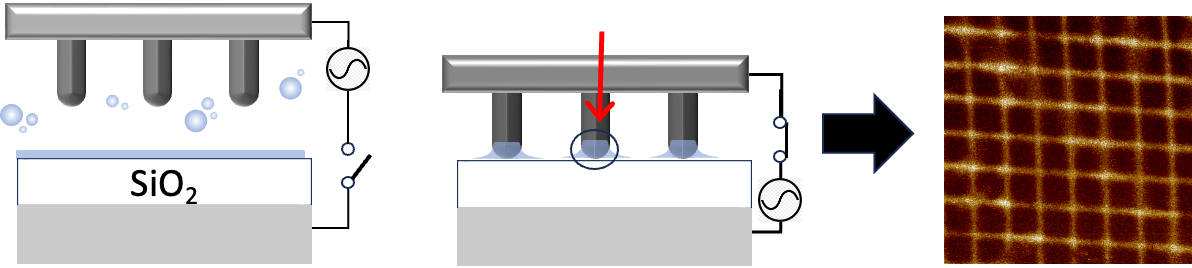
In this study, EFEN was adapted for parallel processing to enable large-area patterning. Instead of an AFM probe, a conductive stamp composed of parallel lines was used. Under high-humidity conditions (~95% RH), a nanometric water meniscus naturally forms between the stamp protrusions and the SiO2 surface, creating a confined nano-electrochemical cell. When an AC bias is applied through the conductive stamp, localised electrochemical reactions occur only beneath the protrusions, reproducing the stamp geometry on the substrate. Beyond spatial control, EFEN allows fine-tuning of local effects by adjusting the applied bias, process duration, or repeating the treatment in targeted regions. Figure 1 shows the scheme of the process.
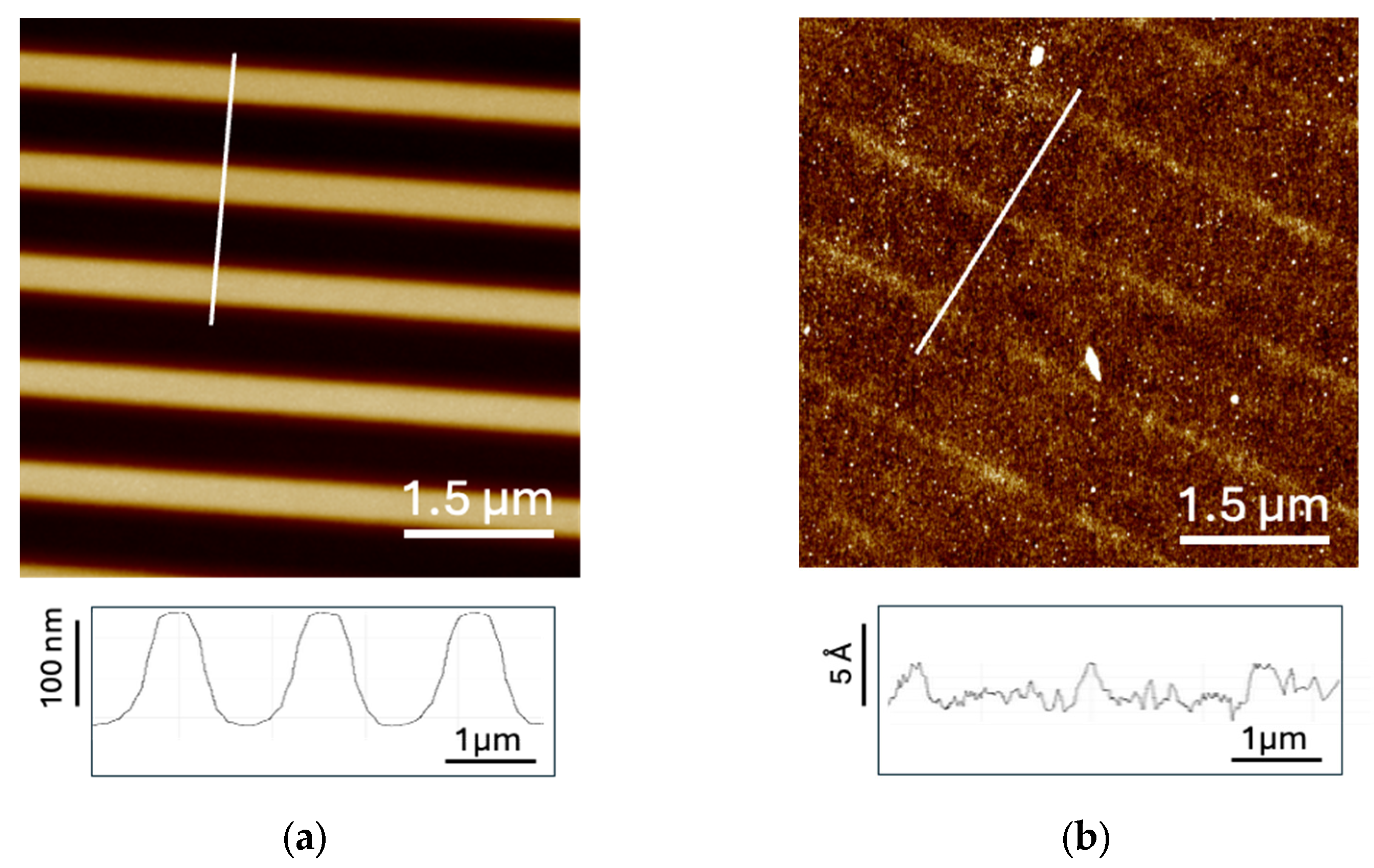
To demonstrate EFEN’s effectiveness for electret fabrication, experiments were conducted on thermally grown SiO₂ films deposited on highly doped silicon substrates, commonly used in organic electronics. SiO₂ is a well-known electret material. The treatment involved applying an AC bias of 15 V at 50 kHz for varying durations under 95% relative humidity. The stamp used was a polymer replica of a blank compact disc coated with a 100 nm gold layer (Figure 2a). The stamp consisted of parallel lines with a thickness of 220 nm and a spacing of 1.5 µm.
For short treatments (<1 hour), EFEN leaves the SiO₂ morphology essentially unaltered. Prolonged exposure (> 1 hour) induces only minor roughness changes (RMS < 0.2 nm), within the range of instrumental uncertainty.
To assess the impact of EFEN on the electronic properties of SiO₂, we used Electric Force Microscopy (EFM) and Kelvin Probe Force Microscopy (KPFM).

2.2. Electric Force Microscopy

EFM is highly sensitive to nanoscale variations in surface charge distribution, whereas KPFM maps surface potential (SP), providing insight into changes in work function and local charge states.
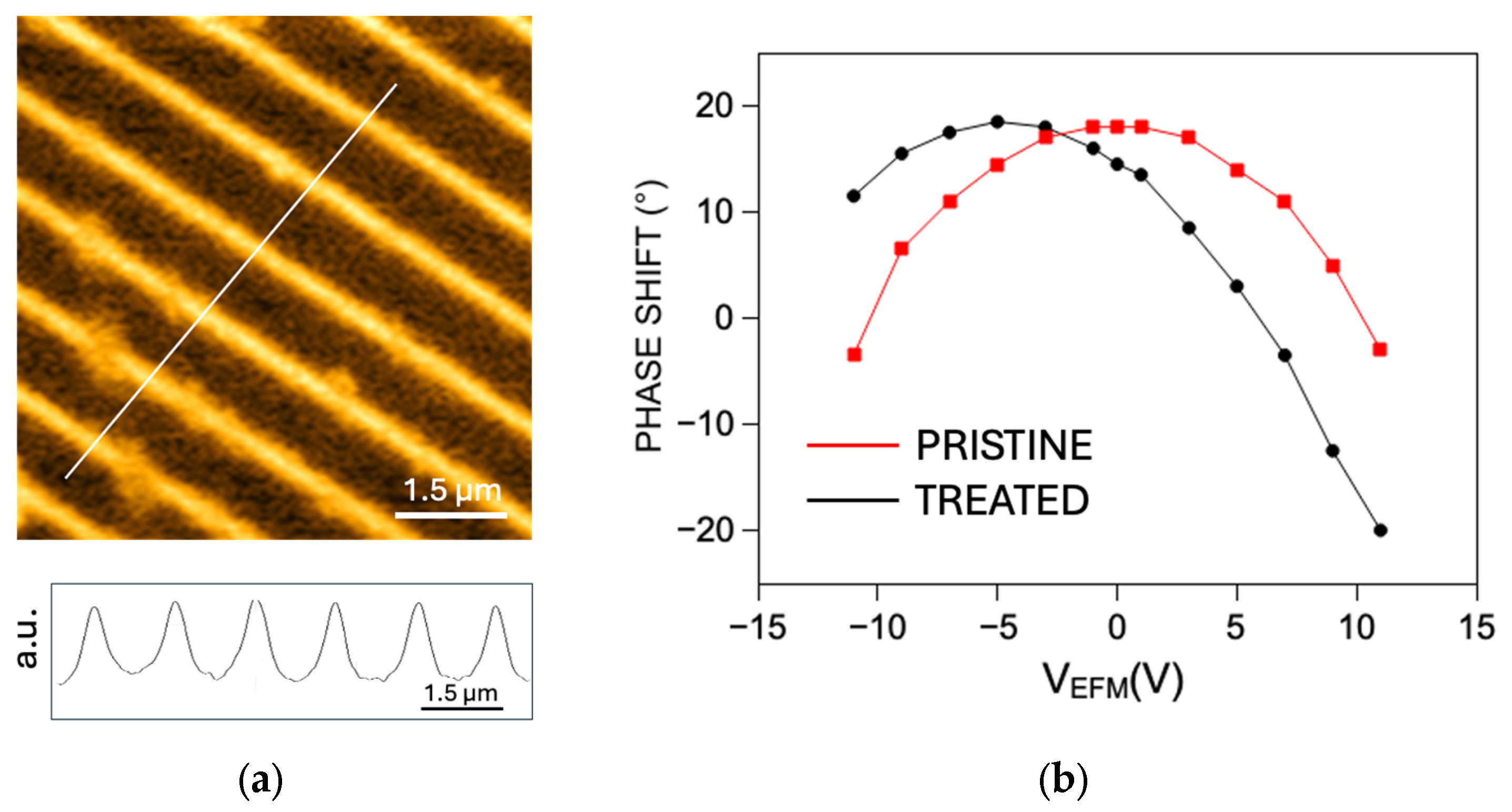
EFM operates in a two-pass mode, detecting electrostatic forces between the oscillating probe and the sample [24]. These forces generate a gradient that induces a phase shift in the cantilever oscillation. For small oscillation amplitudes, the interaction can be decomposed into capacitive forces (quadratically dependent on the applied EFM voltage, (VEFM) and Coulombic forces, linearly dependent on VEFM due to static charges or multipoles on the surface [28]:
ϕ   F 1 2 C s t V E F M 2 + E s C s t V E F M
where Δϕ is the Phase shift, F’ is Force gradient C’s-t and C’’s-t are the first and second derivative capacitances with respect to the tip–sample distance, respectively and ES is Electric field caused by static charge.
Although EFEN did not produce significant morphological changes, EFM imaging revealed clear contrasts replicating the stamp pattern. Figure 3a shows a representative EFM phase image of a patterned SiO₂ film. Voltage-dependent EFM measurements (Figure 3b) reveal that pristine SiO₂ responds with a purely quadratic phase–bias dependence, characteristic of neutral dielectrics. In contrast, EFEN-treated regions show a pronounced linear component and a negative shift of the phase maximum, demonstrating the presence of trapped negative charges.

2.2. Kelvin Probe Force Microscopy

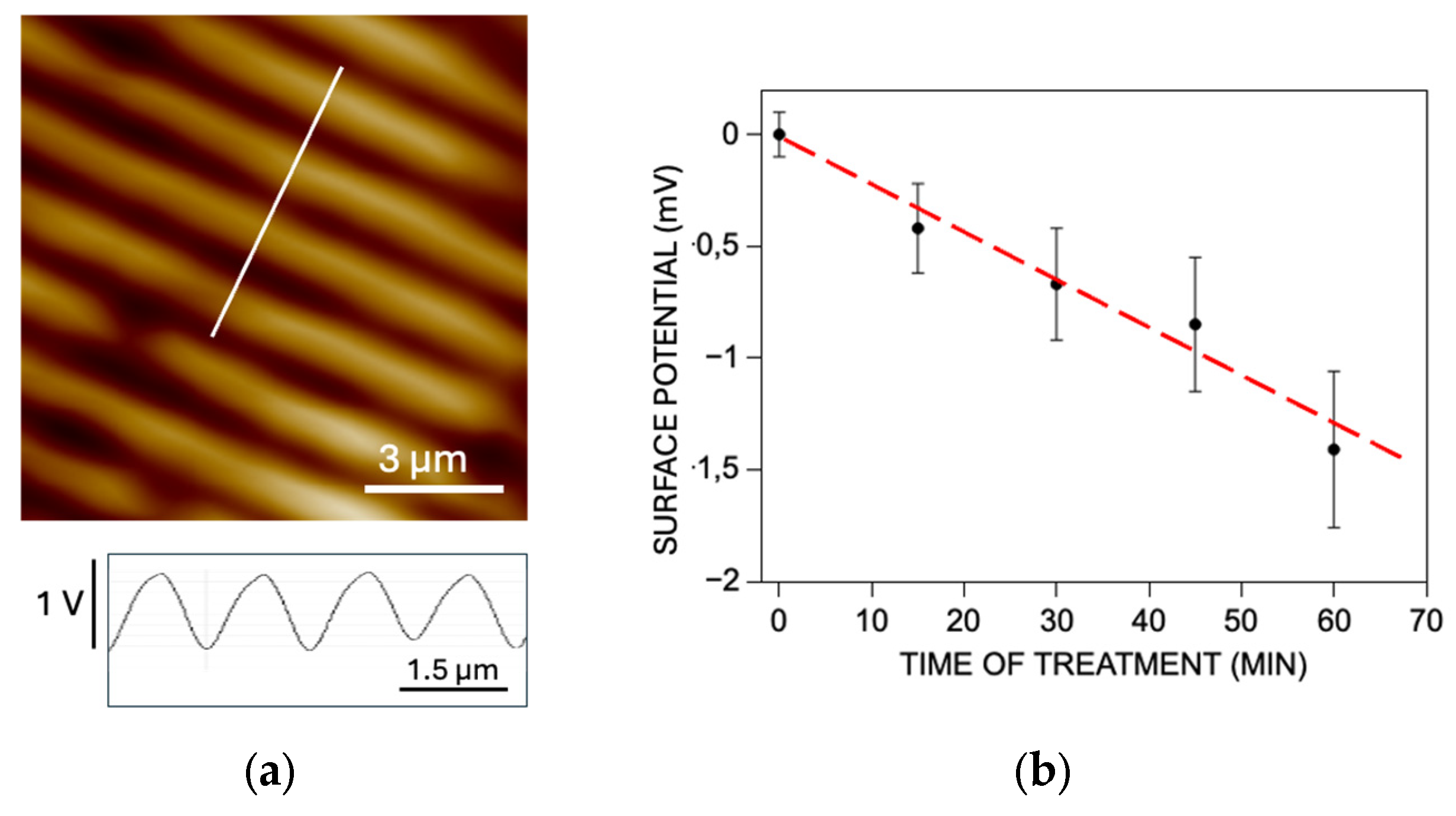
KPFM measurements further demonstrated a decrease in surface potential (SP) within patterned regions (Figure 4a). The SP contrast increases approximately linearly with treatment duration up to 60 min up to -1.7 V (Figure 4b), beyond which local film degradation or increased roughness affect measurement accuracy. The trapped charge density (σ) was estimated using a parallel-plate capacitor model:
Δ S P = σ h e f f ε 0 ε r
where: ΔSP is the surface potential contrast, heff is the effective dielectric thickness of the SiO2 layer (~200 nm), and εr ≈ 3 is its relative permittivity. Using these parameters, extended EFEN treatments yield surface-change densities up to σ ≈ 300 nC·cm⁻2, fully consistent with reported values for SiO₂-based electrets. This model provides a reliable first-order estimate because the tip radius (≈20 nm) is significantly larger than the patterned features, ensuring that the local electrostatic interaction can be approximated as a macroscopic capacitive geometry.
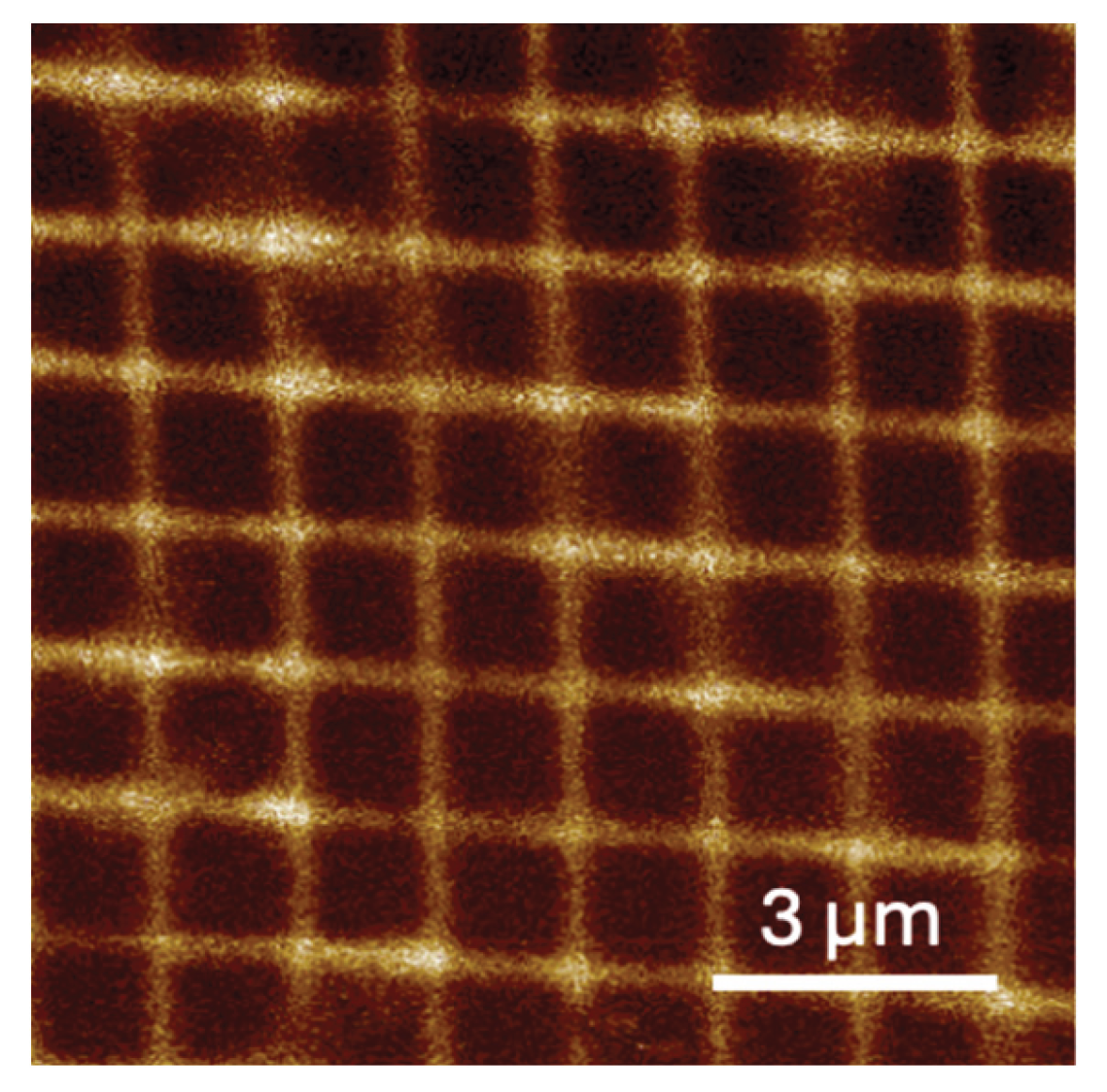
Finally, EFEN processing can be repeated within the same region to increase charge density, expand coverage, or create complex patterns (Figure 5).

4. Conclusions

We demonstrated a parallel implementation of Electrode-Free Electrochemical Nanolithography that can produce patterned electrets over areas up to 1 cm2 using standard laboratory equipment. The method maintains a slightly lower precision than scanning-probe techniques but enables high-throughput processing, which is essential for technological applications. Applied to thermally grown SiO₂, EFEN achieves high-quality charge patterning and chemical surface functionalisation, highlighting its potential for integration in advanced electronic and sensing devices. Because the mechanism relies on capacitive coupling rather than direct electrical contact, the method is compatible with a wide range of inorganic and organic substrates. EFEN therefore offers a versatile and scalable route to engineered electrets and functionalised surfaces.

Funding

This research was funded by European Union–Next Generation EU from the Italian Ministry of University and Research. Project PRIN 2022SRHPF2 ″Molecular assisted atom vacancies arrangement to modulate magnetism in 2D transition metal dichalcogenides″ (MAVAM).

Data Availability Statement

Experimental data are available by reasonable request to the corresponding author.

Conflicts of Interest

The authors declare no conflicts of interest.

References

  1. Liang, F.; Li, H.Y.; Wang, Y.; Kuang, S.Y.; Fan, Y.J.; Wang, Z.L.; Zhu, G. Charge Distribution and Stability of SiO2 Nanoarray Electret. Chemnanomat 2020, 6, 212–217. [Google Scholar] [CrossRef]
  2. Ma, X.L.; Zhao, D.; Xue, M.Q.; Wang, H.; Cao, T.B. Selective Discharge of Electrostatic Charges on Electrets Using a Patterned Hydrogel Stamp. Angew Chem Int Edit 2010, 49, 5537–5540. [Google Scholar] [CrossRef] [PubMed]
  3. Zhang, Y.H.; Zhao, D.; Tan, X.X.; Cao, T.B.; Zhang, X. AFM Force Mapping for Characterizing Patterns of Electrostatic Charges on SiO2 Electrets. Langmuir 2010, 26, 11958–11962. [Google Scholar] [CrossRef] [PubMed]
  4. Melucci, M.; Zambianchi, M.; Favaretto, L.; Palermo, V.; Treossi, E.; Montalti, M.; Bonacchi, S.; Cavallini, M. Multicolor, large-area fluorescence sensing through oligothiophene-self-assembled monolayers. Chem. Commun. 2011, 47, 1689–1691. [Google Scholar] [CrossRef] [PubMed]
  5. Gentili, D.; Sonar, P.; Liscio, F.; Cramer, T.; Ferlauto, L.; Leonardi, F.; Milita, S.; Dodabalapur, A.; Cavallini, M. Logic-gate devices based on printed polymer semiconducting nanostripes. Nano Letters 2013, 13, 3643–3647. [Google Scholar] [CrossRef]
  6. Cavallini, M.; Hemmatian, Z.; Riminucci, A.; Prezioso, M.; Morandi, V.; Murgia, M. Regenerable Resistive Switching in Silicon Oxide Based Nanojunctions. Adv. Mater. 2012, 24, 1197–1201. [Google Scholar] [CrossRef]
  7. Leclere, P.; Surin, M.; Lazzaroni, R.; Kilbinger, A.F.M.; Henze, O.; Jonkheijm, P.; Biscarini, F.; Cavallini, M.; Feast, W.J.; Meijer, E.W.; et al. Surface-controlled self-assembly of chiral sexithiophenes. J. Mater. Chem. 2004, 14, 1959–1963. [Google Scholar] [CrossRef]
  8. Heaviside, O. Electromagnetic induction and its propagation. Electrization and electrification. Natural electrets. The Electrician 1885, 7, 230–231. [Google Scholar]
  9. Gerhard, R.; Ieee. Dielectric materials for electro-active (electret) and/or electro-passive (insulation) applications . 2nd International Conference on Electrical Materials and Power Equipment (ICEMPE), Guangzhou, China, 7–10 April 2019; pp. 91–96. [Google Scholar]
  10. Suzuki, Y. Recent progress in MEMS electret generator for energy harvesting. IEEJ Trans Electr Electron Eng 2011, 6, 101–111. [Google Scholar] [CrossRef]
  11. Kamogashira, T.; Yamasoba, T.; Kikuta, S.; Kondo, K. A Sleep Sensor Made with Electret Condenser Microphones. Clocks & Sleep 2025, 7, 28. [Google Scholar] [CrossRef]
  12. Jacobs, H.O.; Campbell, S.A.; Steward, M.G. Approaching nanoxerography: The use of electrostatic forces to position nanoparticles with 100 nm scale resolution. Adv Mater 2002, 14, 1553–1557. [Google Scholar] [CrossRef]
  13. Zimoch, L.; Schröder, S.; Elzenheimer, E.; Kaps, S.; Strunskus, T.; Faupel, F.; Höft, M.; Adelung, R. Electret integrated magnetic field sensor based on magnetostrictive polymer composite with nT resolution. Sci Rep 2025, 15, 1561. [Google Scholar] [CrossRef] [PubMed]
  14. Yasuda, T.; Komine, R.; Nojiri, R.; Takabe, Y.; Nara, K.; Kaneko, T.; Horigome, S.; Takeda, Y.; Wang, Y.-F.; Kawaguchi, S.; et al. Ultra-Rapidly Responsive Electret-Based Flexible Pressure Sensor via Functional Polymeric Nanoparticle Synthesis. Adv Fun Mater 2024, 34, 2402064. [Google Scholar] [CrossRef]
  15. Hu, L.; Li, X.; Guo, X.Y.; Xu, M.X.; Shi, Y.Q.; Herve, N.B.; Xiang, R.; Zhang, Q. Electret Modulation Strategy to Enhance the Photosensitivity Performance of Two-Dimensional Molybdenum Sulfide. Acs Appl Mater Inter 2023, 15, 59704–59713. [Google Scholar] [CrossRef]
  16. Xu, S.; Guan, X.; Bian, K.; Zhu, Q.; Dai, N.; Zhao, X.; Qiu, Y.; Zheng, S.; Dong, Y.; Zhong, J.; et al. Electret actuators enabling dual functions of optical ranging and audio feedback to elevate non-contact human-machine interactions. Nano Energy 2024, 125, 109553. [Google Scholar] [CrossRef]
  17. Mescheder, U.; Müller, B.; Baborie, S.; Urbanovic, P. Properties of SiO2 electret films charged by ion implantation for MEMS-based energy harvesting systems. J Micromech Microeng 2009, 19, 094003. [Google Scholar] [CrossRef]
  18. Guo, Z.F.; Patil, Y.; Shinohara, A.; Nagura, K.; Yoshida, M.; Nakanishi, T. Organic molecular and polymeric electrets toward soft electronics. Mol Syst Des Eng 2022, 7, 537–552. [Google Scholar] [CrossRef]
  19. Bonilla, R.S.; Wilshaw, P.R. Potassium ions in SiO2: Electrets for silicon surface passivation. J Phys D: Appl Phys 2017, 51, 025101. [Google Scholar] [CrossRef]
  20. Minami, T.; Utsubo, T.; Yamatani, T.; Miyata, T.; Ohbayashi, Y. SiO2 electret thin films prepared by various deposition methods. Thin Solid Films 2003, 426, 47–52. [Google Scholar] [CrossRef]
  21. Juberi, A.M.; Saha, P.C.; Faruqe, O.; Park, C. Partial Discharge Characteristics of SiO₂/Si₃N₄ Electret Incorporated AlN Substrates. IEEE T Transp Electr 2024, 10, 7796–7803. [Google Scholar] [CrossRef]
  22. Kim, Y.J.; Yang, C.H. Electret formation in transition metal oxides by electrochemical amorphization. Npg Asia Mater 2020, 12, 1. [Google Scholar] [CrossRef]
  23. Zahmatkeshsaredorahi, A.; Millan-Solsona, R.; Jakob, D.S.; Collins, L.; Xu, X.G. Kelvin probe force microscopy under ambient conditions. Nat Revi. Methods Primers 2025, 5, 53. [Google Scholar] [CrossRef]
  24. Albonetti, C.; Chiodini, S.; Annibale, P.; Stoliar, P.; Martinez, R.V.; Garcia, R.; Biscarini, F. Quantitative phase-mode electrostatic force microscopy on silicon oxide nanostructures. J Microscopy 2020, 280, 252–269. [Google Scholar] [CrossRef]
  25. Li, H.Y.; Ying, Z.; Lyu, B.S.; Deng, A.L.; Wang, L.L.; Taniguchi, T.; Watanabe, K.; Shi, Z.W. Electrode-Free Anodic Oxidation Nanolithography of Low-Dimensional Materials. Nano Lett 2018, 18, 8011–8015. [Google Scholar] [CrossRef]
  26. Gentili, D.; Calabrese, G.; Lunedei, E.; Borgatti, F.; Mirshokraee, S.A.; Benekou, V.; Tseberlidis, G.; Mezzi, A.; Liscio, F.; Candini, A.; et al. Tuning Electronic and Functional Properties in Defected MoS2 Films by Surface Patterning of Sulphur Atomic Vacancies. Small Methods 2025, 9, 2401486. [Google Scholar] [CrossRef]
  27. Gentili, D.; Chini, E.; Cavallini, M. Generation and Tuning of Semiconductor Electronic and Functional Properties through Electrochemical Patterning. Acc. Mater. Res. 2025, 6, 1094–1104. [Google Scholar] [CrossRef]
  28. Qi, G.C.; Yan, H.; Guan, L.; Yang, Y.L.; Qiu, X.H.; Wang, C.; Li, Y.B.; Jiang, Y.P. Characteristic capacitance in an electric force microscope determined by using sample surface bias effect. J App Phys 2008, 103, 114311-1. [Google Scholar] [CrossRef]
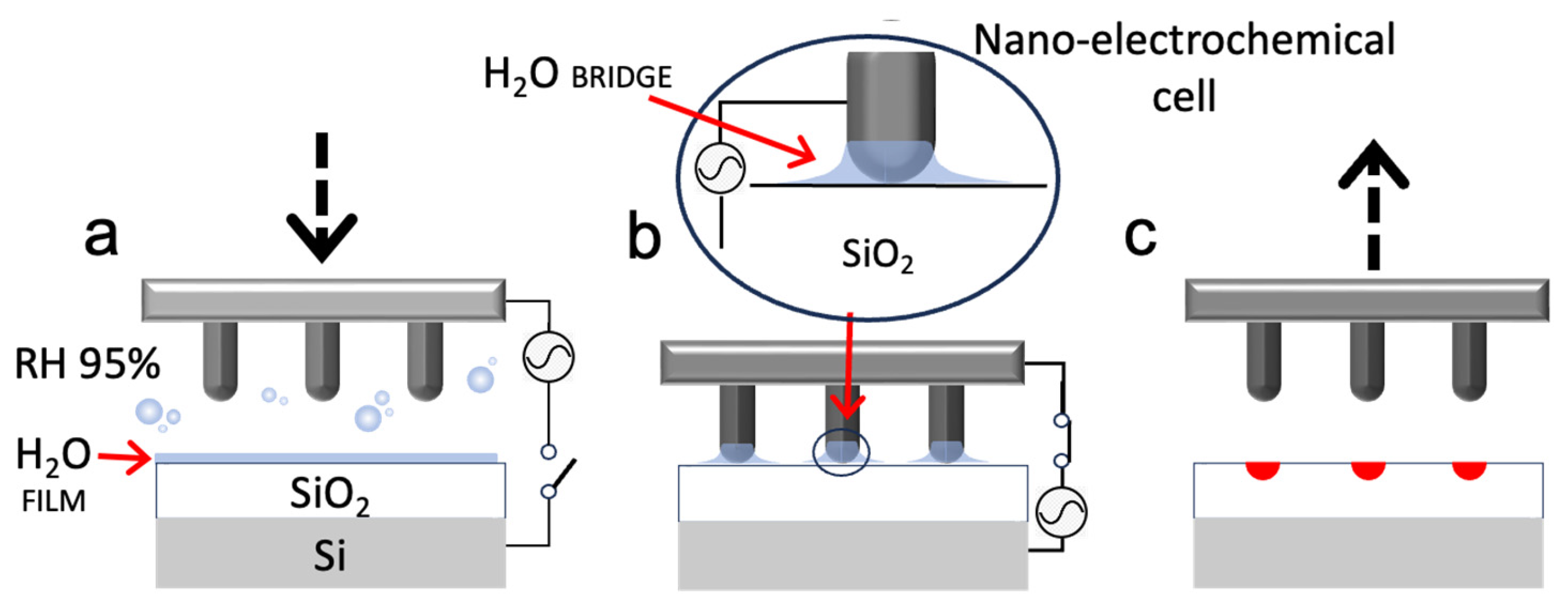
Figure 1. Scheme of electrode-free local electrochemical nanolithography (EFEN). (a) A thin water layer is formed in highly humid conditions (Relative Humidity >95%). (b) Stamp motifs create a meniscus through capillary force upon contact with the surface, forming a two-electrode nano-electrochemical cell. By applying AC bias voltage, electrochemical reactions take place within this nano-cell. (c) The electrochemical reaction occurs exclusively beneath the stamp protrusions, resulting in the patterning of surface structures that replicate the stamp relief features.
Preprints 188894 g001
Figure 2. (a) AFM topographic image of the stamp, and corresponding morphological line profile. (b) AFM topographic image of the SiO2 surface treated by Electrode-Free Electrochemical Nanolithography (EFEN) for 1 hour, and corresponding morphological line profile.
Preprints 188894 g002
Figure 3. (a) Electric Force Microscopy (phase shift) image of the SiO2 surface after 30 minutes of Electrode-Free Electrochemical Nanolithography treatment, along with its line profile. (b) Voltage-dependent EFM measurements comparing a pristine sample (red curve) and an EFEN-treated sample (30-minute treatment).
Preprints 188894 g003
Figure 4. (a) Surface potential map of the SiO2 surface after 30 minutes of treatment using Electrode-Free Electrochemical Nanolithography, along with the corresponding line profile. (b) Changes in surface potential over time for different durations of EFEN treatments.
Preprints 188894 g004
Figure 5. Electric Force Microscopy (phase shift) image of the SiO2 surface after 30 minutes of Electrode-Free Electrochemical Nanolithography treatment. The sample was obtained by rotating the sample 90° after the first process application.
Preprints 188894 g005
Disclaimer/Publisher’s Note: The statements, opinions and data contained in all publications are solely those of the individual author(s) and contributor(s) and not of MDPI and/or the editor(s). MDPI and/or the editor(s) disclaim responsibility for any injury to people or property resulting from any ideas, methods, instructions or products referred to in the content.
Copyright: This open access article is published under a Creative Commons CC BY 4.0 license, which permit the free download, distribution, and reuse, provided that the author and preprint are cited in any reuse.
Prerpints.org logo

Preprints.org is a free preprint server supported by MDPI in Basel, Switzerland.

Subscribe

Disclaimer

Terms of Use

Privacy Policy

Privacy Settings

© 2025 MDPI (Basel, Switzerland) unless otherwise stated