

Submitted:
17 December 2025
Posted:
18 December 2025
You are already at the latest version
Abstract
Background Generative AI (genAI) has the capacity to create realistic and convincing animal videos, however, it must simplify and reduce behavioural variation to do so, possibly leading to misinformation. Methods We categorised 29 videos in the press release for a specific video genAI engine. Twelve featured animals. We mapped each video to the Five Domains and categorised behaviour and welfare within. Results Negative welfare was rarely seen, ranging from 8% (n = 1) for Nutrition, to 42% (n =5) for Behavioural Interactions. By contrast, Mental State, Environment, and Behavioural Interactions appeared positive in >42% (n = 5) of the videos featured. However, videos were often misleading or did not represent accurate animal behaviour. Limitations This work was limited to a press-release of data and does not explore user experience. Conclusions GenAI videos pose a new route for client confusion and veterinarians need to incorporate genAI misinformation combatting in their practice.
Keywords:
animal behaviour and welfare
; veterinary consult
; human-non human animal relationship
; generativeAI
Introduction
"Hey Fido, shall we go for a _?"
What is the next word in this sentence? You may guess "walk", Fido is an archetypical dog’s name, and dogs like to walk. You may suggest "run", if you're a more energetic person, or "hike", but even words like "bath" or "parambulation" fit. Your prediction forms from your experience with both human conversation in general, and the implied contextual clues.
In a nutshell, this is how Generative Artificial Intelligence (genAI) works. It uses context clues to ‘guess’ the next event in a sequence based on its previous training data [1]. GenAI is the catch-all term for a series of complex computer models which include Large Language Models (LLM). They appear to respond to queries like a human intelligence, contextually adjusting their responses [2], can appear to reason temporally, mathematically, and inferentially; but crucially they cannot abstractly reason, and often hallucinate facts, such as making up references in a scientific paper [3].
GenAI has a number of implications for veterinary practice. In human medicine, we see genAI being utilised by patients and clinicians looking for advice, diagnoses, and treatment plans [4], although there may be accuracy issues with all three [5]. Clinicians will already be aware of the inherent challenges with ‘Vet Google’ influencing the average consult [6,7]. However, genAI has unique new capabilities which pose a unique challenge to the veterinary profession, thanks to a peculiar quirk of internet culture and technical capability. GenAI can now produce video content quickly and easily, and this commonly features animals. The internet is being flooded with animal videos where there are no actual animals involved, posing threats to conservation and welfare [8].
This has a surprisingly outsized impact on the veterinary profession. First, it is important to understand a principal of genAI operation. Many people are aware that the training data for genAI can be biased [9], creating inaccuracies in responses, but GenAI fundamentally simplifies and ‘loses’ information when it responds to a prompt [1]. When asked to generate something that it is common and typical, such a dog walking up to a person and inviting it to play, it will do so very well. However, if asked to generate a video of a lion doing the same thing, it may rely on data it knows better, generating a lion with dog like behaviour. It knows that Fido goes for a walk, but might not know that Fido also needs a bath.
Previously, genAI videos required considerable resources and skills, often falling into the "deep fake" category where, for example, a celebrity's head is pasted onto an existing body. However, genAI is becoming more and more capable of creating moving images and associated sound from simple text prompts. In late 2025, openAI announced Sora2 [10], which produces short videos based off of text prompts. AI videos have started to flood short form video social media, and some platforms, such as Meta, are creating platforms to specifically generate and view AI videos [11]
The veterinary industry needs to stay abreast of these technological developments and understand their impact on practice. In this short communication, we evaluate the AI generated videos in the Sora2 press release using the Five Domains Model [12] to explore whether these AI videos can present positive or negative welfare situations, and discuss the potential impacts on clients and veterinary practice.
Methods
Ethical Review
This project received a favourable opinion from the R(D)SVS Human Ethical Review Committee (Ref: 2025_141).
Data Collection
We reviewed the press release for the Sora2 generative video AI released by OpenAI at two time points, 16th October 2025 for text, and 9th November 2025 for videos. We found no discrepancies between the content in those two time points. All videos were reviewed by both JM and LC and classed as ‘Containing Animals’ (yes or no), ‘Realistic’ (All videos are by nature Computer Generated Images, however some are created in an animated style, whether that is ‘anime’, ‘CGI-style’ or similar, whereas others are created in a real-world mimicking style), Format (landscape or vertical format), and then assessed across the Five Welfare Domains [12] to assess whether the animal in that specific video was experiencing positive, neutral, or negative welfare in that domain during the video. We used the ‘tidyverse’ package [13] in R [14] to explore and visualise representation of the Welfare Domains across the videos.
Results
Of the 29 videos included in the Sora2 press release, all were claimed to be generated by Sora2 directly, with accompanying prompts for each one. Twelve (41%) contained animals, 9 (75%) were realistic videos (compared to 70%, n = 12 of non-animal videos being realistic) and 8 (67%) were cinematic format (compared to 82%, n = 14 of non-animal videos being in cinematic format). Across the welfare domains, Nutrition and Health were rarely observed being impacted, whereas Behavioural Interactions were positive in 42% of videos and negative in 42% of videos (Figure 1).
Across the animal-related videos, there were a number of behavioural inaccuracies, or anomalies, which were notable. For example, in ‘triple axle’, a cat rides a figure skater’s head. When the cat is balancing on the person’s head, the tail is in a neutral, even ‘wagging’ state, instead of being stretched out for balance or in a positive affective state that a cat would engage in. In ‘Dalmatian agility’, a Dalmatian dog attempts an agility course and runs through a series of obstacles, literally transposing through a pole, without injury or pause. In ‘Ostrich Ride’, a man rides an ostrich to no ill effect. The video characteristics are described in Table 1 alongside their stated prompt. It should be noted that while some prompts contain information regarding the animal’s affective state, e.g. in Ostrich Ride the ostrich is intended to be ‘bucking’, the Sora2 model often ‘chooses’ to convey positive affective state in environments that would arguably not promote that state, e.g. in ‘Horse on horse’.
Discussion
In this short communication, we have demonstrated that genAI can create animal video content, and that this capability is seen as a feature to be used in marketing materials. Furthermore, genAI videos can represent animals in both positive and negative welfare contexts, although the relationship between how welfare is defined in the prompt and how welfare is depicted in the generation requires further study.
It is possible, even likely, that these videos will start to impact how people consider animal welfare. We know that being presented with positive messaging around sub-optimal welfare conditions, people will soften their objections in an apparent face-saving exercise [15]. There are already concerns regarding how genAI videos will influence consumer thinking around wildlife conservation [8]. While it seems unlikely that many clients will be approaching their veterinarian with questions about how to support their cat’s figure skating ambitions, all veterinarians will be familiar with unusual and alternative requests in consultations [16] and there is an urgent need for support in how to help clients evaluate animal content online.
Furthermore, Pandora’s box has been opened and we cannot recapture genAI content now it exists online. Veterinarians should not consider themselves unable to be fooled by genAI video because of their expert status in animal behaviour and welfare. Selective attention means that at the very least, even obvious stimuli are overlooked in times of cognitive stress [17], and so veterinarians must not consider themselves safe from genAI. Clients are equally likely to be ‘fooled’ into thinking a video is real, and this may well impact their perceptions and expectations of their animals. The Social Media Animal Cruelty Coalition warns against the numbing effect of extensive animal cruelty videos on social media [18], and now there is greater facility for misrepresenting animal experiences. Discrepancies between expectation and reality in pet keeping are a source of conflict in the human-animal bond [19] and we urgently need to better understand how genAI feeds into owner expectations. We also need to recognise, however, that a ‘poisoned well’ exists of animal behaviour content. Previously, citizen science approaches have called for people to record animal behaviour, especially in hard-to-reach contexts such as pet keeping, to better understand animal experience [20]. Now, video content cannot be easily trusted. If clients are directed to the internet to find, for example, videos of crate training, we must now be aware that there may be many inappropriate and unrealistic videos present too.
This is an ever-evolving arena, with many AI detection tools being touted, but it is clear that genAI animal content is now a feature of our day-to-day lives, and will have a range of impacts on veterinary work. There is an urgent need for more research to understand the capabilities and impact of genAI videos on the human-animal relationship, professional development for veterinarians, and client education tools, to support owners to have appropriate and real-world centred expectations of their animals.
Conclusions
The internet is now home to a growing number of animal-related videos generated by ‘Artificial Intelligence’. By their very nature, these videos simplify any behaviours exhibited by these artificial animals, resulting in animals acting in unnatural patterns. In an examination of videos from one AI’s technical demonstration, we found evidence that videos generated by these AI were capable of showing both positive and negative states across the Five Welfare Domains. Clients, and clinicians, may be consciously or unconsciously affected by these videos, and consultations around behaviour and welfare will need to be cognisant of this new form of misinformation and potential for normalising ‘real-life’ animal suffering or abuse.
Funding
The authors received no funding for this work
CREDIT Statement
JRDM: Conceptualization; Data curation; Formal analysis; Investigation; Methodology; Project administration; Resources; Software; Validation; Visualization; Writing – original draft; Writing – review & editing. LC: Conceptualization; Data curation; Formal analysis; Investigation; Methodology; Project administration; Resources; Software; Validation; Writing – original draft; Writing – review & editing
References
- Chiang T. ChatGPT is a blurry JPEG of the web. The New Yorker [Internet]. 2023 Feb 9;Online. Available from: https://www.newyorker.com/tech/annals-of-technology/chatgpt-is-a-blurry-jpeg-of-the-web.
- Uddin M, Arfeen SU, Alanazi F, Hussain S, Mazhar T, Arafatur Rahman M. A Critical Analysis of Generative AI: Challenges, Opportunities, and Future Research Directions. Arch Comput Methods Eng. 2025. [CrossRef]
- Chang Y, Wang X, Wang J, Wu Y, Yang L, Zhu K, et al. A Survey on Evaluation of Large Language Models. ACM Trans Intell Syst Technol. 2024;15(3). [CrossRef]
- Chen A, Liu L, Zhu T. Advancing the democratization of generative artificial intelligence in healthcare: a narrative review. J Hosp Manag Heal Policy. 2024;8:0–3. [CrossRef]
- Gourabathina A, Gerych W, Pan E, Ghassemi M. The Medium is the Message: How Non-Clinical Information Shapes Clinical Decisions in LLMs. ACMF AccT 2025 - Proc 2025 ACM Conf Fairness, Accountability,and Transpar. 2025;1805–28. [CrossRef]
- Springer S, Grimm H, Sandøe P, Lund TB, Kristensen AT, Corr SA. Compete or Cooperate with “Dr. Google”? Small Animal Veterinarians’ Attitudes towards Clients’ Use of Internet Resources - A Comparative Study across Austria, Denmark and the UK. Animals. 2022;12(2117). [CrossRef]
- Springer S, Lund TB, Corr SA, Sandøe P. Does “Dr. Google” improve discussion and decisions in small animal practice? Dog and cat owners use of internet resources to find medical information about their pets in three European countries. Front Vet Sci. 2024;11(June):1–11. [CrossRef]
- Guerrero-Casado J, Murillo-Jiménez T, Carpio AJ, Tortosa FS, Serrano-Rodríguez R. Threats to conservation from artificial-intelligence-generated wildlife images and videos. Conserv Biol. 2025;(June):1–4. [CrossRef]
- Hansen JM, Ferrell OC, Ferrell L, Levin MA, Wilson P, Cloud K. Pandora’s Box Reopened: Can Generative AI Restore Hope or Result in a Decline in the Quest for Academic Integrity. J Macromarketing. 2025. [CrossRef]
- OpenAI. Sora2 Is Here [Internet]. 2025 [cited 2025 Oct 16]. Available from: https://openai.com/index/sora-2/.
- Meta. Introducing Vibes: A New Way to Discover and Create AI Videos [Internet]. Sustainability (Switzerland). 2025 [cited 2025 Nov 25]. Available from: https://about.fb.com/news/2025/09/introducing-vibes-ai-videos/.
- Mellor DJ, Beausoleil NJ, Littlewood KE, McLean AN, McGreevy PD, Jones B, et al. The 2020 five domains model: Including human–animal interactions in assessments of animal welfare. Animals. 2020;10(10):1–24. [CrossRef]
- Wickham H, Averick M, Bryan J, Chang W, D’Agostino McGowan L, Francois R, et al. Welcome to the tidyverse. J Open Source Softw. 2019;4(43):1686. [CrossRef]
- R Core Team. R: A Language and Environment for Statistical Computing [Internet]. Vienna, Austria; 2023. Available from: https://www.r-project.org/.
- Riddle E, MacKay JRD. Social Media Contexts Moderate Perceptions of Animals. Animals. 2020;10(845):16. [CrossRef]
- Parr JM, Remillard RL. Handling alternative dietary requests from pet owners. Vet Clin North Am - Small Anim Pract. 2014;44(4):667–88. [CrossRef]
- Pahor A, Mester RE, Carrillo AA, Ghil E, Reimer JF, Jaeggi SM, et al. UCancellation: A new mobile measure of selective attention and concentration. Behav Res Methods [Internet]. 2022;54(5):2602–17. Available from: . [CrossRef]
- HOME | SMACC [Internet]. [cited 2025 Nov 26]. Available from: https://www.endcrueltyonline.com/.
- Anderson KL, Holland KE, Casey RA, Cooper B, Christley RM. Owner expectations and surprises of dog ownership experiences in the United Kingdom. Front Vet Sci. 2024;11(February). [CrossRef]
- Stewart L, MacLean EL, Ivy D, Woods V, Cohen E, Rodriguez K, et al. Citizen science as a new tool in dog cognition research. PLoS One. 2015;10(9):1–16. [CrossRef]
Figure 1.
Categorisation of the Five Domains across 12 genAI Videos in the Sora2 press release which contained animals
Figure 1.
Categorisation of the Five Domains across 12 genAI Videos in the Sora2 press release which contained animals
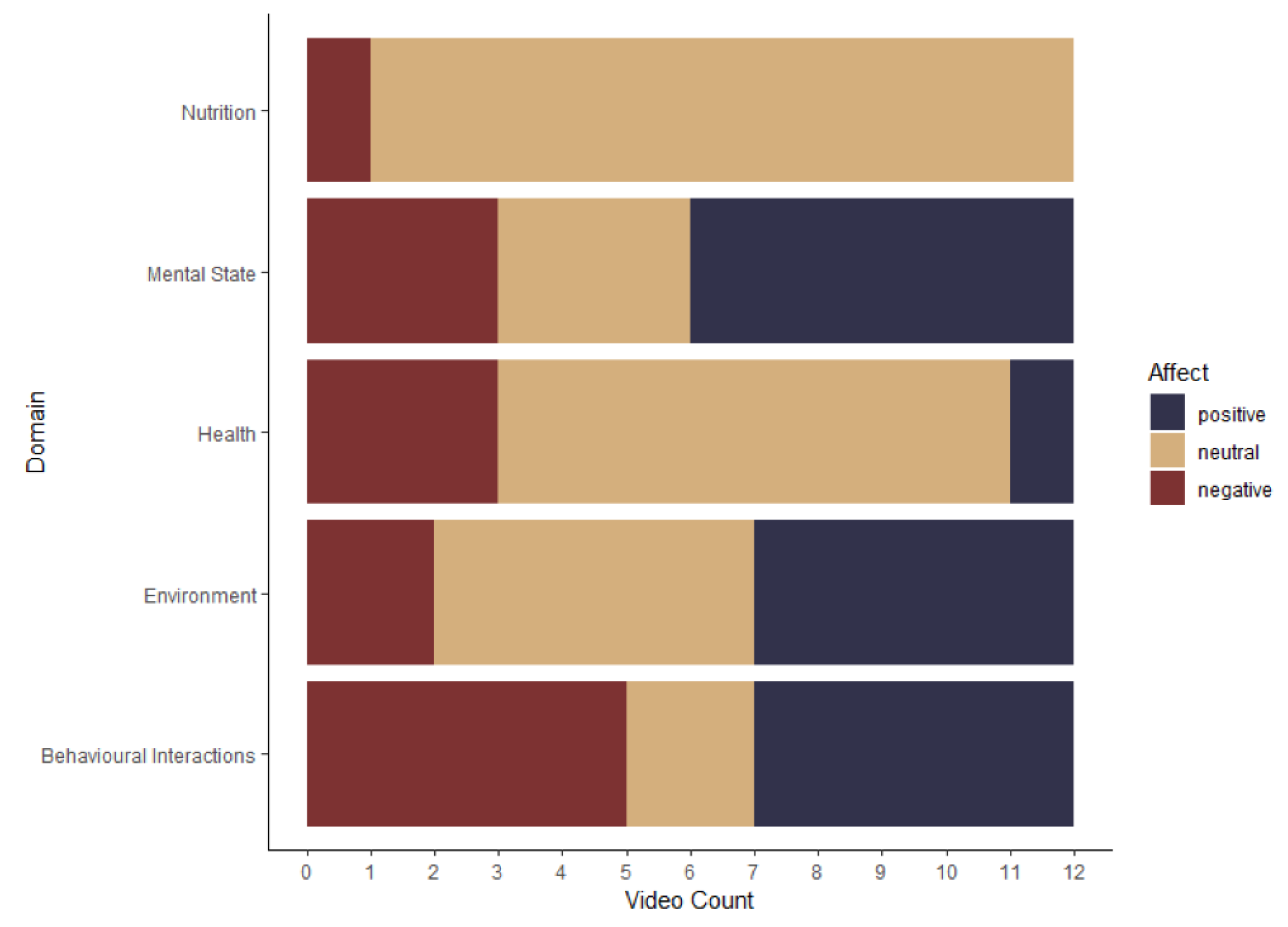

Table 1.
Video characteristics, description, and stated generating prompts of 12 animal-containing generated AI videos from the Sora2 press release.
Table 1.
Video characteristics, description, and stated generating prompts of 12 animal-containing generated AI videos from the Sora2 press release.
| Video ID | Description | Stated Prompt | Realistic Style |
|---|---|---|---|
| Triple axel | An ice skater performs a triple axel with a white cat on her head, the cat leaps off, tail erect, and lands on ice | Prompt: figure skater performs a triple axle with a cat on her head |
yes |
| Two horses | Two horses in Western tack gallop alongside one another, with a rider standing with one foot on each horse. Rider falls and horses show escape behaviours | Prompt: a person is standing on 2 horses with legs spread. make it not slowmo also realistic. the guy fell off pretty hard in the end. single shot | yes |
| Astronaut dog | A golden retriever floats into and around a cartoonish space station, appears to eat Tennis balls. | Prompt: an astronaut golden retriever named Sora levitates around an intergalactic pup-themed space station with a tiny jet back that propels him. gorgeous specular lighting and comets fly through the sky, retro-future astro-themed music plays in the background. light glimmers off the dog's eyes. the dog initially propels towards the space station with the doors opening to let him in. the shot then changes. now inside the space station, many tennis balls are flying around in zero gravity. the dog's astronaut helmet opens up so he can grab one. 35mm film, the intricate details and texturing of the dog's hair are clearly visible and the light of the comets shimmers off the fur | no |
| Horse on horse | A horse in combination Western tack and some form of yoke walks along with a second horse in Western tack standing at ease on top its back. A rider is on top of the second horse. Some tail swishing and ears positioned back | Prompt: a man rides a horse which is on another horse | yes |
| Dalmatian agility | A Dalmatian dog attempts an agility sequence, passes through an agility pole and jumps into a canal before completing a pyramid climb, its hind quarters closely clipping the top of the pyramid. | Prompt: a dalmatian deftly walks runs and hops his way through a complex obstacle course in burano italy | yes |
| Diver | A diver swims with fish in a coral reef | Prompt: underwater scuba diver, sounds of the coral reef | yes |
| Ghibli dog | A animated boy and dog run uphill | Prompt: in the style of a studio ghibli anime, a boy and his dog run up a grassy scenic mountain with gorgeous clouds, overlooking a village in the distant background | no |
| Martial arts | A martial artist practices in a koi pond, koi jump out of the water | Prompt: Martial artist doing a bo-staff kata waist-deep in a koi pond |
yes |
| Superhero dog | A photorealistic looking dog wears a cape and acts as a superhero, rescuing a man from falling. | Prompt: @rocket is a superpowered superhero dog, flying through the sky and saving new york city | no |
| Ostrich | A man standing at the fence of what appears to be an ostrich farm, interacts with an ostrich, who grabs his hat and runs off | Prompt: an ostrich steals dads hat and dad chases after it | yes |
| Ostrich Ride | In a dust pasture, a man rides an ostrich. The ostrich appears unharmed as it trots along | Prompt: @rohan rides a bucking ostrich | yes |
| Zebra | A zebra herd stampedes around man playing trumpet | Prompt: @daniel plays trumpet in the middle of a stampede of zebras | yes |
Disclaimer/Publisher’s Note: The statements, opinions and data contained in all publications are solely those of the individual author(s) and contributor(s) and not of MDPI and/or the editor(s). MDPI and/or the editor(s) disclaim responsibility for any injury to people or property resulting from any ideas, methods, instructions or products referred to in the content. |
© 2025 by the authors. Licensee MDPI, Basel, Switzerland. This article is an open access article distributed under the terms and conditions of the Creative Commons Attribution (CC BY) license (https://creativecommons.org/licenses/by/4.0/).
Copyright: This open access article is published under a Creative Commons CC BY 4.0 license, which permit the free download, distribution, and reuse, provided that the author and preprint are cited in any reuse.


