

Submitted:
19 January 2026
Posted:
21 January 2026
You are already at the latest version
Abstract
We simulate the propagation of a W states through an optical fiber in the presence of mode coupling. We illustrate the propagating quantum state graphically on a group of higher order Poincaré spheres. At the fiber output we show how to recover the input quantum state using the simulated quantum state information displayed on the multiple spheres. The geometry of these states is an SU(N) quantum geometry. Applications include higher dimensional quantum communications, quantum cryptography, and quantum networks, and longer-term quantum optical computing.
Keywords:
qudit propagation
; quantum state
; W state
1. Introduction
Quantum communications and in particular quantum key distribution, QKD, research is of significant worldwide interest. This is occurring due to increased interest in modular quantum computing [1] and in secure communications based on quantum physics, [2,3,4,5]. Quantum technology is mostly based on the processing of qubits [6], the quantum state which has a probability amplitude in being in one of 2 positions, states. Qudits are quantum states that can be detected in one of N states. There are advantages to processing quantum information with qudits rather than qubits, but the added implementation complexity is often not understood. Research on this topic is now an important subject for quantum information technology.
Within quantum communications, the transmission of quantum information using advanced states such as W states and GHZ states [7,8] is of importance and current interest. A key advantage is that one can send more quantum information per photon [9]. In this report we investigate theoretically and through modeling the possibility of transmitting W quantum states through multimode optical fiber. As an application, we consider transmitting a 4-mode spatial – polarization quantum state through fiber in the presence of mode coupling. This is similar to transmitting a polarization - based qubit through single mode fiber, under the presence of mode coupling, but is somewhat more complex. In the single mode case, one recovers the input polarizations states using polarization controllers. Now with system linked stabilized, the qubit can be transmitted and measured. The polarization controllers need to be monitored and adjusted on the order of minutes. In the 4 mode, qudit case, a more complex quantum state results at the fiber output. Using the quantum field distribution, which we display on a group of Higher Order Quantum Spheres, one can coherently combine both the spatial modal and polarization fields to recover the input quantum state.
The technology and the photonic components required for the implementation of higher dimensional quantum communications is currently being helped by advancements in spatial – mode division multiplexing [10] for the purposes of increasing the capacity of classical optical communications. The growth of classical communications continues to at an exceptional rate. But it is now being greatly enhanced by the communications demands resulting from the rapid hardware - commercial implementations of Artificial Intelligence, A I.
Interest in commercial – classical communications using few mode fiber and mode division multiplexing is growing. Current commercial deployments incorporate MIMO [11,12] to deal with the mode coupling that occurs during signal propagation. These systems require significant power to implement the digital system processing and not therefore suitable for quantum communications. Principal Mode transmission, however can be used to overcome the deleterious effects of the mode coupling [13,14,15,16].
Apart from mode division multiplexing and principal mode transmission, higher dimensional quantum communications is of interest in that one can transmit more information [9] and for some quantum networks [17]. So, it is the purpose of this communication to focus on the transmission of a single photon through higher dimensional space, but without mode division multiplexing. The coherent properties of the photon are important as one needs to recover the input photon state to retain the quantum information or if one wants to implement entanglement swapping. Entanglement swapping is of interest for long distance communication [18] and for quantum networks. In the single mode case [18], polarization controllers are used to regain the initial polarization state. This is required to the polarization coupling that occurs in the transmission. In the multimode – higher dimensional situation, we need a similar method to regain the initial quantum state, spatial – polarization mode. By simulating the transmission of a single photon transmitting through a 4 transmission medium. For example, a 2 polarization – 2 spatial mode such as an LP11 mode in an optical fiber. This numerical simulation is independent of the fiber index profile. The profile can be for example a step index or parabolic profile [19] , we are only concerned with the coupling within a modal group, for example the LP11 mode.
In section II, Modal propagation in Optical Fiber, we write the mode coupling propagation equations for a photon transmitting through a 4 mode (2 spatial modes times 2 polarization modes) channel within a fiber. Such modes occur within an LPmn mode of a multimode fiber [19]. In order to track and display the propagation, we propose using a group of Poincaré spheres. [20] We track the propagation along an input sphere and then coupling to other spheres (adjacent modes) as the propagation progresses.
In section III, Mode Coupling, Mode Coherence and Field Recombination at Fiber Output, we show mathematically how to use the calculated or experimentally determined quantum filed information to coherently combine the polarized – modal information to recover the input state. Once this is established, a specific W quantum state can be transmitted and measured at the output.,
In Section IV, Multiple – Higher Order Poincare Spheres and the Geometry of the Quantum State, we discuss the relationship of the higher order Poincare sphere to the geometry of the quantum state and the implications of the SU(N) geometry.
In Section V, Oulook, we discuss the current research status as it relates to the implementation of higher dimensional quantum communications.
2. Modal Propagation in Optical Fiber
Propagation of light in optical fiber is well described by the scaler equation [9] when the index difference between core and clad is, on the order of a few percent. The axial solution is an exponential propagating wave, and the radial and azimuthal components are solutions to the scalar equation [9]
The scalar wave equation can be solved using a Eigen solution method [11]. Here a set of basis functions are used to obtain wave functions which are a superpositions of these basis functions. Typically, Laguerre Gauss functions are used as the basis functions and the solutions are characterized as LP, linearly polarized modes. These solutions are functions of a radial function (µ ) and an azimuthal function (ν). For m not equal to 0, they are also characterized as orbital angular momentum modes. For circular cores, the LPµν modes are separable in their radial, azimuthal and axial components and can be written as:
Spatial – higher dimensional quantum communications [8,12] intends to use these spatial distributions as channels for communication with distance and choosing m = +- 1 and a polarization linear state as +- . So, a W quantum state can be written as
In theory, one can use any LPm,n mode to transmit a W(4) state, but LP(m=+-1, n =1,2,3) are most easily isolated in a fiber (13).
Mode coupling within these LPmn modes is common and expected due to stresses and strains on the fiber due to the deployment process. As an example, the mode coupling components describing this coupling are described by Vassallo for example. [13].
Consider the propagation of the 4 modes within an the LPmn mode described above. The propagation equations are:
In eq 4b, S is a stress optic coefficient, which we use a beat length of 10 meters.
Light propagating and coupling between two polarizations in time can be displayed on a Poincaré sphere (20). Born and Wolf (20) show how to use the amplitude and phase of the two components can be used to plot the light’s position on the sphere as the propagation continues
3. Mode Coupling, Mode Coherence and Field Recombination at Fiber Output
With 4 modes, there are 6 combinations of the fields of i and j. So, we can plot 6 spheres simultaneously as light propagates and then couples among the 4 modes. So, for the 4 modes, we can take 2 modes at a time and plot a sphere for each. So the spheres will be of: (E1,E2; E1,E3; and E1,E4); If we input light into |1,1>, we can plot the propagation trajectory on the sphere, which combines mode |1,1> with |1,-1>. This is the combination of OAM1 and polarization P1 combining with OAM1 with and polarization -1. The light propagates and couples with the parameters of equation 4 under the coupling equations above with a cross coupling birefringence of a meter and an internal birefringence (beat length) of 1 meter between the 2 OAM modes of different polarizations and a beat length of one-half meter between an OAM modes of two different polarizations.
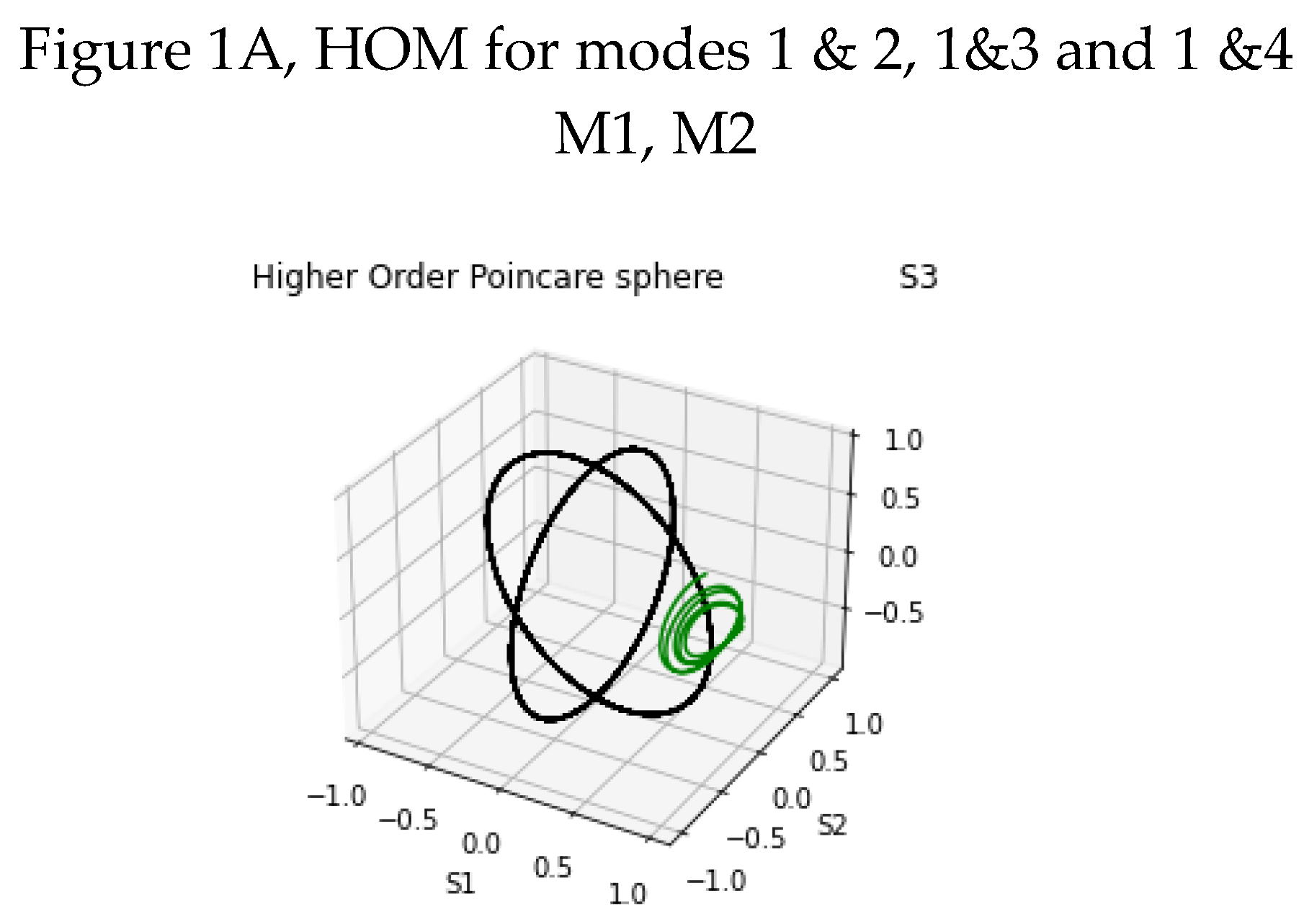
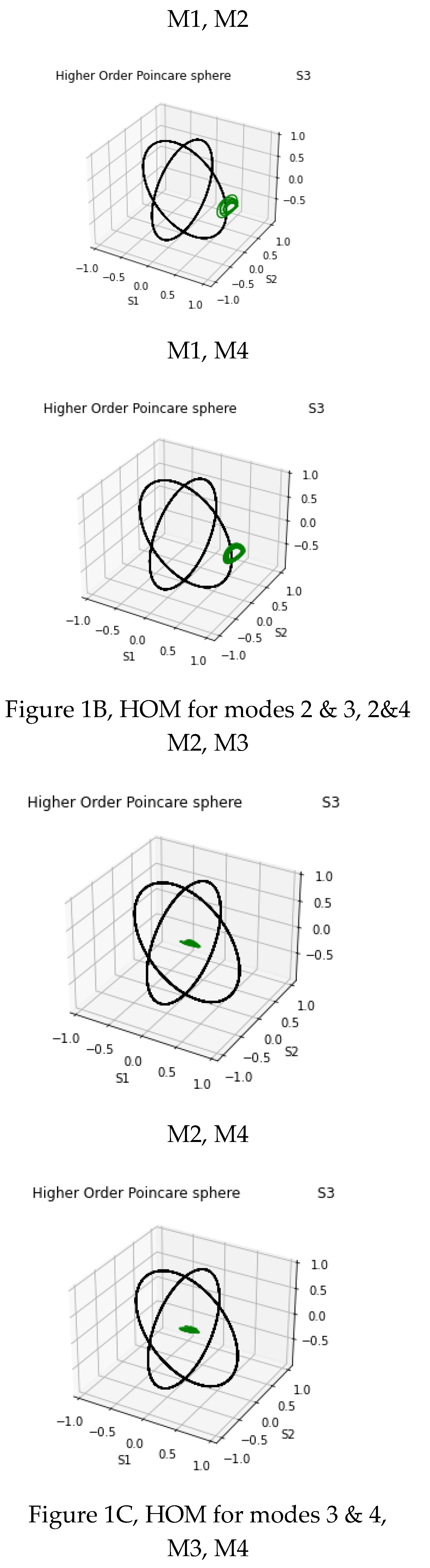
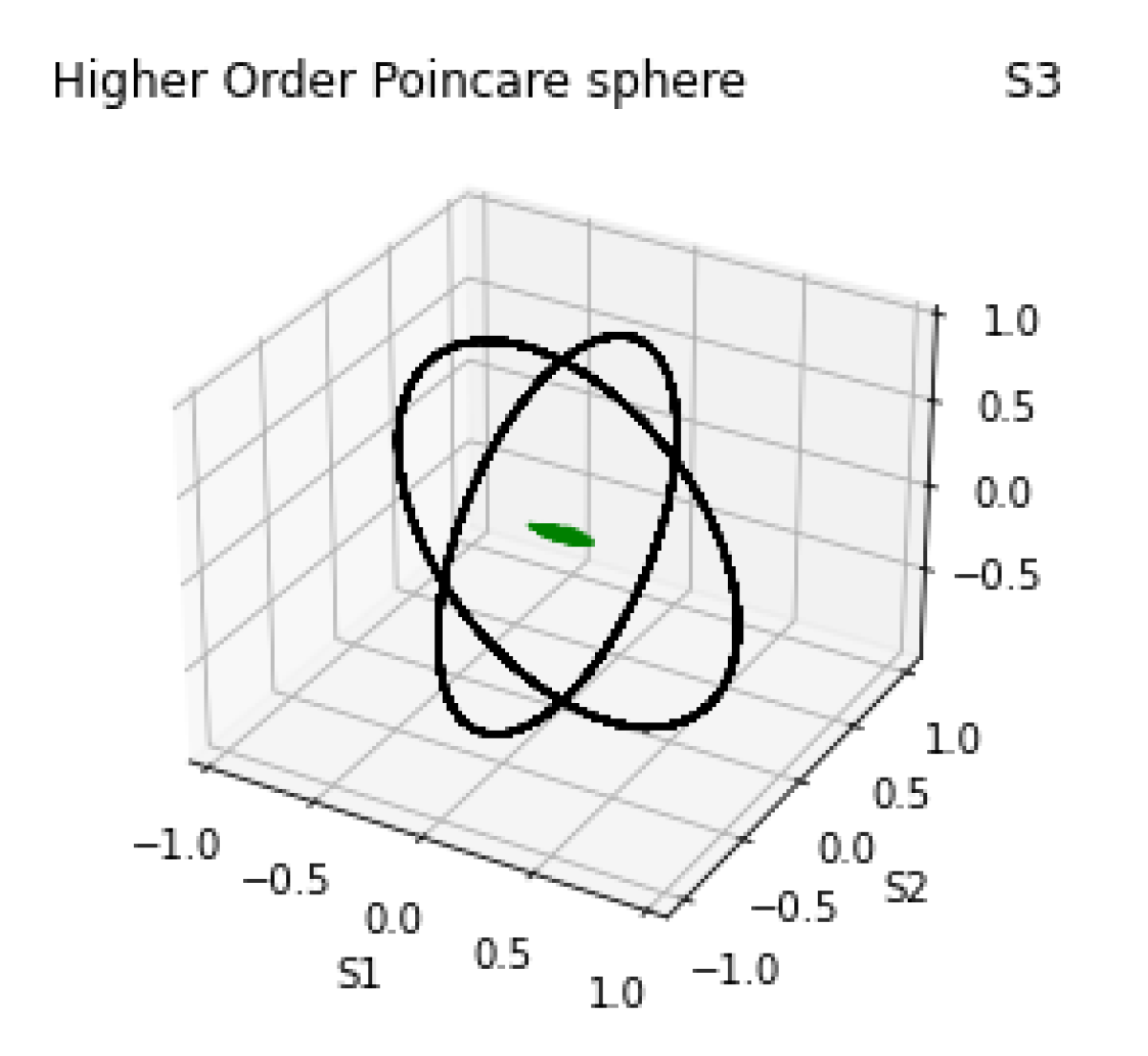
As the light couples from the input OAM mode and a specific polarization, the radius of the sphere is 1, but then as it begins to couple to the other possibilities, the radius of the initial sphere shrinks and other spheres begin to appear and grow in radius. We plot below the 6 spheres below as the light propagates up to 100 meters. We use Python 3 d graphics to plot the spheres, Figure 1. At the output the fiber, the light from each sphere can be coherently combined to a position on a defined sphere. With applications in mind, we discuss below how to combine these fields at the fiber output, enabling one to transfer a W state.
Consider the first 3 spheres above marked, M1, M2: M1, M3; and M1, M4. These spheres display the phase difference between the two fields Mi and Mj, as well as their amplitudes. Amplitudes. Using the spheres in Figure 1A, one can relate the modal fields in M2, M3, and M4 to those of M1. So, M1 can be chosen the reference to which the other fields relate. By rotating the spatial fields to align and or the polarizations to align, one can coherently combine the fields coherently by shifting one field with respect to the other by this phase difference. The phase difference is proportional to S3. The phase at the polar Z axis maximum is π/2. Experimentally, these phase differences can be implemented with for example a Cailabs – C multiple beam phase controller. The polarizations can be rotated with a half wave plate and the fields can be rotated with flat optics for example [21]
4. Multiple – Higher Order Poincare Spheres and the Geometry of the Quantum State,
The W state of equation 3 can be used to transfer a qudit with more information per photon than that of a qubit. As mentioned, we can do this using an LPmn mode in an optical fiber [22,23,24]. Due to mode coupling during propagation, the photon in an initial OAM state and polarization state can have a probability amplitude of being in the other OAM mode and or the other polarization as was shown in the Figure 1. A sphere represents the relative amplitude and phase of 2 electric fields. In the typical Poincaré sphere, this is the relation of 2 polarization, but also in a higher order Poincare sphere, characterizing orbital angular momentum modes [25]. In our case we have spheres combining 2 fields of a propagating OAM mode, which can have field combinations of a spatial field with a polarization and another spatial field with a different polarization.
The photon output therefore has a probability amplitude of being in each of the 4 positions with a specific value. Again, in our situati2 n the 4 positions are composed of 2 polarizations and 2 spatial modes. In single mode optical fiber, the quantum state can be graphically displayed on the Poincare sphere. In higher dimensional quantum communications, the quantum states need to be displayed on a higher dimensional sphere, something we can’t do in a 3 dimensional world. So, we propose to use a group of spheres to display the quantum information. The Poincare sphere is used to display fiber polarization - propagation information in single mode fiber and this is an SU(2) quantum geometry. Any 2 dimensional quantum state can be displayed on this sphere. Also, any quantum state in this situation can be mathematically described as a specific sum of the Pauli matrices, which represents the quantum geometry of these states. Likewise, the geometry of an N dimensional quantum state is an SU(N) geometry [26]. Also, any state in an SU(N) geometry can be mathematically represented as a specific sum of the generalized Gell Mann N2 -1 generators quantified with the generalized Gell Mann matrices. Interestingly using these generators, principal states can be determined enabling the possibility of spatial division multiplexing in the presence of mode coupling [27,28]. This is also the case with single mode fiber where one can polarization multiplex without cross talk using principal states based on polarization and determined using the Pauli spin matrices. These principal states are launched using a combination of polarization modes mathematically described with the Pauli spin matrices [29]. In the case of multimode fiber, mathematically the generalized Gell Mann matrices are used to generate the launch conditions. Again, this is because any quantum state in an N dimensional geometry can be described mathematically using the generalized Gell Mann matrices and then cross talk free states are the principal states, solved with an eigen value matrix. The Gell Mann matrices are important as they relate to determining principal modes, because all states in these systems can be described using these matrices. This is why the principal states can be determining using them.
Most often however, in today’s commercial quantum communication QKD systems, multiplexing is not utilized, and principal states are not required. However, the polarization mode coupling that occurs during transmission, polarization controllers are required to coherently combine the transmitted state to the intended polarization state outcome.
5. Outlook
Quantum communications is in an early state of implementation. Applications are mostly in cryptography, quantum key distribution using single mode optical and point to point systems. Higher dimensional quantum communications is in the earlier research stage. Advantages include the possibility of quantum communicating with more information per photon. Also, higher dimensional quantum communications offer the possibility of using these dimensions to enable new possibilities in network routing [17,30]. Also, new enhanced encryption methods and materials are evolving that can be applicable here [31]. This is expected to be a very fruitful area of research and eventual commercial implementation. In network routing, the routing is based on multiparticle entanglement. Multiple particle entanglement can be based on wavelength, polarization and spatial mode. Longer term, one could expect all three of these possibilities. Quantum memories will also paly a role as the memory will be used to store the photons for entanglement swapping. The number of wavelengths available in a quantum network, will most likely be less than those in a classical network, due to the more complex requirements of these memories. Thus, the need for additional entanglements parameters such as space and polarization. It is also possible to include time as an entanglement parameter, but using time in this way will slow done the network.
References
- Edd Gent, IEEE Spectrum, 27 Feb, 2025.
- Bennett, C. H.; Broussard, G. Quantum Cryptography, Public key distribution and key tossing. Proceeding of IEEE International Conference on Computers, Systems and Signal Processing, 1984; pp. 175–179. [Google Scholar]
- Korzh, B.; et al. Provably secure and practical quantum key distribution over 307 km of optical fiber. arXiv 2014, arXiv:1407.7427v1. [Google Scholar]
- Lo, Hoi-Kwong; Curty, M.; Qi, B. Measurement-Device-Independent Quantum Key Distribution. Phys. Rev. Lett 2012, 108, 130503. [Google Scholar] [CrossRef]
- Boaron; et al. Secure Quantum Key Distribution over 421 km of optical fiber. Phys. Rev. Lett. 2018, 121, 190502. [Google Scholar] [CrossRef]
- Nielsen, M.; Chuang, I. Quantum Computation and Quantum Information; Cambridge, 2000. [Google Scholar]
- Prevedal, R. Experimental All-)ptical One-Way Quantum Computing; Sudwestdeutcher Verlag, 2009. [Google Scholar]
- Cozzolino, D.; et al. High dimensional quantum communications: benefits, progress, and future challenges. Adv. Quantum Technol 2019, 2, 190038. [Google Scholar] [CrossRef]
- Mirhosseini, O; et al. High-D Quantum Technol 2019, 2, 190038 imensional Quantum Cryptography with Twisted Light. New Journal of Physics 2015, 17, 033033. [Google Scholar] [CrossRef]
- Richardson, D.; Fini, J.; Nelson, L. Space Division Multiplexing in Optical Fibers. Nature Photonics 2013, 7, 354. [Google Scholar] [CrossRef]
- Van Uden; Okonkwo, C.; et al. MIMO equalization with adaptive step size for few mode fiber transmission systems. Optics Express 2013, 22, 119–126. [Google Scholar] [CrossRef]
- Karadimitrakis, A., et. al., IWCS 2014 Barcelona, Spain, 2014, pgs 966 – 070.
- Fan, S.; Kahn, M. Principal modes in multimode fiber; VDM publications: Saarbrucken, Germany, 2010. [Google Scholar]
- Carpenter, J.; Benjamin, J.; Eggleton, J. Comparison of principal modes and spatial eigenmodes in multimode fibre. Lasers & Photonics Reviews 2016, 11, 1600259. [Google Scholar]
- Xiong, W. ettermining principal modes in a multimode fiber using the mode dependent signal method, JOSA, B, 32, 143 – 149, 2015.. al., Principal modes in multimode fibers: exploring the crossover from weak to strong mode coupling. arXiv 2016, arXiv:1609.025. [Google Scholar]
- Milione, G.; Nolan, D.; Alfano, R. Determining principal nodes in multimode fiber, using mode delay method. JOSA B 2015, 32, 143–149. [Google Scholar] [CrossRef]
- Gu, X; Chen, L.; Zeilinger, A.; Krenn, M. Quantum experiments and graphs III: high-dimensional and multi-particle entanglement. arXiv 2019, arXiv:1812.095582v2. [Google Scholar]
- Sangouard, N.; Simon, C.; de Riedmatten, H.; Gisin, N. Quantum repeaters based on atomic ensembles and linear optics. arXiv 2009, arXiv:0906.2699v2. [Google Scholar] [CrossRef]
- Black, R.; Gagnon. Optical Waveguide Modes; McGraw Hill, 2010. [Google Scholar]
- Born, M.; Wolf, E. Principal of Optics; Pergamon Press, 1959. [Google Scholar]
- Yao, O; et al. Flat optical rotator enabled by conformal mapping. Laser and photonics news, 12 Nov.
- Meunier, J.; Pigeon, J.; Massot, J. A general approach to the numerical determination of modal propagatioember, 2025. n constants of optical fibers. Opt. Quantum Electron 1981, 13, 71–83. [Google Scholar] [CrossRef]
- Lavery, M.; et al. Refractive elements for the measurements of the orbital angular momentum of a single photon. Opt. Express 2012, 20, 2110–2115. [Google Scholar] [CrossRef]
- Vassallo, C. Optical Waveguide Concepts; Elsevier, 1991. [Google Scholar]
- Ulrich, R.; Simon, A. Polarization optics of twisted single-mode fiber. Appl. Opt. 1979, 18, 2241–2251. [Google Scholar] [CrossRef] [PubMed]
- Milione, M.; Szul, H.; Nolan, D.; Alfano, R. Higher order Poincare sphere and the angular momentum of light. Phys. Rev. Lett 2011, 107, 053601. [Google Scholar] [CrossRef]
- Nolan, D. Higher-Dimensional communications using multimode fibers and compact components to enable a set of communicating channels. Optics 2024, 5, 330–341. [Google Scholar] [CrossRef]
- Nolan, D. Simulating Higher-Dimensional quantum communications using principal modes. Optics 2025, 6, 24. [Google Scholar] [CrossRef]
- Gordon, J.; Kogelnik, H. PMD fundamentals: polarization mode dispersion in optical fibers. ProcNatl. Acad. Sci. USA 2000, 97, 4541–4550. [Google Scholar] [CrossRef]
- Erhard, M.; Mehul, M.; Zeilinger. A quantum router for high-dimensional entanglement. IOP Science Quantum Science and Technology 2017, 2, 014001. [Google Scholar] [CrossRef]
- Lopez –Bastida. Classical encryption demonstration with BB84 protocol – inspired coherent states using reduced graphene oxide. Quantum rep 2025, 3, 35. [Google Scholar] [CrossRef]
Figure 1.
Higher Order Poincare Spheres of the different Mode Combinations.
Disclaimer/Publisher’s Note: The statements, opinions and data contained in all publications are solely those of the individual author(s) and contributor(s) and not of MDPI and/or the editor(s). MDPI and/or the editor(s) disclaim responsibility for any injury to people or property resulting from any ideas, methods, instructions or products referred to in the content. |
© 2026 by the authors. Licensee MDPI, Basel, Switzerland. This article is an open access article distributed under the terms and conditions of the Creative Commons Attribution (CC BY) license (http://creativecommons.org/licenses/by/4.0/).
Copyright: This open access article is published under a Creative Commons CC BY 4.0 license, which permit the free download, distribution, and reuse, provided that the author and preprint are cited in any reuse.


