

Submitted:
15 December 2025
Posted:
17 December 2025
You are already at the latest version
Abstract
Introduction: Nursing educators and clinical leaders face persistent challenges in engaging the next generation of nurses, often characterized by short attention spans, frequent phone use, and underdeveloped communication skills. This article describes the design and delivery of a full-day interactive teaching workshop for nursing faculty, senior clinical nurses, and nurse leaders, developed using a design-thinking approach supported by generative AI.
Methods: The workshop comprised three thematic sessions: (1) Learning styles across generations, (2) Interactive teaching methods, and (3) Application of interactive teaching strategies. Generative AI was used during planning to create icebreakers, discussion prompts, clinical teaching scenarios, and application templates. Design decisions emphasized low-tech, low-prep strategies suitable for spontaneous clinical teaching, thereby reducing barriers to adoption. Activities included emoji-card introductions, quick generational polls, color-paper reflections, portable whiteboard brainstorming, role plays, fishbowl discussions, gallery walks, and movement-based group exercises.
Results: Analysis of 59 participant reflections revealed six interconnected themes, grouped into three categories: engagement and experiential learning, practical applicability and generational awareness, and facilitation, environment, and motivation. Participants emphasized the workshop’s lively pace and hands-on design, noting “It was impossible to fall asleep; we were always talking, sharing, writing, or moving.” Experiencing strategies firsthand built confidence
for application, while generational awareness encouraged reflection on adapting methods for younger learners. The facilitator’s passion, personable approach, and structured use of peer learning created a psychologically safe and motivating climate, leaving participants recharged and inspired to integrate interactive methods.
Discussion: The workshop illustrates how AI-assisted, design-thinking-driven professional development can model effective strategies for next-generation learners. When paired with skilled facilitation, AI-supported planning enhances engagement, fosters reflective practice, and promotes immediate transfer of interactive strategies into diverse teaching settings.
Keywords:
interactive teaching
; generational learning
; nursing education
; generative AI
; professional development
1. Introduction
Engaging the next generation of nurses presents a critical challenge for nursing educators and clinical leaders, as learners today often exhibit shortened attention spans, extensive mobile phone use, and limited interpersonal communication skills (Sancha, 2025). These trends have been associated with decreased sustained attention and memory consolidation, particularly among individuals who frequently engage with short-form digital media, underscoring the need for instructional approaches that sustain situational interest while managing cognitive load (Hart, 2017; Sancha, 2025).
Within today’s nursing classrooms and clinical education settings, multiple generations—Generation X, Millennials (Generation Y), Generation Z, and Alpha —converge, each bringing unique values, technological fluency, and preferred learning modalities (Bliss, 2024; Hart, 2017;
Sancha, 2025; Shatto & Erwin, 2017). Generation Z learners, in particular, are highly connected, visually oriented, and accustomed to rapid access to information, yet they often require structured opportunities to strengthen interpersonal communication and critical thinking (Hampton et al., 2020). Tailoring instruction to meet the learning preferences of these cohorts can bridge generational gaps and promote deeper engagement, relational learning, and professional socialization (Bliss, 2024; Shatto & Erwin, 2017).
In response to these needs, active and collaborative teaching strategies have gained prominence as effective methods to cultivate learner engagement and higher-order reasoning skills.
Approaches such as think–pair–share (TPS), role-playing, and gallery walks provide opportunities for social construction of knowledge, peer feedback, and experiential reflection (Freeman et al., 2014; Guenther & Abbott, 2024; Tan & Perrault, 2025). These learner-centered techniques have repeatedly demonstrated stronger learning outcomes than passive lecture methods, particularly in domains requiring real-time application, empathy, and communication—skills essential to clinical nursing practice.
Concurrently, generative artificial intelligence (AI) is emerging as a promising tool in educational design, capable of accelerating the creation of teaching materials, discussion prompts, and case scenarios tailored to diverse learning contexts (Glauberman, et al., 2023; Simms, 2025). When integrated thoughtfully, AI can augment instructors’ creativity and planning efficiency, supporting rapid prototyping and customization of interactive activities while preserving the relational, human elements central to effective facilitation (Glauberman, et al., 2023; Simms, 2025). Rather than replacing educator expertise, AI serves as a co-designer—enhancing adaptability, creativity, and learner engagement (Vanderlaan et al., 2025; Yee, et al., 2024).
This paper presents the design, execution, and participant outcomes of a full-day interactive teaching workshop for nursing faculty, senior clinical nurses, and nurse leaders. Grounded in design-thinking principles and supported by generative AI during the planning phase, the workshop emphasized low-tech, high-engagement methods—such as emoji introductions, think-share-pair, Socratic questioning, fishbowl observations, role plays, and gallery walks—to foster an inclusive, dynamic, and reflective learning environment. The subsequent sections outline the pedagogical design and methods, report participant feedback and thematic analysis findings, and discuss the implications for nursing and health professions education in the era of AI-enhanced professional learning.
2. Methods
Workshop Objectives
A full-day interactive teaching workshop was conducted for an audience consisted of nursing faculty, senior clinical nurses, and nurse leaders tasked with educating next-generation nurses. The workshop aimed to develop participants’ ability to: (1) recognize generational differences in learning styles, (2) engage in and practice interactive teaching methods, and (3) apply these strategies to their instructional contexts. The curriculum was structured into three sequential sessions: “Learning Styles Across Generations,” “Interactive Teaching Methods,” and “Application of Interactive Strategies.”
Workshop Design
Informed by design thinking and adult learning theory, all activities were intentionally designed to be low-tech and low-preparation to facilitate rapid adoption, particularly in clinical and time-constrained teaching scenarios. Materials included emoji cards for icebreakers, colored papers and hard cardboards for individual reflection, color markers for creative stimulation, portable whiteboards for small-group brainstorming, sticky notes for gallery walk feedback, and small incentives to encourage participation.
The design-thinking process emphasized whole-class interactivity, with frequent short activities every 8 -12 minutes to sustain energy and attention. Activities followed an experiential - reflective cycle, with each exercise linked to participants’ own teaching challenges and followed by structured reflection and group debriefing. Sequencing followed a progressive risk structure, beginning with low-stakes openers to ensure early engagement from all participants and building toward activities requiring public sharing and peer feedback. Visual and tactile engagement was incorporated throughout to enhance memory and stimulate creative thinking. All activities directly addressed the workshop’s central theme of overcoming teaching and learning challenges with next-generation learners.
Pedagogical Underpinnings
The pedagogical design of the workshop was grounded in several complementary learning theories and frameworks that collectively supported its experiential, interactive, and inclusive approach: Kolb’s Experiential Learning Cycle (1984), the Interactive, Constructive, Active, and Passive (ICAP) framework (Chi & Wylie, 2014), Universal Design for Learning (UDL) (CAST, 2018; Meyer, et al., 2014), Keller’s ARCS Model of Motivation (2010), and Cognitive Load Theory (Sweller, 2011; van Merriënboer & Sweller, 2010). These complementary frameworks were integrated through a design-thinking process to support experiential, inclusive, and cognitively efficient learning for busy clinical educators.
Kolb’s Experiential Learning Cycle (1984) provided the overarching structure for the workshop’s flow and sequencing. Each activity followed a cyclical pattern of experience–reflection–conceptualization–application, where participants first engaged in immersive experiences—such as think–pair–share discussions, Socratic questioning, fishbowl discussion, role plays, and gallery walks - followed by individual reflection, small-group debriefing, and collective synthesis. This iterative approach mirrored how nurses learn in practice—through doing, reflecting, and adapting - and reinforced the transferability of interactive strategies to real-world teaching situations.
The ICAP framework (Chi & Wylie, 2014) further guided the design of activities to deepen cognitive engagement. ICAP—an acronym for Interactive, Constructive, Active, and Passive modes of learning—proposes that learning outcomes improve as learners move from passive reception (listening) to active participation (doing), constructive processing (generating new ideas), and interactive co-construction (collaborative meaning-making). Activities were therefore designed to maximize interaction and co-construction of meaning, such as through collaborative generational group discussion polls, brainstorming on portable whiteboards, and role play reflections and group debriefings. These formats required participants to not only share but also build upon one another’s contributions, reinforcing deeper learning and empathy across generational perspectives.
To address the diversity of learners’ preferences and ensure accessibility, Universal Design for Learning (UDL) (CAST, 2018; Meyer, et al., 2014) informed the use of multimodal engagement strategies. Participants interacted with colorful tactile materials—emoji cards, color papers, color markers, and sticky notes—that stimulated visual and kinesthetic learning while encouraging creative expression. Multiple modalities of participation (writing, speaking, moving, observing, and reflecting) provided equitable avenues for engagement regardless of comfort level or communication style.
Sustained motivation was supported through Keller’s ARCS Model (2010), which guided the incorporation of elements that captured Attention (via creative openers and movement-based activities), ensured Relevance (through clinical examples), built Confidence (through scaffolded, low-stakes practice), and fostered Satisfaction (through reflection, peer and instructor feedback, and small participation incentives). This motivational design was particularly critical for participants accustomed to hierarchical or lecture-based teaching models, promoting a psychologically safe and energizing learning climate.
Finally, Cognitive Load Theory (Sweller, 2011; van Merriënboer & Sweller, 2010) informed the chunking of activities into succinct, focused segments to optimize working memory and minimize extraneous demands. The deliberate use of low-tech, low-preparation, and visually supported activities helped maintain attention and reduce cognitive overload- ensuring that participants could focus on interaction and reflection rather than logistics or technology management.
These frameworks were purposefully integrated through a design-thinking lens, emphasizing empathy with learners’ needs, iterative reflection, and user-centered design (Interaction Design Foundation, 2024; Shanks, 2018). Sequencing followed a progressive risk structure, from low-stakes openers to peer discussion, to gradually build trust and engagement. The resulting design fostered a whole-class interactive environment that blended theory-informed pedagogy with practical applicability. Collectively, they provided a coherent pedagogical foundation that balanced motivation, engagement, inclusivity, and cognitive efficiency—ensuring that each element of the workshop contributed to an active, reflective, and transferable learning experience for nursing educators and clinical leaders.
Interactive Teaching Activities
Generative artificial intelligence (AI) tools such as ChatGPT were strategically employed in the planning stages of the workshop to augment instructional creativity and efficiency. AI was used to develop the Emoji Introduction icebreaker, generate prompts for generational discussion, design questions for Think–Pair–Share and Socratic questioning, and draft realistic fishbowl and role-play scenarios situated in clinical teaching contexts. Additionally, AI assisted in creating structured instructions for the Gallery Walk activity and an Application Template to guide participants in designing interactive lessons. The integration of AI in this process substantially accelerated preparation time, broadened the range of pedagogical examples, and ensured contextual alignment with nursing education and clinical teaching environments (Glauberman , et al, 2023; Guenther & Abbott, 2024; Tan & Perrault, 2025). Used as a generative partner rather than a replacement for instructor expertise, AI supported design thinking by enabling iterative idea generation and customization while preserving the human relational and reflective elements essential to effective facilitation (Holmes et al., 2019; Glauberman, et al, 2023; Simms, 2025).
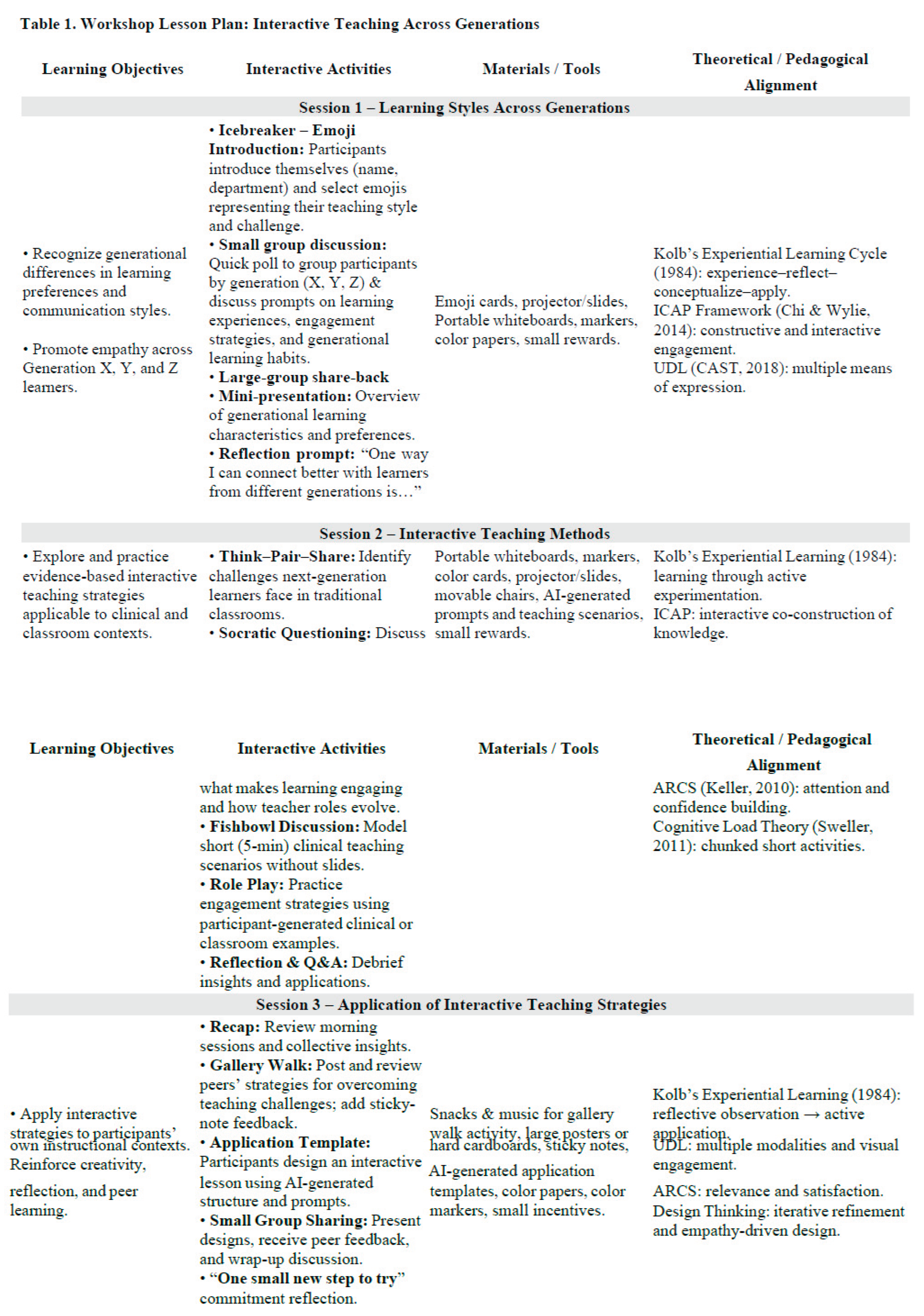
Session 1, Learning Styles Across Generations, opened with the Emoji Introduction and a quick generational poll (X, Y, Z), designed to establish psychological safety and early engagement through humor and self-expression. Participants discussed prompts addressing how they were taught growing up, what helps them stay engaged when learning something new, and one learning habit characteristic of their generation. These small-group dialogues, followed by large-group share-backs and individual reflections, fostered cross-generational empathy and set the stage for recognizing diverse learner preferences (Shatto & Erwin, 2017; Bliss, 2024).
Session 2, Interactive Teaching Methods, guided participants through a series of progressively complex active-learning techniques. Think–Pair–Share and Socratic questioning encouraged critical reflection on challenges faced by next-generation learners and effective engagement approaches. Participants then experienced fishbowl discussions and role plays simulating brief clinical teaching encounters without slides, promoting spontaneous interaction and immediate peer feedback. Each activity was followed by structured debriefing to support reflective learning, consistent with Kolb’s (1984) experiential learning cycle and Chi and Wylie’s (2014) ICAP model emphasizing interactive and constructive engagement.
Following a lunch break, Session 3, Application of Interactive Teaching Strategies, began with a synthesis discussion revisiting morning takeaway. Participants then engaged in a Gallery Walk, posting draft teaching strategies addressing common instructional challenges and offering sticky-note feedback to peers. The visual, movement-based structure re-energized the group, stimulated idea exchange, and reinforced collaborative learning (Freeman et al., 2014; Tan & Perrault, 2025). The concluding Application Template activity guided participants in developing an interactive lesson plan tailored to their own teaching context. Small group sharing and collective reflection concluded the day, with each participant identifying “one small new step to try” to promote post-workshop transfer.
A detailed outline of the three-session workshop is presented in Table 1, which maps each phase to its corresponding learning objectives, theoretical rationale, and interactive techniques.
3. Results
Participant responses and facilitator observations indicated that the full-day interactive teaching workshop achieved high levels of engagement, relevance, and perceived value. Engagement was consistently strong throughout the morning and afternoon sessions. The warm, low-stakes openers, such as emoji introductions and generational quick polls, effectively involved all participants early and set the tone for active participation. Facilitator observations noted visible increases in energy during movement-based activities, including rotating small-group discussions, portable whiteboard brainstorming, fishbowl observations, role play, and the gallery walk. The use of colorful, tactile materials such as hard cardboards, markers, and sticky notes contributed to a playful yet professional atmosphere that sustained attention and stimulated creativity. One participant summarized the experience succinctly: “It was impossible to fall asleep; we were always talking, sharing, writing, or moving.”
Thematic analysis of 59 mid- and end-workshop reflections revealed six interconnected themes, which can be organized into three overarching categories: (1) engagement and experiential learning, (2) practical applicability and generational awareness, and (3) facilitation, environment, and motivation (Table 2).
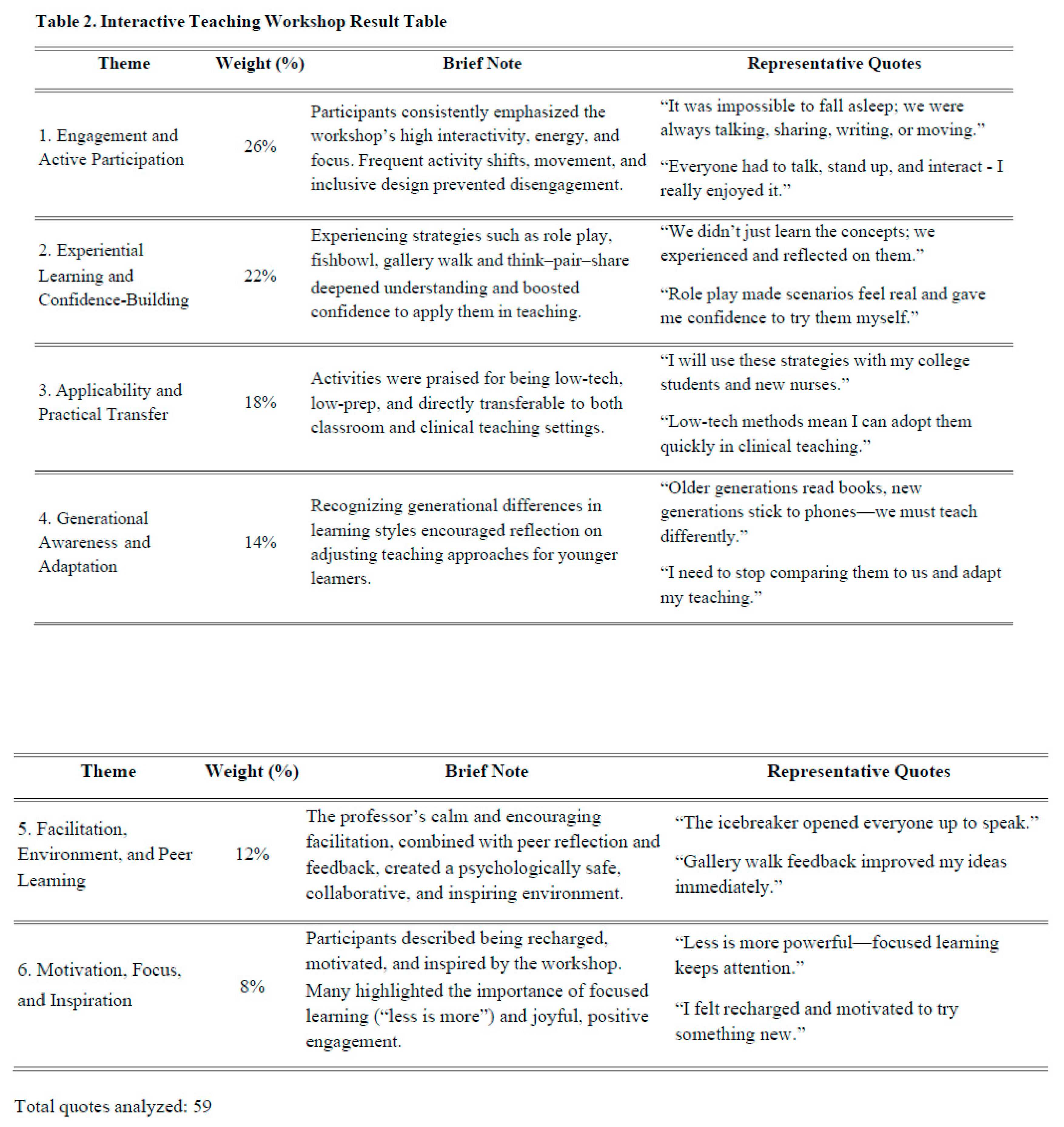
The first category, engagement and experiential learning, emerged as the most salient. Participants consistently valued the experiential nature of the workshop, noting that directly practicing strategies such as role play, fishbowl discussions, think–pair–share, and gallery walks deepened understanding and built confidence for application. As one participant explained, “We didn’t just learn the concepts; we experienced and reflected on them, which gave me confidence to try them myself.” Another elaborated, “Everyone had to talk, stand up, and interact - I really enjoyed it.”
The second category, practical applicability and generational awareness, highlighted the perceived transferability of workshop strategies to both classroom and clinical contexts.
Participants emphasized that the activities were low-tech, low-prep, and therefore realistic to implement in time-constrained teaching environments. One participant observed, “Low-tech methods mean I can adopt them quickly in clinical teaching.” Reflections also revealed heightened awareness of generational differences, prompting reconsideration of teaching approaches for younger learners. As one participant stated, “Older generations read books, but new generations stick to phones—we must use different teaching methods.” Another reflected, “I need to stop comparing them to us and adapt my teaching.”
The third category, facilitation, environment, and motivation, underscored the importance of the instructor’s role and the broader learning climate. The professor’s calm demeanor, passion for teaching, and personable approach created a psychologically safe environment where all participants felt encouraged to contribute. One participant shared, “The icebreaker opened everyone up to speak.” Peer-to-peer exchange was also highlighted as impactful, with one participant noting, “Gallery walk feedback improved my ideas immediately.” Finally, the workshop was consistently described as motivating and energizing. Several participants highlighted the principle that “less is more powerful,” emphasizing that focused, concise activities held their attention better than information-heavy lectures. Others described the day as “recharging” and “reigniting their passion for teaching.”
In sum, the findings suggest that the combination of design-thinking principles, AI-assisted planning, and skilled, passionate facilitation produced a highly engaging, practical, and motivating professional development experience. The workshop not only provided participants with transferable strategies but also cultivated renewed confidence and commitment to applying interactive teaching methods in their own practice.
4. Discussion
Findings from this study demonstrate the effectiveness of integrating interactive, design-informed pedagogy with AI-assisted planning to address persistent challenges in next-generation nursing education. Participants’ reflections confirmed that experiential and highly engaging strategies—such as think–pair–share, fishbowl discussions, role play, and gallery walks—were particularly effective in sustaining attention, stimulating critical thinking, and fostering confidence in applying interactive teaching methods. These results align with extensive evidence showing that active and collaborative learning enhances engagement and knowledge retention compared with traditional lectures (Freeman et al., 2014; Chi & Wylie, 2014).
Consistently high participation and the quality of participant-generated strategies illustrate the power of the experiential–reflective learning cycle (Kolb, 1984) and the deliberate use of progressive risk sequencing to build confidence and engagement. Low-stakes openers, frequent transitions, and visually stimulating materials sustained motivation, reflecting the motivational and engagement principles of the ARCS model (Keller, 2010) and Universal Design for Learning (UDL) (CAST, 2018; Meyer, et al., 2014). This structure effectively mitigated typical barriers to attention and focus often observed in adult learning, such as post-lunch disengagement or cognitive fatigue (Hart, 2017).
The results also directly address generational learning challenges in nursing education. Next-generation learners—particularly Gen Z and emerging Gen Alpha nurses—often exhibit shorter attention spans, multitasking behaviors, and reduced interpersonal communication skills linked to digital immersion (Bliss, 2024; Shatto & Erwin, 2017). Workshop discussions fostered empathy and reflection on how educators might adapt strategies to bridge these generational differences, promoting greater generational awareness and learner-centered adaptation.
A major strength of this workshop model lies in its practicality and adaptability. Participants consistently valued the low-tech, low-preparation design, emphasizing its relevance to fast-paced clinical and academic environments where time and resources are limited. This finding aligns with literature emphasizing flexible, low-resource pedagogies as critical for nursing educators working in dynamic or resource-constrained contexts (Ghasemi et al., 2020).
The facilitator’s role emerged as central to the workshop’s success. The professor’s passion, generosity, and personable approach fostered psychological safety and trust—conditions essential for active participation. This observation reinforces prior research emphasizing that effective facilitation depends not only on pedagogical skill but also on relational authenticity, active listening, and enthusiasm for student learning (Hou, 2021, 2022a, 2022b, 2025; Hou & Chou, 2025; Schön, 1983; van Dyk, et al., 2022). Participants’ comments on the instructor’s calm, encouraging demeanor and skillful orchestration of discussions illustrate how emotional tone and psychological safety enhance learning outcomes.
Finally, the integration of AI-assisted design served as a catalyst for innovation. Generative AI tools were used to create prompts, discussion questions, and structured templates that expanded creative variety and contextual relevance while reducing preparation barriers. This aligns with recent studies identifying AI as a design accelerator that enhances educators’ creativity and efficiency (Labrague et al., 2025; Liu et al., 2025; Vanderlaan et al., 2025; Yee et al., 2024).
Importantly, the benefits of AI were maximized when combined with skilled human facilitation, echoing findings that AI can augment, but never replace, the reflective and relational dimensions of teaching (Holmes et al., 2019; Vanderlaan et al., 2025; Yee et al., 2024). Together, these results highlight the potential of AI-assisted, design-thinking-based workshops to offer scalable, human-centered professional development that bridges technological innovation with authentic connection in nursing education.
Implications, Conclusion, and Future Directions
This study offers a practical and replicable model for faculty and clinical educator development, integrating design-thinking pedagogy, generative AI–assisted planning, and interactive, low-tech teaching strategies. It exemplifies the theme of this special issue—Next-Generation Programming Education: Integrating Generative AI and Collaborative Tools for Cutting-Edge Learning Experiences, by uniting technological innovation with human facilitation.
First, the success of experiential, high-engagement activities reinforce a growing body of evidence that active, learner-centered methods are more effective than passive instruction for promoting reflection, skill transfer, and confidence (Freeman et al., 2014; Kolb, 1984).
Second, generative AI served as a design catalyst, enabling educators to rapidly produce tailored scenarios, prompts, and templates with minimal preparation time. This finding supports emerging perspectives that view instructors as AI-empowered co-designers, leveraging technology to enhance creativity and responsiveness in teaching (El Arab et al., 2025; Vanderlaan et al., 2025; Yee et al., 2024).
Third, the workshop underscored the continued necessity of skilled human facilitation. Participants’ responses affirmed that warmth, enthusiasm, and authentic engagement remain irreplaceable components of effective teaching. This finding aligns with literature describing trust, psychological safety, and emotional connection as key mediators of learning in adult and professional contexts (Hou, 2021, 2022a, 2022b, 2025; Hou & Chou, 2025; Schön, 1983; van Dyk, et al., 2022).
6. Conclusion
This study illustrates a compelling synergy between AI-supported design, interactive pedagogy, and human-centered facilitation. It demonstrates how thoughtfully designed, low-tech, low-prep interactive strategies—when guided by purposeful planning and empathetic facilitation—can sustain engagement, enhance confidence, and promote application in both classroom and clinical teaching contexts. Beyond nursing, this model represents a transferable approach for educator development across health professions and disciplines.
Future research should evaluate long-term impacts on teaching practices and learner outcomes, exploring how AI-augmented professional development influences instructional quality, confidence, and student engagement over time. The combination of experiential reflection, tactile and visual engagement, and AI-assisted design created a workshop environment that was both dynamic and practical. These findings support expanding AI-enhanced, interactive professional development initiatives as an evidence-informed response to the evolving learning needs of next-generation health professionals.
References
- Bliss, J. (2024). Exploring Generational Learning Preferences in Nursing Education: A Comprehensive Study. COJ Nurse Healthcare. 9(1). COJNH. 000702. [CrossRef]
- CAST. (2018). Universal Design for Learning guidelines version 2.2. CAST, Inc. http://udlguidelines.cast.org .
- Chi, M.T.H.; Wylie, R. The ICAP framework: Linking cognitive engagement to active learning outcomes. Educational Psychologist 2014, 49(4), 219–243. [Google Scholar] [CrossRef]
- El Arab, R.; Al Moosa, O.; Abuadas, F.; Somerville, J. The role of AI in nursing education and practice: Umbrella review. Journal of Medical Internet Research 27 2025, e69881. [Google Scholar] [CrossRef] [PubMed]
- Freeman, S.; Eddy, S. L.; McDonough, M.; Smith, M. K.; Okoroafor, N.; Jordt, H.; Wenderoth, M. P. Active learning increases student performance in science, engineering, and mathematics. Proceedings of the National Academy of Sciences 2014, 111(23), 8410–8415. [Google Scholar] [CrossRef] [PubMed]
- Ghasemi, M. R.; Moonaghi, H. K.; Heydari, A. Strategies for sustaining and enhancing nursing students' engagement in academic and clinical settings: a narrative review. Korean journal of medical education 2020, 32(2), 103–117. [Google Scholar] [CrossRef] [PubMed]
- Glauberman, G.; Ito-Fujita, A.; Katz, S.; Callahan, J. Artificial Intelligence in Nursing Education: Opportunities and Challenges. Hawai'i journal of health & social welfare 2023, 82(12), 302–305. [Google Scholar]
- Guenther, AR; Abbott, CM. Think-Pair-Share: Promoting Equitable Participation and In-Depth Discussion. PRiMER 2024, 8, 7. [Google Scholar] [CrossRef] [PubMed] [PubMed Central]
- Hart, S. Today’s learners and educators: Bridging the generational gaps. Teaching and Learning in Nursing 2017, 12(4), 253–257. [Google Scholar] [CrossRef]
- Hampton, D; Welsh, D; Wiggins, AT. Learning Preferences and Engagement Level of Generation Z Nursing Students. Nurse Educ. 2020, 45(3), 160–164. [Google Scholar] [CrossRef] [PubMed]
- Holmes, W., Bialik, M., & Fadel, C. (2019). Artificial intelligence in education: Promises and implications for teaching and learning. Center for Curriculum Redesign.
- Hou, S-I. A mixed methods outcome evaluation on mixed methods research competencies. Int J Teaching and Learning in Higher Education 2025, 35, 20–35. [Google Scholar] [CrossRef]
- Hou, S-I. A mixed methods evaluation on teaching evaluation: Innovative course-based service-learning model on program evaluation competencies. J Scholarship of Teaching and Learning 2022a, 22, 95–112. [Google Scholar] [CrossRef]
- Hou, S-I. Advancing a competency-based mixed methods tool to assess a course-based service-learning model integrating real-world experience. Canadian J Program Evaluation 2022b, 36, 391–407. [Google Scholar] [CrossRef]
- Hou, S.-I. A mixed methods process evaluation of an integrated course design on teaching mixed methods research. International Journal of Scholarship of Teaching and Learning 2021, 15(2), Article 8. [Google Scholar] [CrossRef]
- Hou, S-I; Chou, W-Y. A Mixed Methods Evaluation of a Purposefully Designed Short, Intensive Workshop-Style Course for Teaching Mixed Methods Research in Taiwan. Journal of Healthcare and Nursing Research 2025, 7(3), 175. [Google Scholar]
- Interaction Design Foundation. (2024). The 5 Stages in the Design Thinking Process: Empathise, Define, Ideate, Prototype, Test. https://www.interaction-design.org/literature/article/5-stages-in-the-design-thinkingprocess .
- Keller, J. M. (2010). Motivational design for learning and performance: The ARCS model approach. Springer. [CrossRef]
- Kolb, D. A. (1984). Experiential learning: Experience as the source of learning and development. Prentice-Hall.
- Labrague, L. J., Al Sabei, S., & Al Yahyaei, A. (2025). Artificial intelligence in nursing education: A review of AI-based teaching pedagogies. Teaching and Learning in Nursing. Advance online publication. [CrossRef]
- Liu, J., Wang, L., He, X., Xia, Y., Gong, X., Wu, R., Li, S., & Wang, L. (2025). Leveraging generative artificial intelligence to enhance ICU novice simulation instructors’ case design: A qualitative study. Clinical Simulation in Nursing, 105, 101770. [CrossRef]
- Meyer, A.; Rose, D. H.; Gordon, D. Universal Design for Learning: Theory and practice; CAST Professional Publishing, 2014. [Google Scholar]
- Sancha, A. Understanding Generation Z nursing students and Role of Nursing Faculty and Educators: A Narrative review. International Journal of Medical Research and Review 2025, 13(1), 5–10. Available online: https://ijmrr.medresearch.in/index.php/ijmrr/article/view/1534.
- Schön, D. A. The reflective practitioner: How professionals think in action; Basic Books, 1983. [Google Scholar]
- Shanks, M. (2018). An introduction to design thinking process guide. Stanford University. https://web.stanford.edu/~mshanks/MichaelShanks/files/509554.pdf .
- Shatto, B.; Erwin, K. Teaching Millennials and Generation Z: Bridging the generational divide. Creative Nursing 2017, 23(1), 24–28. [Google Scholar] [CrossRef] [PubMed]
- Simms, R. C. Generative artificial intelligence (AI) literacy in nursing education: A crucial call to action. Nurse education today 2025, 146, 106544. [Google Scholar] [CrossRef] [PubMed]
- Sweller, J. Cognitive load theory. In The psychology of learning and motivation; Mestre, J. P., Ross, B. H., Eds.; Academic Press, 2011; Vol. 55, pp. 37–76. [Google Scholar] [CrossRef]
- Tan, W. A.; Perrault, S. Enhancing student engagement through a gallery walk: applying multiple strategies to communicate scientific concepts. Journal of microbiology & biology education 2025, 26(2), e0020724. [Google Scholar] [CrossRef]
- Vanderlaan, J., Nicholas, L., Leland, N. (2025). Practical Intelligence: Generative AI Toolkit for Nurse Education. 1-137. Las Vegas (Nev.): University of Nevada, Las Vegas. https://oasis.library.unlv.edu/nursing_fac_articles/424.
- van Merriënboer, J. J. G.; Sweller, J. Cognitive load theory in health professional education: Design principles and strategies. Medical Education 2010, 44(1), 85–93. [Google Scholar] [CrossRef]
- van Dyk, EC; van Rensburg, GH; Janse van Rensburg, ES. The educator as facilitator of trust in the nursing education environment. PLoS ONE 2022, 17(8), e0266240. [Google Scholar] [CrossRef] [PubMed]
- Yee, K.; Uttich, L.; Main, E.; Giltner, E. AI Hacks for Educators UCF Created OER Works. 9. 2024. Available online: https://stars.library.ucf.edu/oer/9.
Disclaimer/Publisher’s Note: The statements, opinions and data contained in all publications are solely those of the individual author(s) and contributor(s) and not of MDPI and/or the editor(s). MDPI and/or the editor(s) disclaim responsibility for any injury to people or property resulting from any ideas, methods, instructions or products referred to in the content. |
© 2025 by the authors. Licensee MDPI, Basel, Switzerland. This article is an open access article distributed under the terms and conditions of the Creative Commons Attribution (CC BY) license (http://creativecommons.org/licenses/by/4.0/).
Copyright: This open access article is published under a Creative Commons CC BY 4.0 license, which permit the free download, distribution, and reuse, provided that the author and preprint are cited in any reuse.


