
Preprint
Article

This version is not peer-reviewed.

The Copepod/Artemia Trade-Off in the Culture of Long Snouted Seahorse Hippocampus guttulatus

Submitted:

16 December 2025

Posted:

17 December 2025

You are already at the latest version

Abstract

This study investigated the effects of copepods and copepod conditioning strategies on the growth and survivorship of long-snouted seahorse (Hippocampus guttulatus) juveniles from 1 to 60 days post-parturition (DPP). Four dietary treatments were tested: 24h Isochrysis galbana enriched Artemia (control), freshly collected copepods, 48h unfed copepods, and 24h I. galbana enriched copepods. Juveniles fed any copepod-based diet exhibited significantly higher growth (P < 0.05) and survival than those fed enriched Artemia. Mean standard length increased from 1.3 ± 0.1 cm at release to 5.9 ± 0.2, 7.5 ± 1.4, 7.1 ± 1.2, and 7.3 ± 1.1 cm at 60 DPP for the respective treatments. Wet weight rose from 0.002 ± 1 g to 0.44 ± 0.07, 0.81 ± 0.4, 0.68 ± 0.3, and 0.76 ± 0.4 mg, while final survival reached 20%, 60%, 33.3%, and 56%, respectively. Compared with Artemia, copepods markedly enhanced juvenile performance, supporting faster growth and promoting beneficial behavioral traits which contributed to improved survival. These results demonstrate that copepods as a superior live feed for early juvenile H. guttulatus, but copepod conditioning strategies directly influence their nutritional quality and, consequently, seahorse growth and survivorship. The use of copepods for the first 60 DPP is therefore not only feasible but strongly recommended.

Keywords: 
;  ;  ;  ;  

1. Introduction

Seahorses (Hippocampus spp.) are globally traded marine fishes with considerable commercial value. Dried seahorses are predominantly used in traditional Chinese medicine (TCM) and, to a lesser extent, as curios, whereas live individuals are sold in the ornamental aquarium trade [1]. While the trade in dried seahorses constitutes 98% of the total seahorse trade [2], the aquarium trade can exert the greatest pressure on specific populations [3]. The global annual trade in seahorses and related syngnathid species is estimated at approximately 37 million individuals [4,5,6]. China, including Hong Kong, consumes about 250 tons of seahorses annually for TCM purposes [7], and nearly 80 countries were involved in the trade of seahorses and related taxa between 1996 and 2001 [8,9]. The number of wild-caught seahorse species traded internationally remained relatively stable between 1997 and 2008, while the number of captive-bred species increased between 2002 and 2004, indicating a growing trend in seahorse aquaculture [10]. Despite this, the trade in wild-caught specimens continues to exert significant pressure on native populations and is considered one of the main drivers of population declines in many species [11]. Seahorses possess unique life-history traits, including low fecundity, monogamous mating systems, and prolonged parental care for small broods [12]. These biological characteristics make seahorses particularly vulnerable to overexploitation and environmental disturbances. Consequently, according to the 2025 IUCN Red List of Threatened Species, one species is classified as Critically Endangered, two as Endangered, thirteen as Vulnerable, and two as Near Threatened, while the remaining species are listed as Least Concern or Data Deficient. Notably, 23 species are reported to have declining populations, while the remaining rest unknown [11].
In this context, seahorse aquaculture represents a promising alternative to meet the growing demand for ornamental marine species while potentially reducing fishing pressure on wild populations (Martin-Smith and Vincent, 2006). The global market for aquaculture-sourced seahorses is dominated by live specimens [10]. Of the 45 recognized Hippocampus species [25], seven, H. abdominalis, H. barbouri, H. breviceps, H. comes, H. ingens, H. kuda, and H. reidi, account for over 99% of internationally traded captive-bred individuals [13]. The long-snouted seahorse, Hippocampus guttulatus (Cuvier, 1829), is among the wild-caught species traded in relatively large numbers [10] and may thus represent a promising candidate for diversification within the aquaculture industry. Due to its geographical distribution, the optimal temperature range for H. guttulatus is lower than that of several other species commonly traded in the ornamental market, such as H. kuda [14,15], H. comes [16], H. barbouri [17], and H. reidi [18,19]. However, its temperature tolerance is comparable to other widely traded species such as H. ingens [20], H. whitei [21], H. erectus [22], and H. abdominalis [23,24], supporting its potential for production as an ornamental species. Nevertheless, seahorses remain challenging candidates for aquaculture development due to persistent knowledge gaps concerning their nutritional requirements. Feed formulation and delivery continue to represent a major bottleneck in the successful rearing of seahorses, particularly during the early juvenile stages. The low survival in the early juvenile stages [25] is still one of the bottlenecks affecting commercial economic return of seahorse culture. Although high survival rates in some juvenile seahorse species have been reported (e.g., H. abdominalis [26], H. erectus [27], H. comes [16] or H. guttulatus [28]), a consensual husbandry protocol including feeding preventive of substantial mortalities in the first day’s post parturition (DPP) haven’t been achieved. Water quality, light intensity and rearing density do play a role in seahorse juvenile survival [e.g. 21;29], but inadequate feeds have been identified as the major cause for juvenile mortality in the first day’s post parturition (DPP) [30,31]. As juvenile seahorses feed only on live prey, to date most rearing attempts have relied on the use of Artemia nauplii [e.g. 14,18,32-43]. Yet, Artemia nauplii and metanauplii have repeatedly proven to be nutritionally deficient as a food source for larvae and juvenile marine fishes compared to natural zooplankton, mainly copepods, which consistently produce much better results in terms of growth, survival and overall health condition regardless of the copepod species [6,18,29,33,44,45,46,47,48]. Copepods are known as the preferred natural prey for most marine fish larvae and often form the dominant component of their diets [49]. Copepods not only possess nutritional profiles that meet larval fish requirements [50,51,52]; but also contain high levels of digestive enzymes [53] and capable of producing appetite stimulatory effects on larvae [54,55]. Delbare et al. (1996) [56] summarized the advantages of using copepods, to their wide range of body size between nauplii and adults, typical movement, and high content of HUFAs.
Fish, like other vertebrates, require three long-chain HUFAs, docosahexaenoic acid (DHA), eicosapentaenoic acid (EPA), and arachidonic acid (AA) for growth, development and reproduction. Conversely, a deficit in these fatty acids may cause a general decrease in larval health, poor growth, low feed efficiency, anemia, and high mortality [57,58,59,60,61,62]. These compounds play an important role in cell membrane structure and function and act as precursors to a group of highly biologically active hormones known as eicosanoids [57,58]. Eicosanoids are involved in a wide range of physiologic functions and are produced in response to stressful situations. Unlike terrestrial vertebrates and most freshwater and marine fishes are unable to synthesize these HUFAs from other molecules. DHA, EPA, and AA are therefore considered essential fatty acids in marine-fish nutrition [44]. Recent research has demonstrated that because of competitive interactions between these fatty acids and between their chemical precursors and products, dietary ratios of DHA, EPA, and AA may be more important than actual levels. Therefore, HUFA levels in aquaculture feeds and enrichment products must be considered in relative terms rather than as absolute amounts. No matter the considerable variation in HUFA requirements among marine fish species many of those species seem to benefit from a high DHA-to-EPA ratio [57,58].
Copepods are considered an optimal diet for marine fish larvae most due to their balanced fatty acids profile, but their practical use in aquaculture can be very expensive. Copepods do not reach nearly as high density in culture conditions as other live food thus requiring larger volumes of water and larger culture vessels [44]. The use of wild-caught copepods can eliminate this problem, but wild populations may be subjected to a high degree of fluctuations. When collected from the wild and later kept until use, or even captive breed, it is necessary to maintain the adequate nutritional profile, so their conditioning is fundamental.
This study aimed to evaluate not only the usefulness of using copepods as a live diet, but also, to evaluate if different copepod conditioning prior to use, either by limited time food deprivation or through enrichment, would have a significant effect on growth and survival of juvenile long snout seahorse, H. guttulatus.

2. Materials and Methods

2.1. Broodstock Maintenance and Feeding

A broodstock of twenty F3 generation adult H. guttulatus (10 females, 10 males), were stocked in each of 2 units of 250L white plastic flat bottom rectangular tanks at 10 animals (5 males, 5 females) per tank. Tanks were assembled in a flow-through system with a constant water flow (100 l h-1) and moderate aeration. Temperature and salinity were not controlled and followed the natural seasonal pattern. Tanks were illuminated from above with 2×36W fluorescent tubes, with an intensity of 600±25 lux at the water surface and a photoperiod controlled by a timer. Photoperiod was adjusted every two weeks to match the natural photoperiod. Water quality parameters (ammonia, nitrates and nitrites) were recorded twice a week and kept stable throughout the experiment; ammonia values were always below detectable levels, nitrate <0.3 mg l-1 and nitrite <1.25 mg l-1. Seahorses were fed a mixed diet composed of mysid shrimp (Mesopodopsis slabberi and Diamysis lagunaris) and frozen shrimp (Atlantic ditch shrimp, Palaemonetes varians).

2.2. Breeding Protocol

For the porpoise of the experiment, adult seahorses were allowed to mate and reproduce freely. After parturition, juveniles from a single brood were gently collected, counted and randomly stocked in each of 16 (10 l glass rectangular) tanks at a density of 1.5 fish l-1 (15 juveniles per tank) (n=240). Density was intentionally kept low to prevent detrimental effects on juvenile seahorse growth. Husbandry conditions and experimental design used were the same as described by [40]. The rearing trial was conducted according to a completely randomised design, with four replicate tanks assigned to each tested diet. In each replicate tank, the front wall was left uncovered for observation, but lateral and back walls were covered with a black adhesive to improve prey detection [26]. Seawater temperature, salinity and dissolved oxygen were kept, respectively, at 20.5 ± 0.3ºC, 37.5 ± 0.1‰ and 7.4 ± 0.1mg l-1. Tanks were illuminated from above with 2 × 36 W fluorescent tubes, with a light intensity of 900 ± 40 lux at the water surface and a photoperiod controlled by a timer adjusted as described above. Seawater quality data (ammonia, nitrates, and nitrites) were recorded biweekly. Values remained stable throughout the experiment; ammonia values were always below detectable levels, nitrate <0.3 mg l-1 and nitrite <1.25 mg l-1. The rearing trial was run for 60 days (0-60 DPP), period after which, copepods became size inadequate to fed juvenile H. guttulatus.
Juvenile Hippocampus guttulatus were assigned to one of four dietary treatments: (1) 24 h–enriched Artemia (control diet), (2) freshly captured copepods, (3) 24 h–enriched copepods, and (4) 48 h–unfed copepods. For the control diet, AF Artemia cysts (Inve®, Dendermonde, Belgium) were hatched following the protocol described by [63]. The nauplii were subsequently enriched for 24 h in a 20 L acrylic cylindrical–conical tank at a maximum density of 50,000 Artemia L⁻¹, maintained at room temperature (20–22 °C) under constant moderate aeration. The enrichment medium consisted of cultured Isochrysis galbana provided at a concentration of 6 × 10⁶ cells mL⁻¹.
Copepods (Oithona nana) were collected daily from the outflow ponds of the research station, where they occurred naturally. Following collection, copepods were counted and divided equally into three portions corresponding to the respective dietary treatments. The first portion was supplied immediately after collection (fresh copepod diet). The second portion was enriched for 24 h in a 20 L acrylic cylindrical–conical tank with I. galbana, following the same enrichment procedure applied to Artemia (enriched copepod diet). The third portion was maintained unfed for 48 h in a 20 L tank before use (unfed copepod diet). In all dietary treatments, juvenile seahorses were fed ad libitum once daily at an approximate prey density of 3,000 prey L⁻¹. Each morning, two hours prior to feeding, uneaten prey were removed by siphoning, and faeces and other debris were eliminated using the same procedure.
During the experimental period, seahorses were sampled every two weeks, using a simplified protocol as an alternative to the measuring protocol proposed by [64] in order to minimize stress during sampling. Instead of the three measurements proposed by this author (the sum of head, trunk and tail lengths) juvenile seahorses were measured by the sum of the head length and fish height. Both, length and weight were collected using [35] protocol. Juveniles were individually collected from the broodstock tank with a small container and transferred to a shallow tray where were measured with Vernier digital calliper. Seahorse wet weight was measured on a Kern microgram balance following quick blot-drying. This data was used to calculate: 1) Mean Weight Gain WG(mg/fish) = (Wf-Wi)/Wi, where Wf is the final seahorse wet weight and Wi is the initial wet weight, 2) Mean Length Gain LG(cm/fish) = (Lf-Li)/Li, where Lf is the final seahorse length and Li is the initial length, 3) Growth rate was calculated using the thermal-unit growth coefficient (TGC) method (modified from [65] by Cho [66]), using the equation TGC=[(Wf1/3 – Wi1/3)/Σ(T×D)]×100, where Wf is the final seahorse wet weight and Wi is the initial wet weight; T=water temperature, ºC; D=number of days, 4) Condition Factor (CF)=(wet weight (g)/length (cm-3))×100.

2.4. Proximate Analysis

Artemia and copepod analyses were performed on triplicate 50g (wet weight) of each of the three dietary treatments. Samples were freeze-dried, grinded and stored at -18 ºC until analysis. Samples were analysed for dry matter and ash contents according to the methods of [67], crude protein (N × 6.25) by Dumas method using a Leco Nitrogen Analyser, and total lipid by petroleum ether extraction using a XT20 ANKOM analyser (Ankom Technology, Macedon, NY, USA).

2.5. Lipid Analysis

Triplicate samples of each of the four dietary treatments were frozen and stored at -80ºC. The samples were then freeze-dried for 2 days. Total dry weights were recorded and then samples were taken for lipid extraction. Total lipid samples were separated into classes by one-dimensional double-development high-performance thin-layer chromatography (HPTLC) using methyl acetate/ isopropanol/ chloroform/ methanol/ 0.25% (w/v) KCl (25:25:25:10:9 by vol.), as the polar solvent system and hexane/diethyl ether/glacial acetic acid (80:20:2 by vol.), as the neutral solvent system. Lipid classes were quantified by charring with a copper acetate reagent followed by calibrated scanning densitometry using a SHIMADZU CS-9001PC (Kyoto, Japan) dual wavelength flying spot scanner [68]. Total lipid extracts were subjected to acid-catalysed transmethylation for 16 h at 50ºC, using 1mL of toluene and 2 mL of 1% sulphuric acid (v/v) in methanol. The resulting fatty-acid methyl esters (FAME) were purified by thin-layer chromatography (TLC) and visualized with iodine in chloroform:methanol (2:1 v/v) 98% (v/v) containing 0.01% BHT [69]. Prior to transmethylation, heneicosanoic acid (21:0) was added to the TL as an internal standard. FAME were separated and quantified using a SHIMADZU GC 2010 (Kyoto, Japan) gas chromatograph equipped with a flame-ionisation detector (250ºC) and a fused silica capillary column RTX - WAXTM (10 m x 0.1 mm I.D.). Helium was used as a carrier gas and the initial oven temperature was 150ºC, followed by an increase at a rate of 90ºC min-1 to a final temperature of 250ºC for 3 min. Individual FAME were identified by reference to authentic standards and to a well-characterized fish oil. BHT, potassium chloride, potassium bicarbonate, and iodine were supplied by Sigma Chemical Co (St. Louis, USA). TLC (20x20 cm x 0.25 mm) and HPTLC (10x10 cm x 0.15 mm) plates, pre-coated with silica gel (without fluorescent indicator) were purchased from Macheren-Nagel (Düren, Germany). All organic solvents used for GC were of reagent grade and were purchased from PANREAC (Barcelona, Spain).

2.5. Statistical Analysis

Statistical analyses were conducted using the package GraphPad Prism (version 9.0, GraphPad Software, San Diego, CA, USA). Differences in seahorse length, wet weight, CF, TGC and FCR tested using nested ANOVA with post hoc Neuman-Keul’s (NK) multiple comparison test (P=0.05). One-way ANOVA followed by a pair-wise multiple comparisons of means using Tukey’s test following testing for normality and homogeneity of variance were used to determine differences in fatty acid composition (P < 0.05).

3. Results

The proximate composition of each dietary treatment is presented in Table 1. The moisture content differed significantly among diets, with enriched Artemia showing the lowest moisture (70.3 ± 0.4%), while all copepod-based diets exhibited significantly higher values (84.6–86.6%), with no differences among the copepod groups. Consequently, enriched Artemia had a significantly higher dry matter content (29.7 ± 1%) compared with daily-collected, 48 h unfed, and 24 h enriched copepods (13.4–15.4%). Enriched Artemia also displayed the highest gross protein (17.7 ± 0.8 g/100 g DM) and total lipid levels (9.8 ± 0.7 g/100 g DM), both significantly higher than any of the copepod treatments. Among copepods, protein and lipid contents were lower and similar across daily-collected, 48 h unfed, and 24 h enriched groups. Gross energy content was significantly higher in daily-collected copepods (504.28 ± 1.2 kcal/100 g DM) and in the 24 h enriched copepods (502.53 ± 1.4 kcal/100 g DM) compared with enriched Artemia and 48 h unfed copepods, which showed lower but comparable energy values.
The fatty acid profiles of the four dietary treatments (enriched Artemia, daily copepods, starved copepods, and enriched copepods) revealed marked differences in the proportions of saturated (SFA), monounsaturated (MUFA), and polyunsaturated fatty acids (PUFA) (Table 2). SFA were significantly higher in all copepod-based diets compared to enriched Artemia (p < 0.05). The highest SFA levels were found in daily and starved copepods (47.77 ± 0.75% and 47.90 ± 1.01%, respectively), while enriched Artemia showed the lowest (32.46 ± 1.43%). The predominant SFA, 16:00, was significantly higher in copepod diets (24.6–27.3%) than in Artemia (20.9%). MUFA were most abundant in enriched Artemia (45.15 ± 2.31%), significantly exceeding those in copepod treatments (14.13–18.05%) (p < 0.05). This was mainly due to higher proportions of 16:1n7 and 18:1n9 in Artemia (12.42% and 16.37%, respectively), compared to lower values in copepods (2.06–6.93% and 2.22–5.99%). PUFA, particularly highly unsaturated fatty acids (HUFA, ≥C20), were markedly higher in copepod diets. ΣHUFA reached 27.14 ± 0.14% in daily copepods and 28.73 ± 2.17% in starved copepods, significantly greater than in enriched Artemia (8.37 ± 0.58%) (p < 0.05). Enriched copepods also contained elevated HUFA (22.35 ± 0.60%), though slightly lower than other copepod treatments. The high HUFA content was mainly due to 22:6n3 (DHA) and 20:5n3 (EPA), which were especially abundant in copepods (DHA: 16.28–18.66%; EPA: 5.31–9.67%) relative to Artemia (0.23% and 5.77%, respectively). Regarding PUFA families, the n-3 fatty acids were significantly higher in copepod diets (27.48–30.15%) compared to enriched Artemia (10.61%) (p < 0.05), while n-6 fatty acids showed the opposite trend, being higher in Artemia (7.49%) and enriched copepods (6.88%) than in daily and starved copepods (2.86–3.52%). Consequently, the n-3/n-6 ratio was significantly lower in copepod diets (0.33–0.52) than in Artemia (1.42). Ratios among key fatty acids further highlighted compositional shifts between diets. Copepods presented significantly higher DHA/EPA, EPA/AA, and DHA/AA ratios (1.92–3.06, 9.14–9.39, and 17.9–28.07, respectively) than Artemia (0.04, 3.43, and 0.14, respectively), indicating a stronger enrichment in long-chain n-3 HUFA. Overall, copepod-based diets, particularly daily and starved copepods, were characterized by high levels of SFA and HUFA, especially DHA and EPA, while enriched Artemia contained substantially higher MUFA proportions but lower HUFA levels.
Data on standard length, body weight, mean weight gain (WG), condition factor (CF), thermal-unit growth coefficient (TGC), and survival are presented in Table 3. After 60 days, juvenile growth performance was similar between seahorses fed daily copepods and those fed 24 h enriched copepods (p > 0.05), but significantly lower (p < 0.05) in fish fed enriched Artemia. This difference in growth performance was already evident from the first sampling period (Figure 1a,b) and persisted until the end of the experiment. Seahorses fed 48 h unfed copepods showed intermediate growth and survival values, positioned between those of fish fed daily or 24 h enriched copepods and those receiving enriched Artemia (Table 1).
Among the measured parameters, CF was the only one unaffected by diet, with no significant differences (p > 0.05) observed among H. guttulatus juveniles across treatments (Table 3). Survival ranged from 20% to 60% among dietary groups (Figure 1), being markedly lower in fish fed enriched Artemia (20%) compared to those fed daily copepods (60%) and 24 h enriched copepods (56%) (Figure 1c).

4. Discussion

During fish embryogenesis, nutrients required for growth, cellular and organ differentiation and metabolism originate on the yolk reserves, until the onset of exogenous feeding [70]. Seahorses and H. guttulatus in particular are no exception, as according to [70] this species as an extremely high rate of total fatty acid (TFA) consumption (67.8%) a value higher than observed in other fish, thus reflecting the high fatty acid requirements for development. As many other fish species presently breed in captivity, it was expectable that the use of enriching products could fulfil H. guttulatus TFA requirements. However, as reported by [40] the use of Artemia metanauplii enriched with DHA-Selco® resulted in 100% mortality just 10 DPP mostly due to the occurrence of gas bladder overinflation triggered by the use of enriching products which result in nutritionally unbalanced diets [30]. Due to this, and despite the available enriching products on the market intended to manipulate the levels and ratios of HUFAs in Artemia and other live foods, the use of copepods continues to produce better fish yields [33,71,72,73,74,75,76]. This suggests that either the ideal levels or proportions of HUFAs are not being attained through enrichment, or that there are other factors affecting growth and survival of fishes reared on copepods versus those reared on Artemia [44]. The latter hypothesis is supported by the results obtained by [77] in which two groups of the pipefish Stigmatopora argus fed with copepods containing either high or low HUFA levels did not evidenced significant differences in growth or survival. Naess et al. (1995) [78] analysed the fatty acid composition of the live feeds used on first feeding of Atlantic halibut (Hippoglossus hippoglossus) found that copepod-dominated wild plankton have a higher DHA/EPA ratio ranging from 1.4 to 1.7, compared to un-enriched and SuperSelco™ enriched Artemia which had DHA/EPA ratios of 0.1 and 0.5, respectively. The present study demonstrated that differences in dietary fatty acid composition had a clear effect on the growth performance and survival of fish. Despite all experimental parameters being standardized, fish fed copepod-based diets (daily, fasted, or enriched copepods) exhibited significantly higher standard length, body weight, and growth indices (WG and TGC) compared to those fed enriched Artemia. Not surprisingly, the best performance was achieved with the daily copepod diet, which yielded the greatest body weight (0.81 ± 0.4 g), weight gain (0.013 ± 0.002 g·d⁻¹), and thermal growth coefficient (0.27), while enriched Artemia resulted in markedly lower growth (0.007 ± 0.001 g·d⁻¹; TGC = 0.15) and the poorest survival (20%). These results align with previous findings that copepods constitute a superior live prey source for marine fish larvae due to their balanced and naturally rich fatty acid profile (31, 79-81].
The enhanced growth and survival in copepod-fed groups are likely associated with their higher levels of highly unsaturated fatty acids (HUFA), particularly docosahexaenoic acid (DHA, 22:6n3) and eicosapentaenoic acid (EPA, 20:5n3). In the present study, total HUFA in copepod treatments reached 22–29%, compared to only 8% in enriched Artemia. DHA levels were especially elevated in copepods (16–18%), while Artemia contained only trace amounts (0.23%), resulting in markedly higher DHA/EPA and DHA/AA ratios in copepod diets. Such fatty acid profiles are essential for maintaining membrane integrity, neural and visual development, and optimal metabolic function in fish larvae [57,82]. The superior growth obtained with copepods therefore reflects the larvae’s better access to essential long-chain n-3 PUFA, particularly DHA, which is often the limiting nutrient in Artemia-based rearing systems. In contrast, enriched Artemia was characterized by elevated monounsaturated fatty acids (45.15%) and lower HUFA proportions, leading to an unbalanced n-3/n-6 ratio (1.42) compared to copepods (0.33–0.52). Although enrichment protocols can improve the nutritional quality of Artemia, achieving HUFA levels equivalent to natural copepods remains challenging [53,83]. The insufficient supply of long-chain n-3 HUFA likely contributed to the lower growth and survival observed in Artemia-fed fish, as has been previously reported for several marine species including Solea senegalensis, Gadus morhua, and Hippocampus spp. [40,84,85].
Interestingly, no significant differences in growth performance were found among the three copepod-based treatments, despite slight variations in their fatty acid profiles. Although enriched copepods exhibited somewhat lower total HUFA than daily or fasted copepods, the DHA and EPA concentrations were still within ranges known to support optimal juvenile development. This suggests that once a sufficient threshold of essential fatty acids is met, further enrichment may not produce measurable improvements in growth. The relatively high survival (56–60%) in copepod-fed groups compared to Artemia (20%) reinforces the importance of adequate DHA and EPA levels for maintaining larval robustness and resistance to stress.
Overall, these results highlight the critical role of dietary fatty acid composition, particularly DHA and EPA availability, in determining growth and survival outcomes in early fish development. Copepods provided a superior balance of HUFA and an optimal n-3/n-6 ratio, supporting improved growth efficiency and survival compared to Artemia. These findings underscore the nutritional advantages of using copepods in seahorse juvenile rearing protocols and emphasize the need to refine Artemia enrichment strategies to more closely replicate the fatty acid profiles of natural zooplankton prey.

5. Conclusions

This study provides the first integrated evaluation of how different copepod feeding and conditioning strategies influence early growth and survival of Hippocampus guttulatus juveniles. By directly comparing freshly collected, unfed, and enriched copepods against enriched Artemia, the work demonstrates that copepods, regardless of conditioning, substantially outperform Artemia as a first feed, enhancing both growth trajectories and survivorship during the critical first 60 days post-parturition. Importantly, the study also shows that copepod conditioning modulates the magnitude of these benefits, revealing that simple daily-collected or short-term enriched copepods yield the best overall outcomes. This provides evidence-based guidance for optimizing early feeding protocols in seahorse aquaculture and contributes novel insight into how live feed nutritional quality and conditioning directly shape early seahorse performance.

Author Contributions

Conceptualization, J.P.; methodology, J.P. and M.J.L.; formal analysis, J.P. and I.H.-C.; writing—original draft preparation, J.P.; review and editing, M.J.L. and J.P.A.; supervision, J.P.; project administration, J.P.; funding acquisition, J.P. and J.P.A. All authors have read and agreed to the published version of the manuscript.

Funding

This study was funded by the project HIPPONUTRE “Cultivo do cavalo marinho de focinho comprido, Hippocampus guttulatus: Optimização zootécnica e avaliação de requisitos nutricionais” (Programa Operacional MAR2020-16-02-01-FMP-54), and received Portuguese national funds from FCT - Foundation for Science and Technology through projects UIDB/04326/2020 (DOI:10.54499/UIDB/04326/2020) and LA/P/0101/2020 (DOI:10.54499/LA/P/0101/2020).

Institutional Review Board Statement

CCMAR facilities and the research are certified to house and conduct experiments with live animals (Group-C licenses from the Direção Geral de Alimentação e Veterinária, Ministério da Agricultura, Florestas e Desenvolvimento Rural, Portugal). The experimental design of the present study was part of the Projects HIPPONUTRE (reference 1602-01-FMP-54), which obtained approval from the ethics committee of the Veterinary Medicines Directorate, Ministry of Agriculture, Rural Development and Fisheries, Portugal. The study adhered to the guidelines outlined by the European Union Council (86/609/EU) and the relevant Portuguese legislation concerning the use of laboratory animals.

Data Availability Statement

The data used during the current study are available from the corresponding author upon reasonable request.

Conflicts of Interest

The authors declare no conflict of interest. The funders had no role in the design of the study; in the collection, analysis, or interpretation of data; in the writing of the manuscript; or in the decision to publish the results.

References

  1. Vincent, A.C.J. The International Trade in Seahorses; TRAFFIC International: Cambridge, UK, 1996; ISBN 1 85850 098 2. [Google Scholar]
  2. Foster, S.J.; Wiswedel, S.; Vincent, A.C.J. Opportunities and challenges for analysis of wildlife trade using CITES data - seahorses as a case study. Aquat. Conserv. Mar. Freshwat. Ecosyst. 2016, 26(1), 154–172. [Google Scholar] [CrossRef]
  3. Vincent, A.C.J.; Foster, S.J.; Koldewey, H.J. Conservation and management of seahorses and other Syngnathidae. J. Fish Biol. 2011, 78, 1681–1724. [Google Scholar] [CrossRef] [PubMed]
  4. Kuo, T.C.; Vincent, A.C.J. Assessing the changes in international trade of marine fishes under CITES regulations – a case study of seahorses. Mar. Policy 2018, 88, 48–57. [Google Scholar] [CrossRef]
  5. Lawson, J.M.; Foster, S.J.; Vincent, A.C.J. Low bycatch rates add up to big numbers for a genus of small fishes. Fisheries 2017, 42, 19–33. [Google Scholar] [CrossRef]
  6. Huang, J.X.; Qin, G.; Zhang, B.; Tan, S.W.; Sun, J.H.; Lin, Q. Effects of food, salinity, and ammonia-nitrogen on the physiology of juvenile seahorse (Hippocampus erectus) in two typical culture models in China. Aquaculture 2020, 520, 734965. [Google Scholar] [CrossRef]
  7. Law, S. Dried seahorse in traditional medicine: A narrative review. Infect. Dis. Herb. Med. 2021, 2, 158. [Google Scholar] [CrossRef]
  8. McPherson, J.M.; Vincent, A.C.J. Assessing East African trade in seahorse species as a basis for conservation under international controls. Aquat. Cons. Mar. Freshwat. Ecosyst. 2004, 14, 521–538. [Google Scholar] [CrossRef]
  9. Baum, J.K.; Vincent, A.C.J. Magnitude and inferred impacts of the seahorse trade in Latin America. Environ. Conserv. 2005, 32, 305–319. [Google Scholar] [CrossRef]
  10. Koldewey, H.J.; Martin-Smith, K.M. A global review of seahorse aquaculture. Aquaculture 2010, 302, 131–152. [Google Scholar] [CrossRef]
  11. IUCN. The IUCN Red List of Threatened Species. Version 2021.1. Available online: http://www.iucnredlist.org (accessed on 26 November 2025).
  12. Foster, S.J.; Vincent, A.C.J. Life history and ecology of seahorses: Implications for conservation and management. J. Fish Biol. 2004, 65, 1–61. [Google Scholar] [CrossRef]
  13. Martin-Smith, K.M.; Vincent, A.C.J. Exploitation and trade of Australian seahorses, pipehorses, sea dragons and pipefishes (Family Syngnathidae). Oryx 2006, 40, 141–151. [Google Scholar] [CrossRef]
  14. Job, S.D.; Do, H.H.; Meeuwig, J.J.; Hall, H.J. Culturing the oceanic seahorse, Hippocampus kuda. Aquaculture 2002, 214, 333–341. [Google Scholar] [CrossRef]
  15. Lin, Q.; Gao, Y.L.; Sheng, J.Q.; Chen, Q.X.; Zhang, B.; Lu, J. The effects of food and the sum of effective temperature on the embryonic development of the seahorse, Hippocampus kuda Bleeker. Aquaculture 2007, 262, 481–492. [Google Scholar] [CrossRef]
  16. Job, S.D.; Buu, D.; Vincent, A.C.J. Growth and survival of the Tiger tail seahorse Hippocampus comes. J. World Aquac. Soc. 2006, 37, 322–327. [Google Scholar] [CrossRef]
  17. Garcia, L.M.B.; Hilomen-Garcia, G.V.; Celino, F.T.; Gonzales, T.T.; Maliao, R.J. Diet composition and feeding periodicity of the seahorse Hippocampus barbouri reared in illuminated sea cages. Aquaculture 2012, 358–359, 1-5. [Google Scholar] [CrossRef]
  18. Olivotto, I.; Avella, M.A.; Sampaolesi, G.; Piccinetti, C.C.; Navarro Ruiz, P.; Carnevali, O. Breeding and rearing the long snout seahorse Hippocampus reidi: Rearing and feeding studies. Aquaculture 2008, 283, 92–96. [Google Scholar] [CrossRef]
  19. Souza-Santos, L.P.; Regis, C.G.; Mélo, R.C.S.; Cavalli, R.O. Prey selection of juvenile seahorse Hippocampus reidi. Aquaculture 2013, 404–405, 35–40. [Google Scholar] [CrossRef]
  20. Ortega-Salas, A.A.; Reyes-Bustamante, H. Fecundity, survival, and growth of the seahorse Hippocampus ingens (Pisces: Syngnathidae) under semi-controlled conditions. Rev. Biol. Trop. 2006, 54, 1099–1102. [Google Scholar] [CrossRef]
  21. Wong, J.M.; Benzie, J.A.H. The effects of temperature, Artemia enrichment, stocking density and light on the growth of juvenile seahorses, Hippocampus whitei (Bleeker, 1855), from Australia. Aquaculture 2003, 228, 107–121. [Google Scholar] [CrossRef]
  22. Lin, Q.; Li, G.; Qin, G.; Lin, J.; Huang, L.; Sun, H.; Feng, P. The dynamics of reproductive rate, offspring survivorship and growth in the lined seahorse, Hippocampus erectus Perry, 1810. Biol. Open. 2012, 1, 391–396. [Google Scholar] [CrossRef]
  23. Woods, C.M.C. Growth of cultured seahorses (Hippocampus abdominalis) in relation to feed ration. Aquacult. Int. 2005, 13, 305–314. [Google Scholar] [CrossRef]
  24. Woods, C.M.C.; Valentino, F. Frozen mysids as an alternative to live Artemia in culturing seahorses Hippocampus abdominalis. Aquacult. Res. 2003, 34, 757–763. [Google Scholar] [CrossRef]
  25. Scarratt, A.M. Techniques for rising lined seahorses (Hippocampus erectus). Aquar. Front. 1996, 3, 24–29. [Google Scholar]
  26. Woods, C.M.C. Improving initial survival in cultured seahorses, Hippocampus abdominalis Leeson, 1827 (Teleostei: Syngnathidae). Aquaculture 2000, 190, 377–388. [Google Scholar] [CrossRef]
  27. Lin, Q.; Lin, J.; Zhang, D. Breeding and juvenile culture of the lined seahorse, Hippocampus erectus Perry, 1810. Aquaculture 2008, 277, 287–292. [Google Scholar] [CrossRef]
  28. Planas, M.; Blanco, A.; Chamorro, A.; Valladares, S.; Pintado, J. Temperature-induced changes of growth and survival in the early development of the seahorse Hippocampus guttulatus. J. Exp. Mar. Biol. Ecol. 2012, 438, 154–162. [Google Scholar] [CrossRef]
  29. Sheng, J.Q.; Lin, Q.; Chen, Q.X.; Gao, Y.L.; Shen, L.; Lu, J. Effects of food, temperature and light intensity on the feeding behavior of three-spot juvenile seahorses, Hippocampus trimaculatus Leach. Aquaculture 2006, 256, 596–607. [Google Scholar] [CrossRef]
  30. Palma, J.; Bureau, D.P.; Andrade, J.P. The effect of diet on ontogenic development of the digestive tract in juvenile reared long snout seahorse Hippocampus guttulatus. Fish Physiol. Biochem. 2014, 40, 739–750. [Google Scholar] [CrossRef]
  31. Palma, J.; Lima, R.; Andrade, J.P.; Lança, M.J. Optimization of live prey enrichment media for rearing juvenile short-snouted seahorse, Hippocampus hippocampus. Fishes 2023, 8, 494. [Google Scholar] [CrossRef]
  32. Lunn, K. E; Hall, H. J. Breeding and management of seahorses in aquaria. In Briefing documents for the First International Aquarium Workshop on Seahorse Husbandry, Management and Conservation; Project Seahorse: Chicago, IL, USA, 1998. [Google Scholar]
  33. Payne, M.F.; Rippingale, R.J. Rearing West Australian seahorse, Hippocampus subelongatus, juveniles on copepod nauplii and enriched Artemia. Aquaculture 2000, 188, 353–361. [Google Scholar] [CrossRef]
  34. Hilomen-Garcia, G.V.; Delos Reyes, R.; Garcia, C.M.H. Tolerance of seahorse Hippocampus kuda (Bleeker) juveniles to various salinities. J. Appl. Ichthyol. 2003, 19, 94–98. [Google Scholar] [CrossRef]
  35. Woods, C.M.C. Growth and survival of juvenile seahorse Hippocampus abdominalis reared on live, frozen and artificial foods. Aquaculture 2003, 220, 287–298. [Google Scholar] [CrossRef]
  36. Woods, C.M.C. Effects of varying Artemia enrichment on growth and survival of juvenile seahorses, Hippocampus abdominalis. Aquaculture 2003, 220, 537–548. [Google Scholar] [CrossRef]
  37. Martinez-Cardenas, L.; Purser, G.J. Effect of tank colour on Artemia ingestion, growth and survival in cultured early juvenile pot-bellied seahorses (Hippocampus abdominalis). Aquaculture 2007, 264, 92–100. [Google Scholar] [CrossRef]
  38. Lin, Q.; Lin, J.; Huang, L. Effects of substrate color, light intensity and temperature on survival and skin color change of juvenile seahorses, Hippocampus erectus Perry, 1810. Aquaculture 2009, 298, 157–161. [Google Scholar] [CrossRef]
  39. Lin, Q.; Lin, J.; Zhang, D.; Wang, Y. Weaning of juvenile seahorses Hippocampus erectus Perry, 1810 from live to frozen food. Aquaculture 2009, 291, 224–229. [Google Scholar] [CrossRef]
  40. Palma, J.; Bureau, D.P.; Andrade, J.P. Effect of different Artemia enrichments and feeding protocol for rearing juvenile long snout seahorse, Hippocampus guttulatus. Aquaculture 2011, 318, 439–443. [Google Scholar] [CrossRef]
  41. Pham, N.; Lin, J. The effects of different feed enrichments on survivorship and growth of early juvenile long-snout seahorse, Hippocampus reidi. J. World Aquacult. Soc. 2013, 44, 435–446. [Google Scholar] [CrossRef]
  42. Teh, J.C.; Kamarudin, M.S.; Romano, N.; Arshad, A.; Wong, J.M. Dietary effects of rotifers, brine shrimps and cultured copepods on survival and growth of newborn seahorse Hippocampus kuda (Bleeker 1852). J. Environ. Biol. 2018, 39, 923–930. [Google Scholar] [CrossRef]
  43. Wung, L.Y.; Christianus, A.; Zakaria, M.H.; Worachananant, S.; Min, C.C. Effect of Cultured Artemia on Growth and Survival of Juvenile Hippocampus barbouri J. Fish. Environ. 2020, 44, 40–49, https://li01.tci-thaijo.org/index.php/JFE/article/view/208621. [Google Scholar]
  44. Gardner, T. The Copepod/Artemia Trade-Off in the Captive Culture of Hippocampus Erectus, a Vulnerable Species in New York State. Master’s Thesis, Hofstra University, Long Island, NY, USA, 2004. [Google Scholar]
  45. Sheng, J.Q.; Lin, Q.; Chen, Q.X.; Shen, L.; Lu, J. Effect of starvation on the initiation of feeding, growth and survival rate of juvenile seahorses, Hippocampus trimaculatus Leach and Hippocampus kuda Bleeker. Aquaculture 2007, 271, 469–478. [Google Scholar] [CrossRef]
  46. Olivotto, I.; Buttino, I.; Borroni, M.; Piccinetti, C.C.; Malzone, M.G.; Carnevali, O. The use of the Mediterranean calanoid copepod Centropages typicus in Yellowtail clownfish (Amphiprion clarkii) larviculture. Aquaculture 2008, 284, 211–216. [Google Scholar] [CrossRef]
  47. Olivotto, I.; M. Avella, A.; Buttino, I.; Cutignano, A.; Carnevali, O. Calanoid copepod administration improves yellow tail clownfish (Amphiprion clarkii) larviculture: biochemical and molecular implications. AACL Bioflux 2009, 2, 355–367. Available online: http://www.bioflux.com.ro/docs/2009.2.355-367.pdf.
  48. Zhang, D.; Lin, T.; Liu, X. A comparison of growth, survival, and fatty acid composition of the lined seahorse, Hippocampus erectus, juveniles fed enriched Artemia and a calanoid copepod, Schmackeria dubia. J. World Aquac. Soc. 2015, 46, 608–616. [Google Scholar] [CrossRef]
  49. Holt, G.J. Research on culturing the early life history stages of marine ornamental species. In Marine Ornamental Species: Collection, Culture and Conservation; Cato, J.C., Brown, C.L., Eds.; Iowa State Press: Ames, IA, 2003; pp. 251–254. ISBN 978-0813829876. [Google Scholar]
  50. Aragão, C.; Conceição, L.E.; Dinis, M.T.; Fyhn, H.J. Amino acid pools of rotifers and Artemia under different conditions: Nutritional implications for fish larvae. Aquaculture 2004, 234, 429–445. [Google Scholar] [CrossRef]
  51. Hamre, K.; Srivastava, A.; Rønnestad, I.; Mangor-Jensen, A.; Stoss, J. Several micronutrients in the rotifer Brachionus sp. may not fulfil the nutritional requirements of marine fish larvae. Aquac. Nutr. 2008, 14, 51–60. [Google Scholar] [CrossRef]
  52. Rønnestad, I.; Thorsen, A.; Finn, R.N. Fish larval nutrition: a review of recent advances in the roles of amino acids. Aquaculture 1999, 177, 201–216. [Google Scholar] [CrossRef]
  53. Conceição, L.E.; Yúfera, M.; Makridis, P.; Morais, S.; Dinis, M.T. Live feeds for early stages of fish rearing. Aquacult. Res. 2010, 41, 613–640. [Google Scholar] [CrossRef]
  54. Olivotto, I.; Planas, M.; Simões, N.; Holt, G.J.; Avella, M.A.; Calado, R. Advances in breeding and rearing marine ornamentals. J. World Aquac. Soc. 2011, 42, 135–166. [Google Scholar] [CrossRef]
  55. Zaleha, K.; Ibrahim, B.; John, B.A.; Kamaruzzaman, B. Generation time of some marine harpacticoid species in laboratory condition. J. Biol. Sci. 2012, 12, 433. [Google Scholar] [CrossRef]
  56. Delbare, D.; Dhert, P.; Lavens, P. Zooplankton. In Manual on the Production and Use of Live Food for Aquaculture; Lavens, P., Sorgeloos, P., Eds.; FAO: Rome, Italy, 1996; pp. 252–282. ISBN 92-5-103934-8. [Google Scholar]
  57. Sargent, J.R.; Bell, G.; McEvoy, L.A.; Tocher, D.R.; Estevez, A. Recent developments in the essential fatty acid nutrition of fish. Aquaculture 1999, 177, 191–199. [Google Scholar] [CrossRef]
  58. Sargent, J.R.; McEvoy, L.A.; Estevez, A.; Bell, G.; Bell, M.; Henderson, J.; Tocher, D.R. Lipid nutrition of marine fish during early development: current status and future directions. Aquaculture 1999, 179, 217–229. [Google Scholar] [CrossRef]
  59. Bell, J.G.; McEvoy, L.A.; Estevez, A.; Shields, R.J.; Sargent, J.R. Optimizing lipid nutrition in first-feeding flatfish larvae. Aquaculture 2003, 227, 211–220. [Google Scholar] [CrossRef]
  60. Faulk, C.K.; Holt, G.J. Advances in rearing cobia Rachycentron canadum larvae in recirculating aquaculture systems: live prey enrichment and greenwater culture. Aquaculture 2005, 249, 231–243. [Google Scholar] [CrossRef]
  61. Olivotto, I.; Cardinali, M.; Barbaresi, L.; Maradonna, F.; Carnevali, O. Coral reef fish breeding: the secrets of each species. Aquaculture 2003, 224, 69–78. [Google Scholar] [CrossRef]
  62. Olivotto, I.; Rollo, A.; Sulpizio, R.; Avella, A.M.; Tosti, L.; Carnevali, O. Breeding and rearing the Sunrise Dottyback Pseudochromis flavivertex: the importance of live prey enrichment during larval development. Aquaculture 2006, 255, 480–487. [Google Scholar] [CrossRef]
  63. Sorgeloos, P.; Lavens, P.; Léger, P.; Tackaert, W.; Versichele, D. Manual for the Culture of Brine Shrimp Artemia in Aquaculture; University of Ghent: Ghent, Belgium, 1986; ISBN 92-5-103934-8. [Google Scholar]
  64. Lourie, S.A.; Pritchard, J.C.; Casey, S.P.; Truong, S.K.; Hall, H.J.; Vincent, A.C.J. The taxonomy of Vietnam’s exploited seahorses (family Syngnathidae). Biol. J. Linn. Soc. 1999, 66, 231–256. [Google Scholar] [CrossRef]
  65. Iwama, G.K.; Tautz, A.F. A simple growth model for salmonids in hatcheries. Can. J. Fish. Aquat. Sci. 1981, 38, 649–656. [Google Scholar] [CrossRef]
  66. Cho, C.Y. Fish nutrition, feeds and feeding: With special emphasis on salmonid aquaculture. Food Rev. Int. 1990, 6, 333–357. [Google Scholar] [CrossRef]
  67. AOAC (Association of Official Analytical Chemists). Official Methods of Analysis of AOAC International. In Agricultural Chemicals; Contaminants Drugs, 16th ed.; Association of Official Analytical Chemists: Arlington, VA, USA, 1995; Volume 1, ISBN 9780935584547. [Google Scholar]
  68. Olsen, R.E.; Henderson, R.J. The rapid analysis of neutral and polar marine lipids using double-development HPTLC and scanning densitometry. J. Exp. Mar. Biol. Ecol. 1989, 129, 189–197. [Google Scholar] [CrossRef]
  69. Christie, W.W. Lipid Analysis, 2nd ed.; Pergamon Press: Oxford, UK, 1982; ISBN 978-0-08-023791-6. [Google Scholar]
  70. Faleiro, F.; Narciso, L. Lipid dynamics during early development of Hippocampus guttulatus seahorses: Searching for clues on fatty acid requirements. Aquaculture 2010, 307, 56–64. [Google Scholar] [CrossRef]
  71. Kraul, S.; Ako, H.; Brittain, K.; Ogasawara, A.; Cantrell, R.; Nagao, T. Comparison of copepods and enriched Artemia as feeds for larval Mahimahi (Coryphaena hippurus). In Larvi ’91; Special Publication No. 15; European Aquaculture Society: Ghent, Belgium, 1991. [Google Scholar]
  72. Kraul, S.; Brittain, K.; Cantrell, R; Nagao, T.; Ako, H.; Ogasawara, A.; Kitagawa, H. Nutritional factors affecting stress resistance in the larval mahimahi, Coryphaena hippurus. J. World Aquac. Soc. 1993, 24, 186–193. [Google Scholar] [CrossRef]
  73. Shields, R.J.; Bell, J.G.; Luizi, F.S.; Gara, B.; Bromage, N.R.; Sargent, J.R. Natural copepods are superior to enriched Artemia nauplii as feed for halibut larvae (Hippoglossus hippoglossus) in terms of survival, pigmentation and retinal morphology: relation to dietary essential fatty acids. J. Nutr. 1999, 129, 1186–1194. [Google Scholar] [CrossRef] [PubMed]
  74. Støttrup, J.G. The elusive copepods: their production and suitability in marine aquaculture. Aquacult. Res. 2000, 31, 703–711. [Google Scholar] [CrossRef]
  75. Shao, L.; Zeng, C. Survival, growth, ingestion rate and foraging behavior of larval green mandarin fish (Synchiropus splendidus) fed copepods only versus co-fed copepods with rotifers. Aquaculture 2020, 520, 734958. [Google Scholar] [CrossRef]
  76. Zeng, C.; Shao, L.; Ricketts, A.; Moorhead, J. The importance of copepods as live feed for larval rearing of the green mandarin fish Synchiropus splendidus. Aquaculture 2018, 491, 65–71. [Google Scholar] [CrossRef]
  77. Payne, M.F.; Rippingale, R.J.; Longmore, R.B. Growth and survival of juvenile pipefish (Stigmatopora argus) fed live copepods with high and low HUFA content. Aquaculture 1998, 167, 237–245. [Google Scholar] [CrossRef]
  78. Naess, T.; Germain-Henry, M.; Naas, K.E. First feeding of Atlantic halibut (Hippoglossus hippoglossus) using different combinations of Artemia and wild zooplankton. Aquaculture 1995, 130, 235–250. [Google Scholar] [CrossRef]
  79. McEvoy, L.A.; Næss, T.; Bell, J.G.; Lie, Ø. Lipid and fatty acid composition of normal and malpigmented Atlantic halibut (Hippoglossus hippoglossus) fed enriched Artemia: a comparison with fry fed wild copepods. Aquaculture 1998, 163, 237–250. [Google Scholar] [CrossRef]
  80. Olivotto, I.; Capriotti, F.; Buttino, I.; Avella, A.M.; Vitiello, V.; Maradonna, F.; Carnevali, O. The use of harpacticoid copepods as live prey for Amphiprion clarkii larviculture: Effects on larval survival and growth. Aquaculture 2008, 274, 347–352. [Google Scholar] [CrossRef]
  81. Rasdi, N.W.; Qin, J.G. Improvement of copepod nutritional quality as live food for aquaculture: a review. Aquacult. Res. 2016, 47, 1–20. [Google Scholar] [CrossRef]
  82. Tocher, D.R. Fatty acid requirements in ontogeny of marine and freshwater fish. Aquacult. Res. 2010, 41(5), 717–732. [Google Scholar] [CrossRef]
  83. Dhont, J.; Van Stappen, G. Biology, tank production and nutritional value of Artemia. In Live Feeds in Marine Aquaculture; Støttrup, J.G., McEvoy, L.A., Eds.; Blackwell Science: Oxford, UK, 2003; pp. 65–121. ISBN 0-632-05495-6. [Google Scholar]
  84. Villalta, M.; Estévez, A.; Bransden, M.P.; Bell, J.G. The effect of graded concentrations of dietary DHA on growth, survival and tissue fatty acid profile of Senegal sole (Solea senegalensis) larvae during the Artemia feeding period. Aquaculture 2005, 249, 353–365. [Google Scholar] [CrossRef]
  85. Evjemo, J.O.; Reitan, K.I.; Olsen, Y. Copepods as live food organisms in the rearing of marine fish larvae: Nutritional value and requirements. Aquaculture 2008, 274, 183–197. [Google Scholar] [CrossRef]
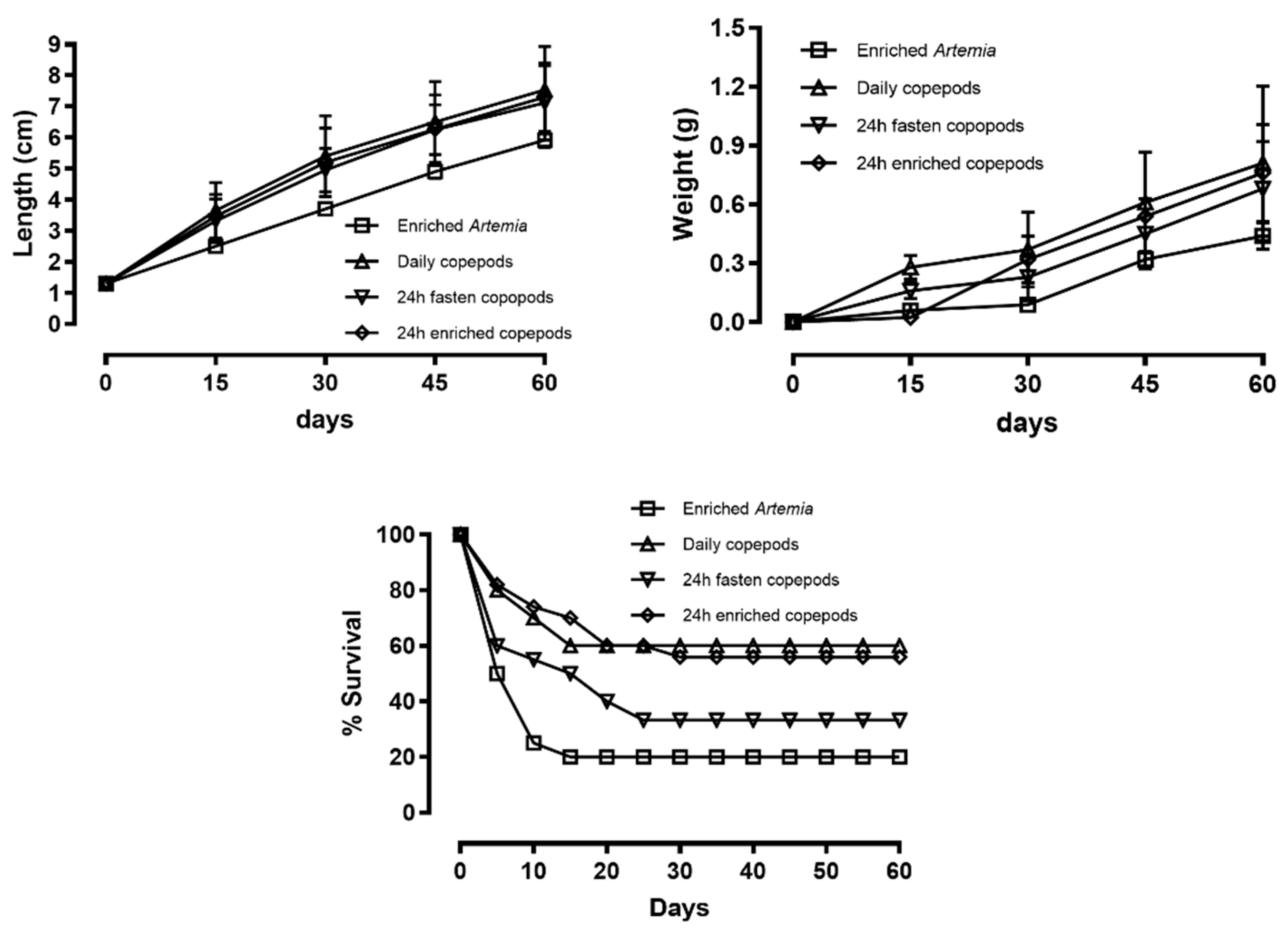
Figure 1. (a) Length increase, (b) weight increase, and (c) percent survival of juvenile H. guttulatus fed each of the four tested diets (24h I. galbana enriched Artemia (control diet), daily captured copepods, 48h unfed copepods, and 24h enriched copepods).
Preprints 190102 g001
Table 1. Proximate composition of the four tested dietary treatments (per 100 g of Dry Matter (g/100 g DM)) (24h I. galbana enriched Artemia, daily captured copepods, 48h unfed copepods, and 24h I. galbana enriched copepods).
Proximate Composition Enriched Artemia Daily copepods 48h unfed copepods 24h enriched copepods
Moisture (%) 70.3±0.4b 86.6±1.1a 84.6±1.0a 85.5±1.0a
Dry Matter (%) 29.7±1a 13.4±1.1b 15.4±1.3b 14.5±1.3b
Gross Protein (g/100g DM) 17.7±0.8a 10.4±0.6b 8.9±1.1a 9.8±1.1b
Total Lipids (g/100g DM) 9.8±0.7a 4.9±0.8b 4.3±0.7b 4.8±0.9b
Gross Energy (Kcal/100 DM) 488.9±0.7b 504.28±1.2a 491.53±1.4b 502.53±1.4a
Table 2. Fatty acid composition of each dietary treatment, 24h I. galbana enriched Artemia, daily captured copepods, 48h unfed copepods and 24h I. galbana enriched copepods (mean ± standard deviation, (n=3)) expressed as a percentage (%) of total identified fatty acids. SMA (saturated fatty acids), MUFA (monounsaturated fatty acids), PUFA (polyunsaturated fatty acids), HUFA (highly unsaturated fatty acids). Row values with different superscripts are significantly different (p < 0.05).
Category Fatty acid 24h enriched Artemia Daily copepods 48h unfed copepods 24h enriched copepods
SMA (saturated) 14:00 4.32 ±0.14b 10.02 ±0.6a 3.67 ±0.21b 8.48 ±0.2a
15:00 0.71 ±0.12a 1.13 ±0.11a 0.67 ±0.08a 0.88 ±0.08a
16:00 20.92 ±0.89c 27.31 ±0.4a 26.58 ±0.75a 24.6 ±0.05b
17:00 0.61 ±0.09c 1.09 ±0.05b 1.92 ±0.11a 1.3 ±0.1a
18:00 5.24 ±0.15c 6.91 ±0.15b 13.24 ±0.21a 7.57 ±0.13b
21:00 0.47 ±0.07a 0.20 ±0.03b 0.38 ±0.09b 0.60 ±0.03a
24:00 0.19 ±0.04a 0.30 ±0.06a 0.17 ±0.15a 0.20 ±0.17a
Σ Saturated 32.46±1.43b 47.77 ±0.75a 47.90 ±1.01a 44.46 ±0.35a
MUFA (monoenes) 16:1n7 12.42 ±0.32a 6.93 ±0.23b 2.06 ±0.20d 4.14 ±0.02c
17:01 0.19 ±0.20b 0.24 ±0.02a 0.26 ±0.24a 0.40 ±0.01a
18:1n9 16.37 ±0.05a 2.22 ±0.03c 2.71 ±1.18c 5.99 ±0.12b
18:1n7 12.81 ±0.04a 3.24 ±0.11b 3.03 ±1.20b 3.22 ±0.06b
22:1n9 1.94 ±0.21b 1.61 ±0.12b 4.51 ±0.03a 2.35 ±0.05b
24:01 1.42 ±0.59a 0.60 ±0.07b 0.78 ±0.68b 0.99 ±0.03a
Σ Monoenes 45.15±2.31a 15.95 ±0.60b 14.13 ±1.39b 18.05 ±0.14b
PUFA (non-HUFA) 16:2n4 0.42 ±0.07a 0.29 ±0.01a 0.04 ±0.07a 0.21 ±0.07a
16:3n4 0.15 ±0.21a 0.35 ±0.01a 0.30 ±0.30a 0.25 ±0.07a
16:4n1 0.18 ±0.09a 0.20 ±0.06a 0.07 ±0.13a 0.14 ±0.12a
18:2n6 4.86 ±0.06a 1.05 ±0.05b 0.92 ±0.05b 3.78 ±0.09a
18:3n6 0.63 ±0.09b 0.75 ±0.07b 0.66 ±0.21b 1.39 ±0.11a
18:3n3 3.21 ±0.05a 1.31 ±0.00b 0.85 ±0.06b 2.47 ±0.05a
18:4n3 1.02 ±0.04b 0.97 ±0.00b 0.57 ±0.04b 2.66 ±0.05a
Σ PUFA (non-HUFA) 10.47±2.45
HUFA (=C20) 20:4n6 (AA) 1.68 ±0.03a 0.96 ±0.02a 1.03 ±0.08a 0.58 ±0.05b
20:5n3 (EPA) 5.77 ±0.32b 8.77 ±0.01a 9.67 ±0.50a 5.31 ±0.17b
22:5n3 0.37 ±0.23a 0.74 ±0.02a 0.40 ±0.04a 0.45 ±0.05a
22:5n6 0.32 ±0.16b 0.49 ±0.04a 0.25 ±0.21b 0.82 ±0.19a
22:6n3 (DHA) 0.23±0.07b 17.18 ±0.12a 18.66 ±1.72a 16.28 ±0.56a
Σ HUFA 8.37±0.58c 27.14 ±0.14a 28.73 ±2.17a 22.35 ±0.60b
Σ PUFA (total) (non-HUFA + HUFA) 18.84±1.48b 29.42 ±0.14a 30.15 ±2.19a 27.48 ±0.62a
Total Σ (SMA + MUFA + PUFA) 96.45±1.42a 97.61 ±0.36a 95.90 ±3.53a 97.52 ±0.42a
Unknown 3.55±1.42a 2.39±0.36a 4.13±3.53a 2.48±0.42a
Saturated 32.46±1.09b 47.77±0.75a 47.9±1.01a 44.46±0.35a
Monoenes 45.15±2.14a 15.95±0.6b 14.13±1.39b 18.05±0.14b
n-3 10.6±1.45b 29.42±0.14a 30.15±2.19a 27.48±0.62a
n-6 7.49±0.5a 3.52±0.2b 2.86±0.15b 6.88±0.24a
n-9 18.31±0.53a 4.06±0.12c 7.65±1.09b 8.78±0.14b
n-3 HUFA 6.37±0.61c 27.14±0.14a 28.73±2.17a 22.35±0.6b
n-3/n-6 1.42±0.07a 0.51±0.004b 0.52±0.02b 0.33±0.005b
DHA/EPA 0.039±0.02a 1.96±0.002b 1.92±0.01b 3.06±0.008b
EPA/AA 3.43±0.2a 9.14±0.15b 9.39±0.21b 9.16±0.22b
DHA/AA 0.14±0.02a 17.9±0.1b 18.12±0.1b 28.07±0.12b
Table 3. Standard length (cm), Body weight (mg), Thermal-unit growth coefficient (TGC), and Condition Factor (CF) (mean ± SD) of juvenile H. guttulatus fed 24h I. galbana enriched Artemia, daily captured copepods, 48h unfed copepods or 24h I. galbana enriched copepods at the end of the 60-day study.
Enriched Artemia Daily copepods 24h unfed copepods 24h enriched copepods
Standard length (cm) 5.9±0.2b 7.5±1.4a 7.1±1.2a 7.3±1.1a
Body weight (g) 0.44±0.07c 0.81±0.4a 0.68±0.24b 0.76±0.25a
WG (g.d-1) 0.007±0.001b 0.013±0.002a 0.011±0.002a 0.013±0.002a
TGC 0.15b 0.27a 0.23a 0.25a
CF 0.21±0.02a 0.19±0.03a 0.19±0.03a 0.2±0.04a
% survival 20c 60a 33.3b 56a
Initial weight=0.002±0.001g: Initial length=1.3±0.1cm, Initial Condition Factor=0.09±0.01.
Disclaimer/Publisher’s Note: The statements, opinions and data contained in all publications are solely those of the individual author(s) and contributor(s) and not of MDPI and/or the editor(s). MDPI and/or the editor(s) disclaim responsibility for any injury to people or property resulting from any ideas, methods, instructions or products referred to in the content.
Copyright: This open access article is published under a Creative Commons CC BY 4.0 license, which permit the free download, distribution, and reuse, provided that the author and preprint are cited in any reuse.
Prerpints.org logo

Preprints.org is a free preprint server supported by MDPI in Basel, Switzerland.

Subscribe

Disclaimer

Terms of Use

Privacy Policy

Privacy Settings

© 2026 MDPI (Basel, Switzerland) unless otherwise stated
