
Submitted:
15 December 2025
Posted:
17 December 2025
You are already at the latest version
Abstract
Paracetamol (PAR) was selected as an emerging micropollutant model to evaluate the effectiveness of the photo-Fenton process using natural Bandjéli ore (BO) as a heterogeneous source of iron. An aliquot of 1 ml of the activated product was introduced into 200 mL of an aqueous solution of paracetamol at a defined concentration. The tests were conducted in a double-jacketed glass photoreactor (0.2 L), continuously stirred and equipped with two UVA PL-L lamps (36 W, λ = 365 nm), with the temperature maintained at 20°C and pH around 2.4. The photo-Fenton process was applied with different initial concentrations of paracetamol (10–50 mg/L), different H2O2/PAR initial molar ratio (10:1 and 5:1), and different ferric ion concentrations (2.84-4.73 mg/L). Under these conditions, complete elimination of paracetamol was achieved in less than 3 h for iron contents below 5 mg/L, in compliance with the discharge standards applicable in France and Togo. Inhibition tests with propan-2-ol highlighted the predominant role of hydroxyl radicals and the secondary involvement of superoxide radicals in the subsequent stages. Taken together, these results demonstrate that the Bandjéli ore is an effective, sustainable, and economically advantageous alternative to commercial iron salts for the implementation of the photo-Fenton process in the decontamination of water polluted by persistent organic micropollutants.
Keywords:
photodegradation
; paracetamol
; photo-Fenton
; hydrogen peroxide
; Bandjéli ore
1. Introduction
The growing presence of persistent organic micropollutants, such as paracetamol (Para), in wastewater is a major global concern due to their harmful effects on the environment and human health [1,2,3]. Their high solubility combined with their resistance to biodegradation makes them difficult to remove using conventional treatment processes [4,5]. Among these substances, paracetamol is frequently detected in hospital and domestic effluents, with concentrations reaching several tens of micrograms per liter [6]. Due to its solubility and persistence in conventional biological treatments, it remains present in treated water. Its toxic effects on aquatic ecosystems, coupled with the risk of forming by-products that are sometimes more reactive and bio accumulative, justify the development of advanced treatment technologies aimed at its total mineralization [2,7]. In this context, advanced oxidation processes (AOP), particularly the photo-Fenton process, are the subject of intense research [8]. This process is based on the generation of hydroxyl radicals [9], powerful oxidizing agents resulting from the synergistic reaction between iron, hydrogen peroxide, and UV-A or visible light irradiation. Thanks to this synergy, the photo- Fenton process is particularly effective in degrading recalcitrant compounds [10,11]. However, the use of conventional iron salts raises several questions regarding costs, sludge production, and environmental impact [12]. Indeed, the iron used in these processes generally comes from industrial salts, which generates high costs and the formation of undesirable ferric sludge. Recently, numerous studies have highlighted the benefits of replacing this industrial iron with natural, mineral, or waste resources in order to overcome these limitations [13,14]. In this context, the present study aims to evaluate the potential of natural Bandjéli ore (BO) as a source of iron for the photo-Fenton process applied to the degradation of paracetamol, chosen as a model pollutant. The effects of various operating parameters, such as the initial concentration of the pollutant, the molar ratio, and the ferric ion content, were systematically studied. In addition, hydroxyl radical ( and ) inhibition tests were used to better understand the mechanisms involved. This study thus aims to propose a sustainable, effective, and economically accessible method for the decontamination of water polluted by pharmaceutical residues and other resistant organic micropollutants.
2. Materials and Methods
2.1. Chemicals
Isopropyl alcohol (99.8%, Sigma Aldrich), sulfuric acid (95-97%, Merck), hydrogen peroxide (30% w/w in , Sigma Aldrich) and acetaminophen (98%, Alfa Aesar) were used without further treatment.
2.2. Ore Preparations
The Bandjéli ore was collected during a sampling campaign conducted at the Bandjéli processing site, located in the Bassar prefecture in northwestern Togo. The raw material was then crushed, sieved to a particle size of 50 µm, thoroughly washed with ultrapure water, filtered, and then dried at 45°C for 24 h. Following this preparation, it underwent several physicochemical analyses such as the elemental composition from X-ray fluorescence (XRF), the morphology and microtexture with scanning electron microscopy coupled with energy dispersive spectroscopy (SEM-EDX), crystal structure identified with X-ray diffraction (XRD) and finally, surface chemical groups characterized by Fourier transform infrared spectroscopy (FTIR). Results from these characterizations have been published in a recent scientific paper [15].
2.3. Experimental Procedure
A 3 mg sample of Bandjéli ore was introduced in 4 mL of sulfuric acid () at 6.1% and activated by microwave treatment at 200°C for 2 h. After activation, 1 mL of the mixture obtained was added into 200 mL of an aqueous solution of paracetamol, at a defined concentration, contained in a glass photoreactor equipped with two UVA PL-L lamps (2x36 W, λ = 365 nm) arranged above it. The reactor, kept under continuous agitation and connected to a thermostatic bath, to ensure a constant reaction temperature of 20°C. The reactor was protected by a cardboard screen covered with aluminum foil to optimize the reflection of UVA radiation. The addition of 1 mL of prepared catalyst resulted in a pH of approximately 2.4 and a ferric ion concentration of 2.84 mg/L, avoiding any additional pH correction. Unless otherwise stated, the molar ratio was set at 10:1; a reduced ratio of 5:1 was only used to evaluate the effect of this hydrogen peroxide concentration. The molar ratio was selected for the photo-Fenton process, corresponding to the half of the theoretical stoichiometric coefficient required for the complete mineralization of paracetamol (), as described by the balance equation proposed by Audino et al [6]:
This methodological choice is based on their experimental results, showing that ratios close to 10.5 allow rapid and almost complete degradation of paracetamol while optimizing hydrogen peroxide consumption [6]. Indeed, systematic studies have shown that using a ratio corresponding to half the theoretical stoichiometry maximizes the performance of the process in terms of reaction kinetics and degree of mineralization, with total organic carbon reductions of up to 68.5%. Investigating higher ratios (21 or 42), that result in a decrease in specific efficiency [6]
As direct photolysis showed no degradation of paracetamol under these conditions, the photo-Fenton process was initiated by switching on the UVA lamps immediately followed by the addition of . 5 mL samples were taken using a syringe at the initial time, then every 30 min up to 3 h of irradiation for analysis. Before this procedure, control tests were investigated in darkness and without a catalyst. The residual paracetamol concentration was determined by UV-Visible spectrophotometry at 243 nm. The effect of ferric ion concentration was examined using the same protocol, increasing the mass of activated ore to 4 mg and 5 mg, corresponding to a total iron contents of 3.78 mg/L and 4.73 mg/L, respectively. Those values are below the limits set by the European Directive of August 24, 2017 [16] and the Togolese Ministerial Decree No. 010/MER/MS/MERF, which establish the national permissible limit of 5 mg/L for total iron in industrial effluents.
2.4. Radical Inhibition Tests
In order to elucidate the reaction mechanisms involved, tests were conducted in the presence of a selective hydroxyl radical scavenger, isopropanol (propan-2-ol), introduced at a molar ratio of 10:1 relative to the hydrogen peroxide concentration. These experiments were carried out according to the protocol described in section 2.3, with the addition of isopropanol immediately before the introduction of hydrogen peroxide.
3. Results
3.1. Characterization of the Ore
X-ray fluorescence (XRF) analysis of the washed Bandjéli ore indicates that it is predominantly consists of more than 93% of hematite (Table 1). This corresponds to an overall iron content of more than 95% when expressed in terms of elemental composition (Table 2). The minor phases identified are silica (4.19%) and alumina (1.45%), while undesirable elements such as Cr, Mg, Ti, Mn, and Sr are only detected in trace amounts [15]. The high proportion of hematite, known for its structural stability and ability to gradually release ferric ions in an acidic environment, makes the ore particularly suitable for use as a catalyst in the photo-Fenton process [17].
3.2. Degradation of Paracetamol
Preliminary blank experiments were performed without UVA irradiation and in complete darkness on the degradation of paracetamol either in presence of Bandjéli ore or in the presence of hydrogen peroxide () to assure that the results found during the photo-Fenton treatment were consistent and not due to hydrolysis and/or photolysis. A very low degradation of paracetamol was observed thus highlighting the crucial importance of the synergy of the components of the photo-Fenton process in achieving optimal efficiency. The effects of initial concentration of paracetamol (PAR) on its degradation under UVA irradiation at wavelength of 365 nm, with an molar ratio set at 10 and a ferric ion concentration of 2.84 mg/L were performed. The results depicted in Figure 1 show complete elimination of paracetamol for initial concentrations up to 20 mg/L in less than 3 h. For a lower initial concentration of 10 mg/L, total degradation was achieved within 150 min. However, at high PAR concentrations of 30 mg/L and 50 mg/L, under the same other operating conditions, the degradation rate was 90.48% and 61.74% respectively after 3 h, revealing the limitations of the process at high pollutant loads. To overcome this limitation, various parameters were adjusted to optimize degradation at 50 mg/L of paracetamol. In this regard, it is significant to examine the effect of initial concentrations of hydrogen peroxide on the PAR degradation due to its role in the production of hydroxyl via heterogeneous photo-Fenton reactions. Lowering the H₂O₂/PAR molar ratio from 10 to 5, i.e. reducing the initial hydrogen peroxide concentration from 160.2 mg/L to 80.1 mg/L, at an initial concentration of ferric ion maintained at 2.48 mg/L and the constant light intensity, resulted in a marked decrease in the PAR degradation efficiency from 61.74% to 49.39% as shown in Figure 2. In line with, studies indicating that an adequate dose of oxidant is essential to maximize the generation of hydroxyl radicals while avoiding their competitive consumption. The enhancement in degradation rate can be explained by the generation of more hydroxyl through the activation of more hydrogen peroxide by catalyst at higher initial hydrogen peroxide concentration. Furthermore, the gradual increase in ferric ion concentration to 3.78 and then 4.73 mg/L depicted in Figure 3, led to a notable improvement in the degradation performance of PAR, achieving total degradation of paracetamol at 4.73 mg/L in ferric ion concentration. This observation corroborates result in the literature. Audino et al [6] report that iron concentrations close to regulatory limits (up to 5 mg/L) promote complete elimination of paracetamol, even at high initial concentrations (40–50 mg/L) [6]. These observations confirm that simultaneous optimization of the ratio and ferric ion content is essential to ensure maximum efficiency of the photo-Fenton process, particularly in the case of high pollutant loads. The results obtained are consistent with the one published in the literature on paracetamol degradation [6], highlighting the need to control these parameters in order to meet performance requirements and comply with discharge standards. Finally, a comparison carried out for an initial concentrations in paracetamol of 30 mg/L and 50 mg/L between the conventional Fenton system (), the pair, and the system under our experimental photo-Fenton conditions as mentioned in Figure 4 reveals that the latter is the most effective, thus demonstrating the superior efficiency of the photo-Fenton process under these conditions [6,19,20]
A simplified mechanism for paracetamol degradation via Fenton and photo-Fenton reactions, as proposed by Audino et al. [6] and Giménez et al. [21] and adapted to our study, is summarized in Table 3, where is considered as the generic intermediate compound arising from the interaction of hydroxyl radicals () with PAR. This mechanism points out the important role of the hydroxyl radical () in the process. To support the contribution of hydroxyl radicals () species during the degradation process of paracetamol, experiments were performed in the presence of propan-2-ol, used as a selective hydroxyl radical scavenger [18]. Results shown in Figure 5 indicate that the degradation rate of paracetamol () decreased from 100% to only 33% under our optimal operating conditions.
This marked inhibition confirms the predominant role of hydroxyl radicals () as the dominant oxidizing species in the photo-Fenton process. Furthermore, the observed decrease in performance in the presence of propan-2-ol also highlights a secondary contribution of superoxide radicals () [9] in the subsequent stages of degradation. These observations are consistent with the mechanisms classically described for the photo-Fenton process, in which the synergistic interaction between ferrous/ferric ions, hydrogen peroxide, and light irradiation leads to the successive generation of hydroxyl radicals and secondary oxidizing species.
4. Conclusions
This study highlights the strong potential of the photo-Fenton process using natural Bandjéli ore as an iron catalyst for the degradation of paracetamol in contaminated water. The results obtained, with complete elimination under optimal conditions (a ferrous ion concentration of 4,78 mg/L and a molar ratio ) for concentrations up to 50 mg/L, demonstrate that controlling the operating parameters, in particular the ferric ion content and the ratio, makes it possible to achieve high efficiency while maintaining residual iron levels that comply with environmental standards. Beyond its technical performance, this approach makes use of an abundant local resource, reducing treatment costs, industrial reagent consumption, and sludge production, while limiting the environmental footprint. These results pave the way for the direct integration of iron-rich minerals into advanced oxidation processes for the sustainable removal of organic micropollutants. Future work will focus on monitoring the formation and fate of oxidation by-products and complete mineralization in order to consolidate the method's efficiency and sustainability.
Acknowledgments
The authors would like to thank all the technical staff at the Laboratory of Automation, Process Engineering and Pharmaceutical Engineering (LAGEPP, Université Claude Bernard Lyon1, France), the Analytical Chemistry Laboratory at CPE Lyon (France), and the Waste Management, Treatment and Recovery Laboratory (GTVD) from University of Lomé in Togo. This work received financial support from the French Embassy in Togo through the France Excellence scholarship awarded by its Cooperation and Cultural Action Department (SCAC).
Conflicts of Interest
The authors declare no conflicts of interest regarding the publication of this paper.
References
- Rivera-Utrilla J, Sánchez-Polo M, Ferro-García MÁ, Prados-Joya G, Ocampo-Pérez R. Pharmaceuticals as emerging contaminants and their removal from water. A review. Chemosphere 2013;93:1268–87. [CrossRef]
- Aus Der Beek T, Weber F-A, Bergmann A, Hickmann S, Ebert I, Hein A, Küster A Pharmaceuticals in the environment—Global occurrences and perspectives. Environmental Toxicology and Chemistry 2015;35:823–35. [CrossRef]
- Houtman CJ. Emerging contaminants in surface waters and their relevance for the production of drinking water in Europe. Journal of Integrative Environmental Sciences 2010;7:271–95. [CrossRef]
- Luo Y, Guo W, Ngo HH, Nghiem LD, Hai FI, Zhang J, et al. A review on the occurrence of micropollutants in the aquatic environment and their fate and removal during wastewater treatment. Science of The Total Environment 2014;473–474:619–41. [CrossRef]
- Liang L, Ji L, Ma Z, Ren Y, Zhou S, Long X, et al. Application of Photo-Fenton- Membrane Technology in Wastewater Treatment: A Review. Membranes 2023;13:369. [CrossRef]
- Audino F, Conte LO, Schenone AV, Pérez-Moya M, Graells M, Alfano OM. A kinetic study for the Fenton and photo-Fenton paracetamol degradation in an annular photoreactor. Environ Sci Pollut Res 2019;26:4312–23. [CrossRef]
- Hinojosa Guerra MM, Oller Alberola I, Malato Rodriguez S, Agüera López A, Acevedo Merino A, Quiroga Alonso JM. Oxidation mechanisms of amoxicillin and paracetamol in the photo-Fenton solar process. Water Research 2019;156:232–40. [CrossRef]
- Hassan ME, Chen Y, Liu G, Zhu D, Cai J. Heterogeneous photo-Fenton degradation of methyl orange by Fe2O3/TiO2 nanoparticles under visible light. Journal of Water Process Engineering 2016;12:52–7. [CrossRef]
- Xiao J, Guo S, Wang D, An Q. Fenton-Like Reaction: Recent Advances and New Trends. Chemistry A European J 2024;30:e202304337. [CrossRef]
- Pignatello JJ, Oliveros E, MacKay A. Advanced Oxidation Processes for Organic Contaminant Destruction Based on the Fenton Reaction and Related Chemistry. Critical Reviews in Environmental Science and Technology 2006;36:1–84. [CrossRef]
- Brillas E, Martínez-Huitle CA. Decontamination of wastewaters containing synthetic organic dyes by electrochemical methods. An updated review. Applied Catalysis B: Environmental 2015;166–167:603–43. [CrossRef]
- Neamtu M, Yediler A, Siminiceanu I, Kettrup A. Oxidation of commercial reactive azo dye aqueous solutions by the photo-Fenton and Fenton-like processes. Journal of Photochemistry and Photobiology A: Chemistry 2003;161:87–93. [CrossRef]
- Clausi M, Savino S, Cangialosi F, Eramo G, Fornaro A, Quatraro L, et al. Polluta nts abatement in aqueous solutions with geopolymer catalysts: A photo fenton case. Chemosphere 2023;344:140333. [CrossRef]
- Kim SL, Yang H, Lee S, Cho S-K, Lee C-G, Azat S, et al. Mining waste as heterogeneous catalysts. Green Chem 2025;27:8691–709. [CrossRef]
- Kessouagni MJ, Koriko M, Fiaty K, Charcosset C, Jaurand X, Brioude A, Tchangbedji G., Mineralogical and Physico-Chemical Characterization of Raw Iron Ore from Bandjéli in Bassar Prefecture in Northern Togo. Journal of Materials Science and Chemical Engineering 2025;13:85–97. [CrossRef]
- Decree of 24/08/17 amending, in a series of ministerial decrees, the provisions relating to the discharge of hazardous substances into water from facilities classified for environmental protection | AIDA n.d. https://aida.ineris.fr/reglementation/arrete-240817- modifiant-serie-darretes- ministeriels-dispositions-relatives-rejets (accessed August 8, 2025).
- Araujo FVF, Yokoyama L, Teixeira LAC, Campos JC. Heterogeneous Fenton process using the mineral hematite for the discoloration of a reactive dye solution. Braz J Chem Eng 2011;28:605–16. [CrossRef]
- Gracien EB, Jérémie ML, Joseph LK-K, Omer MM, Antoine MK, Hercule KM. Role of hydroxyl radical scavenger agents in preparing silver nanoparticles under γ-irradiatio n. SN Appl Sci 2019;1:961. [CrossRef]
- Reina AC,Santos-Juanes L.,Garcia Sanchez J.L.,Casas Lopès J.L.,Maldonado Rubio M.I.,Li Puma G.,Sanchez Pérez J.A. Modelling the photo-Fenton oxidation of the pharmaceutical paracetamol in water including the effect of photon absorption (VRPA) Applied Catalysis B:Environmental 166–167(2015)295–301. http://dx.doi.org/10.1016/j.apcatb.2014.11.023.
- Hurtado L, Avilés O, Brewer S, Donkor KK, Romero R, Gómez-Espinosa RM,Alvarado O,Natividad R.Al/Cu-PILC as a Photo-Fenton Catalyst: Paracetamol Mineralization. ACS Omega 2022;7:23821–32. [CrossRef]
- Bárbara N. Giménez, Leandro O. Conte, Francesca Audino, Agustina V. Schenone, Moisès Graellsb, Orlando M. Alfano, Montserrat Pérez-Moya, Kinetic model of photo-Fenton degradation of paracetamol in an annular reactor: main reaction intermediates and cytotoxicity studies, Catalysis Today 413-415(2023)113958. [CrossRef]
Figure 1.
Kinetics of paracetamol degradation by photo-Fenton (365 nm, 3 h, pH ≈ 2.4, 20°C, [Fe³⁺] = 2.84 mg/L, [H₂O₂]/PAR = 10) at different initial concentrations of paracetamol.
Figure 1.
Kinetics of paracetamol degradation by photo-Fenton (365 nm, 3 h, pH ≈ 2.4, 20°C, [Fe³⁺] = 2.84 mg/L, [H₂O₂]/PAR = 10) at different initial concentrations of paracetamol.
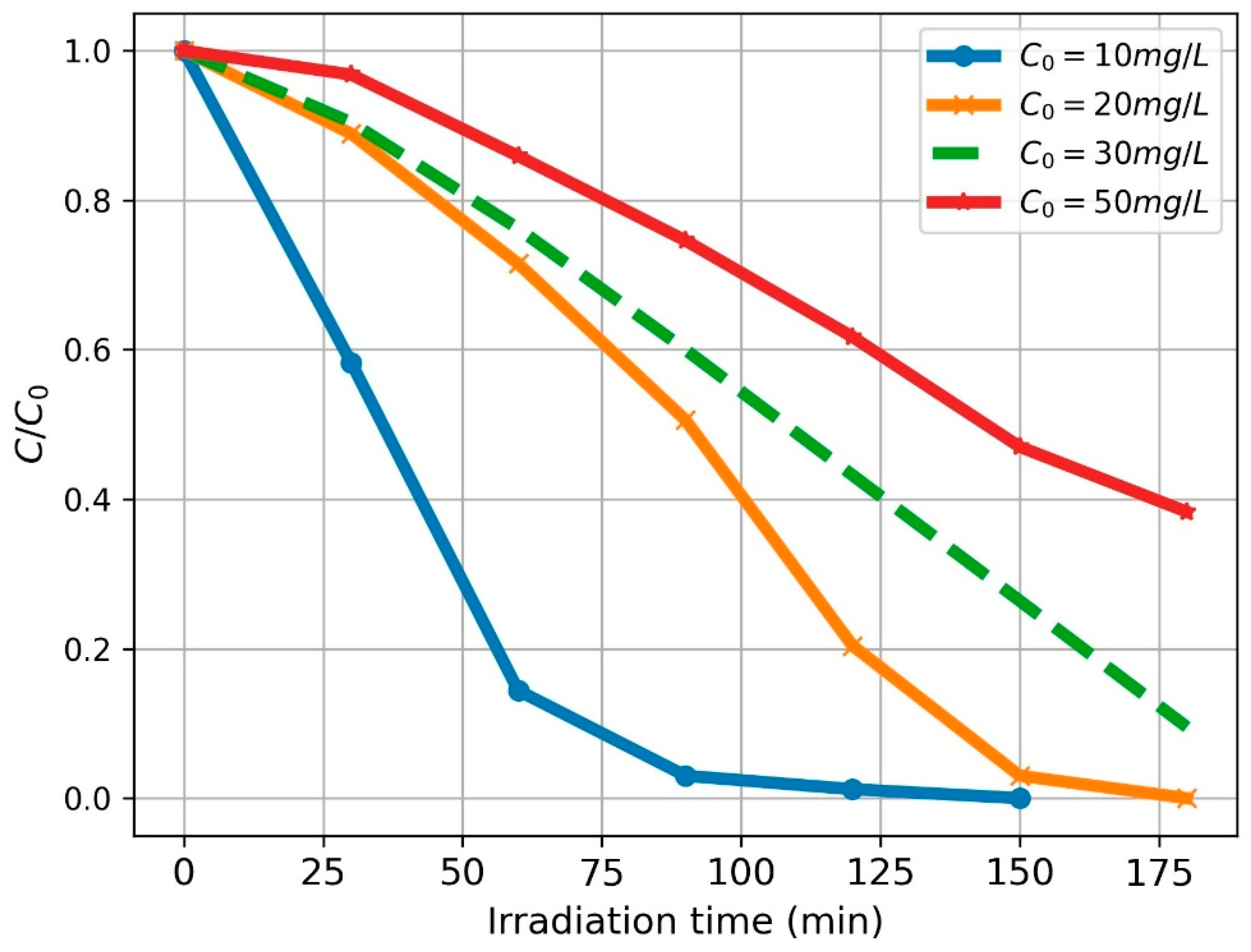
Figure 2.
Impact of the [H₂O₂]/PAR ratio on the degradation of paracetamol (50 mg/L) – 365 nm, 3 h, pH ≈ 2.4, 20°C, [Fe³⁺] = 2.84 mg/L.
Figure 2.
Impact of the [H₂O₂]/PAR ratio on the degradation of paracetamol (50 mg/L) – 365 nm, 3 h, pH ≈ 2.4, 20°C, [Fe³⁺] = 2.84 mg/L.
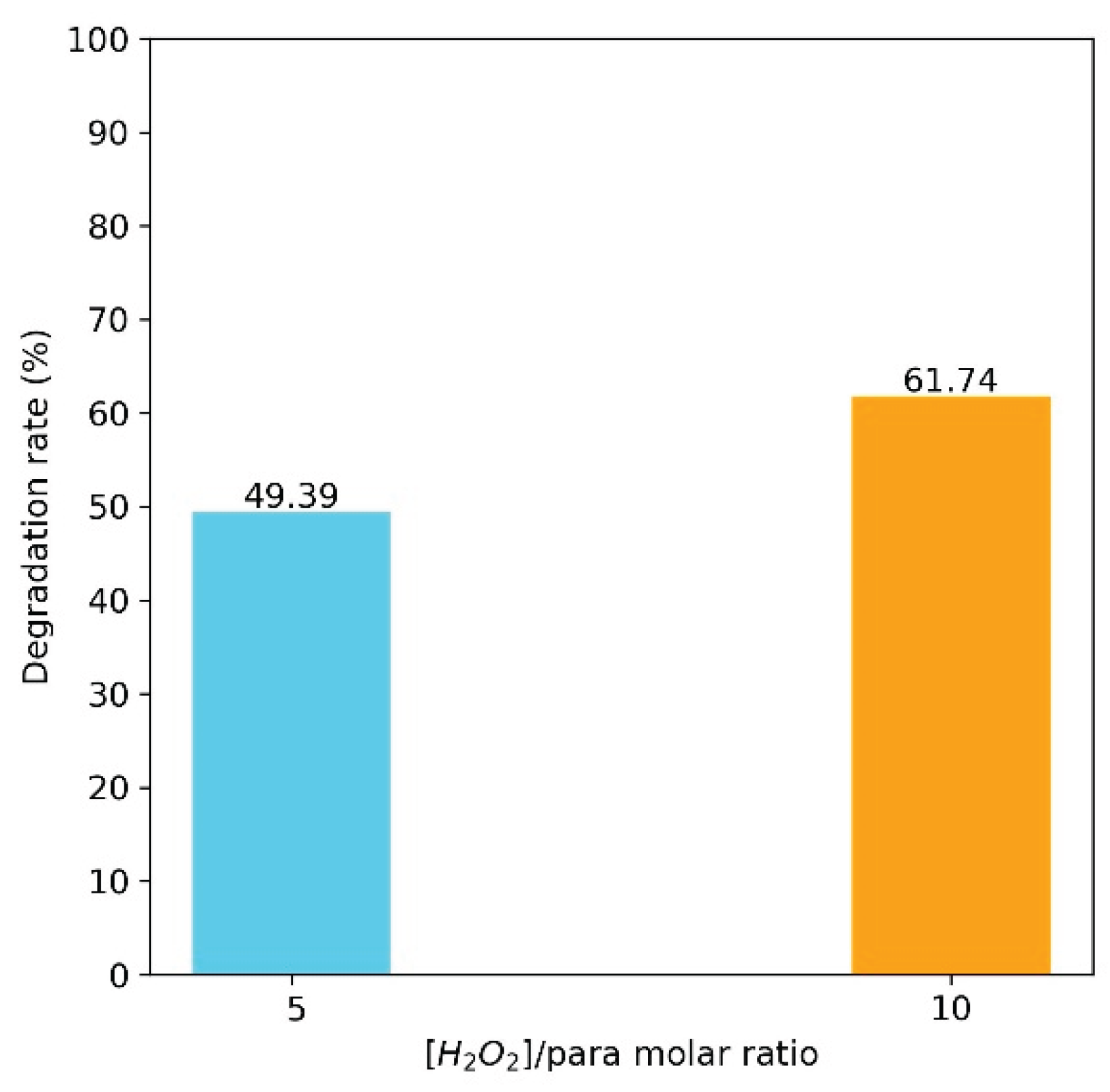
Figure 3.
Impact of ferric ion initial concentration on the degradation of paracetamol (50 mg/L) – 365 nm, 3 h, pH ≈ 2.4, 20°C.
Figure 3.
Impact of ferric ion initial concentration on the degradation of paracetamol (50 mg/L) – 365 nm, 3 h, pH ≈ 2.4, 20°C.
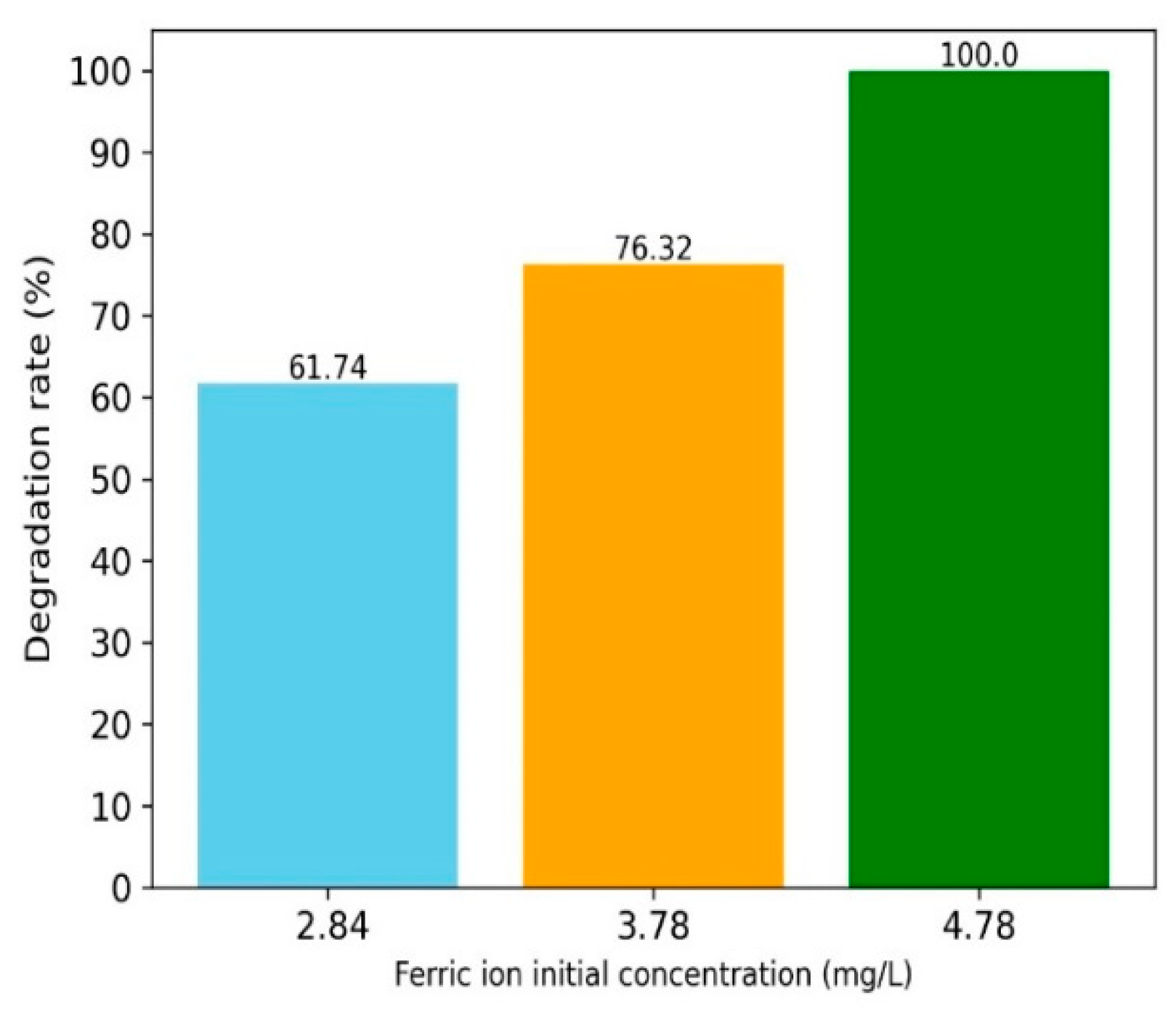
Figure 4.
Comparison of Fenton, H₂O₂/UV, and photo-Fenton for the degradation of two initial concentrations of paracetamol 30 mg/L and 50 mg/L – 365 nm, 3 h, pH ≈ 2.4, 20°C, [Fe³⁺] = 2.84 mg/L, [H₂O₂]/PAR = 10.
Figure 4.
Comparison of Fenton, H₂O₂/UV, and photo-Fenton for the degradation of two initial concentrations of paracetamol 30 mg/L and 50 mg/L – 365 nm, 3 h, pH ≈ 2.4, 20°C, [Fe³⁺] = 2.84 mg/L, [H₂O₂]/PAR = 10.
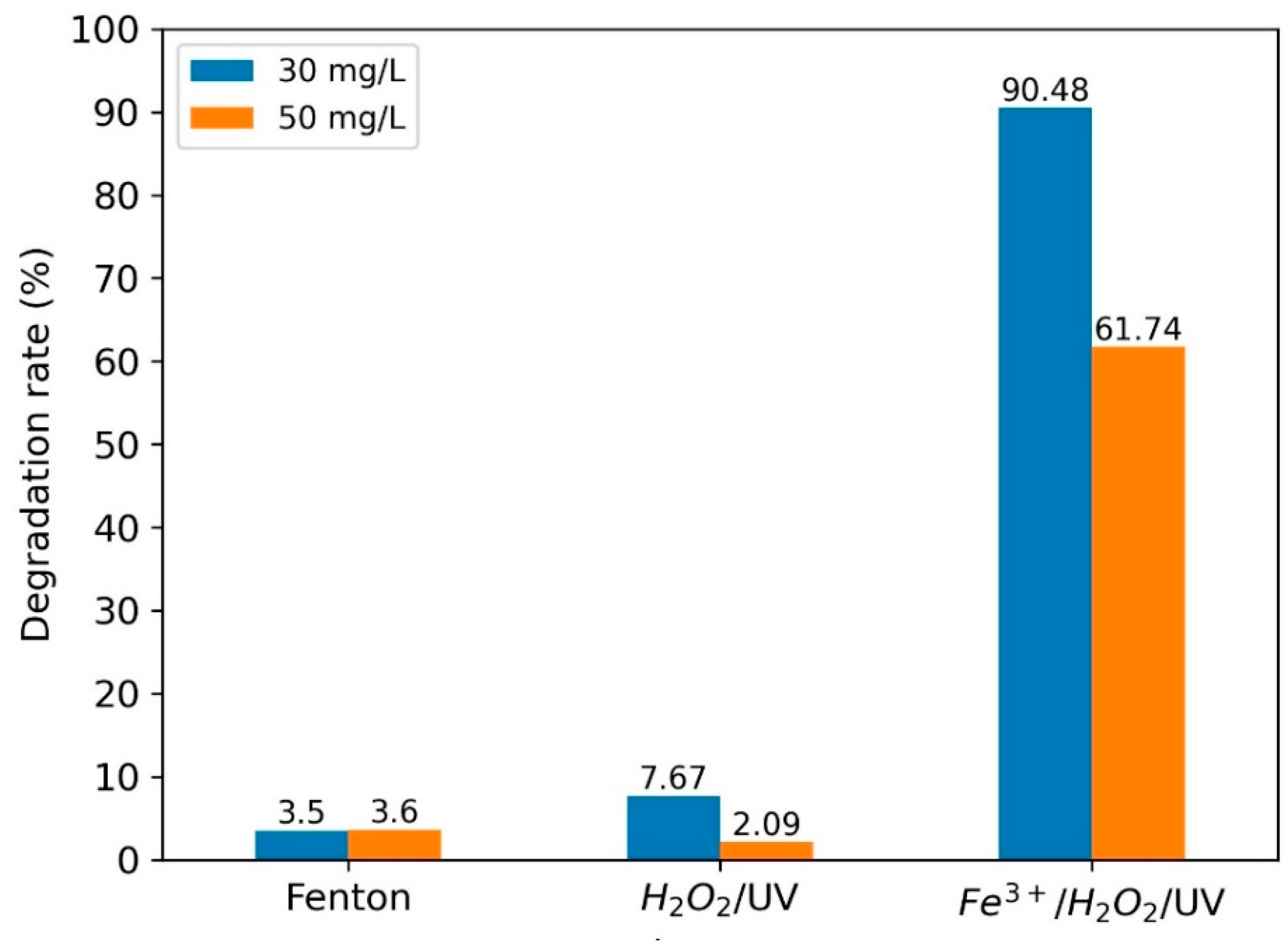
Figure 5.
Degradation rate of 50 mg/L PAR in a PAR-Fe³⁺]-H₂O₂-UV mixture (50 mg/L-4.73 mg/L) in the presence and absence of propan-2-ol ( with to ensure propan-2-ol/H2O2 molar rate of 10).
Figure 5.
Degradation rate of 50 mg/L PAR in a PAR-Fe³⁺]-H₂O₂-UV mixture (50 mg/L-4.73 mg/L) in the presence and absence of propan-2-ol ( with to ensure propan-2-ol/H2O2 molar rate of 10).
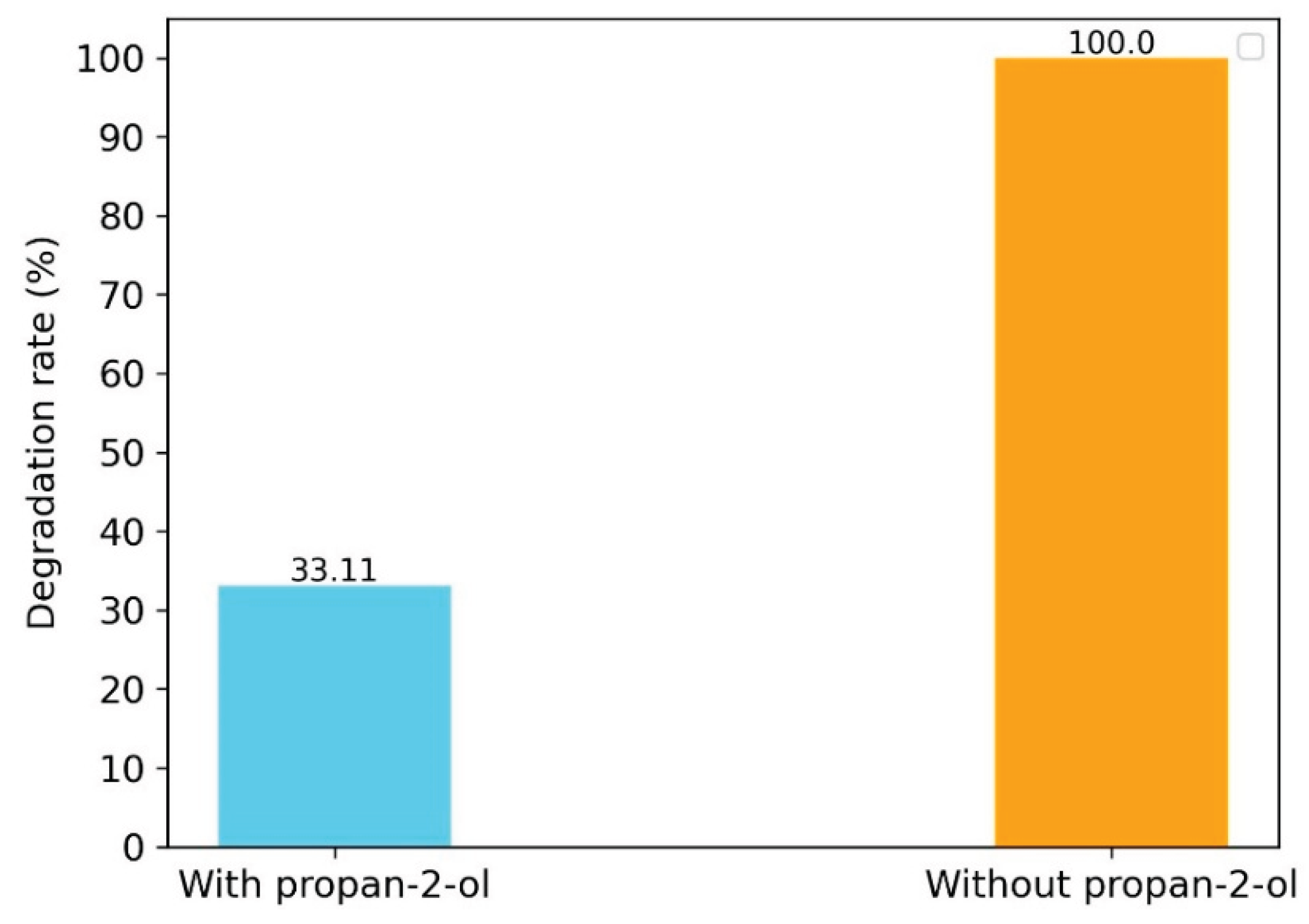

Table 1.
Chemical composition of the raw iron ore in oxide form by XRF [15].
Table 1.
Chemical composition of the raw iron ore in oxide form by XRF [15].
| Oxide | |||||||||||
| W(%) | 93.45 | 4.19 | 1.45 | 0.30 | 0.29 | 0.10 | 0.05 | 0.06 | 0.02 | 0.02 | 0.01 |
Table 2.
Chemical composition of the raw iron ore in elements form by XRF [15].
Table 2.
Chemical composition of the raw iron ore in elements form by XRF [15].
| Element | Fe | Si | Al | Mg | S | Ti | Cl | Mn | P | Cr | V | Sr | Rb |
| W(%) | 95.84 | 2.54 | 0.98 | 0.20 | 0.15 | 0.08 | 0.07 | 0.06 | 0.04 | 0.02 | 0.01 | 0.01 | 0.01 |
Table 3.
Simplified reaction scheme of PCT photo-Fenton degradation.
| Reactions steps |
Disclaimer/Publisher’s Note: The statements, opinions and data contained in all publications are solely those of the individual author(s) and contributor(s) and not of MDPI and/or the editor(s). MDPI and/or the editor(s) disclaim responsibility for any injury to people or property resulting from any ideas, methods, instructions or products referred to in the content. |
© 2025 by the authors. Licensee MDPI, Basel, Switzerland. This article is an open access article distributed under the terms and conditions of the Creative Commons Attribution (CC BY) license (http://creativecommons.org/licenses/by/4.0/).
Copyright: This open access article is published under a Creative Commons CC BY 4.0 license, which permit the free download, distribution, and reuse, provided that the author and preprint are cited in any reuse.


