

Submitted:
15 December 2025
Posted:
16 December 2025
You are already at the latest version
Abstract
Academic minors provide universities with a flexible mechanism to broaden curricular reach, attract diverse students, and integrate experiential learning. The Wildlife Care and Handling Minor, established at the University of X in 2015, illustrates how a minor can foster professional, academic, and personal growth while preparing students for animal care. The program combines coursework, structured externships, and reflective writing, requiring more than 200 hours of service in institutions managing captive wildlife. This study analyzes 121 student reflections from the capstone externship course. Thematic analysis revealed consistent patterns across four domains. Professionally, students described the Minor as confirming ambitions, redirecting career goals, or expanding horizons to fields such as environmental education, raptor work, or animal law. Academically, it bridged theory and practice, strengthened graduate preparation, clarified interests, and fostered transferable skills in communication and leadership. Personally, students reported growth in resilience, empathy, and ethical awareness, shaped by challenges in living arrangements, cultural adaptation, and compassion fatigue. Advice to future participants emphasized exploration, preparation, professionalism, adaptability, and mentorship, reflecting peer support. Collectively, findings show the WCH Minor as both proving ground and pivot point, enabling students to test identities, integrate learning, and cultivate maturity. The program offers a transferable model for experiential, reflective education that prepares graduates who are thoughtful, resilient, and ethically grounded.
Keywords:
wildlife care and handling
; academic minor
; wildlife management
; academic growth
; student reflections
1. Introduction
Wild animals provide a wide range of valuable ecosystem services. Humans value wild animals as part of biodiversity, for aesthetics, for hunting, for direct products (e.g., meat, fur, leather), for medicines, spiritual value, and more [1,2,3]. Management of wild animals and the landscapes in which they live is an important function of government, and often a role played by the private sector [4]. As such, there are wildlife departments and majors in most larger universities [5,6]. Graduates from such programs seek employment in state and federal government, in non- government organizations (NGOs), in private firms, and in academia. Many professional wildlife positions require an advanced degree (c.f., The Wildlife Society, Wildlife Management Institute). Undergraduate curricula in wildlife science typically emphasize population-scale understanding, such as ecology, management, and field methods. The perceived role of most such programs is to prepare students for professional service or graduate study. Yet, many students seek opportunities to work with wildlife at the individual scale, whether through rehabilitation, zoos, sanctuaries, research facilities, or as veterinarians. Few university wildlife programs offer structured training in the safe and ethical handling of captive wild animals, leaving a gap in professional preparation and personal exploration.
Academic minors provide one mechanism to broaden curricular reach, offering visibility, recognition, and specialized training without the full commitment of a major [7]. Minors can attract students from diverse disciplines, strengthen enrollment, and provide a credential that signals expertise in a defined subfield. For institutions, minors represent a relatively low-cost innovation: they often combine existing courses with targeted new offerings, minimizing administrative burden while expanding impact [7]. Exposure to an interesting field (e.g., wildlife handling) outside a person’s home discipline strengthens critical thinking [8,9,10]. Such university programs also advance awareness and contribute to wildlife health [11,12]. For students, minors provide a structured pathway to explore interests, test career directions, and integrate interdisciplinary perspectives. In this way, minors can serve as both recruitment tools and educational bridges, connecting classroom learning with applied practice.
Academic majors and minors provide ways for universities to identify content within a field and certify that a graduate, or a person completing a program has attained a certain level of competence. An academic minor provides a wide range of benefits to students and the universities in which they enroll [13,14]. Minors spread the word, providing exploring students with a taste of the content in, or related to a major, potentially attracting new majors [15,16]. The great majority of college students change their major at least once, and a minor provides exposure, potentially drawing interested people into a major [17]. Similarly, minors broaden the exposure of a department, or a major, providing increased visibility within, and outside the university [18,19]. Minors deepen the experience for our students, allowing them to take a small number of credits (typically 13-20) in a specialized area [20,21]. Students with a designated minor might have increased employment opportunities and might have an edge in applications to graduate school [22,23]. Similarly, academic minors offer students exposure to a field, providing an increased awareness of issues of societal value [18]. College is a time of exploration. Exposure to broader societal issues encourages reflection on the ways society values and makes decisions [24]. A minor captures student enthusiasm, encouraging them to explore and be engaged [25]. For a student, a minor is a low-cost venture into a new field, supporting personal growth.
Research on high-impact practices demonstrates that curricular innovations such as minors can improve student engagement and graduation rates [26]. Minors also foster civic-mindedness and interdisciplinary learning, broadening the scope of higher education beyond disciplinary silos [27]. These findings suggest that minors can serve both institutional and student needs, and enhance visibility while cultivating transferable skills and civic awareness.
Developing and sustaining an academic minor can be expensive in terms of faculty time, advertising, and administrative support. Faculty at most universities have a full load of responsibilities and adding courses in support of a minor may be a difficult sell. A minor might be seen as a dilution of the major field [13]; some would ask if a person can understand a little about wildlife from a 15-credit minor, why bother to enroll in a 60-credit major? Some might see addition of a minor as mission creep, extending the topics covered in a wildlife program to topics better-covered elsewhere [14]. We believe this paper offers an effective counter argument to those concerns.
Wildlife Care and Handling (WCH) is a 15-credit minor established at the University of X in 2015 to address the gap in training for individual-scale wildlife care. The Minor combines classroom learning, debates, and facility profiles with a capstone externship, where students complete more than 200 hours of service in an institution managing captive wildlife. Over ten years, nearly 300 students from 16 majors have enrolled, with more than 120 completing the Minor. The capstone of the Minor is a three-credit externship, which is broader than an internship, adding at least some exposure to aspects like institutional finance and human resources [28,29]. In contrast, an internship is narrower and more focused on disciplinary skills. Externship placements spanned 11 states and seven countries, ranging from local rehabilitation centers to international sanctuaries (Figure 1). This breadth underscores the Minor’s adaptability and reach, offering students opportunities to engage with wildlife care in varied cultural and ecological contexts.
The WCH Minor was designed not only to provide technical training but also to foster reflection on professional, academic, and personal growth. The externship culminates in a structured reflective assignment, where students articulate impacts across these dimensions and offer advice to future participants. These reflections provide a unique window into how students experience the Minor, how it shapes their trajectories, and how they perceive its value. While quantitative measures such as enrollment numbers and placement diversity demonstrate reach, qualitative reflections reveal depth: they capture the lived experiences of students navigating career decisions, academic integration, and personal challenges.
This paper analyzes 121 student reflections from the externship to evaluate how the WCH Minor influenced professional, academic, and personal growth, and the advice completing students offer for future participants. The analysis highlights several recurring themes. Professionally, students described the Minor as confirming existing ambitions, redirecting goals, or broadening horizons. Academically, they emphasized integration of learning, preparation for graduate or professional school, refinement of interests, and development of transferable skills. Personally, they reflected on challenges in living arrangements, cultural adaptation, emotional resilience, and ethical awareness. Advice to future participants centered on exploration, professionalism, resilience, and preparation. Together, these reflections illustrate how the Minor provided a structured, low-risk environment for students to test professional identities, refine academic interests, and cultivate personal growth.
Beyond its specific contributions to wildlife education, the WCH Minor offers a model for other universities seeking to broaden their impact through minors. The program demonstrates how a relatively small curricular innovation can expand visibility, attract diverse students, and foster connections with external institutions. It also illustrates how experiential learning and reflective practice can deepen student growth across multiple dimensions. For leaders of academic programs, the lessons from the WCH Minor are transferable: whether in wildlife care or other disciplines, minors can serve as powerful tools for curricular innovation, recruitment, and student development.
In the sections that follow, we describe the structure and reach of the WCH Minor, analyze student reflections to illustrate professional, academic, and personal impacts, and present advice offered by graduates to future participants. We then place these findings within the broader literature on minors, experiential learning, animal welfare education, resilience, and ethics. Our goal is to demonstrate both the specific value of the WCH Minor and the general potential of minors as mechanisms for expanding curricular reach and fostering holistic student growth.
2. Materials and Methods
2.1. Data Source
The primary data for this study consisted of written reflections submitted by students as part of the capstone externship course. The assignment prompt (Appendix A) asked students to describe how the Minor influenced their professional, academic, and personal goals, and to provide advice for future participants. A total of 121 reflections were collected between 2015 and 2023. Responses varied in length and depth, with most addressing multiple dimensions of growth.
2.2. Analytic Approach
We employed a qualitative thematic analysis to identify recurring patterns across reflections. Coding proceeded in two stages:
- First pass: open coding to capture emergent themes.
- Second pass: categorization into a structured codebook aligned with the assignment prompts (Professional, Academic, Personal, Advice).
Themes included career confirmation, redirection, expansion of horizons, professional realism, integration of learning, transferable skills, cultural adaptation, emotional resilience, and ethical awareness. Not all students responded to each prompt so the data set varies slightly: Professional (n=121, Academic n=91; Personal n=112; Advice n=110). Prevalence is reported descriptively (e.g., “about one-third of students described career redirection”).
To ensure rigor, we maintained an audit trail of coding decisions, incorporated negative cases to avoid bias, and triangulated findings with course records (e.g., enrollment data, externship placements). Limitations include reliance on self-reported reflections, potential social desirability bias, and the single-institution context.
3. Results
3.1. Program Structure and Reach
The Wildlife Care and Handling Minor was designed as a 15-credit program that balances new and existing courses. Table 1 summarizes the curriculum, which includes three core courses: Managed Captive Wildlife, one of three Principles courses (i.e., Wildlife, Fisheries, or Conservation Biology), and the capstone Externship, supplemented by electives in advanced animal courses and human dimensions. This design minimized administrative burden by leveraging existing offerings while introducing targeted new courses. Seven years after inception, we thoroughly reviewed and revised the curriculum (Table 1). That review added human dimensions as a component, and expanded choices for students.
Externship placements were diverse and more than 60% gained their externship field experience close to home. That experience has included zoos, education centers, local rehabilitation centers and international sanctuaries. Some students have gone quite widely, seeking to deepen their experience. That included 11 states, and seven foreign countries (Figure 1). This distribution highlights the Minor’s adaptability and reach, offering students opportunities to engage with wildlife care in varied cultural and ecological contexts.
3.2. Professional Growth
Student reflections revealed that the WCH Minor was pivotal in shaping career trajectories. Across 121 responses, students described how the Minor confirmed existing ambitions, redirected professional goals, broadened awareness of new opportunities, and fostered realism about the challenges of working with wildlife. Collectively, these reflections illustrate the Minor’s role as a structured, low-risk environment for testing professional identities and building confidence.
Approximately one-third of students reported that the Minor reinforced long-standing ambitions in veterinary medicine, wildlife rehabilitation, or zookeeping. These students entered the program with clear professional goals and found that hands-on experiences validated their choices. One student explained “This class and my externship experience haven’t drastically changed my future professional vision, they have reinforced it even more and have made me want to include wildlife medicine more in my veterinary plans”. Others emphasized that the accumulation of hours in animal care strengthened their veterinary school applications, providing tangible evidence of competence. In this way, the Minor served as a credentialing experience, confirming that students were on the right path and equipping them with the confidence to pursue it.
Roughly one-quarter of students reported that the Minor prompted them to reconsider their professional futures. Some shifted from wildlife medicine to small animal practice, citing the importance of human–animal owner relationships. One student commented “While wildlife medicine is rewarding, it lacked the human connection I value. I plan to specialize in small animal medicine as opposed to wildlife medicine”. Others moved away from rehabilitation toward fields like environmental education, conservation research, or law. A student who had aspired to zookeeping concluded that financial realities made the profession unsustainable: “My head keeper at the Cincinnati Zoo made less than $30,000 a year… I realized I may have a passion when it comes to Animal Law”. These redirections were not framed as failures but as clarifications. The Minor provided authentic exposure that allowed students to test assumptions and recalibrate goals before committing to graduate school or long-term employment.
Several students discovered entirely new fields through the Minor, often in areas they had not previously considered. Experiences in primate behavior, marine biology, and environmental education emerged as unexpected interests. One student described how a field position with northern goshawks “helped me fall in love with fieldwork” and sparked an interest in raptor biology, leading to plans for graduate research. Another found that working with ambassador animals in an environmental learning center opened a path toward education and outreach. These discoveries highlight the Minor’s capacity to broaden professional horizons, exposing students to diverse wildlife-related careers beyond traditional veterinary or rehabilitation tracks.
A recurring theme was the growing awareness of the practical constraints of wildlife careers. Students confronted issues of financial sustainability, limited job availability, and compassion fatigue. Several noted that wildlife rehabilitation positions are scarce and often dependent on private donations. Others acknowledged the emotional toll of euthanasia and compassion fatigue loss, recognizing that passion alone may not sustain a career. Importantly, students did not abandon their interest in wildlife; rather, they integrated realism into their planning, often envisioning volunteer work or shorter-term engagements alongside more sustainable careers. As one student summarized: “I love wildlife rehab, but I’ve found it’s just not something I would want to do all my life — and that’s okay”. These reflections demonstrate professional maturity, encouraging students to weigh passion against practicality.
Beyond career direction, nearly all students emphasized the skills gained through the Minor. Technical competencies included hydration checks, wellness exams, enrichment design, and preventive medicine. Equally important were interpersonal skills such as communication, conflict management, and independence. One student highlighted that “having over three hundred hours of working hands-on with wildlife… will be a valuable addition to my veterinary school application”. Others described how the externship challenged them to step outside their comfort zones, build confidence, and develop professionalism. Several noted that the Minor provided their first opportunity to take responsibility for animal care, reinforcing the seriousness of the work and the importance of ethical decision-making. These skills were not only transferable to future wildlife positions but also applicable to broader professional contexts, strengthening students’ employability across disciplines.
Collectively, these reflections on professional growth demonstrate that the WCH Minor functions as both a proving ground and a pivot point. For some, it confirmed long-held ambitions and provided the hours and experiences needed to advance toward veterinary school or wildlife rehabilitation. For others, it redirected career paths toward small animal practice, environmental education, or graduate school, offering clarity before major commitments were made. Still others discovered new passions, expanding their horizons to include raptor biology, marine biology, or conservation research. Across all groups, students gained realism about the challenges of wildlife careers and developed technical and interpersonal skills that will serve them in diverse professional contexts.
The Minor’s design, which combines classroom preparation, structured externships, and reflective writing, created a supportive environment in which students could explore, test, and refine their professional identities. In doing so, it not only advanced individual career trajectories but also contributed to the broader goal of preparing graduates who are thoughtful, resilient, and ethically grounded in their approach to animal care.
3.3. Academic Growth
Student reflections on academic growth revealed that their experience in WCH played a significant role in shaping educational trajectories. While professional goals often dominated student narratives, many emphasized how the Minor influenced their coursework, broadened perspectives, and clarified future academic plans. Academic responses clustered around four major themes: integration of learning, preparation for graduate or professional school, refinement of academic interests, and development of transferable skills.
Students consistently described the Minor as a bridge between theoretical coursework and applied practice. Externships allowed them to connect concepts from animal science, ecology, and conservation biology with real-world situations. One student reflected “Completing this course also brings me one step closer to completing my Wildlife Care and Handling minor… I was able to draw in experiences from other courses more than I expected”. Others highlighted how the Minor complemented their major by offering individual-scale perspectives on wildlife, which contrast with population-level approaches in core curricula. This integration reinforced the value of interdisciplinary learning and helped students see their education as a coherent whole.
Many students viewed the Minor as a strategic addition to their academic record, strengthening applications to veterinary or graduate programs. Hours logged in externships were cited as evidence of competence and commitment. Several emphasized the importance of building relationships with supervisors who could provide letters of recommendation. One student noted: “This class and the externship… will definitely add to my veterinary school application as I was able to get a significant number of hours working with wildlife”. Others described how the Minor encouraged them to consider graduate programs they had not previously envisioned, including environmental education and raptor biology. In this way, the Minor expanded academic horizons while also serving as a credential.
The Minor also helped students clarify fields they did not wish to pursue. Wildlife rehabilitation, for example, was often described as valuable but not a long-term fit. One student wrote: “I now know for sure that I don’t want to go in the direction of wildlife rehabilitation. I am still interested in field biology, and I have gained a greater interest in environmental education”. Others discovered that research or clinical medicine did not align with their strengths, leading them to explore zookeeping, education, or conservation. These reflections underscore the Minor’s role in narrowing choices and guiding students toward more authentic academic pathways.
Beyond disciplinary knowledge, students emphasized gains in communication, teamwork, and leadership. Group projects, debates, and facility profiles provided opportunities to practice collaboration and public speaking. Several noted that these experiences improved their confidence in academic settings and prepared them for internships or graduate study. One student summarized it as follows: “It is one thing to say you want to be a veterinarian in theory, but actually experiencing the day-to-day workings of a clinic really helped me cement my desire… and contributed to my interpersonal skills”. Such skills were seen as essential not only for wildlife careers but also for broader academic success.
Across student reflections, these observations demonstrate that the WCH Minor contributed meaningfully to academic growth. It integrated classroom and field learning, strengthened graduate school preparation, clarified academic interests, and fostered transferable skills. For some, the Minor confirmed existing plans; for others, it redirected or expanded possibilities. In all cases, the Minor provided a structured environment in which students could reflect on their education, connect theory to practice, and envision future academic trajectories.
3.4. Personal Impacts
Student reflections revealed that WCH was not only an academic and professional experience but also a deeply personal journey. Across more than one hundred responses, students described challenges in living arrangements, cultural adaptation, emotional resilience, and interpersonal growth. These experiences highlight how the Minor fostered maturity, empathy, and self-awareness alongside technical training.
Many students emphasized the challenge of living and working in close quarters with peers from diverse backgrounds. Cohabitation during externships required negotiation of responsibilities, patience, and adaptability. One student noted: “We were told that the people you are living with will be our group for the next six months so we have to learn how to coexist”. While initially difficult, most reported that these experiences led to lasting friendships and improved teamwork skills. Learning to navigate interpersonal dynamics was seen as a critical part of personal growth.
Students who completed externships abroad described the challenges of adjusting to new cultures and environments. Experiences in Belize, for example, exposed students to different social norms, resource limitations, and climates. One student reflected: “Traveling to Belize… I experienced a totally new environment. I learned how to take changes in stride and see them as opportunities for growth”. These encounters broadened perspectives, increased openness, and fostered resilience in unfamiliar settings. For many, cultural immersion was as transformative as the animal care itself.
A recurring theme was the emotional toll of wildlife care, particularly in rehabilitation settings where euthanasia and loss commonly led to compassion fatigue [30]. Students described feelings of guilt and grief, but also growth in coping strategies. One student recounted: “Despite everything you do for a patient, sometimes you can’t save everyone and it is okay to grieve”. Others learned to balance dedication with self-care, recognizing the importance of boundaries to sustain long-term involvement in animal care. These reflections underscore the Minor’s role in preparing students for the emotional realities of wildlife work.
Several students described overcoming personal fears, whether of specific animals (e.g., cockroaches, flamingos) or of public speaking. One student explained how repeated exposure helped diminish fear: “I didn’t want to feel so paralyzed by my fears, and knew the best way was just to face them head on”. Others reported growth in confidence through presentations, environmental education, or leadership roles with volunteers. These experiences helped students recognize their capacity to adapt and grow in challenging circumstances.
Students also reflected on ethical dilemmas encountered during their externships, such as resource use in rehabilitation facilities or the role of zoos in conservation. These challenges prompted deeper consideration of personal values and the alignment between individual beliefs and institutional practices. One student noted: “I thought wildlife rehabilitation was a great idea, but I found myself questioning some of the methods… facing these dilemmas was a challenge but helped me to grow as a person”. Such reflections demonstrate how the Minor encouraged critical thinking about the broader implications of wildlife care.
Collectively, student reflections on personal impacts reveal that the WCH Minor fostered growth well beyond technical skills. Students learned to navigate interpersonal dynamics, adapt to new cultures, cope with emotional challenges, confront fears, and refine ethical perspectives. These experiences cultivated resilience, empathy, and self-awareness, qualities essential for both professional success and personal fulfillment. By integrating personal growth into its design, the Minor provides a holistic educational experience that prepares students not only for careers in wildlife care but also for the broader challenges of life and work.
3.5. Student Suggestions to Future Participants
The final reflections invited students to “pass it along” by offering advice to future participants in the Minor. More than one hundred responses revealed consistent themes of exploration, professionalism, resilience, and preparation. Collectively, these suggestions illustrate how students internalized the Minor’s lessons and sought to guide others toward maximizing its benefits.
The most common advice was to embrace the Minor’s openness and flexibility. Over half the respondents emphasized the importance of stepping outside one’s comfort zone, often using phrases such as “this course is so wide open for a reason”. Students encouraged peers to pursue externships in unfamiliar settings, try new species, or engage with institutions beyond their initial interests. One student wrote: “Don’t be afraid to go somewhere different — this is the time to stretch your boundaries”. This sentiment reflects the Minor’s design as a low-risk exposure to diverse wildlife contexts, and students recognized that exploration was central to its value.
Alongside encouragement to explore, many students advised embracing whatever placement one secures. Roughly one-third used language such as “bloom where you’re planted”, urging future participants to commit fully to their externship, even if it was not their first choice. Students highlighted that every facility offers opportunities for growth, whether through animal care, institutional operations, or interpersonal dynamics. This advice underscores the importance of attitude: success in the Minor depends less on the prestige of the placement than on the student’s willingness to engage deeply.
Another major theme was the importance of professionalism. Students advised peers to treat the externship as a genuine workplace, emphasizing punctuality, responsibility, and respect for staff and animals. Many noted that supervisors and colleagues could become valuable references, and that building a professional network was as important as technical skills. One student reflected: “Consciously focus on strengthening your professional network — these connections will carry you forward”. Others cautioned against last-minute planning, noting that competitive placements require early applications. This advice reflects the Minor’s role in preparing students for the realities of professional life, where reputation and relationships are critical.
Students frequently stressed the need for preparation, both logistical and emotional. Several advised researching facilities well in advance, contacting potential hosts early, and clarifying expectations before arrival. Others emphasized readiness for the physical and emotional demands of wildlife care, including long hours, compassion fatigue, and ethical dilemmas. One student noted: “Be prepared for loss — not every animal survives, and you need to take care of yourself too”. This advice highlights the Minor’s dual role as providing training in technical skills and as preparation for the psychological realities of animal care.
A recurring theme was resilience in the face of challenges. Students described externships as unpredictable, with unexpected tasks, resource limitations, or interpersonal conflicts. Advice to future participants often centered on adaptability: “Go with the flow, because things rarely go as planned”. Others emphasized the importance of maintaining a positive attitude, even when faced with setbacks. This advice reflects the Minor’s emphasis on experiential learning, where growth often comes through navigating difficulties rather than avoiding them.
Many students highlighted the importance of interpersonal skills, advising peers to communicate clearly, collaborate effectively, and respect diverse perspectives. Several noted that teamwork could determine whether animals lived or died, underscoring the seriousness of collaboration in wildlife care. Advice often included practical suggestions such as “listen more than you speak” or “don’t be afraid to ask questions”. These reflections demonstrate that students recognized the externship as not only a technical experience but also a crucible for developing interpersonal competence.
Some students encouraged future participants to reflect critically on the ethical dimensions of wildlife care. They advised questioning facility practices, considering resource use, and thinking about the broader implications of rehabilitation or captivity. One student wrote: “Think about whether the methods align with your values — this is part of your growth”. Such advice illustrates how the Minor fostered ethical awareness, encouraging students to integrate personal values into professional practice.
The advice offered by WCH graduates reveals a collective effort to guide future participants toward success. Students emphasized exploration, urging peers to take advantage of the Minor’s openness to new experiences. They balanced this with encouragement to embrace whatever placement is available, recognizing that growth can occur in any context. Professionalism, networking, and preparation were highlighted as essential for long-term success, while resilience and adaptability were seen as critical for navigating the challenges of wildlife care. Interpersonal skills and ethical awareness rounded out the advice, underscoring the holistic nature of the Minor’s impact.
These reflections demonstrate that the WCH Minor not only shaped individual trajectories but also fostered a culture of mentorship, where graduates sought to support those who follow. The advice reflects maturity, empathy, and a deep understanding of the realities of wildlife care. In passing along their insights, students affirmed Minor’s role as a transformative educational experience that prepares participants for both the technical and personal dimensions of working with wildlife.
A small subset of student reflections offered broad, integrative comments in addition to detailed accounts of professional, academic, or personal growth. These responses emphasized the overall value of the WCH Minor, noting that it provided unexpected opportunities, meaningful experiences, and a sense of fulfillment. Students described the Minor as “fun”, “rewarding”, and “confidence-building”, highlighting its role in bridging classroom learning with real-world practice. Several remarked that the program exceeded initial expectations, helping them clarify career interests and appreciate the diversity of paths available. Collectively, these general comments affirm the Minor’s holistic impact across multiple dimensions of student development.
4. Discussion
The Wildlife Care and Handling (WCH) Minor provides a structured environment in which students explore professional identities, refine academic interests, and cultivate personal growth. Analysis of 115 student reflections reveals consistent themes of career confirmation, redirection, expansion of horizons, academic integration, transferable skills, resilience, and ethical awareness. Our findings underscore the Minor’s value as both a specialized program in wildlife care and a transferable model for other disciplines. In this section, we interpret our results in light of the literature on experiential learning, animal welfare education, and the institutional role of minors. In closing, we consider implications for program design and student development.
4.1. Experiential Learning and Formation of a Professional Identity
Experiential learning has long been recognized as a critical component of higher education, particularly in fields requiring technical competence and ethical judgment. Kolb’s experiential learning cycle emphasizes integration of concrete experience, reflective observation, abstract conceptualization, and active experimentation [32]. The WCH Minor exemplifies this model: students engaged in hands-on animal care, reflected through structured assignments, experiences connected to classroom theory, and insights applied to future planning.
Impacts of WCH on the ways students developed a professional identity were evident across reflections. For some students, the Minor confirmed long-held ambitions in veterinary medicine or wildlife rehabilitation, providing confidence and credentialing experiences. For others, authentic exposure prompted redirection toward small animal practice, environmental education, or law. These results align with work showing that experiential learning in wildlife courses improves retention, problem solving, and decision-making [3]. Similarly, experiential curricula have been shown to deepen student affinities and attitudes toward wildlife [6] and to foster caring and learning through place-based education [33]. These findings support the argument that experiential minors can both validate and challenge career assumptions, offering students a low-risk environment in which to test professional identities before committing to graduate school or employment.
4.2. Academic Integration and Transferable Skills
Students consistently described WCH as a bridge between theoretical coursework and applied practice. This integration reinforced the coherence of their education, connecting population- level perspectives from core curricula with individual-scale experiences in wildlife care. Such interdisciplinary synthesis is a hallmark of effective minors, which often combine existing courses with targeted new offerings to broaden educational reach [7].
Preparation for graduate or professional school was another recurring theme. Students emphasized the value of externship hours, letters of recommendation, and exposure to new fields. These experiences strengthened applications and expanded horizons, encouraging consideration of programs in veterinary medicine, environmental education, and raptor research. Beyond disciplinary knowledge, students highlighted transferable skills in communication, teamwork, and leadership. Group projects, debates, and facility profiles provided opportunities to practice collaboration and public speaking, preparing students for both academic and professional contexts. These findings echo broader literature on high-impact practices, which demonstrate that experiential innovations improve student engagement and graduation rates [26].
Experiential education has also been shown to broaden awareness of ecosystem services and environmental connections [34]. The WCH Minor’s emphasis on reflection and integration parallels these findings, illustrating how structured experiential programs can deepen academic learning while fostering transferable skills.
4.3. Personal Growth, Resilience, and Ethical Awareness
The Minor’s impacts extended beyond professional and academic domains to deeply personal growth. Students described challenges in living arrangements, cultural adaptation, emotional resilience, and interpersonal dynamics. Cohabitation during externships required negotiation of responsibilities and patience, fostering maturity and empathy. Cultural immersion, particularly in international placements, broadened perspectives and increased openness to diversity.
Emotional resilience was a recurring theme, especially in rehabilitation settings, where euthanasia and loss were common. Students confronted compassion fatigue, guilt, and grief, but also developed coping strategies and boundaries to sustain long-term involvement in animal care. These reflections highlight the importance of preparing students for the emotional realities of wildlife work, a dimension often overlooked in curricula.
Ethical awareness emerged as students questioned facility practices, resource use, and the role of zoos in conservation. Such reflections demonstrate critical thinking about the broader implications of wildlife care and alignment between personal values and institutional missions. Encouraging students to grapple with ethical dilemmas is essential for cultivating professionals who are not only technically competent but also ethically grounded. This aligns with research showing that undergraduate students value welfare curricula and perceive them as critical to their preparation [35]. More recent work highlights that attitudes toward welfare science should inform teaching approaches, ensuring that ethics are integrated into curricula [36].
4.4. Advice to Future Participants: A Culture of Mentorship
The advice offered by students to future participants reflects maturity, empathy, and a collective effort to support peers. Themes of exploration, professionalism, preparation, resilience, teamwork, and ethical awareness illustrate how students internalized the Minor’s lessons and sought to guide others toward success. This culture of mentorship is itself a valuable outcome, fostering continuity and community within the program.
Encouragement to explore widely and “bloom where you’re planted” underscores the Minor’s openness and flexibility. Students recognized that growth can occur in any context, regardless of prestige, and that attitude and engagement are critical determinants of success. Professionalism and networking were emphasized as essential for long-term advancement, reflecting the realities of competitive fields. Preparation and readiness, both logistical and emotional, were highlighted as necessary for navigating the demands of wildlife care. Resilience and adaptability were seen as vital for coping with unpredictability, while interpersonal skills and ethical awareness rounded out the advice. Collectively, these insights affirm the Minor’s holistic impact across technical, personal, and ethical dimensions.
4.5. Implications for Wildlife Education
The WCH Minor contributes to ongoing discussions about the role of experiential learning in wildlife education. Traditional wildlife curricula often emphasize ecological theory and population-level management, leaving limited opportunities for individual-scale care. By integrating classroom learning with externships, the WCH Minor provides students with authentic exposure to animal handling, rehabilitation, and captive management. This not only broadens professional horizons but also fosters empathy, resilience, and ethical awareness.
For institutions, WCH demonstrates how relatively small curricular innovations can expand visibility, attract diverse students, and foster connections with external facilities. The Minor has drawn participants from 16 majors across the university, underscoring its interdisciplinary appeal. Externship placements spanned multiple states and countries, highlighting adaptability and reach. These outcomes suggest that minors can serve as effective recruitment tools, drawing students from varied disciplines and enhancing institutional impact [7,26].
4.6. Transferability to Other Disciplines
While the WCH Minor is specific to wildlife care, its lessons are transferable to other fields. Minors in areas such as environmental education, public health, or sustainability could adopt similar structures, combining classroom preparation with applied experiences and reflective assignments [33]. The key elements, interdisciplinary integration, experiential learning, structured reflection, and mentorship are broadly applicable.
For program leaders considering new minors, the WCH case illustrates several design principles:
- Leverage existing courses to minimize administrative burden while introducing targeted new offerings.
- Embed experiential learning through externships or applied projects to connect theory with practice.
- Require structured reflection to encourage integration of professional, academic, and personal growth.
- Foster mentorship and continuity by encouraging graduates to support future participants.
These principles can guide development of minors across disciplines, enhancing visibility, recruitment, and student development.
4.7. Limitations and Future Directions
Several limitations should be acknowledged. Reflections were self-reported and may be subject to social desirability bias. The analysis was conducted at a single institution, limiting generalizability. Counts were descriptive rather than statistical, and not all students responded to every prompt. Despite these limitations, the reflections provide rich insights into student experiences and outcomes.
Future research could include longitudinal tracking of graduates to assess long-term impacts on career trajectories, academic advancement, and personal development. Comparative studies across institutions and disciplines could further illuminate the role of minors in higher education. Additionally, quantitative measures of skill acquisition, resilience, and ethical awareness could complement qualitative reflections, providing a more comprehensive evaluation.
5. Conclusions
The Wildlife Care and Handling (WCH) Minor illustrates the transformative potential of academic minors. By integrating classroom learning with experiential practice and structured reflection, the program fosters professional identity formation, academic integration, personal growth, and ethical awareness. Student advice to future participants reflects a culture of mentorship and continuity, reinforcing the Minor’s holistic impact. For institutions, the program demonstrates how minors can expand visibility, attract diverse students, and foster connections with external partners. For students, it provides a low-risk environment to explore, test, and refine identities across professional, academic, and personal domains.
The Minor demonstrates the transformative potential of academic minors as vehicles for experiential learning, professional identity formation, and holistic student development. Through structured coursework, intensive externships, and reflective writing, the program provides students with opportunities to confirm or redirect career goals, integrate academic knowledge with practice, and cultivate resilience and ethical awareness. Analysis of 121 student reflections revealed consistent themes of professional growth, academic integration, personal maturity, and peer mentorship. Collectively, these outcomes affirm the Minor’s role as both a proving ground for wildlife careers and a transferable model for other disciplines.
For institutions, the WCH Minor illustrates how relatively modest curricular innovations can expand visibility, attract diverse students, and foster connections with external partners. Enrollment data showed participation from 16 majors across the university, underscoring the Minor’s interdisciplinary appeal. Externship placements spanned multiple states and countries, highlighting adaptability and reach. These outcomes suggest that minors can serve as effective recruitment tools, drawing students from varied disciplines and enhancing institutional impact [7,26]. For students, the Minor provided a low-risk environment to explore, test, and refine identities across professional, academic, and personal domains, preparing graduates who are thoughtful, resilient, and ethically grounded.
Several limitations should be acknowledged. First, reflections were self-reported and may be subject to bias, with students emphasizing positive outcomes or minimizing challenges. Second, the analysis was conducted at a single institution, limiting generalizability to other contexts. Third, counts were descriptive rather than statistical, and not all students responded to every prompt. Finally, the study did not include longitudinal tracking of graduates, so long-term impacts on career trajectories and academic advancement remain unknown. Despite these limitations, the reflections provide rich insights into student experiences and outcomes, offering a valuable lens on the role of minors in higher education.
Future research could extend this work by comparing minors across institutions and disciplines, incorporating quantitative measures of skill acquisition and resilience, and following graduates over time to assess enduring impacts. Such studies would deepen understanding of how minors contribute to student development and institutional goals.
In conclusion, the WCH Minor highlights the power of experiential, interdisciplinary programs to shape professional, academic, and personal growth. Its design and outcomes affirm the value of minors as mechanisms for broadening educational reach and preparing graduates for the complex realities of life and work [32,35,36].
Supplementary Materials
The following supporting information can be downloaded at the website of this paper posted on Preprints.org, Figure S1: title; Table S1: title; Video S1: title.
Author Contributions
Conceptualization, J.P., M.W., H.P..; methodology, J.P., H.P.; formal analysis, J.P.; writing—original draft preparation, J.P.; writing—review and editing, J.P., M.W., J.P., H.P.. All authors have read and agreed to the published version of the manuscript.
Funding
This research received no external funding.
Institutional Review Board Statement
Ethical review and approval were waived for this study, because all reflections were anonymized prior to analysis. No identifying information was retained. According to institutional guidelines, IRB review was not required for an educational program evaluation using anonymized student reflections.
Informed Consent Statement
Not applicable.
Conflicts of Interest
The authors declare no conflicts of interest.
Abbreviations
The following abbreviations are used in this manuscript:
| WCH | Wildlife Care and Handling |
Appendix A. Assignment to WCCH students as they complete their field Externship
How’d that all work out? You are completing the Wildlife Care and Handling Minor. It has been an interesting journey, sometimes intense and sometimes a little droll. It might not have been exactly as you originally envisioned. How did this all work out? Develop a reflective essay describing how externship and the entire Minor have influenced your views of your professional, academic and personal goals.
Discuss the impacts of this experience on your professional, academic and personal future.
A1. Professionally (e.g., 5-7 yrs): what did you originally pose as where you see yourself in that time frame, how is that vision different today and did this class contribute to that?
A2. Academically: within the curriculum as your approach graduation, what role did you hope this class would play and is that different today?
A3. Personally: how were you challenged (e.g., new cultures, experiences, friends, ethical dilemmas or personal dynamics) and how have you grown?
A4, Passing it along: what 3 things would you offer to the next students who will take this class (e.g., relative to the class, to your facility, to your preparation or experience)?
References
- Folmer, A.; Haartsen, T.; Huigen, P. P. P. How ordinary wildlife makes local green places special. Land. Res. 2019, 44, 393–403. [Google Scholar] [CrossRef]
- Osterman-Miyashita, E-F.; Pernat, N.; Konig, H. J.; Hemminger, K.; Gandl, N.; Bellingrath-Kimura, S. D.; Hibler, S.; Kiffner, C. Attitudes of wildlife park visitors towards returning wildlife species: an analysis of patterns and correlates. Biol. Cons. 2023. [Google Scholar] [CrossRef]
- Costello, C.; Lewis, L.; Lynham, J.; Richardson, L. The charisma premium: iconic individuals and wildlife values. Jour. Environ. Econ. Manage. 2023, 122, 102872. [Google Scholar] [CrossRef]
- Williams, S. M.; Acevedo, K.; Garcia-Molliner, G.; Tzadik, O.; Duval, M.; Cruz- Motta, J. J. Development and analyses of stakeholder driven conceptual models to support the implementation of ecosystem-based fisheries management in the U.S. Caribbean. PLoS ONE 2024, 19, e0304101. [Google Scholar] [CrossRef]
- Kaminsky, R. M. Status of waterfowl science and management programs in United States and Canadian universities. Wildlife Soc. Bull. 2002, 30, 616–622. [Google Scholar]
- Ortiz, J.L.; Conkey, A.A.T.; Brennan, L.A.; Fedynich, L.V.; Green, M. Wild birds in the classroom: Evaluation of student affinities, perceptions, and attitudes in response to an experiential curriculum. Int. Jour. Environ. Sci. Educ. 2018, 13, 787–803. [Google Scholar]
- Link, H.L. Minors Matter: How Interdisciplinary Solutions Benefit Institutions and Students; Academic Impressions: Denver, CO, USA, 2021. [Google Scholar]
- Anderson, D. R.; Cooch, E. G.; Gutierrez, R. J.; Krebs, C.; Lindberg, M. S.; Pollock, K. H.; Ribic, C. A.; Shenk, T. M. Rigorous science: suggestions on how to raise the bar. Wildlife Soc. Bull. 2023, 31, 296–305. [Google Scholar]
- Booth, A. Professor Leopold, What is education for? Wildlife Soc. Bull. 1998, 26, 707–712. [Google Scholar]
- Shaw, W. B. Graduate education in wildlife management: major trends and opportunities to serve international students. Wildlife Soc. Bull. 2000, 28, 514–517. [Google Scholar]
- Sykes, D. Creating a successful wildlife education program for public schools. Wildlife Rehab. Bull. 2020, 38. [Google Scholar] [CrossRef]
- Lord, J. Presenting Successful Wildlife Education Programs—The Message. Wildlife Rehab. Bull. 2006, 24. [Google Scholar] [CrossRef]
- Apgar, D. Social work minors in undergraduate education: benefit, or burden? Jour Teach. Social Work. 2020, 40, 129–146. [Google Scholar] [CrossRef]
- Maleki, F. S; Stephens, G. M. Challenges of developing a new academic minor for junior faculty: a case study of developing a new marine construction minor without a civil engineering major program. ASEE annual conference and exposition 2019. Available online: https://peer.asee.org/32501.
- Bowler, N.; Larson, B. F.; Gray, J. N. Iowa State University’s undergraduate minor, online graduate certificate and resource center in NDE AIP Conf. Proc. 2014, 1581, 2119–2126. [Google Scholar] [CrossRef]
- Guyer, L. K.; Wayne, M. L.; Hardt, N. S. Undergraduate minor in health disparities in society: a magnet for under-represented pre-professional students. Jour. Racial Ethnic Health Disparities 2018, 5, 495–503. [Google Scholar] [CrossRef]
- Stock, P. A.; Stock, E. M. Factors that influence a college student’s choice of an academic major and minor. Jour. Scholastic Inquiry: Business 2018. [Google Scholar] [CrossRef]
- Damron-Martinez, D.; Presley, A.; Zhang, L. A Study of undergraduate student intent to minor in business: a test of the theory of planned behavior. Jour. Educ. for Business. 2013, 88, 109–116. [Google Scholar] [CrossRef]
- Kovacs, C.R.; Walter, D. SCUBA diving and kinesiology: development of an academic program. Jour. Physical Educ., Rec. & Dance. 2015, 86, 12–19. [Google Scholar]
- Begun, A. L.; Babcock, J.; Davis, A. K. Developing your program’s substance misuse minor/concentration. Jour. Social Work Practice in the Addictions. 2021, 21, 202–206. [Google Scholar] [CrossRef]
- Jahanian, S.; Matthews, J. M. Motivating mechanical engineers to minor in electrical engineering. IEEE Trans. Educ. 1999, 42, 59. [Google Scholar] [CrossRef]
- Luona, M.; Liu, J.; Qian, K. Designing an undergraduate minor program in E-discovery. Poster presented at Innovation and technology in computer science education. 2017 ITiCSE ‘17, July 3-5, 2017, Bologna, Italy. [CrossRef]
- Saukkonen, P.; Honkanen, A.; Ritola-Pesonen, U. tourism studies in Finland—can a minor subject steer career development? Jour. Hospitality, Leisure, Sport, Tourism Educ. 2013, 13, 260–265. [Google Scholar] [CrossRef]
- Berkson, J.; Harrison, A. -L. An integrative capstone course for the conservation biology curriculum. Conserv. Biol. 2021, 15, 1461–1463. [Google Scholar] [CrossRef]
- Millenbah, K. F.; Wolter, B. H. K.; Taylor, W. W. Education in the Era of the Millennials and Implications for Future Fisheries Professionals and Conservation. Fisheries 2011, 36, 300–304. [Google Scholar] [CrossRef]
- Johnson, S.R.; Stage, F.K. Academic engagement and student success: Do high-impact practices mean higher graduation rates? Jour. Higher Educ. 2018, 89, 753–781. [Google Scholar] [CrossRef]
- Minor, L.L. Educating for Civic-Mindedness: Examining Student Impacts of Academic Programs of Community and Civic Engagement in Higher Education; Clemson University Dissertation: Clemson, SC, USA, 2019. [Google Scholar]
- Cooper, R. J.; Conroy, M. J.; Carroll, J.P. Wildlife biometrics training at the University of Georgia: adding a quantitative emphasis to a wildlife management program. Wildlife Soc. Bull. 2001, 29, 1049–1051. [Google Scholar]
- Dayer, A. A.; Mengak, L. F. Human dimensions in undergraduate fisheries and wildlife degree programs in United States universities. Hum. Dimen. of Wild. 2020, 25, 478–488. [Google Scholar] [CrossRef]
- Jones, B.; Herbert, C.; Finnerty, S.; Kennedy, B.; Lykins, A.; Martin, J.M.; McManus, P.; Raubenheimer, D.; Shaw, M.; McGreevy, P.D. In Situ Provisioning Wildlife with Food, Water, or Shelter after Bushfires: Using a One Welfare Framework to Guide Responses. Animals 2023, 13, 3518. [Google Scholar] [CrossRef]
- Kolb, D.A. Experiential Learning: Experience as the Source of Learning and Development; Prentice Hall: Englewood Cliffs, NJ, USA, 1984. [Google Scholar]
- Millenbah, K.F.; Millspaugh, J.J. Using experiential learning in wildlife courses to improve retention, problem solving, and decision-making. Wildlife Soc. Bull. 2003, 31, 127–137. [Google Scholar]
- Wright, D.S.; Crooks, K.R.; Balgopal, M.M. Wildlife photographs: Seeing, caring, and learning through place-based education. Front. Educ. 2022, 7, 910324. [Google Scholar] [CrossRef]
- Michalik-Śnieżek, M.; Trzaskowska, E.; Nowak-Kępczyk, M.; Kułak, A.; Lipińska, H.; Wyłupek, T. Experiential environmental education as a tool to enhance awareness of ecosystem services among adolescents. Sustainability 2024, 17, 10439. [Google Scholar] [CrossRef]
- Mijares, S.; Sullivan, P.; Cramer, C.; Román-Muñiz, N.; Edwards-Callaway, L. Perceptions of animal welfare and animal welfare curricula offered for undergraduate and graduate students in animal science departments in the United States. Transl. Anim. Sci. 2021, 5, txab222. [Google Scholar] [CrossRef] [PubMed]
- Beaver, A.; Ventura, B.A. Undergraduate student attitudes towards animal welfare science: An investigation to inform teaching approaches. Anim. Welfare. Cambridge University Press. 2025, 34, 45–56. [Google Scholar] [CrossRef] [PubMed]
Figure 1.
Location of WCH Externships.
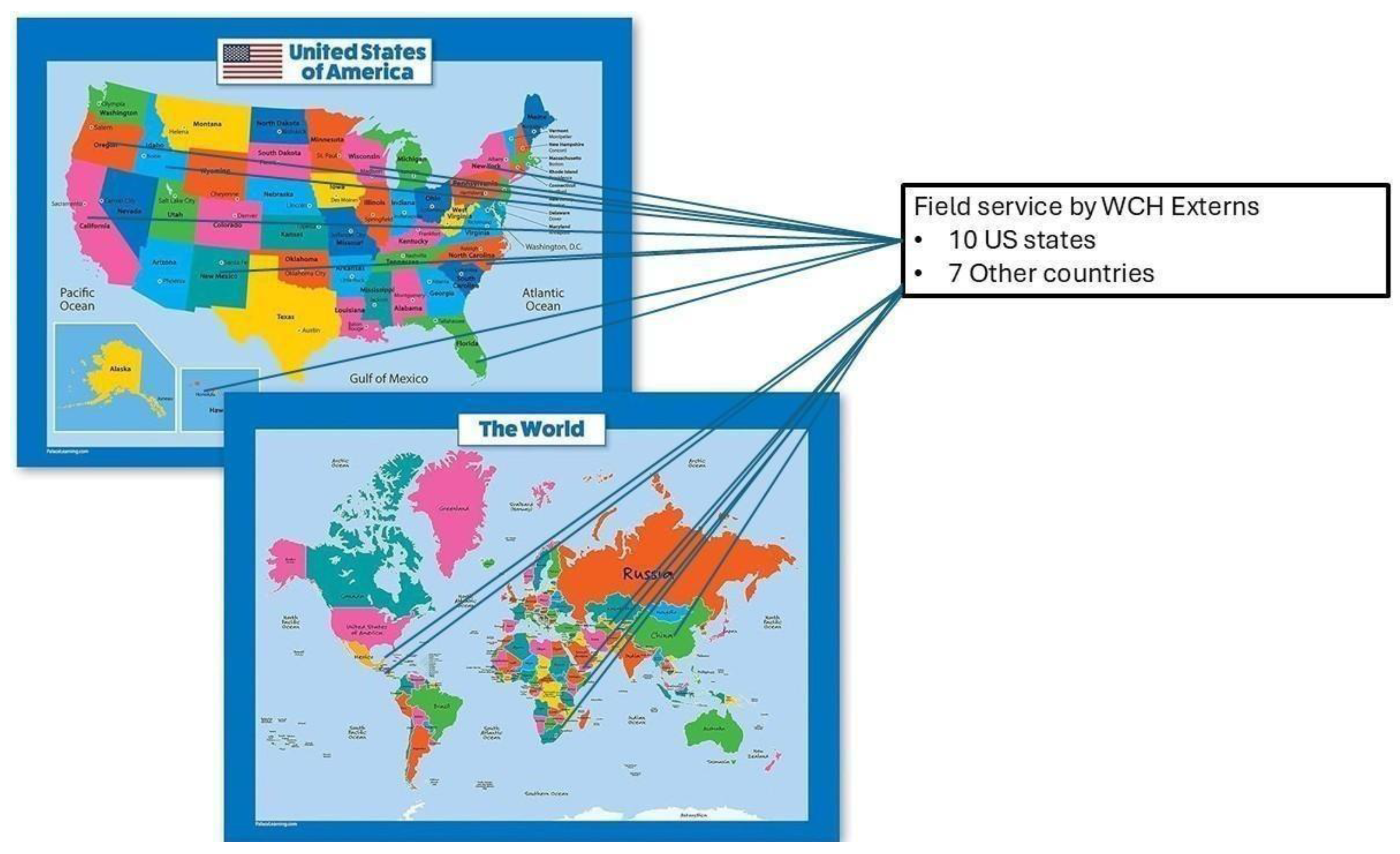

Table 1.
The WCH Curriculum, Historic (2016-2023) and New as of Fall ‘23.
| Core courses 9 cr | |||
| Historic | New (as of Fall ‘23) | ||
| Managed captive wildlife 3cr One Principles course: Wildlife Management 3cr, or Conservation Biology 3cr WCH Externship 3cr |
Managed captive wildlife 3cr One Principles course: Principles of Wildlife Management 3cr or Principles of Conservation Biology 3cr or Principles of Fisheries Science and Management 3cr WCH Externship 3cr |
||
| Exploratory courses 6 cr | |||
| Historic | New (as of Fall ‘23) | ||
|
Choose one of six animal care courses 3cr Animal Nutrition 3cr Companion Animal Anatomy 3 cr Fish Physiology and Behavior 3cr Introduction to Animal Behavior 3cr Primate Ecology and Social Behavior 3cr Small Animal Management 3 cr |
Choose at least 3 cr among 19 animal care courses Animal Behavior in the Field 4cr Animal Welfare and Ethics 3cr Applied Animal Behavior 3cr Animal Nutrition 3cr Belize: Rainforest to Reef- Wildlife Medicine and Conservation 3cr Borneo Global Seminar: Tropical Wildlife Conservation & Climate Change 3cr Coral Reef Ecology 3cr Diseases in Free-Ranging and Captive Wildlife 3cr Herpetology 3cr Ichthyology 3cr Introduction to Animal Behavior 3cr Introductory Concepts in Raptor Rehabilitation 1cr AND Intro to Raptor Reconditioning AND 1 Cr Directed Study Mammalogy 3cr Marine Animal Diversity Lab 1cr Ornithology 3cr Primate Ecology and Social Behavior 3cr Small Animal Management 3cr Thailand: Vertebrate Research Design and Field Survey Techniques 3cr Wildlife Handling and Immobilization 2cr AND 1 Cr Directed Study |
||
| Choose one of six advanced courses (3 cr) Aquaponics 3cr Basic Raptor Rehabilitation 2cr Requires 1 Cr Directed Study Disease in Captive and Free Ranging Wildlife 3cr Human Dimensions of Wildlife 3 Wildlife Handling and Immobilization 2cr, Requires 1 Cr Directed Study | |||
|
Choose at least 3 cr among 10 Human Dimensions courses American Indian Environmental Issues and Ecological Perspectives 3cr Communicating Food, Agriculture & Environmental Science to the Public 3c Conservation Decisions for a Sustainable Future 3cr Culturally Responsive Engagement in Agriculture, Food & Natural Resources 3cr Environmental Conflict Management, Leadership, and Planning 3cr Ethics in Natural Resources 3cr Human Dimensions of Wildlife 3 cr Interrelationships of People and Animals in Society Today 2cr, AND 1 Cr Directed Study Professional Communication for Agriculture, Food, and the Environment 3cr Tribal and Indigenous Natural Resource Management 3cr |
|||
| Fisheries and Wildlife | Animal Science | Environmental Science, Policy and Management | |
| Human Physiology | Ecology, Evolution and Behavior | Forestry and Natural Resource Management | |
| Biology | Cellular Physiology | Genetics and Cell Biology | |
| Political Science | Bioinformatics | Psychology | |
| Applied Economics | Sociology | Bachelors of Individual Studies | |
Disclaimer/Publisher’s Note: The statements, opinions and data contained in all publications are solely those of the individual author(s) and contributor(s) and not of MDPI and/or the editor(s). MDPI and/or the editor(s) disclaim responsibility for any injury to people or property resulting from any ideas, methods, instructions or products referred to in the content. |
© 2025 by the authors. Licensee MDPI, Basel, Switzerland. This article is an open access article distributed under the terms and conditions of the Creative Commons Attribution (CC BY) license (http://creativecommons.org/licenses/by/4.0/).
Copyright: This open access article is published under a Creative Commons CC BY 4.0 license, which permit the free download, distribution, and reuse, provided that the author and preprint are cited in any reuse.


