

Submitted:
12 December 2025
Posted:
15 December 2025
You are already at the latest version
Abstract
This study aimed to identify relationships between variables by integrating green consumption value (GCV), attitude toward foods, and brand evangelism for farm-to-table (FTT) foods in the context of green food tourism. Moreover, the study aimed to provide insights into the travel behaviour of tourists. The study sample comprised 473 South Koreans who participated in FTT events held in a rural area. Data analyses consisted of confirmatory factor analysis and structural equation modelling. Data analyses showed that health value had the greatest influence on attitude toward FTT foods, followed by emotional value, environmental consciousness, quality value, and social value. Moreover, a positive relationship was found between attitude toward FTT foods, purchase intention, and positive and oppositional brand referrals. In particular, the importance of health value, environmental consciousness, and social value, and the relationship between the sub-variables of brand evangelism, was a finding that differed from previous food tourism studies. Understanding tourists' consumption value for FTT foods in the context of green food tourism is crucial for effectively measuring tourist behaviour. However, the relationship between GCV, attitude toward foods, and brand evangelism for FTT foods has not yet been investigated. Suitably, this study is the first attempt to discuss these tourist behaviours.
Keywords:
farm-to-table foods
; green consumption value
; attitude toward foods
; brand evangelism
1. Introduction
Considering the growing demand for healthier and more environmentally friendly foods, farm-to-table (FTT) has become increasingly important [1]. FTT is a social movement that was organized to provide economic benefits to local communities, reduce the climate and environmental impact of growing food for human consumption, and improve the nutritional value and taste of food at the point of consumption [2]. The FTT movement emerged in response to the boom in fast food culture, which was perceived as a threat to local food traditions [3]. FTT is a simple yet powerful concept that involves bringing fresh and seasonal ingredients straight from local farms to the table. The movement involves keeping activities close to home, celebrating the bounty of each season, and savouring the flavours of locally grown produce [1].
The benefits of FTT practices include promoting sustainable agricultural practices and markedly reducing carbon footprints owing to FTT foods requiring shorter transport distances than those of food produced by corporate agriculture or imported from other countries [2]. FTT practices also strengthen local economies and provide tourists with fresher and healthier food options [4]. FTT practices treat food as both a subject and a medium for tourism, allowing tourists to experience the culture of a destination through food and drink. This form of tourism utilizes locally produced food and beverages to tell stories or convey specific aspects of local culture [5]. Accordingly, several independent FTT organizations promote local artisans, farmers, and regional flavours through local events, such as tasting workshops, wine and food tastings, and farmers' markets [3]. Therefore, FTT practices simultaneously benefit tourists the local economy, and small farms [2]. Therefore, this study focuses on FTT foods as a green food tourism resource.
Although food plays a role in the tourism industry, tourists have various needs and expectations regarding food consumption [6]. For the tourism and hospitality industries to effectively meet the culinary needs and wants of tourists, understanding destination-specific food-related consumption attitude and behaviour is crucial [7]. Therefore, investigating the importance of consumption value in shaping the attitude and behaviour of food tourists is crucial [8,9]. The theory of consumption value (TCV) proposed by Sheth et al. [10] provides insight into the motivations behind consumer consumption behaviour through consumption value [11]. TCV assumes that consumer preferences are influenced by multiple pre-consumption cues, namely the potential multidimensional consumption value of products or services [9,12]. These values also explain why customers favour specific products or decide not to purchase particular products or services [10]. Consumption value has also become a multi-dimensional entity utilized in food tourism literature [13]. Each dimension of consumption value enables predictions about the relationship between the choices and responses of tourists [11]. Furthermore, the more environmentally conscious the consumer, the more likely they are to purchase eco-friendly products that simultaneously protect the environment and develop green markets [14]. Based on the theory of reasoned action [15], De Silva et al. [16] argued that the extent to which consumers perceive the green benefits of a product and convert them into purchase intentions depends on differences in consumption value. They proposed environmental consciousness, status consciousness, and value-for-money consciousness as individual consumption value when purchasing green products. Subsequently, Chen and Peng [17] analysed consumer purchase behaviour toward green hotels by applying the three factors proposed by De Silva et al. [16] to consider the influence of green consumption value. Therefore, this study proposes a green consumption value (GCV) theory that combines the theories of Sheth et al. [10] and De Silva et al. [16] in the context of green food tourism.
The value-attitude-behaviour (VAB) theory proposed by Homer and Kahle [18] assumes that value possess unique dimensions and play a crucial role in the evolution of attitudinal and behavioural tendencies [19]. In the context of food tourism, consumption value is highly correlated with attitude [8,9,12,20]. Therefore, understanding the relationship between the multidimensional value perception and attitude of tourists toward FTT foods consumption in the context of green food tourism is important. Furthermore, attitude is a key antecedent of consumer intention, which in turn influences actual consumption behaviour [21]. Moreover, a substantial correlation between attitude and purchase intention (behavioural intention) has been observed [22]. This relationship between value, attitude, and behavioural intention is based on the VAB model, which describes the sequential relationships between constructs [18,23].
Matzler et al. [24] argued that focusing solely on word-of-mouth fails to capture customer behaviour and their power to persuade others about their preferred brands. Brand evangelism has emerged as an important concept in consumer-brand relationship research [25]. Brand evangelism refers to actively and enthusiastically promoting a brand and persuading others to engage with the brand [26]. Although some similarities exist between the definitions of brand loyalty and brand evangelism, many believe that the terms are distinct [27]. Although both evangelism and loyalty require an emotional attachment between a customer and a product/brand, evangelism requires a much stronger bond [28]. Brand evangelism influences customers and provides financial benefits to companies by outperforming traditional word-of-mouth advertising [29]. Moreover, brand evangelism is an intense form of brand-related behaviour, including brand purchase intention, providing positive referrals regarding the brand, and issuing disparaging comments about opposing brands [30]. Therefore, in-depth research exploring multidimensional GCV, attitude toward food, and factors leading to brand evangelism is required.
Recognizing the food-related behaviours of tourists is essential for effective marketing strategies [31]. Consuming local food evokes emotional, epistemological, functional, and sociological responses that motivate tourists to visit, revisit, and recommend destinations to others [20]. Moreover, TCV-based studies [8,9,11,12] have investigated the relationship between tourists' multidimensional consumption values, attitude, and behavioural intention toward local food. Previous studies have recognized the significance of motivations in analysing tourists' local food consumption behaviour; however, these studies have focused more on specific types of cuisine or festivals [20]. The complex interactions between consumption value for green local food and tourist behaviour remain unexplored. In addition, in the context of green food purchases, previous studies used TCV [32], Haws et al. [33]'s green consumption values [34], and VAB [19] that were modified according to the studies and used as single or multidimensional. However, these studies fail to reflect consumer environmental consciousness. To overcome this limitation, this study proposes a GCV by adding environmental consciousness to TCV.
Brand evangelism, where customers become enthusiastic advocates and promoters of a brand, is a crucial behavioural variable for achieving long-term success [35]. However, few studies have applied brand evangelism from a food consumption value perspective. To fill this research gap, this study aims to identify the relationships among variables by integrating the GCV, attitude, and brand evangelism of tourists toward FTT foods in the context of green food tourism. This study design is not found in previous studies. These results will provide insights into the GCV of tourists toward FTT foods and their tourism behaviour. Therefore, the GCV, which broadens the TCV used in existing tourism literature, makes a theoretical contribution to food tourism literature. Furthermore, this study highlights the importance of FTT foods as a tourism resource and provides stakeholders in relevant fields with powerful practical implications that guide the development of destination marketing strategies.
2. Literature Review and Hypotheses
2.1. Green Consumption Value
The TCV introduced by Sheth et al. [10] has been widely applied in marketing and consumer behaviour, suggests that consumer perceived value determines purchase decisions, product type selection, and brand selection. Therefore, this theory explains why customers prefer certain products and prefer one product type over another [11]. Specifically, the TCV has been applied in studies [19,32,36,37] investigating the factors influencing choice behaviour for green and organic foods. The theory has also been used to understand tourist purchasing behaviour in green hotels and restaurants [37,38]. In a green context, consumption value is the overall appraisal of the net benefit of a product or service between what is received and what is given based on the environmental desires, sustainable expectations, and green needs of the consumer [39]. Furthermore, in the context of food consumption, GCV refers to an individual's desire to consume foods that meet their expectations in terms of the environment and sustainability [34]. Thus, GCV is considered an important factor that guides consumer behaviour and preferences for green goods and services [40].
TCV assumes that consumer choice behaviour is influenced by multiple consumption values, such as functional, social, emotional, epistemic, and conditional value, each of which contributes differently [8]. First, functional value is the perceived utilitarian value of green products or services, which provide economic or tangible benefits [39]. The definition of functional value is broad; therefore, the term has been conceptualized interchangeably as quality and price value, and other specific functional or utilitarian characteristics (e.g., health benefits) [8]. Quality value reflects sensory attributes, such as taste, appearance, and freshness of food, whereas health value encompasses food safety, nutrition, and healthful attributes [41]. Consumers are willing to pay a premium for green products to maintain personal and social benefits. However, this must be accompanied by quality maintenance [38] because consumers desire high-quality food at a reasonable price [39]. Second, in the context of green products, social value is the perceived net utility gained from consuming green products, driven by social pressure or status enhancement [37]. Social values that motivate green food purchases include consumer self-image, such as social approval and self-identity, and utilitarian motivations, such as reducing environmental pressure, supporting local farmers, and animal welfare [41]. Furthermore, social value is also related to interpersonal interactions [9]. Choe and Kim [8] explain that an important travel experience for tourists is enjoying food in a natural environment while interacting with friends and relatives. Third, emotional value is the perceived net utility derived from a product's ability to evoke emotions or affective states [10,37]. Tourists consume food for energy and emotional enjoyment. In particular, when choosing to consume local foods that deviate from their usual diet, tourists often expect to receive positive emotional benefits [8]. Fourth, epistemic value is the perceived usefulness of a product's ability to stimulate curiosity and novelty, or satisfy the need for knowledge [10,41]. Consuming green products stimulates novelty and curiosity in consumers and satisfies their need for knowledge [38]. Furthermore, curiosity, novelty, and knowledge is enhanced by travelling to other regions, and consuming local food is particularly likely to provide epistemic value [8]. Fifth, conditional value is the perceived utility acquired by an alternative due to the specific situation or set of circumstances facing the choice maker [38]. These specific situations include the availability of subsidies or discounts on green products, easy and nearby availability of green products, and the purchase of the green product under worsening environmental conditions [37].
Consumer concerns for the environment and nature appear to be a key antecedent of green consumption because individuals tend to view environmental issues [23], such as global warming and climate change, differently based on their beliefs and values [17]. De Silva et al. [16] applied environmental consciousness, status consciousness, and value-for-money consciousness as consumption values to identify the relationship between a product's green benefits and consumer purchase intentions. Environmental consciousness is an individual's desire to protect and preserve the environment and represents environmentally-related intentions [16]. Status consciousness is a consumer's desire to enhance their status and social image by purchasing eye-catching products [17]. Value for money reflects a concern for paying low prices, subject to some quality constraints [16]. Status consciousness aligns with social value in TCV, and value for money is identical to price value. Therefore, the key variables of GCV applied in this study were adjusted to fit the FTT context by adding environmental consciousness to TCV. Based on recent research on eco-friendly and food tourism, this study ultimately included environmental consciousness as well as quality, health, price, social, emotional, and epistemic value in the GCV of tourists.
2.2. Relationship Between Green Consumption Value and Attitude Toward FTT Foods
Attitude is the degree to which an individual evaluates or judges a behaviour favourably or unfavourably and is an accurate predictor of the intention to perform a specific behaviour [42,43]. In a green context, attitude is the extent to which consumers hold favourable or unfavourable feelings toward environment-related issues [44]. Specifically, attitude refers to evaluations of specific green products or behaviours, such as choosing green products, visiting green hotels, or choosing organic food [45]. The reasons for tourists choosing a destination's local food include a desire for fresh and delicious food, support for the local community, environmental protection, and health benefits [46]. In this regard, considering food value is a useful approach for evaluating studies on consumer decision-making processes related to food [46].
In the context of food tourism and green, previous studies have concluded that consumption value influences consumer attitudes and environmental behaviours. The quality of tourists' dining experiences, particularly the taste of the food, sensory aspects of the food, and the variety and quality of the food event, are fundamental in shaping positive attitudes [8]. Additionally, food taste, quality, and health value contribute to forming a more favourable impression and image of a tourist destination and increase positive food tourism behaviour [11]. Similarly, taste, safety, health, and morality are key value evaluations that drive organic food purchases compared with those of conventional foods [47,48].
Although food quality is assessed based on taste, freshness, and presentation, perceptions of fair or affordable prices also positively influence consumer associations [46]. Furthermore, price is crucial for healthy food purchase decisions, as consumers simultaneously evaluate price and quality when making purchase decisions [49]. In the context of food tourism, several studies [12,20,50] have identified price as a prerequisite for attitude toward food.
Consumers driven by social values choose products that reflect the norms of their friends and peers or convey the social image they wish to project [8,10]. This involves social perception, pressure, and approval, which are shaped by interpersonal interactions that drive product choice [19,51]. Social value is derived from consumption, whereas traveling has been identified as a crucial antecedent of individual attitudes and behaviours in hospitality and tourism contexts [9,12]. Simply, the more an individual's evaluation of local food consumption consistently aligns with their personal values, the more favourable their attitude toward the food served in that restaurant will be [46].
Emotional value plays a crucial role in shaping tourists' attitudes toward a destination. Emotional value determines whether consumers are satisfied with their dining experiences during and after their trip and predicts their likelihood of revisiting the destination in the future [9]. Furthermore, in the realm of green consumption, emotional value plays a crucial role in consumer decision-making processes [52]. According to Gupta et al. [20], the emotional value of food served in Delhi is particularly emphasized because it can considerably alter perceptions of Persian food as a tourist attraction.
Epistemic value is associated with curiosity and novelty, which satisfies the need for knowledge [10,49]. The epistemic value substantially influences tourists' food experiences at destinations [53]. According to Choe and Kim [8], epistemic value stimulates tourists' interest in learning about the local culture. Furthermore, epistemic value is more important in other Asian and Western groups than in Chinese groups. Therefore, epistemic value is a crucial prerequisite for shaping tourists' positive cognitive responses and attitudes [11].
Environmental consciousness has become a human value that reflects an individual's perception, value judgment, and beliefs in minimizing environmental damage [14]. Therefore, individuals with a high level of environmental consciousness demonstrate greater environmental commitment attitudes [54]. Furthermore, consumers are more willing to purchase green products with fewer harmful impacts on society [55]. In certain contexts, such as ecotourism, tourists' environmental concerns substantially influence the specific context in which human concerns are activated [54]. Existing studies agree that environmental consciousness directly influences tourists' attitudes and decision-making processes toward local food. According to Shin et al. [43], consumers who are concerned about environmental issues and have good knowledge of environmental impacts have a positive attitude toward visiting local restaurants. Based on the existing discussion, the following hypotheses are proposed:
Hypothesis 1a (H1a). Quality value has a positive effect on attitude toward FTT foods.
Hypothesis 1b (H1b). Health value has a positive effect on attitude toward FTT foods.
Hypothesis 1c (H1c). Price value has a positive effect on attitude toward FTT foods.
Hypothesis 1d (H1d). Social value has a positive effect on attitude toward FTT foods.
Hypothesis 1e (H1e). Emotional value has a positive effect on attitude toward FTT foods.
Hypothesis 1f (H1f). Epistemic value has a positive effect on attitude toward FTT foods.
Hypothesis 1g (H1g). Environmental consciousness has a positive effect on attitude toward FTT foods.
2.3. Relationship Between Attitude toward FTT Foods and Purchase Intentions of Brand Evangelism
The concept of evangelism has transcended its religious origins and gained prominence in business and marketing, particularly during the Internet boom of the late 1990s [56]. Matzler et al. [24] described brand evangelism as a more active and dedicated way to spread positive opinions and enthusiastically persuade others to engage with a brand [30]. In marketing, brand evangelism has birthed brand evangelists [56] that freely and passionately spread positive information, emotions, and ideas about a particular brand to influence the consumption behaviour of others [27]. Brand evangelism, rooted in persuasive missionary elements, is an extreme form of word-of-mouth that goes beyond simply talking about a preferred brand [30,57]. Simply, brand evangelism simultaneously spreads positive word-of-mouth and discourages others from purchasing competing brands [27]. Brand evangelism differs from traditional brand advocacy because it involves a deeper emotional investment and missionary-like passion that fosters extreme loyalty extending beyond the transactional relationship [58]. Therefore, brand evangelism generates a greater and more effective customer response than word-of-mouth [25].
Becerra and Badrinarayanan [30] adopted a multidimensional approach by characterising brand evangelism into three dimensions: brand purchase intention, positive brand referrals, and oppositional brand referrals [58]. From a pro-environmental perspective, purchase intention is the ability and desire of a consumer concerned about environmental issues to choose a green product instead of a conventional product [59]. Positive brand endorsement is an active behavioural support for a brand by spreading favourable opinions and recommendations and actively persuading others to use the brand [25,58]. Oppositional brand referrals is a negative opinion of a competing brand, thereby implying negative feelings toward the competing brand stemming from loyalty to a specific brand [60].
Attitude is a powerful indicator of consumer intentions and behaviours, and people with positive attitudes toward a particular behaviour are more likely to engage in that behaviour [21,61]. Similarly, tourists' positive attitudes toward food services/products are generally associated with positive behavioural intentions [12]. Specifically, tourists who have positive experiences with local cuisine are more likely to try local food again and recommend it to others [11]. Most studies have found that attitudes toward food influence behavioural intentions. Ryan and Cassidy [21] and Kamboj and Kishor [19] applied the rarely used VAB model to explore organic food consumption behaviour and identify the relationships between variables. In the context of food tourism, attitude toward food has also been reported as an important antecedent of behavioural intention [8,9,11,20]. Mohammad et al. [11] found that consumption and experiential value strengthen attitudes toward local foods and enhance behavioural intentions. Therefore, the following hypothesis was proposed:
Hypothesis 2 (H2). Attitude toward FTT foods has a positive effect on purchase intention.
2.4. Relationship Between Sub-Variables in Brand Evangelism
In today's competitive and saturated business environment, brand evangelism has become an organization's most important tool [35,57]. In the tourism context, destination evangelism refers to the passionate promotion and advocacy of a specific destination, driven by strong personal or cultural attachments and the desire to share positive experiences [56] . Theoretical and empirical insights into tourism and green fields support the importance of brand evangelism [58]. Sohaib et al. [62] explored the role of nature-based solutions in green hotels and found that mental health, green brand attitude, green brand loyalty, and emotional well-being considerably impacted brand evangelism. According to Li et al. [55], green purchasing intention has the most notable impact on brand evangelism; hence, investing in evangelists who spread green messages is required to improve environmental sustainability.
Strong correlations have been found between the subfactors of brand evangelism, as consumers prefer to purchase specific branded products and services and communicate with other consumers [55]. Becerra and Badrinarayanan [30] found that purchase intention was a crucial antecedent of both positive brand referrals and oppositional brand referrals. They argued that consumers with strong purchase intent were more likely to become voluntary salespeople and engage in behaviours that benefit the brand. According to Maduranga Arachchi and Samarasinghe [63], consumers with strong purchase intentions are more likely to purchase a brand, provide positive recommendations, and persuade others to not purchase competing brands. They argued that purchase intentions simultaneously predict actual purchase behaviour and serve as key factors in converting consumers into brand activists. Swimberghe et al. [64] suggest that customers can evangelize for a restaurant by inviting other customers, sharing positive experiences, and revising negative customer reviews. Accordingly, the following hypotheses are proposed:
Hypothesis 3 (H3). Purchase intention has a positive effect on positive brand referrals.
Hypothesis 4 (H4). Purchase intention has a positive effect on oppositional brand referrals.
All the hypotheses are in the research model, depicted in Figure 1.
3. Methodology
3.1. Research Instrument
All variables in this study were adopted from existing literature and measured with items modified to fit the context of FTT foods. The thirty-one items of GCV were cited from Choe and Kim [8], Woo and Kim [32], Roh et al. [39], Chen and Peng [17], and Gupta et al. [20]. These included environmental consciousness, as well as quality, health, price, social, emotional, and epistemic value. The four items of attitude toward FTT foods were cited from Woo and Kim [32] and Kamboj and Kishor [19]. The nine items of brand evangelism were cited from Woo and Kim [32] and Guanqi and Nisa [26]. These items included purchase intention), positive brand referrals, and oppositional brand referrals. The measured items were used on a 5-point Likert-type scale ranging from strongly disagree (1) to strongly agree (5).
3.2. Sampling and Data Collection
The study population comprised domestic tourists who had visited other regions of Korea for food tourism purposes. Among the population, domestic tourists aged 20 years or older who had participated in FTT events held in a rural area within the past three months during their food tourism experience were selected. An FTT event is a tourism event that allows consumers to visit farms that grow agricultural products using eco-friendly farming methods and experience farm dining and various other experiences. Data collection was conducted online by ENTRUST, a global online research company, from April 1 to 30, 2025. Respondents were administered two screening questions before being invited to participate in interviews: “Do you know about FTT?” and “Have you participated in an FTT event and had a dining experience within the past three months?” The survey was terminated if the respondent answered “No” to either question. Of the 8,000 respondents, 512 answered “Yes” to both questions. The research company explained the purpose of the study to the 512 respondents and obtained their informed consent before conducting the survey. Of the 512 questionnaires collected, 473 valid questionnaires were used for analysis after removing incomplete and unusable responses.
The demographic characteristics of the sample were examined and specified as follows:47.6% of the respondents were male and 52.4% were female; 9.5% of the respondents were between 20 and 29, 17.3% were between 30 and 39, 25.8% were between 40 and 49, and 28.5% were between 50 and 59 years old. The majority of the respondents (51.6%) had obtained at least four-year university degree; 37.8% had an average monthly income of USD 5000–5999, 30.9% between USD 4000–4999, and 14.8% between USD 3000–3999. Lastly, 40.0% were office workers, 33.0% were professionals, and 15.2% were self-employed.
3.3. Data Analysis
SPSS 25.0 and AMOS 25.0 were used for data analysis. The two-step approach (measurement model and structural model assessment) of Anderson and Gerbing [65] was used for hypothesis testing. First, confirmatory factor analysis (CFA) was performed to test the adequacy of the measurement model and to evaluate convergent and discriminant validity. Thereafter, structural equation modelling (SEM) was performed to test the hypotheses among the 11 constructs proposed in the research model.
4. Results
4.1. CFA of the Measurement Model
The fit of the measurement model was assessed via CFA. Seven common model fit measures, including χ2/df < 3, GFI > 0.90, RMSEA < 0.08, RMR < 0.08, NFI > 0.9, IFI > 0.9, and CFI > 0.9, were used to estimate the measurement model fit (Hair et al., 2016). Table 1 shows the CFA results. The measurement model fit the data (χ2 = 1475.587, df = 781, χ2/df = 1.889, RMR = 0.032 GFI = 0.878, NFI = 0.868, IFI = 0.933, CFI = 0.932, and RMSEA = 0.043). The reliability of the constructs was evaluated using Cronbach’s Alpha (α) scores, which ranged between 0.694–0.890, which is above the value of 0.7 for basic requirements [66]. Additionally, the measurement model was evaluated to verify the convergent validity and discriminant validity. First, the average variance extracted (AVE) of the constructs ranged from 0.590 to 0.789, which was greater than the minimum threshold of 0.50 suggested by Hair et al. [67]. In addition, the composite reliabilities of the constructs were greater than 0.70, indicating that all constructs of the model had acceptable internal consistency. Therefore, convergent validity was achieved for each construct [67] (see Table 1). Second, to evaluate discriminant validity, the AVE for each construct was compared with the squared correlation coefficients for the corresponding constructs. The AVE for each construct was higher than the squared correlation coefficients for its corresponding constructs (see Table 2), thereby supporting discriminant validity [68].
4.2. Structural Model Hypothesis Testing and SEM
To test the hypotheses established using the SEM path coefficients, the fit of the structural model describing the relationships among constructs was assessed. The model fit indices were χ² = 1591.024, df = 797, p = 0.000, χ²/df = 1.996, RMR = 0.036, GFI = 0.867, NFI = 0.857, IFI = 0.923, CFI = 0.923, and RMSEA = 0.046, thus meeting the standard assessment criteria. The result of each hypothesis test describing the causal relationship between any pair of constructs is presented in Table 3. Quality value (β=0.177, p=0.000), health value (β=0.364, p=0.000), social value (β=0.176, p=0.006), emotional value (β=0.240, p=0.000) positively and significantly influenced attitude toward FTT foods. Thus, H1a, H1b, H1d, H1e, H1g were supported. In contrast, price value (β=-0.036, p=0.291) and epistemic value (β=0.034, p=0.518) did not significantly influences attitude toward FTT foods. Thus, H1c and H1f were not supported. Attitude toward FTT foods (β=0.962, p=0.000) positively and significantly influenced purchase intention. Thus, H2 was supported. Purchase intention positively and significantly influenced positive brand referrals (β=0.798, p=0.000), and oppositional brand referrals (β=0.555, p=0.000). Thus, H3 and H4 were supported.
5. Discussion
The results of the data analysis, first, quality value positively influenced attitude toward FTT foods. These results support previous studies in which tourists visiting a specific region developed favourable attitude toward local food that they perceived to have good taste or quality value [8,12,20]. Therefore, in the context of FTT food consumption, food quality is an important part of tourists' consumption value, similar to non-green food.
Second, health value positively influenced attitude toward FTT foods. This indicates that food made from agricultural products grown on local farms was perceived as healthy and safe by tourists and played a key role in forming positive attitude. These results support those of previous studies which found that overall evaluations of local food were influenced by their health value [12,20].
Third, although price value was non-significant, it had a negative effect on attitude toward food. However, because the mean value for price was below the median, price and attitude toward food could be interpreted as having a positive relationship. This finding supports those of previous studies [12,20,50]. Hence, tourists who attended the FTT event may have believed that the prices of the FTT foods were reasonable.
Fourth, social value positively influences attitude toward FTT foods. Surprisingly, this finding contradicts those of previous studies [8,20,50]. Choe and Kim [8] found that Westerners emphasized the pleasure of enjoying local food and interacting with friends and relatives in Hong Kong. Gupta et al. [20] found that different tourism products may be associated with different prestige levels depending on the visitor's cultural background, and this background may or may not be associated with local food. This study found that tourists gained prestige and strengthened their friendships with their companions through FTT food experiences. This result is interpreted as being unrelated to the cultural and ethnic background issues discussed in a previous study [20], as the tourists who participated in the green FTT event were Korean.
Fifth, emotional value positively influenced attitude toward FTT foods. This finding supports those of previous studies [8,12,20]. This indicates that tourists can experience happiness, enjoyment, and positive emotions while eating FTT food. Gupta et al. [20] also highlighted that the emotional value of cuisine served in Delhi, India, as a tourist attraction, could markedly alter visitors' perceptions of Persian foods.
Sixth, epistemic value did not significantly influence attitude toward FTT foods. This result contradicts the findings of a previous study in which tourists valued food in Hong Kong because it stimulated their interest in learning about the local culture [8]. However, FTT food events and restaurants are not yet active in South Korea. Therefore, FTT events do not satisfy tourists' intellectual needs.
Seventh, environmental consciousness positively influenced attitude toward FTT foods. This implies that tourists' environmental consciousness is further strengthened when eating FTT green foods. These results were consistent with those of a previous study that revealed that Americans with high environmental awareness and concern tended to visit restaurants that use local ingredients [43].
Eighth, attitude toward FTT foods positively influenced purchase intention. This supports previous studies [11,19,21,69] that identified attitude as a major antecedent of purchase and visit intention in the context of general food tourism and green food purchases. This implies that tourists who develop favourable attitudes toward FTT foods are more likely to reattend FTT events or visit FTT restaurants in their residential areas.
Ninth, purchase intention positively influences positive brand referrals and oppositional brand referral. This implies that tourists who develop a heightened purchase intention toward FTT foods during green food tourism will likely spread strong word-of-mouth about FTT foods and restaurants and may exhibit strong anti-brand behaviour toward non-green food or restaurants.
5.1. Theoretical Implications
First, green tourism advocates for minimizing local environmental damage and promoting cultural benefits for local residents [70]. Furthermore, local green tourism creates new jobs, improves the quality of life for local residents, preserves natural and cultural values, and creates new recreational and leisure spaces [71]. Despite the importance of green tourism, previous studies [8,9,12,20] identified relationships between consumption value and tourist behaviour variables. However, these studies neglected the green dimension. To fill this research gap, this study focused on FTT foods in the context of green food tourism and investigated tourists' perceived consumption values and behaviours. Therefore, this study is academically crucial in that it expands the subject matter and scope of the study, unlike previous studies that conducted food tourism research using general local food.
Second, to address the limitations of the aforementioned studies, a literature review was conducted and the study proposed a new GCV that adds environmental consciousness to the TCV (quality, health, price, social, and epistemic value) proposed by Sheth et al. [10]. Furthermore, the study verified the fit of the research model by integrating it with other variables (attitude toward FTT foods, purchase intention, positive brand referrals, and oppositional brand referrals). This theoretical GCV framework, which broadens TCV, can be applied in future green food tourism and green food purchasing. Therefore, this study theoretically contributes to the literature.
Third, brand evangelism, a type of advanced marketing in which consumers voluntarily participate in green brand promotion, was applied as a dependent variable to measure the behaviour of powerful tourists. In some studies [35,56,62] that applied brand evangelism in the tourism and hospitality sector, brand evangelism was structured as a single dimension. Moreover, previous studies [8,9,12,20,50] identified relationships among variables with consumption value, attitude, and behavioural intention as key pathways. However, this study included brand evangelism as purchase intention, positive brand referrals, and oppositional brand referrals to verify tourists’ strong loyalty. Ultimately, in the context of green food tourism, this study designed a model that integrated GCV with FTT foods, attitude toward foods, and brand evangelism and identified the relationships among the variables. This design is a novel attempt that cannot be found in previous TCV-based food tourism studies.
5.2. Practical Implications
First, the health benefits perceived by FTT event participants should be prioritized. Considering that farms already cultivate their produce using eco-friendly methods, event planners should emphasize the health benefits when promoting events. Additionally, farm restaurants should also provide menu and ingredient descriptions and nutritional information to ensure that tourists fully perceive the health benefits while dining. FTT events, which are primarily held in rural areas, are a valuable resource for both farmers and local tourism. Local governments should establish policies that ensure the health and quality of FTT foods. Such policies include the introduction of farm restaurant certification systems where local restaurants that use a certain percentage of ingredients are officially certified as farm restaurants. In addition, local governments can provide promotional opportunities, tax incentives, and priority access to public procurement in certified restaurants. Local governments should actively promote FTT food and farm restaurant certifications to revitalize the local economy through FTT events.
Second, FTT events should evoke pleasant emotions in tourists, and FTT restaurants should strive to improve the taste and quality of their food products. These restaurants should develop unique menus utilizing healthy farm ingredients and local specialties, ultimately offering a dining experience unmatched by popular urban restaurants. Additionally, FTT events should plan and offer a variety of farm experience programs beyond dining. For example, participating in simple farm work or participating in the growth of vegetables and grains could be beneficial programs. Accordingly, this study also proposes programs that involve cooking using healthy ingredients and making of traditional South Korean sauces. In particular, if the healthy cooking program includes dishes that tourists can make at home, they will naturally continue to purchase the farm's produce and strongly recommend it to others. To achieve this, farm managers will need to establish an online distribution system that allows them to communicate directly with consumers. These FTT experience programs will increase the interaction value of tourists by allowing them to spend enjoyable time with their companions (e.g., family, friends, lovers) and will also strengthen their willingness to participate again. To vitalize these programs, integrated local government policies are needed rather than simply hosting once-off FTT events at specific farm restaurants. Local governments should establish a local food tourism strategy that integrates local food, rural tourism, the restaurant industry, and cultural tourism and designate food tourism clusters based on local ingredients and traditional cuisine.
Third, stakeholders should also inform tourists that consuming FTT foods increases their environmental contribution. For example, FTT foods minimize travel distance from farm to table, thereby reducing carbon emissions during transportation and contributing to a healthier planet. By promoting the use of locally sourced, indigenous ingredients, FTT foods promote biodiversity conservation and support the preservation of traditional agricultural practices, thereby contributing to ecosystem resilience. To achieve this, a consultative committee comprising local governments, tourism organizations, FTT restaurants, and farmer groups should be formed. This committee should establish sustainability criteria to assess local economic contributions and carbon footprint reduction. For example, legal protection of local ingredients should be strengthened through the implementation of geographical indications and local brand registration systems. These local initiatives will help increase the environmental consciousness of tourists and raise awareness of the importance of FTT practices. These environmental contributions will also enhance tourist social value.
6. Conclusions
This study investigated the effect of tourists' GCV toward FTT foods on their attitude toward FTT foods, purchase intentions, positive brand referrals, and oppositional brand referrals in the context of green food tourism. The study clarifies how tourists’ GCV toward FTT foods influences their behaviour and reveals novel results that differ from those of non-green food tourism research. In particular, the health benefits of FTT foods strongly influenced tourists' attitude toward foods. In the context of green food tourism, emotional and quality value were also identified as important consumption values. However, social and epistemic values show contradictory results from previous studies. Additionally, the influence of environmental consciousness on attitude toward FTT foods is a novel finding that has not been investigated in previous studies. Although a few tourism studies [54,69] a moderating effect of environmental consciousness was found, this study confirmed its direct effect on attitude toward foods as a sub-factor of consumption value. These results demonstrate that the dimensions of value considered by tourists in green and non-green food tourism differ considerably. Positive purchase intentions shaped by attitude toward FTT foods positively influenced both positive and opposing brand referrals. To obtain strong brand evangelism from tourists, it is important to enhance attitude toward FTT foods by strengthening health, quality, social, emotional, and environmental consciousness. The novel findings of this study provide valuable insights for researchers and stakeholders in the local tourism industry.
7. Limitations and Future Research
This study presents the following limitations and future research directions. First, the data used in this study were only collected in South Korea, which may limit the generalizability of the results. Because the demand for FTT foods tourism may vary across countries, the applicability of the results to other countries is limited. Second, given the paucity of studies exploring consumption value in green food tourism, the initial variables of TCV and environmental consciousness were applied based on previous studies on local food tourism. This may limit the ability to understand the behaviour of tourists who experience FTT foods. In addition to these constitutive variables, other variables may influence tourists' attitude toward FTT foods and behaviours. Therefore, future researchers could gain more comprehensive insights by further modifying TCV to accommodate various green food tourism situations.
Author Contributions
S.J.K. and H.M.J. conceived and designed the experiments; S.J.K. performed the experiments and analyzed the data; S.J.K., J.K.K., and H.M.J. wrote the paper. All of the authors have read and agreed to the published version of the manuscript.
Funding
Funding for this paper was provided by Namseoul University.
Institutional Review Board Statement
Not applicable.
Informed Consent Statement
Not applicable.
Data Availability Statement
The data presented in this study are available upon request from the corresponding author.
Conflicts of Interest
The authors declare no conflicts of interest.
References
- Informamarkets. What is Farm to Table. Available online: https://foodnhotelasia.com/glossary/fnb/farm-to-table/ (accessed 3 August 2025).
- Wilson, D. Chemical sensors for farm-to-table monitoring of fruit quality. Sensors 2021, 21, 1634. [Google Scholar] [CrossRef]
- Musa, S.F.P.D.; Chin, W.L. The role of farm-to-table activities in agritourism towards sustainable Development. Tour. Rev. 2022, 77, 659–671. [Google Scholar] [CrossRef]
- Elshaer, I.A.; Azazz, A.M.S.; Hassan, S.S.; Fayyad, S. Farm-to-fork and sustainable agriculture practices: perceived economic benefit as a moderator and environmental sustainability as a mediator. Sustainability 2023, 15, 11462. [Google Scholar] [CrossRef]
- Kuo, T.M.; Liu, C.R.; Wang, Y.C.; Chen, H. Sensory experience at farm-to-table events (SEFTE): conceptualization and scale development. J. Hosp. Mark. Manag. 2024, 33, 169–189. [Google Scholar] [CrossRef]
- Naruetharadhol, P.; Gebsombut, N. A bibliometric analysis of food tourism studies in Southeast Asia. Cogent Bus. Manag. 2020, 7, 1733829. [Google Scholar] [CrossRef]
- Cheng, Q.; Huang, R. Is food tourism important to Chongqing (China)? J. Vacat. Mark. 2016, 22, 42–54. [Google Scholar] [CrossRef]
- Choe, J.Y.J.; Kim, S.S. Effects of tourists’ local food consumption value on attitude, food destination image, and behavioral intention. Int. J. Hosp. Manag. 2018, 71, 1–10. [Google Scholar] [CrossRef]
- Soltani, M.; Soltani Nejad, N.; Taheri Azad, F.; Taheri, B.; Gannon, M. J. Food consumption experiences: a framework for understanding food tourists’ behavioral intentions. Int. J. Contemp. Hosp. Manag. 2021, 33, 75–100. [Google Scholar] [CrossRef]
- Sheth, J.N.; Newman, B.I.; Gross, B.L. Consumption values and market choices: theory and applications.; South-Western Pub: Cinicinnati, OH, 1991. [Google Scholar]
- Martinez-Ruiz, M.P.; Ruiz-Palomino, P.; Izquierdo-Yusta, A.; Pick, D. The influence of food values on satisfaction and loyalty: evidence obtained across restaurant types. Int. J. Gast. Food Sci. 2023, 33, 100770. [Google Scholar] [CrossRef]
- Rousta, A.; Jamshidi, D. Food tourism value: investigating the factors that influence tourists to revisit. J. Vacat. Mark. 2019, 26, 73–95. [Google Scholar] [CrossRef]
- Kaur, P.; Dhir, A.; Talwar, S.; Ghuman, K. The value proposition of food delivery apps from the perspective of theory of consumption value. Int. J. Contemp. Hosp. Manag 2021, 33, 1129–1159. [Google Scholar] [CrossRef]
- Cheung, M.F.J.; To, W.M. An extended model of value-attitude-behavior to explain Chinese consumers’ green purchase behaviour. J. Retail. Consum. Serv. 2019, 50, 145–153. [Google Scholar] [CrossRef]
- Fishbein, M.; Ajzen, I. Belief, attitude, intention, and behavior: an introduction to theory and research; Addison-Wesley: Reading, MA, 1975. [Google Scholar]
- De Silva, M.; Wang, P.; Kuah, A.T.H. Why wouldn’t green appeal drive purchase intention? Moderation effects of consumption values in the UK and China. J. Bus. Res. 2021, 122, 713–724. [Google Scholar] [CrossRef]
- Chen, A.; Peng, N. Antecedents to consumers’ green hotel stay purchase behavior during the COVID-19 pandemic: the influence of green consumption value, emotional ambivalence, and consumers’ perceptions. Tour. Manag. Persp. 2023, 47, 101107. [Google Scholar] [CrossRef] [PubMed]
- Homer, P.M.; Kahle, L.R. A structural equation test of the value-attitude-behaviour hierarchy. J. Personal. Soc. Psychol. 1988, 54, 638–646. [Google Scholar] [CrossRef]
- Kamboj, K.; Kishor, N. Influence of customer perceived values on organic food consumption behaviour: mediating role of green purchase intention. FIIB Bus. Rev. 2022, Online Published. [CrossRef]
- Gupta, V.; Galati, A.; Sharma, S. Explore, eat and revisit: does local food consumption value influence the destination’s food image? British Food J. 2023, 125, 4639–4661. [Google Scholar] [CrossRef]
- Ryan, J.; Casidy, R. The role of brand reputation in organic food consumption: a behavioral reasoning perspective. J. Retail. Consum. Serv. 2018, 41, 239–247. [Google Scholar] [CrossRef]
- Laheri, V.K.; Lim, W.M.; Arya, P.K.; Kumar, S. A multidimensional lens of environmental consciousness: towards an environmentally conscious theory of planned behaviour. J. Consum. Mark. 2024, 41, 281–297. [Google Scholar] [CrossRef]
- Shin, Y.H.; Moon, H.; Jung, S.E.; Severt, K. The effect of environmental values and attitudes on consumer willingness to pay more for organic menus: a value-attitude-behavior approach. J. Hosp. Tour. Manag. 2017a, 33, 113–121. [Google Scholar] [CrossRef]
- Matzler, K.; Pichler, E.A.; Hemetsberger, A. Who is spreading the word? the positive influence of extraversion on consumer passion and brand evangelism. In Proceedings of the American Marketing Association Winter Conference, 2007; pp. 25–32. [Google Scholar]
- Mvondo, G.F.N.; Jing, F.; Hussain, K.; Jin, S.; Raza, M.A. Impact of international tourists’ co-creation experience on brand trust, brand passion, and brand evangelism. Frontiers in Psychol. 2022a, 13, 866362. [Google Scholar]
- Guanqi, Z.; Nisa, Z.U. Prospective effects of food safety trust on brand evangelism: a moderated-mediation role of consumer perceived ethicality and brand passion. BMC Pub. Health 2023, 23, 2331. [Google Scholar] [CrossRef]
- Shang, Y.; Li, F.S. How does ritualistic service increase brand evangelism through E2C interaction quality and memory? the moderating role of social phobia. Int. J. Hosp. Manag. 2024, 116, 103624. [Google Scholar] [CrossRef]
- Panda, T.K.; Kumar, A.; Jakhar, S.; Luthra, S.; Garza-Reyes, J.A.; Kazancoglu, I.; Nayak, S.S. Social and environmental sustainability model on consumers’ altruism, green purchase intention, green brand loyalty and evangelism. J. Clean. Prod. 2020, 243, 118575. [Google Scholar] [CrossRef]
- Purohit, S.; Hollebeek, L.D.; Das, M.; Sigurdsson, V. The effect of customers’ brand experience on brand evangelism: the case of luxury hotels. Tour. Manag. Persp. 2023, 46, 101092. [Google Scholar] [CrossRef]
- Becerra, E.P.; Badrinarayanan, V. Influence of brand trust and brand identification on brand evangelism. J. Prod. Brand Manag. 2013, 22, 371–383. [Google Scholar] [CrossRef]
- Feldmann, C.; Hamm, U. Consumers’ perceptions and preferences for local food: a review. Food Qual. Pref. 2015, 40, 152–164. [Google Scholar] [CrossRef]
- Woo, E.; Kim, Y.G. Consumer attitudes and buying behavior for green food products: from the aspect of green perceived value (GPV). British Food J. 2019, 121, 320–332. [Google Scholar] [CrossRef]
- Haws, K.L.; Winterich, K.P.; Naylor, R.W. Seeing the world through GREEN-tinted glasses: green consumption values and responses to environmentally friendly products. J. Consum. Psychol. 2014, 24, 336–354. [Google Scholar] [CrossRef]
- Alagarsamy, S.; Mehrolia, S.; Mathew, S. How green consumption value affects green consumer behaviour: the mediating role of consumer attitudes towards sustainable food logistics practices. Vision 2021, 25, 65–76. [Google Scholar] [CrossRef]
- Mansoor, M.; Paul, J.; Khan, T.; Abukhait, R.; Hussain, D. Customer evangelists: elevating hospitality through digital competence, brand image, and corporate social responsibility. Int. J. Hosp. Manag. 2025, 126, 104085. [Google Scholar] [CrossRef]
- Ray, A.; Das, B.; She, L. What affects consumers' choice behaviour towards organic food restaurants? by applying organic food consumption value model. J. Hosp. Tour. Insights 2024, 7, 2582–2602. [Google Scholar] [CrossRef]
- Qasim, H.; Yan, L.; Guo, R.; Saeed, A.; Ashraf, B.N. The defining role of environmental self-identity among consumption values and behavioral intention to consume organic food. Int. J. Environ. Res. Pub. Health 2019, 16, 1106. [Google Scholar] [CrossRef]
- Nekmahmud, M.; Ramkissoon, H.; Fekete-Farkas, M. Green purchase and sustainable consumption: a comparative study between European and non-European tourists. Tour. Manag. Persp. 2022, 43, 100980. [Google Scholar] [CrossRef]
- Roh, T.; Seok, J.; Kim, Y. Unveiling ways to reach organic purchase: green perceived value, perceived knowledge, attitude, subjective norm, and trust. J. Retail. Consum. Serv. 2022, 67, 102988. [Google Scholar] [CrossRef]
- Wang, J.; Wang, J.; Gao, J. Effect of green consumption value on consumption intention in a pro-environmental setting: the mediating role of approach and avoidance motivation. SAGE Open 2020, 10, 1–10. [Google Scholar] [CrossRef]
- Truong, V.A.; Lang, B.; Conroy, D.M. Are trust and consumption values important for buyers of organic food? a comparison of regular buyers, occasional buyers, and non-buyers. Appetite 2021, 161, 105–123. [Google Scholar] [CrossRef] [PubMed]
- Ajzen, I. The theory of planned behaviour. Organ. Behav. Hum. Dec. Proc. 1991, 50, 179–211. [Google Scholar] [CrossRef]
- Shin, Y.H.; Im, J.; Jung, S.E.; Severt, K. Consumers’ willingness to patronize locally sourced restaurants: the impact of environmental concern, environmental knowledge, and ecological behaviour. J. Hosp. Mark. Manag. 2017b, 26, 644–658. [Google Scholar] [CrossRef]
- Huy, L.V.; Nguyen, H.T.T.; Long, P.H.; Thi, P.Q.P.; Pham, N.T. Going green: predicting tourists' intentions to stay at eco-friendly hotels–the roles of green attitude and environmental concern. J. Hosp. Tour. Insights 2024, 7, 2723–2741. [Google Scholar]
- Verma, B.K.; Chandra, B.; Kumar, S. Values and ascribed responsibility to predict consumers' attitude and concern towards green hotel visit intention. J. Bus. Res. 2019, 96, 206–216. [Google Scholar] [CrossRef]
- Martinez-Ruiz, M.P.; Ruiz-Palomino, P.; Izquierdo-Yusta, A.; Pick, D. The influence of food values on satisfaction and loyalty: evidence obtained across restaurant types. Int. J. Gast. Food Sci. 2023, 33, 100770. [Google Scholar] [CrossRef]
- Arvola, A.; Vassallo, M.; Dean, M.; Lampila, P.; Saba, A.; Lahteenmaki, L. Predicting intentions to purchase organic food: the role of affective and moral attitudes in the theory of planned behaviour. Appetite 2008, 50, 443–454. [Google Scholar] [CrossRef] [PubMed]
- Lin, J.; Guo, J.; Turel, O.; Liu, S. Purchasing organic food with social commerce: an integrated food technology consumption values perspective. Int. J. Inf. Manag. 2020, 51, 102033. [Google Scholar] [CrossRef]
- Raza, A.; Akram, M.; Asif, M. Investigating the influence of consumption values on healthy eating choices: the moderating role of healthy food awareness. DLSU Bus. Econ. Rev. 2021, 31, 29–41. [Google Scholar] [CrossRef]
- Hussain, K.; Abbasi, A.Z.; Rasoolimanesh, S.M.; Schultz, C.D.; Ting, D.H.; Ali, F. Local food consumption values and attitude formation: the moderating effect of food neophilia and neophobia. J. Hosp. Tour. Insights 2023, 6, 464–491. [Google Scholar] [CrossRef]
- Sweeney, J.C.; Soutar, G.N. Consumer perceived value: the development of a multiple item scale. J. Retail. 2001, 77, 203–220. [Google Scholar] [CrossRef]
- Lin, P.C.; Huang, Y.H. The influence factors on choice behavior regarding green products based on the theory of consumption values. J. Clean. Prod. 2012, 22, 11–18. [Google Scholar] [CrossRef]
- Zhu, Y.; Zhu, L.; Weng, L. How do tourists’ value perceptions of food experiences influence their perceived destination image and revisit intention? a moderated mediation model. Foods 2024, 13, 412. [Google Scholar] [CrossRef]
- Ahmad, W.; Kim, W. G.; Anwer, Z.; Zhuang, W. Schwartz personal values, theory of planned behavior and environmental consciousness: how tourists’ visiting intentions towards eco-friendly destinations are shaped. J. Bus. Res. 2020, 110, 228–236. [Google Scholar] [CrossRef]
- Li, H.; Haq, I.U.; Nadeem, H.; Albasher, G.; Alqatani, W.; Nawaz, A.; Hameed, J. How environmental awareness relates to green purchase intentions can affect brand evangelism? altruism and environmental consciousness as mediators. Revista Argentina de Clinica Psicologica 2020, 29, 811–825. [Google Scholar]
- Amani, D. Love is a verb: bolstering destination evangelism through the interplay of destination brand love and destination psychological ownership. J. Human. Appl. Soc. Sci. 2025, Online Published. [CrossRef]
- Mansoor, M.; Paul, J. Mass prestige, brand happiness and brand evangelism among consumers. J. Bus. Res. 2022, 144, 484–496. [Google Scholar] [CrossRef]
- Mvondo, G.F.N.; Jing, F.; Hussain, K.; Raza, M.A. Converting tourists into evangelists: exploring the role of tourists’ participation in value co-creation in enhancing brand evangelism, empowerment, and commitment. J. Hosp. Tour. Manag. 2022b, 52, 1–12. [Google Scholar] [CrossRef]
- Ng, P.M.L.; Cheung, C.T.Y.; Lit, K.K.; Wan, C.; Choy, E.T.K. Green consumption and sustainable development: the effects of perceived values and motivation types on green purchase intention. Bus. Strategy and the Environ. 2024, 33, 1024–1039. [Google Scholar] [CrossRef]
- Sigit, I.; Atmaja, F.T. Analysis of the influence of brand attitude and brand engagement on positive brand referral Kopiko brand. Manag. Anal. J. 2024, 13, 1–10. [Google Scholar] [CrossRef]
- Bagozzi, R.P. The self-regulation of attitudes, intentions, and behaviour. Soc. Psychol. Quart. 1992, 55, 178–204. [Google Scholar] [CrossRef]
- Sohaib, M.; Wang, Y.; Iqbal, K.; Han, H. Nature-based solutions, mental health, well-being, price fairness, attitude, loyalty, and evangelism for green brands in the hotel context. Int. J. Hosp. Manag. 2022, 101, 103126. [Google Scholar] [CrossRef]
- Maduranga Arachchi, H.A.D.; Samarasinghe, G.D. Do fear-of-COVID-19 and regional identity matter for the linkage between perceived CSR and brand evangelism? a comparative analysis in South Asia. Europ. J. Manag. Stud. 2024, 29, 361–393. [Google Scholar] [CrossRef]
- Swimberghe, K.; Darrat, M.A.; Beal, B.D.; Astakhova, M. Examining a psychological sense of brand community in elderly consumers. J. Bus. Res. 2018, 82, 171–178. [Google Scholar] [CrossRef]
- Anderson, J.C; Gerbing, D.W. Structural equation modelling in practice: a review and recommended two-step approach. Psychol. Bull. 1988, 103, 411–423. [Google Scholar] [CrossRef]
- Nunnally, J.C. Psychometric theory.; McGraw Hill: New York, 1978. [Google Scholar]
- Hair, J.F.; Hult, G.T.M.; Ringle, C.; Sarstedt, M. Primer on Partial Least Squares Structural Equation Modelling (PLS-SEM), Sage, Los Angeles, CA, 2016.
- Fornell, C.R.; Larcker, D.F. Evaluating structural equation models with unobservable variables and measurement error. J. Mark. Res. 1981, 18, 39–50. [Google Scholar] [CrossRef]
- Ashraf, M.S.; Hou, F.; Kim, W.G.; Ahmad, W.; Ashraf, R.U. Modelling tourists' visiting intentions toward ecofriendly destinations: implications for sustainable tourism operators. Bus. Strat. Environ. 2020, 29, 54–71. [Google Scholar] [CrossRef]
- Ibnou-Laaroussi, S.; Rjoub, H.; Wong, W.K. Sustainability of green tourism among international tourists and its influence on the achievement of green environment: evidence from North Cyprus. Sustainability 2020, 12, 5698. [Google Scholar] [CrossRef]
- Roman, M.; Kudinova, I.; Samsonova, V.; Kawẹ, N. Innovative development of rural green tourism in Ukraine. Tour. Hosp. 2024, 5, 537–558. [Google Scholar] [CrossRef]
Figure 1.
Figure 1. Research model.
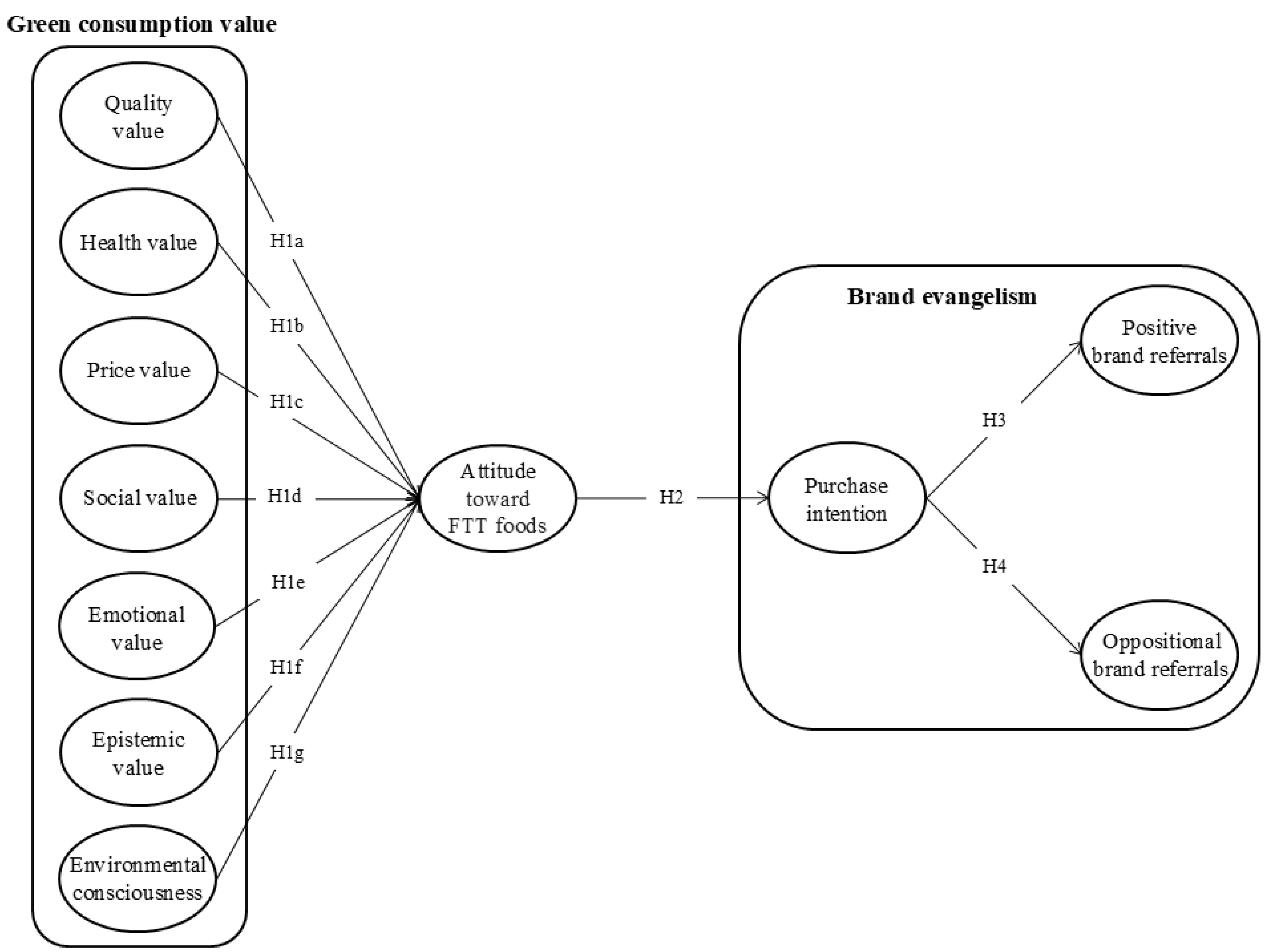

Table 1.
Measurement model assessment.
| Variables and Items | SL | CR | AVE |
| Quality value (QUV) (α=0.863) | |||
| FTT foods provide a high standard of quality. | 0.808 | 0.903 | 0.700 |
| FTT foods provides good quality ingredients. | 0.818 | ||
| FTT foods are tasty. | 0.761 | ||
| FTT foods are prepared from fresh and aromatic ingredients. | 0.735 | ||
| Health value (HEV) (α=0.849) | |||
| FTT foods are hygienic. | 0.829 | 0.936 | 0.789 |
| FTT foods make me healthy. | 0.803 | ||
| FTT foods are safe. | 0.889 | ||
| FTT foods provide good nutrition. | 0.611 | ||
| Price value (PRV) (α=0.871) | |||
| FTT foods are reasonably priced. | 0.812 | 0.881 | 0.651 |
| FTT foods offer value for money. | 0.895 | ||
| FTT foods are a good product for the price. | 0.792 | ||
| The ingredients from this farm are relatively cheaper than those from regular markets. | 0.696 | ||
| Social value (SOV) (α=0.890) | |||
| Experiencing FTT foods help me to feel acceptable. | 0.660 | 0.910 | 0.629 |
| Experiencing FTT foods improve the way that I am perceived. | 0.744 | ||
| Experiencing FTT foods make a good impression on other people. | 0.753 | ||
| Experiencing FTT foods gives me prestige. | 0.792 | ||
| My friendship or kindship with my travel companion has increased while experiencing FTT foods. | 0.760 | ||
| Experiencing FTT foods helps me to interact with the people I travel with. | 0.747 | ||
| Emotional value (EMV) (α=0.839) | |||
| FTT foods can make me feel happy. | 0.649 | 0.900 | 0.644 |
| FTT foods can give me pleasure. | 0.723 | ||
| FTT foods make me feel excited. | 0.745 | ||
| FTT foods make me crave it. | 0.716 | ||
| FTT Foods make me feel relaxed. | 0.699 | ||
| Epistemic value(EPV) (α=0.796) | |||
| I would research FTT foods well before purchasing them. | 0.642 | 0.866 | 0.618 |
| I’m interested in learning more about FTT foods. | 0.700 | ||
| I enjoy looking for new and unique foods. | 0.738 | ||
| Before purchasing FTT foods, I would conduct a comprehensive search of all accessible possibilities. | 0.732 | ||
| Environmental consciousness (ENC) (α=0.795) | |||
| Strict global measures must be taken immediately to halt environmental decline. | 0.707 | 0.887 | 0.666 |
| While experiencing FTT foods, I realized that the environment is one of the most important issues facing society today. | 0.736 | ||
| Unless each of us recognizes the need to protect the environment, future generation will suffer the consequences. | 0.735 | ||
| While experiencing FTT foods, I realized that a substantial amount of money should be devoted to environmental protection. | 0.696 | ||
| Attitude toward FTT food (α=0.786) | |||
| Experiencing FTT foods is a valuable behavior. | 0.628 | 0.895 | 0.681 |
| Experiencing FTT foods is a beneficial behavior. | 0.716 | ||
| Experiencing FTT foods is a good idea. | 0.726 | ||
| I have a positive attitude toward FTT foods. | 0.702 | ||
| Purchase intention (PUI) (α=0.749) | |||
| I attend this event again and will purchase FTT foods because it is environmentally friendly. | 0.615 | 0.873 | 0.700 |
| I will participate in other FTT events to experience more diverse FTT foods. | 0.834 | ||
| I will visit my local FTT restaurants due to environmental concern. | 0.708 | ||
| Positive brand referrals (PBR) (α=0.714) | |||
| I will spread positive word of mouth about FTT foods and restaurants. | 0.757 | 0.825 | 0.613 |
| I would recommend FTT foods and restaurants. | 0.629 | ||
| If my friends are looking for a restaurant, I will tell FTT Restaurant them. | 0.601 | ||
| Oppositional brand referrals (OPR) (α=0.701) | |||
| I tell my friends not to visit to regular restaurants if possible. | 0.732 | 0.742 | 0.590 |
| I would likely spread negative word of mouth about regular grocery stores or restaurants. | 0.688 | ||
Note: SL, standard loading; CR, composite reliability; AVE, average variance extracted.
Table 2.
Correlations of analysis between the variables.
| Variable | 1 | 2 | 3 | 4 | 5 | 6 | 7 | 8 | 9 | 410 | 11 |
| 1. QUV | 0.837 | ||||||||||
| 2. HEV | 0.346 | 0.888 | |||||||||
| 3. PRV | -0.228 | -0.176 | 0.807 | ||||||||
| 4. SOV | 0.654 | 0.395 | -0237 | 0.793 | |||||||
| 5. EMV | 0.424 | 0.438 | -0.237 | 0.547 | 0.802 | ||||||
| 6. EPV | 0.431 | 0.275 | -0214 | 0.485 | 0.431 | 0.786 | |||||
| 7. ENC | 0.452 | 0.315 | -0.217 | 0.490 | 0.439 | 0.515 | 0.816 | ||||
| 8. ATT | 0.519 | 0.608 | -0.226 | 0.556 | 0.537 | 0.364 | 0.427 | 0.825 | |||
| 9. PUI | 0.308 | 0.443 | -0.163 | 0.375 | 0.446 | 0.260 | 0.361 | 0.510 | 0.837 | ||
| 10.PBR | 0.406 | 0.393 | -0.255 | 0.472 | 0.432 | 0.437 | 0.545 | 0.494 | 0.405 | 0.783 | |
| 11.OBR | 0.370 | 0.227 | -0.208 | 0.431 | 0.285 | 0.376 | 0.511 | 0.277 | 0.245 | 0.362 | 0.768 |
| Mean | 3.644 | 3.976 | 2.459 | 3.489 | 3.921 | 4.043 | 3.823 | 3.878 | 3.930 | 3.827 | 3.642 |
| S.D. | 0.694 | 0.552 | 0.821 | 0.691 | 0.583 | 0.616 | 0.575 | 0.518 | 0.551 | 0.556 | 0.730 |
Notes: 1) Diagonal elements show the square root of AVE. 2) Below the diagonal is the corresponding correlation coefficient. 3) All correlation coefficients were significant at the 0.01 level.
Table 3.
Results of the structural model analysis.
| Hypotheses | β | t-value | Decision | |
| H1a | QUV → ATT | 0.177 | 3.204** | supported |
| H1b | HEV → ATT | 0.364 | 7.710** | supported |
| H1c | PRV → ATT | -0.036 | -1.055 | not suppoerted |
| H1d | SOV → ATT | 0.176 | 2.735** | supported |
| H1e | EMV → ATT | 0.240 | 4.235** | supported |
| H1f | EPV → ATT | 0.034 | 0.647 | not supported |
| H1g | ENC → PUI | 0.229 | 4.029** | supported |
| H2 | ATT → PUI | 0.962 | 7.322** | supported |
| H3 | ATT → PBR | 0.798 | 7.252** | supported |
| H4 | ATT → OBR | 0.555 | 6.104** | supported |
Note: **p<.01.
Disclaimer/Publisher’s Note: The statements, opinions and data contained in all publications are solely those of the individual author(s) and contributor(s) and not of MDPI and/or the editor(s). MDPI and/or the editor(s) disclaim responsibility for any injury to people or property resulting from any ideas, methods, instructions or products referred to in the content. |
© 2025 by the authors. Licensee MDPI, Basel, Switzerland. This article is an open access article distributed under the terms and conditions of the Creative Commons Attribution (CC BY) license (http://creativecommons.org/licenses/by/4.0/).
Copyright: This open access article is published under a Creative Commons CC BY 4.0 license, which permit the free download, distribution, and reuse, provided that the author and preprint are cited in any reuse.


