

Submitted:
11 December 2025
Posted:
15 December 2025
You are already at the latest version
Abstract
The sustainability of the beef and dairy industry requires a systems approach that in-tegrates environmental stewardship, economic viability, and social responsibility. Over the past two decades, global genetic consortia have advanced data-driven germplasm programs to enhance sustainability across cattle systems. These initiatives employ multi-trait selection indices aligned with consumer demands and supply chain trends, targeting production, longevity, health, and reproduction which include greenhouse gas mitigation, improved resource efficiency, operational safety, and optimized animal welfare as outcomes. This study analyzes strategic initiatives, germplasm portfolios, and data platforms from leading genetics companies in the USA, Europe, and Brazil. U.S. programs combine genomic selection with reproductive technologies such as in-vitro fertilization and sexed semen to accelerate genetic progress. European efforts emphasize resource efficiency, welfare, and environmental impact, while Brazilian strategies focus on adaptability to tropical conditions, heat tolerance, and disease re-sistance. Furthermore, mathematical models and decision-support tools are increas-ingly used to balance profitability with environmental goals, reducing sustainability trade-offs through data-driven resource allocation. Industry wide collaboration among stakeholders and regulatory bodies underscores a rapid shift toward sustainabil-ity-oriented cattle management strategies, positioning genetics and technology as key drivers of long-term resilience.
Keywords:
beef and dairy sustainability
; data-platforms
; genomics
; landscape analysis
; reproductive programs
1. Introduction
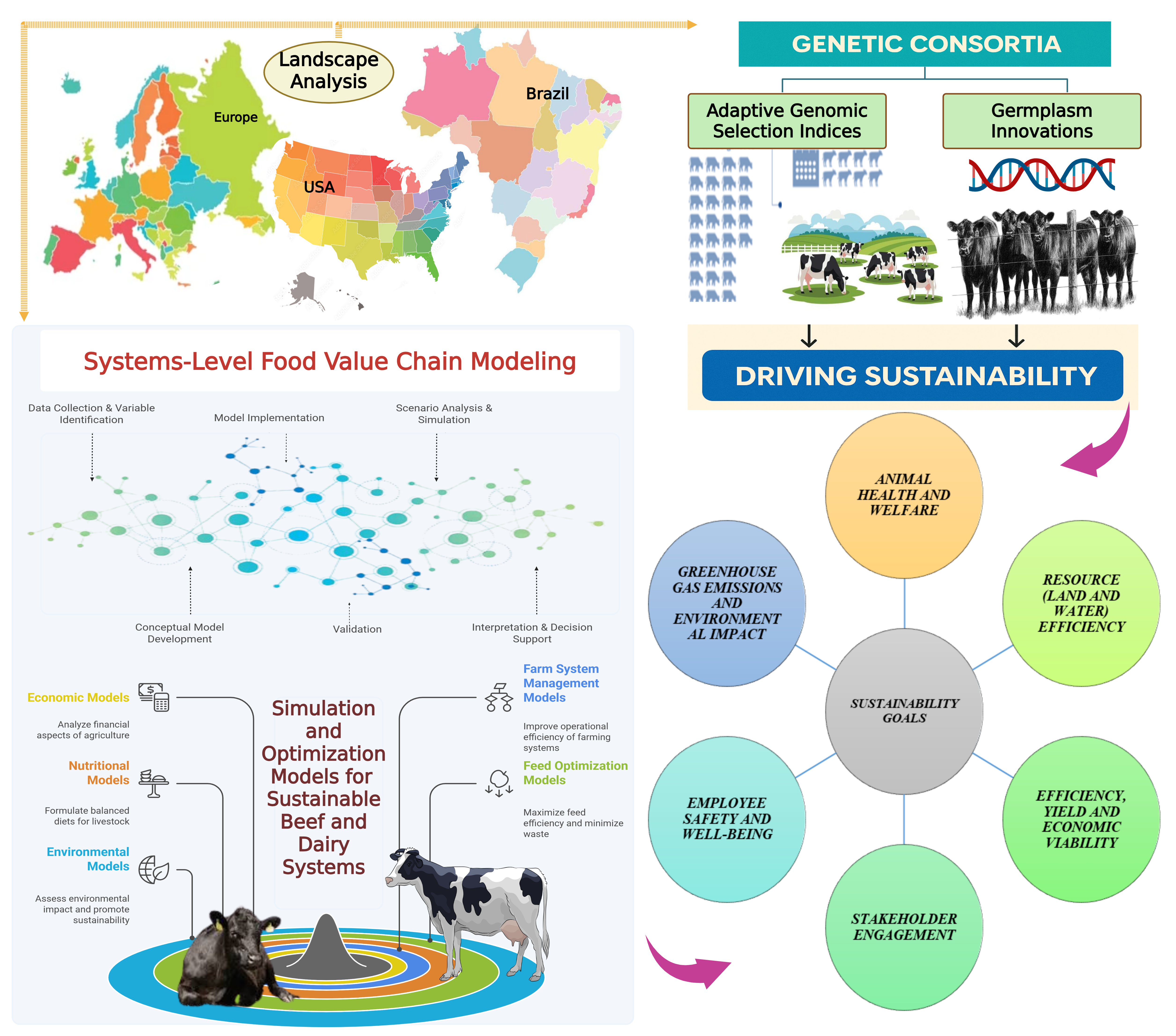
The global beef and dairy production industries are encountering various challenges which include maintaining sustainability metrics, competitiveness amidst declining prices, rising costs, intense competition and increasing public scrutiny. These challenges require finding solutions that are sustainable, appropriate, technically feasible, cost-effective and publicly acceptable [1]. The transition to sustainable beef and dairy production is inevitable, regardless of the challenges. Multi-trait optimization of germplasm and advanced reproductive technologies offers a vital solution by addressing these challenges holistically. This approach enables the industry to achieve a balanced alignment of various objectives (Figure 1) including air and greenhouse gas emissions, land and water resources, employee safety, animal health and well-being, as well as efficiency and yield [2,3,4,5]. However, this multi-trait complex system optimization process will not happen spontaneously, rather must be coordinated with the policy implementation plans of governments, policymakers and NGOs [6]. Policymakers are increasingly called upon to evaluate the impact of their strategies and policies concerning sustainable development. This requires the use of agricultural systems decision models as tools and data for identifying and assessing the potential environmental, economic and social effects of different policy options [7]. Advances in computer modelling and artificial intelligence coupled with the complexity and interconnectedness of global sustainability challenges, will likely drive demand for credible, realistic, transparent and useful models, necessitating a multidimensional and interdisciplinary approach to their [8].
Our study aims to investigate sustainability-enhancing activities in the global beef and dairy industries through three objectives: (1) emphasizing the multi-trait nature of sustainability dimensions in the US, Europe, and Brazil (2) exploring the propagation of multi-trait optimized germplasm by cattle genetic consortia, aligned with dynamic sustainability metrics designed by stakeholders, including consumers; and (3) highlighting the need to integrate decision models and data-driven platforms to make informed decisions, ensuring continuous progress towards evolving sustainability targets..
2. Regional Trends in Beef and Dairy Population, Production and Consumption Patterns in the USA, Europe and Brazil
Cattle production involves breeding animals to produce products such as meat, milk, and other dairy products for human consumption [9]. Beef and milk production faces challenges in balancing food needs and sustainable development, however new technologies can aid in optimal development and biodiversity conservation [10]. The USA, Brazil, and Europe are the three of the largest beef and milk-producing geographies globally. An analysis of historical and current trends in cattle population, beef production and milk production across the USA, Brazil and Europe from 1962 to 2022 reveals distinct regional patterns. Cattle production is one of the most important agricultural income sources in the United States, accounting for 18% ($66.2 billion) of the total cash receipts from agricultural commodities in 2019 [11]. In the USA, the cattle population peaked at 250.65 million in 1985 but declined to 87.2 million in 2024. According to the cattle report published by the National Agricultural Statistics Service (NASS), there are 28.2 million beef cows and 9.36 million dairy cows in the United States as of 2024. The Brazilian cattle industry showed a dramatic increase driven by intensified beef production and productivity gains. Similarly, Europe's cattle numbers declined from 197.9 million in 1962 to 113.22 million in 2022. These dynamic trends in cattle population highlight regional differences in cattle production and its economic and environmental impacts. The USA and Europe have experienced a decline in cattle numbers, yet their beef and milk production per animal have increased significantly, indicating advancements in productivity and efficiency.
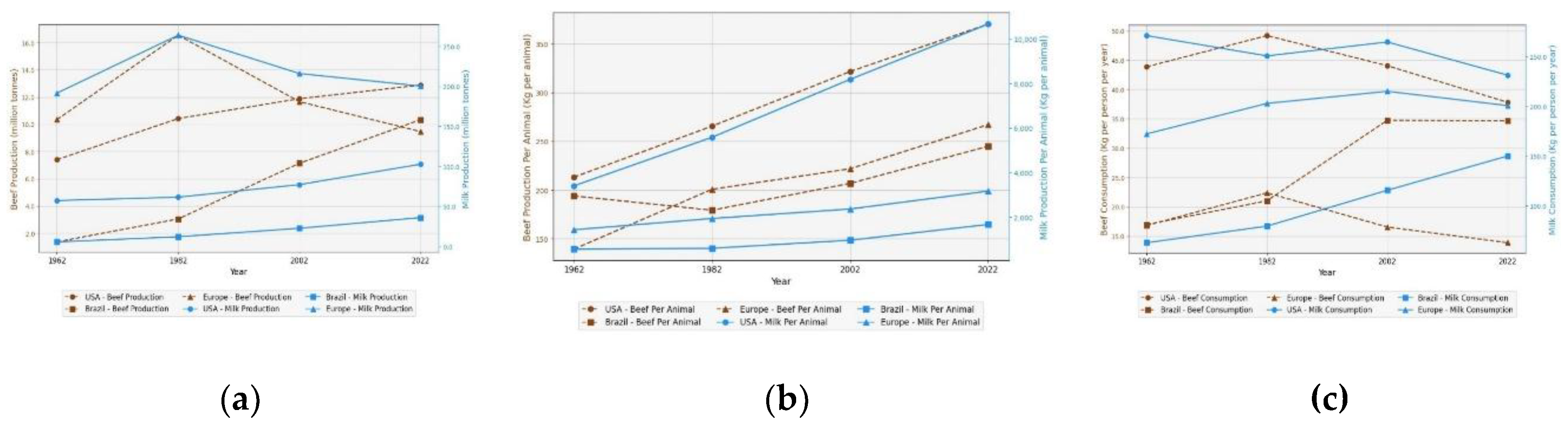
According to Food and Agriculture Organization of the United Nations [12], beef production in the USA increased from 7.41 to 12.89 million tonnes over the decades from 1962 to 2022, Europe peaked at 16.56 million tonnes in 1982 before declining to 9.47 million tonnes in 2022, while Brazil steadily expanded from 1.36 to 10.35 million tonnes. Similarly, milk production rose in the USA from 57.27 to 102.75 million tonnes in 2022. It is peaked in Europe at 264.08 million tonnes in 1982 before decreasing to 200.44 million tonnes in 2022 and saw substantial growth in Brazil from 5.53 to 35.94 million tonnes from a period of 1962 to 2022, highlighting advancements in dairy farming (Figure 1a). Despite declining cattle numbers, beef productivity per animal increased significantly in the USA (213.20 to 370.30 kg) and Europe (139.4 to 267.20 kg) between 1962 and 2022, while Brazil saw a slower rise from 194 to 245 kg. Similarly, milk yield per animal improved dramatically in the USA (3,400.2 to 10,667.5 kg), Europe (1,428.4 to 3,164.9 kg) and Brazil (556.8 to 1,669.4 kg), reflecting advancements in dairy management and efficiency (Figure 1b). Even though Brazil has witnessed a substantial rise in cattle population (from 57.7 million in 1962 to 234.3 million in 2022) and total production, although its per capita beef and milk consumption remains lower compared to the USA and Europe.
Per capita meat consumption varies significantly across countries, often reflecting economic transitions and social-economic development trends. Globally, average per capita meat consumption has risen, indicating that meat production has grown faster than population growth [12]. Regardless of the fact that individuals in European and North American regions consume significant amounts of meat [13,14], per capita beef consumption declined in the USA (43.87 to 37.81 kg) and Europe (16.82 to 13.88 kg) from 1962 to 2021, while per capita beef consumption in Brazil has nearly doubled, with a rise of approximately 16.96 to 34.66 kg, reflecting a growing domestic market. There is a strong positive relationship between per capita meat consumption and average gross domestic product per capita: the richer a country is, the more meat the average person typically eats. Similarly, milk consumption decreased in the USA (271.14 to 231.39 kg) and Europe (172.28 to 200.74 kg), whereas Brazil experienced a significant rise (62.78 to 150.03 kg), indicating improved availability and dietary preferences (Figure 1c).
Globally, sustainable food and agriculture (SFA) play a crucial role in supporting all four pillars of food security such as availability, access, utilization, and stability, while also addressing the key dimensions of sustainability, including environmental, social and economic aspects [14].
Figure 1.
The Changing Landscape of Beef and Dairy Production: Production Trends and Transformations Over Time [12] they are listed as: (a) Beef and Milk Production Across USA, Europe and Brazil (1962-2022); (b) Beef and Milk Production Per Animal in the USA, Europe and Brazil (1962-2022); (c) Per Capita Beef and Milk Consumption in the USA, Europe and Brazil (1962-2022).
Figure 1.
The Changing Landscape of Beef and Dairy Production: Production Trends and Transformations Over Time [12] they are listed as: (a) Beef and Milk Production Across USA, Europe and Brazil (1962-2022); (b) Beef and Milk Production Per Animal in the USA, Europe and Brazil (1962-2022); (c) Per Capita Beef and Milk Consumption in the USA, Europe and Brazil (1962-2022).
3. Multidimensional Sustainability Analysis in Beef Production: insights from the USA, Europe and Brazil
Sustainability represents the state of a complex system that is always evolving, and it is an intrinsic characteristic of the system that needs to be constantly shaped and managed. The beef industry is improving sustainability through various assessment frameworks, stakeholder engagement, and increased transparency but needs to clarify the concept of sustainability and strengthen cooperation among national roundtables [15]. The multi stakeholder (including input from the United States National Cattlemen’s Beef Association - NCBA) Global Roundtable for Sustainable Beef (GRSB) recently defined sustainable beef as a product that is socially responsible, environmentally sound, and economically viable. This definition emphasizes prioritizing the planet (focusing on natural resources, efficiency and innovation), people (including community well-being and food safety), animals (addressing animal health, welfare and efficient practices) and progress (encompassing natural resources, community, animal welfare, food quality and innovation) [16]. The sustainability of the beef industry encompasses a range of factors and provide a road map with interconnected actions that can support countries in selecting and prioritizing resources to accelerate the transition towards sustainable approaches (Figure 2). The numerous trade-offs between economic and environmental goals make it difficult to meet the challenge of sustainable beef production on a global scale [17]. Enhancing traditional husbandry practices and addressing welfare concerns through scientific investigations, practical solutions, consumer perceptions and educational tools can improve the beef industry's sustainability [18].
Global meat production had increased more than threefold by 1975, surpassing 350 million tonnes annually. The production of ruminant meat particularly beef is the agricultural commodity that contributes the most to the U.S. economy in terms of agricultural receipts. However, it is also the most dependent on natural resources and generates the highest environmental impact per kilocalorie or gram of protein among available food resources for the human population [19]. Protein nutraceuticals from highly mineralized collagen-containing beef raw materials have high amino acid potential making them a valuable source for specialized biologically active additives [20] and offers the potential to aid in reaching increased global protein needs [21]. The ruminant meat lipids provide heart-healthy cis-monounsaturated fatty acids and bioactive phospholipids, which can improve human health and contribute to global food security [22]. Furthermore, increasing genetic potential for marbling increases the likelihood of achieving higher yield and better-quality grade outcomes in commercial beef cattle [23].
Beef yield per animal has increased over time in the USA, Brazil and Europe due to advances in genetics, production and management practices and environmental management. Beef production in the USA is highly technology-driven, utilizing reproductive management strategies, genetic improvement technologies and various feed processing strategies to improve efficiency and cost of production [24]. Likewise, the European Union is the world's third-largest beef producer with strong production efficiency and adaptability driven by a diverse range of breeds animal types including cows, bulls, steers and heifers and various farming systems such as intensive, extensive, mixed breeders and feeders [25]. However, the European beef sector faces challenges in production efficiency, sustainability and animal welfare, necessitating new strategies and research to adapt to changing market demands and evolving research objectives [26]. Analogous to USA and Europe, sustainable beef cattle development in Brazil requires new digital technologies and sustainable supply chain management, with strategies that can promote human, environmental, and animal welfare [27]. As an example, the Sustainable Tension Index can help identify areas in the Brazilian pampa biome with potential for sustainable beef production, aiding decision-making for farm managers and politicians [28]. Intensive beef farming has expanded to the Brazilian Amazon where confinement practices have led to higher productivity rates and reduced deforestation [29]. This kind of productivity gains and land-saving strategies have significantly contributed to the growth in Brazilian beef production, reducing the need for extensive pasture expansion [30]. Diverse initiatives and dissemination of knowledge about sustainable practices in the beef chain is being implemented to provide a coordinated response of production, processing and distribution by multiple organizations, as they capitalize on market opportunities for sustainable livestock in Brazil [31]. Differences in beef production across countries reflect factors like natural resource availability, climate, population size, traditional culture and economic development [32]. Cultural and lifestyle differences influence sustainability of beef production in different regions [33]. In addition, vegetation and human demographics threaten the sustainability of regionally interconnected beef production systems. However, advancements in beef cattle production are necessary to secure the industry’s future sustainability [21].
Beef cattle are one among the most important sources of atmospheric CH4 and mitigation of this gaseous emission has been highlighted as a tool to slow global climate change [34]. Production of 1 kg of beef used most land and energy and had highest global warming potential, followed by production of 1 kg of pork, chicken, eggs and milk [35]. The beef industry has come under scrutiny in recent decades over its perceived impacts on climate change from both climate scientists and the public [36]. Hence, climate change and animal welfare concerns demanded balanced breeding objectives and selection approaches for sustainable production-including health and longevity [37]. Tedeschi & Beauchemin [38] stated that U.S. beef cattle emissions account for about 2.2% of total anthropogenic greenhouse gas (GHG) emissions, equating to 22.6% of total US agricultural emissions. Feed additives could reduce these emissions by 5 to 15%, which aligns with efforts to improve the environmental sustainability of beef production. The U.S. beef cattle emissions have been reduced by about 30% from 1975 to 2021, and potential improvements in livestock and crop production systems could result in a 4.6% reduction in global CO2e emissions by 2030. Efforts to reduce the environmental impacts of beef production will likely be the strongest drivers of enhanced sustainability.
Carbon-reduced beef production, processing and trade techniques must be encouraged and supported to mitigate the effects of global warming and progress towards climate neutrality. The carbon footprint of beef production in Kansas, Oklahoma, and Texas is 18.3± 1.7 kg CO2e/kg carcass weight, with most of the footprint associated with the cow-calf phase [39]. According to USDA Meat Animal Research Center beef production system has decreased its carbon footprint by 6%, but its water footprint has increased 42% due to increased irrigated corn production [40]. Whereas beef production in Europe has a high potential for mitigating greenhouse gas emissions, with an average carbon footprint of 20.5 kg CO2 eq per kg carcass [41]. Beef cattle's carbon footprint varies between 8 and 22 kg CO2e per kg of live weight, with significant reductions in Canada, the US, Europe, Australia and Brazil over the last 30 years due to sustainable land management practices [42]. Minimising the carbon footprint of beef cattle through crossbreeding, genetic improvement and improved productivity per constant unit can effectively mitigate the effects of climate change [43]. Net beef GHG emissions can be reduced substantially via changes in management, with 46% reduction in net GHG emissions per unit of beef achieved using carbon sequestration management strategies on grazed lands and 8% reduction using growth efficiency strategies [44]. These initiatives prioritize preserving and enhancing carbon stocks in soils and landscapes. According to [45] soil sequestration has the highest mitigation potential in GHG emissions, with 80%, followed by growth enhancement technology (16%), diet modification (6%) and grazing management improvement (7%).
Efficient use of resources such as feed, water and land are critical for sustainable beef production with beef production being less efficient in converting natural resources into edible products compared to other livestock systems [4]. Organic beef production systems are slightly more profitable but have a higher impact on global warming and land use [5]. However, competition with other uses for land and water resources will also intensify, necessitating more efficient livestock production [46]. Numerous producers and farmers already make positive contributions to the environment to ensure that the beef value chain is a net positive contributor to nature. The global beef value chain manages natural resources responsibly and enhances ecosystem health [47]. The water use efficiency of each segment of the beef supply chain can be improved to reduce water footprint, by optimizing and integrating grazing systems (selecting water-efficient forage species like C4 plants), methods (utilizing precision agriculture techniques like soil mapping to optimize water use) and external inputs (optimizing fertilizer applications to increase dry matter production with less water requirements) to enhance ecosystem services, thereby decreasing the overall environmental impact of livestock production [48]. In many instances, producers are adopting land management practices to maintain soil health, increase carbon sequestration and optimize water usage efficiently [49]. A multi-indicator approach combining carbon and water footprints can provide a more comprehensive understanding of environmental impacts in beef cattle production systems [50]. Such strategies are developed to sustain and restore grazing lands, enhance resilience, conserve forests, grasslands and native vegetation, increase biodiversity and reverse ecological decline [51].
4. Innovations in Dairy Production: Enhancing Cattle Welfare, Genetic Improvements, Technological Advancements and Herd Management Strategies for Dairy Sustainability
Dairy production provides high-quality nutrients, animal welfare, and environmental sustainability while maintaining economic viability for dairy farmers [52]. Dairy herd turnover and sensible culling decisions improve profitability, welfare and sustainability [53]. Sustainability in the dairy industry involves achieving competitive growth and efficiency in dairy farming and processing, while ensuring environmental, economic and social aspects [54]. The dairy industry endeavors to harmonize environmental stewardship, economic sustainability and community well-being while adapting to evolving resources, technological advancements and consumer preferences. Sustainable dairy management practices should complement international perspectives from export markets, international organizations and dairy corporations. Sustainable agriculture hinges on emphasizing genetic diversity and resilience in dairy cattle, employing adaptive genetic improvement techniques and ensuring a consistent and accurate data flow [55].
Strategic interventions can significantly improve dairy production in developing countries, addressing challenges like feed, management, health and food safety, contributing to meeting global demand and UN Sustainable Development Goals [56]. Leading dairy countries in the EU focus on implementing sustainability principles, focusing on environmental impact, animal welfare, health, and breed management issues [57]. Climate change may positively impact dairy cow production in Central Europe by potentially increasing fodder quantity through prolonged growing seasons and slight rises in ambient temperature and CO2 levels. However, mitigation strategies will be essential to ensure that adequate nutrition and maintenance of performance [58]. Brazil's dairy farming plays a vital role in the country's economy, with public policies supporting milk quality and safety. Dairy products contribute to daily intakes of selected nutrients of concern in Brazil, including 6.1-39.9% of daily energy intake, 7.3% of protein, 16.9% of saturated fat, 11.1% and 4.3% of total sugars and 10.2-37.9% of daily calcium, vitamin D, P, vitamin A and K, but mean daily consumption of 142 grams per person, equating to less than one typical portion per day below the 2006 Brazilian dietary guidelines, which recommend three portions of milk and dairy products daily [59]. However, its limited presence in the international market is primarily due to high production costs and lower milk quality [60]. There is a need for policies and practices that align with local and international expectations, particularly in the dairy industry of Brazil [61]. In Brazil, dairy farms face common welfare and production issues, such as subclinical mastitis and tick infestations, but also specific issues like lameness and hock injuries [62]. Sustainability objectives prioritize the well-being of dairy cattle by promoting the widespread adoption of optimal practices in disease prevention, treatment, management, stress resistance and selecting suitable genetics to promote better welfare outcomes throughout the production cycle. Large-scale dairy farms in Parana, Brazil, have greater economic, environmental, and social sustainability, making them more likely to survive in the medium and long term [63].
According to Borawski et al. [64] the U.S. milk market has experienced notable changes between 2009 and 2018. During this period, the number of dairy cows increased slightly by 2%, from 9.2 million to 9.4 million. However, milk yield per cow saw a significant rise of 13%, leading to a 15% overall increase in milk production. Despite this growth in production, per capita consumption of liquid milk decreased from 112 kg in 1975 to 66 kg in 2018, while total dairy product consumption per person increased from 244 kg to 293 kg over the same period. The life cycle assessment of the U.S. dairy industry in 2008 highlighted its environmental impact and by 2017, advancements in dairy farming practices had reduced water use by 30%, land use by 21%, and the carbon footprint by 19% per gallon of milk compared to 2007 [65]. The dairy industry aims to achieve GHG neutrality, optimize water use and improve water quality by 2050, with U.S. dairy farmers committed to enhancing soil health and protecting biodiversity [66]. Beef-on-dairy breeding strategies enhance profitability and sustainability in dairy production, and it is a potential solution to mitigating the GHG footprint of beef [67]. Increasing animal productivity, improving genetic potential and reducing herd size can significantly reduce GHG emissions from livestock production systems [68]. Beef production from dairy calves has lower environmental impacts than suckler herds, but sustainable management strategies are needed to improve environmental performance [69].
5. Landscape Analysis of Genetic Consortia in the Beef and Dairy Industries of the USA, Europe and Brazil: Driving Sustainability Through Adaptive Genomic Selection Indices and Germplasm Innovations
Genomic information and genetic selection indices integrated into genetic evaluations significantly benefits traits linked to welfare and sustainable production of both beef and dairy systems. In the USA, several genomic selection indices are utilized by companies to enhance cattle breeding efficiency and profitability. ABS Global's Beef Advantage Index uses multitrait optimization to select beef sires for dairy operations, emphasizing traits crucial for reproductive success, growth, feed intake and carcass quality. Incorporating growth and carcass traits in breeding goals for combined dairy and beef production systems can improve profitability and increase self-sufficiency [85]. The Custom Index of ABS Global allows dairy producers to tailor genetics to their specific needs, leading to faster genetic progress and improved profitability. The EcoFeed Index by ST Genetics focuses on feed efficiency and environmental sustainability, targeting animals that maximize production while minimizing feed resources and GHG emissions. Novel monitoring systems to measure dairy cattle phenotypic traits can lead to more sustainable production with reduced environmental impact through reduced GHG emissions [86]. Zoetis offers the Dairy Wellness Profit Index (DWP$) focusing on maximizing productivity, efficiency, and sustainability across the dairy and beef industries. The Net Merit and Cheese Merit indices, developed by Select Sires and Alta Genetics, provide comprehensive tools for predicting profit potential in various milk markets, emphasizing key traits like milk yield, fertility and longevity (Figure 3). Refinement of selection indexes and breeding goals to emphasize traits related to animal welfare, health, longevity, environmental efficiency and overall resilience is enhancing sustainability and efficiency in dairy cattle [87].
In Europe, genomic selection indices are geared towards optimizing both productivity and sustainability. Viking Genetics’ Nordic Total Merit Index (NTM) focuses on enhancing herd profitability and functionality by prioritizing health, reproduction and production traits. CRV's Health and Efficiency Indexes guide dairy farmers in improving herd health, fertility, and overall efficiency, leading to increased profitability and sustainability. Similarly, the NVI or Total Merit Index used in the Netherlands and Flanders integrates production, longevity, fertility, and cow health to guide breeding programs toward enhanced farm income and consumer acceptance. These European indices place a strong emphasis on health and sustainability, aligning with regional goals of improving cattle welfare while boosting production (Figure 3).
In Brazil, genomic selection tools are pivotal in driving cattle production advancements and several companies in Brazil utilize specific selection indices to improve livestock genetics and enhance production efficiency (Figure 3). SEMEX Brazil employs the Methane Efficiency Index, which focuses on selecting animals based on their methane emissions efficiency, contributing to environmentally sustainable livestock production. Selection for lower-emitting phenotypes in dairy cattle can decrease the environmental footprint of dairy cattle products [88]. Methane intensity could be decreased by 24% by 2050 through the incorporation of CH4 production into breeding objectives [89]. However, genetic improvement in feed efficiency and reducing enteric methane production in replacement heifers can enhance the sustainability of beef cattle production [90], In particular, selecting for residual methane emissions holds significant potential, as it enables the breeding of low methane-emitting animals without negatively impacting other economically important traits [91]. Bell & Jauernik [92] argued for the inclusion of a customized profit and carbon total merit index as an effective tool for identifying sustainable milking cows and herd replacements, ultimately increasing profitability and reducing carbon emissions in commercial dairy herds. These methods maximize profit without compromising welfare [93]. ABS Pecplan company in Brazil utilizes the ABS Pecplan Selection Index, a comprehensive system designed to rank animals based on a combination of genetic and economic traits essential for the beef and dairy industries. Similarly, CRV Lagoa uses the Total Merit Index, an index that evaluates overall animal performance by incorporating multiple economic and genetic factors, ultimately aiming to improve herd efficiency and profitability. Additionally, CRV Health Indexes to improve dairy herd health and efficiency in Brazil, similar to Europe, ensuring that Brazilian farmers can produce healthier, more sustainable cattle while maintaining profitability. Brazilian genetic consortiums, including ABS Pecplan, CRV Brasil, and Semex Brazil emphasize multi-breed and indigenous cattle programs, particularly focusing on the integration of European and Zebu germplasm for tropical environments. These companies play a crucial role in advancing genetic selection and sustainable livestock production in Brazil.
The Figure 4 presents a variety of germplasm products offered by different genetic consortia across the USA, Brazil and Europe, focusing on enhancing cattle genetics for beef and dairy production. These products include multi-breed semen and embryos, with companies like ABS Global, Genex and CRV Brasil providing crossbreeding solutions to improve productivity and adaptability. Fertility and reproductive technology, such as in-vitro fertilized embryo transfer, is offered by companies like Vytelle to improve reproduction efficiency in both beef and dairy operations. Reproductive efficiency and health improvements are achieved through genomic selection and fertility-focused germplasm, leading to higher conception rates, reduced calving difficulties, and improved animal welfare. Targeted genetic solutions from organizations like Select Sires aim to maximize feed efficiency and reproductive success. Genetic programs and management changes can improve efficiency, sustainability and profitability of beef production by reducing feed used for maintenance and incorporating appropriate indicator traits in national cattle evaluation systems [94]. However, beef-on-dairy programs from ABS Global, Semex, and STGenetics introduce beef genetics into dairy operations to increase the value of dairy bull calves while maintaining dairy herd performance. Genomic testing-based selection from companies like Zoetis helps producers make informed breeding decisions, enhancing genetic diversity, productivity and supporting precision breeding strategies for sustainable and profitable cattle production.
The sustainability outcomes of these genetic programs focus on economic viability, climate-smart solutions, enhanced herd health and optimized production systems. Additionally, evaluating genetic resistance to disease, climate tolerance and resilience associated traits are being used as objective, measurable phenotypes or as suitable biomarkers [95] for genomic selection in beef and dairy cattle. Companies like ABS Global and STGenetics emphasize economic profitability and feed efficiency through accelerated genetic progress and improved herd management. Genomic selection based on data sources from new precision livestock technologies; that is data-drive phenotyping strategies can improve feed efficiency and upgrade sustainability in dairy cattle [96], especially by focusing on fitness, health, welfare, milk quality [97]. While companies like Select Sires and Zoetis highlight multi-trait optimization to ensure breeding decisions align with economic and environmental sustainability. Climate-smart and resource-efficient livestock systems are supported by genetic programs like ABS Global’s BeefAdvantage Index, which ensures optimal beef protein supply while reducing resource waste and VikingGenetics' Nordic Total Merit Index, which incorporates 90 economically important traits for multidimensional sustainability goals. Companies like Vytelle and ABS Pecplan provide data-driven reproductive solutions to enhance supply chain transparency and genetic health. Data-driven decision-making for long-term sustainability is emphasized by companies like AltaGenetics, which use genomic data to ensure optimized breeding strategies that align with long-term sustainability goals. Digital technologies and targeted genotypes can further improve productivity and overall sustainability in beef herds [73]. Customized solutions for different production systems are offered by Brazilian genetic consortia, including CRV Brasil and Semex Brazil, ensuring adaptability to various management conditions. Companies like CRV and Alta Genetics integrate farm management insights to create customized breeding programs suited to different environments.
6. Decision-Making for Beef and Dairy Sustainability: The Need for Systems-Level Food Value Chain Modeling
Agri-food chains are complex systems involving multiple firms and various modeling approaches can help evaluate decision-making and information flows in these complex systems [98]. Digital technologies that enable rapid capture and use of environmental and cattle performance data, even within extensive systems, enhance beef and dairy industry’s productivity, efficiency, animal welfare and sustainability. These findings underscore the role of data-driven decision-making in modern animal breeding, enabling optimized livestock productivity while maintaining ethical and sustainable farming practices. The use of interactive web tools, herd monitoring and modelling platforms aids in providing customized farming insights, linking sustainability with economic and environmental resilience.
Mathematical modelling (MM) is the process of constructing computer models systematically and have a critical role in enhancing the sustainability of beef and dairy production by enabling the optimization of production processes, resource allocation and overall management strategies (Table 1). These models, which include linear programming, stochastic simulations and dynamic systems modeling, help producers make decisions by predicting outcomes under various scenarios, such as feed strategies, herd management and environmental impacts and operational efficiency of farming. The use of MM to facilitate research is consistently underutilized because potential users are not aware of the capabilities and benefits of MM, or they believe that model development is complex and difficult [99]. In the USA, the Integrated Farm System Model (IFSM) evaluates environmental and economic impacts of dairy farm practices, while the Cornell Net Carbohydrate and Protein System (CNCPS) optimizes ruminant nutrition. Meanwhile, in Brazil, the Linear Programming Mathematical Model helps optimize livestock-crop systems for sustainability. Brazil's Bioeconomic Model [100] and Linear Programming Mathematical Model [101] emphasize resource allocation and livestock health management, particularly in mixed crop-livestock systems. In the United States and Brazil, mathematical models have played a crucial role in optimizing cattle production systems. Simulation modeling can effectively evaluate the impact of policy-related decisions on interorganisational fairness in European food value chains, with potential applications in various food value chain case studies [102]. By integrating economic analysis, precision nutrition and environmental assessment, these models provide data-driven decision-making frameworks that support risk management, sustainable farm operations, and long-term profitability.
Mathematical nutrition models can assist in the discovery of the biological efficiency of mature beef cows [103]. Beef supply chain performance can be improved by using a model-driven decision support system based on system dynamics, projecting that optimizing beef weight and carcass percentage will reduce deficits and achieve a surplus by 2028, contributing to national food self-sufficiency [104]. Several models, such as the Farm Optimization Model: FARMDYN [105] and Optimization of Ruminant Farm for Economic and Environmental Assessment: Orfee of Europe [106], can simulate the cost of beef cattle production and analyse its environmental sustainability, aiding in risk management and profit management [107]. The MOLP (multi-objective linear programming) model effectively balances economic and environmental goals in beef logistics networks, highlighting the importance of distances and green tax incentives for sustainability [108]. Similarly, the MINLFP model (USA) and Linear Programming Model (Brazil) incorporate multi-objective optimization to balance these goals in beef logistics networks. These models aid in improving sustainability in European beef systems by incorporating economic, environmental and social sustainability metrics. Additionally, models like Pasture Simulation Model: PaSim [109] and the Nordic Feed Evaluation System (NorFor Model) [110] simulate pasture and feed interactions, optimize livestock production while assess emissions and carbon sequestration strategies. These approaches assist farmers in adopting precision agriculture techniques to enhance productivity while reducing the environmental footprint of cattle production. while USA models like the Dynamic Cattle Growth Model and Discounted Cash Flow (DCF) models evaluate profitability and cash flow in cow-calf operations. Additionally, the Brazilian Bioeconomic Model simulates the impact of tick infestations on beef systems, aiding in improved animal health and welfare. Integration of various data sources, random forests and linear regression models can accurately predict beef production and quality at the national level, aiding in sustainable livestock production [111].
Optimal design of dairy supply chains considering environmental and social aspects can lead to higher profits and lower economic costs, achieving social sustainability [112] like the DigiMilk model [113] which optimizes the dairy supply chain by integrating digital technologies to enhance traceability, resource efficiency and sustainability. Kristensen [114] suggested that a stochastic dynamic model for dairy cow production and food intake can predict income from milk, and calves, aiding in the development of a replacement model. Similarly, the Random Forest algorithm-based model predicts daily milk yield of dairy cows under heat stress conditions, enhancing sustainability and efficiency in the dairy sector [115]. The model proposed by Hassani et al. [116] optimizes resilience and sustainability in industrial dairy farms, increasing profitability and reducing environmental degradation. However, the Gamede model effectively explains differences in sustainability indicators between dairy farms, aiding decision-making and supporting resource-efficient production [117]. Shamsuddoha et al. [118] uses a system dynamics approach and simulation modeling to optimize dairy waste management and value addition, achieving sustainable outcomes for the industry and surrounding community. For instance, the Deterministic Whole Herd Simulation Model [119] and the Forage and Cattle Analysis and Planning (FORCAP) Model [120] focus on evaluating dairy herd management and dual-use forage systems to maximize profitability and sustainability. In dairy farming, European models like the Nordic Dairy Cow Model, Karoline optimize feeding by simulating digestion and metabolism, the Moorepark Dairy Systems Model (MDSM) enhances herd management for profitability and the DairyWise model improves farm sustainability by reducing disease risks, while the Financial and Renewable Multi-objective Optimization (FARMOO) Model integrates economic and environmental goals. Intrafarm simulation models focus on specific subsystems within a farm, such as nutrition, genetics, or reproductive management, while whole-farm simulation models take a systems-level approach, integrating multiple farm components including livestock, crops, labour, economics, and environmental factors to assess overall farm performance and sustainability. Whole farm systems models are an appropriate tool for developing and measuring GHG mitigation strategies in beef and dairy cattle production systems, with improvements in animal productivity and fertility potentially reducing emissions. Models can optimize nutrition, milk production, and reproductive strategies in dairy farming, while in the beef industry they assist in managing supply chains, evaluating economic sustainability and improving animal health and welfare. Combining multiple statistical analyses and investigating the purpose of the mathematical model is crucial for assessing their adequacy and usefulness for predictive purposes [122]. Ultimately, these models contribute to more efficient, sustainable, and profitable livestock operations..

Table 1.
Simulation and Optimization Models for Sustainable Beef and Dairy Systems: Insights from the USA, Europe and Brazil
Table 1.
Simulation and Optimization Models for Sustainable Beef and Dairy Systems: Insights from the USA, Europe and Brazil
| MODELS | PREDICTIVE VARIABLES AND SUSTAINABILITY OUTCOMES | REGION | FARM TYPE | METHODOLOGY AND SCOPE | |
| Economic Models | |||||
| Farm Model (FM) [123] | Evaluate dairy farm resilience by simulating production plan adjustments to adapt to external challenges and uncertainties | Europe | Dairy | Whole farm Optimization | |
| Bio-Economic model implemented using GAMS (General Algebraic Modeling System) software [124] | Assess farmers' adoption of precision agriculture practices by evaluating its economic and biological impacts on Greek dairy cattle farms. | Europe | Dairy | Whole farm Optimization | |
| ScotFarm [125] | Assess the financial vulnerability of Scottish dairy farms by simulating Johne's disease and payment support impacts to optimize economic resilience and sustainability. | Europe | Dairy | Whole farm Optimization | |
| Dynamic stochastic simulation model [126] | Optimize dry period decisions in dairy herds by simulating impacts on milk production, cash flow, and emissions, accounting for farm variability. | Europe | Dairy | Intrafarm Simulation |
|
| Moorepark Dairy Systems Model (MDSM) [127] | Evaluate the financial performance of Holstein Friesian strains in different systems to identify the most profitable breeding and management strategies | Europe | Dairy | Whole farm Simulation | |
| Dairy Farm Model [128] | Evaluate manure policy impacts on profitability, nutrient management, and emissions after milk quota abolition. | Europe | Dairy | Whole farm Optimization | |
| A mathematical programming model [129] | Optimize dairy management to meet somatic cell count targets, improving milk quality and profitability while reducing mastitis control costs. | USA | Dairy | Intrafarm Optimization |
|
| A dynamic cattle growth model Discounted cash flow (DCF) models [130] |
Evaluate profitability, risk, and cash flow in cow-calf operations by simulating cattle growth and financial performance to guide investment decisions. | USA | Beef | Intrafarm Simulation; optimization |
|
| The Forage and Cattle Analysis and Planning (FORCAP) model [120] | Simulate and evaluate the feasibility of dual-use forage systems in cow-calf operations to optimize management for profitability and sustainability. | USA | Beef; dairy | Whole farm Simulation |
|
| Bioeconomic model [100] | Simulate the economic and biological impacts of tick infestations on Brazilian beef systems to optimize management, reduce losses, and improve cattle health. | Brazil | Beef | Whole farm Simulation |
|
| A bio-economic farm model [131] | Assess the viability of conservation agriculture in Brazil's mixed crop-livestock systems by optimizing resource use for profitability and ecological resilience | Brazil | Beef; dairy | Whole farm Optimization |
|
| Nutritional/Farm System Management Models | |||||
| DigiMilk model [113] | Optimize the dairy supply chain by integrating digital technologies to enhance traceability, resource efficiency, and sustainability in milk production and distribution. | Europe | Dairy | Whole farm Simulation | |
| Pasture-Based Herd Dynamic Milk Model (PBHDM) [114] | Simulate and predict milk production in pasture-based dairy systems, considering herd size, pasture availability, and seasonal variations. | Europe | Dairy | Whole farm Simulation | |
| Dairy Wise [132] | Simulate dairy farm processes to optimize herd management, improve profitability, and reduce gastrointestinal nematode risk under varying conditions | Europe | Dairy | Whole farm Simulation | |
| Multiscale agent-based simulation model of a dairy herd (MABSDairy) [133] | Simulate interactions between animals, herd dynamics, and management to optimize dairy herd health, productivity, and economic outcomes. | USA | Dairy | Intrafarm Simulation |
|
| Stochastic dynamic simulation modelling [134] | Evaluate reproduction and selection strategies in dairy herds to optimize performance and economic outcomes, considering farm uncertainty and variability. | USA | Dairy | Intrafarm Simulation |
|
| A multi-objective mixed-integer nonlinear fractional programming (MINLFP) model [135] | Optimize organic mixed farming by balancing profitability, resource efficiency, and sustainability through nutrient recycling. | USA | Beef; Dairy | Whole farm Optimization |
|
| Farm System Management Models | |||||
| Mathematical model developed in the Czech University [136] | Optimize milking parlor performance by simulating management scenarios to enhance efficiency and profitability in dairy farms. | Europe | Dairy | Intrafarm Simulation |
|
| Moorepark Dairy Systems Model (MDSM) Pasture-Based Herd Dynamic Milk Model (PBHDM) [137] |
Simulate pasture-based dairy systems to optimize herd management, maximizing milk production and profitability | Europe | Dairy | Whole farm Simulation | |
| The mathematical model created in the Czech Republic [138] | Improve operational efficiency and economic performance by simulating different milking systems under farm-specific conditions. | Europe | Dairy | Intrafarm Simulation |
|
| The farm optimization model FARMDYN [105] | Simulate and optimize farm decisions by integrating economic, environmental, and social sustainability in European beef systems. | Europe | Beef; dairy | Whole farm Optimization & simulation |
|
| Deterministic whole herd simulation model [119] | Optimize dairy herd management by simulating milking capacity, housing, and fat quota impacts on economics, productivity, and herd dynamics | USA | Dairy | Intrafarm Optimization |
|
| Organic Dairy Model [139] | Optimize forage and supplement use on southeastern U.S. organic dairy farms to enhance profitability, sustainability, and resource efficiency | USA | Dairy | Whole farm Optimization |
|
| Nutritional Models | |||||
| Stochastic and dynamic mathematical model [140] | Simulate dairy farm performance under varying management and environmental conditions to optimize decision-making amid operational uncertainty. | Europe | Dairy | Intrafarm Simulation |
|
| Nordic Dairy Cow Model, Karoline [141,142] | Simulate digestion, metabolism, and nutrient use in dairy cows to optimize feeding and improve milk efficiency in Nordic systems. | Europe | Dairy | Intrafarm Simulation | |
| Molley Model [143] | Simulate metabolic processes in lactating cows to optimize feeding and improve milk production efficiency. | USA | Dairy | Intrafarm Simulation |
|
| Feed Optimization Models | |||||
| A feed pusher robot, designed and simulated using Simulink tools [144] | Automate feed pushing process to improve efficiency and reduce labour in dairy and livestock farms. | Europe | Dairy | Intrafarm Simulation |
|
| Linear Program Optimization (LPO) Model [145] | Optimize nutritional resource allocation in a dairy herd by minimizing feed costs while meeting dietary, health, and farm constraints efficiently. | Europe | Dairy | Whole farm Optimization; | |
| Linear programming (LP) and weighted goal programming (WGP) techniques [146] | Optimize dairy cow rations on organic farms by balancing feed costs, nutrition, and organic farming constraints | Europe | Dairy | Intrafarm Optimization | |
| Nordic Feed Evaluation System (NorFor Model) [110] | Optimize ruminant feeding by predicting nutrient needs and feed use to improve milk, meat production efficiency, and farm profitability. | Europe | Beef; dairy | Intrafarm Simulation |
|
| Rostock Feed Evaluation System [147,148] | Assess nutrient supply and utilization in ruminants by modeling digestion to optimize feeding efficiency and improve livestock productivity and sustainability. | Europe | Beef; dairy | Intrafarm evaluation model with simulation components | |
| A multi-period LP feed model [149] | Optimize dairy feed selection by evaluating economic and nutritional trade-offs over time to improve profitability and efficiency | USA | Dairy | Intrafarm Optimization |
|
| Farm-scale diet optimization model [150] | Optimize energy and protein efficiency in dairy diets to reduce land, water use, emissions, and enhance sustainability and profitability. | USA | Dairy | Whole farm Simulation |
|
| The Cornell Net Carbohydrate and Protein System (CNCPS) [151,152,153,154] | Predict ruminant nutrient needs by modeling digestion and metabolism to optimize diets for improved performance and efficiency | USA | Dairy; Beef | Intrafarm Simulation |
|
| Ruminant Nutrition System (RNS) [155] | Predict ruminant nutrient needs, intake, and performance, optimizing diets for productivity and sustainability | USA | Dairy; Beef | Intrafarm Simulation |
|
| Environmental Models | |||||
| Financial and Renewable Multi-objective Optimization (FARMOO) Model [156] | Integrate economic profitability with environmental sustainability by maximizing financial returns, minimizing carbon footprint, and optimizing renewable energy in agricultural systems. | Europe | Dairy | Intrafarm Optimization | |
| HolosNor [157] | Assess mitigation strategies to reduce emissions intensity while maintaining or improving farm economic performance. | Europe | Dairy | Whole farm Optimization and simulation | |
| Optimization of Ruminant Farm for Economic and Environmental assessment (Orfee) [106] | Optimize biotechnical and economic performance of mixed herds by balancing profitability and sustainability under different management strategies. | Europe | Beef; dairy | Whole farm Optimization | |
| Pasture Simulation Model (PaSim) [109] |
Simulate climate, soil, and pasture interactions to assess livestock production, emissions, and carbon sequestration under various management and climate scenarios. | Europe | Beef; dairy | Intrafarm Simulation |
|
| Integrated Farm System Model (IFSM) [158] | Simulate environmental and economic impacts of farm practices, focusing on sustainability metrics like emissions, nutrient cycling, and resource efficiency in grazing dairy farms. | USA | Dairy | Whole farm Simulation and optimization |
|
| N-CyCLES (nutrient cycling: crops, livestock, environment, and soil) [159] | Optimize nutrient cycling between crops, livestock, soil, and environment to reduce nutrient imbalances and enhance sustainability and profitability on dairy farms. | USA | Dairy | Whole farm Optimization |
|
| A linear programming mathematical model [101] | Optimize livestock-crop systems by efficiently allocating resources to maximize profitability while considering environmental sustainability | Brazil | Dairy | Whole farm Optimization |
|
| Economic, Environmental and Feed Optimization Models | |||||
| Nonlinear multiobjective diet optimization | Optimize cattle feeding by minimizing costs and GHG emissions while maximizing productivity and nutritional efficiency | Europe | Beef | Intrafarm Optimization | |
7. Conclusions
The global beef and dairy industries are facing significant sustainability challenges, with a pressing need for innovative solutions to balance environmental, social and economic factors. Region-specific strategies are essential, as differences in resource availability, climate and economic conditions influence cattle production and sustainability outcomes in countries like the USA, Brazil, and Europe. Genomic selection, and multi-trait optimization have emerged as vital tools in achieving sustainable beef and dairy production by improving feed efficiency, reducing methane emissions and promoting animal welfare without compromising productivity. Additionally, the adoption of digital technologies, data-driven decision models and environmental monitoring systems enhances both operational efficiency and sustainability across various production environments. Mathematical models and decision support systems play a crucial role in optimizing cattle production systems, from logistics and herd management to environmental impact assessments. These models enable producers to make decisions by simulating outcomes under various scenarios, improving resource allocation and helping the industry navigate complex challenges. A coordinated approach that integrates scientific advancements, technological innovation and sustainable practices is necessary to meet the rising meat and milk demand and food security needs while reducing their environmental footprint.
Author Contributions
Karun Kaniyamattam and Miguel Gonzalez conceived the idea for the review. Megha Poyyara Saiju performed the literature search, data analysis and drafted the manuscript. Karun Kaniyamattam critically revised and refined the final version of the work.
Funding
This research received no external funding
Data Availability Statement
The raw data supporting the conclusions of this article will be made available by the authors on request.
Acknowledgments
The authors gratefully acknowledge the support provided by the Artificial Intelligence for Sustainable Livestock Systems (AISLS) Lab at Texas A&M University. We extend our sincere appreciation to Texas A&M AgriLife Research for enabling this work through its research environment and collaborative infrastructure. We also thank the Department of Animal Science at Texas A&M University for their academic support, resources, and continuous encouragement throughout the development of this review.During the preparation of this review, the authors used ChatGPT 5.1 solely for paraphrasing and grammar refinement. All content was thoroughly reviewed, verified, and edited by the authors, who take full responsibility for the accuracy and integrity of the final manuscript.
Conflicts of Interest
The authors declare no conflicts of interest.
Abbreviations
The following abbreviations are used in this manuscript:
| NASS | National Agricultural Statistics Service |
| SFA | Sustainable Food and Agriculture |
| GRSB | Global Roundtable for Sustainable Beef |
| GHG | Greenhouse gas |
| MM | Mathematical modelling |
| CNCPS | Cornell Net Carbohydrate and Protein System |
| MOLP | Multi-objective linear programming |
| FORCAP | Forage and Cattle Analysis and Planning |
| FARMOO | Financial and Renewable Multi-objective Optimization |
References
- Bishop, S.C.; Woolliams, J.A. Genetic approaches and technologies for improving the sustainability of livestock production. J. Sci. Food Agric. 2004, 84, 911–919. [Google Scholar] [CrossRef]
- Sweeten, J.M. Environmental management for the beef cattle industry. In Proceedings of the American Association of Bovine Practitioners Conference, USA, 1994. [Google Scholar]
- Firbank, L.G. The beef with sustainability. Nat. Ecol. Evol. 2017, 2, 5–6. [Google Scholar] [CrossRef] [PubMed]
- Gerber, P.J.; Mottet, A.; Opio, C.I.; Falcucci, A.; Teillard, F. Environmental impacts of beef production: Review of challenges and perspectives for durability. Meat Sci. 2015, 109, 2–12. [Google Scholar] [CrossRef]
- Kamali, F.P.; Meuwissen, M.P.; Lansink, A.O. Evaluation of beef sustainability in conventional, organic, and mixed crop–beef supply chains. Unpublished work.
- Lerma, L.M.; Díaz Baca, M.F.; Burkart, S. Sustainable beef labelling in Latin America and the Caribbean: Initiatives, developments, and bottlenecks. Front. Sustain. Food Syst. 2023. [Google Scholar] [CrossRef]
- Boulanger, P.; Bréchet, T. Models for policy-making in sustainable development: The state of the art and perspectives for research. Ecol. Econ. 2005, 55, 337–350. [Google Scholar] [CrossRef]
- Scrieciu, S.; Varga, L.; Zimmermann, N.; Chalabi, Z.; Freeman, R.; Dolan, T.; Borisoglebsky, D.; Davies, M. An inquiry into model validity when addressing complex sustainability challenges. Complex. 2022, 1193891. [Google Scholar] [CrossRef]
- Mahmud, M.S.; Zahid, A.; Das, A.K.; Muzammil, M.; Khan, M.U. A systematic literature review on deep learning applications for precision cattle farming. Comput. Electron. Agric. 2021, 187, 106313. [Google Scholar] [CrossRef]
- Petrovic, M.; Petrovic, V.; Gorlov, I.; Slozenkina, M.; Selionova, M.; Nikolaevna, I.; Itckovich, Y. Perspectives and challenges of global cattle and sheep meat and milk production. In Proceedings of the IOP Conference Series: Earth and Environmental Science, Russia, 2021. [Google Scholar] [CrossRef]
- USDA-ERS. Farm income and wealth statistics: U.S. and state-level farm income and wealth statistics. U.S. Department of Agriculture, Economic Research Service. Available online: https://www.ers.usda.gov (accessed on 11 June 2024).
- Food and Agriculture Organization of the United Nations. Per capita consumption of other meat – FAO. Available online: https://ourworldindata.org/grapher/per-capita-meat-consumption-by-type-kilograms-per-year (accessed on 20 March 2025).
- Daniel, C.; Cross, A.; Koebnick, C.; Sinha, R. Trends in meat consumption in the USA. Public Health Nutr. 2010, 14, 575–583. [Google Scholar] [CrossRef] [PubMed]
- Henchion, M.; Moloney, A.; Hyland, J.; Zimmermann, J.; McCarthy, S. Trends for meat, milk and egg consumption for the next decades and the role played by livestock systems. Anim. 2021, 100287. [Google Scholar] [CrossRef]
- Souza, D.; Petre, R.; Jackson, F.; Hadarits, M.; Pogue, S.; Carlyle, C.; Bork, E.; McAllister, T. Sustainability enhancements in the beef value chain: State-of-the-art and recommendations. Anim. 2017, 7. [Google Scholar] [CrossRef]
- Faulkner, D. Sustainability of the beef industry. In Encyclopedia of Food and Agricultural Ethics; Springer: Location, Country, 2016. [Google Scholar] [CrossRef]
- Castonguay, A.C.; Polasky, S.; Holden, M.H.; et al. Navigating sustainability trade-offs in global beef production. Nat. Sustain. 2023, 6, 284–294. [Google Scholar] [CrossRef]
- Lyles, J.; Calvo-Lorenzo, M. Practical developments in managing animal welfare in beef cattle: what does the future hold? J. Anim. Sci. 2014, 92, 5334–5344. [Google Scholar] [CrossRef]
- Eshel, G.; Shepon, A.; Shaket, T.; et al. A model for "sustainable" US beef production. Nat. Ecol. Evol. 2017, 2, 81–85. [Google Scholar] [CrossRef]
- Mezenova, N.; Agafonova, S.; Mezenova, O.; et al. Potential of protein nutraceuticals from collagen-containing beef raw materials. Theory Pract. Meat Process. 2021, 6, 10–22. [Google Scholar] [CrossRef]
- Hubbart, J.A.; Blake, N.; Holásková, I.; et al. Challenges in sustainable beef cattle production: A subset of needed advancements. Challenges 2023, 14, 14. [Google Scholar] [CrossRef]
- Vahmani, P.; Ponnampalam, E.; Kraft, J.; et al. Bioactivity and health effects of ruminant meat lipids. Meat Sci. 2020, 165, 108114. [Google Scholar] [CrossRef] [PubMed]
- Thompson, N.; DeVuyst, E.; Brorsen, B.; Lusk, J. Yield and quality grade outcomes influenced by molecular breeding values. J. Anim. Sci. 2015, 93, 2045–2055. [Google Scholar] [CrossRef] [PubMed]
- Drouillard, J. Current situation and future trends for beef production in the United States. Asian-Australas. J. Anim. Sci. 2018, 31, 1007–1016. [Google Scholar] [CrossRef]
- Hocquette, J.; Ellies-Oury, M.; Lherm, M.; et al. Current situation and future prospects for beef production in Europe. Asian-Australas. J. Anim. Sci. 2018, 31, 1017–1035. [Google Scholar] [CrossRef]
- Hocquette, J.; Chatellier, V. Prospects for the European beef sector over the next 30 years. Anim. Front. 2011, 1, 20–28. [Google Scholar] [CrossRef]
- Casagranda, Y.G.; Wiśniewska-Paluszak, J.; Paluszak, G.; et al. Emergent research themes on sustainability in the Brazilian beef cattle industry. Sustainability 2023, 15, 4670. [Google Scholar] [CrossRef]
- Freitas, D.; Oliveira, T.; Oliveira, J. Sustainability in the Brazilian pampa biome: A composite index to integrate beef production, social equity, and ecosystem conservation. Ecol. Indic. 2019. [Google Scholar] [CrossRef]
- Vale, P.; Gibbs, H.; Vale, R.; et al. The expansion of intensive beef farming to the Brazilian Amazon. Glob. Environ. Change 2019. [Google Scholar] [CrossRef]
- Martha, G.; Alves, E.; Contini, E. Land-saving approaches and beef production growth in Brazil. Agric. Syst. 2012, 110, 173–177. [Google Scholar] [CrossRef]
- Miguelangelo, G.; Gianezini, J.; Otávio, J.; et al. Sustainability and market orientation in the Brazilian beef chain. Unpublished work.
- Smith, S. Muscle biology and meat quality – challenges, innovations, and sustainability. In Book Title; Elsevier: Location, Country, 2020. [Google Scholar] [CrossRef]
- Place, S.; Miller, M.; Amy, M.S. Beef production: Human and environmental impacts. Nutr. Today 2020, 55, 227–233. [Google Scholar] [CrossRef]
- Lynch, R.; Henchion, M.; Hyland, J.J.; Gutiérrez, J.A. Creating a rainbow for sustainability: The case of sustainable beef. Sustainability 2022, 14, 4446. [Google Scholar] [CrossRef]
- Vries, M.; Boer, I. Comparing environmental impacts for livestock products: A review of life cycle assessments. Livest. Sci. 2010, 128, 1–11. [Google Scholar] [CrossRef]
- Stackhouse-Lawson, K.R.; Thompson, L.R. Climate change and the beef industry: A rapid expansion. J. Anim. Sci. 2022. [Google Scholar] [CrossRef]
- Erasmus, L.; van Marle-Köster, E. Moving towards sustainable breeding objectives and cow welfare in dairy production: A South African perspective. Trop. Anim. Health Prod. 2021, 53. [Google Scholar] [CrossRef]
- Tedeschi, L.; Beauchemin, K. A holistic perspective of the societal relevance of beef production and its impacts on climate change. J. Anim. Sci. 2023, 101. [Google Scholar] [CrossRef]
- Rotz, C.; Asem-Hiablie, S.; Dillon, J.; Bonifacio, H. Cradle-to-farm gate environmental footprints of beef cattle production in Kansas, Oklahoma, and Texas. J. Anim. Sci. 2015, 93, 2509–2519. [Google Scholar] [CrossRef] [PubMed]
- Rotz, C.; Isenberg, B.; Stackhouse-Lawson, K.; Pollak, E. A simulation-based approach for evaluating environmental footprints of beef production systems. J. Anim. Sci. 2013, 91, 5427–5437. [Google Scholar] [CrossRef]
- Pishgar-Komleh, S.; Beldman, A. Literature review of beef production systems in Europe. Unpublished work.
- Desjardins, R.; Worth, D.; Vergé, X.; et al. Carbon footprint of beef cattle. Sustainability 2012, 4, 3279–3301. [Google Scholar] [CrossRef]
- Scholtz, M.; Steyn, Y.; Marle-Köster, E.; Theron, H. Improved production efficiency in cattle to reduce carbon footprint. S. Afr. J. Anim. Sci. 2012, 42, 450–453. [Google Scholar] [CrossRef]
- Cusack, D.; Kazanski, C.; Hedgpeth, A.; et al. Reducing climate impacts of beef production: A synthesis of life cycle assessments across management systems. Glob. Change Biol. 2021, 27, 1721–1736. [Google Scholar] [CrossRef]
- Wang, T.; Kreuter, U.; Davis, C.; Cheye, S. Climate impacts of alternative beef production systems depend on the functional unit used. Proc. Natl. Acad. Sci. USA 2024, 121, e2321245121. [Google Scholar] [CrossRef]
- Hayes, B.J.; Lewin, H.A.; Goddard, M. The future of livestock breeding: Genomic selection for efficiency, reduced emissions intensity, and adaptation. Trends Genet. 2013, 29, 206–214. [Google Scholar] [CrossRef]
- Bragaglio, A.; Braghieri, A.; Pacelli, C.; Napolitano, F. Environmental impacts of beef corrected for ecosystem services. Sustainability 2020, 12, 93828. [Google Scholar] [CrossRef]
- Philipp, D.; Putman, B.; Thoma, G. Life cycle assessment of forage-based livestock production systems. J. Anim. Sci. 2019, 97, 1865–1873. [Google Scholar] [CrossRef]
- Jin, Z.; Ge, D. Optimization of sustainable land use management in water source areas using water quality dynamic monitoring model. Comput. Intell. Neurosci. 2021, 2021, 3881092, (Retracted.). [Google Scholar] [CrossRef] [PubMed]
- Ridoutt, B.; Sanguansri, P.; Harper, G. Comparing carbon and water footprints for beef cattle production in Southern Australia. Sustainability 2011, 3, 2443–2455. [Google Scholar] [CrossRef]
- Henry, B.; Murphy, B.; Cowie, A. Sustainable Land Management for Environmental Benefits and Food Security. A Synthesis Report for the GEF; Global Environment Facility: Washington, DC, USA, 2018; 127p. [Google Scholar]
- Nguyen, B.; Briggs, K.; Nydam, D. Dairy production sustainability through a one-health lens. J. Am. Vet. Med. Assoc. 2022, 1–5. [Google Scholar] [CrossRef]
- Nguyen, B.T.; Briggs, K.R.; Eicker, S.; Overton, M.; Nydam, D.V. Herd turnover rate reexamined: A tool for improving profitability, welfare, and sustainability. Am. J. Vet. Res. 2023, 84, 1. [Google Scholar] [CrossRef]
- Blaskó, B. An analysis of the Hungarian dairy industry in the light of sustainability. Reg. Bus. Stud. 2011, 3, 699–711. [Google Scholar]
- Miles, A. Sustainable dairy breeding: Working within the US national evaluation system. J. Anim. Sci. 2022, 25. [Google Scholar] [CrossRef]
- Adesogan, A.; Dahl, G. MILK Symposium introduction: Dairy production in developing countries. J. Dairy Sci. 2020, 103(11), 9677–9680. [Google Scholar] [CrossRef]
- Greblikaite, J.; Astrovienė, J.; Rakštys, R. Analysis of sustainable dairy farming practices in the EU and foreign countries. Rural Dev. 2019. [Google Scholar] [CrossRef]
- Gauly, M.; Bollwein, H.; Breves, G.; Brügemann, K.; Dänicke, S.; Daş, G.; Demeler, J.; Hansen, H.; Isselstein, J.; König, S.; et al. Future consequences and challenges for dairy cow production systems arising from climate change in Central Europe—A review. Anim. 2013, 7, 843–859. [Google Scholar] [CrossRef]
- Murphy, M.; Barraj, L.; Toth, L.; Harkness, L.; Bolster, D. Daily intake of dairy products in Brazil and contributions to nutrient intakes: A cross-sectional study. Public Health Nutr. 2015, 19, 393–400. [Google Scholar] [CrossRef]
- Leite, A.; Alves, E.; Melo, F.; Barroso, I.; Soares, A.; Imazaki, P.; Medeiros, E. Overview of the milk production chain in Brazil: Development and perspectives. Rev. Cient. Multidiscip. Núcleo Conhecimento 2023. [Google Scholar] [CrossRef]
- Anthony, R.; Fregonesi, J.A.; Vieira, A.D. Sustainable dairy cattle production in Southern Brazil: A proposal for engaging consumers and producers to develop local policies and practices. 2015. [Google Scholar] [CrossRef]
- Costa, J.; Hötzel, M.; Longo, C.; Balcão, L. A survey of management practices that influence production and welfare of dairy cattle on family farms in southern Brazil. J. Dairy Sci. 2013, 96, 307–317. [Google Scholar] [CrossRef] [PubMed]
- Bankuti, F.; Prizon, R.; Damasceno, J.; De Brito, M.; Pozza, M.; Lima, P. Farmers’ actions toward sustainability: A typology of dairy farms according to sustainability indicators. Anim. Int. J. Anim. Biosci 2020, 1–7. [Google Scholar] [CrossRef]
- Borawski, P.; Kalinowska, B.; Mickiewicz, B.; Parzonko, A.; Klepacki, B. Changes in the milk market in the United States on the background of the European Union and the world. Eur. Res. Stud. J. 2021. [Google Scholar] [CrossRef]
- U.S. Dairy. Environmental sustainability. U.S. Dairy. Available online: https://www.usdairy.com/sustainability/environmental-sustainability (accessed on 8 June 2024).
- Innovation Center for U.S. Dairy. 2021–2022 U.S. Dairy Sustainability Report. Available online: https://2021-2022report.usdairy.com/ (accessed on 16 September 2024).
- Berry, D.P. Invited review: Beef-on-dairy—The generation of crossbred beef × dairy cattle. J. Dairy Sci. 2021, 104(4), 3789–3819. [Google Scholar] [CrossRef] [PubMed]
- Hristov, A.; Ott, T.; Tricarico, J.; Rotz, A.; Waghorn, G.; Adesogan, A.; Dijkstra, J.; Montes, F.; Oh, J.; Kebreab, E.; et al. Special topics—Mitigation of methane and nitrous oxide emissions from animal operations: III. A review of animal management mitigation options. J. Anim. Sci. 2013, 91, 5095–5113. [Google Scholar] [CrossRef] [PubMed]
- Nguyen, T.; Hermansen, J.; Mogensen, L. Environmental consequences of different beef production systems in the EU. J. Clean. Prod. 2010, 18, 756–766. [Google Scholar] [CrossRef]
- Rowe, E.; Mullan, S. Advancing a “good life” for farm animals: Development of resource tier frameworks for on-farm assessment of positive welfare for beef cattle, broiler chicken and pigs. Anim. 2022, 12. [Google Scholar] [CrossRef]
- Compiani, R. Strategies to optimize the productive performance of beef cattle. Ph.D. Thesis, 2014. [Google Scholar] [CrossRef]
- Pulina, G.; Acciaro, M.; Atzori, A.S.; Battacone, G.; Crovetto, G.M.; Mele, M.; Pirlo, G.; Rassu, S.P. Animal board invited review—Beef for future: Technologies for a sustainable and profitable beef industry. Anim. 2021, 15, 100358. [Google Scholar] [CrossRef]
- Greenwood, P. Review: An overview of beef production from pasture and feedlot globally, as demand for beef and the need for sustainable practices increase. Anim. 2021, 100295. [Google Scholar] [CrossRef]
- McAllister, T.; Basarab, J.; Guan, L. 177 Strategies to improve the efficiency of beef cattle production. J. Anim. Sci. 2019, 97, 183. [Google Scholar] [CrossRef]
- Asikin, Z.; Baker, D.; Villano, R.; Daryanto, A. Business models and innovation in the Indonesian smallholder beef value chain. Sustainability 2020, 12, 7020. [Google Scholar] [CrossRef]
- Buckley, K.J.; Newton, P.; Gibbs, H.K.; McConnel, I.; Ehrmann, J. Pursuing sustainability through multi-stakeholder collaboration: A description of the governance, actions, and perceived impacts of the roundtables for sustainable beef. World Dev. 2019, 121, 203–217. [Google Scholar] [CrossRef]
- Susanty, A.; Puspitasari, N.; Purwaningsih, R.; Hazazi, H. Prioritization of an indicator for measuring sustainable performance in the food supply chain: Case of beef supply chain. In Proceedings of the 2019 IEEE International Conference on Industrial Engineering and Engineering Management (IEEM), 2019; pp. 881–885. [Google Scholar] [CrossRef]
- Chen, M.; von Keyserlingk, M.; Magliocco, S.; Weary, D. Employee management and animal care: A comparative ethnography of two large-scale dairy farms in China. Animals 2021, 11. [Google Scholar] [CrossRef] [PubMed]
- Vecchio-Sadus, A.; Griffiths, S. Marketing strategies for enhancing safety culture. Saf. Sci. 2004, 42, 601–619. [Google Scholar] [CrossRef]
- Rotz, C.; Asem-Hiablie, S.; Place, S.; Thoma, G. Environmental footprints of beef cattle production in the United States. Agric. Syst. 2019. [Google Scholar] [CrossRef]
- White, R.; Brady, M.; Capper, J.; McNamara, J.; Johnson, K. Cow–calf reproductive, genetic, and nutritional management to improve the sustainability of whole beef production systems. J. Anim. Sci. 2015, 93, 3197–3211. [Google Scholar] [CrossRef]
- Place, S.; McCabe, C.; Mitloehner, F. Symposium review: Defining a pathway to climate neutrality for US dairy cattle production. J. Dairy Sci. 2022. [Google Scholar] [CrossRef]
- Capper, J. The environmental impact of beef production in the United States: 1977 compared with 2007. J. Anim. Sci. 2011, 89(12), 4249–4261. [Google Scholar] [CrossRef]
- Terry, S.; Basarab, J.; Guan, L.; McAllister, T. Strategies to improve the efficiency of beef cattle production. Can. J. Anim. Sci. 2020, 101, 1–19. [Google Scholar] [CrossRef]
- Hietala, P.; Juga, J. Impact of including growth, carcass and feed efficiency traits in the breeding goal for combined milk and beef production systems. Anim. 2017, 11, 564–573. [Google Scholar] [CrossRef]
- Bell, M.; Tzimiropoulos, G. Novel monitoring systems to obtain dairy cattle phenotypes associated with sustainable production. Front. Sustain. Food Syst. 2018. [Google Scholar] [CrossRef]
- Brito, L.; Bédère, N.; Douhard, F.; Oliveira, H.; Arnal, M.; Peñagaricano, F.; Schinckel, A.; Baes, C.; Miglior, F. Review: Genetic selection of high-yielding dairy cattle toward sustainable farming systems in a rapidly changing world. Anim. Int. J. Anim. Biosci 2021, 100292. [Google Scholar] [CrossRef]
- Haas, Y.D.; Pszczoła, M.; Soyeurt, H.; Wall, E.; Lassen, J. Invited review: Phenotypes to genetically reduce greenhouse gas emissions in dairying. J. Dairy Sci. 2017, 100, 855–870. [Google Scholar] [CrossRef]
- Haas, Y.; Veerkamp, R.; Jong, G.; Aldridge, M. Selective breeding as a mitigation tool for methane emissions from dairy cattle. Anim. 2021, 100294. [Google Scholar] [CrossRef]
- Renand, G.; Vinet, A.; Decruyenaere, V.; Maupetit, D.; Dozias, D. Methane and carbon dioxide emission of beef heifers in relation with growth and feed efficiency. Animals 2019, 9. [Google Scholar] [CrossRef] [PubMed]
- Manzanilla-Pech, C.; Løvendahl, P.; Gordo, D.; Difford, G.; Pryce, J.; Schenkel, F.; Wegmann, S.; Miglior, F.; Chud, T.; Moate, P.; et al. Breeding for reduced methane emission and feed-efficient Holstein cows: An international response. J. Dairy Sci. 2021. [Google Scholar] [CrossRef]
- Bell, M.; Jauernik, G. Selecting the “sustainable” cow using a customized breeding index: Case study on a commercial UK dairy herd. Agriculture 2023, 13, 423. [Google Scholar] [CrossRef]
- Egger-Danner, C.; Cole, J.; Pryce, J.; Gengler, N.; Heringstad, B.; Bradley, A.; Stock, K. Invited review: Overview of new traits and phenotyping strategies in dairy cattle with a focus on functional traits. Anim. 2014, 9, 191–207. [Google Scholar] [CrossRef]
- Nielsen, M.; MacNeil, M.; Dekkers, J.; Crews, D.; Rathje, T.; Enns, R.; Weaber, R. Life-cycle, total-industry genetic improvement of feed efficiency in beef cattle: Blueprint for the Beef Improvement Federation. 2013. [Google Scholar] [CrossRef]
- König, S.; May, K. Invited review: Phenotyping strategies and quantitative-genetic background of resistance, tolerance and resilience-associated traits in dairy cattle. Anim. 2019, 13, 897–908. [Google Scholar] [CrossRef] [PubMed]
- Boichard, D.; Brochard, M. New phenotypes for new breeding goals in dairy cattle. Anim. 2012, 6(4), 544–550. [Google Scholar] [CrossRef] [PubMed]
- Miglior, F.; Fleming, A.; Malchiodi, F.; Brito, L.; Martin, P.; Baes, C. A 100-year review: Identification and genetic selection of economically important traits in dairy cattle. J. Dairy Sci. 2017, 100, 10251–10271. [Google Scholar] [CrossRef]
- Bryceson, K.; Smith, C. Abstraction and modelling of agri-food chains as complex decision making systems. In Proceedings; 2008; Volume 2, pp. 147–159. [Google Scholar] [CrossRef]
- Tedeschi, L.O.; Menendez, H.M., III. Mathematical modelling in animal production. In Animal Agriculture; Academic Press: Place, Country, 2020; pp. 431–453. [Google Scholar] [CrossRef]
- Calvano, M.P.C.; Brumatti, R.C.; Barros, J.C.; Garcia, M.V.; Martins, K.R.; Andreotti, R. Bioeconomic simulation of Rhipicephalus microplus infestation in different beef cattle production systems in the Brazilian Cerrado. Agric. Syst. 2021, 194, 103247. [Google Scholar] [CrossRef]
- Gameiro, A.; Rocco, C.; Caixeta Filho, J. Linear programming in the economic estimate of livestock-crop integration: Application to a Brazilian dairy farm. Rev. Bras. Zootec. 2016, 45, 181–188. [Google Scholar] [CrossRef]
- McGarraghy, S.; Ólafsdóttir, G.; Kazakov, R.; Huber, É.; Loveluck, W.; Gudbrandsdottir, I.; Čechura, L.; Esposito, G.; Samoggia, A.; Aubert, P.; et al. Conceptual system dynamics and agent-based modelling simulation of interorganisational fairness in food value chains: Research agenda and case studies. Agriculture 2022, 12, 280. [Google Scholar] [CrossRef]
- Lancaster, P.A.; Davis, M.E.; Tedeschi, L.O.; Rutledge, J.J.; Cundiff, L.V. A mathematical nutrition model adequately predicts beef and dairy cow intake and biological efficiency. Transl. Anim. Sci. 2022, 6, txab230. [Google Scholar] [CrossRef]
- Anaking, P.; Suryani, E. Beef supply chain analysis to improve availability and supply chain value using system dynamics methodology. IPTEK J. Proc. Ser. 2021. [Google Scholar] [CrossRef]
- Kokemohr, L.; Escobar, N.; Mertens, A.; Mosnier, C.; Pirlo, G.; Veysset, P.; Kuhn, T. Life cycle sustainability assessment of European beef production systems based on a farm-level optimization model. J. Clean. Prod. 2022, 379, 134552. [Google Scholar] [CrossRef]
- Diakité, Z.; Mosnier, C.; Baumont, R.; Brunschwig, G. Biotechnical and economic performance of mixed dairy cow–suckler cattle herd systems in mountain areas: Exploring the impact of herd proportions using the Orfee model. Livest. Sci. 2019, 229, 105–113. [Google Scholar] [CrossRef]
- Reis, B.; Bernardes, E.; Rodrigues, B.; Gameiro, A.; Sarturi, J. Development of a mathematical model for cost calculation and sustainability analysis of beef cattle grazing systems. J. Anim. Sci. 2023. [Google Scholar] [CrossRef]
- Soysal, M.; Bloemhof-Ruwaard, J.; Vorst, J. Modelling food logistics networks with emission considerations: The case of an international beef supply chain. Int. J. Prod. Econ. 2014, 152, 57–70. [Google Scholar] [CrossRef]
- Graux, A.I.; Gaurut, M.; Agabriel, J.; Baumont, R.; Delagarde, R.; Delaby, L.; Soussana, J.F. Development of the Pasture Simulation Model for assessing livestock production under climate change. Agric. Ecosyst. Environ. 2011, 144, 69–91. [Google Scholar] [CrossRef]
- Volden, H. NorFor – The Nordic Feed Evaluation System; Wageningen Academic Publishers: Wageningen, The Netherlands, 2011. [Google Scholar]
- Aiken, V.; Fernandes, A.; Passafaro, T.; Acedo, J.; Dias, F.; Dórea, J.; Rosa, G. Forecasting beef production and quality using large scale integrated data from Brazil. J. Anim. Sci. 2020. [Google Scholar] [CrossRef]
- Kirilova, E.; Vaklieva-Bancheva, N.; Vladova, R.; Petrova, T.; Ivanov, B.; Nikolova, D.; Dzhelil, Y. An approach for sustainable decision-making in product portfolio design of dairy supply chain in terms of environmental, economic and social criteria. Clean Technol. Environ. Policy 2021, 24, 213–227. [Google Scholar] [CrossRef]
- Bosona, T.; Gebresenbet, G. Multipurpose simulation model for pasture-based mobile automated milking and marketing system, Part I: Pasture, milk yield, and milk marketing characteristics. Comput. Electron. Agric. 2021, 190. [Google Scholar] [CrossRef]
- Kristensen, A. A model to describe and predict the production and food intake of the dairy cow. Acta Agric. Scand. 1986, 36, 305–317. [Google Scholar] [CrossRef]
- Bovo, M.; Agrusti, M.; Benni, S.; Torreggiani, D.; Tassinari, P. Random forest modelling of milk yield of dairy cows under heat stress conditions. Animals 2021, 11. [Google Scholar] [CrossRef]
- Hassani, L.; Kakhki, M.; Sabouni, M.; Ghanbari, R. The optimization of resilience and sustainability using mathematical programming models and metaheuristic algorithms. J. Clean. Prod. 2019. [Google Scholar] [CrossRef]
- Vayssières, J.; Guerrin, F.; Paillat, J.; Lecomte, P. GAMEDE: A global activity model for evaluating the sustainability of dairy enterprises. Part I—Whole-farm dynamic model. Agric. Syst. 2009, 101, 128–138. [Google Scholar] [CrossRef]
- Shamsuddoha, M.; Nasir, T.; Hossain, N. A sustainable supply chain framework for dairy farming operations: A system dynamics approach. Sustainability 2023, 15, 8417. [Google Scholar] [CrossRef]
- Pattamanont, P.; De Vries, A. Effects of limits in milking capacity, housing capacity, or fat quota on economic optimization of dry period lengths. J. Dairy Sci. 2021, 104, 11715–11737. [Google Scholar] [CrossRef] [PubMed]
- Popp, M.; Ashworth, A.; West, C. Simulating the feasibility of dual use switchgrass on cow–calf operations. Energies 2021, 14, 2422. [Google Scholar] [CrossRef]
- Ruelle, E.; Shalloo, L.; Butler, S. Economic impact of different strategies to use sex-sorted sperm for reproductive management in seasonal-calving, pasture-based dairy herds. J. Dairy Sci. 2021, 104, 11747–11758. [Google Scholar] [CrossRef] [PubMed]
- Tedeschi, L. Assessment of the adequacy of mathematical models. Agric. Syst. 2006, 89, 225–247. [Google Scholar] [CrossRef]
- Pecnik, Z.; Zgajnar, J. Resilience of dairy farms measured through production plan adjustments [Odpornost kmetij s prirejo mleka z različnimi prilagoditvami proizvodnega načrta]. J. Cent. Eur. Agric. 2022, 23, 207–219. [Google Scholar] [CrossRef]
- Kleftodimos, G.; Kyrgiakos, L.; Kleisiari, C.; Tagarakis, A.; Bochtis, D. Examining farmers’ adoption decisions towards precision-agricultural practices in Greek dairy cattle farms. Sustainability 2022, 14, 411. [Google Scholar] [CrossRef]
- Shrestha, S.; Ahmadi, B.; Barratt, A.; Thomson, S.; Stott, A. Financial vulnerability of dairy farms challenged by Johne’s disease to changes in farm payment support. Front. Vet. Sci. 2018, 5, 316. [Google Scholar] [CrossRef]
- Kok, A.; Van Middelaar, C.; Mostert, P.; Van Knegsel, A.; Kemp, B.; De Boer, I.; Hogeveen, H. Effects of dry period length on production, cash flows and greenhouse gas emissions of the dairy herd: A dynamic stochastic simulation model. PLoS ONE 2017, 12, e0187101. [Google Scholar] [CrossRef]
- March, M.; Shalloo, L.; Roberts, D.; Ryan, W. Financial evaluation of Holstein Friesian strains within composite and housed UK dairy systems. Livest. Sci. 2017, 200, 14–22. [Google Scholar] [CrossRef]
- Klootwijk, C.; Van Middelaar, C.; Berentsen, P.; de Boer, I. Dutch dairy farms after milk quota abolition: Economic and environmental consequences of a new manure policy. J. Dairy Sci. 2016, 99, 8384–8396. [Google Scholar] [CrossRef] [PubMed]
- Troendle, J.; Tauer, L.; Gröhn, Y. Optimally achieving milk bulk tank somatic cell count thresholds. J. Dairy Sci. 2017, 100, 731–738. [Google Scholar] [CrossRef] [PubMed]
- Trejo-Pech, C.; Bruhin, J.; Boyer, C.; Smith, S. Profitability, risk and cash flow deficit for beginning cow–calf producers. Agric. Finance Rev. 2022, 82, 1–19. [Google Scholar] [CrossRef]
- Alary, V.; Corbeels, M.; Affholder, F.; Alvarez, S.; Soria, A.; Valadares Xavier, J.; da Silva, F.; Scopel, E. Economic assessment of conservation agriculture options in mixed crop–livestock systems in Brazil using farm modelling. Agric. Syst. 2016, 144, 33–45. [Google Scholar] [CrossRef]
- van der Voort, M.; Van Meensel, J.; Lauwers, L.; de Haan, M.; Evers, A.; Van Huylenbroeck, G.; Charlier, J. Economic modelling of grazing management against gastrointestinal nematodes in dairy cattle. Vet. Parasitol. 2017, 236, 68–75. [Google Scholar] [CrossRef]
- Al-Mamun, M.; Grohn, Y. Mabsdairy: A multiscale agent-based simulation of a dairy herd. In Proceedings of the 50th Annual Simulation Symposium, Virginia Beach, VA, USA, 2017; Volume 49, pp. 82–93. [Google Scholar]
- Kaniyamattam, K.; Elzo, M.A.; Cole, J.B.; De Vries, A. Stochastic dynamic simulation including multitrait genetics to estimate genetic, technical, and financial consequences of dairy farm reproduction and selection strategies. J. Dairy Sci. 2016, 99, 8187–8202. [Google Scholar] [CrossRef]
- Liang, Y.; Wai Hui, C.; You, F. Multi-objective economic–resource–production optimization of sustainable organic mixed farming systems with nutrient recycling. J. Clean. Prod. 2018, 196, 304–330. [Google Scholar] [CrossRef]
- Chiumenti, A.; da Borso, F.; Chiumenti, R.; Kic, P. Applying a mathematical model to compare, choose, and optimize the management and economics of milking parlors in dairy farms. Agriculture 2020, 10, 472. [Google Scholar] [CrossRef]
- Ruelle, E.; Delaby, L.; Wallace, M.; Shalloo, L. Using models to establish the financially optimum strategy for Irish dairy farms. J. Dairy Sci. 2018, 101, 614–623. [Google Scholar] [CrossRef]
- Sada, O.; Leola, A.; Kic, P. Choosing and evaluation of milking parlours for dairy farms in Estonia. Agron. Res. 2016, 14, 1694–1701. [Google Scholar]
- Allison, J.; Burdine, K.; Dillon, C.; Smith, S.; Butler, D.; Bates, G.; Pighetti, G. Optimal forage and supplement balance for organic dairy farms in the Southeastern United States. Agric. Syst. 2021, 189, 103048. [Google Scholar] [CrossRef]
- Calsamiglia, S.; Astiz, S.; Baucells, J.; Castillejos, L. A stochastic dynamic model of a dairy farm to evaluate the technical and economic performance under different scenarios. J. Dairy Sci. 2018, 101(8), 8357–8374. [Google Scholar] [CrossRef]
- Danfaer, A.; Huhtanen, P.; Udén, P.; Sveinbjörnsson, J.; Volden, H. The Nordic dairy cow model, Karoline—Description. Agric. Food Sci. 2006, 15 (Suppl. 1), 1–24. [Google Scholar]
- Danfaer, A.; Sveinbjörnsson, J.; Huhtanen, P.; Udén, P.; Volden, H. The Nordic dairy cow model, Karoline—Evaluation. Agric. Food Sci. 2006, 15 (Suppl. 1), 25–56. [Google Scholar]
- Baldwin, R.L.; France, J.; Gill, M. Metabolism of the lactating cow. Part II. Digestive elements of a mechanistic model. J. Dairy Res. 1987, 54, 107–131. [Google Scholar] [CrossRef]
- Pavkin, D.; Shilin, D.; Nikitin, E.; Kiryushin, I. Designing and simulating the control process of a feed pusher robot used on a dairy farm. Appl. Sci. 2021, 11, 10665. [Google Scholar] [CrossRef]
- Bellingeri, A.; Gallo, A.; Liang, D.; Masoero, F.; Cabrera, V. Development of a linear programming model for the optimal allocation of nutritional resources in a dairy herd. J. Dairy Sci. 2020, 103(11), 10898–10916. [Google Scholar] [CrossRef]
- Prisenk, J.; Turk, J.; Pazek, K. Multi-goal optimization process for formulation of daily dairy cow rations on organic farms: A Slovenian case study. Anim. Nutr. Feed Technol. 2016, 16, 13–24. [Google Scholar] [CrossRef]
- Chudy, A. Rostock Feed Evaluation System—An example of the transformation of energy and nutrient utilization models to practical application. In Nutrient Digestion and Utilization in Farm Animals: Modelling Approaches; Kebreab, E., Dijkstra, J., Bannink, A., Gerrits, W.J.J., France, J., Eds.; CABI Publishing: Cambridge, MA, USA, 2006; pp. 366–382. [Google Scholar]
- Jentsch, W.; Chudy, A.; Beyer, M. Rostock Feed Evaluation System: Reference Numbers of Feed Value and Requirement on the Base of Net Energy; Plexus Verlag: Miltenberg-Frankfurt, Germany, 2003. [Google Scholar]
- Alqaisi, O.; Moraes, L.; Ndambi, O.; Williams, R. Optimal dairy feed input selection under alternative feeds availability and relative prices. Inf. Process. Agric. 2019, 6(4), 438–453. [Google Scholar] [CrossRef]
- White, R. Increasing energy and protein use efficiency improves opportunities to decrease land use, water use, and greenhouse gas emissions from dairy production. Agric. Syst. 2016, 146, 20–22. [Google Scholar] [CrossRef]
- Fox, D.; Sniffen, C.; O’Connor, J.; Russell, J.; Van Soest, P. A net carbohydrate and protein system for evaluating cattle diets. Part III. Cattle requirements and diet adequacy. J. Anim. Sci. 1992, 70, 3578–3596. [Google Scholar] [CrossRef]
- O’Connor, J.D.; Sniffen, C.J.; Fox, D.G.; Chalupa, W. A net carbohydrate and protein system for evaluating cattle diets: IV. Predicting amino acid adequacy. J. Anim. Sci. 1993, 71, 1298–1311. [Google Scholar] [CrossRef]
- Russell, J.; O’Connor, J.; Fox, D.; Van Soest, P.; Sniffen, C. A net carbohydrate and protein system for evaluating cattle diets. Part I. Ruminal fermentation. J. Anim. Sci. 1992, 70, 3551–3561. [Google Scholar] [CrossRef]
- Sniffen, C.; O’Connor, J.; Van Soest, P.; Fox, D.; Russell, J. A net carbohydrate and protein system for evaluating cattle diets. Part II. Carbohydrate and protein availability. J. Anim. Sci. 1992, 70, 3562–3577. [Google Scholar] [CrossRef]
- Tedeschi, L.O.; Fox, D.G. The Ruminant Nutrition System: An Applied Model for Predicting Nutrient Requirements and Feed Utilization in Ruminants, 2nd ed.; XanEdu: Acton, MA, USA, 2018. [Google Scholar]
- Breen, M.; Upton, J.; Murphy, M. Photovoltaic systems on dairy farms: Financial and renewable multi-objective optimization (FARMOO) analysis. Appl. Energy 2020, 278, 115534. [Google Scholar] [CrossRef]
- Gülzari, S.; Vosough Ahmadi, B.; Stott, A. Impact of subclinical mastitis on greenhouse gas emissions intensity and profitability of dairy cows in Norway. Prev. Vet. Med. 2018, 150, 19–29. [Google Scholar] [CrossRef] [PubMed]
- Rojas-Downing, M.; Nejadhashemi, A.; Elahi, B.; Cassida, K.; Daneshvar, F.; Hernandez-Suarez, J.; Abouali, M.; Herman, M.; Dawood Al Masraf, S.; Harrigan, T. Food footprint as a measure of sustainability for grazing dairy farms. Environ. Manag. 2018, 62, 1073–1088. [Google Scholar] [CrossRef] [PubMed]
- Pellerin, D.; Charbonneau, E.; Fadul-Pacheco, L.; Soucy, O.; Wattiaux, M. Economic effect of reducing nitrogen and phosphorus mass balance on Wisconsin and Québec dairy farms. J. Dairy Sci. 2017, 100, 8614–8629. [Google Scholar] [CrossRef]
- Marques, J.; de Oliveira Silva, R.; Barioni, L.; Hall, J.; Fossaert, C.; Tedeschi, L.; Garcia-Launay, F.; Moran, D. Evaluating environmental and economic trade-offs in cattle feed strategies using multiobjective optimization. Agric. Syst. 2022, 195, 103308. [Google Scholar] [CrossRef]
Figure 2.
Sustainability goals pursued by the global beef and dairy industries. Multiple competing animal and environmental traits of interest are being optimized by cattle geneticists and production management experts (indicating an intense multi-trait optimisation approach)
Figure 2.
Sustainability goals pursued by the global beef and dairy industries. Multiple competing animal and environmental traits of interest are being optimized by cattle geneticists and production management experts (indicating an intense multi-trait optimisation approach)
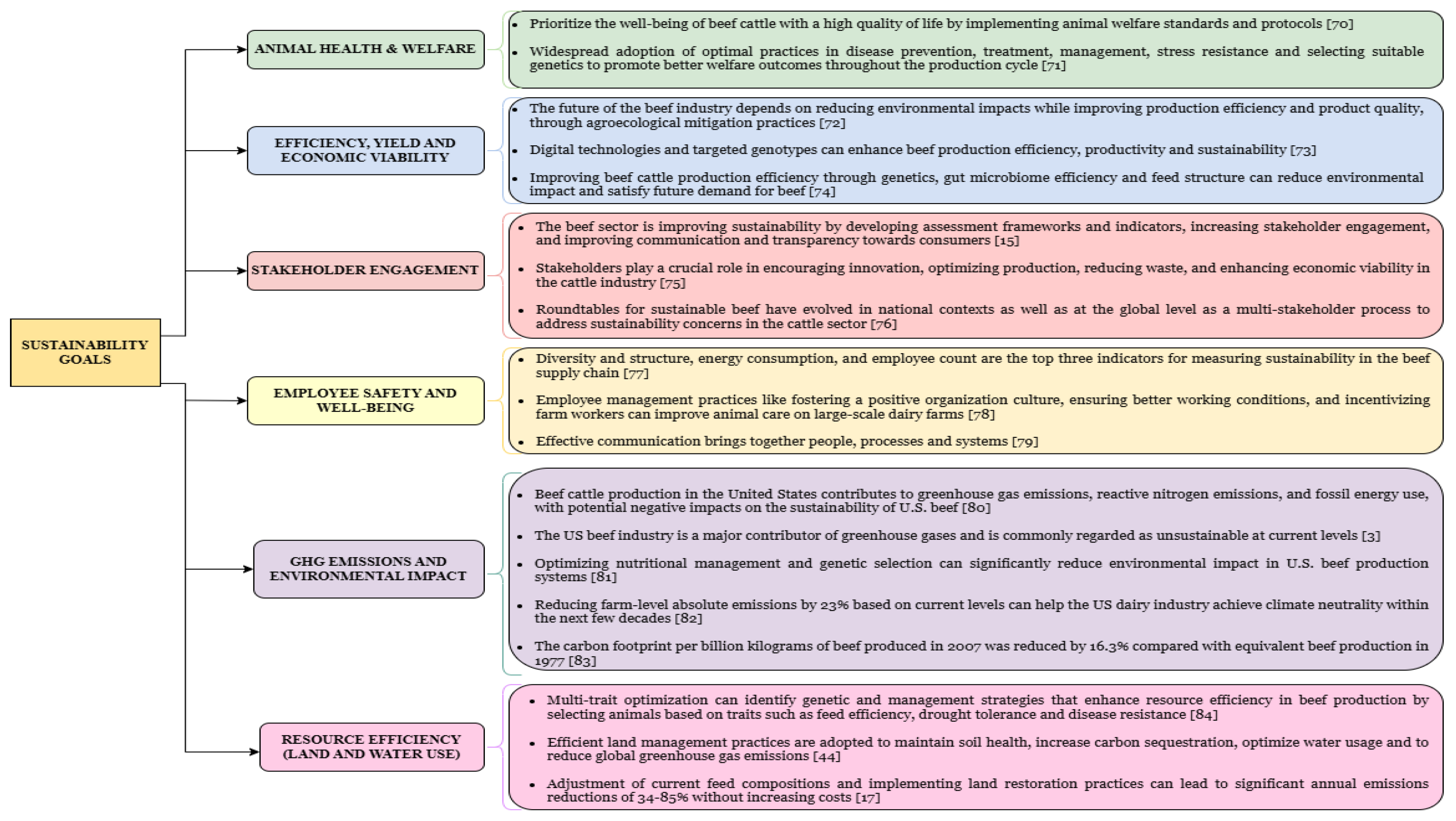
Figure 3.
Genomic Selection Tools and Multitrait Optimized Selection Indices of genetic consortia in USA, Europe and Brazil, that is being periodically redesigned to contribute to the Sustainability aspirations of the cattle industry. Figure credits: https://www.edrawmind.com/app/editor/uArp5zpmZyJppxS3RLUBEqy1lvx0Yrsc
Figure 3.
Genomic Selection Tools and Multitrait Optimized Selection Indices of genetic consortia in USA, Europe and Brazil, that is being periodically redesigned to contribute to the Sustainability aspirations of the cattle industry. Figure credits: https://www.edrawmind.com/app/editor/uArp5zpmZyJppxS3RLUBEqy1lvx0Yrsc
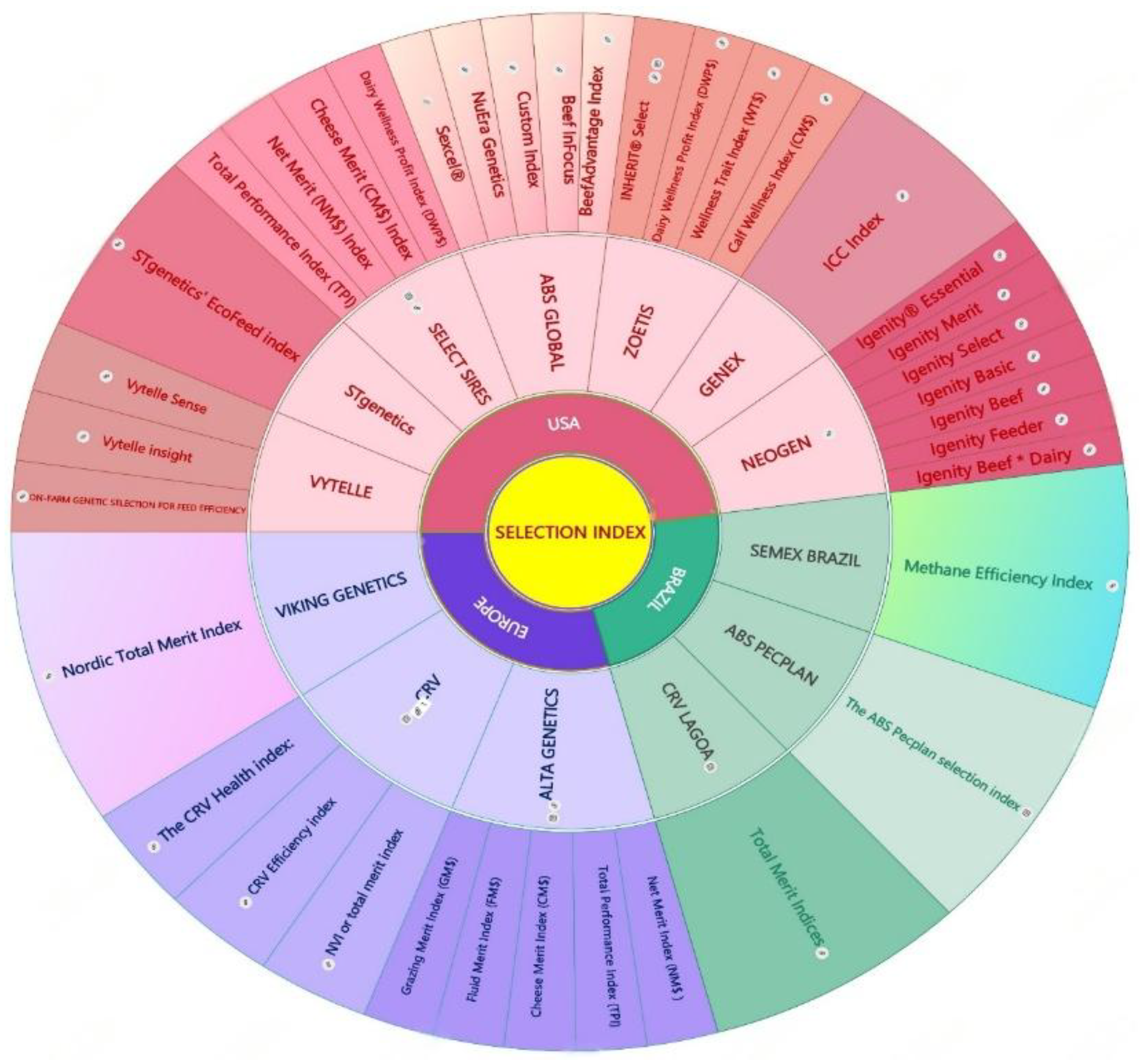
Figure 4.
Global Genetic Consortiums in Cattle Breeding: Germplasm Products, Genomic Programs, and Sustainability Outcomes
Figure 4.
Global Genetic Consortiums in Cattle Breeding: Germplasm Products, Genomic Programs, and Sustainability Outcomes
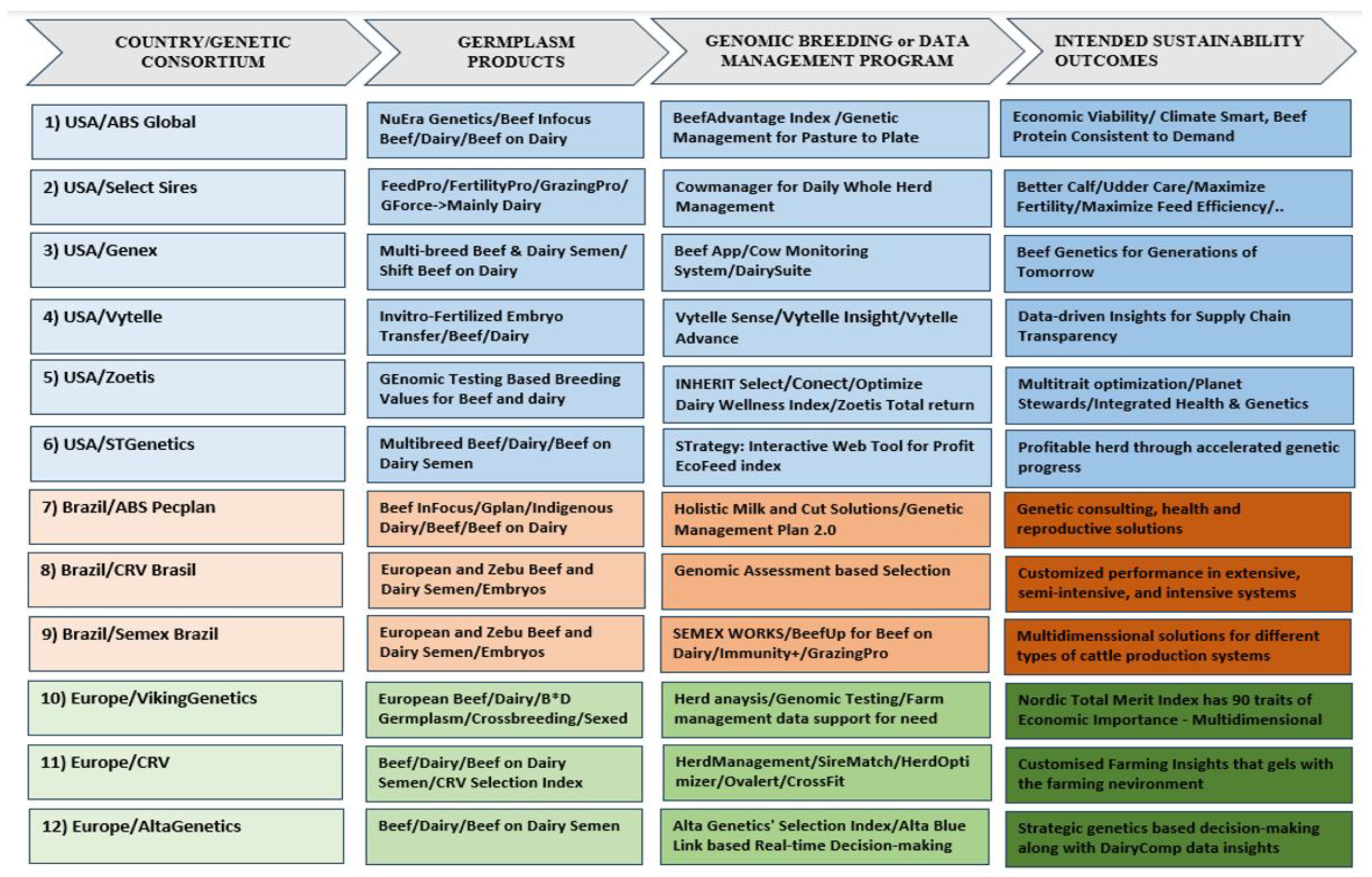
Disclaimer/Publisher’s Note: The statements, opinions and data contained in all publications are solely those of the individual author(s) and contributor(s) and not of MDPI and/or the editor(s). MDPI and/or the editor(s) disclaim responsibility for any injury to people or property resulting from any ideas, methods, instructions or products referred to in the content. |
© 2025 by the authors. Licensee MDPI, Basel, Switzerland. This article is an open access article distributed under the terms and conditions of the Creative Commons Attribution (CC BY) license (http://creativecommons.org/licenses/by/4.0/).
Copyright: This open access article is published under a Creative Commons CC BY 4.0 license, which permit the free download, distribution, and reuse, provided that the author and preprint are cited in any reuse.


