

Submitted:
08 December 2025
Posted:
14 December 2025
You are already at the latest version
Abstract
Manufacturing variability has a measurable impact on the NVH behavior of gear drives. Small deviations in tooth geometry or surface quality can increase transmission error. These effects become more pronounced in electric powertrains due to the lack of masking noise. Housing stiffness variations further shape how gear-mesh excitations are radiated as airborne sound. This review examines how common gear and housing tolerances influence NVH performance and summarizes recent advances in stochastic analysis, robust design, and measurement-driven modeling. The results show that unit-to-unit differences in gear quality and housing dynamics can shift radiated noise by several decibels. Integrating real manufacturing data, statistical tolerance assessment, and coupled structural–acoustic simulations provides a practical approach to achieving consistently quiet powertrains in series production.
Keywords:
1. Introduction
2. Gear Manufacturing Deviations and NVH Performance
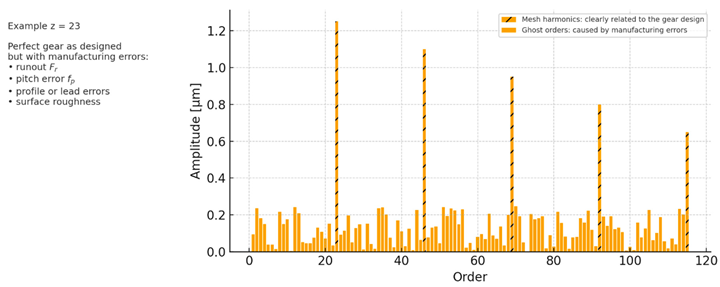
3. Statistical and Robust Analysis of Tolerances
4. Gear Housing Variations and Radiated Noise
5. Integrated Gear-Bearing-Housing Modeling
6. Robust NVH Design and Quality Assurance
- Tolerance Allocation & Stack-Up: During design, engineers perform tolerance analysis specifically for NVH-critical parameters. For instance, they might allocate a tighter pitch error tolerance if analysis shows indexing error contributes strongly to TE and noise[1]. If certain errors (e.g., profile error) are less sensitive thanks to profile modifications, their tolerance could be relaxed slightly in favor of manufacturability[4]. Modern gear design software even allows “NVH quality” checks; e.g., Kisssoft can simulate how a gear at the tolerance limits would affect TE and contact pressure[12]. By setting NVH-driven tolerance limits, one ensures that any gear meeting print tolerances is also likely to meet noise targets (though as we saw, ghost noise can slip through standard tolerancing, thus sometimes new metrics like flank waviness must be specified).
- Process Capability and Process Shift: It’s not enough to set tolerances; one must ensure the manufacturing process can consistently achieve them. Process capability indices (Cp, Cpk) are used to quantify this. A high Cpk (>>1) means the process variation is well within spec limits, yielding a low reject rate and uniform output. For NVH, consistent processes mean less spread in TE and noise across production. However, processes can drift (mean shifts) or have tool wear effects. For example, a grinding machine might gradually introduce more lead error as the dresser wears. Robust design anticipates this by perhaps targeting a Cpk of 1.33 at half the allowed tolerance—providing margin for drift. Another strategy is process corrections: on-line measurements (like barkhausen or optical scans) can detect trends and allow proactive adjustment (e.g., tweak machine offsets) before parts go out of spec. In our large-scale production, it’s observed that the combined effect of small gear and housing deviations leads to a distribution of NVH outcomes; to keep that distribution tight (i.e., minimal variance in noise), processes must be tightly controlled and centered (minimum mean shifts)[2]. This often requires investment in high-precision machines, in-process gauging, and rigorous maintenance of machine calibration.
- Inline and End-of-Line Inspection: Leading transmission manufacturers now implement 100% NVH testing of gearsets or even individual gears before assembly[2]. For example, a single-flank torsional vibration test can screen gears for ghost order excitations by measuring their acceleration spectrum at high speed[2]. If a gear produces spikes at certain orders, it can be marked as noisy and either scrapped or reworked. This approach effectively catches those outliers where, say, an undetectable flank anomaly would otherwise slip through. Additionally, traditional gear inspection (lead, profile, pitch measurements) is performed on every gear or statistically sampled to ensure conformance. Inline metrology (such as laser scanning or on-machine measurement) provides data to keep the manufacturing process in check and feeds back to design. The concept of “measured performance drawing” is emerging: instead of just yes/no tolerances, gear measurements can be fed into a model to predict if that gear will meet NVH requirements. Only gears with predicted high TE or ghost risk are filtered out, potentially allowing a slightly higher tolerance as long as the model predicts acceptability. This closes the loop between design prediction and quality control.
7. Open Research Questions
- Predictive “Ghost Noise” Modeling: While we can simulate ghost orders by inputting measured errors, doing so predictively (without measurements) is tricky. A full multi-physics model that captures gear manufacturing process signatures (e.g., grinder chatter patterns) and translates them into noise predictions is not yet standard. Researchers are working on linking machine tool errors to gear spectral error content. Moreover, replicating ghost order effects requires high frequency resolution and accounting for tooth-to-tooth variability—pushing the limits of current modeling. Improved techniques (or higher computational power) to include, for example, stochastic surface error representations in dynamic simulations would help here. Boundary conditions also matter: real gear pairs have varying support stiffness and backlash which influence ghost tones; modelling the range of these in operation (cold vs. hot, different mounting) is an ongoing area.
- Direct Integration of Measured Topography: Although one can now map measured 3D tooth surface data into simulations (as shown in research[1]), it’s not yet a routine part of design due to time and data size constraints. Future tools might integrate CMM measurements of gears directly into FE or MBD models in an automated way. This would allow digital twins of actual production units, enabling correlation of specific surface features with noise. One vision is that every gear gets a “fingerprint” and its expected noise can be forecast by simulating the measured geometry—then pairing of gears or targeted lapping could be done to mitigate any issues. Advancements in scanning speed and data handling, as well as model reduction (to condense a surface map into key error harmonics), will facilitate this.
- AI and Explainable Diagnostics: With the plethora of inspection data (profile plots, FFTs of TE, etc.), there is interest in applying machine learning to identify patterns that correlate with noisy gears. For example, an ML model could be trained on many gear measurements and their noise test results to predict NVH outcomes from measurements alone. Some initial work in this direction exists, but a challenge is making these models explainable—i.e., providing insight like “high amplitude of 5th-order waviness in profile is causing a ghost order”. Bridging AI with physical causation (XAI for metrology) would greatly help quality engineers introduce controlled amounts of “behavioral” modifications. Interestingly, as noted in a Marposs report, sometimes a perfectly smooth gear can be noisier than one with slight imperfections, because a touch of random “disorder” can damp certain resonances[2]. Understanding such counter-intuitive effects and guiding the manufacturing process (perhaps to intentionally introduce benign micro-variations) is a frontier. AI might detect when a gear’s spectrum is “too perfect” and likely to ring at a single frequency, vs. one with a mild broadband roughness that spreads energy.
- NVH of New Manufacturing Methods: As production evolves (e.g., additive manufacturing for gears, new heat treatments, composite housings), the nature of manufacturing variability changes. For instance, 3D-printed gears may have different error signature (layer-induced waviness). How these affect NVH and how to control them will need study. Similarly, lightweight composite or plastic housings will have different variability (material property scatter, joint tolerances) and acoustic radiation characteristics, raising new questions for robust NVH design.
- Extending Robust Design to System Level: We often tackle gear and housing separately in analysis, but ultimately the entire powertrain including e-motor, differential, mounts, etc., has manufacturing variances. A holistic robust NVH model that includes motor shaft balance, gear errors, bearing preload variation, and housing modes together would be extremely valuable to predict the overall vehicle NVH variability. This is a complex, multi-disciplinary problem that likely requires new efficient simulation and uncertainty propagation techniques.
- Misalignment process shift — importance 0.094
- Crown wheel pitch process shift — 0.087
- Crown wheel runout process shift — 0.080
- Crown wheel form defect process shift — 0.078
- Spur gear form defect process shift — 0.076
- Misalignment process shift: 22.493 → 22.510 (Δ ≈ +0.017)
- Crown wheel pitch process shift: 22.496 → 22.505 (Δ ≈ +0.009)
- Crown wheel runout process shift: 22.496 → 22.511 (Δ ≈ +0.015)
- Single-variable linear effects are not the story. With near-zero Pearson r, KTE depends on weak, nonlinear, and interacting contributors.
- Process shifts matter. Despite low R2, nonlinear modeling and quartile trends consistently elevate misalignment and crown-wheel pitch/runout shifts as the most actionable levers.
- Design for capability. Use the dataset for Monte Carlo/GSA to set evidence-based NVH targets that respect manufacturing capability (yield) and process centering.
- System view. Extend the analysis to include housing and other boundary-condition variability for end-to-end NVH robustness.
8. Conclusions
References
- Horváth, K., & Feszty, D. (2025). The impact of pitch error on the dynamics and transmission error of gear drives. Applied Sciences, 15(14), 7851. https://doi.org/10.3390/app15147851 (436538224547332†L111-L125). [CrossRef]
- https://www.mdpi.com/2076-3417/15/14/7851.
- Lukomski, S. (2025, January 2). Noise vibration harshness (NVH) quality inspection. Quality Magazine. Elérhető: https://www.qualitymag.com/articles/98488-noise-vibration-harshness-nvh-quality-inspection (389536188286787†L79-L96).
- https://www.qualitymag.com/articles/98488-noise-vibration-harshness-nvh-quality-inspection.
- Türich, A., & Deininger, K. (2024, February 15). Noise analysis for e-drive gears and in-process gear inspection. Gear Solutions Magazine. Elérhető: https://gearsolutions.com/features/noise-analysis-for-e-drive-gears-and-in-process-gear-inspection/ (532263998404355†L127-L170).
- https://gearsolutions.com/features/noise-analysis-for-e-drive-gears-and-in-process-gear-inspection/.
- Kissling, U. (2022). Taking into account the production methodology and estimating the influence of manufacturing quality on NVH performance when sizing gears. Gear Technology, 2022 szeptember/október, 36–45. Elérhető: https://www.geartechnology.com/taking-into-account-the-production-methodology-and-estimating-the-influence-of-manufacturing-quality-on-nvh-performance-when-sizing-gears (18607558803261†L53-L96).
- https://www.geartechnology.com/taking-into-account-the-production-methodology-and-estimating-the-influence-of-manufacturing-quality-on-nvh-performance-when-sizing-gears.
- Intra Corporation. (2020). Intra NVH Analysis—Production gear NVH analysis & quality system. Elérhető: https://www.intra-corp.net/intra-nvh-analysis/ (73004508228027†L37-L50).
- https://www.intra-corp.net/intra-nvh-analysis/.
- Kim, B.-S., Han, H.-W., Chung, W.-J., & Park, Y.-J. (2024). Optimization of gearbox housing shape for agricultural UTV using structural–acoustic coupled analysis. Scientific Reports, 14(1), 4145. https://doi.org/10.1038/s41598-024-54606-8 (667989211892494†L228-L236). [CrossRef]
- https://www.nature.com/articles/s41598-024-54606-8?error=cookies_not_supported&code=0c9f2b46-2685-4771-ac00-1fdd5c559eeb.
- Chung, W.-J., Park, Y.-J., Choi, C., & Kim, S.-C. (2023). Effects of manufacturing errors of gear macro-geometry on gear performance. Scientific Reports, 13, Article 50. https://doi.org/10.1038/s41598-022-27204-9 (663181554004956†L128-L137). [CrossRef]
- https://www.nature.com/articles/s41598-022-27204-9?error=cookies_not_supported&code=14fdabe7-0681-4d50-90e9-960cd8e63d05.
- Lim, T. C., & Singh, R. (1988). A review of gear housing dynamics and acoustics literature. NASA Technical Report (RF Project 765863/719176). National Aeronautics and Space Administration. Elérhető: https://ntrs.nasa.gov/api/citations/19880017291/downloads/19880017291.pdf (321868595728394†L29-L56).
- https://ntrs.nasa.gov/api/citations/19880017291/downloads/19880017291.pdf.
- Seybert, A. F., Wu, T. W., Wu, X. F., & Oswald, F. B. (1991). Acoustical analysis of gear housing vibration. NASA Technical Memorandum 103691. Elérhető: https://ntrs.nasa.gov/api/citations/19910016097/downloads/19910016097.pdf (267658057204112†L23-L40).
- https://ntrs.nasa.gov/api/citations/19910016097/downloads/19910016097.pdf.
- Farshi, K., Bopp, M., Petersen, M., Gohlke, T., & Albers, A. (2023). Numerical study of noise and vibration behaviour of lightweight gearbox housing. DAGA 2023 konferenciakötet, 549–552. Deutsche Gesellschaft für Akustik. Elérhető: https://pub.dega-akustik.de/DAGA_2023/data/articles/000212.pdf (201714219881401†L0-L14).
- https://pub.dega-akustik.de/DAGA_2023/data/articles/000212.pdf.
- Farshi, K., Ott, S., & Albers, A. (2025). Influence of rib dimensions on the NVH performance of lightweight gearbox housings in an electric vehicle. DAS|DAGA 2025 konferenciakötet, 1450–1454. Deutsche Gesellschaft für Akustik. Elérhető: https://pub.dega-akustik.de/DAS-DAGA_2025/files/upload/paper/189.pdf (272195474559153†L0-L24).
- http://pub.dega-akustik.de/DAS-DAGA_2025/files/upload/paper/189.pdf.
- Najib, R., Neufond, J., Franco, F., & Petrone, G. (2025). Effect of manufacturing tolerances and uncertainties on the NVH response of spur and helical gears: A review. Proceedings of the Institution of Mechanical Engineers, Part C: Journal of Mechanical Engineering Science, 239(16), 1–??. https://doi.org/10.1177/09544062251340428 (848805840523331†L69-L80). [CrossRef]
- https://www.researchgate.net/publication/392702508_Effect_of_manufacturing_tolerances_and_uncertainties_on_the_NVH_response_of_spur_and_helical_gears_A_review.
Disclaimer/Publisher’s Note: The statements, opinions and data contained in all publications are solely those of the individual author(s) and contributor(s) and not of MDPI and/or the editor(s). MDPI and/or the editor(s) disclaim responsibility for any injury to people or property resulting from any ideas, methods, instructions or products referred to in the content. |
© 2025 by the authors. Licensee MDPI, Basel, Switzerland. This article is an open access article distributed under the terms and conditions of the Creative Commons Attribution (CC BY) license (http://creativecommons.org/licenses/by/4.0/).