
Submitted:
05 December 2025
Posted:
09 December 2025
Read the latest preprint version here
Abstract
Entanglement is conventionally treated as an abstract property of tensor-product Hilbert spaces. We show instead that it can be realized as a global compatibility constraint in the internal gauge bundle of the vacuum, encoded by a locally pure-gauge field Ξ(x) acting only on internal degrees of freedom. This vacuum internal gauge symmetry (VIGS) yields a concrete, symmetry-based mechanism for quantum correlations that requires no nonlocal dynamics, introduces no new particles or forces, and leaves the Standard Model Lagrangian unchanged. Our main result is the Vacuum Internal Gauge Theorem, which demonstrates that: (i) all nontrivial global constraints induced by Ξ are confined to internal fibers; (ii) only internal degrees of freedom can become entangled; (iii) no information can be transmitted via the vacuum gauge structure; and (iv) gravitational degrees of freedom, having no internal fiber structure, cannot be entangled. Thus VIGS explains the empirical restriction of entanglement to internal DOFs and predicts the absence of gravitational entanglement, providing a gauge-theoretic foundation for quantum correlations within a strictly local spacetime.
Keywords:
vacuum gauge symmetry
; entanglement
; internal DOFs
; gauge bundles
; no-signaling
; gravitational entanglement
1. Introduction
Quantum entanglement is widely recognized as one of the most distinctive features of quantum theory, yet a simple empirical pattern has received surprisingly little theoretical attention: all experimentally verified entanglement involves internal degrees of freedom. Spin and polarization entanglement were established decades ago in pioneering Bell tests [1,4], and modern loophole-free experiments continue to confirm these correlations [13]. Internal atomic and ionic states also exhibit robust entanglement in high-precision platforms [6,38], as do internal photonic mode indices such as orbital angular momentum (OAM) [22]. By contrast, no experiment has demonstrated sustained entanglement of external classical observables such as mass, size, shape, gravitational curvature, or classical energy.
Even proposed “gravitationally mediated entanglement” experiments ultimately rely on internal spin-path correlations in matter systems, rather than on entanglement of the gravitational field itself [7,24]. Despite extensive theoretical and experimental efforts, there is still no evidence that purely gravitational degrees of freedom can become entangled.
Standard quantum mechanics and quantum field theory treat internal and external degrees of freedom on different mathematical footing, but they do not supply a physical principle explaining why only internal DOFs participate in entanglement. In the Hilbert-space formalism any tensor-product factor is, in principle, entangleable, yet nature exhibits a much sharper restriction than the theory suggests [15].
In this work we show that a minimal, fully gauge-invariant extension of the Standard Model supplies a natural explanation for this empirical dichotomy. By introducing a vacuum internal gauge field that is locally pure gauge and therefore dynamically inert but capable of supporting global compatibility constraints, we obtain a mechanism in which entanglement arises from the internal gauge geometry of the vacuum. This Vacuum Internal Gauge Symmetry (VIGS) leaves all local quantum field dynamics unchanged, introduces no new particles or forces, and predicts the observed confinement of entanglement to internal degrees of freedom. In the following sections we show that this mechanism is mathematically natural, experimentally testable, and provides a gauge-theoretic account of quantum correlations within the standard spacetime ontology.
2. Theoretical Context and Relation to Prior Work
The present proposal lies at the intersection of three well-developed research programs: (i) the gauge-bundle formulation of the Standard Model, (ii) algebraic and decoherence-based accounts of entanglement, and (iii) geometric and gauge-theoretic approaches to quantum correlations. We summarize the relevant context and clarify the novelty of the Vacuum Internal Gauge Symmetry (VIGS) mechanism.
Gauge-bundle formulations.
It is standard to regard internal degrees of freedom as fibers of associated bundles to a principal bundle over spacetime, with gauge bosons interpreted as connections whose curvature determines the local dynamics [3,26]. However, these formulations assign no independent gauge structure to the vacuum itself: the internal bundle carries no additional geometric data beyond the dynamical connection . In particular, no global compatibility structure is present that could constrain internal frames in spatially separated regions.
Algebraic and decoherence-based views.
In algebraic quantum field theory (AQFT), entanglement is encoded in the structure of operator algebras associated with spacelike-separated regions [12,33]. Decoherence theory explains its fragility through environmental monitoring of local degrees of freedom [43]. These approaches successfully characterize entanglement but do not supply a physical field or symmetry that implements the global compatibility relations underlying nonlocal correlations. The structure remains kinematical, tied to the tensor product of Hilbert spaces, rather than dynamical or geometric.
Geometric and gauge-based proposals.
Various works have explored geometric or gauge-theoretic analogies to entanglement—such as wormhole-based “ER=EPR” ideas [23], entanglement-induced geometry in holography [34], or topological-field-theory models of quantum correlations. These proposals either require new dynamical fields, invoke quantum-gravitational assumptions, or do not reproduce ordinary entanglement within flat spacetime and Standard Model physics.
Novelty of the VIGS mechanism.
The VIGS framework differs from all prior approaches in two respects. First, the vacuum field is a locally pure-gauge section of with vanishing curvature, introducing no new local dynamics or propagating degrees of freedom. Second, entanglement arises as a global compatibility constraint encoded by rather than as an algebraic property of operator algebras or Hilbert-space tensor products. This provides a natural, symmetry-preserving mechanism that explains why only internal degrees of freedom entangle and yields concrete, testable predictions such as the absence of gravitational entanglement.
Thus, VIGS may be viewed as an extension of the internal gauge redundancy to the vacuum configuration itself, enlarging the symmetry of the vacuum sector without altering any dynamical gauge fields; in this way it provides a minimal, symmetry-preserving extension of the Standard Model that leaves all local physics unchanged while supplying the first gauge-theoretic account of entanglement compatible with a fixed spacetime background.
3. Internal Gauge Bundles in the Standard Model
In the geometric formulation of the Standard Model, matter fields are described as sections of vector bundles associated to a principal internal gauge bundle over spacetime [3,11,26,37]. Let denote the spacetime manifold equipped with a Lorentzian metric, and let
be the internal gauge group of the Standard Model. A principal G-bundle
encodes the internal gauge structure, with typical fiber G and a connection one-form A on P representing the gauge potential in the sense of Yang and Mills [40].
Given a unitary representation on a finite-dimensional complex vector space , one obtains an associated vector bundle
whose fiber carries the internal degrees of freedom of a matter multiplet (e.g. color, isospin, hypercharge, or spinor components). A matter field is then a smooth section
and gauge transformations act fiberwise via .
By contrast, external geometric quantities—spacetime position, proper time, curvature, and all metric relations—reside in the base manifold and its tangent/cotangent bundles, rather than in . The Standard Model thus already embodies a sharp separation between internal DOFs (the fibers of ) and external DOFs (the geometry of ).
The empirical restriction of quantum entanglement to internal degrees of freedom may therefore reflect the fact that only the internal fibers carry a structure capable of supporting nontrivial global constraints. In what follows, we introduce a minimal extension of this internal gauge bundle—at the level of the vacuum rather than the dynamical connection— that realizes entanglement as a global compatibility condition in the internal bundle, without modifying the local dynamics of the Standard Model.
4. Vacuum Internal Gauge Symmetry (VIGS)
Before introducing the formal definition, it is useful to outline the physical intuition. In ordinary gauge theory, the internal symmetries act on the internal orientation of matter fields: each charged particle carries its own internal coordinate axes (color frame, weak–isospin frame, phase reference), and a gauge transformation simply rotates these axes, as emphasized in standard bundle treatments [26,37]. Crucially, in the Standard Model nothing assigns an internal orientation to the vacuum; only matter fields carry such frames, while the vacuum is inert.
VIGS extends this picture in a minimal way: the vacuum is allowed to choose its own internal coordinate axes. Mathematically, this corresponds to a smooth field
which at each point x specifies an automorphism of the internal fiber i.e., a linear change of basis acting on the same internal degrees of freedom that matter fields inhabit. Physically, is nothing more exotic than a vacuum assignment of “which internal axes point where.”
Because an automorphism is not a connection, defines no parallel transport and carries no curvature. Locally, it can always be gauged away. Thus VIGS introduces no new forces and no local gauge-invariant observables.
The key point is that a flat internal-frame field can nevertheless possess nontrivial global structure—much like the global phase information in the Aharonov–Bohm effect or the holonomy of a flat bundle [39]. Even when curvature vanishes, the vacuum’s internal axes may still be consistently aligned across distant regions in a way that cannot be removed globally.
It is precisely this global, curvature-free structure—“global holonomy without curvature”—that carries physical content in VIGS. These global compatibility relations between the internal frames of separated regions, rather than any local interaction, form the mechanism underlying quantum entanglement in the VIGS framework.
We now introduce a minimal extension of the internal gauge structure of the Standard Model by assigning an internal gauge configuration not only to matter fields but also to the vacuum. Let denote the typical fiber of the associated bundle in the usual geometric formulation of gauge theory [3,11,26]. We introduce a smooth field
assigning to each point an automorphism of the internal fiber. Unlike the dynamical gauge connection, encodes a choice of vacuum-frame alignment and does not represent a propagating local field.
Gauge transformation law.
Under a local gauge transformation , matter fields transform as , and we require the vacuum field to transform covariantly:
This places in the adjoint representation of G, analogous to an adjoint-valued field on the associated bundle in the sense of [19]. Because adjoint conjugation removes all gauge-invariant local content, introduces no new pointlike observables.
Local triviality.
To avoid introducing new interactions or excitations, we require to be locally pure gauge. Let D denote the covariant derivative acting on -valued fields, and define the analogue of a curvature tensor [2]:
The vacuum internal gauge symmetry (VIGS) postulate is
Thus in any simply connected neighborhood ,
so is locally gauge-equivalent to a constant element of . Such flat internal configurations carry no stress–energy and generate no local forces, just as flat gauge fields in Yang–Mills theory are locally unobservable [39].
Global structure.
Even when locally trivial, a field with may possess nontrivial global structure encoded in holonomies, boundary conditions, or topology of the underlying bundle [2,39]. The only gauge-invariant information in is therefore its global compatibility data—for example, whether the internal frames in distant regions can be consistently identified via the global configuration of . These global compatibility conditions, rather than any local dynamics, constitute the physical content of VIGS and will serve as the mechanism underlying quantum entanglement in later sections.
In summary, VIGS promotes internal gauge redundancy from a symmetry of matter fields to a symmetry of the vacuum configuration itself. The vacuum field is locally invisible, yet its global structure can impose nontrivial constraints on multi-region quantum states without altering any local dynamics of the Standard Model. See Figure 1 for an illustration.
5. Vacuum Gauge Bridges
The vacuum internal gauge field introduced above is locally pure gauge and therefore carries no gauge-invariant local structure in the sense of flat gauge configurations [2,39]. Nevertheless, its global configuration may encode nontrivial relations between internal degrees of freedom supported on spatially separated regions, much as flat connections can implement nontrivial holonomy or global frame identifications in gauge theory [11,19]. We refer to such global constraints as vacuum gauge bridges.
Definition.
Let be disjoint spacetime regions supporting matter degrees of freedom with internal fibers and . A vacuum gauge bridge between A and B is a gauge-invariant relation
such that there exists a global section of satisfying the flatness condition and for which
Equivalently, consists of those internal states whose representatives remain compatible under the global internal-frame identification encoded by a flat .
Physical interpretation.
In geometric terms, selects joint internal states for which and differ only by the global internal-frame alignment specified by . Because is flat, this compatibility does not arise from curvature or local propagation but from the global structure of a flat connection, mirroring how nontrivial holonomy may persist even when a gauge field has vanishing curvature [39].
Example: spin singlet.
For two spin- systems localized in regions A and B, the spin-singlet constraint
corresponds to the statement that, when the internal frames at A and B are identified by , the sum of the spin vectors vanishes. Here is the one-dimensional antisymmetric subspace of , familiar from the standard theory of spin entanglement [31,37]. The global section supplies a vacuum-level identification of the two internal spin frames without introducing any local coupling or exchange interaction.
Local triviality and absence of energy cost.
Because is locally gauge-trivial (), a vacuum gauge bridge produces no local gauge curvature, no stress–energy, and no propagating degrees of freedom. All pointwise gauge-invariant observables built from vanish; the bridge manifests only through restrictions on the allowed joint internal states in A and B. This parallels the way entangled correlations appear in algebraic QFT as constraints on joint states rather than as dynamical connections between regions [33].
Interpretation.
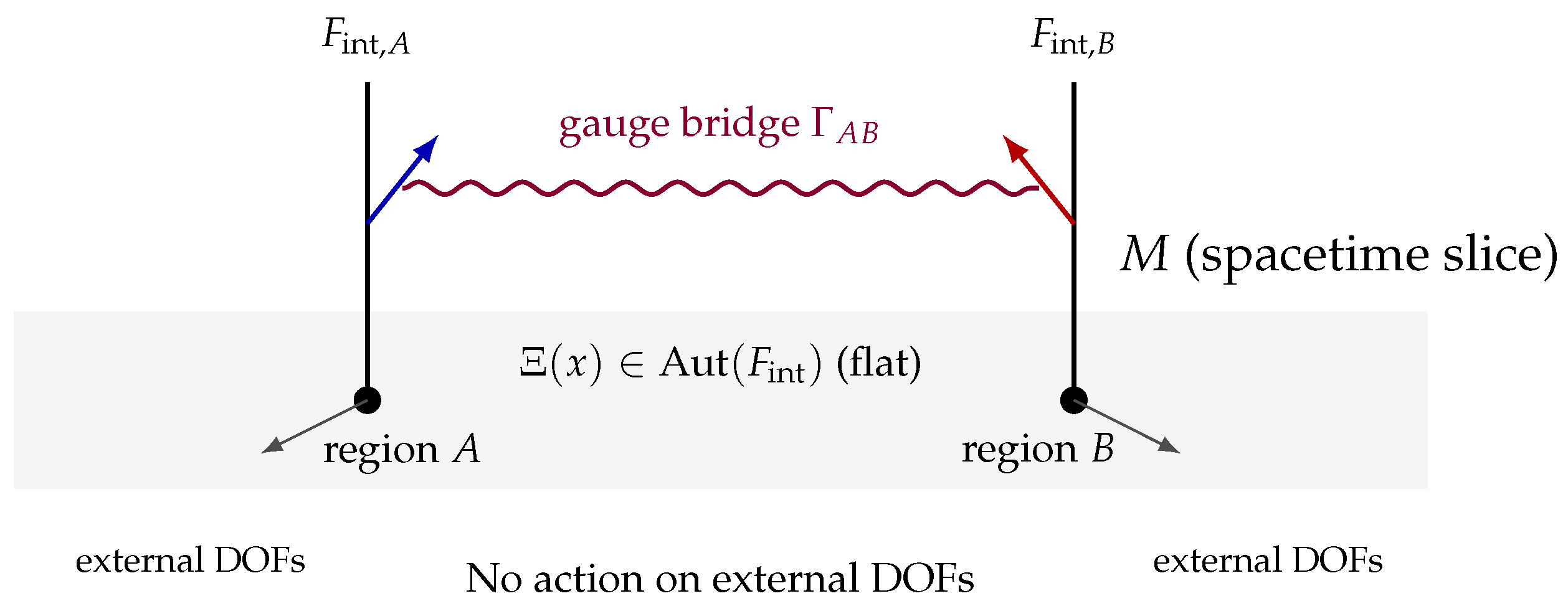
A vacuum gauge bridge endows the vacuum with a global internal-frame structure that correlates internal DOFs in separated regions while remaining invisible to all local measurements. In this framework, entangled states correspond precisely to joint states , i.e. states whose internal components satisfy the global compatibility condition encoded by a flat internal vacuum field . Figure 2 is an illustration of this gauge bridge structure.
6. Central Theorem: Vacuum Internal Gauge Mechanism
We now formalize the core result of the VIGS framework. A mathematically explicit construction and rigorous proof of the claims below are provided in Appendix A, where the vacuum gauge constraint is modeled as a projector acting solely on the internal sector of the Hilbert space.
Let be the Standard Model principal bundle with structure group
and let denote the associated internal bundle representing all internal degrees of freedom (spin, polarization, flavor, internal atomic states), in the standard geometric formulation of gauge theories [11,19,26]. External geometric quantities—the metric , curvature , and all tensor fields on or —live outside and encode the gravitational sector in the sense of general relativity [35].
We introduce a vacuum field
satisfying the following properties:
- Internality. acts only on and has no representation on or . Thus cannot couple to external geometric degrees of freedom, a structural fact also emphasized in the Standard Model’s separation of internal and Lorentz symmetries [37].
- Physical-state constraint. Physical states obey a global compatibility relationwhose explicit realization as a constraint projector is given in Appendix A.
We now state the central result.
Theorem 6.1
(Vacuum Internal Gauge Theorem). Let , , and Ξ be as above. Then:
-
Constraint localization. All nontrivial global constraints induced by Ξ lie infor any pair of regions . No constraint can be imposed on external geometric DOFs. A formal proof in finite-dimensional Hilbert-space factorization is given in Proposition A.1 of Appendix A.
- Restriction of entanglement. All physically realizable entangled states are encoded in global constraints on internal fibers. External quantities (mass, classical position, curvature, gravitational excitations) cannot become entangled. The restriction of all Schmidt correlations to the internal sector is proved explicitly in Proposition A.2.
- No-signaling. For any local operator supported in region A, the reduced state in a spacelike-separated region B satisfiesso no local operation can change the global gauge-equivalence class of Ξ or modify statistics at B. The rigorous statement and proof appear in Proposition A.3 of Appendix A, following standard locality arguments in QFT algebras [12,33].
- Gravitational decoupling. Since gravity resides entirely in the external geometric sector and has no internal fiber structure, no gravitational degree of freedom can enter any . Thus gravitational entanglement is impossible. The formal argument is given in Proposition A.4 of Appendix A.
Sketch of Proof.
A conceptual proof is given here; full mathematical details are provided in Appendix A.
(1) Flatness () implies is locally gauge-trivial, so all constraints generated by must act on internal fibers. Appendix Proposition A.1 shows this explicitly via the projector .
(2) Since has no action on or , it cannot constrain external geometric variables. Proposition A.2 shows that only internal tensor factors appear in the Schmidt decomposition of physical states.
(3) Local operators correspond to completely positive maps with compact support. Because is locally pure gauge, such operations cannot alter the global equivalence class of , establishing no-signaling (see Proposition A.3).
(4) Gravity and curvature tensors reside in the external geometric sector [35], which carries no G-action. Proposition A.4 shows that no gravitational tensor factor is ever affected by the constraint projector. □
See Appendix A for proof details.
7. Mechanism of Entanglement
The vacuum internal gauge field allows entanglement to be understood as a global compatibility requirement on physical states rather than as a nonlocal interaction. Because is locally pure gauge, it introduces no new excitations and alters no local dynamics, consistent with the locality structure of relativistic quantum field theory [12,37].
Physical Hilbert space.
Let denote the usual Hilbert space of the Standard Model [30,37]. The vacuum field selects the subspace of physical states satisfying the global constraint
which enforces internal-frame compatibility encoded by the vacuum gauge bridge. For two localized subsystems A and B, this requires the joint internal state to lie in a specific constraint space , analogous to selecting superselection sectors in algebraic QFT but arising here from a gauge-theoretic condition rather than operator algebra structure [12].
Time evolution.
Time evolution is generated by the unmodified Standard Model Hamiltonian
so local dynamics proceed exactly as in conventional QFT. Flatness of the vacuum field () implies that preserves the constraint unless a local process imposes an internal alignment incompatible with the global structure. In that case the compatibility condition fails, and the gauge bridge collapses at once, reproducing the observed fragility of entanglement without invoking any nonlocal collapse rule or environmental tracing as in decoherence theory [43].
Thus, entanglement persists precisely while internal degrees of freedom remain jointly compatible with , and disappears when local dynamics drive the system outside the constraint subspace .
Origin of Bell correlations.
Bell-inequality-violating correlations [4,9] arise because a vacuum gauge bridge imposes a single global constraint linking the internal fibers in regions A and B. No influence, signal, or propagating field connects these regions; both systems simply reference the same global internal-frame alignment. This accords with the mathematical structure of relativistic QFT, where Bell correlations coexist with strict microcausality [33].
Local evolution remains fully causal and gauge covariant [36], while the correlations reflect the global constraint defined by .
In summary, entanglement occurs precisely when a state satisfies the global compatibility condition determined by the vacuum field , and it vanishes when local interactions make that condition unsatisfiable. The mechanism requires no modification of local QFT dynamics and provides a purely gauge-theoretic explanation of quantum correlations.
8. Why Only Internal Degrees of Freedom Entangle
The vacuum gauge field takes values in and thus acts exclusively on the internal fibers of the associated bundle , the natural home of Standard Model internal quantum numbers [3,26,37]. Its transformation law (1) ensures that it has no representation on the spacetime manifold , nor on the tangent or cotangent bundles. Consequently, can constrain only internal degrees of freedom.
Structural separation of DOFs.
In the Standard Model, physical quantities divide cleanly into:
- External DOFs associated with spacetime geometry (position, mass, classical trajectory, curvature), encoded in and its tensor bundles;
- Internal DOFs (spin, polarization, isospin, hypercharge, flavor, color) residing in the fibers of .
Gauge bridges require internal action.
A vacuum gauge bridge is a global compatibility condition
arising from the global gauge structure of . Since the vacuum field has no action on or , no analogous compatibility relation can be imposed on spacetime or metric variables. Only internal fibers admit the structure necessary to support a bridge.
Consequences for entanglement.
Because physical states satisfy the compatibility constraint , which acts entirely within , entanglement is confined to internal DOFs:
External quantities—mass, position, shape, curvature—lie outside the action of and therefore cannot enter any bridge subspace .
Empirical agreement.
This prediction matches all existing experiments: every confirmed entanglement phenomenon involves internal DOFs such as spin, polarization, atomic internal states, or photon mode indices [8,29,32,42]. No experiment has ever demonstrated entanglement of purely external or classical geometric variables.
In summary, entanglement is restricted to internal DOFs because only these transform under the vacuum gauge symmetry capable of supporting global compatibility constraints.
9. Prediction: Absence of Gravitational Entanglement
In the VIGS framework, gravitational degrees of freedom reside entirely in the external geometric sector: the spacetime metric and its curvature on the base manifold M, as in classical general relativity [25,35]. These quantities carry no internal fiber structure and transform only under diffeomorphisms, not under the internal gauge group of the Standard Model.
The vacuum field
acts exclusively on internal fibers and transforms by the adjoint action (1). Since the metric sector admits no representation of G, the vacuum field cannot impose compatibility conditions on or on any quantity constructed purely from external geometry. This structural decoupling is consistent with the standard treatment of quantum fields on curved backgrounds, where gravity enters only through classical geometry [5].
No gravitational gauge bridges.
Vacuum gauge bridges require nontrivial internal fiber structure in order to relate internal frames between spatially separated regions. Because the gravitational field possesses no such internal fibers, it cannot enter any gauge-bridge subspace . Entanglement in the VIGS mechanism is therefore necessarily confined to internal degrees of freedom.
Prediction.
Purely gravitational degrees of freedom cannot become entangled. All realizable entanglement arises from compatibility constraints on internal degrees of freedom.
Accordingly, proposed tests of gravitationally mediated entanglement (e.g. [7,24]) should observe entanglement only through internal variables such as spin or internal energy levels, and not through the gravitational field itself. A verified observation of entanglement carried solely by gravitational degrees of freedom would therefore falsify the vacuum gauge-bridge mechanism.
10. Discussion
The VIGS framework preserves the full local dynamics of the Standard Model while introducing no new particles, forces, or nonlocal propagation. Entanglement is reinterpreted as a global compatibility condition in the internal gauge bundle, encoded by a vacuum field that is locally pure gauge and therefore dynamically invisible. This symmetry-based mechanism explains the empirical restriction of entanglement to internal DOFs [1,28] and yields sharp, testable predictions—most notably the absence of gravitational entanglement.
Nonlocal correlations without nonlocal dynamics.
Like standard quantum theory, VIGS reproduces Bell-inequality-violating correlations [4] while respecting relativistic causality. Because carries only global equivalence-class data, no local operation can alter its global gauge structure. Thus measurement choices at A cannot influence statistics at spacelike-separated B, preserving the no-signaling theorem in the sense of relativistic QFT [12]. The framework therefore permits nonlocal correlations without nonlocal dynamics, providing a physical mechanism absent in decoherence-based or algebraic accounts [17,41].
Implications for cosmology.
Many contemporary cosmological proposals invoke entanglement of gravitational degrees of freedom—such as entangled curvature modes in inflationary scenarios [18] or entanglement-driven emergence of spacetime [34]. Since gravitational DOFs lie in the external geometric sector and carry no internal fibers, VIGS predicts that gravitational entanglement is impossible. Cosmological models relying on entangled gravitons, entangled metric perturbations, or curvature-based entanglement must therefore be reinterpreted entirely in terms of matter-sector internal DOFs.
Relation to deeper microscopic theories.
Although the present construction is purely phenomenological and compatible with the Standard Model on a fixed spacetime background, the structure allows a natural embedding into theories where vacuum alignment or internal-frame structure arises from deeper microscopic physics, such as emergent gauge mechanisms or pre-geometric models of spacetime [16]. In this sense, VIGS functions as both: (i) a minimal completion of the internal-bundle architecture of the Standard Model, and (ii) an effective window onto possible microphysical origins of vacuum structure.
The VIGS mechanism provides a reformulation of entanglement as a global gauge-compatibility constraint within the Standard Model. Its predictions—especially the absence of gravitational entanglement—are concrete, falsifiable, and accessible to forthcoming experiments.
11. Conclusions
We have proposed a minimal and fully gauge-invariant extension of the Standard Model in which the vacuum carries an internal gauge configuration that is locally pure gauge but may possess nontrivial global structure. In this framework, quantum entanglement arises not from nonlocal influences but from global compatibility conditions imposed by the vacuum internal gauge field. Because the field acts exclusively on internal fibers of the associated bundle, the mechanism naturally explains the empirical fact that all verified entanglement involves internal degrees of freedom [1,28] and not external geometric variables.
The construction preserves all local quantum field theory dynamics and introduces no new particles, interactions, or nonlocal propagation. Yet it yields sharp, falsifiable predictions—most notably that purely gravitational degrees of freedom, which reside in the external geometric sector, cannot become entangled. This stands in contrast with proposals invoking gravitational or curvature-based entanglement in cosmology and quantum gravity [18,34].
By providing a symmetry-based, geometrically transparent account of quantum correlations, the VIGS framework offers both a natural extension of the Standard Model’s internal-bundle structure and a potential window onto deeper vacuum physics. Its predictions are experimentally accessible, conceptually minimal, and fully compatible with the established principles of relativistic quantum field theory.
Author Contributions
Bin Li is the sole author. All authors have read and agreed to the published version of the manuscript.
Funding
This research received no external funding.
Abbreviations
The following abbreviations are used in this manuscript:
| VIGS | Vacuum Internal Group Symmetry |
| DOF | degrees of freedom |
Appendix A. Mathematical Formulation of the Vacuum Gauge Mechanism
In this appendix we provide a simple mathematical setting in which the Vacuum Internal Gauge Theorem (Theorem 6.1) can be formulated and proved rigorously. Our construction follows standard tensor-product factorization and constraint-projector techniques used in quantum information theory and in algebraic quantum field theory (AQFT) [12,27,33]. For clarity we work with finite-dimensional internal Hilbert spaces; the generalization to field-theoretic degrees of freedom is standard [36].
Appendix A.1. Hilbert-Space Factorization
Let M be a fixed spacetime manifold and let denote two spacelike-separated regions. We associate to each region internal and external Hilbert spaces
with . The total Hilbert space factorization
is the standard tensor-product decomposition used throughout quantum information theory [27].
Appendix A.2. Vacuum Gauge Field and Constraint Projector
Let G be a compact Lie group and a unitary representation of the internal degrees of freedom. A vacuum internal gauge field defines a gauge-equivalence class of internal automorphisms, subject to , i.e. a flat connection in the sense of [2,39].
In the finite-dimensional model, selects a constraint subspace
encoded by an orthogonal projector , analogous to the projector used for constrained quantization à la Dirac [10]. The corresponding physical projector on the full system is
which leaves the external sector untouched.
Appendix A.3. Proof of the Vacuum Internal Gauge Theorem
Proposition A2
Proof.
Proposition A3
(Restriction of entanglement). If is pure, then all entanglement required by the constraint appears in the internal sector. External degrees of freedom remain unconstrained.
Proof.
Proposition A4
(No-signaling). Let be a CPTP map acting only on region A, preserving the constraint subspace. Then
so no information can be transmitted via .
Proof.
Proposition A5
(Gravitational decoupling). If carries no nontrivial G-action, then no vacuum gauge bridge can act on gravitational DOFs.
Proof.
Since acts trivially on the gravitational factor, every constraint projector factorizes as
which is the standard representation-theoretic argument for the absence of internal-gauge action on other sectors [37]. Thus no can involve purely gravitational DOFs. □
References
- Aspect, A.; Dalibard, J.; Roger, G. Experimental test of Bell’s inequalities using time-varying analyzers. Phys. Rev. Lett. 1982, 49, 1804. [Google Scholar] [CrossRef]
- Atiyah, M. F.; Bott, R. The Yang–Mills equations over Riemann surfaces. Phil. Trans. R. Soc. A 1983, 308, 523–615. [Google Scholar] [CrossRef]
- Baez, J. C.; Muniain, J. P. Gauge Fields, Knots and Gravity; World Scientific, 1994. [Google Scholar]
- Bell, J. S. On the Einstein–Podolsky–Rosen paradox. Physics 1964, 1, 195–200. [Google Scholar] [CrossRef]
- Birrell, N. D.; Davies, P. C. W. Quantum Fields in Curved Space; Cambridge University Press, 1982. [Google Scholar]
- Blatt, R.; Wineland, D. Entangled states of trapped atomic ions. Nature 2008, 453, 1008–1015. [Google Scholar] [CrossRef] [PubMed]
- Bose, S. Spin entanglement witness for quantum gravity. Phys. Rev. Lett. 2017, 119, 240401. [Google Scholar] [CrossRef]
- Bouwmeester, D. Experimental quantum teleportation. Nature 1997, 390, 575–579. [Google Scholar] [CrossRef]
- Clauser, J. F.; Horne, M. A.; Shimony, A.; Holt, R. A. Proposed experiment to test local hidden-variable theories. Phys. Rev. Lett. 1969, 23, 880. [Google Scholar] [CrossRef]
- Dirac, P. A. M. Lectures on Quantum Mechanics; Yeshiva University Press, 1964. [Google Scholar]
- Frankel, T. The Geometry of Physics, 3rd ed.; Cambridge University Press, 2011. [Google Scholar]
- Haag, R. Local Quantum Physics; Springer, 1992. [Google Scholar]
- Hensen, B. Loophole-free Bell inequality violation using electron spins separated by 1.3 km. Nature 2015, 526, 682–686. [Google Scholar] [CrossRef]
- Holevo, A. S. Statistical Structure of Quantum Theory; Springer, 2001. [Google Scholar]
- Horodecki, R.; Horodecki, P.; Horodecki, M.; Horodecki, K. Quantum entanglement. Rev. Mod. Phys. 2009, 81, 865–942. [Google Scholar] [CrossRef]
- Hossenfelder, S. Quantum gravity and the emergence of spacetime. J. Phys. Conf. Ser. 2015, 626, 012020. [Google Scholar]
- Joos, E. Decoherence and the Appearance of a Classical World in Quantum Theory; Springer, 2003. [Google Scholar]
- Kiefer, C.; Polarski, D. Emergence of classicality for primordial fluctuations: Concepts and analogies. Annalen Phys. 1998, 7, 137–158. [Google Scholar] [CrossRef]
- Kobayashi, S.; Nomizu, K. Foundations of Differential Geometry; Wiley, 1963; Vol. 1. [Google Scholar]
- Kraus, K. General state changes in quantum theory. Ann. Phys. 1971, 64, 311. [Google Scholar] [CrossRef]
- Lindblad, G. On the generators of quantum dynamical semigroups. Commun. Math. Phys. 1976, 48, 119. [Google Scholar] [CrossRef]
- Mair, A.; Vaziri, A.; Weihs, G.; Zeilinger, A. Entanglement of the orbital angular momentum states of photons. Nature 2001, 412, 313–316. [Google Scholar] [CrossRef] [PubMed]
- Maldacena, J.; Susskind, L. Cool horizons for entangled black holes. Fortsch. Phys. 2013, 61, 781–811. [Google Scholar] [CrossRef]
- Marletto, C.; Vedral, V. Gravitationally induced entanglement between two massive particles is enough to witness quantum gravity. Phys. Rev. Lett. 2017, 119, 240402. [Google Scholar] [CrossRef]
- Misner, C. W.; Thorne, K. S.; Wheeler, J. A. Gravitation; W. H. Freeman, 1973. [Google Scholar]
- Nakahara, M. Geometry, Topology and Physics, 2nd ed.; Taylor & Francis, 2003. [Google Scholar]
- Nielsen, M. A.; Chuang, I. L. Quantum Computation and Quantum Information; Cambridge University Press, 2000. [Google Scholar]
- Pan, J.-W. Multiphoton entanglement and interferometry. Rev. Mod. Phys. 2012, 84, 777–838. [Google Scholar] [CrossRef]
- Peres, A. Quantum Theory: Concepts and Methods; Kluwer, 1995. [Google Scholar]
- Peskin, M. E.; Schroeder, D. V. An Introduction to Quantum Field Theory; Addison–Wesley, 1995. [Google Scholar]
- Sakurai, J. J.; Napolitano, J. Modern Quantum Mechanics, 2nd ed.; Addison–Wesley, 2011. [Google Scholar]
- Shimony, A. Degree of entanglement. Ann. N.Y. Acad. Sci. 1995, 755, 675–679. [Google Scholar] [CrossRef]
- Summers, S. J.; Werner, R. Bell’s inequalities and quantum field theory. I. General setting. J. Math. Phys. 1985, 28, 2440–2447. [Google Scholar] [CrossRef]
- Van Raamsdonk, M. Building up spacetime with quantum entanglement. Gen. Rel. Grav. 2010, 42, 2323–2329. [Google Scholar] [CrossRef]
- Wald, R. M. General Relativity; University of Chicago Press, 1984. [Google Scholar]
- Wald, R. M. Quantum Field Theory in Curved Spacetime and Black Hole Thermodynamics; University of Chicago Press, 1994. [Google Scholar]
- Weinberg, S. The Quantum Theory of Fields, Vol. I; Cambridge University Press, 1995. [Google Scholar]
- Leibfried, D.; Blatt, R.; Monroe, C.; Wineland, D. Quantum dynamics of single trapped ions. Rev. Mod. Phys. 2003, 75, 281–324. [Google Scholar] [CrossRef]
- Wu, T. T.; Yang, C. N. Concept of nonintegrable phase factors and global formulation of gauge fields. Phys. Rev. D 1975, 12, 3845–3857. [Google Scholar] [CrossRef]
- Yang, C. N.; Mills, R. L. Conservation of isotopic spin and isotopic gauge invariance. Phys. Rev. 1954, 96, 191–195. [Google Scholar] [CrossRef]
- H. D. Zeh, The Physical Basis of the Direction of Time; Springer, 2007.
- Zeilinger, A. Experiment and the foundations of quantum physics. Rev. Mod. Phys. 1999, 71, S288–S297. [Google Scholar] [CrossRef]
- Zurek, W. H. Decoherence, einselection, and the quantum origins of the classical. Rev. Mod. Phys. 2003, 75, 715–775. [Google Scholar] [CrossRef]
Figure 1.
A 2D perspective illustration of VIGS. A globally defined flat internal frame exists in the vacuum, while each spacetime point possesses full local gauge freedom (elliptic rotation loops). Because is flat (), all local internal frames can be aligned globally without contradiction. This global internal-frame structure—invisible to local dynamics—provides the geometric origin of vacuum gauge bridges and entanglement in VIGS.
Figure 1.
A 2D perspective illustration of VIGS. A globally defined flat internal frame exists in the vacuum, while each spacetime point possesses full local gauge freedom (elliptic rotation loops). Because is flat (), all local internal frames can be aligned globally without contradiction. This global internal-frame structure—invisible to local dynamics—provides the geometric origin of vacuum gauge bridges and entanglement in VIGS.
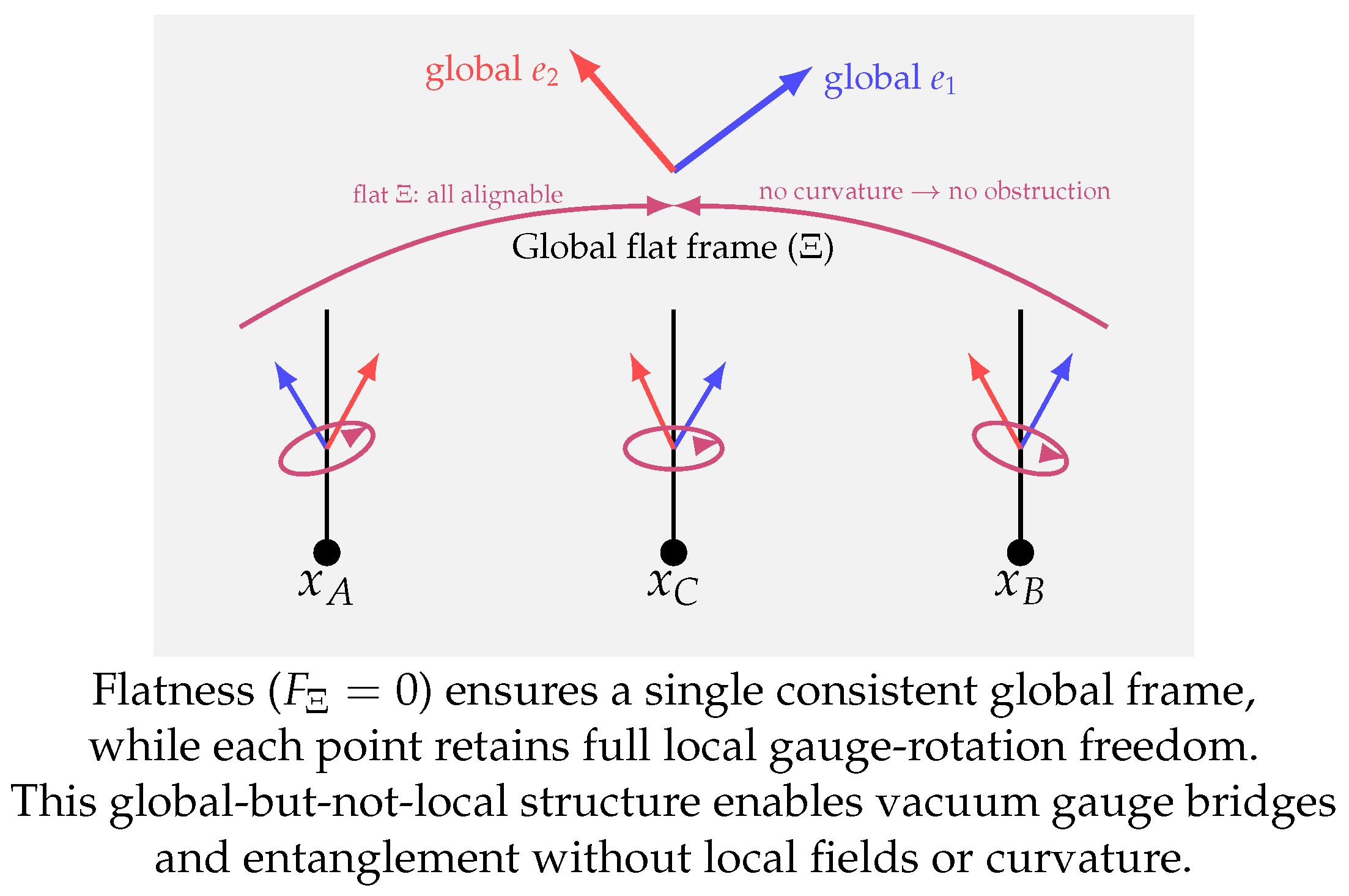
Figure 2.
Vacuum Gauge Bridge Between Internal Fibers. Two spatially separated regions A and B possess internal fibers and associated with the Standard Model gauge bundle. The vacuum field is locally pure gauge () and imposes no constraints on external geometric variables, which remain strictly local. A global compatibility condition encoded in produces a gauge bridge linking the internal fibers, giving rise to entanglement without any nonlocal dynamics. External degrees of freedom lack such a bridge and therefore cannot be entangled.
Figure 2.
Vacuum Gauge Bridge Between Internal Fibers. Two spatially separated regions A and B possess internal fibers and associated with the Standard Model gauge bundle. The vacuum field is locally pure gauge () and imposes no constraints on external geometric variables, which remain strictly local. A global compatibility condition encoded in produces a gauge bridge linking the internal fibers, giving rise to entanglement without any nonlocal dynamics. External degrees of freedom lack such a bridge and therefore cannot be entangled.
Disclaimer/Publisher’s Note: The statements, opinions and data contained in all publications are solely those of the individual author(s) and contributor(s) and not of MDPI and/or the editor(s). MDPI and/or the editor(s) disclaim responsibility for any injury to people or property resulting from any ideas, methods, instructions or products referred to in the content. |
© 2025 by the authors. Licensee MDPI, Basel, Switzerland. This article is an open access article distributed under the terms and conditions of the Creative Commons Attribution (CC BY) license (http://creativecommons.org/licenses/by/4.0/).
Copyright: This open access article is published under a Creative Commons CC BY 4.0 license, which permit the free download, distribution, and reuse, provided that the author and preprint are cited in any reuse.