

Submitted:
08 December 2025
Posted:
09 December 2025
You are already at the latest version
Abstract
We develop a two–level model of ultralight dark matter (ULDM) solitonic core subjected to the adiabatic perturbation due to the baryonic matter. Approximation the dark matter–only core as a Gaussian ground state in a harmonic potential defined by the central core density, and the first radial s–wave excitation (n = 1, l = 0) we project the GPP system onto 2-dimensional Hilbert space. In our formalism, we show that the baryonic Dhenen γ component couples through the overlap integral Jij .(γ, α) where α = Rc/ab is the ratio of the soliton core radius to the baryon scale radius. The resulting core dynamics is governed by the relative Hamiltonian Hrel(t) = 1/2 ∆(t)σz + J(t)σx with baryon dependent level splitting ∆(t) and mixing J(t), both linear in enclosed baryonic mass. In the adiabatic limit the soliton follows instantaneous lower eigenstate leading to radial excitation controlled by Jij (γ, α). We illustrate the predictions using a model dwarf–like galaxy to illustrate the resulting gap and mixing angle between the two states of the model. In (Part–II) companion paper we will consider higher number of excited states and also use this framework with real dwarf spheroidal galaxies, using observed baryonic profiles and stellar kinematics to study the baryon induced shifts in the core radius and infer other ULDM parameters including the dark matter particle mass. We will also study Gaffe–like(γ → 2) distribution model as a limiting case in the Dehnen-γ baryon distribution.
Keywords:
Dehnen-gamma distribution
; Hardy-Littlewood-Sobolev inequality
; solitonic core
1. Introduction
Ultralight Dark matter (ULDM), fuzzy dark matter or bosonic dark matter with mass , successfully explains galactic and sub-galactic dynamics. In the weak field limit, the complex wavefunction satisfies the Gross-Pitaevskii-Poisson equation (GPP) [1]:
where is the Newtonian potential for dark matter (DM) only case, and g is the self-interaction coupling constant. Cosmological simulations have shown that the virialized dark matter haloes have a solitonic core of radius , and surrounded by cold dark matter (CDM)-like envelopes described by the NFW profile [2,3]. The gravitational atom (see [4,5] solutions with populated excited states have been widely studied, but without a proper treatment of baryons as time-dependent perturbation. In dwarf galaxies, stars, gas and other baryonic matter contribute to the potential and evolve on timescales which are longer compared to the dynamical time of the core. In this work we construct a two-level harmonic oscillator description of the ULDM solitonic core surrounded by a baryonic potential. The dark matter-only core is the ground state of a harmonic potential defined by the central density , and the first radial s-wave excitation as second basis state, projecting our dark matter system onto the two-dimensional Hilbert Space. We introduce baryonic Dehnen potential as adiabatic perturbation [6]. The baryonic matter couple to the dakr matter soliton core through the overlap integral which is evaluated for general value of in the limit . The Hamiltonian expresses the dynamics with a baryon dependent level splitting and off diagonal mixing. As baryons evolve slowly, the ULDM core remains in it’s instantaneous eigen-state and acquires a finite accumulation of first radial excitation. In this part, we focus on the formalism and develop a toy model for a dwarf galaxy. We also give a general ovrview of the dynamics of first excited state with dipole like excitation. In part II we test this framework with real dwarf spheroidal galaxies and stellar kinematic data.
2. Two–Level Solitonic Core
We consider the dark matter only case (without baryons) first with spherical symmetry near the center of the dark matter halo. The Poisson equation takes the form:
Assuming that near the soliton core, density is approximately constant
Here, is the soliton core radius. The Poisson equation reduces to
Integrating this equation twice gives the harmonic potential near the center:
The potential for a particle of mass m is given by:
The effective oscillation frequency is given by:
We omit the constant and define the effective oscillator length (in this case, the core radius ) as:
The Hamiltonian for single dark matter particle is approximated as:
The eigenstates corresponding to this hamiltonian are the quantum states of a 3D isotropic harmonic oscillator. We can write the s–wave eigenfunctions as:
with radial functions . We are only concerned with the ground state and the first radial s–wave excitation, which forms our two level basis. For a quantum mechanical overview the readers can consult Refs.[7,8].
2.1. Ground and First Radial Excitation Modes
The radial wavefunction of the 3D harmonic oscillator ground state () is:
The first radial excited s–wave mode is:
These satisfy the orthonormality conditions:
which are the two lowest s– wave levels of the isotropic harmonic oscillator.
The single particle energies corresponding to the two quantum states (s–wave modes) are:
with dark–matter–only energy level spacing is:
In our GPP-system self-gravity and self-interaction modify the spectrum, so and are our effective parameters which encode these corrections.
2.2. Two–Level Truncation
The total wavefunction of the ULDM particle for the two s–wave modes is:
with
The amplitudes satisfy the condition: , where is the total number of ULDM particles in the solitonic core.
The two-level Hamiltonian for the dark matter-only case is:
With the energy gap given by 16. The nonlinear self-interactions renormalize and and we focus on the linear baryon-induced perturbations. The ground state soliton density profile, with soliton mass , is given by:
We see that at we get the expression for which is the density near the center of the solitonic core.
3. Adiabatic Perturbation by Dehnen Baryons
The spherical baryonic density distribution given by the Dehnen -model [9,10] is:
Here, is the total baryonic mass, is the scale radius. The corresponding gravitational potential is:
For a detailed discussion of distribution functions for spherical systems see [11]. Here we externally specify and and impose the time dependence by adiabatically varying and .
We add baryons into the two-level system as an adibatic perturbation, so that the total Hamiltonian density gets an extra term as:
Projecting onto the level system with the basis :
Using the equation 22 and the radial orthonormality condition for the wavefunctions we get:
Here, the first term produces an overall energy shift and the second term is physically relevant baryonic perturbation (relative matrix element):
where is the dimensionless baryon overlap integral given by:
Here, , and the dimensionless radial profiles defined via . The core in dwarf galaxy is more compact [12,13] than the baryonic distribution: so that . So we expand:
leads to the scaling relation
where
The coefficients can be evaluated in terms of the gamma function. The coefficients corresponding to the overlap integral i.e overlap coefficients have been calculated in the Appendix A.
3.1. Effective Two–Level Baryon Induced Hamiltonian and Mixing Angle
We construct two-level Hamiltonian including baryonic perturbation. Baryons add given by the equation 26 to the DM-only Hamiltonian in equation 19. The total perturbed Hamiltonian in the two-state basis is:
and define
The relative Hamiltonian takes the form:
Lets conveniently define
so that we get compact form for and as:
Thus the instantaneous eigen values of the are:
and the mixing angle is defined as:
A convenient way to express the instantaneous eigens tates is:
so that . The expectation value of the relative Hamiltonian is a bounded function of the mixing angle. This can also be proven by using the Hardy-Littlewood-Sobolev (HLS) inequality (see [14,15]). The adiabatic perturbation theory implies that the baryonic component grows slowly in comparison to the dynamical time due to which the two-state soliton wavefunction remains at the eigenstate up to a phase of the time dependent Hamiltonian given by the equation 35. The adiabatic condition can be written as:
The mixed ground-radial state density corresponding to the instantaneous lower and upper eigenstates can be written in the form:
and
We can easily show that for any because the transformation bewteen the and basis is unitary.
4. Dwarf Galaxy: A Toy Model
In this section we develop and test adiabatic formalism, we consider am idealized dwarf galaxy whose dark matter distribution is dominated by ULDM solitonic core and the baryonic matter in this galaxy follow Dehnen- profile. The self-gravitating core at the center of the halo is natural in this model and is a well-motivated framework for dwarf galaxy dynamics. The numerical values of all the parameters in this setup are taken from ( [10,16,17,18,19,20,21]).
4.1. Solitonic Core and DM–Only Level Spacing
We model the solitonic core as 3D harmonic oscillator near the center. Our choice of values are:
Here, m is the dark matter particle mass, is the soliton mass and is the core radius. We calculate the values of effective frequency and the energy gap between the ground state and the first radial excitation as:
For the cuspy and cored baryonic component we take the values for final baryonic mass and baryon scale radius as:
We see that the baryon distribution scale is larger than for the solitonic core, which is true for a typical dwarf galaxy.
4.2. Baryon–Induced Shifts and Mixing
For the calculation of energy shifts and energy level mixing due to baryons we take the following numerical values.
and numerically we have,
The final baryonic mass is:
4.3. Dimensionless Parametrization for the Two–Level ULDM System
For our numerical work we choose the following dimensionless quantites:
and we define the baryon mass fraction as a function of time:
We express:
for general value of
For specific values of i.e for both the Plummer model () and Hernquist-like () model, numerically:
For the Hernquist-like model:
For the more symmetric Plummer-model for baryons:
In the simulation we are considering a smooth adiabatic growth of baryons via
so that the baryonic mass and the baryon-induced mixings grow slowly. The baryon mass and the mixing of the states is switched on slowly (i.e adiabatically) with stationary points at and . This model provides a controlled and natural setting to study how the baryonic growth dirves the adiabatic mixing between the ground and the first radial excited state and soliton core deformation.
Figure 1.
The corresponding dimensionless profiles and are shown.
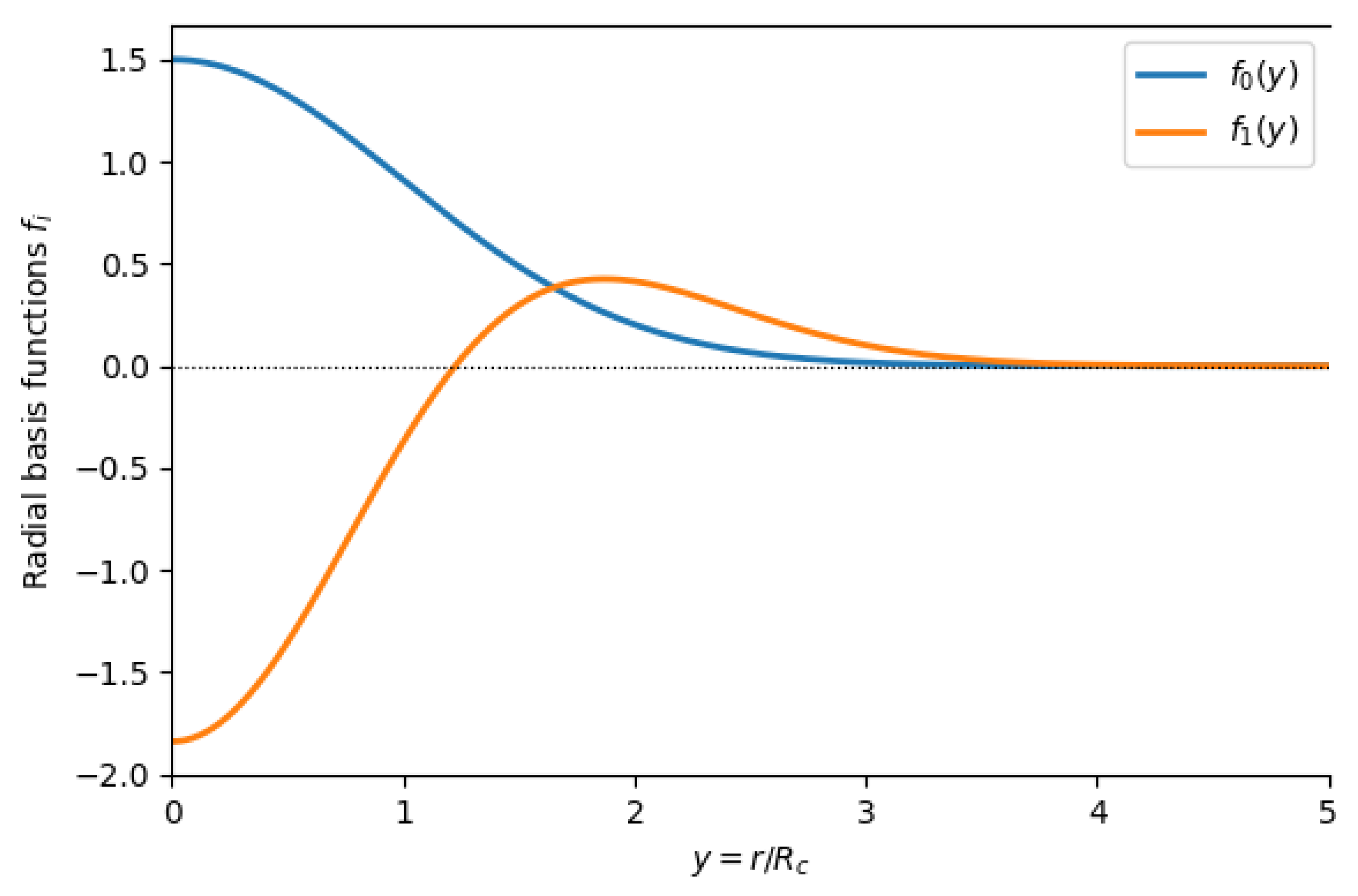
Figure 2.
Dimensionless radial density profiles of the instantaneous lower − and upper + as baryon mass grows adiabatically. The curves remain nearly identical for all , implying a tiny excited state population of ULDM particles
Figure 2.
Dimensionless radial density profiles of the instantaneous lower − and upper + as baryon mass grows adiabatically. The curves remain nearly identical for all , implying a tiny excited state population of ULDM particles
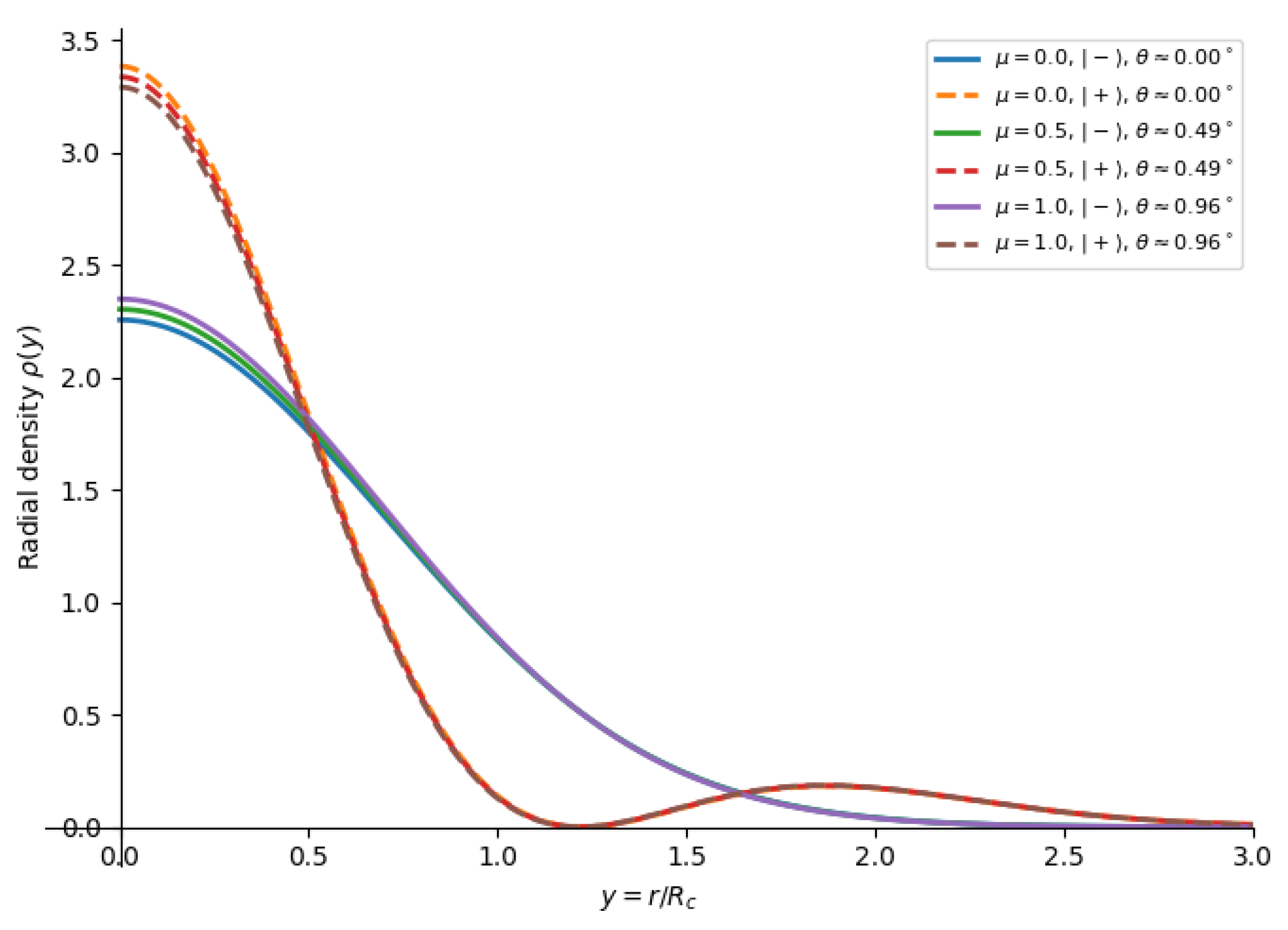
Figure 3.
Two dimensional slices of the normalized density when increase from 0 to 1 for Dehnen-.

5. Summary and Outlook
In this work we presented a two–level harmonic oscillator like model for describing the ULDM solitonic core in the presence of Dehnen baryonic matter for = 0 and 1. We proved that resulting core dynamics due to the baryonic adiabatic perturbation is governed by two–level relative Hamiltonian leading to the deformation of the density profile. In our toy dwarf–galaxy, adiabatic evolution of baryonic matter cannot generate any substantial excited state occupation number i.e only fraction of particles is in the excited state. The normalized density distribution function for ULDM particles remains almost symmetric during the baryonic evolution In (Part–II) companion paper we will consider higher number of excited states and also use this framework with real dwarf spheroidal galaxies, using observed baryonic profiles and stellar kinematics to study the baryon induced shifts in the core radius and infer other ULDM parameters including the dark matter particle mass. We will also study Gaffe–like() distribution model as a limiting case in the Dehnen- baryon distribution.
Appendix A. Overlap Coefficients
for and :
The overlap integrals scale as
References
- Chen, J.; Du, X.; Lentz, E.W.; Marsh, D.J.E.; Niemeyer, J.C. New insights into the formation and growth of boson stars in dark matter halos. Phys. Rev. D 2021, 104, 083022. [Google Scholar] [CrossRef]
- Dawoodbhoy, T.; Shapiro, P.R.; Rindler-Daller, T. Core-envelope haloes in scalar field dark matter with repulsive self-interaction: fluid dynamics beyond the de Broglie wavelength. Monthly Notices of the Royal Astronomical Society 2021, 506, 2418–2444. [Google Scholar] [CrossRef]
- Navarro, J.F.; Frenk, C.S.; White, S.D. A universal density profile from hierarchical clustering. The Astrophysical Journal 1997, 490, 493. [Google Scholar] [CrossRef]
- Della Rocca, M.; Spieksma, T.F.; Duque, F.; Gualtieri, L.; Cardoso, V. Gravitational Atom Spectroscopy. arXiv 2025, arXiv:2511.13848. [Google Scholar] [CrossRef]
- Nielsen, N.G.; Palessandro, A.; Sloth, M.S. Gravitational atoms. Phys. Rev. D 2019, 99, 123011. [Google Scholar] [CrossRef]
- Rigolin, G.; Ortiz, G.; Ponce, V.H. Beyond the quantum adiabatic approximation: Adiabatic perturbation theory. Phys. Rev. A 2008, 78, 052508. [Google Scholar] [CrossRef]
- Sakurai, J.J.; Napolitano, J. Modern Quantum Mechanics, 3 ed.; Cambridge University Press: Cambridge, 2020. [Google Scholar]
- Griffiths, D.J.; Schroeter, D.F. Introduction to Quantum Mechanics, 3 ed.; Cambridge University Press: Cambridge, 2018. [Google Scholar]
- Dehnen, W. Simple Distribution Functions for Stellar Disks. The Astronomical Journal 1999, 118, 1201. [Google Scholar] [CrossRef]
- Dehnen, W. A family of potential–density pairs for spherical galaxies and bulges. Monthly Notices of the Royal Astronomical Society 1993, 265, 250–256. [Google Scholar] [CrossRef]
- Binney, J.; Tremaine, S. Galactic Dynamics: Second Edition, rev - revised, 2 ed.; Princeton University Press, 2008. [Google Scholar]
- De Martino, I.; Broadhurst, T.; Henry Tye, S.H.; Chiueh, T.; Schive, H.Y. Dynamical evidence of a dark solitonic core of 109M in the milky way. Physics of the Dark Universe 2020, 28, 100503. [Google Scholar] [CrossRef]
- Broadhurst, T.; De Martino, I.; Luu, H.N.; Smoot, G.F.; Tye, S.H.H. Ghostly galaxies as solitons of Bose-Einstein dark matter. Phys. Rev. D 2020, 101, 083012. [Google Scholar] [CrossRef]
- Dolbeault, J.; Jankowiak, G. Sobolev and Hardy–Littlewood–Sobolev inequalities. Journal of Differential Equations 2014, 257, 1689–1720. [Google Scholar] [CrossRef]
- Lieb, E.H. Sharp Constants in the Hardy-Littlewood-Sobolev and Related Inequalities. Annals of Mathematics 1983, 118, 349–374. [Google Scholar] [CrossRef]
- Hui, L.; Ostriker, J.P.; Tremaine, S.; Witten, E. Ultralight scalars as cosmological dark matter. Phys. Rev. D 2017, 95, 043541. [Google Scholar] [CrossRef]
- Schive, H.Y.; Chiueh, T.; Broadhurst, T. Cosmic structure as the quantum interference of a coherent dark wave. Nature Physics 2014, 10, 496–499. [Google Scholar] [CrossRef]
- Schive, H.Y.; Liao, M.H.; Woo, T.P.; Wong, S.K.; Chiueh, T.; Broadhurst, T.; Hwang, W.P. Understanding the core-halo relation of quantum wave dark matter from 3D simulations. Physical review letters 2014, 113, 261302. [Google Scholar] [CrossRef] [PubMed]
- Li, X.; Hui, L.; Yavetz, T.D. Oscillations and random walk of the soliton core in a fuzzy dark matter halo. Phys. Rev. D 2021, 103, 023508. [Google Scholar] [CrossRef]
- Hernquist, L. An analytical model for spherical galaxies and bulges. Astrophysical Journal; (USA) 1990, 356. [Google Scholar] [CrossRef]
- Jaffe, W. A simple model for the distribution of light in spherical galaxies. Monthly Notices of the Royal Astronomical Society 1983, 202, 995–999. [Google Scholar] [CrossRef]
Disclaimer/Publisher’s Note: The statements, opinions and data contained in all publications are solely those of the individual author(s) and contributor(s) and not of MDPI and/or the editor(s). MDPI and/or the editor(s) disclaim responsibility for any injury to people or property resulting from any ideas, methods, instructions or products referred to in the content. |
© 2025 by the authors. Licensee MDPI, Basel, Switzerland. This article is an open access article distributed under the terms and conditions of the Creative Commons Attribution (CC BY) license (http://creativecommons.org/licenses/by/4.0/).
Copyright: This open access article is published under a Creative Commons CC BY 4.0 license, which permit the free download, distribution, and reuse, provided that the author and preprint are cited in any reuse.


