

Submitted:
08 December 2025
Posted:
09 December 2025
You are already at the latest version
Abstract
Extreme environments such as low pressure, high temperature, and intense radiation pose severe challenges for humidity sensors, causing conventional hygroscopic materials to exhibit sluggish responses, drift, and instability. In response, recent research has adopted multi-level strategies involving material modification, structural engineering, and packaging optimization to enhance the adaptability of humidity-sensitive materials in extreme environments. This review examines humidity sensing from an environmental perspective, integrating sensing mechanisms, material classifications, and application scenarios. The performance, advantages, and limitations of six major categories of humidity-sensitive materials, including carbon-based, metal oxides, conductive and insulating polymers, two-dimensional (2D) materials, and composites, are systematically summarized under extreme conditions. Finally, emerging development trends are discussed, highlighting a shift from material-driven to system-driven approaches. Future progress will rely on multidisciplinary integration, including interface engineering, multiscale structural design, and intelligent algorithms, to achieve higher accuracy, stability, and durability in extreme-environment humidity sensing.
Keywords:
humidity sensors
; extreme environments
; chemical materials
; humidity-sensing materials
1. Introduction
As space exploration advances from the near-Earth atmosphere into deep space, extreme conditions such as low pressure or vacuum, high temperature, and intense radiation impose stringent and quantitatively defined requirements on process control and equipment safety [1,2,3]. Environmental humidity is particularly critical because it directly affects engineering risks including insulation failure, corrosion and aging, optical contamination, and thermal control malfunction. It therefore acts as a major disturbance that governs process consistency, material stability, and overall system reliability. Accurate monitoring of environmental humidity under extreme conditions is thus essential [4]. However, variations in mass transfer and thermal convection, thermochemical degradation of devices and interface structures at elevated temperatures, and radiation induced disturbances to intrinsic material defects and electronic structures collectively intensify the hysteresis, drift, and aging observed in conventional humidity sensors. Achieving high sensitivity, fast response, long term stability, and strong repeatability in humidity detection under such extreme environments has consequently become a central scientific and engineering challenge [5,6,7].
Chemical humidity sensors are the most widely used instruments for humidity detection. They operate by sensing variations in physical parameters resulting from the adsorption or absorption of water vapor molecules by a sensitive medium. Their performance is primarily determined by the properties and stability of the hygroscopic materials employed [8,9,10]. However, under extreme environmental conditions such as low temperature, low pressure, and intense radiation, these sensors often suffer from major limitations, including sluggish response, elevated detection limits, increased signal drift, and reduced operational lifespan [11,12,13]. Such drawbacks severely constrain their long-term stability in applications involving near-space missions, polar research, and deep space exploration. Consequently, there is an urgent need to develop new chemical sensing materials capable of enhancing water vapor adsorption, transport, and signal conversion, thereby overcoming the performance bottlenecks of conventional devices under extreme conditions [14,15,16].
In response to the degradation and failure mechanisms of humidity sensing performance under extreme environmental conditions, research since 2016 has proposed a range of adaptability-enhancement strategies at multiple levels, including material modification, structural design, and packaging processes [8,17,18]. The number of related publications has shown a steady upward trend, and by 2025 nearly 479 studies had been reported in this field. To further illustrate this growing research activity, Figure 1 presents a bibliometric overview of publications from 2016 to 2025. As shown, the annual number of studies on extreme-environment humidity detection has increased continuously, while the distribution across major Research Areas, including Chemistry, Computer Science, Crystallography, Electrochemistry, and Energy & Fuels, highlights the interdisciplinary nature of current efforts. Notably, publications in the Chemistry category consistently represent the largest proportion, reflecting the material-oriented focus of most investigations. However, most existing studies focus on specific material types or individual sensing mechanisms, whereas systematic analyses addressing the combined impacts of extreme environmental factors remain relatively limited.
Against this background, the present paper reorganizes the current research landscape and mechanistic understanding of humidity sensing materials and devices, using environmental conditions as the central theme. Figure 2 illustrates the overall framework adopted in this review, which encompasses three dimensions: humidity sensing mechanisms, classification of material types, and application environments. In contrast to traditional reviews organized by material category or sensing principle [8,10,18,19,20], this paper systematically examines the response behaviors, failure characteristics, and adaptation mechanisms of various chemical humidity sensitive materials operating under extreme conditions. It also compares the advantages, limitations, and applicable ranges of different material systems.
The final section synthesizes the common patterns, key bottlenecks, and emerging trends associated with advanced humidity sensitive materials exposed to extreme environments. This provides a unified evaluation perspective and aims to establish a systematic and scalable reference paradigm for the design, performance assessment, and application expansion of humidity sensors in extreme settings. In doing so, it lays the groundwork for a paradigm shift in the field from material driven to system driven development.
2. Fundamentals and Performance of Chemical Sensing Materials
Given the stringent challenges that extreme conditions pose to humidity detection, this section describes the performance characteristics and adaptability of various humidity sensitive materials according to their material type. Based on differences in composition and structure, common humidity sensing materials can be classified into six primary categories: carbon-based materials, metal oxides, conductive polymers, insulating polymers, two-dimensional (2D) materials, and composite nanomaterials. Each material system exhibits distinct advantages and limitations when operating in low pressure or vacuum environments, high temperature conditions, and strong irradiation fields. This section introduces the materials whose electrical properties vary with humidity and illustrates these characteristics through representative examples.
2.1. Carbon-Based Materials: A High-Performance System Featuring Rapid Response and Tunable Microstructures
Carbon-based materials, characterized by their high specific surface area, hierarchical porosity, and tunable surface functional groups, rank among the fastest responding humidity sensitive materials within the low to medium humidity range. Their sensing mechanism primarily depends on the physical adsorption of water molecules at surface active sites and the resulting modulation of electrical conductivity [21,22]. However, challenges such as response hysteresis and reduced stability remain under extreme conditions, including high temperature and intense radiation. As summarized in Table 1, single-component carbon-based materials exhibit notable limitations in sensitivity, stability, and response linearity under extreme humidity conditions, which restricts their applicability in harsh environments. Common carbon-based humidity sensitive materials include carbon nanotubes (CNTs) [23], graphene oxide (GO) [24], carbon black [21], carbon quantum dots (CQDs) [25], and biochar [26]. Studies indicate that the conductive networks constructed from these materials retain strong stability even when exposed to high temperatures and ultraviolet radiation.
2.1.1. CNTs
CNTs have emerged as important humidity sensitive materials because of their high electrical conductivity, excellent chemical stability, and tunable surface structures. Numerous studies have enhanced their performance under low pressure, high temperature, and strong radiation conditions through diverse composite and surface modification strategies. CNTs have emerged as important humidity-sensitive materials because of their high electrical conductivity, excellent chemical stability, and tunable surface structures. In addition to their intrinsic advantages, the fabrication and sensing behavior of CNT–cellulose hybrid structures have also been systematically demonstrated by Oya et al. [33], who developed a CNT composite paper prepared by mixing CNT and pulp dispersions, filtering the slurry through a fine mesh, and heat-pressing the resulting sheet. As shown in Figure 3, the humidity response of this composite originates from moisture-induced swelling of cellulose fibers, which perturbs the CNT percolation network and leads to measurable resistance changes. Both the static and dynamic humidity-sensing characteristics of this paper-based CNT system further highlight the versatility of CNTs when incorporated into deformable or porous substrates.
Beyond CNT–cellulose architectures, numerous studies have enhanced CNT-based humidity sensing performance under low pressure, high temperature, and radiation-intensive conditions through diverse composite and surface modification strategies. For example, Al Hamry et al. [34] fabricated a humidity sensing film by combining GO with multiwalled nanotubes (MWNTs) and applying laser writing to the composite. The incorporation of MWNTs improved both the conductive pathways and structural robustness, allowing the sensor to maintain long term repeatability with response/recovery times of 10.7 s and 9.3 s under high humidity and high pressure, while exhibiting reduced hysteresis and aging relative to pure GO films. Wang et al. [35] developed a ternary composite film composed of hydroxylated MWCNTs, GO, and nafion. The sulfonic acid groups in nafion and the hydroxyl groups on the nanotubes acted synergistically to enhance water adsorption, which significantly increased capacitance sensitivity, reaching 547 kHz/%relative humidity (RH), and improved long term stability for use in sealed or wireless systems. Hu et al. [36] designed a layer-by-layer self-assembled MXene/SWCNTs composite film in which carboxyl-functionalized SWCNTs act as interlayer spacers to expand the MXene lamellar structure and introduce additional hydrophilic sites. This structural modulation effectively accelerates both the adsorption and desorption of water molecules, enabling a rapid response and recovery of 2 s and 1.75 s, respectively, even under high-humidity and fluctuating-temperature conditions. Chen et al. [37] enhanced the performance of a flexible non-contact humidity sensor by constructing a graphene nanoflakes (GNPs) and MWCNTs conductive network. This design enabled rapid recovery within 0.5 s during periodic respiration and low-pressure airflow, supporting its feasibility in rarefied and vacuum conditions. Al-Kadhim et al. [38] proposed a three-electrode ion humidity sensor with CNTs that utilizes high field ionization to detect trace water vapor in low pressure and vacuum environments. The device achieved a sensitivity of 11.83%RH to the power of negative one and response/recovery times of 11 s and 5 s, offering a promising approach for aerospace vacuum monitoring. Furthermore, Suman et al. [39] evaluated the radiation stability of functionalized and Cu-plated SWCNTs and poly(methyl methacrylate) (PMMA) thin films. The devices retained normal sensing capability after exposure to 1000 krad X ray irradiation, highlighting the radiation resistance of nanotube-based networks. A GO, hydroxylated CNT, and Nafion sensor integrated with a wireless inductive coupling method also maintained stable readout under electromagnetic interference and temperature fluctuations.
2.1.2. GO
GO offer distinct advantages for humidity sensing under extreme conditions because of its high specific surface area and abundant, tunable oxygen containing functional groups. Recent research has focused on enhancing its humidity sensing performance through chemical modification and composite engineering. For example, mild alkaline treatment of GO improves electrical conductivity while preserving hydrophilic groups [40]. The resulting flexible sensing membrane exhibits very high sensitivity from dry conditions to high humidity near 80% RH, with impedance decreasing by several orders of magnitude as humidity increases, and demonstrates rapid and reversible response behavior. However, some hysteresis and slow recovery persist in low humidity environments. Another study functionalized reduced graphene oxide (rGO) with 1,3,5-phenyltricarboxylic acid (H3BTC-rGO) and incorporated Ag (H3BTC-rGO) nanoclusters through in situ reduction to produce a highly sensitive and low hysteresis flexible humidity sensor [41]. This composite provides abundant hydrophilic active sites together with an efficient conductive network, enabling excellent performance across the entire range of 0 to 100% RH. The sensor maintains high sensitivity in both extremely dry conditions and high humidity regions, exhibits a low hysteresis of plus or minus 5% RH, and features second level response and recovery along with strong long-term stability and repeatability. In addition, an ultrathin, wearable sensing membrane produced through layer-by-layer assembly and thermal reduction of rGO and silk fibroin (SF) offers simultaneous humidity and temperature detection [42]. The incorporation of SF substantially enhances the mechanical flexibility of the rGO film, more than doubling its elastic modulus, which allows stable operation under repeated bending and combined temperature and humidity cycling. This highly sensitive device can capture minute fluctuations in temperature and humidity generated by skin contact or respiration in real time, providing a reliable platform for monitoring physiological signals in dynamic and extreme environments.
2.1.3. Carbon Black
Carbon black is a low-cost conductive filler widely employed in humidity sensors to establish conductive networks. However, it readily saturates under medium to high humidity conditions, which limits its sensitivity and dynamic response. To overcome this limitation, researchers have developed energy self-supply designs and composite material strategies. In one study, a low cost and flexible humidity sensor was fabricated by screen printing a graphene-polypyrrole (PPy) -carbon black ink onto a paper substrate [43]. The device achieved a resistive sensitivity of approximately 12.2/% RH within the range of 23 to 92.7% RH and demonstrated strong flexibility and stability, with no significant degradation after fifty humidity cycles. Its response/recovery times were about 5 s and 7 s, respectively, which is sufficient for respiratory monitoring. The sensor also showed high repeatability, with deviations between devices limited to plus or minus 1 ohm/% RH. In addition to wearable applications, this paper-based sensor is suitable for environmental and soil moisture monitoring. Another study combined water-soluble gelatin with carbon black nanoparticles to deposit a nanoscale thin film onto interdigitated electrodes, forming a humidity sensitive composite layer [44]. This gelatin and carbon black film effectively detected humidity in the range of 20.3 to 83.2% RH and exhibited a linear response between 20 and 65.2% RH with a sensitivity of about 0.35 millivolts/% RH and good repeatability. The response and recovery times were both under 10 s.
A further advancement involved the development of a self-powered humidity sensor based on a porous carbon black film loaded with lithium bromide (LiBr) electrolyte [31]. Flame processed porous carbon black served as the substrate, providing a three-dimensional (3D) pore structure for the orderly adsorption and desorption of water vapor by the electrolyte. When paired with Cu and Al electrodes, the system enabled humidity detection without the need for external power. The sensor exhibited a rapid response time of approximately 11.7 s and a recovery time of about 23.9 s. Air plasma treatment generated an ultrathin hydrophilic layer on the carbon black surface, which further enhanced humidity sensing performance. The flexible device generated electrical signals through humidity induced electrolyte ionization and redox reactions at the electrodes, enabling entirely self-powered operation. These sensors have been demonstrated in applications such as respiratory monitoring, contactless switching, silent speech recognition, and diaper wetness detection, highlighting their versatility for wearable technologies and extreme environment sensing.
2.1.4. CQDs
In recent years, carbon-based nanomaterials have demonstrated significant potential for humidity sensing under extreme environmental conditions. Among them, sensing strategies employing CQDs as active materials have attracted considerable attention. Huang et al. [45] developed a flexible, self-powered humidity sensor based on porous P(VDF–HFP) films modified with hydrophilic CQDs. The CDs not only introduced abundant -OH/-COOH/-NH2 surface groups that promoted water adsorption, but also induced a significant increase in the -phase content of the polymer matrix, thereby enhancing both humidity sensitivity and piezoelectric output. The incorporation of CDs transformed the originally hydrophobic P(VDF–HFP) film (PC0) into a more hydrophilic surface (PC1/PC2), reducing the water contact angle from 126.3° to as low as 65.1° and suppressing humidity hysteresis. Furthermore, the schematic humidity–interaction model illustrates how moderate hydrophilicity enables reversible adsorption/desorption of water molecules, leading to an almost linear and highly sensitive voltage response across fluctuating humidity conditions. This design strategy demonstrates a promising route toward self-powered humidity sensing under extreme environmental variations. Qin et al. [25] fabricated a CQDs-based humidity sensor for self-powered respiration monitoring. Owing to the abundance of hydrophilic groups in pure CQDs films, water molecules can be efficiently adsorbed and form conductive water chains, leading to a substantial decrease in resistance. The relative electrical signal response reaches 5318% at 94% RH and remains stable across a wide humidity range of 11 to 94% RH. The sensing mechanism involves water vapor molecules being captured by surface functional groups on the CQDs and transported via a proton-hopping (Grotthuss) mechanism, thereby greatly enhancing humidity sensitivity. When integrated with a respiration-driven triboelectric nanogenerator (TENG), the sensor enables real-time respiration monitoring without the need for an external power source, making it particularly suitable for harsh environments lacking conventional energy supplies. Morsy et al. [46] proposed a graphitic carbon nitride (g-C3N4)/GQD composite humidity sensor. The layered structure of g-C3N4 effectively prevents GQDs-agglomeration and increases the specific surface area, providing abundant active sites for water vapor adsorption. Adsorbed water molecules dissociate under the influence of hydroxyl groups on the GQDs surface, generating hydrated hydrogen ions that migrate via chain proton hopping. The device exhibits a rapid, linear, and reversible humidity response over the range of 7 to 97% RH. Owing to the excellent thermal stability of g-C3N4 and the anti-interference characteristics of the composite, the sensor maintains reliable performance under extreme conditions such as high temperature and irradiation.
2.1.5. Biochar
Biochar, a sustainable, low-cost, and porous carbon-based material, has demonstrated substantial potential for humidity sensing in recent years. Numerous studies have enhanced the performance of biochar-based sensors in extreme environments through material modification and composite design strategies. For example, Fiori et al. [47] produced black liquor-derived biochar (BH) from paper industry waste and dispersed it into a stable nanofilm using ultrasonic exfoliation. This nanofilm was directly coated onto a recycled paper substrate to create a fully biodegradable humidity sensor. The resulting device not only aligns with the principles of the circular economy but also exhibits excellent flexibility and humidity responsiveness, demonstrating strong adaptability in compact or complex environments. In another study, researchers incorporated 10 wt.% activated kitchen-waste-derived biochar into an Fe-BDC metal–organic framework (MOF) to synthesize an Fe-BDC@BC composite [48]. This composite improved the material’s specific surface area, crystallinity, and thermal stability while simultaneously optimizing its electronic properties by reducing the band gap and enhancing electrical conductivity. Humidity response tests revealed rapid sensing capability across a wide relative humidity range (10-95% RH), with a signal change of up to 96% and response and recovery times of 10 s and 50 s, respectively, indicating excellent dynamic performance and sensitivity. More importantly, the MOF–-biochar composite structure remains stable at elevated temperatures [32], significantly enhancing sensor reliability in extreme environments such as high thermal loads and radiation exposure. Furthermore, Ziegler et al. employed a PVP polymer binder to fabricate humidity-sensing films using two commercial biochar materials (SWP700 and OSR700), forming an n-p heterojunction structure. At low humidity levels (5% RH), the composite films exhibit a pronounced increase in impedance. Compared with pure biochar films, which are prone to peeling, the incorporation of PVP markedly improves film adhesion and structural integrity. The material provides rapid response across a broad humidity range (5-100% RH) at room temperature, with a response time of approximately 1 min and a reasonable recovery time. In addition, it demonstrates strong resistance to interference from gases such as ozone, methane, and carbon dioxide.
2.2. Metal Oxides: A Core Material System for Extreme Environments
Metal oxides, owing to their outstanding chemical inertness, thermal stability, and radiation resistance, are among the most widely used humidity-sensing materials for extreme environments [17,49,50]. In high-temperature or corrosive conditions, they retain stable crystal structures and surface-active sites, thereby ensuring consistent water adsorption behavior. Their fundamental humidity-sensing mechanism arises from reversible changes in electrical properties during water adsorption and desorption. As relative humidity increases, a chemisorbed monolayer first forms on the surface, which gradually transitions into a physisorbed multilayer and ultimately develops into a continuous water film [51]. Throughout this process, n-type semiconductors exhibit decreased resistance due to an increase in electron concentration, whereas p-type semiconductors display increased resistance as hole concentration decreases.
For dielectric insulating oxides, the incorporation of water molecules with high dielectric constants leads to an enhanced equivalent dielectric constant and, consequently, increased capacitance. These evolutionary processes are clearly reflected in impedance spectroscopy and frequency-domain responses [52,53]. However, as summarized in Table 2, most single-component metal oxides still exhibit limited sensitivity or slow recovery under extreme humidity conditions, reflecting the intrinsic constraints of non-composite systems. Therefore, optimizing electronic and ionic conduction through precise control of surface defects, ion doping, and micro/nanostructures is essential for improving the overall sensing performance.
2.2.1. ZnO
Among n-type metal oxides, is widely used for humidity sensing owing to its wide bandgap (3.3–3.4 eV), wurtzite structure, and excellent thermal and chemical stability. However, conventional dense thin films often show limited sensitivity and slow response under extreme conditions. To address this, Park et al. [61] developed a self-bridging ZnO nanowire array through simple thermal annealing, enabling a deposited Zn layer to convert into a highly crystalline, interconnected nanowire network. The resulting sensor demonstrated high resistive sensitivity down to 1.73% RH and rapid, reversible switching (35.3 s response; 32.6 s recovery). Rare-earth ion doping has also proven effective in increasing defect-rich adsorption sites and enhancing responsiveness. Zhang et al. [62] synthesized oxygen-vacancy–rich black ZnO doped with 3% , achieving resistance changes of over three orders of magnitude across 11–95% RH with minimal hysteresis and response/recovery times of 32.3 s and 39.6 s. Similarly, Akççay et al. [63] introduced low concentrations of into ZnO films via a sol–gel method, generating nanoporous hexagonal structures that promoted water adsorption. The optimized 3 mol% -doped sensor exhibited a nearly 245-fold sensitivity enhancement and ultrafast response/recovery times of 1.0 s and 5.5 s at low humidity. Collectively, these studies demonstrate that nanostructuring and rare-earth doping substantially improve sensitivity, defect-mediated adsorption, and dynamic performance in ZnO-based humidity sensors.
To further highlight the advantages of composite nanostructures, Priyadharshini et al. [64] presents representative data for a GO–Mn-doped ZnO (GOZnMnO) humidity sensor. The incorporation of Mn-modified ZnO domains into GO sheets creates abundant oxygen-rich active sites and defect-assisted pathways, enabling fast, repeatable capacitance responses and significantly shorter response/recovery times compared with pristine GO or undoped ZnMnO. Moreover, the resistance-based sensitivity profile shows excellent linearity and a markedly steeper slope, demonstrating how nanocomposite engineering and optimized electrode geometry synergistically enhance humidity-sensing performance (Figure 4).
2.2.2.
has also attracted substantial attention in recent years. As a typical wide-bandgap n-type semiconductor with strong redox surface activity and excellent high-temperature stability, is widely employed in gas and humidity sensing, particularly in high-temperature, low-pressure, and radiation-intensive environments. Traditional sensing mechanisms rely on oxidative adsorption, which leads to performance degradation under vacuum conditions [65]. Introducing nanoscale defect structures offers an effective solution to this limitation. Recent studies have demonstrated that impedance-type humidity sensors based on quantum dots can operate stably at pressures as low as 5 mbar [66]. Their high specific surface area (60 m2/g) and abundant oxygen vacancies enable sustained moisture adsorption even in vacuum, highlighting the potential of for humidity monitoring in aerospace and semiconductor vacuum environments. In addition, constructing p–n heterojunctions or forming composites with conductive polymers can significantly enhance the sensitivity and stability of . For example, integrating with PEDOT:PSS to form a p–n heterojunction improves charge separation and transport efficiency, yielding a device sensitivity of 85.7% and rapid response/recovery times of 14 s and 7 s [67], respectively. Moreover, doping with Ag, Al, or rare-earth elements can further shorten the response time to the 5–10 s range, an effect particularly beneficial in low-humidity or high-temperature conditions. Other studies have revealed that exhibits strong stability under ultraviolet and gamma irradiation. Kajal et al. [68] found that gamma irradiation (75–200 kGy) introduces oxygen vacancies, enhancing the conductivity of films and reducing the bandgap from 3.8 eV to 3.4 eV. These changes improve sensitivity under irradiation and promote surface charge migration, thereby accelerating response in high-humidity environments and enabling sensors to maintain stable performance under intense radiation or in outer space.
2.2.3.
is a representative p-type spinel oxide characterized by high chemical stability and strong electrochemical activity. Its excellent thermal stability and reversible redox behavior make it a promising candidate for high-reliability humidity sensing in extreme environments. In conditions such as high-temperature flue gas or intense solar radiation, the ceramic-like thermal resistance of reaching up to 800 °C enables long-term stable operation. Nanostructuring further mitigates thermal strain and suppresses crack formation, thereby preserving a linear sensing response. In addition, the p-type conduction mechanism of behaves oppositely to radiation-induced carrier variations, facilitating signal discrimination under irradiation and enhancing anti-interference performance. Despite these advantages, the high thermal stability of also imposes limitations: conventional -based sensors typically require operating temperatures above 200°C to achieve adequate humidity sensitivity. To address this challenge, recent studies have explored composite conductive materials and ionomer integration strategies to enable high-sensitivity detection at room temperature. Seekaew et al. [69] fabricated flexible humidity-sensitive films based on p-type /p-type heterojunction nanoparticles, achieving a positive humidity response of approximately 456% over the 10–95% RH range, with excellent linearity, low hysteresis (<5% RH), and good cycling stability. Through composite engineering and interface functionalization, -based systems have been transformed from temperature-dependent oxide sensors into robust room-temperature humidity detectors. Andre et al. [70] demonstrated that – heterostructured nanofibers modified with exhibited markedly enhanced humidity-sensing performance, including a large and nearly linear resistance variation across 25–75% RH, rapid response within 5 s, and excellent cycling repeatability.
2.2.4.
The diverse phase structures and tunable morphologies of have opened new avenues for advanced humidity sensing. , one of the most widely utilized metal oxides, possesses a bandgap of 3.2 eV along with excellent chemical and thermal stability. Its high mechanical strength and strong chemical inertness make it a highly suitable candidate for humidity sensing in high-temperature or corrosive environments [71]. Previous studies have demonstrated that ceramic capacitive sensors can operate stably from room temperature to 320°C [72]. Impedance analysis further reveals that the surface undergoes a transition from dielectric to conductive behavior at elevated temperatures, enabling sensitive detection even under low-humidity, high-temperature conditions. These features give notable advantages in applications such as drying ovens, combustion engines, and geothermal systems. In addition, nanoscale engineering has been employed to enhance the surface activity of . For example, Ghadiry et al. [73] developed an optical waveguide humidity sensor using nano-anatase , achieving a substantial light-intensity variation of 14 dB over the 35–98% RH range with an ultrafast response time of 0.7 s. The sensor also demonstrated excellent tolerance and reversibility under UV exposure, indicating strong suitability for real-time monitoring in radiation-intense environments such as nuclear energy and aerospace systems. Tong et al. [74] further improved the performance of by integrating nanoparticles with cellulose nanocrystals (CNC) to fabricate a flexible thin-film sensor. The device offered a wide detection range of 11–97% RH, response and recovery times of approximately 34 s and 18 s, respectively, and stable operation for more than 30 days under repeated bending. This composite system effectively combines the inherent stability of with the strong hygroscopicity of CNC, making it well suited for extreme environments involving high temperatures, mechanical vibrations, or wearable applications.
2.2.5. Insulating Metal Oxides
Insulating metal oxides (e.g., , , and ) are widely employed in capacitive humidity sensors. Although they lack free charge carriers, their exceptional thermochemical stability and strong water-adsorption capacity provide irreplaceable advantages under high-temperature, highly corrosive, and high-radiation environments [75]. Recent studies further show that the response and recovery times of anodic-aluminum-oxide (AAO) sensors can be reduced to the order of seconds under high-frequency operation [76], while maintaining excellent linearity in the ranges of 40-70% RH and 60-90% RH. Chung et al. [77] fabricated low-cost AAO thin films via one-step anodic oxidation, achieving a sensor with a response exceeding 5000% over a 16 area and response/recovery times of only 9 s. The thin oxide layer shortens the diffusion pathway, markedly enhancing the response rate. This material also exhibits long-term stability under elevated temperatures and vacuum conditions.
2.3. Conducting Polymers: Advantages of Structural Order and Conduction Coupling
Conducting polymers (CPs) have long been central to humidity-sensing research owing to their intrinsic conductivity, mechanical flexibility, and excellent processability [78]. Their sensing behavior is mainly governed by two mechanisms: (i) water adsorption alters the doping level and carrier concentration, modulating electrical conductivity [10,79]; and (ii) moisture absorption induces polymer swelling or network reconstruction, changing conductive pathways or interfacial barriers [80,81]. These attributes provide semiconductor-like tunability while enabling seamless integration into flexible and wearable systems [82]. However, CP-based humidity sensors face notable limitations under extreme conditions: high temperatures may cause dopant loss and chain scission [83], low temperatures can result in water freezing and suppressed ion transport [84], ionizing radiation may induce chain breakage or cross-linking [85], and vacuum environments can destabilize polymer structures [66]. As reflected in Table 3, single-component CPs often exhibit hysteresis, limited stability, and reduced sensitivity at very low or high relative humidity. Recent advances in composite engineering, surface functionalization, and structural optimization have significantly improved the robustness and usability of CP-based humidity sensors for extreme-environment applications.
2.3.1. PANI
PANI, a representative conducting polymer, has received extensive attention in humidity-sensing research owing to its simple synthesis, environmental stability, and reversible proton doping/dedoping behavior. Unlike conventional inorganic humidity-sensing materials that typically require elevated operating temperatures, PANI-based sensors function efficiently at room temperature with low power consumption, making them suitable for humidity monitoring in specialized or constrained environments. In extreme conditions, PANI and its modified derivatives exhibit remarkable adaptability and performance advantages. Experiments conducted at the Large Hadron Collider (LHC) demonstrated that a polymer humidity sensor placed in a cryogenic chamber at -20°C and near 0% RH [13], and exposed to high-flux proton irradiation (approximately protons accumulated over 33 days), was still able to generate reliable humidity alarm signals, confirming its survivability under intense irradiation. Although the study employed commercial polymer-based capacitive elements, the findings suggest that well-encapsulated conductive-polymer sensors are promising candidates for use in the harsh radiation environments encountered in space. Moreover, the long-term stability and anti-interference capability of PANI-based sensors have been widely documented. Nanocomposite-enhanced PANI sensors often demonstrate excellent cyclic repeatability and low hysteresis. For instance, the response curves of a PANI/1% Cu-ZnS porous microsphere sensor nearly overlapped during cyclic testing [90], indicating outstanding repeatability. In terms of cross-sensitivity, pure PANI may respond to polar species such as ammonia, but appropriate composite design can significantly improve selectivity. Studies on a GO/PANI sensing film reported minor responses to interfering gases such as methane, ethanol, and benzene under high humidity, while showing negligible sensitivity to common impurities including , formaldehyde, and acetone [91,92,93]. These results indicate that PANI-based sensors possess inherent anti-interference capability in complex real-world atmospheres, especially when material composition and interfacial structures are optimized.
2.3.2. PPy
PPy is a versatile conducting polymer with advantages comparable to PANI, including simple synthesis, low cost, light weight, flexibility, and good electrochemical reversibility. Its rapid humidity response, minimal hysteresis, and strong environmental stability make it suitable for demanding applications. Under complex or harsh conditions, PPy-based sensors can operate across wide temperature and pressure ranges, enabling humidity monitoring in confined or low-pressure environments such as spacecraft and deep-space probes. PPy films can even detect trace water vapor under vacuum. The thermal stability of PPy composites is further enhanced by incorporating inorganic components [94]; for instance, , with its high melting point (1870°C) and chemical inertness [95], provides partial thermal protection and structural reinforcement, allowing PPy/ films to outperform pure PPy at elevated temperatures. Such robustness is essential for applications in mines, blast furnaces, and other high-temperature industrial environments. PPy-based sensors also show potential resistance to radiation: the conjugated polymer backbone offers tolerance to radiation-induced chain scission [13], while inorganic phases such as remain unaffected by ionizing radiation and may dissipate part of the energy. Consequently, PPy/metal oxide composites are expected to exhibit higher radiation stability than fully organic sensing materials.
Although pristine PPy films inherently suffer from limited moisture uptake and thus require structural or compositional modification, a variety of PPy-based hybrid architectures have been developed to overcome these limitations. As an illustrative example, Ni et al. [96] reported a PPy@lignocellulosic slurry/CMC composite that significantly enhances environmental stability and humidity-responsive conductivity (Figure 5). The schematic in Figure 5(a) shows the integration of PPy with a DES-derived lignocellulosic scaffold and CMC binder, while Figure 5(c)–(f) demonstrate improved conductivity switching between dry and wet states and enhanced antioxidant stability, confirming the effectiveness of structural modification in elevating PPy-based humidity sensing performance.
2.3.3. PEDOT:PSS
As a humidity-sensitive material, PEDOT:PSS is prone to degradation under high humidity because the acidic and strongly hygroscopic PSS component can corrode electrodes, swell, and generate interfacial defects that introduce carrier-trapping sites. Near saturation, excessive water uptake leads to signal saturation and slow recovery, highlighting the need for material and interfacial engineering. Two primary strategies have been widely adopted: (i) chemical treatments or cross-linkers that partially remove or neutralize PSS, and (ii) composite engineering with nanomaterials to improve sensitivity and environmental stability [97].
Despite these limitations, PEDOT:PSS-based sensors offer important advantages for extreme environments, including mechanical flexibility, scalable processing, and strong structural robustness. Devices printed on PET substrates—such as PEDOT:PSS/PEO and PEDOT:PSS/MXene, exhibit negligible performance loss after repeated bending and extended aging [98]. Cross-linked films also maintain stable operation over broad RH and temperature ranges, remaining functional after long exposure to 80% RH at 40°C [99]. For harsher conditions, including temperatures above 100°C or high radiation flux, PSS-free PEDOT structures or encapsulation layers can provide improved durability. Although radiation data for PEDOT:PSS remain limited, polymer-based humidity sensors operating under fluences up to suggest that appropriately protected PEDOT:PSS devices may be suitable for space or nuclear applications. In addition, PEDOT:PSS offers good selectivity, as its humidity response, such as in PEDOT:PSS/MXene composites, arises mainly from water adsorption and is minimally affected by , , or VOCs [100].
2.4. Insulating Polymers: Interfacial Modification and Moisture Regulation Mechanisms
Compared with conducting polymers, insulating or low-conductivity polymers also play a significant role in humidity sensing. These materials typically serve as dielectric or electrolyte layers in capacitive and impedance sensors, where variations in dielectric constant, ionic conductivity, or structural dimensions arise from the adsorption and desorption of water vapor [10,82]. Representative examples include polyimide (PI), polyvinyl alcohol (PVA), cellulose and its derivatives, polymethyl methacrylate (PMMA), and polyamides (PA) [101,102,103,104,105] Owing to their excellent film-forming ability, tunable hydrophilic functional groups, and high environmental stability, these polymers have garnered increasing attention for humidity detection under extreme environmental conditions in recent years. An overview of their representative sensing performances is presented in Table 4, providing a clearer picture of how single-component insulating polymers behave across different humidity regimes.
2.4.1. PI
PI is widely regarded as an ideal material for humidity sensing owing to its outstanding thermal stability, chemical resistance, and ability to retain performance under extreme conditions [109,110]. To further enhance its sensitivity and response speed, various innovative modification strategies have been explored. For example, one study employed a partially fluorinated ultrathin PI sensing film (approximately 100 nm thick) sandwiched between top and bottom electrodes, with MWCNTs serving as a gas-permeable top electrode [111]. This design reduced the sensor’s response time to the millisecond scale (). In addition, integrating PI with inorganic nanomaterials has proven to be an effective route for performance improvement. In a MEMS-based humidity sensor, halloysite nanotubes (HNTs) functionalized with amino groups were incorporated into the PI layer to form a nanotube/polymer composite. Owing to the high specific surface area of HNTs and the additional adsorption sites provided by hydrophilic hydroxyl groups, the composite exhibited substantially enhanced water-vapor adsorption. As a result, the sensor’s sensitivity increased to 0.87 pF/% RH while maintaining low hysteresis () and good linearity () across the 10–90% RH range. The PI-based sensor also demonstrated excellent long-term stability under high-temperature and high-humidity conditions, consistent with the fact that PI maintains its physical and electrical properties across a wide temperature range from -269°C to 400°C [112].
2.4.2. PVA
PVA, owing to the abundance of hydroxyl groups along its polymer backbone, exhibits strong water adsorption at room temperature and is therefore widely used to enhance humidity sensitivity [113]. However, pristine PVA films tend to absorb water excessively, leading to swelling or even dissolution under high-humidity conditions. To address this limitation, various modification strategies have been developed to improve their stability in extreme humidity environments. One effective approach is crosslinking PVA or introducing copolymers to construct interpenetrating network structures. For example, Chen et al. [114] developed a semi-interpenetrating polymer network comprising polydiallyl ammonium chloride (PDDA) and PVA, in which PVA was crosslinked in situ using glutaraldehyde. The resulting PDDA/crosslinked-PVA composite film, combined with graphene-oxide-derived electrodes, enabled a resistive humidity sensor that showed an impedance variation of nearly three orders of magnitude over the 10–90% RH range, along with a linear response and low hysteresis (4.4% RH). For instance, blending 10 wt% glycerol (Gly) with PVA produces a flexible film with significantly improved moisture absorption and reduced hysteresis. Gassab et al. [115] reported that PVA/Gly composite film exhibited strong capacitive response and extremely low hysteresis within the 20–90% RH range, achieving a humidity sensitivity of up to 0.08 nF/%RH at 100 Hz and a hysteresis error of only 1.5% RH at 70% RH. To illustrate how nanocarbon–polymer composition governs humidity-responsive behavior, Figure 6 summarizes the representative performance of CNO–PVA-based resistive humidity sensors. As shown in Figure 6(a–d), adjusting the CNO:PVA ratio significantly influences resistance stability, hysteresis, and sensitivity across 5–95% RH, with the 1:1 composite yielding superior reproducibility and a more linear response at moderate humidity.
2.4.3. Cellulose
Cellulose and its derivatives, derived from renewable natural resources, are considered promising materials for green humidity sensing and flexible devices owing to their biodegradability, porous architectures, and excellent hygroscopic properties. Cellulose-based materials typically appear as porous membranes, paper substrates, or hydrogels, where abundant hydrophilic groups and interconnected micropores enable rapid adsorption and desorption of water vapor. For example, hydroxyethyl cellulose (HEC) has been used to fabricate hydrogel films coated onto the end facets of optical fibers, forming Fabry-Perot (F-P) interferometer cavities capable of dual-parameter temperature and humidity sensing, with sensitive and linear optical humidity detection across the 48–60% RH range [108]. The incorporation of cellulose nanomaterials has become an emerging research hotspot. Cellulose nanofibers (CNFs), characterized by their small diameter and high specific surface area, can be processed into uniform and dense humidity-sensitive films. Introducing ionic liquids into CNF networks further enhances low-humidity dielectric response. Paper-based cellulose sensors have also attracted significant interest due to their low cost, flexibility, and suitability for wearable applications. Using laser direct writing to pattern conductive electrodes directly onto 2,2,6,6-tetramethylpiperidinyl-1-oxyl (TEMPO)-oxidized cellulose paper enables the fabrication of fully cellulose-based humidity sensors with rapid response and disposable functionality [117]. Furthermore, porous bacterial cellulose (BC) membranes produced by microbial fermentation, when combined with two-dimensional MXene or GO, provide both high conductivity and strong hygroscopicity [118,119]. These hybrid structures have been reported to yield humidity sensors with high sensitivity, fast response, and excellent mechanical flexibility.
2.4.4. PMMA
PMMA, owing to its intrinsic hydrophobicity and structural stability, exhibits excellent repeatability and low drift in optical and high-precision environmental monitoring. In pristine PMMA, water molecules are adsorbed only through weak physical interactions, resulting in minor changes in refractive index and volume, approximately 0.4% volumetric expansion per 1% RH increase [120]. Although this limits its humidity response, it also provides exceptional linearity and extremely low hysteresis. Comparative studies of PMMA-, PVA-, and PEG-based F-P fiber-optic humidity sensors have shown that PMMA-coated sensors possess the lowest sensitivity but demonstrate the highest linearity in wavelength drift during wet-dry cycling (PMMA > PVA > PEG) [106]. In addition, PMMA shows no performance degradation after repeated high-humidity cycling, confirming its superior repeatability and stability. To enhance the humidity sensitivity of PMMA, several modification strategies have been explored. One approach involves fabricating porous or micro/nanostructured PMMA films to increase water-vapor contact area and penetration depth. For example, porous PMMA coatings deposited on fiber Bragg gratings (FBG) can significantly extend the sensor’s humidity response range. Another strategy is to construct PMMA microsphere resonant cavities. Li et al. [121] integrated PMMA microspheres, tens of micrometers in diameter, with fiber Bragg gratings, utilizing refractive-index variations and thermo-optic effects induced by humidity changes to achieve simultaneous humidity and temperature sensing. The F-P cavity formed between a PMMA microsphere and the fiber facet exhibited a humidity sensitivity of approximately 127 pm/% RH over the 35–85% RH range while remaining temperature-independent.
2.4.5. PA
The amide groups along the PA backbone readily form hydrogen bonds with water molecules, imparting moderate hygroscopicity. At the same time, PA exhibits strong mechanical strength and excellent abrasion resistance. In the field of flexible and wearable humidity sensors, thermoplastic polyamide elastomers (TPAEs) have gained considerable attention because they combine the elasticity of rubber with the strength of plastics. For example, the TPAE-based respiratory monitoring device developed by Chen et al. [105] displays characteristic negative humidity sensitivity: the resistance of the sensing membrane decreases as ambient relative humidity increases, with an approximately linear response across 11-91 % RH and a coefficient of determination exceeding 0.99. PA also demonstrates strong stability under extreme environmental conditions. Nylon generally retains its mechanical integrity below 150°C and resists repeated bending and impact stresses [122]. In vacuum or low-pressure environments, it gradually releases adsorbed moisture without structural degradation. However, exposure above the glass transition temperature or prolonged irradiation can lead to polyamide chain degradation. Therefore, when operating in harsh environments such as high temperatures or nuclear radiation, protective shielding or material modification strategies should be considered for polyamide-based sensors.
2.5. 2D Materials: Highly Responsive and Tunable Platforms for Extreme-Condition Humidity Sensing
Emerging 2D materials, characterized by their layered structures, exceptionally large specific surface areas, and tunable surface functional groups, exhibit unprecedented sensitivity and rapid dynamic response behaviors [15]. These materials possess atomic-scale thickness and extend laterally in two dimensions, encompassing graphene and its derivatives, transition metal dichalcogenides (TMDs), MXenes, layered metal phosphorous sulfides (e.g., ), and black phosphorus [123,124,125,126]. Their extensive surface exposure, high density of active sites, and, in some cases, intrinsic hydrophilic functional groups endow 2D materials with significant potential for high-sensitivity and fast-response humidity sensing applications. As shown in Table 5, typical single-component 2D materials already demonstrate outstanding response speeds and broad humidity operating ranges, underscoring their intrinsic suitability for high-performance humidity sensing.
Graphene-based materials were discussed in the preceding section on carbon-based systems; therefore, this section focuses on non-carbon 2D materials.
2.5.1. TMDs Materials
TMDs with their layered structures, tunable bandgaps, and high specific surface areas, offer distinct advantages for humidity sensing. These properties have led to their increasing use in both material design and device-level architectures intended for operation under extreme or harsh environmental conditions.
In MoS2-based systems, recent research has focused on mitigating zero drift and hysteresis arising from temperature–humidity coupling through temperature compensation and surface/defect engineering, while simultaneously achieving low-humidity activation and wide-range linearity. For example, dense yet active-site-rich MoS2 resistive films prepared via molten salt-assisted chemical vapor deposition allow the introduction of electrical temperature compensation, stabilizing sensitivity across varying temperatures [137]. These devices exhibit sub-second to multi-second response times at room temperature while maintaining low hysteresis, making them suitable for outdoor applications or environments with abrupt temperature fluctuations. The representative sensing characteristics of these temperature-compensated MoS2 devices are summarized in Figure 7, including their linearity, hysteresis behavior, dynamic response, and long-term stability, all of which underscore the effectiveness of integrating compensation circuitry with defect-engineered MoS2 films.
To meet the requirements of large-area fabrication, flexible integration, and low-temperature processing, printable and transferable MoS2 inks have emerged as another major focus [138]. Conductive films produced through atomized inkjet printing demonstrate conductivity changes spanning several orders of magnitude over the 10-95% RH range, with response/recovery times on the order of seconds. Such inks can be patterned directly onto flexible polymer substrates, enabling low-power wearable humidity sensors. In environments characterized by strong electromagnetic interference or high-voltage discharge, optical readout offers a natural advantage by avoiding the risks associated with wiring and electromagnetic coupling. When MoS2 is coated onto microfiber, evanescent-field, or interferometric structures, the overall response/recovery time decreases to 0.09 s and 0.13 s, and the optical interrogation path becomes insensitive to electromagnetic noise, making these devices suitable for detecting rapid humidity disturbances near plasma, microwave, or high-voltage systems [139].
To balance low-humidity activation with high-humidity saturation behavior, MoSe2 and its MoS2 heterostructures leverage a synergistic mechanism of interface polarization, defect modulation, and short mass-transfer pathways. 3D MoSe2@MoS2 composites deliver enhanced response amplitude and shorter response/recovery times across 11-95% RH by constructing continuous adsorption-desorption pathways along basal planes and edge sites [140]. The MM3 heterostructure exhibits the largest sensitivity enhancement, the fastest response/recovery times (30 s/33 s), excellent cyclic reversibility, and clear concentration-dependent step responses from 12.5 to over 20 000 ppm H2O far outperforming single phase MoSe2 or MoS2. These composites also maintain reversible output under cyclic and mechanical perturbations, making them promising for environments with rapid fluctuations in temperature and humidity or mechanical stress. Composites of MoSe2 with porous templates or wide-bandgap oxides further exhibit low hysteresis and strong linearity even under near-saturated humidity. Their processability and tunable pore structures support translation into array-based and large-area manufacturing.
Work on WS2 emphasizes flexibility and low power consumption. By coupling with graphene quantum dots or 2D conductive frameworks, continuous electron/ion transport networks can be established at low temperatures while simultaneously suppressing moisture-induced hysteresis. GOQD/ flexible composite films achieve high responsiveness and rapid dynamics across wide humidity ranges, retaining performance after repeated bending and adapting well to wearable applications such as sweat monitoring or large-deformation conditions [141]. Meanwhile, fully printed /MXene composite sensors exhibit broad humidity sensitivity, low hysteresis, and good array uniformity, offering practical advantages for low-temperature fabrication and large-area adhesion [142].
Beyond flexibility-oriented design strategies, recent WS2-based devices have also explored structural actuation to enhance dynamic performance. In particular, Li et al. [143] integrated a piezoelectric actuator beneath a WS2 capacitive sensor, demonstrating that high-frequency PZT vibration can significantly accelerate moisture adsorption and desorption without compromising sensitivity or stability. The representative device architecture and sensing characteristics are summarized in Figure 8, highlighting fast response/recovery, reduced hysteresis, and robust long-term operation under repeated humidity cycling.
Research on has extended 2D humidity sensing to textile platforms to meet the challenges of strong deformation and long-term wear. Incorporating a 2H- conductive coating into cotton fabrics yields stable and reversible resistive responses across 30–90% RH while maintaining breathability, washability, and cyclic durability which features essential for wearable real-time monitoring and high–water-vapor-flux environments within clothing layers [144]. Additionally, CVD-grown impedance sensors achieve minimal hysteresis () under low-humidity conditions and controllable hysteresis () under high humidity, providing valuable benchmarks for low-humidity detection and reproducibility evaluation [145].
Recent research has expanded the material palette to include “quasi–two-dimensional” and emerging 2D semiconductors such as , , and , enabling the development of humidity sensors with high sensitivity, broad measurement ranges, and stable operation even under near-saturated humidity conditions.
, a metal silicide, provides abundant adsorption and active sites while maintaining high intrinsic conductivity due to its layered structure. It has been employed for the first time in resistive humidity sensors, fabricated on interdigitated electrodes using low-cost printing processes, yielding highly linear resistance variations across a wide humidity range. Such devices have shown strong applicability in human–machine interaction scenarios under high-humidity and rapidly fluctuating environments, including respiratory monitoring and non-contact skin-moisture detection [131].
, a typical TMDC, features a tunable bandgap of approximately 1 eV and a layered van der Waals structure. 2D nanosheets produced via wet milling and liquid-phase exfoliation can be spin-coated onto flexible interdigitated electrodes to form large-area, continuous conductive networks. Sensors based on this architecture exhibit resistive sensitivity as high as 68 k% RH, excellent linearity, and rapid response/recovery times on the order of 1–2 s within the 15-80% RH range [132]. The device maintains stable capacitive behavior under various bending angles and demonstrates reliable non-contact humidity detection when a moist or dry fingertip is placed several millimeters above the surface. The transient response to humidity bursts, whether from exhaled moisture, skin evaporation, or sprayed water, remains fast and reproducible, confirming the practical suitability of ZrSe2 flakes for wearable, high-humidity, and dynamically varying environments.
Furthermore, constructing a 0D/2D Au/GeS heterostructure using gold nanoparticles significantly enhances interfacial polarization and accelerates water adsorption/desorption kinetics in the IV–VI semiconductor GeS. The resulting flexible humidity sensor exhibits extremely high response and sub-second response/recovery times even at 90% RH. Its successful integration into an IoT platform for real-time wireless respiratory monitoring indicates that GeS and its heterostructures are well suited for humidity sensing under near-saturated humidity conditions and even in condensation-prone environments [146].
As a 2D magnetic semiconductor, possesses an interlayer P–S framework that provides abundant polar sites, enabling selective adsorption of water molecules and substantial charge-transfer interactions. A first-principles study published in 2025 quantitatively demonstrated the preferential adsorption of and its pronounced modulation of the electronic conductivity of [147]. The results showed that water molecules induce significantly stronger charge redistribution than common interfering gases, suggesting that can maintain stable humidity sensitivity even under temperature fluctuations and mixed-gas environments. In addition, surface-defect engineering and strain modulation further reduce response times, establishing a tunable parameter window suitable for rapid transitions between low and high humidity and for detecting fast RH step changes.
2.5.2.
For readout strategies that require strong electromagnetic immunity, optical interrogation is preferred, especially in environments involving strong electromagnetic fields or high-voltage discharge. Coating 2D semiconductors onto microfibers or evanescent-field waveguides can inherently avoid failures caused by wiring or electromagnetic coupling. Although such demonstrations have been predominantly reported for , the fabrication process and device architecture are directly transferrable to [148].
In the context of multi-parameter sensing, recent materials science studies have revealed tunable excitonic and magnetic ordering in , providing a foundation for integrating optical or magneto-optical readout schemes into humidity sensors designed for irradiated or high-magnetic-field environments [149]. As an experimental reference, early flexible -based humidity sensors have already demonstrated second-scale response times, mechanical bendability, and strong selectivity [150]. These device-level insights, including electrode design, impedance-spectroscopy mechanisms, and in-situ Raman tracking, offer valuable guidance for the structural design and packaging requirements of sensors intended for extreme operating conditions.
2.5.3. MXene Materials
MXene materials, owing to their metallic conductivity, abundant surface −OH and =O functional groups, and tunable 2D layered structures, have recently emerged as promising candidates for next-generation humidity sensors. Their humidity-sensing mechanism involves a coupled process of ionic conduction and interlayer expansion. Under low to moderate humidity, surface-adsorbed water molecules enhance ionic transport and interfacial polarization, markedly increasing sensitivity. At high humidity levels, water penetrates the interlayer galleries, inducing layer expansion and suppressing interlayer electron transport, which in turn causes a counterintuitive increase in resistance. Although this unique mechanism confers exceptionally high sensitivity, it also leads to challenges in stability under extreme conditions [151,152].
To address oxidation and long-term degradation, Yang et al. [153] stabilized MXene ink using sodium ascorbate and fabricated a flexible capacitive humidity sensor on paper substrates via screen printing. The device exhibited a capacitance change of 131.4% across 11-97% RH, with response/recovery times of 9.4 s and 12.9 s, respectively. This anti-oxidation strategy effectively mitigates performance decay under high humidity and enables a low-cost, large-area, and robust platform suitable for harsh environments such as high humidity and elevated temperature. Surface functionalization further enhances MXene performance, particularly in high-humidity regions. Huang et al. [154] modified with the cationic polyelectrolyte PDDA to create a fully printed flexible thin-film sensor capable of non-contact humidity detection. The device demonstrated high sensitivity and excellent cycling stability even under severe electromagnetic interference and in confined spaces. Wang et al. [155] incorporated carrageenan into MXene films to form a disposable, low-cost, and fast-responding paper-based sensor suitable for distributed deployment in extreme environments. Similarly, sodium-alginate (SA)/MXene composite sensors remain stable under saturated humidity and long-term humidity cycling [156].
In strong electromagnetic or high-voltage discharge environments, optical readout offers a promising strategy to avoid electrode failure and wiring-related issues. Li et al. [157] developed an all-optical humidity-sensing platform by coating onto optical fibers, achieving rapid and stable responses, including in applications such as respiratory monitoring, while maintaining immunity to external electromagnetic interference. Porous aerogel architectures have proven highly effective for reducing hysteresis and enhancing dynamic performance. Xiao et al. [158] reported a aerogel-based wearable sensor with near-linear humidity response () and extremely low hysteresis (), making it suitable for environments characterized by frequent humidity steps and rapid fluctuations. To provide a representative example of MXene–polyelectrolyte systems capable of operating in extreme humidity, Figure 9 presents the structural design and humidity-sensing performance of a cross-linked SA/MXene device, including its stability at saturated humidity and repeated cycling durability [156].
2.6. Composite Materials: Multimodal Mechanisms for Humidity Detection
Modern humidity-sensing technology places strong emphasis on the use of nanomaterials and multicomponent composites. Many of the materials discussed above exhibit markedly enhanced performance when engineered at the nanoscale. Size effects impart nanomaterials with properties not present in their bulk counterparts, such as quantum-confinement–induced modulation of carrier transport and surface-energy dominated adsorption behavior. Nanofibers, nanowires, and quantum dots, for example, offer exceptionally high specific surface areas and short diffusion pathways, enabling faster and more efficient humidity adsorption and desorption. Incorporating nanostructures into various humidity-sensitive material systems allows for synergistic optimization, effectively combining the inherent advantages of each component to achieve improved overall sensing performance.
Structural parameters such as porosity, particle size, and film thickness have a profound influence on the humidity-sensing characteristics of materials. Increasing porosity can substantially enhance the effective surface area available for moisture adsorption, accelerate the adsorption–desorption process, improve sensitivity, and shorten response times. However, excessive porosity may compromise the mechanical integrity of the film, necessitating a balance between sensitivity and structural stability [58]. Achieving uniform and well-ordered surface morphology further contributes to improved sensor consistency and repeatability. Film thickness also plays a critical role in sensing dynamics: overly thick films extend the diffusion path of water molecules, resulting in slower responses, whereas ultrathin films—despite their rapid response—may suffer from weak signal output or reduced stability due to limited water uptake. Therefore, selecting appropriate nanostructures and geometries according to specific application requirements is essential. Moreover, combining two or more materials enables the integration of complementary advantages and compensation for individual limitations, representing an important direction in the development of next-generation humidity-sensing materials.
1D nanowires and nanotubes, owing to their small diameters and high specific surface areas, can adsorb larger quantities of water molecules and provide direct electron and ion transport pathways, thereby enhancing both response speed and signal strength. A representative example is the @ZnO core–shell nanorod system: the ZnO shell offers a hydrophilic surface and ionic conduction channels, while the core improves electronic transport and mechanical robustness, enabling the sensor to achieve high sensitivity with low hysteresis. Similarly, self-supported ZnO nanowire humidity-sensitive membranes exhibit significantly faster dynamic responses than particulate membranes, largely because the nanowire network minimizes the blocking effects of grain boundaries and pores. 2D nanosheet assemblies can form interlayer diffusion channels that allow water molecules to migrate rapidly along the stacking interfaces. Dual-sided adsorption increases the total water uptake capacity; however, excessively dense stacking can hinder penetration, necessitating interlayer spacing control or the introduction of supporting structures to maintain porosity. 0D nanoparticles and hollow spheres further highlight the importance of mesoporous and macroporous architectures. Nanoparticle-assembled mesopores regulate capillary condensation, hollow spheres provide internal cavities for water storage, and thin-shell structures facilitate rapid water ingress and egress [159,160].These structural advantages across 0D, 1D, and 2D nanoarchitectures are summarized in Figure 10, which schematically illustrates representative humidity-sensitive morphologies.
Recent studies further validate the critical role of nanostructures in enhancing humidity sensitivity. Jin et al. [161] fabricated a honeycomb-like CNF/CNT aerogel membrane using an ice-templating method, achieving a relative resistivity change of 71.5% over the 0–75% RH range, with response and recovery times of 18 s and 47 s, respectively. Chen et al. [162] developed a “PI nanoforest” structure that significantly increased surface area and adsorption sites, resulting in a device sensitivity 15 times higher than that of planar PI across 10–90% RH. Musa et al. [163] synthesized a V-doped three-dimensional array via solution impregnation, improving sensitivity from 196 (pure ) to 314. This enhancement was attributed to the increased adsorption/desorption capability associated with defect sites introduced by V doping and the densely packed nanostructure.
In the field of metal-organic frameworks (MOFs), Wu et al. [164] prepared a highly porous polyelectrolyte membrane by in situ crosslinking UIO-66 with a sulfonated polymer. The resulting film exhibited rapid respiratory humidity detection, with a response time of 3.1 s and a recovery time of only 1.5 s. Polymer/MOF composites have similarly attracted attention: MOFs possess ultrahigh surface areas and tunable functional groups that provide exceptional humidity sensitivity, yet their inherently low conductivity limits direct sensing applications. Embedding MOFs within conductive polymer matrices yields dielectric or impedance-type composite films capable of detecting trace water vapor. Sapsanis et al. [165] demonstrated that capacitive electrodes coated with the copper-based MOF HKUST-1 produced humidity responses several times higher than those of traditional polymer dielectrics. Zhang et al. [166] reported that an amino-functionalized titanium-based MOF (-MIL-125(Ti)) resistive thin-film sensor exhibited resistance changes of up to three orders of magnitude within 30–90% RH. These results indicate that polymers supply mechanical support and electrical pathways for MOF particles, while MOFs contribute exceptional hygroscopic capacity and selectivity together enabling synergistic performance enhancement. Composite functional coatings can also improve selectivity under extreme conditions. For instance, coating ZnO with a hydrophobic MOF (ZIF-8) effectively suppresses humidity interference in acetone detection at 260°C, enabling humidity-insensitive gas sensing. Similarly, applying a ZIF-8 layer onto gas-sensitive films acts as a “molecular sieve” to block water molecules, allowing accurate detection even under high humidity [160]. These examples clearly demonstrate that composite surface functionalization can significantly enhance sensor selectivity and reduce cross-sensitivity in harsh environments.
It is important to recognize that the behavior of materials incorporating nanostructures must be re-evaluated when operating in extreme environments. On the one hand, nanomaterials with high specific surface areas are more susceptible to accumulating radiation-induced damage or adsorbing particulate contaminants, necessitating appropriate shielding strategies. On the other hand, certain nanostructures possess limited mechanical robustness and may collapse or aggregate under thermal cycling or vibrational shock. For example, applying a hydrophobic and breathable protective film to the surface of a humidity sensor can prevent liquid-water condensation from damaging the sensing layer and reduce interference from adhered volatile contaminants. For space and near-space applications, humidity sensors typically require encapsulation layers capable of withstanding high-energy particle radiation and abrupt temperature fluctuations. These protective layers, together with the sensing material, form a composite system that must balance environmental protection with minimal obstruction to water-vapor transport.
In the Typhoon Near-Space Sounder developed by the BIT team, researchers evaluated several shell materials and ultimately selected rigid foam as a structural carrier to balance insulation performance and overall device weight. This design effectively adds a composite protective structure to the sensing unit, enabling reliable operation at temperatures as low as -60°C and under extremely low-pressure conditions. Meanwhile, the device’s integrated micro-heating and temperature-control system can also be regarded as a functional composite component, ensuring that the sensing membrane remains within an appropriate temperature–humidity window and thereby enhancing reliability in harsh environments. Consequently, humidity-sensitive composite materials intended for extreme-condition applications must prioritize stable interfacial bonding and undergo rigorous environmental simulation testing [167].

Table 6.
Performance summary of single-component polymer materials for humidity sensing.
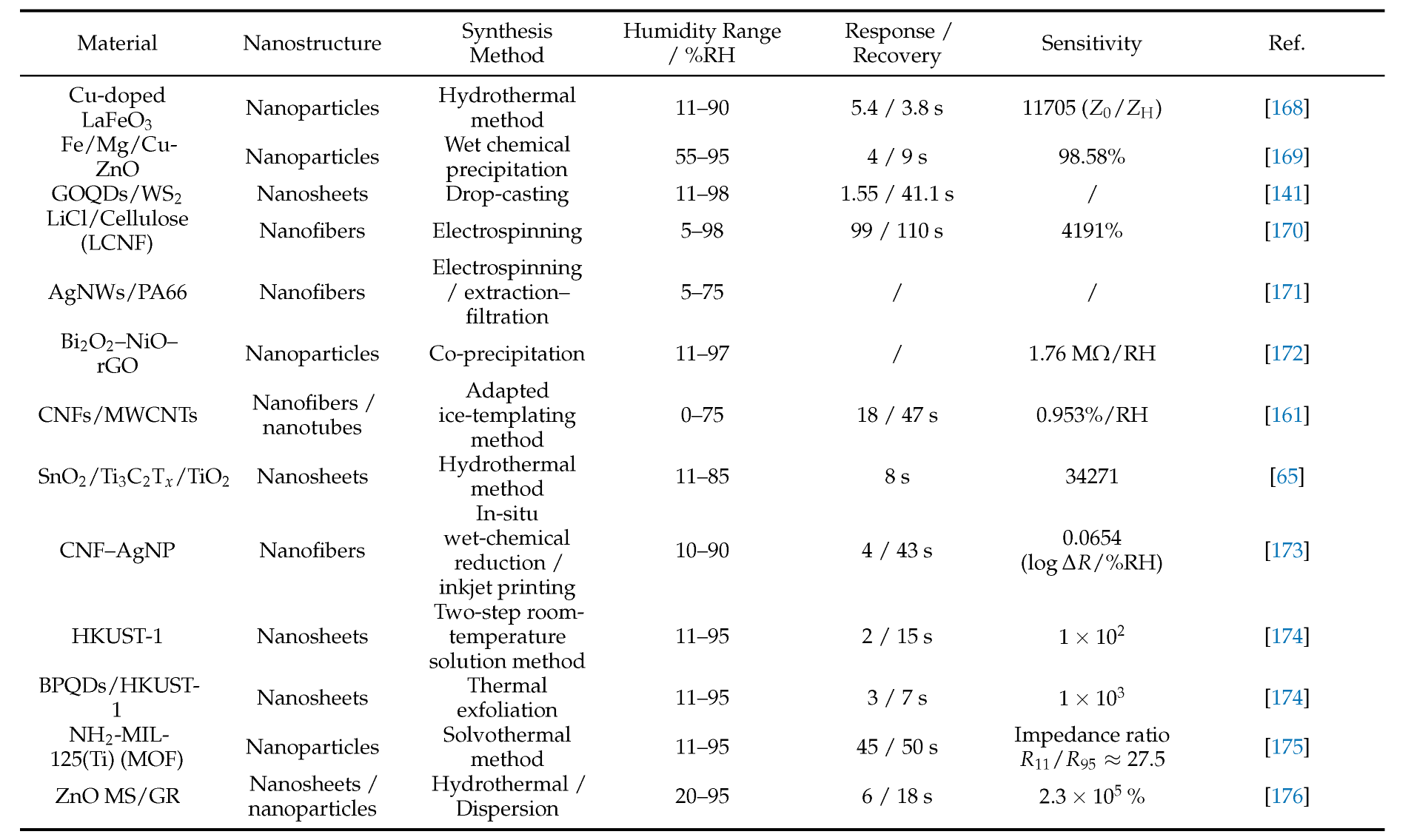
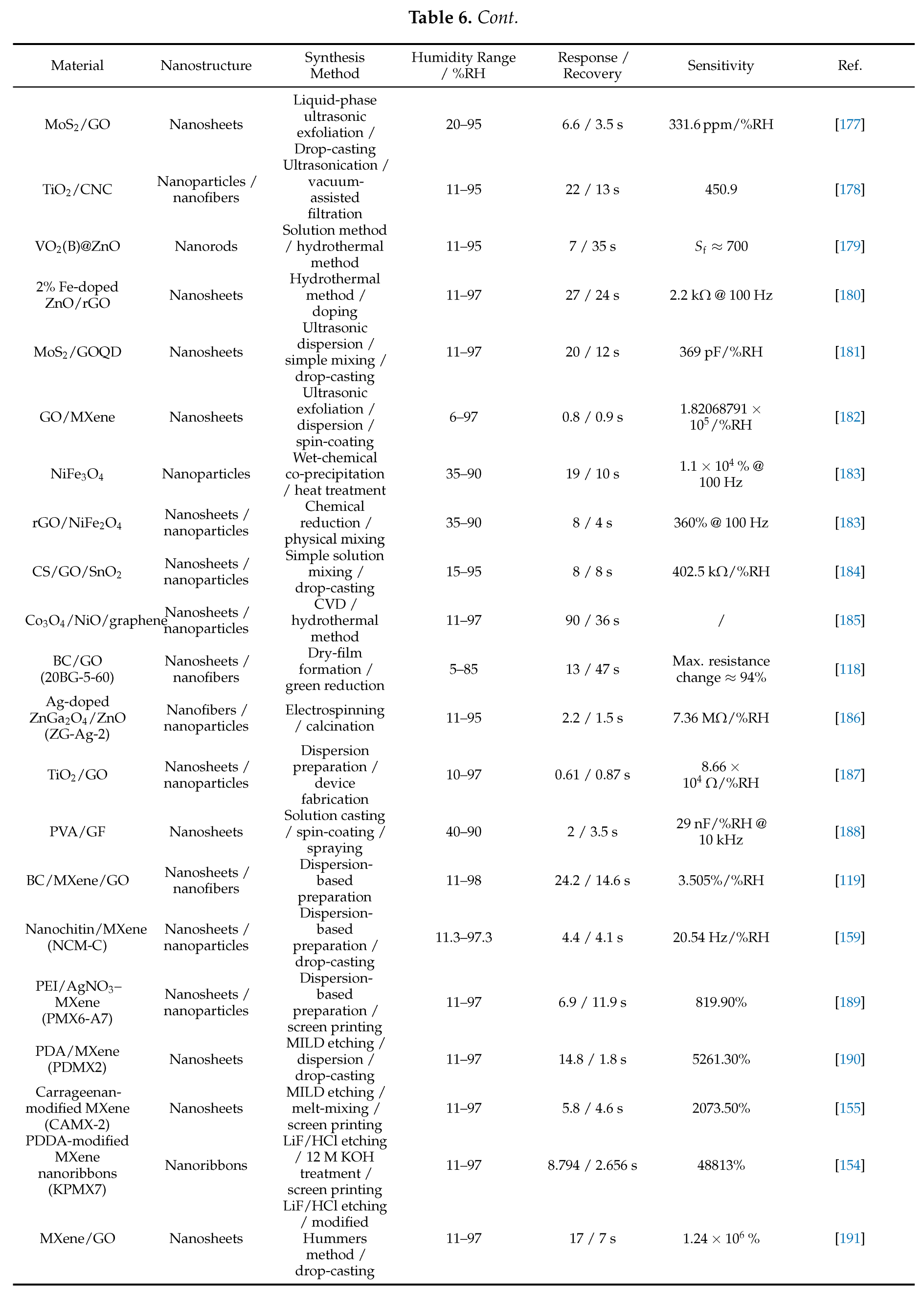
3. Discussion
In summary, different humidity-sensitive material systems exhibit distinct structure–performance relationships and environmental adaptability when used for humidity detection under extreme conditions. Porous carbon materials, with their hierarchical micro/meso/macroporous architectures, provide exceptional rapid response in low-humidity environments, making them one of the most effective material systems for dry and arid extreme settings. Metal oxides, benefiting from their robust lattice frameworks and tunable surface oxygen vacancies, offer outstanding chemical and structural stability under harsh conditions such as high temperature and corrosive atmospheres. Polymers and hydrogels, through the formation of dynamic water networks, deliver ultrahigh sensitivity and fast proton conduction in high-humidity or saturated environments. 2D materials and MXenes, leveraging their adjustable interlayer spacing, abundant defect states, and high charge-carrier mobility, achieve a unique combination of high sensitivity and mechanical flexibility, rendering them particularly suitable for flexible, wearable, and deformable humidity-sensing applications in extreme environments.
Despite the unique advantages offered by each material system, all of them exhibit inherent limitations when exposed to extreme humidity environments involving multiphysics coupling. For instance, metal oxides are prone to surface water–film–dominated effects under ultrahigh humidity, which can lead to pronounced hysteresis and increased nonlinearity. Polymers and hydrogels may undergo swelling fatigue, structural relaxation, or even irreversible network rearrangement during repeated humidity cycling. 2D materials and MXenes can suffer from interlayer degradation, oxidation, or terminal-group instability when subjected to high humidity or elevated temperatures. Porous carbon materials, meanwhile, often display notable hysteresis and saturation effects in high-humidity regions due to water retention within the pores and insufficient intrinsic hydrophilicity.
In contrast, composite material systems and multimodal humidity-sensing strategies can partially overcome the limitations of single-material sensors through material synergy and signal complementarity. For example, inorganic–polymer composites can achieve both high-temperature stability and strong responsiveness under high humidity. Hybrid structures combining two-dimensional materials with carbon materials, or MXenes with polymers, enhance environmental tolerance while preserving high sensitivity. Multimodal sensing approaches further improve reliability by integrating multiple signal channels, hereby enabling redundant recognition and error suppression in complex or extreme environments. Together, these strategies offer system-level pathways toward robust and accurate humidity detection under harsh operating conditions.
Table 7 summarizes the advantages, limitations, and suitable operating environments of various material systems. It is evident that the performance of humidity-sensitive materials under extreme conditions is no longer dictated solely by their intrinsic chemical properties, but is governed by a combination of factors, including interfacial water structuring, adsorption–desorption energy barriers, carrier migration mechanisms, and the evolution of material microstructures. Consequently, achieving high reliability, low hysteresis, a wide dynamic response range, and long-term stability in extreme-environment humidity detection requires coordinated optimization across multiple dimensions, including materials chemistry, interface engineering, multiscale structural design, and system-level integration.
The forthcoming Future Prospects section will expand on these findings through a cross-system examination of materials, addressing fundamental issues relevant to extreme-humidity applications, including interfacial adsorption behavior, saturation and hysteresis mechanisms, stability evolution, and methodologies for multimodal detection and composite-material development. It will also outline potential pathways for overcoming current performance bottlenecks and advancing humidity-sensing technologies for operation under extreme conditions.
4. Future Prospect
Despite recent advances in humidity-responsive materials, current humidity-sensing technologies still exhibit substantial limitations when operated in extreme environments characterized by high temperature, high humidity, corrosive media, intense radiation fields, or coupled multi-physics effects, making them insufficient for the demands of engineering practice and frontier scientific exploration. Under such conditions, the adsorption behavior of water molecules, the structure of interfacial water layers, carrier migration pathways, and the evolution of material microstructures do not follow simple linear trends; instead, they form a highly coupled system that spans molecular, interfacial, and device-level scales. Consequently, future research on humidity detection in extreme environments should shift from pursuing incremental improvements in the single-point performance of individual material systems to reconstructing the integrated design logic across materials, interfaces, architectures, algorithms, and system-level operation.
- Precise regulation of interfacial water behavior will be a decisive breakthrough for advancing the entire field. The fundamental causes of hysteresis, high-humidity saturation, and irreversible adsorption can almost always be traced to the configurational evolution and asymmetric potential-energy landscape of interfacial water. Therefore, future materials must enable active control over interfacial adsorption energetics and hydrogen-bond dynamics. For example, by constructing reversible hydrogen-bond networks, tuning the polarity and spatial distribution of surface functional groups, and guiding adsorption pathways through interfacial electric-field effects. Such strategies will be essential for achieving truly low-hysteresis, fully reversible, and rapid humidity responses.
- Multiscale structural engineering will become a central strategy for achieving rapid and stable water migration under extreme environmental conditions. In natural systems, water transport is governed by finely orchestrated hierarchical architectures, exemplified by the dendritic fractal networks of leaf veins, the capillary-gradient structures of insect limbs, and the microtextured surfaces found on desert beetles. These biomimetic structural principles offer a broad design space for creating hierarchical channels, capillary pathways, and dual-domain interfaces that facilitate efficient water transport. By integrating such features, materials can effectively suppress water retention in high-humidity or near-saturated environments and achieve controllable adsorption–desorption kinetics.
- The environmental robustness of materials must shift from being an auxiliary consideration to a primary design criterion from the earliest stages of development. Issues such as MXene oxidation, interlayer degradation in TMDCs, and hydration-induced fatigue in polymers collectively indicate that humidity sensing under extreme environments concerns not only the optimization of device performance but also the fundamental survivability of the underlying materials. Future material systems will therefore depend more heavily on chemically and structurally robust strategies, such as engineering hydrophobic–hydrophilic gradient interfaces to regulate water transport into sensitive regions, incorporating ultrathin antioxidant coatings to protect two-dimensional architectures, and designing hybrid rigid–flexible mechanical frameworks to delay structural fatigue. These approaches will be essential for ensuring long-term stability and reliability under harsh environmental conditions.
- Humidity detection mechanisms are expected to evolve from single-channel material responses to multichannel, multimodal, and multiscale integrated sensing systems. In extreme environments, humidity often coexists with variations in temperature, pressure, corrosive species, and electromagnetic radiation, making reliable identification impossible when relying on a single type of signal. Consequently, multimodal sensing will become a key development direction. Its core lies not only in acquiring multiple signals but also in leveraging machine learning to decouple complex response modes, compensate for hysteresis, correct signal drift, and predict interacting environmental factors. Through such approaches, humidity sensing systems will transition from passive response to intelligent interpretation.
- Intelligent and system-level design will become key drivers of future humidity detection in extreme environments. With the rapid advancement of edge computing, AI-assisted sensing, and self-calibration algorithms, humidity sensors are transitioning from simple material-based devices to fully integrated systems that combine materials, algorithms, and hardware architectures. Future sensors will aim to minimize error sources at the material level while maximizing usable signal extraction at the system level, thereby overcoming the intrinsic limitations of individual materials and enabling long-term operation with high precision and high reliability.
Overall, humidity detection in extreme environments is undergoing a pivotal transition from a materials-driven paradigm to a design- and system-driven paradigm. Research priorities are expanding beyond water-molecule adsorption dynamics to encompass interfacial regulation science, from microstructural stability to system-level robustness, and from optimizing single-material systems to developing multimodal fusion and intelligent compensation strategies. As advancements continue in 2D materials, MXenes, biomimetic porous architectures, hydrogel-based composites, and multimodal sensing technologies, and as cross-scale interface engineering becomes increasingly integrated with intelligent data-analysis algorithms, future humidity sensors are expected to deliver unprecedented accuracy, operational stability, and environmental robustness under extreme humidity, elevated temperature, corrosive atmospheres, intense radiation, and complex coupled conditions.
These advances will not only accelerate the upgrading of key technologies in aerospace, deep-sea exploration equipment, nuclear engineering, smart energy systems, and extreme-environment monitoring, but will also establish a new research platform for investigating interfacial water behavior, material microstructure evolution, and multiphysics coupling. In doing so, they will fundamentally reshape the scientific foundations and technological framework of next-generation sensing technologies designed for extreme environments.
Author Contributions
Conceptualization, X.Y.D., D.P.L., D.Z.Z. and A.B.C.; investigation, X.Y.D. and D.P.L.; resources, X.Y.D. and D.P.L.; data curation, X.Y.D. and D.P.L.; writing—original draft preparation, X.Y.D. and D.P.L.; writing—review and editing, X.Y.D., D.P.L. and A.B.C.; visualization, A.B.C.; supervision, D.Z.Z.; project administration, D.Z.Z.; funding acquisition, D.Z.Z.; All authors have read and agreed to the published version of the manuscript.
Institutional Review Board Statement
Not applicable.
Informed Consent Statement
Not applicable.
Data Availability Statement
MDPI Research Data Policies.
Acknowledgments
During the preparation of this manuscript, the author(s) received support from the State Key Laboratory of Environment Characteristics and Effects for Near-space. The authors have reviewed and edited the content provided by the laboratory and take full responsibility for the final manuscript.
Conflicts of Interest
The authors declare no conflicts of interest.
References
- Abdel-Karim, R. Advanced Approaches in Micro-and Nano-sensors for Harsh Environmental Applications: A Review. Modern Nanotechnology 2023, Volume 1, 585–612. [Google Scholar]
- Liu, Q.; Wang, Y.; Zhao, F.; Zheng, C.; Xie, J. A Review of the Research Progress of Sensor Monitoring Technology in Harsh Engineering Environments. Sensors 2025, 25, 6308. [Google Scholar] [CrossRef] [PubMed]
- Zhang, Q.; Liu, Y.; Li, H.; Wang, J.; Wang, Y.; Cheng, F.; Han, H.; Zhang, P. A review of SiC sensor applications in high-temperature and radiation extreme environments. Sensors 2024, 24, 7731. [Google Scholar] [CrossRef] [PubMed]
- Ma, Z.; Fei, T.; Zhang, T. An overview: Sensors for low humidity detection. Sensors and Actuators B: Chemical 2023, 376, 133039. [Google Scholar] [CrossRef]
- Kou, H.; Tan, Q.; Wang, Y.; Zhang, G.; Su, S.; Xiong, J. A wireless slot-antenna integrated temperature-pressure-humidity sensor loaded with CSRR for harsh-environment applications. Sensors and Actuators B: Chemical 2020, 311, 127907. [Google Scholar] [CrossRef]
- Gu, X.; Cao, L.; Miao, S.; Tao, X.; Zhao, Y.; Huang, S. A comprehensive review on preparation and humidity sensing applications of metal-halide perovskites. Materials Science and Engineering: B 2025, 311, 117834. [Google Scholar] [CrossRef]
- Haque, M.F.; Park, S.; Yang, D. Gas Sensors in Harsh Environments: Challenges and Advances in High Temperature, High Humidity, Radiative and Corrosive Conditions. Journal of Science: Advanced Materials and Devices 2025, 101049. [Google Scholar] [CrossRef]
- Sajid, M.; Khattak, Z.; Rahman, K.; Hassan, G.; Choi, K. Progress and future of relative humidity sensors: A review from materials perspective. Bulletin of Materials Science 2022, 45, 238. [Google Scholar] [CrossRef]
- Kok, S.P.; Go, Y.I.; Wong, M. Effect of Hygroscopic and Electronic Materials, Challenges, and Sensing Requirements in Humidity-Controlled Industry. Journal of Electronic Materials 2025, 1–22. [Google Scholar] [CrossRef]
- Qian, J.; Tan, R.; Feng, M.; Shen, W.; Lv, D.; Song, W. Humidity sensing using polymers: A critical review of current technologies and emerging trends. Chemosensors 2024, 12, 230. [Google Scholar] [CrossRef]
- Qiu, H.; Zhu, M.; Mo, S.; Gao, Y.; Yao, Y.; Dong, Y.; Tian, J. Low-temperature-crosstalk humidity fiber sensor based on a thermal expansion-resistant Fabry-Perot interferometer. Measurement 2025, 242, 116302. [Google Scholar] [CrossRef]
- Jahanshahi, H. A comprehensive review of tactile sensing technologies in space robotics. Chinese Journal of Aeronautics 2025, 103423. [Google Scholar] [CrossRef]
- Kapić, A.; Tsirou, A.; Verdini, P.G.; Carrara, S. Analysis of Proton Radiation-induced Effects on Polymer-based Relative Humidity Sensor. Research Square 2023. [Google Scholar]
- Luo, W.; Ma, J.; Li, M.; Xu, H.; Wan, C.; Li, Z. Spatial and Temporal Characterization of Near Space Temperature and Humidity and Their Driving Influences. Remote Sensing 2024, 16, 4307. [Google Scholar] [CrossRef]
- Shaukat, R.A.; Tamim, A.M.; Hwang, G.T.; Jeong, C.K. Humidity Sensors Using 2D and 3D Nanomaterials: From Materials Selection to Technological Aspects. Transactions on Electrical and Electronic Materials 2024, 25, 123–140. [Google Scholar] [CrossRef]
- Leelasree, T.; Sidhartha, P.; Tathacharya, M.; Chappanda, K.N.; Aggarwal, H. A low-cost, swift response, highly sensitive MOF-based dual sensing device enables detection of ultralow humidity levels and solvent polarity changes. Journal of Materials Chemistry C 2024, 12, 7295–7305. [Google Scholar] [CrossRef]
- Farahani, H.; Wagiran, R.; Hamidon, M.N. Humidity sensors principle, mechanism, and fabrication technologies: A comprehensive review. Sensors 2014, 14, 7881–7939. [Google Scholar] [CrossRef]
- Chen, Z.; Lu, C. Humidity sensors: A review of materials and mechanisms. Sensor letters 2005, 3, 274–295. [Google Scholar] [CrossRef]
- Zhang, Y.; Liu, Y.; Lin, L.; Zhou, M.; Zhang, W.; Lin, L.; Li, Z.; Piao, Y.; Paek, S.H. Advanced flexible humidity sensors: Structures, techniques, mechanisms and performances. Frontiers of Materials Science 2023, 17, 230662. [Google Scholar] [CrossRef]
- Chen, Q.; Yao, Y.; Ao, J.; Yu, X.; Wu, D.; Shou, M.; Li, R.; Yang, P. Advances in quartz crystal microbalance relative humidity sensors: A review. Measurement 2025, 243, 116415. [Google Scholar] [CrossRef]
- Tulliani, J.M.; Inserra, B.; Ziegler, D. Carbon-based materials for humidity sensing: A short review. Micromachines 2019, 10, 232. [Google Scholar] [CrossRef] [PubMed]
- Wang, C.; Xia, K.; Wang, H.; Liang, X.; Yin, Z.; Zhang, Y. Advanced carbon for flexible and wearable electronics. Advanced materials 2019, 31, 1801072. [Google Scholar] [CrossRef] [PubMed]
- Arunachalam, S.; Izquierdo, R.; Nabki, F. Low-hysteresis and fast response time humidity sensors using suspended functionalized carbon nanotubes. Sensors 2019, 19, 680. [Google Scholar] [CrossRef] [PubMed]
- Zeng, S.; Pan, Q.; Huang, Z.; Gu, C.; Wang, T.; Xu, J.; Yan, Z.; Zhao, F.; Li, P.; Tu, Y.; et al. Ultrafast response of self-powered humidity sensor of flexible graphene oxide film. Materials & Design 2023, 226. [Google Scholar]
- Qin, J.; Yang, X.; Shen, C.; Chang, Y.; Deng, Y.; Zhang, Z.; Liu, H.; Lv, C.; Li, Y.; Zhang, C.; et al. Carbon nanodot-based humidity sensor for self-powered respiratory monitoring. Nano Energy 2022, 101, 107549. [Google Scholar] [CrossRef]
- Jagdale, P.; Ziegler, D.; Rovere, M.; Tulliani, J.M.; Tagliaferro, A. Waste coffee ground biochar: A material for humidity sensors. Sensors 2019, 19, 801. [Google Scholar] [CrossRef]
- Liu, L.; Ye, X.; Wu, K.; Han, R.; Zhou, Z.; Cui, T. Humidity sensitivity of multi-walled carbon nanotube networks deposited by dielectrophoresis. Sensors 2009, 9, 1714–1721. [Google Scholar] [CrossRef]
- Tripathi, D.; Tripathi, S.; Rawat, R.K.; Chauhan, P. Highly Sensitive Humidity Sensor Based on Freestanding Graphene Oxide Sheets for Respiration and Moisture Detection. Journal of Electronic Materials 2023, 52. [Google Scholar] [CrossRef]
- Bi, H.; Yin, K.; Xie, X.; Ji, J.; Wan, S.; Sun, L.; Terrones, M.; Dresselhaus, M.S. Ultrahigh humidity sensitivity of graphene oxide. Scientific reports 2013, 3, 2714. [Google Scholar] [CrossRef]
- Zhang, X.; Ming, H.; Liu, R.; Han, X.; Kang, Z.; Liu, Y.; Zhang, Y. Highly sensitive humidity sensing properties of carbon quantum dots films. Materials Research Bulletin 2013, 48, 790–794. [Google Scholar] [CrossRef]
- Lin, D.; Huang, Y.; Liao, Z.; Jiang, J.; Li, G. Self-powered fast-response humidity sensor based on electrolyte-loaded porous carbon black film. Microchemical Journal 2025, 113703. [Google Scholar] [CrossRef]
- Ziegler, D.; Palmero, P.; Giorcelli, M.; Tagliaferro, A.; Tulliani, J.M. Biochars as innovative humidity sensing materials. Chemosensors 2017, 5, 35. [Google Scholar] [CrossRef]
- Oya, T.; Saito, T.; Morita, Y.; Arai, K. Simple Moisture Sensing Element Using Carbon Nanotube Composite Paper. Chemosensors 2025, 13, 373. [Google Scholar] [CrossRef]
- Al-Hamry, A.; Lu, T.; Chen, H.; Adiraju, A.; Nasraoui, S.; Brahem, A.; Bajuk-Bogdanović, D.; Weheabby, S.; Pašti, I.A.; Kanoun, O. Ultra-sensitive and fast humidity sensors based on direct laser-scribed graphene oxide/carbon nanotubes composites. Nanomaterials 2023, 13, 1473. [Google Scholar] [CrossRef]
- Wang, C.; Jiao, C.; Wang, M.; Pan, J.; Wang, Q. GO/CNT- OH/Nafion Nanocomposite Humidity Sensor Based on the LC Wireless Method. Nanomaterials 2023, 13, 1925. [Google Scholar] [CrossRef]
- Wang, Y.K.; Hu, C.; Li, Z.X.; Zhao, Q.L.; Wang, H.Y.; Chen, J.H.; Zheng, D.Z.; Yang, G.Y.; Liu, B. A fast response humidity sensor based on MXene-SWCNTs for the monitoring of respiration. Sensors and Actuators B: Chemical 2024, 410, 135655. [Google Scholar] [CrossRef]
- Chen, X.; Ma, K.; Ou, J.; Mo, D.; Lian, H.; Li, X.; Cui, Z.; Luo, Y. Fast-response non-contact flexible humidity sensor based on direct-writing printing for respiration monitoring. Biosensors 2023, 13, 792. [Google Scholar] [CrossRef]
- Al-Kadhim, S.A.S.O.; Zhang, Y.; Cheng, Z.; Muhammad, W.; Gao, W.; Zhao, M.; Wei, X. Enhanced humidity sensing performance of a triple-electrode ionization sensor utilizing carbon nanotubes. Sensors and Actuators A: Physical 2024, 376, 115612. [Google Scholar] [CrossRef]
- Suman, G.; Pulikkathara, M.; Wilkins, R.; Treadwell, L.J. Ionizing Radiation Sensing with Functionalized and Copper-Coated SWCNT/PMMA Thin Film Nanocomposites. Nanomaterials 2023, 13, 2653. [Google Scholar] [CrossRef]
- Laera, A.M.; Cassano, G.; Burresi, E.; Protopapa, M.L.; Penza, M. Flexible humidity sensor based on chemically reduced graphene oxide. Chemosensors 2024, 12, 245. [Google Scholar] [CrossRef]
- Liang, H.; Guo, L.; Niu, Y.; Tang, Z.; Zhao, Z.; Mei, H.; Fang, R.; Liu, C.; Gong, W. High-Sensitivity, Low-Hysteresis, Flexible Humidity Sensors Based on Carboxyl-Functionalized Reduced-Graphene Oxide/Ag Nanoclusters. Nanomaterials 2025, 15, 800. [Google Scholar] [CrossRef] [PubMed]
- Cho, H.; Lee, C.; Lee, C.; Lee, S.; Kim, S. Robust, ultrathin, and highly sensitive reduced graphene oxide/silk fibroin wearable sensors responded to temperature and humidity for physiological detection. Biomacromolecules 2023, 24, 2606–2617. [Google Scholar] [CrossRef] [PubMed]
- Parthasarathy, P. Graphene/polypyrrole/carbon black nanocomposite material ink-based screen-printed low-cost, flexible humidity sensor. Emergent Materials 2023, 6, 2053–2060. [Google Scholar] [CrossRef]
- Yu, W.; Huang, C.; Xia, C.; Wang, Z. Carbon black nanoparticles modified gelatin composite-based thin film for rapid-response humidity sensing. Measurement Science and Technology 2022, 34, 015101. [Google Scholar] [CrossRef]
- Huang, P.; Xu, S.; Liu, L.; Fu, K.; Fu, H.; Shao, K.; Huang, Q.; Xiao, Z.; Huang, J.; Jin, H. Hydrophilic carbon quantum dots assisting porous P (VDF–HFP) film for self-powered humidity sensing with high sensitivity and low hysteresis. Journal of Materials Chemistry C 2024, 12, 18800–18806. [Google Scholar] [CrossRef]
- Morsy, M.; Gomaa, I.; Mokhtar, M.; ElHaes, H.; Ibrahim, M. Design and implementation of humidity sensor based on carbon nitride modified with graphene quantum dots. Scientific reports 2023, 13, 2891. [Google Scholar] [CrossRef]
- Fiori, S.; Scroccarello, A.; Della Pelle, F.; Del Carlo, M.; Cozzoni, E.; Compagnone, D. Integrating electrochemical sensors in circular economy: Biochar-film sensors based on paper industry waste for agri-food by-product valorization. Green Analytical Chemistry 2025, 100277. [Google Scholar] [CrossRef]
- Alfadhli, S.; Darwish, A.; Al-Ghamdi, S.; Aljohani, M.M.; Seleim, S.M.; Mahmoud, M.E.; Khasim, S.; Hamdalla, T.A. Synthesis, characterization, optical, and sensing investigations for Fe-BDC doped with 10 wt.% of activated food waste biochar. Journal of Asian Ceramic Societies 2024, 12, 23–33. [Google Scholar] [CrossRef]
- Xie, T.; Abdul Rahman, A.F.; Abu Bakar, A.; Arsad, A. Design and Optimization of Metal Oxide-Based Humidity Sensors: A Review on Mechanisms and Material Engineering. Journal of Cluster Science 2025, 36, 148. [Google Scholar] [CrossRef]
- Velumani, M.; Meher, S.; Alex, Z. Composite metal oxide thin film based impedometric humidity sensors. Sensors and actuators B: Chemical 2019, 301, 127084. [Google Scholar] [CrossRef]
- Traversa, E. Ceramic sensors for humidity detection: The state-of-the-art and future developments. Sensors and Actuators B: Chemical 1995, 23, 135–156. [Google Scholar] [CrossRef]
- Sekulić, D.L.; Ivetić, T.B. Characterization of an impedance-Type humidity sensor based on porous SnO2/TiO2 composite ceramics modified with molybdenum and zinc. Sensors 2023, 23, 8261. [Google Scholar] [CrossRef] [PubMed]
- Zhang, D.; Wang, M.; Tang, M.; Song, X.; Zhang, X.; Kang, Z.; Liu, X.; Zhang, J.; Xue, Q. Recent progress of diversiform humidity sensors based on versatile nanomaterials and their prospective applications. Nano Research 2023, 16, 11938–11958. [Google Scholar] [CrossRef]
- Zhang, Y.; Yu, K.; Jiang, D.; Zhu, Z.; Geng, H.; Luo, L. Zinc oxide nanorod and nanowire for humidity sensor. Applied surface science 2005, 242, 212–217. [Google Scholar] [CrossRef]
- Kumar, A.; Kumari, P.; Kumar, M.S.; Gupta, G.; Shivagan, D.; Bapna, K. SnO2 nanostructured thin film as humidity sensor and its application in breath monitoring. Ceramics International 2023, 49, 24911–24921. [Google Scholar] [CrossRef]
- Zhang, Y.; Wu, Y.; Duan, Z.; Liu, B.; Zhao, Q.; Yuan, Z.; Li, S.; Liang, J.; Jiang, Y.; Tai, H. High performance humidity sensor based on 3D mesoporous Co3O4 hollow polyhedron for multifunctional applications. Applied Surface Science 2022, 585, 152698. [Google Scholar] [CrossRef]
- Yanyan, Z.; Wuyou, F.; Haibin, Y.; Qi, Q.; Yi, Z.; Tong, Z.; Ruixia, G.; Guangtian, Z. Synthesis and characterization of TiO2 nanotubes for humidity sensing. Applied Surface Science 2008. [Google Scholar]
- Ku, C.A.; Hung, C.W.; Chung, C.K. Influence of anodic aluminum oxide nanostructures on resistive humidity sensing. Nanomanufacturing 2024, 4, 58–68. [Google Scholar] [CrossRef]
- Wang, Z.; Lu, Y.; Yuan, S.; Shi, L.; Zhao, Y.; Zhang, M.; Deng, W. Hydrothermal synthesis and humidity sensing properties of size-controlled zirconium oxide (ZrO2) nanorods. Journal of colloid and interface science 2013, 396, 9–15. [Google Scholar] [CrossRef]
- Tang, Y.; Li, Z.; Ma, J.; Wang, L.; Yang, J.; Du, B.; Yu, Q.; Zu, X. Highly sensitive surface acoustic wave (SAW) humidity sensors based on sol–gel SiO2 films: Investigations on the sensing property and mechanism. Sensors and Actuators B: Chemical 2015, 215, 283–291. [Google Scholar] [CrossRef]
- Park, S.; Lee, D.; Kwak, B.; Lee, H.S.; Lee, S.; Yoo, B. Synthesis of self-bridged ZnO nanowires and their humidity sensing properties. Sensors and Actuators B: Chemical 2018, 268, 293–298. [Google Scholar] [CrossRef]
- Zhang, M.; Zhang, H.; Li, L.; Tuokedaerhan, K.; Jia, Z. Er-enhanced humidity sensing performance in black ZnO-based sensor. Journal of Alloys and Compounds 2018, 744, 364–369. [Google Scholar] [CrossRef]
- Akçay, N.; Algün, G.; Öztel, H.O. Contribution of lanthanum doping to the fast humidity sensing capability of zinc oxide nanostructured thin films. Indian Journal of Physics 2025, 99, 2803–2816. [Google Scholar] [CrossRef]
- Priyadharshini, B.; Valsalal, P. An improved humidity sensor with GO-Mn-doped ZnO nanocomposite and dimensional orchestration of comb electrode for effective bulk manufacturing. Nanomaterials 2022, 12, 1659. [Google Scholar] [CrossRef] [PubMed]
- Yu, H.; Liu, T. Ultra-responsive humidity sensor based on SnO2/Ti3C2Tx/TiO2 nanocomposite. Vacuum 2025, 233, 114016. [Google Scholar] [CrossRef]
- Pan, S.; Gayathri, G.; Reshma, T.; Mangamma, G.; Prasad, A.K.; Das, A. A sensitive humidity sensor at low pressure with SnO2 QDs. Sensors and Actuators A: Physical 2022, 346, 113835. [Google Scholar] [CrossRef]
- Chellamuthu, P.; Savarimuthu, K.; Alsath, M.G.N.; Krishnamoorthy, R.; T, Y.; Alnaimat, F.; Shabaz, M. CTAB modified SnO2 PEDOT PSS heterojunction humidity sensor with enhanced sensitivity stability and machine learning evaluation. Scientific Reports 2025, 15, 29042. [Google Scholar] [CrossRef]
- Kajal, R.; Kataria, B.; Asokan, K.; Mohan, D. Effects of gamma radiation on structural, optical, and electrical properties of SnO2 thin films. Applied Surface Science Advances 2023, 15, 100406. [Google Scholar] [CrossRef]
- Seekaew, Y.; Chin, S.X.; Wongchoosuk, C. Flexible humidity sensor by p-type Co3O4/p-type AgO heterojunction nanoparticles. Nano-Structures & Nano-Objects 2024, 38, 101157. [Google Scholar]
- Andre, R.S.; Pereira, J.C.; Mercante, L.A.; Locilento, D.; Mattoso, L.H.; Correa, D.S. ZnO-Co3O4 heterostructure electrospun nanofibers modified with poly (sodium 4-styrenesulfonate): Evaluation of humidity sensing properties. Journal of Alloys and Compounds 2018, 767, 1022–1029. [Google Scholar] [CrossRef]
- Zhang, J.; Shen, H.; Li, Y.; Li, X.; Sun, J.; Yan, D.; Jin, X.; Wu, X. High-performance flexible humidity sensor based on B-TiO2/SnS2 nanoflowers for non-contact sensing and respiration detection. Surfaces and Interfaces 2024, 54, 105136. [Google Scholar] [CrossRef]
- Lensch, H.; Bastuck, M.; Baur, T.; Schütze, A.; Sauerwald, T. Impedance model for a high-temperature ceramic humidity sensor. Journal of Sensors and Sensor Systems 2019, 8, 161–169. [Google Scholar] [CrossRef]
- Ghadiry, M.; Gholami, M.; Choon Kong, L.; Wu Yi, C.; Ahmad, H.; Alias, Y. Nano-anatase TiO2 for high performance optical humidity sensing on chip. Sensors 2015, 16, 39. [Google Scholar] [CrossRef] [PubMed]
- Tong, X.; Wang, H.; Ding, H.; Li, J.; Zhao, H.; Lin, Z.; Xi, H.; Zhang, X. Flexible humidity sensors based on multidimensional titanium dioxide/cellulose nanocrystals composite film. Nanomaterials 2022, 12, 1970. [Google Scholar] [CrossRef]
- Carneiro, J.O.; Ribeiro, A.; Miranda, F.; Segundo, I.R.; Landi, S., Jr.; Teixeira, V.; Costa, M.F. Development of capacitive-type sensors by electrochemical anodization: Humidity and touch sensing applications. Sensors 2021, 21, 7317. [Google Scholar] [CrossRef]
- Tran, K.N.; Tran, H.N.Q.; Abell, A.D.; Law, C.S.; Santos, A. Nanoporous anodic alumina-based gas sensors: Insights into advances and perspectives. Microchimica Acta 2025, 192, 441. [Google Scholar] [CrossRef]
- Chung, C.; Ku, C.; Wu, Z. A high-and-rapid-response capacitive humidity sensor of nanoporous anodic alumina by one-step anodizing commercial 1050 aluminum alloy and its enhancement mechanism. Sensors and Actuators B: Chemical 2021, 343, 130156. [Google Scholar] [CrossRef]
- Le, T.H.; Kim, Y.; Yoon, H. Electrical and electrochemical properties of conducting polymers. Polymers 2017, 9, 150. [Google Scholar] [CrossRef]
- Ravikiran, Y.; Chethan, B. Humidity sensing studies on conducting polymers: Polyaniline and polypyrrole. Inorganic Chemistry Communications 2022, 145, 110019. [Google Scholar] [CrossRef]
- Gupta, N.; Neelisetty, S.S.B.; Pragya; Mahendran, A.R. Multi-sensing functional polymers: A review on humidity, strain, temperature, and smart packaging applications. Monatshefte für Chemie-Chemical Monthly 2025, 1–15. [Google Scholar] [CrossRef]
- Likhite, R.; Banerjee, A.; Majumder, A.; Karkhanis, M.; Kim, H.; Mastrangelo, C.H. Parametrically amplified low-power MEMS capacitive humidity sensor. Sensors 2019, 19, 3954. [Google Scholar] [CrossRef]
- Pasalwad, K.A.; Baby, N.; Edjenguele, A.; Sadhasivam, S.; Palanisamy, G.; Magdum, S.S.; Thangarasu, S.; Oh, T.H. Progress on polymer-based materials and composites for humidity sensors applications: Materials aspects to sensor performances. Journal of Materials Chemistry A 2025. [Google Scholar] [CrossRef]
- Yalcin, D.; Bamford, S.; Espiritu, M.; Rigopoulos, N.; Martinez-Botella, I.; Alexander, D.; Gozukara, Y.; Greaves, M.; Bruton, E.A.; Kinlen, P.J.; et al. New insight into degradation mechanisms of conductive and thermally resistant polyaniline films. Polymer Degradation and Stability 2023, 215, 110427. [Google Scholar] [CrossRef]
- Mendes, S.R.; da Silva, G.M.; Araújo, E.S.; Faia, P.M. A Review on Low-Temperature Protonic Conductors: Principles and Chemical Sensing Applications. Chemosensors 2024, 12, 96. [Google Scholar] [CrossRef]
- Azevedo, A.M.d.; da Silveira, P.H.P.M.; Lopes, T.J.; da Costa, O.L.B.; Monteiro, S.N.; Veiga-Júnior, V.F.; Silveira, P.C.R.; Cardoso, D.D.; Figueiredo, A.B.H.d.S. Ionizing Radiation and Its Effects on Thermoplastic Polymers: An Overview. Polymers 2025, 17, 1110. [Google Scholar] [CrossRef]
- Chani, M.T.S.; Karimov, K.S.; Khalid, F.A.; Moiz, S.A. Polyaniline based impedance humidity sensors. Solid state sciences 2013, 18, 78–82. [Google Scholar] [CrossRef]
- Hussain, S.; Tahir, M.; Ibraheem; Ali, S.; Muhammad, F.; Gul, Z.; Ud Din, S.I.; Brekhna; Wahab, F.; Khan, A.U.; et al. Polypyrrole: Synthesis, characterization and its potential application for humidity sensor. Polymer Bulletin 2024, 81, 8869–8882. [Google Scholar] [CrossRef]
- Kuş, M.; Okur, S. Electrical characterization of PEDOT: PSS beyond humidity saturation. Sensors and Actuators B: Chemical 2009, 143, 177–181. [Google Scholar] [CrossRef]
- Roslan, N.A.; Bakar, A.A.; Bawazeer, T.M.; Alsoufi, M.S.; Alsenany, N.; Majid, W.H.A.; Supangat, A. Enhancing the performance of vanadyl phthalocyanine-based humidity sensor by varying the thickness. Sensors and Actuators B: Chemical 2019, 279, 148–156. [Google Scholar] [CrossRef]
- Parangusan, H.; Bhadra, J.; Ahmad, Z.; Mallick, S.; Touati, F.; Al-Thani, N. Capacitive type humidity sensor based on PANI decorated Cu–ZnS porous microspheres. Talanta 2020, 219, 121361. [Google Scholar] [CrossRef]
- Chethan, B.; Prasad, V.; Mathew, S.; Jan, H. Polyaniline/Graphene oxide composite as an Ultra-Sensitive humidity sensor. Inorganic Chemistry Communications 2024, 166, 112633. [Google Scholar] [CrossRef]
- Wu, Z.; Zhu, S.; Dong, X.; Yao, Y.; Guo, Y.; Gu, S.; Zhou, Z. A facile method to graphene oxide/polyaniline nanocomposite with sandwich-like structure for enhanced electrical properties of humidity detection. Analytica Chimica Acta 2019, 1080, 178–188. [Google Scholar] [CrossRef] [PubMed]
- Zhang, D.; Wang, D.; Li, P.; Zhou, X.; Zong, X.; Dong, G. Facile fabrication of high-performance QCM humidity sensor based on layer-by-layer self-assembled polyaniline/graphene oxide nanocomposite film. Sensors and Actuators B: Chemical 2018, 255, 1869–1877. [Google Scholar] [CrossRef]
- Mahadeva, S.K.; Yun, S.; Kim, J. Flexible humidity and temperature sensor based on cellulose–polypyrrole nanocomposite. Sensors and Actuators A: Physical 2011, 165, 194–199. [Google Scholar] [CrossRef]
- Chethan, B.; Prakash, H.R.; Ravikiran, Y.; Vijayakumari, S.; Thomas, S. Polypyyrole based core-shell structured composite based humidity Sensor operable at room temperature. Sensors and Actuators B: Chemical 2019, 296, 126639. [Google Scholar] [CrossRef]
- Ni, Q.; Wang, Y.; Wang, S.; Gibril, M.E.; Kong, F. Constructing Multifunctional Composite Paper Coated with Polypyrrole@ Lignocellulosic Slurry with Humidity Sensing, Conductivity, Antibacterial, and Photothermal Properties. Polymers 2025, 17, 898. [Google Scholar] [CrossRef]
- Seiti, M.; Giuri, A.; Corcione, C.E.; Ferraris, E. Advancements in tailoring PEDOT: PSS properties for bioelectronic applications: A comprehensive review. Biomaterials Advances 2023, 154, 213655. [Google Scholar] [CrossRef]
- Qiu, Y.; Li, L.; Xu, H.; Yang, R.; Song, Y.; Geng, Y.; Zhang, S.; Wang, X. High-Performance Humidity Sensor for Advanced Respiratory Monitoring and Educational Applications: Flexible and Wearable Design Based on Ag/PEDOT: PSS Binary Nanocomposites. ACS Applied Electronic Materials 2025, 7, 2776–2784. [Google Scholar] [CrossRef]
- Shan, X.; Fang, M.; Wu, L.; Rong, H.; Liao, Q.; Qian, D.; Lin, M. Enhanced water resistance of PEDOT: PSS through crosslinking agent incorporation for efficient and stable organic solar cells. Science China Materials 2025, 68, 1452–1461. [Google Scholar] [CrossRef]
- Chaloeipote, G.; Wongchoosuk, C. Flexible humidity sensor based on PEDOT: PSS/Mxene nanocomposite. Flexible and Printed Electronics 2024, 9, 015015. [Google Scholar] [CrossRef]
- Boudaden, J.; Steinmaßl, M.; Endres, H.E.; Drost, A.; Eisele, I.; Kutter, C.; Müller-Buschbaum, P. Polyimide-based capacitive humidity sensor. Sensors 2018, 18, 1516. [Google Scholar] [CrossRef] [PubMed]
- Guo, Y.; Xi, H.; Gu, Z.; Li, M.; Li, X.; Gao, D. A self-powered PVA-based flexible humidity sensor with humidity-related voltage output for multifunctional applications. Colloids and Surfaces A: Physicochemical and Engineering Aspects 2023, 658, 130700. [Google Scholar] [CrossRef]
- Li, Z.; Wang, J.; Xu, Y.; Shen, M.; Duan, C.; Dai, L.; Ni, Y. Green and sustainable cellulose-derived humidity sensors: A review. Carbohydrate Polymers 2021, 270, 118385. [Google Scholar] [CrossRef] [PubMed]
- Liehr, S.; Breithaupt, M.; Krebber, K. Distributed humidity sensing in PMMA optical fibers at 500 nm and 650 nm wavelengths. Sensors 2017, 17, 738. [Google Scholar] [CrossRef]
- Chen, X.; Mei, S.; Zhao, W.; Zhang, Y.; Zhang, X.; Cui, Z.; Fu, P.; Pang, X.; Liu, M.; Ye, Y. Thermoplastic polyamide elastomer based flexible humidity sensor for breath monitoring. Materials & Design 2023, 235, 112438. [Google Scholar] [CrossRef]
- Dang, H.; Chen, F.; Li, J.; Liu, F.; Yang, J. Compact FPI-Based Fiber Optic Humidity Sensors Functionalized with PMMA/PVA/PEG. Polymers 2025, 17, 2810. [Google Scholar] [CrossRef]
- Li, Z.; Xue, C.; Wang, Y.; Yin, T.; Li, J.; Liu, S. Nafion film-based microcantilever humidity sensor for highly sensitive humidity detection and moisture sensitive characterization. Sensor Review 2025. [Google Scholar]
- Yan, H.; Sun, D.; Hou, Z.; Wang, G. Miniature and high-performance optical fiber relative humidity sensor based on Fabry-Perot structure interacting with hydroxyethyl cellulose. Optical Materials 2023, 141, 113962. [Google Scholar] [CrossRef]
- Zhao, H.; Han, K.; Li, Y. Strip-type flexible capacitive humidity sensor based on composite of polyimide and poly (glycidyl methacrylate): Fabrication, humidity sensitive performance and potential for detecting water content in liquids. Colloids and Surfaces A: Physicochemical and Engineering Aspects 2023, 675, 132092. [Google Scholar] [CrossRef]
- Han, K.; Li, Y. Flexible parallel-type capacitive humidity sensors based on the composite of polyimide aerogel and graphene oxide with capability of detecting water content both in air and liquid. Sensors and Actuators B: Chemical 2024, 401, 135050. [Google Scholar] [CrossRef]
- Itoh, E.; Iguchi, J.; Aruga, Y. Stable, ultra-fast vertical polyimide capacitive-type humidity sensors by CNT gas permeable electrodes and hydrophobic underlayer. IEICE Transactions on Electronics 2025, 2024OMS0007. [Google Scholar] [CrossRef]
- Mu, Y.; Jin, P.; Zheng, L.; Wang, C.; Hou, Y.; Liu, W.; Si, L.; Liu, Z. An enhanced MEMS-based polyimide capacitive-type relative-humidity sensor with halloysite nanotube as a modifier. Microchemical Journal 2023, 191, 108934. [Google Scholar] [CrossRef]
- Wen, H.Y.; Liu, Y.C.; Chiang, C.C. The use of doped conductive bionic muscle nanofibers in a tennis racket–shaped optical fiber humidity sensor. Sensors and Actuators B: Chemical 2020, 320, 128340. [Google Scholar] [CrossRef]
- Chen, H.; Han, K.; Li, Y. Laser-direct-writing assisted preparation of flexible humidity sensors based on semi-interpenetrating polymer network for applications in non-contact human-machine interaction. Sensors and Actuators B: Chemical 2023, 394, 134486. [Google Scholar] [CrossRef]
- Gassab, M.; Papanastasiou, D.T.; Sylvestre, A.; Bellet, D.; Dridi, C.; Basrour, S. Dielectric Study of Cost-Effective, Eco-Friendly PVA-Glycerol Matrices with AgNW Electrodes for Transparent Flexible Humidity Sensors. Advanced Materials Interfaces 2023, 10, 2201652. [Google Scholar] [CrossRef]
- Serban, B.C.; Dumbravescu, N.; Buiu, O.; Bumbac, M.; Dumbravescu, C.; Brezeanu, M.; Pachiu, C.; Nicolescu, C.M.; Romanitan, C.; Brincoveanu, O. Carbon Nano-Onions–Polyvinyl Alcohol Nanocomposite for Resistive Monitoring of Relative Humidity. Sensors 2025, 25, 3047. [Google Scholar] [CrossRef]
- Zhu, P.; Liu, Y.; Fang, Z.; Kuang, Y.; Zhang, Y.; Peng, C.; Chen, G. Flexible and highly sensitive humidity sensor based on cellulose nanofibers and carbon nanotube composite film. Langmuir 2019, 35, 4834–4842. [Google Scholar] [CrossRef]
- Song, J.; Fan, M.; Zhang, R.; Qu, M.; Tang, P.; Wang, H.; Bin, Y. Highly sensitive humidity sensor based on composite film of partially reduced graphene oxide and bacterial cellulose. Biosensors and Bioelectronics 2024, 257, 116296. [Google Scholar] [CrossRef]
- Zhang, Z.; Ma, H.; Si, F.; Liu, Q.; Li, J.; Tian, L.; Ding, J.; Zhang, W.; Fan, X. Highly Sensitive Flexible Humidity Sensor Based on Bacterial Cellulose/MXene/Graphene Oxide Composite Film. ACS Applied Electronic Materials 2025. [Google Scholar]
- Li, J.; Lai, M.; Zhang, H.; Song, H.; He, J.; Chen, Y.; Qi, Y.; Zhu, B.; Ma, Y.; Liu, B. Performance-enhanced fiber optic humidity sensors based on SiO2/porous PMMA coatings. Applied Optics 2023, 62, 1575–1581. [Google Scholar] [CrossRef]
- Li, M.; Ma, C.; Li, D.; Bao, S.; Jin, J.; Zhang, Y.; Liu, Q.; Liu, M.; Zhang, Y.; Li, T.; et al. Dual-parameter optical fiber sensor for temperature and humidity based on PMMA-microsphere and FBG composite structure. Optical Fiber Technology 2023, 78, 103292. [Google Scholar] [CrossRef]
- Hossain, M.M.; Islam, M.A.; Shima, H.; Kafeela, M.; Hasan, M.; Lee, M. Synergistic effect in moisture sensing of nylon-6 Polymer films through molecular-level interfacial interactions of amide linkages in the presence of graphene. The Journal of Physical Chemistry C 2018, 122, 24672–24683. [Google Scholar] [CrossRef]
- Sulleiro, M.V.; Dominguez-Alfaro, A.; Alegret, N.; Silvestri, A.; Gómez, I.J. 2D Materials towards sensing technology: From fundamentals to applications. Sensing and bio-sensing research 2022, 38, 100540. [Google Scholar] [CrossRef]
- Lv, C.; Hu, C.; Luo, J.; Liu, S.; Qiao, Y.; Zhang, Z.; Song, J.; Shi, Y.; Cai, J.; Watanabe, A. Recent advances in graphene-based humidity sensors. Nanomaterials 2019, 9, 422. [Google Scholar] [CrossRef] [PubMed]
- Riazi, H.; Taghizadeh, G.; Soroush, M. MXene-based nanocomposite sensors. ACS omega 2021, 6, 11103–11112. [Google Scholar] [CrossRef] [PubMed]
- Korotcenkov, G. Black phosphorus-new nanostructured material for humidity sensors: Achievements and limitations. Sensors 2019, 19, 1010. [Google Scholar] [CrossRef] [PubMed]
- Zhang, S.L.; Jung, H.; Huh, J.S.; Yu, J.B.; Yang, W.C. Efficient exfoliation of MoS2 with volatile solvents and their application for humidity sensor. Journal of nanoscience and nanotechnology 2014, 14, 8518–8522. [Google Scholar] [CrossRef]
- Awais, M.; Khan, M.U.; Hassan, A.; Bae, J.; Chattha, T.E. Printable highly stable and superfast humidity sensor based on two dimensional molybdenum diselenide. Scientific reports 2020, 10, 5509. [Google Scholar] [CrossRef]
- Shelke, N.T.; Late, D.J. Hydrothermal growth of MoSe2 nanoflowers for photo-and humidity sensor applications. Sensors and Actuators A: Physical 2019, 295, 160–168. [Google Scholar] [CrossRef]
- Pataniya, P.; Solanki, G.; Zankat, C.K.; Tannarana, M.; Patel, K.; Pathak, V. Giant humidity responsiveness of WSe2 nanosheets for novel electronic listening and touchless positioning interface. Journal of Materials Science: Materials in Electronics 2019, 30, 3137–3143. [Google Scholar] [CrossRef]
- Shaukat, R.A.; Khan, M.U.; Saqib, Q.M.; Chougale, M.Y.; Kim, J.; Bae, J. All range highly linear and sensitive humidity sensor based on 2D material TiSi2 for real-time monitoring. Sensors and Actuators B: Chemical 2021, 345, 130371. [Google Scholar] [CrossRef]
- Shaukat, R.A.; Khan, M.U.; Saqib, Q.M.; Chougale, M.Y.; Kim, J.; Bermak, A.; Bae, J. Two dimensional Zirconium diselenide based humidity sensor for flexible electronics. Sensors and Actuators B: Chemical 2022, 358, 131507. [Google Scholar] [CrossRef]
- Zhang, C.; Zhang, Y.; Cao, K.; Guo, Z.; Han, Y.; Hu, W.; Wu, Y.; She, Y.; He, Y. Ultrasensitive and reversible room-temperature resistive humidity sensor based on layered two-dimensional titanium carbide. Ceramics International 2021, 47, 6463–6469. [Google Scholar] [CrossRef]
- Jenjeti, R.N.; Kumar, R.; Sampath, S. Two-dimensional, few-layer NiPS 3 for flexible humidity sensor with high selectivity. Journal of Materials Chemistry A 2019, 7, 14545–14551. [Google Scholar] [CrossRef]
- Mondal, S.; Min, B.K.; Yi, Y.; Choi, C.G. Highly sensitive and fast responsive humidity sensor based on 2D PtSe2 with gamma radiation tolerance. Advanced Materials Technologies 2022, 7, 2100751. [Google Scholar] [CrossRef]
- Sun, L.; Wang, B.; Wang, Y. A novel silicon carbide nanosheet for high-performance humidity sensor. Advanced Materials Interfaces 2018, 5, 1701300. [Google Scholar] [CrossRef]
- Li, D.; Zhang, H.; Chen, A.; Dong, X.; Yang, Y.; Zheng, D.; Na, R. Adaptive temperature compensation for MoS2 humidity sensor in complex environments using ISSA-BP neural network. Sensors and Actuators A: Physical 2024, 379, 115982. [Google Scholar] [CrossRef]
- Pereira, N.M.; Rezende, N.P.; Cunha, T.H.; Barboza, A.P.; Silva, G.G.; Lippross, D.; Neves, B.R.; Chacham, H.; Ferlauto, A.S.; Lacerda, R.G. Aerosol-printed MoS2 ink as a high sensitivity humidity sensor. ACS omega 2022, 7, 9388–9396. [Google Scholar] [CrossRef]
- Guo, P.; Cui, D.; Dai, Q.; Cheng, H.; Yu, J.; Guan, H.; Luo, Y.; Lu, H.; Xiao, Y.; Zhong, Y.; et al. Ultrafast microfiber humidity sensor based on three dimensional molybdenum disulfide network cladding. Frontiers in Physics 2022, 10, 863344. [Google Scholar] [CrossRef]
- Guo, W.; He, Z.; Li, J.; Yao, L.; Qiao, Y.; Wang, F.; Wang, Y.; Wang, F. 3D MoSe2@ MoS2 heterojunction for humidity sensors to improve sensing performance. Journal of Alloys and Compounds 2024, 983, 173833. [Google Scholar] [CrossRef]
- Wang, J.; Ma, H.; Si, F.; Ke, N.; Wang, G.; Zhang, S.; Ding, J.; Zhang, W.; Fan, X. A Flexible Wearable Humidity Sensor with Fast Response and High Responsivity Based on GOQDs/WS2 Heterojunctions. ACS Applied Nano Materials 2025, 8, 5193–5206. [Google Scholar] [CrossRef]
- Hussain, S.; Vikraman, D.; Sheikh, Z.A.; Mehran, M.T.; Shahzad, F.; Batoo, K.M.; Kim, H.S.; Kim, D.K.; Ali, M.; Jung, J. WS2-embedded MXene/GO hybrid nanosheets as electrodes for asymmetric supercapacitors and hydrogen evolution reactions. Chemical Engineering Journal 2023, 452, 139523. [Google Scholar] [CrossRef]
- Li, D.; Chen, A.; Dong, X.; Zheng, D.; Na, R. Modeling analysis and experimental verification of IDE humidity sensor integrated with PZT: Ultra-fast response and recovery times. Sensors and Actuators B: Chemical 2025, 426, 136985. [Google Scholar] [CrossRef]
- Trovato, V.; Konar, R.; Teblum, E.; Lazzaroni, P.; Re, V.; Rosace, G.; Nessim, G.D. Humidity-and Temperature-Sensing Properties of 2D-Layered Tungsten Di-Selenide (2H-WSe2) Electroconductive Coatings for Cotton-Based Smart Textiles. Polymers 2025, 17, 752. [Google Scholar] [CrossRef]
- Bhadra, J.; Sassi, L.M.; Oliveira, E.F.; Hachtel, J.A.; Parangusan, H.; Mallick, S.A.; Ahmad, Z.; Galvao, D.S.; Puthirath, A.B.; Vajtai, R.; et al. An impedance humidity sensor based on CVD grown WSe2 2D films. ACS applied electronic materials 2024, 6, 7734–7743. [Google Scholar] [CrossRef]
- Sharma, D.; Kumar, R.; Sakhuja, N.; Pal, A.; Bhat, N. Ultra-Sensitive Chemiresistive Humidity Sensor based on 2D GeS Nanoflakes. In Proceedings of the 2024 8th IEEE Electron Devices Technology & Manufacturing Conference (EDTM), 2024; IEEE; pp. 1–3. [Google Scholar]
- Jiang, M.; Xu, J.; Xie, Z.H.; Munroe, P.; Lu, H. Enhancing Humidity Sensing with NiPS3: A Theoretical Study on Selectivity and Sensitivity. Physica B: Condensed Matter 2025, 417306. [Google Scholar]
- Li, H.; Liu, S.; Xu, S.; Sun, D.; Fu, Y. Relative humidity sensor based on U-shaped microfiber interferometer coated with MoS2 films. Materials Letters 2021, 301, 130245. [Google Scholar] [CrossRef]
- He, W.; Shen, Y.; Wohlfeld, K.; Sears, J.; Li, J.; Pelliciari, J.; Walicki, M.; Johnston, S.; Baldini, E.; Bisogni, V.; et al. Magnetically propagating Hund’s exciton in van der Waals antiferromagnet NiPS3. Nature Communications 2024, 15, 3496. [Google Scholar] [CrossRef]
- Ho, C.H.; Hsu, T.Y.; Muhimmah, L.C. The band-edge excitons observed in few-layer NiPS3. npj 2D Materials and Applications 2021, 5, 8. [Google Scholar] [CrossRef]
- Wang, Y.; Hu, C.; Li, Z.; Zheng, D.; Cui, F.; Yang, X. Theoretical and simulation analysis of static and dynamic properties of mxene-based humidity sensors. Applied Sciences 2022, 12, 8254. [Google Scholar] [CrossRef]
- Tang, K.; Ding, X.; Yu, X.; Lu, J.; Liu, F.; Li, H.; Chen, X. High fundamental frequency QCM humidity sensor based on C60-OH/Ti3C2TX nanocomposite with superior response. Sensors and Actuators B: Chemical 2025, 426, 137014. [Google Scholar] [CrossRef]
- Yang, M.y.; Huang, M.l.; Li, Y.z.; Feng, Z.s.; Huang, Y.; Chen, H.j.; Xu, Z.q.; Liu, H.g.; Wang, Y. Printing assembly of flexible devices with oxidation stable MXene for high performance humidity sensing applications. Sensors and Actuators B: Chemical 2022, 364, 131867. [Google Scholar] [CrossRef]
- Huang, M.l.; Lu, J.; Ji, J.x.; Zhang, H.w.; Xu, Z.q.; Feng, Z.s.; Wu, W.; Wang, Y. Non-contact humidity monitoring: Boosting the performance of all-printed humidity sensor using PDDA-modified Ti3C2Tx nanoribbons. Chemical Engineering Journal 2024, 485, 149633. [Google Scholar] [CrossRef]
- Wang, Y.s.; Lou, Y.f.; Xu, P.j.; Wei, W.h.; Yu, Y.; Feng, Z.s.; Wan, L.y.; Kang, F.; Wang, Y. Carrageenan-modified MXene nanocomposite-based all-printed flexible humidity sensor for healthcare application. Sensors and Actuators B: Chemical 2024, 418, 136316. [Google Scholar] [CrossRef]
- Chen, H.; Huang, X.; Yang, Y.; Li, Y. Sodium Alginate/MXene-Based Flexible Humidity Sensors with High-Humidity Durability and Application Potentials in Breath Monitoring and Non-Contact Human–Machine Interfaces. Nanomaterials 2024, 14, 1694. [Google Scholar] [CrossRef]
- Li, X.; Sun, B.; Xue, T.; Pan, K.; Su, Y.; Jiang, Y.; Du, B.; Yang, D. MXene-based fiber-optic humidity sensor for fast human breath monitoring. Proceedings of the Photonics. MDPI 2024, Vol. 11, 79. [Google Scholar] [CrossRef]
- Xiao, Y.; Pu, Q.; Jia, X.; Gu, T.; Liu, Y.; Sun, P.; Liu, F.; Lu, G. Ti3C2T x Aerogel-Based Wearable Humidity Sensors with Low Hysteresis and High Linearity for Expiratory Comfort Management. ACS sensors 2024, 9, 6709–6716. [Google Scholar] [CrossRef]
- Li, Y.; Huang, X.; Chen, Q.; Yao, Y.; Pan, W. Nanochitin/MXene composite coated on quartz crystal microbalance for humidity sensing. Nanomaterials 2023, 13, 3135. [Google Scholar] [CrossRef] [PubMed]
- Nair, S.S.; Illyaskutty, N.; Tam, B.; Yazaydin, A.O.; Emmerich, K.; Steudel, A.; Hashem, T.; Schöttner, L.; Wöll, C.; Kohler, H.; et al. ZnO@ ZIF-8: Gas sensitive core-shell hetero-structures show reduced cross-sensitivity to humidity. Sensors and Actuators B: Chemical 2020, 304, 127184. [Google Scholar] [CrossRef]
- Jin, G.; Sun, M.; Gao, Y.; Zhou, X.; Wei, C.; Lyu, L. A CNFs/MWCNTs aerogel film-based humidity sensor with directionally aligned porous structure for substantially enhancing both sensitivity and response speed. Chemical Engineering Journal 2023, 473, 145304. [Google Scholar] [CrossRef]
- Chen, G.; Liu, Y.; Shi, M.; Zhou, N.; Dai, X.; Mao, H.; Chen, D. Performance enhanced humidity sensor by in-situ integration of nanoforests. IEEE Electron Device Letters 2021, 42, 585–588. [Google Scholar] [CrossRef]
- Musa, M.Z.; Mamat, M.H.; Othman, M.; Shameem, B.I.; Nagamalai, V.; Malek, M.F.; Rusop, M. Enhanced sensitivity of humidity sensor prepared using vertically aligned v-doped TiO2 nanorods array. Journal of Electrical and Electronic Systems Research (JEESR) 2020, 17, 68–73. [Google Scholar] [CrossRef]
- Wu, K.; Fei, T.; Zhang, T. Humidity sensors based on metal–organic frameworks. Nanomaterials 2022, 12, 4208. [Google Scholar] [CrossRef]
- Sapsanis, C.; Omran, H.; Chernikova, V.; Shekhah, O.; Belmabkhout, Y.; Buttner, U.; Eddaoudi, M.; Salama, K.N. Insights on capacitive interdigitated electrodes coated with MOF thin films: Humidity and VOCs sensing as a case study. Sensors 2015, 15, 18153–18166. [Google Scholar] [CrossRef] [PubMed]
- Zhang, Y.; Fu, B.; Liu, K.; Zhang, Y.; Li, X.; Wen, S.; Chen, Y.; Ruan, S. Humidity sensing properties of FeCl3-NH2-MIL-125 (Ti) composites. Sensors and Actuators B: Chemical 2014, 201, 281–285. [Google Scholar] [CrossRef]
- Liu, X.; Gao, Z.; Wan, Z.; Wu, Z.; Li, T.; Mao, T.; Liang, X.; Zheng, D.; Zhang, J. Toward Near-Space Communication Network in the 6G and Beyond Era. Space: Science & Technology 2025, 5, 0337. [Google Scholar]
- Kumari, M.; Dhariwal, N.; Yadav, P.; Kumar, V.; Thakur, O. Urea modified Cu-doped LaFeO3 nano-particles for humidity sensing with contactless moisture detection for medical and agricultural application. Sensors and Actuators B: Chemical 2025, 423, 136749. [Google Scholar] [CrossRef]
- Taka, G.; Das, T. Synthesis and application of Fe/Mg/Cu-doped ZnO nanoparticles in humidity sensors and low-voltage varistors. Physica B: Condensed Matter 2025, 708, 417228. [Google Scholar] [CrossRef]
- Liu, X.; Wang, L.; Lei, Y.; Li, X.; Cheng, C.; Yang, L.; Jiao, L.; Yang, S.; Shu, D.; Cheng, B. Highly sensitivity and wide-range flexible humidity sensor based on LiCl/cellulose nanofiber membrane by one-step electrospinning. Chemical Engineering Journal 2025, 503, 158018. [Google Scholar] [CrossRef]
- Fu, Y.; Wang, Y.; Zuo, H.; Li, Y.; Li, D. Ag Nanowire/Polyamide 66 Nanofiber Membranes for Strain Sensing, Humidity Detection, and Dual-Mode Thermal Response. ACS Applied Nano Materials 2025. [Google Scholar]
- Abdel Salam, A.I.; Soliman, T.; Matar, H.A.; Khalid, A.; Morsy, M. Nickel and graphene oxide enhanced bismuth oxide for humidity sensing capabilities. Optical and Quantum Electronics 2025, 57, 567. [Google Scholar] [CrossRef]
- Won, M.; Jung, M.; Kim, J.; Kim, D.S. Fully printed cellulose nanofiber–ag nanoparticle composite for high-performance humidity sensor. Nanomaterials 2024, 14, 343. [Google Scholar] [CrossRef]
- Wang, Q.; Lian, M.; Zhu, X.; Chen, X. Excellent humidity sensor based on ultrathin HKUST-1 nanosheets. RSC advances 2021, 11, 192–197. [Google Scholar] [CrossRef]
- Zhang, Y.; Chen, Y.; Zhang, Y.; Cong, H.; Fu, B.; Wen, S.; Ruan, S. A novel humidity sensor based on NH2-MIL-125 (Ti) metal organic framework with high responsiveness. Journal of nanoparticle research 2013, 15. [Google Scholar] [CrossRef]
- Huo, C.; Chen, H.; Chen, L.; Yang, S.; Cui, P.; Song, J. Humidity Sensor Based on ZnO MS/GR Composite Material. Journal of Electronic Materials 2024, 53, 5238–5245. [Google Scholar] [CrossRef]
- Li, X.; Tan, Q.; Qin, L.; Zhang, L.; Liang, X.; Yan, X. A high-sensitivity MoS2/graphene oxide nanocomposite humidity sensor based on surface acoustic wave. Sensors and Actuators A: Physical 2022, 341, 113573. [Google Scholar] [CrossRef]
- Wu, J.; Chen, Y.; Shen, W.; Wu, Y.; Corriou, J.P. Highly sensitive, flexible and transparent TiO2/nanocellulose humidity sensor for respiration and skin monitoring. Ceramics International 2023, 49, 2204–2214. [Google Scholar] [CrossRef]
- Li, W.; Ma, Y.; Ji, S.; Sun, G.; Jin, P. Synthesis and humidity sensing properties of the VO2 (B)@ ZnO heterostructured nanorods. Ceramics International 2016, 42, 9234–9240. [Google Scholar] [CrossRef]
- Karamat, S.; Majeed, W.; Albaqami, M.D.; Sheikh, M.; Talha, M.; Batool, U.; Imran, Z.; Khan, S.; Kashif, M. High-performance humidity sensors based on reduced graphene oxide sheets decorated with Cobalt and iron doped ZnO nanorods. Materials Today Communications 2024, 40, 109742. [Google Scholar] [CrossRef]
- Guo, L.; Li, X.; Li, W.; Gou, C.; Zheng, M.; Zhang, Y.; Chen, Z.; Hong, Y. High-sensitive humidity sensor based on MoS2/graphene oxide quantum dot nanocomposite. Materials Chemistry and Physics 2022, 287, 126146. [Google Scholar] [CrossRef]
- Waheed, W.; Anwer, S.; Khan, M.U.; Sajjad, M.; Alazzam, A. 2D Ti3C2Tx-MXene nanosheets and graphene oxide based highly sensitive humidity sensor for wearable and flexible electronics. Chemical Engineering Journal 2024, 480, 147981. [Google Scholar] [CrossRef]
- Aziz, A.; Shah, M.; Khattak, S.G.; Muhammad, Y.; Hassan, H. High-performance and sensitive humidity sensors based on reduced Graphene Oxide/Nickel Ferrite nanocomposites. Materials Science and Engineering: B 2024, 307, 117519. [Google Scholar] [CrossRef]
- Wang, S.; Yan, H.; Zheng, H.; He, Y.; Guo, X.; Li, S.; Yang, C. Fast response humidity sensor based on chitosan/graphene oxide/tin dioxide composite. Sensors and Actuators B: Chemical 2023, 392, 134070. [Google Scholar] [CrossRef]
- Abdel-Haleem, F.M.; Morsy, M.; Ataya, M.; Hussein, B.H. Co3O4/NiO/graphene nanostructured composite for humidity sensing: Synthesis, characterization, and performance analysis. Diamond and Related Materials 2025, 112795. [Google Scholar] [CrossRef]
- Sun, C.; Li, W.; Lv, Z.; Guo, Y. High-performance humidity sensor based on Ag-doped ZnGa 2 O 4/ZnO composite nanofibers. RSC Applied Interfaces 2024, 1, 1233–1240. [Google Scholar] [CrossRef]
- Al-Hamry, A.; Pašti, I.A.; Kanoun, O. Titanium Dioxide/Graphene Oxide Nanocomposite-Based Humidity Sensors with Improved Performance. Journal of Composites Science 2025, 9, 60. [Google Scholar] [CrossRef]
- Rahman, S.A.; Khan, S.A.; Rehman, M.M.; Kim, W.Y. Highly sensitive and stable humidity sensor based on the bi-layered PVA/graphene flower composite film. Nanomaterials 2022, 12, 1026. [Google Scholar] [CrossRef] [PubMed]
- Zhang, H.w.; Xu, X.; Huang, M.l.; Wang, Y.s.; Xu, Z.q.; Feng, Z.s.; Zhang, Y.; Wang, Y. Interlayer cross-linked MXene enables ultra-stable printed paper-based flexible sensor for real-time humidity monitoring. Chemical Engineering Journal 2024, 495, 153343. [Google Scholar] [CrossRef]
- Wang, Y.s.; Huang, M.l.; Lu, J.; Zhang, H.w.; Wang, L.; Feng, Z.s.; Wang, Y. Mussel-inspired dopamine/MXene composite: Improved oxidation stability for humidity sensing and non-contact monitoring. Sensors and Actuators B: Chemical 2025, 433, 137533. [Google Scholar] [CrossRef]
- Li, L.; Zhang, C.; Xu, Z.; Gu, L.; Xu, R.; Zhao, J. Synergistic MXene/GO Composites for Flexible Capacitive Humidity Sensors with Ultrahigh Sensitivity and Fast Response. Surfaces and Interfaces 2025, 106948. [Google Scholar] [CrossRef]
Figure 1.
(a) Year-by-year increase in the number of publications related to extreme-environment detection from 2016 to 2025; (b) Distribution of these publications across different Research Areas (source: Web of Science).
Figure 1.
(a) Year-by-year increase in the number of publications related to extreme-environment detection from 2016 to 2025; (b) Distribution of these publications across different Research Areas (source: Web of Science).
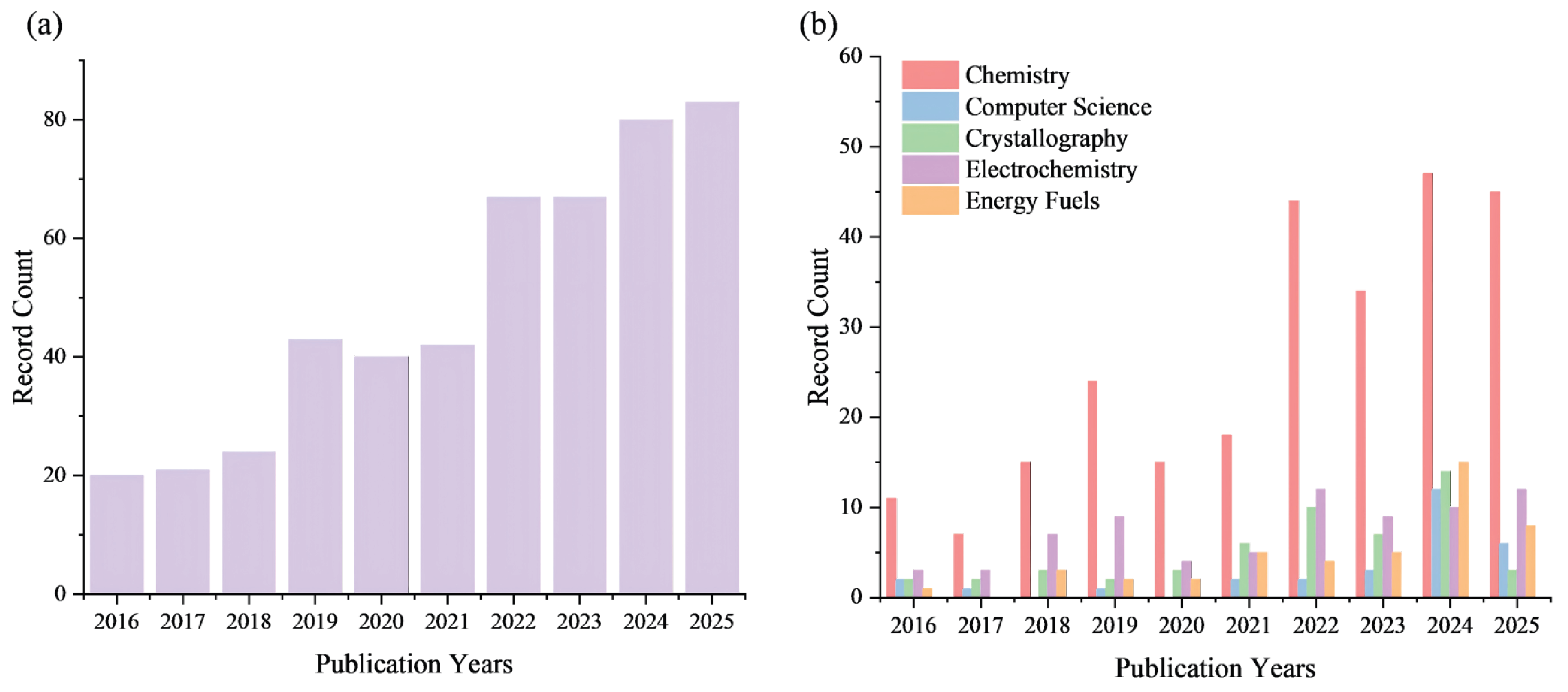
Figure 2.
Overview of humidity sensing materials and their adaptability to extreme environments, including low temperature, low pressure, strong radiation, and complex meteorological disturbance.
Figure 2.
Overview of humidity sensing materials and their adaptability to extreme environments, including low temperature, low pressure, strong radiation, and complex meteorological disturbance.
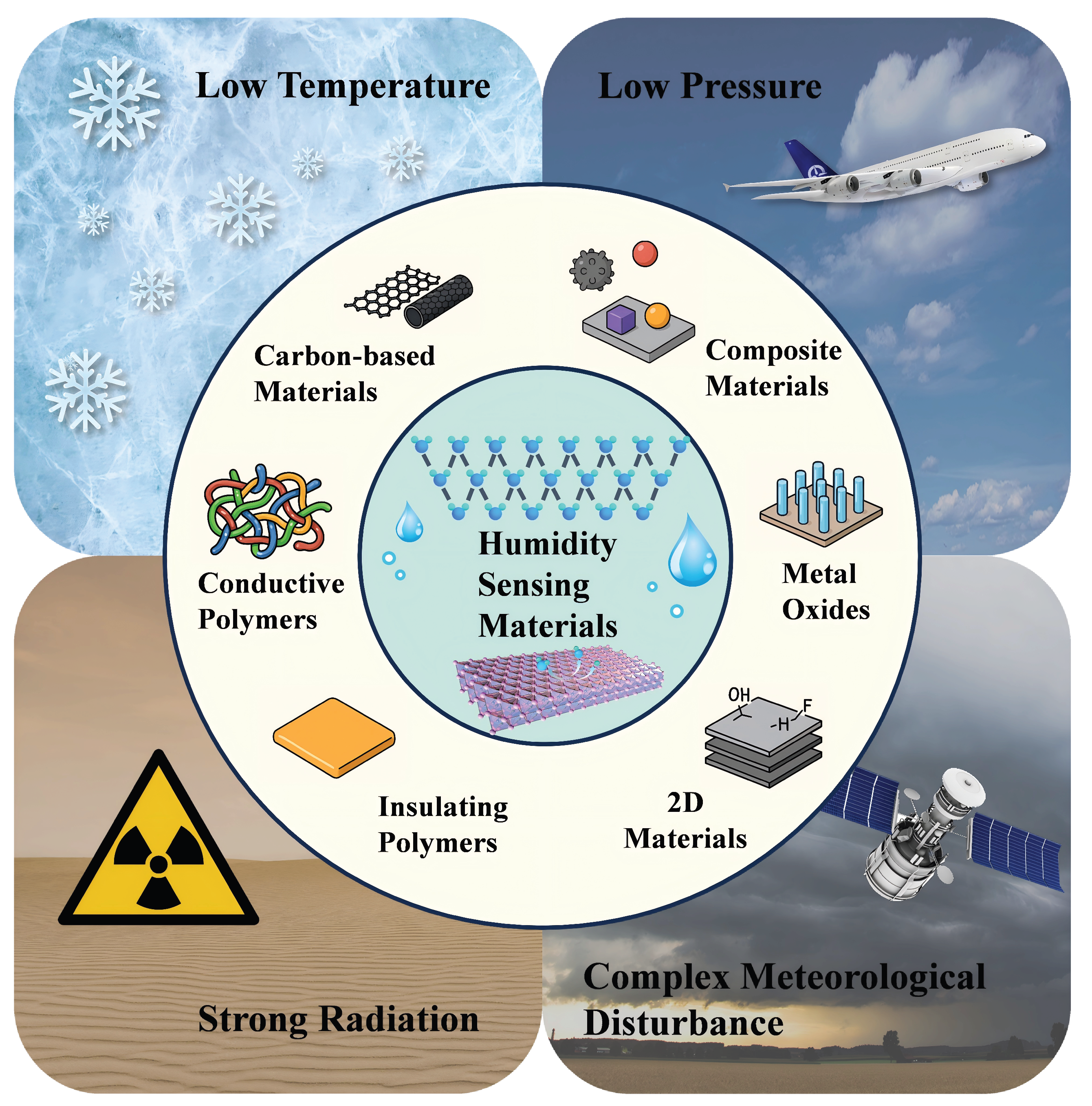
Figure 3.
(a) Fabrication process of CNT composite paper, including dispersion mixing, filtration and heat pressing; (b) Photograph of CNT composite paper samples; (c) Resistance variation of the composite paper as a function of relative humidity; (d) Cyclic humidity response between low and high RH levels. Adapted from Oya et al., Chemosensors 2025, 13, 373, CC BY 4.0. [33].
Figure 3.
(a) Fabrication process of CNT composite paper, including dispersion mixing, filtration and heat pressing; (b) Photograph of CNT composite paper samples; (c) Resistance variation of the composite paper as a function of relative humidity; (d) Cyclic humidity response between low and high RH levels. Adapted from Oya et al., Chemosensors 2025, 13, 373, CC BY 4.0. [33].
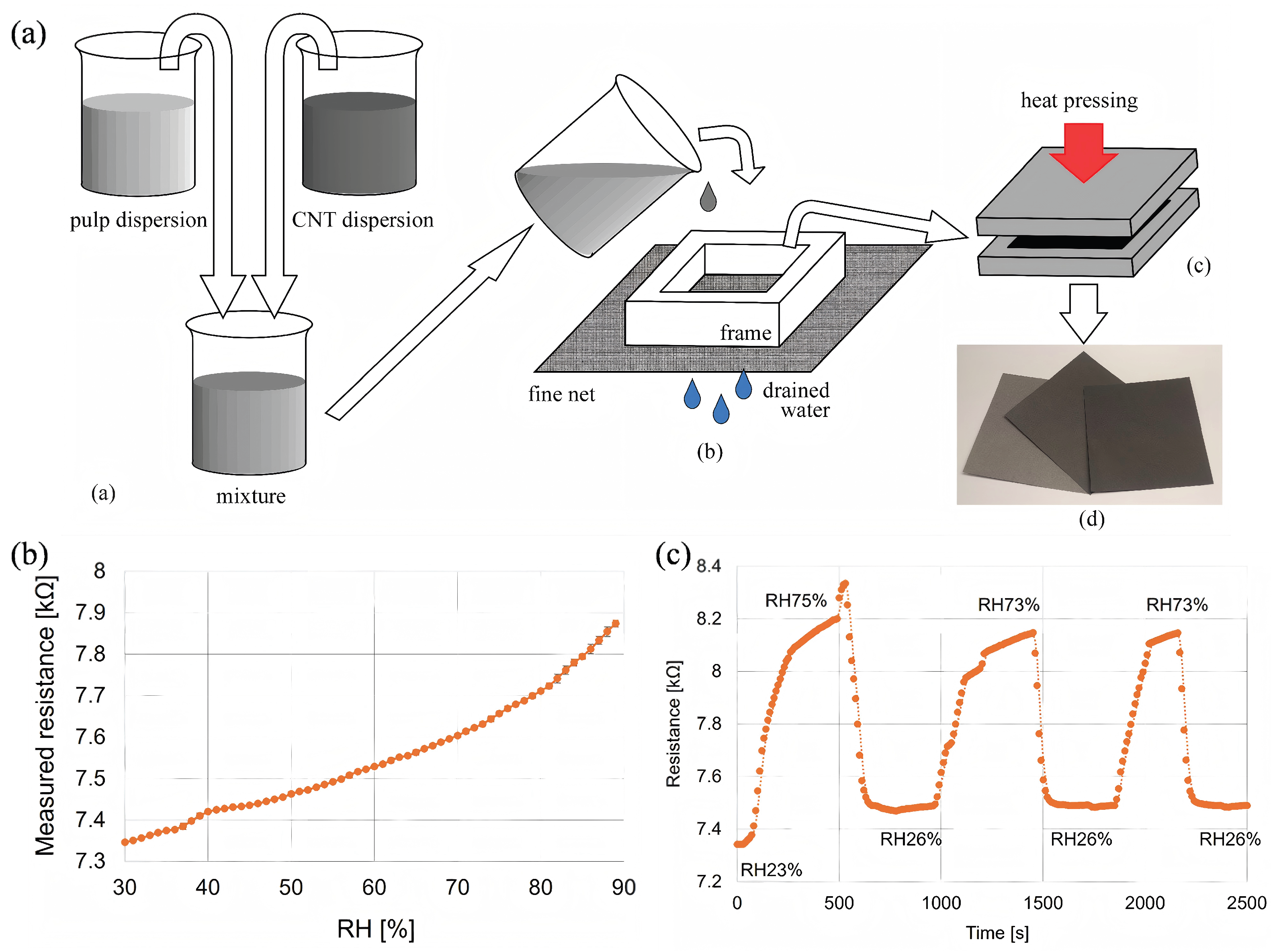
Figure 4.
(a) Schematic representation of the adsorption and sensing mechanism in the GO–Mn-doped ZnO (GOZnMnO) nanocomposite; (b) Structural model of Mn/Zn–oxide clusters coordinated with oxygen-rich GO functional groups; (c) Transient capacitive response of the GOZnMnO sensor under repeated humidity cycling; (d) Sensitivity (resistance-based) of GOZnMnO, ZnMnO, and GO using a 28-finger comb electrode across 20–90% RH; (e) Comparison of response and recovery times for GO, ZnMnO, and GOZnMnO using interdigital electrodes with different finger numbers; (f,g)Response curve of the GOZnMnO (28-finger) device during humidification from 20% to 85% RH. Adapted from Priyadharshini & Valsalal, Nanomaterials 2022, 12, 1659, CC BY 4.0. [64].
Figure 4.
(a) Schematic representation of the adsorption and sensing mechanism in the GO–Mn-doped ZnO (GOZnMnO) nanocomposite; (b) Structural model of Mn/Zn–oxide clusters coordinated with oxygen-rich GO functional groups; (c) Transient capacitive response of the GOZnMnO sensor under repeated humidity cycling; (d) Sensitivity (resistance-based) of GOZnMnO, ZnMnO, and GO using a 28-finger comb electrode across 20–90% RH; (e) Comparison of response and recovery times for GO, ZnMnO, and GOZnMnO using interdigital electrodes with different finger numbers; (f,g)Response curve of the GOZnMnO (28-finger) device during humidification from 20% to 85% RH. Adapted from Priyadharshini & Valsalal, Nanomaterials 2022, 12, 1659, CC BY 4.0. [64].
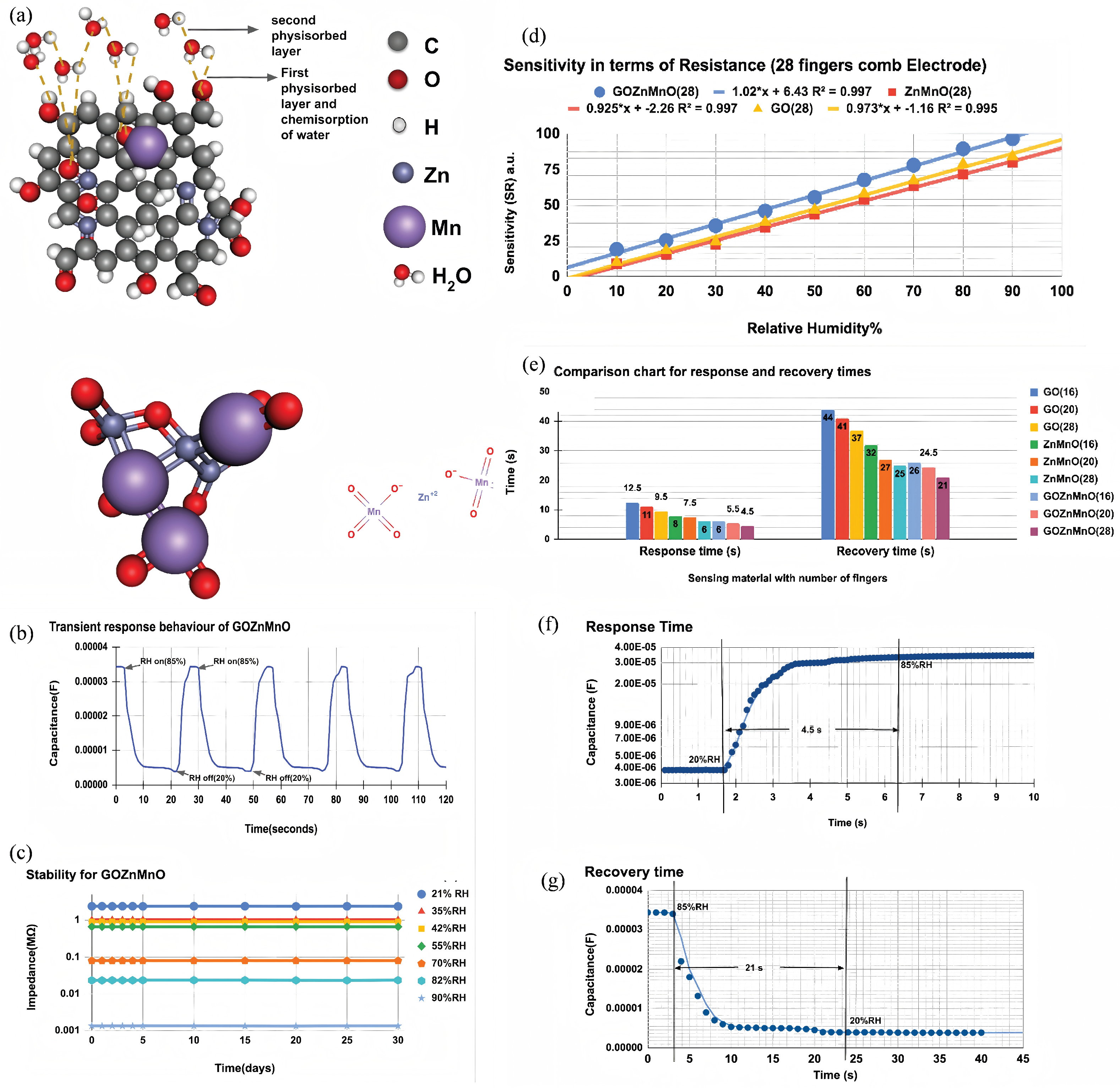
Figure 5.
(a) Schematic illustration of the fabrication process of the PPy@LS/CMC composite, including DES pretreatment; (b) Cyclic electrical stability of PPy@LS/CMC under repeated testing cycles; (c,d) I–V characteristics of PPy@LS/CMC composites in the dry (c) and wet (d) states, demonstrating humidity-dependent electrical behavior; (e) Comparison of electrical conductivities under dry and wet conditions for composites with varying CMC contents; (f) Free-radical scavenging efficiencies of the PPy-based composites. Adapted from Ni et al., Polymers 2025, 17, 898, under the terms of the Creative Commons CC BY 4.0 license. [96].
Figure 5.
(a) Schematic illustration of the fabrication process of the PPy@LS/CMC composite, including DES pretreatment; (b) Cyclic electrical stability of PPy@LS/CMC under repeated testing cycles; (c,d) I–V characteristics of PPy@LS/CMC composites in the dry (c) and wet (d) states, demonstrating humidity-dependent electrical behavior; (e) Comparison of electrical conductivities under dry and wet conditions for composites with varying CMC contents; (f) Free-radical scavenging efficiencies of the PPy-based composites. Adapted from Ni et al., Polymers 2025, 17, 898, under the terms of the Creative Commons CC BY 4.0 license. [96].
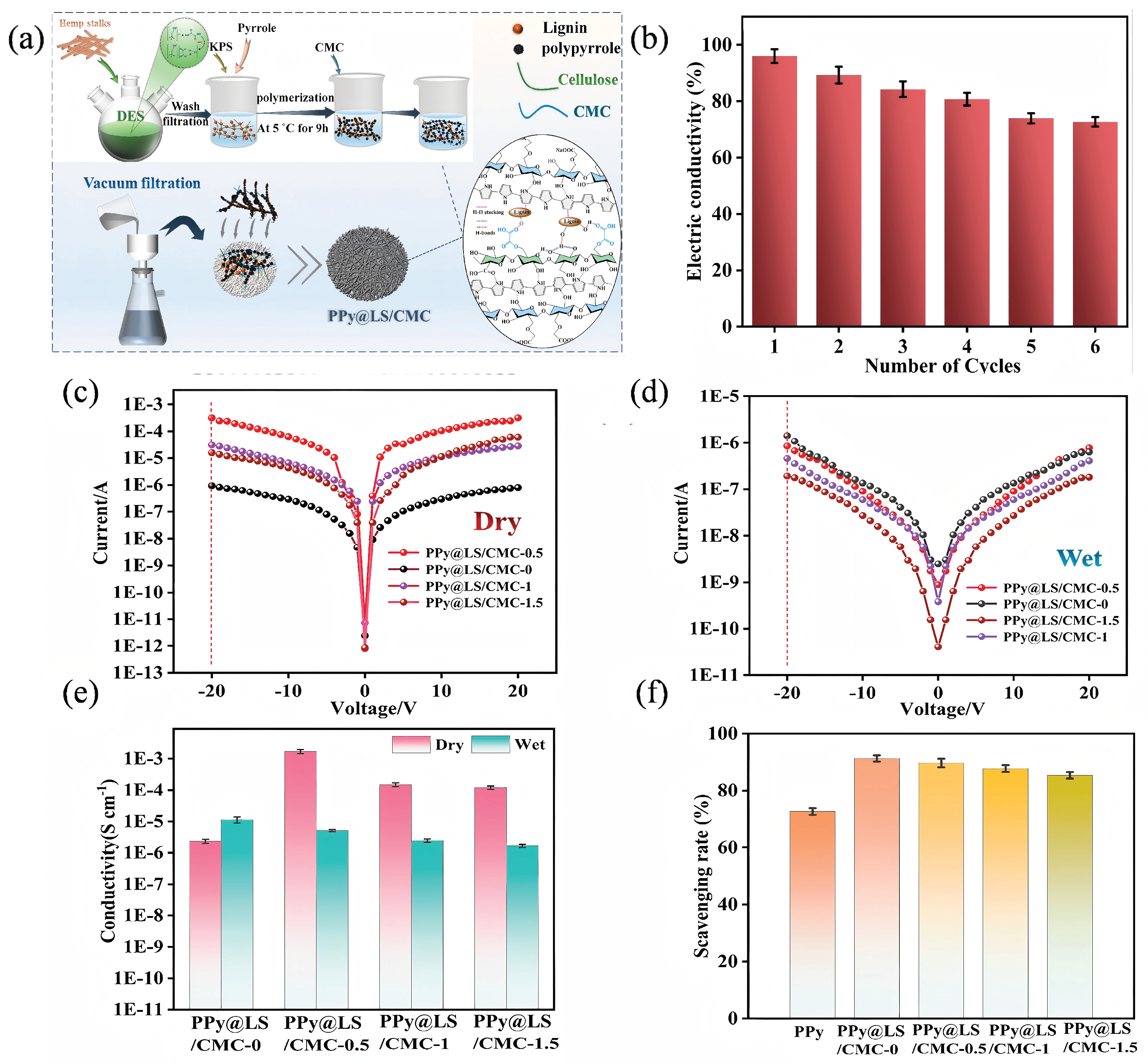
Figure 6.
(a,b) Dynamic resistance variations of CNO–PVA nanocomposite humidity sensors with CNO:PVA mass ratios of 1:1 (a) and 2:1 (b), measured under successive RH cycles and compared against a commercial reference sensor; (c,d) Relative resistance change as a function of relative humidity for three independently fabricated sensors using CNO:PVA ratios of 1:1 (c) and 2:1 (d), demonstrating reproducibility and compositional influence on sensitivity; (e) Sensitivity and response-time analysis of the CNO:PVA (1:1) sensor, including the definition of and response-time parameters (left), humidity-domain-dependent sensitivity values (top right), and relative response-time ratios compared to the reference sensor (bottom right). AAdapted from Serban et al., Sensors 2025, 25, 3047, under the terms of the Creative Commons CC BY 4.0 license. [116].
Figure 6.
(a,b) Dynamic resistance variations of CNO–PVA nanocomposite humidity sensors with CNO:PVA mass ratios of 1:1 (a) and 2:1 (b), measured under successive RH cycles and compared against a commercial reference sensor; (c,d) Relative resistance change as a function of relative humidity for three independently fabricated sensors using CNO:PVA ratios of 1:1 (c) and 2:1 (d), demonstrating reproducibility and compositional influence on sensitivity; (e) Sensitivity and response-time analysis of the CNO:PVA (1:1) sensor, including the definition of and response-time parameters (left), humidity-domain-dependent sensitivity values (top right), and relative response-time ratios compared to the reference sensor (bottom right). AAdapted from Serban et al., Sensors 2025, 25, 3047, under the terms of the Creative Commons CC BY 4.0 license. [116].
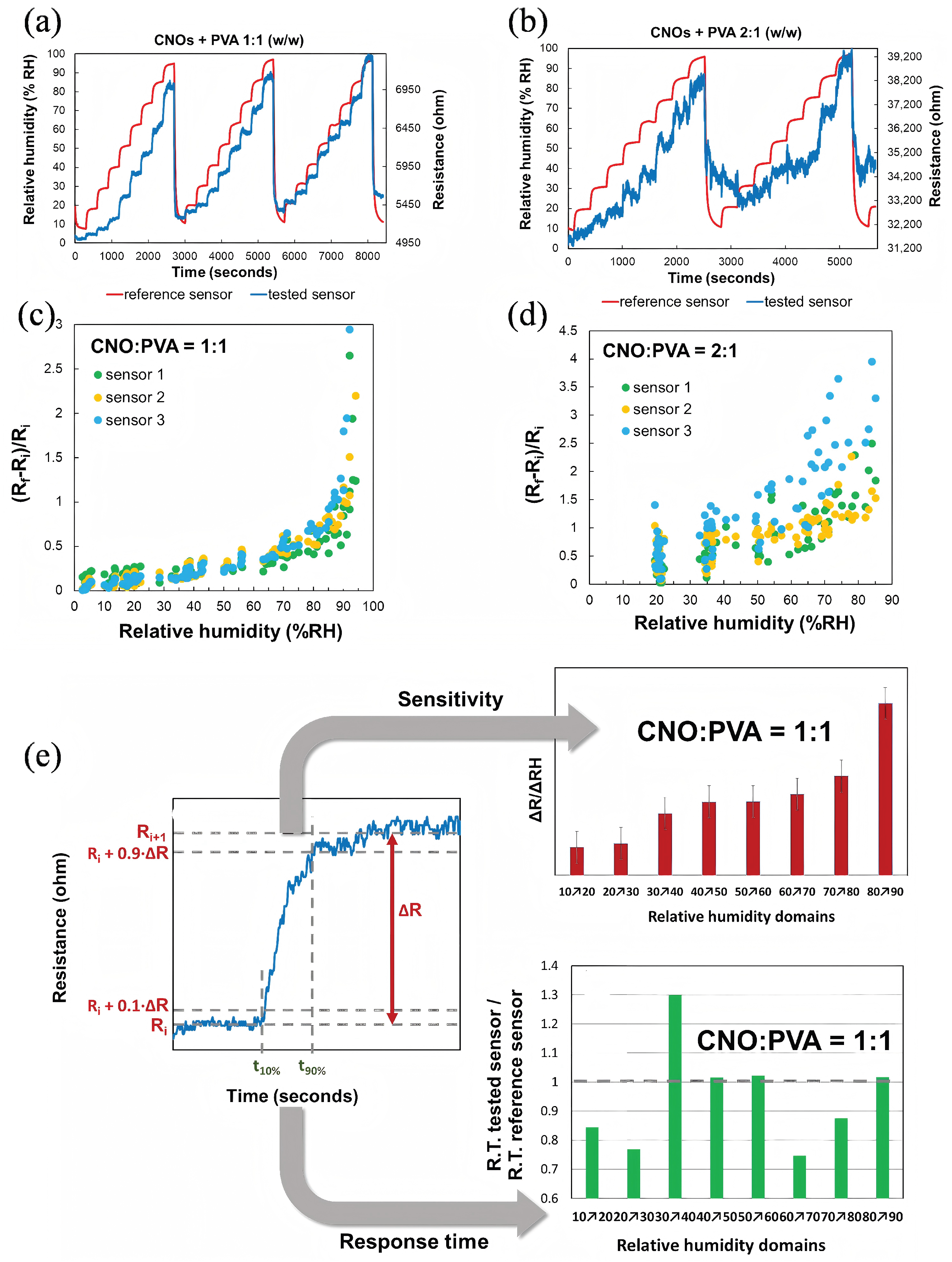
Figure 7.
(a) Dynamic capacitance response under stepwise RH changes. (b) Steady-state capacitance versus RH with linear fits. (c) Adsorption–desorption hysteresis. (d) Cyclic responses at fixed RH levels. (e) Long-term stability over 30 days. (f) Fast switching between low and high RH. (g) Capacitance change versus RH for different device configurations. (h) Response and recovery time comparison. (i) Sensing mechanism involving hydrogen bonding, physisorption, and chemisorption. Copyright 2024 Elsevier. Used with permission. [137].
Figure 7.
(a) Dynamic capacitance response under stepwise RH changes. (b) Steady-state capacitance versus RH with linear fits. (c) Adsorption–desorption hysteresis. (d) Cyclic responses at fixed RH levels. (e) Long-term stability over 30 days. (f) Fast switching between low and high RH. (g) Capacitance change versus RH for different device configurations. (h) Response and recovery time comparison. (i) Sensing mechanism involving hydrogen bonding, physisorption, and chemisorption. Copyright 2024 Elsevier. Used with permission. [137].
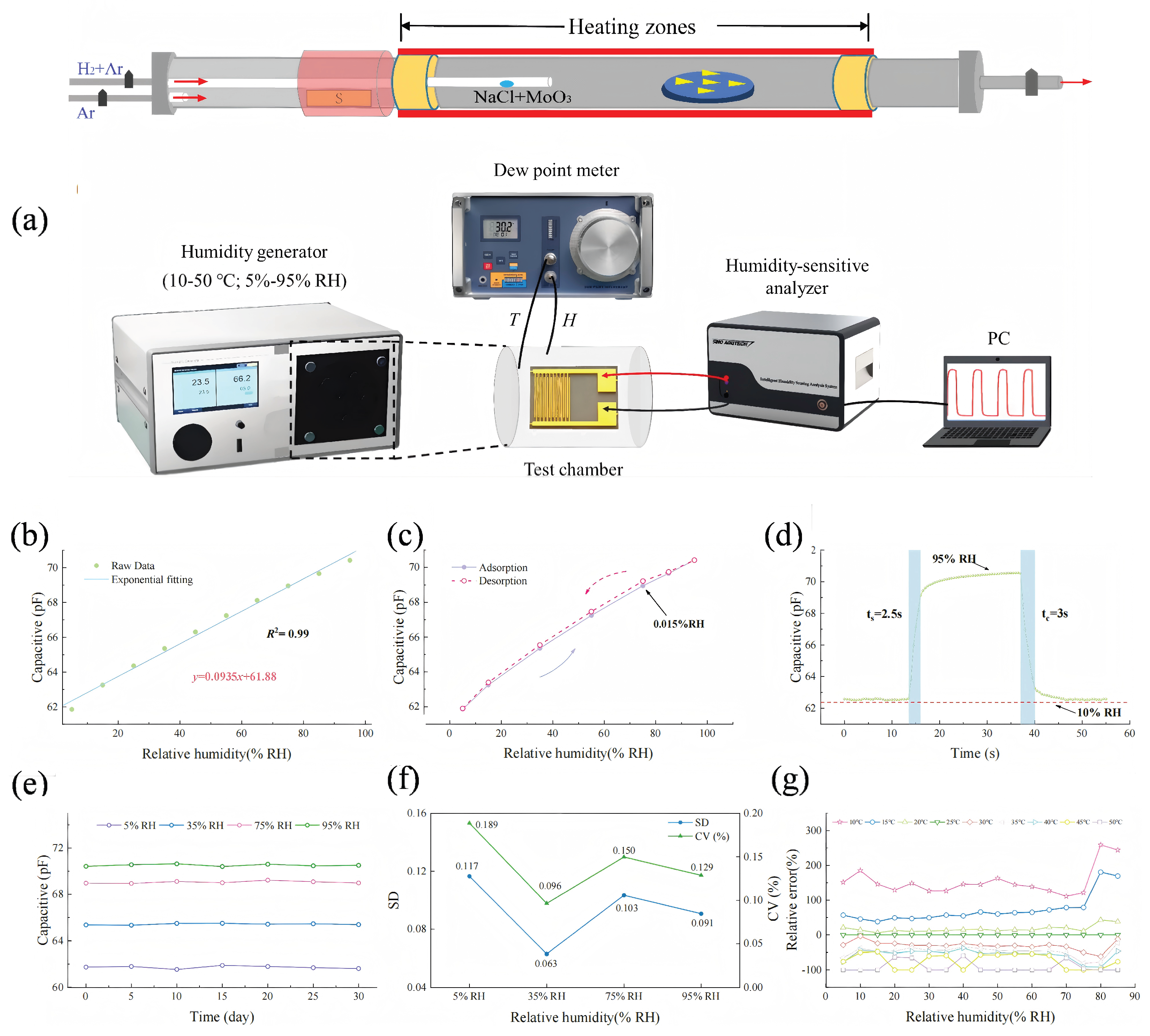
Figure 8.
(a) Schematic of the molten-salt-assisted CVD growth system for WS2 and the static/dynamic humidity-measurement setup; (b) Steady-state capacitance response versus relative humidity with exponential fitting; (c) Adsorption–desorption hysteresis curves before and after PZT actuation; (d) Fast humidity-switching response (11%–95% RH), showing shortened response and recovery times under PZT vibration; (e) Long-term stability over 30 days at multiple RH levels; (f) Statistical evaluation of stability (SD and CV) across humidity conditions; (g) Relative error distribution showing sensing accuracy across the RH range. Copyright 2025 Elsevier. Used with permission. [143].
Figure 8.
(a) Schematic of the molten-salt-assisted CVD growth system for WS2 and the static/dynamic humidity-measurement setup; (b) Steady-state capacitance response versus relative humidity with exponential fitting; (c) Adsorption–desorption hysteresis curves before and after PZT actuation; (d) Fast humidity-switching response (11%–95% RH), showing shortened response and recovery times under PZT vibration; (e) Long-term stability over 30 days at multiple RH levels; (f) Statistical evaluation of stability (SD and CV) across humidity conditions; (g) Relative error distribution showing sensing accuracy across the RH range. Copyright 2025 Elsevier. Used with permission. [143].
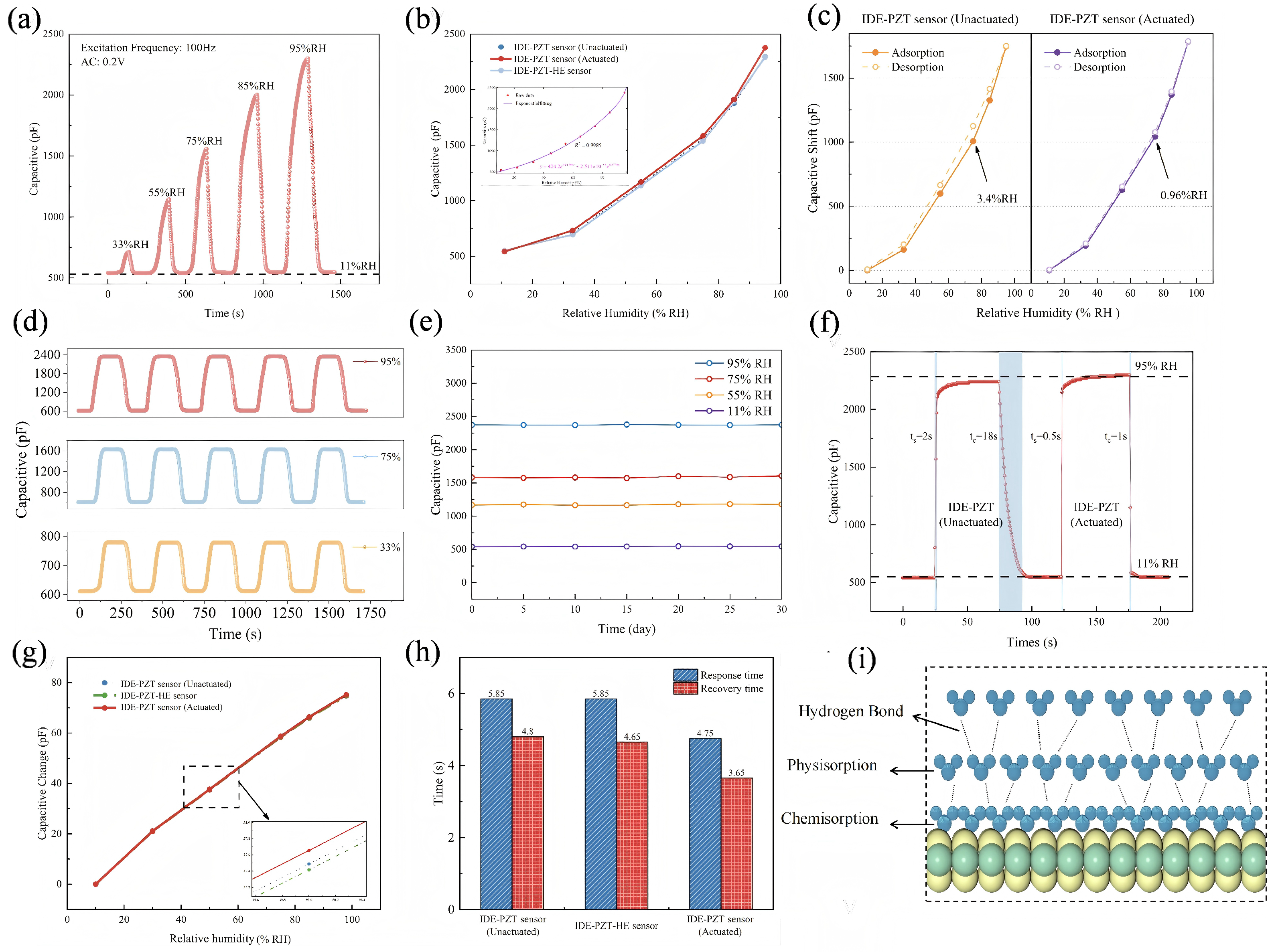
Figure 9.
(a) Schematic illustration of the preparation of MXene nanosheets (etching of Ti3AlC2 MAX phase) and fabrication of the SA/MXene composite film followed by Ca+3 crosslinking; (b) Long-term impedance stability of the c-SA/MXene sensor when exposed to 98% RH for 9 h; (c) Impedance–humidity characteristics before and after 24 h storage at 98% RH, demonstrating high-humidity durability; (d) Response of the sensor to 500 ppm organic vapors, confirming its selectivity toward humidity; (e) Repeated switching responses between low (11% RH) and high (98% RH) humidity for 120 cycles, showing excellent reversibility and stability; enlarged segments highlight the stable periodic patterns at different stages. Adapted from Chen et al., Nanomaterials 2024, 14, 1694, under the terms of the Creative Commons CC BY 4.0 license. [156].
Figure 9.
(a) Schematic illustration of the preparation of MXene nanosheets (etching of Ti3AlC2 MAX phase) and fabrication of the SA/MXene composite film followed by Ca+3 crosslinking; (b) Long-term impedance stability of the c-SA/MXene sensor when exposed to 98% RH for 9 h; (c) Impedance–humidity characteristics before and after 24 h storage at 98% RH, demonstrating high-humidity durability; (d) Response of the sensor to 500 ppm organic vapors, confirming its selectivity toward humidity; (e) Repeated switching responses between low (11% RH) and high (98% RH) humidity for 120 cycles, showing excellent reversibility and stability; enlarged segments highlight the stable periodic patterns at different stages. Adapted from Chen et al., Nanomaterials 2024, 14, 1694, under the terms of the Creative Commons CC BY 4.0 license. [156].
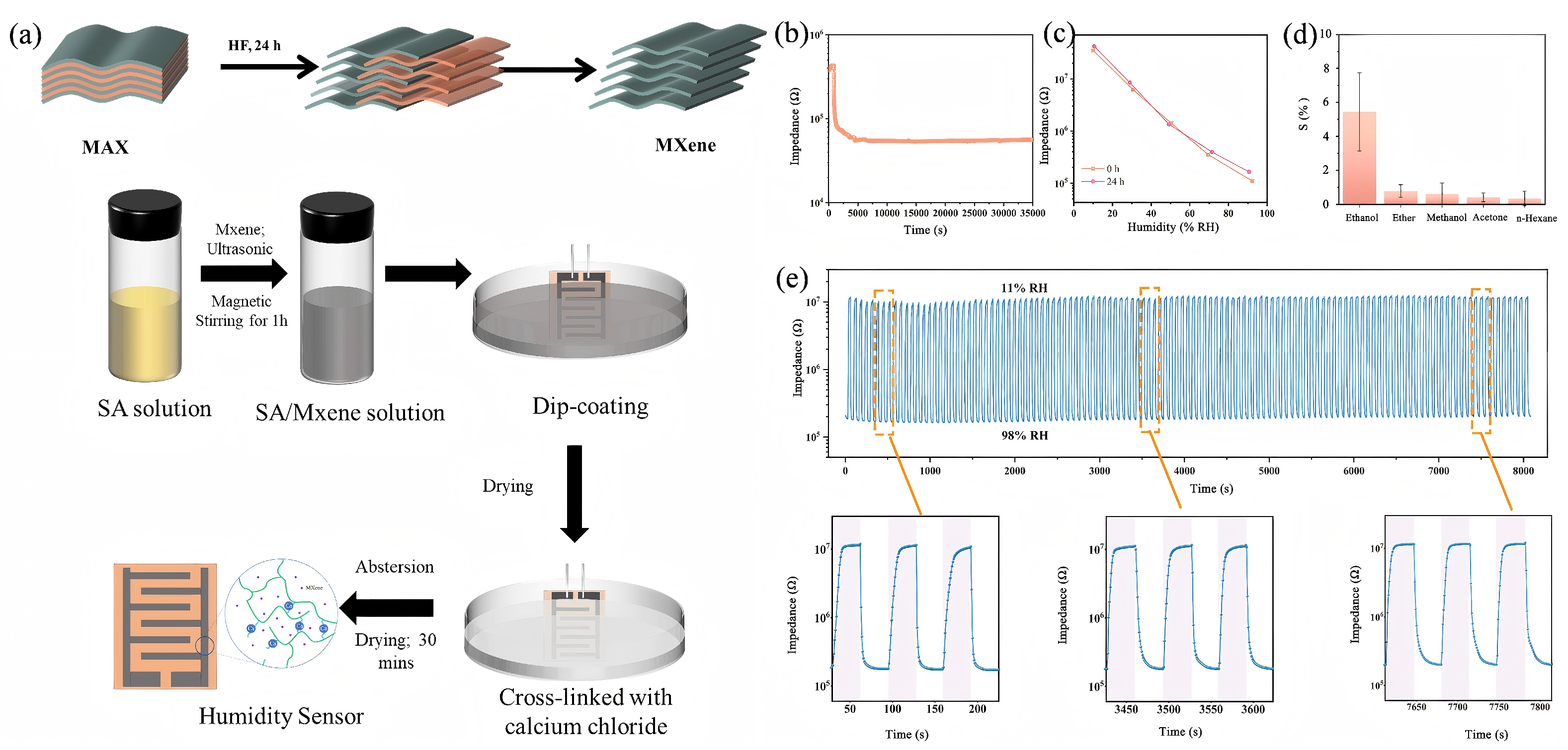
Figure 10.
Schematic representations of typical carbon-based humidity-sensitive material morphologies. (a) 1D nanotubes structure; (b) 1D nanofiber; (c) 2D nanosheet structure; (d) 0D nanoparticles array.
Figure 10.
Schematic representations of typical carbon-based humidity-sensitive material morphologies. (a) 1D nanotubes structure; (b) 1D nanofiber; (c) 2D nanosheet structure; (d) 0D nanoparticles array.
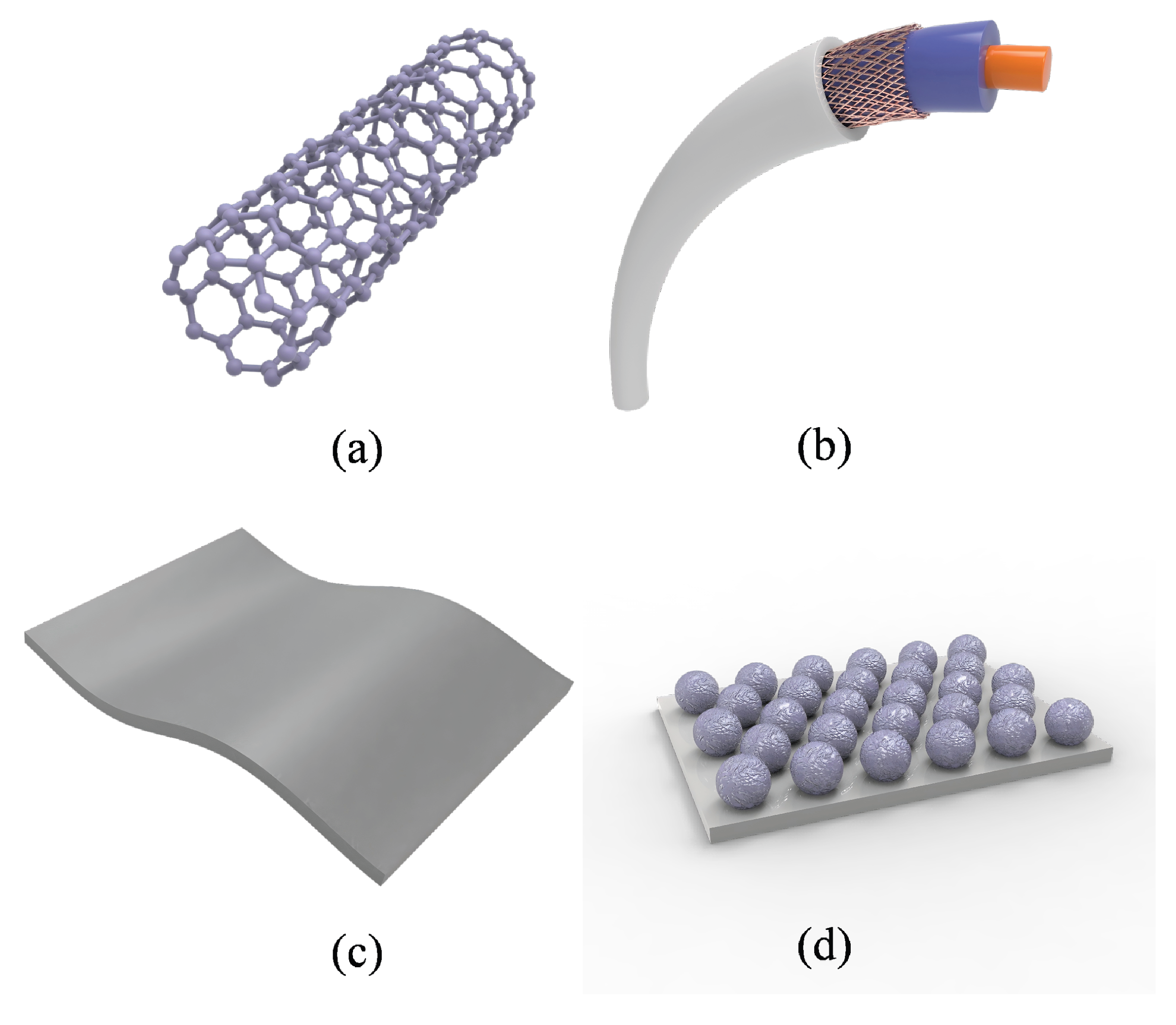
Table 1.
Performance summary of single-component carbon-based materials used as humidity-sensing layers.
Table 1.
Performance summary of single-component carbon-based materials used as humidity-sensing layers.
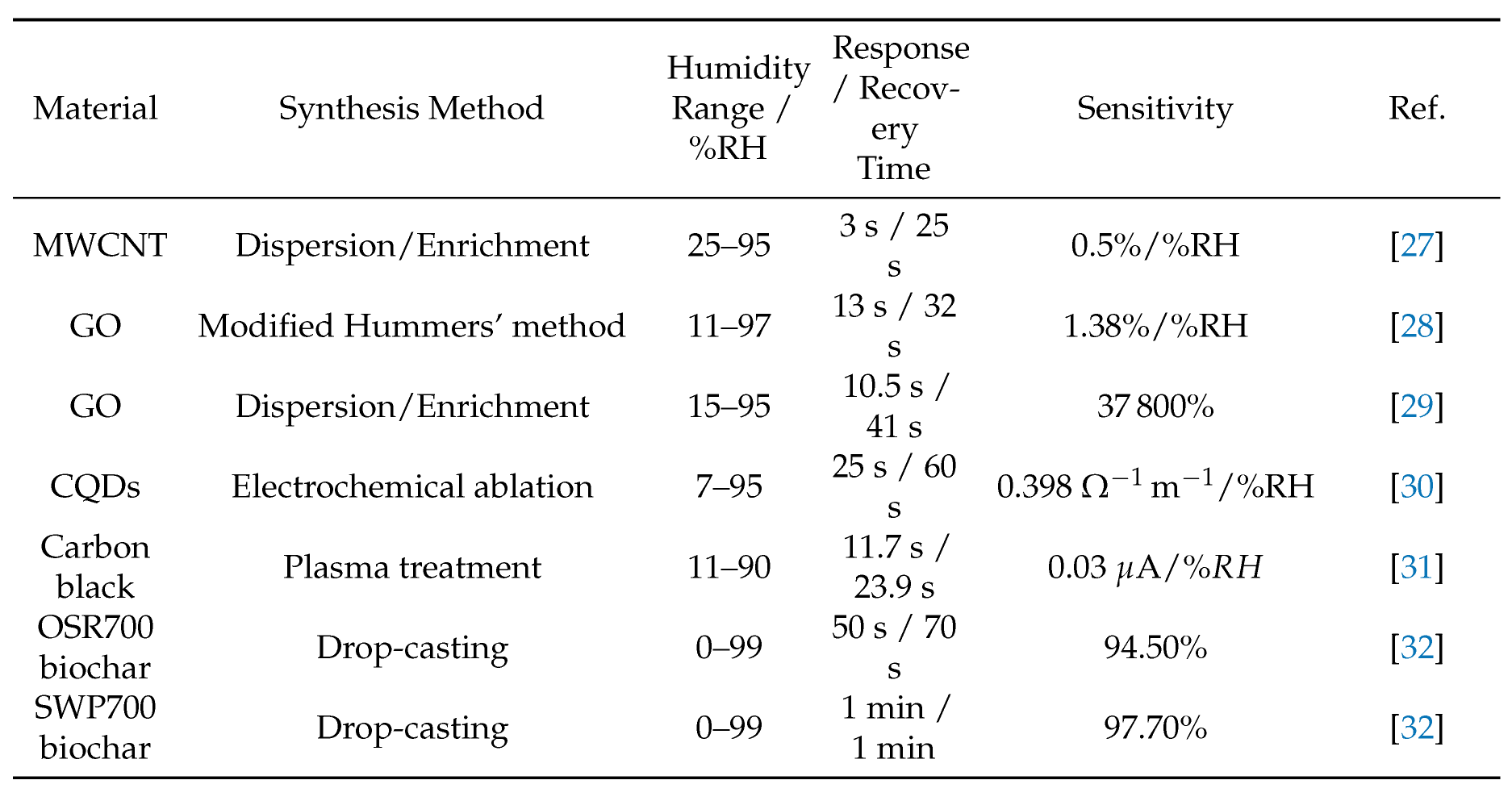
Table 2.
Performance Summary of Single-Component Metal Oxide Materials for Humidity Sensing.
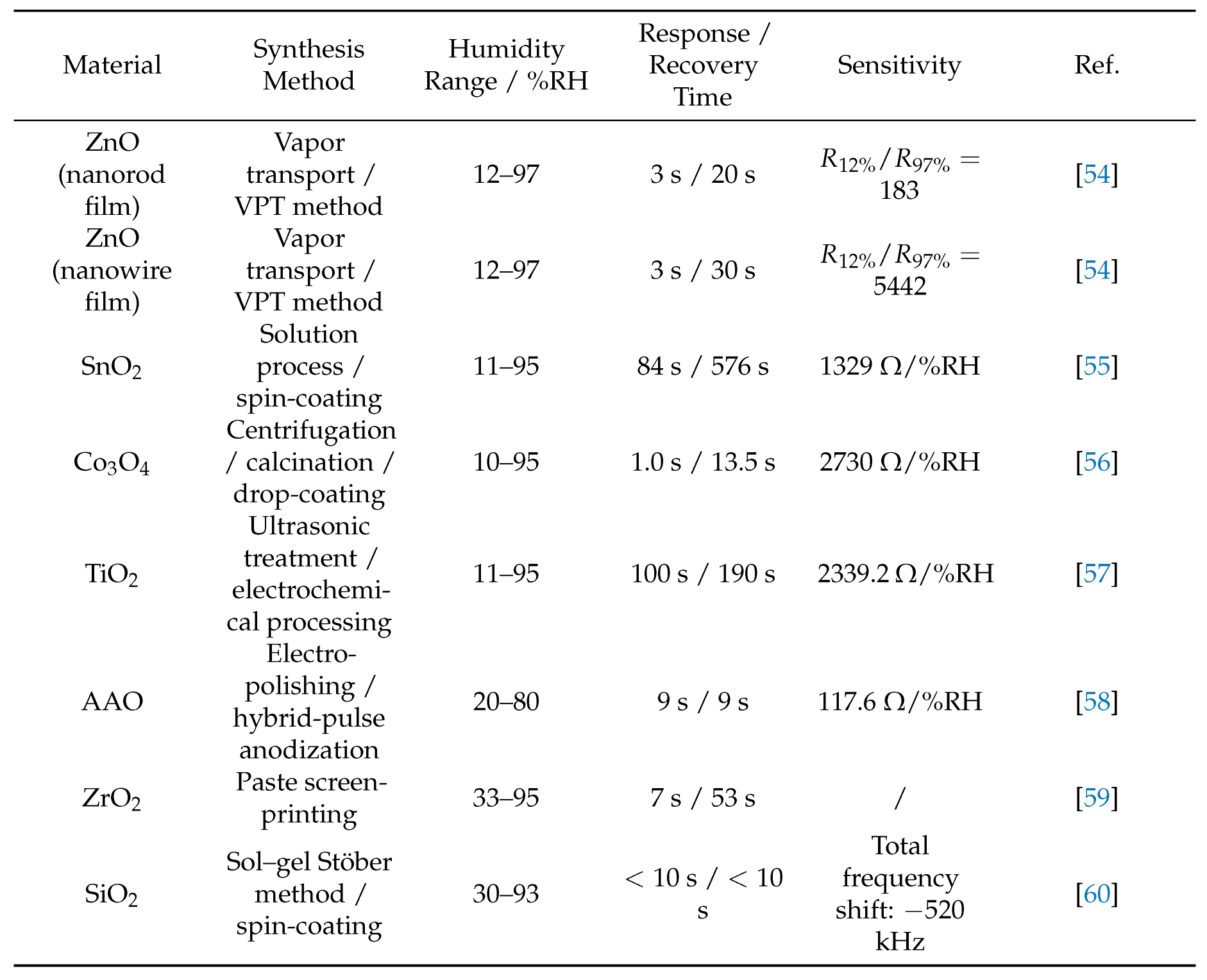
Table 3.
Performance summary of single-component conducting polymer materials for humidity sensing.
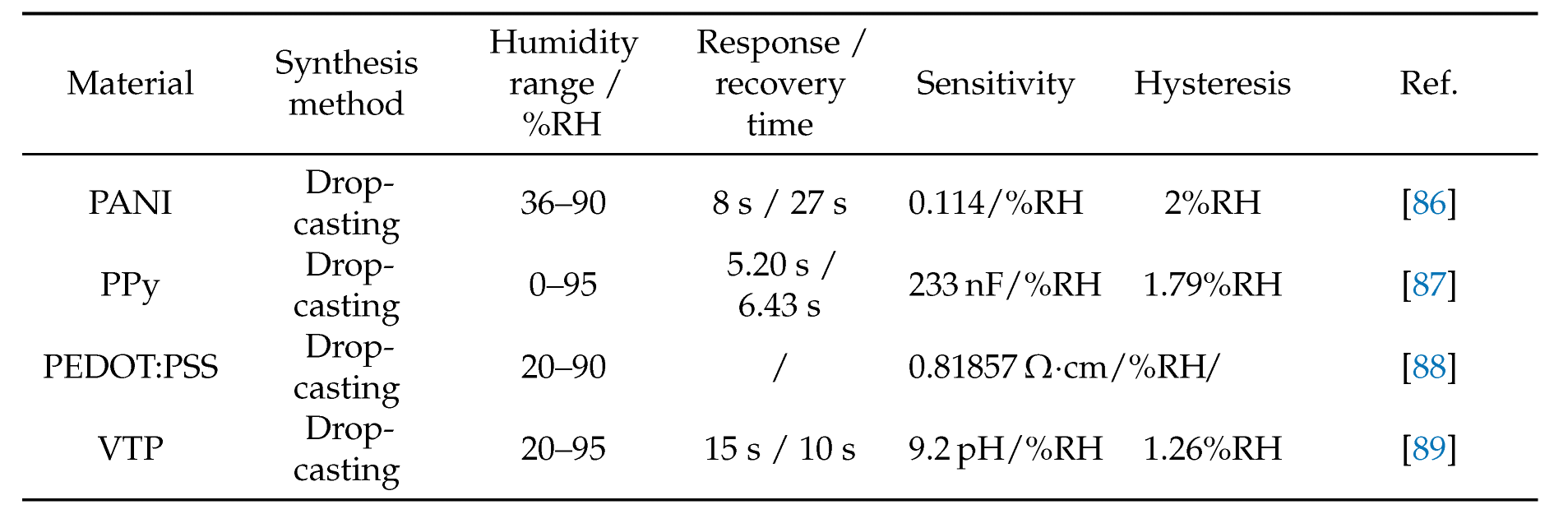
Table 4.
Performance summary of single-component polymer materials for humidity sensing.
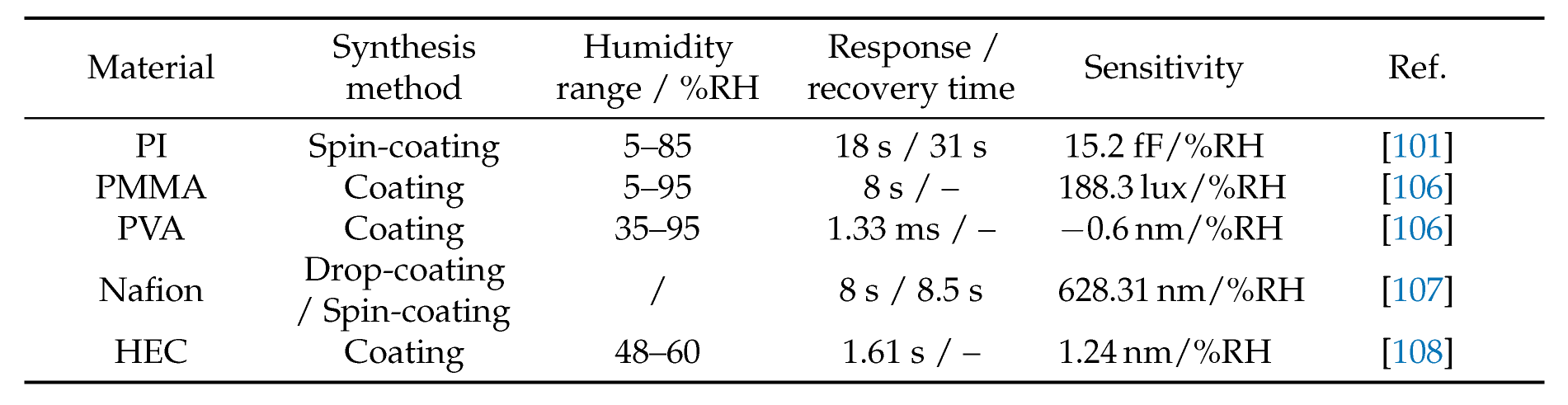
Table 5.
Performance summary of single-component polymer materials for humidity sensing.
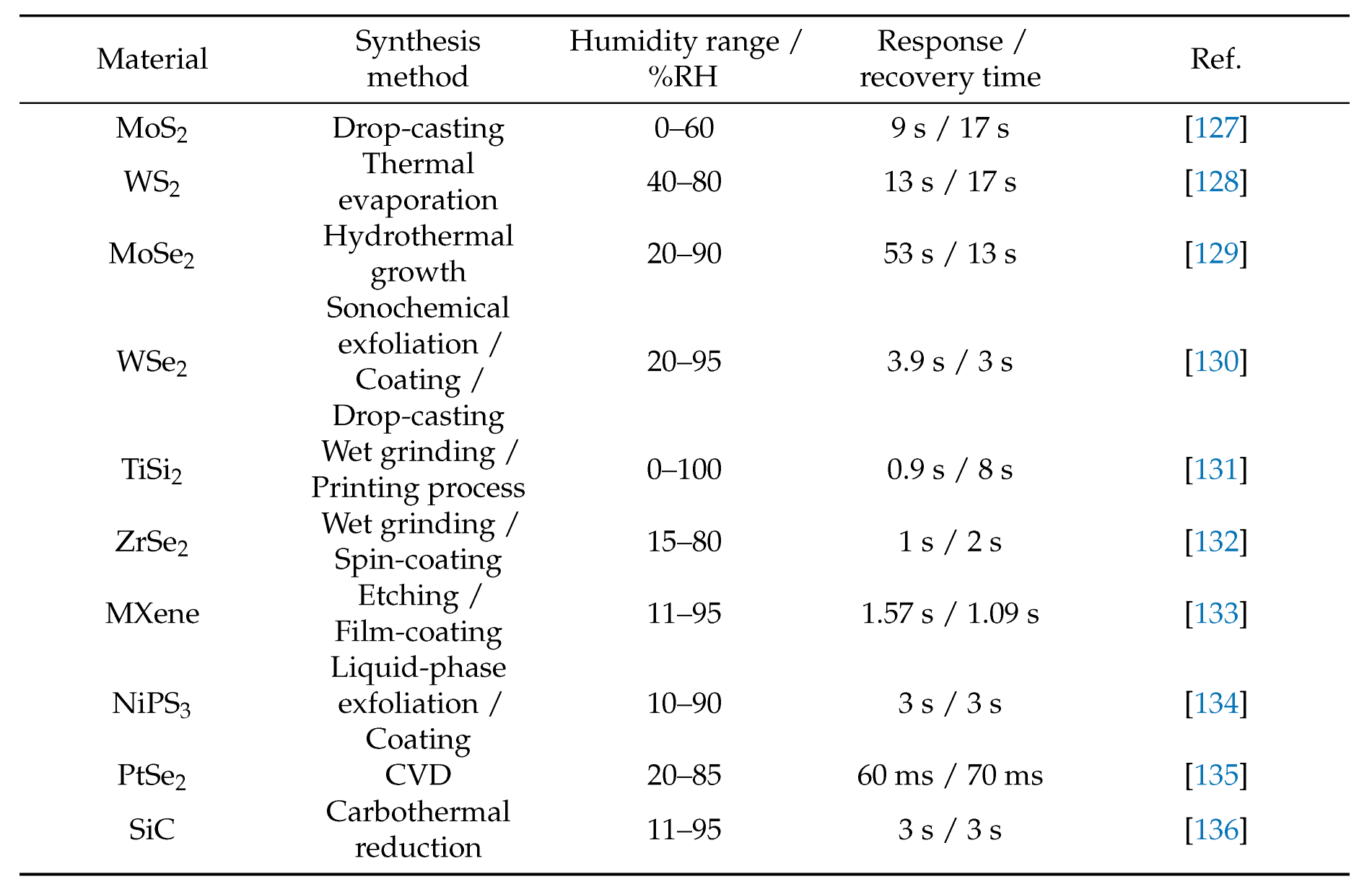
Table 7.
Summary of representative humidity-sensing material systems for extreme-environment applications.
Table 7.
Summary of representative humidity-sensing material systems for extreme-environment applications.
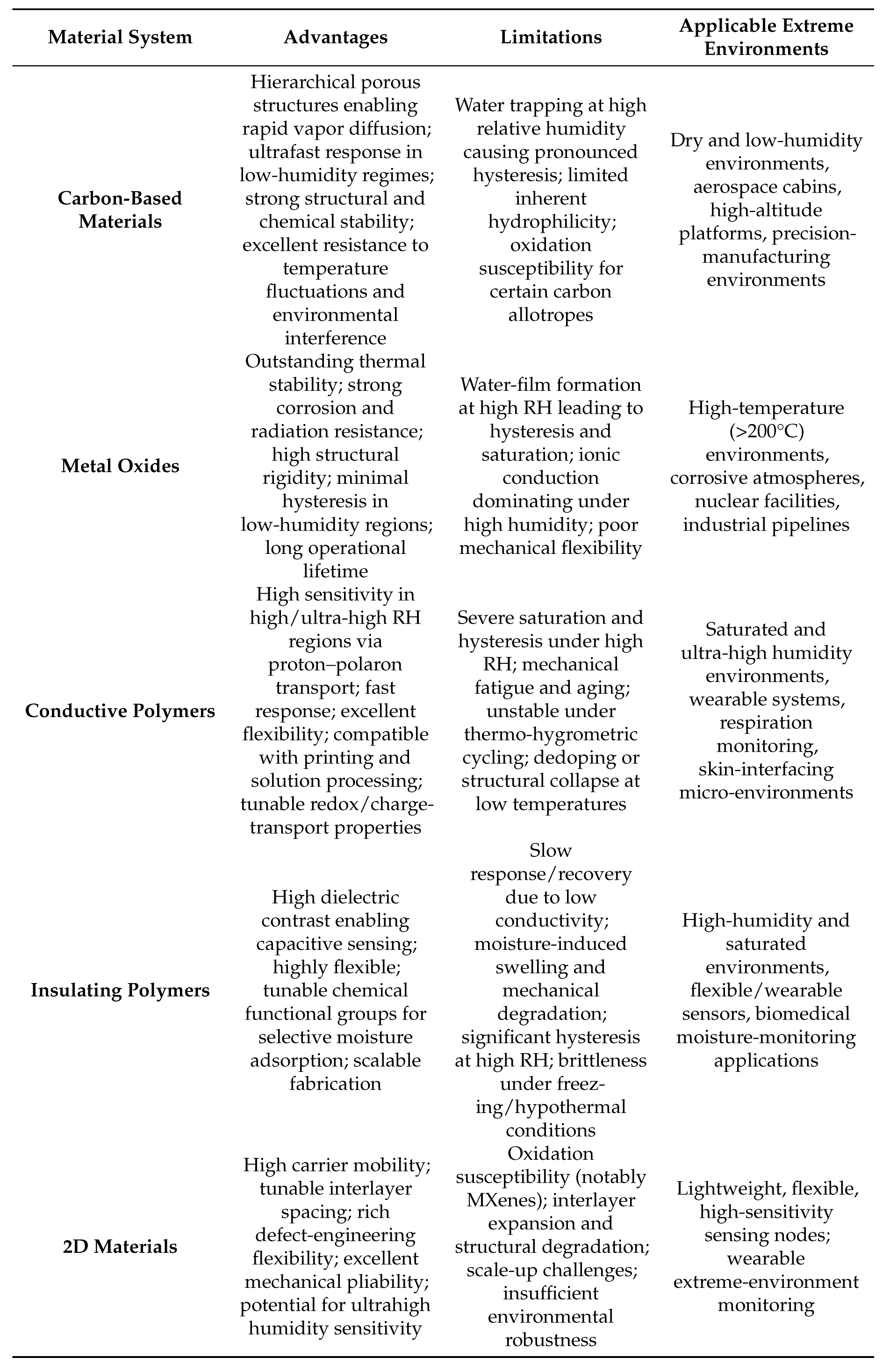
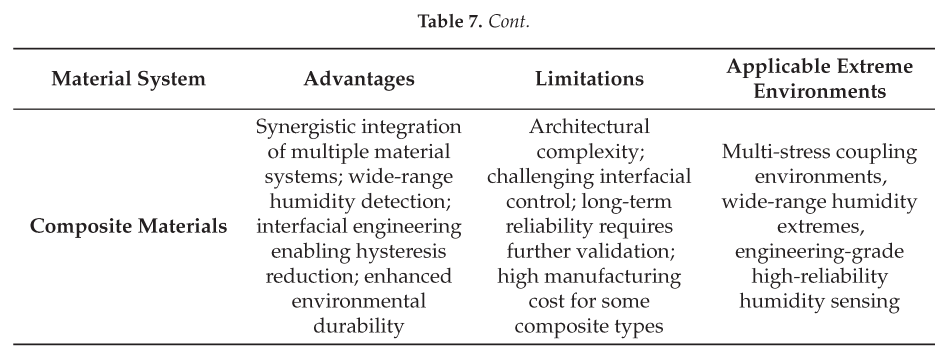
Disclaimer/Publisher’s Note: The statements, opinions and data contained in all publications are solely those of the individual author(s) and contributor(s) and not of MDPI and/or the editor(s). MDPI and/or the editor(s) disclaim responsibility for any injury to people or property resulting from any ideas, methods, instructions or products referred to in the content. |
© 2025 by the authors. Licensee MDPI, Basel, Switzerland. This article is an open access article distributed under the terms and conditions of the Creative Commons Attribution (CC BY) license (https://creativecommons.org/licenses/by/4.0/).
Copyright: This open access article is published under a Creative Commons CC BY 4.0 license, which permit the free download, distribution, and reuse, provided that the author and preprint are cited in any reuse.


