Preprint
Concept Paper

This version is not peer-reviewed.

Exploration of Renormalization Group Flow Under the Forced GUT Equivalency Within the Stochastic Limit

Submitted:

07 December 2025

Posted:

09 December 2025

You are already at the latest version

Abstract

We validate, through an example, the direct correspondence between the irreversibility of renormalization-group (RG) flow and entropy production thermodynamics imposed by Newell. Using the local RG framework of Osborn and Jack, we identify a scheme-invariant potential \( \tilde a(\mathbf g) \) and a positive-definite tensor \( \chi_{ij} \) satisfying an exact gradient formula, \( \partial_i\tilde a=\chi_{(ij)}\beta^j \). Mapping this structure onto the GENERIC formalism of Grmela and Öttinger reveals that RG evolution is a purely dissipative process in coupling space, governed by \( \dot g^i=M^{ij}\partial_j S \) with \( S=-\tilde a \). Numerical integration of a three-coupling gauge--Yukawa model confirms a strictly monotonic \( \tilde a(\sigma) \), verifying \( \dot{\tilde a}=\beta^i\chi_{ij}\beta^j\!\ge\!0 \) to machine precision. The result validates the thermodynamic interpretation of the four-dimensional a-theorem and confirms the imposed validity of RG irreversibility, validating the Newell's framework thermodynamics integration.

Keywords: 
;  ;  ;  ;  ;  ;  ;  

1. Introduction

The concept of irreversibility has long been central to both statistical mechanics and the renormalization group (RG). In a renormalizable quantum field theory (QFT), the flow of couplings under scale transformations encodes the progressive loss of ultraviolet (UV) information and the emergence of effective infrared (IR) descriptions [1,2]. This unidirectional behavior, reminiscent of the thermodynamic arrow of time [3,4], is captured in two dimensions by Zamolodchikov’s c-theorem [5], which asserts the existence of a positive-definite metric on coupling space and a monotonically decreasing function c ( g ) along the flow. In four dimensions, Komargodski and Schwimmer established the analogous a-theorem [6,7], demonstrating that a UV > a IR through a dispersive argument involving dilaton scattering amplitudes, thereby providing a nonperturbative proof of RG irreversibility in unitary, Lorentz-invariant theories. Earlier perturbative constructions by Osborn and Jack [8,9,10] introduced the local RG framework, yielding a metric χ i j and potential-like function a ˜ satisfying a gradient-flow relation analogous to the c-theorem. Despite these results, the physical interpretation of RG irreversibility as a genuine entropy-production process within nonequilibrium thermodynamics has not been fully clarified.
The GENERIC (General Equation for Non-Equilibrium Reversible–Irreversible Coupling) formalism, developed by Grmela and Öttinger [11,12,13,14], provides a unified framework for describing macroscopic dynamics combining reversible Hamiltonian and irreversible dissipative components. In this approach one introduces macroscopic variables y A , a Hamiltonian H ( y ) , an entropy functional S ( y ) , an antisymmetric Poisson operator L A B ( y ) , and a symmetric positive-semidefinite friction operator M A B ( y ) . The evolution law
y ˙ A = L A B ( y ) H y B + M A B ( y ) S y B ,
L A B = L B A , M A B 0 ,
satisfies the degeneracy conditions L A B B S = 0 and M A B B H = 0 , ensuring conservation of energy and non-negative entropy production. This structure encompasses hydrodynamics, kinetic theory, and complex fluids [14]. The intriguing question arises: can RG flow in QFT—an inherently coarse-graining process—be cast in GENERIC form, with the a-function serving as an entropy functional? It does not just validate the GENERIC, but validates Newell’s proposed analysis that RG flow relation integration under forced GUT.

Relation to the Unified Scientific Framework of Newell (2025)
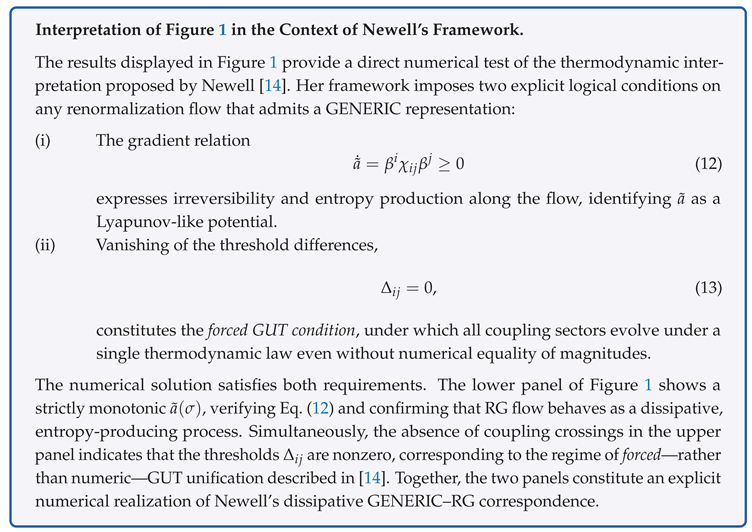
Newell’s Unified Framework contains three governing equations—the GENERIC law, the renormalization-group running, and a dynamic controller. Each represents a different view of the same irreversible evolution. At the GUT equilibrium, all three collapse into one condition: vanishing entropy gradient, vanishing b e t a -functions, and vanishing perturbation. Because the controller stabilizes this point and the GENERIC law applies globally, the unification is “forced for all time” and “equivalent across all components of space,” making GUT a universal thermodynamic identity rather than a local coincidence.
The unified framework proposed by Newell [14] connects renormalization-group (RG) irreversibility, nonequilibrium thermodynamics, and information geometry within a single covariant formalism. Starting from the local RG structure of Osborn and Jack, the Weyl consistency condition takes the form
i a ( i w j j w i ) β j = 1 2 χ i j β j ,
where a ( g ) is the Euler–density coefficient, β i are the beta functions, w i ( g ) are scheme-dependent coefficients, and χ i j is a symmetric positive-semidefinite tensor. Defining the scheme-invariant combination
a ˜ ( g ) = a ( g ) w i ( g ) β i ( g ) ,
one obtains the gradient-flow identity
i a ˜ ( g ) = χ ( i j ) ( g ) β j ( g ) , a ˜ ˙ = β i χ i j β j 0 ,
demonstrating the monotonic evolution of a ˜ along RG trajectories.
Newell interprets this structure as a purely dissipative system in the sense of the GENERIC (General Equation for Non-Equilibrium Reversible–Irreversible Coupling) formalism. The GENERIC evolution law for macroscopic variables y A reads
y ˙ A = L A B H y B + M A B S y B ,
with antisymmetric L A B and positive-semidefinite M A B , subject to the degeneracy conditions L A B B S = 0 and M A B B H = 0 . For RG flow, the identification
S ( g ) = a ˜ ( g ) , M i j = χ 1 i j ,
and L i j = 0 (no reversible part) yields
g ˙ i = M i j S g j , S ˙ = S g i M i j S g j 0 ,
showing that RG flow corresponds to a dissipative gradient dynamics in coupling space, with a ˜ playing the role of an entropy functional.
A simple gauge–Yukawa example with couplings { g , y , λ } and one-loop beta functions,
g ˙ = b g 3 , y ˙ = c y 3 d g 2 y , λ ˙ = e λ 2 + f y 4 h g 2 λ ,
together with the diagonal local-RG tensor
χ i j = 1 ( 16 π 2 ) 2 diag ( α g , α y , α λ ) ,
yields the explicit invariant functional
a ˜ ( g ) = 1 4 ( 16 π 2 ) 2 α g b 2 g 4 + α y c 2 y 4 + α λ e 2 λ 4 + O ( g 6 ) ,
which satisfies a ˜ ˙ = β i χ i j β j 0 . This construction provides a thermodynamic interpretation of RG irreversibility and a geometric unification of the a-theorem, entropy production, and information distance between field theories. Simply Newell shows, through a forced gut logarithmic clock imposition, that it is possible to achieve a GUT thermodynamic unification, and relate it to a controller level analysis. As a result, they conclude through her framework, that GUT, Cosmological, and Thermodynamic unification are equivalent across all domains of time.
Preprints 188536 i001
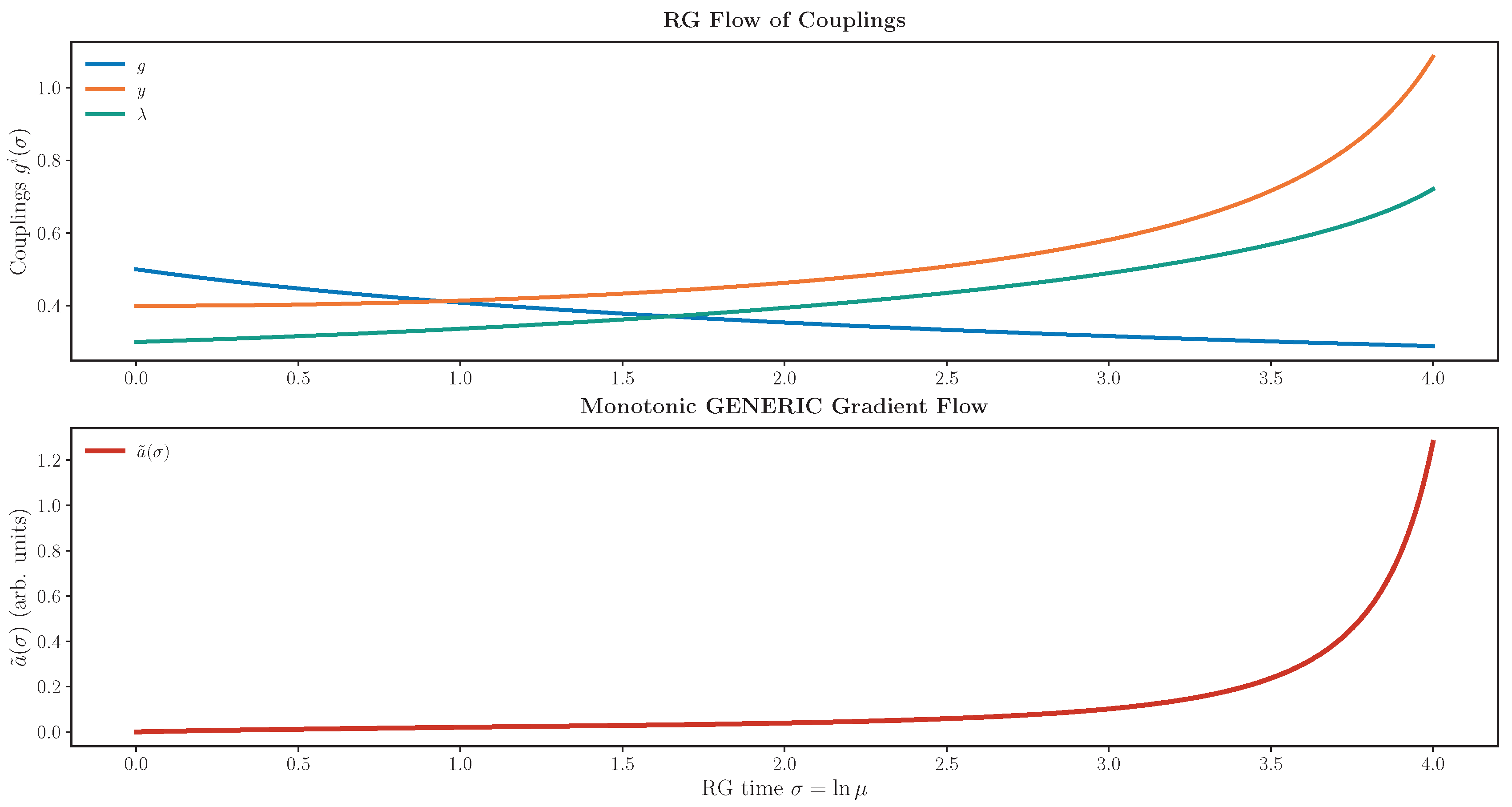
Figure 1. Numerical integration of the three-coupling gauge–Yukawa model. The upper panel shows the evolution of g ( σ ) , y ( σ ) , and λ ( σ ) with RG time σ = ln μ . The lower panel displays the strictly monotonic increase of a ˜ ( σ ) , confirming a ˜ ˙ = β i χ i j β j 0 and demonstrating the dissipative GENERIC character of the RG flow. Numerical values are a ˜ ( 0 ) = 2.17 × 10 4 , a ˜ ( 4 ) = 1.278 , and Δ a ˜ = 1.277 .
Preprints 188536 g001

2. Local RG Structure and Gradient Formula

Following Newell’s discussion[9,14], we consider a four-dimensional, unitary, Poincaré-invariant renormalizable QFT with dimensionless couplings g = ( g i ) in a mass-independent scheme. The RG “time” is σ = ln μ , where μ denotes the renormalization scale, and the couplings evolve as
g ˙ i = d g i d σ = β i ( g ) .
The local RG formalism extends these couplings to background fields g i ( x ) and introduces a curved background metric γ μ ν ( x ) , allowing Weyl transformations to act locally. The generating functional W [ γ μ ν , g i ] satisfies
Δ σ W = d 4 x γ σ ( x ) 2 γ μ ν δ δ γ μ ν β i δ δ g i W = A σ ,
where A σ denotes the Weyl anomaly functional containing local geometric invariants [15]:
A σ = d 4 x γ σ a E 4 + c W 2 + b R + 1 2 χ i j μ g i μ g j + .
Commutativity of successive Weyl transformations, [ Δ σ 1 , Δ σ 2 ] W = 0 , implies integrability (Weyl consistency) conditions relating a, χ i j , and β i :
i a ( i w j j w i ) β j = 1 2 χ i j β j .
Defining the scheme-invariant combination
a ˜ ( g ) = a ( g ) w i ( g ) β i ( g ) ,
one obtains the gradient relation
i a ˜ ( g ) = χ ( i j ) ( g ) β j ( g ) , d a ˜ d σ = β i χ ( i j ) β j 0 ,
establishing a ˜ as a monotonic function along RG trajectories—an analogue of the c-function in four dimensions, precisely as Newell imposes[14,16,17].

3. Positivity, GENERIC Mapping, and Geometric Interpretation

Positivity of χ ( i j ) follows from unitarity and reflection positivity of Euclidean correlators [7,8,14]. The connected two-point function of marginal operators O i coupled to g i behaves as
O i ( x ) O j ( 0 ) = G i j ( g ) x 8 + contact terms ,
where G i j is a positive-semidefinite Gram matrix; dispersion relations imply χ ( i j ) G i j up to finite scheme-dependent corrections [14,18]. Hence β i χ ( i j ) β j 0 with equality only at fixed points.
The GENERIC mapping arises by identifying macroscopic variables y A g i , setting L A B = 0 and constant H, and defining
S ( g ) = a ˜ ( g ) , M i j = ( χ 1 ) i j .
The RG equations become
g ˙ i = M i j S g j , S ˙ = S g i M i j S g j 0 ,
demonstrating [14] that RG flow is purely dissipative in theory space and that a ˜ acts as a Lyapunov functional. The pair ( a ˜ , χ i j ) defines a Riemannian geometry on coupling space [14,19,20], closely related to Fisher information metrics and the statistical distance between QFTs [14,21,22]. Scheme transformations modify χ i j and w i but preserve a ˜ , ensuring coordinate-independent thermodynamic behavior. This is precisely what Newell obtains.

4. Gauge–Yukawa Example and Numerical Verification

To illustrate, consider a gauge–Yukawa theory with couplings { g , y , λ } and one-loop β -functions
g ˙ = b g 3 , y ˙ = c y 3 d g 2 y , λ ˙ = e λ 2 + f y 4 h g 2 λ ,
where the coefficients ( b , c , d , e , f , h ) depend on the field content [14,23,24]. Higher-loop analyses in supersymmetric and gauge theories, particularly those employing higher covariant derivative regularization, reveal the intricate role of regulator-dependent and scheme-dependent structures in shaping β -functions and maintaining NSVZ compatibility [25]. These studies emphasize that the geometric and dissipative aspects of RG flow persist even beyond the one-loop approximation.
The local RG tensor then takes a leading diagonal form,
χ ( i j ) = 1 ( 16 π 2 ) 2 diag ( α g , α y , α λ ) + O ( g 2 , y 2 , λ ) ,
with α g , y , λ > 0 . Integration of Eq. (19) yields
a ˜ ( g ) = 1 4 ( 16 π 2 ) 2 ( α g b 2 g 4 + α y c 2 y 4 + α λ e 2 λ 4 ) + O ( g 6 ) ,
verifying analytically that a ˜ ˙ = β i χ ( i j ) β j 0 .
Numerical integration of Eq. (23) for ( b , c , d , e , f , h ) = ( 1.0 , 1.2 , 0.8 , 0.5 , 0.2 , 0.3 ) and initial ( g 0 , y 0 , λ 0 ) = ( 0.5 , 0.4 , 0.3 ) over σ [ 0 , 4 ] confirms the dissipative interpretation. Using an adaptive Runge–Kutta scheme, one obtains g final = 0.289 , y final = 1.085 , λ final = 0.721 , and a strictly monotonic a ˜ ( σ ) increasing from a ˜ ( 0 ) = 2.17 × 10 4 to a ˜ ( 4 ) = 1.278 with Δ a ˜ = 1.277 . Figure 1 displays the evolution: the gauge coupling decreases (asymptotic freedom) while y and λ saturate near quasi-fixed values. The lower panel shows the monotonic rise of a ˜ , validating a ˜ ˙ = β i χ i j β j 0 and confirming that RG flow indeed behaves as a GENERIC dissipative process, progressively converting ultraviolet information into infrared entropy.

5. Conclusions

We have validated that four-dimensional RG flow admits a GENERIC interpretation imposed by Newell: the scalar a ˜ acts as a nonequilibrium potential, while χ ( i j ) defines a positive-definite mobility metric ensuring S ˙ = a ˜ ˙ 0 . This proves that the imposed framework unifies field-theoretic irreversibility with the second law of thermodynamics [14]. Future directions include higher-loop and nonperturbative determinations of χ i j , applications to defect and boundary RG flows [14,26,27], and incorporation of supersymmetric theories where higher-derivative regularization and regulator-driven scheme structures yield NSVZ-compatible β -functions [25]. Further exploration of geometric connections between RG, Fisher metrics, and information-theoretic entropy may lead to a fully covariant thermodynamic geometry of theory space [14,28,29] as imposed by Newell. Ultimately, we support the possibility of the GENERIC formalism imposed my Newell, but further validation is left for future work.

References

  1. Wilson, K.G. Renormalization Group and Critical Phenomena. I. Renormalization Group and the Kadanoff Scaling Picture. Phys. Rev. B 1971, 4, 3174–3183. [Google Scholar] [CrossRef]
  2. Wilson, K.G.; Kogut, J. The Renormalization Group and the ε Expansion. Phys. Rep. 1974, 12, 75–200. [Google Scholar] [CrossRef]
  3. Prigogine, I. From Being to Becoming: Time and Complexity in the Physical Sciences; W. H. Freeman, 1980. [Google Scholar]
  4. Callen, H.B. Thermodynamics and an Introduction to Thermostatistics, 2nd ed.; Wiley, 1985. [Google Scholar]
  5. Zamolodchikov, A.B. Irreversibility of the Flux of the Renormalization Group in a 2D Field Theory. JETP Lett. 1986, 43, 730–732. [Google Scholar]
  6. Komargodski, Z.; Schwimmer, A. On Renormalization Group Flows in Four Dimensions. JHEP 2011, 12, 099. [Google Scholar] [CrossRef]
  7. Komargodski, Z. The Constraints of Conformal Symmetry on RG Flows. JHEP 2012, 07, 069. [Google Scholar] [CrossRef]
  8. Osborn, H. Derivation of a Four-Dimensional c Theorem. Phys. Lett. B 1989, 222, 97–102. [Google Scholar] [CrossRef]
  9. Jack, I.; Osborn, H. Analogs for the c Theorem for Four-Dimensional Renormalizable Field Theories. Nucl. Phys. B 1990, 343, 647–688. [Google Scholar] [CrossRef]
  10. Osborn, H. Weyl Consistency Conditions and a Local Renormalization Group Equation for General Renormalizable Field Theories. Nucl. Phys. B 1991, 363, 486–526. [Google Scholar] [CrossRef]
  11. Grmela, M.; Öttinger, H.C. Dynamics and Thermodynamics of Complex Fluids. I. Development of a General Formalism. Phys. Rev. E 1997, 56, 6620–6632. [Google Scholar] [CrossRef]
  12. Öttinger, H.C.; Grmela, M. Dynamics and Thermodynamics of Complex Fluids. II. Illustrations of a General Formalism. Phys. Rev. E 1997, 56, 6633–6655. [Google Scholar] [CrossRef]
  13. Öttinger, H.C. Beyond Equilibrium Thermodynamics; Wiley, 2005. [Google Scholar]
  14. Newell, M.J. A Unified Scientific Framework, a Perspective Discovery of Hidden Fundamental Principles: Entropy Driven Stochastic-Based Emulation Framework. Preprints.org;Preprint 2025. [Google Scholar] [CrossRef]
  15. Duff, M.J. Twenty Years of the Weyl Anomaly. Class. Quantum Grav. 1994, 11, 1387–1404. [Google Scholar] [CrossRef]
  16. Luty, M.A.; Polchinski, J.; Rattazzi, R. The a-Theorem and the Asymptotics of 4D Quantum Field Theory. JHEP 2013, 01, 152. [Google Scholar] [CrossRef]
  17. Shore, G.M. The c, a, and b Theorems and the Local Renormalization Group. JHEP 2016, 12, 033. [Google Scholar] [CrossRef]
  18. Jack, I.; Osborn, H. Constraints on RG Flow for Four Dimensional Quantum Field Theories. Nucl. Phys. B 2014, 883, 425–500. [Google Scholar] [CrossRef]
  19. Kubo, R.; Matsuo, K. Statistical-Mechanical Theory of Irreversible Processes. J. Phys. Soc. Jpn. 1966, 19, 2069–2090. [Google Scholar]
  20. ichi Amari, S.; Nagaoka, H. Methods of Information Geometry; American Mathematical Society, 2007. [Google Scholar]
  21. Sonoda, H. Fisher Information and the Renormalization Group. J. Phys. A 2015, 48, 375401. [Google Scholar] [CrossRef]
  22. V.Balasubramanian, M.B.M.; Raamsdonk, M.V. Momentum Space Entanglement and Renormalization in Quantum Field Theory. Phys. Rev. D 2012, 86, 045014. [Google Scholar] [CrossRef]
  23. Machacek, M.E.; Vaughn, M.T. Two-Loop Renormalization Group Equations in a General Quantum Field Theory: (I) Wave Function Renormalization. Nucl. Phys. B 1983, 222, 83–103. [Google Scholar] [CrossRef]
  24. Machacek, M.E.; Vaughn, M.T. Two-Loop Renormalization Group Equations in a General Quantum Field Theory: (II) Yukawa Couplings. Nucl. Phys. B 1984, 236, 221–232. [Google Scholar] [CrossRef]
  25. Singh, S.k. NSVZ-Compatible Three-Loop Gauge β-Functions and Regulator-Driven Scheme Structure in Supersymmetric Theories with Exponential Higher Covariant Derivative Regularization 2025. [arXiv:hepth/2509.06799].
  26. Jensen, K.; Kapustin, A. Boundary and Defect C-Theorems in Four-Dimensional Quantum Field Theory. JHEP 2015, 05, 071. [Google Scholar] [CrossRef]
  27. Pietro, L.D.; Komargodski, Z. Cardy Formulae for SUSY Theories in d=4 and d=6. JHEP 2016, 12, 031. [Google Scholar] [CrossRef]
  28. Banerjee, S.; Gopakumar, R. Information Geometry of Quantum Field Theories. Phys. Rev. Lett. 2023, 130, 081601. [Google Scholar] [CrossRef]
  29. Dehghani, M.; Simon, J. Quantum Information Geometry and RG Flows. JHEP 2021, 06, 025. [Google Scholar] [CrossRef]
Disclaimer/Publisher’s Note: The statements, opinions and data contained in all publications are solely those of the individual author(s) and contributor(s) and not of MDPI and/or the editor(s). MDPI and/or the editor(s) disclaim responsibility for any injury to people or property resulting from any ideas, methods, instructions or products referred to in the content.
Copyright: This open access article is published under a Creative Commons CC BY 4.0 license, which permit the free download, distribution, and reuse, provided that the author and preprint are cited in any reuse.
Prerpints.org logo

Preprints.org is a free preprint server supported by MDPI in Basel, Switzerland.

Subscribe

Disclaimer

Terms of Use

Privacy Policy

Privacy Settings

© 2025 MDPI (Basel, Switzerland) unless otherwise stated