

Submitted:
07 December 2025
Posted:
09 December 2025
You are already at the latest version
Abstract
The progress, reproducibility, and validity of life sciences research depend on maintaining robust data integrity. The complete need for truthful and transparent data practices highlights the severe implications of data fabrication and falsification, including inaccurate research findings, misguided policy decisions, and reputational damage. Retraction data, statistics and case studies show a marked increase in research misconduct, which now accounts for over 60% of the biomedical sciences retractions, with significant impacts on scientific advancement, resource utilization, and public trust. Strengthening research integrity through improved editorial oversight, post-publication review systems, and further measures is discussed. Data integrity is not just an ethical necessity; it is essential for ensuring reliable research outcomes and preventing the dissemination of misinformation.
Keywords:
data integrity
; retraction
; data manipulation
; life science
; artificial intelligence
1. Introduction
Researchers can produce or falsify data to have the necessary significance so that grants or money are provided for them, which is the foundation of research continuity [1]. The integrity of data in the life sciences is not merely a principle; it’s the basis of credible findings, their translations into healthcare innovation, and public trust, touching every step from revolutionary discoveries to the effectiveness and safety of treatments [2]. The contamination stain of datasets, experimental data, or reported results—from unpremeditated errors to deliberate deceit—can infect all subsequent research, leading to false, extraneous, or even harmful conclusions that can mislead practitioners and endanger the public [3]. The covert activities of data falsification, image manipulation, falsification, and selective reporting erode the foundation of science, jeopardizing public health, distorting funding priorities, and compromising the legitimacy of regulatory decision-making. The chilling effect on trust is evident [4].
2. Why Data Integrity is Crucial in Life Science Research
In life science, research is inherently cumulative —new knowledge is built upon prior hypotheses, experiments, and observations [5]. When underlying data are honest, reproducible, and transparent, other scientists can verify results through rigorous testing, replicate protocols precisely, and derive new insights from previous work [6]. In contrast, falsified or corrupted data waste resources, lead research astray, and can risk harmful interventions—a ripple effect of scientific dishonesty [7]. For example, a high-profile study investigating hydroxychloroquine’s effect on COVID-19 was later retracted due to concerns over data integrity and methodology [8]. However, prior to retraction, this study significantly influenced treatment recommendations, prescriptions, and public opinion, demonstrating the real-world dangers of dubious data. Furthermore, deceptive or fabricated research erodes public confidence [9]. Long-term vaccine hesitancy can be partly explained by the now-withdrawn Wakefield paper that falsely associated the MMR vaccine and autism [10]. False data can harm public health even after correction, as misinformation often persists [11]. The integrity of the scientific process is thus fundamental to the trust between the scientific community and society [12].
3. Reasons Beyond Data Manipulation
3.1. The Demand for Obtaining Grants
Scientific misconduct stems not only from the deliberate manipulating data but also from immense pressure to secure research. This environment can distort priorities and compromise ethical standards [13]. Grant success is critical to career advancement and continued support for research laboratories, fostering a highly competitive—and occasionally unethical—environment. Such stress may drive scientists to prioritize positive or novel results, sometimes at the expense of meticulous and reproducible research [14]. This stress can lead researchers to publish positive or groundbreaking results, a way to an end in terms of securing grants, rather than the often less exciting, but necessary, work of meticulous and reproducible science [15]. With dwindling grant success rates, researchers face intense pressure to secure funding, leading to a rise in the temptation to embellish results or selectively present data, ultimately jeopardizing the reliability of scientific research [16].
3.2. Technical Barriers for Getting Desired Outcomes
Research is often resisted by technical hurdles: inadequate experimental models, difficulties in replicating results, and the limitations of instruments with poor sensitivity can all prevent researchers from obtaining the data they expect [6]. Such challenges may halt progress, produce inconclusive results, or create conflicting results, hence causing frustration and pressure to come up with publishable outcomes [17]. Researchers may be tempted to compromise research integrity or selectively report results, particularly when facing constraints of time, funding, or career progression. These difficulties can be resolved through transparency, a robust methodology, and institutional backing of studies with negative or null findings [18].
3.3. Lack of Real Scientific Experience
Research errors and misconduct may arise significantly from a lack of scientific expertise, such as the lack of understanding of experimental design, statistical analysis, and underlying biological processes, which may lead to methodological flaws and erroneous interpretations [19]. This incompetence can lead to the unintentional production of unreliable data and a failure to identify inconsistencies, thus raising the risk of substandard scientific practices [20]. This underscores the necessity of comprehensive governmental, non-biased training, mentorship, inspections and ongoing professional development to guarantee competent and ethical research practices [21]. As an example, thousands of researchers and scientists are working on cancer immunotherapies and vaccines without studying the fundamentals of immunology and immune balancing matrices, which is a very complicated mechanism. This leads to inaccurate experimental design or analysis or incorrect results interpretations [22,23].
3.4. Insufficient Governmental Inspection and Surveillance
Insufficient governmental inspection and monitoring of research activities can lead to accountability gaps and unchecked unethical practices [24]. A lack of consistent monitoring may reduce institutional commitment to stringent research integrity standards, thereby increasing the likelihood that misconduct remains unaddressed [25]. Poor regulation can cultivate an environment of complacency, thereby making falsification and manipulation of data more probable. Greater governmental regulation plays a very critical role in ensuring transparency, public trust, and scientific integrity [26].
3.5. Absence of Database to Upload All Data to the Public
Scientific transparency and accountability are hampered by the absence of a mandatory, centralized public database for the dissemination of raw research data [27]. The inaccessibility of data presents a significant challenge to peer review, reproducibility, and the identification of research misconduct. Such secrecy may conceal mistakes or falsification and therefore undermine trust in published results. Public data repositories would enhance scientific validity, cooperation, and reproducibility of studies [28,29].
3.6. Absence of Morals and True Scientific Interest
Ignoring moral responsibility and true scientific interest can make scientists prioritize personal interest over finding the truth [30]. Dishonest practices, such as data manipulation and plagiarism, may arise when ethical values are subordinated to ambition, recognition, or financial incentives [31]. Without rigorous dedication to scientific integrity and curiosity-based research, research suffers a drop in quality and reputation. A commitment to performing ethical deeds and an earnest dedication to discovery are paramount to safeguarding the integrity of scientific inquiry [32].
3.7. Political Evidence Beyond the Data Manipulation
The political influence on scientific conclusions may extend beyond the scope of objective data, potentially leading to biased interpretations or selective reporting of results [33]. The alignment of research with political agendas, whether for policy rationalization, public communication, or national objectives, jeopardizes scientific objectivity [33]. Subtly and without explicit manipulation of data, this process often involves emphasizing supporting evidence, neglecting contradictory information, and presenting results in a way that supports pre-existing interpretations. These practices diminish public confidence and compromise the objectivity of science in policy decisions [34,35].
4. Life Sciences Retraction Trends: Scope and Growth
4.1. Overall Increase in Retractions
The rate of retractions in the life sciences increased significantly over the past several decades. A Retraction Watch database analysis revealed that through early 2023, approximately 13,567 life science articles had been retracted. Annual retraction numbers showed a consistent upward trend (~12–20% yearly growth) between 1976 and 2023 [36]. Further analysis revealed a startling rise in retractions; approximately 38 in 2000, increasing to over 2,300 by 2020, and skyrocketing to more than 10,000 in 2023, indicating a serious trend [37,38]. Expansion that has been observed is partially attributable to heightened vigilance and more vigilant post-publication scrutiny (e.g., facilitated by sites like PubPeer), but it also highlights underlying pressures and vulnerabilities in the publication process, specifically paper mills and fake peer review rings [39,40,41]. In 2021, retractions for fake research were demonstrated to considerably increase, with a specific effect on cellular, molecular, and cancer biology, fields vulnerable to image manipulation [42,43]. The retractions documented in NCBI database (Pubmed) are represented in Table 1 and Figure 1.
4.2. Misconduct vs. Error
Most retracted studies are due to deliberate falsification or fabrication of data, rather than error. Of over 2,000 biomedical life science retractions in PubMed as of 2012, almost 67% were for misconduct, such as fraud, duplication, or plagiarism, and only just over 21% were for errors [44]. About 60% of retractions were attributed to misconduct from a meta-analysis of 17 cohorts. Of these, about 19% were for falsifications or fabrications, 19% for duplication or overlap, and 15% for plagiarism, while an insignificant mere 7% involved ethical issues [44,45]. Honest errors accounted for a minority proportion. From 2000 to 2021, one survey of 2,069 retracted European institution articles concluded 66.8% resulted from misconduct and 15.6% from good-faith errors [46]. Over the years, research misconduct’s nature changed, with a frightening peak in fabrication and falsification as it rose from a mere 0.8 to a staggering 5.9 cases per 100,000 publications. The reality that willful manipulation of data is so overtly engaged in retractions highlights a critically significant matter [47,48].
4.3. Discipline, Geography, and Team Patterns
The trend of global life science retractions comes with significant variations, headed by China at almost 39%, the U.S. at roughly 15.8%, and India at approximately 5% [36,49]. Retraction analysis indicates that interdisciplinary and multidisciplinary life science studies (approximately 20%), cell biology (approximately 19%), and cancer biology (approximately 14%) experienced the highest retraction rates [36]. Team behavior plays a significant role in affecting publication outcomes; authors who participate in retractions tend to collaborate with each other closely, and one subgroup of authors tends to contribute disproportionately high numbers of retractions [50,51]. Authors of withdrawn articles, particularly those presented first or last, are often subject to long-term reputational and professional harm irrespective of their extent of involvement [51].
5. The Risks and Ramifications of Data Fabrication in Life Sciences
5.1. Ripple Effects Across Research
When a publication has been withdrawn on the basis of falsified or forged data, the resulting consequences, though often unseen, can be far-reaching and significantly impact the scientific community [52]. A retracted 2005 stem cell study, for example, even in retraction, garnered over 667 citations and impacted over 33,000 later publications [53]. With retranslations into retraction databases and watermarks on flawed papers, most authors are still not warned, quoting these papers and extending errors, indicating a communication breakdown [38]. Because of this cascade phenomenon, forgery in one area will contaminate adjacent projects, undermining hypotheses, wasting lab supplies, and misdirecting grant funds, causing significant research slowdowns [54,55]. Time devoted to duplicating others’ errors or reconstructing faulty models can stall scientific advances for decades, stifling innovation and discovery [56].
5.2. Institutional and Career Consequences
Exemplary case studies highlight the personal consequences of falsified data. The evidence against Dipak K. Das, a cardiovascular researcher, was substantial as he was found guilty of fabricating data in over 20 published papers that impacted on the validity of medical research [3]. Following an investigation, Luk Van Parijs of MIT owned up to being involved in the fabrication and falsification of data presented in academic papers and grants, a gross misconduct in research ethics [57]. Terry Elton from Ohio State, who was accused of research misconduct, had seven of his papers retracted, and lost his supervisory rights along with grant funds [58]. At the institutional level, retractions due to data fabrication trigger extensive internal investigations, leading to policy overhauls and causing significant reputational damage to universities, funders, and journals, often accompanied by intense media scrutiny and public outrage. Co-authors, departments, and funding agencies, even if innocent, often experience repercussions from the misconduct of others [59].
5.3. Paper Mills and Fake Peer Review
Bigger paper mill operations producing bogus manuscripts, figures and fraudulent peer-review networks pose a solemn menace to scholastic integrity marked by fraud and the dissemination of false information [60]. Spurious reviews, responsible for as much as 11–12% of retractions, severely undermined the integrity of genetics and biomedical literature: data integrity issues ~18–19% [61]. Almost 33% of India’s retractions were due to spurious peer review, while data integrity issues accounted for almost 17% and plagiarism ~15%. Such systemic fraud schemes undermine the integrity of entire disciplines. Such systemic fraud schemes undermine the integrity of entire disciplines [62].
6. Upholding Data Integrity: Strategies and Obligations (The Solutions)
6.1. Robust Peer Review and Editorial Vigilance
High-impact journals are obligated to uphold stringent standards of data transparency and reproducibility, demanding meticulous documentation and readily available data sets for verification [63,64,65]. There is a positive correlation between retraction trends and journal impact factor, showing that higher impact journals face more scrutiny and consequences [44,52,66]. Journals should mandate the availability of raw data, implement image integrity checks to prevent manipulation, and clearly detail their methodologies [67,68]. Editorial policies must enforce accountability for suspicious patterns by implementing robust review processes and independent investigations, and ensure timely, informative retraction notices are communicated transparently, clarifying the nature of the misconduct and steps taken to prevent recurrence [69,70,71].
6.2. Post-Publication Scrutiny and Alert Mechanisms
Post-publication, platforms like PubPeer and expert image forensic reviewers, including Elisabeth Bik, are crucial in identifying anomalies, their keen eyes spot suspicious patterns and manipulations within the images [72,73]. Formal journal processes should include integration with such platforms. Moreover, the scientific ecosystem requires automated alert systems to promptly notify citing authors of retractions, prompting a critical reassessment of their own research [74,75].
6.3. Institutional Culture and Training
Universities and research institutions must embed research integrity training into early career development, ensuring that trainees understand the importance of ethical conduct and data transparency [76]. Mentorship, open data practices, and strong consequences for misconduct including clear processes for addressing errors without unnecessary stigma, will foster ethical norms. To ensure fairness and prevent future misconduct, research investigations must be conducted impartially, with transparent processes, and result in effective measures to rectify the situation [77].
6.4. Funding Agency and Regulatory Role
Granting bodies and regulators should enforce data integrity expectations, mandate transparent data sharing, and conduct thorough audits of key studies, ensuring all data is complete, accurate, and readily available [78,79]. To prevent misaligned incentives, promotion metrics must prioritize the value of robust, verifiable research over superficial achievements or mere output [80]. Funding agencies may also support initiatives to automate integrity detection and citation alerts, similar to DARPA’s exploration of tools that dynamically assess the reliability of published findings, potentially improving the overall trustworthiness of scientific research [81,82,83].
6.5. Quality Control Measures to Ensure Published Data Integrity
Several studies are created to meet the bare minimum experimental quality for publication, following the rule of minimal data required for obtaining grants [84]. Although scientists frequently publish papers and mass records, they still fail to demonstrate any understanding of the current highly competitive landscape of single-cell multiomics research [85]. Quality control measures must be implemented in the scientific committee and publishing practices. Without this, there will be no evidence of positive medical advancements to document [12,86,87,88].
6.6. The Substantial Need for Door Guards in Research
During the research cycle, which starts with the submission of articles to journals, next to submission of grants and until the awarding of grants, there are supposed to be guards on the doors of scientific research to avoid any crossing of fraud or its generators [1,89]. The administration of data integration is crucial for preventing any falsified or malicious data to be introduced to the scientific community [55,90]. The summary of problems and solutions is represented in Figure 2.
7. Conclusion: Facing the Threat of Fabrication, Strengthening the Future
The increasing complexity of life sciences research in translational and clinical settings magnifies the potential consequences of fraudulent or fabricated data; the impact on patient care and scientific integrity is profound. Without flawless data integrity, progress is impossible. It’s the foundation, the very essence of moving forward, a feeling of unshakeable stability. Even a small compromise jeopardizes the entire process, threatening its stability and success. While rising retraction rates may reflect a self-correcting system, the pervasiveness of misconduct poses serious risks, including wasted resources, the distortion of scientific findings, potential harm to patients, and a decline in public trust, leaving a bitter taste in the mouths of those who had placed their faith in science.
To preserve the continuity and credibility of life science research, all stakeholders—researchers, journals, institutions, funders, and platforms—must work together in a coordinated and collaborative manner, ensuring transparency and open communication throughout the research process. Maintaining data integrity requires a rigorous, multi-stage process: precise data collection and thorough peer review are crucial, as are post-publication checks and strong institutional oversight to guarantee accuracy and reliability. Only then, with continuous scrutiny and open dialogue, can science remain self-correcting, reliable, and effectively serve the advancement of knowledge and societal progress.
To protect against the reputation damage caused by falsified data, strong punitive measures should be taken by federal agencies and the government against those who publish unethical research, discouraging scientists from manipulating their findings. Such measures could include publishing retractions and blacklisting research.
Author Contributions
MKS perform the Conceptualization, methodology, validation, formal analysis, investigation, data curation, writing—original draft preparation, writing—review and editing, visualization, and supervision. The author has read and agreed to the published version of the manuscript.”.
Funding
This research received no external funding.
Data Availability Statement
We encourage all authors of articles published in MDPI journals to share their research data. In this section, please provide details regarding where data supporting reported results can be found, including links to publicly archived datasets analyzed or generated during the study. Where no new data was created, or where data is unavailable due to privacy or ethical restrictions, a statement is still required. Suggested Data Availability Statements are available in section “MDPI Research Data Policies” at https://www.mdpi.com/ethics.
Conflicts of Interest
The author declare no conflicts of interest.”.
References
- Cogan, E. Preventing fraud in biomedical research. Front Cardiovasc Med 2022, 9, 932138. [CrossRef]
- Thiese, M.S.; Walker, S.; Lindsey, J. Truths, lies, and statistics. J Thorac Dis 2017, 9, 4117-4124. [CrossRef]
- Phogat, R.; Manjunath, B.C.; Sabbarwal, B.; Bhatnagar, A.; Reena; Anand, D. Misconduct in Biomedical Research: A Meta-Analysis and Systematic Review. J Int Soc Prev Community Dent 2023, 13, 185-193. [CrossRef]
- Rao, K.N.; Mair, M.; Arora, R.D.; Dange, P.; Nagarkar, N.M. Misconducts in research and methods to uphold research integrity. Indian J Cancer 2024, 61, 354-359. [CrossRef]
- Deaton, A.; Cartwright, N. Understanding and misunderstanding randomized controlled trials. Soc Sci Med 2018, 210, 2-21. [CrossRef]
- National Academies of Sciences, E., and Medicine; Policy and Global Affairs; Committee on Science, Engineering, Medicine, and Public Policy; Board on Research Data and Information; Division on Engineering and Physical Sciences; Committee on Applied and Theoretical Statistics; Board on Mathematical Sciences and Analytics; Division on Earth and Life Studies; Nuclear and Radiation Studies Board; Division of Behavioral and Social Sciences and Education; Committee on National Statistics; Board on Behavioral, Cognitive, and Sensory Sciences; Committee on Reproducibility and Replicability in Science. In Reproducibility and Replicability in Science; National Academies Press (US); 2019 May 7. 5, Replicability.: Washington (DC), 2019.
- Kemp, P.L.; Alexander, T.R.; Wahlheim, C.N. Recalling fake news during real news corrections can impair or enhance memory updating: the role of recollection-based retrieval. Cogn Res Princ Implic 2022, 7, 85. [CrossRef]
- Gautret, P.; Lagier, J.C.; Parola, P.; Hoang, V.T.; Meddeb, L.; Mailhe, M.; Doudier, B.; Courjon, J.; Giordanengo, V.; Vieira, V.E.; et al. RETRACTED: Hydroxychloroquine and azithromycin as a treatment of COVID-19: results of an open-label non-randomized clinical trial. Int J Antimicrob Agents 2020, 56, 105949. [CrossRef]
- Bricker-Anthony, R.; Herzog, R.W. Large-scale falsification of research papers risks public trust in biomedical sciences. Mol Ther 2024, 32, 865-866. [CrossRef]
- Rao, T.S.; Andrade, C. The MMR vaccine and autism: Sensation, refutation, retraction, and fraud. Indian J Psychiatry 2011, 53, 95-96. [CrossRef]
- Desai, A.N.; Ruidera, D.; Steinbrink, J.M.; Granwehr, B.; Lee, D.H. Misinformation and Disinformation: The Potential Disadvantages of Social Media in Infectious Disease and How to Combat Them. Clin Infect Dis 2022, 74, e34-e39. [CrossRef]
- Kretser, A.; Murphy, D.; Bertuzzi, S.; Abraham, T.; Allison, D.B.; Boor, K.J.; Dwyer, J.; Grantham, A.; Harris, L.J.; Hollander, R.; et al. Scientific Integrity Principles and Best Practices: Recommendations from a Scientific Integrity Consortium. Sci Eng Ethics 2019, 25, 327-355. [CrossRef]
- Khadilkar, S.S. Scientific Misconduct: A Global Concern. J Obstet Gynaecol India 2018, 68, 331-335. [CrossRef]
- Conte, M.L.; Schnell, S.; Ettinger, A.S.; Omary, M.B. Trends in NIH-supported career development funding: implications for institutions, trainees, and the future research workforce. JCI Insight 2020, 5. [CrossRef]
- Meirmans, S. How Competition for Funding Impacts Scientific Practice: Building Pre-fab Houses but no Cathedrals. Sci Eng Ethics 2024, 30, 6. [CrossRef]
- Efimov, I.R.; Flier, J.S.; George, R.P.; Krylov, A.I.; Maroja, L.S.; Schaletzky, J.; Tanzman, J.; Thompson, A. Politicizing science funding undermines public trust in science, academic freedom, and the unbiased generation of knowledge. Front Res Metr Anal 2024, 9, 1418065. [CrossRef]
- Kannan, S.; Gowri, S. Contradicting/negative results in clinical research: Why (do we get these)? Why not (get these published)? Where (to publish)? Perspect Clin Res 2014, 5, 151-153. [CrossRef]
- Zhaksylyk, A.; Zimba, O.; Yessirkepov, M.; Kocyigit, B.F. Research Integrity: Where We Are and Where We Are Heading. J Korean Med Sci 2023, 38, e405. [CrossRef]
- Resnik, D.B.; Stewart, C.N., Jr. Misconduct versus honest error and scientific disagreement. Account Res 2012, 19, 56-63. [CrossRef]
- Morgan, J. Wrongful convictions and claims of false or misleading forensic evidence. J Forensic Sci 2023, 68, 908-961. [CrossRef]
- Kruk, M.E.; Gage, A.D.; Arsenault, C.; Jordan, K.; Leslie, H.H.; Roder-DeWan, S.; Adeyi, O.; Barker, P.; Daelmans, B.; Doubova, S.V.; et al. High-quality health systems in the Sustainable Development Goals era: time for a revolution. Lancet Glob Health 2018, 6, e1196-e1252. [CrossRef]
- Bullock, T.N.J. Fundamentals of Cancer Immunology and Their Application to Cancer Vaccines. Clin Transl Sci 2021, 14, 120-131. [CrossRef]
- Kaczmarek, M.; Poznanska, J.; Fechner, F.; Michalska, N.; Paszkowska, S.; Napierala, A.; Mackiewicz, A. Cancer Vaccine Therapeutics: Limitations and Effectiveness-A Literature Review. Cells 2023, 12. [CrossRef]
- Hunt, D.F.; Dunn, M.; Harrison, G.; Bailey, J. Ethical considerations in quality improvement: key questions and a practical guide. BMJ Open Qual 2021, 10. [CrossRef]
- Schrag, M.; Patrick, K.; Bik, E. Academic Research Integrity Investigations Must be Independent, Fair, and Timely. J Law Med Ethics 2025, 1-4. [CrossRef]
- Bavli, I. When Public Health Goes Wrong: Toward a New Concept of Public Health Error. J Law Med Ethics 2023, 51, 385-402. [CrossRef]
- Lvovs, D.; Creason, A.L.; Levine, S.S.; Noble, M.; Mahurkar, A.; White, O.; Fertig, E.J. Balancing ethical data sharing and open science for reproducible research in biomedical data science. Cell Rep Med 2025, 6, 102080. [CrossRef]
- Foster, N.D.; Benjamin, K.; Parwani, P.; Perehudoff, K. Universal Health Coverage and Social Protection: Evolution and Future Opportunities for Global Health Law and Equity. J Law Med Ethics 2025, 53, 35-39. [CrossRef]
- Nosek, B.A.; Spies, J.R.; Motyl, M. Scientific Utopia: II. Restructuring Incentives and Practices to Promote Truth Over Publishability. Perspect Psychol Sci 2012, 7, 615-631. [CrossRef]
- Miteu, G.D. Ethics in scientific research: a lens into its importance, history, and future. Ann Med Surg (Lond) 2024, 86, 2395-2398. [CrossRef]
- Resnik, D.B. Is it time to revise the definition of research misconduct? Account Res 2019, 26, 123-137. [CrossRef]
- Armond, A.C.V.; Cobey, K.D.; Moher, D. Research Integrity definitions and challenges. J Clin Epidemiol 2024, 171, 111367. [CrossRef]
- Rekker, R. The nature and origins of political polarization over science. Public Underst Sci 2021, 30, 352-368. [CrossRef]
- Simundic, A.M. Bias in research. Biochem Med (Zagreb) 2013, 23, 12-15. [CrossRef]
- Kaptchuk, T.J. Effect of interpretive bias on research evidence. BMJ 2003, 326, 1453-1455. [CrossRef]
- Bhattacharyya, S.; Chatterjee, N.; Ramanathan, A. Understanding the patterns and magnitude of life science publication Retractions in the last four decades. International Journal for Educational Integrity 2025, 21, 17. [CrossRef]
- Koo, M.; Lin, S.C. Retracted articles in scientific literature: A bibliometric analysis from 2003 to 2022 using the Web of Science. Heliyon 2024, 10, e38620. [CrossRef]
- Ioannidis, J.P.A.; Pezzullo, A.M.; Cristiano, A.; Boccia, S.; Baas, J. Linking citation and retraction data reveals the demographics of scientific retractions among highly cited authors. PLoS Biol 2025, 23, e3002999. [CrossRef]
- Rivera, H.; Teixeira da Silva, J.A. Retractions, Fake Peer Reviews, and Paper Mills. J Korean Med Sci 2021, 36, e165. [CrossRef]
- Galbraith, D.W. Redrawing the frontiers in the age of post-publication review. Front Genet 2015, 6, 198. [CrossRef]
- Caron, M.M.; Lye, C.T.; Bierer, B.E.; Barnes, M. The PubPeer conundrum: Administrative challenges in research misconduct proceedings. Account Res 2024, 1-19. [CrossRef]
- Wittau, J.; Seifert, R. How to fight fake papers: a review on important information sources and steps towards solution of the problem. Naunyn Schmiedebergs Arch Pharmacol 2024, 397, 9281-9294. [CrossRef]
- Else, H. Biomedical paper retractions have quadrupled in 20 years - why? Nature 2024, 630, 280-281. [CrossRef]
- Fang, F.C.; Steen, R.G.; Casadevall, A. Misconduct accounts for the majority of retracted scientific publications. Proc Natl Acad Sci U S A 2012, 109, 17028-17033. [CrossRef]
- Stretton, S.; Bramich, N.J.; Keys, J.R.; Monk, J.A.; Ely, J.A.; Haley, C.; Woolley, M.J.; Woolley, K.L. Publication misconduct and plagiarism retractions: a systematic, retrospective study. Curr Med Res Opin 2012, 28, 1575-1583. [CrossRef]
- Freijedo-Farinas, F.; Ruano-Ravina, A.; Pérez-Ríos, M.; Ross, J.; Candal-Pedreira, C. Biomedical retractions due to misconduct in Europe: characterization and trends in the last 20 years. Scientometrics 2024, 129, 2867-2882. [CrossRef]
- Godskesen, T. Fraudulent Research Falsely Attributed to Credible Researchers—An Emerging Challenge for Journals? Learned Publishing 2025, 38, e2009. [CrossRef]
- Khalifa, A.A.; Farouk, O. Increasing publications count by falsifying, fabricating, and misconducting research data. Is it worth it? The Egyptian Orthopaedic Journal 2024, 59, 317-319. [CrossRef]
- Shi, L.; Zhang, X.; Ma, X.; Sun, X.; Li, J.; He, S. Mapping retracted articles and exploring regional differences in China, 2012-2023. PLoS One 2024, 19, e0314622. [CrossRef]
- Maddi, A.; Monneau, E.; Guaspare-Cartron, C.; Gargiulo, F.; Dubois, M. The retraction gender gap: Are mixed teams more vulnerable? Quantitative Science Studies 2025, 6, 351-374. [CrossRef]
- Memon, S.A.; Makovi, K.; AlShebli, B. Characterizing the effect of retractions on publishing careers. Nat Hum Behav 2025, 9, 1134-1146. [CrossRef]
- Fang, F.C.; Casadevall, A. Retracted science and the retraction index. Infect Immun 2011, 79, 3855-3859. [CrossRef]
- van der Heyden, M.A.; van de Ven, T.; Opthof, T. Fraud and misconduct in science: the stem cell seduction: Implications for the peer-review process. Neth Heart J 2009, 17, 25-29. [CrossRef]
- Tham, W.Y. Science, interrupted: Funding delays reduce research activity but having more grants helps. PLoS One 2023, 18, e0280576. [CrossRef]
- Kennedy, J.E. Addressing researcher fraud: retrospective, real-time, and preventive strategies-including legal points and data management that prevents fraud. Front Res Metr Anal 2024, 9, 1397649. [CrossRef]
- Hall, R.P., 3rd. Replication and Reproducibility and the Self-Correction of Science: What Can JID Innovations Do? JID Innov 2023, 3, 100188. [CrossRef]
- Reich, E.S. Former MIT biologist penalized for falsifying data. Nature 2009. [CrossRef]
- Findings of Research Misconduct. Fed Regist 2012, 77, 76041-76042.
- Bauchner, H.; Steinbrook, R.; Redberg, R.F. Research Misconduct and Medical Journals. J Law Med Ethics 2025, 1-6. [CrossRef]
- Teixeira da Silva, J.A. Paper mills and on-demand publishing: Risks to the integrity of journal indexing and metrics. Med J Armed Forces India 2021, 77, 119-120. [CrossRef]
- Hwang, S.Y.; Yon, D.K.; Lee, S.W.; Kim, M.S.; Kim, J.Y.; Smith, L.; Koyanagi, A.; Solmi, M.; Carvalho, A.F.; Kim, E.; et al. Causes for Retraction in the Biomedical Literature: A Systematic Review of Studies of Retraction Notices. J Korean Med Sci 2023, 38, e333. [CrossRef]
- Elango, B. Retracted articles in the biomedical literature from Indian authors. Scientometrics 2021, 126, 3965-3981. [CrossRef]
- Hill, R.A.; Lin, S.; Grape, E.S.; Zhang, Y.; Schilling, O.S.; Voiry, D. Stories of data sharing. Nature Water 2025, 3, 7-10. [CrossRef]
- Mayo-Wilson, E.; Grant, S.; Supplee, L.; Kianersi, S.; Amin, A.; DeHaven, A.; Mellor, D. Evaluating implementation of the Transparency and Openness Promotion (TOP) guidelines: the TRUST process for rating journal policies, procedures, and practices. Res Integr Peer Rev 2021, 6, 9. [CrossRef]
- Gierasch, L.M.; Davidson, N.O.; Rye, K.A.; Burlingame, A.L. The data must be accessible to all. J Biol Chem 2020, 295, 4371. [CrossRef]
- Resnik, D.B.; Wager, E.; Kissling, G.E. Retraction policies of top scientific journals ranked by impact factor. J Med Libr Assoc 2015, 103, 136-139. [CrossRef]
- Cromey, D.W. Avoiding twisted pixels: ethical guidelines for the appropriate use and manipulation of scientific digital images. Sci Eng Ethics 2010, 16, 639-667. [CrossRef]
- Alter, G.; Gonzalez, R. Responsible practices for data sharing. Am Psychol 2018, 73, 146-156. [CrossRef]
- Xu, S.B.; Evans, N.; Hu, G.; Bouter, L. What do Retraction Notices Reveal About Institutional Investigations into Allegations Underlying Retractions? Sci Eng Ethics 2023, 29, 25. [CrossRef]
- Manca, A.; Moher, D.; Cugusi, L.; Dvir, Z.; Deriu, F. How predatory journals leak into PubMed. CMAJ 2018, 190, E1042-E1045. [CrossRef]
- Godlee, F. Dealing with editorial misconduct. BMJ 2004, 329, 1301-1302. [CrossRef]
- Thorp, H.H. Genuine images in 2024. Science 2024, 383, 7. [CrossRef]
- Jones, N. How journals are fighting back against a wave of questionable images. Nature 2024, 626, 697-698. [CrossRef]
- Schneider, J.; Woods, N.D.; Proescholdt, R.; Team, R. Reducing the Inadvertent Spread of Retracted Science: recommendations from the RISRS report. Res Integr Peer Rev 2022, 7, 6. [CrossRef]
- Bakker, C.; Boughton, S.; Faggion, C.M.; Fanelli, D.; Kaiser, K.; Schneider, J. Reducing the residue of retractions in evidence synthesis: ways to minimise inappropriate citation and use of retracted data. BMJ Evid Based Med 2024, 29, 121-126. [CrossRef]
- Briskin, J.L.; Gunsalus, C.K. Fostering Accountability: How Institutions Can Promote Research Integrity with Practical Tools and Knowledge. Journal of Law, Medicine & Ethics 2025, 53, 67-73. [CrossRef]
- Bukusi, E.A.; Manabe, Y.C.; Zunt, J.R. Mentorship and Ethics in Global Health: Fostering Scientific Integrity and Responsible Conduct of Research. Am J Trop Med Hyg 2019, 100, 42-47. [CrossRef]
- In Clinical Data as the Basic Staple of Health Learning: Creating and Protecting a Public Good: Workshop Summary; The National Academies Collection: Reports funded by National Institutes of Health; Washington (DC), 2010.
- Gokulakrishnan, D.; Venkataraman, S. Ensuring data integrity: Best practices and strategies in pharmaceutical industry. Intelligent Pharmacy 2024. [CrossRef]
- Trueblood, J.S.; Allison, D.B.; Field, S.M.; Fishbach, A.; Gaillard, S.D.M.; Gigerenzer, G.; Holmes, W.R.; Lewandowsky, S.; Matzke, D.; Murphy, M.C.; et al. The misalignment of incentives in academic publishing and implications for journal reform. Proc Natl Acad Sci U S A 2025, 122, e2401231121. [CrossRef]
- Lahusen, C.; Maggetti, M.; Slavkovik, M. Trust, trustworthiness and AI governance. Scientific Reports 2024, 14, 20752. [CrossRef]
- Kulal, A.; Rahiman, H.U.; Suvarna, H.; Abhishek, N.; Dinesh, S. Enhancing public service delivery efficiency: Exploring the impact of AI. Journal of Open Innovation: Technology, Market, and Complexity 2024, 10, 100329. [CrossRef]
- Capraro, V.; Lentsch, A.; Acemoglu, D.; Akgun, S.; Akhmedova, A.; Bilancini, E.; Bonnefon, J.F.; Branas-Garza, P.; Butera, L.; Douglas, K.M.; et al. The impact of generative artificial intelligence on socioeconomic inequalities and policy making. PNAS Nexus 2024, 3, pgae191. [CrossRef]
- Kwok, C.S.; Muntean, E.A.; Mallen, C.D.; Borovac, J.A. Data Collection Theory in Healthcare Research: The Minimum Dataset in Quantitative Studies. Clin Pract 2022, 12, 832-844. [CrossRef]
- Tarazona, S.; Arzalluz-Luque, A.; Conesa, A. Undisclosed, unmet and neglected challenges in multi-omics studies. Nat Comput Sci 2021, 1, 395-402. [CrossRef]
- Simera, I.; Moher, D.; Hirst, A.; Hoey, J.; Schulz, K.F.; Altman, D.G. Transparent and accurate reporting increases reliability, utility, and impact of your research: reporting guidelines and the EQUATOR Network. BMC Med 2010, 8, 24. [CrossRef]
- Mousa, A.; Flanagan, M.; Tay, C.T.; Norman, R.J.; Costello, M.; Li, W.; Wang, R.; Teede, H.; Mol, B.W. Research Integrity in Guidelines and evIDence synthesis (RIGID): a framework for assessing research integrity in guideline development and evidence synthesis. EClinicalMedicine 2024, 74, 102717. [CrossRef]
- Bustin, S.A.; Huggett, J.F. Reproducibility of biomedical research - The importance of editorial vigilance. Biomol Detect Quantif 2017, 11, 1-3. [CrossRef]
- Marusic, A.; Wager, E.; Utrobicic, A.; Rothstein, H.R.; Sambunjak, D. Interventions to prevent misconduct and promote integrity in research and publication. Cochrane Database Syst Rev 2016, 4, MR000038. [CrossRef]
- Miller, G.; Spiegel, E. Guidelines for Research Data Integrity (GRDI). Sci Data 2025, 12, 95. [CrossRef]
Figure 1.
Number of article retractions cited in PubMed (NCBI) from 2000 to December 5th, 2025. The increasing trend in the number of retracted citations started with the time and after the COVID-19 pandemic.
Figure 1.
Number of article retractions cited in PubMed (NCBI) from 2000 to December 5th, 2025. The increasing trend in the number of retracted citations started with the time and after the COVID-19 pandemic.
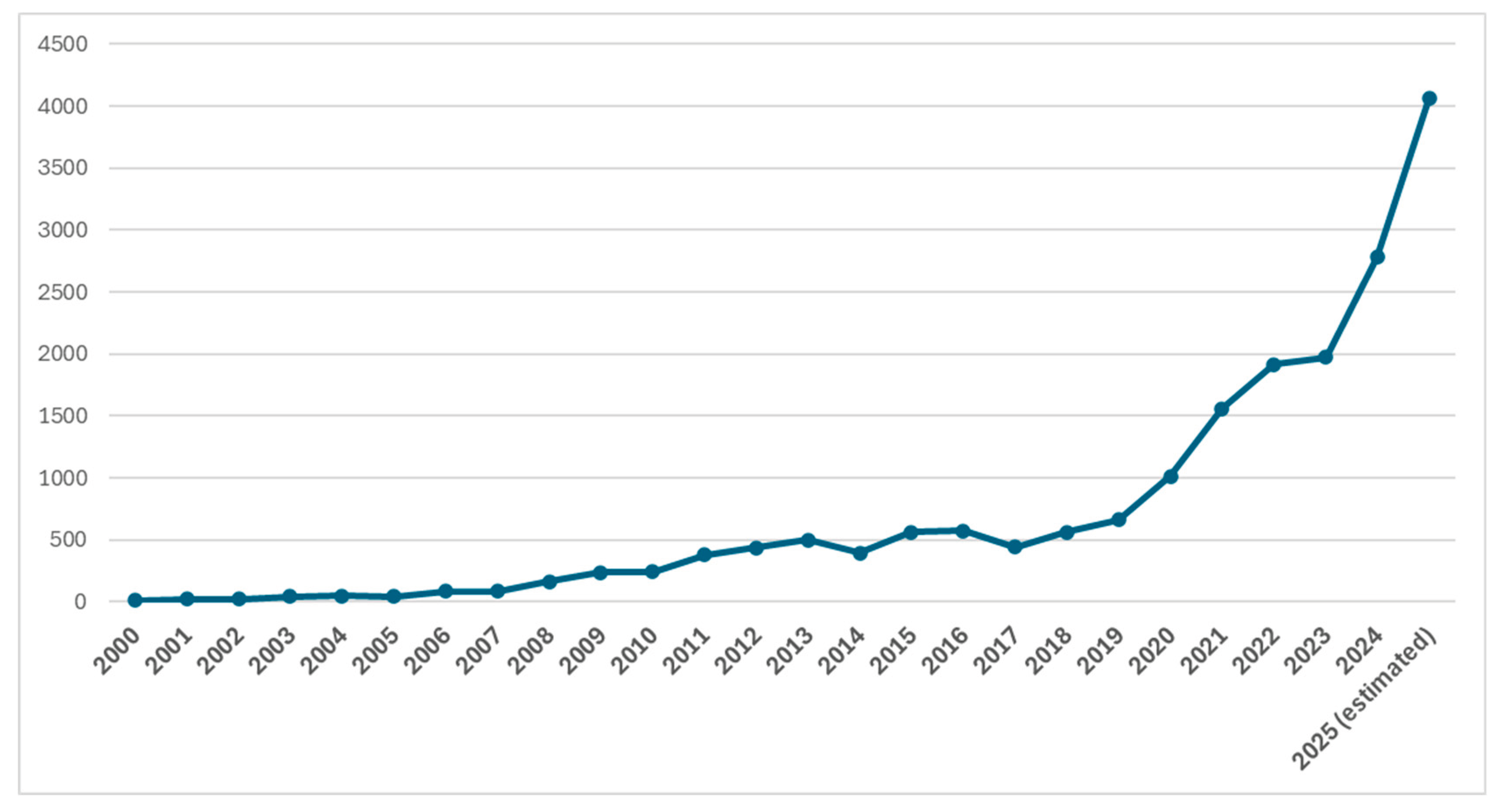
Figure 2.
Schematic representation for the main reasons of non-ethical scientific data manipulation (problems and solutions).
Figure 2.
Schematic representation for the main reasons of non-ethical scientific data manipulation (problems and solutions).
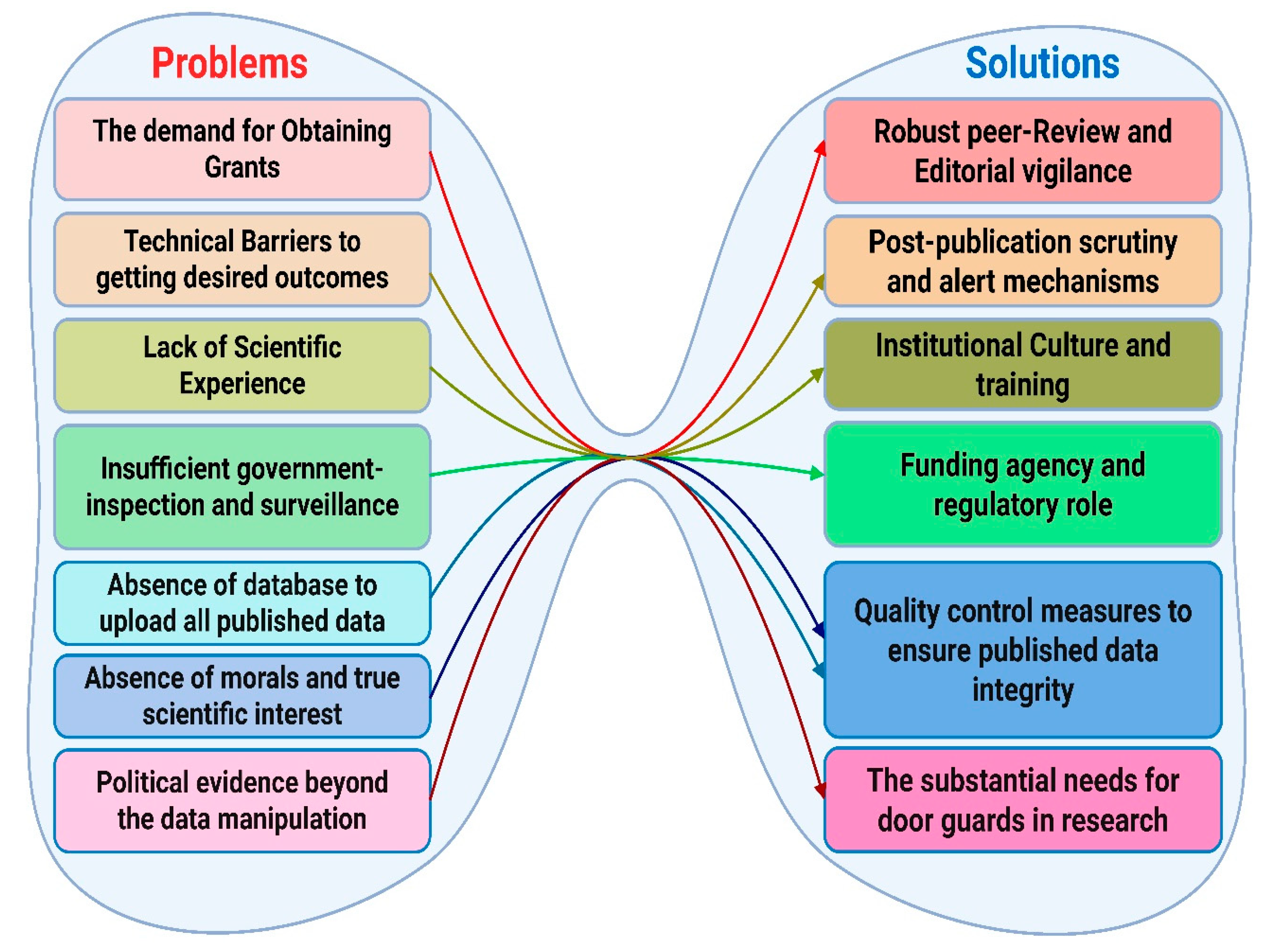

Table 1.
NCBI annual number of Retractions.
| Year | Number of Retractions | Progress |
|---|---|---|
| 2000 | 11 | Beginning of digital indexing; low detection/reporting |
| 2001 | 19 | |
| 2002 | 22 | |
| 2003 | 45 | |
| 2004 | 46 | |
| 2005 | 42 | Increased awareness, more journals adopting retraction policies |
| 2006 | 86 | |
| 2007 | 83 | |
| 2008 | 165 | |
| 2009 | 235 | |
| 2010 | 241 | Surge due to misconduct cases (e.g., Stapel, Boldt) |
| 2011 | 379 | |
| 2012 | 437 | |
| 2013 | 497 | |
| 2014 | 396 | |
| 2015 | 561 | Retraction Watch gains visibility; journal standards improving |
| 2016 | 571 | |
| 2017 | 442 | |
| 2018 | 564 | |
| 2019 | 661 | More active journal corrections and scrutiny |
| 2020 | 1015 | COVID-19 pandemic led to rapid publications and scrutiny |
| 2021 | 1556 | Highest yearly retraction rate, many COVID-19 related |
| 2022 | 1916 | Continued rise, automation and AI tools detecting fraud |
| 2023 | 1974 | Predatory journals, fake peer review, and data fabrication flagged |
| 2024 | 2778 | |
| 2025 (estimated) | 4058 | The rise of artificial intelligence |
Disclaimer/Publisher’s Note: The statements, opinions and data contained in all publications are solely those of the individual author(s) and contributor(s) and not of MDPI and/or the editor(s). MDPI and/or the editor(s) disclaim responsibility for any injury to people or property resulting from any ideas, methods, instructions or products referred to in the content. |
© 2025 by the authors. Licensee MDPI, Basel, Switzerland. This article is an open access article distributed under the terms and conditions of the Creative Commons Attribution (CC BY) license (http://creativecommons.org/licenses/by/4.0/).
Copyright: This open access article is published under a Creative Commons CC BY 4.0 license, which permit the free download, distribution, and reuse, provided that the author and preprint are cited in any reuse.