

Submitted:
05 December 2025
Posted:
08 December 2025
You are already at the latest version
Abstract
Although Palestine ratified the Convention on the Elimination of All Forms of Discrimination against Women (CEDAW) in 2014 without reservations, women’s participation in the labor force has stagnated over the past fifteen years, fluctu-ating between 16% and 20%. In light of the explicit commitments under Article 11 of the CEDAW regarding employment, it is essential to assess the extent to which these commitments are aligned with the national legal frameworks and institutional practices to recognize their role in achieving SDGs 5 (gender equality) and 8 (decent work). This study employs a mixed-method design, where quantitative findings reveal a widespread, albeit superficial, awareness of Article 11, with one-third of respondents reporting they did not attempt to review reliable sources to learn about it. In contrast, self-learned respondents showed significantly higher levels of knowledge. Qualitative results highlight the symbolic nature of reform, fragmented advocacy efforts, limited enforcement capacity, wage inequality, and the fragility of the private sector. Overall, the findings reveal a persistent gap between international commitments and domestic implementation. Strengthening legal rights, enforcement mechanisms, inter-institutional coordination, and civil society partnerships at the national level are essential to translating the normative commitments of CEDAW into tangible improvements in women’s employment outcomes and to promoting gender-responsive and sustainable reforms.
Keywords:
CEDAW
; Article 11
; women’s labour-force participation
; Palestine
; gender equality
; labour law
; sustainable development
; SDG5
; SDG8
; SDG17
1. Introduction
1.1. Context and Rationale
The United Nations affirms that human rights, including the right to work, apply to everyone without discrimination. Yet women remain one of the groups most exposed to exclusion and abuse worldwide. Keen to close that gap, 189 states (including Palestine in 2014) have ratified the Convention on the Elimination of All Forms of Discrimination against Women (CEDAW). Article 11 of CEDAW particularly obliges States Parties to guarantee equal employment opportunities, equal remuneration, maternity protection, and safe working conditions [1]. Nevertheless, Palestinian women constituted only 17.4 % of the labour force in Q3 2023, indicating that treaty ratification alone has not yet translated into substantive labour-market change [2].
1.2. Literature Gap
International studies show that CEDAW can improve political and health outcomes for women, but much less is known about its effect on employment, especially in conflict-affected contexts like Palestine. Existing studies rarely integrate (i) post-ratification legal harmonization, (ii) women’s own awareness of Article 11, and (iii) the moderating role of NGOs and civil-society mobilization. This research tackles those gaps.Recent studies emphasize that the CEDAW can influence women's social, economic, and political outcomes; however, evidence regarding its impact on employment is still insufficient. Gahagan and Christopher found that ratifications of human rights treaties, such as CEDAW, are correlated with increases in women's participation in formal employment; however, empirical studies examining employment outcomes and post-ratification dynamics are limited [3].
Global evaluations of legal harmonization and gender equality initiatives demonstrate that the outcomes of women's empowerment are contingent upon legal awareness, implementation capacity, and the mobilization of NGOs and civil society participants. Nevertheless, limited research amalgamates (a) the harmonization of labor laws post-ratification, (b) women's awareness of Article 11 of CEDAW, and (c) the moderating influence of NGOs and civil-society mobilization within the employment sector. This study addresses these blind spots in the context of Palestine's implementation of CEDAW [13,14].
1.3. Research Objectives
This study explores the relationship between ratification of CEDAW and women’s participation in the Palestinian labour market by focusing on the legislative development, awareness, role of NGOs, and bottlenecks in the implementation of CEDAW by:
- Examining the impact of CEDAW ratification on government action regarding women’s employment by comparing labour-market conditions for women before and after ratification, focusing on formal employment opportunities.
- Evaluating the legal and legislative measures adopted since 2014 to harmonise Palestinian labour laws with CEDAW, and determining how far enacted reforms align with Article 11 obligations.
- Assessing women’s awareness of CEDAW, especially Article 11, and its moderating effect on the link between ratification and government action.
- Analysing the role of NGOs and civil society organisations in promoting CEDAW implementation.
1.4. Link to the Sustainable Development Goals
By examining how treaty commitments are translated into practice, the study contributes directly to SDG 5.1 (ending all forms of discrimination against women), SDG 5.c (adopting and enforcing gender-equality legislation), and SDG 8.5 (achieving full and productive employment and equal pay for work of equal value), while also addressing SDG 17.17 through its analysis of the partnership roles of NGOs and civil society in monitoring CEDAW implementation. Framing the inquiry within these interlinked goals highlights the institutional levers, such as legal definitions, labour inspections, and workplace learning, that can transform treaty obligations into measurable progress on gender equality and decent work.
1.5. Research Questions
- To what extent have legal and legislative measures in Palestine changed since the ratification of CEDAW to support gender equality in employment, and how do these reforms align with Article 11 of the Convention?
- How does women’s awareness of CEDAW influence their participation in the labour market and their advocacy for employment rights?
- What role do NGOs and civil society organizations play in promoting awareness and supporting the implementation of CEDAW in the Palestinian labour market context?
- How can the findings inform policy interventions to enhance women’s participation and ensure compliance with CEDAW commitments?
1.6. Literature Review
Upon CEDAW Ratification, the Convention made it legally necessary for states parties to take institutional, administrative, and legislative steps to eliminate all kinds of discrimination and ensure that everyone has equal rights in many areas, such as the workplace [1,5].
In the Palestinian case, ratification of CEDAW coincides with national reforms designed to align labor laws with international standards; however, ratification faces implementation challenges due to political instability, legal pluralism, and deeply entrenched gender norms.
The positive contribution of CEDAW ratification and application has been shown in several studies. For example, Gahagan looked into whether human rights treaties have an effect on the economy and found that CEDAW had a significant effect on women's health and political outcomes. In economic life, Gahagan also shows that the ratification of CEDAW reduces informal economic activity by reducing barriers to women in the formal sector. This change not only promotes economic inclusion but also aligns with broader sustainable development goals such as legal empowerment and poverty reduction [3].
Comstock examines the proactive role of NGOs in leveraging CEDAW before formal ratification. It demonstrates that NGOs play a vital role in initiating legal action, raising awareness, and reporting to international bodies that, in turn, pressure states to reform their domestic frameworks.
In Palestine, civil society organizations have played a leading role in monitoring compliance and raising awareness among women of their rights under Article 11, which addresses workplace protection. Using CEDAW as a case study, Comstock's findings provide strong evidence that ratification of CEDAW plays a significant role in reducing the informal economy by removing legal barriers to women's formal employment, leading to significant positive economic and social outcomes. However, the lack of gender-disaggregated data on the informal economy and the inherent complexities of ratification and implementation point to areas for future research aimed at improving our understanding of CEDAW's impact on women's economic outcomes [6].
Numerous studies have examined the influence of CEDAW on women's rights outcomes at the local level, highlighting the treaty's ability to encourage local activism as a means of ensuring compliance. In her master's thesis at the University of Oklahoma, MORENO conducted a cross-border analysis (1975–2021) and found that ratification of CEDAW often galvanizes women's mobilization, which in turn contributes to improving their political, social, and economic rights. The study supports a two-step compliance model, where international legal obligations encourage local changes through the active participation of civil society [7].
However, while mobilization is closely linked to rights gains, the combined effect of ratification and activism did not produce a multiplier effect, suggesting that treaty success depends largely on internal political and social dynamics, not ratification alone. In this study, Moreno underscores the significance of enduring local engagement and robust democratic institutions in the translation of international standards to effective rights protection.
There aren't many studies on Palestine. Hattab and Abualrob offer a comprehensive examination of the debates regarding the implementation of CEDAW in Palestine, focusing on the disputes related to underage marriage and economic inequality. They show how patriarchal traditions, religious interpretations, and political hesitation continue to constrain the translation of international commitments into enforceable legal protections for women, while also emphasizing the potential of progressive Islamic scholarship and feminist advocacy to promote gradual reform [8].
1.7. International Comparison and Sustainability Linkages
Although the ratification of CEDAW signifies a significant normative commitment to gender equality, it does not inherently lead to equitable labour market outcomes. Data from the World Bank Gender Data Portal (2024) reveal that global female labour force participation remains markedly lower than that of males (47 percent compared to 69 percent). Also, the gender pay gap is still there, with women earning about 77 cents for every dollar men earn. In many developing countries, women are more likely than men to work in informal and unsafe jobs, while they often don't have access to social protection or decent working conditions. Although significant advancements have been made in educational attainment and formal labor market participation, women's economic empowerment continues to be constrained by enduring structural inequalities, such as occupational segregation, wage disparities, and the disproportionate burden of unpaid care work.[4].
These global dynamics differ across national contexts, shaped by variations in institutional capacity, socio-cultural norms, and the efficacy of policy enforcement. In Latin America and the Caribbean, for instance, although women's participation in education has exceeded that of men, and participation in the labour market has increased, women are still highly disadvantaged by the persistence of wage differentials, prevalence in informal jobs, and disproportionate burdens of unpaid household care [9].In Palestine, such overlapping challenges are further exacerbated by ongoing political and economic instability, underscoring the need to critically evaluate the impact of CEDAW’s ratification on women’s participation in the labor market within this uniquely complex environment. The ratification of CEDAW, however, has been linked with positive developments towards gender equality in the labour market, but the experiences vary by country. For instance, CEDAW ratification in Central and Southern America is positively connected with favorable gender labour and health outcomes but depends on ratification date, legal reservations, and institutional compliance [10]. Ruwaida focuses on migrants from West Africa, asserting that protection under the CEDAW strengthens political dialogue, but implementation deficiencies hinder it. [11] In Southeast Asia, Sinha found that although CEDAW has been shown to promote integration of labour in the formal sector, informal and insecure work continues to remain pervasive, indicating the need for reforms in labour to encompass security for informal labour for sustainable development outcomes [12]. Pruitt also stresses the treaty's possibilities for rural women, typically neglected in both scholarship and policy-making. It directly applies to Palestine's rural workforce, in which structural disadvantages are exacerbated by limited legal knowledge and socio-economic marginality [13]. However, previous studies have only briefly addressed the impact of CEDAW on economic outcomes, perhaps focusing particularly on women's participation in the informal economy. They have largely overlooked the Convention's impact on employment and women's participation in the labor market. These insights underscore that sustainability in labour rights reform depends not only on legal commitments but on governance capacity and social accountability structures that vary from country to country.
1.8. Implications for Palestine and Sustainable Labour Policy
Together, these results support a key lesson: CEDAW ratification is a necessary but incomplete step toward lasting gender equality in the labour market. Legal harmonization is not enough, and must be complemented by institutional accountability, focused education, and effective civil society participation. In the case of Palestine, this implies converting treaty commitments into legally enforceable policies while mainstreaming awareness and mobilization, particularly for marginalized populations. This study advances the literature by moving beyond ratification-status comparisons to examine how CEDAW Article 11 is operationalized through statutory definitions, executive regulations, and enforcement capacity in Palestine. While prior regional work has centered on normative commitments and high-level indicators in countries such as Jordan, Tunisia, and Morocco, this study contributes a mixed-methods approach that links awareness pathways and enforcement mechanisms to observed labor-market outcomes.
1.9. Conceptual Framework: Factors of Change After CEDAW Ratification
This study suggests that the effects of CEDAW ratification traverse four interconnected pathways, linking international commitments to tangible changes in women's lives. Studies cited in references [3,6,7] indicate that the translation of human rights treaties into practical equality relies not solely on formal ratification but also on the manner in which societies accept and implement them. Overall, progress depends on (a) women’s awareness of their rights, (b) the existence of legal protection, (c) the participation of civil society, and (d) the labor market’s response to changes that promote gender equality [3,6,7].
As illustrated in Figure 1, these factors together form the analytical framework that guides this research. The place where women's empowerment begins, and which represents the basis for exercising their rights to participate, is their awareness of their rights [6,7]. Legal measures indicate how the principles of the CEDAW are reflected in national laws, implementing regulations, and enforcement systems [1,4]. At the same time, the role of NGOs exemplifies the vital work of civil society organizations in advocating for, educating, and holding institutions accountable [6,14]. Under similar institutional, social, and economic conditions, Prigge and Thyen, in their article "Economic Empowerment of Rural Women in the Maghreb," published in April of this year, highlighted how structural constraints such as limited access to formal employment, inadequate social protection systems, and the dominance of informal work affect women's economic opportunities across the region. This discussion provides a useful conceptual perspective for examining similar labor market challenges in Palestine, where efforts are ongoing to align national frameworks with Article 11 of the CEDAW. [15]
Lastly, labour-market conditions encompass the structural shifts that follow ratification, such as reduced informality, improved access to decent work, and narrowing gender gaps. [3,10,11,12,13]. These four factors together allow us to understand how the universal principles of the CEDAW Convention are incorporated into the Palestinian context. This framework bridges the gap between international theory and the realities faced by women in the labor market, paving the way for subsequent analysis.
2. Materials and Methods
2.1. Research Design
The study follows a convergent mixed-methods design that integrates a quantitative survey with a qualitative ethnographic strand to explain how Palestine’s ratification of CEDAW, particularly Article 11, has affected women’s labour-market participation and legal environments. The two strands are implemented in parallel, analysed separately, and merged through joint displays to offer complementary insight into awareness levels, legislative change, and stakeholder experience.
Ethical approval was granted by the GAU Social Sciences Ethics Committee (Ref. SBEK 2024-25.009, 20 Jan 2025); electronic consent was obtained, and data were securely encrypted to ensure confidentiality.
2.2. Quantitative Component
A structured online questionnaire was developed to capture the awareness of working women in Palestine as an exploratory data source; its sole purpose was to guide and contextualize the study’s qualitative strand. After expert review (statistician, gender specialist, survey-design expert) and a 15-responder pilot, the instrument was finalized with forced-response logic.
The survey includes five questions on general awareness of CEDAW and several yes/no items on Article 11 knowledge, perceived impact, familiarity with labour laws, and major employment barriers, as well as the main factors affecting women's participation in the labour market.
Targeting women aged 15 and above who are economically active, working, and employed in the labour market in the West Bank,
A stratified random sampling technique was used: Stratum (A): public sector workers under the Civil Service Law (n=259); Stratum (B): women in private, NGO, and community sectors under the Labour Law (n=270).
Using Cochran’s finite-population formula (N=7,522; p=0.50; 95% CI; ±5% error), a minimum of 368 cases was determined; oversampling resulted in 529 valid responses collected in June-July 2025. Survey sample size (N = 529) exceeds the conventional minimum derived from Cochran’s formula for large populations (n0 ≈ 384). The achieved sample, therefore, offers adequate precision, and the analysis reports effect sizes alongside p-values to aid interpretation.
Data was exported to IBM SPSS v27, chosen over other statistical packages because it is one of the most used statistical analysis software by social scientists all over the world. [16] Data analysis involved descriptive statistics, Pearson’s χ² (with trend), one-way ANOVA, and binary logistic regression to examine how age, education, experience, and law type predict knowledge of Article 11 and perceptions of barriers. Before analysis, statistical assumptions were checked, including normality (Shapiro–Wilk test), homogeneity of variances (Levene’s test), expected cell counts, and multicollinearity; all assumptions were satisfied.
2.3. Qualitative Component
Four groups of qualitative data were analyzed:
- (i).
- eight key-informant interviews (a. three senior government officials, and b. five civil-society/union leaders),
- (ii).
- 529 open-ended survey narratives submitted by working women as a part of the survey questionnaire,
- (iii).
- paired State and shadow reports on CEDAW implementation (2016-2024), and
- (iv).
- a legal-alignment matrix that compares Palestinian labour statutes with Article 11 obligations.
The study’s qualitative component employed a hybrid (deductive-inductive) thematic design, using the MAXQDA 2024 program, which was chosen over other qualitative software because it combines flexible coding tools with powerful visualization options (such as code matrices, maps, and document portraits) that make it easier to identify patterns and relationships in the data. Compared with more code-intensive or less specialized programs, MAXQDA offers an intuitive interface, supports multiple data types (interviews, focus groups, documents), and provides integrated tools for summaries and memo-writing, which streamlines the entire workflow from raw text to structured, reportable findings. [17]
Data was organized according to the four data groups clarified in Table 1.
Qualitative Sampling and Trustworthiness: Eight semi-structured interviews were purposively selected to reflect government, trade union, and civil society roles in Article 11 implementation. Data sufficiency was assessed through iterative memos and code-matrix checks; no new themes emerged after the final two interviews, indicating saturation for the study’s scope. Trustworthiness was supported by an audit trail (codebook, memos, quotes) and triangulation across actor types.
2.3.1. Hybrid Thematic Design and Analytic Workflow
The qualitative strand followed a hybrid thematic design in MAXQDA. Seven primary themes, mentioned below, were established deductively from the research questions. During coding, the data themselves generated a complementary set of secondary themes. All the mentioned themes were divided into 64 subthemes (codes).
This deductive inductive hierarchy allowed for the capture of both the predetermined analytical focus and the nuanced issues that surfaced organically in interviews, open-ended survey responses, and document reviews.
2.3.2. Core Qualitative Themes (Derived from the Hybrid Thematic Analysis)
Twelve themes constitute the analytic spine of the qualitative strand; each is later linked to complementary survey patterns in the mixed-methods joint display, which are analytical “drill-down” codes that enrich primary themes; they are not reported as stand-alone results but deepen interpretation during cross-theme comparisons and mixed-methods integration as follows:
Primary Themes
- Legislative Adaptation & Reform: tracks the extent, pace, and content of post-2014 legal amendments, highlighting partial alignment and persistent legislative gaps.
- Institutional Roles: maps the division of labour among government ministries, trade unions, NGOs, and international agencies in advancing or stalling CEDAW implementation.
- Barriers to Compliance: captures socio-cultural, workplace, and legal-administrative obstacles (patriarchal norms, weak inspections, wage-gap incentives, childcare deficits).
- CEDAW Impact on Participation: collates perceptions of whether ratification has changed women’s access to, retention in, and progression within the labour market.
- Private-Sector Role & Commitment: examines employer attitudes, cost concerns, and defensive hiring practices that shape Article 11 compliance outside the public sector.
- Awareness of Article 11: distinguishes symbolic recognition of CEDAW from substantive knowledge of specific employment rights and enforcement channels.
- Advocacy & Mobilisation: documents civil-society strategies (shadow reports, campaigns, coalitions) and the counter-pressures they face from conservative backlash.
Secondary Themes:
- 8.
- Cross-cutting/Policy Recommendations: aggregates practical reform proposals voiced by interviewees and the day-to-day realities that motivate those proposals.
- 9.
- Social & Economic Impacts of Women’s Employment: reflects narratives linking women’s paid work to household resilience, poverty reduction, and community wellbeing.
- 10.
- National Strategy to Eliminate Discrimination: captures calls for a unified, cross-sector plan that embeds CEDAW principles in all labour-related legislation.
- 11.
- Real-Life Personal Experience: first-person accounts of unequal pay, harassment, promotion ceilings, and childcare hurdles, grounding abstract themes in lived reality.
- 12.
- Misunderstanding of CEDAW: records instances of the Convention being framed as a foreign or anti-religious agenda, fuelling resistance and misinformation.
A 64-node codebook was derived deductively from the six research questions and Article 11 sub-clauses, then expanded inductively during pilot coding. Two coders independently applied the scheme to 15 % of the corpus, achieving inter-coder reliability of Scott’s π = 0.86 before proceeding with full coding.
2.4. Integration Strategy
After separate analyses, quantitative results (e.g., χ² on awareness by sector) are mapped onto research questions corresponding to the related qualitative themes (e.g., “Private-Sector Resistance”) in a joint display, allowing direct comparison of statistical patterns with narrative explanations. Convergence, complementarity, and divergence are documented in integrative memos that feed into the Discussion section.
2.5. Ethical Considerations
All participants will give informed consent; anonymity codes replace personal identifiers in transcripts and datasets. Government and NGO stakeholders review summary findings for accuracy before publication.
2.6. Limitations
Access to certain governmental documents or officials may be restricted for political reasons, and cultural norms could influence candidness in interviews. Reliance on self-reported awareness carries the risk of social-desirability bias; triangulation with multiple data sources mitigates, though does not eliminate, this limitation.
3. Results
3.1. Quantitative Findings
All statistics below are drawn from the study dataset and administrative series compiled for this paper; full descriptive tables and SPSS outputs are available in the supplementary materials.
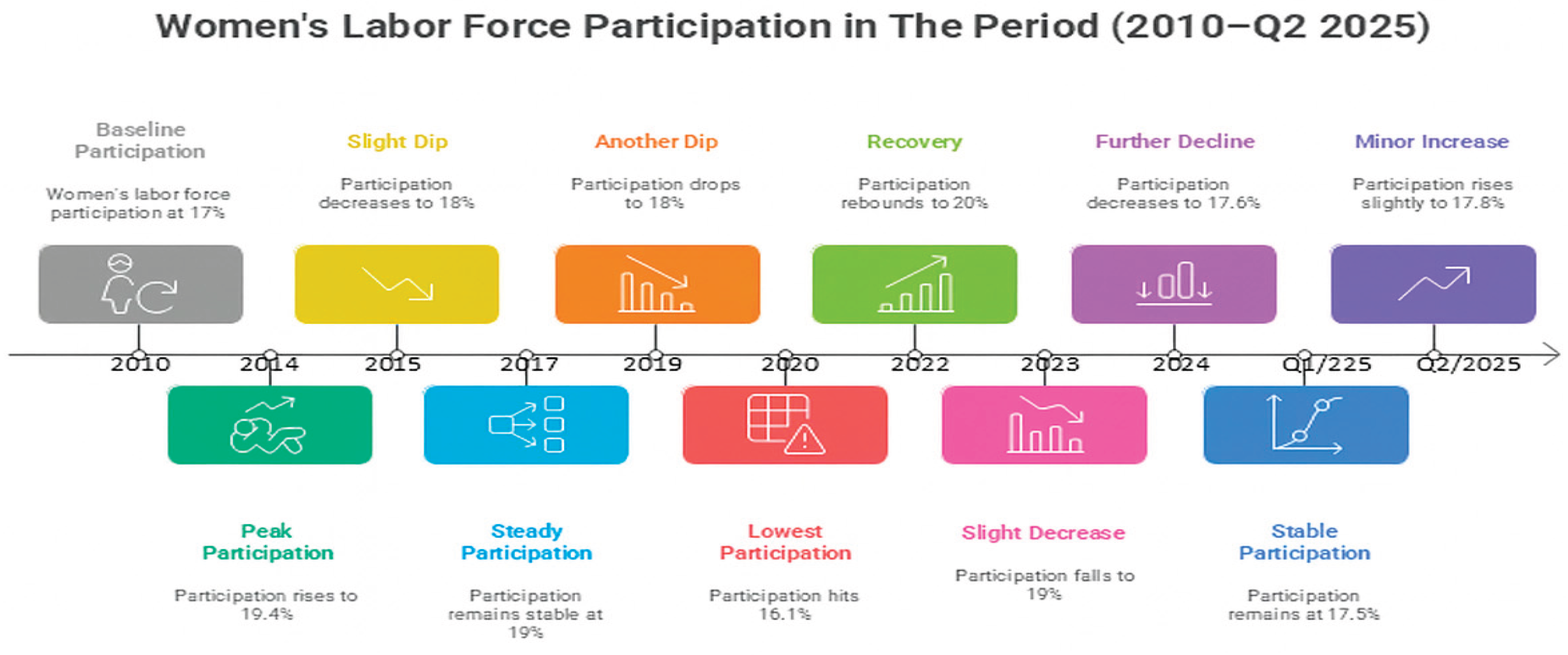
- First bullet; Female labour force participation (2010–mid-2025).
Administrative series show that women’s labour force participation in Palestine has remained confined to a narrow 16–20% band over the last fifteen years. It rose from 17% in 2010 to a local peak of 19.4% in 2014, dipped to 16.1% in 2020 during the pandemic, briefly reached 20% in 2022, then eased to ~19% in 2023 and 17.5–17.8% in the first two quarters of 2025. The pattern reflects cyclical bumps rather than a sustained upward trajectory. (Source PCBS)
Figure 2.
Women’s Labour Force Participation (%), [2].
Figure 2.
Women’s Labour Force Participation (%), [2].
- Second bullet; Awareness and knowledge of CEDAW Article 11 (N = 529).
Among 529 respondents, awareness of CEDAW Article 11 was broad yet shallow: about two-thirds had heard of it, one-third had consulted an authoritative source, and fewer than 10 percent understood its implementation in Palestine. Civil society outreach was limited (≈ 17%). Consulting a reliable source was positively correlated with knowledge of Article 11 (r = .54, p < .001) and with NGO outreach (r = .30, p < .001), whereas name recognition showed weaker associations (r = .26). Logistic regression indicated that education and exposure to NGO activities significantly predicted informed awareness, followed by professional experience. These results suggest that awareness deepens mainly among individuals who actively seek information or engage with institutional or civil-society initiatives.
- Third bullet; Perceived labour market barriers.
As shown in Figure 3, four obstacles dominate respondents’ selections: wage inequality (48%), insufficient childcare/family-friendly policies (41%), gender discrimination in hiring/promotion (38%), and sexual harassment/hostile workplaces (9%), with a further 8% citing transport, family pressure, or other hurdles. These frequencies establish a clear profile of impediments that Article 11 is intended to address (equal pay, non-discrimination, safe workplaces, and care support).
- Fourth bullet; Age gradients in awareness.
Chi-square tests for linear trend indicate a generational pattern. The likelihood of having at least heard of CEDAW increases with age (χ²(1, N = 529) = 8.19, p = .004), whereas the probability of having consulted a reliable source declines among older cohorts (χ²(1) = 11.01, p = .001). Similar negative trends appear for knowledge of Article 11 (χ²(1) = 8.08, p = .004) and for knowing about its implementation in Palestine (χ²(1) = 4.36, p = .037). Perceived effectiveness (p = .448) and beliefs about government alignment (p = .925) show no age-related pattern; civil society contact is marginal (p = .060). Together, the data point to greater actionable knowledge among younger women despite higher name recognition among older groups.
- Fifth bullet; Experience and education.
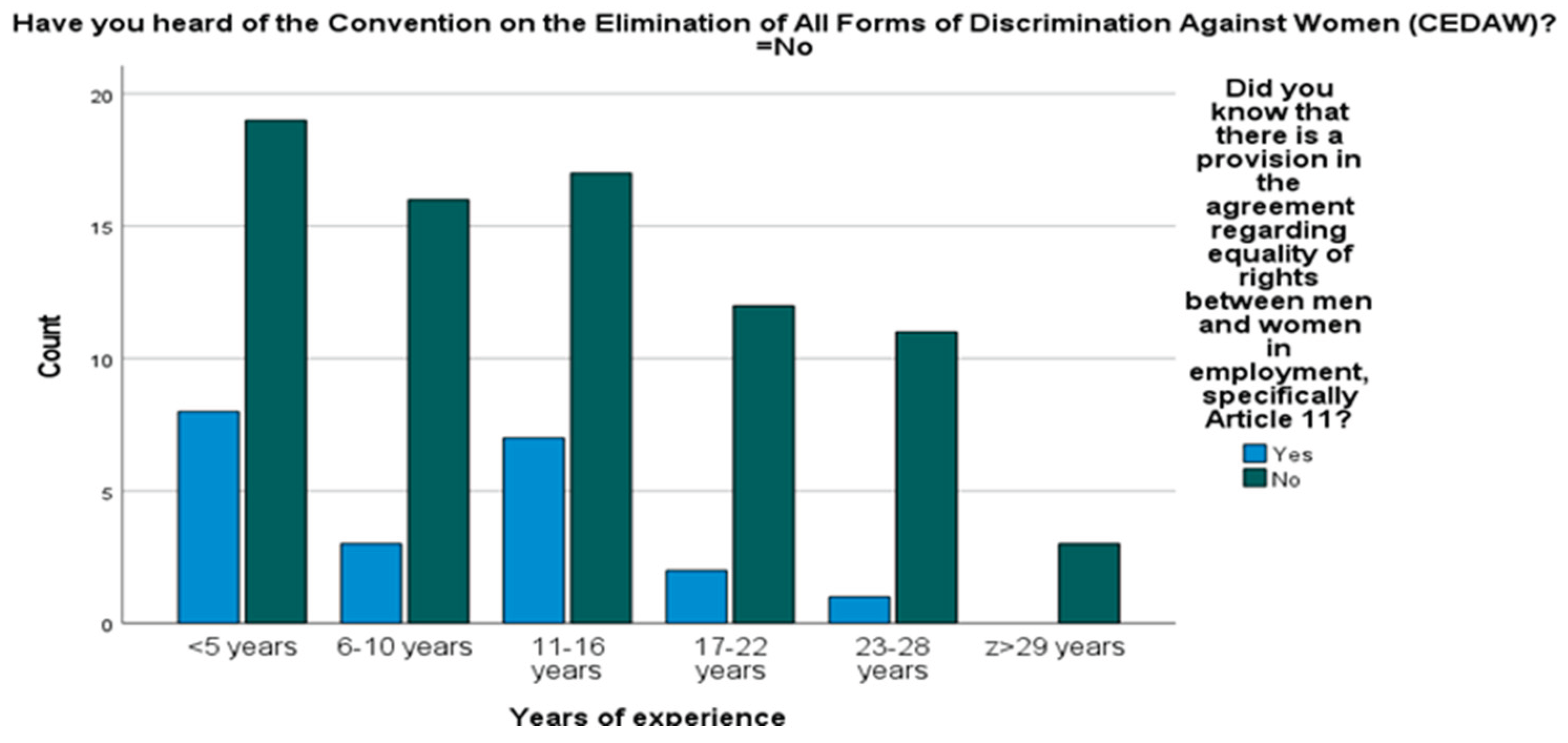
Knowledge of Article 11 does not differ sharply across experience bands overall (p = .39), but a modest negative linear trend is evident: longer tenure associates with lower recognition (linear by linear p ≈ .04; r = −.09).
Chart 1.
A comparison between women who heard about CEDAW and knew about Article 11, focusing on the differences found between different work experience groups.
Chart 1.
A comparison between women who heard about CEDAW and knew about Article 11, focusing on the differences found between different work experience groups.

Chart 2.
A comparison between women who did not hear about CEDAW and knew about Article 11, focusing on the differences found between different work experience groups.
Chart 2.
A comparison between women who did not hear about CEDAW and knew about Article 11, focusing on the differences found between different work experience groups.
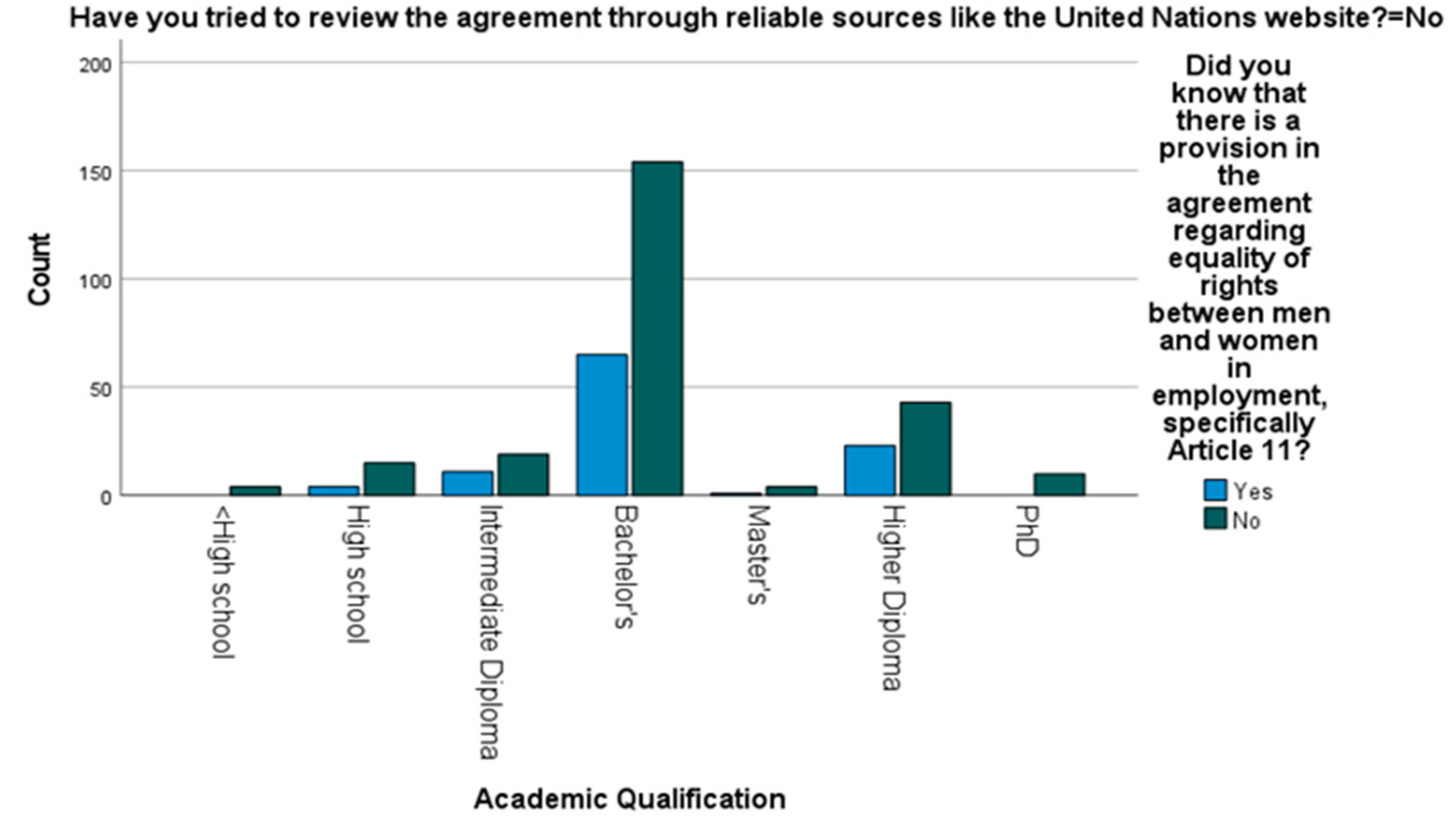
Academic qualification relates to awareness with a small-to-moderate effect (χ²(6, N = 529) = 15.13, p = .019, V = .17), and there is a strong educational gradient in the likelihood of consulting an authoritative source (linear trend χ² = 12.2, p < .001). Among those already aware of CEDAW, higher qualifications more often translate into self-initiated fact-finding (linear trend χ² = 9.5, p = .002).
Chart 3.
A comparison between women who heard about CEDAW and knew about Article 11, focusing on the differences found between different educational level groups.
Chart 3.
A comparison between women who heard about CEDAW and knew about Article 11, focusing on the differences found between different educational level groups.
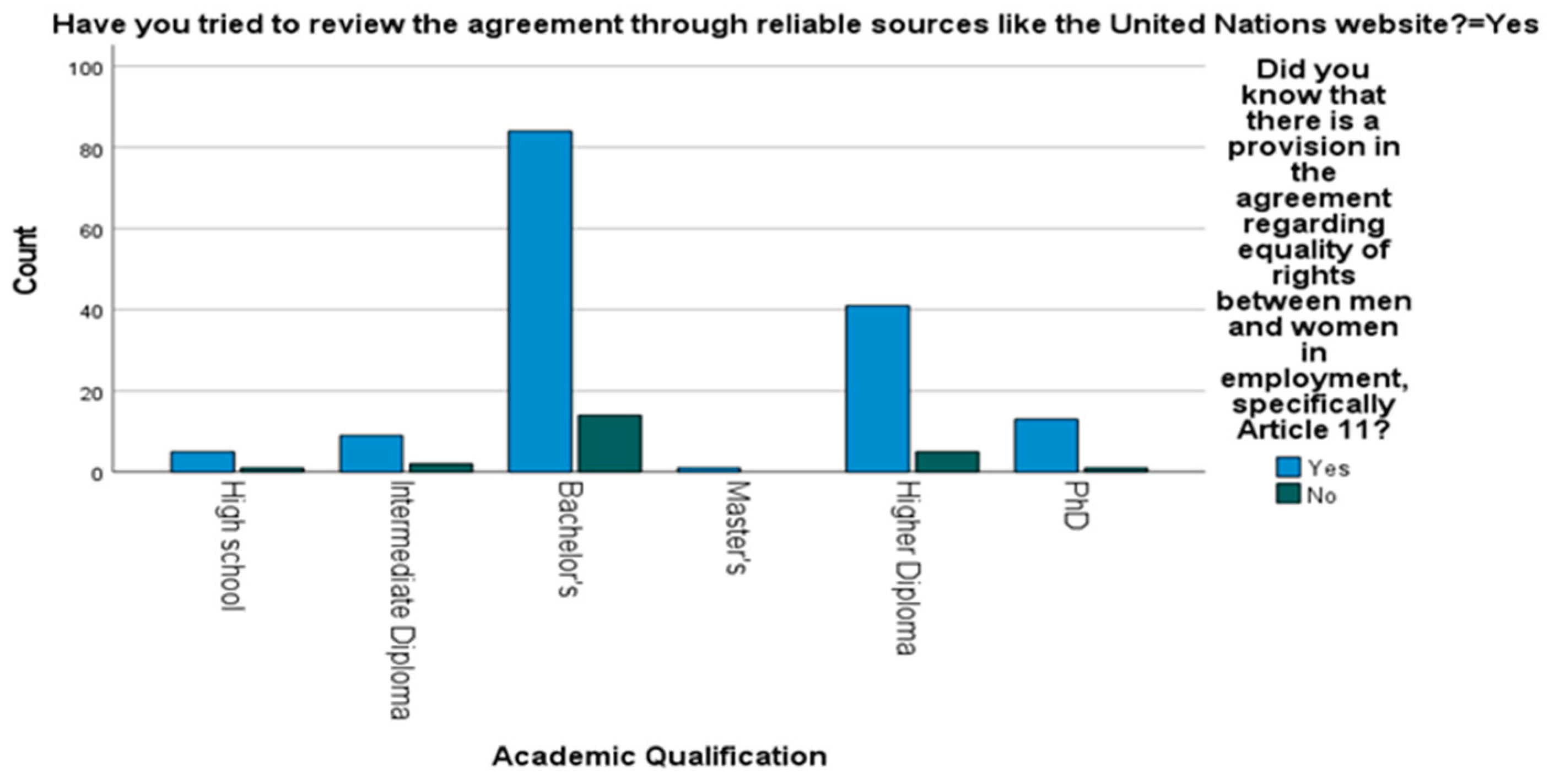
Chart 4.
A comparison between women who did not hear about CEDAW and knew about Article 11, focusing on the differences found between different educational level groups.
Chart 4.
A comparison between women who did not hear about CEDAW and knew about Article 11, focusing on the differences found between different educational level groups.
- Sixth bullet; Shifts in Article 11 Awareness.
As shown in Figure 4 below, it was found that higher age and higher formal education are associated with lower odds of knowing Article 11; experience and law coverage are not significant. The pattern suggests cohort effects whereby recent entrants, rather than senior or more highly educated workers, have benefited more from contemporary awareness efforts.
- Seventh bullet; Sectoral law coverage differences.
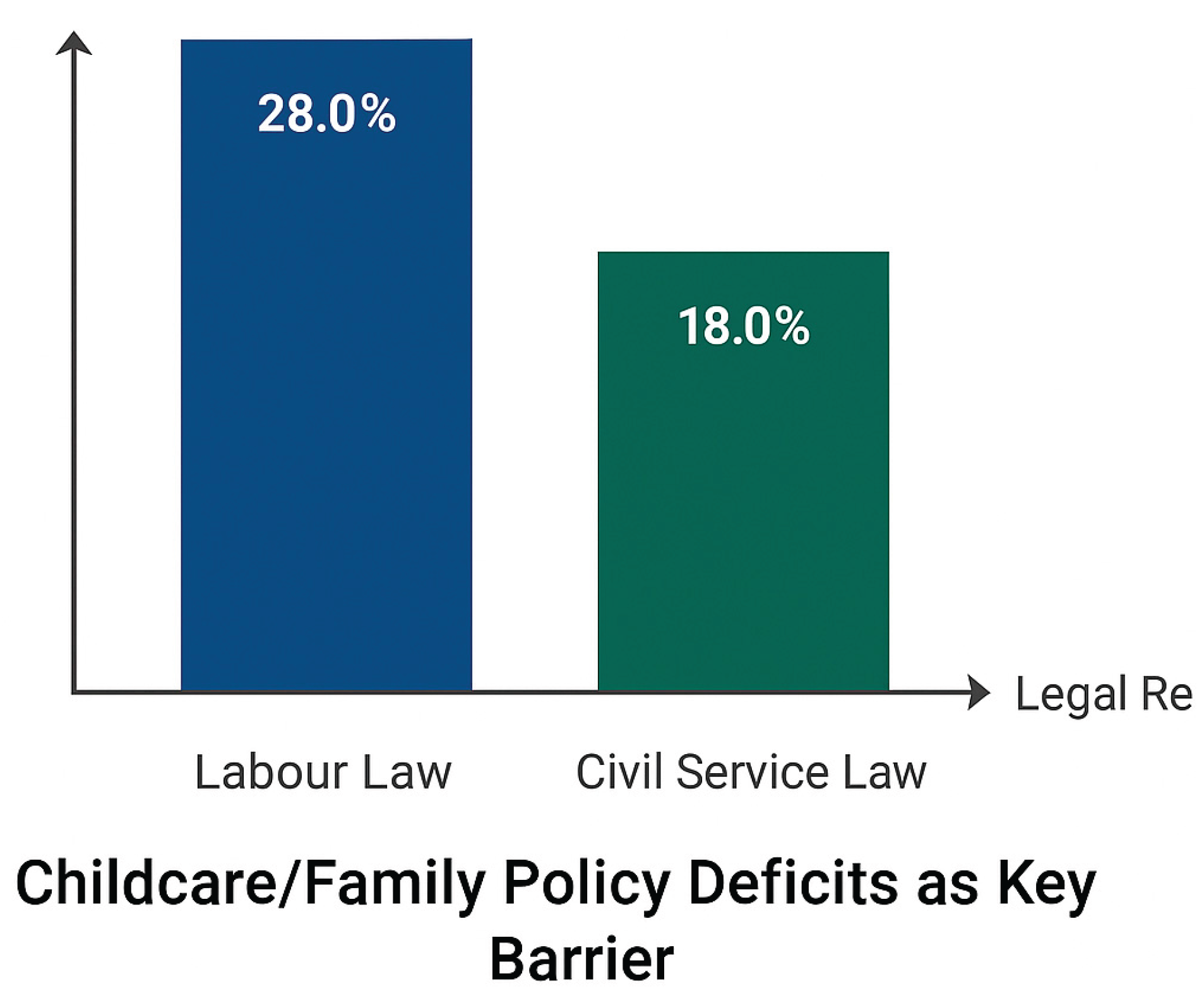
Knowledge of Article 11 does not differ by the legal regime governing employment (Civil Service Law vs. Labour Law; χ² ≈ 0.31, p ≈ .58). By contrast, women covered by the Labour Law are significantly more likely to select childcare/family-policy deficits as a key barrier than women under the Civil Service Law (28.0% vs. 18.0%; χ²(1, 529) = 6.35, p = .012, Φ = .11, OR = 0.64 [0.45, 0.91]).
Chart 5.
This chart shows Sectoral law coverage differences in awareness and perceived barriers.
- Eighth bullet; Perceived employer response and implementation challenges.
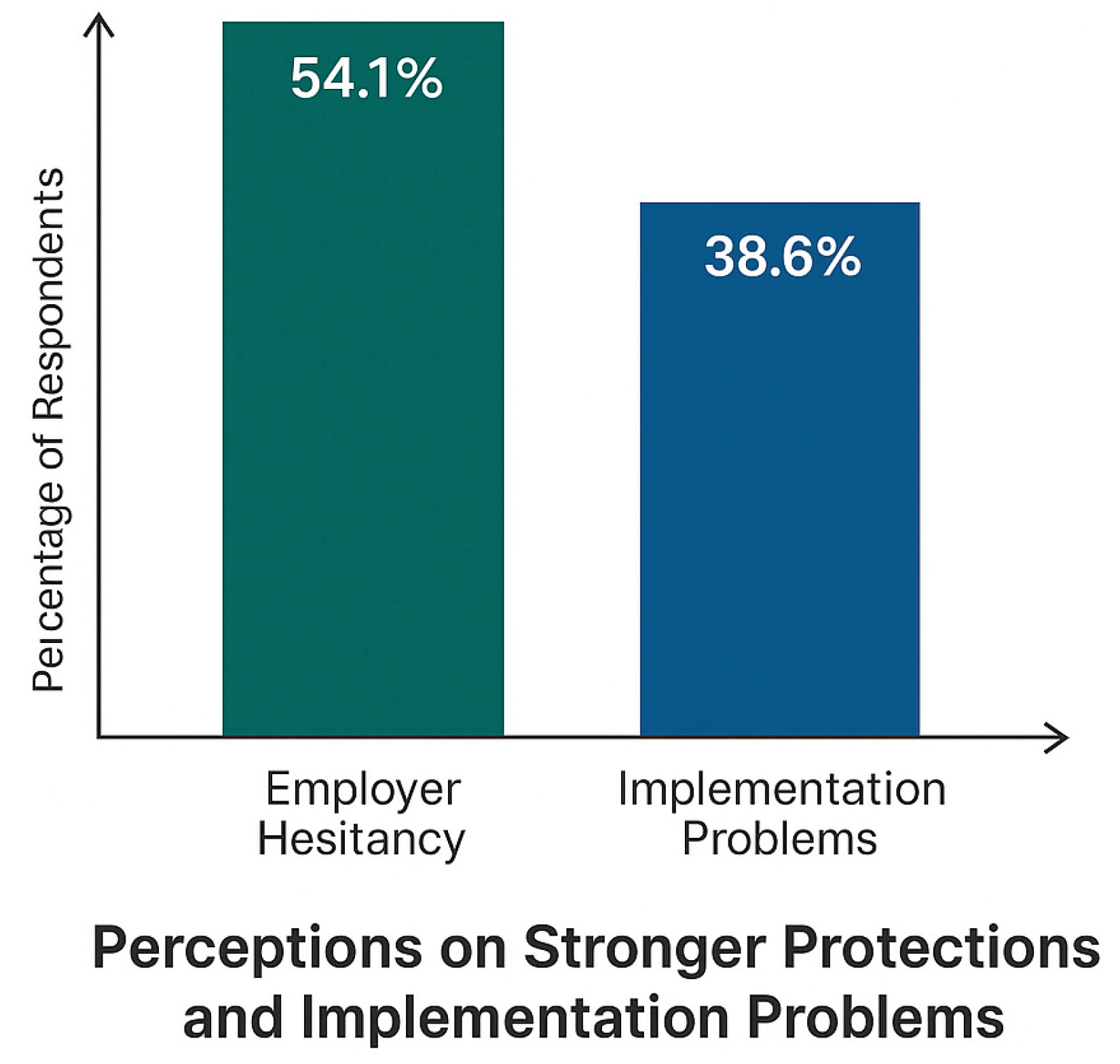
A slim majority (54.1%) believe stronger protections under Article 11 could make some employers more hesitant to hire women; this belief is unrelated to law coverage (χ²(1) = 0.25, p = .620). Meanwhile, 38.6% anticipate specific implementation problems in Palestine, also independent of coverage (χ²(1) = 2.66, p = .103).
Chart 6.
This chart shows the perceived employer responses and anticipated implementation challenges.
Chart 6.
This chart shows the perceived employer responses and anticipated implementation challenges.
- Ninth bullet; Knowledge confidence link.
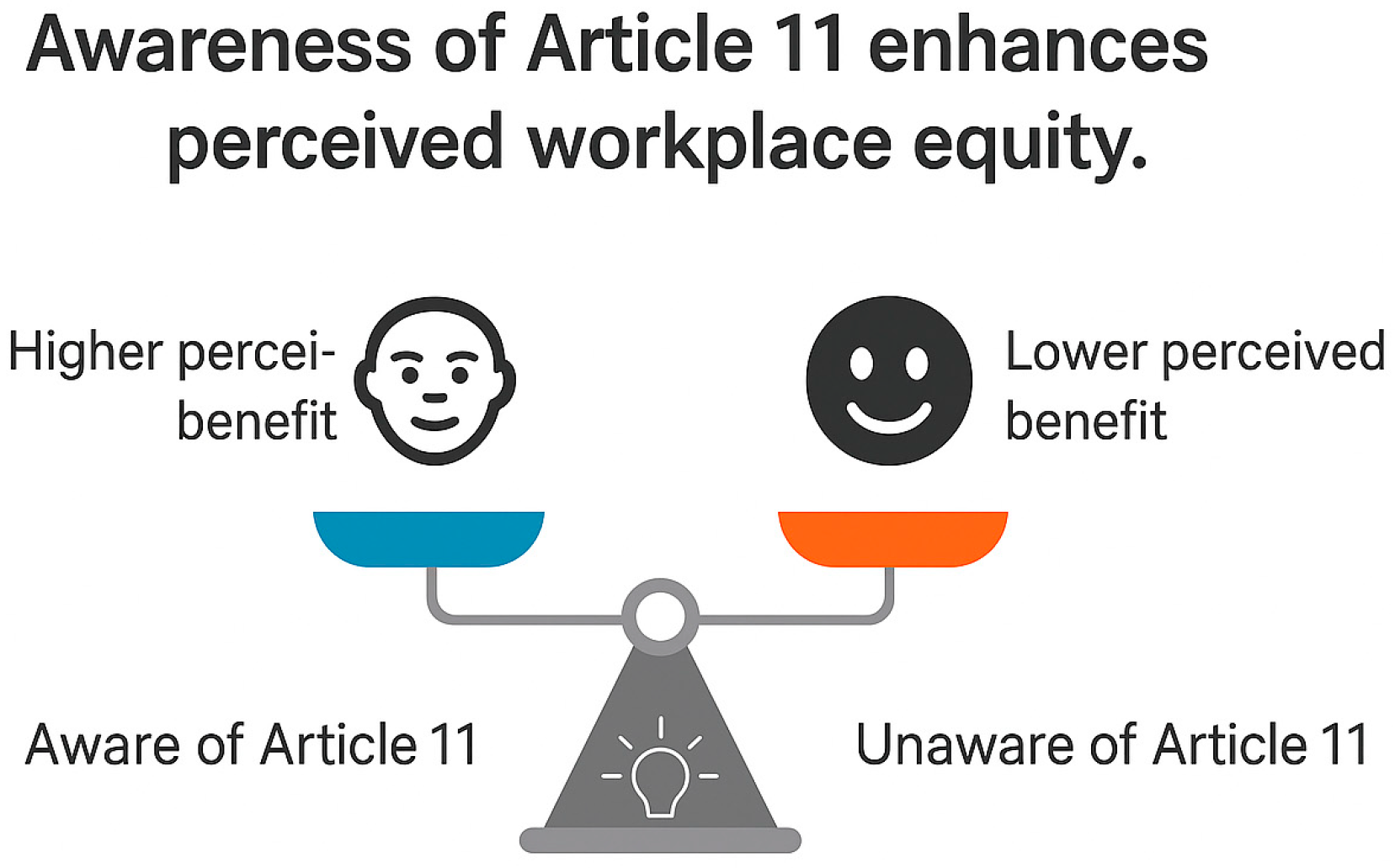
Figure 7 illustrates what a one-way ANOVA confirms that participants who know about Article 11 rate it as more helpful for improving workplace equity (M = 1.74, SD = 0.82) than those who do not (M = 1.47, SD = 0.89), F(1, 527) = 4.42, p = .036, η² = .008 (small effect).
Figure 4.
Influence of Awareness of Article 11 on enhancing the perception of workplace equity.
3.2. Qualitative Findings
Below is a drop-in the “Qualitative Main Findings” section, organised around the four research questions. Each part begins with the corresponding analytical theme generated through MAXQDA and grounded in the MAXQDA memos/tables. It keeps results tone (descriptive, mechanism-focused, no policy prescriptions yet) and uses short, anonymised quotes to illustrate patterns.
From five NGOs and civil-society organisations, and three with government ministries (e.g., labour and women's affairs, and justice). Interviews were conducted in Arabic, anonymised, and imported into MAXQDA 2024. A hybrid deductive–inductive coding frame anchored in CEDAW Article 11 and the SDG 5/8 indicator families guided coding, memo creation, and code-matrix checks. Given the small sample size, the qualitative strand targets analytic generalisation (mechanism-level explanation) rather than statistical generalisation; trustworthiness rests on the documented audit trail of codes, memos, and curated quotes drawn from the MAXQDA exports.
- First question; To what extent have legal and legislative measures in Palestine changed since the ratification of CEDAW to support gender equality in employment, and how do these reforms align with Article 11 of the Convention?
Related Themes: Legislative Adaptation & Reform; Institutional Roles; Barriers to Compliance; CEDAW Impact on Participation
The signing of the Convention was largely symbolic, not aimed at improving the situation of women, and resulted in only partial legal harmonization and the perpetuation of structural inequalities. Participants described the impact of the Convention on the Elimination of All Forms of Discrimination against Women as largely rhetorical, useful for setting agendas, but weak and insufficient in bringing about substantive improvements in women's daily working conditions. The Convention was not formally published in the Official Gazette, and no consolidated Labour Law amendments followed.
Periodic state reports were viewed as “cosmetic,” and implementation was limited.
“Despite signing CEDAW in 2014, we have not seen any amendments to the laws … nor any significant changes that impact women’s rights.” Human Rights and Democracy Media Center, SHAMS (General Manager).
“Palestine ratifies many agreements, including CEDAW, to showcase a civilised image, but lacks the capacity and political will to implement them.” GFTU (Board Member).
Some positive signals were noted, including the creation of gender units within ministries, quotas, gender content in inspector training, hotlines for complaints, pilot pay-equity committees, and extended maternity leave in the civil service.
50% of the beneficiaries of the Employment Fund's programs and projects go to women.” Ministry of Labour (Deputy Minister).
Still, many workers continue to face unstable contracts and informal work arrangements, and there isn’t enough support to make sure labor laws are properly enforced. Even though proposed laws mention equal pay and non-discrimination, the legal system still has major gaps. For instance, discrimination isn’t clearly defined, maternity provisions are inconsistent, and there are no enforceable rules to protect against harassment.. Progress on reforms has stalled because there’s no Legislative Council and the West Bank and Gaza are governed separately, so new initiatives haven’t moved beyond the drafting stage. As one official observed, “Inspectors apply the law as it is; therefore, the law must be amended before asking inspectors to apply new concepts.” Another added, “There is no national definition of discrimination in Palestine as of now.”
Participants agreed that alignment with Article 11 remains incomplete. Although a number of bylaws have been reviewed, “none reached the legal gazette,” according to a Ministry of Labour source. Key legal anchors are still missing anti-harassment provisions, unified childcare obligations, disability accommodation, and clear penalties. Beyond the legal framework, interviewees described persistent structural labour-market inequalities that pre- and post-date ratification. Women’s horizontal entry into feminised and lower-paid sectors has improved modestly, but vertical mobility, pay equity, and workplace safety continue to lag. Senior decision-making positions in both the public and private sectors remain dominated by men. A job seeker pointed out that even though the law has changed, employers still ask new female employees if they plan to get married. She feels that these legal protections haven’t really changed how employers think or behave.
In the public sector, standardized pay scales help reduce significant wage disparities, but barriers to women’s advancement to senior positions and continued professional segregation still remain. In contrast, the private sector exhibits even wider wage gaps, limited childcare support, and widespread job insecurity due to temporary contracts. “There is no respect for the minimum wage,” noted a workers' representative, while a Ministry of Women’s Affairs official added that “women are concentrated in service sectors that do not adhere to minimum wage regulations.”
Mechanisms of implementation remain weak. Labour inspections are understaffed (“52 inspectors for 160,000 establishments,” according to the Inspection Directorate), labour courts are slow and generalist, and social-security parity and leave rights are largely theoretical outside the civil service.
Cross-cutting barriers reinforce these patterns:
The government has most of the power when it comes to making rules, while unions and NGOs try to help with legal advice and training, but their efforts don’t reach enough people.
Many small and medium businesses feel that offering benefits like maternity leave, childcare, or conducting equal-pay audits is too expensive unless they get support or see faster ways to resolve disputes. As one employer put it, “If we increase maternity leave, we can’t stay competitive—this should be subsidized by the government.”
- Deep-rooted social norms, resistance based on religious views, and favoritism in hiring and promotions make it harder for women to advance or even to speak up about unfair treatment. These challenges often discourage women from filing complaints.
- Legal and procedural gaps: No comprehensive Anti-Discrimination Act; uneven maternity provisions; night-work restrictions that “protect” rather than enable; no specialised labour courts; and weak accommodation for women with disabilities. CEDAW serves primarily as leverage for reform-minded officials and civil-society actors, but this leverage is constrained by political bottlenecks, budget shortages, and fragile enforcement systems. The Convention’s influence thus remains symbolic intent signalled, but substantive alignment is incomplete. While participation by women in certain sectors has expanded horizontally, gaps in vertical mobility, pay equity, and workplace safety continue to undermine Article 11’s objectives, leaving most of its commitments aspirational rather than institutionalised.
- Second question; How does women’s awareness of CEDAW influence their participation in the labour market and their advocacy for employment rights?
Related Themes: Awareness of Article 11; Barriers to Compliance; Advocacy & Mobilisation.
Awareness is weak and not based on reliable information. Practical knowledge of Article 11 of the Convention is scarce, and workers' awareness of Article 11 is limited. Employers' awareness of Article 11 is almost non-existent. Public campaigns are sporadic and concentrated in Ramallah, where key ministries and active civil society organizations are located.
Quote: “I only heard about Article 11 at a union workshop last year." Government employee.
Quote: “Our awareness of CEDAW is more focused on political participation and issues of violence than on other topics.” Human Rights and Democracy Media Center, SHAMS (General Manager).
Quote: “The community was unable to distinguish between accurate information and false or distorted information.” Democracy & Workers’ Rights Center (Head of International Relations).
Anti-CEDAW rhetoric, initially directed by conservative representatives, portrayed the treaty as foreign, and government officials rarely responded with clear, value-based explanations and a principled defence of the Convention. Therefore, many managers consider CEDAW irrelevant.
Quote: “Managers consider CEDAW foreign; they ignore it." NGO trainer.
As knowledge deepens (through self-learning or guided communication), confidence in claiming rights increases. However, legal and procedural barriers (such as slow courts and weak inspections) still hinder behavior change. Therefore, awareness is necessary but insufficient in the absence of actionable remedies.
- Third question; Role of NGOs/civil society in promoting awareness and implementation
Related Themes: Advocacy & Mobilisation; Institutional Roles; Private-Sector Role & Commitment.
Energetic but fragmented advocacy moves norms more than law. CSOs and unions draft amendment papers, run legal-aid clinics/hot-lines, and file shadow reports; Advocacy efforts grounded in empirical evidence, such as campaigns highlighting gender pay gaps, tend to be more influential than those framed primarily in legal or technical terms.
Quote: “Petitions get traction when linked to wage-gap stats. Human Rights Activist.
Outreach is uneven (rural districts are underserved), coalitions are donor-driven, and despite stating otherwise, the state rarely treats CSOs as equal partners. NGO director.
Quote: “UN-Women projects rarely leave Ramallah; rural districts are invisible.” NGO director.
Quote: “The Ministry finds that the role of civil society organizations is essential in advocacy, pressure, and informing working women of their rights.” Ministry of Labour (Deputy Minister).
Quote: “Civil society is fragmented … the government does not consider civil society and unions as actual partners.” GFTU (Head of Women’s Unit).
Quote: The president and the government do not consider civil society a true partner and attempt to diminish its role. General Federation of Palestinian Trade Unions (Board Member & Head of Women’s Unit).
With a dormant legislature and shifting ministerial agendas, advocacy often stops at awareness; converting proposals into binding rules requires formalised consultation and legislative follow-through that are currently weak.
- Fourth Question; How can the findings inform policy interventions to enhance women’s participation and ensure compliance with CEDAW commitments?
Related Themes: All Themes Integrated.
The qualitative results showed that Palestine’s implementation of the Convention on the Elimination of All Forms of Discrimination against Women is merely a framework of symbolic commitment and not an effective mechanism for achieving gender equality in the workplace. Participants described the Convention's impact as mainly rhetorical within policy frameworks and institutional dialogue, yet hindered by stagnant legislative reform, restricted enforcement capacity, and enduring structural inequalities in the labor market. Factors that undermine women's access to equal and safe employment opportunities include fragmented laws, informal work patterns, and weak inspection systems.
The interview results provide multiple pragmatic avenues for converting these findings into actionable policy insights designed to reconcile the disparity between formal regulation and effective execution:
- The principles of equality and discrimination must be codified into the existing laws.
Participants frequently mentioned that the absence of a legal definition of discrimination, prohibitions against harassment, and clear restrictions regarding mothers and childcare hindered implementation. To make sure that national legislation follows the rules of Article 11, these legal foundations must be finalized.
- 2.
- Strengthening enforcement architecture.
Respondents across ministries, unions, and NGOs highlighted that labour inspections are severely understaffed and judicial procedures are slow. Establishing specialised labour courts and increasing inspector capacity were viewed as prerequisites for real enforcement
- 3.
- Strengthening coordination and the principle of accountability within institutions.
What has slowed progress in implementing the CEDAW principles is mainly due to the government having excessive power in setting rules, and the efforts of NGOs and trade unions being very scattered. Establishing coordination platforms between the government and civil society organizations would enhance coherence and oversight of commitments related to the Convention on the Elimination of All Forms of Discrimination against Women.
- 4.
- Private sector involvement is crucial.
Many employers fear the costs of providing maternity and childcare benefits, which may make them hesitant to hire women. Offering incentives, such as temporary subsidies or tax breaks, can alleviate these concerns and encourage companies to comply with the law without making it more difficult for women to find employment.
- 5.
- Addressing sociocultural resistance.
Interviewees repeatedly referred to patriarchal norms, wasta networks, and religiously framed objections as barriers to women’s mobility and complaint-making. Awareness campaigns and positive framing of CEDAW’s social and economic benefits could improve acceptance and reduce resistance.
- Integrative Summary
Across all four research questions, the seven primary themes converge on one diagnosis: CEDAW has embedded the language of equality but not yet its institutional reality. Partial legal alignment, uneven awareness, and fragmented enforcement continue to limit substantive progress toward gender-equal employment. Taken together, these results indicate that achieving the objectives of Article 11 requires a two-pronged approach: completing the legal framework to close definitional and procedural gaps, and activating enforcement interventions and social norms that translate rights from paper to practice. Strengthening the relationship between law, policy, and institutional accountability would allow the symbolic gains achieved through CEDAW ratification to evolve into tangible improvements in women’s participation, protection, and equality in the Palestinian labour market.
The qualitative interviews have shown that CEDAW operates more as a normative anchor than a fully enforced framework: it helps officials and advocates articulate goals (equal pay, non-discrimination, safe workplaces, childcare), but legislative gridlock, conceptual gaps in the statutes, and thin enforcement capacity keep many guarantees on paper only.
Awareness campaigns, while valuable, do not by themselves overcome employer cost calculations, patriarchal gatekeeping, or the absence of fast, affordable remedies. The qualitative evidence thus explains why progress appears sector-specific and uneven: public sector women encounter promotion ceilings despite standardised pay, while private sector women face wage gaps, care deficits, and precarious contracts. These mechanisms set up the next step of mixed methods integration by clarifying why several quantitative effects are small or non-significant and where targeted reforms could unlock CEDAW Article 11’s promise.
3.3. Mixed Methods Integration (Quantitative ↔ Qualitative)
The mixed-methods integration followed four steps. First, a joint display compared quantitative results with qualitative themes to show where they aligned or differed. Second, a narrative synthesis brought both strands together to explain the meaning behind the findings. Third, sensitivity checks tested whether the results were consistent across different groups and conditions. Finally, a brief integrated summary combined all the evidence into one clear takeaway that directly answered the research questions.
First: Joint Display (evidence cross-walk)

Table 2.
Mixed-Methods Joint Display.
| New Research Question | Key Quantitative Evidence | Matched Qualitative Evidence (Summarised) | Integrated Interpretation (What This Means) |
| RQ1. To what extent have legal and legislative measures in Palestine changed since the ratification of CEDAW to support gender equality in employment, and how do these reforms align with Article 11? | • Female LFP stagnant (16–20%) 2010–2025. • Weak perceptions of legal amendment (r ≈ .20–.22). • Childcare barrier is higher under Labour Law (28% vs 18%). • Knowledge not differing by legal regime (χ² ≈ 0.31). |
Implementation perceived as symbolic; no comprehensive amendments enacted; definitions of discrimination and harassment absent; enforcement under-resourced; public sector offers stable pay but promotion ceilings; private sector marked by wage gaps and job insecurity. | Normative change without structural lift. Ratification improved discourse and partial alignment “on paper,” but weak enforcement, fragmented governance, and informal labour practices prevent CEDAW Article 11 from translating into measurable participation gains. |
| RQ2. How does women’s awareness of CEDAW influence their participation in the labour market and advocacy for employment rights? | • Self-learning strongly predicts knowledge of Article 11 (r = .54, p < .001). • Knowledge linked to higher perceived usefulness (p = .036). • Older women hear of CEDAW more; younger women seek reliable sources. |
Awareness largely self-directed and uneven; official outreach is sporadic and focused on political rights more than employment; misinformation is widespread; digital media is used inconsistently by ministries and CSOs. | Awareness is necessary but insufficient. Genuine understanding arises from self-initiated learning rather than institutional education; inconsistent messaging and limited focus on labour rights restrict awareness from driving behavioural or advocacy outcomes. |
| RQ3. What role do NGOs and civil society organisations play in promoting awareness and supporting the implementation of CEDAW in the Palestinian labour market context? | • ~17% of respondents report CSO contact. • CSO contact correlates with deeper knowledge (r ≈ .20–.30). |
CSOs submit shadow reports and conduct advocacy and training; unions and NGOs act as intermediaries between international frameworks and local practice; cooperation with government remains ad hoc and leadership-dependent. | Active but under-institutionalised. Civil society sustains visibility of Article 11 and expands women’s knowledge base, yet limited partnership mechanisms and state dominance in rule-making constrain systematic policy uptake. |
| RQ4. How can the findings inform policy interventions to enhance women’s participation and ensure compliance with CEDAW commitments? | — (Derived from integrated mixed-methods synthesis) | Data convergence points to four priorities: legal codification of equality principles; stronger enforcement and inspection capacity; improved institutional coordination; and incentive-based support for employers. Sociocultural barriers require parallel awareness strategies. | Bridging ratification and implementation demands a dual approach: completing the legal architecture and operationalising enforcement and social-norm change. Only through combined legal, institutional, and societal measures can Article 11 commitments evolve from symbolic to substantive equality. |
Second: Narrative synthesis (meta inferences)
The flat participation series (16–20%) across 2010–mid 2025 corroborates interview accounts that CEDAW has functioned more as a normative anchor than an operational system. While respondents can often name the treaty, actionable knowledge concentrates among those who consult reliable sources, a behaviour more prevalent among younger women, aligning with interview descriptions of digital campaigns that are impactful yet not continuous and sometimes concealed by misinformation. This helps explain why formal education and age correlate negatively with knowledge: awareness pathways appear cohort and channel-specific rather than simply level of education-driven.
The barrier profile (wage inequality, childcare, discrimination, harassment) maps closely onto interview themes. In the public sector, standardised pay structures reduce overt wage discrimination consistent with the MoL statement, yet promotion ceilings and horizontal segregation remain. In the private sector, interviews about minimum wage non-compliance and concentration of women in service sectors dovetail with the survey’s childcare and wage gap salience. The significant childcare split by legal regime (Labour Law vs Civil Service) is thus not only statistically visible but also mechanistically explained by interview testimony about policy obligations and compliance patterns.
Finally, the integration clarifies why knowledge is weakly (but significantly) linked to perceived usefulness: where the enforcement chain is thin, missing definitions, un-gazetted regulations, limited inspection capacity, and slow adjudication, even informed workers and supportive managers face high friction to act. In short, knowledge raises confidence, but capacity and incentives determine outcomes.
Third: Sensitivity & robustness notes
• Awareness gradients remain robust across specifications (self learning strongly predicts knowledge; knowledge modestly predicts perceived usefulness).
• Differences in women's perceptions of childcare and family responsibilities as barriers to employment are linked to the type of law governing their work. Women employed under labor law are more likely to view childcare as a major obstacle compared to those employed under civil service law. This difference remains evident when comparing the two groups directly, but diminishes when considering women's awareness of the Convention on the Elimination of All Forms of Discrimination against Women (CEDAW). This suggests that both the institutional context and the level of rights awareness influence how childcare and family responsibilities are perceived as barriers to labor market participation.
Fourth: One paragraph integrated takeaway
Across strands, treaty text without operational “teeth” does not move outcome numbers. The survey shows flat participation and a consistent barrier profile; interviews explain this with legal gaps, un-gazetted regulations, under-resourced inspection, and sporadic, misaligned awareness. Where women self learn or engage with CSOs, actionable knowledge improves, yet conversion into change depends on definitions, regulations, enforcement capacity, and sector-specific incentives. These inferences directly motivate the Policy Box priorities presented later in the Results/Discussion.
4. Discussion
Ratification motives & symbolic change
Interviews consistently frame CEDAW’s ratification as normatively useful but materially thin. Stakeholders describe a “performative” adoption used to signal modernity while leaving core labour provisions unchanged (e.g., no published gazette of reforms; draft texts stalled). These perceptions coexist with pockets of progress (gender content in inspection, isolated staffing gains), indicating dual-track agenda setting versus implementation. Quantitatively, the headline indicator is flat: women’s labour force participation hovered between 16 and 20% from 2010 to mid-2025, suggesting no sustained post ratification lift. Together, the numeric plateau and the interview narrative support the view that CEDAW has functioned more as a symbol than a system so far. This aligns with Hattab and Abualrob’s observation that CEDAW’s adoption in Palestine has been largely symbolic, with limited legal translation [8], and with Comstock’s argument that normative commitments often outpace actual institutional reform [6].
Civil society mobilisation & advocacy
The Institutional Roles family shows strong salience for trade unions (n=99) and CSOs (n=22), with collaboration nodes (n=25) and government awareness (n=29) also visible. Interviews credit CSOs/unions with drafting amendment papers, running legal aid clinics/hot lines, and sustaining Article 11 visibility via media and workshops. These actors provide the connective tissue between treaty text and worker experience, explaining why, in the survey, CSO contact correlates with deeper Article 11 knowledge. Yet participants also describe fragmentation and donor-driven agendas, which help explain the modest size of awareness nodes and the limited diffusion of actionable knowledge. This is consistent with Comstock’s findings that civil society and unions act as key intermediaries that translate CEDAW commitments into public awareness and pressure for reform, even as fragmentation and limited institutional capacity constrain their overall impact [6].
Backlash & government inaction
Backlash emerges as a recurrent brake: interviewees recount anti-CEDAW campaigns portraying the convention as “foreign,” and they note episodes where the government did not publicly defend CEDAW against clan/religious attacks. This silence, combined with a dormant legislature, dampens the conversion of advocacy into binding law. The memos also document unpublished bylaws and the absence of a national discrimination definition, signaling limited executive follow-through even where draft texts exist. These qualitative patterns align with survey evidence that most respondents do not believe laws were amended to match Article 11, and mirror Hattab and Abualrob’s observation that patriarchal resistance and political hesitation continue to obstruct the translation of CEDAW commitments into enforceable protections, resulting in stalled or unpublished legal reforms [8].
Barriers (cultural, workplace, legal, economic)
MAXQDA codes locate barriers at four levels:
- Cultural: Patriarchal norms and religious framing undermine women’s claims (n≈19 in “patriarchal norms” sub-node), reinforcing bias in hiring/promotion and fuelling public scepticism toward CEDAW. This is what Hattab and Abu al-Rub presented when looking at these barriers through the lens of social norms; they reflect the continuity of normative restrictions that are repeated through patriarchal power structures and weak legal codification [8].
- Workplace: Child-care access (n=13), sexual harassment (n=9), wage gap (n=6), and low-level occupations recur, matching survey rankings: wage inequality 48%, child-care 41%, biased hiring/promotion 38%, harassment 9%.
- Legal/policy: High-salience nodes for Gaps/Legal Vacuum (n=54) and Enforcement Mechanisms (n=25) point to missing anchors (no discrimination definition; uneven maternity provisions; few executive regulations) and weak inspection/labour-court pathways.
- Economic/structural: Economic constraints (n=7) and occupation-related constraints (n=14) shape opportunity sets and enforcement reach, amplifying employers’ cost-centred calculus around maternity and compliance.
The age gradients in the survey reinforce these themes: younger women are more likely to have consulted reliable sources and to know Article 11, while name-recognition accumulates with age, evidence of shallow but wide awareness, and the need for continuous, workplace-based learning. The age-graded awareness patterns align with Moreno’s finding that norm internalisation around CEDAW advances unevenly when institutional anchors and reinforcement mechanisms are limited [7].
Sectoral differences
Mixed-methods evidence suggests different faces of the same problem by sector. Qualitatively, the private sector imposes barriers in pay, child-care, and contract security, while the public sector shows glass ceilings/horizontal segregation despite standardised base pay. Quantitatively, a two-way comparison shows a statistically significant gap on the child-care barrier (Labour-Law 28% vs Civil-Service 18%; χ²(1)=6.35, p=.012, Φ=.11); in a three-way crosstab conditioning on Article-11 awareness, this attenuates (χ²≈.46, p≈.50), suggesting that specification and awareness conditioning matter. The qualitative strand explains the divergence: enforcement and incentives, not wording, drive sectoral risk profiles. These findings are consistent with Ghahan’s argument that labor market inequalities persist when institutional incentives determine economic behavior rather than legal texts [3], and complement Comstock’s finding that pathways of awareness and implementation mediate how rights are experienced across sectors [6], and reflect Moreno’s observation that unequal institutional capacity produces divergent outcomes despite nominally uniform legal obligations [7].
Enforcement gaps
Across interviews, the implementation chain breaks at three links: (i) law on the books (no statutory discrimination definition/equal-pay teeth), (ii) rules to enforce (few gazetted executive regulations, unclear penalties), and (iii) capacity to act (under-resourced inspection; slow, generalist courts). Stakeholders point to “52 inspectors for 160,000 establishments”, and officials emphasise that inspectors can only apply existing law, underscoring why numerical gains are limited and why even informed workers often drop complaints. These gaps map directly onto the survey’s weak link between legal regime and outcomes, and the small but significant relationship between Article 11 knowledge and perceived usefulness (F(1,527)=4.42, p=.036, η²=.008): knowledge helps, but only enforcement converts it into change, which is consistent with Gahagan’s observation that international commitments have limited practical effect in the absence of robust enforcement capacity [3], accords with Comstock’s finding that legal rights require functional implementation mechanisms to become operational [6], and reflects Hattab and Abualrob’s conclusion that gaps in statutory definitions and executive regulations hinder the domestic realisation of CEDAW obligations [8].
Link with literature and SDGs:
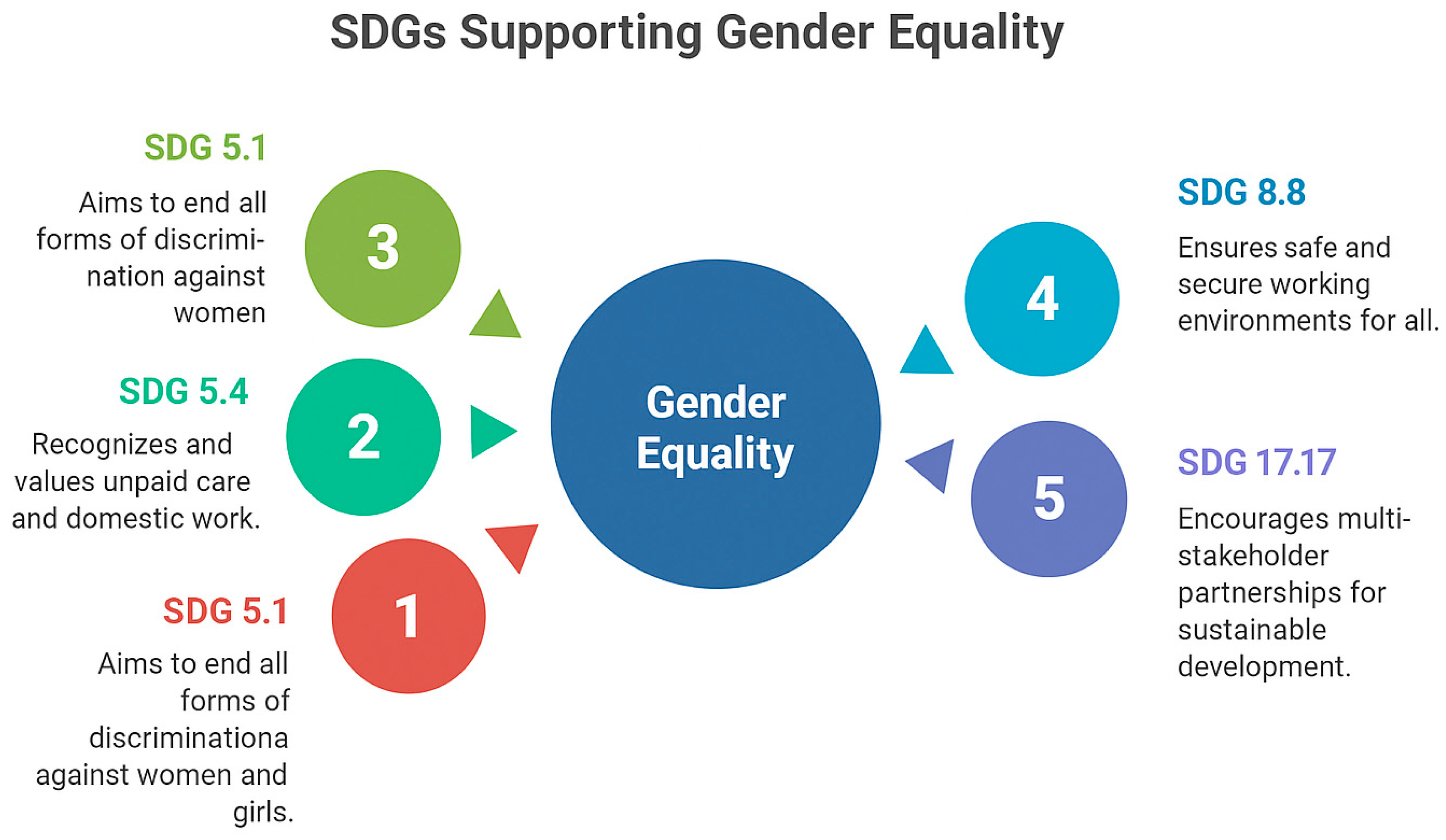
Beyond their general consistency with the SDGs, Figure 5 demonstrates how the study's results are connected to the SDGs. SDG 5.1 on ending discrimination is related to gaps in legal compliance; SDG 5.4 on recognizing unpaid care is related to restrictions on childcare and care work; SDG 8.5 on equal pay is related to evidence of the wage gap; and SDG 8.8 on safe and secure workplaces is related to measures to combat harassment and injustice. The credible collaboration between civil society organizations and governments enhances SDG 17.17 on multilateral partnerships.
Research supports this SDG-oriented framework: international evidence indicates that treaties represent normative obligations, yet they achieve SDG-aligned results only when underpinned by implementation capacity and institutional incentives. This shows that Ghahan agrees that local capacity is important for making real progress [3], Comstock suggests that institutional and civil society mechanisms are necessary for upholding rights commitments [6], and Moreno believes that sustained local involvement is needed to promote gender equality [7].
The joint presentation and policy fund connect these concepts to the work being conducted to meet the SDGs by finding effective instruments, such as definitions, laws, inspections, progressive pathways, and partnerships with civil society organizations that make it possible to keep the commitments made in Article 11 within the SDG framework.
Figure 5.
This figure illustrates how Article 11 aligns with the SDGs.
5. Conclusions
Overall Assessment
Fifteen years after ratification, CEDAW has anchored a vocabulary of equality in Palestine but has not yet produced a system-wide increase in women’s economic participation. Labour-force data remain flat at approximately 16–20%, indicating structural rather than statistical stagnation. The mixed-methods evidence clarifies why: legal gaps, ungazetted regulations, weak inspection capacity, and sector-specific incentives keep many guarantees “on paper only.” Civil-society mobilisation sustains visibility and worker confidence, yet fragmentation and limited state partnership constrain the conversion of advocacy into binding, enforceable rules.
Key Findings
The quantitative and qualitative evidence align on comparable obstacles to women's engagement in the labor market. Disparities in pay, bias in recruitment and job promotion, insufficient maternity and childcare provisions, and workplace harassment are seen as the most critical barriers. These findings affirm that the alignment of domestic laws with Article 11 is incomplete and predominantly symbolic: a legal definition of gender discrimination is absent, maternity and childcare protections are inconsistent, and enforcement capabilities are restricted. Sectoral variations further demonstrate different results. Equal pay provisions are present in the public sector; however, promotion ceilings and occupational segregation remain. In the private sector, pay gaps and job insecurity are widespread. Awareness of rights enhances knowledge and confidence; however, it is often limited and varies across generations, indicating that information alone does not substitute for enforcement.
Policy and Practice Implications
Taken together, the evidence supports a pragmatic implementation thesis: translating Article 11 from symbol to system requires three linked moves:
- Define and align the law, adopt a clear anti-discrimination definition, and ensure enforceable clauses on equal pay, harassment prevention, and childcare obligations.
- Publish and enforce gazette executive regulations, introduce sanctions, strengthen inspection capacity, and establish faster labour adjudication mechanisms.
- Institutionalise partnership, formalise the role of unions and CSOs, and expand workplace-based training and awareness programmes.
These priorities correspond directly to the strongest quantitative and qualitative indicators of perceived improvement and align with SDG 5.1, SDG 5.4, SDG 8.5, and SDG 8.8.
Contributions and Limitations
Substantively, this study contributes a fifteen-year mixed-methods account of CEDAW’s post-ratification implementation in Palestine and clarifies where and why barriers persist across sectors. Methodologically, this research combines a quantitative survey covering only areas of the West Bank with a qualitative path coded using MAXQDA, providing a verifiable and reproducible basis for future monitoring. Limitations include reliance on cross-sectional data and a purposive qualitative sample.
Future Research Avenues
Future research needs to include Gaza, which was under war while conducting the study, and utilize long-term and sector-specific methodologies to evaluate reform outcomes. Essential indicators, including inspection frequency, case duration, and consequence recovery, must be followed to assess the concrete impacts of legal and institutional reforms over time.
Bottom Line
Text without teeth will not move numbers. Only when legal definitions, published regulations, and adequately resourced enforcement are paired with institutionalised partnerships and workplace learning will Article 11’s promise translate into measurable gains in women’s participation, fair pay, and safe work in Palestine.
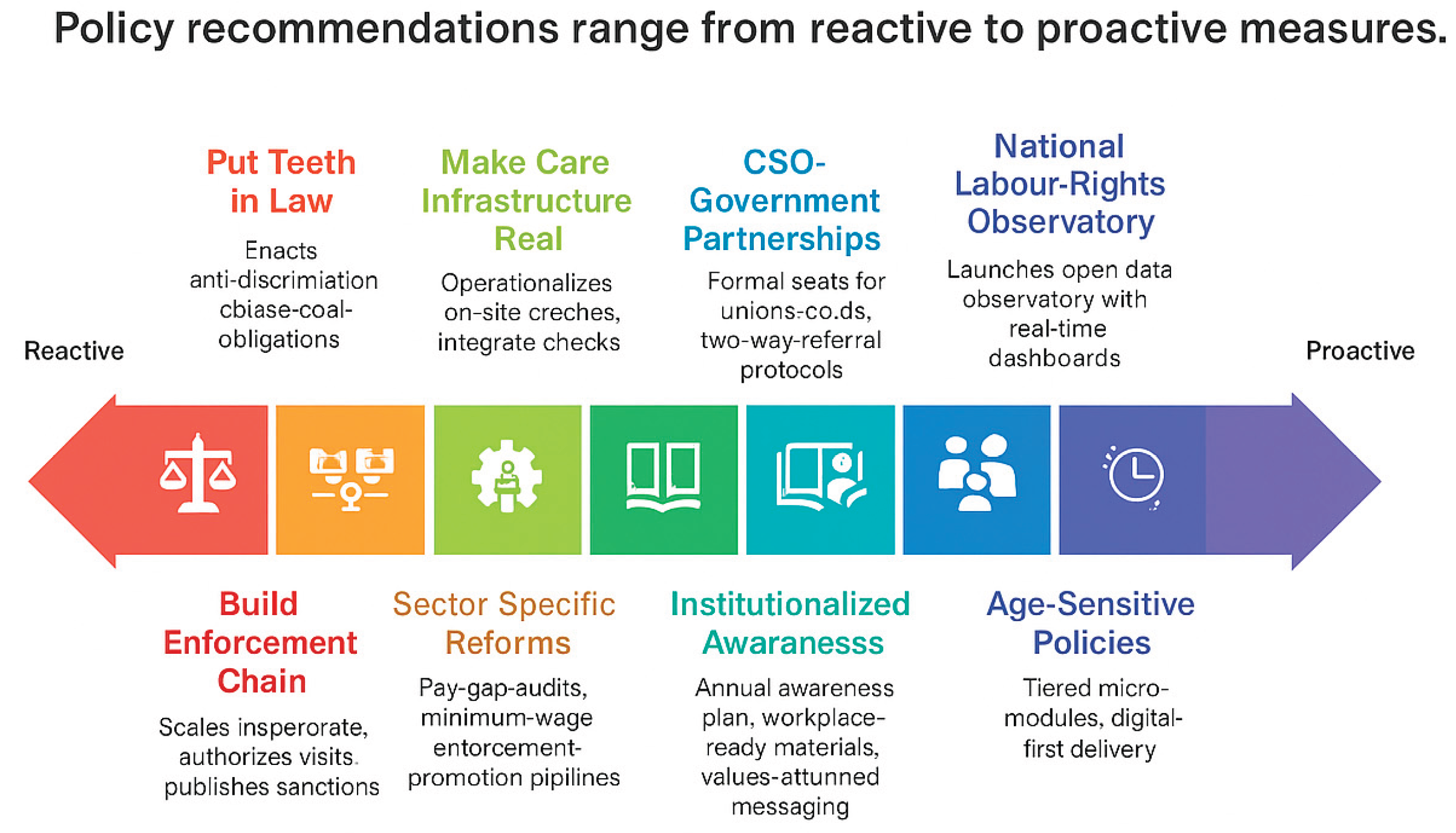
6. Policy Recommendations / Operationalizing CEDAW Article 11 in Palestine
To accelerate the implementation of CEDAW Article 11, policy reform in Palestine must focus on enforceability rather than symbolism. Clear definitions of anti-discrimination, formal regulations, and adequately resourced inspection and adjudication systems are essential to moving commitments from mere words on paper to practical application. Sector-specific measures should be complemented, such as closing wage gaps, expanding childcare infrastructure, ensuring equitable promotions, workplace awareness-raising, formal partnerships between civil society organizations and the government, and an open labor rights observatory to promote accountability and intergenerational inclusivity, translating CEDAW principles into tangible outcomes in the labor market rather than symbolism. Clear definitions of discrimination, robust anti-discrimination laws, and adequately resourced labor inspection and court systems are essential to translating commitments from mere words on paper into practical implementation. Sector-specific measures should be complemented, such as closing wage gaps, expanding childcare infrastructure, ensuring equitable promotions, promoting workplace awareness, establishing formal partnerships between civil society organizations and the government, and creating an open labor rights observatory to foster accountability and intergenerational inclusivity, thus translating the principles of the CEDAW Convention into tangible labor market outcomes.
The following Table 3 summarizes policy-level recommendations, detailing their rationale, required actions, impact measurement indicators (KPIs), and identifying responsible lead actors for implementation.
Outcome indicators to track (summary)
Legal: discrimination definition enacted; # executive regulations gazetted and in force.
Enforcement: inspections per 1,000 establishments; % unannounced visits; median labour case duration; sanction collection rate.
Workplaces: % firms filing equal pay audits; % providing childcare/allowances; harassment cases resolved ≤ 90 days.
Awareness: % women who consulted a reliable source; % contacted by CSOs; perceived usefulness of Article 11.
Impact: female Labor Force Participation (PCBS); gender wage gap; women in Grade A posts (public sector).
Figure 6.
Policy Recommendations to Operationalize Article 11 of the CEDAW Convention.
Supplementary Materials
The following supporting information can be downloaded at the website of this paper posted on Preprints.org.
Author Contributions
Conceptualization, A.H. and F.B.; methodology, A.H.; software, A.H.; validation, A.H. and F.B.; formal analysis, A.H.; investigation, A.H.; resources, A.H.; data curation, A.H.; writing—original draft preparation, A.H.; writing—review and editing, A.H. and F.B.; visualization, A.H.; supervision, F.B.; project administration, A.H.; funding acquisition, none. All authors have read and agreed to the published version of the manuscript.
Funding
Please add: This research received no external funding.
Institutional Review Board Statement
The study was conducted in accordance with the Declaration of Helsinki and approved by the Ethics Committee of Girne American University (GAU) for the research project titled “Normative Anchor or an Operational System: Where does Palestine stand in CEDAW ratification with regard to employment?”Protocol code: SBEK2024-25.009Date of approval: April 21st, 2025(As documented in the official Ethics Committee approval letter) .
Informed Consent Statement
Written informed consent was obtained from all interview participants. For the survey component, informed consent was secured through the introductory statement attached to the questionnaire, which explained the purpose of the study, the voluntary nature of participation, and the confidentiality of the data collected.
Data Availability Statement
The data supporting the findings of this study are available from the corresponding author upon reasonable request. Qualitative interview materials and survey datasets cannot be publicly shared due to confidentiality commitments and ethical restrictions stipulated in the Institutional Review Board approval.
Acknowledgments
The authors would like to thank the institutions and individuals who facilitated access to participants and supported the coordination of interviews and survey distribution. The authors also acknowledge the administrative assistance provided by the Faculty of Business and Economics at Girne American University throughout the research process.
During the preparation of this manuscript, the authors used ChatGPT (OpenAI, GPT-5.1, 2025 version) for text refinement, language editing, and formatting assistance. The authors reviewed and edited all AI-generated content and take full responsibility for the final manuscript.
Conflicts of Interest
The authors declare no conflicts of interest. No external funder influenced any part of the study.
Abbreviations
The following abbreviations are used in this manuscript:
| CEDAW | Convention on the Elimination of All Forms of Discrimination against Women |
| CSO(s) | Civil Society Organisation(s) |
| DWRC | Democracy & Workers’ Rights Center |
| HJC | High Judicial Council |
| HR | Human Resources |
| ILO | International Labour Organization |
| KPI(s) | Key Performance Indicator(s) |
| MoF | Ministry of Finance (State of Palestine) |
| MoJ | Ministry of Justice |
| MoL | Ministry of Labour |
| MoNE | Ministry of National Economy |
| MoSA | Ministry of Social Affairs (now MoSD in some documents) |
| MoWA | Ministry of Women’s Affairs |
| NGO(s) | Non-Governmental Organisation(s) |
| PCBS | Palestinian Central Bureau of Statistics |
| PGFTU | General Federation of Palestinian Trade Unions |
| PLC | Palestinian Legislative Council |
| RWDS | Rural Women Development Society |
| SDG(s) | Sustainable Development Goal(s) |
| SHAMS | Human Rights and Democracy Media Center SHAMS |
| UN | United Nations |
| UN Women | United Nations Entity for Gender Equality and the Empowerment of Women |
References
- UN. Convention on the Elimination of All Forms of Discrimination Against Women (CEDAW). United Nations: New York, NY, USA, 1979. https://www.ohchr.org/en/instruments-mechanisms/instruments/convention-elimination-all-forms-discrimination-against-women.
- PCBS, Labor Force Survey: (July-September, 2023), Third Quarter, 2023, Ramallah, West Bank: PCBS, 2023. http://www.pcbs.gov.ps/.
- Gahagan, C. The Right to Work: How a Human Rights Treaty Reduces the Informal. Florida State University, Department of Political Science: Tallahassee, FL, USA, 2023.
- Word Bank, "Women, Business and the Law," World Bank, Washington, DC, USA, 2024. https://wbl.worldbank.org.
- United Nations. Transforming Our World: The 2030 Agenda for Sustainable Development. United Nations: New York, NY, USA, 2015.]. Available: https://sdgs.un.org/2030agenda.
- Comstock, L.A. Signing CEDAW and Women's Rights: Human Rights Treaty Signature and Legal Mobilization; Cambridge University Press: Cambridge, UK, 2023; p. 49. [CrossRef]
- Moreno, L.M. The Effects of the Convention on the Elimination of Discrimination Against Women (CEDAW) on Mobilization: Analysis of Mobilization as a Compliance Mechanism. Master's Thesis, Oklahoma State University, Stillwater, OK, USA, 2023.
- Hattab, A.; Abualrob, A. Under the veil: Women's economic and marriage. Humanit. Soc. Sci. Commun. 2023, 10, 110. [CrossRef]
- International Labour Organization (ILO). Persistent Gender Gaps at Work Make it Necessary to Adopt Transformative Measures. Available online: https://www.ilo.org/resource/news/ilo-persistent-gender-gaps-work-make-it-necessary-adopt-transformative (accessed on 26 March 2025).
- Gevrek, D.; Middleton, K. Globalization and women's and girls' health in 192 UN-member countries. Int. J. Soc. Econ. 2016, 43, 692–721. [CrossRef]
- Rueda, V.C. Women Migrant Workers' Labour Market Situation in West Africa; ILO: Geneva, Switzerland, 2020. https://researchrepository.ilo.org.
- Sinha, S. Gender Based Inequities in the World of Work: Insights from Latin America, Sub-Saharan Africa, and Asia. In Inequality, Democracy and Development under Neoliberalism and Beyond; Seventh South-South Institute: Bangkok, Thailand, 2014; pp. 109–126. https://core.ac.uk/download/pdf/35171358.pdf#page=109.
- Pruitt, L.R. Migration, Development, and the Promise of CEDAW for Rural Women. Michigan Journal of International Law 2009, 30, 1052–2867. Available online: https://repository.law.umich.edu/mjil/vol30/iss3/7.
- UN Women. Convention on the Elimination of All Forms of Discrimination Against Women (CEDAW). Available online: https://www.un.org/womenwatch/daw/cedaw/cedaw.htm (accessed on 26 March 2025).
- Prigge, K.; Thyen, K. Rural Women's Economic Empowerment in the Maghreb: A Materialist Critique. Middle East Crit. 2025, 34, 1–19. [CrossRef]
- Rahman, A.; Muktadir, M.G. SPSS: An imperative quantitative data analysis tool for social science research. Int. J. Res. Innov. Soc. Sci. 2021, 5, 300–302.
- The Practice of Qualitative Data Analysis: Research Examples Using MAXQDA, Gizzi, M.C.; Rädiker, S. (Eds.) The Practice of Qualitative Data Analysis: Research Examples Using MAXQDA; MAXQDA Press: Berlin, Germany, 2024.
Figure 1.
Factors of Change After CEDAW Ratification. (Source: Author’s elaboration based on Gahagan 2023; Comstock 2023; Moreno 2023; UN Women 2023; World Bank 2022.).
Figure 1.
Factors of Change After CEDAW Ratification. (Source: Author’s elaboration based on Gahagan 2023; Comstock 2023; Moreno 2023; UN Women 2023; World Bank 2022.).
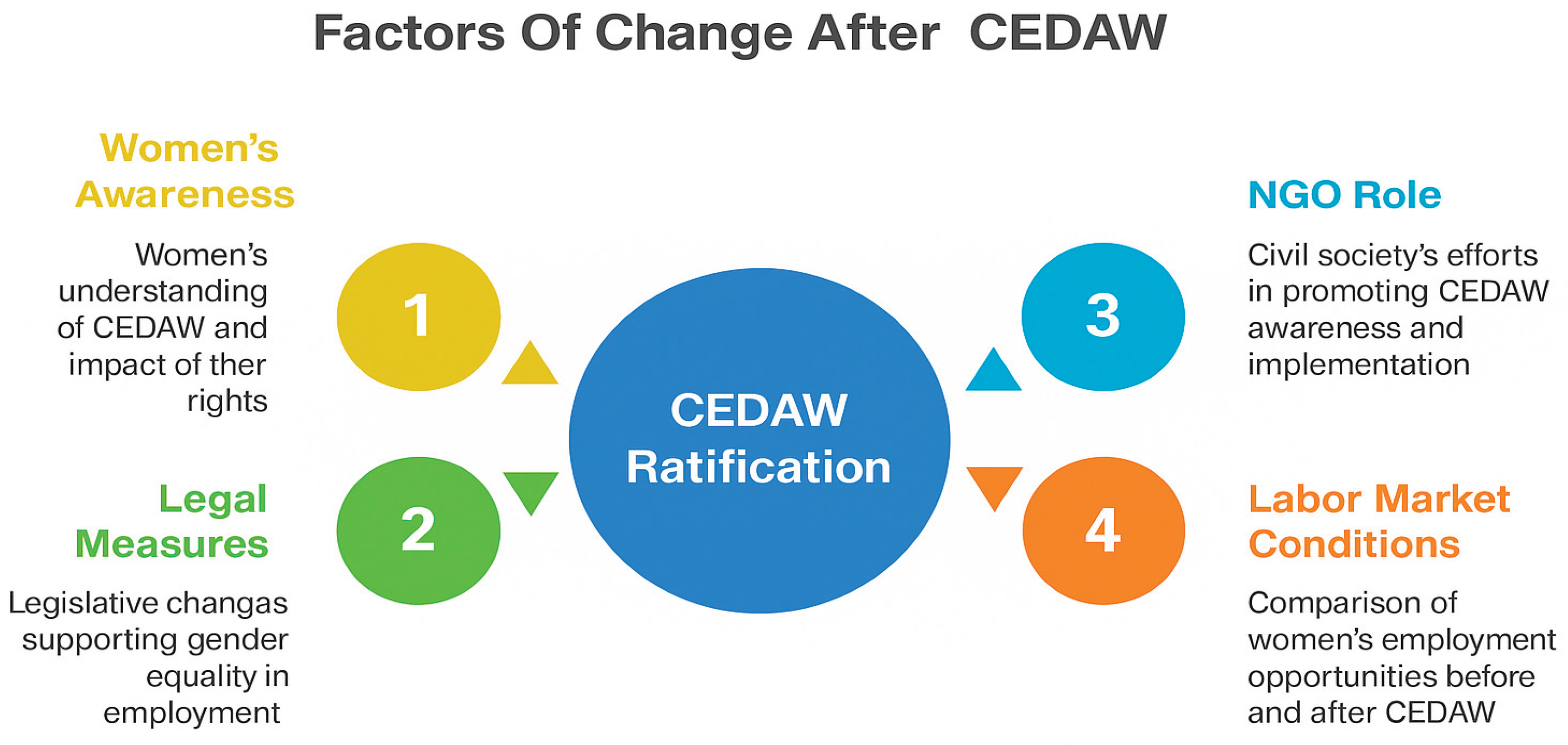
Figure 2.
Labour Market Barriers.
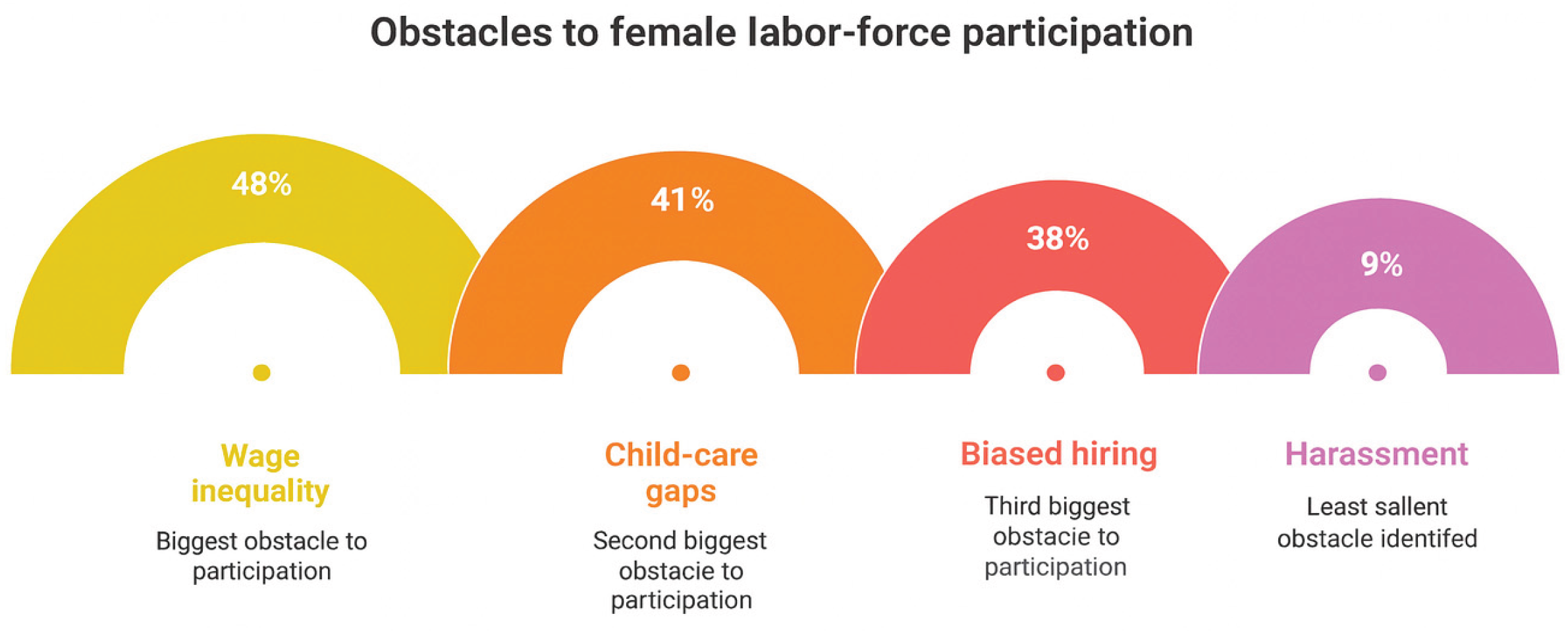
Figure 3.
Factors influencing working women's awareness of Article 11.
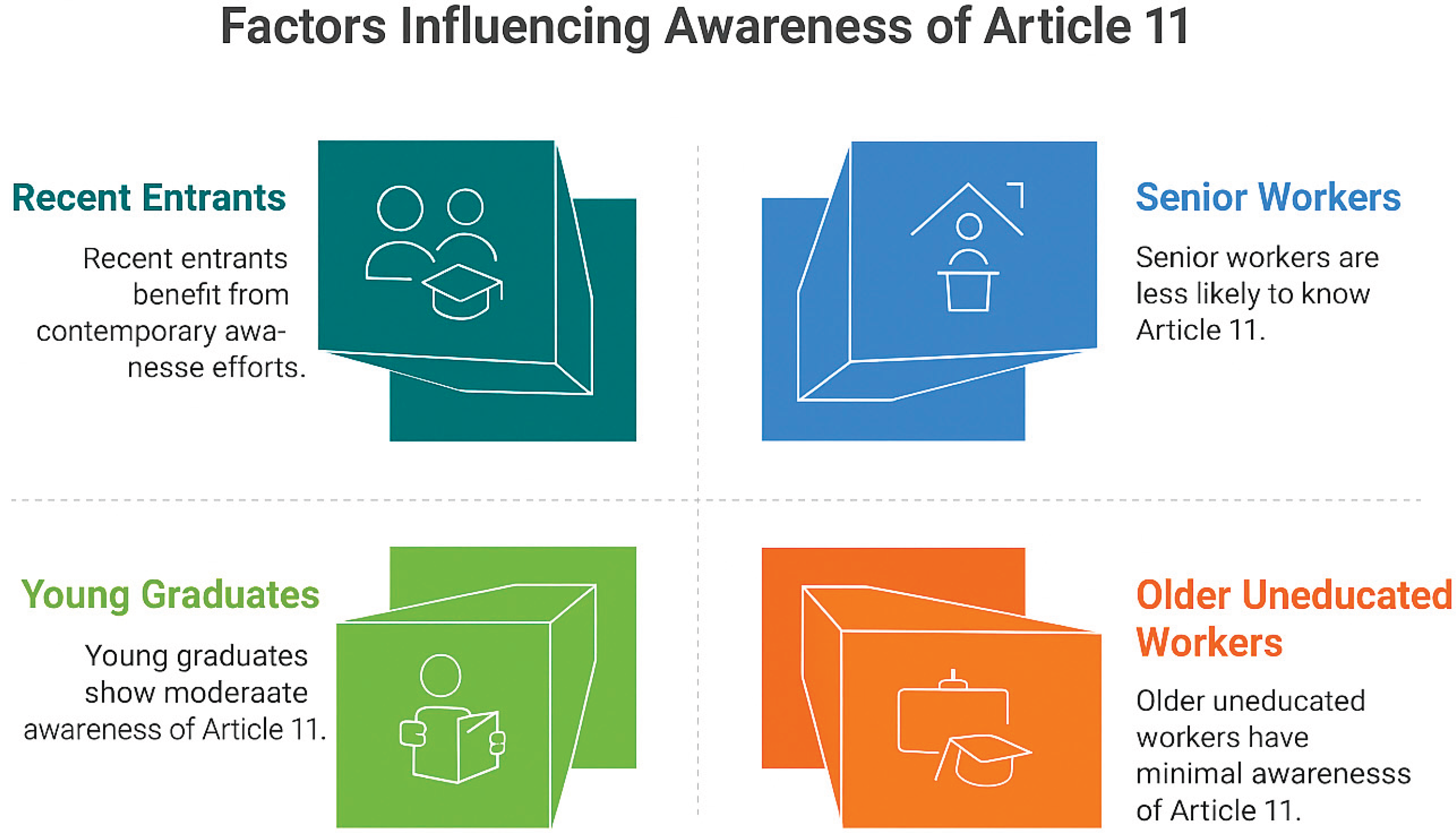
Table 1.
Groups of qualitative data were analysed by thematic design.
| no. | Data Source Group | Participants/unit counts | Purpose in analysis |
| i.a | Government KIIs | 3 senior officials (Women’s Affairs, Labour, Justice) | Capture the State’s view on post-CEDAW reforms and enforcement mechanisms. |
| i.b | Civil-society/unions KIIs | 5 leaders from NGOs & trade unions (General Union of Palestinian Women, Rural Women Society, SHAMS, Trade Union, Democracy and Workers' Rights Center) | Document advocacy strategies, monitoring roles, and field-level barriers. |
| ii | Working-women voices | 529 open answers embedded in the online survey (treated as short narrative “mini-interviews”) | Provide grass-roots perceptions that triangulate KII findings. |
| iii | Desk-review (CEDAW monitoring) | Annual state vs. shadow reports 2016-2024 | Identify areas of agreement/contradiction in official vs. NGO assessments. |
| iv | Desk-review (legal alignment) | Side-by-side matrix of Labour & Civil-Service laws vs. Article 11 obligations | Map legislative gaps without disclosing numerical scores. |
Table 3.
This table summarizes recommendations, actions, KPIs, and actors for implementation.
| NO | RECOMMENDATIONS FOR THE POLICY LEVEL | |
| 1 | Description | Put teeth in the law (define, align, publish) |
| Rationale (from results) | No statutory definition of discrimination; uneven maternity/childcare rules; draft reforms not gazetted, leaving Article 11 largely declaratory. Actions. |
|
| Actions. | Adopt a unified gender anti-discrimination framework across labour laws and finalise and gazette the 17 bylaws with enforceable, time-bound regulations. | |
| KPIs (12–18 mo). | Discrimination definition enacted; # of executive regulations gazetted; % ministries issuing compliance circulars. | |
| Lead actors. | MoL, MoJ, Presidency/PLC; support from CSO. | |
| 2 | Description | Build an enforcement chain that works |
| Rationale (from results) | Inspection is understaffed; courts are slow; penalties are rare, so compliance is patchy. | |
| Actions. | Scale inspectorate, authorise unannounced visits, publish a sanctions schedule; pilot fast-track labour benches/courts. | |
| KPIs (12–18 mo). | Inspections per 1,000 establishments; % unannounced visits; median case duration; sanction collection rate. | |
| Lead actors. | MoL (Inspection & occupational safety and health (OSH) ), High Judicial Council, Attorney General. | |
| 3 | Description | Sector-specific reforms (private vs public) |
| Rationale (from results) | Private sector: wage gaps, childcare deficits, precarious contracts; Public sector: standardised pay but promotion ceilings. | |
| Actions. | Private sector: enforce pay-gap audits, wage compliance, anti-harassment rules, and SME maternity support; Public sector: ensure transparent, gender-balanced promotion pathways. | |
| KPIs (12–18 mo). | % firms completing pay-gap audits; minimum-wage compliance rate; women’s share in Grade-A /leadership posts. | |
| Lead actors. | MoL, Pay-Equity Committee, employers’ associations; CSOs (public sector). | |
| 4 | Description | Make care infrastructure real |
| Rationale (from results) | Childcare obligations are not enforceable; women under the Labour Law report higher childcare barriers than under the Civil Service Law. | |
| Actions. | Operationalise on-site crèches or pooled funds/allowances, phased by firm size/sector; integrate checks into inspection. | |
| KPIs (12–18 mo). | % employers providing childcare/allowances; inspection coverage of family-friendly provisions. | |
| Lead actors. | MoL, MoSA, MoF; municipalities for permitting / monitoring. | |
| 5 | Description | Institutionalised awareness (workplace-based; misinformation-proof) |
| Rationale (from results) | Awareness is broad but shallow; outreach is not continuous; misinformation persists; content often skews to non-labour topics. | |
| Actions. | Develop a joint awareness plan with workplace-ready Article 11 materials, using value-aligned messaging and trusted messengers, and embed brief modules in onboarding, promotion, and grievance processes. | |
| KPIs (12–18 mo). | ≥ 60% consulted a reliable source or had direct CSO contact; rise in perceived usefulness of Article 11. | |
| Lead actors. | MoWA, MoL, CSO coalitions; media units. | |
| 6 | Description | CSO–government partnerships (formalise the quartet) |
| Rationale (from results) | CSOs/unions sustain visibility (shadow reports, clinics), yet the partnership is under-institutionalised; the government did not publicly defend CEDAW during the backlash. | |
| Actions. | Provide unions/CSOs with formal seats on drafting and monitoring committees with quarterly reviews, and establish two-way referral protocols between hotlines/legal clinics and inspectorate/courts with ≤30-day feedback. | |
| KPIs (12–18 mo). | # joint policy notes adopted; % complaints resolved ≤ 90 days; public trust measures. | |
| Lead actors. | MoL, MoWA, CSO coalitions, unions (with ILO support). | |
| 7 | Description | Age-sensitive policies |
| Rationale (from results) | Older cohorts are more likely to have heard of CEDAW; younger cohorts are more likely to consult reliable sources and recognize Article 11 as an actionable channel gap. | |
| Actions. | Tiered, in-work micro-modules for 18–28 / 29–50 / 51+; digital-first delivery leveraging MoWA’s intensive social-media use. | |
| KPIs (12–18 mo). | ≥ 60% reliable-source consultation; increased Article 11 knowledge across age groups. | |
| Lead actors. | MoL, MoWA, HR units; unions/CSOs | |
| 8 | Description | Create a National Labour-Rights Observatory |
| Rationale (from results) | No national observatory tracks outcomes (wage gaps, harassment, case times), hindering accountability and learning. | |
| Actions. | Launch an open-data observatory (MoL + PCBS + universities/CSOs) with real-time dashboards on equal pay, harassment, childcare compliance, inspections, and case durations. | |
| KPIs (12–18 mo). | Public dashboards online; quarterly updates; # legislative/inspection actions triggered by observatory evidence. | |
| Lead actors. | PCBS & MoL; co-leads by universities, CSOs. | |
Disclaimer/Publisher’s Note: The statements, opinions and data contained in all publications are solely those of the individual author(s) and contributor(s) and not of MDPI and/or the editor(s). MDPI and/or the editor(s) disclaim responsibility for any injury to people or property resulting from any ideas, methods, instructions or products referred to in the content. |
© 2025 by the authors. Licensee MDPI, Basel, Switzerland. This article is an open access article distributed under the terms and conditions of the Creative Commons Attribution (CC BY) license (http://creativecommons.org/licenses/by/4.0/).
Copyright: This open access article is published under a Creative Commons CC BY 4.0 license, which permit the free download, distribution, and reuse, provided that the author and preprint are cited in any reuse.