
1. Introduction
Pear (
Pyrus communis L.) is a commercially significant temperate fruit crop whose production and orchard longevity are heavily reliant on the quality of planting material supplied during the nursery stage. Early vegetative growth of nursery trees impacts root architecture, canopy structure, branching potential, and young plants’ ability to withstand transplanting stress [
1]. High-quality nursery stock is thus critical for assuring speedy orchard establishment and uniform growth in the early years of operation.
Nitrogen management has a significant impact on pear seedling growth because proper nitrogen delivery promotes leaf expansion, shoot elongation, and biomass accumulation—all of which are important components of early vigor [
2,
3]. Nitrogen is critical for vegetative growth, photosynthetic efficiency, and protein synthesis, whereas balanced phosphorus and potassium supply is required for root development, carbohydrate allocation, osmotic regulation, and cell metabolism [
4,
5]. Nitrogen availability has a considerable influence on root morphology, nitrogen uptake efficiency, and shoot biomass in nursery-grown woody perennial seedlings, revealing the susceptibility of early developmental stages to fertilization regimes [
6].
Shoot biomass, also known as fresh and dry weight, is widely acknowledged as an important indication of seedling vigor and nursery stock quality. It considers the cumulative impacts of nutrient availability on essential physiological processes such cell expansion, leaf area development, and photosynthetic capacity during early growth [
7,
8]. In nursery crops, seedlings with larger above-ground biomass have higher glucose reserves, better resilience to abiotic stress, and better transplant establishment [
9,
10,
11]. Shoot biomass in woody perennial species, such as fruit trees, is directly related to future tree architecture, branching potential, and canopy growth, all of which influence early production. Because shoot biomass is sensitive to variation in nutrient supply—particularly nitrogen, phosphorus, and potassium—it is widely accepted as a reliable metric for evaluating seedling responses to fertilization regimes in nursery systems [
12,
13,
14].
Despite its importance, fertilization in pear nurseries is frequently empirical, with many growers applying conventional or excessive fertilizer amounts without considering cultivar traits, substrate type, or site-specific growth conditions. Nitrogen overapplication can cause excessive shoot elongation, reduced lignification, increased stress susceptibility, and nutrient leaching [
15]. In contrast, low nutrient input inhibits biomass production, delays the development of saleable stock, and jeopardizes seedling uniformity, all of which are crucial for orchard establishment [
16].
Pear fertilization research has been focused on orchard conditions, revealing that P and K fertilization has a significant impact on leaf nutrient status, vegetative growth, and yield components [
17]. Research indicates that using organic or mineral fertilizers in Pyrus communis has a considerable impact on shoot growth, leaf nutrient content, and early production [
18,
19]. Furthermore, investigations of commercial pear orchards in China found significant nutrient surpluses, particularly for nitrogen and phosphorus, indicating inefficiencies in fertilization procedures and the need for more accurate nutrient management strategies [
20]. Industry recommendations also underline the significance of a balanced NPK supply in pear production to maintain vegetative development and fruiting potential [
21,
22].
Although several studies have looked at nutrient treatment tactics in mature pear orchards [
23,
24,
25], there has been little research on how pear nursery plants respond to graded NPK fertilizer rates. In contrast, comprehensive research in other woody perennial nursery systems has shown that nursery fertilization has a significant impact on biomass accumulation, nutrient usage efficiency, and even future field performance [
26,
27,
28]. These findings indicate that optimal nutrition management during the nursery period is critical for producing high-quality planting material capable of sustaining rapid development following transplantation.
Despite the agronomic relevance of pear cultivation, there is a substantial lack of study into how graded NPK fertilizer influences shoot biomass buildup in nursery-grown pear plants. Existing research focuses mostly on orchard fertilization or the comparison of organic and mineral supplements, while quantitative analyses of shoot fresh and dry weight responses to rising NPK rates during the nursery stage are almost nonexistent. The current work is therefore unusual in analyzing the direct effects of four chemical NPK levels on shoot biomass in two pear cultivars using a controlled, multi-factorial experimental approach. This study bridges a crucial knowledge vacuum by relating nitrogen supply to early shoot development—a feature essential for transplant quality—and gives practical fertilization parameters suited specifically for pear nursery output.
The two Romanian pear cultivars, “Napoca” and “Monica,” show almost equivalent nutrient-driven development trajectories, indicating comparable nutrient-use efficiency despite their different genetic backgrounds. This brings new insights to the current study. Since cultivar-specific fertilization recommendations have always been generalized or drawn from unrelated germplasm, this is a novel addition to pear nursery science. Our findings offer physiologically based data to improve fertilizer recommendations for regional nursery systems by measuring regression-based growth responses and recording diminishing returns at increasing NPK levels.
The goal of this study was to assess the influence of various chemical NPK fertilizer rates on shoot biomass accumulation—measured as shoot fresh and dry weight—in pear nursery trees. The findings aim to give statistically validated fertilization recommendations for pear nursery production while also contributing to the development of sustainable nutrient management strategies for temperate fruit crops.
2. Materials and Methods
2.1. Site description
The experiment was carried out in 2025 at a commercial fruit-tree nursery in north-western Romania (47°10′ N, 23°30′ E). The region has a temperate continental climate, with typical annual temperatures ranging from 9.5 to 10.0 degrees Celsius and 600 to 750 millimeters of precipitation.
The soil at the study location is a loamy Cambisol, appropriate for nursery production. The 0-30 cm layer has the following characteristics: pH 6.3, organic matter 2.1%, total N 0.12%, available P (P₂O₅) 38 mg kg⁻¹, available K (K₂O) 145 mg kg⁻¹, and bulk density 1.28 g cm⁻³.
2.2. Plant material
The plant material was quince rootstocks (category “Certified”). Grafting took place in late summer 2024, utilizing the dormant bud method (chip budding with latent buds). Buds of two Romanian pear cultivars, ‘Napoca’ and ‘Monica’, were obtained from verified mother orchards and grafted onto quince rootstocks during good weather circumstances. Nursery trees were handled uniformly throughout the 2025 growing season, with regular irrigation, shoot training, rootstock growth reduction, and phytosanitary protection. This technique ensured the generation of genetically homogeneous, high-quality plant material while reducing variability unrelated to fertilization treatments.
2.3. Experimental design
The study employed a two- factor (4 × 2) factorial experiment with a structure and five replications in a randomized block design. Each experimental plot included four trees planted at a spacing of 0.70 × 0.25 m, like the planting density utilized in intensive pear nursery production. Fertilization (Factor A) was applied at four levels, including an unfertilized control (N₀P₀K₀) and three rising nutrient rates (N₈P₈K₈, N₁₆P₁₆K₁₆, N₂₄P₂₄K₂₄). Factor B represented the cultivar, which comprised the Romanian pear cultivars ‘Napoca’ and ‘Monica’.
Fertilization with a water-soluble 16-16-16 (N-P₂O₅-K₂O) complex fertilizer produced by (COMPO Expert, Basfoliar™, Germany) was used to achieve the desired nutrient levels. The N₈P₈K₈, N₁₆P₁₆K₁₆, and N₂₄P₂₄K₂₄ treatments were applied at 50, 100, and 150 kg ha⁻¹, respectively, based on nutritional content. Fertilizer was manually applied in early spring 2025, before the commencement of rapid vegetative development, and was mixed into the top 10-12 cm of soil to promote uniform nitrogen distribution within the root zone. The control version got no mineral fertilizer during the growth season. Throughout the vegetative period (April-October 2025), all nursery trees were maintained using conventional pear nursery procedures to achieve uniform development across treatments. Overhead sprinklers were used to apply irrigation two to three times per week, depending on weather conditions, providing an average of 20-25 mm per irrigation event (equal to roughly 20-25 L m⁻²), with increasing frequency during summer seasons of high evapotranspiration. Weed control was accomplished through a combination of hand hoeing between rows and shallow mechanical cultivation inside rows at 3–4-week intervals, ensuring that competition for water and nutrients remained low throughout the season. Shoot training entailed maintaining a single vertical leader by manually eliminating rival lateral shoots in early summer and guiding scion growth along a support stake as needed. To prevent assimilate diversion from the scion, rootstock suckers were removed routinely by hand at each growth flush (about once a month). Phytosanitary protection followed local integrated pest management (IPM) recommendations, which included preventive fungicide applications with copper hydroxide (Kocide 2000®, Dupont) at budbreak, followed by mancozeb (Dithane M-45®, Corteva) and myclobutanil (Systhane 20EW®, Corteva) at 14–21-day intervals during fungal infection-prone periods.
2.4. Growth measurements
Growth measurements were taken in October 2025, just before the trees were lifted from the nursery for grading and storage. At this point, vegetative development had stopped and shoots had reached complete physiological maturity, making above-ground biomass measurements reliable and similar among treatments. For each experimental plot, the current-season shoot of each tree was removed with a clean incision just above the graft union, ensuring that only scion growth was measured. Shoots were individually tagged and transferred to the laboratory within 20 minutes of harvest to avoid moisture loss. Fresh shoot weight was measured immediately after collection using a calibrated analytical precision scale (± 0.01 g). To standardize measurements, surface moisture from recent irrigation or dew was carefully removed using absorbent paper as needed. Shoot fresh weight was chosen as the primary response variable because it strongly correlates with vegetative vigor, biomass accumulation, and overall nursery stock quality—all of which are critical for predicting transplant performance and early orchard establishment. The use of fresh weight reduces handling time and eliminates the possibility of tissue damage during drying, providing an accurate, rapid indicator of growth differences caused by fertilization treatments.
2.5. Statistical analysis
A three-way analysis of variance (ANOVA) was used to examine shoot fresh weight because the experiment used a randomized block design with a factorial structure. Fertilization rate (four levels), cultivar (two levels), and block (five replications) were regarded as fixed effects. The primary impacts of cultivar and fertilization, as well as the interaction between fertilization and cultivar, were examined by the model. To take into consideration spatial heterogeneity within the nursery field, block effects were incorporated.
Tukey’s Honest Significant Difference (HSD) test was employed for post hoc pairwise comparisons between treatment means when ANOVA revealed significant differences (p < 0.05). The means ± standard error (SE) are used to display the results. At the p < 0.05 level, distinct letters for each table denote statistically significant differences between treatment means.
3. Results
3.1. Effect of fertilization on shoot fresh weight
Fertilization had a noticeable, statistically significant effect on shoot fresh weight in pear nursery trees (
Table 1). Shoot biomass grew steadily with increasing NPK treatment, demonstrating a strong quantitative response to nitrogen delivery. The unfertilized control (N₀P₀K₀) had the lowest shoot fresh weight (0.42 kg tree⁻¹), indicating baseline growth with inherent soil fertility. Applying 50 kg ha⁻¹ of 16-16-16 fertilizer (N₈P₈K₈) produced a significant increase in shoot fresh weight to 0.54 kg tree⁻¹, a 29% improvement compared to the control. Increasing nutrient input to 100 kg ha⁻¹ (N₁₆P₁₆K₁₆) resulted in a 45% increase in average shoot biomass to 0.61 kg tree⁻¹ compared to the control. The highest fertilization rate of 150 kg ha⁻¹ (N₂₄P₂₄K₂₄) resulted in the highest shoot fresh weight (0.66 kg tree⁻¹), a 59% increase compared to unfertilized trees.
3.2. Interaction between fertilization rate and cultivar
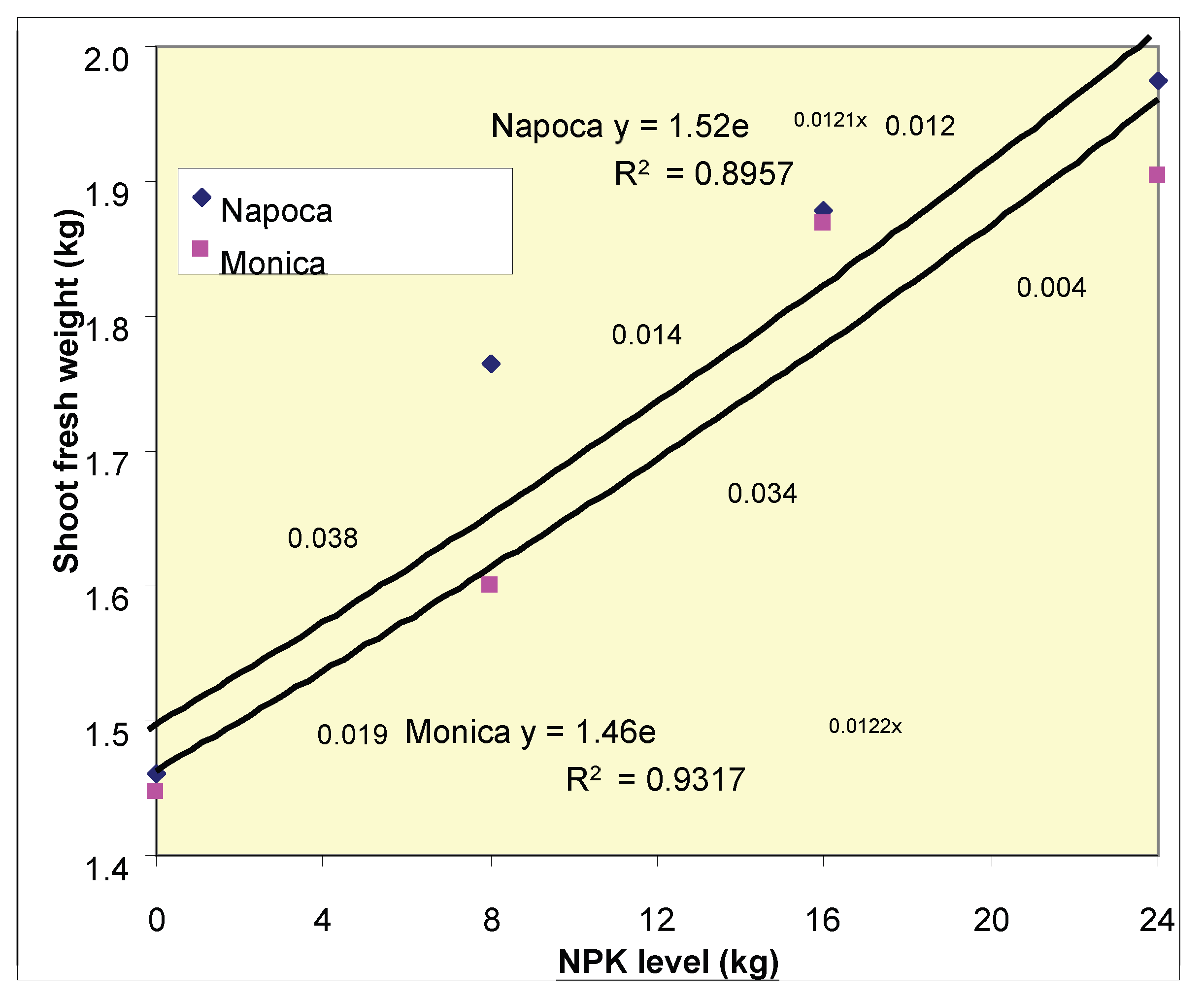
In both “Napoca” and “Monica,” the interaction between fertilization rate and cultivar showed a very uniform response pattern to an increase in NPK supply (
Table 2). From the unfertilized control to the maximum fertilization level, shoot fresh weight grew gradually and significantly in both cultivars. The mean shoots fresh weight in “Napoca” grew from 0.42 kg tree⁻¹ under N₂P₂K₀ to 0.66 kg tree⁻¹ under N₂₄P₂₄K₂₄, with intermediate values of 0.54 kg tree⁻¹ and 0.61 kg tree⁻¹ reported under the treatments of N
8P
8K
8 and N
16P
16K
16, respectively. A similar pattern was seen in “Monica,” where shoot fresh weight rose from 0.43 kg tree⁻¹ in the control group to 0.65 kg tree⁻¹ at the maximum fertilization rate, with matching intermediate values under moderate nutrient input. The different grouping letters allocated to consecutive NPK rates show that all fertilization levels within each cultivar varied considerably from one another (Tukey’s HSD, p < 0.05). In both cultivars, the coefficients of variation stayed comparatively low and stable across fertilization treatments, suggesting strong experimental precision and consistent plant responses within treatments. No statistically significant changes between the two cultivars were found at any fertilization level, despite the obvious fertilization impact. At each NPK rate, the difference in shoot fresh weight between ‘Napoca’ and ‘Monica’ was modest, ranging from only 0.01 to 0.03 kg tree⁻¹. These findings show that, under the study’s nursery settings, both cultivars demonstrated a roughly equal potential for shoot biomass accumulation in response to increasing NPK fertilization.
The quantitative response of shoot fresh weight in the two pear cultivars “Napoca” and “Monica” across four graded NPK fertilization levels is depicted in Figure 1. The high reliance of early vegetative growth on mineral nutrient availability in nursery circumstances was confirmed by the steady increase in shoot biomass in both cultivars with increasing nutrient input. Increased photosynthetic capability and vegetative vigor are intimately linked to nitrogen, an essential component of proteins, chlorophyll, and enzymes. Therefore, increased assimilate production and enhanced nitrogen-driven metabolic activity are responsible for the steady increase in shoot biomass across NPK treatments. By increasing the efficiency of nutrient intake and water acquisition from the soil, phosphorus—which is necessary for ATP synthesis, energy transfer, and root system development—further promotes biomass growth. In the meantime, potassium helps with osmoregulation, translocation of photo assimilates, and stomatal regulation, all of which improve overall growth efficiency and enable the consistent build-up of shoot biomass shown in Figure 1. Both cultivars show similar nutrient absorption and utilization capacities under the investigated conditions, according to the similarity of the fitted curves for “Napoca” (R² = 0.8957) and “Monica” (R² = 0.9317). Growth variations in nursery production are mostly determined by nutrient availability rather than genetic background, as the virtually overlapping growth responses indicate that neither genotype is physiologically superior in nutrient-use efficiency during early development. A biologically coherent pattern is also revealed by the high coefficients of determination: both cultivars are able to convert increasing amounts of mineral nutrients in the rhizosphere into proportionate increases in shoot biomass without exhibiting signs of nutrient saturation within the tested range. Overall, the figure emphasizes how crucial balanced NPK fertilization is for encouraging strong shoot growth and appropriate biomass partitioning in the nursery stage. Because seedlings with higher shoot biomass often have stronger photosynthetic potential, better carbohydrate stores, and superior transplant establishment capacity, these physiological responses support the generation of high-quality planting material. In order to maximize early growth performance and guarantee uniformity in pear nursery production systems, proper nutrient management is crucial, as demonstrated by the graphical trends.
Orchard establishment is directly impacted by the reported increases in shoot fresh weight with greater NPK fertilizer. Larger leaf areas, higher glucose reserves, and enhanced post-transplant photosynthetic capability are characteristics of seedlings with more robust shoot systems, all of which promote quicker root regeneration and increased resilience during field establishment. The identical response patterns of “Monica” and “Napoca” imply that suitable fertilizing techniques during the nursery stage can consistently improve early vigor across cultivars, leading to more consistent development following planting. As a result, the fertilization-induced increases in nursery biomass depicted in the figure are agronomically significant indicators of improved early orchard performance, shorter establishing times, and possibly an earlier start to commercial productivity.
Figure 2.
Variation in shoot growth of the two pear cultivars in response to different NPK fertilization levels.
Figure 2.
Variation in shoot growth of the two pear cultivars in response to different NPK fertilization levels.
3.3. Relative increase in shoot fresh weight and cultivar differences
Table 3 shows the relative increase in shoot fresh weight following fertilization. When compared to the unfertilized control, all NPK treatments produced significant increases in biomass. Shoot fresh weight increased by 29% when N
8P
8K
8 was applied, however increases of 45% and 59% were obtained when N
16P
16K
16 and N₂₄P₂₄K₂₄ were used. These findings demonstrate that, in nursery settings, mineral fertilization has a significant positive and dose-dependent impact on the accumulation of shoot biomass. Very slight numerical changes in shoot fresh weight were found when cultivars were compared across all fertilization levels; these differences ranged from 0.01 kg tree⁻¹ at all NPK rates. Both “Napoca” and “Monica” showed almost equal growth responses to an increase in NPK supply, as these differences were not statistically significant (p > 0.05). The widespread applicability of the fertilization effect across various pear genetic backgrounds is further supported by this consistency in response.
Overall, the results demonstrate a clear and consistent effect of NPK fertilization on shoot fresh weight in pear nursery trees. Across all analyses, shoot biomass increased progressively with increasing nutrient rates, and all fertilized treatments differed significantly from the unfertilized control. Both cultivars exhibited highly similar response patterns, and no significant cultivar-dependent differences were detected at any fertilization level. The low coefficients of variation and consistent trends across treatments indicate good experimental precision and uniform plant responses under the applied nursery conditions.
4. Discussion
The steady increase in shoot fresh weight in the current study indicates that pear nursery trees react well to rising NPK fertilization rates. In comparison to the unfertilized control, shoot biomass rose by 29–59% across all fertilization treatments, demonstrating unequivocally that mineral nutrition is a significant limiting factor for vegetative growth during the nursery stage. This demonstrates how crucial a balanced NPK supply is for encouraging early biomass building, which is necessary to produce robust planting material with high transplanting potential. A significant contribution to pear nutrition research is the quantitative assessment of shoot biomass responses to graded mineral fertilization under field settings and the emphasis on grafted pear plants at the nursery stage. While numerous research has explored fertilization impacts in mature pear orchards—primarily in connection to yield, fruit quality, and nutrient dynamics—quantitative information on biomass production during the nursery phase remains scarce. The current work helps close the gap between orchard nutrition research and nursery production practices and gives growers useful fertilization standards by directly connecting mineral nutrition to shoot fresh weight in early nursery plants.
Nitrogen, phosphorus, and potassium are known to promote shoot elongation, leaf area expansion, and overall vegetative growth in pear and other pome fruit orchards, which is consistent with the growth response seen here [
29,
30,
31]. Increased nitrogen and phosphate availability causes proportionate increases in shoot biomass in nursery systems of various woody perennials, such as apple, citrus, and forest tree species [
32,
33,
34]. These comparable trends across species demonstrate that shoot fresh weight is a sensitive measure of food availability during early growth stages [
35,
36]. The complimentary roles of potassium, phosphorus, and nitrogen in plant metabolism provide strong evidence for the physiological foundation of the observed growth stimulation. Because nitrogen is involved in amino acid synthesis, photosynthetic capability, and meristematic activity, it directly promotes shoot elongation and leaf growth [
37]. Phosphorus is essential for energy transfer, nucleic acid synthesis, and root development, thereby enhancing water and nutrient uptake [
38], while potassium regulates enzyme activation, osmoregulation, and carbohydrate transport, supporting efficient biomass production and assimilate partition [
39]. Under both unfertilized and moderately treated environments, nutrient availability remained restricted, as seen by the steady increase in shoot fresh weight across fertilizer levels. However, the decreased incremental gain between the two highest NPK levels shows that shoot development approaches a physiological saturation threshold at high nutrient input, suggesting diminishing benefits under excessive fertilization [
40].
An important practical conclusion of this study is the lack of substantial changes between the two pear cultivars, ‘Napoca’ and ‘Monica’, across all fertilization treatments. Both cultivars displayed virtually equal patterns of shoot biomass increase, indicating equivalent nutrient uptake and use efficiency at the nursery stage. Similar genotype-independent fertilization responses during early growth have been observed in apple rootstocks and forest tree seedlings, where environmental and nutritional factors have a greater impact on biomass accumulation than genetic background during juvenile development [
41,
42].
From a nursery management standpoint, our data give significant recommendations for optimizing fertilization practices. The large biomass gains achieved at moderate to high fertilizer rates illustrate the importance of minimizing nitrogen deficit during the nursery phase [
43]. However, the lower relative growth increase at the highest fertilizer level implies that moderate-to-high rates may already assure near-optimal shoot biomass output, whereas excessive fertilization may be neither economically nor environmentally justified. This is consistent with earlier research highlighting the necessity of minimizing nutrient losses in intensive nursery systems and striking a balance between growth performance and nutrient-use efficiency [
44,
45].
Despite the evident positive impacts reported, the present study is limited to above-ground biomass and a single growth season. Future studies could use additional quality measures, such as root system architecture, shoot-to-root ratio, stem diameter, and carbohydrate reserves, that are highly predictive of nursery plant quality and post-transplant survival [
46,
47]. In addition, long-term field trials examining orchard establishment, early yield, and stress tolerance of plants generated under diverse nursery fertilization regimes would further improve the practical applicability of our findings. Comparative studies comparing mineral and alternative fertilization options would further improve the broader relevance of this research within sustainable crop nutrition frameworks [
48,
49].
Although fresh shoot weight was utilized as the primary predictor of biomass development in this work, various experimental and physiological factors support its validity as a robust proxy for real biomass accumulation under the present nursery settings. First, all measurements were obtained at the end of the growing season, following complete shoot maturation, when vegetative development had halted and tissue water content had mostly stabilized across treatments. Second, to reduce treatment-induced variance in short-term tissue hydration, all plots were kept under the same soil conditions, watering schedules, and microclimatic exposure. Differences in fresh weight under such uniform nursery circumstances are more likely to be caused by variations in structural biomass than by temporary water status. The addition of shoot and root dry weight data in future studies will allow a more comprehensive partitioning of structural biomass and water content and would further support the physiological interpretation of nutrient-use efficiency and carbon allocation. However, shoot fresh weight continues to be a physiologically valid and practically significant predictor of fertilization response in the context of operational pear nursery production, where transplant quality and early vigor are of vital significance.
Overall, this study provides a quantitative assessment of how graded NPK fertilizer rates influence shoot fresh weight in grafted pear nursery trees under commercial field conditions—an early production stage that has received scant attention in pear research. The results reveal that (i) shoot biomass responds to mineral fertilization in a clear dose-dependent way, (ii) this response is consistent across two genetically diverse Romanian cultivars, and (iii) decreasing returns become obvious at higher nutrient inputs. These results contribute to increasing the effectiveness and sustainability of pear propagation techniques and provide an evidence-based basis for enhancing fertilization techniques in pear nursery systems.
5. Conclusions
It is evident that NPK fertilization increases shoot fresh weight in pear nursery trees because all fertilized treatments performed noticeably better than the unfertilized control. As fertilizer rates rose, biomass accumulation gradually increased, demonstrating that mineral nutrition plays a significant role in vegetative development throughout the nursery stage. Both cultivars, ‘Napoca’ and ‘Monica’, had essentially comparable responses across all fertilization levels, demonstrating that genotype had a little influence on nutrient-driven shoot growth under the conditions of this study. The reduced incremental gain at this level indicates that optimal nutrient-use efficiency is probably reached at moderate-to-high NPK rates rather than under excessive fertilization, even though the greatest fertilization rate yielded the most biomass.
Overall, these results underscore the necessity of a balanced nutrient supply for creating vigorous and uniform pear nursery stock capable of rapid orchard establishment and outstanding early performance. Future studies that incorporate post-transplant field performance, nutrient partitioning, and root development will improve fertilization recommendations and aid in the creation of more environmentally friendly pear production systems.
Supplementary Materials
The following supporting information can be downloaded at:
https://www.mdpi.com/article/doi/s1, Table S1: Three-way ANOVA of shoot fresh weight. Table S2: Coefficients of variation under different fertilization treatments. Table S3: Estimated nutrient input per tree under each fertilization level.
Author Contributions
Conceptualization, A.V. and C. M. M.; methodology, F. S.; software, A. P.; validation, A. P., F. S. and A.V.; formal analysis, A.V.; investigation, A. P.; resources, C. M. M.; data curation, F. S.; writing—original draft preparation, A.V.; writing—review and editing, A. P.; visualization, A.V.; supervision, F. S.; project administration, A.V.; funding acquisition, A.V. All authors have read and agreed to the published version of the manuscript.
Funding
The APC was funded by the University of Oradea.
Data Availability Statement
The original contributions presented in this study are included in the article/supplementary material. Further inquiries can be directed to the corresponding author(s).
Conflicts of Interest
The authors declare no conflicts of interest.
References
- Wang, Y.; Zhang, X.; Li, H.; Chen, Z. Effects of nursery management practices on early growth and transplant survival of pear trees. Sci. Hortic. 2022, 293, 110651.
- Li, Y.; Wang, J.; Huang, Q.; Zhang, L. Nitrogen effects on shoot growth and photosynthesis of pear seedlings. J. Plant Nutr. 2017, 40, 2345–2356.
- Clark, J.R.; Smith, M.W.; Taylor, G. Nitrogen nutrition and growth of woody nursery plants. HortScience 2015, 50, 1442–1448.
- Razaq, M.; Zhang, P.; Shen, H.; Salahuddin. Influence of nitrogen and phosphorus on the growth and root morphology of plants. J. Plant Nutr. 2017, 40, 1514–1524.
- Brunetto, G.; Melo, G.W.; Toselli, M.; Quartieri, M.; Tagliavini, M. The role of nitrogen, phosphorus, and potassium fertilization on fruit tree nutrition. Rev. Bras. Frutic. 2015, 37, 1089–1104.
- Liao, X.; Zhao, W.; Liu, Y.; Zhang, C. Nitrogen availability regulates root architecture and shoot biomass in nursery woody perennials. Plant Soil 2025, 497, 215–229.
- Lindström, A.; Rune, G.; Larsson, S. Shoot and root biomass allocation in young forest plants as affected by fertilization. New For. 2005, 29, 87–98.
- Close, D.C.; Davidson, N.J.; Beadle, C.L. Physiological responses of nursery seedlings to nutrient supply. Tree Physiol. 2005, 25, 479–489.
- Haase, D.L. Understanding forest seedling quality: Measurements and interpretation. Tree Planters’ Notes 2008, 52, 24–30.
- Grossnickle, S.C. Why seedlings survive: Influence of plant attributes. New For. 2012, 43, 711–738.
- Grossnickle, S.C.; MacDonald, J.E. Seedling quality: History, application, and plant attributes. Forests 2018, 9, 283.
- Soti, P.G.; Jayachandran, K.; Koptur, S.; Volin, J.C. Effect of nutrient fertilization on growth of container-grown woody plants. HortTechnology 2014, 24, 583–591.
- Close, D.C.; Wilson, S.J. Provenance, and fertilizer effects on growth of nursery seedlings. Aust. For. 2002, 65, 242–248.
- Dong, Q.; Yang, Y.; Yu, K.; Feng, H. Biomass accumulation responses of fruit nursery plants to nutrient supply. Agronomy 2020, 10, 1241.
- Chen, S.; Zhang, X.; Zhao, Y.; Ma, Y. Excess nitrogen fertilization reduces stress tolerance and increases nutrient leaching in orchard systems. Environ. Pollut. 2018, 243, 563–572.
- Trubat, R.; Cortina, J.; Vilagrosa, A. Low nutrient availability delays nursery stock development and field establishment. Plant Soil 2010, 327, 29–42.
- Melo, G.W.; Brunetto, G.; Toselli, M.; Quartieri, M. Phosphorus and potassium fertilization in pear orchards. Acta Hortic. 2015, 1099, 273–280.
- Bordeanu, N.; Butcaru, A.; Sestras, R. Influence of organic and mineral fertilizers on pear tree growth. Fruits 2015, 70, 211–218.
- Ilić, R.; Aćimović, S.; Radičević, S. Fertilization effects on shoot growth and leaf nutrient status of pear. Hort. Sci. 2022, 49, 117–125.
- Liang, G.; He, P.; Jin, J.; Zhou, W. Nutrient surpluses and fertilization inefficiency in commercial pear orchards of China. Nutrients 2022, 14, 2465.
- Haifa Group. Pear Fertilization Guide; Haifa Chemicals: Haifa, Israel, 2020.
- ICL Growing Solutions. Pear Nutrition and Fertilizer Programmes; ICL: Tel-Aviv, Israel, 2021.
- Gill, P.P.S.; Verma, M.L.; Josan, J.S. Integrated nutrient management in pear orchards. Indian J. Hortic. 2017, 74, 258–264.
- Wu, L.; Lu, J.; Wang, J. Effects of balanced fertilization on vegetative growth and yield of pear. Sci. Hortic. 2019, 246, 112–118.
- Jiang, S.; Zhang, L.; Li, J. Long-term fertilization effects on pear orchard soil fertility and productivity. Soil Tillage Res. 2020, 198, 104542.
- Park, B.B.; Yanai, R.D.; Sahm, J.M. Nursery fertilization and post-transplant performance of deciduous trees. For. Ecol. Manag. 2015, 335, 150–158.
- Wang, Z.; Li, J.; Zhang, X. Fertilization effects on nutrient use efficiency of nursery-grown woody plants. J. Environ. Hortic. 2015, 33, 78–85.
- Rotowa, K.A.; Mensah, S.; Adu-Bredu, S. Nursery fertilization determines field performance of woody perennials. Agronomy 2025, 15, 312.
- Tagliavini, M.; Quartieri, M.; Millard, P. Remobilized nitrogen, and root uptake of nitrate for spring leaf growth, flowers and developing fruit in pear (Pyrus communis L.). Plant Soil 2000, 221, 281–290.
- Neilsen, D.; Neilsen, G.H.; Herbert, L.C.; Hogue, E.J. Response of apple to fertigation of N and K under conditions susceptible to nitrate leaching. Soil Sci. Soc. Am. J. 2004, 68, 1612–1620.
- Nava, G.; Dechen, A.R.; Nachtigall, G.R. Nitrogen and potassium fertilization affect apple fruit quality in southern Brazil. Sci. Hortic. 2008, 117, 344–349.
- Bauer, G.; Schulz, H.; Wieneke, J. Growth and nutrient uptake of nursery plants in response to different nitrogen fertilization regimes. J. Plant Nutr. 2004, 27, 985–999.
- Uscola, M.; Villar-Salvador, P.; Gross, P.; Maillard, P. Fast growth involves high dependence on stored resources in seedlings of Mediterranean woody species. New Phytol. 2015, 205, 169–180.
- Oliet, J.A.; Planelles, R.; Artero, F.; Jacobs, D.F. Nursery fertilization, outplanting stress, and field performance of Mediterranean oak seedlings. For. Ecol. Manag. 2009, 258, 2432–2440.
- Tsakaldimi, M.; Tsitsoni, T.; Ganatsas, P.; Zagas, T. Nursery stock quality and field performance of Quercus pubescens seedlings produced under different fertilization regimes. Ann. For. Sci. 2013, 70, 389–398.
- Lamhamedi, M.S.; Labbé, L.; Margolis, H.A.; Stowe, D.C.; Blais, L. Effects of nitrogen fertilization on growth and physiology of container-grown white spruce seedlings. New For. 2012, 43, 493–509.
- Marschner, P. Marschner’s Mineral Nutrition of Higher Plants, 3rd ed.; Academic Press: London, UK, 2012.
- Hawkesford, M.; Horst, W.; Kichey, T.; Lambers, H.; Schjoerring, J.; Møller, I.S.; White, P. Functions of macronutrients. In Marschners Mineral Nutrition of Higher Plants; Marschner, P., Ed.; Academic Press: London, UK, 2012; pp. 135–189.
- Zörb, C.; Senbayram, M.; Peiter, E. Potassium in agriculture—Status and perspectives. J. Plant Physiol. 2014, 171, 656–669.
- Poorter, H.; Niklas, K.J.; Reich, P.B.; Oleksyn, J.; Poot, P.; Mommer, L. Biomass allocation to leaves, stems and roots: Meta-analyses of interspecific variation and environmental control. New Phytol. 2014, 202, 30–46.
- Atkinson, C.J.; Else, M.A.; Taylor, L.; Dover, C.J. Root and shoot growth of apple trees in response to different irrigation and fertilization regimes. Tree Physiol. 2010, 30, 123–131.
- Oliet, J.A.; Jacobs, D.F. Restoring forests: Advances in techniques and theory. New For. 2012, 43, 535–541.
- Landis, T.D.; Dumroese, R.K.; Haase, D.L. The Container Tree Nursery Manual, Volume 7: Seedling Processing, Storage, and Outplanting; USDA Forest Service: Washington, DC, USA, 2010.
- Tramontini, S.; Vitali, M.; Celi, L.; Certini, G. Fertilization effects on growth, nutrient uptake and nitrogen use efficiency in woody nursery seedlings. J. Plant Nutr. Soil Sci. 2013, 176, 267–276.
- Fernández-Escobar, R.; Benlloch, M.; Barranco, D.; Dueñas, A.; Gutiérrez-Gañán, J.A. Response of olive trees to nitrogen fertilization under drip irrigation. Plant Soil 2014, 381, 253–264.
- Jacobs, D.F.; Rose, R.; Haase, D.L.; Morgan, P.D. Influence of nursery fertilization and irrigation on early field performance of conifer seedlings. For. Sci. 2009, 55, 94–107.
- Villar-Salvador, P.; Puértolas, J.; Peñuelas, J.L.; Planelles, R. Effect of nursery fertilization on drought resistance and field performance of Mediterranean woody species. New For. 2012, 43, 721–737.
- Diacono, M.; Montemurro, F. Long-term effects of organic amendments on soil fertility: A review. Agron. Sustain. Dev. 2010, 30, 401–422.
- López-Bellido, L.; Muñoz-Romero, V.; López-Bellido, R.J. Energy use efficiency and sustainability of agricultural production systems. Agron. Sustain. Dev. 2014, 34, 955–963.

|
Disclaimer/Publisher’s Note: The statements, opinions and data contained in all publications are solely those of the individual author(s) and contributor(s) and not of MDPI and/or the editor(s). MDPI and/or the editor(s) disclaim responsibility for any injury to people or property resulting from any ideas, methods, instructions or products referred to in the content. |
© 2025 by the authors. Licensee MDPI, Basel, Switzerland. This article is an open access article distributed under the terms and conditions of the Creative Commons Attribution (CC BY) license (http://creativecommons.org/licenses/by/4.0/).