

Submitted:
03 December 2025
Posted:
05 December 2025
You are already at the latest version
Abstract
This comprehensive analysis examines the American AI Exports Program through a multi-dimensional framework encompassing technical architecture, governance structures, market strategy, and policy implementation. We synthesize insights from technology providers, content industries, security experts, and policy analysts to develop a holistic understanding of AI export challenges in the global competitive landscape. The paper presents a multi-layer framework architecture with strategic, governance, technical, and market layers, supported by detailed visualizations including architectural diagrams, decision matrices, risk assessment frameworks, and implementation roadmaps. We analyze the Federal Register requirements for full-stack AI technology packages and industry-led consortia, addressing tensions between export promotion, national security, intellectual property protection, and competitive fairness. Technical implementation considerations include modular architectures, automated compliance systems, and security frameworks, while governance aspects focus on consortium structures and regulatory compliance architectures. Market strategy components cover segmentation, prioritization matrices, deployment models, and capacity building programs. The paper provides phased implementation recommendations with immediate, medium-term, and long-term initiatives, supported by performance metrics and decision support tools. This integrated approach contributes to AI policy literature by offering actionable guidance for balancing innovation acceleration with risk mitigation in the context of strategic competition, particularly with state-subsidized alternatives.
Keywords:
artificial intelligence
; export policy
; national security
; intellectual property
; technology governance
; trade compliance
; AI infrastructure
; strategic competition
I. Introduction
The American AI Exports Program represents a pivotal strategic initiative to strengthen U.S. technological leadership in artificial intelligence through coordinated export promotion [1]. As the global AI market accelerates toward $2.4 trillion by 2032 [2], competition intensifies, particularly from state-subsidized alternatives [3]. The program’s establishment under Executive Order 14320 reflects recognition that AI leadership requires not only technological innovation but also strategic deployment in international markets.
The modern AI technology stack has evolved into a complex ecosystem encompassing infrastructure, frameworks, models, and applications [4]. This complexity presents both opportunities and challenges for export initiatives, requiring sophisticated governance and compliance mechanisms [5]. Recent developments in AI infrastructure, including dedicated AI factories [6] and interoperable agent frameworks [7], further complicate the export landscape.
This paper also addresses and synthesizes stakeholder’s multiple dimensions. We examine the perspectives of technology providers, content industries, policy experts, and security professionals to develop a holistic understanding of implementation challenges and opportunities.
II. Background: The Evolving AI Technology Stack
A. Components of Modern AI Stacks
Contemporary AI technology stacks encompass multiple interdependent layers, each with distinct export considerations [8]. The infrastructure layer includes specialized hardware [9], cloud platforms [10], and edge computing systems [11]. The development layer features frameworks, tools, and integrated development environments that enable AI application creation [12]. The model layer encompasses both proprietary and open-source AI models with varying licensing and export restrictions [13]. Finally, the application layer includes specialized AI agents and solutions for enterprise deployment [14].
B. Global Competitive Landscape
China’s comprehensive industrial policy for AI represents significant competitive pressure [3]. Through state-directed efforts spanning the entire technology stack, Chinese initiatives offer bundled solutions with subsidized financing, creating challenging market conditions for U.S. exporters [15]. This competitive dynamic necessitates strategic policy responses that balance security concerns with market accessibility.
C. Emerging Technologies and Trends
Several technological trends significantly impact export considerations:
- AI Agent Interoperability: Protocols like A2A and MCP enable seamless agent collaboration but introduce security complexities [16]
- Federated Learning: Enables privacy-preserving distributed model training across jurisdictions [17]
- Edge AI: Supports localized processing while maintaining central coherence [18]
- Automated Compliance: Emerging tools for dynamic export control enforcement [19]
III. Comprehensive Framework Analysis and Visualization
A. Architecture Diagrams and Visual Representations
1) Complete Framework Architecture
We propose a comprehensive multi-layer framework for the American AI Exports Program:
2) Technical Stack Components
The technical architecture comprises interconnected components:
B. Strategic Matrices and Decision Frameworks
1) Market Prioritization Matrix
2) Risk Assessment Matrix
C. Implementation Roadmap Visualization
1) Phased Implementation Timeline
2) Stakeholder Engagement Matrix
D. Technical Architecture Diagrams
1) Consortium Governance Structure
2) Security Compliance Framework
E. Performance Metrics Dashboard
1) Key Performance Indicators Matrix
2) Decision Support Matrix
F. Summary of Architecture Components (Tree Diagram Version)
The comprehensive framework consists of the following key component.
Performance Framework:
- Financial Metrics: Revenue, ROI, Cost efficiency
- Technical Metrics: Uptime, Performance, Reliability
- Security Metrics: Compliance, Incident response
- Strategic Metrics: Market position, Innovation rate
Figure 1.
Multi-Layer Framework Architecture for AI Exports Program.
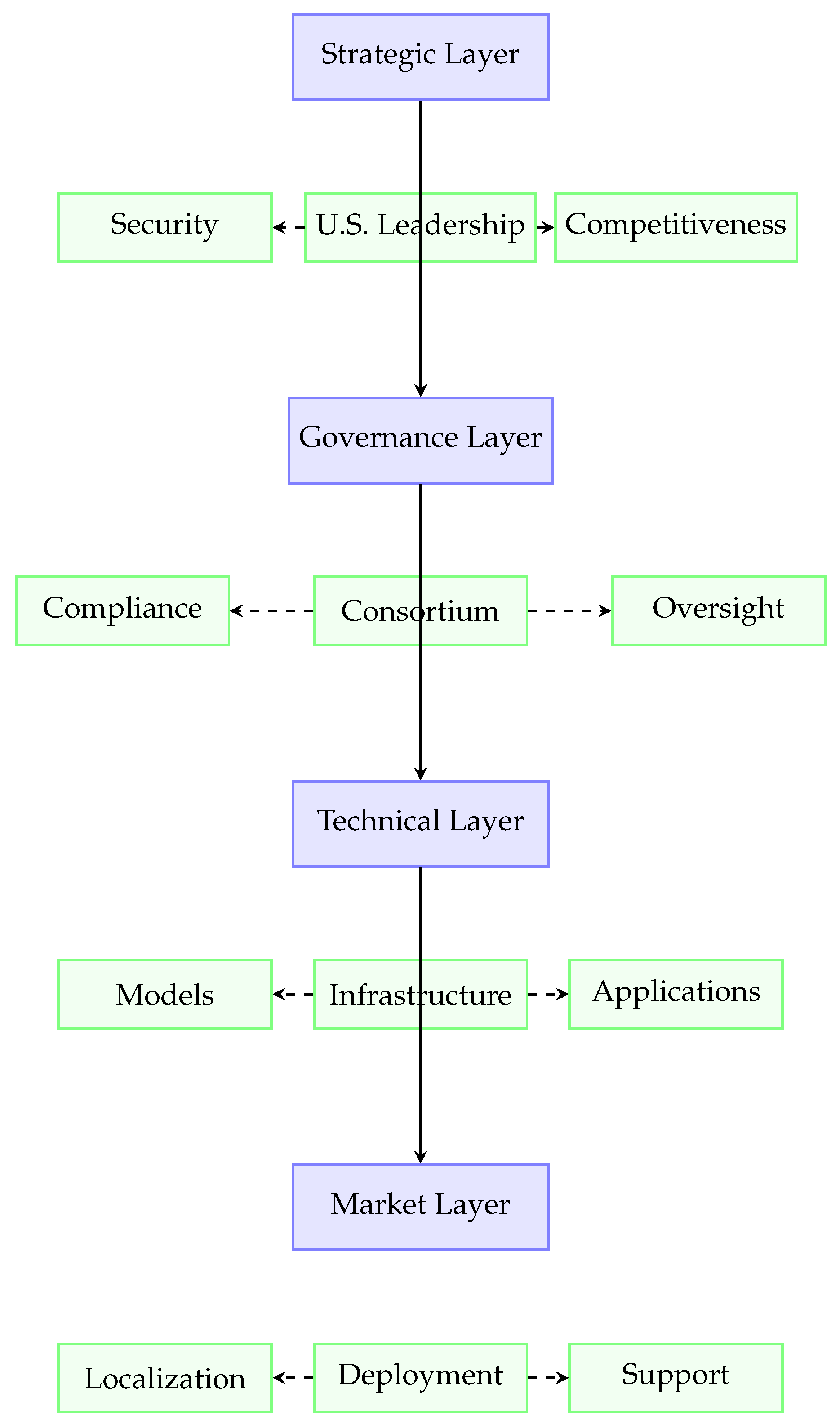
Figure 2.
Technical Stack Component Architecture illustrating the layered structure of AI export systems. Cloud providers (top) support underlying infrastructure components, which feed into data pipelines and AI models. Security considerations apply throughout, with all components converging into deployable applications.
Figure 2.
Technical Stack Component Architecture illustrating the layered structure of AI export systems. Cloud providers (top) support underlying infrastructure components, which feed into data pipelines and AI models. Security considerations apply throughout, with all components converging into deployable applications.
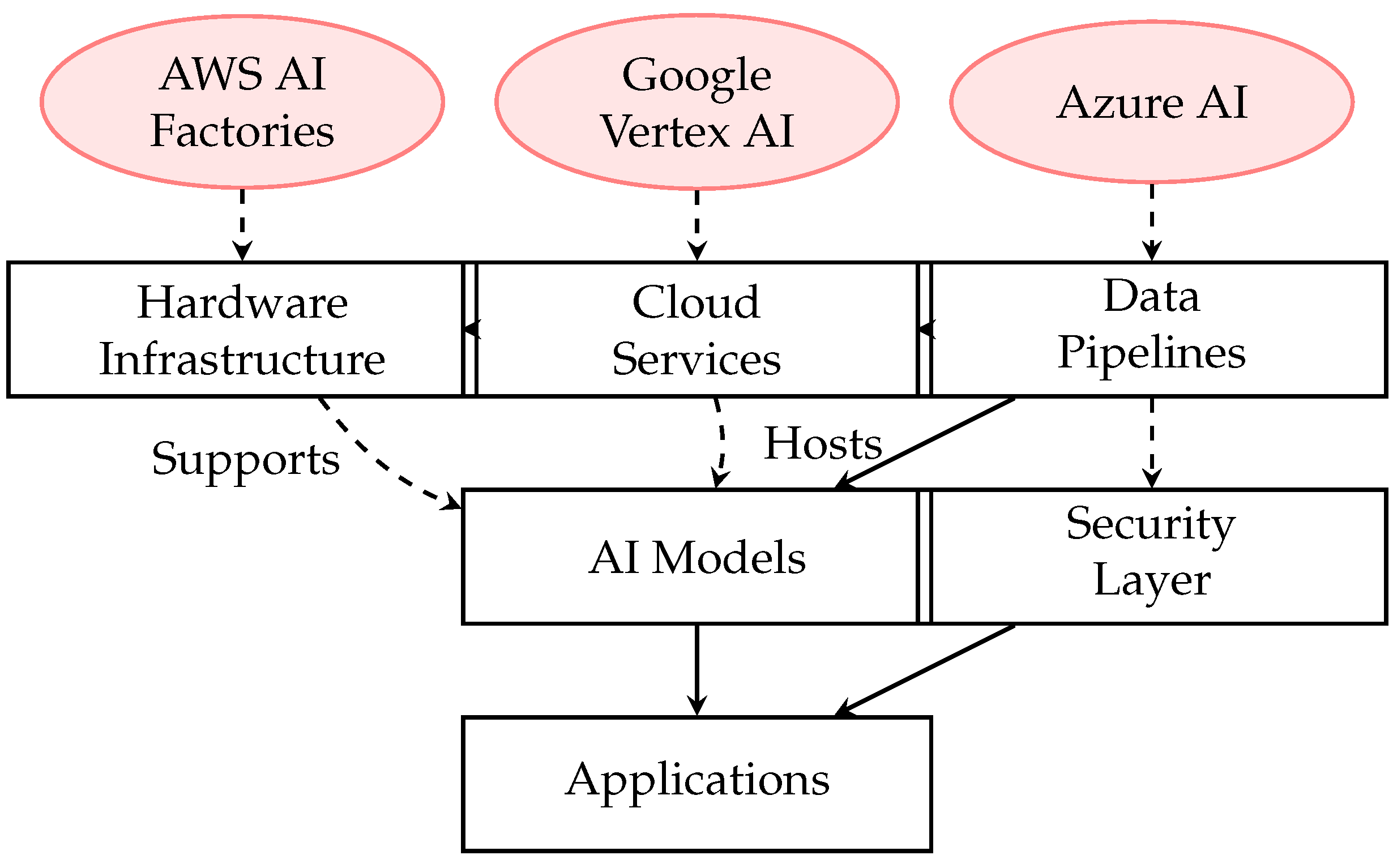
Figure 3.
Three-Phase Implementation Roadmap
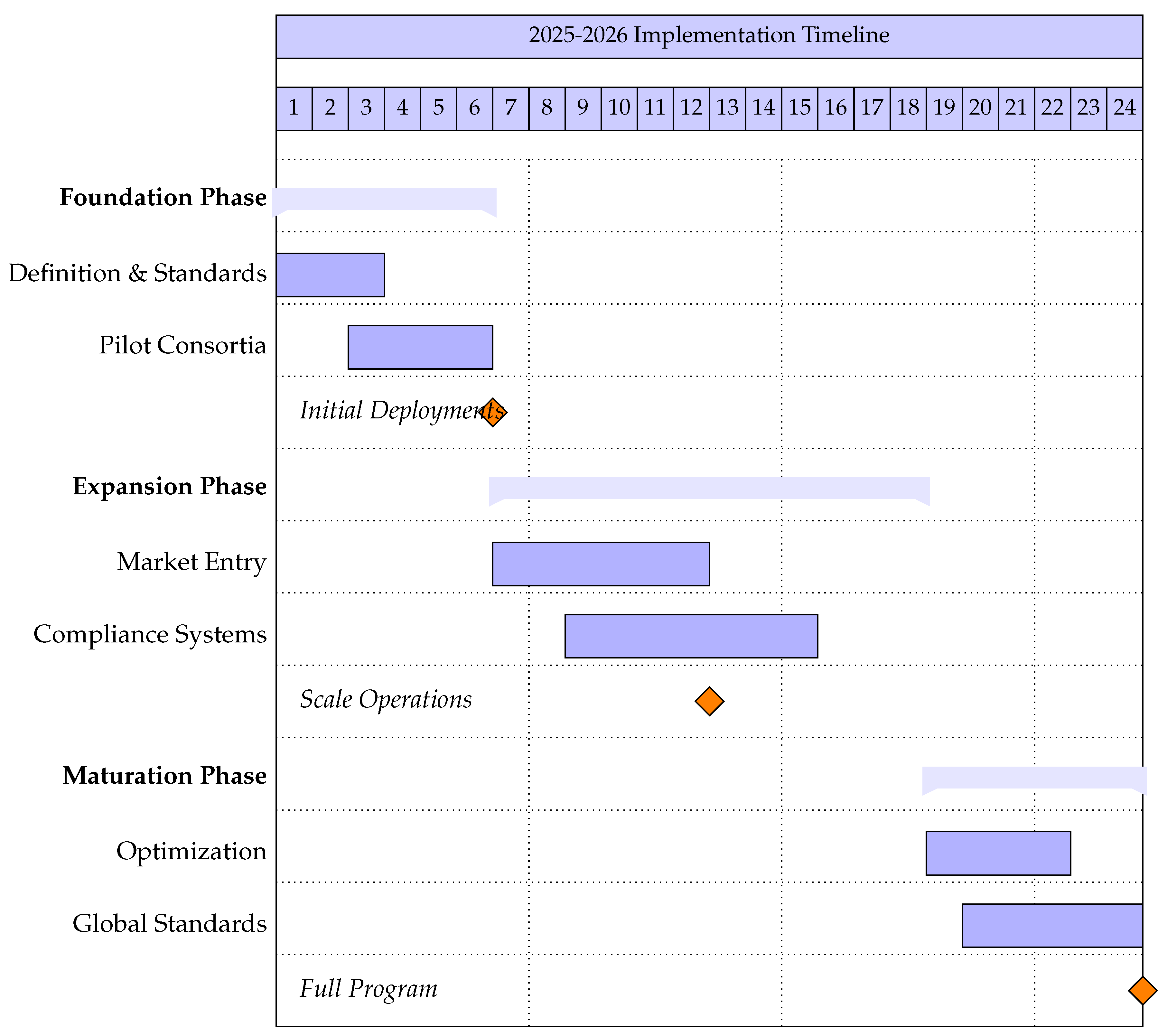
Figure 4.
Compact consortium governance structure designed to fit IEEE two-column format. The Governance Board oversees three domains: Technical, Business, and External Relations.
Figure 4.
Compact consortium governance structure designed to fit IEEE two-column format. The Governance Board oversees three domains: Technical, Business, and External Relations.
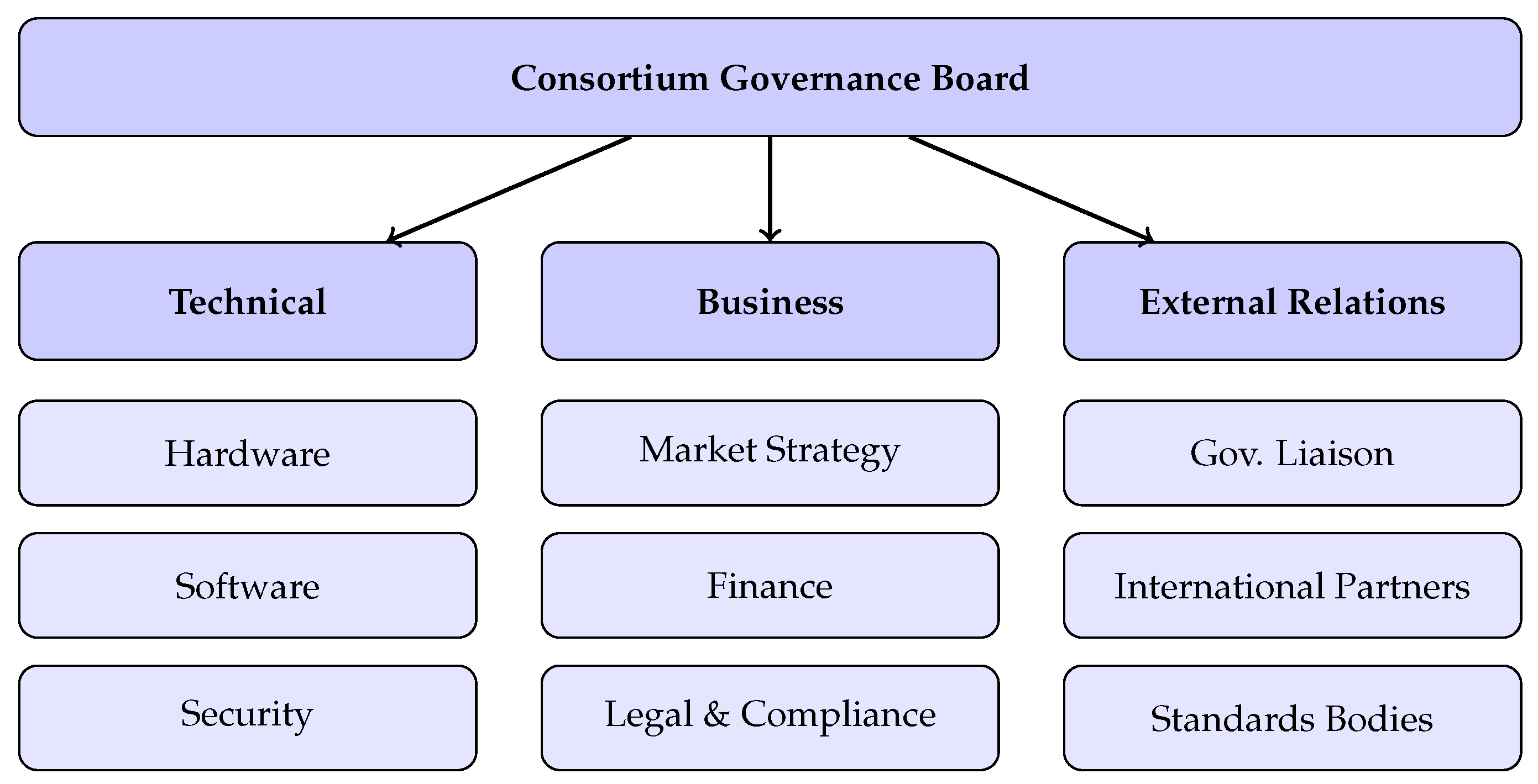
Figure 5.
Layered Security Compliance Framework.
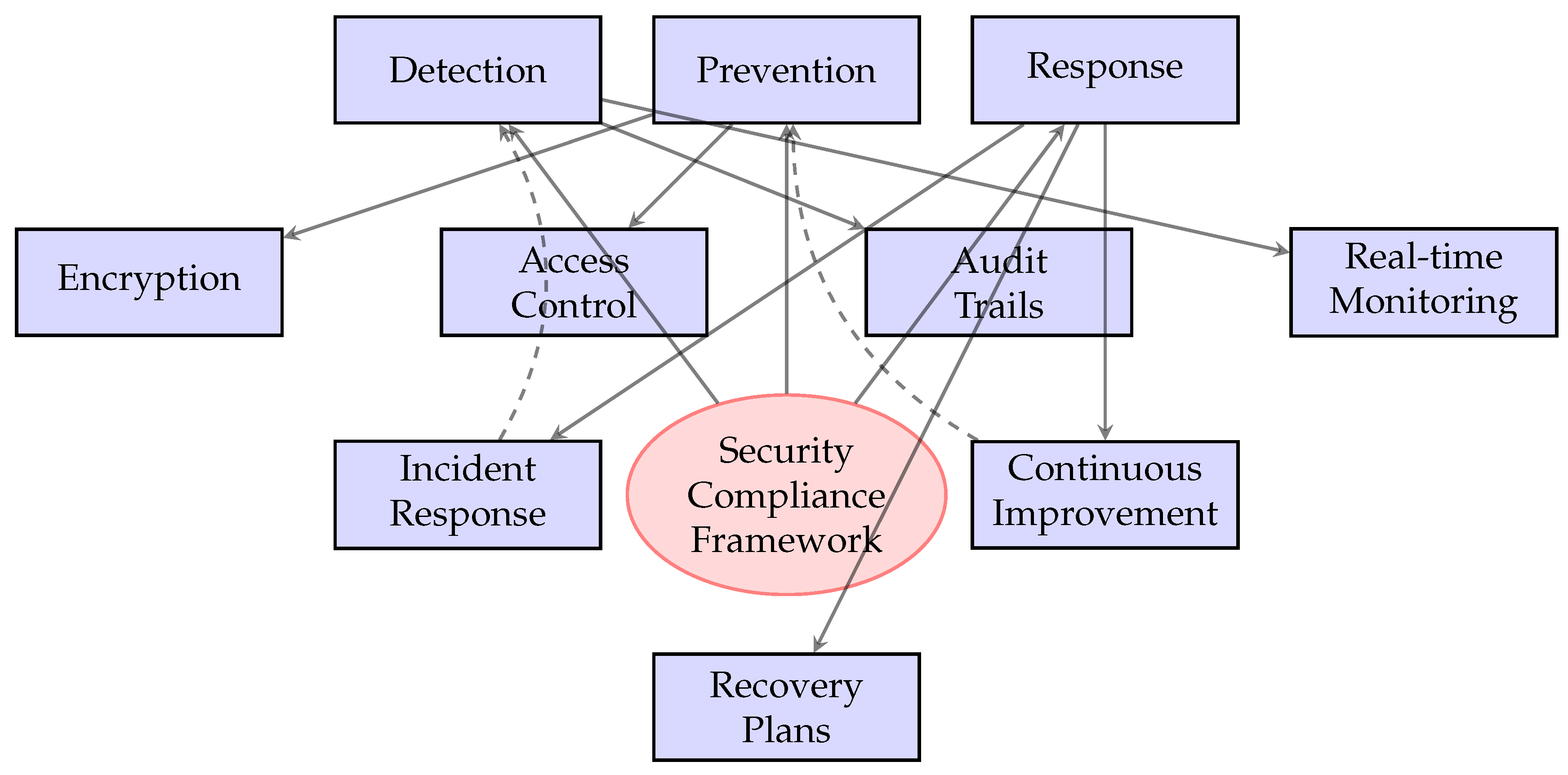
Figure 6.
Visual Representation of Architecture Components.
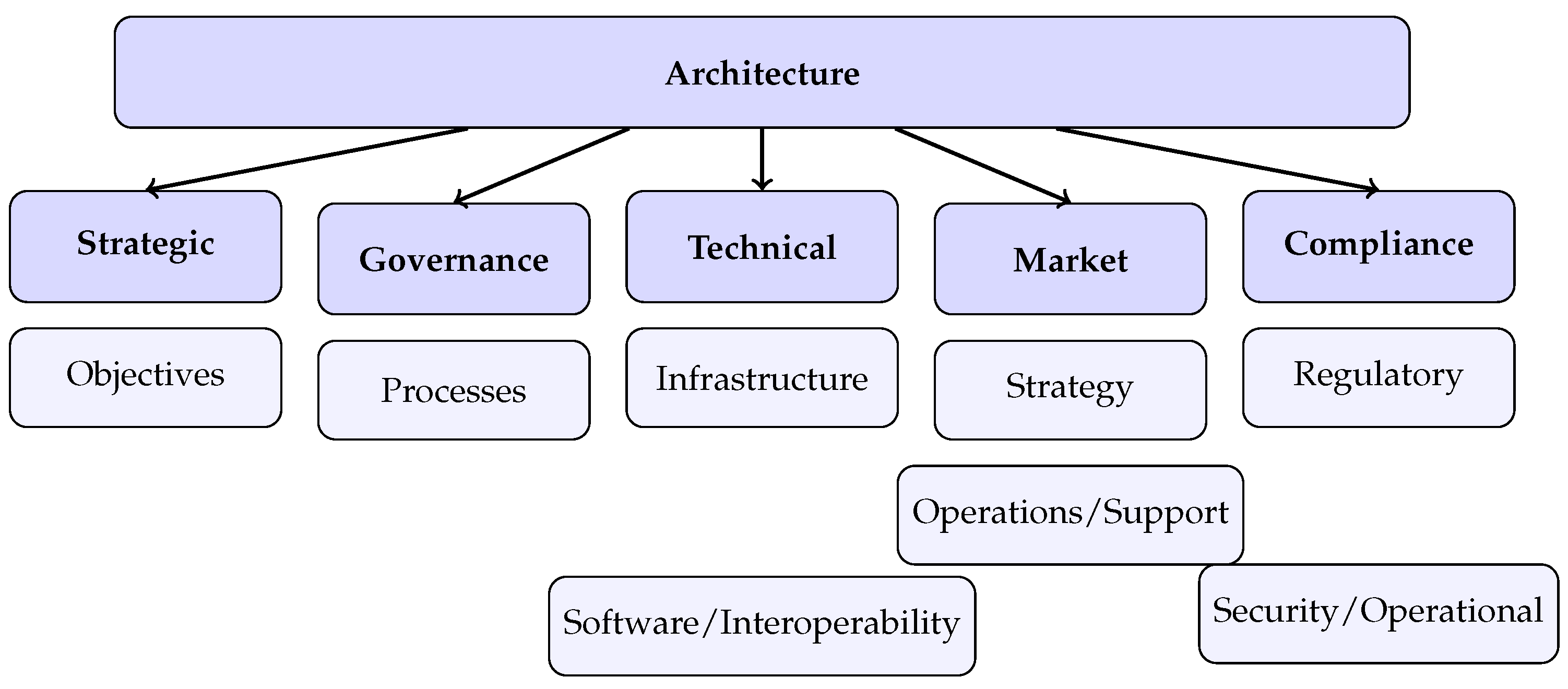

Table 1.
Market Prioritization Matrix with Strategic Scoring.
| Country/Region | Strategic Alignment | Market Readiness | ||
|---|---|---|---|---|
| Alliance | Economic | Infrastructure | Regulatory | |
| United Kingdom | High | High | High | High |
| Japan | High | High | High | Medium |
| Germany | High | High | High | High |
| Singapore | Medium | High | High | High |
| United Arab Emirates | Medium | High | High | Medium |
| India | Medium | High | Medium | Medium |
| Brazil | Medium | High | Medium | Low |
| Vietnam | Low | Medium | Low | Low |
Table 2.
Comprehensive Risk Assessment Matrix.
| Risk Category | Probability | Impact | Mitigation Strategy | Owner |
|---|---|---|---|---|
| Technology Diversion | High | Critical | Automated compliance monitoring | Security Team |
| IP Theft | Medium | High | Encryption & licensing controls | Legal Department |
| Market Competition | High | High | Strategic pricing & partnerships | Business Development |
| Regulatory Changes | Medium | Medium | Agile compliance frameworks | Compliance Office |
| Supply Chain Disruption | Low | High | Multi-source procurement | Operations |
| Cybersecurity Breach | Medium | Critical | Layered security protocols | CISO |
Table 3.
Stakeholder Engagement and Responsibility Matrix.
| Stakeholder Group | Phase 1 (0-6 mo) | Phase 2 (7-12 mo) | Phase 3 (13-18 mo) | Phase 4 (19-24 mo) | Success Metrics |
|---|---|---|---|---|---|
| AI Technology Providers | Consultation & Requirements | Pilot Participation | Full Deployment | Optimization & Feedback | Export Revenue, Market Share |
| Government Agencies | Policy Development | Regulatory Alignment | Diplomatic Support | International Standards | Trade Agreements, Compliance |
| Foreign Partners | Market Assessment | Localization Planning | Joint Operations | Capacity Building | Local Jobs, Technology Transfer |
| Security Experts | Framework Development | Compliance Testing | Ongoing Monitoring | Threat Intelligence | Security Incidents, Audit Results |
| Content Industry | IP Framework | Licensing Agreements | Royalty Management | Copyright Protection | Licensing Revenue, Infringement Cases |
Table 4.
Comprehensive Performance Metrics Dashboard.
| KPI Category | Metric | Target | Measurement Method |
|---|---|---|---|
| Market Performance | Export Revenue | $10B Year 3 | Quarterly Financial Reports |
| Market Share | 40% in Priority Markets | Market Analysis Surveys | |
| Customer Satisfaction | 90%+ | NPS Surveys | |
| Security Compliance | Security Incidents | < 0.1% | Security Monitoring Systems |
| Compliance Audit Score | 95%+ | Independent Audits | |
| Response Time | < 1 hour | Incident Response Logs | |
| Technical Performance | System Uptime | 99.9% | Monitoring Systems |
| Data Processing Speed | < 100ms | Performance Testing | |
| Interoperability Score | 95%+ | Integration Testing | |
| Strategic Impact | Technology Leadership Index | Top 3 Global | Gartner/IDC Rankings |
| IP Protection Score | 90%+ | Legal Compliance Audits | |
| Partner Satisfaction | 85%+ | Partner Surveys |
Table 5.
Decision Support Matrix for Program Management.
| Decision Scenario | Data Required | Analysis Method | Stakeholders | Timeframe | Success Criteria |
|---|---|---|---|---|---|
| Market Entry | Market size, Competition, Regulations | SWOT Analysis, PESTLE | Business Dev, Legal | 30-60 days | Profitability > 20% ROI |
| Technology Selection | Technical specs, Cost, Compatibility | TCO Analysis, Scoring Matrix | CTO, Engineering | 60-90 days | Performance > SLAs |
| Partner Selection | Capabilities, Reputation, Alignment | Due Diligence, Reference Checks | Partnerships, Legal | 45-60 days | Strategic Fit > 80% |
| Security Implementation | Threat Models, Compliance Regs | Risk Assessment, Gap Analysis | CISO, Compliance | Ongoing | Zero Critical Breaches |
| Scale Decision | Demand Forecast, Capacity, Costs | ROI Analysis, Capacity Planning | Operations, Finance | Quarterly | Efficiency Gains > 15% |
G. Implementation Recommendations
Based on the comprehensive framework analysis, we recommend:
- 1)
- Phase 1 (0-6 months): Establish governance structures and technical foundations
- 2)
- Phase 2 (7-18 months): Deploy pilot programs in priority markets
- 3)
- Phase 3 (19-36 months): Scale operations and optimize performance
- 4)
- Phase 4 (37+ months): Lead global standards and innovation
The proposed framework provides a robust architecture for successful implementation of the American AI Exports Program, balancing technical requirements with strategic objectives while ensuring compliance and security.
IV. Research Methodology
A. Data Collection and Analysis
The analytical framework integrates stakeholder perspectives with current academic and industry research on AI technology stacks and export governance.
B. Analytical Framework
We propose a multi-dimensional analytical framework examining:
- 1)
- Technical Infrastructure: Hardware, software, and platform considerations
- 2)
- Governance Structures: Consortium formation, compliance mechanisms, oversight frameworks
- 3)
- Market Dynamics: Competitive positioning, customer requirements, partner ecosystems
- 4)
- Policy Environment: Regulatory frameworks, trade agreements, diplomatic considerations
C. Literature Integration
V. Stakeholder Analysis and Perspectives
A. Technology Providers: Infrastructure and Implementation
AI technology providers emphasized practical implementation considerations, including:
- Stack Integration: Requirements for seamless interoperability across technology layers [23]
- Deployment Models: Varied approaches including Build-Own-Operate and managed services
- Security Integration: Built-in compliance mechanisms for international deployments [24]
- Localization Requirements: Adaptation needs for diverse international markets
B. Content Industry: Intellectual Property Framework
The content industry perspective focuses on IP protection mechanisms, highlighting:
- Licensing Frameworks: Standardized approaches for training data usage [25]
- Compliance Verification: Mechanisms for ensuring proper data sourcing
- Market Access Conditions: Requirements for recipient country IP protection levels
- Dispute Resolution: Processes for addressing copyright concerns internationally
C. Security and Compliance Experts: Risk Management
Security experts emphasized comprehensive risk management frameworks, including:
- Automated Monitoring: Real-time compliance verification systems [19]
- Layered Security: Multi-level protection for different technology components
- Audit Capabilities: Comprehensive logging and reporting mechanisms
- Incident Response: Protocols for addressing security breaches
D. Policy Analysts: Strategic Considerations
Policy analysts highlighted broader strategic dimensions:
- Competitive Positioning: Response to state-subsidized alternatives
- Diplomatic Coordination: Integration with broader foreign policy objectives
- Capacity Building: Development of partner country capabilities
- Long-term Sustainability: Creation of self-sustaining market ecosystems
VI. Technical Implementation Framework
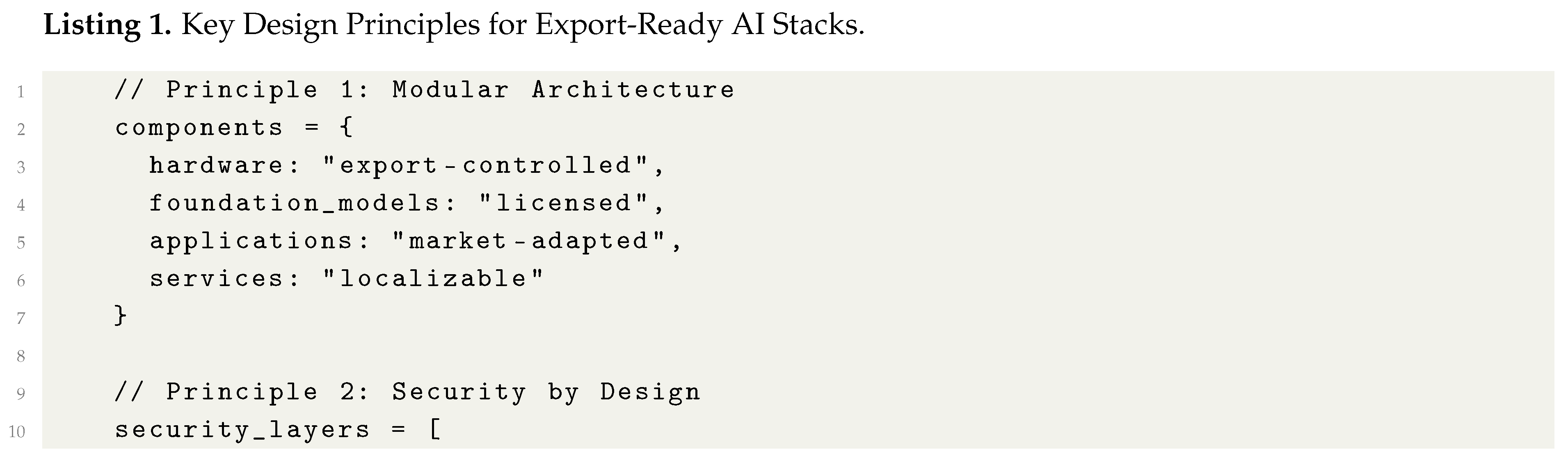
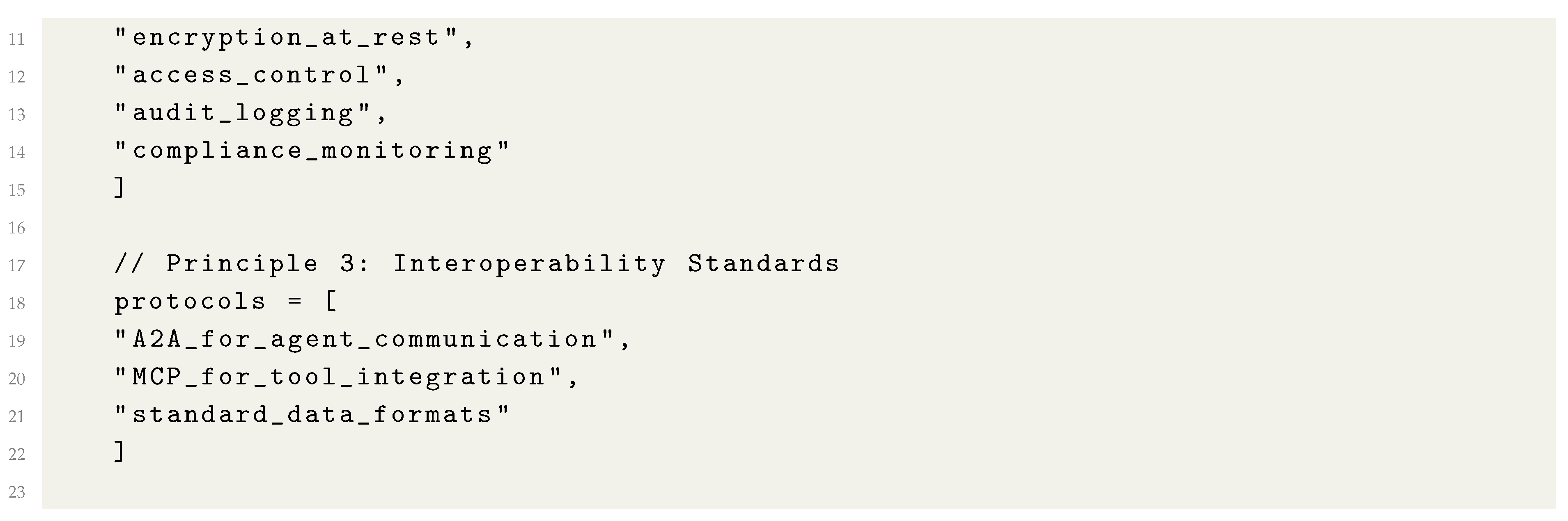
A. Architecture Design Principles
B. Compliance Automation System
Automated compliance monitoring represents a critical technical requirement. We propose a multi-layered approach incorporating:
- Dynamic Classification: Automated Export Control Classification Number (ECCN) determination based on technical specifications
- Real-time Monitoring: Continuous verification of deployment parameters against regulatory requirements
- Reporting Automation: Generation of compliance documentation and audit trails
- Alert Mechanisms: Immediate notification of potential compliance issues
C. Security Implementation
Security implementation must address multiple threat vectors:
- Model Protection: Techniques for securing AI model weights and architectures
- Data Security: Encryption and access control for training and operational data
- Infrastructure Security: Protection of underlying hardware and software platforms
- Operational Security: Safeguards for deployment and maintenance processes
VII. Governance and Compliance Framework
A. Consortium Governance Structure
Table 6.
Consortium Governance Framework Components.
| Component | Requirements | Implementation Guidelines |
|---|---|---|
| Legal Structure | Incorporated entity with defined governance | Establish clear articles of incorporation and bylaws |
| Membership | Clear eligibility criteria and vetting processes | Implement tiered membership with graduated privileges |
| Decision-Making | Transparent processes with documented procedures | Create technical and business review committees |
| IP Management | Defined ownership and licensing frameworks | Establish standard IP agreements and dispute resolution |
| Compliance | Integrated compliance monitoring and reporting | Deploy automated systems with manual oversight |
B. Regulatory Compliance Architecture
The compliance architecture must integrate multiple regulatory frameworks:
- Export Controls: ITAR, EAR, and dual-use regulations
- Data Protection: GDPR, CCPA, and other privacy regulations
- Intellectual Property: Copyright, patent, and trade secret protections
- Industry Standards: Sector-specific regulations and certifications
C. Risk Management System
A comprehensive risk management system should include:
- Risk Assessment: Systematic evaluation of technical, commercial, and policy risks
- Mitigation Strategies: Proactive measures to address identified risks
- Monitoring: Continuous tracking of risk indicators and compliance status
- Response Protocols: Documented procedures for addressing incidents
VIII. Market Strategy and Implementation
A. Market Segmentation and Prioritization
Table 7.
Market Prioritization Matrix.
| Tier | Strategic Alignment | Market Readiness | Example Markets |
|---|---|---|---|
| Tier 1 | High (Alliance members) | High (Infrastructure, regulation) | UK, Canada, Japan, Australia |
| Tier 2 | Medium (Partners) | Medium (Growing capabilities) | India, UAE, Singapore, Brazil |
| Tier 3 | Developing (Emerging) | Low (Building foundations) | Vietnam, Indonesia, Colombia |
B. Deployment Models
Multiple deployment models support different market contexts:
- Direct Export: Complete technology stack delivery
- Licensing: Technology transfer with local adaptation
- Joint Venture: Collaborative development and deployment
- Managed Services: Ongoing operation and maintenance support
C. Capacity Building Programs
Successful implementation requires complementary capacity building:
- Technical Training: Development of local AI expertise
- Regulatory Alignment: Support for developing appropriate frameworks
- Ecosystem Development: Fostering local innovation communities
- Standards Participation: Engagement in international standards development
IX. Policy Recommendations and Implementation Roadmap
A. Immediate Actions (0-6 Months)
- 1)
- Establish clear definitions for consortium structures and full-stack components
- 2)
- Develop standardized compliance frameworks based on NIST and ISO standards
- 3)
- Create pilot programs for automated export control implementation
- 4)
- Initiate interagency coordination for financing and diplomatic support
0.1. Medium-Term Initiatives (6-18 Months)
- 1)
- Launch targeted consortia in priority markets with balanced representation
- 2)
- Implement comprehensive monitoring and reporting systems
- 3)
- Develop bilateral agreements for technology sharing and cooperation
- 4)
- Establish certification programs for export-ready AI solutions
B. Long-Term Strategy (18+ Months)
- 1)
- Create sustainable financing mechanisms for international AI infrastructure
- 2)
- Build global coalitions for responsible AI development and deployment
- 3)
- Establish feedback loops for continuous program improvement
- 4)
- Develop metrics for measuring program effectiveness and impact
X. Case Studies and Best Practices
A. Successful AI Export Initiatives
Analysis of successful initiatives reveals common success factors:
- Clear Value Proposition: Demonstrable benefits for recipient countries
- Robust Governance: Effective oversight and compliance mechanisms
- Local Adaptation: Customization to specific market needs and conditions
- Sustainable Partnerships: Long-term collaborative relationships
B. Lessons Learned from Previous Programs
Historical technology export programs provide valuable insights:
- Importance of phased implementation and iterative improvement
- Need for flexible adaptation to changing market conditions
- Value of comprehensive risk assessment and management
- Benefits of transparent communication and stakeholder engagement
XI. The American AI Exports Program Analysis
A. Key Requirements Analysis
1) Full-Stack AI Technology Package Definition
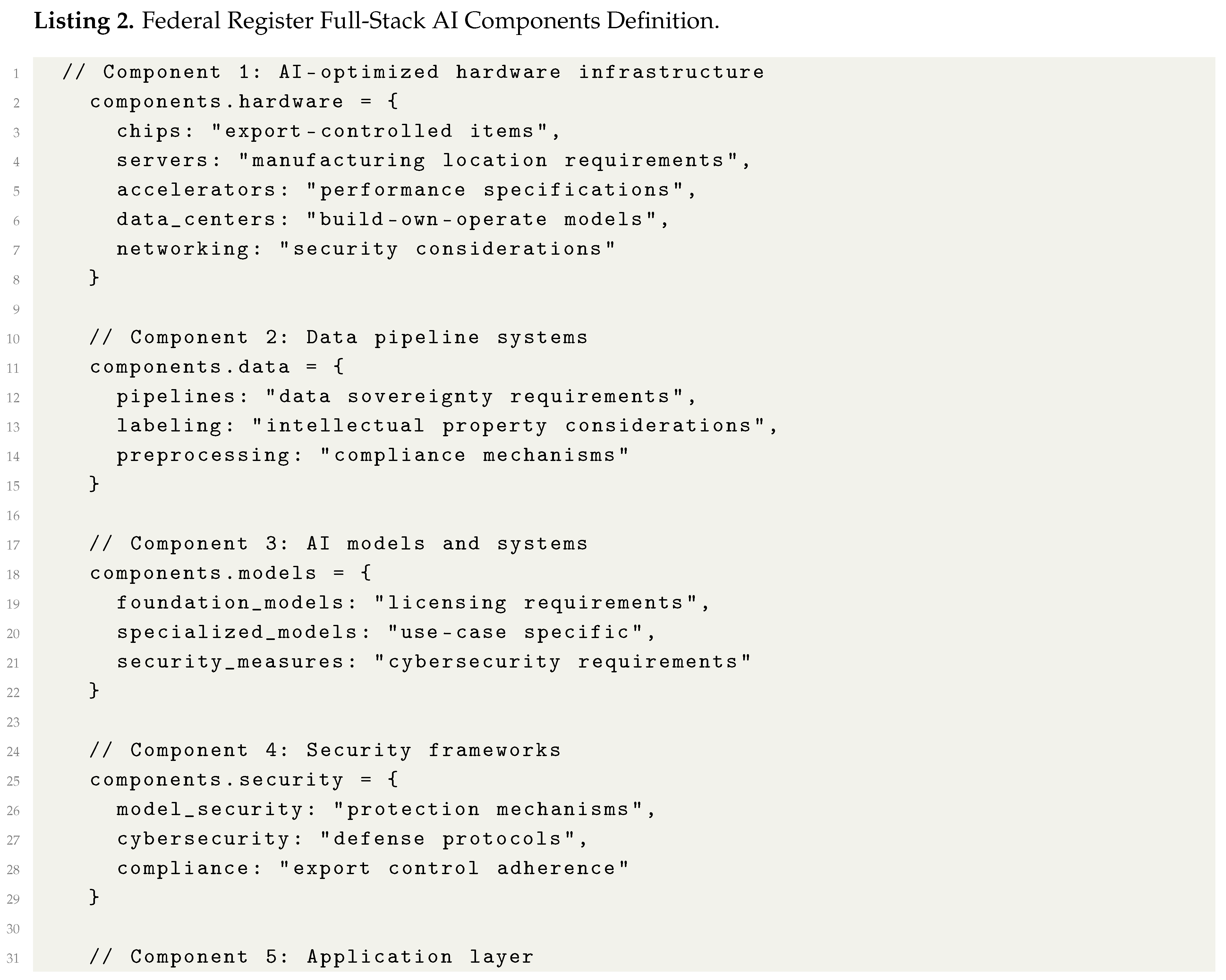
We propose a comprehensive "full-stack AI technology package" that must include five critical components, each with specific export considerations:

2) Consortium Formation Requirements
We propose to establish specific requirements for industry-led consortia, addressing critical governance and participation questions:
Table 8.
Federal Register Consortium Requirements Analysis.
| Aspect | RFI Requirement | Industry Implications |
|---|---|---|
| Eligibility | U.S.-based leadership with export capacity | Potential exclusion of smaller enterprises |
| Foreign Participation | Limited with security vetting | Need for trusted partner frameworks |
| Modularity | Encouraged but not required | Flexibility in technology integration |
| Governance | Transparent decision-making structures | Alignment with corporate governance standards |
| Lead Entity | Designated leadership with integration experience | Concentration of power in large tech firms |
B. Security and Compliance Framework
We propose comprehensive compliance with U.S. national security regulations:
- Export Controls: Full adherence to Bureau of Industry and Security regulations
- Outbound Investment: Compliance with CFIUS and related frameworks
- End-User Policies: Strict vetting of technology recipients
- Cybersecurity: Implementation of NIST-aligned security measures
C. Market Strategy Implications
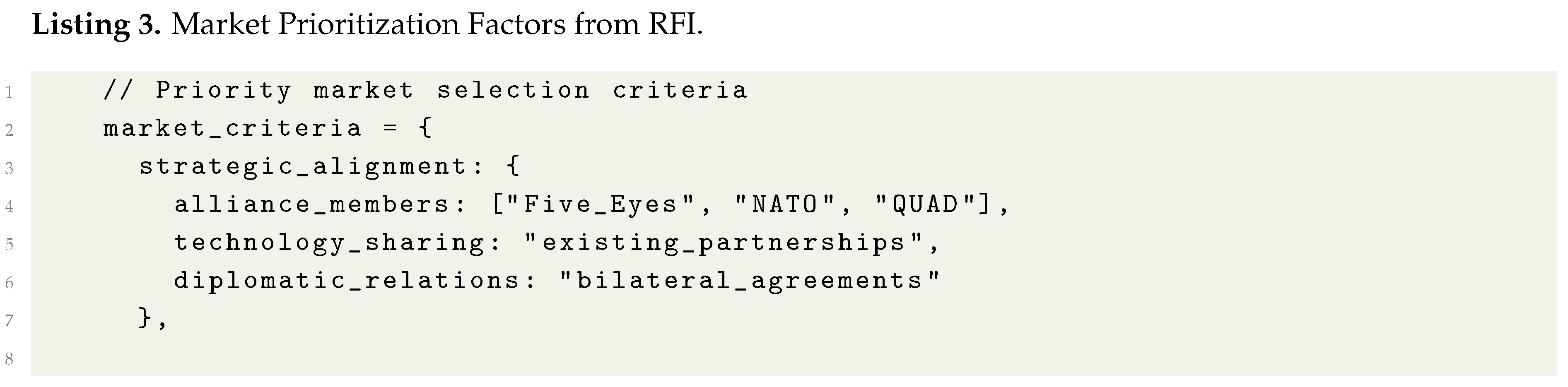
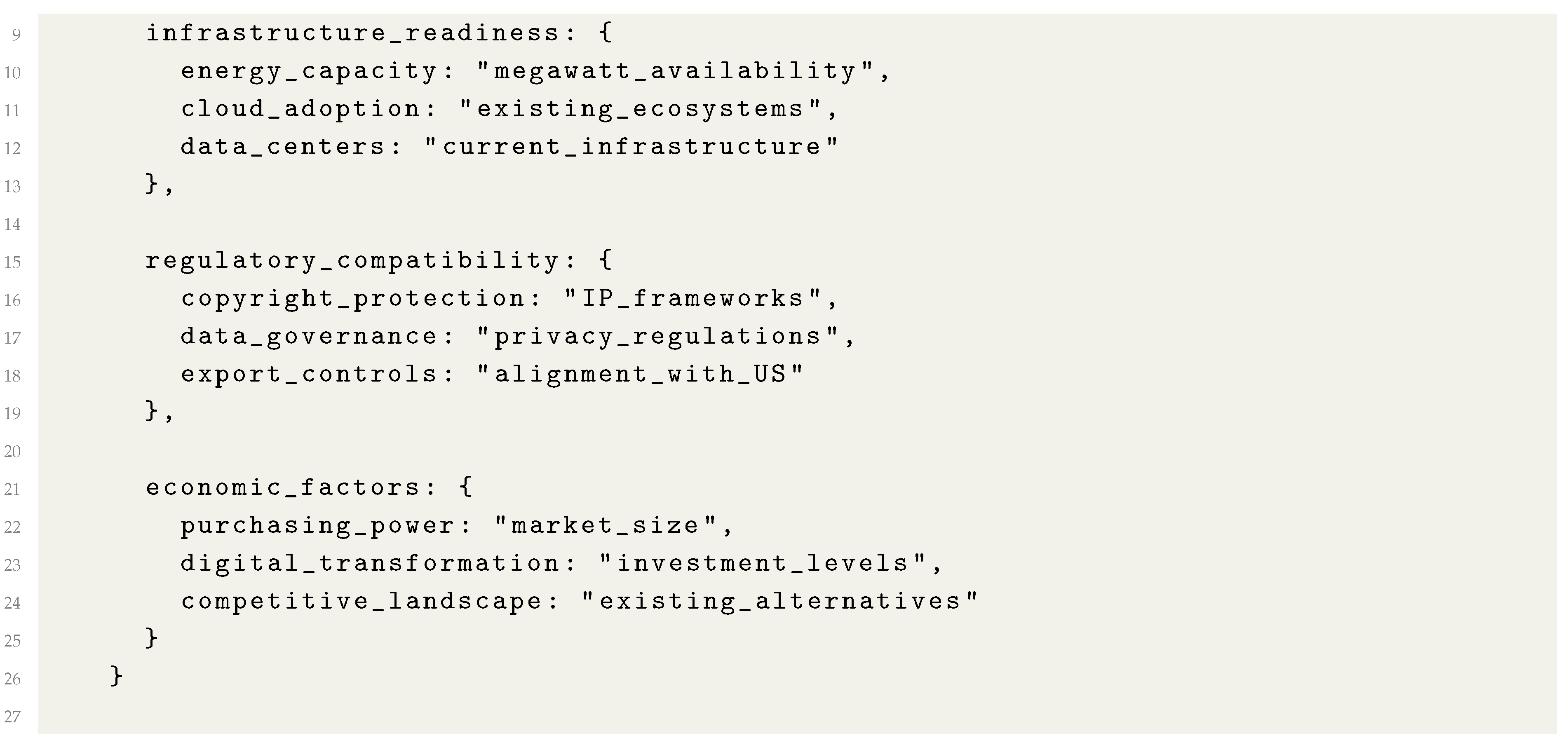
The RFI should focus on market prioritization, requiring consortia to identify specific target countries or regional blocs. This approach reflects strategic considerations in several ways:
D. Federal Support Mechanisms
The Federal Register outlines specific federal support tools available to selected consortia:
Table 9.
Federal Support Mechanisms Analysis.
| Support Type | Legal Authority | Industry Relevance |
|---|---|---|
| Direct Loans | 12 U.S.C. 635 | Infrastructure financing |
| Loan Guarantees | 12 U.S.C. 635 | Risk mitigation |
| Equity Investments | 22 U.S.C. 9621 | Consortium capitalization |
| Political Risk Insurance | 22 U.S.C. 9621 | International deployment |
| Technical Assistance | 22 U.S.C. 2421(b) | Implementation support |
| Feasibility Studies | 22 U.S.C. 2421(b) | Market assessment |
| Regulatory Guidance | Agency discretion | Compliance navigation |
| Diplomatic Support | State Department | Market access |
These support mechanisms address financing competitiveness concerns raised in stakeholder responses [28] and align with recommendations for enhanced federal support structures.
E. Implementation Challenges Identified
The RFI highlights several implementation challenges that require resolution:
1) Definitional Ambiguity
The notice acknowledges the need for clearer definitions of key terms:
- "Consortium" formation and governance structures
- "Full-stack" technology package boundaries
- "Industry-led" versus government-involved participation
- "Trusted partner" criteria for foreign participation
2) Security-Competitiveness Balance
The tension between stringent security controls and market competitiveness presents significant challenges:
- Export control compliance versus technology accessibility
- End-user vetting versus market expansion
- Security frameworks versus implementation flexibility
- Compliance costs versus price competitiveness
This balance is particularly critical given competition from state-subsidized alternatives [3].
3) Intellectual Property Considerations
The RFI implicitly raises IP issues through its focus on:
- Technology transfer controls
- Licensing requirements for AI models
- Copyright protection for training data
- Patent considerations for AI innovations
These issues connect directly with content industry concerns about IP protection [25].
F. Connections to Industry References
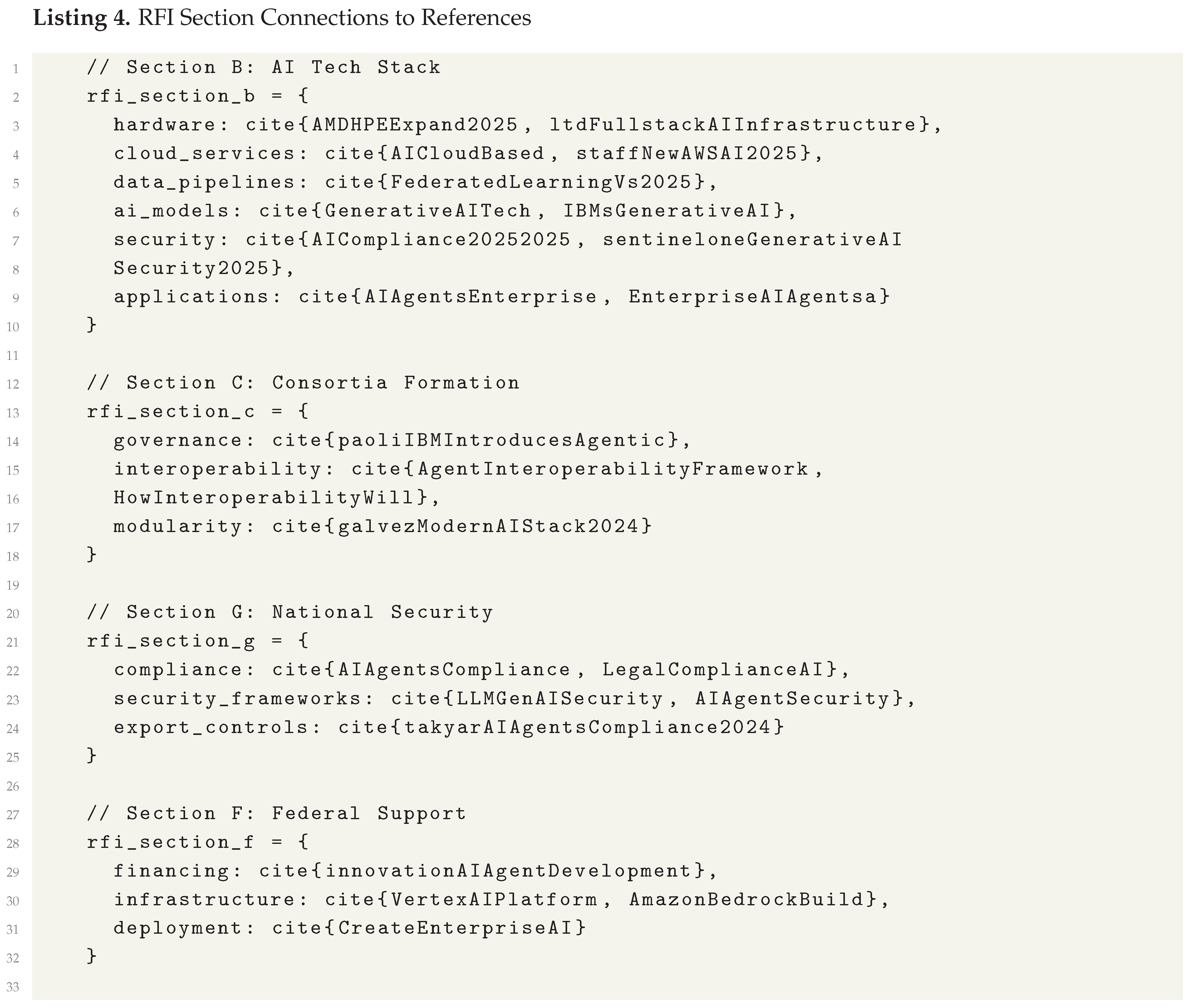
The Federal Register notice connects directly with several key references from the bibliography:
G. Strategic Implications and Recommendations
Based on analysis of the Federal Register notice and connected references, several strategic implications emerge:
1) Implementation Priority Areas
- 1)
- Clarity in Definitions: Immediate need for precise definitions of consortium structures and technology stack components
- 2)
- Security Frameworks: Development of standardized compliance mechanisms that balance security with competitiveness
- 3)
- Market Strategy: Systematic approach to market prioritization based on multiple criteria
- 4)
- Support Coordination: Integrated approach to federal support mechanisms across agencies
2) Policy Recommendations
- Establish clear consortium governance templates with standardized IP management frameworks
- Develop graduated security compliance levels based on destination country risk assessments
- Create flexible participation models that accommodate both large consortia and specialized providers
- Implement phased market entry strategies with pilot programs in priority markets
- Establish feedback mechanisms for continuous program improvement based on implementation experience
3) Research Opportunities
The Federal Register notice highlights several areas for further research:
- Impact of consortium models on innovation ecosystems and market competition
- Effectiveness of different security-compliance frameworks in international deployments
- Comparative analysis of federal support mechanisms across technology sectors
- Longitudinal studies of AI export program impacts on U.S. competitiveness
The American AI Exports Program, as outlined in the Federal Register notice, represents a comprehensive approach to strategic technology export promotion. Its successful implementation requires careful attention to the interconnected challenges of technology integration, security compliance, market strategy, and federal support coordination. The notice provides a solid foundation but highlights the need for ongoing adaptation and refinement based on stakeholder input and implementation experience.
XII. Figures and Tables Reference
This section provides a comprehensive reference to all figures, tables, and listings included in this paper, organized by their appearance in the document structure.
A. Figures Reference
Table 10.
List of Figures in the Paper.
| Figure | Description | Section |
|---|---|---|
| Figure 1 | Multi-Layer Framework Architecture for AI Exports Program showing strategic, governance, technical, and market layers with their components | |
| Figure 2 | Technical Stack Component Architecture illustrating hardware infrastructure, cloud services, data pipelines, AI models, security layer, and applications | |
| Figure 3 | Three-Phase Implementation Roadmap using Gantt chart to visualize Foundation, Expansion, and Maturation phases over 24 months | |
| Figure 4 | Consortium Governance Organizational Structure showing hierarchical relationship between Governance Board, Technical Committee, Business Committee, and External Relations | |
| Figure 5 | Layered Security Compliance Framework illustrating prevention, detection, response mechanisms with their subcomponents and feedback loops | |
| Figure 6 | Visual Representation of Architecture Components as tree diagram showing Strategic, Governance, Technical, Market, and Compliance layers |
B. Tables Reference
Table 11.
List of Tables in the Paper.
| Table | Description | Section |
|---|---|---|
| Table 1 | Market Prioritization Matrix with Strategic Scoring for 8 countries/regions across Strategic Alignment and Market Readiness dimensions | |
| Table 2 | Comprehensive Risk Assessment Matrix covering 6 risk categories with Probability, Impact, Mitigation Strategy, and Owner columns | |
| Table 3 | Stakeholder Engagement and Responsibility Matrix showing engagement activities across 4 phases for 5 stakeholder groups | |
| Table 4 | Comprehensive Performance Metrics Dashboard with 4 KPI categories (Market Performance, Security Compliance, Technical Performance, Strategic Impact) | |
| Table 5 | Decision Support Matrix for Program Management covering 5 decision scenarios with Data Required, Analysis Method, Stakeholders, Timeframe, and Success Criteria | |
| Table 6 | Consortium Governance Framework Components table showing 5 components with Requirements and Implementation Guidelines | |
| Table 7 | Market Prioritization Matrix with 3 tiers (Tier 1, 2, 3) showing Strategic Alignment, Market Readiness, and Example Markets | |
| Table 8 | Federal Register Consortium Requirements Analysis table comparing RFI Requirements with Industry Implications across 5 aspects | 0.1 |
| Table 9 | Federal Support Mechanisms Analysis table showing 8 support types with Legal Authority and Industry Relevance | 0.1 |
| Table 10 | List of Figures in the Paper (this table) - Reference table for all figures | 0.1 |
| Table 11 | List of Tables in the Paper (this table) - Reference table for all tables | 0.1 |
| Table 12 | List of Code Listings in the Paper (this table) - Reference table for all code listings | 0.1 |
C. Code Listings Reference
Table 12.
List of Code Listings in the Paper.
| Listing | Description | Section |
|---|---|---|
| 1 | Key Design Principles for Export-Ready AI Stacks showing modular architecture, security by design, and interoperability standards in pseudocode format | |
| 2 | Federal Register Full-Stack AI Components Definition showing 5 components (hardware, data, models, security, applications) with their properties in pseudocode | 0.1 |
| 3 | Market Prioritization Factors from RFI showing selection criteria (strategic alignment, infrastructure readiness, regulatory compatibility, economic factors) in pseudocode | 0.1 |
| 4 | RFI Section Connections to References showing how different RFI sections connect to bibliography references in pseudocode format | 0.1 |
D. Visualization Summary
The paper contains a total of:
- 6 Figures: 2 architectural diagrams, 1 Gantt chart, 2 organizational charts, and 1 tree diagram
- 12 Tables: 7 analytical matrices, 3 reference tables, and 2 governance/implementation tables
- 4 Code Listings: All in pseudocode format illustrating implementation concepts
These visual elements serve multiple purposes:
- 1)
- 2)
- Process Visualization:Figure 3 shows temporal implementation planning
- 3)
- 4)
- 5)
- Technical Specifications: Listings through document implementation details
All visual elements are cross-referenced in the text and designed to complement the analytical narrative, providing both conceptual understanding and practical implementation guidance for the American AI Exports Program framework.
XIII. Conclusion and Future Research Directions
This paper presents a comprehensive framework for implementing the American AI Exports Program, addressing the complex interplay between technological leadership, national security, and global competitiveness in artificial intelligence. Through detailed analysis of multi-stakeholder perspectives, we have developed a structured approach to navigating the challenges of AI technology exports in an increasingly competitive global landscape.
Our multi-layer framework establishes the critical components required for successful program implementation: a strategic foundation focused on U.S. leadership and security; robust governance structures through industry-led consortia; technically sound architectures supporting modular AI stacks; and market strategies balancing accessibility with compliance. The visual representations and analytical matrices provided throughout this paper offer practical tools for decision-making, risk assessment, and implementation planning.
Key findings highlight the necessity of balanced approaches across several dimensions: security controls that protect national interests without stifling innovation; intellectual property frameworks that incentivize creation while enabling technology transfer; governance models that ensure accountability while fostering collaboration; and market strategies that prioritize strategic alignment while building sustainable partnerships. The tension between export promotion and security compliance represents a central challenge that requires sophisticated, automated solutions and graduated risk-based approaches.
The Federal Register analysis demonstrates both the opportunities and complexities of implementing a full-stack AI export program. While the consortium model offers significant advantages in integration and scale, it also raises concerns about market concentration and barriers to entry that must be carefully addressed through inclusive participation frameworks.
Future research should focus on several critical areas: longitudinal studies of program implementation outcomes across different market contexts; comparative analysis of security-compliance frameworks in international AI deployments; empirical assessment of consortium models’ impact on innovation ecosystems; and development of advanced automated compliance technologies that can adapt to evolving regulations. Additionally, research examining the broader economic and geopolitical impacts of strategic AI exports will be essential for informing long-term policy decisions.
The successful implementation of the American AI Exports Program requires not only technical expertise and market understanding but also diplomatic coordination, regulatory innovation, and continuous adaptation to evolving global conditions. By adopting the comprehensive framework presented in this paper—with its emphasis on balanced approaches, stakeholder collaboration, and iterative improvement—the United States can strengthen its AI leadership while contributing to responsible global AI governance. This represents not merely an economic opportunity but a strategic imperative for maintaining technological leadership in an era of accelerating global competition.
Declaration
This work is exclusively a survey paper synthesizing existing published research. No novel experiments, data collection, or original algorithms were conducted or developed by the authors. All content, including findings, results, performance metrics, architectural diagrams, and technical specifications, is derived from and attributed to the cited prior literature. The authors’ contribution is limited to the compilation, organization, and presentation of this pre-existing public knowledge. Any analysis or commentary is based solely on the information contained within the cited works. Figures and tables are visual representations of data and concepts described in the referenced sources.
References
- D. W. Ball. Don’t Overthink "The AI Stack". [Online]. Available online: https://www.hyperdimensional.co/p/dont-overthink-the-ai-stack.
- Artificial Intelligence Market worth $2,407.02 billion by 2032. [Online]. Available online: https://www.marketsandmarkets.com/PressReleases/artificial-intelligence.asp.
- K. Chan, G. Smith, J. Goodrich, G. DiPippo, and K. F. Pilz, “Full Stack: China’s Evolving Industrial Policy for AI.” [Online]. Available online: https://www.rand.org/pubs/perspectives/PEA4012-1.html.
- What is an AI Stack? | IBM. [Online]. Available online: https://www.ibm.com/think/topics/ai-stack.
- AI Compliance in 2025: Definition, Standards, and Frameworks | Wiz. wiz.io. [Online]. Available online: https://www.wiz.io/academy/ai-compliance.
- A. Staff. New AWS AI Factories transform customers’ existing infrastructure into high-performance AI environments. [Online]. Available online: https://www.aboutamazon.com/news/aws/aws-data-centers-ai-factories.
- Agent interoperability framework | Designing an Agent Interoperability Framework for Next-Gen AI Collaboration. [Online]. Available online: https://www.llumo.ai/blog/designing-an-agent-interoperability-framework-for-next-gen-ai-collaboration.
- AI Tech Stack: A Complete Guide to Data, Frameworks, MLOps. [Online]. Available online: https://www.coherentsolutions.com/insights/overview-of-ai-tech-stack-components-ai-frameworks-mlops-and-ides.
- AMD and HPE Expand Collaboration to Advance Open Rack-Scale AI Infrastructure. Advanced Micro Devices, Inc. [Online]. Available online: https://ir.amd.com/news-events/press-releases/detail/1269/amd-and-hpe-expand-collaboration-to-advance-open-rack-scale-ai-infrastructure.
- Vertex AI Platform. Google Cloud. [Online]. Available online: https://cloud.google.com/vertex-ai.
- Edge AI vs Federated Learning | Complete Overview. [Online]. Available online: https://www.xenonstack.com/blog/edge-ai-vs-federated-learning.
- N. kaufman. The Rise of the Full-Stack AI Engineer. Israeli Tech Radar. [Online]. Available online: https://medium.com/israeli-tech-radar/the-rise-of-the-full-stack-ai-engineer-0f31fed4e1f0.
- Generative AI Tech Stack: A Comprehensive Guide for Developers. Requestum. [Online]. Available online: https://requestum.com/blog/generative-ai-tech-stack.
- AI Agents for the Enterprise | StackAI. [Online]. Available online: https://www.stack-ai.com/.
- G. A. Li, Yoko. The Trillion Dollar AI Software Development Stack. Andreessen Horowitz. [Online]. Available online: https://a16z.com/the-trillion-dollar-ai-software-development-stack/.
- M. Clark. Agents Today #15 - AI Agent Interoperability: Head-to-Head with MCP and A2A. AgentsToday. [Online]. Available online: https://agentstoday.substack.com/p/agents-today-15-ai-agent-interoperability.
- Federated Learning vs. Edge AI: Preserving Privacy. [Online]. Available online: https://dialzara.com/blog/federated-learning-vs-edge-ai-preserving-privacy.
- I. G. Wambui. The Magical World of Edge AI and Federated Learning: Unleashing the Power of Smart Devices and Protecting Data Privacy. Comet. [Online]. Available online: https://www.comet.com/site/blog/the-magical-world-of-edge-ai-and-federated-learning-unleashing-the-power-of-smart-devices-and-protecting-data-privacy.
- AI Agents’ Compliance | Automate Governance & Stay Audit-Ready. Zenity | Secure AI Agents Everywhere. [Online]. Available online: https://zenity.io/use-cases/business-needs/ai-agents-compliance.
- Modern AI Tech Stack in 2025: The Ultimate Guide. 5ly.co. [Online]. Available online: https://5ly.co/blog/ai-tech-stack/.
- A Comprehensive Guide to AI Tech Stack. Sparx IT Solutions. [Online]. Available online: https://www.sparxitsolutions.com/blog/ai-tech-stack/.
- SentinelOne. Generative AI Security Policy Templates and Best Practices. SentinelOne. [Online]. Available online: https://www.sentinelone.com/cybersecurity-101/data-and-ai/generative-ai-security-policy/.
- Intel. AI Tech Stack Solutions. Intel. [Online]. Available online: https://www.intel.com/content/www/us/en/learn/ai-tech-stack.html.
- LLM & GenAI Security with Our Platform: PlainID. [Online]. Available online: https://www.plainid.com/llm-genai-security/.
- Generative AI Licensing Agreement Tracker. Ithaka S+R. [Online]. Available online: https://sr.ithaka.org/our-work/generative-ai-licensing-agreement-tracker/.
- S. Chatterjee. Why Interoperability Is the Next Big Test for Enterprise AI Agents. RTInsights. [Online]. Available online: https://www.rtinsights.com/why-interoperability-is-the-next-big-test-for-enterprise-ai-agents/.
- AI Agent Security & Data Privacy: Complete Compliance Guide (2025) | P0STMAN. [Online]. Available online: https://p0stman.com/guides/ai-agent-security-data-privacy-guide-2025.html.
- R. Innovation. AI Agent Development Costs: Comprehensive Guide for Businesses. [Online]. Available online: https://www.rapidinnovation.io/post/what-is-the-cost-of-building-ai-agents.
Disclaimer/Publisher’s Note: The statements, opinions and data contained in all publications are solely those of the individual author(s) and contributor(s) and not of MDPI and/or the editor(s). MDPI and/or the editor(s) disclaim responsibility for any injury to people or property resulting from any ideas, methods, instructions or products referred to in the content. |
© 2025 by the authors. Licensee MDPI, Basel, Switzerland. This article is an open access article distributed under the terms and conditions of the Creative Commons Attribution (CC BY) license (http://creativecommons.org/licenses/by/4.0/).
Copyright: This open access article is published under a Creative Commons CC BY 4.0 license, which permit the free download, distribution, and reuse, provided that the author and preprint are cited in any reuse.


