

Submitted:
02 December 2025
Posted:
03 December 2025
You are already at the latest version
Abstract
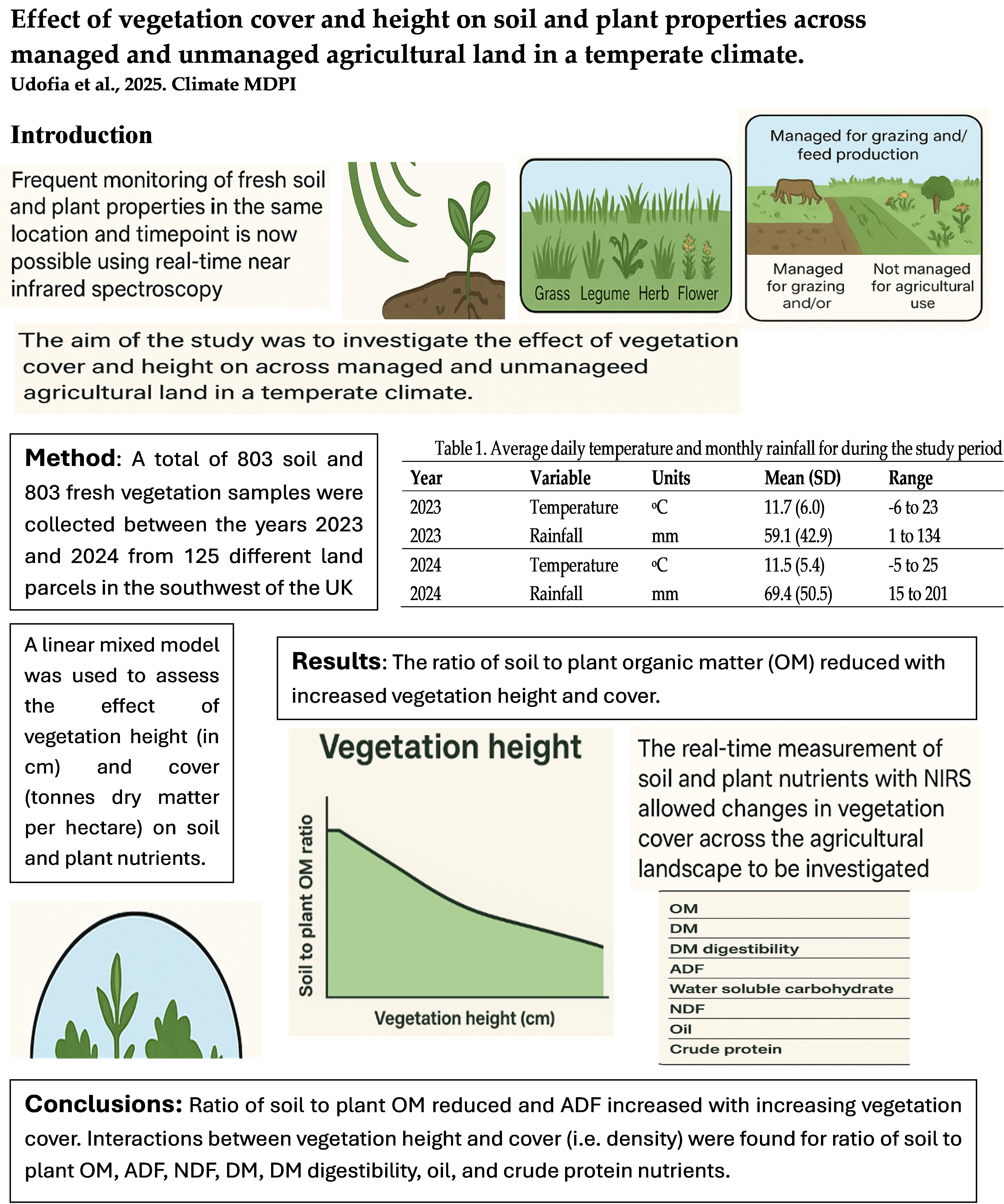
Frequent monitoring of fresh soil and plant properties in the same location and timepoint is now possible using real-time near infrared spectroscopy (NIRS). The aim of the study was to investigate the effect of vegetation cover and height on soil and plant nutrients across managed and unmanaged agricultural land in a temperate climate. A total of 803 soil and 803 fresh vegetation samples were collected between the years 2023 and 2024 from 125 different land parcels in the southwest of the UK, which were either managed for grazing and/or feed production or not managed for agricultural use. The land had a range of grass, crops, legume, herb and flower species, across temporary grass, arable and permanent grass areas. A linear mixed model was used to assess the effect of vegetation height (in cm) and cover (tonnes dry matter per hectare) on soil and plant nutrients. The results showed that the ratio of soil to plant organic matter (OM) reduced with increased vegetation height and cover. Plant dry matter (DM) digestibility, acid detergent fibre (ADF), water soluble carbohydrate and oil contents increased with vegetation height, and DM and neutral detergent fibre (NDF) decreased with vegetation height. Ratio of soil to plant OM reduced and ADF increased with increasing vegetation cover. Interactions between vegetation height and cover (i.e. density) were found for ratio of soil to plant OM, ADF, NDF, DM, DM digestibility, oil, and crude protein nutrients. The real-time measurement of soil and plant nutrients with NIRS allowed changes in vegetation cover across the agricultural landscape to be investigated.
Keywords:
biomass
; soil
; land management
; plant species
1. Introduction
Sustainable agricultural productivity and ecosystem preservations can be improved by understanding vegetation cover interactions with soil nutrients such as organic matter and pH [1]. Information on changes in vegetation cover and height are relevant in determining soil health because these properties influence the level of added soil organic matter and nutrients [2]. Soil nutrients are utilized by plants while degraded plant cover is important for soil nutrient availability thus indicating the existence of a symbiotic relationship between soil and plant cover [3]. For informed decision making and optimum yield of agricultural crops and pastures, plant and soil interactions require proper evaluations to understand the effect of land management changes. Root biomass and plant residues are the main sources of soil organic matter and help support the structure of the soil [4]. Soil is productive if it has good structure, water holding, and nutrient retention capacity, and these can be improved by high vegetation cover associated with adequate organic matter supply in the soil [5]. Soil pH stability is promoted by high vegetation cover which helps buffer against the process of acidification, though these can be affected by changes in plant species composition and their associated decomposition rates [6].
The height of vegetation is a suitable measure for estimating the maturity of above-ground plant biomass. Maturity of vegetation is associated with taller plants with lower quality and digestibility due to increased fibre proportions such as high lignin and cellulose [7,8]. Increased plant height may also result in the dilution of plant nutrients in nutrient-rich tissues, such as leaves, thereby lowering the contents of crude protein and oil found in leaves [9]. In livestock grazing, productivity of pastures is measured by the quantity and quality of forage, with forage yield and maturity being managed to ensure nutrient richness [10]. Despite these well-established links, many previous studies have focused on either vegetation or soil properties in isolation, often using destructive and time-intensive laboratory methods such as loss on ignition for organic matter content analysis, and the pipette or hydrometer methods for particle size texture analysis. The emergence of real-time NIRS offers a transformative approach to analysing whole samples of fresh organic material in the field. The use of NIRS enables frequent, low-cost, and non-destructive measurement of common soil and plant nutrients to allow exploration of relationships [10,11]. This approach is helping to inform agricultural land use decision making. For example, a managed and fertilised grassland used for grazing will typically experience changes associated with animal and land management, which will subsequently shape the composition of plant species and the nutrient characteristics of soil and plant biomass [12,13]. On the other hand, unmanaged or semi-natural land may be abundant in diverse communities of plant species and thereby become more resilient with high nutrient retaining capacity in the long term [14,15]. These differences highlight the importance of comparing vegetation structure and soil properties across land-use gradients to inform regenerative and climate-smart agricultural strategies. Grasslands, which dominate much of the United Kingdom (UK) and global agricultural landscape, are of particular interest in this context. They not only provide a critical forage base for livestock but also offer opportunities to enhance biodiversity, carbon sequestration, and water regulation when managed sustainably [16,17].
Generally, UK grassland systems have prioritised productivity through monocultures of high-yielding species like perennial ryegrass (Lolium perenne), selected for traits such as high dry matter yield, crude protein, and sugar content [9,18]. However, this productivity focus has increasingly been balanced with environmental concerns, including reducing synthetic fertiliser dependency, man-made inputs, chemicals, organic fertilisers and improving drought resilience [19]. Recent research supports the use of multispecies swards with grasses, legumes, herbs, and flowering species to improve both forage productivity and soil health [20]. These mixed systems are known to promote complementary resource use, enhance plant nutrient uptake, and increase resilience to climatic stress [8,15]. Moreover, such diversity can increase root exudation and microbial activity, leading to improved nutrient cycling and soil carbon retention [3]. This study contributes to this growing body of knowledge by assessing how vegetation cover and height affect key soil and plant chemical properties using real-time NIRS across a range of managed and unmanaged lands in the UK. By analysing both the independent and interactive effects of vegetation cover and height, it offers new insights into how plant-soil responses function in temperate agroecosystems. The findings are relevant not only for pasture management and livestock production but also for crop production and broader goals related to soil conservation, biodiversity, and climate change mitigation.
The objective of this study was to investigate the effect of vegetation height and cover on soil and plant nutrients across managed and unmanaged agricultural land in a temperate climate.
2. Materials and Methods
2.1. Study Area and Field Data
The study was conducted across 125 established fields and grassland plots (28 arable crops, 41 temporary ley grasslands, and 56 permanent grasslands) across nine farms in the southwest of England (51.90oN, -2.29oW, 41m a.s.l) between March 2023 and August 2024. Five farms were in the Severn Vale region, and four farms were in the Cotswold National Landscape. Fields studied were managed for agricultural production, whereas grassland plots (~6m2) were left undisturbed and not used for agricultural production. The grassland plots consisted of 4 randomized blocks of 6 plots (~6m2) with either herbal ley, mustard/radish cover crop, wildflowers, ryegrass/clover mix or native grass species. The fields and plots provided diversity in terms of plant species composition, stage of growth, age, and land use. The soil in the region is predominantly clay loam. The region studied has a temperate climate and is dominated by grassland. The ambient temperature and rainfall were recorded by a local Met Office weather station. The average daily temperature was similar across study years (Table 1) and the average monthly rainfall was slightly higher in 2024 compared to 2023.
2.2. Samples and Field Data Collection
A total of 803 soil and 803 fresh vegetation samples were collected. Soil and plant samples were collected at the same time from the same location and within a 30 cm diameter wire ring (0.1 m2) randomly placed on the ground. In the plots, two random samples were taken within the plot, whereas, in each field, 5 samples were obtained after walking in a W-pattern across the field. The biomass sample was cut to ground level within the wire ring to determine the total fresh weight (FW) (grams) of plant material. The total FW was used to estimate the FW cover in t FW ha-1 based on the area of the sampling ring. The FW cover value was then multiplied by the percentage of DM obtained by nutrient analysis to derive the DM cover (t DM ha-1). A rising plate meter (F400; Farmworks Precision Farming Systems Ltd, Feilding, New Zealand) was used to measure sward height. The pasture height of each field and plot was estimated from the average ‘spot’ measurements when walking the W-pattern across the area sampled. The average FW and DM cover was divided by the sward height to derive the density of biomass in t FW ha-1cm-1 and t DM ha-1cm-1.
Soil samples were collected using a 2 cm diameter soil corer to a maximum depth of 30 cm. Mobile NIRS was used to measure the nutrient content of whole fresh soil (Agrocares, series-E; Wageningen, Netherlands) and plant (NIR4; Aunir, Towcester, UK) samples. Soil nutrients of organic matter (OM), total nitrogen (N; both g/kg and t/ha), clay, moisture (both %), pH, and ratios of organic carbon to nitrogen, organic matter to clay and organic matter to plant organic matter contents. Dry soil content (in grams) was divided by soil volume (in cm3) to estimate bulk density (g/cm3) and used to estimate organic matter and total nitrogen stock (t/ha = [10000 × soil depth cm/100 × bulk density g/cm3 × OM or N g/kg] /1000). Plant nutrients of dry matter (DM), crude protein, acid detergent fibre (ADF), neutral detergent fibre (NDF), water soluble carbohydrates, ash, dry matter digestibility (DMD) and oil (all in g/kg DM).
2.3. Statistical Analysis
Data were analysed in SPSS (IBM SPSS Statistics for Windows, Version 29.0. Armonk, NY). A total of 222 average values for sampled areas during the study period were used for the analysis. A linear mixed model (Equation 1) was used to assess the effect of vegetation cover and height on soil and plant nutrients, with the random effect of farm included as:
where Yijis dependent plant or soil nutrient; µ = intercept; b1H = linear regression of Y on vegetation height in cm; b2V = linear regression of Y on vegetation cover in kg DM/ha; F = random effect of farm (i = 1 to 9); M = random effect of month (j = 1 to 12); e = random error term. Significance was attributed at P<0.05.
Yij = µ + b1H × b2V + Fi × Mj + eij
3. Results
The plant species across fields and plots were identified and recorded during plant sampling. The plant species included: wheat (Triticum aestivum), barley (Hordeum vulgare), perennial ryegrass and hybrids (Lolium perenne), timothy (Phleum pratense), Yorkshire fog (Holcus lanatus), cocksfoot (Dactylis glomerata), common bent (Agrostis capillaris), oat-grass (Arrhenatherum elatius), meadow grass (Poa annua), sweet vernal grass (Anthoxanthum odoratum), soft brome (Bromus hordeaceus), crested dogstail (Cynosurus cristatus), chicory (Cichorium intybus), plantain (Plantago lanceolate), red clover (Trifolium pratense), alsike clover (Trifolium hybridum), white clover (Trifolium repens), sainfoin (Onobrychis vicifolia), burnet (Sanguisorba minor), mustard (Sinapsis alba), raddish (Raphanus sativus), knapweed (Centaurea nigra), field poppy (Papaver rhoeas), yarrow (Achillea millefolium), bindweed (Convolvulus arvensis), ox-eye daisy (Leucanthemum vulgare), broad-leaved dock (Rumex obtusifolius), common dandelion (Taraxacum officinale), creeping buttercup (Ranunculus repens), and heal-all (Punella vulgaris).
Across areas studied, there was considerable variability in vegetation height, cover (fresh and dry matter) and density (fresh and dry matter), with coefficients of variation ranging >70%; Table 2). All plant nutrients studied showed variability. The soil organic matter content was the most variable soil nutrient (>40%; Table 2).
3.1. Effect of Vegetation Cover and Height on Plant Nutrients
The ADF, water soluble carbohydrate, oil (all P<0.001) and DM digestibility (P<0.01) content of vegetation increased with taller vegetation, and dry matter (P<0.001) and NDF (P<0.05) reduced with taller vegetation (Table 3). The ADF content (P<0.05) increased and DM content reduced (P<0.05) with higher vegetation cover. There was an interaction between vegetation height and cover for DM, crude protein, ADF, NDF, DMD, oil (all P<0.001) and water soluble carbohydrate (P<0.05). There was no effect of vegetation height or cover on ash content.
3.2. Effect of Vegetation Cover and Height on Soil Nutrients
The ratio of soil OM to plant OM reduced with increased vegetation height and cover (P<0.001; Table 4). Significant soil to plant OM ratio effects against height, dry matter cover and density (height x cover) were observed (P<0.001; Figure 1). The OM stock increased with increased vegetation cover and pH reduced with increased vegetation cover (both P < 0.05). There was no interaction between vegetation height and cover (P = 0.145 for OM; P = 0.051 for pH).
4. Discussion
This study explored the influence of vegetation cover and height (i.e. vegetation structure and density) on soil and plant properties measured at the same location and timepoint across a range of managed and unmanaged agricultural land. Using rapid soil and plant nutrient analytical sensors, such as NIRS, real-time variation in key soil properties such as organic matter and pH, and plant properties and nutrients such as DM digestibility, fibre, protein and oil contents were found. The current study found that vegetation cover influenced plant properties differently from plant height, with the interaction between vegetation cover and height representing the density of vegetation. More cover was linked with higher ADF and lower soil to plant OM ratio. The results therefore specifically suggest that as plants mature and grow taller, they may develop more structural parts which are rich in fibre but this dilutes sugars and protein contents in other cells or tissues such as leaves. Denser cover means more competition among plants (for light, nutrients), which often leads to plants producing more supportive or fibrous parts (stems etc.) that are less nutrient dense. For example, protein, water soluble carbohydrates, digestibility and oil reduce with increasing density (interaction between height and cover). NDF increases with increasing height x cover. This agrees with other research which shows that competitive dynamics in dense swards involve plants investing more in structural tissue to capture light and persist under shading conditions [12]. Also, when the cover is dense, there is more plant material going back into the soil (litter, roots), so soil OM increases [3], reducing the proportion held in live plant tissue. Taller vegetation was associated with ADF and higher DM digestibility. This aligns with other research findings which show that as plants mature, it often correlates with height, and fiber often increases but digestibility may still be reasonably high, depending on species and whether it is grazed or for forage production [7]. There was a significant effect of vegetation height on several plant nutrients despite the limited effect on soil nutrients in the present study. The implication again is that the plant invests in height and structure, while nutritive elements like protein and digestibility decline as fibre increases [21]. The reduction in soil-to-plant OM ratio with increasing cover aligns with the soil findings, further supporting the conclusion that high vegetation density accelerates organic inputs to the soil, potentially improving soil carbon storage and fertility [3]. Grasslands with good cover have been reported to increase soil organic content fairly and rapidly [22]. Also, a previous study on sustainable grassland management found that good cover and diverse species lead to improved soil physicochemical properties (including organic matter) and better nutrient status in many grassland soils [7]. However, it should be noted that taller species may be dependent on the plant types and their growth rate, for example legumes or fast-growing grasses have both high structural development and elevated metabolic rates, which translates into higher energy content and increased height [8]. Some plant communities with greater height may reflect more competitive species that invest in both structure and photosynthetic capacity, balancing fiber content with nutritional value. The reduction in NDF and DM can also be dependent on plant type differences in terms of physiology and growth rate. For example, in some species, taller vegetation may be composed of tissues with higher water content and lower cell wall complexity, possibly reflecting a shift toward leafier growth or species with less lignified biomass [23]. The decrease in oil content could result from a lower prevalence of oil-rich plants in taller stands dominated by grass.
Vegetation cover had a significant effect on specific soil properties of OM stock and pH in the current study. Other studies have shown that increased plant biomass inputs promote the addition of organic carbon to the soil [2,5]. Denser vegetation increases plant residues and root biomass in lands and therefore promotes the addition of organic compounds to the soil, enhances microbial activity, and contributes to humus formation [2,5]. This will subsequently lead to greater stabilization of organic carbon, maintenance of fertility, water retention, and carbon sequestration in the soil [24]. The observed decline in soil pH with increasing vegetation cover may be explained by several mechanisms. Firstly, decomposition of organic material often produces organic acids, which acidify the soil microenvironment [25]. Secondly, denser plant cover may promote specific microbial communities that can process organic matter through pathways that generate acidic byproducts, such as nitrification or fungal decomposition [2,5]. Additionally, competition for cations like calcium, magnesium, and potassium are common in dense vegetation and can result in base cation depletion, thereby lowering pH further [4]. This dynamic is particularly relevant in temperate regions like the UK, where relatively high rainfall can exacerbate leaching of base cations in high biomass systems. In the current study, there were no significant effects of vegetation height on soil nutrients, except the ratio of soil to plant OM. This suggests that vegetation height, and interaction with vegetation cover, plays a limited role in the soil nutrients studied. This result aligns with other research findings that show that the addition of major plant-derived inputs to soil e.g. plant residues, root turnover and exudates take place at or below the soil surface and are therefore more closely related to vegetation cover rather than height [3,26].Recent observations in the UK for less disturbed cropland soil with more vegetation cover showed increased soil organic carbon, after many years of decline [27]. Also, another study reported a rapid increase in soil organic carbon and total nitrogen where vegetation was restored in predominantly grassland; vegetation height did not have much effect on soil properties like pH or organic matter [22]. This suggests that plant density or cover determines soil processes, rather than vegetation height. This aligns with the findings from previous grassland studies in the UK which showed that less intensively managed grasslands had better vegetation cover or density resulting in increased soil nutrient, such as soil carbon and nitrogen, than intensively managed land [27].
One of the most significant findings of this study is the interaction of vegetation height and cover in affecting plant nutrients such as ADF, NDF, DMD, oil, protein, and soil-to-plant OM ratio. These interactions indicate that vegetation cover and height (structure) have a relative effect on plant quality and as such vegetation cover cannot be considered separately from plant height because dense or sparse vegetation cover will affect the forage quality and nutritional status of a tall plant differently. It can therefore be suggested that, in sparse areas, taller plants may be younger and more palatable, whereas in dense stands, taller plants might be older and more fibrous, reducing digestibility. This is supported by previous research findings which showed that the impact of plant height on digestibility may be stronger or weaker depending on how dense the sward is. A previous study showed a similar interaction where vegetation cover and species phenology together under different environmental or management conditions affected plant digestibility and protein content more than any single factor alone [6]. Similarly, high protein content may occur in short but dense swards dominated by legumes, whereas tall and sparse vegetation might have lower protein but higher fiber [8]. These interactive effects highlight the complex state of plant and soil interactions in real-world ecosystems. Vegetation structure is shaped by numerous factors including species composition, land use history, grazing or mowing intensity, and microclimatic conditions [13]. Therefore, managing optimal forage quality and soil health requires a detailed understanding of how these variables interact. Traditional agronomic measurements and analysis that treat vegetation variables in isolation may fail to capture the full variability in plant and soil function, but the high-resolution, real-time data captured through NIRS in this study offers a promising tool for monitoring changes in soil and plant and their interactions enabling more adaptive and data-informed land management strategies [28].
The general findings of this study highlight the importance of maintaining both sufficient vegetation cover and appropriate structure or height to improve agricultural landscapes. Cover is essential for building and maintaining soil organic matter and moderating pH, both of which are critical for nutrient availability, microbial health, and long-term productivity [29]. Height, on the other hand, plays a significant role in determining the nutritional quality of vegetation cover. Managing sward height through controlled grazing, mowing, or rotational practices may help balance forage fibre content with digestibility and energy value [30]. Moreover, the observed interactions in the current study suggest that vegetation cover and height cannot be managed in isolation. For instance, promoting tall vegetation without ensuring sufficient density may reduce forage quality or slow soil OM inputs. Conversely, overly dense low-growing vegetation might enhance soil carbon but offer less nutritional value. Therefore, integrated management approaches that consider how the ground is covered, that is, vegetation or biomass cover or density alongside the vegetation height (adequate species selected for desired structure) are necessary to optimize outcomes in mixed-use agricultural landscape [23]. Further investigation of the use of vegetation cover and height (density) data to develop a model for the prediction of soil organic matter and pH in farmland is suggested.
5. Conclusions
Vegetation cover and height exert significant interactive effects on both soil and plant properties in temperate agricultural systems. Denser vegetation increases plant residues and root biomass in land, and this is associated with increased addition of organic compounds and nutrients such as soil pH and OM to the soil. There is a trade-off where taller growth helps crude protein content thus enhancing digestibility but reduces oil content and raises fiber content. Specifically speaking, taller plants, despite being more fibrous, also offer higher digestibility. Soil health improvement, increase in soil organic matter and maintenance of favorable soil pH can be enhanced by maintaining good vegetation cover even more so than promoting great plant height alone. Both plant height and density determine how plants interact with soil, and vegetation cover cannot be considered separately from plant height. Farmland management approaches should aim to balance cover and height, because together they determine outcomes more than either alone. Also, it is suggested to carry out further investigation into the use of vegetation cover and height data to develop models for soil organic matter and pH prediction in temperate farmlands. The wider spectral range, real-time data captured through NIRS in this study offers a promising tool for monitoring changes in soil and plants and their interactions to generate data that can better inform land management practices.
Author Contributions
Conceptualization, S-O.U. and M.J.B; methodology, S-O.U. and M.J.B.; formal analysis, S-O.U. and M.J.B; resources, M.J.B.; data curation, S-O.U., W.K.P.N. and M.J.B.; writing—original draft preparation, S-O.U., L.K.W., A.W. and M.J.B.; writing—review and editing, S-O.U., L.K.W., A.W., M.J.B., T.B and W.K.P.N; supervision, L.K.W., A.W. and M.J.B.; project administration, S-O.U., L.K.W., A.W., M.J.B. and T.B; funding acquisition, S-O.U., M.J.B. and T.B. All authors have read and agreed to the published version of the manuscript.
Funding
This work was funded by Tertiary Education Trust Fund (TETFUND), Nigeria.
Data Availability Statement
The data that support the findings of this study are available on request from the corresponding author. The study is part of a PhD thesis and a longer-term study.
Acknowledgments
The work to collect the soil and plant samples was funded by the Farming in Protected Landscapes programme (created by Defra and delivered locally by the Cotswolds National Landscape team) the Douglas Bomford Trust and John Oldacre Trust. We are grateful to all farms included in the study, the support of the Gloucestershire Wildlife Trust, and the help with fieldwork from Greta Jauernik.
Conflicts of Interest
The author declares no competing interests.
Abbreviations
The following abbreviations are used in this manuscript:
| NIRS | Near infrared spectroscopy |
| Uk | United Kingdom |
| SD | Standard deviation |
| OM | Organic matter |
| N | Total nitrogen |
| DM | Dry matter |
| ADF | Acid detergent fibre |
| NDF | Neutral detergent fibre |
| DMD | Dry matter digestibility |
| FW | Fresh Weight |
References
- Udofia, S.O.U.; Williams, L.K.; Wills, A.P.; Bell, M.J. Importance of Vegetation Cover in Organic Systems. In Advances in Organic Farming; GB: CABI, 2025; pp. 163–174. [Google Scholar] [CrossRef]
- Fornara, D.A.; Tilman, D. Plant functional composition influences rates of soil carbon and nitrogen accumulation. J. Ecol. 2008, 96, 314–322. [Google Scholar] [CrossRef]
- Bardgett, R.D.; Van der Putten, W.H. Belowground biodiversity and ecosystem functioning. Nat. 2014, 515, 505–511. [Google Scholar] [CrossRef]
- Neina, D. The role of soil pH in plant nutrition and soil biota activity: A review. Soil syst. 2019, 3, 15. [Google Scholar] [CrossRef]
- Six, J.; Bossuyt, H.; Degryze, S.; Denef, K. A history of research on the link between (micro) aggregates, soil biota, and soil organic matter dynamics. Soil Till Res. 2004, 79, 7–31. [Google Scholar] [CrossRef]
- Gentsch, N.; Kaiser, M.; Mikutta, R.; et al. Cover crops improve soil structure and change organic carbon distribution in macroaggregate fractions. Soil 2024, 10, 139–155. [Google Scholar] [CrossRef]
- Lisec, T.; Šibanc, N.; Lojen, S.; Vidrih, T. Sustainable grassland-management systems affect soil physicochemical properties and forage nutritional quality. Plants 2024, 13, 838. [Google Scholar] [CrossRef]
- Tilman, D.; Reich, P.B.; Knops, J.M.H. Biodiversity and ecosystem stability in a decade-long grassland experiment. Nat. 2001, 441, 629–632. [Google Scholar] [CrossRef] [PubMed]
- Crosse, S.; O’Donovan, M.; Delaby, L.; Boland, T.M. Quantifying the effect of sward characteristics on the nutritive value of grass herbage. Grass Forage Sci. 2015, 70, 364–377. [Google Scholar] [CrossRef]
- Bell, M.J.; Mereu, L.; Davis, J. The use of mobile near-infrared spectroscopy for real-time pasture management. Front. Sustain. Food Syst. 2018, 2, 76. [Google Scholar] [CrossRef]
- Reinermann, S.; Rathmann, J.; Lüker-Jans, N.; Schmidtlein, S. Grassland yield estimations – potentials and limitations of remote sensing. BG 2025, 22, 4969–4983. [Google Scholar] [CrossRef]
- Franzluebbers, A.J. Soil organic matter stratification ratio as an indicator of soil quality. Soil Till Res. 2002, 66, 95–106. [Google Scholar] [CrossRef]
- Hobbs, R.J.; Higgs, E.; Harris, J.A. Novel ecosystems: implications for conservation and restoration. Trends Ecol. Evol. 2008, 24, 599–605. [Google Scholar] [CrossRef]
- UK Centre for Ecology & Hydrology (UKCEH). Less intensively managed grasslands have higher plant diversity and better soil health. UKCEH website, 2022. Available online: https://www.ceh.ac.uk/press/less-intensively-managed-grasslands-havehigher-plant-diversity-and-better-soil-health.
- Jerrentrup, J.S.; Wrage-Mönnig, N.; Röver, K.U.; Isselstein, J. Grazing with different livestock species affects the plant and insect diversity of species-rich grasslands. Agr Ecosyst Environ 2020, 287, 106679. [Google Scholar] [CrossRef]
- Gibon, A. Managing grassland for production, the environment and the landscape. Livest. Prod. Sci. 2005, 96, 11–31. [Google Scholar] [CrossRef]
- Batello, C.; Mannetje, L.; Martinez, A.; Suttie, J. Plant genetic resources of forage crops, pasture and rangelands. Thematic background study. FAO report 2008, 5-7. Available online: https://www.fao.org/fileadmin/templates/agphome/documents/PGR/SoW2/thematicstudy_forage.pdf.
- Wilkins, P.W.; Humphreys, M.O. Progress in breeding perennial forage grasses for temperate agriculture. J. Agric. Sci. 2003, 140, 129–150. [Google Scholar] [CrossRef]
- Wrage, N.; Strodthoff, J.; Cuchillo, H.M.; Isselstein, J.; Kayser, M. Phytodiversity of temperate permanent grasslands: ecosystem services for agriculture and livestock management for diversity conservation. Biodivers. Conserv. 2011, 20, 3317–3339. [Google Scholar] [CrossRef]
- Bell, M.J.; J Huggett, Z.; Slinger, K.R.; Roos, F. Effect of pasture cover and height on nutrient concentrations in diverse swards in the UK. Grassl Sci. 2021, 67, 267–272. [CrossRef]
- Mainetti, A.; Ravetto Enri, S.; Pittarello, M.; Lombardi, G.; Lonati, M. Main ecological and environmental factors affecting forage yield and quality in Alpine summer pastures (NW-Italy, Gran Paradiso National Park). Grass Forage Sci. 2023, 78, 254–267. [Google Scholar] [CrossRef]
- Yang, Y.; Gunina, A.; Cheng, H.; Liu, L.; Wang, B.; Dou, Y. .; Chang, S.X. Unlocking mechanisms for soil organic matter accumulation: carbon use efficiency and microbial necromass as the keys. Glob Chang Biol. 2025, 31, e70033. [Google Scholar] [CrossRef]
- You, X.; Li, S.; Zhang, T.; Wang, Y. Vegetation structure regulates soil nutrient dynamics in grassland ecosystems under changing climates. J. Appl. Ecol. 2024, 61, 45–59. [Google Scholar] [CrossRef]
- Lal, R. Soil carbon sequestration impacts on global climate change and food security. Sci. 2004, 304, 1623–1627. [Google Scholar] [CrossRef] [PubMed]
- Rousk, J.; Bååth, E.; Brookes, P.C.; Lauber, C.L.; Lozupone, C.; Caporaso, J.G. ..; Fierer, N. Soil bacterial and fungal communities across a pH gradient in an arable soil. ISME J. 2010, 4, 1340–1351. [Google Scholar] [CrossRef]
- Wardle, D.A.; Bardgett, R.D.; Klironomos, J.N.; Setala, H.; Van Der Putten, W.H.; Wall, D.H. Ecological linkages between aboveground and belowground biota. Sci. 2004, 304, 1629–1633. [Google Scholar] [CrossRef]
- Levy, P.; Bentley, L.; Danks, P.; Emmett, B.; Garbutt, A.; Heming, S. .; Wickenden, A. The effects of land use on soil carbon stocks in the UK. BG 2024, 21, 4301–4315. [Google Scholar] [CrossRef]
- Brown, D.J.; Shepherd, K.D.; Walsh, M.G.; Mays, M.D.; Reinsch, T.G. Global soil characterization with VNIR diffuse reflectance spectroscopy. Geoderma 2018, 144, 1–19. [Google Scholar] [CrossRef]
- Vitousek, P.M.; Menge, D.N.L.; Reed, S.C.; Cleveland, C.C. Biological nitrogen fixation: rates, patterns and ecological controls in terrestrial ecosystems. Philos. Trans. R. Soc. B, Biol. Sci. 2010, 365, 1215–1225. [Google Scholar] [CrossRef] [PubMed]
- Li, T.; Zhang, X.; Zou, M.; Chen, J.; Hou, F. Grazing management of cultivated grassland with different weed proportions optimizes soil nutrient status and improves forage yield and nutritional quality. Field Crops Res. 2025, 331, 110018. [Google Scholar] [CrossRef]
Figure 1.
Change in soil to plant organic matter ratio with plant height (crosses and solid line) and dry matter cover (dots and dashed line). Line of best fit shown.
Figure 1.
Change in soil to plant organic matter ratio with plant height (crosses and solid line) and dry matter cover (dots and dashed line). Line of best fit shown.
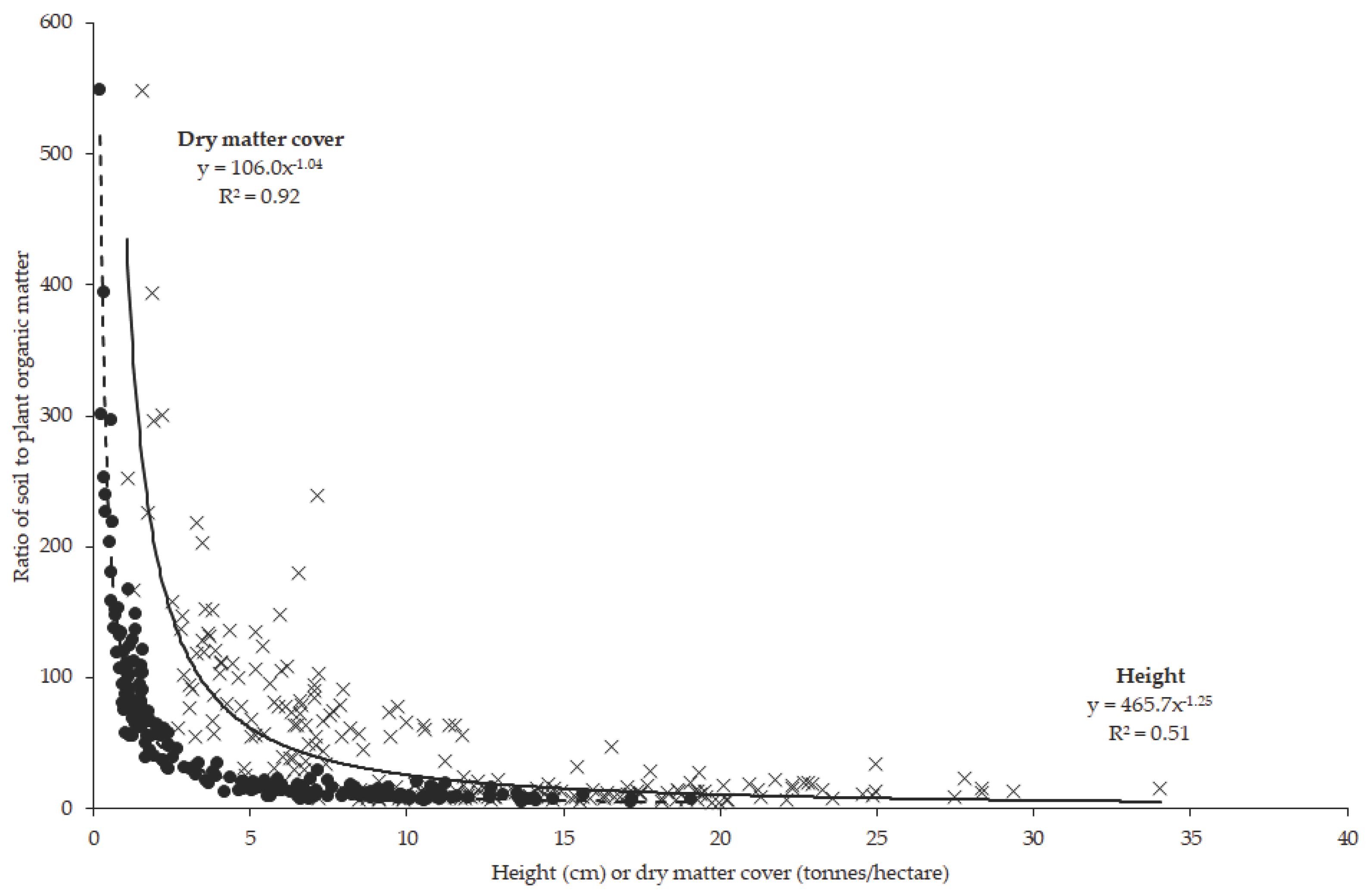

Table 1.
Average daily temperature and monthly rainfall for during the study period.
| Year | Variable | Units | Mean (SD) | Range |
|---|---|---|---|---|
| 2023 | Temperature | oC | 11.7 (6.0) | -6 to 23 |
| 2023 | Rainfall | mm | 59.1 (42.9) | 1 to 134 |
| 2024 | Temperature | oC | 11.5 (5.4) | -5 to 25 |
| 2024 | Rainfall | mm | 69.4 (50.5) | 15 to 201 |
Table 2.
Average vegetation cover, vegetation nutrients, and soil nutrients across samples collected.
Table 2.
Average vegetation cover, vegetation nutrients, and soil nutrients across samples collected.
| Variable | Units | Mean (SD) | Range | Coefficient of variation (%) |
| Vegetation properties | ||||
| Height | cm | 8.7 (6.1) | 1.0–24.6 | 71 |
| Fresh weight cover | t FW/ha | 10.4 (9.4) | 0.7–54.6 | 90 |
| Dry matter | g/kg | |||
| Dry matter cover | t DM/ha | 2.8 (3.1) | 0.2–17.2 | 110 |
| Fresh density | t FW/ha/cm | 13.8 (10.9) | 0.9–51.7 | 79 |
| Dry density | t DM/ha/cm | 4.1 (3.6) | 0.2–13.6 | 87 |
| Crude protein | g/kg DM | 194.3(64.8) | 10.0-320.1 | 33 |
| Acid detergent fibre | g/kg DM | 259.9(33.1) | 152.0-350.7 | 13 |
| Neutral detergent fibre | g/kg DM | 479.1(136.1) | 305.2-990.0 | 28 |
| Water soluble carbohydrates | g/kg DM | 90.1(41.8) | 0.0-166.1 | 46 |
| Ash | g/kg DM | 91.7(14.9) | 20.2-123.5 | 16 |
| Dry matter digestibility | g/kg DM | 717.0(61.6) | 514.7-811.3 | 9 |
| Oil | g/kg DM | 18.8(4.8) | 3.5-25.5 | 26 |
| Soil properties | ||||
| Organic matter | g/kg | 29.5 (13.5) | 11–125 | 46 |
| Organic matter | t /ha | 61.2 (25.3) | 14.5-254.4 | 41 |
| Total nitrogen | g/kg | 2.8 (1.1) | 1.2–9.2 | 40 |
| Total nitrogen | t/ha | 5.2 (1.4) | 2.4 - 9.9 | 27 |
| Clay | % | 21.3 (5.8) | 7.0–38 | 27 |
| Moisture | % | 23.5 (6.7) | 0.4–52.5 | 28 |
| pH | 6.9 (0.3) | 5.9-7.8 | 5 | |
| Bulk density | g/cm3 | 0.73 (0.1) | 0.4-0.9 | 19 |
| Organic carbon: nitrogen1 | 10.6 (1.1) | 5.5–17.0 | 10 | |
| Organic matter: clay | 0.15 (0.1) | 0.03–1.04 | 66 | |
| Soil organic matter: plant organic matter | 52.9 (68.4) | 4.4-548.2 | 129 | |
1 Assuming 58% of organic matter is organic carbon. SD = Standard deviation.
Table 3.
Effect of vegetation cover and height on plant nutrients.
| Effect | P value | ||||||
|---|---|---|---|---|---|---|---|
| Variable | Units | Height (cm) | Cover (t DM/ha) | Height × cover | Height (cm) | Cover (t DM/ha) | Height × cover |
| Dry matter | g/kg | -12.5 (3.1) | -13.2 (6.4) | 3.0 (0.5) | <0.001 | <0.05 | <0.001 |
| Crude protein | g/kg DM | 1.4 (1.3) | 2.0 (2.6) | -0.8 (0.2) | 0.270 | 0.440 | <0.001 |
| Acid detergent fibre | g/kg DM | 3.9 (0.6) | 3.2 (1.3) | -0.5 (0.1) | <0.001 | <0.05 | <0.001 |
| Neutral detergent fibre | g/kg DM | -5.0 (2.3) | -5.1 (4.7) | 1.9 (0.3) | <0.05 | 0.282 | <0.001 |
| Water soluble carbohydrates | g/kg DM | 2.9 (0.8) | -2.8 (1.6) | -0.3 (0.1) | <0.001 | 0.080 | <0.05 |
| Ash | g/kg DM | -0.1 (0.4) | -0.04 (0.7) | -0.1 (0.1) | 0.769 | 0.958 | 0.334 |
| Dry matter digestibility | g/kg DM | 3.1 (1.1) | 1.3 (2.3) | -0.6 (0.2) | <0.01 | 0.555 | <0.001 |
| Oil | g/kg DM | 0.3 (0.1) | -0.1 (0.2) | -0.1 (0.01) | <0.001 | 0.788 | <0.001 |
Table 4.
Effect of vegetation cover and height on soil nutrients.
| Effect | P value | ||||||
|---|---|---|---|---|---|---|---|
| Variable | Units | Height (cm) | Cover (t DM/ha) | Height × cover | Height (cm) | Cover (t DM/ha) | Height × cover |
| Organic matter | g/kg | -0.4 (0.4) | 1.3 (0.8) | -0.1 (0.1) | 0.373 | 0.122 | 0.238 |
| Organic matter | t/ha | -0.7 (0.7) | 3.1 (1.5) | -0.2 (0.1) | 0.357 | <0.05 | 0.145 |
| Total nitrogen | g/kg | -0.03 (0.02) | 0.1 (0.04) | -0.003 (0.003) | 0.219 | 0.200 | 0.334 |
| Total nitrogen | t/ha | -0.05 (0.04) | 0.1 (0.1) | -0.01 (0.01) | 0.214 | 0.09 | 0.234 |
| Clay | % | -0.03 (0.1) | -0.1 (0.2) | -0.01 (0.01) | 0.741 | 0.763 | 0.692 |
| Moisture | % | -0.04 (0.2) | -0.01 (0.3) | -0.01 (0.02) | 0.824 | 0.975 | 0.692 |
| Bulk density | g/cm3 | 0.0001 (0.003) | -0.002 (0.01) | 0.00004 (0.0001) | 0.926 | 0.710 | 0.933 |
| pH | 0.0001 (0.01) | -0.03 (0.01) | 0.002 (0.001) | 0.957 | <0.05 | 0.051 | |
| Organic carbon to nitrogen ratio | 0.03 (0.02) | 0.06 (0.04) | -0.003 (0.002) | 0.137 | 0.084 | 0.294 | |
| Organic matter to clay ratio | -0.002 (0.002) | 0.003 (0.004) | 0.0001 (0.0001) | 0.194 | 0.383 | 0.446 | |
| Soil to plant organic matter ratio | -10.3 (1.3) | -19.6 (2.5) | 1.1 (0.2) | <0.001 | <0.001 | <0.001 | |
Disclaimer/Publisher’s Note: The statements, opinions and data contained in all publications are solely those of the individual author(s) and contributor(s) and not of MDPI and/or the editor(s). MDPI and/or the editor(s) disclaim responsibility for any injury to people or property resulting from any ideas, methods, instructions or products referred to in the content. |
© 2025 by the authors. Licensee MDPI, Basel, Switzerland. This article is an open access article distributed under the terms and conditions of the Creative Commons Attribution (CC BY) license (http://creativecommons.org/licenses/by/4.0/).
Copyright: This open access article is published under a Creative Commons CC BY 4.0 license, which permit the free download, distribution, and reuse, provided that the author and preprint are cited in any reuse.


