

Submitted:
03 December 2025
Posted:
05 December 2025
You are already at the latest version
Abstract
The present work reports the latest findings from photometric and spectroscopic studies of the Seyfert galaxy NGC 4151. Photometric and spectroscopic observations were carried out using the Zeiss-1000 and AZT-8 telescopes at the Tien Shan Astronomical Observatory (TSHAO) and the Kamenskoe Plateau Observatory of the Fesenkov Astrophysical Institute (FAI). In addition, photometric data were obtained at the Shamakhy Astrophysical Observatory (ShAO) with the “Zeiss 600” telescope in the Cassegrain focus. The collected data enabled us to construct light curves and perform a comparative analysis of both modern and archival spectral observations.
Keywords:
active galaxies
; Seyfert galaxies
; NGC 4151
; photometric variability
; spectral variability
; archival spectral data
; supermassive black hole
1. Introduction
The study of spectral and photometric variability is an effective diagnostic tool for investigating the physical processes occurring in accreting compact supermassive objects, which constitute the majority of galaxies with active nuclei [1]. The characteristic timescales of this variability indicate the relatively compact sizes of the regions that emit the optical continuum and broad emission lines [2,3]. Investigating the spectral and photometric variability of galaxies is essential for understanding the structure and evolution of active galactic nuclei (AGN); without this knowledge, it is impossible to approach the problem of identifying the nature of the central energy source. Information on the properties of spectral and photometric variability in AGN must be taken into account to refine their theoretical models. Within the framework of the supermassive black hole model with an accretion disk, both periodic and stochastic variations in the brightness of active galactic nuclei can be expected [4,5]. The galaxy NGC 4151 (Seyfert 1.5), with coordinates and , has a redshift of [6]. The distance to this galaxy has been estimated using two methods. Using the Expanding Photosphere Method, the authors derived , while the standard candle method gives . The average distance is therefore [7]. The mass of its central supermassive black hole (SMBH) is estimated to be – [8].
NGC 4151 is one of the most thoroughly studied Seyfert galaxies, as it exhibits significant variability across all wavelength ranges except the radio band. Measurements have shown that the variability delays of the infrared flux relative to the UV and optical variations are days, which may be associated with changes in the luminosity of the central energy source [9]. An important feature of NGC 4151 is the variability of the emission-line and continuum fluxes. During a 15 day monitoring campaign in 1993, sharp flux changes with time intervals of up to 70 minutes were detected [10]. Long-term observations using the reverberation-mapping method (1994–-2022) made it possible to identify the connection between the dynamics of the H broad-line region and changes in the luminosity [11]. A component was found in the light curve whose variations occur with a period of about 16 () years. The authors interpret these cyclic periods as the characteristic dynamical timescale of accretion processes [12].
The aim of this study is to investigate the photometric and spectral characteristics of NGC 4151, including the analysis of brightness variability and emission-line parameters, based on new observations carried out at the Fesenkov Astrophysical Institute (FAI) and the Nasreddin Tusi Shamakhy Astrophysical Observatory (ShAO).
2. Materials and Methods
Photometric observations of the Seyfert galaxy NGC 4151 were carried out at the Tien Shan Astronomical Observatory (TShAO) of the Fesenkov Astrophysical Institute using the Zeiss-1000 "East" telescope (F = 6600 mm, D = 1 m). The angular field of view of a single CCD frame is . For the observations and image acquisition, several CCD cameras manufactured by Apogee were used: U9000D9 prior to 2016, Alta F16M (, m) until November 2021, and since mid-2022 the U9000D9 CCD camera has been employed, together with BVRc Astrodon filters.
Before 2016, the angular scale of the CCD frames was /pixel (for binning). After 2016, the scale was /pixel, and after 2021 it became /pixel. The photometric data reduction was performed using the MaxIm DL 6 software package [13].
Parallel photometric observations of NGC 4151 in the BV and Ic filters were conducted at the Cassegrain focus of the 60-cm telescope of the Shamakhy Astrophysical Observatory named after N. Tusi (Azerbaijan). The telescope is equipped with a CCD photometer with a thermoelectrically cooled CCD matrix (FLI ). The angular scale for binning is /pixel, and the field of view in the focal plane is in diameter. The observational data were reduced using the MaxIm DL 4 software package [13].
Spectroscopic observations of NGC 4151 were carried out at the AZT-8 telescope using a long-slit spectrograph and an SBIG STT-3200 CCD camera, as well as with the Zeiss-1000 "West" telescope (TShAO). Wavelength calibration was performed using comparison lamp spectra of He, Ne, and Ar. Absolute flux calibration relied on spectra of standard stars with known energy distributions. Spectral data reduction was performed using the IRAF (Image Reduction and Analysis Facility) software package developed at the National Optical Astronomy Observatory (NOAO) [14].
3. Results of Photometric Data
Photometric observations of the Seyfert galaxy NGC 4151 were carried out during the period 2016–2025. The galaxy images were measured using the differential photometry method with nearby comparison stars. As standards, we used stars from the works G3 by Lyuty [15] and from Roberts [8,16] while the G4 stars from Lyuty’s list were used as control stars. The root-mean-square (RMS) error of the measurements was calculated for each image and is presented in the Table 1, Table 2. The results of our photometric observations obtained during 2016–2025 in the B, V, and filters are presented in Table 1, and the B, V, and magnitudes of NGC 4151 obtained in 2020–2023 at the Shamakhy Astrophysical Observatory named after N. Tusi are given in Table 2.
The light curve of NGC 4151 in the B and V filters, constructed from the TShAO data (blue and green squares) and the ShAO data (blue and green crosses), as well as from the additional B-band data of Li et al. (2022) [17] (blue asterisks, JD ≈ 57 554–60 033) and the V-band data of Lahue et al. (2025) [18] (green asterisks, JD ≈ 60 300–60 600), is shown in Figure 1. The horizontal axis represents the Julian Date (JD–2400000), while the vertical axis shows the apparent magnitude in the B and V filters.
The light curve of NGC 4151 in the Rc and Ic filters, constructed from the TShAO data (red squares) and the ShAO data (red asterisks), is shown in Figure 2. The horizontal axis represents the Julian Date (JD–2400000), while the vertical axis shows the apparent magnitude in the Rc and Ic filters.
As seen from the light curves presented in Figure 1 and Figure 2, both an increase and a decrease in the brightness of the galaxy are observed synchronously in all filters. No periodicity in the brightness variations of NGC 4151 was detected during our observing campaign. The largest amplitude changes occurred in the period from 17 April 2022 to 29 March 2023, amounting to , , , and magnitudes, respectively. As follows from the light curves and the photometric analysis, the Seyfert galaxy NGC 4151 exhibited significant brightness variations throughout the entire observational period. The FAI data and the measurements reported by Lahue et al. (2025) [18] agree well in the interval JD ≈ 60 300–60 600, where variability of about 0.3–0.4 mag is observed, confirming the variable nature of this galaxy.
The FAI (TShAO) data, shown in Figure 3, reveal a typical Active Galactic Nuclei (AGN) characteristic: the (B–V) color index increases as the brightness decreases. This trend is explained by the weakening of the blue continuum and the subsequent prominence of the more stable red emission. At the same time, the (V–) index remains nearly constant, indicating a relatively stable contribution of the H emission. The observed color–magnitude dependence is consistent with previously reported results for NGC 4151 [19,20] .
Figure 4 presents the results of the discrete correlation function (DCF) calculations for the filter pairs B–V and V–Rc for NGC 4151, computed following the method of Edelson & Krolik (1988) [21]. This approach can be used to investigate possible periodicities in the light curves. The x-axis shows the time lag (delay) in years, while the y-axis displays the DCF correlation coefficient. The DCF values represent the mean correlation within each time bin, and the corresponding lags are the central values of these delay intervals. The adopted bin size is 10 days. The number of contributing pairs was determined using the criterion described in Guo et al. [22]:
The lag values at which the peaks appear indicate possible periodic components in the light curve. Positive lags imply that variations in the B band occur earlier than those in V. The peak height reflects the strength of the correlation. The plots show a combination of short-, intermediate-, and long-term cycles. The most significant peaks are found in the range from 0.5 to 3.5 years. A clear and strongest peak is observed at a lag of 0.56 years in both B–V and V–Rc, though with different amplitudes. This peak represents genuine physical variability of the source—corresponding to a stable and global process in the accretion disk—rather than random fluctuations. The difference in peak strength indicates that the variability is chromatic.
Several non-exact harmonics of the main peak are also present at lags of approximately 1.25, 1.9, 2.5, 3.35, and 4.3 years. In addition, the presence of negative peaks further supports the interpretation that the observed variability is chromatic in nature.
3.1. Results of Spectral Observations of NGC 4151
The brightness of the galaxy NGC 4151 and its spectral characteristics can vary significantly over time. These variations also affect the emission lines, including the Balmer lines (H, H, etc.). The Balmer lines, especially H and H, are among the dominant features in the spectrum of NGC 4151 and contain important information about the physical conditions and kinematics of the gas in the active galactic nucleus. The profiles of the Balmer lines in NGC 4151 exhibit a complex structure and may change with time. Such variations indicate changes in the distribution and motion of the gas responsible for the emission.
The Table 3 below presents the measured fluxes in the continuum and in the emission lines, as well as several characteristics of the emission-line profiles. It should be noted that in the red spectral region, the reported values correspond to the total fluxes of the H+[N ii] 6548, 6583 Å and [S ii] 6717, 6731 Å emission lines.
Figure 5 shows the spectral energy distribution (SED) of NGC 4151 constructed from the data in Table 3. The X-axis represents the wavelength, while the Y-axis shows . The resulting SED illustrates the continuum levels at different wavelengths during the observation periods and allows us to assess their variability over time.
To obtain a quantitative estimate of the size of the broad-line region (BLR) at different epochs, we calculated the continuum luminosity at () using the luminosity distance to NGC 4151 of Mpc, as determined by Sebastian et al. (2014) [23], and applied the empirical R–L relation [19] derived in that study. The results are summarized in Table 4. The characteristic BLR size varies from approximately 0.13 to 0.15 light days over the different observing epochs.
4. Discussion
We carried out photometric and spectroscopic observations of the Seyfert galaxy NGC 4151 in the optical range in order to investigate its variability. The photometric light curves obtained in four filters (B, V, , ) show similar behavior (Figure 1 and 2), and the photometric uncertainties do not exceed 0.001–0.004 mag, confirming the high quality of the observational material. Over the entire monitoring interval, the variability amplitude reaches – mag, which is consistent with the well-known high activity level of this Seyfert nucleus.
Comparison of our measurements with previously published data shows good agreement. The fluxes in the B filter obtained at FAI, SHAO, and in Li et al. [24] agree well over the interval JD 57554–60033. The V-band data from FAI and Lahue et al. [25] also coincide in the range JD –, where variability of about 0.3–0.4 mag is observed. This confirms the reliability of our photometric series. No stable periodicities were detected in the brightness variations of NGC 4151. The largest brightness changes occurred between 17 April 2022 and 29 March 2023: , , , and mag.
Analysis of the color indices and obtained at TShAO shows that the object exhibits a complex structure typical of AGN. A clear “bluer-when-brighter’’ trend is observed, where NGC 4151 becomes noticeably bluer as it brightens. This behavior is consistent with variations of the accretion-disk continuum, which strengthens as the ionizing activity of the nucleus increases.
The discrete correlation function (DCF) analysis revealed significant correlation peaks in the lag range 0.5–3.5 years. Peaks detected simultaneously in the and dependencies (Figure 3) indicate the presence of quasi-periodic components in the light curve. Positive lags imply that variations in the B band precede those in V, which is consistent with a scenario in which disturbances propagate from the hotter inner regions of the accretion disk to the cooler outer zones. The strongest peak at a lag of years may represent a characteristic delay time between disk regions or the dynamical timescale of structural readjustment within the accretion flow.
The spectroscopic data further confirm the variability of NGC 4151. Both the brightness and the spectral properties change significantly over time, including variations in the profiles of the dominant Balmer lines (H, H). Changes in their shape and intensity reflect modifications in the distribution and kinematics of the gas in the broad-line region (BLR). The spectral energy distribution (SED) shows that the lowest values occur on 31 March 2022 and 18 March 2024, indicating states of reduced AGN activity. In contrast, the highest continuum levels, recorded on 7 April 2024, 7 May 2024, and 27 May 2024, correspond to phases of increased activity, where the continuum strengthens and the SED slope becomes flatter. This behavior is consistent with enhanced thermal emission from the accretion disk and an increase in ionizing flux.
The characteristic BLR size varies between 0.13 and 0.15 light days at different epochs, which is consistent with previous estimates for NGC 4151 and indicates a relatively compact broad-line region. The combined photometric, spectroscopic, and correlation results show that the variability of NGC 4151 is driven by complex internal processes within the accretion disk and BLR, including structural changes in the disk geometry, variations in the accretion rate, and the response of the emitting gas to fluctuations in the ionizing radiation.
5. Conclusions
This study details the findings from ongoing photometric and spectroscopic monitoring of the Seyfert galaxy NGC 4151. The photometric data were acquired at two facilities: the Fesenkov Astrophysical Institute (Almaty, Kazakhstan) and the Nasreddin Tusi Shamakhi Astrophysical Observatory (Shamakhi, Azerbaijan), while the spectroscopic observations were conducted solely at FAI.
The B, V, , and light curves exhibit a consistent structure (Figure 1 and Figure 2), with the most significant brightness variability observed between 17 April 2022 and 29 March 2023, registering amplitudes of , , , and mag. Analysis via the discrete correlation function (DCF) identified a prominent peak at a time lag of approximately years. This feature is hypothesized to represent either the characteristic timescale for perturbation propagation within the accretion disk or the dynamical timescale associated with structural reconfiguration of the disk.
The spectral energy distribution (SED) analysis indicates that the lowest values were measured on 31 March 2022 and 18 March 2024, corresponding to intervals of diminished AGN activity (Figure 5). Conversely, the data collected on 7 April 2024, 7 May 2024, and 27 May 2024 reflect phases of heightened activity, characterized by a stronger continuum and a flatter SED slope.
The characteristic size of the broad-line region (BLR) was found to vary between and light days across different epochs, a result which is in good agreement with prior estimates for NGC 4151.
These findings underscore the intricate and multi-component nature of the physical processes operative in the central engine of NGC 4151. Continued high-cadence monitoring, coupled with detailed decomposition of emission-line profiles into constituent components and the determination of the physical parameters of the emitting regions, is essential for advancing our understanding of the accretion disk structure and the kinematics of the BLR.
Author Contributions
Conceptualization, methodology and visualization, N.H., S.S. and A.S.; formal analysis, A.S.; validation, S.R and G.N; formal analysis, L.K..; investigation, S.S. and L.K.; resources, I.V., N.H. and S.R.; data curation, G.N, S.S. and L.A.; writing—original draft preparation, review and editing, N.H., S.S., A.S., L.K. and G.N; supervision, project administration and funding acquisition, S.S. All authors have read and agreed to the published version of the manuscript.
Funding
This research is funded by the Ministry of Science and Higher Education of the Republic of Kazakhstan (Grant No. BR24992607).
Acknowledgments
The authors express their gratitude to the SHAO team and the FAI observers for their assistance in organizing and conducting the spectral and photometric observations.
Conflicts of Interest
The authors declare no conflicts of interest. The funders had no role in the design of the study, in the collection, analyses or interpretation of data, in the writing of the manuscript or in the decision to publish the results.
References
- Antonucci, R. Unified Models for Active Galactic Nuclei and Quasars. Annual Review of Astronomy and Astrophysics 1993, 31, 473–521. [Google Scholar] [CrossRef]
- Merkulova, N.I. UBVRI Light Curves of the Seyfert Galaxy NGC 7469 During 1990–1998: Microvariability. Astronomical Journal 2000, 119, 631. [Google Scholar] [CrossRef]
- Denissyuk, E.K.; Valiullin, R.R.; Shomoshekova, S.A.; Kondratyeva, L.N.; Reva, I.V.; Aimanova, G.A.; Krugov, M.A. Results of Spectral Observations of 15 Seyfert Galaxies. Astrophysics 2022, 65, 447–455. [Google Scholar] [CrossRef]
- Grafton-Waters, S.; Branduardi-Raymont, G.; Mehdipour, M.; Page, M.J.; Behar, E.; Kaastra, J.; Arav, N.; Bianchi, S.; Costantini, E.; Ebrero, J.; et al. Multi-wavelength campaign on NGC 7469. VI. Photoionisation modelling of the emission line regions and the warm absorber. arXiv arXiv:1907.01946633, A62. [CrossRef]
- Nandi, P.; Chakrabarti, S.K.; Mondal, S. Spectral Properties of NGC 4151 and the Estimation of Black Hole Mass Using TCAF Solution. ApJ 2019, arXiv:1905.02147877, 65. [Google Scholar] [CrossRef]
- Hönig, S.F.; Watson, D.; Kishimoto, M.; Hjorth, J. A dust-parallax distance of 19 megaparsecs to the supermassive black hole in NGC 4151. Nature 2014, 515, 528–530. [Google Scholar] [CrossRef]
- Tsvetkov, D.Y.; Baklanov, P.V.; Potashov, M.S.; Oknyansky, V.L.; Mikailov, K.M.; Huseynov, N.A.; Alekberov, I.A.; Khalilov, O.V.; Pavlyuk, N.N.; Metlov, V.G.; et al. Supernova 2018aoq and a distance to Seyfert galaxy NGC 4151. MNRAS 2019, arXiv:1904.06586487, 3001–3006. [Google Scholar] [CrossRef]
- Roberts, C.A.; Bentz, M.C.; Vasiliev, E.; Valluri, M.; Onken, C.A. The Black Hole Mass of NGC 4151 from Stellar Dynamical Modeling. ApJ 2021, 916, 25. [Google Scholar] [CrossRef]
- Oknyansky, V.L.; Shenavrin, V.I.; Metlova, N.V.; Gaskell, C.M. The Relative Wavelength Independence of IR Time Lags in NGC 4151 During 2010–2015. Astronomy Letters 2019, 45, 197–207. [Google Scholar] [CrossRef]
- Vedavathi, P.; Doddamani, V.H. Short timescale UV variability study in NGC 4151 using IUE data. JAA 2018, 39, 55. [Google Scholar] [CrossRef]
- Chen, Y.J.; Bao, D.W.; Zhai, S.; Fang, F.N.; Hu, C.; Du, P.; Yang, S.; Yao, Z.H.; Li, Y.R.; Brotherton, M.S.; et al. Broad-line region in NGC 4151 monitored by two decades of reverberation mapping campaigns – I. Evolution of structure and kinematics. MNRAS 2023, 520, 1807–1831. [Google Scholar] [CrossRef]
- Oknyanskij, V.L.; Metlova, N.V.; Huseynov, N.A.; Guo, D.F.; Lyuty, V.M. Optical Monitoring of NGC4151 During 110 Years. Odessa Astronomical Publications 2016, 29, 95. [Google Scholar] [CrossRef]
- Astronomical Imaging Software.
- Fitzpatrick, M.; Placco, V.; Bolton, A.; Merino, B.; Ridgway, S.; Stanghellini, L. Modernizing IRAF to Support Gemini Data Reduction. arXiv arXiv:2401.01982. [CrossRef]
- Lyutyi, V.M. Optical Variability of the Nuclei of Seyfert Galaxies. Soviet Astronomy 1973, 16, 763. [Google Scholar]
- Roberts, C.A.; Rumstay, K.R. A Ten-Year Photometric Study of Selected Active Galaxies. JSARA 2012, 6, 47–58. [Google Scholar]
- Li, S.S.; Feng, H.C.; Liu, H.T.; Bai, J.M.; Li, R.; Lu, K.X.; Wang, J.G.; Huang, Y.K.; Zhang, Z.X. Velocity-resolved Reverberation Mapping of Changing-look AGN NGC 4151 during Outburst Stage. ApJ 2022, 936, 75. [Google Scholar] [CrossRef]
- Lahue, V.; Bentz, M.C.; Padrick, N. The V-band Variability of NGC 4151. RNAAS 2025, 9, 48. [Google Scholar] [CrossRef]
- Bentz, M.C.; Denney, K.D.; Grier, C.J.; et al. The Low-luminosity End of the Radius–Luminosity Relationship for AGN. ApJ 2013, 767, 149. [Google Scholar] [CrossRef]
- Merkulova, N.I.; Doroshenko, V.T.; Lyuty, V.M.; et al. Characteristics of the continuum variability of the nucleus of NGC 4151. A&A 2001, 371, 771–782. [CrossRef]
- Edelson, R.A.; Krolik, J.H. The Discrete Correlation Function: a new method for analyzing unevenly sampled variability data. ApJ 1988, 333, 646–659. [Google Scholar] [CrossRef]
- Guo, D.F.; Hu, S.M.; Chen, X.; Gao, D.W.; Qu, J.L. Optical monitoring of the Seyfert galaxy NGC 4151 and possible periodicities in its historical light curve. RAA 2014, 14, 923–938. [Google Scholar] [CrossRef]
Figure 1.
Light curve of NGC 4151 in the B and V filters, constructed from the TShAO data (blue and green squares), ShAO data (blue and green crosses), Li et al. (2022) [17] (blue asterisks), and Lahue et al. (2025) [18] (green asterisks).
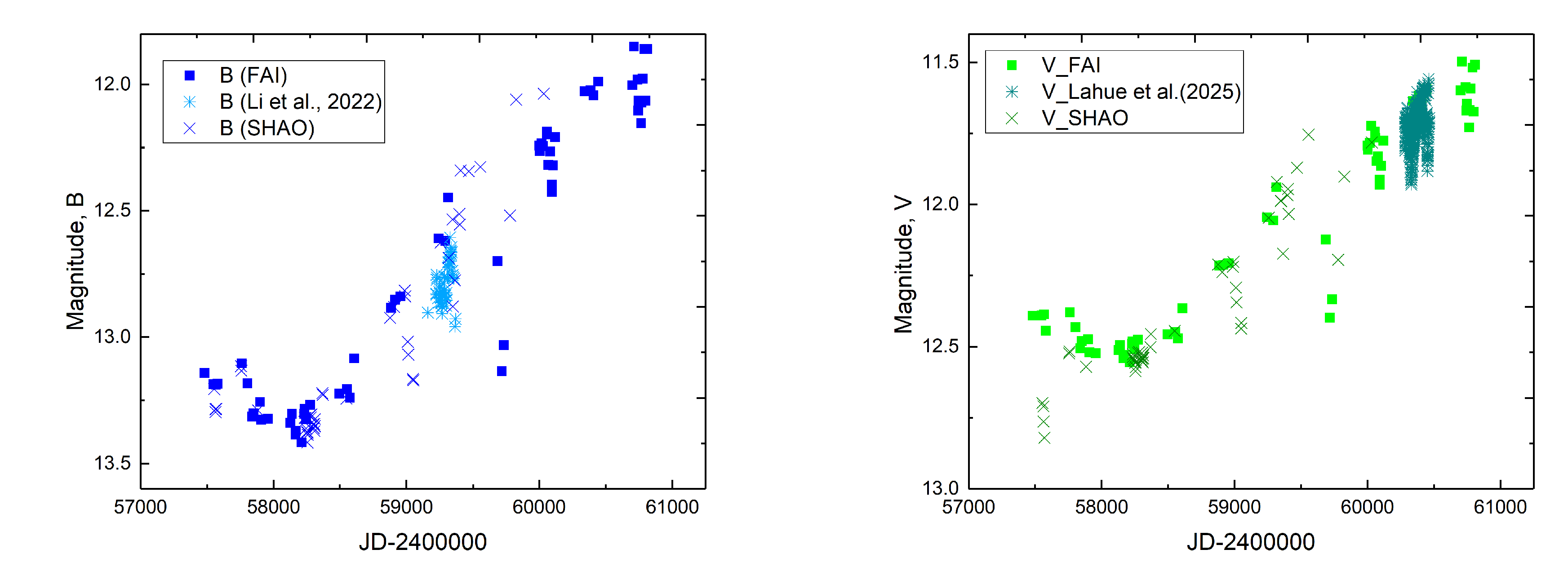
Figure 2.
Light curve of NGC 4151 in the Rc and Ic filters constructed from the TShAO observations (red squares) and the ShAO observations (red asterisks).
Figure 2.
Light curve of NGC 4151 in the Rc and Ic filters constructed from the TShAO observations (red squares) and the ShAO observations (red asterisks).
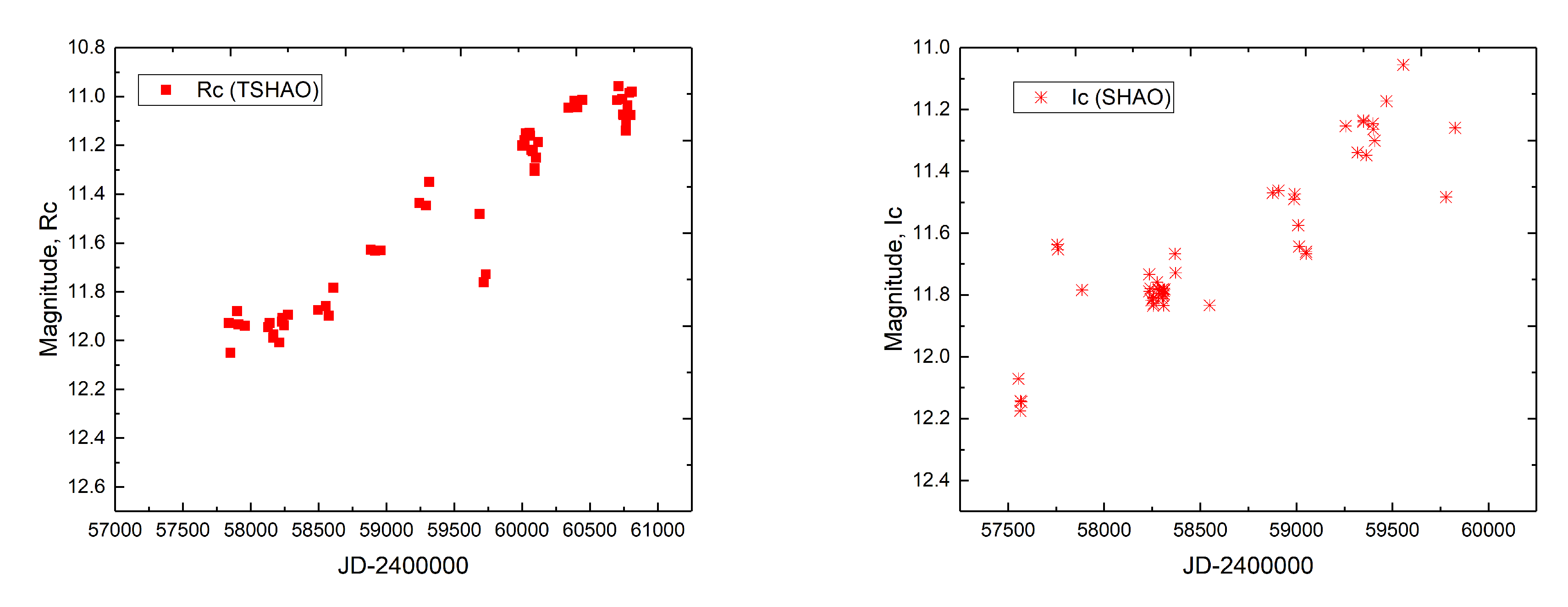
Figure 3.
General behavior of the color indices as a function of brightness for the galaxy NGC 4151 (TShAO data).
Figure 3.
General behavior of the color indices as a function of brightness for the galaxy NGC 4151 (TShAO data).
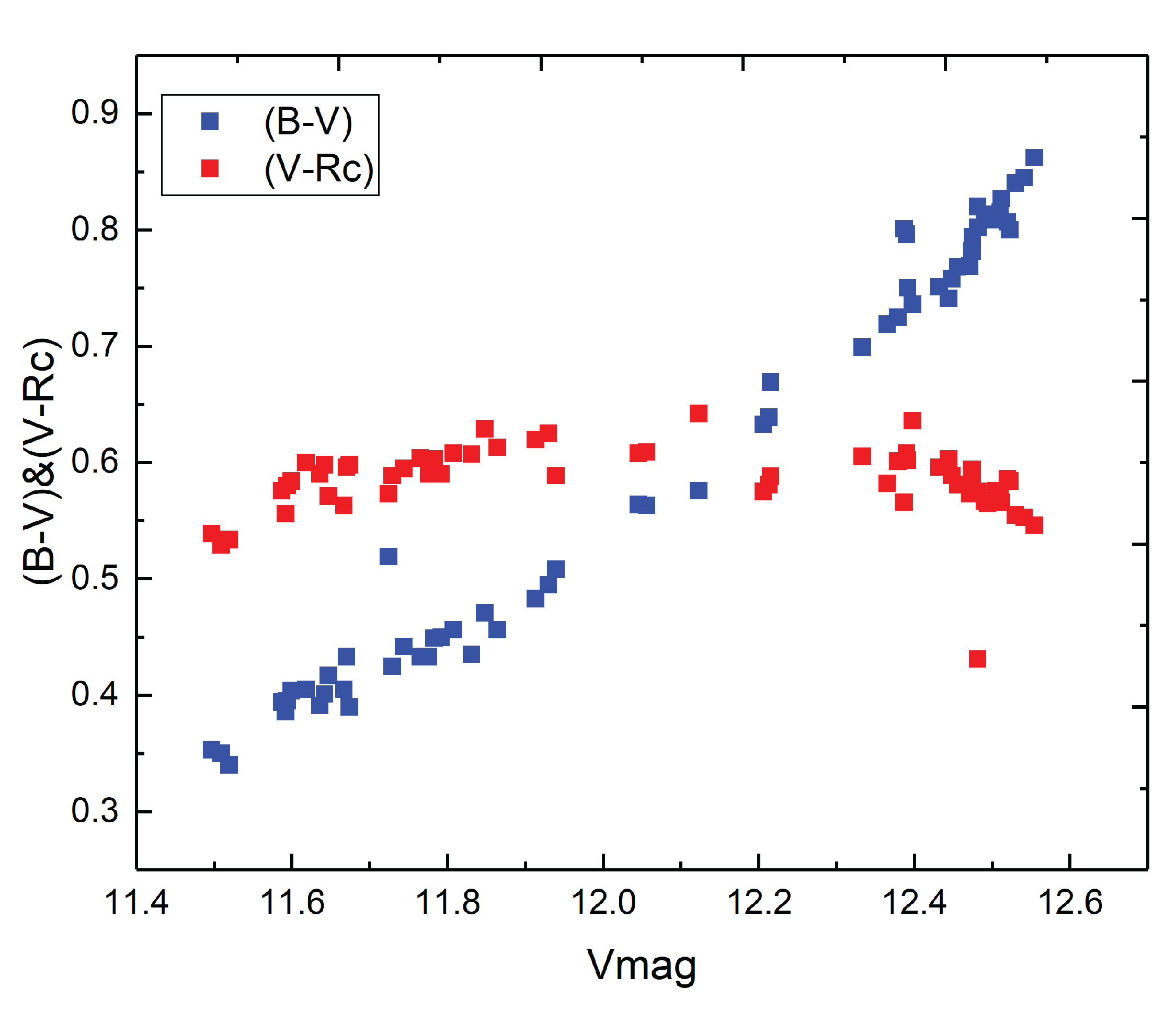
Figure 4.
Results of the discrete correlation function for NGC 4151 (TShAO data)
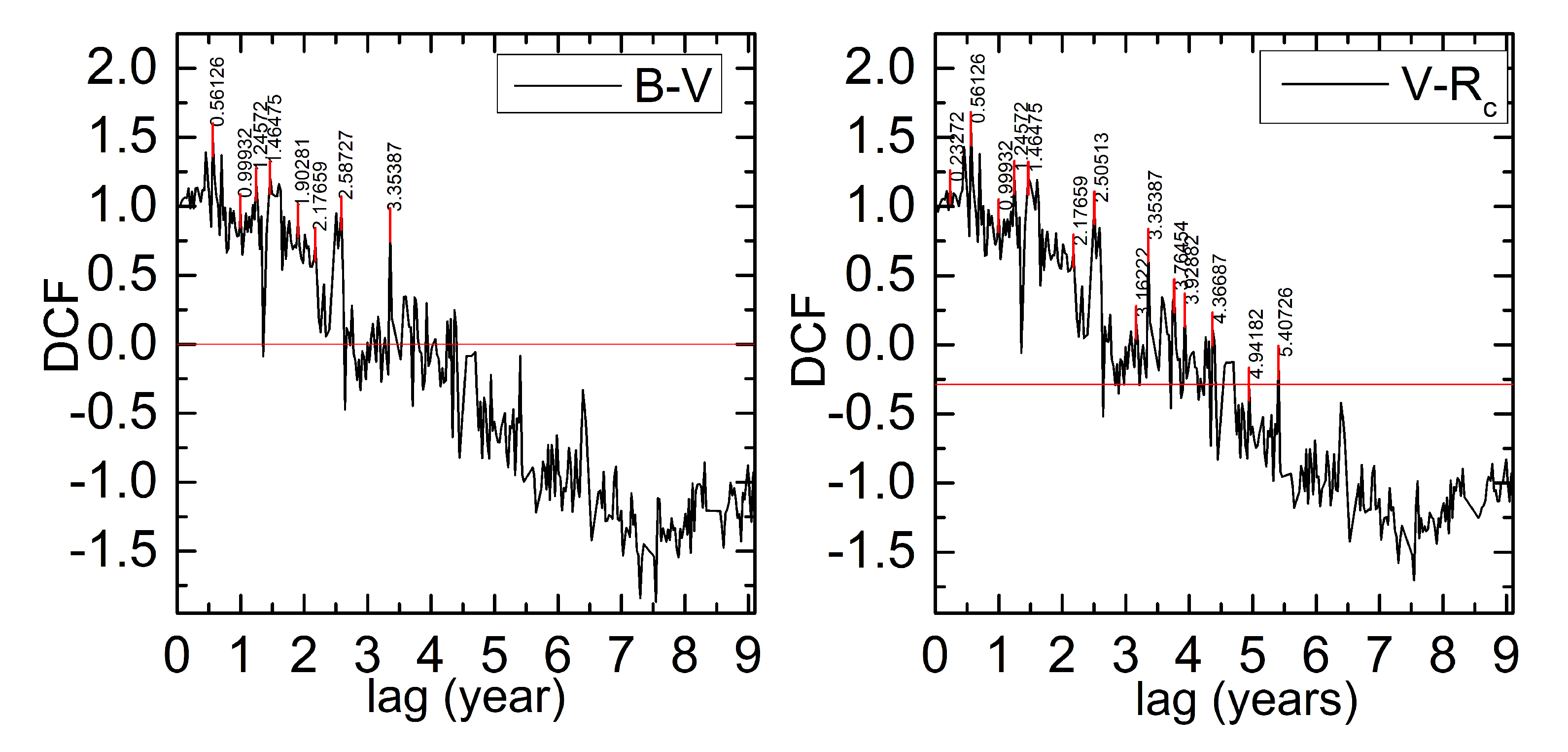
Figure 5.
Spectral energy distribution (SED) of NGC 4151. The X-axis represents wavelength, and the Y-axis represents .
Figure 5.
Spectral energy distribution (SED) of NGC 4151. The X-axis represents wavelength, and the Y-axis represents .
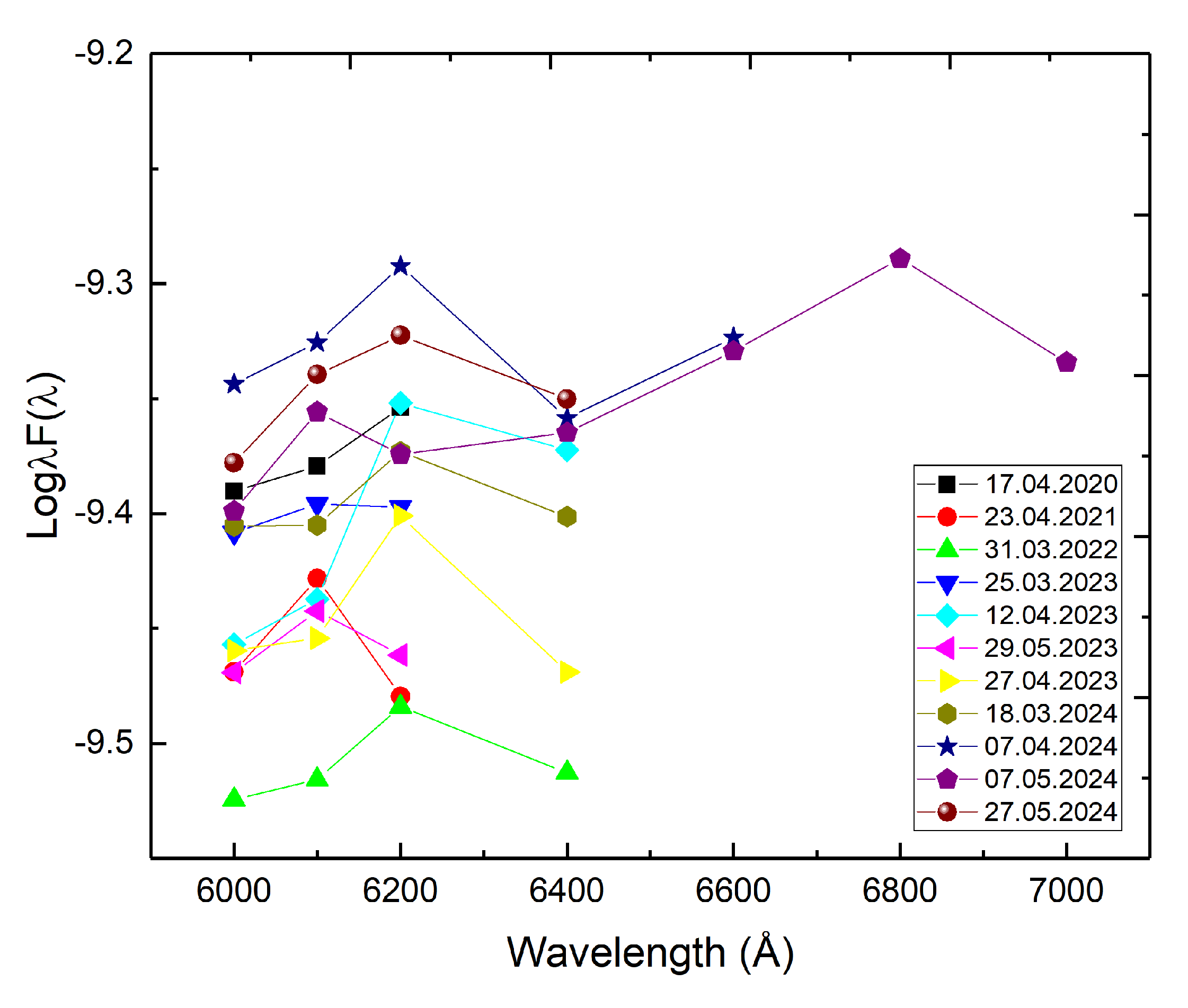

Table 1.
Photometric measurements of NGC 4151 in the B, V, and bands obtained in 2016–2025 at the FAI.
Table 1.
Photometric measurements of NGC 4151 in the B, V, and bands obtained in 2016–2025 at the FAI.
| Date | JD + 2400000 | B | V | |
|---|---|---|---|---|
| 06.02.2020 | 58885 | 12.884 ± 0.002 | 12.215 ± 0.001 | 11.627 ± 0.001 |
| 08.03.2020 | 58916 | 12.852 ± 0.002 | 12.213 ± 0.001 | 11.632 ± 0.001 |
| 18.04.2020 | 58957 | 12.839 ± 0.001 | 12.206 ± 0.001 | 11.631 ± 0.001 |
| 29.01.2021 | 59243 | 12.609 ± 0.001 | 12.045 ± 0.001 | 11.437 ± 0.001 |
| 18.03.2021 | 59291 | 12.619 ± 0.002 | 12.056 ± 0.001 | 11.447 ± 0.001 |
| 10.04.2021 | 59314 | 12.447 ± 0.001 | 11.939 ± 0.001 | 11.350 ± 0.001 |
| 17.04.2022 | 59686 | 12.699 ± 0.002 | 12.123 ± 0.001 | 11.481 ± 0.001 |
| 19.05.2022 | 59718 | 13.134 ± 0.003 | 12.398 ± 0.002 | 11.762 ± 0.001 |
| 04.06.2022 | 59734 | 13.032 ± 0.002 | 12.333 ± 0.001 | 11.728 ± 0.001 |
| 26.02.2023 | 60001 | 12.242 ± 0.001 | 11.792 ± 0.002 | 11.202 ± 0.001 |
| 28.02.2023 | 60003 | 12.264 ± 0.003 | 11.808 ± 0.002 | 11.200 ± 0.002 |
| 28.02.2023 | 60003 | 12.244 ± 0.001 | 11.807 ± 0.002 | 11.200 ± 0.001 |
| 14.03.2023 | 60017 | 12.232 ± 0.001 | 11.783 ± 0.002 | 11.180 ± 0.001 |
| 24.03.2023 | 60027 | 12.243 ± 0.001 | 11.724 ± 0.001 | 11.151 ± 0.001 |
| 22.04.2023 | 60056 | 12.186 ± 0.002 | 11.744 ± 0.001 | 11.149 ± 0.001 |
| 25.04.2023 | 60059 | 12.198 ± 0.001 | 11.765 ± 0.001 | 11.161 ± 0.001 |
| 04.05.2023 | 60068 | 12.319 ± 0.002 | 11.848 ± 0.001 | 11.219 ± 0.001 |
| 15.05.2023 | 60079 | 12.266 ± 0.001 | 11.831 ± 0.001 | 11.224 ± 0.001 |
| 29.05.2023 | 60093 | 12.425 ± 0.001 | 11.930 ± 0.001 | 11.305 ± 0.001 |
| 30.05.2023 | 60094 | 12.396 ± 0.001 | 11.913 ± 0.001 | 11.293 ± 0.001 |
| 08.06.2023 | 60103 | 12.320 ± 0.001 | 11.864 ± 0.001 | 11.251 ± 0.001 |
| 24.06.2023 | 60119 | 12.209 ± 0.001 | 11.776 ± 0.001 | 11.186 ± 0.001 |
| 02.02.2024 | 60342 | 12.027 ± 0.001 | 11.636 ± 0.001 | 11.046 ± 0.001 |
| 17.03.2024 | 60386 | 12.023 ± 0.001 | 11.618 ± 0.001 | 11.018 ± 0.001 |
| 07.04.2024 | 60407 | 12.043 ± 0.001 | 11.642 ± 0.001 | 11.044 ± 0.001 |
| 14.05.2024 | 60444 | 11.989 ± 0.005 | 11.594 ± 0.001 | 11.014 ± 0.001 |
| 25.01.2025 | 60700 | 12.003 ± 0.001 | 11.599 ± 0.001 | 11.015 ± 0.001 |
| 05.02.2025 | 60711 | 11.850 ± 0.001 | 11.497 ± 0.001 | 10.958 ± 0.001 |
| 04.03.2025 | 60738 | 11.981 ± 0.001 | 11.587 ± 0.001 | 11.011 ± 0.001 |
| 10.03.2025 | 60744 | 12.103 ± 0.001 | 11.670 ± 0.001 | 11.074 ± 0.001 |
| 13.03.2025 | 60747 | 12.064 ± 0.001 | 11.647 ± 0.001 | 11.076 ± 0.001 |
| 31.03.2025 | 60765 | 12.154 ± 0.001 | 11.729 ± 0.001 | 11.140 ± 0.001 |
| 03.04.2025 | 60768 | 12.072 ± 0.001 | 11.667 ± 0.001 | 11.104 ± 0.001 |
| 12.04.2025 | 60777 | 11.978 ± 0.001 | 11.592 ± 0.001 | 11.036 ± 0.001 |
| 25.04.2025 | 60790 | 11.859 ± 0.001 | 11.519 ± 0.001 | 10.985 ± 0.001 |
| 03.05.2025 | 60798 | 12.064 ± 0.001 | 11.674 ± 0.001 | 11.076 ± 0.001 |
| 15.05.2025 | 60810 | 11.859 ± 0.001 | 11.509 ± 0.001 | 10.980 ± 0.001 |
Table 2.
B, V, and magnitudes of NGC 4151 obtained during 2020–2023 at ShAO.
| Date | JD + 2400000 | B | V | |
|---|---|---|---|---|
| 28.01.2020 | 58877 | 12.923 ± 0.003 | 12.211 ± 0.003 | 11.469 ± 0.004 |
| 27.02.2020 | 58907 | 12.880 ± 0.003 | 12.238 ± 0.003 | 11.463 ± 0.004 |
| 18.05.2020 | 58988 | 12.815 ± 0.003 | 12.219 ± 0.003 | 11.490 ± 0.004 |
| 21.05.2020 | 58991 | 12.839 ± 0.003 | 12.202 ± 0.003 | 11.474 ± 0.004 |
| 09.06.2020 | 59010 | 13.018 ± 0.003 | 12.293 ± 0.003 | 11.574 ± 0.004 |
| 14.06.2020 | 59015 | 13.069 ± 0.003 | 12.344 ± 0.003 | 11.643 ± 0.004 |
| 19.07.2020 | 59050 | 13.165 ± 0.003 | 12.436 ± 0.003 | 11.670 ± 0.004 |
| 20.07.2020 | 59051 | 13.171 ± 0.003 | 12.416 ± 0.003 | 11.660 ± 0.004 |
| 11.02.2021 | 59257 | 12.630 ± 0.003 | 12.050 ± 0.003 | 11.253 ± 0.003 |
| 13.04.2021 | 59318 | 12.690 ± 0.003 | 11.920 ± 0.003 | 11.340 ± 0.003 |
| 13.05.2021 | 59348 | 12.530 ± 0.003 | 11.990 ± 0.003 | 11.235 ± 0.003 |
| 14.05.2021 | 59349 | 12.880 ± 0.003 | 11.990 ± 0.003 | 11.239 ± 0.003 |
| 29.05.2021 | 59364 | 12.780 ± 0.003 | 12.170 ± 0.003 | 11.347 ± 0.003 |
| 02.07.2021 | 59398 | 12.510 ± 0.003 | 11.970 ± 0.003 | 11.246 ± 0.003 |
| 05.07.2021 | 59401 | 12.550 ± 0.003 | 11.950 ± 0.003 | 11.265 ± 0.003 |
| 11.07.2021 | 59407 | 12.340 ± 0.003 | 12.030 ± 0.003 | 11.301 ± 0.003 |
| 11.09.2021 | 59469 | 12.340 ± 0.003 | 11.870 ± 0.003 | 11.172 ± 0.003 |
| 07.12.2021 | 59556 | 12.330 ± 0.003 | 11.750 ± 0.003 | 11.055 ± 0.003 |
| 18.07.2022 | 59779 | 12.520 ± 0.003 | 12.190 ± 0.003 | 11.484 ± 0.004 |
| 03.09.2022 | 59826 | 12.060 ± 0.003 | 11.900 ± 0.003 | 11.259 ± 0.003 |
| 29.03.2023 | 60033 | 12.040 ± 0.003 | 11.780 ± 0.003 | 10.973 ± 0.003 |
Table 3.
Spectral line parameters and continuum/line fluxes of NGC 4151.
| Date | (Å) | Continuum Flux | Line Flux | EW | FWHM | Telescope |
|---|---|---|---|---|---|---|
| (erg s−1 cm−2 Å−1) | (erg s−1 cm−2) | (Å) | (Å) | |||
| 17.04.2020 | 4859.336 | 8.378E-14 | 2.902E-12 | 35 | 22 | West 1 m, TShAO |
| 4960.098 | 8.417E-14 | 5.620E-12 | 66 | 8 | ||
| 5007.523 | 8.840E-14 | 1.825E-11 | 206 | 8 | ||
| 23.04.2021 | 6302.772 | 5.390E-14 | 7.652E-13 | 14 | 13 | AZT-8 |
| 6564.355 | 5.683E-14 | 2.431E-11 | 428 | 63 | ||
| 6724.901 | 4.930E-14 | 1.749E-12 | 35 | 23 | ||
| 31.03.2022 | 6300.296 | 4.744E-14 | 7.732E-13 | 16 | 10 | AZT-8 |
| 6364.729 | 4.792E-14 | 3.344E-13 | 7 | 14 | ||
| 6562.976 | 5.000E-14 | 2.611E-11 | 522 | 67 | ||
| 6724.010 | 4.567E-14 | 1.849E-12 | 40 | 25 | ||
| 28.02.2023 | 6299.590 | 3.651E-14 | 5.309E-13 | 15 | 11 | AZT-8 |
| 6560.780 | 3.862E-14 | 1.599E-11 | 414 | 65 | ||
| 6723.590 | 3.336E-14 | 1.061E-12 | 32 | 27 | ||
| 25.03.2023 | 4862.556 | 2.318E-13 | 1.624E-11 | 70 | 63 | AZT-8 |
| 4961.336 | 2.596E-13 | 6.023E-12 | 23 | 13 | ||
| 5008.703 | 2.581E-13 | 1.096E-11 | 42 | 17 | ||
| 12.04.2023 | 6302.412 | 5.540E-14 | 6.842E-13 | 12 | 11 | AZT-8 |
| 6367.008 | 5.740E-14 | 3.426E-13 | 6 | 15 | ||
| 6564.198 | 6.774E-14 | 2.669E-11 | 394 | 67 | ||
| 6725.933 | 6.309E-14 | 1.576E-12 | 25 | 26 | ||
| 27.04.2023 | 6303.415 | 5.506E-14 | 6.458E-13 | 12 | 11 | AZT-8 |
| 6368.211 | 5.518E-14 | 2.445E-13 | 4 | 12 | ||
| 6564.869 | 6.051E-14 | 2.638E-11 | 436 | 67 | ||
| 6726.645 | 5.049E-14 | 1.699E-12 | 34 | 25 | ||
| 29.05.2023 | 4857.798 | 6.990E-14 | 6.354E-12 | 91 | 58 | AZT-8 |
| 4958.809 | 7.283E-14 | 4.135E-12 | 57 | 10 | ||
| 5006.948 | 6.900E-14 | 1.290E-11 | 187 | 10 | ||
| 18.03.2024 | 6300.789 | 6.240E-14 | 5.612E-13 | 9 | 9 | AZT-8 |
| 6364.924 | 6.183E-14 | 2.824E-13 | 5 | 14 | ||
| 6563.661 | 6.452E-14 | 2.752E-11 | 427 | 70 | ||
| 6725.709 | 5.901E-14 | 1.545E-12 | 26 | 24 | ||
| 07.04.2024 | 6300.177 | 7.194E-14 | 6.903E-13 | 10 | 11 | AZT-8 |
| 6364.516 | 7.425E-14 | 3.050E-13 | 4 | 68 | ||
| 6563.539 | 7.771E-14 | 2.852E-11 | 367 | 26 | ||
| 6724.437 | 6.514E-14 | 1.736E-12 | 27 | – | ||
| 07.05.2024 | 4862.180 | 8.208E-14 | 7.216E-12 | 88 | 66 | AZT-8 |
| 4961.292 | 8.884E-14 | 3.364E-12 | 39 | 9 | ||
| 5009.577 | 8.433E-14 | 1.106E-11 | 131 | 9 | ||
| 6304.229 | 6.848E-14 | 7.414E-13 | 11 | 12 | ||
| 6369.560 | 7.355E-14 | 3.956E-13 | 5 | 16 | ||
| 6568.734 | 7.823E-14 | 3.135E-11 | 400 | 69 | ||
| 6728.888 | 6.885E-14 | 1.855E-12 | 27 | 25 | ||
| 27.05.2024 | 6300.002 | 6.650E-14 | 8.722E-13 | 13 | 16 | AZT-8 |
| 6366.348 | 7.188E-14 | 3.236E-13 | 5 | 23 | ||
| 6564.075 | 7.250E-14 | 2.689E-11 | 371 | 68 | ||
| 6723.241 | 6.642E-14 | 1.468E-12 | 22 | 27 |
Table 4.
Flux, luminosity, and BLR size estimates for NGC 4151.
| Epoch (Date) | (erg cm−2 s−1 Å−1) | (erg s−1) | (light-days) |
|---|---|---|---|
| 17.04.2020 | 0.15 | ||
| 25.03.2023 | 0.14 | ||
| 29.05.2023 | 0.13 | ||
| 07.05.2024 | 0.14 |
Disclaimer/Publisher’s Note: The statements, opinions and data contained in all publications are solely those of the individual author(s) and contributor(s) and not of MDPI and/or the editor(s). MDPI and/or the editor(s) disclaim responsibility for any injury to people or property resulting from any ideas, methods, instructions or products referred to in the content. |
© 2025 by the authors. Licensee MDPI, Basel, Switzerland. This article is an open access article distributed under the terms and conditions of the Creative Commons Attribution (CC BY) license (http://creativecommons.org/licenses/by/4.0/).
Copyright: This open access article is published under a Creative Commons CC BY 4.0 license, which permit the free download, distribution, and reuse, provided that the author and preprint are cited in any reuse.


