

Submitted:
01 December 2025
Posted:
03 December 2025
You are already at the latest version
Abstract
Magnetic superconductor EuRbFe4As4 is a quite unique system in which macroscopic superconductivity and magnetic ordering coexist, with interesting interactions between Abrikosov vortices and Eu2+ spins that were investigated mostly by static (DC) magnetization measurements. Our aim is to study the dynamic interactions between the two sub-systems using AC susceptibility measurements in a wide range of temperatures and superimposed DC fields. In low DC fields, the magnetic transition at 15 K is clearly visible. We have observed very little difference between the AC susceptibility in different cooling regimes, but large difference for different field orientation. For field perpendicular to the superconducting planes, we have observed an anomalous dependence just below the critical temperature, which is absent in the parallel field orientation. We explained the anomaly by the interplay between the sample dimensions and the temperature dependence of the London penetration depth which may allow the paramagnetic Meissner phase to be detected in the susceptibility response.
Keywords:
magnetic superconductor
; EuRbFe4As4
; AC susceptibility
1. Introduction
Soon after the discovery of iron-based superconductors (IBS) [1], the 122 family based on AEFe2As2 (AE being alkali-earth metal Ca, Sr, Ba) parent compound, became the most popular materials for both physical explorations and applications because of their critical temperature Tc as high as 38 K [2], very high upper critical fields µ0Hc2 (> 70 T) [3,4] and low anisotropies (γ < 2) [4]. Superconductivity in AEFe2As2 is primarily induced by alkali metal (A = Na, K, Rb, Cs) substitution at AE sites with a concomitant suppression or elimination of the structural and magnetic ordering transition. The structure’s crystallographic space group (I4/mmm) is not changed by this A substitution because AE and A randomly occupy crystallographically equivalent sites. Thus, (AE1−xAx)Fe2As2 (also noted as (AE,A)Fe2As2) are solid solutions between AEFe2As2 and AFe2As2 compounds with the same structural type. Later it was found that, if there is a large difference in the ionic radii Δr of AE and A, such solid solutions are not possible and a new type of IBSs has been reported [5], having a new structure, abbreviated as AEA1144, namely CaAFe4As4 (A = K, Rb, Cs) and SrAFe4As4 (A = Rb, Cs). In these cases, because A does not mix with AE due to the large Δr, AEA1144 crystallizes through alternate stacking of the AE and A layers across the Fe2As2 layers, changing the space group from I4/mmm to P/4 mmm, the compounds being superconductors with Tc values between 31 and 36 K. One of the most studied superconductor (SC) in this new family is CaKFe4As4 (CaK1144) due to its excellent superconducting properties including very high critical current density and very high pinning potential [6]. Following the discovery of the 1144-type IBS, in 2016 two Eu-containing materials in the family, AEuFe4As4 (A = Rb, Cs), were subsequently synthesized and characterized [7,8]. The two sibling compounds exhibit SC at Tc = 36.5 K (A = Rb) and 35 K (A = Cs), respectively, without extrinsic doping. The Eu2+ spins order at Tm = 15 K (A = Rb) or 15.5 K (A = Cs) [8]. The Mössbauer studies [9] indicate that the Eu2+ spins in AEuFe4As4 are ferromagnetically (FM) coupled and lie flat in the ab plane. Intuitively, the removal of every alternating magnetic Eu-layer in EuFe2As2 would give rise to Eu-spin FM. Nevertheless, recent neutron diffraction study [10] revealed a helical modulation with the magnetic propagation vector of k = (0, 0, 1/4) for the Eu-spin ordering. If a small magnetic field (∼ 0.2 T and ∼ 0.4 T, respectively, for H // ab and H // c) is applied [11], this helically modulated magnetic structure easily changes into a genuine FM, the latter of which fully coexists with SC. Therefore, the new materials can be viewed as a natural atomic-thick superconductor–ferromagnet superlattice, as sketched in Figure 1. The parent compound EuFe2As2 is an antiferromagnet (Figure 1a). Due to the large difference in atomic radii, a 50% substitution of Eu with Rb results not in (Eu0.5Rb0.5)Fe2As2 solid solution, but in the new, layered 1144 structure, EuRbFe4As4, in which the Eu layers having helical magnetism sandwiches a thick superconducting layer composed of two Fe2As2 planes with a Rb plane between them (Figure 1b). By applying a small magnetic field, helical magnetism in the Eu planes is driven into a ferromagnetic state (Figure 1c).
The new magnetic superconductor was characterized by many techniques to elucidate various aspects of superconductivity. After their discovery by Kawashima et al [7], the crystal structure was investigated by XRD and determined to be tetragonal with symmetry group P4/mmm and by resistivity and DC magnetization that showed a critical temperature of about 36 K, an upper critical field (extrapolated at 0 K) of about 92 T and a coherence length of 1.8 nm [7]. More importantly, they discovered an anomaly in the magnetic response at 15 K which was correctly interpreted as coexistence of superconductivity and a magnetic ordered state created by Eu2+ ions. A few months later, Liu et al. [8] managed to replicate the material, and, in addition to resistivity and magnetization measurements that confirmed previous results, they performed also magnetization hysteresis measurements and specific heat measurements that revealed a very rare third-order type magnetic transition. In a seminal paper, Ishida et al. [12], by combining neutron diffraction and magnetization measurements, revealed that ferromagnetic alignment of Eu2+ moments is induced by superconducting vortices. They showed that the direction of the Eu2+ spins is dominated by the distribution of pinned vortices based on the critical state model, highlighting a unique interplay between magnetism and superconductivity. Vortex matter, dynamics and pinning are reflected different in the case of AC susceptibility as compared to DC studies. For this reason, in this work we investigated the interplay between magnetic moments and vortex matter and dynamics in the case of AC fields superimposed on DC fields up to 9 T, for fields orientations perpendicular and, respectively, parallel to the superconducting planes, in both Zero-Field-Cooling (ZFC) and Field-Cooling (FC) procedures. The results showed the expected ferromagnetic signal at around 15 K superimposed on the diamagnetic screening at low DC fields (similar to DC susceptibility measurements), as well as a clear anomaly in the diamagnetic screening due to ferromagnetic ordering of the spins immediately after Tc at higher fields. The anomaly in the in-phase susceptibility is accompanied by a shoulder in the out-of-phase susceptibility (dissipation peak), in both ZFC and FC regimes, for perpendicular orientation. In the case of measurements with the thin sample parallel to the fields, such anomalies were not detected.
2. Materials and Methods
The EuRbFe4As4 single crystals were grown in AIST Tsukuba, Japan, by the RbAs-flux method [13]. EuAs, Fe2As and RbAs precursors were prepared from Eu and As, Fe and As, and Rb and As, respectively, which were mixed at appropriate molar ratios. EuAs and Fe2As mixtures were sealed in evacuated quartz tubes, while RbAs was sealed in a stainless-steel tube with an alumina crucible. The mixtures were sintered for 20 h at the following temperatures: 750 °C for EuAs, 900 °C for Fe2As and 600 °C for RbAs, then were weighed at a ratio 1:1:15 to a total amount of 9g and placed in an alumina crucible which was sealed in a stainless-steel container. The thermal process leading to crystal growth consisted in heating in 5 h to 700 °C, maintaining this temperature for 5 h, then heated in 5 h to 970 °C and maintaining this temperature for 10 h. The final step was a very slow cooling for 350 h ( 1 °C/h) to 620 °C. After cleaving the surfaces of the single crystals, XRD patterns showed only the (00l) peaks from EuRbFe4As4 [12]. The sample investigated in this work is a thin square with length l = 0.9±0.1 mm and thickness t ≈ 0.06±0.02 mm.
AC magnetic susceptibility was measured using a Quantum Design PPMS-9 T with an ACMS option and the PPMS MultiVu software, which allows to pre-program the type of measurements, the temperature (fixed or variable, between 1.9 and 350 K), the field (fixed or variable, up to 9 T), the frequency of the AC field excitation (up to 10 kHz), and the amplitude of the AC field excitation (up to 16 Oe). For this work, AC susceptibility measurements were conducted as a function of temperature by applying an AC magnetic field perpendicular or parallel to the superconducting layers (a-b planes), with or without a superimposed DC magnetic field up to 9 T, in the Zero-Field Cooling (ZFC) conditions or Field Cooling (FC) conditions. The measurements were taken at a fixed AC field amplitude hAC = 1 Oe and at the AC field frequency ν = 5686.4 Hz. To prevent any potential effects of residual field trapped within the DC magnet on the sample response, before each measurement we warmed the magnet close to room temperature, applied 2 T and reduce the field to zero in the oscillation mode. This demagnetizing process was proven to reduce the trapped DC field below 1 Oe. After demagnetizing procedure, the sample was cooled to 5 K in ZFC or FC conditions. Susceptibility as function of temperature data were measured between 5 and 40 K with a sweep rate of 0.1 K/min, such small sweeping rate ensuring a large number of measured points for each curve.
3. Results
3.1. Fields Perpendicular to the Superconducting Planes
Figure 2 shows the temperature dependence of the in-phase fundamental susceptibility of the sample measured with an AC field with amplitude of 1 Oe and frequency of 5686.4 Hz superimposed on DC magnetic fields of 0.01, 0.1, 0.5, 1, 2, 3, 4, 5, 6, 7, 8 and 9 T.
The first thing we observed is the small signal at low temperature and very low DC fields (< 0.5 T) that indicates the magnetic transition, similar to the ones detected in DC magnetization measurements [7,8]. In higher fields the ferromagnetic signal from Eu2+ is masked by the decrease in diamagnetic screening due to the decrease of Jc with increasing DC field. Near Tc we observe a standard sharp superconducting transition in low DC fields, which, as expected, becomes wider and having smaller on-set temperature with increasing DC fields. However, for DC fields higher than 0.5 T the in-phase susceptibility shows an unexpected anomaly not far from Tc as can be seen in the main panels and, in detail, in the lower inserts. After the normal increase in diamagnetic screening with decreasing temperature, we can see a decrease in diamagnetic screening, which is consistent with the appearance of a small ferromagnetic signal from the Eu2+ spins. The anomaly starts as a “shoulder” for fields smaller than about 2 T, and develops as a clear local “maximum” for larger DC fields. Looking at both sets of graphs, we can see that there are small, but not significant differences between ZFC and FC cooling protocols.
Figure 3 show the temperature dependence of the out-of-phase susceptibility, in both ZFC and FC cooling protocols, for the same DC fields as in Figure 2. Figures show again very small, negligible, differences between ZFC and FC cooling protocols. For small fields, the dissipation signal has a very sharp peak and, as DC fields exceed 0.5 T, a “shoulder” is developing and becomes more visible with the increase of DC field, together with the expected broadening of the dissipation signal.
The positions (temperatures) of the shoulders corresponds to those of the local “peaks” in the in-phase susceptibility as seen in Figure 2.
3.2. Fields Parallel with the Superconducting Planes
For this geometry, we have performed the measurements with two AC field amplitude, 1 and 10 Oe, and with two frequencies, 497 and 5686.4 Hz, in ZFC protocol. After looking at the results at DC fields 0 and 0.01 T, we have seen that the signal for 1 Oe and 497 Hz are very noisy, as can be seen in Figure 4.
Even for the low frequency, we can see a sharp superconducting transition in both diamagnetic screening and dissipation peak. The magnetic transition is clearly visible at 15 K, similar to the case of perpendicular orientation and DC susceptibility measurements.
For AC field amplitude of 10 Oe the measurements look similar, only without the noise at low frequency. For DC field of 0.01 T (100 Oe), both ZFC and FC measurements with AC field amplitudes of 1 and 10 Oe look similar to the zero DC field case (again with quite large noise at 1 Oe and 497 Hz). The data can be seen in Supplementary Material 1. For higher fields, the measurements in parallel configuration show standard in-phase susceptibility, without any anomaly just below Tc as was the case of perpendicular configuration. To summarize the results of the measurements in parallel configuration in zero or very small DC fields: the superconducting transitions are sharp, with the expected magnetic signal in the in-phase susceptibility at 15 K, very similar to measurements in perpendicular configuration and to low-field DC measurements reported in the literature. In higher fields, there is no anomaly in the diamagnetic signal as is the case for perpendicular fields configuration. The small positive signal in the normal state will be addressed in the next sub-section.
3.3. Comparison Between Perpendicular and Parallel Configurations
Since we have not observed any anomaly in the in-phase susceptibility in parallel orientation, it is interesting to have a comparison between χ’1 (T) for the two orientations, in the same DC field, measured with the same amplitude and frequency of the AC field. For such comparison to be meaningful, we need to take into account the huge difference in demagnetization factors for the two field orientations due to the plate-like shape of the sample with thickness one order of magnitude smaller than the larger dimensions, so we normalized the in-phase susceptibility curves to the largest values of the diamagnetic signal for the two orientations, which are about -3.5×10⁻⁵ emu/Oe in perpendicular configuration (see Figure 2), and, respectively, about -0.9×10⁻⁶ emu/Oe in parallel configuration (see left-hand-side of Figure 4), ensuring in this way that in both orientations the in-phase normalized susceptibility at 5 K is −1 (perfect diamagnetism). All the normalized susceptibility curves shown below were measured in various DC fields using ZFC protocol, with AC field amplitude of 1 Oe and frequency of 5686.4 Hz. FC protocols gave the same results, with small, minor differences. Figure 5 shows the results for zero and 100 Oe, below the transition between helical and ferromagnetic arrangements of the Eu2+ spins.
It can be seen that, in zero and very low DC field, the superconducting transitions are sharp, with the same Tc. The signal due to magnetic transition is 5 times larger in the case of parallel orientation, which can be easily explained considering that is much easier for the Eu2+ spins to follow the direction of the AC field in the a-b planes for parallel orientation than to tilt away from the planes to follow the direction of perpendicular AC field. For the same reason there is a small, positive magnetic signal in the normal phase of the superconductors (for temperatures higher than Tc) in parallel configuration. Remarkably, the value of the positive susceptibility in the normal state is about the same as the height of the peak at 5 K, namely about 0.05 a.u. in the normalized scale. A larger signal for the parallel orientation at the magnetic transition at 15 K was observed also in DC magnetization measurements in a DC field of 30 Oe [14].
Figure 6 shows the temperature dependence of the in-phase fundamental susceptibility for the two orientations, for fields above the field of helical magnetism / ferromagnetism transition, but not very large, 0.1 T (left-hand side) and 0.5 T (right-hand side). It can be seen that, in such intermediate fields, there is a competition between the magnetic interaction of Eu2+ spins with the larger density of vortices induced by the DC field (similar to the so called “magnetic pinning”) and the tendency to follow the AC field orientation. In 0.1 T the signals due to magnetic transition are much smaller, and very noisy, while in 0.5 T the signal practically disappears.
In higher fields there is no more visible signal at 15 K due to the much larger density of vortices which, through magnetic interaction, impede the Eu2+ spins from following the direction of AC field, but for such larger DC fields the anomaly just below Tc in perpendicular configuration appears. Figure 7 shows the comparison between the temperature dependence of the normalized in-phase susceptibility for parallel and perpendicular configurations, in DC fields of 1 T (left-hand-side) and 3 T (right hand side). Inserts show details of curves just below Tc, where the anomaly starts to appear for perpendicular configuration. Apart from the anomaly, there are a few interesting features. The most visible is the appearance of a small difference in the critical temperatures for the two orientations, due to the large demagnetization factor in perpendicular configuration. Another feature is the decrease of the positive signal in the normal state with increasing DC field, again due to the magnetic interaction between Eu2+ spins and magnetic flux lines with an increasing density, preventing the spins to follow the direction of AC field. It is worth noting that we have kept the same normalizing factors as in zero DC field; this is the reason for in-phase susceptibility for parallel orientation at low temperature laying below −1.
4. Discussion
We will start our discussion with a comparison between the EuRb1144 magnetic superconductor and its more studied “relative” non-magnetic CaK1144. Quite unexpectedly, EuRb1144 show a higher Tc of 37 K as compared to 35.8 K in CaK1144 [6,15] despite the presence of magnetism which usually suppress critical temperature. However, the interaction between Eu2+ spins and the vortex system leads to a much broader superconducting transition in high magnetic fields and a more pronounced reduction of Tc with increasing DC field. For example, in a DC field of 9 T, Tc decreases with 10% in EuRb1144 (see lower inserts of Figure 2) while in CaK1144 Tc decreases with only 8 % (see Supplementary Material 2). Another important aspect is the comparison between ZFC and FC cooling conditions. Similar to CaK1144, there is no significant difference between ZFC and FC AC susceptibility in EuRb1144, unlike the case of isovalently substituted BaFe2(As1-xPx)2 122 compound which showed a very pronounced magnetic memory effect [16,17]. Of course, the main difference between the two 1144 materials is the signal around 15 K due to the magnetic transition, which was first detected through DC magnetization measurements and reported in the same papers that announced the new material [7,8]. The feature that was not observed previously in any studies is the anomaly in the susceptibility response to the AC field perturbation just below Tc in fields larger than approximately 0.5 T, only with the fields perpendicular to the ab planes. We explain this anomaly by the interplay between the temperature dependence of the London penetration depth, λab and the dimensions of the sample, in the context of the very peculiar interaction between the vortex system and the subsystem of Eu2+ spins [18,19]. Vlasko-Vlasov et al. [18] performed a study of the magnetic-flux evolution in EuRb1144 using magneto-optical imaging and DC magnetization measurements. They showed that the interplay of magnetic susceptibility amplifying the magnetic induction and vortex pinning attenuating the magnetic flux entry results in a field- and temperature-dependent critical state that emulates a paramagnetic Meissner effect. They further concluded that the observed vortex dynamics corresponds to a nontrivial spatial current distribution and yields a self-consistent inhomogeneous enhancement of the sample magnetization. Suppression of superconductivity by correlated magnetic fluctuations were also detected by high-resolution scanning Hall probe microscopy [19]. In our explanation of the origin of the anomalous susceptibility response in perpendicular configuration we are extending the concept of paramagnetic Meissner effect described in [18] to the case of penetration of AC perturbation of the mixed state stabilized by a large DC field. In this context, just below Tc the superimposed AC magnetic field disturbs the critical state inside the sample on a scale of London penetration depth, λab, resulting in the AC susceptibility response of the sample. The region of the sample not perturbed by the AC excitation (in the center of the sample) we would describe as paramagnetic Meissner state following [18], although it contains Abrikosov vortices (not perturbed by AC magnetic field excitation) as well as oriented Eu2+ spins. For a clearer explanation of the anomaly just below Tc we are using the experimental data (detail near the superconducting transition) of the temperature dependence of the in-phase susceptibility χ’ in a DC field of 9 T, showed in the left-hand-side of Figure 8. The temperatures indicated in the Figure are Tc (9 T) = 35. 8 K, T1 is a temperature in the first part of increasing diamagnetic signal, Tm is the temperature of the starting of anomalous susceptibility response, T2 is a temperature where the diamagnetic response decrease with decreasing temperature due to Eu2+ spins, TM is the temperature where the derivative dχ’/dT changes sign again and T3 a temperature at which the circulating AC currents result in diamagnetic AC shielding overcoming the paramagnetic Eu2+ spins paramagnetic response due to much higher critical current density at this lower temperature. To check our scenario, we have calculated the London penetration depth, λab(T), shown in the right-hand side of Figure 8.
For the value λab(0) we have taken the experimental value of 94 nm as determined in [11], while for the functional of temperature dependence of λab(T) we have used the dependence given by the 3D X-Y critical fluctuations model, λab(T) = λab(0)(1− T/Tc)-1/3 that gave the best fit compared with mean-field and two-fluid models, which predicts different dependencies, for both 1144 and 122 IBS systems [20]. The notations of temperatures are the same in the two panels. Please note that half-width of the sample in perpendicular configuration is about 450 nm, while in parallel configuration is about 30 nm, with the London penetration depth λc(0) = 160 nm [11].
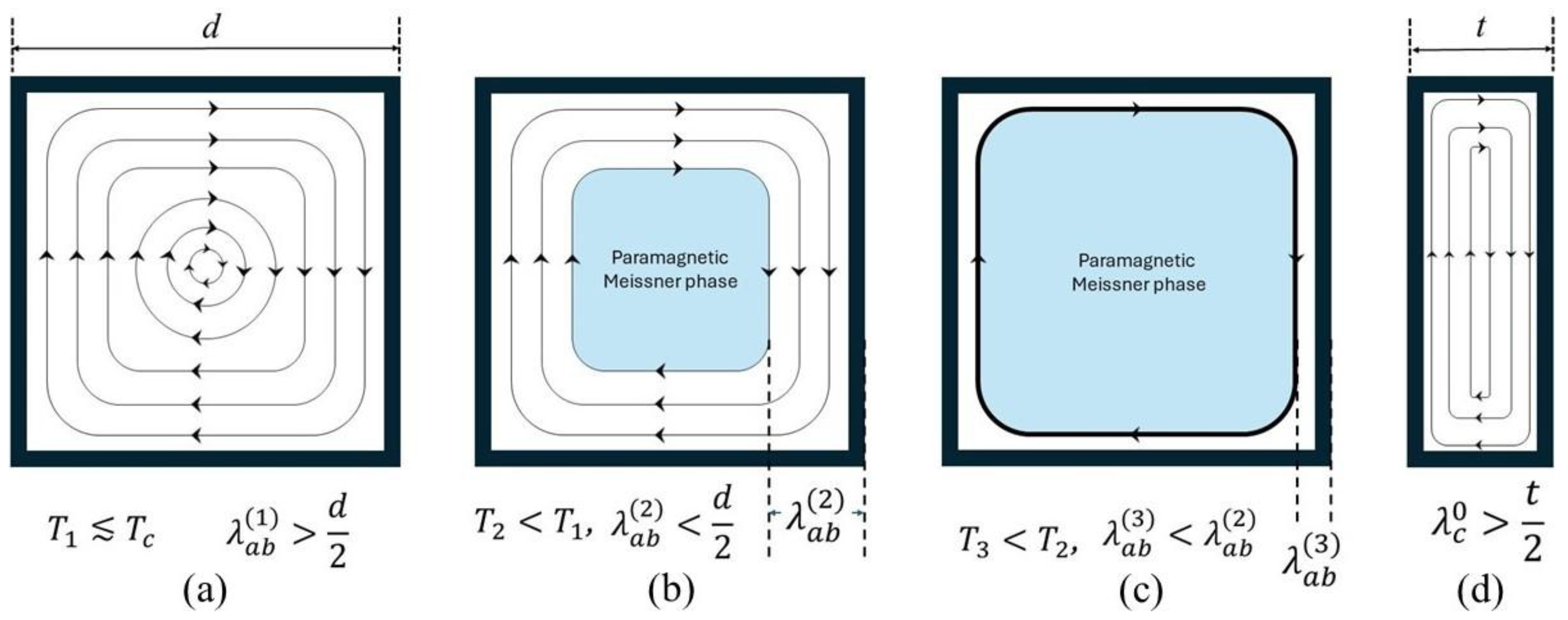
Figure 9 is a sketch that helps understanding our explanation for the appearance of the anomaly in the AC susceptibility in EuRb1144, only in the perpendicular configuration. Figure 9 (a) describe the penetration of the circulating AC supercurrents induced by the AC field excitation at temperature T1 indicated in left-hand-side of Figure 8. At this temperature, λab(T1) ≈ 600 nm is larger than the half-width of the sample d/2 ≈ 450 nm, so the sample is fully penetrated by the AC perturbation, with a small critical current density due to high temperature. Hence, there is the expected increase of the diamagnetic shielding due to the increase of critical current density with decreasing temperature, down to the temperature Tm where λab(Tm) ≈ d/2 ≈ 450 nm.
With further decrease in temperature, as in Figure 9 (b), at T2, λab(T2) ≈ 400 nm < d/2 the AC excitation doesn’t penetrate all the sample, so in the middle there is the so-called paramagnetic Meissner phase whose dimension expands due to the further decrease of London penetration depth with decreasing temperature. Since the circulating supercurrent is still small due to closeness to Tc, the paramagnetic signal from Eu2+ spins increases with decreasing λab(T) faster than the increase in critical current density, their combination leading to the anomalous decrease of the diamagnetic shielding between Tm and TM as shown in Figure 8 (left-hand side). Again, please note that the paramagnetic Meissner phase in AC susceptibility is not a true Meissner phase as in the phase diagrams of type 2 superconductors, it indicates just the central region where the AC field perturbation doesn’t penetrate. Further decrease in temperature below TM, at T3 (Figure 9 (c)) lead to a larger paramagnetic Meissner phase, but now the critical current density becomes large enough for the usual dependence of the diamagnetic shielding.
Figure 9 (d) explains the reason for the absence of the anomaly in the parallel configuration: even at the lowest temperature, the London penetration depth (λc(T) > 160 nm) is much larger than the thickness of the crystal, so the AC field penetration in the parallel configuration is complete at all temperatures, and the AC response of the Eu2+ spins is not present in the susceptibility measurements.
The last noteworthy aspect resulted from our experiments is the small positive signal of fundamental in-plane AC susceptibility for parallel configuration in the normal phase (T > Tc), as seen in Figure 4, Figure 5, Figure 6 and Figure 7. This is, to our knowledge, the first indication that the interaction of Eu2+ spins occurs not only with the Abrikosov vortices, as previously demonstrated, but also with the magnetic flux lines in the normal state. Clearly, the presence of a positive susceptibility signal in the normal phase for fields parallel to the ab planes indicates the fact that there is a plane of easy magnetization. For not too large DC fields in the parallel direction, Eu2+ spins can, to a small extent and with the help of thermal energy, follow the AC field excitation which occurs in the ab plane. When the DC field is large, the magnetic interaction between the Eu2+ spins and magnetic flux lines is larger and the tentative spins rotation to follow the variation of DC field is slowed down, like the movement of a particle in a medium with increased viscosity. For the perpendicular configuration, the absence of a noticeable positive in-phase susceptibility indicates that tilting of Eu2+ spins from the ab plane towards the c-axis is much more difficult. Since the interaction between the Eu2+ spins occurs not only with the vortices in the superconducting state but also with the magnetic flux lines in the normal state, a future research direction which will bring great benefits to a better understanding of the complexity of vortex matter, dynamics and pinning in magnetic superconductors will be to employ studies of third-harmonic susceptibility, which already proved great benefits for a better understanding on iron-based superconductors [17].
Author Contributions
Conceptualization, A.C. and M.P.; methodology, A.C and M.P.; software, I.I. and A.G.; validation, C.F.M. and D.N.C.; formal analysis, A.M.B.; investigation, A.G., A.M.B. and I.I.; resources, A.C. and M.P.; data curation, A.G.; writing—original draft preparation, A.C.; writing—review and editing, A.C., M.P. and A.G.; supervision, A.C. and M.P.; project administration, A.C.; funding acquisition, A.C. and M.P. All authors have read and agreed to the published version of the manuscript.
Funding
This research was funded by the Core Program of the National Institute of Materials Physics, under the Project PC2-PN23080202 and by the EU COST Action CA21144 SUPERQUMAP. M.P. acknowledges partial financial support by the PRIN 2022 PNRR Project QUESTIONs Grant No. P2022KWFBH.
Institutional Review Board Statement
Not applicable.
Informed Consent Statement
Not applicable.
Data Availability Statement
All data, as well as Figures not included in the paper, are available upon request.
Acknowledgments
We gratefully acknowledge S. Ishida, A. Iyo and H. Eisaki from AIST Tsukuba, Japan, for the donation in kind of EuRbFe4As4 single crystals.
Conflicts of Interest
The authors declare no conflicts of interest.
Abbreviations
The following abbreviations are used in this manuscript:
| MDPI | Multidisciplinary Digital Publishing Institute |
| IBS | Iron-based superconductors |
| AE | Alkali-earth metal |
| A | Alkali metal |
| AEA1144 | AEAFe4As4 |
| FM | Ferromagnet/Ferromagnetic |
| ZFC | Zero-field cooling |
| FC | Field cooling |
| DC | Direct current |
| AC | Alternate current |
| PPMS | Physical Properties Measurement System |
| ACMS | Alternate Current Measurement System |
References
- Kamihara, Y.; Watanabe, T.; Hirano, M.; Hosono, H. Iron-based layered superconductor La[O1-xFx]FeAs (x= 0.05-0.12) with Tc = 26 K. Journal of the American Chemical Society 2008, 130, 3296–3297. [Google Scholar] [CrossRef] [PubMed]
- Rotter, M.; Tegel, M.; Johrendt, D. Superconductivity at 38 K in the iron arsenide (Ba1-xKx)Fe2As2. Physical Review Letters 2008, 101, 107006. [Google Scholar] [CrossRef] [PubMed]
- Yuan, H.Q.; Singleton, J.; Balakirev, F.F.; Baily, S.A.; Chen, G.F.; Luo, J.L.; Wang, N.L. Nearly isotropic superconductivity in (Ba,K)Fe2As2. Nature 2009, 457, 565–568. [Google Scholar] [CrossRef] [PubMed]
- Altarawneh, M.M.; Collar, K.; Mielke, C.H.; Ni, N.; Bud’Ko, S.L.; Canfield, P.C. Determination of anisotropic Hc2 up to 60 T in Ba0.55K0.45Fe2As2 single crystals. Physical Review B - Condensed Matter and Materials Physics 2008, 78, 220505. [Google Scholar] [CrossRef]
- Iyo, A.; Kawashima, K.; Kinjo, T.; Nishio, T.; Ishida, S.; Fujihisa, H.; Gotoh, Y.; Kihou, K.; Eisaki, H.; Yoshida, Y. New-Structure-Type Fe-Based Superconductors: CaAFe4As4 (A = K, Rb, Cs) and SrAFe4As4 (A = Rb, Cs). Journal of the American Chemical Society 2016, 138, 3410–3415. [Google Scholar] [CrossRef] [PubMed]
- Ionescu, A.M.; Ivan, I.; Crisan, D.N.; Galluzzi, A.; Polichetti, M.; Ishida, S.; Iyo, A.; Eisaki, H.; Crisan, A. Pinning potential in highly performant CaKFe4As4 superconductor from DC magnetic relaxation and AC multi-frequency susceptibility studies. Scientific Reports 2022, 12, 1–10. [Google Scholar] [CrossRef] [PubMed]
- Kawashima, K.; Kinjo, T.; Nishio, T.; Ishida, S.; Fujihisa, H.; Gotoh, Y.; Kihou, K.; Eisaki, H.; Yoshida, Y.; Iyo, A. Superconductivity in Fe-Based Compound EuAFe4As4(A=Rb and Cs). Journal of the Physical Society of Japan 2016, 85, 064710. [Google Scholar] [CrossRef]
- Liu, Y.; Liu, Y. Bin; Tang, Z.T.; Jiang, H.; Wang, Z.C.; Ablimit, A.; Jiao, W.H.; Tao, Q.; Feng, C.M.; Xu, Z.A.; et al. Superconductivity and ferromagnetism in hole-doped RbEuFe4As4. Physical Review B 2016, 93, 214503. [Google Scholar] [CrossRef]
- Albedah, M.A.; Nejadsattari, F.; Stadnik, Z.M.; Liu, Y.; Cao, G.H. Mössbauer spectroscopy measurements on the 35.5 K superconductor Rb1-δEuFe4As4. Physical Review B 2018, 97, 144426. [Google Scholar] [CrossRef]
- Iida, K.; Nagai, Y.; Ishida, S.; Ishikado, M.; Murai, N.; Christianson, A.D.; Yoshida, H.; Inamura, Y.; Nakamura, H.; Nakao, A.; et al. Coexisting spin resonance and long-range magnetic order of Eu in EuRbFe4As4. Physical Review B 2019, 100, 014506. [Google Scholar] [CrossRef]
- Smylie, M.P.; Willa, K.; Bao, J.K.; Ryan, K.; Islam, Z.; Claus, H.; Simsek, Y.; Diao, Z.; Rydh, A.; Koshelev, A.E.; et al. Anisotropic superconductivity and magnetism in single-crystal RbEuFe4As4. Physical Review B 2018, 98, 104503. [Google Scholar] [CrossRef]
- Ishida, S.; Kagerbauer, D.; Holleis, S.; Iida, K.; Munakata, K.; Nakao, A.; Iyo, A.; Ogino, H.; Kawashima, K.; Eisterer, M.; et al. Superconductivity-driven ferromagnetism and spin manipulation using vortices in the magnetic superconductor EuRbFe4 As4. Proceedings of the National Academy of Sciences of the United States of America 2021, 118, e2101101118. [Google Scholar] [CrossRef] [PubMed]
- Bao, J.K.; Willa, K.; Smylie, M.P.; Chen, H.; Welp, U.; Chung, D.Y.; Kanatzidis, M.G. Single Crystal Growth and Study of the Ferromagnetic Superconductor RbEuFe4As4. Crystal Growth and Design 2018, 18, 3517–3523. [Google Scholar] [CrossRef]
- Stolyarov, V.S.; Casano, A.; Belyanchikov, M.A.; Astrakhantseva, A.S.; Grebenchuk, S.Y.; Baranov, D.S.; Golovchanskiy, I.A.; Voloshenko, I.; Zhukova, E.S.; Gorshunov, B.P.; et al. Unique interplay between superconducting and ferromagnetic orders in EuRbFe4As4. Physical Review B 2018, 94, 140506. [Google Scholar] [CrossRef]
- Ionescu, A.M.; Ivan, I.; Miclea, C.F.; Crisan, D.N.; Galluzzi, A.; Polichetti, M.; Crisan, A. Vortex Dynamics and Pinning in CaKFe4As4 Single Crystals from DC Magnetization Relaxation and AC Susceptibility. Condensed Matter 2023, 8, 93. [Google Scholar] [CrossRef]
- (Ionescu), A.M.B.; Ivan, I.; Miclea, C.F.; Crisan, D.N.; Galluzzi, A.; Polichetti, M.; Crisan, A. Magnetic Memory Effects in BaFe2(As0.68P0.32)2 Superconducting Single Crystal. Materials 2024, 17, 5340. [Google Scholar] [CrossRef] [PubMed]
- Galluzzi, A.; Crisan, A.; Badea Ionescu, A.M.; Ivan, I.; Leo, A.; Grimaldi, G.; Polichetti, M. Multiharmonic AC magnetic susceptibility analysis of the rhombic-to-square transition in the Bragg vortex glass phase in a BaFe2(As1−xPx)2 crystal. Results in Physics 2025, 78, 108500. [Google Scholar] [CrossRef]
- Vlasko-Vlasov, V.K.; Welp, U.; Koshelev, A.E.; Smylie, M.; Bao, J.K.; Chung, D.Y.; Kanatzidis, M.G.; Kwok, W.K. Cooperative response of magnetism and superconductivity in the magnetic superconductor RbEuFe4As4. Physical Review B 2020, 101, 104504. [Google Scholar] [CrossRef]
- Collomb, D.; Bending, S.J.; Koshelev, A.E.; Smylie, M.P.; Farrar, L.; Bao, J.K.; Chung, D.Y.; Kanatzidis, M.G.; Kwok, W.K.; Welp, U. Observing the Suppression of Superconductivity in RbEuFe4As4 by Correlated Magnetic Fluctuations. Physical Review Letters 2021, 126, 157001. [Google Scholar] [CrossRef] [PubMed]
- Ivan, I.; Ionescu, A.M.; Crisan, D.N.; Crisan, A. Vortex Glass—Vortex Liquid Transition in BaFe2(As1-xPx)2 and CaKFe4As4 Superconductors from Multi-Harmonic AC Magnetic Susceptibility Studies. International Journal of Molecular Sciences 2023, 24, 7896. [Google Scholar] [CrossRef] [PubMed]
Figure 1.
Schematic structures of: (a) EuFe2As2; (b) EuRbFe4As4 with helical magnetism of Eu2+ spins; and (c) EuRbFe4As4 with ferromagnetism of Eu2+ spins induced by magnetic field.
Figure 1.
Schematic structures of: (a) EuFe2As2; (b) EuRbFe4As4 with helical magnetism of Eu2+ spins; and (c) EuRbFe4As4 with ferromagnetism of Eu2+ spins induced by magnetic field.
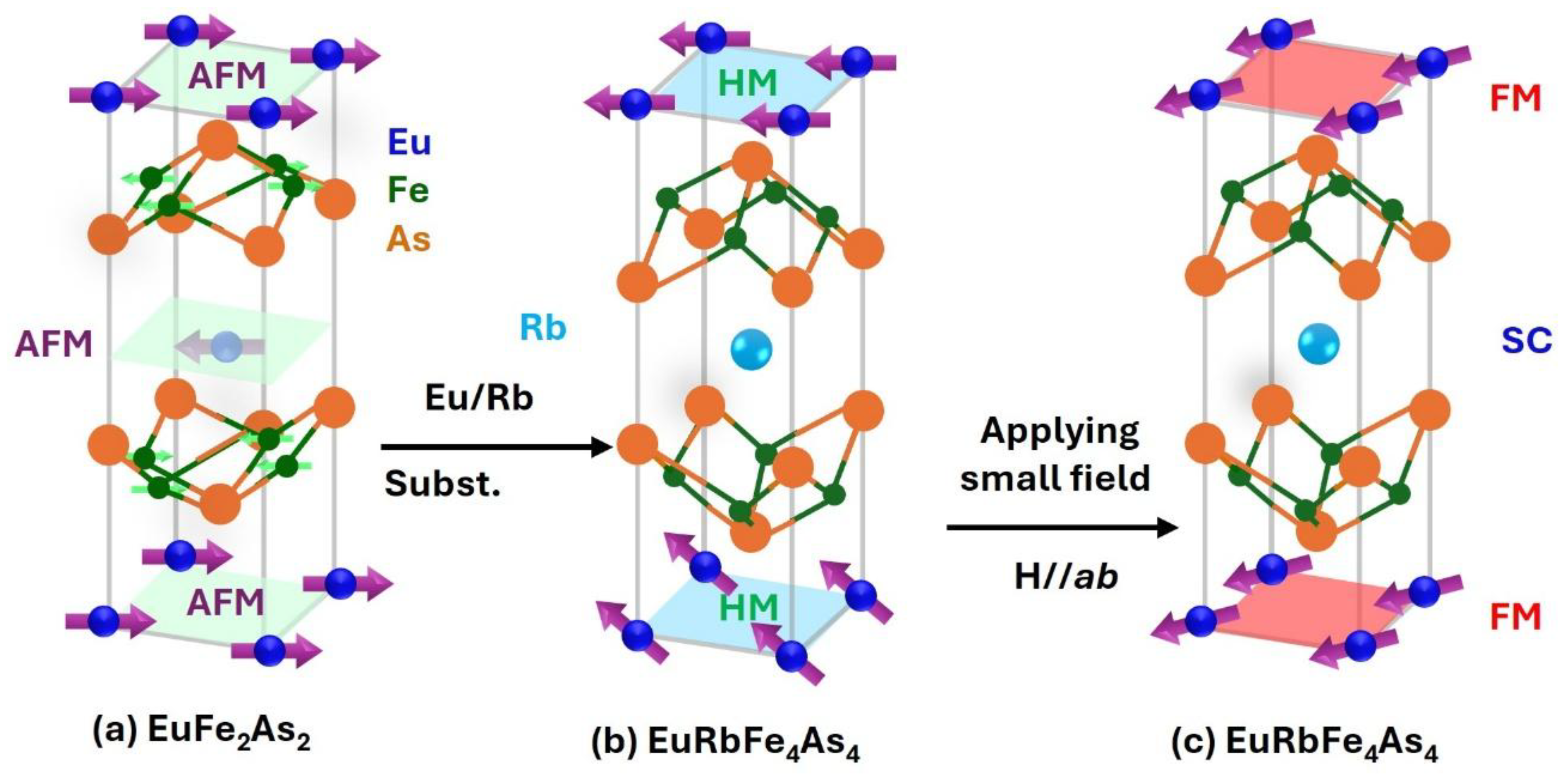
Figure 2.
Temperature dependence of the in-phase susceptibility for the DC fields indicated in the Figure, for fields perpendicular to the superconducting planes, in ZFC (left-hand side) and FC (right-hand side) cooling protocols. Upper inserts show details of the diamagnetic signal around the temperature of the magnetic transition (15 K) while lower inserts show details of the diamagnetic signal near Tc.
Figure 2.
Temperature dependence of the in-phase susceptibility for the DC fields indicated in the Figure, for fields perpendicular to the superconducting planes, in ZFC (left-hand side) and FC (right-hand side) cooling protocols. Upper inserts show details of the diamagnetic signal around the temperature of the magnetic transition (15 K) while lower inserts show details of the diamagnetic signal near Tc.
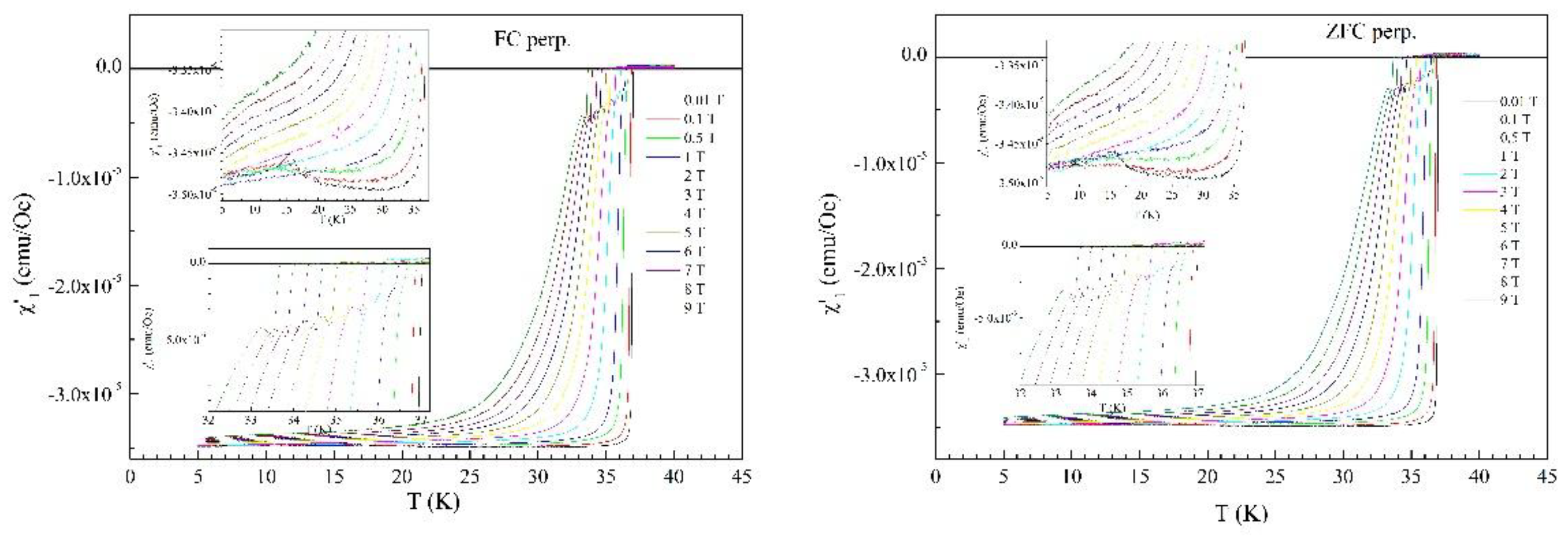
Figure 3.
Temperature dependence of the out-of-phase susceptibility for the DC fields indicated in the Figure, for fields perpendicular to the superconducting planes, in ZFC (left-hand side) and FC (right-hand side) cooling protocols. Inserts show a more detailed picture of the dissipation signal.
Figure 3.
Temperature dependence of the out-of-phase susceptibility for the DC fields indicated in the Figure, for fields perpendicular to the superconducting planes, in ZFC (left-hand side) and FC (right-hand side) cooling protocols. Inserts show a more detailed picture of the dissipation signal.
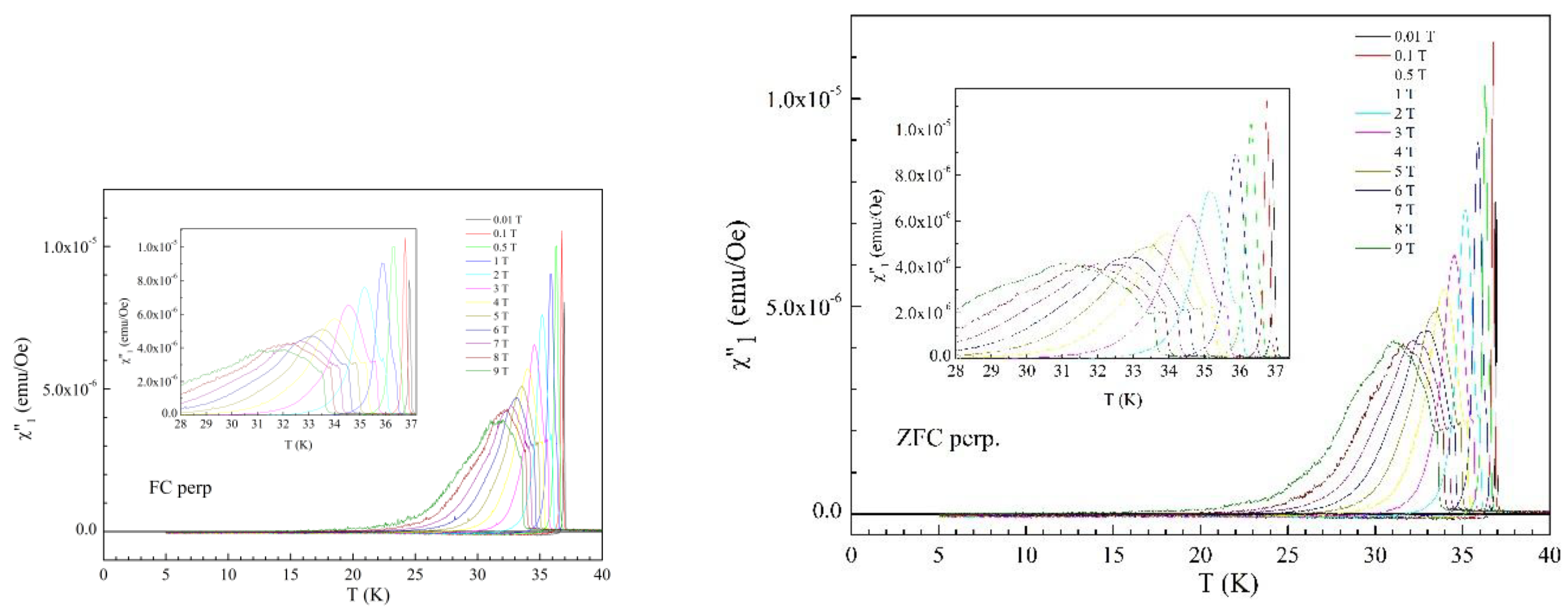
Figure 4.
Tempereture dependence of the in-phase (left-hand side) and out-of-phase (right-hand-side) susceptibility in zero DC field, with AC field amplitude of 1 Oe and the two AC frequencies indicated in the Figure. Insert shows the detail of the signal due to magnetic transition at 15 K.
Figure 4.
Tempereture dependence of the in-phase (left-hand side) and out-of-phase (right-hand-side) susceptibility in zero DC field, with AC field amplitude of 1 Oe and the two AC frequencies indicated in the Figure. Insert shows the detail of the signal due to magnetic transition at 15 K.
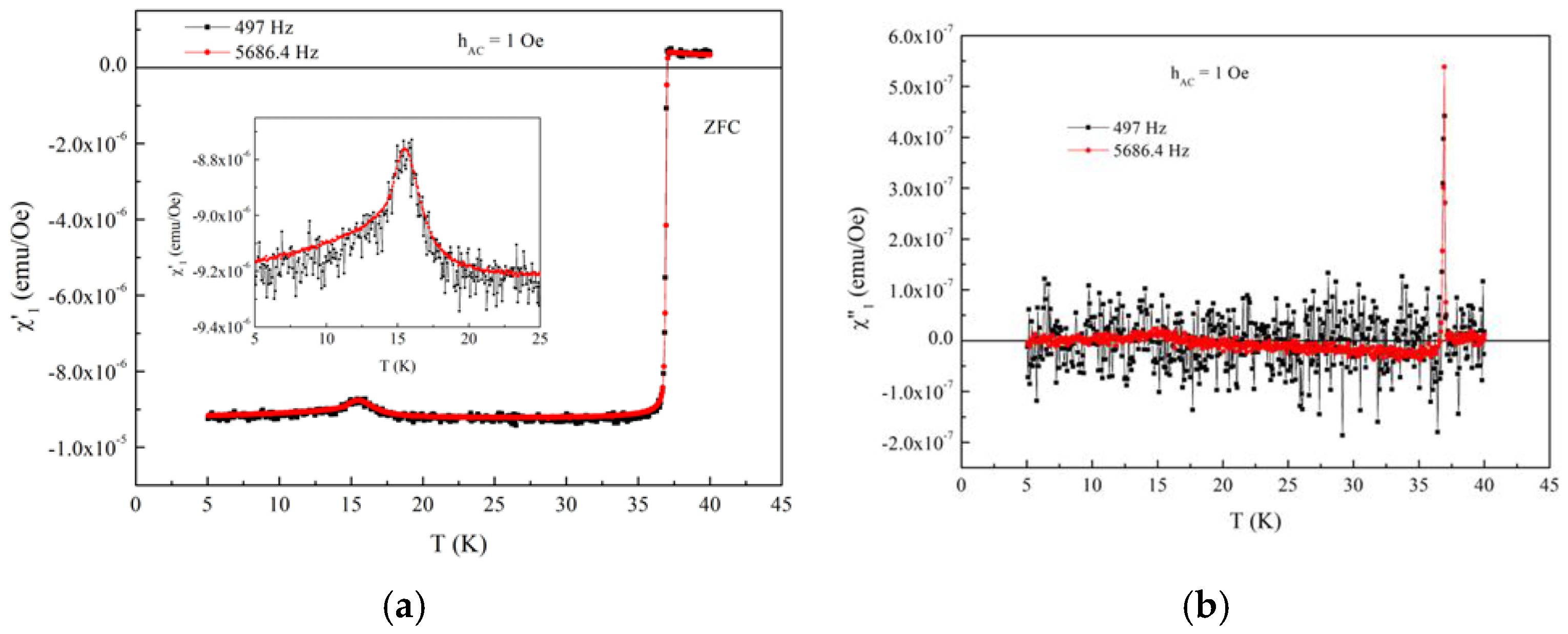
Figure 5.
Tempereture dependence of the in-phase susceptibility in zero DC field (left-hand side) and in DC field of 100 Oe (right-hand-side), measured with AC field amplitude of 1 Oe and AC frequency of 5686.4 Hz. Inserts show the details of the signal due to magnetic transition at 15 K.
Figure 5.
Tempereture dependence of the in-phase susceptibility in zero DC field (left-hand side) and in DC field of 100 Oe (right-hand-side), measured with AC field amplitude of 1 Oe and AC frequency of 5686.4 Hz. Inserts show the details of the signal due to magnetic transition at 15 K.
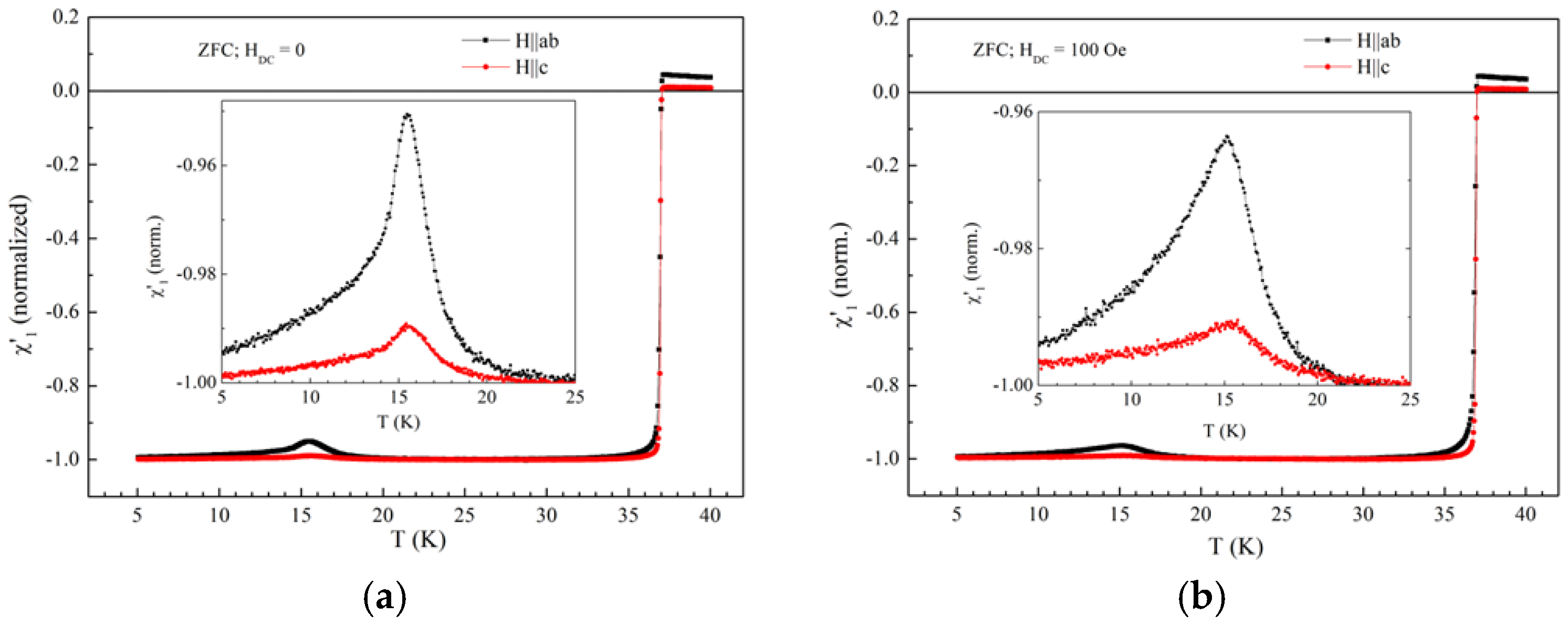
Figure 6.
Tempereture dependence of the in-phase susceptibility in DC field of 0.1 T (left-hand side) and in DC field of 0.5 T (right-hand-side) , measured with AC field amplitude of 1 Oe and AC frequency of 5686.4 Hz. Inserts show the details of the signal due to magnetic transition at 15 K.
Figure 6.
Tempereture dependence of the in-phase susceptibility in DC field of 0.1 T (left-hand side) and in DC field of 0.5 T (right-hand-side) , measured with AC field amplitude of 1 Oe and AC frequency of 5686.4 Hz. Inserts show the details of the signal due to magnetic transition at 15 K.
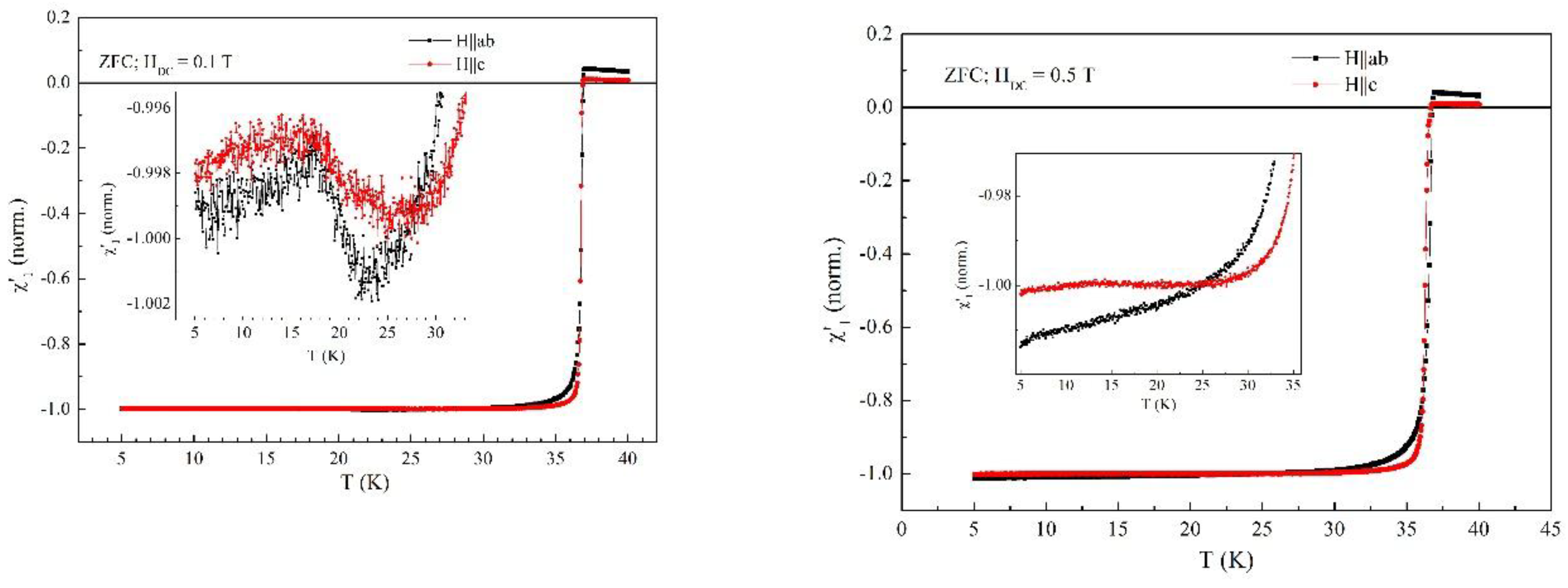
Figure 7.
Temperetare dependence of the in-phase susceptibility DC field of 1 T (left-hand side) and in DC field of 3 T (right-hand-side) , measured with AC field amplitude of 1 Oe and AC frequency of 5686.4 Hz. Inserts show the details of the transition just below Tc.
Figure 7.
Temperetare dependence of the in-phase susceptibility DC field of 1 T (left-hand side) and in DC field of 3 T (right-hand-side) , measured with AC field amplitude of 1 Oe and AC frequency of 5686.4 Hz. Inserts show the details of the transition just below Tc.
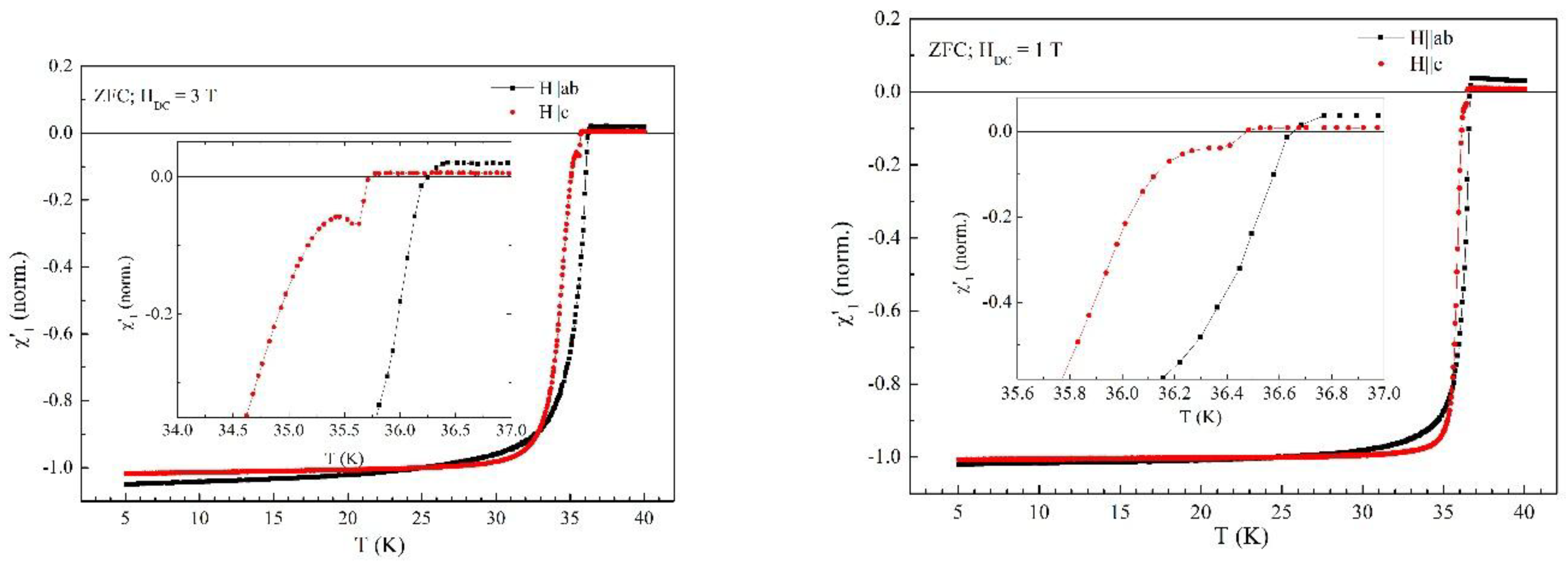
Figure 8.
Details of temperature dependence of in-phase susceptibility just below Tc for HDC = 9 T (left-hand side), and of the calculated penetration depth λab (right-hand side). Indicated temperatures are explained in the text.
Figure 8.
Details of temperature dependence of in-phase susceptibility just below Tc for HDC = 9 T (left-hand side), and of the calculated penetration depth λab (right-hand side). Indicated temperatures are explained in the text.
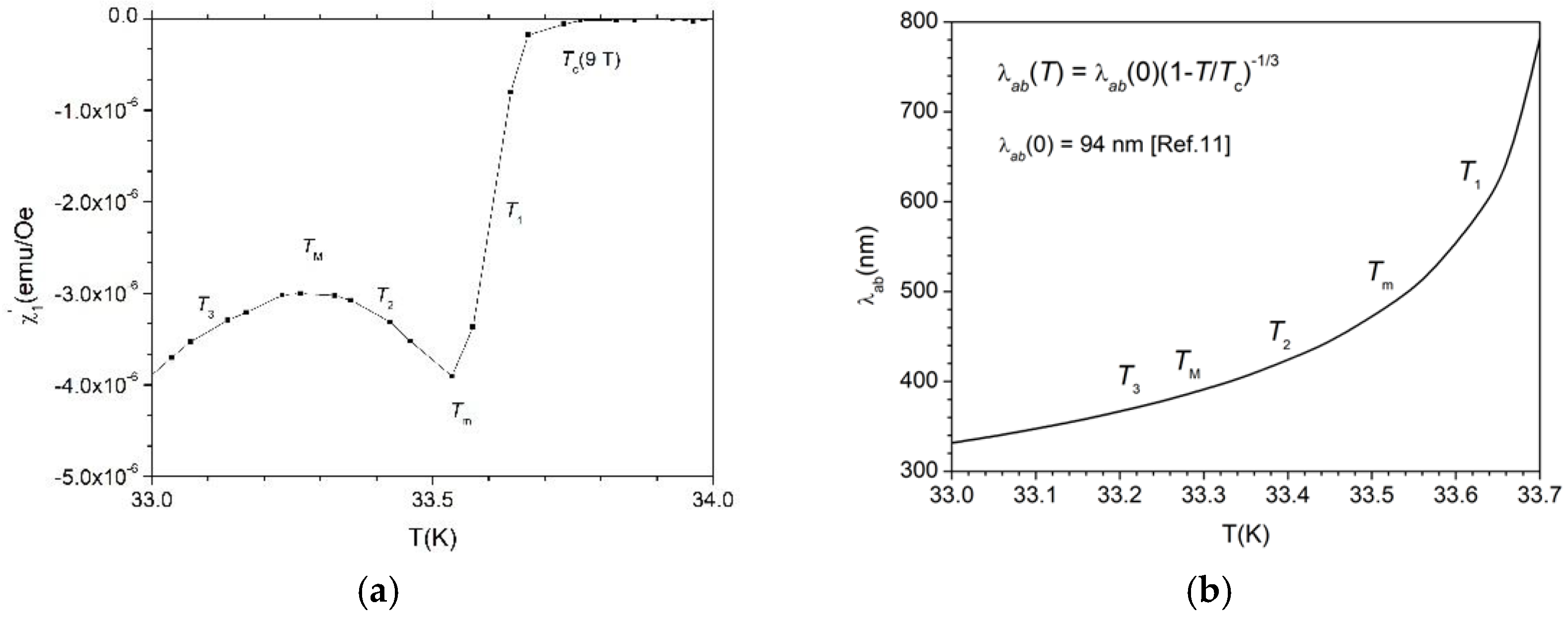
Figure 9.
(a-c) Schematics of the circulating supercurrents in perpendicular orientation for three decreasing temperatures, same as those indicated in Figure 8; and (d) in parallel orientation.
Figure 9.
(a-c) Schematics of the circulating supercurrents in perpendicular orientation for three decreasing temperatures, same as those indicated in Figure 8; and (d) in parallel orientation.
Disclaimer/Publisher’s Note: The statements, opinions and data contained in all publications are solely those of the individual author(s) and contributor(s) and not of MDPI and/or the editor(s). MDPI and/or the editor(s) disclaim responsibility for any injury to people or property resulting from any ideas, methods, instructions or products referred to in the content. |
© 2025 by the authors. Licensee MDPI, Basel, Switzerland. This article is an open access article distributed under the terms and conditions of the Creative Commons Attribution (CC BY) license (http://creativecommons.org/licenses/by/4.0/).
Copyright: This open access article is published under a Creative Commons CC BY 4.0 license, which permit the free download, distribution, and reuse, provided that the author and preprint are cited in any reuse.


