
Submitted:
01 December 2025
Posted:
02 December 2025
You are already at the latest version
Abstract
This article presents a unified mechanistic explanation for the equality of inertial and gravitational mass. We demonstrate that both emerge from energy exchange processes between deformed spatial wave structures. Elastic collisions involve energy transfer between velocity-dependent deformations, while gravitational attraction involves energy transfer through time-dilation gradients. Both processes exhibit mass proportionality because they measure the same underlying quantity: the deformation energy stored in matter's wave structure. This resolves the centuries-old mystery of the equivalence principle within a wave-based paradigm of matter.
Keywords:
equivalence principle
; inertial mass
; gravitational mass
; wave-based matter
; energy density gradient
; elastic collision
; time dilation
; wave mechanics
1. Introduction: Visualizing the Mass Mystery
Why should resistance to acceleration (inertial mass ) be precisely proportional to gravitational attraction strength (gravitational mass )? For centuries, this equality has been observed experimentally but remained mechanistically unexplained. We propose that both masses emerge from the same physical process: energy exchange between deformed spatial structures.
2. Wave-Based Paradigm Foundations
Our paradigm, developed in previous work [1,2], establishes matter as confined wave structures in a spatial medium. Within this framework, velocity manifests as geometric deformation of wave patterns, while particles naturally generate localized energy density gradients through their evanescent wave fields.
3. Two Manifestations of Energy Exchange
3.1. Case 1: Elastic Collision - Inertial Mass in Action
Consider two particles colliding elastically. What physically occurs?
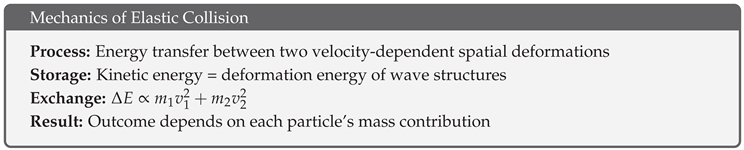
The "inertial mass" factor m in quantifies how much deformation energy is stored per unit velocity. In collisions, energy transfer is proportional to these stored energies, making outcomes mass-dependent.
3.2. Case 2: Gravitational Attraction - Gravitational Mass in Action
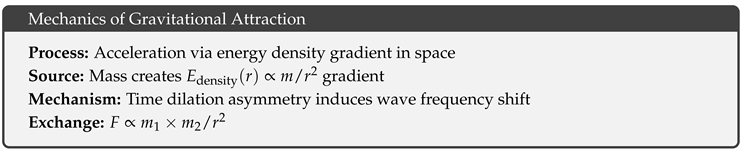
Now consider gravitational attraction. The mechanism differs but exhibits similar proportionality:
4. Visual Mechanism: Why Gravity Accelerates Matter
4.1. Standing Waves in a Gradient Field
Consider a particle as a standing wave formed by two counter-propagating waves. In flat space (no gradient), both waves experience identical conditions:
4.2. Time Dilation Breaks Symmetry
In a gravitational gradient, time flows slower where energy density is higher. The two waves now experience different conditions:
4.3. From Standing to Quasi-Stationary Waves
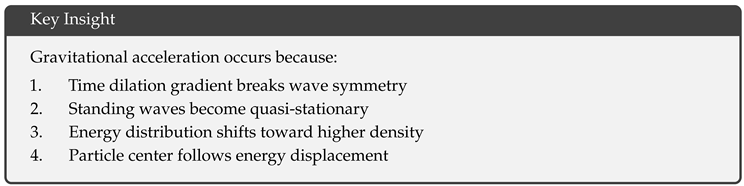
The frequency mismatch transforms the standing wave into a quasi-stationary wave. Crucially, a quasi-stationary wave necessarily involves energy transport along its structure - the phase difference between forward and backward components creates a net energy flow.
This energy flow toward the higher density region shifts the wave energy distribution center - effectively translating the particle toward the mass. The gravitational "force" thus emerges as a consequence of energy redistribution within the particle’s wave structure.
5. Unified Proportionality Principle
5.1. Common Energy Basis
Both processes involve energy exchange proportional to deformation content:
Since , both exhibit mass proportionality.
5.2. Why Acceleration Is Mass-Independent
Crucially, gravitational acceleration g is independent of test mass because:
Each atom experiences the same time dilation gradient imposed by source mass M. Whether few or many atoms, their wave structures undergo identical frequency shifts, producing identical acceleration. This explains Galileo’s observation: all bodies fall equally.
6. Mathematical Formulation
6.1. Deformation Energy Framework
Let be deformation energy for mass m at velocity v:
6.2. Unified Mass Definition
Both masses derive from deformation energy:
Since , we obtain .
7. Resolving Historical Paradoxes
7.1. Galileo’s Universality Revisited
The famous feather-and-hammer experiment finds its explanation through several interconnected mechanisms:
- Each individual atom experiences precisely the same time dilation gradient
- Wave frequency shifts induced by this gradient are identical for every atomic component
- The collective acceleration of the entire body equals the acceleration experienced by each constituent atom
- This mass-independent behavior emerges because gravitational interaction operates at the wave-structure level, not through bulk material properties
7.2. Einstein’s Elevator Thought Experiment
The profound indistinguishability between acceleration and gravitational fields becomes transparent when we consider their common effects on wave structures. In both scenarios:
- Acceleration involves external forces directly reconfiguring the wave pattern geometry
- Gravity operates through internal energy density gradients that similarly reconfigure wave structures
- Both processes modify the wave geometry relative to the fundamental spatial medium
- An observer confined within either system cannot detect which mechanism is active, since both produce identical deformations of measuring instruments and biological processes
8. Experimental Verification: Explaining Established Results
Our framework provides the mechanistic explanation for why the equivalence principle has been experimentally verified across centuries of precise measurements:
8.1. Historical Experimental Validation
- Galileo (1638): All bodies fall equally regardless of composition
- Eötvös (1909): to precision for diverse materials
- Bessel (1832): Pendulum experiments confirming mass equivalence
- Modern tests: Lunar laser ranging, torsion balances, atom interferometry
8.2. Our Contribution: Explaining the "Why"
Rather than predicting new phenomena, our model explains why these experimental results occur. The equivalence emerges necessarily because:
- Both masses measure deformation energy of wave structures
- Energy exchange in both collision and gravitational contexts must be proportional to this energy
- Therefore, the proportionality constants must be equal (up to universal factor G)
Key insight: The experimental verification of mass equivalence, rather than being a mysterious coincidence, becomes an expected consequence of matter’s wave nature. Our model transforms an empirical observation into a theoretical necessity.
8.3. Future Experimental Directions
While our model explains why mass equivalence holds under normal conditions, it naturally suggests where subtle departures might be investigated:
- High-energy collisions: The asymmetric H+/He+ test [3] probes whether kinetic energy storage depends on absolute velocity relative to the spatial medium, which could reveal inertial/gravitational mass differences at relativistic energies.
- Extreme gravitational fields: Near black holes or neutron stars, where energy density gradients approach wave structure scales, non-linear effects might become measurable.
- Quantum regime: As experimental techniques approach quantum gravity scales, the discrete nature of wave structure deformation could yield testable predictions.
These potential tests explore the boundaries of the equivalence principle rather than its validity in established regimes, offering pathways to further refine our understanding of matter’s wave nature.
9. Conclusion
We have provided a concrete, visualizable mechanism explaining the equivalence principle:
- Inertial mass quantifies deformation energy in velocity-dependent wave structures
- Gravitational mass quantifies capacity to create energy density gradients
- Both measure the same deformation energy, differently manifested
- Gravitational acceleration occurs via time-dilation-induced wave frequency shifts
- Mass independence of g arises because each atom experiences identical gradients
This resolution removes centuries of mystery while providing intuitive physical pictures. The wave-based paradigm not only explains that masses are equal, but why they must be - offering profound unification of inertia and gravity.
References
- G. Furne Gouveia. The Vibrational Fabric of Spacetime: A Model for the Emergence of Mass, Inertia, and Quantum Non-Locality. Preprints 2025, 2025090184. [CrossRef]
- G. Furne Gouveia. The IN/OUT Wave Mechanism: A Non-Local Foundation for Quantum Behavior and the Double-Slit Experiment. Preprints 2025, 2025092122. [CrossRef]
- G. Furne Gouveia. Towards a New Physics of Space: Experimental Test via Asymmetric Ion Collisions. Preprints 2025, 2025110658. [CrossRef]
- Galileo Galilei. Discourses and Mathematical Demonstrations Relating to Two New Sciences. Leiden (1638).
- A. Einstein. The Foundation of the General Theory of Relativity. Annalen der Physik 49, 769 (1916).
- L. I. Schiff. On Experimental Tests of the General Theory of Relativity. American Journal of Physics 28, 340 (1960).
- R. H. Dicke. Experimental Tests of Mach’s Principle. Physical Review Letters 12, 311 (1964).
Disclaimer/Publisher’s Note: The statements, opinions and data contained in all publications are solely those of the individual author(s) and contributor(s) and not of MDPI and/or the editor(s). MDPI and/or the editor(s) disclaim responsibility for any injury to people or property resulting from any ideas, methods, instructions or products referred to in the content. |
© 2025 by the authors. Licensee MDPI, Basel, Switzerland. This article is an open access article distributed under the terms and conditions of the Creative Commons Attribution (CC BY) license (http://creativecommons.org/licenses/by/4.0/).
Copyright: This open access article is published under a Creative Commons CC BY 4.0 license, which permit the free download, distribution, and reuse, provided that the author and preprint are cited in any reuse.


