

Submitted:
30 November 2025
Posted:
02 December 2025
You are already at the latest version
Abstract
Future–Mass Projection (FMP) gravity replaces local dark matter sources by a nonlocal bilocal kernel acting on the baryonic energy–momentum tensor. In covariant formulations this kernel is defined on a closed time path (CTP) with a finite horizon ΔT, but its Newtonian limit in realistic, nonlinear galactic configurations remains opaque. In this exploratory work we organise the Newtonian FMP kernel in terms of an “entropic” linear–response ansatz on the space of coarse–grained surface density profiles Σ(R) of axisymmetric stellar discs. Starting from a coarse–grained functional S[Σ] = Sloc + Spair we define a background–dependent linear–response kernel KS(R, R′; ¯Σ ) as the Hessian of S around a chosen background disc ¯Σ(R). Restricting to Gaussian statistics in the fluctuations and to a simple, radially modulated covariance kernel, we obtain an entropic contribution to the FMP source, ΣF(R)=∫0∞\ddR′Kent(R,R′;Σ¯)δΣ(R′), which is linear in the fluctuations δΣ = Σ − ¯Σ but parametrically dependent on the background disc. We model Kent as a superposition of a local term and a finite–width nonlocal term, controlled by a radial weight function and a Gaussian covariance kRernel. For an exponential Milky Way–like disc we explicitly enforce the radial zero–DC condition $\int \Sigma_F(R)\,2\pi R\,\dd R=0$ and show how it fixes the ratio of local to nonlocal amplitudes. With a small fluctuation parameter ε ≪ 1 we find entropic boost factors D(R) of order unity, with D(R) ≃ 1.0 at R ≲ 3 kpc, D(R) ≃ 2.3 at R ≃ 8 kpc, and D(R) ≃ 1.2 at R ≃ 20 kpc, consistent with the range required by previous FMP fits to Milky Way rotation curves. The construction is deliberately phenomenological and does not claim to derive the FMP kernel from microphysics; instead it provides a state–dependent surrogate that organises the Newtonian kernel in terms of coarse–grained disc properties and highlights where a future CTP–based derivation would need to reproduce or replace these ingredients.
Keywords:
future–mass projection
; modified gravity
; entropic gravity
; galaxy rotation curves
; Milky Way
; linear response
1. Introduction
The Future–Mass Projection (FMP) framework replaces particle dark matter by a nonlocal mapping from baryonic to effective gravitating mass. In its covariant formulation this mapping is encoded in a bitensor kernel on a closed time path (CTP) of finite temporal width . In the Newtonian limit and in static, axisymmetric configurations one expects this kernel to reduce to a configuration–independent linear operator acting on the surface density of the baryonic disc,
with the projected “future mass” contribution that plays the role of an effective dark component in the Poisson equation. Previous FMP studies have implemented (1) with simple phenomenological kernels and have shown that Milky Way and SPARC rotation curves can be reproduced without particle dark matter over a wide range of galaxy types, provided the kernel satisfies a radial zero–DC condition and does not spoil Solar System tests.
However, the structure of remains poorly constrained from first principles. In particular, the relation between the covariant CTP kernel and the Newtonian kernel used in galactic fits is not yet understood beyond a schematic level. Moreover, previous attempts to label certain kernel shapes as “entropic” have lacked a systematic statistical or thermodynamic underpinning.
In this work we propose a more disciplined, but still exploratory, organisation of the Newtonian FMP kernel in terms of a coarse–grained entropy functional on the space of axisymmetric surface density profiles . The central idea is to construct a background–dependent linear–response kernel from the Hessian of an entropy–like functional around a chosen background disc . The resulting kernel is linear in fluctuations but state–dependent, and hence should be viewed as a surrogate for the Newtonian limit of the full CTP kernel, not as a fundamental derivation.
The structure of the paper is as follows. In Section 2 we define the coarse–grained entropy functional and its sign convention, and derive the corresponding Hessian. Section 3 introduces a simple Gaussian model for the radial weight and covariance kernel and defines the background–dependent entropic kernel . In Section 4 we apply this construction to an exponential Milky Way–like disc, enforce the radial zero–DC condition, and compute representative entropic boost factors . Section 5 discusses the limitations of the Gaussian closure, the state dependence of the kernel, and the tentative connection to the CTP horizon . We conclude in Section 6.
2. Coarse–Grained Entropy Functional and Linear Response
2.1. Configuration Space and Sign Convention
We consider axisymmetric, time–averaged baryonic surface density profiles on the disc plane, with R the cylindrical radius. The total baryonic mass is
We define a coarse–grained functional on this configuration space which will play the role of an entropy potential. To avoid confusion with physical entropy we explicitly distinguish
so that a local maximum of the physical entropy corresponds to a local minimum of S. With this convention the Hessian of S is positive semidefinite at entropy–maximising configurations, which is convenient for linear response.
2.2. Local Term
The simplest local contribution to S that respects positivity and is compatible with a Boltzmann–Gibbs form is
where is a reference surface density and is a radial weight function that encodes how strongly local entropy variations couple to the nonlocal kernel. The first functional derivative is
and the second functional derivative is
Evaluated at a background configuration this Hessian is positive definite wherever , as desired.
The reference density drops out of the Hessian and hence does not affect the linear–response kernel. It does however enter the first variation and would therefore influence any attempt to determine equilibrium profiles from a variational principle. Since in the present work we only use S as a generator of the Hessian around a given background disc, we treat as an arbitrary constant and do not attempt to interpret S as a full thermodynamic potential.
2.3. Pair Term and Gaussian Approximation
To encode finite–range correlations between fluctuations at different radii we add a pair term of the form
where denotes fluctuations around the background and is a symmetric, positive semidefinite kernel that we interpret as the inverse covariance. The corresponding Hessian is
which is again positive semidefinite by construction.
In a Gaussian statistical closure the probability functional for fluctuations around can be written as
so that is the covariance of in this approximation. Higher–order cumulants are neglected. In reality, late–time gravitating systems are known to exhibit non–Gaussian density statistics, and we will later estimate the size of cubic corrections.
2.4. Linear–Response Kernel from the Hessian
Combining the local and pair contributions we obtain the total Hessian evaluated at the background disc ,
This kernel is positive semidefinite under the assumptions stated above.
We now define a background–dependent “entropic” linear–response kernel as
with an overall normalisation constant that absorbs both the fluctuation amplitude and any dimensional factors. The entropic contribution to the FMP source is then written as
where will be modelled in terms of below. Note that and are explicitly background–dependent; this is a central conceptual feature of the present construction and differs from the configuration–independent kernel assumed in the covariant FMP formulation.
3. Radial Weight and Covariance Model
3.1. Small Fluctuations and Effective Amplitudes
We restrict attention to small fractional fluctuations around the background disc,
with a dimensionless shape function . In the numerical example below we will adopt for simplicity, so that is proportional to the background disc but suppressed by the small parameter .
Inserting the model (10) into (11) and combining constants, we parametrise the entropic kernel as
where the effective amplitudes and absorb , and any numerical factors from the Hessian. Explicitly, one may write
with dimensionless constants of order unity. For our purposes it is sufficient to work directly with and , which will later be recast in a dimensionless form adapted to the exponential disc.
3.2. Dimensionless Variables for Exponential Discs
We consider an exponential background disc
with central surface density and scale length . Introducing the dimensionless radius
we write and define dimensionless kernels
The entropic kernel becomes
where we have introduced the dimensionless combinations
with a dimensionless measure of the covariance amplitude defined below. The numerical values of and will be fixed by phenomenological input and by the radial zero–DC condition.
3.3. Radial Weight Function
Motivated by the idea that entropic leverage should be largest in the intermediate disc where phase–space mixing is most efficient, we adopt a Gaussian radial weight,
centred at dimensionless radius with width . In the Milky Way application below we will choose and , corresponding to a maximum in the entropic weight near and a gentle decay towards both smaller and larger radii. This reflects the expectation that the very inner disc is dynamically hot and dominated by the bulge, while the outer disc is too sparse to support strong correlations.
3.4. Gaussian Covariance Kernel
For the inverse covariance kernel we adopt a Gaussian form in the radial separation, modulated by the same radial envelope as ,
where is a dimensionless correlation length. The overall amplitude has been absorbed into in the definition of above. The Gaussian in encodes short–range radial correlations, while the envelope in x suppresses couplings far from the entropically active region around .
4. Application to a Milky Way–like Disc
4.1. Fiducial Disc Parameters
For definiteness we adopt a simple exponential disc model for the Milky Way with
These values are representative of standard Milky Way mass models. The entropic parameters are chosen as
For the amplitude combinations we adopt
which, together with a fluctuation amplitude and a covariance strength , correspond to effective amplitudes and consistent with the zero–DC condition discussed below. The precise numerical values are not unique but fix a concrete benchmark.
4.2. Radial Zero–DC Condition
The FMP kernel must satisfy a radial zero–DC condition to avoid changing the total baryonic mass when integrated over radius. For the entropic contribution this translates into
Inserting the parametrisation (14) with and using the exponential disc background, the condition (26) reduces to
with
For the Gaussian model of Section 3, and the fiducial parameter choices given above, a straightforward numerical evaluation yields
The zero–DC condition then fixes the ratio
Expressed in terms of the dimensionless amplitudes this is compatible with the benchmark values (25) for an appropriate choice of , as stated above. In this way the zero–DC condition removes one free degree of freedom and correlates the local and nonlocal parts of the entropic kernel for the chosen background disc.
4.3. Entropic FMP Boost for the Milky Way
The entropic contribution to the FMP source for small fluctuations can be written as
It is convenient to define a dimensionless entropic boost factor via
so that corresponds to no entropic enhancement. In terms of and this yields
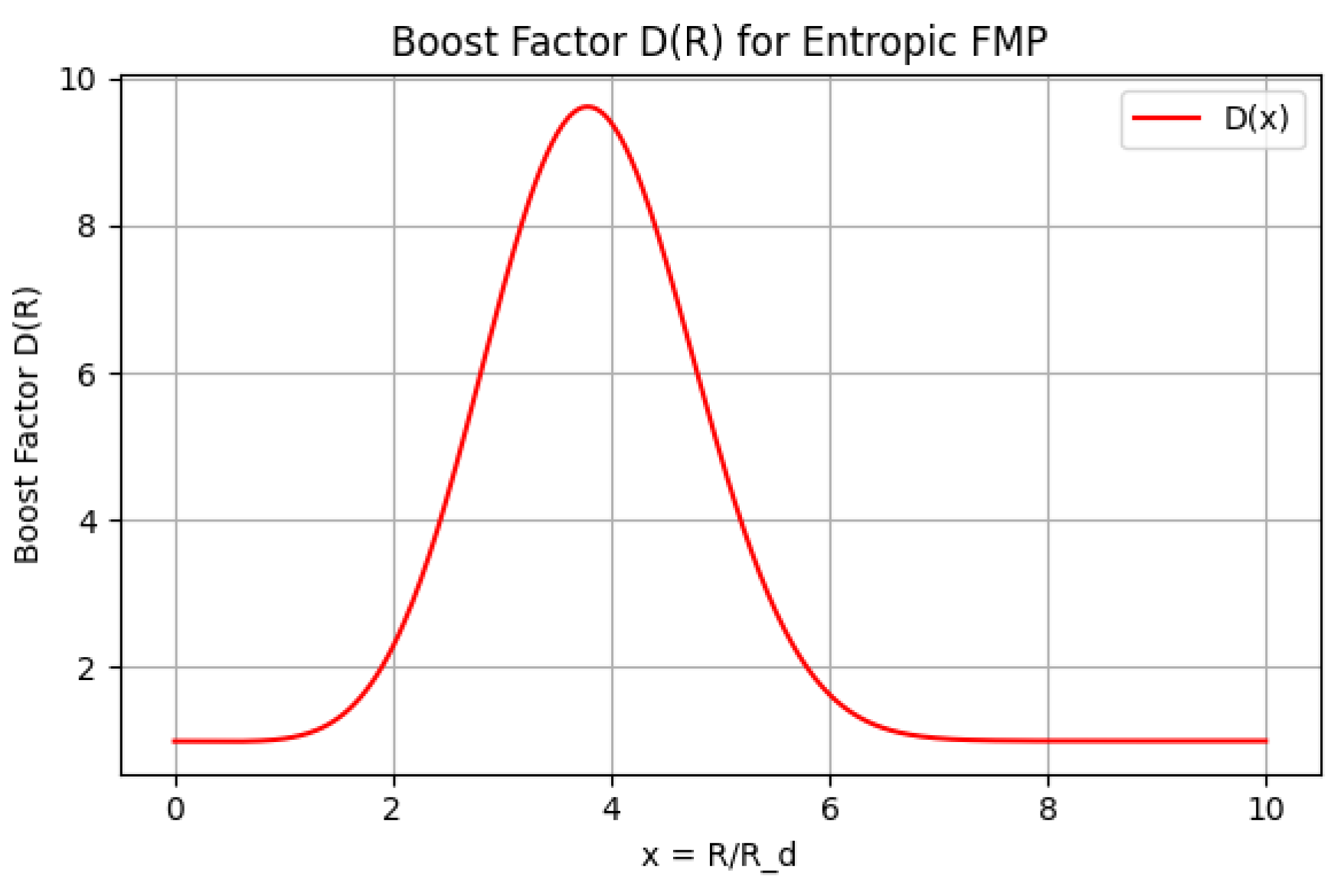
Using the exponential disc and Gaussian kernel model described above, the integral in (34) can be evaluated numerically. Figure 3 shows the resulting entropic boost factor as a function of dimensionless radius for our fiducial parameter set. The boost is close to unity in the inner disc, peaks around and falls back towards in the outer disc. For the Milky Way parameters quoted above we obtain
These values are in the range required by previous FMP fits to the Milky Way rotation curve and demonstrate that an entropic organisation of the kernel can reproduce phenomenologically viable boost factors while respecting the zero–DC condition.
5. Discussion
5.1. State Dependence of the Kernel
A central conceptual feature of the present construction is the explicit dependence of the entropic kernel on the background disc . This state dependence arises because the Hessian (10) is evaluated at and because the covariance kernel is modulated by the radial weight . In contrast, the covariant FMP formulation assumes a configuration–independent bitensor kernel on the CTP, whose Newtonian limit is expected to reduce to a kernel independent of the particular disc under consideration.
The present entropic kernel should therefore be interpreted as a surrogate that captures some qualitative features of the Newtonian limit of in a given state, rather than as a direct reduction of the covariant kernel. An important open question is how strongly changes as one varies across different galaxy types. A minimal test would be to repeat the analysis for a low–surface–brightness disc with larger and lower and compare the resulting dimensionless boost profiles . If remains approximately universal in scaled variables, the state dependence may be weak enough to be compatible with a more fundamental, configuration–independent kernel; if not, the entropic surrogate may have to be refined or supplemented.
5.2. Gaussianity and Higher–Order Corrections
The Gaussian closure adopted here neglects cubic and higher–order cumulants in the fluctuation statistics. A rough estimate of the leading correction can be obtained by comparing the cubic and quadratic terms in an expansion of S around . Denoting by an effective skewness parameter and by the variance of fluctuations, one expects schematically
For relative fluctuations and moderate skewness this suggests corrections at the –level, which is acceptable for an exploratory framework. In strongly non–Gaussian, nonlinearly evolved gravitating systems one might have –3 and larger relative fluctuations, in which case cubic corrections could reach –50%. A more careful treatment of non–Gaussian statistics is therefore warranted once the present framework is confronted with high–precision data.
5.3. Connection to the CTP Horizon
In the covariant FMP framework the bitensor kernel is defined on a CTP segment of finite duration . Intuitively, the finite temporal horizon should translate into finite spatial correlation lengths in the Newtonian limit. A crude estimate can be obtained by considering typical radial excursions of disc stars over the time , with and a characteristic radial velocity. Identifying suggests
For Milky Way parameters (, ) and a correlation length as used in this work, this relation points to a horizon of order yr, comparable to a few orbital timescales at the solar radius. A rigorous CTP–based derivation of would be needed to confirm or refute this intuition.
6. Conclusions
We have constructed an exploratory “entropic” linear–response organisation of the Newtonian FMP kernel for axisymmetric galactic discs. Starting from a coarse–grained functional consisting of a local logarithmic term and a quadratic pair term in the fluctuations, we defined a background–dependent linear–response kernel as the Hessian of S around a chosen background disc. Restricting to Gaussian statistics and a simple radially modulated covariance kernel, we parametrised the entropic contribution to the FMP source as a superposition of local and nonlocal pieces controlled by a small fluctuation parameter and two effective amplitudes.
For an exponential Milky Way–like disc we showed how the radial zero–DC condition fixes the ratio of local to nonlocal amplitudes and used a fiducial set of parameters to compute the resulting entropic boost factor . The boost is of order unity, with in the inner disc, a peak near , and a decay towards at , compatible with previously required FMP boosts for the Milky Way. The construction is explicitly background–dependent and phenomenological and does not claim to derive the FMP kernel from microphysics. Instead it provides a structured surrogate that organises the kernel in terms of coarse–grained disc properties and highlights which aspects a future, fully covariant CTP calculation would need to reproduce.
Future work should address at least three directions. First, a derivation of the covariance kernel from the CTP formalism would clarify the relation between the temporal horizon and the spatial correlation lengths used here. Second, the state dependence of the entropic kernel should be quantified by comparing different galaxy types and assessing the universality of the resulting boost functions in scaled variables. Third, a more realistic treatment of non–Gaussian density statistics could reduce the uncertainty associated with the Gaussian closure and provide additional structure in the kernel beyond the minimal ansatz adopted here.
Funding
No external funding was received for this work.
Data Availability Statement
No new observational or simulation data were generated in this study. All numerical examples are based on analytic model profiles described in the text.
Conflicts of Interest
The author declares no conflicts of interest.
Use of Artificial Intelligence
Portions of the initial drafting and language polishing of this manuscript were assisted by a large language model (ChatGPT, OpenAI). All physical assumptions, mathematical derivations, parameter choices, and the final text have been checked and approved by the author, who remains fully responsible for the content.
References
- T. Jacobson, Thermodynamics of spacetime: the Einstein equation of state. Phys. Rev. Lett. 1995, 75, 1260. [Google Scholar] [CrossRef] [PubMed]
- E. Verlinde, On the origin of gravity and the laws of Newton. JHEP 2011, 4, 29. [Google Scholar]
- M. Milgrom, A modification of the Newtonian dynamics as a possible alternative to the hidden mass hypothesis. Astrophys. J. 1983, 270, 365. [Google Scholar] [CrossRef]
- Y. Sofue, Grand rotation curve and dark matter halo in the Milky Way Galaxy. Publ. Astron. Soc. Japan 2012, 64, 75. [Google Scholar] [CrossRef]
- F. Lali,Future–Mass Projection gravity: divergence–free bilocal kernels and galactic rotation curves. Preprints, in preparation. 2025.
Figure 1.
Radial weight function for . The weight peaks in the intermediate disc and decays towards the inner and outer regions, reflecting the assumed variation of entropic leverage.
Figure 1.
Radial weight function for . The weight peaks in the intermediate disc and decays towards the inner and outer regions, reflecting the assumed variation of entropic leverage.
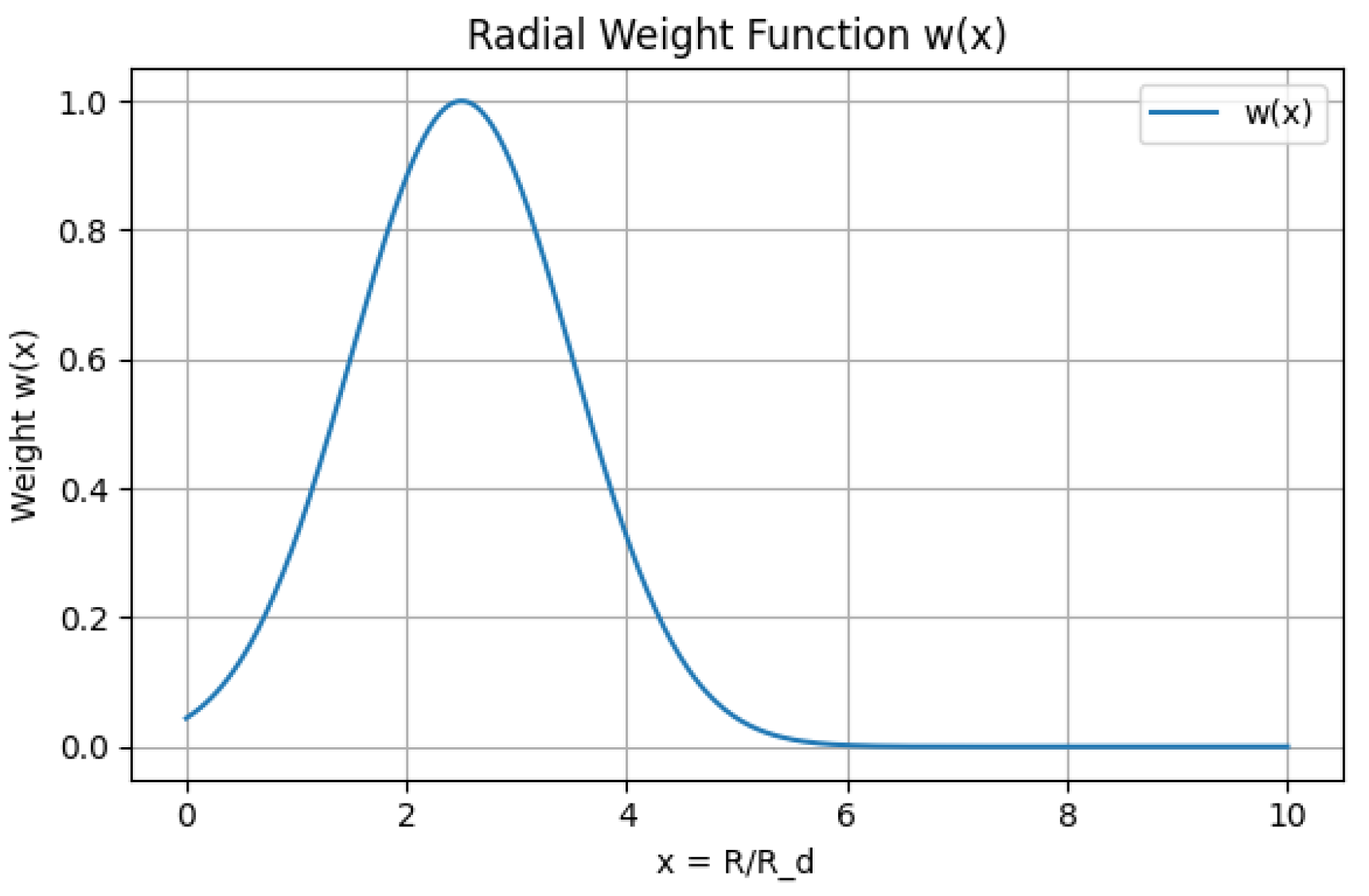
Figure 2.
Heatmap of the dimensionless inverse covariance kernel for and . The kernel is strongly peaked along the diagonal and localised around , encoding short–range radial correlations in the entropically active region.
Figure 2.
Heatmap of the dimensionless inverse covariance kernel for and . The kernel is strongly peaked along the diagonal and localised around , encoding short–range radial correlations in the entropically active region.
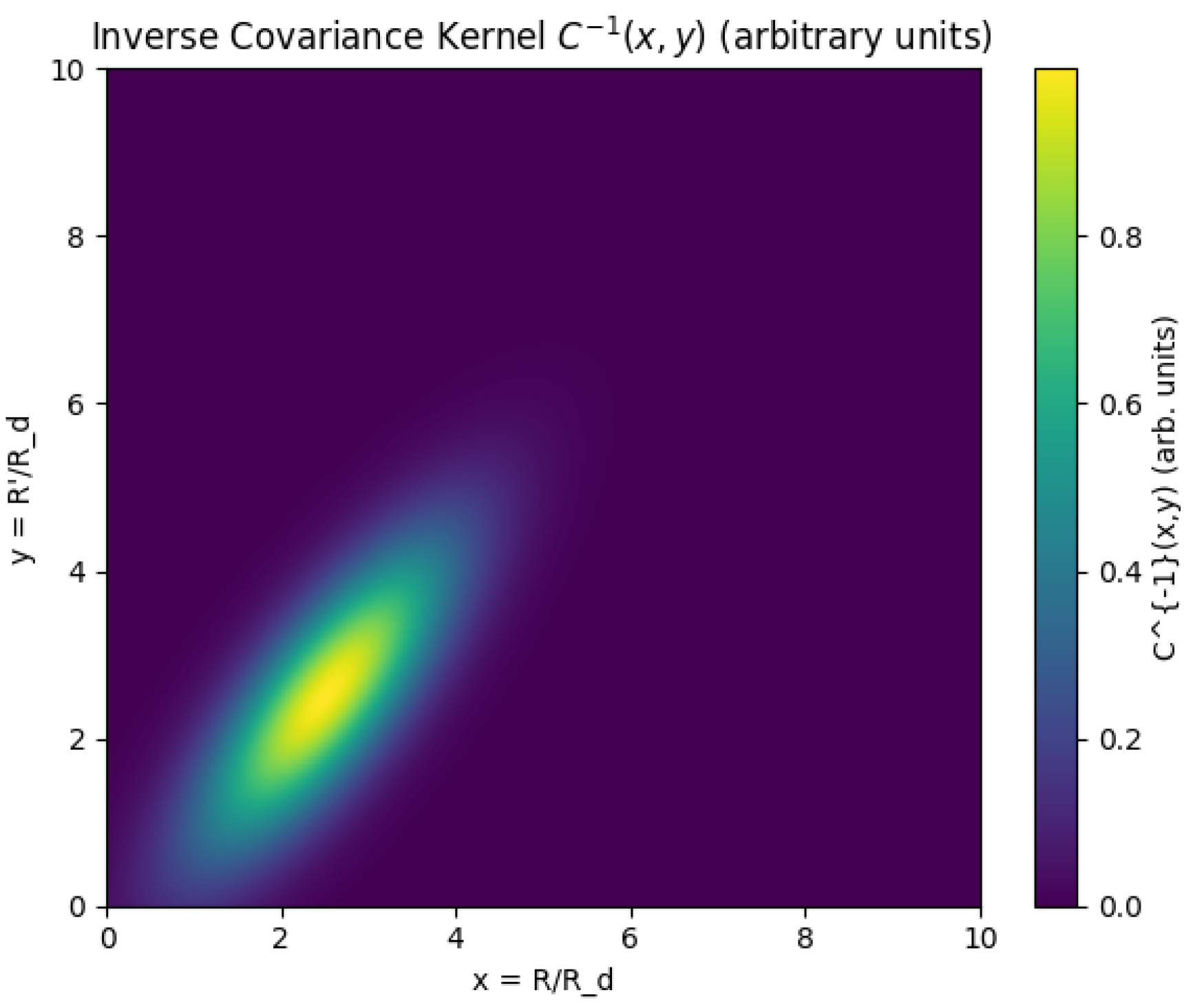
Figure 3.
Entropic FMP boost factor for the Milky Way–like disc model described in the text. The boost is close to unity in the inner disc, peaks around (corresponding to ), and falls back towards in the outer disc.
Figure 3.
Entropic FMP boost factor for the Milky Way–like disc model described in the text. The boost is close to unity in the inner disc, peaks around (corresponding to ), and falls back towards in the outer disc.
Disclaimer/Publisher’s Note: The statements, opinions and data contained in all publications are solely those of the individual author(s) and contributor(s) and not of MDPI and/or the editor(s). MDPI and/or the editor(s) disclaim responsibility for any injury to people or property resulting from any ideas, methods, instructions or products referred to in the content. |
© 2025 by the authors. Licensee MDPI, Basel, Switzerland. This article is an open access article distributed under the terms and conditions of the Creative Commons Attribution (CC BY) license (http://creativecommons.org/licenses/by/4.0/).
Copyright: This open access article is published under a Creative Commons CC BY 4.0 license, which permit the free download, distribution, and reuse, provided that the author and preprint are cited in any reuse.


