

Submitted:
29 November 2025
Posted:
02 December 2025
You are already at the latest version
Abstract
A small amount of research related to the assessment of the limitations of the motor functions of Russian football players in the sports reserve has shaped the desire of the authors to provide detailed information about their work experience, observations and measurements. The objective of this study was to conduct a retrospective analysis of the motor function limitations of 14-15-year-old football players using functional movement assessment. We studied football players from the North-Western region of the Russian Federation, representing the teams of the Department of Youth football development of football club Zenit, St. Petersburg. A functional assessment of movements in football players aged 14 and 15 years showed significant impairments in the motor functions of the musculoskeletal joints and the bone structure of the musculoskeletal system. The functional impairments in the motor functions of football players are characterized by a combination of symptoms, including limited mobility in the trunk, upper extremities, and thoracic spine, as well as motor asymmetry in the shoulders. In addition, there is a low level of functional mobility in the hip joint during rotation and leg elevation, as well as instability in the knee joint. Motor asymmetry in the pelvic position has also been identified.
Keywords:
football
; sports reserve
; functional assessment of movement
; health
; motor functions
; motor limitations
1. Introduction
Sports researchers and practicing physiotherapists Gray Cook and Lee Burton have developed and proposed a simple tool for monitoring motor function limitations among both youth and adults, called functional motion assessment (FMS) [1]. It is known that specific motor actions of football players performed during during training or competitive activities, they cause a redistribution of loads in the links of the kinematic chain, forming a muscular imbalance of the body [2]. Kiesel K. and others. In his research, he found that players with an FMS score of < 14 were more likely to suffer injuries than players with an FMS score of > 14 [3].
Given the limited research on the motor function limitations of 14-15-year-old Russian football players, the authors aimed to provide detailed information about their experiences, observations, and measurement results. The objective of this study was to conduct a retrospective analysis of the motor function limitations of 14-15-year-old football players using functional movement assessment.
2. Materials and Methods
The subjects were divided into 2 age categories (14 years old, body length 161±2.3 cm, body weight 58.6±2.71 kg, n=62, 15 years old, body length 170,3±1.5 cm, body weight 62.6±2.71 kg, n=67). All players have been notified of the purpose of this study. The written informed consent was signed by the players and their parents.
2.1. Participant
The sample consists of football players from the North-Western region of the Russian Federation, representing the teams of the Department of Youth football development of football club Zenit, St. Petersburg. All the subjects competed in football competitions at the regional and federal levels under the auspices of the Russian Football Union for seven playing seasons. (2017-18, 2018-19, 2019-20, 2020-21, 2021-22, 2022-23, 2023-24).
2.2. Test Stimuli
The functional assessment of movement test is represented by 7 test exercises (Figure 1): Deep Squat, Hurdle Step, In-Line Lung, Shoulder Mobility, Active Straight Leg Raise, Push-up, Trunk Stability. The evaluation system was implemented according to the recommendations of the authors-developers [1]. Score 3 – absolutely correct motor performance, without compensatory movements, loss of balance, etc.; Score 2 – the test is performed with compensatory movements or in a light version; Score 1 – the test is not completed or incomplete; Score 0 – pain during the test. Note that the maximum possible score for this testing system is 21. The players completed three attempts in each test and recorded the worst result. In FMS testing, there are two verification tests that are evaluated using the binary system “positive/negative” (+/-); if the verification test is positive (the athlete feels pain), the corresponding test is evaluated as zero (0).
Before performing the FMS test, the players performed a 10-minute warm-up:
- 5 minutes of low-intensity running with general preparatory exercises,
- 5 minutes of exercises aimed at dynamic flexibility.
The set of equipment for the FMS test is represented by a measuring board 150x10x3 cm, a bodyboard, a tape measure, and a height-varying barrier (Figure 1).
2.3. Statistical Analysis
The Kolmogorov-Smirnov test was used to determine whether a sample (sample size > 50 samples) corresponded to a normal distribution. ANOVA variance analysis was used to determine the difference in group averages between football players of different ages. The significance of the differences was determined using the Tukey criterion (p<0.05). All tasks were solved in the statistical application program “STATISTICA 12.0” and the program «Microsoft Excel 2017» [4].
3. Results
Figure 2 shows the graphical differences between the seven FMS test exercises. A comparative analysis of the score values in the “Deep Squat” test for football players of different ages determined the dynamics of their decline, namely, for 14-year-old players, the values decreased by 27%, for 15-year-olds by 39%, the differences did not gain significant significance (p<0.05). By analyzing the results of the FMS test exercise “Hurdle Step (right and left side),” it was revealed that the football players in this sample have a muscular imbalance represented by a vector shift of the body to the right relative to its vertical axis (Figure 2). At the age of 14, the performance of stepping over a barrier with the left foot decreased by 5% (p=0.014) compared to the right foot, and by 8% (p=0.011) at the age of 15. The statistical calculation of the FMS test exercise “In-Line Lung (right and left side)” revealed that 14- and 15-year-old football players performed this assessment task more effectively when the right leg was in front compared to the left leg by 6.1% (p=0.798) and 2.6% (p=0.014), respectively. One of the most challenging FMS test exercises for the studied football players was “Shoulder Mobility (right and left side)”. This diagnostic tool revealed a significant decrease in the score values in the test exercise when the left hand was placed on top and the right hand was placed on the bottom (Figure 2). Dysfunctionality in the right and left shoulder joints was recorded at the following levels: 2.1% (p=0.022) in 14-year-old football players and 8.5% (p=0.014) in 15-year-old football players. By studying the motor limitations in the FMS test “Active Straight Leg Raise (right and left side),” it was concluded that 14-year-old football players had a 14.6% (p=0.011) lower right leg lift than the left leg lift, while 15-year-old football players had a 3.5% (p=0.024) lower left leg lift than the right leg lift. When performing the “Trunk Stability Push-Up” task, 14-year-old football players showed deviations from the estimated guideline (Figure 2), which amounted to 24.2% (p=0.018), and 15-year-old football players by 14.1% (p=0.018). In the “Rotary Stability (right and left side)” test, the deterioration of motor functions in 14-year-old football players was 31.4% (p=0.871), and in 15-year-old players it was 32.4% (p=0.916), but the data were not confirmed.
4. Discussion
Previous studies and a number of systematic reviews on the study of FMS have shown that a cumulative score below 14 can be identified as a criterion for an increased risk of acute and chronic injuries [3]. The age of football players aged 13-15 is destabilizing in the formation of basic motor functions, which is in some way consistent with the results of other authors, who associate an imbalance in flexibility, inefficiency of movement mechanics, and various compensations for motor functions with the phenomenon of “adolescent awkwardness” - a time period of physical development of an athlete, during which the musculature lags behind in size and development. strength, while the trunk and limbs have already increased significantly [5].
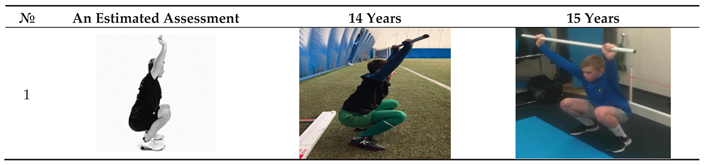
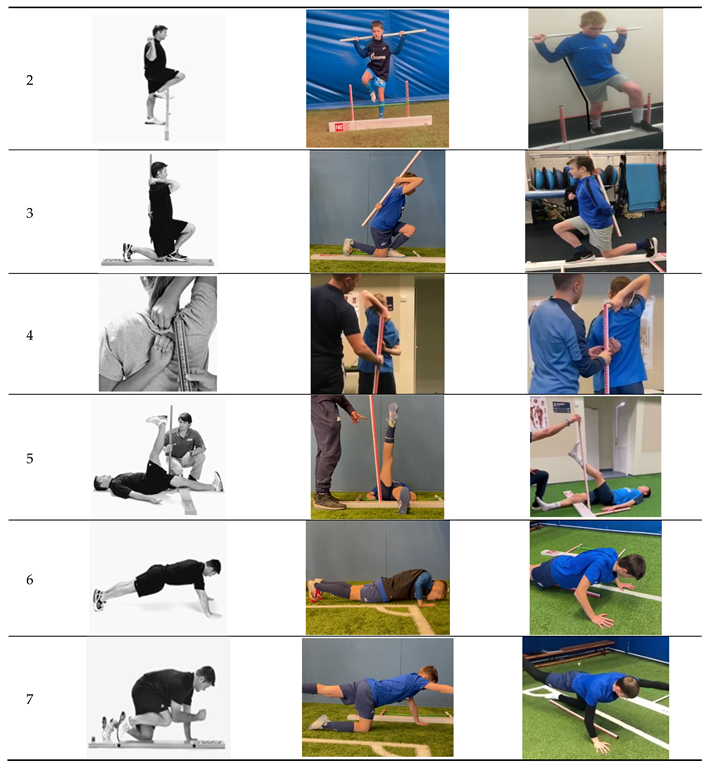
We have attempted to visualize the age-related limitations of motor functions in 14- and 15-year-old football players, as shown in Table 1. It is evident that football players experience significant functional limitations in almost all FMS test exercises, regardless of their age (Table 1). In the test exercise “Deep Squat”, the limitations of motor functions in football players are similar and are determined by uncoordinated movements of the limbs, there is an excessive tilt of the upper body, tension of the muscles of the shoulder girdle and neck (Figures 1, Table 1), discomfort in the lumbar (5 vertebrae L1-L5) and sacral regions (5 vertebrae, S1-S5). Figures 2, Table 1 show the exercise “Hurdle Step right and left side”, they came to the conclusion about the destabilization of the position on one leg, the tremor of the supporting leg and the tilt of the body in the opposite direction for a more stable position. A low level of mobility of the hip joint and muscle tension of the anterior surface of the thigh were determined at the time of stepping over the barrier, and an asymmetric pelvic position was observed (Figures No. 2, Table 1). The photographs of the “In-Line Lung right and left side” exercise (Figures No. 3, Table 1) demonstrate the forward tilt of the body and the separation of the heel zone of the foot in front of the standing leg from the surface of the measuring device when performing a downward movement during a lunge, which indicates a low elasticity of the calf muscles. It should be noted that the unstable state is maintained during the flexion of the legs at the knee and hip joints. Features of motor restrictions when performing the test exercise “Shoulder Mobility (Shoulder Mobility) right and left side” are accompanied by a state of tension in the pectoral and anterior deltoid muscles (Figures 4, Table 1). The differences in the distance of the fists (right hand on top, left hand on bottom) are significantly greater by 12.4% (p=0.012) than the left hand on top, right hand on bottom. The subjects testified to uncomfortable sensations in the area of the “shoulder-thoracic joint” and the cervical spine (7 vertebrae, C-1-C7). Figures 5 in Table 1 visualize the dysfunctions in the test exercise “Active Straight Leg Raise. Two unambiguous features of motor limitations were observed - a low degree of elasticity of the soft tissues of the posterior surface of the thigh and a state of overstrain of the hamstrings (Figures 5, Table 1). When the leg is in an upright position, most players experience unpleasant sensations (tightness, tightness) in the lower back, which, when palpated by sports medicine specialists, is defined as muscle tension. When performing the Trunk Stability Push-Up test exercise, the players observed a zigzagging of the spine, which causes weakness of the stabilizer muscles, namely the deep core muscles (Figures 6, Table 1). Low results in the test “rotational stability (Rotary Stability) right and left side”, characterized by the lack of coordination of the upper and lower limbs throughout the kinematic chain of the musculoskeletal system, indicating the functional weakness of the stabilizing muscles. During the execution of this exercise, an unstable position of the hip joint was observed with a shift to one side relative to the horizontal plane (Figures 7, Table 1).
Thus, a retrospective analysis of the performance of test exercises for the functional assessment of movements in football players aged 14 and 15 years revealed significant impairments in the motor functions of the musculoskeletal joints and the bone structure of the musculoskeletal system. The functional deficiencies in the motor functions of football players are characterized by a combination of symptoms, including limited mobility of the trunk, upper extremities, and thoracic spine, as well as motor asymmetry in the shoulders. Additionally, there is a low level of functional mobility in the hip joint during rotation and leg elevation, as well as instability in the knee joint. Motor asymmetry of the pelvic position has been determined.
5. Practical Recommendations
Functional movement assessment (FMS) in football players aged 10-18 should be carried out systematically 2-3 times a year, using photos and videos in order to track more accurate dynamics of progress / regression of players.
Authors’ Contributions
Golubev Denis Vyacheslavovich - idea, preparation and conduct of research, translation of the research into English, statistical analysis. Acena Angel Rodriguez - formation of research results, translation of the research into English, statistical analysis, interaction with the editorial board of the journal. Schennikova Marina Yurievna – idea, expert evaluation and preparation of the study.
References
- Cook, G.; Burton, L.; Hoogenboom, B. Pre-participation screening: the use of fundamental movements as an assessment of function—part 1. North Am. J. Sports Phys. Ther. 2006, 1, 62–72. [Google Scholar]
- Golubev, D.V.; et al. Motor performance as a factor of limiting motor capabilities of soccer players. Mod. Issues Biomed. 2021, 5, 192. [Google Scholar] [CrossRef]
- Kiesel, K.; Plisky, P.; Voight, M. Can serious injury in professional football be predicted by a preseason functional movement screen? North Am. J. Sports Phys. Ther. 2007, 2, 147–158. [Google Scholar]
- Hopkins, W.G.; Marshall, S.W.; Batterham, A.M.; et al. Progressive statistics for studies in sports medicine and exercise science. Med. Sci. Sports Exerc. 2009, 41, 3–7. [Google Scholar] [CrossRef] [PubMed]
- Clarke, L. The Effects of Physical Growth on Gait Stability in Adolescent Athletes. 2022.
Figure 1.
– Functional Movement Assessment (FMS) equipment.
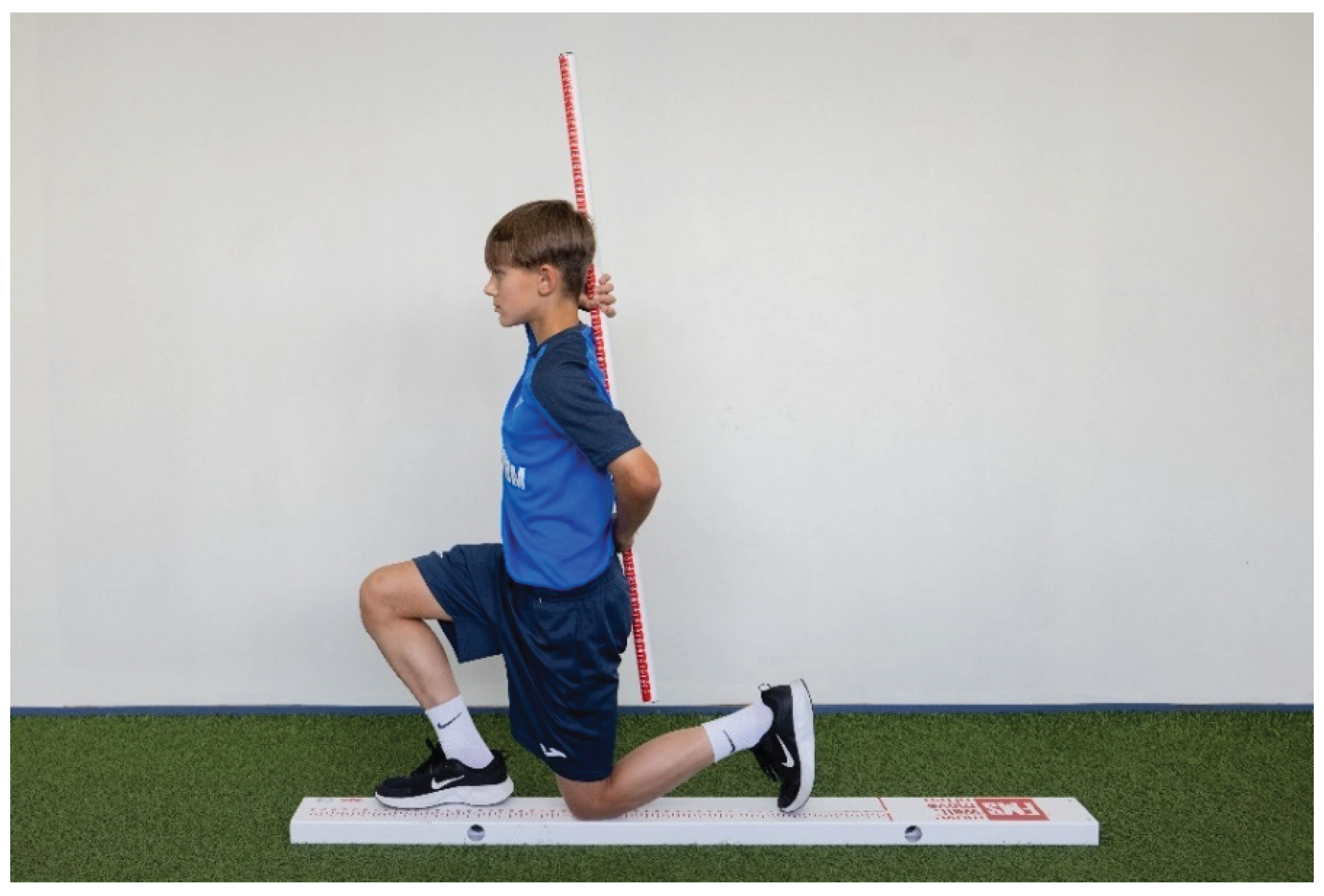
Figure 2.
– Comparative analysis of the limitations of the motor functions of football players according to 7 test exercises for functional movement assessment.
Figure 2.
– Comparative analysis of the limitations of the motor functions of football players according to 7 test exercises for functional movement assessment.
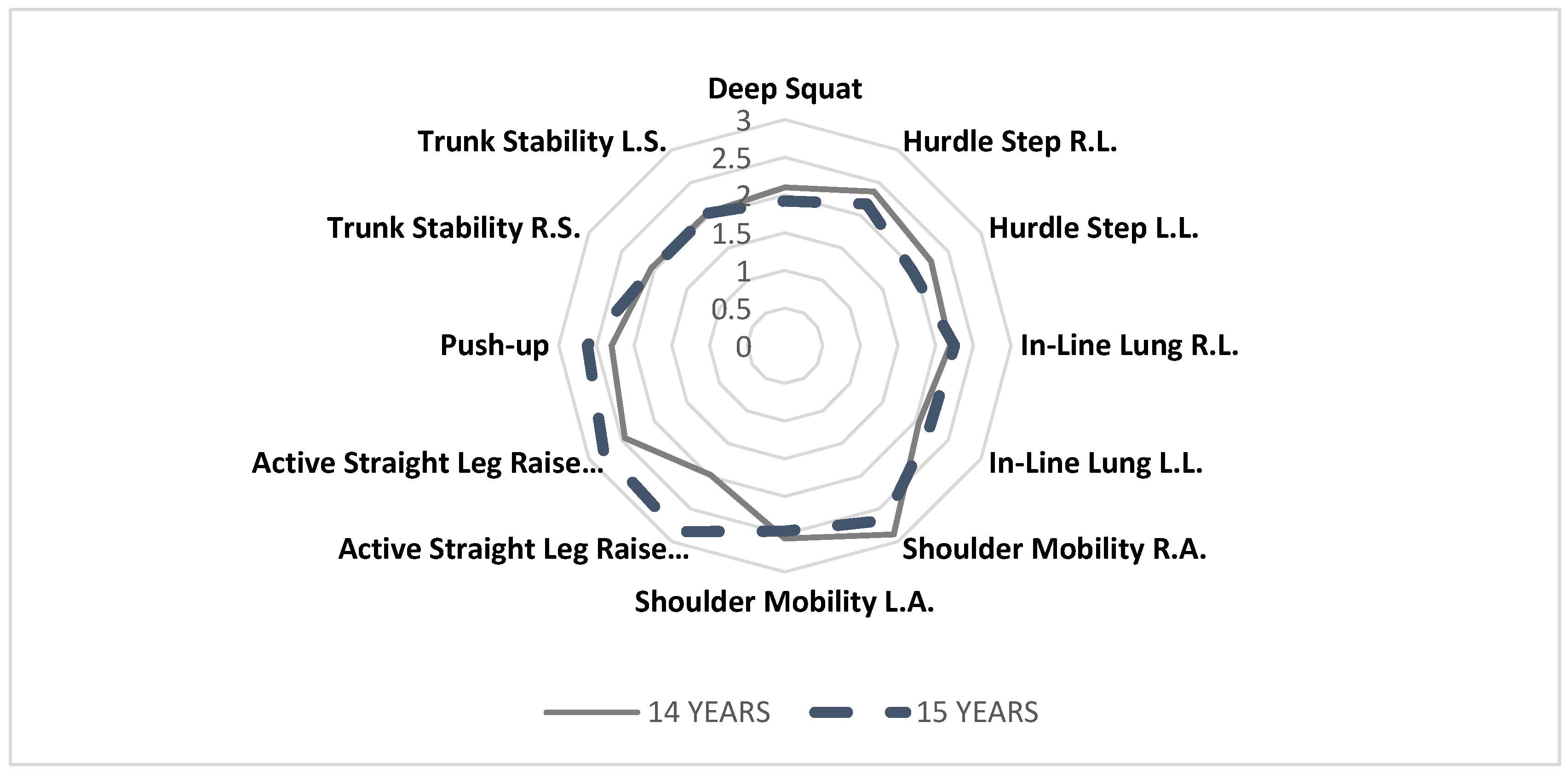

Table 1.
– Features of limitations of motor functions of football players aged 10-18 years when performing FMS test exercises.
Table 1.
– Features of limitations of motor functions of football players aged 10-18 years when performing FMS test exercises.
Disclaimer/Publisher’s Note: The statements, opinions and data contained in all publications are solely those of the individual author(s) and contributor(s) and not of MDPI and/or the editor(s). MDPI and/or the editor(s) disclaim responsibility for any injury to people or property resulting from any ideas, methods, instructions or products referred to in the content. |
© 2025 by the authors. Licensee MDPI, Basel, Switzerland. This article is an open access article distributed under the terms and conditions of the Creative Commons Attribution (CC BY) license (http://creativecommons.org/licenses/by/4.0/).
Copyright: This open access article is published under a Creative Commons CC BY 4.0 license, which permit the free download, distribution, and reuse, provided that the author and preprint are cited in any reuse.


