

Submitted:
28 November 2025
Posted:
01 December 2025
You are already at the latest version
Abstract
The land use and land cover (LULC) of many regional landscapes are changing due to natural effects and anthropogenic activities, impacting biodiversity and ecosystem services. LULC dynamics reflect the altered flow of energy, water, and greenhouse gases, influencing the pillars of sustainability: society, environment, and economy. Thus, assessing LULC changes is vital for understanding the relationship between nature and society. This study used multi-temporal remotely sensed imagery to examine LULC change between 1990 and 2019 in the context of Forest Transition Theory (FTT) across the Greater Shawnee National Forest (GSNF) area of southern Illinois, USA, using a Random Forest algorithm, and projecting change to 2050 with a Land Change Model integrated with IPCC temperature and precipitation scenarios. From 1990 to 2019, LULC analysis showed increases in deciduous forest (1.35%), mixed forest (26.40%), agriculture (2.15%), and built-up areas (6.70%), while hay/grass/pasture declined (16.0%). LULC change intensity was highest from 1990 to 2001 (2.35% annually), slowing to 0.23% (2001–2010) and 0.18% (2010–2019). LULC classification accuracy ranged from 92.9% to 95.9% with kappa coefficients of 0.89–0.94. Projections to 2050 showed consistent increases in built-up areas (17.12%–42.61%), water (28.75%–39.70%), and hay/grass/pasture (6.23%–38.38%), while overall forest cover declined in all scenarios. Deciduous forests decreased by 3.11%–19.87% and were replaced by mixed forests in some scenarios (12.45%-23.63%), while evergreen forests showed mixed responses, ranging from a decline of up to 17.13% to an increase of 2.90%. The results showed that the GSNF broadly follows the FTT framework: forest recovery since 2001 coincided with rural depopulation, slow agricultural expansion, and rising incomes. However, climate change is expected to disrupt this recovery, pushing transitions toward mixed and evergreen forests. Findings demonstrate the importance of integrating remote sensing-based LULC with socio-economic trends and climate adaptation strategies to sustain forests and ecosystem services under future environmental pressures.
Keywords:
LULC
; random forest
; climate change
; forest transition theory
; remote sensing
; Markov Chain Model
1. Introduction
1.1. The Relationship Between Land Use Land Cover Change, Climate Change, and Ecosystem Services
Land is a fundamental terrestrial resource that humans alter for their basic needs including food, shelter, and services. The anthropogenic alterations of these terrestrial resources, such as converting forests, grasslands, and shrublands to agricultural areas or urban areas, or any other land cover types, are considered land use and land cover (LULC) change [1,2]. LULC change poses a significant environmental challenge that affects biodiversity, ecosystem services (ES), and climate regulation, threatening the existence of various terrestrial life forms that depend upon these resources [3,4,5]. LULC change is the most visible representation of how an ecosystem and its services change, with impacts that are often immediately apparent, but can also exhibit legacy effects, shaping ecosystem structure, function, and services long after the initial change [2,6,7]. For example, past land conversions may influence current carbon storage, species richness, and recreational values, illustrating the need for frameworks that account for both immediate and lasting impacts [6]. The trajectory of LULC change is driven by industrialization, population growth, and technological progress. These driving forces enable the expansion of agriculture and urban areas, supporting economic development and improved living standards. However, this progress often comes at the expense of ecological integrity, causing immediate damage like deforestation, soil degradation, biodiversity loss, pollution, and the long-term degradation of ecosystem services [1,8].
LULC change has complex ecological, social, and economic effects. Landowners and managers often prioritize short-term economic gain, which risks degrading long-term ecosystem services, with significant financial and social consequences, as these services provide trillions of dollars in benefits annually. For instance, Kubiszewski, et al. [9] estimated that, depending on land-use decisions, global ES values could decline by $51 trillion or increase by $30 trillion annually by 2050. These changes are not evenly distributed geographically; while Germany recorded increases in ES value, China saw losses. The burden of ES changes is also inequitably distributed within societies. Gourevitch, et al. [10] demonstrated that forest and wetland conversion in the US disproportionately reduced ecosystem services for low-income, non-white, and urban communities. Therefore, the legacy of LULC change is not only ecological but also economic and social, indicating that LULC decisions are as much about justice and equity as about environmental sustainability.
Climate change and LULC change are deeply interconnected, forming a feedback system that operates across local to global scales. Anthropogenic activities such as deforestation and urban expansion release greenhouse gases and alter surface properties, thereby altering energy balances and climate patterns. Similarly, climate change through shifting rainfall regimes, rising temperatures, and more frequent extreme events impact LULC by reducing crop yields, stressing forests, and straining water supplies [11,12]. These changes increase demand for resources just as their availability decreases, adding stress to ecosystems and human livelihoods [13]. To understand these dynamics, researchers use integrated assessment models that combine the IPCC’s Shared Socioeconomic Pathways (SSPs) with Representative Concentration Pathways (RCPs). These scenario frameworks spanning sustainable futures (SSP1-2.6) to fossil-fuel-intensive scenarios (SSP5-8.5) offer a structured way to explore how climate and socioeconomic change together influence LULC, biodiversity, and ES [2,14].
The ability to monitor and predict LULC change has improved with advances in remote sensing technologies and modeling techniques. Remote sensing satellite systems such as Landsat, MODIS, and Sentinel provide consistent, multi-temporal, and cost-effective data for monitoring LULC change at multiple spatial scales [15,16]. Global products [17,18], regional datasets [19], and national initiatives [20] now offer comprehensive coverage, enabling researchers to link LULC to biodiversity, ecosystem functions, and atmospheric processes [21]. Predictive models such as Markov chains and cellular automata estimate future transitions based on historical probabilities [22,23], providing an additional dimension of the LULC. These models help identify biodiversity hotspots, vulnerable landscapes, and potential policy outcomes, providing tools for proactive management.
Understanding the causes of LULC requires examining economic drivers, institutional frameworks, and the processes involving LULC transitions. Farmers and landowners frequently prioritize short-term gains, while market forces and government policies can either reinforce or counter these choices [24]. For example, agriculture is often managed to maximize yields, overlooking the non-market benefits provided by forests, such as water regulation and wildlife habitat, which are central to ES [25]. Governance plays a key role through regulations, conservation initiatives, and LULC planning, though policy decisions typically involve trade-offs between economic growth and ecological protection. To understand these dynamics, Forest Transition Theory (FTT) offers valuable insights, illustrating how these drivers: human, economy, and institutional frameworks can shift from deforestation to reforestation, enhancing ecosystems and ES [24].
1.2. LULC in the Context of Forest Transition Theory
LULC transitions, from the perspective of FTT as a shift from net forest loss to net forest gain, have gained importance in shaping strategies for socio-ecological management. Mather [26] proposed FTT and stated that societies follow a U-shaped trajectory of forest cover change, moving from deforestation for agriculture and industry to eventual stabilization and recovery. Rudel, et al. [27] expanded this framework by outlining pathways such as economic development, forest scarcity, state-led reforestation, and the displacement of deforestation through trade. MacDonald [28] reported that forest gains often involve trade-offs in biodiversity and equity, while Rosa, et al. [29] showed that regrowth in Brazil’s Atlantic Forest remains fragile and governance-dependent. In China, the Grain for Green Program has driven a state-led forest transition, resulting in a net gain of over 438,000 km² in planted forests from 1990 to 2020, primarily through conversions from cropland, shrublands, and grasslands [30]. Gupta, et al. [31] found that LULC transitions shape distinct forest change trajectories within the FTT framework, with cropland expansion driving rapid forest loss due to agricultural prioritization, while wetlands and shrublands support gradual forest recovery through natural regeneration and restoration, reinforcing governance-driven reforestation and the preservation of ES.
These insights help revisit FTT in the US context. Figure 1 illustrates the historical trajectory of LULC and forest cover in relation to agriculture and economic development. The early phase was characterized by rapid land conversion with little government oversight, while the later phase reflects more deliberate policies and conservation initiatives that slowed deforestation and encouraged regrowth. This framework demonstrates that transitions are not automatic outcomes of development but are mediated by institutional capacity, policy interventions, governance, and societal values.
Despite FTT’s wide application in large-scale forest dynamics, it remains underutilized in local contexts, where it can effectively contextualize, interpret, and quantify LULC trajectories derived from remotely sensed data. This theory is developed mainly in high-income temperate regions, but its relevance to rural settings is underexplored. In southern Illinois, the shift from 19th-century deforestation to 20th-century recovery, driven by land abandonment, conservation policy, and socio-economic change, offers a strong case for testing the theory. This test will reveal how its applications often overlook links between LULC transition and local-socioeconomic dynamics and broaden the theory’s scope while informing conservation planning, ecosystem management, and sustainable rural development.
1.3. Research Motivation and Objectives
The broad aim of this study is to examine LULC dynamics in the Greater Shawnee National Forest (GSNF), southern Illinois, USA, and evaluate them within the FTT framework, while also projecting future LULC trajectories under the SSP-RCPs scenario. The specific objectives are: (i) to quantify spatiotemporal patterns and intensities of LULC change from 1990 to 2019, (ii) to assess whether forest cover and agriculture in the GSNF follow FTT trajectories, and (iii) to predict climate-driven forest transitions to 2050 under SSP-RCP scenarios. The hypotheses are that LULC change in the GSNF aligns with national trends [32,33] and that climate variability will significantly influence future forest cover. By integrating long-term remote sensing data with scenario-based modeling, the study contributes to understanding how local forest transitions interact with broader socio-economic and climatic drivers. The findings provide empirical evidence of FTT in a rural context and offer data-driven insights into conservation planning, ecosystem management, and sustainable LULC policy.
2. Materials and Methods
2.1. Study Area
The GSNF covers approximately 1,425 km² across 11 counties between the Mississippi and Ohio Rivers in southern Illinois (Figure 2). Elevation ranges from 89 to 312 meters, and the climate is characterized by mean seasonal temperatures of 2.2 °C in winter and 24.4 °C in summer, with precipitation averaging 290 mm and 310 mm, respectively. It is located at the terminal boundary of the Illinoisan Glacier during the Pleistocene Epoch (~120,000 years ago), distinguished by sandstone, limestone, and shale escarpments that shape its rugged physiography [34,35,36]. The vegetation is dominated by Oak–Hickory (Quercus–Carya) forests that regenerated following fire and other disturbances, but in recent decades, mesophication has shifted community composition toward mesophytic hardwoods such as red maple (Acer rubrum), sugar maple (Acer saccharum), and beech (Fagus grandifolia) [34,37].
In the 1800s, oak–hickory forests, wetlands, and waterways dominated the GSNF landscape (Illinois Natural History Survey, Prairie Research Institute). Indigenous communities maintained subsistence and sustainable lifestyles, prioritizing essential needs, preserving cultural practices, and minimizing environmental footprints through limited modifications to the natural landscape [38]. Beginning in the late 17th century, and especially after 1778, European settlers significantly altered landscapes in southern Illinois. They transformed forests and wetlands into agricultural fields and extracted timber for fuel, construction, and furniture. Thus, the recent transformation of LULC in southern Illinois resulted from the European settlers’ continuous and perceived progress of human society.
2.2. Data Acquisition
The Landsat program, operational since 1972, provides the longest continuous record of spaceborne terrestrial observations globally, with a spatial resolution of 30 m and a 16-day revisit interval [16]. This study utilized Landsat 5 Thematic Mapper (TM), Landsat 7 Enhanced Thematic Mapper Plus (ETM+), and Landsat 8 Operational Land Imager (OLI) imagery to classify LULC in the GSNF region of southern Illinois from 1990 to 2019. The beginning of this study was limited to 1990 due to the lack of earlier high-resolution aerial photographs for training the LULC models. The Landsat images within the study boundary were stacked year by year and preprocessed for cloud removal, along with gap fillings of Landsat 7 ETM+ scan line error. Then, from the yearly preprocessed stack, the median value of the stack was acquired to classify LULC.
This study incorporated two additional LULC datasets: one for the 1800s, derived from the Public Land Survey System and resampled to 30 m resolution to estimate forest and agricultural land, and another for 1980, published by the USGS and later converted to a GIS format (NAD1983, 30 m). Although the Public Land Survey System-derived dataset contains inherent spatial uncertainties, it remains one of the most valuable and widely used sources for reconstructing pre-settlement land cover. Population and median household income data were obtained from the US Census Bureau for the years 1800 through 2019. These datasets: LULC, population, and household income (Table 1) were used to evaluate the FTT framework.
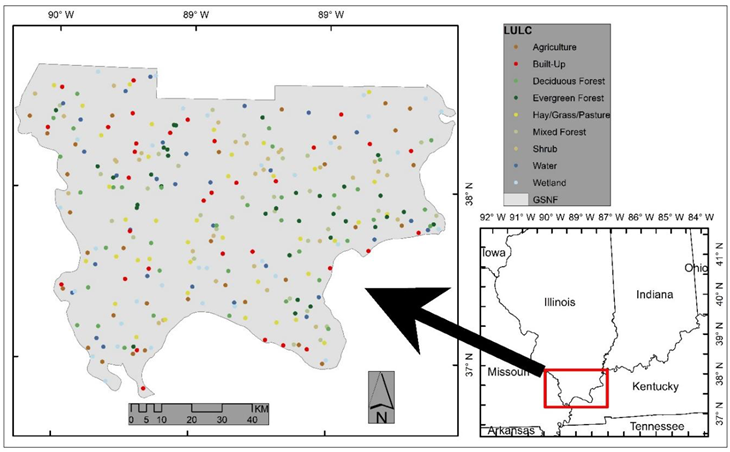
Accurate LULC classification requires reliable ground truth data, ideally collected independently in the field or from reliable sources [16]. For this study, training data were drawn from Google Earth’s historical imagery (1990, 2001) and USDA aerial imagery (2010, 2019; 1 m resolution) obtained from the USDA repository. In addition, 300 random field locations (Appendix A) were surveyed across the study area during the summers of 2019 and 2020, with at least 30 sites per LULC class using a GARMIN GPSMAP 64s to ensure equal representation. The classification included nine categories (Appendix B): agriculture, built-up, deciduous forest, evergreen forest, mixed forest, hay/grass/pasture, shrub/scattered trees, water, and wetland, based on a system developed by Anderson [39], Levels I and II, adapted for medium-resolution satellite data such as Landsat.
2.3. LULC Classification and Prediction
The Random Forest (RF) algorithm is a widely used and robust supervised machine learning technique for LULC classification and regression, operating on ensembles of decision trees [40,41]. It employs bootstrap aggregation (bagging) to generate multiple decision trees from resampled training data, while out-of-bag (OOB) samples are used to validate model performance [42]. Each tree contributes an independent classification, and final predictions are derived from majority voting across all trees, which reduces variance and increases predictive accuracy [43,44].
RF model construction begins with the selection of predictor variables and splitting criteria, commonly based on the Gini Impurity Index to assess attribute purity [42]. Key tuning parameters include the number of trees (ntree), number of variables sampled at each split (mtry), sample size, minimum node size (nodesize), and maximum number of terminal nodes (maxnodes). Typically, about 64–80% of training samples are used per bootstrap iteration to balance accuracy and avoid overfitting. Default values in R often set ntree to 501, with error convergence assessed using OOB plots [45,46]. To optimize performance efficiently, the tuneRF function in R can be applied, which iteratively adjusts parameter values until an optimal model configuration is reached.
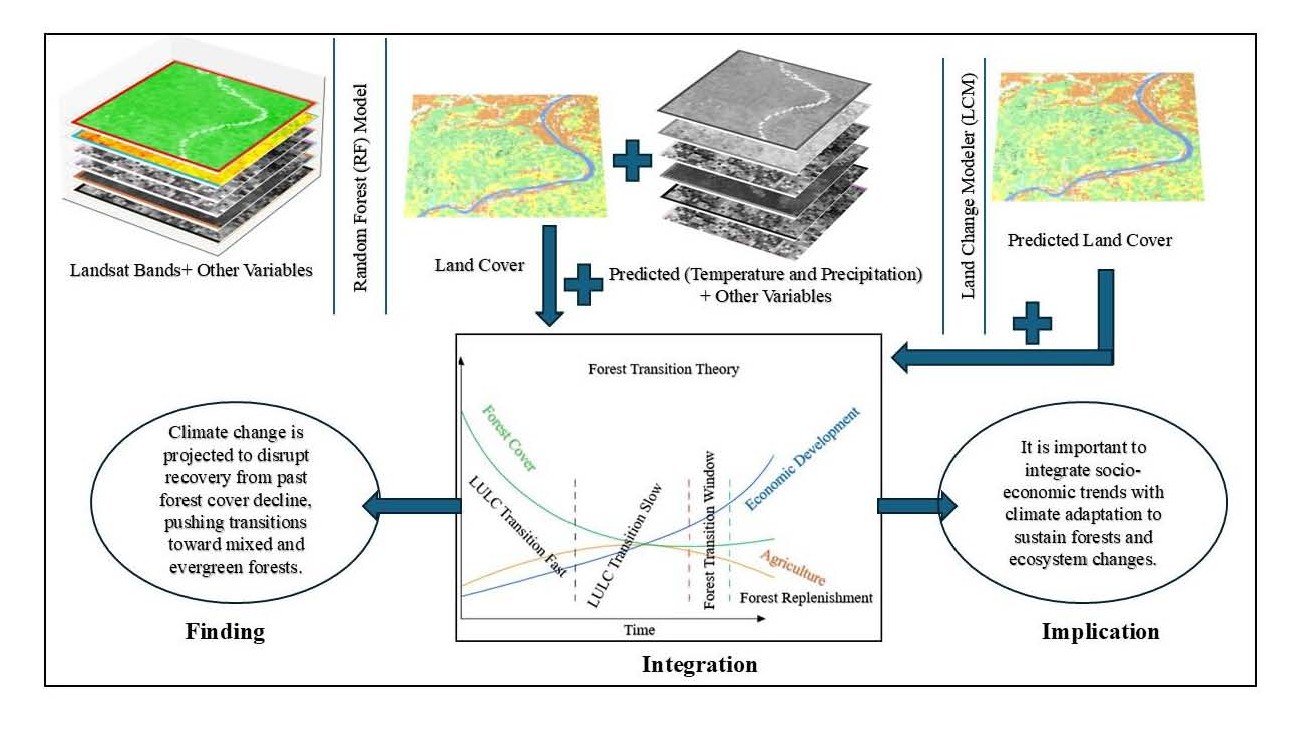
This study employed all Landsat spectral bands along with derived indices (NDVI, SAVI, MSI; Table 2) as predictor variables for LULC classification in the GSNF. Eighty percent of the training data was used for model development, with the remaining twenty percent reserved for validation. Classification accuracy was evaluated using a confusion matrix, reporting overall accuracy, kappa coefficients, and class-specific producers’ and users’ accuracy. A producer’s accuracy indicates how often ground features are correctly classified, while a user’s accuracy reflects the reliability of mapped classes in representing actual ground conditions. The overall workflow and classification variables are summarized in Figure 3.
LULC prediction was conducted using the Land Change Modeler (LCM) in TerrSet Geospatial Monitoring and Modeling System [47], which integrates a Markov Chain Model (MCM) with a multilayer perceptron neural network (MLP-NN) to estimate transition potentials among LULC classes [5,47]. The LCM framework involves four steps: (1) change analysis, (2) transition potential estimation, (3) prediction, and (4) validation.
The MLP-NN is a feed-forward network with input, hidden, and output layers that employs a back-propagation algorithm to capture nonlinear relationships between explanatory and response variables [22]. Compared to logistic regression, it provides greater flexibility in modeling complex spatial transitions. Explanatory variables included population density [48], Euclidean distance from roads and streams (US Census Bureau), slope and elevation (DEM), and SSP-RCP–based precipitation and temperature projections for 2050 (CanESM, downscaled using quantile mapping).
Markov chain analysis was used to model transition probabilities, where the probability of a state at time t+1 depends on the state at t [22,49]. Transition potentials derived from 1990–2010 were first used to predict 2019 and then extended to 2050. Model performance was validated by comparing the 2019 prediction with the observed 2019 LULC using 198 randomly generated accuracy points, reporting overall accuracy and kappa coefficients. The mathematical formulation of the Markov process is:
Where, , the status of the event at time t, and status of the event in time t+1, is the probability of an event changing from one event to another in time t+n. The equations (1 and 2) develop a transition probability map that depicts the probability of each LULC type at a given pixel after a given number of times.
2.4. LULC Intensity
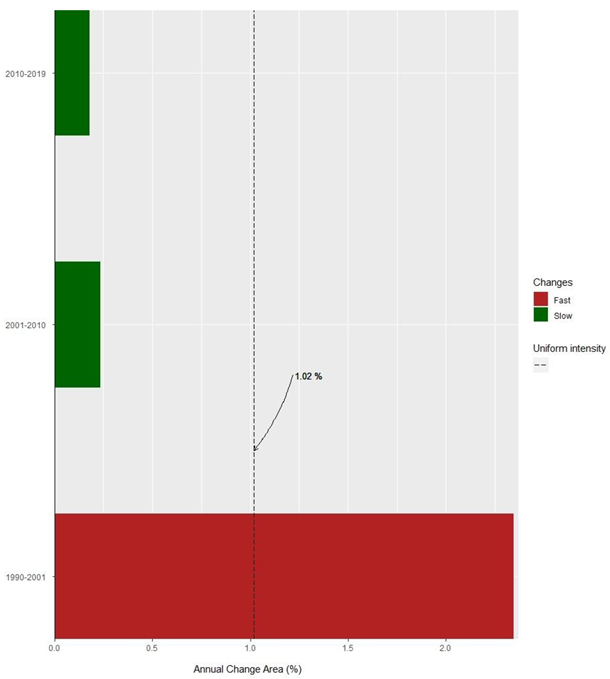
Intensity analysis was applied to quantify the rate and stability of LULC changes across multiple time intervals, providing a measure of how rapidly or slowly LULC transitions occurred [50,51,52]. The intensity of LULC can be quantified using the equations below (equations 3-10), which require at least three distinct time intervals to assess temporal dynamics and the rate of change. In the equations, St (equation 3) indicates LULC intensity and U (equation 4) indicates uniform intensity; if St is greater than U, the LULC change is fast; otherwise, it is slow, and if St is evenly distributed over a whole time interval, the change indicates a stable change [50,51,52]. The i and j indicate the number of LULC categories, Ctij denotes the area transferred from category i to j at time t, and YT indicates the number of time points.
Category level intensity helps to examine the LULC change of a specific land category over a given period and can be quantified using the equation below [50,51,52]. Gtj (equation 5) is annual gain intensity, and Lti (equation 6) is annual loss intensity.
Similarly, the transition level of a particular land category can be quantified using the equation below [50]. Rtin (equation 7) is a transition intensity from category i to n for a specific time t, Wtn (equation 8) is the average transition during time interval t when land category n is increasing over time, Qtmj (equation 9) is the transition intensity from category m to category j in a particular time interval, and Vtm (equation 10) is the average transition intensity during a given time interval when land category m is decreasing over time t.
2.4. Statistical Analysis
Historical records of forest cover, agricultural LULC, population, and median household income from 1800 to 2019 were compiled from archival sources (Table 1), the US Census Bureau demographic data, and economic surveys. Variables were standardized (e.g., expressed as percentages of total land area) and analyzed across two periods: 1800–2001, representing the pre-intensive conservation, and 2001–2019, corresponding to the phase of management intensification. This segmentation was employed to capture potential shifts in LULC and socio-economic trajectories, consistent with period-based approaches in forest transition research [53,54].
Ordinary least squares (OLS) linear regression was applied to each variable independently, with time as the predictor. Period-specific slopes were estimated and tested for significance at an α level of 0.05. Slope direction and magnitude were interpreted within the FTT, with agricultural decline and population stabilization expected to coincide with forest recovery. Possible external drivers, such as climate change, were considered qualitatively when evidence was available [53]. All analyses were carried out in R using the lm () function [45,46].
3. Results
3.1. Accuracy Assessment and LULC Change
The overall classification accuracy for the LULC for 2001, 2010, and 2019 was closely ranged, while the 1990 classification exhibited the lowest accuracy among the years studied. The highest overall LULC classification accuracy was achieved for the 2019 LULC, with an overall accuracy of 95.90% and a Kappa coefficient of 0.94 (Table 3). In contrast, the 1990 LULC had lower accuracy, with an overall accuracy of 92.90% and a Kappa coefficient of 0.89. Across all classification years, the water class consistently demonstrated the highest User’s and Producer’s accuracies. Conversely, the lowest accuracies for both users and producers were observed for the mixed forest and shrub classes in 1990.
The multi-temporal LULC analysis of the GSNF from 1990 to 2019 revealed varied changes across nine major classes: agriculture, built-up areas, deciduous forest, evergreen forest, mixed forest, hay/grass/pasture, water, shrub, and wetland (Figure 4). Forests remained the dominant cover, accounting for nearly 39% of the area, followed by agriculture (~28%) and hay/grass/pasture (~18%). Most classes increased modestly over three decades, with agriculture (+2.15%), built-up land (+6.70%), and mixed forest (+26.40%) showing steady gains, while hay/grass/pasture (–16.0%) and evergreen forest (–2.35%) declined. Shrubs (+41.26%) and water (+16.18%) recorded the largest proportional increases, whereas wetlands (+2.24%) and deciduous forests (+1.35%) showed only marginal growth. Spatial patterns illustrate these shifts, for example, near Marion, IL, hay/grass/pasture were replaced mainly by agriculture and built-up land between 1990 and 2001, while near Vienna, IL, agricultural land was converted to residential land after 2010 (Figure 4). The most substantial exchanges occurred between agriculture and hay/grass/pasture during 1990–2001, but after 2001, most classes stabilized, with narrower flows among categories (Figure 5). Built-up land steadily absorbed area from nearly all other classes, while deciduous forests gradually transitioned into mixed forests, indicating ongoing shifts in forest composition (Figure 4 and Figure 5; Table 4).
The LULC intensity was higher between 1990 and 2001, when the annual rate reached 2.35%. However, it slowed considerably in the subsequent decades, with rates of 0.23% from 2001 to 2010 and 0.18% from 2010 to 2019 (Appendix C). This temporal trend in intensity aligns closely with the Sankey diagrams (Figure 5): the broad flows during 1990–2001 reflect dynamic exchanges, especially between agriculture and hay/grass/pasture, whereas the narrower flows after 2001 are consistent with lower intensity rates and greater class stability. Category-level analysis confirmed that water, shrubs, and hay/grass/pasture were the most dynamic classes, while agriculture, built-up areas, and forests were relatively stable. Both the intensity metrics and the Sankey diagrams underscore that built-up expansion was cumulative and irreversible, drawing from agriculture, hay/grass/pasture, and shrub, while wetlands and water contributed smaller but consistent flows to agriculture and built-up areas (Figure 4 and Figure 5; Table 4).
3.2. LULC Transition and Prediction
The transition potential between LULC classes varied considerably. The lowest accuracy was observed in the transition from agriculture to hay/grass/pasture (61.88%, skill measure = 0.39), while the highest occurred in the transition from deciduous forest to evergreen or mixed forest (88.76%, skill measure = 0.76). Across scenarios, the overall transition potential accuracy ranged from 77.99% to 84.67%, with corresponding skill measures of 0.59, 0.55, 0.63, 0.65, and 0.69 for SSP-RCP 1 through SSP-RCP 5, respectively. Among these, SSP-RCP 2 produced the lowest predictive accuracy, while SSP-RCP 4 yielded the highest. Similarly, the overall accuracy of the LCM prediction model ranged from 77.84% to 82.82%, with kappa coefficients between 0.76 and 0.81, again lowest for SSP-RCP 2 and highest for SSP-RCP 4.
Predicted LULC changes between 2019 and 2050 also differed among scenarios (Table 5). Built-up areas, water bodies, and hay/grass/pasture showed consistent increases across all SSP-RCPs. Agriculture increased only under SSP-RCP 5, whereas all other scenarios projected a decline, with SSP-RCP 3 showing the greatest reduction. Wetlands fluctuated depending on the scenario, but were projected to increase under SSP-RCP 2. Forest cover (deciduous, evergreen, and mixed) decreased in all scenarios. Notably, mixed forests expanded in SSP-RCP 2, SSP-RCP 4, and SSP-RCP 5, suggesting that native oak–hickory and other deciduous forests may decline, giving way to evergreen and mixed forests. Such a shift would have important implications for ecosystem composition and functioning, as deciduous forests have long defined the region’s ecological character. Spatial projections indicate that deciduous forests are most likely to be replaced by mixed forests moving west to east through the central GSNF (Figure 6). Variability in wetland cover was concentrated in the Cache River watershed and along the Mississippi River, underscoring the spatial heterogeneity of future LULC transitions in the region.
3.3. Testing Forest Transition Theory in the GSNF
There were distinct phases of LULC transition, particularly forest and agriculture, in the GSNF that align with FTT (Figure 7). Between 1800 and 2001, forest cover declined sharply (slope –0.23) while agricultural land increased (slope +0.12), reflecting the early development phase marked by rapid deforestation and limited government oversight. During the same period, the population grew (slope +0.09) and household income rose modestly (slope +0.11), highlighting the pressure of demographic and economic drivers on land resources. After 2001, however, the trends shifted: forest cover stabilized and showed slight recovery (slope +0.03), agriculture leveled off (slope +0.02), and population began to decline (slope –0.06), while household income increased significantly (slope +0.94). These shifts indicate a transition from rapid to slower LULC change, supported by federal and state conservation policies, rural depopulation, and broader economic diversification. GSNF is currently within the forest transition window, where ecological recovery and forest replenishment are emerging alongside reduced dependence on direct land exploitation.
4. Discussion
4.1. Accuracy Assessment
Classification accuracy assessment, uncertainty analysis, or both are conducted during land cover classification. Users may be interested in the classification accuracy or the uncertainty of the classification results [55]. Classification accuracy and uncertainty are two different concepts: classification accuracy measures how closely a thematic map aligns with a reference, while uncertainty quantifies the variability of these measures across all potential parameters [55,56]. The uncertainty may arise from various sources, including the resolution and quality of remote sensing data, training/validation data, classification algorithms, and the methodologies, making it challenging to achieve a definitive assessment [56,57]. Therefore, accuracy assessments are often deemed sufficient to gain practical and actionable insights from the LULC classification [55]. Usually, studies use a training dataset to assess classification accuracy, which researchers have warned against using the same data for both training and validation to avoid uncertainty and overestimating accuracy [55,57]. Therefore, in this study, 80% of the ground truth data were used for training models, and 20% of the ground truth data was used for validation to avoid inaccuracy and uncertainty. The overall accuracy of the land cover ranged between 92 and 95% and the Kappa coefficients between 0.89 and 0.94. The accuracy assessment statistics (overall accuracy and Kappa coefficients) showed substantial strength of agreement. Despite the accuracy assessment indicating high accuracy in LULC classifications, the changes observed between 1990 and 2019 in some classes were minimal (<3%), potentially falling within the margin of error. This observation aligns with Varanka and Shaver [58], who reported similar findings for the Interior Lowland Ecoregion, which includes the GSNF area, between 1973 and 2000, suggesting that these minor changes accurately reflect real change. Furthermore, the trend in LULC change, especially in forests, corroborates the forest change trends documented in the annual USFS reports, affirming the validity of this study’s findings. Consistency with prior research reinforces the reliability of the findings, but careful interpretation is necessary, acknowledging the potential for inaccuracy and uncertainty. The RF algorithm and LCM model optimize parameters using training data to reduce inaccuracy and uncertainty, improving predictions [55,57]. However, it is important to remember that no model is perfect and free of inaccuracy and uncertainty. The LULC prediction serves as a guiding tool that can be supplemented by an in-depth understanding of the local context and variations in LULC change patterns.
4.2. LULC Change
Visual inspection of the LULC of the early 1800s (Figure 2) and contemporary LULC (Figure 4) reveals a significant alteration in LULC over the last two centuries. The LULC changed variably among LULC classes throughout GSNF between 1990 and 2019, but remained relatively stable after 2001. The relatively stable LULC in the GSNF and elsewhere in the US can be attributed to the maturity of the US land use system during the past several decades [32]. Major LULC classes, such as forest and agriculture, became stable throughout the US [32,59]. The slowing LULC intensity change can be attributed to technological advances, less land for available conversion, and the success of various governmental and non-governmental programs. Several acts, plans, and policies implemented in Illinois, such as the Natural Areas Preservation Act, sustainable agriculture partnership, conservation reserve program, tax incentives, recreational access program, cost-sharing easements, nutrient loss reduction strategy, and certification programs led to a deceleration in the conversion of LULC. These policies are crucial to slow down LULC conversion, especially in GSNF, where most land is privately owned. However, specific policies or plans that significantly influence the slowdown of LULC conservation have yet to be investigated.
Most of the forest was converted to agriculture or built-up land between 1990 and 2019. The highest positive change was seen in shrub and mixed forests. The shrub change was higher in percentage because it constitutes the smallest portion among the LULC, so a slight change in area will be reflected in an overall increase or decrease of the area. There was an overall increase in forest in the GSNF, consistent with the findings of the Illinois Forest Action Plan [60,61]. However, there was an increase in deciduous and mixed forests and a slight decrease in evergreen forests between 1990 and 2019. The increase in forest area in the GSNF can be attributed to the successful implementation of the restoration and management program and plans of the federal/state government and other stakeholder programs such as ‘Let The Sun Shine In’ [62]. Such programs implement prescribed burning, invasive species control, stand improvement, overstory tree removal, and establishment of demonstration areas that aid forest growth. However, the increase in mixed forests may be attributed to both land abandonment and the invasion of evergreen species in areas where deciduous forest patches once existed. Historically, the Shawnee National Forest was used for agriculture, logging, and mining. The cessation of these activities allowed for natural regeneration, leading to the re-establishment of forests, particularly mixed hardwoods and oak-hickory forests.
Additionally, the increase in mixed forests may also be partly linked to climate change, specifically changes in temperature and precipitation, and selective forest harvesting practices that facilitate the expansion of evergreen forests [60]. Invasive pines that were once planted may increase across the landscape, causing some deciduous forest areas to turn into mixed forests. The disturbance activities, such as harvesting and burning, primarily help oak-hickory forests and create an environment for evergreen forests, such as shortleaf pine, to encroach into the surrounding area. However, native shortleaf pine was initially restricted to a very small area in the southeast region of the La Rue Pine Hills, but there are plantations of this species across the GSNF. The decrease of evergreen stands in southern Illinois, particularly pine species, is due to the wilt disease caused by different beetles. As a result, many commercial pine plantations may have been eliminated [60,61].
Similarly, large areas of mature evergreen forest are currently undergoing thinning and reforestation into hardwood forests, leading to increased mixed and deciduous forests [60]. The forest area throughout the US has experienced minor variations since the 1920s; notably, the overall forest area in Illinois has gradually increased [59,60]. The increase in forest area may also be attributed to the agricultural abandonment due to low agricultural prices during the 1990s, leading to a low agricultural return compared to returns from other LULCs such as forestry and urban development [4].
In Illinois, agriculture has changed from small, diverse farms run by hand labor and draft animals to massive industrial farms since the mid-20th century, intensifying forest conversion to agriculture [63]. However, agricultural land conversion dropped significantly after the 1920s [63,64]. Although land conversion decreased substantially after the 1920s, the agricultural land in GSNF increased by 2.15% percent in three decades despite the development of hybrid crops and chemical fertilizers. Despite the increase in agricultural land, the population of GSNF decreased by 7.76% between 1990 and 2020. Similarly, the number of farms declined by 12.19% between 1992 and 2002, 8.22% between 2002 and 2020, and 19.41% between 1992 and 2020 (https://www.nass.usda.gov/). The decline in population and number of farms, but an increase in agricultural land, might indicate that the farmers that persist are facing agricultural productivity decline due to climate change, forcing them to expand their agricultural lands from other LULC types. Additionally, the increase in farm size could suggest that advances in technology have made it easier to manage larger acreages compared to the past, allowing farmers to be more financially sustainable.
LULC classes such as water consistently increased from 1990, except between 2010 and 2019, whereas wetlands increased between 2001 and 2010. The constant fluctuation of water and wetlands might be attributed to Illinois’s climate pattern. Wetlands and water fluctuate near rivers and streams as more frequent and severe floods have occurred in the recent history of southern Illinois. The 1993, 2011, and 2016 floods caused massive destruction of crops, soils, roads, and residences. These floods primarily impacted bordering counties of the Mississippi and Ohio rivers, bringing water further inland and creating temporary water lakes, ponds, and wetlands [65].
4.3. LULC Prediction
The FTT framework showed that LULC change is slowing down with a recent recovery in forest cover. However, the slow LULC transition, particularly forest recovery or agricultural LULC change, may be halted and move in a different direction during the transition window. While inducing SSP-RCP-based temperature and precipitation in the LULC model, the result indicated that forest cover decreases, and built-up area increases in all scenarios. Agricultural land also increases in all scenarios except the business-as-usual scenario (SSP-RCP 5). Therefore, special precautionary steps should be taken while managing the LULC of the GSNF for future conservation and continued forest recovery.
In the GSNF, the built-up area increased from 1990 to 2019, and in all SSP-RCP scenarios, but the growth is at a high differential rate. The GSNF is relatively rural, but the urban area is increasing, particularly in Williamson and Jackson Counties around Marion and Carbondale, respectively [66]. The urban area also grew in all climate scenarios throughout the US, particularly in the Atlantic seaboard in the northeast, the lower peninsula of Michigan, and different urban centers of Illinois [67,68].
The variation in LULC exhibited different characteristics in different SSP-RCP scenarios. All the scenarios showed increased hay/grass/pasture throughout the GSNF. The seasonal variation in temperature and precipitation will alter soil water availability to grassland vegetation, but native grassland vegetation that has adapted to these variations will likely fare better in a changing climate [69]. A disturbance in the balance of temperature and precipitation, i.e., climate change, may reduce the height of native prairie grasses such as big bluestem (Andropogon gerardi) up to 60% in the next 75 years and favor invasion by exotic plants such as cheatgrass (Bromus tectorum) [70,71]. The increase in hay/grass/pasture may be due to the reclamation of fallow fields, road/railroad rights-of-way, and other surface mining areas. However, their reclamations are likely tall fescue (Schedonorus arundinaceus) pasture and broom sedge (Andropogon virginicus) dominated old fields rather than native bluestem grassland.
All the scenarios except SSP-RCP 5 (business-as-usual) showed a decrease in agriculture. Similar results were obtained by Gurgel, et al. [72], where the authors showed that grassland will increase in all SSP-RCP scenarios and agriculture will decrease in all scenarios except SSP-RCP 5. Wear [68] also suggested that the cropland loss will stretch from southern Michigan to the lower Mississippi valley, encompassing a considerable portion of western Kentucky, Indiana, and Ohio. The decrease in agriculture and increase in hay/grass/pasture might also be related to crop yield and production costs. The per-acre production cost of agriculture (approximately $400) is higher than that of hay/grass/pasture (approximately $300), and farmers can obtain up to three years of hay with single seeding, accompanied by light maintenance costs. Since some hay/grass/pasture species are favored due to climate disturbances, farmers might move towards growing hay/grass/pasture rather than row crop agriculture.
The SSP-RCP LULC scenario showed that the water would increase in every scenario, but the wetland area varied. The wetlands could increase by 9% (SSP-RCP 2) or decrease by 31% (SSP-RCP 3), depending on the scenario from the 2019 baseline. In the future, higher temperatures and varied precipitation, particularly during summer, would encourage floods that might lead to increased water and abrupt drought, negatively impacting existing wetlands and causing the decline of wetlands [11]. Wetland extent showed a modest increase under environmentally friendly emission scenarios, but declines in others [67].
The overall forest cover of GSNF will decrease in all scenarios, but the mixed forest would benefit from SSP-RCP 2, 4, and 5. Wear [68] also found that overall forest cover in the US will decrease in all climate change scenarios. The southern region will experience more forest cover loss than the northern region, the Rockies, and the Pacific. Forest cover is expected to decline due to the conversion of forested land to urban and agricultural LULC in changing climates [67]. The pure deciduous forest will be encroached upon by other evergreen species, where there were small patches of evergreen species in a baseline scenario of 2019. Several studies suggest that evergreen species, such as spruce, would withstand climate change better than deciduous species, like birch and oak [64,73]. With a warming climate and variable precipitation, early greening occurs (leaf on) that forces deciduous forest species to decrease water use efficiency, benefiting evergreen species and shrubs, particularly in temperate latitudes [73,74]. Reich, et al. [75] suggest that southern boreal forests may be approaching an unsettling “tipping point” where boreal forests may turn into a novel mixture of vegetation, such as shrubs and temperate tree species, that are a less robust ecological system. Similarly, Dial, Maher, Hewitt and Sullivan [74] found that conifer species expand further beyond their tree lines than they did during the last glacial maximum.
4.4. Forest Transition Theory Framework
Overlaying the timeline curves representing forest cover, agriculture, population, and median household income over time, along with their slopes from the 1800s to 2001 and from 2001 to 2019, shows that the forest recovery in the GSNF aligns with the forest transition framework. The overall forest cover in the GSNF has been slowly but consistently increasing for over three decades, while agricultural land has also expanded, albeit at a much slower rate since 2001. Concurrently, the median household income has risen, and the population in the GSNF has declined, paving the way for forest recovery and a decrease in agricultural land. Foundational drivers of forest and agricultural changes include economic shifts, demographics, technological advancements, and various policy and institutional governance mechanisms [76,77]. The forest cover transitioned from a net loss to a net gain and recovery at the turn of the twenty-first century [60,61]. Trends since the late 1970s, such as a gradual decrease in cropland and forestland, grazed areas, and an increase in pasture areas and total forestland in the US, correlate with the findings of this study [32,72,78]. Similarly, the impact of per capita income growth on forest cover is more pronounced during the early phases of economic development and diminishes as economies mature [79]. In cases like the GSNF, where forest recovery is ongoing, the economy, population dynamics, and policies play a facilitative role by curbing agricultural land changes and promoting nature conservation.
The forest transition framework evaluated in the study allows a fundamental understanding of the factors that influence the spatial and temporal change of LULC, particularly forest loss and recovery. Although the framework captures the general trend of loss and recovery, it cannot address the issues of forest quality and ecosystem integrity. Forest loss and recovery have gone beyond direct human interventions in recent years. For example, natural regeneration and biophysical factors such as climate change, nitrogen deposition, and carbon dioxide fertilization significantly influence the transition process. Therefore, more complex frameworks considering human interventions and climate change should be considered while expanding the existing framework.
5. Conclusion
This remote sensing study conducted LULC classification using a random forest algorithm and predicted LULC based on the SSP-RCP scenario using LCM. The classification results revealed that agriculture, forest, built-up, and water coverage were projected to increase, but hay/grass/pasture will decrease consistently. The study also demonstrated that the LULC change in the GSNF aligns with the FTT framework, where forest recovery is concurrent with slow agricultural land expansion, population decline, and economic growth. The framework underscores the importance of economic shifts, policy measures, and demographic changes in influencing LULC dynamics. The SSP-RCP-based LCM simulation projections show that the forest was substantially reduced in all scenarios, but other LULC classes showed variation from scenario to scenario. How land is utilized for forests, agriculture, and wetlands is essential for achieving climate mitigation goals, and this study provided a deeper understanding of past LULC and its spatio-temporal dynamics. This more localized (context-specific) LULC product will play an essential role in studying the regional roles of climate change. It suggests a path forward for adopting and planning for LULC management to cope with the impact of climate change on the GSNF. Historically, the GSNF has faced significant LULC change since European settlement, but it has become more stable with declining intensity in the last 30 years. Declining population and farm numbers suggest that LULC change stability is somewhat related to this at present; however, when SSP-RCP-based temperature and precipitation are introduced into the prediction model, the change exceeds that observed between 1990 and 2019. The increased projected change shows that climate change will have more influence on LULC change, particularly in the forest, wetland, and hay/grass/pasture LULC than current drivers.
Supplementary Materials
The following supporting information can be downloaded at the website of this paper posted on Preprints.org.
Author Contributions
Conceptualization, S.T., D.G. and R.L.; methodology, S.T.; software, S.T.; validation, S.T.; formal analysis, S.T.; investigation, S.T.; resources, S.T.; data curation, S.T.; writing— S.T., D.G. and R.L.; writing—review and editing, S.T., D.G. and R.L.; visualization, ST; supervision, D.G. and R.L.; project administration, S.T. All authors have read and agreed to the published version of the manuscript.
Funding
This research is supported by a graduate research assistantship from the Environmental Resources and Policy Program at Southern Illinois University Carbondale and is partially supported by the Southern Illinois Plants of Concern Program.
Data Availability Statement
Publicly available datasets were used in this study. These data can be accessed at: https://earthexplorer.usgs.gov/, https://data.census.gov/, and https://clearinghouse.isgs.illinois.edu/. The data processing and analysis codes supporting the conclusions of this article will be made available by the authors upon request.
Acknowledgments
S.T thanks the SIUC Environmental Resources and Policy program and the Plants of Concern Program for financial support. S.T. is grateful to D.G. and R.L. for their continued support throughout graduate school and beyond.
Conflicts of Interest
The authors declare no conflicts of interest.
Appendix A. Locations Visited During the Summers of 2019 and 2020 to Train and Validate Random Forest Model for LULC Classification
Appendix B. LULC Classification and Its Definitions Based on the System Developed by Anderson in 1976
| LULC | LULC Description |
| Agriculture | Areas actively tilled or no-tilled for producing annual/perennial crops like corn, soybean, vegetables, and others. |
| Built-Up | The area is covered with structures such as commercial buildings and roads, as well as areas with a matrix consisting of vegetation, grass, and other structures (low-intensity residential area). |
| Deciduous Forest | Forest area dominated by deciduous tree species (species shedding foliage) and covers more than 80 percent. |
| Evergreen Forest | The forest area is dominated by evergreen tree species (those that do not shed foliage) and covers more than 80 percent. |
| Hay/Grass/Pasture | Areas of perennial or annual natural and domesticated grasses with a tree cover of less than 5 percent, and areas used for livestock grazing. |
| Mixed Forest | Forest areas where deciduous or evergreen forests comprise less than 80 percent of the land. |
| Water | The area covered by water and vegetation is less than 5 percent. |
| Shrub | Forest areas, either deciduous or evergreen, that are less than 5 meters tall and have a canopy cover greater than 20 percent. |
| Wetlands | Areas where the soil or substrate is occasionally wet with water or covered with it, and perennial herbaceous plants are often present. |
Appendix C. Interval Intensity of LULC Between 1990 and 2019. The Dashed Line Shows the Average Change Intensity that Partitions Intensity into Slow or fast LULC Conversion
References
- Foley, J.A.; DeFries, R.; Asner, G.P.; Barford, C.; Bonan, G.; Carpenter, S.R.; Chapin, F.S.; Coe, M.T.; Daily, G.C.; Gibbs, H.K.; et al. Global consequences of land use. Science 2005, 309, 570–574. [Google Scholar] [CrossRef]
- Krause, A.; Haverd, V.; Poulter, B.; Anthoni, P.; Quesada, B.; Rammig, A.; Arneth, A. Multimodel Analysis of Future Land Use and Climate Change Impacts on Ecosystem Functioning. Earth’s Future 2019, 7, 833–851. [Google Scholar] [CrossRef]
- Lambin, E.F.; Geist, H.J.; Lepers, E. Dynamics of land-use and land-cover change in tropical regions. Annual Review of Environment and Resources 2003, 28, 205–241. [Google Scholar] [CrossRef]
- Lawler, J.J.; Lewis, D.J.; Nelson, E.; Plantinga, A.J.; Polasky, S.; Withey, J.C.; Helmers, D.P.; Martinuzzi, S.; Pennington, D.; Radeloff, V.C. Projected land-use change impacts on ecosystem services in the United States. Proceedings of the National Academy of Sciences 2014, 111, 7492–7497. [Google Scholar] [CrossRef] [PubMed]
- Leta, M.K.; Demissie, T.A.; Tränckner, J. Modeling and prediction of land use land cover change dynamics based on land change modeler (Lcm) in nashe watershed, upper blue nile basin, Ethiopia. Sustainability 2021, 13, 3740. [Google Scholar] [CrossRef]
- Dallimer, M.; Davies, Z.G.; Diaz-Porras, D.F.; Irvine, K.N.; Maltby, L.; Warren, P.H.; Armsworth, P.R.; Gaston, K.J. Historical influences on the current provision of multiple ecosystem services. Global Environmental Change 2015, 31, 307–317. [Google Scholar] [CrossRef]
- Nickelson, J.B.; Holzmueller, E.J.; Groninger, J.W.; Lesmeister, D.B. Previous land use and invasive species impacts on long-term afforestation success. Forests 2015, 6, 3123–3135. [Google Scholar] [CrossRef]
- Gurung, K.; Yang, J.; Fang, L. Assessing Ecosystem Services from the Forestry-Based Reclamation of Surface Mined Areas in the North Fork of the Kentucky River Watershed. Forests 2018, 9, 652–652. [Google Scholar] [CrossRef]
- Kubiszewski, I.; Costanza, R.; Anderson, S.; Sutton, P. The future value of ecosystem services: Global scenarios and national implications. In Environmental Assessments; Environmental Assessments Edward Elgar Publishing: 2020; pp. 81-108.
- Gourevitch, J.D.; Alonso-Rodríguez, A.M.; Aristizábal, N.; de Wit, L.A.; Kinnebrew, E.; Littlefield, C.E.; Moore, M.; Nicholson, C.C.; Schwartz, A.J.; Ricketts, T.H. Projected losses of ecosystem services in the US disproportionately affect non-white and lower-income populations. Nature communications 2021, 12, 1–9. [Google Scholar] [CrossRef]
- Byrd, K.; Ratliff, J.; Bliss, N.; Wein, A.; Sleeter, B.; Sohl, T.; Li, Z. Quantifying climate change mitigation potential in the United States Great Plains wetlands for three greenhouse gas emission scenarios. Mitigation and Adaptation Strategies for Global Change 2015, 20, 439–465. [Google Scholar] [CrossRef]
- Gautam, S.; Mishra, U.; Scown, C.D.; Wills, S.A.; Adhikari, K.; Drewniak, B.A. Continental United States may lose 1.8 petagrams of soil organic carbon under climate change by 2100. Global Ecology and Biogeography 2022, 31, 1147–1160. [Google Scholar] [CrossRef]
- Benez-Secanho, F.J.; Dwivedi, P. Analyzing the impacts of land use policies on selected ecosystem services in the upper Chattahoochee Watershed, Georgia, United States. Environmental Research Communications 2021, 3, 115001. [Google Scholar] [CrossRef]
- Rosa, I.M.D.; Purvis, A.; Alkemade, R.; Chaplin-Kramer, R.; Ferrier, S.; Guerra, C.A.; Hurtt, G.; Kim, H.J.; Leadley, P.; Martins, I.S.; et al. Challenges in producing policy-relevant global scenarios of biodiversity and ecosystem services. Global Ecology and Conservation 2020, 22, e00886–e00886. [Google Scholar] [CrossRef]
- Pettorelli, N.; Schulte to Bühne, H.; Tulloch, A.; Dubois, G.; Macinnis-Ng, C.; Queirós, A.M.; Keith, D.A.; Wegmann, M.; Schrodt, F.; Stellmes, M.; et al. Satellite remote sensing of ecosystem functions: opportunities, challenges and way forward. Remote Sensing in Ecology and Conservation 2018, 4, 71–93. [Google Scholar] [CrossRef]
- Roy, D.P.; Ju, J.; Lewis, P.; Schaaf, C.; Gao, F.; Hansen, M.; Lindquist, E. Multi-temporal MODIS–Landsat data fusion for relative radiometric normalization, gap filling, and prediction of Landsat data. Remote Sensing of Environment 2008, 112, 3112–3130. [Google Scholar] [CrossRef]
- Friedl, M.A.; Woodcock, C.E.; Olofsson, P.; Zhu, Z.; Loveland, T.; Stanimirova, R.; Arevalo, P.; Bullock, E.; Hu, K.-T.; Zhang, Y. Medium Spatial Resolution Mapping of Global Land Cover and Land Cover Change Across Multiple Decades From Landsat. Front. Remote Sens 2022, 3. [Google Scholar] [CrossRef]
- Liu, Y.; Li, Y.; Li, S.; Motesharrei, S. Spatial and temporal patterns of global NDVI trends: correlations with climate and human factors. Remote Sensing 2015, 7, 13233–13250. [Google Scholar] [CrossRef]
- Büttner, B.; Kinigadner, J.; Ji, C.; Wright, B.; Wulfhorst, G. The TUM accessibility atlas: Visualizing spatial and socioeconomic disparities in accessibility to support regional land-use and transport planning. Networks and Spatial Economics 2018, 18, 385–414. [Google Scholar] [CrossRef]
- Jin, S.; Homer, C.; Yang, L.; Danielson, P.; Dewitz, J.; Li, C.; Zhu, Z.; Xian, G.; Howard, D. Overall methodology design for the United States national land cover database 2016 products. Remote Sensing 2019, 11, 2971. [Google Scholar] [CrossRef]
- Kafy, A.-A.; Dey, N.N.; Al Rakib, A.; Rahaman, Z.A.; Nasher, N.R.; Bhatt, A. Modeling the relationship between land use/land cover and land surface temperature in Dhaka, Bangladesh using CA-ANN algorithm. Environmental Challenges 2021, 4, 100190. [Google Scholar] [CrossRef]
- Azari, M.; Billa, L.; Chan, A. Multi-temporal analysis of past and future land cover change in the highly urbanized state of Selangor, Malaysia. Ecological Processes 2022, 11, 1–15. [Google Scholar] [CrossRef]
- Khoshnood Motlagh, S.; Sadoddin, A.; Haghnegahdar, A.; Razavi, S.; Salmanmahiny, A.; Ghorbani, K. Analysis and prediction of land cover changes using the land change modeler (LCM) in a semiarid river basin, Iran. Land Degradation & Development 2021, 32, 3092–3105. [Google Scholar] [CrossRef]
- Meyfroidt, P.; Chowdhury, R.R.; de Bremond, A.; Ellis, E.C.; Erb, K.-H.; Filatova, T.; Garrett, R.; Grove, J.M.; Heinimann, A.; Kuemmerle, T. Middle-range theories of land system change. Global environmental change 2018, 53, 52–67. [Google Scholar] [CrossRef]
- Yang, S.; Cui, X. Building Regional Sustainable Development Scenarios with the SSP Framework. Sustainability 2019, 11, 5712–5712. [Google Scholar] [CrossRef]
- Mather, A.S. The forest transition. Area 1992, 367–379. [Google Scholar] [CrossRef]
- Rudel, T.K.; Coomes, O.T.; Moran, E.; Achard, F.; Angelsen, A.; Xu, J.; Lambin, E. Forest transitions: towards a global understanding of land use change. Global environmental change 2005, 15, 23–31. [Google Scholar] [CrossRef]
- MacDonald, H. Envisioning better forest transitions: A review of recent forest transition scholarship. Heliyon 2023. [Google Scholar] [CrossRef]
- Rosa, M.R.; Brancalion, P.H.; Crouzeilles, R.; Tambosi, L.R.; Piffer, P.R.; Lenti, F.E.; Hirota, M.; Santiami, E.; Metzger, J.P. Hidden destruction of older forests threatens Brazil’s Atlantic Forest and challenges restoration programs. Science advances 2021, 7, eabc4547. [Google Scholar] [CrossRef]
- Cheng, K.; Yang, H.; Tao, S.; Su, Y.; Guan, H.; Ren, Y.; Hu, T.; Li, W.; Xu, G.; Chen, M. Carbon storage through China’s planted forest expansion. Nature Communications 2024, 15, 4106. [Google Scholar] [CrossRef]
- Gupta, A.; Eppinga, M.B.; Furrer, R.; Santos, M.J. The Effect of Dominant Land-Cover Transitions in Shaping Trajectories of Global Forest Change. Environmental Management 2025, 1–15. [Google Scholar] [CrossRef]
- Auch, R.F.; Wellington, D.F.; Taylor, J.L.; Stehman, S.V.; Tollerud, H.J.; Brown, J.F.; Loveland, T.R.; Pengra, B.W.; Horton, J.A.; Zhu, Z. Conterminous United States Land-Cover Change (1985–2016): New Insights from Annual Time Series. Land 2022, 11, 298. [Google Scholar] [CrossRef]
- Homer, C.; Dewitz, J.; Jin, S.; Xian, G.; Costello, C.; Danielson, P.; Gass, L.; Funk, M.; Wickham, J.; Stehman, S. Conterminous United States land cover change patterns 2001–2016 from the 2016 national land cover database. ISPRS Journal of Photogrammetry and Remote Sensing 2020, 162, 184–199. [Google Scholar] [CrossRef]
- Olson, M.G.; Stevenson, A.P.; Knapp, B.O.; Kabrick, J.M.; Jensen, R.G. Is there evidence of mesophication of oak forests in the Missouri Ozarks. In Proceedings of the 19th Central Hardwood Forest Conference; 2014; pp. 10–12. [Google Scholar]
- Olson, S.D.; Homoya, M.A.; Hoosier-Shawnee, E.L.S.T.; Undefined. Native plants and communities and exotic plants within the Hoosier-Shawnee ecological assessment area. In The Hoosier-Shawnee Ecological assesment, Thompson, F.R., Ed.; U.S. Dept. of Agriculture, Forest Service, North Central Research Station: 2004; pp. 59-80.
- Thurau, R.G.; Fralish, J.; Hupe, S.; Fitch, B.; Carver, A. Ecological modeling for forest management in the Shawnee National Forest. In Proceedings of the In: Jacobs, Douglass F.; Michler, Charles H., eds. 2008. Proceedings, 16th Central Hardwood Forest Conference; 2008 April 8-9; West Lafayette, IN. Gen. Tech. Rep. NRS-P-24. Newtown Square, PA: US Department of Agriculture, Forest Service, Northern Research Station: 374-385., 2008.
- Nowacki, G.J.; Abrams, M.D. The demise of fire and “mesophication” of forests in the eastern United States. BioScience 2008, 58, 123–138. [Google Scholar] [CrossRef]
- Ostermeier, B. Borderlands: The Goshen Settlement of William Bolin Whiteside. Available online: https://whiteside.siue.edu/illinois-frontier (accessed on 11/24/2025).
- Anderson, J.R. A land use and land cover classification system for use with remote sensor data; Geological Survey US Governement Printing Office, 1976; Volume 964.
- Phiri, D.; Morgenroth, J. remote sensing Review Developments in Landsat Land Cover Classification Methods: A Review. Remote Sensing 2017, 9, 967. [Google Scholar] [CrossRef]
- Zhang, H.K.; Roy, D.P. Using the 500 m MODIS land cover product to derive a consistent continental scale 30 m Landsat land cover classification. Remote Sensing of Environment 2017, 197, 15–34. [Google Scholar] [CrossRef]
- Breiman, L. Random forests. Machine learning 2001, 45, 5–32. [Google Scholar] [CrossRef]
- Amini, S.; Saber, M.; Rabiei-Dastjerdi, H.; Homayouni, S. Urban Land Use and Land Cover Change Analysis Using Random Forest Classification of Landsat Time Series. Remote Sensing 2022, 14, 2654. [Google Scholar] [CrossRef]
- Rodriguez-Galiano, V.F.; Ghimire, B.; Rogan, J.; Chica-Olmo, M.; Rigol-Sanchez, J.P. An assessment of the effectiveness of a random forest classifier for land-cover classification. ISPRS journal of photogrammetry and remote sensing 2012, 67, 93–104. [Google Scholar] [CrossRef]
- R Core Team. R: A language and environment for statistical com-puting. 2017.
- R Core Team. R: A language and environment for statistical computing. R Foundation for Statistical Computing, Vienna, Austria 2020.
- Eastman, J. TERRSET Tutorial. 2018.
- Swanwick, R.H.; Read, Q.D.; Guinn, S.M.; Williamson, M.A.; Hondula, K.L.; Elmore, A.J. Dasymetric population mapping based on US census data and 30-m gridded estimates of impervious surface. Scientific Data 2022, 9, 1–7. [Google Scholar] [CrossRef]
- Hewitt, R.J.; Díaz-Pacheco, J.; Moya-Gómez, B. A cellular automata land use model for the R software environment. 2013. [CrossRef]
- Aldwaik, S.Z.; Pontius, R.G. Intensity analysis to unify measurements of size and stationarity of land changes by interval, category, and transition. Landscape and Urban Planning 2012, 106, 103–114. [Google Scholar] [CrossRef]
- Sang, X.; Guo, Q.; Wu, X.; Fu, Y.; Xie, T.; He, C.; Zang, J. Intensity and Stationarity Analysis of Land Use Change Based on CART Algorithm. Scientific Reports 2019, 9, 1–12. [Google Scholar] [CrossRef] [PubMed]
- Vojteková, J.; Vojtek, M. GIS-Based Landscape Stability Analysis: A Comparison of Overlay Method and Fuzzy Model for the Case Study in Slovakia. Professional Geographer 2019, 71, 631–644. [Google Scholar] [CrossRef]
- Meyfroidt, P.; Lambin, E.F. Forest transition in Vietnam and displacement of deforestation abroad. Proceedings of the National Academy of Sciences 2009, 106, 16139–16144. [Google Scholar] [CrossRef] [PubMed]
- Tang, C.; Long, Y.; Tang, Y.; Mao, Y. Impact of economic growth and agricultural expansion on forest cover in ASEAN: New evidence for forest transition theory. Forest Policy and Economics 2025, 178, 103576. [Google Scholar] [CrossRef]
- Cheng, K.-S.; Ling, J.-Y.; Lin, T.-W.; Liu, Y.-T.; Shen, Y.-C.; Kono, Y. Quantifying uncertainty in land-use/land-cover classification accuracy: a stochastic simulation approach. Frontiers in Environmental Science 2021, 9, 628214. [Google Scholar] [CrossRef]
- Palmate, S.S.; Wagner, P.D.; Fohrer, N.; Pandey, A. Assessment of uncertainties in modelling land use change with an integrated cellular automata–Markov chain model. Environmental Modeling & Assessment 2022, 1-19. [CrossRef]
- Congalton, R.G.; Gu, J.; Yadav, K.; Thenkabail, P.; Ozdogan, M. Global land cover mapping: A review and uncertainty analysis. Remote Sensing 2014, 6, 12070–12093. [Google Scholar] [CrossRef]
- Varanka, D.E.; Shaver, D.K. Land-Use Change Trends in the Interior Lowland Ecoregion; 2007-5145; 2007.
- Li, X.; Tian, H.; Pan, S.; Lu, C. Four-century history of land transformation by humans in the United States: 1630–2020: annual and 1 km grid data for the HIStory of LAND changes (HISLAND-US). Earth System Science Data Discussions 2022, 1–36. [Google Scholar] [CrossRef]
- IDNR. Illinois forest action plan: a statewide forest resource assessment and strategy; 2019.
- IDNR. Illinois Forest Action Plan: A statewide forest resource assessment and strategy 2018 revision; 2018.
- Gibson, D.J.; Thapa, S.; Benda, C. Herbaceous Layer Response to Forest Management at Trail of Tears State Forest from 2014-2018; Shawnee RC&D: 2019.
- Anderson, R.C. Presettlement forests of Illinois; 1991; pp. 9-19.
- Iverson, L.R.; Taft, J.B. Past, Present, and Possible Future Trends with Climate Change in Illinois Forests. Erigenia: Journal of the Southern Illinois Native Plant Society 2022, 53, 70. [Google Scholar]
- Olson, K.R.; Speidel, D.R. Why Does the Repaired Len Small Levee, Alexander County, Illinois, US Continue to Breach during Major Flooding Events? Open Journal of Soil Science 2020, 10, 16–43. [Google Scholar] [CrossRef]
- Qin, H.; Flint, C. Southern Illinois Land Use; University of Illinois, Urbana-Champaign: Department of Natural Resources and Environmental Sciences, 2006. [Google Scholar]
- Sohl, T.L.; Sayler, K.L.; Bouchard, M.A.; Reker, R.R.; Friesz, A.M.; Bennett, S.L.; Sleeter, B.M.; Sleeter, R.R.; Wilson, T.; Soulard, C. Spatially explicit modeling of 1992–2100 land cover and forest stand age for the conterminous United States. Ecological Applications 2014, 24, 1015–1036. [Google Scholar] [CrossRef]
- Wear, D.N. Forecasts of county-level land uses under three future scenarios: a technical document supporting the Forest Service 2010 RPA Assessment. Gen. Tech. Rep. SRS-141. Asheville, NC: US Department of Agriculture Forest Service, Southern Research Station. 41 p. 2011, 141, 1–41. [Google Scholar] [CrossRef]
- Wuebbles, D.J.; Angel, J.; Petersen, K.; Lemke, A.M. An Assessment of the Impacts of Climate Change in Illinois; 2021.
- Smith, A.B.; Alsdurf, J.; Knapp, M.; Baer, S.G.; Johnson, L.C. Phenotypic distribution models corroborate species distribution models: A shift in the role and prevalence of a dominant prairie grass in response to climate change. Global Change Biology 2017, 23, 4365–4375. [Google Scholar] [CrossRef] [PubMed]
- Belesky, D.P.; Malinowski, D.P. Grassland communities in the USA and expected trends associated with climate change. Acta Agrobotanica 2016, 69. [Google Scholar] [CrossRef]
- Gurgel, A.C.; Reilly, J.; Blanc, E. Agriculture and forest land use change in the continental United States: Are there tipping points? Iscience 2021, 24. [Google Scholar] [CrossRef]
- Soh, W.K.; Yiotis, C.; Murray, M.; Parnell, A.; Wright, I.J.; Spicer, R.A.; Lawson, T.; Caballero, R.; McElwain, J.C. Rising CO2 drives divergence in water use efficiency of evergreen and deciduous plants. Science Advances 2019, 5, eaax7906. [Google Scholar] [CrossRef]
- Dial, R.J.; Maher, C.T.; Hewitt, R.E.; Sullivan, P.F. Sufficient conditions for rapid range expansion of a boreal conifer. Nature 2022, 608, 546–551. [Google Scholar] [CrossRef]
- Reich, P.B.; Bermudez, R.; Montgomery, R.A.; Rich, R.L.; Rice, K.E.; Hobbie, S.E.; Stefanski, A. Even modest climate change may lead to major transitions in boreal forests. Nature 2022, 608, 540–545. [Google Scholar] [CrossRef]
- MacDonald, H.; McKenney, D. Envisioning a global forest transition: Status, role, and implications. Land Use Policy 2020, 99, 104808. [Google Scholar] [CrossRef]
- Hosonuma, N.; Herold, M.; De Sy, V.; De Fries, R.S.; Brockhaus, M.; Verchot, L.; Angelsen, A.; Romijn, E. An assessment of deforestation and forest degradation drivers in developing countries. Environmental Research Letters 2012, 7, 044009. [Google Scholar] [CrossRef]
- Sleeter, B.M.; Liu, J.; Daniel, C.; Rayfield, B.; Sherba, J.; Hawbaker, T.J.; Zhu, Z.; Selmants, P.C.; Loveland, T.R. Effects of contemporary land-use and land-cover change on the carbon balance of terrestrial ecosystems in the United States. Environmental Research Letters 2018, 13, 045006–045006. [Google Scholar] [CrossRef]
- Crespo Cuaresma, J.; Danylo, O.; Fritz, S.; McCallum, I.; Obersteiner, M.; See, L.; Walsh, B. Economic development and forest cover: evidence from satellite data. Scientific reports 2017, 7, 40678. [Google Scholar] [CrossRef]
Figure 1.
Overview of LULC transition timeline framework, particularly forest cover, agriculture, and economy, representing different transition zones and essential policies that directly or indirectly helped slow down deforestation and increase reforestation or afforestation in the USA.
Figure 1.
Overview of LULC transition timeline framework, particularly forest cover, agriculture, and economy, representing different transition zones and essential policies that directly or indirectly helped slow down deforestation and increase reforestation or afforestation in the USA.
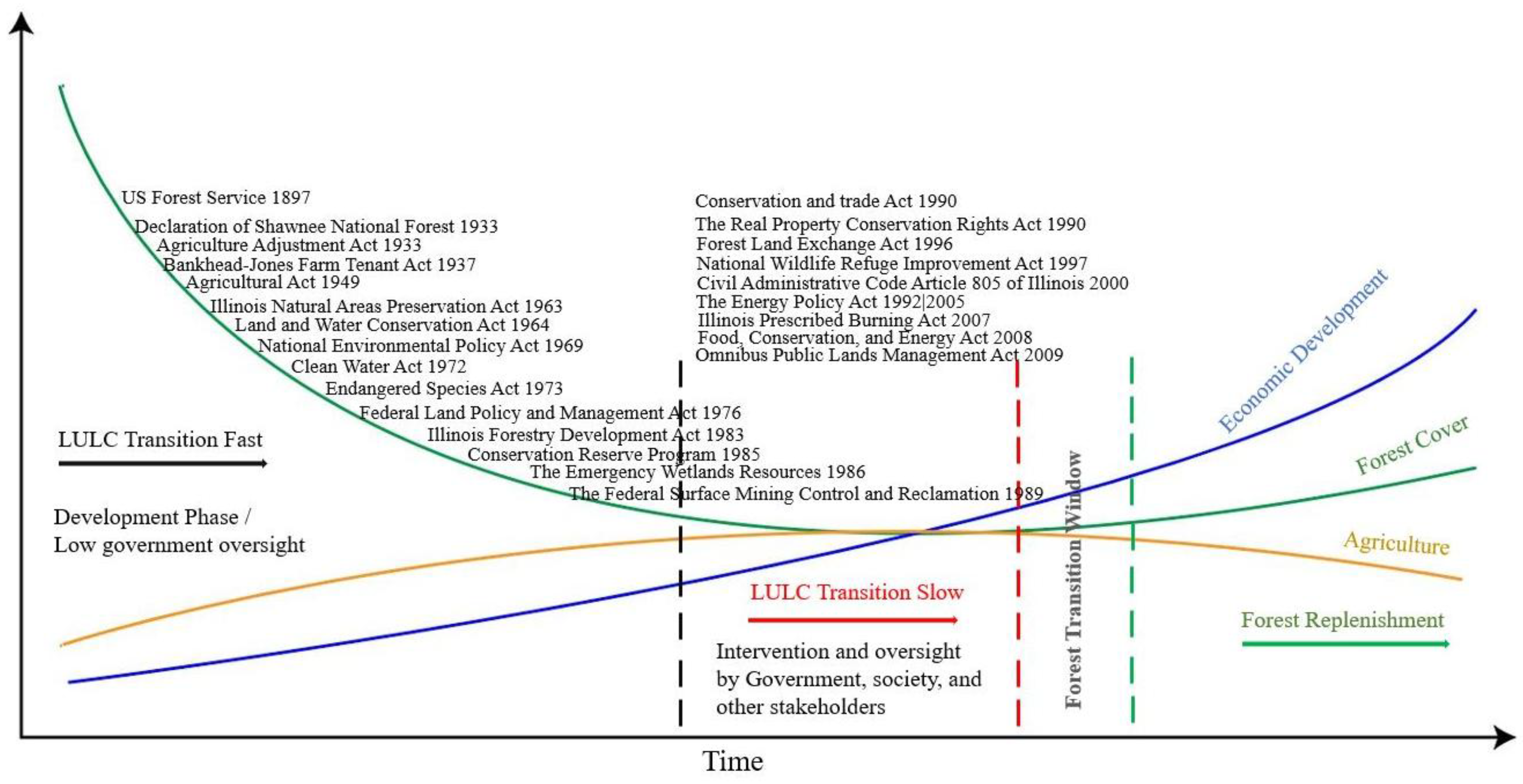
Figure 2.
Greater Shawnee National Forest (GSNF) land cover of the 1800s based on the public land survey system. These data were acquired from the Illinois Natural History Survey, Prairie Research Institute (https://geo.btaa.org/catalog/7901bccf-f9e6-45f4-9270-27129ac80fe8).
Figure 2.
Greater Shawnee National Forest (GSNF) land cover of the 1800s based on the public land survey system. These data were acquired from the Illinois Natural History Survey, Prairie Research Institute (https://geo.btaa.org/catalog/7901bccf-f9e6-45f4-9270-27129ac80fe8).
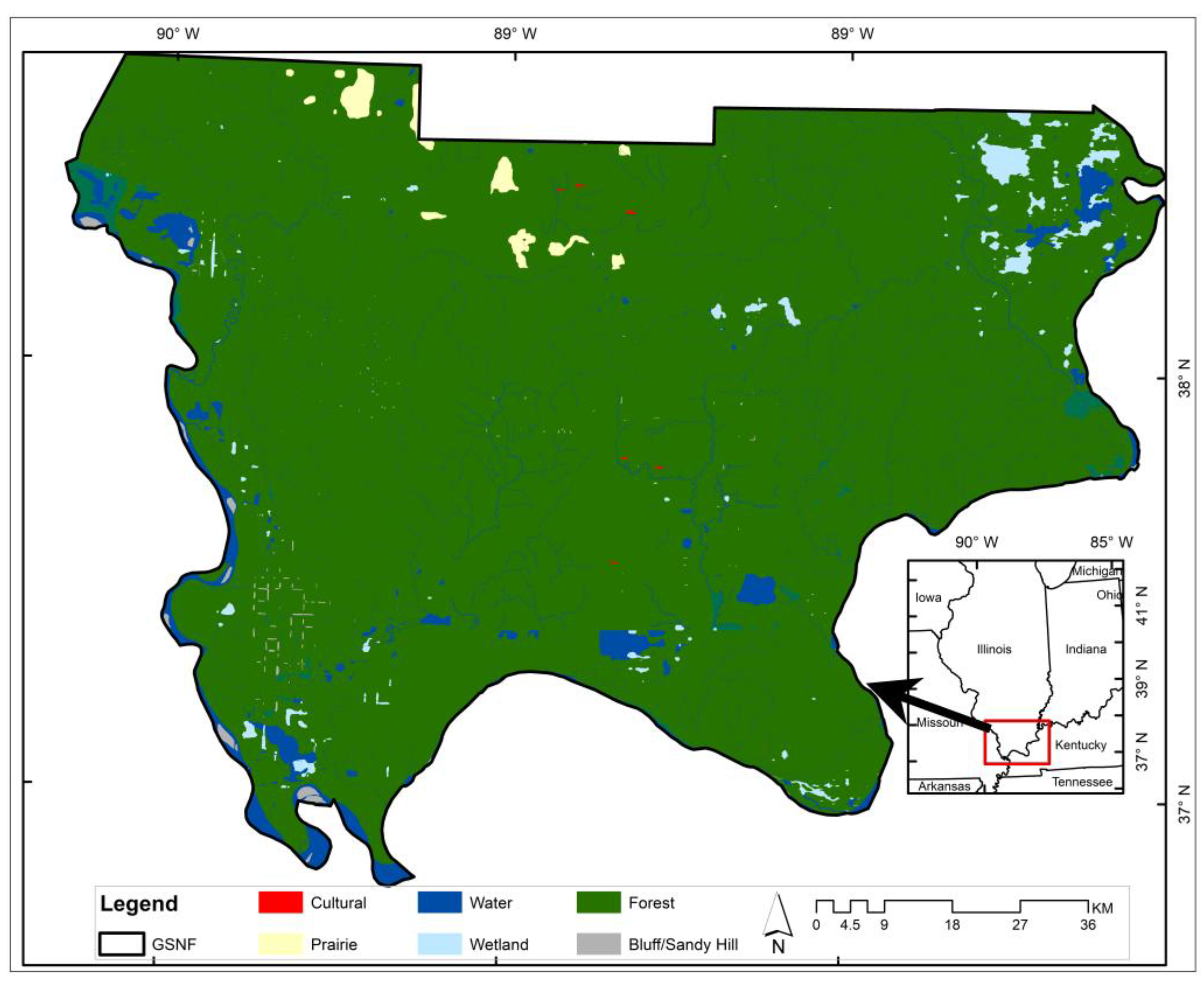
Figure 3.
Stepwise workflow of LULC classification and prediction using RF and LCM model.
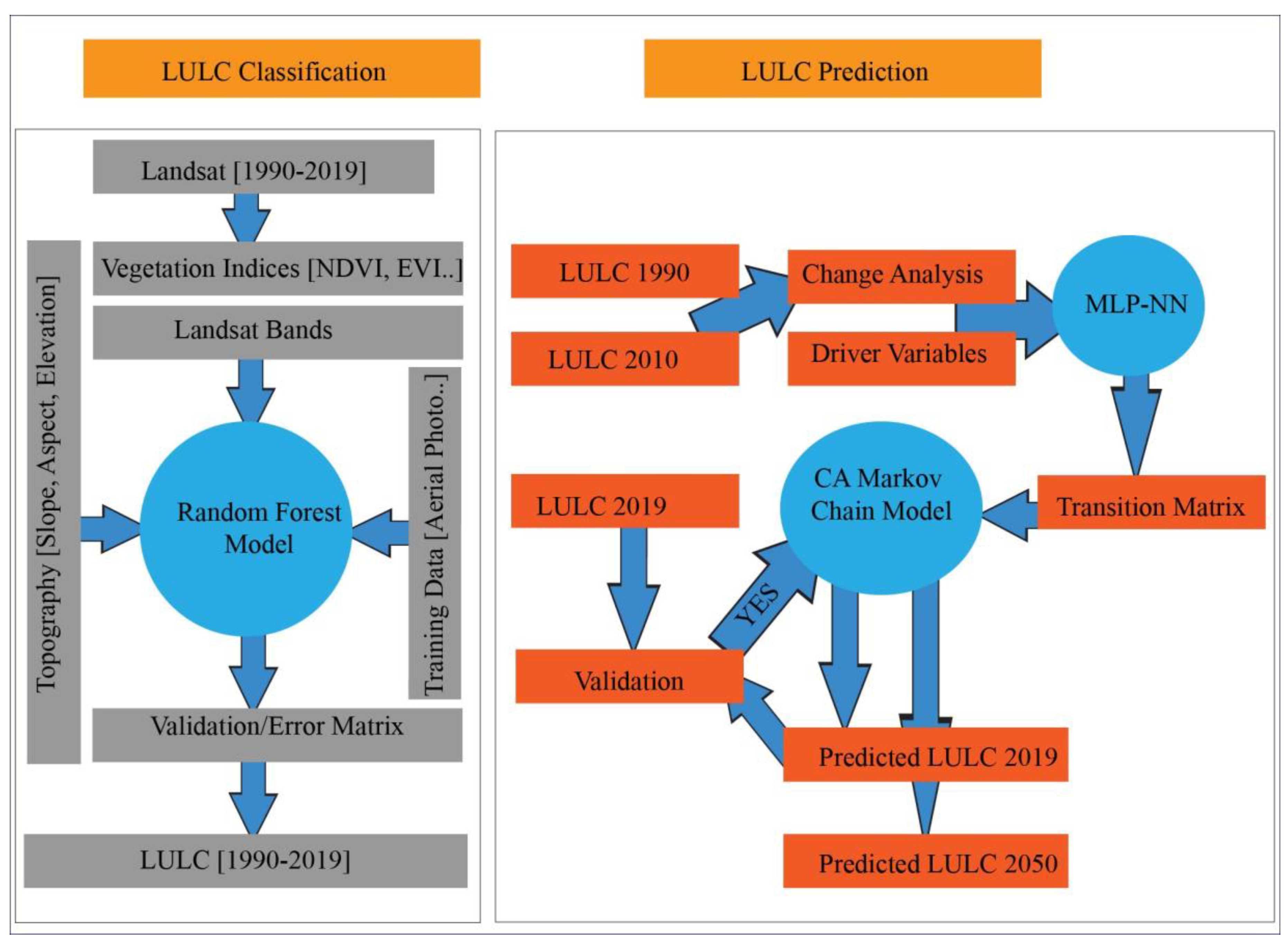
Figure 4.
LULC maps of GSNF from 1990 to 2019. In the center, between 1990 and 2001 (A, upper and lower panels, respectively), indicates LULC change from hay/grass/pasture and mixed forest to built-up near the city of Marion, IL, and between 2010 and 2019 (B, upper and lower panels, respectively) near the city of Vienna, IL, indicates hay/grass/pasture and mixed forest to deciduous forest.
Figure 4.
LULC maps of GSNF from 1990 to 2019. In the center, between 1990 and 2001 (A, upper and lower panels, respectively), indicates LULC change from hay/grass/pasture and mixed forest to built-up near the city of Marion, IL, and between 2010 and 2019 (B, upper and lower panels, respectively) near the city of Vienna, IL, indicates hay/grass/pasture and mixed forest to deciduous forest.
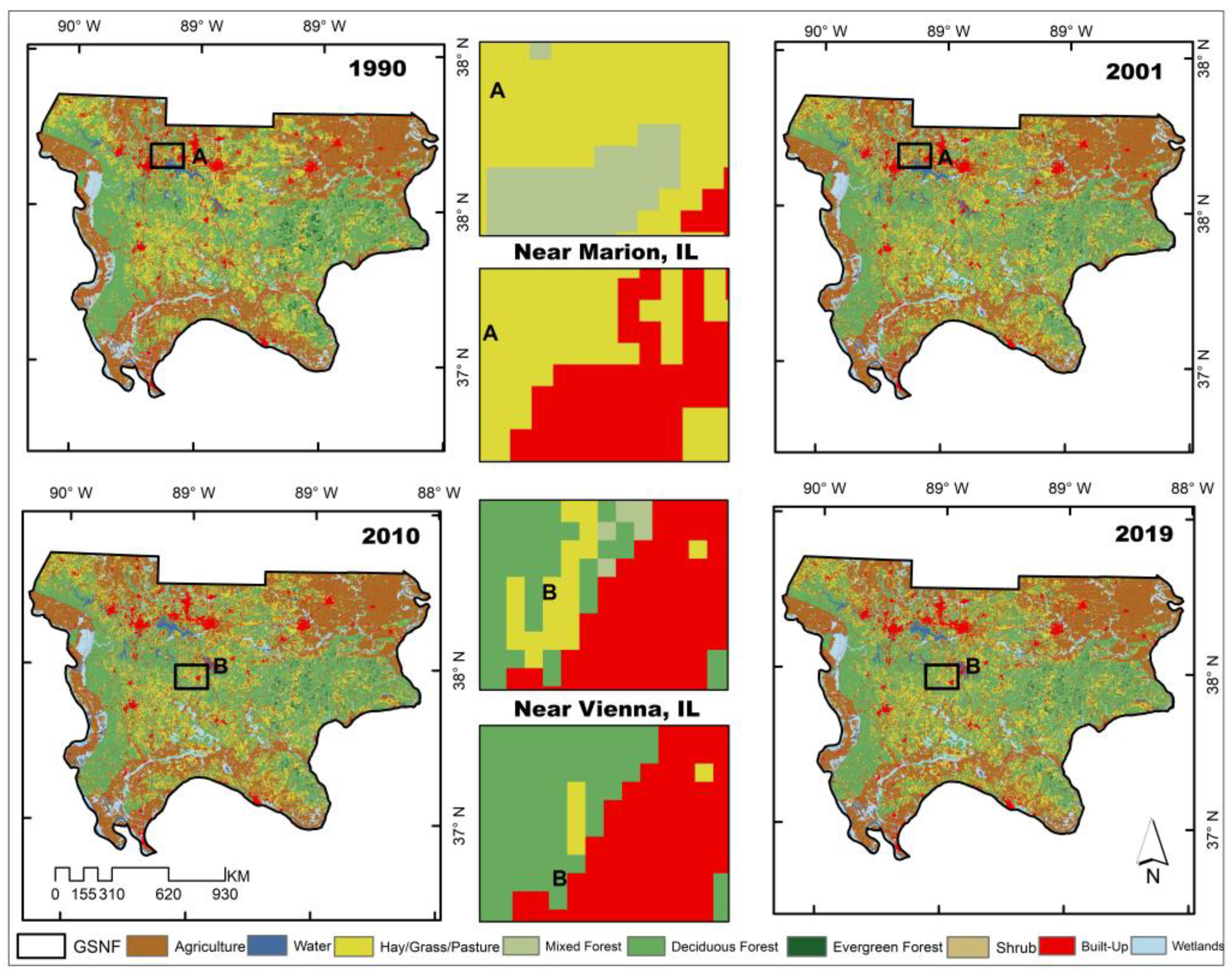
Figure 5.
Sankey diagram showing LULC persistence and conversion between study years. In the figure, AG, BU, DF, H/G/P, SB, MF, WT, EF, and WR represent agriculture, built-up, deciduous forest, hay/grass/pasture, shrubs, mixed forest, wetland, evergreen forest, and water, respectively.
Figure 5.
Sankey diagram showing LULC persistence and conversion between study years. In the figure, AG, BU, DF, H/G/P, SB, MF, WT, EF, and WR represent agriculture, built-up, deciduous forest, hay/grass/pasture, shrubs, mixed forest, wetland, evergreen forest, and water, respectively.
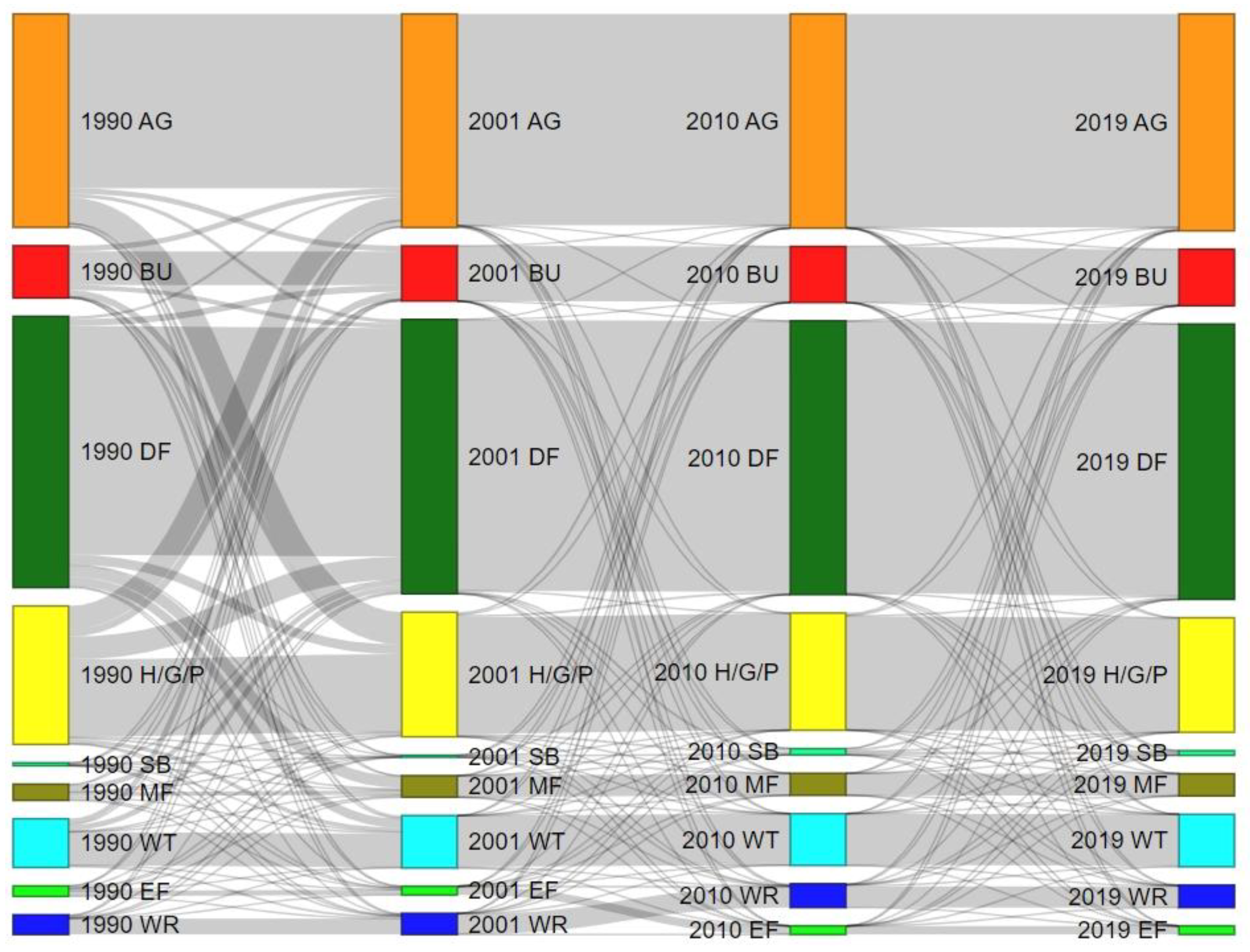
Figure 6.
LULC maps of GSNF 2050. In all SSP-RCP scenarios, the black rectangle shows the area of LULC conversion from deciduous forest to mixed forest.
Figure 6.
LULC maps of GSNF 2050. In all SSP-RCP scenarios, the black rectangle shows the area of LULC conversion from deciduous forest to mixed forest.
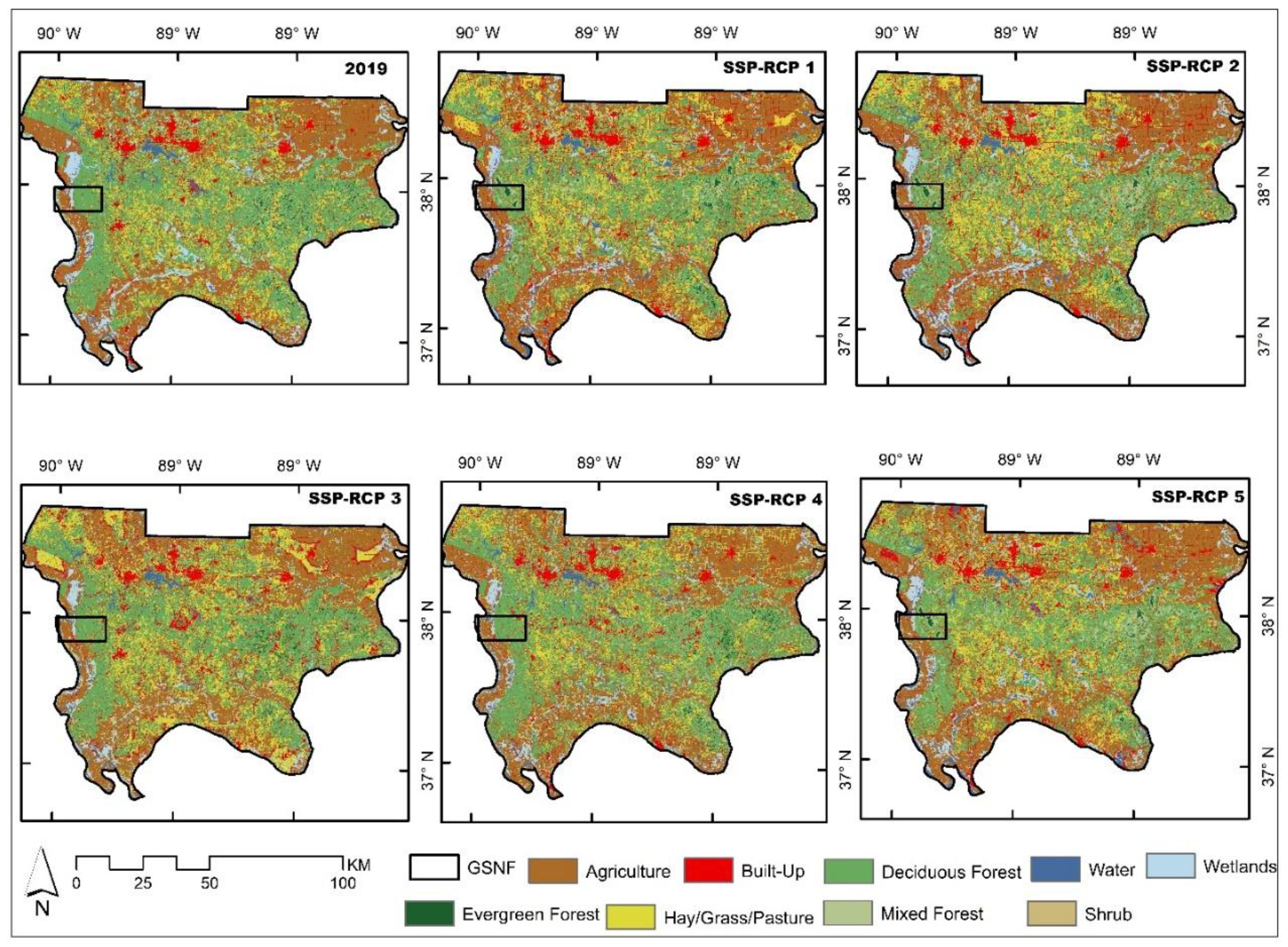
Figure 7.
Graph depicting trends of agriculture, forest cover, median household income, and population of the GSNF. AG, FC, and Pop indicate agricultural land, forest cover, and population of the GSNF, respectively.
Figure 7.
Graph depicting trends of agriculture, forest cover, median household income, and population of the GSNF. AG, FC, and Pop indicate agricultural land, forest cover, and population of the GSNF, respectively.
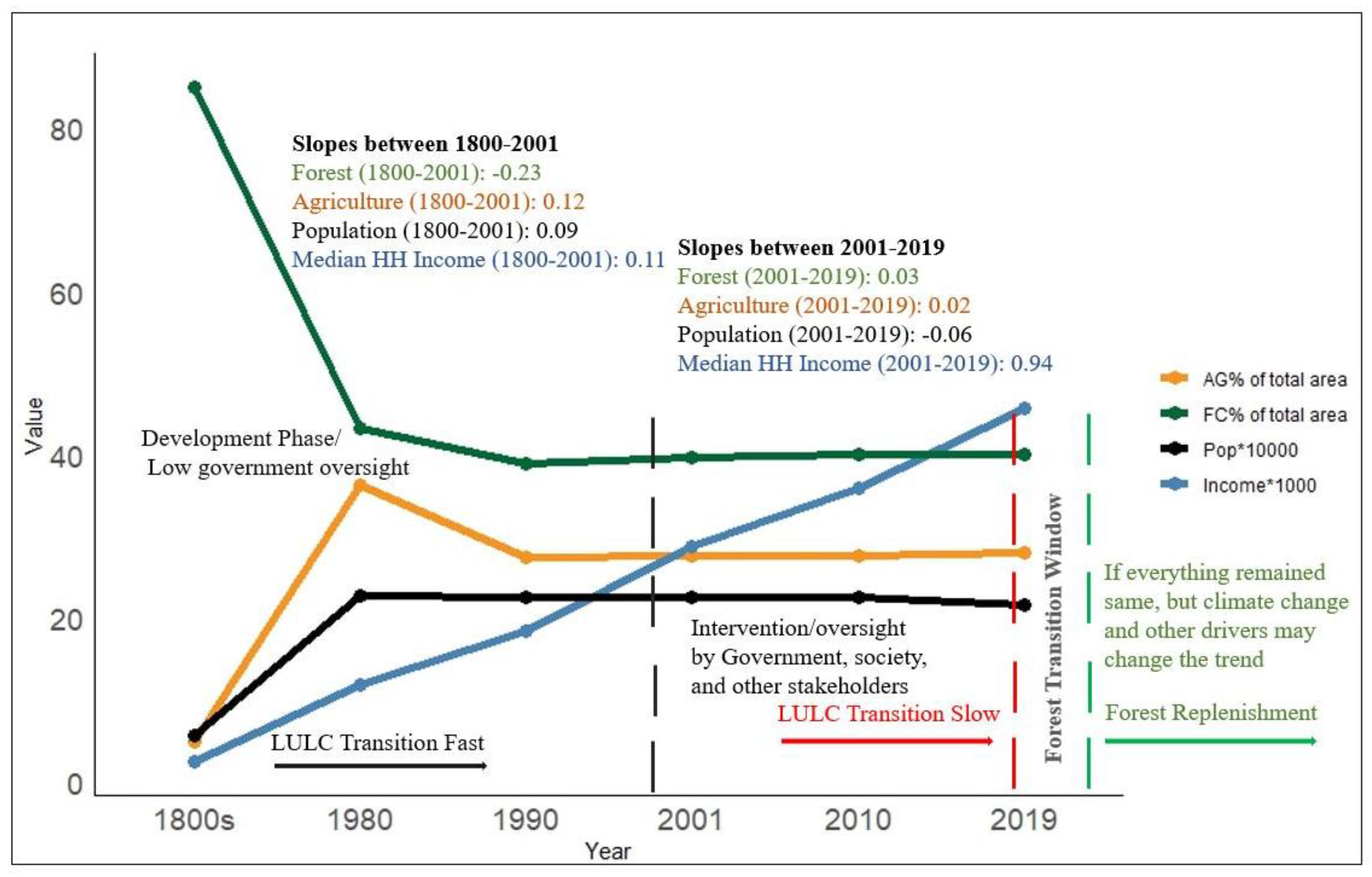

Table 1.
Data and their sources used in the study.
| Data | Sources | Year |
| Landsat | USGS (https://earthexplorer.usgs.gov/) | 1990-2019 |
| NAIP | NRCS (https://nrcs.app.box.com/v/naip) | 2001-2019 |
| LULC Map | Illinois Clearinghouse (https://clearinghouse.isgs.illinois.edu/) | 1800s |
| LULC Map | US EPA (https://www.epa.gov/hydrowq/metadata-giras) | 1980 |
| Population | US Census Bureau (https://data.census.gov/) | 1800-2019 |
| Median Household Income | US Census Bureau (https://data.census.gov/) | 1800-2020 |
Table 2.
Predictor variables used in LULC classification in the RF model.
| Landsat | Bands | Wavelength | Other Variables/Indices | Description |
| Landsat 5TM | Band 1 - Blue | 0.45-0.52 | DEM | NA |
| Band 2 - Green | 0.52-0.60 | Aspect | NA | |
| Band 3 - Red | 0.63-0.69 | Slope | NA | |
| Band 4 - NIR | 0.76-0.90 | Normalized Difference Vegetation Index | NDVI = (NIR – Red) / (NIR + Red) | |
| Band 5 - NIR | 1.55-1.75 | Green Normalized Difference Vegetation Index | GNDVI = (NIR-GREEN) /(NIR+GREEN) | |
| Band 7 - SWIR | 2.08-2.35 | Enhanced Vegetation Index | EVI = G * ((NIR – R) / (NIR + C1 * R – C2 * B + L)) | |
| Landsat 7 ETM | Band 1 - Blue | 0.45-0.52 | Advanced Vegetation Index | AVI = [NIR * (1-Red) * (NIR-Red)] 1/3 |
| Band 2 - Green | 0.52-0.60 | Soil Adjusted Vegetation Index | SAVI = ((NIR – R) / (NIR + R + L)) * (1 + L) | |
| Band 3 - Red | 0.63-0.69 | Normalized Difference Moisture Index | NDMI = (NIR – SWIR) / (NIR + SWIR) | |
| Band 4 - NIR | 0.77-0.90 | Moisture Stress Index | MSI = MidIR / NIR | |
| Band 5 - SWIR | 1.55-1.75 | Green Coverage Index | GCI = (NIR) / (Green) – 1 | |
| Band 7 SWIR | 2.09-2.35 | Normalized Burned Ratio Index | NBR = (NIR – SWIR) / (NIR+ SWIR) | |
| Landsat 8 OLI | Band 1 - Coastal aerosol | 0.43-0.45 | Bare Soil Index | BSI = ((Red+SWIR) – (NIR+Blue)) / ((Red+SWIR) + (NIR+Blue)) |
| Band 2 - Blue | 0.45-0.51 | Normalized Difference Water Index | NDWI = (NIR – SWIR) / (NIR + SWIR) | |
| Band 3 - Green | 0.53-0.59 | Atmospherically Resistant Vegetation Index | ARVI = (NIR – (2 * Red) + Blue) / (NIR + (2 * Red) + Blue) | |
| Band 4 - Red | 0.64-0.67 | Structure Insensitive Pigment Index | SIPI = (NIR – Blue) / (NIR – Red) | |
| Band 5 - NIR | 0.85-0.88 | Modified Soil Adjusted Vegetation Index | MSAVI=(2 * NIR + 1 – sqrt ((2 * NIR + 1)2 – 8 * (NIR - R))) / 2 | |
| Band 6 - SWIR | 1.57-1.65 | Normalized Difference Built-up Index | NDBI = (SWIR – NIR) / (SWIR + NIR) | |
| Band 7 - SWIR | 2.11-2.29 |
Table 3.
Accuracy assessment of LULC classification.
| LULC/Parameters | 1990 | 2001 | 2010 | 2019 | ||||
| Users Accuracy | Producers Accuracy | Users Accuracy | Producers Accuracy | Users Accuracy | Producers Accuracy | Users Accuracy | Producers Accuracy | |
| Agriculture | 89.067 | 95.514 | 97.341 | 99.183 | 94.549 | 98.932 | 90.958 | 98.783 |
| Built-Up | 97.678 | 97.702 | 97.534 | 1.004 | 98.924 | 99.175 | 99.623 | 99.467 |
| Deciduous Forest | 96.345 | 97.269 | 94.924 | 98.476 | 97.105 | 97.939 | 96.465 | 98.027 |
| Evergreen Forest | 80.581 | 83.611 | 90.117 | 80.625 | 82.932 | 85.073 | 90.294 | 88.289 |
| Hay/Grass/Pasture | 79.327 | 58.252 | 92.666 | 91.848 | 97.424 | 83.475 | 96.987 | 84.500 |
| Mixed Forest | 67.109 | 68.992 | 89.560 | 86.001 | 87.016 | 87.161 | 93.630 | 86.199 |
| Water | 96.385 | 99.390 | 98.951 | 99.378 | 96.926 | 99.195 | 99.194 | 98.820 |
| Shrub | 82.262 | 56.550 | 96.380 | 78.051 | 94.985 | 85.049 | 96.412 | 96.979 |
| Wetlands | 92.436 | 73.070 | 95.828 | 93.808 | 97.101 | 94.869 | 96.789 | 95.352 |
| Overall Accuracy | 0.929 | 0.949 | 0.951 | 0.959 | ||||
| Kappa Coefficient | 0.898 | 0.933 | 0.936 | 0.945 | ||||
Table 4.
Percent cover LULC of the GSNF by year and the change between different years.
| LULC | %cover by year | % change between years | ||||||
| 1990 | 2001 | 2010 | 2019 | 1990-2001 | 2001-2010 | 2010-2019 | 1990-2019 | |
| Agriculture | 27.463 | 27.619 | 27.699 | 28.054 | 0.568 | 0.293 | 1.282 | 2.154 |
| Built-Up | 6.844 | 7.133 | 7.237 | 7.303 | 4.218 | 1.517 | 0.915 | 6.703 |
| Deciduous Forest | 35.128 | 35.489 | 35.406 | 35.604 | 1.027 | -0.234 | 0.557 | 1.354 |
| Evergreen Forest | 1.124 | 1.103 | 1.103 | 1.097 | -1.897 | 0.066 | -0.526 | -2.348 |
| Hay/Grass/Pasture | 17.634 | 16.120 | 15.163 | 14.811 | -8.585 | -5.428 | -2.318 | -16.006 |
| Mixed Forest | 2.266 | 2.781 | 2.837 | 2.864 | 22.757 | 2.447 | 0.957 | 26.403 |
| Water | 2.488 | 2.730 | 3.065 | 2.891 | 9.722 | 13.448 | -5.678 | 16.177 |
| Shrub | 0.423 | 0.258 | 0.810 | 0.598 | -39.081 | 130.351 | -26.147 | 41.259 |
| Wetlands | 6.630 | 6.768 | 6.680 | 6.778 | 2.078 | -1.318 | 1.453 | 2.224 |
Table 5.
Predicted LULC change (%) between 2019 and 2050 based on SSP-RCP temperature and precipitation scenarios.
Table 5.
Predicted LULC change (%) between 2019 and 2050 based on SSP-RCP temperature and precipitation scenarios.
| LULC | SSP-RCP 1 | SSP-RCP 2 | SSP-RCP 3 | SSP-RCP 4 | SSP-RCP 5 |
| Agriculture | -0.239 | -3.415 | -10.380 | -3.576 | 8.204 |
| Built-Up | 42.609 | 39.071 | 35.905 | 17.122 | 28.377 |
| Deciduous Forest | -15.415 | -16.870 | -8.501 | -3.110 | -19.873 |
| Evergreen Forest | -7.025 | -17.134 | 2.903 | -4.535 | -18.752 |
| Hay/Grass/Pasture | 19.184 | 15.504 | 38.377 | 6.232 | 11.572 |
| Mixed Forest | -4.442 | 12.453 | -37.082 | 22.846 | 23.629 |
| Water | 39.701 | 28.748 | 29.793 | 32.624 | 34.013 |
| Shrub | 37.452 | 33.797 | -12.707 | 8.924 | 8.091 |
| Wetlands | -23.096 | 9.045 | -31.318 | -24.547 | -7.600 |
Disclaimer/Publisher’s Note: The statements, opinions and data contained in all publications are solely those of the individual author(s) and contributor(s) and not of MDPI and/or the editor(s). MDPI and/or the editor(s) disclaim responsibility for any injury to people or property resulting from any ideas, methods, instructions or products referred to in the content. |
© 2025 by the authors. Licensee MDPI, Basel, Switzerland. This article is an open access article distributed under the terms and conditions of the Creative Commons Attribution (CC BY) license (http://creativecommons.org/licenses/by/4.0/).
Copyright: This open access article is published under a Creative Commons CC BY 4.0 license, which permit the free download, distribution, and reuse, provided that the author and preprint are cited in any reuse.


