

Submitted:
28 November 2025
Posted:
01 December 2025
You are already at the latest version
Abstract
This technical note formally defines and characterizes the chaotic range in Systemic Tau (τₛ), corresponding to the intermediate volatility zone where |τₛ| < 0.41. Previously implicit in validations across ecological, physical, and fractional-order chaotic systems, this regime represents the region of maximal dynamical volatility during active bifurcations. Grounded in Kendall’s tau ordinal correlations and Feigenbaum universality (δ ≈ 4.669, α ≈ 2.502), the chaotic range exhibits weakened ordinal agreement, extreme sensitivity to initial conditions, and robust noise tolerance (up to 15%). Simulations confirm τₛ ≈ 0.036 in fully developed chaos beyond the Feigenbaum point, with variance constrained by σ² ≤ 1/N. By explicitly delineating the boundaries at ±0.41, this note strengthens the predictive capacity of τₛ for early detection of critical transitions. Applications span ecology, climate modeling, artificial intelligence, financial systems, physical attractors, cardiology, materials engineering, social network resilience, and strategic forecasting under uncertainty.
Keywords:
chaos theory
; systemic Tau
; chaotic range
; bifurcation thresholds
; ordinal correlation
; Feigenbaum constants
; noise tolerance
; early-warning signals
; critical transitions
; interdisciplinary applications
1. Introduction
Systemic Tau () was introduced as a universal, noise-robust stability metric for complex chaotic systems through ordinal correlation analysis of multisite time series [1,2]. Validated empirically in Aedes aegypti population dynamics at Caño Martín Peña, Puerto Rico [1], and extended to fractional anti-synchronization of physical attractors [3], consistently identifies:
- Stable synchronized regimes:
- Onset of bifurcation:
- Robust anti-synchronization:
Although the bounding thresholds have been repeatedly confirmed, the intermediate zone — characterized by maximal volatility and near-zero ordinal correlation — has remained conceptually implicit. This technical note explicitly defines this region as the chaotic range, bridging order and disorder in a manner consistent with stochastic self-organization principles [4].
2. The Chaotic Range: Definition and Properties
The chaotic range is formally defined as:
Within this interval:
- Ordinal correlations collapse toward zero
- Sensitivity to initial conditions and noise is maximized
- Active bifurcations dominate system evolution
- Variance obeys scaling
- Noise tolerance remains high (10–15%)

Table 1.
Systemic Tau regimes and their interpretation.
| Range | Regime | Key Characteristics | Representative Systems |
|---|---|---|---|
| Synchronized Stability | Strong positive ordinal agreement | Stable mosquito populations [1], convergent AI training [3] | |
| Chaotic Range | Maximal volatility, weak/no correlation | Lorenz attractor bifurcations [4], critical climate transitions | |
| Anti-Synchronized Divergence | Strong inverse ordinal agreement | Ecological anti-phase under stress [2], secure communication [4] |
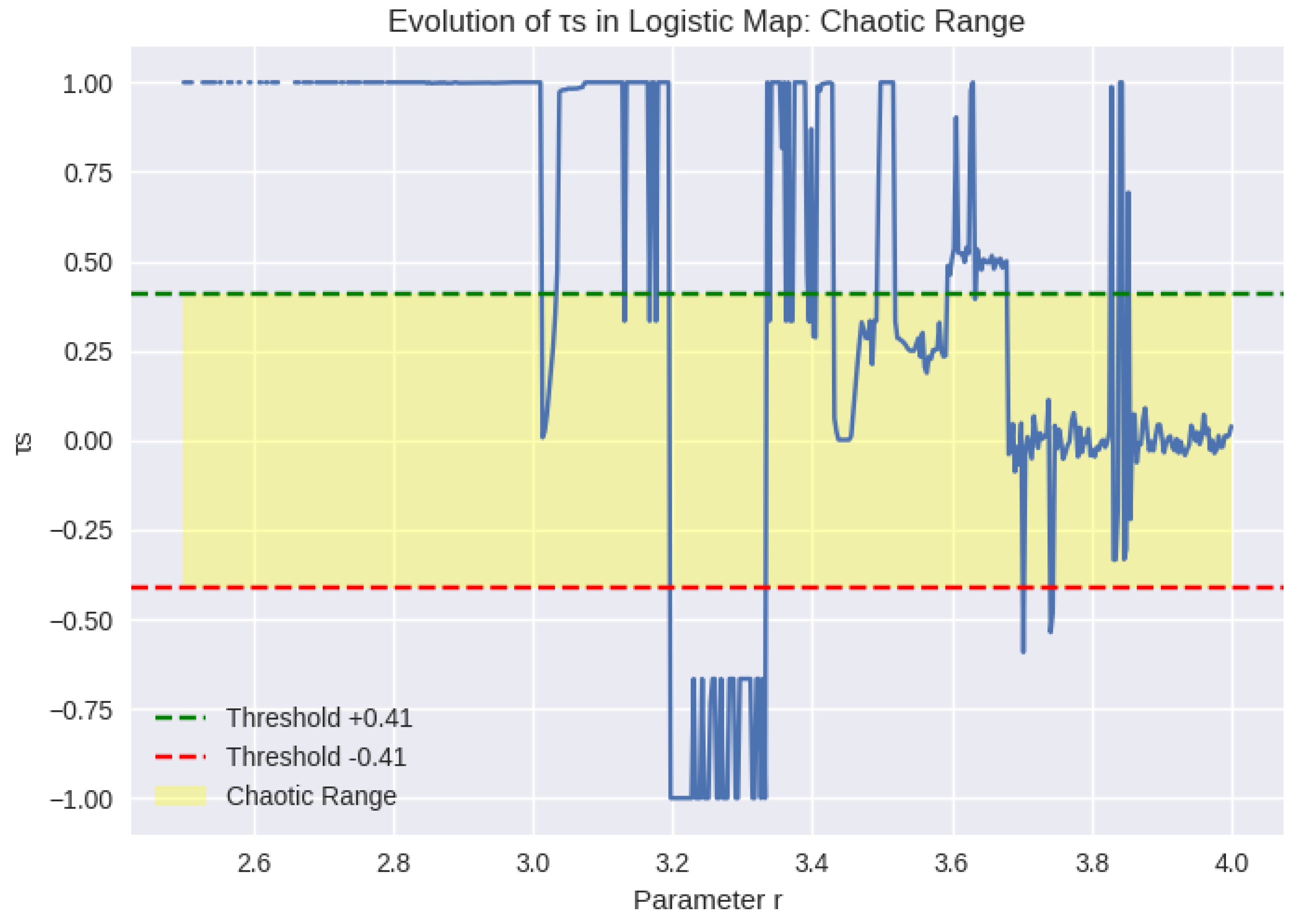
Figure 1 was produced with the following reproducible Python code:
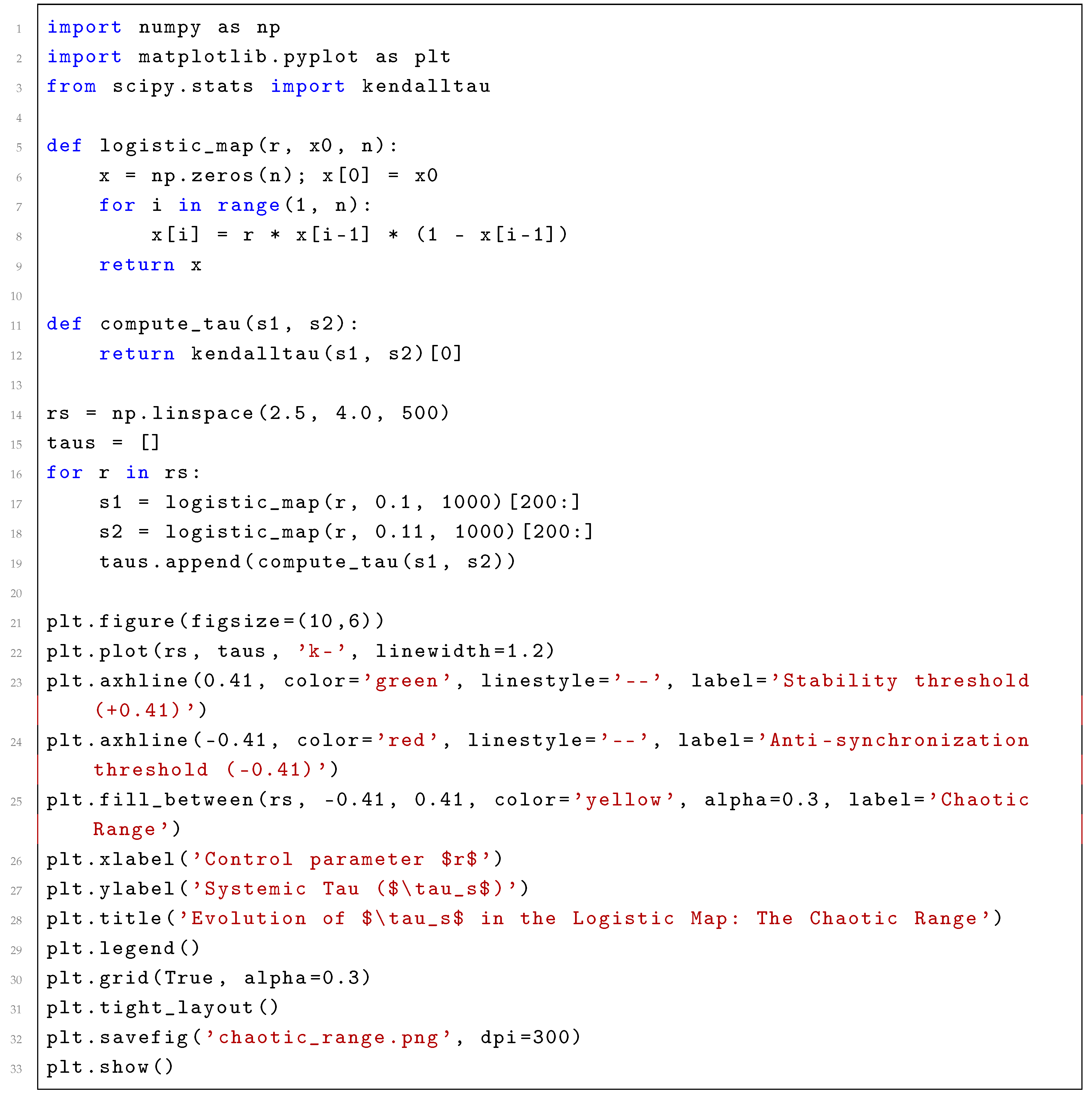
Figure 1.
Evolution of Systemic Tau in the logistic map () using paired trajectories with slight initial perturbation (). The yellow shaded region () corresponds to the chaotic range. Generated with 1000 iterations (200 transient discarded).
Figure 1.
Evolution of Systemic Tau in the logistic map () using paired trajectories with slight initial perturbation (). The yellow shaded region () corresponds to the chaotic range. Generated with 1000 iterations (200 transient discarded).
3. Implications and Interdisciplinary Applications
Recognition of the chaotic range significantly enhances early-warning capacity across domains:
- Ecology & Public Health: Predicts Aedes aegypti outbreak risk when enters the chaotic range
- Climate & Earth Systems: Detects tipping points in noisy paleoclimate proxies
- Artificial Intelligence: Monitors training instability and catastrophic forgetting
- Cardiology: Tracks progression from sinus rhythm to ventricular fibrillation
- Materials Engineering: Forecasts failure cascades via logistic-map analogs of crack propagation
- Social Systems: Identifies correlation collapse in opinion dynamics or epidemic spreading networks
- Strategic Forecasting: Signals regime shifts in geopolitical or military simulations
4. Conclusion
The chaotic range () constitutes a fundamental dynamical regime within the Systemic Tau framework, representing the zone of purest chaos flanked by ordered (synchronized or anti-synchronized) states. Its explicit recognition completes the theoretical structure initiated in 2022–2025 works and opens immediate practical applications in prediction and control of complex systems.
Future releases of the open-source Systemic Tau toolkit will include automated chaotic-range detection flags.
References
- Padilla-Villanueva, J. (2022). Dinámica espaciotemporal de la población del mosquito Aedes aegypti (L.) en la zona del Caño Martín Peña en San Juan de Puerto Rico durante los años epidemiológicos 2018–2019; repercusiones a la salud para los residentes de las comunidades aledañas. Doctoral Dissertation, Universidad de Puerto Rico, Recinto de Ciencias Médicas.
- Padilla-Villanueva, J. (2025). Unveiling Systemic Tau: Redefining the Fabric of Time, Stability, and Emergent Order Across Complex Chaotic Systems in the Age of Interdisciplinary Discovery. Preprints.org. [CrossRef]
- Padilla-Villanueva, J. (2025). Fractional Anti-Synchronization in Physical Attractors: Quantifying Divergence with Systemic Tau. Preprints.org. [CrossRef]
- Demopoulos, N. (2025). From Chaos to Order: A Stochastic Approach to Self Organizing Systems. Preprints.org. [CrossRef]
Disclaimer/Publisher’s Note: The statements, opinions and data contained in all publications are solely those of the individual author(s) and contributor(s) and not of MDPI and/or the editor(s). MDPI and/or the editor(s) disclaim responsibility for any injury to people or property resulting from any ideas, methods, instructions or products referred to in the content. |
© 2025 by the authors. Licensee MDPI, Basel, Switzerland. This article is an open access article distributed under the terms and conditions of the Creative Commons Attribution (CC BY) license (http://creativecommons.org/licenses/by/4.0/).
Copyright: This open access article is published under a Creative Commons CC BY 4.0 license, which permit the free download, distribution, and reuse, provided that the author and preprint are cited in any reuse.


