

Submitted:
28 November 2025
Posted:
02 December 2025
You are already at the latest version
Abstract
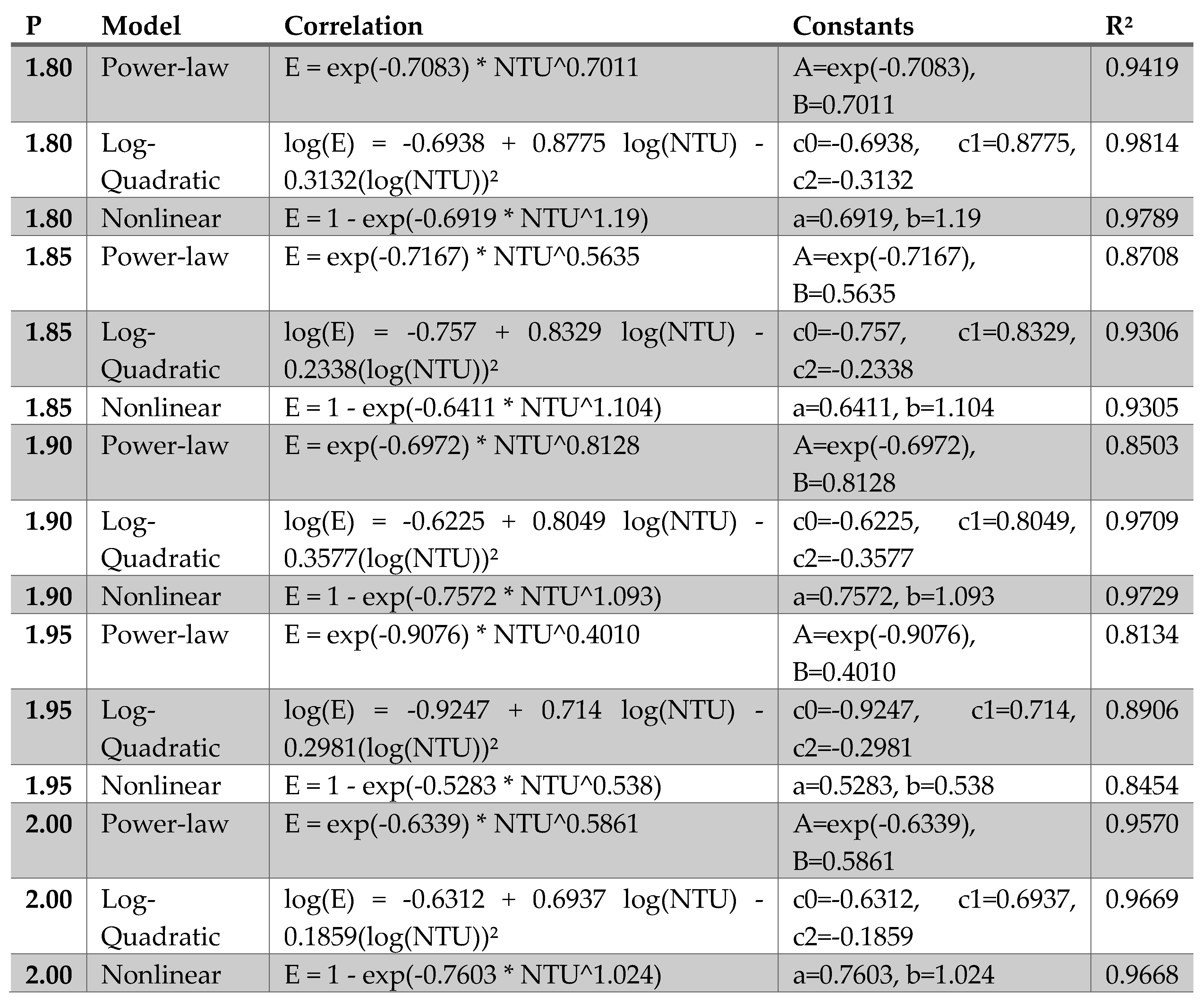
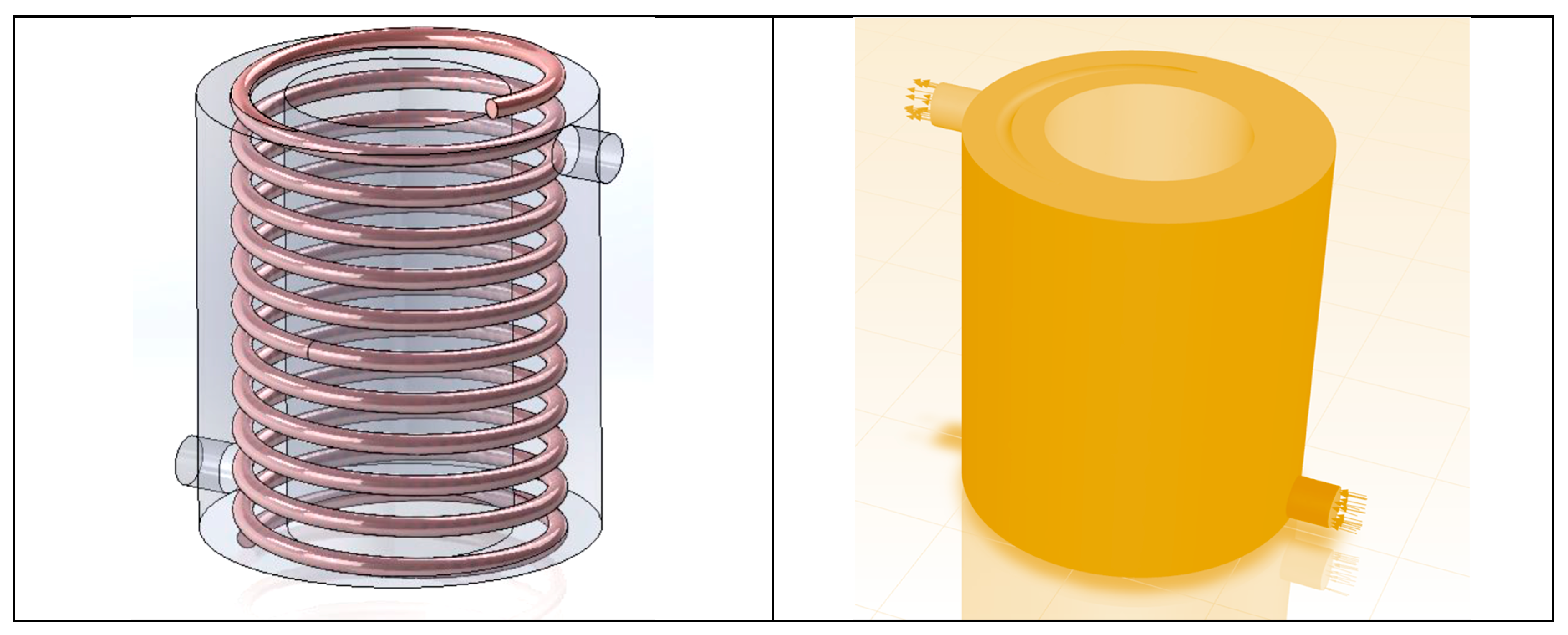
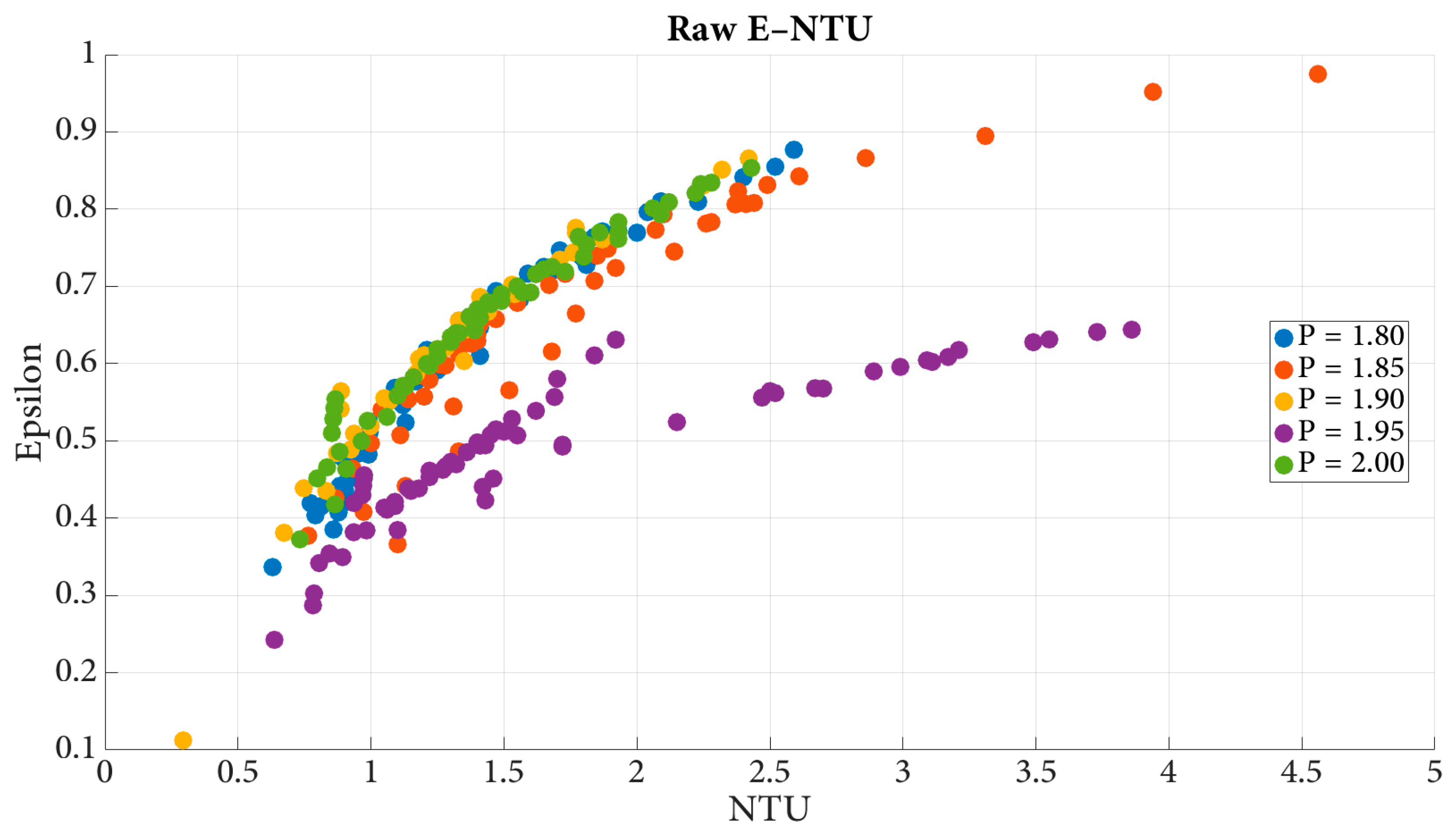
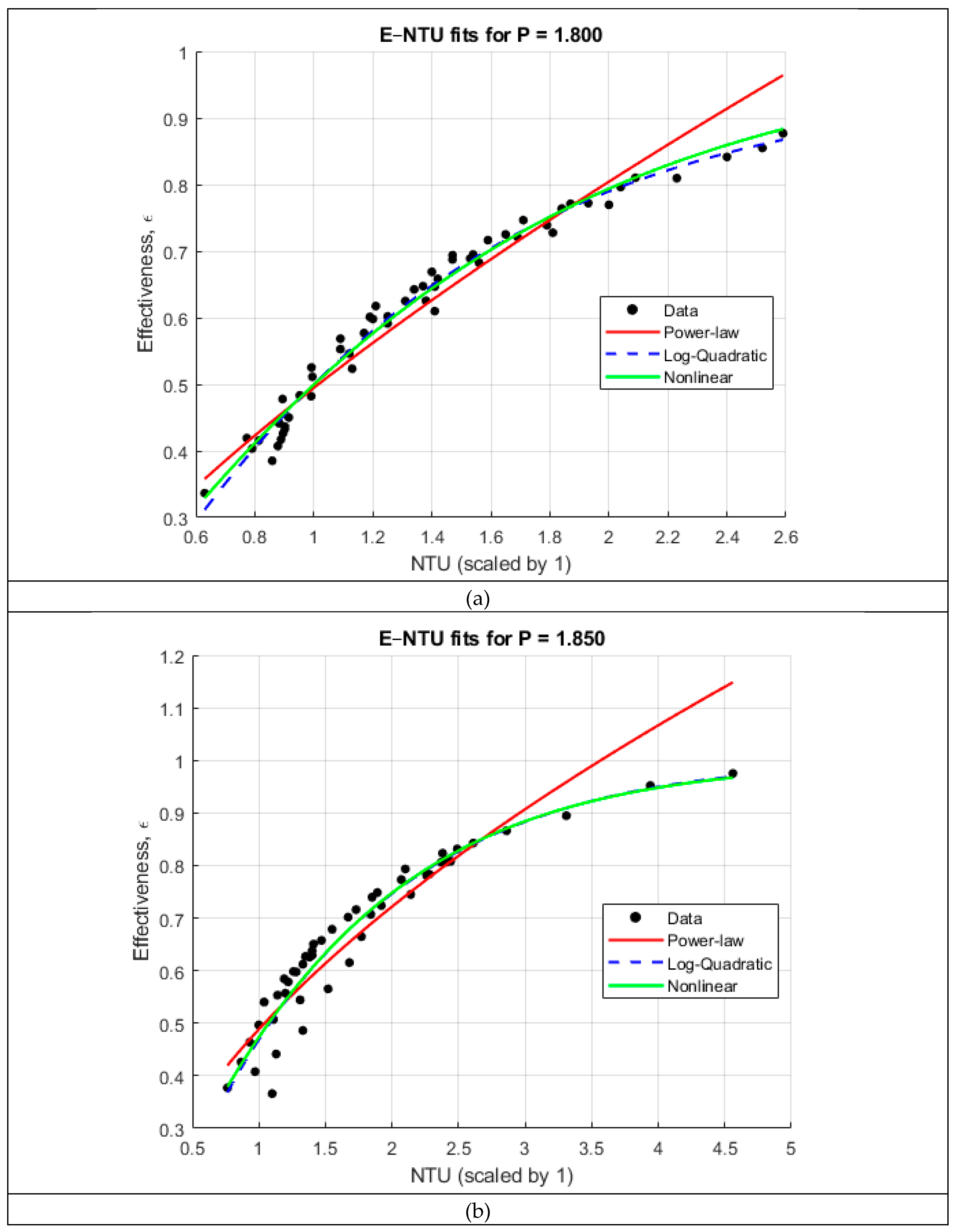
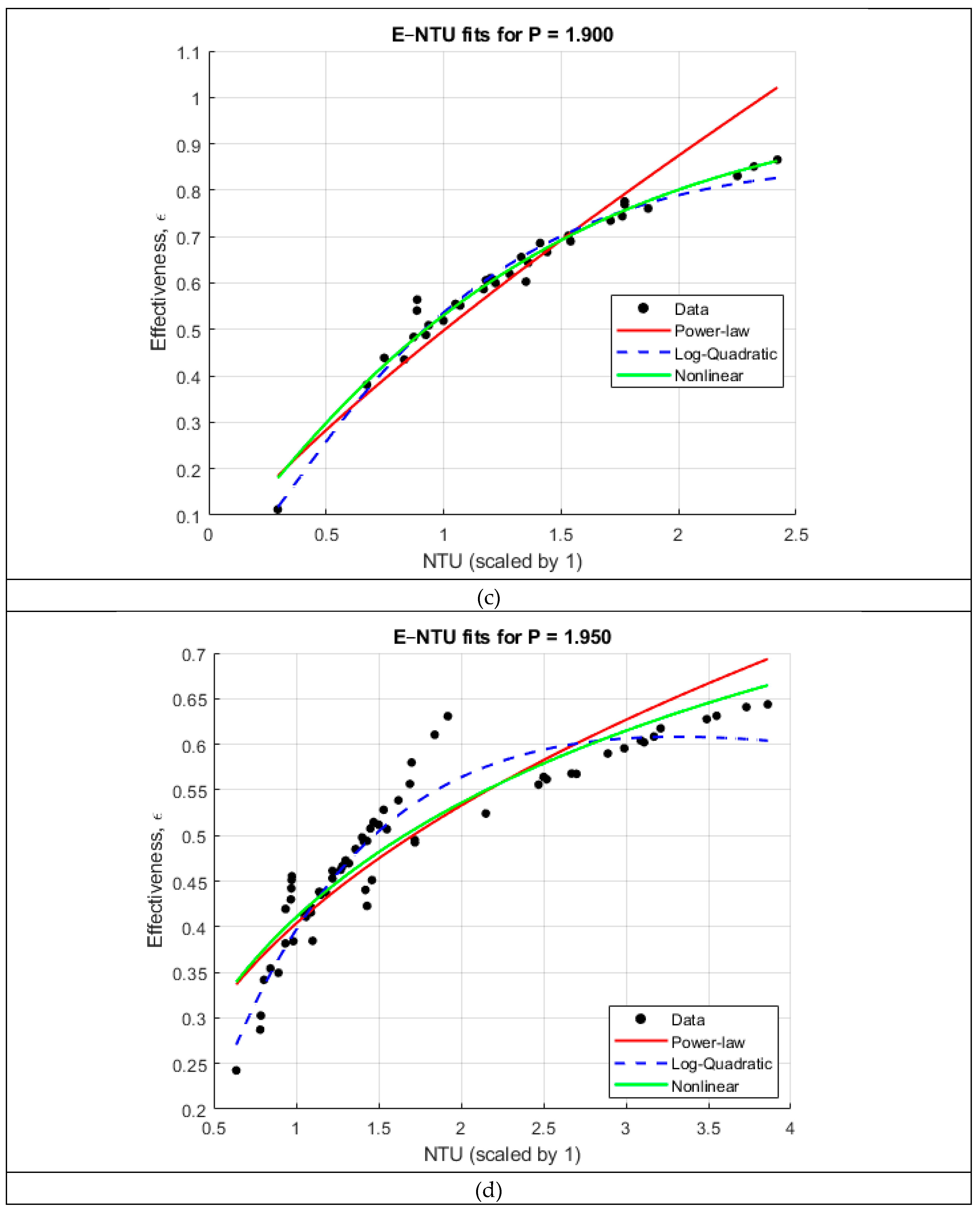
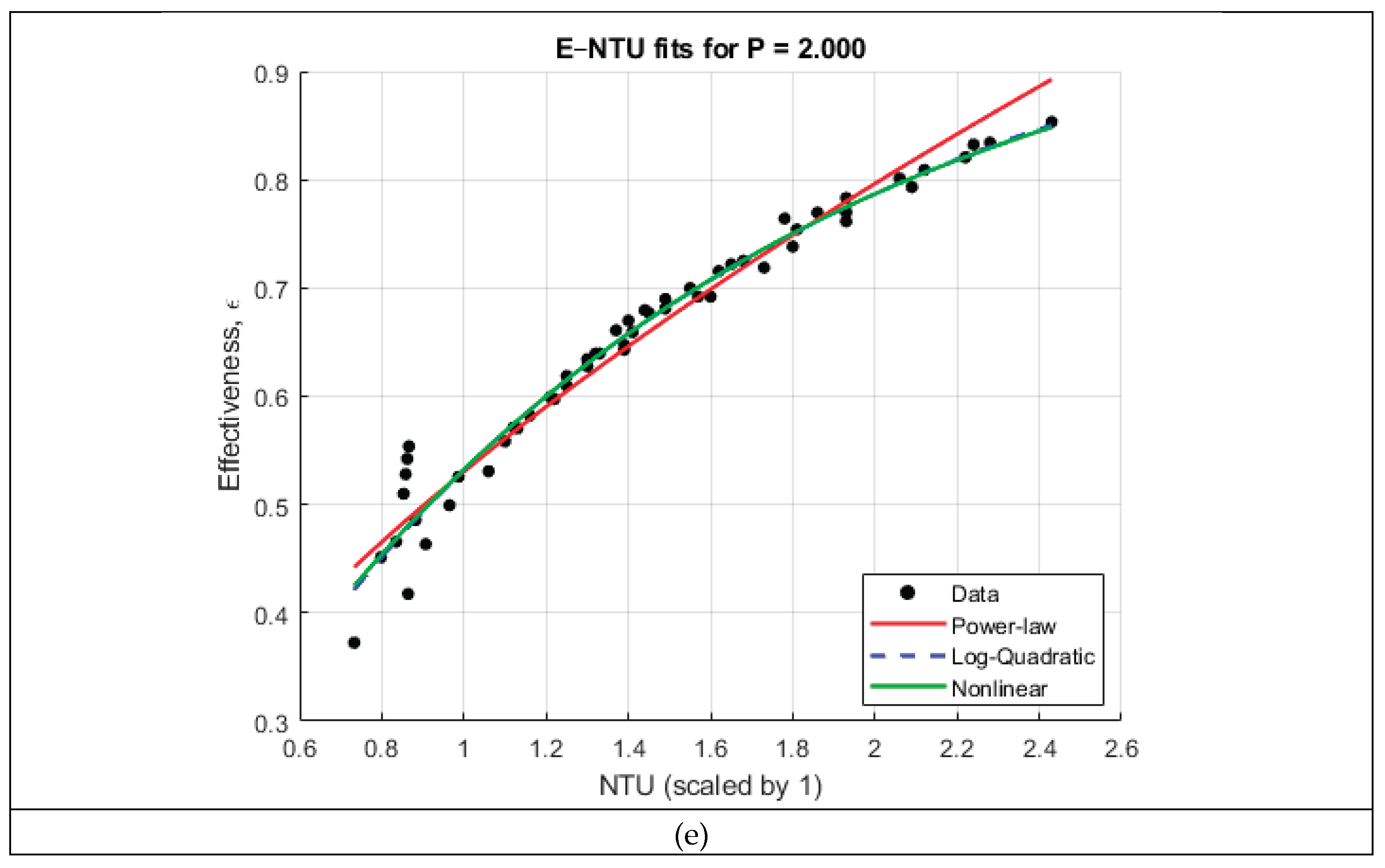
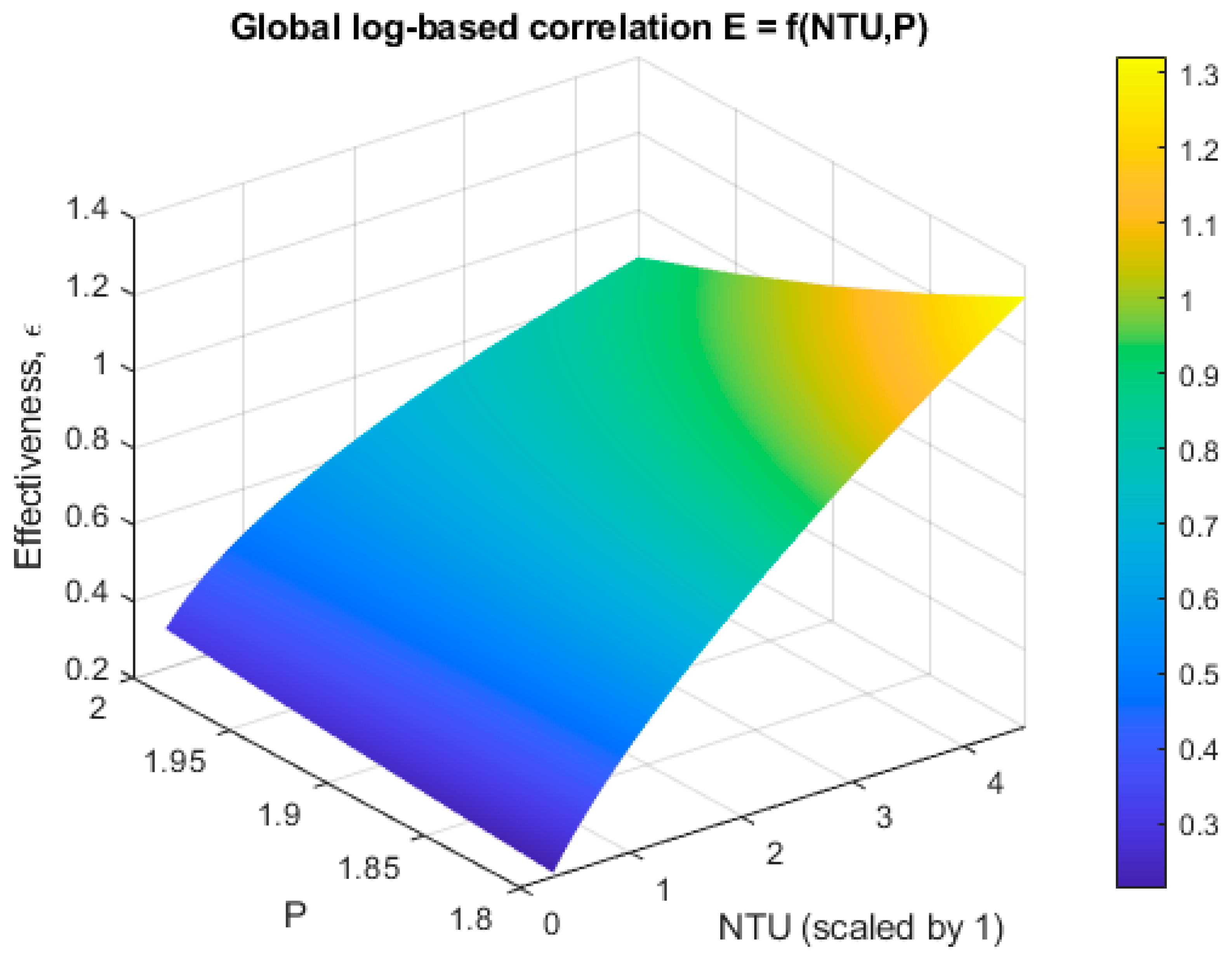
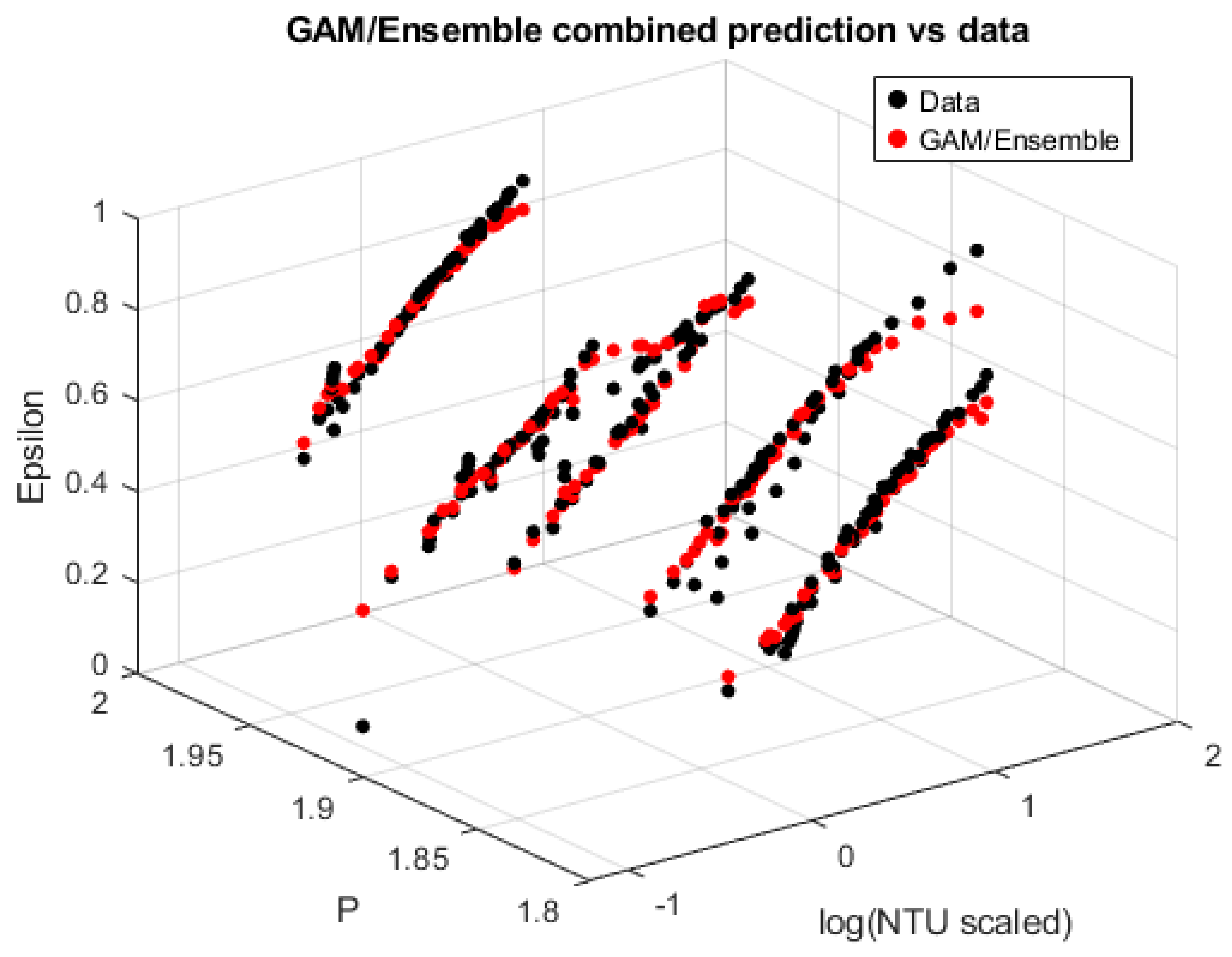
Helically coiled tube heat exchangers (HCTHEXs) are widely deployed in compact thermal systems, yet reliable effectiveness–NTU (ε–NTU) correlations for realistic fluid to fluid operation remain scarce. This work presents a comprehensive three dimensional numerical study of a vertical tube in annular shell HCTHEX under laminar flow on both coil and shell sides, with water as the working fluid in all cases. More than 2400 steady state CFD simulations in ANSYS Fluent are performed to systematically vary morpho hydrodynamic parameters, including coil pitch ratio, flow rates, and thermal boundary conditions. The numerical model is verified against established correlations for coil side Nusselt number and pressure drop, with discrepancies typically below 10%, and is then used to construct a global ε–NTU database. For each pitch ratio, three candidate ε–NTU correlations are evaluated: a power law relation in log–log space, a log quadratic polynomial in log(NTU), and a nonlinear exponential form of the type ε=1-exp(-a NTUb). The log quadratic and exponential models consistently reproduce the characteristic rising–plateau ε–NTU behavior with R2values between 0.90 and 0.98, whereas simple power laws underpredict the curvature. A global log based regression model log(ε)=f[log(NTU),P]captures the overall monotonic trends but attains only moderate accuracy (R2≈0.59 in ε space), highlighting the intrinsic nonlinearity of the ε–NTU–pitch surface. To overcome this limitation, generalized additive models (GAM) and bagged decision tree ensembles are trained using log(NTU)and pitch as predictors. These machine learning regressors yield substantially improved agreement with the CFD data, with R2≈0.94for GAM and R2≈0.91for the ensemble, while a simple average of both predictions achieves the highest fidelity (R2≈0.95). The resulting pitch specific closed form correlations and global GAM/Ensemble surrogate provide practical tools for predicting the effectiveness of helically coiled tube heat exchangers over a broad range of morpho hydrodynamic conditions.
Keywords:
Introduction
Computational Model
Model Verification
Data Reduction
Effectiveness-NTU
Results & Discussion

| Term | Estimate (β) | Std. Error | t-Statistic | p-Value | |
| Intercept (β_0) | −0.77347 | 0.35255 | −2.1939 | 0.029154 | |
| log(NTU) (β_1) | 3.1351 | 0.74153 | 4.2278 | 3.30×10⁻⁵ | |
| P (β_2) | 0.024367 | 0.1853 | 0.1315 | 0.89549 | |
| log(NTU)·P (β_3) | −1.3723 | 0.38933 | −3.5248 | 0.00050325 | |
| Model Summary | |||||
| Metric | Value | ||||
| Root Mean Squared Error (RMSE) | 0.162 | ||||
| R² (log-space) | 0.633 | ||||
| Adjusted R² | 0.629 | ||||
| R² (converted to ε-space) | 0.5883 | ||||
| F-statistic p-value | 1.33×10⁻⁵⁴ | ||||
Concluding Remarks
References
- Mirgolbabaei, H. Numerical investigation of the irregular behavior of helically coiled tube heat exchanger concerning pitch changes. Therm. Sci. 2022, 26, 4685–4697. [Google Scholar] [CrossRef]
- Mirgolbabaei, H. Numerical investigation of vertical helically coiled tube heat exchangers thermal performance. Appl. Therm. Eng. 2018, 136, 252–259. [Google Scholar] [CrossRef]
- Mirgolbabaei, H.; Taherian, H.; Domairry, G.; Ghorbani, N. Numerical estimation of mixed convection heat transfer in vertical helically coiled tube heat exchangers. Int. J. Numer. Methods Fluids 2011, 66, 805–819. [Google Scholar] [CrossRef]
- Ghorbani, N.; Taherian, H.; Gorji, M.; Mirgolbabaei, H. Experimental study of mixed convection heat transfer in vertical helically coiled tube heat exchangers. Exp. Therm. Fluid Sci. 2010, 34, 900–905. [Google Scholar] [CrossRef]
- Ghorbani, N.; Taherian, H.; Gorji, M.; Mirgolbabaei, H. An experimental study of thermal performance of shell-and-coil heat exchangers. Int. Commun. Heat Mass Transf. 2010, 37, 775–781. [Google Scholar] [CrossRef]
- H. Mirgolbabaei, J. H. Mirgolbabaei, J. Gruenes, I. Walaman, M. S. H. Nahid, M. Smith, J. Swaja, R. Eischens, C. Phifer, D. Cornelisen and J. Suliin, "Numerical Exploration of Helically Coiled Tube Heat Exchangers’ Shell-Side Nature Through Morpho-hydrodynamic Variations & A Global Correlation," ChemEngineering, 13 November.
- Mirgolbabaei, H. NUMERICAL OPTIMIZATION OF HELICALLY COILED TUBE HEAT EXCHANGERS USING ARTIFICIAL NEURAL NETWORKS: PREDICTING OPTIMAL PITCH FOR ENHANCED HEAT TRANSFER EFFICIENCY. 10th Thermal and Fluids Engineering Conference (TFEC). LOCATION OF CONFERENCE, United StatesDATE OF CONFERENCE; pp. 1051–1054.
- N. Attarian and H. Mirgolbabaei, "Geometric Anomalies and Nanofluid Influence in Helically Coiled Tube Compact Heat Exchangers: Unraveling the Irregularities," in ASME 2024 Heat Transfer Summer Conference (SHTC2024), Bellevue, WA, 2024.
- E. F. Schmidt, "Wärmeübergang und Druckverlust in Rohrschlangen," Chemie Ingenieur Technik, vol. 39, no. 13, p. 781–789, 10 JUly 1967.
- E. F. Schmidt, "Wärmeübergang und Druckverlust in Rohrschlangen," Chemie Ingenieur Technik, vol. 39, no. 13, pp. 781-789, 1967.
- Ali, S. Pressure drop correlations for flow through regular helical coil tubes. Fluid Dyn. Res. 2001, 28, 295–310. [Google Scholar] [CrossRef]
| 160 | 90 | 9.52/8.001 | 125 | 1.8 | 10.50 | 180 | 1.03771e+05 | 11.57 |
| 160 | 90 | 9.52/8.001 | 125 | 1.85 | 10.22 | 180 | 1.00974e+05 | 11.84 |
| 160 | 90 | 9.52/8.001 | 125 | 1.90 | 9.95 | 180 | 9.83241e+04 | 12.10 |
| 160 | 90 | 9.52/8.001 | 125 | 1.95 | 9.70 | 180 | 9.58106e+04 | 12.35 |
| 160 | 90 | 9.52/8.001 | 125 | 2 | 9.45 | 180 | 9.34230e+04 | 12.60 |
| 160 | 90 | 12.5/10.98 | 125 | 1.8 | 7.11 | 360 | 0.92330e+05 | 0.010.17 |
| 160 | 90 | 12.5/10.98 | 125 | 1.9 | 6.74 | 360 | 0.87494e+05 | 10.74 |
| 160 | 90 | 12.5/10.98 | 125 | 2 | 6.40 | 360 | 0.83142e+05 | 11.27 |
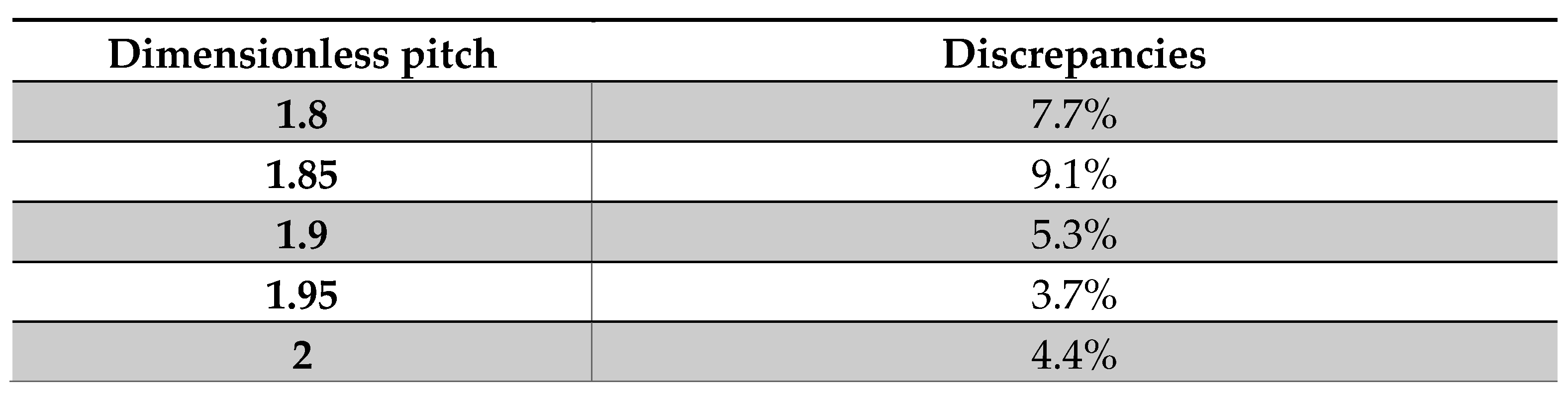
| Dimensionless pitch | Discrepancies |
| 1.8 | 7.05% |
| 1.85 | 4.98% |
| 1.9 | 8.74% |
| 1.95 | 0.7% |
| 2 | 4.42% |
| Model | Predictors | Functional Description | Performance |
| GAM (Generalized Additive Model) | log(NTU), P | ε(x,p) = s₁(x) + s₂(p) + s₃(x,p) x = log(NTU) s₁: smoothing spline (edf ≈ 3.9) s₂: smoothing spline (edf ≈ 1.0) s₃: tensor-product spline (edf ≈ 3.0) | R² = 0.9444 RMSE = 0.085 |
| Ensemble (Bagging Regression Trees) | log(NTU), P | Bagged CART regression trees (~100 trees) MinLeafSize tuned tree depth 6–12 | R² = 0.9138 RMSE = 0.109 |
| Combined GAM + Ensemble Model | log(NTU), P | ε̂_comb = 0.5·ε̂_GAM + 0.5·ε̂_Ens (average of two ML predictions) | R² = 0.9453 RMSE = 0.078 |
Disclaimer/Publisher’s Note: The statements, opinions and data contained in all publications are solely those of the individual author(s) and contributor(s) and not of MDPI and/or the editor(s). MDPI and/or the editor(s) disclaim responsibility for any injury to people or property resulting from any ideas, methods, instructions or products referred to in the content. |
© 2025 by the author. Licensee MDPI, Basel, Switzerland. This article is an open access article distributed under the terms and conditions of the Creative Commons Attribution (CC BY) license (https://creativecommons.org/licenses/by/4.0/).