

Submitted:
27 November 2025
Posted:
01 December 2025
You are already at the latest version
Preprints on COVID-19 and SARS-CoV-2
Abstract
Burnout is well-researched. That no scoping reviews exist on the relationship between burnout and nutrition to determine the range and depth of peer-reviewed studies on burnout, nutrition, nutrition literacy, or food literacy is unexpected. The selection was to conduct a scoping review of the past six years, as the COVID-19 pandemic of 2020-2023 may have significantly affected burnout and nutrition. The search undertaken involved the keywords “burnout AND nutrition AND (nutrition literacy OR food literacy)” of five primary databases (CINAHL Plus, OVID, PubMed, Scopus, Web of Science) and one supplementary database (Google Scholar). Included are all peer-reviewed studies on burnout, nutrition, nutrition literacy, or food literacy in English published between 2020 and 2025. A 3 June 2025 search of the databases produced the included records. They are from two of the six—OVID (n = 1) and Google Scholar (n = 7). Thus, returns from several peer-reviewed studies published between 2020 and 2025 are evident from a search of five primary databases and one supplementary database. The finding is that COVID-19 affected the results in various ways. Research initially focusing on burnout, when considering the relationship between burnout and nutrition regarding nutrition literacy or food literacy, may be most productive.
Keywords:
burnout
; nutrition
; nutrition literacy
; food literacy
; COVID-19
1. Introduction
First described in 1974 [1], the current World Health Organization definition of burnout is an occupation-dependent syndrome from unsuccessfully managed chronic workplace stress [2]—recognizable by reduced professional efficacy. Its result is energy depletion or exhaustion, increased work-related mental distance, negativism, or cynicism [3]. Employees of any type can develop burnout [4], particularly those dedicated to, and seeking perfection in, their jobs [5]. The burnout result is self-undermining behaviors, including ineffective communication, leading to interpersonal conflicts and careless mistakes [6]. Before the COVID-19 pandemic—beginning on 11 March 2020 [7] and ending on 5 May 2023 [8]—burnout was prevalent in employees with high-pressure jobs [9]. There was an escalation of burnout for all employee types throughout the pandemic [10]. Post-COVID-19, there is increasing complexity in finding burnout solutions for employees [11], especially healthcare professionals [12,13]. Attaining psychological flow [14] at work is a way to avoid burnout, suggesting a focus on achieving flow in the workplace might diminish the incidence of employee burnout [15].
Nutrition is the effect of food on the body [16]. In 1990, the United States Nutrition Labeling and Education Act (NLEA) specified that the foods most frequently consumed must provide nutrition labeling—including specific nutrients and food components—and the Food and Drug Administration (FDA) must develop regulations governing the labeling of foods [17]. The result is that since the first proposal in 1992, foods now require a nutrition facts panel label to comply [18,19]. An update to the label was in 2016 [20]. Following the update, the definition of nutrition literacy was the ability to obtain and understand nutrition information [21]. A related term is food literacy—the knowledge, skills, and attitudes responsible for informed decisions about nutrition [16]. Together, nutrition literacy and food literacy encompass the knowledge, skills, and confidence to prepare healthy meals [22] that can help individuals understand and interpret the current food environment [23].
As a consistently well-researched topic, systematic review and meta-analysis publications on burnout are numerous and well-cited [24]. A quick search of Google Scholar on 2 June 2025 of “burnout AND systematic review AND meta-analysis” produced “About 199,000 results”. If this search is limited to those publications between 2021 and 2025 (the last five years), there are “About 40,500 results”. Some of the most cited of these recent publications are [25] (471 citations) and [26] (286 citations). Both of these publications concern healthcare providers. Other investigated professionals regarding burnout are teachers, with one publication [27] garnering 71 citations. Recent investigations have also involved students at the university level [28] (118 citations), and, particularly, medical students [29], attracting 110 citations. Therefore, it is notable that, with all this research on burnout, there has been no systematic review and meta-analysis of burnout and nutrition. Confirmation of this result was by a 2 June 2025 Google Scholar search of “burnout AND nutrition AND systematic review AND meta-analysis”. Although there were “About 30,100 results”, none were of a systematic review and meta-analysis of burnout and nutrition. These results mention some of the topics in the publications, but the relationship between burnout and nutrition is not the focus of a systematic review and meta-analysis.
No systematic review and meta-analysis of burnout and nutrition exists, although burnout is a highly researched topic [30]. Because the extent of current peer-reviewed research on burnout and nutrition [31] is unknown and the interpretation of these terms in the literature is unclear, a scoping review is needed. A 3 June 2025 Google Scholar search of “burnout AND nutrition AND scoping review” for any publications published at any time returns no scoping reviews on burnout and nutrition. A scoping review is advisable before performing a systematic review and meta-analysis [32,33]. Thus, this study aims to undertake the initial scoping review. The hypothesis is that these databases will return several peer-reviewed studies published between 2020 and 2025 on burnout and nutrition that mention nutrition literacy or food literacy. The selection is to scope between 2020 and 2025. The reason is that long-lasting [34] adjustments to eating habits [35] likely affected the relationship between burnout and nutrition resulting from COVID-19.
2. Materials and Methods
The study follows the Internationally standardized [36] 2020 Preferred Reporting Items for Systematic Reviews (PRISMA) Statement extension to scoping reviews—the PRISMA-ScR—guidelines for scoping reviews [37,38], considered best practice for scoping reviews [39].
One investigator completed all aspects of this scoping review. Several steps mitigate cognitive bias. (1) Pre-registration of the review protocol for this study is at osf.io/76ktw. The internet archive link is https://archive.org/details/osf-registrations-nqprg-v1. The registration date was 3 June 2025 (accessed on 3 June 2025). The registration DOI is https://doi.org/10.17605/OSF.IO/NQPRG. Pre-registration is at OSF Registries of the Centre for Open Science [40]. (2) Supplementary S1—Six database searches of 3 June 2025 for the keywords “burnout AND nutrition AND (nutrition literacy OR food literacy)”—contains the results in order of their return of each search undertaken, demonstrating the method of elimination checkable by any investigator. (3) Supplementary S2: Preferred Reporting Items for Systematic reviews and Meta-Analyses extension for Scoping Reviews (PRISMA-ScR) Checklist outlines where all parts of the scoping review process are evident in this publication.
The search parameters are “burnout AND nutrition AND (nutrition literacy OR food literacy)” of peer-reviewed research published since 2020. The consideration is of peer-reviewed empirical research, as the scoping review aims to identify articles appropriate for a future systematic review and meta-analysis [41]. As a statistical tool for combining data mathematically from a systematic review and generating a summary conclusion, the data of a meta-analysis comes from primary research studies [24]. Primary research studies are those published in peer-reviewed journals [42].
There is no requirement for the number of databases to search for a scoping review [39]. Yet, primary databases, which consistently return the same results, are differentiated from supplementary databases, where results may differ depending on the particular search [43]. The primary databases used in this search are CINAHL, OVID, PubMed, Scopus, and Web of Science. The basis of their selection is the topic searched and their high regard [43]. A supplementary database, the Google Scholar search [44], is to expand the reach of the returns, as it is recognized to outperform the coverage of either Scopus or Web of Science [44].
2.1. Database Searches
Table 1 records the databases, search parameters, and returns. It follows the search order of the six databases on 3 June 2025. Requiring the keywords alone to return results was the outcome of two database searches—PubMed and Scopus. The years searched were a necessary addition for Web of Science and Google Scholar to return relevant results. For databases that depend on additional keywords to return relevant results, CINAHL returned nothing while OVID returned seven. A recent scoping review [45] noted that the expectation might be that the fewer the parameters, the more results. Similarly to the previous scoping review, this outcome was not consistent. Although Google Scholar returned the most (230), the results of other database searches with fewer parameters—PubMed, Scopus, and Web of Science—were 2. The expectation, in contrast, might be that more refined criteria—increasing the parameters—would yield fewer returns. Meeting this expectation, CINAHL had no results. OVID, however, returned the second-highest results (7). Consequently, as demonstrated previously [45], the method most effective for a scoping review—more parameters or fewer—remains unclear.
2.2. Selection of Sources of Evidence
Supplementary S1 records the PRISMA-ScR process results for all six searches. Two of the six database searches produced records that were included—OVID (n = 1) and Google Scholar (n = 7)—representing eight studies. The standardized PRISMA process summary is in Figure 1. Following the PRISMA flow diagram [46], the databases searched are differentiated only regarding the location of the records. The “Records removed before screening” results in a consolidation of all returned records. Thus, dividing the database results in following the records identified (n = 243) is not part of this standardization. Nevertheless, this division is relevant for a complete reporting of the scoping process.
Of the records identified, one database (CINAHL) had no returns. The remaining five databases returned as follows, in the order searched: OVID (n = 7), PubMed (n = 2), Scopus (n = 2), Web of Science (n = 2), and Google Scholar (n = 230). The percentages of the records included compared to the returns from these databases are OVID 14.3%, PubMed 0%, Scopus 0%, Web of Science 0%, and Google Scholar 4.3%. Although OVID returned fewer included results than Google Scholar, the percentage included was higher. Nevertheless, both databases had a low rate of included returns.
2.3. Data Items and Summary
Supplementary S1 notes the data items of each database. Table 2 summarizes them. No publication concerns study results from before 2020. Only one (Web of Science) was online before the COVID-19 pandemic (although the registered publication date is April 2020). There were duplications for OVID. All were with Google Scholar. For the PubMed duplications, one was with Web of Science and the other, Scopus. The one duplicate of Scopus was with PubMed and Web of Science. Removal was of all duplicates.
For a scoping review, the most valuable information on each result is available from the Google Scholar search. Supplementary S1 replicates the returned results entries from each database. Only Google Scholar highlights if the keywords are in each result. Permitting the removal of any results lacking keywords before screening, this feature is unavailable for other databases.
Considering the rank of the returns is relevant. The included OVID report was the third of seven entries returned for the OVID search. The rank within the 230 returns for each of the eight reports included for Google Scholar was 3, 5, 9, 13, 19, 23, and 87. Additionally, regarding the organization of Google Scholar returns, only 2 of the 230 before the 87th were without any keywords. These are less than one percent of the total returns lacking keywords. Figure 2 illustrates the results excluded and included regarding the 230 returned reports for Google Scholar. The predominant colors are converted from yellows to blues, starting at the bottom of the diagram. This change indicates that the most relevant entries returned first, and those lacking keywords returned later. Brown represents those studies included.
3. Results
The results follow the Supplementary S2: PRISMA-ScR Checklist sections. They include (1) the characteristics of the sources of evidence, (2) the results of individual sources of evidence, and (3) a synthesis of the results. The subsection on reports of included studies presents the characteristics of the evidence sources. Consideration of the results for individual sources of evidence is in the study details and methodological details. The synthesis of results for the keywords searched then follows.
3.1. Characteristics of the Sources of Evidence
There are eight reports included. One is from OVID, and seven are from Google Scholar. Their titles and citation numbers follow. Exploring the role of dietitians in mental health services and the perceived barriers and enablers to service delivery: A cross-sectional study [47], Content Validation of the Teacher Food and Nutrition-Related Health and Wellbeing Questionnaire, a Delphi Study [48], Burnout Status Among Health and Non-Health Sciences Students During the COVID-19 Pandemic: A Nutritional Perspective [49], Nutrition Literacy: What are Young Adults with Type-1 Diabetes Missing? [50], Fruit and Vegetable Intake, Food Security, Barriers to Healthy Eating, and Empowerment among Dietetic Interns and Physician Assistant Interns: A Cross-Sectional Pilot Study [51], Development of Master Chef: A Curriculum to Promote Nutrition and Mindful Eating among College Students [52], Survey of Nutrition Education Among Medical Students [53], and Treat yourself: Food Delivery Apps and the Interplay Between Justification for Use and Food Well-Being [54].
A research team authored seven included reports [47,48,49,50,51,52,53]. Only one was co-authored [54]. It returned last in the search process. No reports have a single author, and none are by the same research team.
The publications are from various journals. Three of these are nutrition journals [47,49,51], two concern public health [48,52], one is a general medicine journal [50], one involves lifestyle management [53], and one concerns business practices [54]. The order of the returns was nutrition reports, health and medicine studies, lifestyle management publications, and business practices.
Although the search spanned 2020-2025, no included report was older than 2023. There were four publications in 2023 [47,50,53,54], three from 2024 [49,51,52], and one from 2025 [48].
The bibliographic details of these reports are in Table 3.
3.2. Individual Sources of Evidence
Of the eight studies included, only one investigated the relationship between burnout and nutrition [49]. Two more generally focused on mental health and nutrition [47,50]. Three considered health and well-being in general and nutrition [48,51,54], and two offered critiques assessing nutrition advice [52,53].
Three studies followed the recommendation [55] that studies with more than three variables have more than 100 participants [49,51,53]. One study attempted to do so, but of the 100 recruited, only 16 participated—a study involving experts [52]. Another, representing a survey of experts, had only 23 participants [48]; however, these were from six countries. One of the studies with fewer than 100 participants specified the participant type by age [47] and two by their academic specialty [51,53]. One [53] and another [49] indicated that these participants were university students. One study was on participants diagnosed with type-1 diabetes [50], and one did not specify the characteristics of the participants surveyed [54].
The completion of all studies was during the COVID-19 pandemic. The earliest was undertaken in the second half of 2020 [54]. Two were from early 2021 [50,53], and one from later that same year [49]. There were two studies in 2022. One was conducted in the spring [47]. The other did not specify the months of the study [48]. The most recent study period was 2023, one conducted at the beginning of the year [51] and the other during the spring [52].
Most studies were from the USA. Four were solely USA [50] [51,52,53], and one study had it represented as one of the participating countries [48]. Both Australia [47] and Canada [54] had one study, and were part of the multi-country study [48]. The only representation of a non-Western country was Türkiye [49]. Six countries participated in the multi-country study: Australia, Canada, Switzerland, the United Kingdom, New Zealand, and the United States of America.
These individual sources of evidence are in Table 4.
Regarding the study aims, the most evident is that none of them directly concern burnout. Although lacking nutrition knowledge [51], those with medical training considered nutrition education vital to their training to improve patient care [53]. Furthermore, dietitians are seen as helpful in this regard, working as a collaborative healthcare team [47]. Those students with health sciences training were more likely to change their nutrition behavior during the pandemic than other students [49]. Nutrition guidelines were further assessed during the pandemic by experts internationally [48] and regarding one particular program [52]. Nutrition affected the outcome of a type-1 diabetes study [50] and users of mobile food delivery apps (FDAs) [54].
Six of the eight studies had a quantitative component [47,49,50,51,52,53]. Two of these had a qualitative component as well [47,52]. One study was entirely qualitative [54], and one was an E-Delphi consensus vote [48]—a structured communication process using a panel of experts to reach a consensus on a specific topic or issue, accessing a geographically dispersed group of experts, similar to other Delphi methods, but is conducted online [56,57].
Three of the studies demonstrated statistical significance that was generalizable [49,50,53]. Two other studies were statistically significant; however, the sample sizes were too small for generalizability [47,51]. One study with a small sample did not test for statistical significance because the sample size was too small [52]. Additionally, this research had a qualitative aspect that was the focus of the analysis. Statistical significance was not appropriate to test for in the qualitative study [54] or the E-Delphi consensus vote [48].
Table 5 presents the methodological details of the studies.
3.3. Synthesis
Three of the reports focused on the relationship between burnout and food. For [48], the evolving research demonstrating the relationship between burnout and nutrition achieved consensus to remain part of the Teacher Food and Nutrition-related health and wellbeing Questionnaire (TFNQ) of a work-related burnout construct. The influence of burnout on university students was due to the types of food they ate during the pandemic [49]. For [51], eliminating food insecurity was considered relevant to reducing burnout in physician assistant interns. On the other extreme, the research of [50] identified that significantly higher HbA1c levels of young adults living with type-1 diabetes compared to different age groups were likely not because of their eating habits. Instead, it was a result of their burnout from the demands of their disease. Two of the studies concerned groups formed specifically to reduce burnout. Master Chef is part of WellNurse, a Holistic Multidimensional Intervention to reduce burnout in nursing students [52], while Medicine in Motion (MM) is a non-profit student-run organization founded to reduce burnout in medicine [53]. The final two reports regard the effects of burnout. Dietitians have reduced working practices, skills, and objectivity [47]—individuals generally seek comfort and easy life choices [54].
Three reports focus on the role of nutrition in a broad consideration of health. Food consumption influences well-being beyond nutrition [48]. Considering its relationship to dietary habits, a reduction in burnout involves meat, egg, and legume consumption, while milk and dairy consumption were negatively associated with emotional exhaustion and cynicism [49]. The identification was that nutrition choices extend to consumer selection of new food technology options [54]. The importance of considering nutrition was found to need improvement for physician assistant interns [51] and medical students [53], but to be a counter-productive focus for young adults living with type-1 diabetes [50], as diabetes is multidimensional. One of the difficulties in understanding the relationship between mental health and nutrition is the lack of awareness of the dietitian’s role [47]. Similarly, mindfulness-based practices, resilience, and community in nutrition education are recognized as imperative for reducing systematic burnout [52].
Five reports refer to nutrition literacy [47,49,50,52,53]. Three specify food literacy [48,51,54]. Common among these articles is the agreement that increased literacy should be a focus. Of those concerned with nutrition, [47] views that there must be an improvement in nutrition literacy for individuals with mental illness because this population has a high prevalence of lifestyle diseases related to food choices. Health science and other university students were considered to benefit from increased nutrition literacy, potentially [49]. The report of [52] agrees with this assessment but specifies that the college environment is unsupportive of nutrition literacy. Yet [53] stresses the value of encouraging medical students to become more nutrition literate—not only for their benefit but also to improve their future patient outcomes. The focus of [51] is on food literacy rather than nutrition literacy because physician assistant interns demonstrate greater food insecurity than dietetic interns, and this focus helps in avoiding food insecurity. Regarding the extent of what might be involved in improving food literacy, [54] stresses all aspects. The one report regarding nutrition literacy that does not call for an increase in this literacy is [50]. The reason is that nutrition literacy has been the primary focus for young adults with diabetes without sufficient recognition of the more substantial role of burnout in the elevation of their HbA1c levels. The article regarding the content validity of the TFNQ notes consensus in the Resilience and Resistance Eating Practices estimated from the self-perceived food literacy scale [48].
Table 6 indicates the study focus regarding burnout, nutrition, nutrition literacy, or food literacy.
4. Discussion
Considering burnout in association with nutrition, even before appraising their relationship to nutrition literacy or food literacy, is a multi-faceted concern. For the reports returned from the 3 June 2025 search, the various research disciplines comparing the two are nutrition [47,49,51], public health [48,52], medicine [50], lifestyle management [53], and business practices [54]. What is unclear is whether burnout, nutrition, or a combination of both precipitates this multidisciplinary interest. In 2023, the report was that recognizing burnout as a public health concern was recent [58]. Therefore, before this recognition, investigating burnout would have remained outside public health considerations. Similarly, 2022 was the first year that nutrition, health, work-related outcomes, and life satisfaction were evaluated together [59]. It was sometime between this publication and a 2021 report that assessed general concerns about health and wellness and burnout [60] that the relationship between burnout and nutrition involved public health, medicine, lifestyle management, and business practices. Recognizing that this association among these fields about burnout and nutrition wasn’t evident until 2022, provides a reason why a search for relevant reports from 2020–2025 produced no included publications before 2023. Although some studies were in 2021 (two early in the year [50,53], and one late [49]), and two studies were undertaken in 2022 (one in the spring [47] and the other at an unspecified month [48]), this was the result.
The purpose of the studies, their type, and the sufficiency of the number of participants are pertinent for the study relevance assessment. Regarding their purpose, only one investigated the relationship between burnout and nutrition [49], although two more generally focused on mental health and nutrition [47,50]. The others are less relevant, with three broadly concerning health and nutrition [48,51,54]. Two assess nutrition advice [52,53]. Of these, [52] is the least germane—it pertains to expert evaluation of a unique nutritional intervention designed for nursing undergraduates; however, only 16 of the expected 100 experts participated. This number was too small to provide statistical significance. The other study was an observational cohort that produced statistically significant results in testing on 1182 medical students.
Focusing on the most relevant studies, [47,49,50], because of the small sample size, the results from [47] were not generalizable. However, the outcomes of [49] and [50] were statistically significant. The first, [49], involved 747 university students from Türkiye, while the second, [50], investigated 42 young adults with type-1 diabetes from the USA. 2021 was the year of both studies. This year is particularly relevant when considering burnout, nutrition, and nutrition literacy, or food literacy. That 2021 studies would be most significant regarding the topic is notable, as 2021 was the most deadly year of the COVID-19 pandemic [61]. Due to imposed limitations, studies from that year were a challenge [62]. The article about young adults with type-1 diabetes was unique in its focus on burnout, nutrition, and nutrition literacy or food literacy. Where all other articles mentioned the importance of good nutrition to reducing burnout dependent on increased nutrition and/or food literacy, [50] countered that there has been too great a focus on nutrition regarding higher HbA1c levels of young adults living with type-1 diabetes without recognizing that the cause of this result may be burnout in living with the disease rather than nutritional choices. Thus, reducing burnout is more imperative than making dietary changes for this population. There have been several publications [63,64,65] on burnout and diabetes management since [50]. The finding is that diabetes burnout is distinct from other psychosocial conditions [66].
The remaining studies approach burnout, nutrition, and nutrition literacy or food literacy from a different perspective than [50]. Together, they provide a comprehensive message supported by additional research: (1) burnout is affected by nutrition [67], (2) nutrition literacy and food literacy by consumers and healthcare providers currently are at an insufficient level to inform appropriate nutrition choices [16], (3) the COVID-19 pandemic increased nutrition awareness but decreased coping in making healthy choices [26], (4) improvements to nutrition and food literacy are necessary to produce reductions in burnout based on better nutrition [68], and (5) improved standards regarding nutrition are achievable—and being achieved—through wide-spread expert consensus [69].
4.1. Limitations
The limitations of this study regard the type of results returned and the analysis conducted.
CINAHL returned nothing on this topic, while PubMed, Scopus, and Web of Science each returned only two. Compared with the 230 returns from Google Scholar, these results are unexpected. Keyword bias might produce the paucity of returns from most primary databases. A method to enhance the relative accuracy of keywords is to generate and compare them after reading articles [70]. Undertaking this method was not done as the primary database, OVID, produced returns. Therefore, a gap in the field is unlikely to explain why the returns from most primary databases were lacking. In such cases, searching the supplementary database Google Scholar is advised [71]. This method was the one employed. Nevertheless, without representation by CINAHL and few returns from PubMed, Scopus, and Web of Science as primary databases in the included reports, the sense that the review is comprehensive is weakened.
As this is a scoping review—not a systematic review and meta-analysis [24,31]—there is no evaluation of the sample sizes [72] or the validity of the measurement tools [73]. Not providing this evaluation is a limitation of the analysis. However, the recommendation is for a scoping review following PRISMA-ScR guidelines [32,36,74,75,76], as the aim is to investigate the range of information on burnout, nutrition, and nutritional literacy or food literacy.
Regarding the data charting process, one researcher alone completed the searches. This method may lead to cognitive bias [77]. Following PRISMA-ScR procedures for scoping reviews [38] was to counteract possible cognitive bias. Supplementary S1 is a file listing all searches that produced returns. It contains detailed information regarding all the database returns. Any researcher may examine these. Also, the Preferred Reporting Items for Systematic Reviews and Meta-Analyses Extension for Scoping Reviews (PRISMA-ScR) Checklist( as required for scoping reviews [37]) is Supplementary S2. Its inclusion is as an additional measure to reduce the possibility of bias.
4.2. Suggested Research Directions
This scoping review identified a significant effect of the COVID-19 pandemic on burnout, nutrition, and nutrition literacy/food literacy. This effect was not previously known [35]. Moreover, the outcome is that research publications only began in 2023. Therefore, as a topic that is newly developing, the suggestion is for additional research in this area, particularly in various countries to balance the relative abundance of USA studies. Yet to be investigated is the extent of the effect on burnout in conjunction with nutrition when assessing nutrition literacy or food literacy caused by the pandemic. This scoping review has shown that burnout from attending to their disease is the primary reason for elevated HbA1c levels of young adults living with type-1 diabetes, compared to other age groups, rather than nutrition. The question is whether burnout from chronic disease is similarly the cause of increasingly poor relevant test results for nutrition-related reasons. Examples are colitis [78] and Crohn’s disease [79]. Investigating whether burnout should be the primary focus of treatment options rather than diet modification for these nutrition-related chronic diseases requires research. The scoping review encompasses several research areas regarding burnout, nutrition, and nutrition literacy/food literacy. These are nutrition, public health, medicine, lifestyle management, and business practices. Fields that have yet to consider this topic are decision-making and app development. Decision-making is relevant because of the focus on consensus in defining nutrition and food literacy standards, and this decision-making has been considered from the perspective of nutrition analysis rather than focusing on the methodology regarding decision-making [80]. App development is an appropriate research consideration because research has consistently identified apps as promising in improving nutrition literacy and food literacy. However, medicine [81,82] or nutrition [83,84] has been the focus. Research from the perspective of artificial intelligence is yet to be published. These examples represent the most obvious suggestions for investigations on this topic. As an emerging field of research, the range of directions is yet to be restricted.
5. Conclusions
There was corroboration of the hypothesis that several peer-reviewed studies published between 2020 and 2025 can be the result of searching five primary databases and one supplementary database for burnout, nutrition, nutrition literacy, or food literacy. The reports included were one from OVID and seven from Google Scholar. Concerning the importance of nutrition literacy or food literacy, the results indicate that COVID-19 directly affected the relationship between burnout and nutrition. The pandemic increased burnout in various ways, such that one study, regarding young adults living with type-1 diabetes, explicitly found it resulted in significantly higher HbA1c levels. This result represented a more significant cause for the detrimental changes than nutrition itself. This scoping review has revealed that, when burnout is involved, the focus on changes in nutrition may be best initiated from the perspective of burnout rather than nutrition when considering enhancements to nutrition literacy or food literacy.
Supplementary Materials
The following supporting information can be downloaded at the website of this paper posted on Preprints.org. The following supporting information can be downloaded at:10.5281/zenodo.15742571, Supplementary S1: Six database searches of 3 June 2025 for the keywords “burnout AND nutrition AND (nutrition literacy OR food literacy)” in order of their return, and Supplementary S2: Preferred Reporting Items for Systematic reviews and Meta-Analyses extension for Scoping Reviews (PRISMA-ScR) Checklist.
Author Contributions
The contribution of the one author was to all aspects of this work.
Funding
This research received no external funding.
Institutional Review Board Statement
Not applicable.
Informed Consent Statement
Not applicable.
Data Availability Statement
No new data were created.
Acknowledgments
There was no use of GenAI for any purpose.
Conflicts of Interest
The author declares no conflicts of interest.
References
- Freudenberger, H.J. Staff Burn-Out. J. Soc. Issues 1974, 30, 159–165. [CrossRef]
- World Health Organization Burn-out an “Occupational Phenomenon”: International Classification of Diseases 2019.
- Maslach, C.; Leiter, M.P. The Burnout Challenge: Managing People’s Relationships with Their Jobs; Harvard university press: Cambridge (Mass.) London, 2022; ISBN 978-0-674-25101-4.
- Edú-Valsania, S.; Laguía, A.; Moriano, J.A. Burnout: A Review of Theory and Measurement. IJERPH 2022, 19, 1780. [CrossRef]
- Chasson Flawed: Why Perfectionism Is a Challenge for Management; Translational Mental Health Press: S.l., 2024; ISBN 979-8-9900688-2-7.
- Bakker, A.B.; De Vries, J.D. Job Demands–Resources Theory and Self-Regulation: New Explanations and Remedies for Job Burnout. Anxiety Stress Coping 2021, 34, 1–21. [CrossRef]
- Cucinotta, D.; Vanelli, M. WHO Declares COVID-19 a Pandemic. Acta Bio Medica Atenei Parm. 2020, 91, 157–160. [CrossRef]
- Rigby, J.; Satija, B. WHO Declares End to COVID Global Health Emergency. Reuters 2023.
- Hurria, C. Burnout – An Exponential Rise. JOP 2023, 23. [CrossRef]
- Costin, A.; Roman, A.F.; Balica, R.-S. Remote Work Burnout, Professional Job Stress, and Employee Emotional Exhaustion during the COVID-19 Pandemic. Front. Psychol. 2023, 14, 1193854. [CrossRef]
- Kloutsiniotis, P.V.; Mihail, D.M.; Mylonas, N.; Pateli, A. Transformational Leadership, HRM Practices and Burnout during the COVID-19 Pandemic: The Role of Personal Stress, Anxiety, and Workplace Loneliness. Int. J. Hosp. Manag. 2022, 102, 103177. [CrossRef]
- Maresca, G.; Corallo, F.; Catanese, G.; Formica, C.; Lo Buono, V. Coping Strategies of Healthcare Professionals with Burnout Syndrome: A Systematic Review. Medicina 2022, 58, 327. [CrossRef]
- Adnan, N.B.B.; Dafny, H.A.; Baldwin, C.; Jakimowitz, S.; Chalmers, D.; Aroury, A.M.A.; Chamberlain, D. What Are the Solutions for Well-Being and Burn-out for Healthcare Professionals? An Umbrella Realist Review of Learnings of Individual-Focused Interventions for Critical Care. BMJ Open 2022, 12, e060973. [CrossRef]
- Nakamura, J.; Csikszentmihalyi, M. The Experience of Flow: Theory and Research. In The Oxford Handbook of Positive Psychology, 3rd Edition; Snyder, C.R., Lopez, S.J., Edwards, L.M., Marques, S.C., Eds.; Oxford University Press, 2020 ISBN 978-0-19-939651-1.
- Nash, C. A Scoping Review of Burnout Avoidance by Employees During the COVID-19 Pandemic: The Role of Psychological Flow. Encyclopedia 2025, 5, 56. [CrossRef]
- Silva, P.; Araújo, R.; Lopes, F.; Ray, S. Nutrition and Food Literacy: Framing the Challenges to Health Communication. Nutrients 2023, 15, 4708. [CrossRef]
- Silverglade, B.A. The Nutrition Labeling and Education Act—Progress to Date and Challenges for the Future. J. Public Policy Mark. 1996, 15, 148–150. [CrossRef]
- Storz, M.A. Nutrition Facts Labels: Who Is Actually Reading Them and Does It Help in Meeting Intake Recommendations for Nutrients of Public Health Concern? BMC Public Health 2023, 23, 1947. [CrossRef]
- Trumbo, P.; Shimakawa, T. U.S. Food and Drug Administration on Modernization of the Nutrition and Supplements Facts Labels. J. Food Compos. Anal. 2009, 22, S13–S18. [CrossRef]
- Kim, E.J.; Ellison, B.; Prescott, M.P.; Nayga, R.M. Consumer Comprehension of the Nutrition Facts Label: A Comparison of the Original and Updated Labels. Am J Health Promot 2021, 35, 648–657. [CrossRef]
- Krause, C.; Sommerhalder, K.; Beer-Borst, S.; Abel, T. Just a Subtle Difference? Findings from a Systematic Review on Definitions of Nutrition Literacy and Food Literacy. Health Promot. Int. 2016, daw084. [CrossRef]
- Itzkovitz, A.; Maggio, V.; Roy-Fleming, A.; Legault, L.; Brazeau, A. Nutrition and Food Literacy among Young Canadian Adults Living with Type 1 Diabetes. Diabet Med 2022, 39, e14921. [CrossRef]
- Carroll, N.; Perreault, M.; Ma, D.W.; Haines, J. Assessing Food and Nutrition Literacy in Children and Adolescents: A Systematic Review of Existing Tools. Public Health Nutr. 2022, 25, 850–865. [CrossRef]
- Mathew, J.L. Systematic Reviews and Meta-Analysis: A Guide for Beginners. Indian Pediatr 2022, 59, 320–330. [CrossRef]
- Hodkinson, A.; Zhou, A.; Johnson, J.; Geraghty, K.; Riley, R.; Zhou, A.; Panagopoulou, E.; Chew-Graham, C.A.; Peters, D.; Esmail, A.; et al. Associations of Physician Burnout with Career Engagement and Quality of Patient Care: Systematic Review and Meta-Analysis. BMJ 2022, e070442. [CrossRef]
- Ghahramani, S.; Lankarani, K.B.; Yousefi, M.; Heydari, K.; Shahabi, S.; Azmand, S. A Systematic Review and Meta-Analysis of Burnout Among Healthcare Workers During COVID-19. Front. Psychiatry 2021, 12, 758849. [CrossRef]
- Alsalhe, T.A.; Chalghaf, N.; Guelmami, N.; Azaiez, F.; Bragazzi, N.L. Occupational Burnout Prevalence and Its Determinants Among Physical Education Teachers: A Systematic Review and Meta-Analysis. Front. Hum. Neurosci. 2021, 15, 553230. [CrossRef]
- Kaggwa, M.M.; Kajjimu, J.; Sserunkuma, J.; Najjuka, S.M.; Atim, L.M.; Olum, R.; Tagg, A.; Bongomin, F. Prevalence of Burnout among University Students in Low- and Middle-Income Countries: A Systematic Review and Meta-Analysis. PLoS ONE 2021, 16, e0256402. [CrossRef]
- Almutairi, H.; Alsubaiei, A.; Abduljawad, S.; Alshatti, A.; Fekih-Romdhane, F.; Husni, M.; Jahrami, H. Prevalence of Burnout in Medical Students: A Systematic Review and Meta-Analysis. Int J Soc Psychiatry 2022, 68, 1157–1170. [CrossRef]
- Nápoles, J. Burnout: A Review of the Literature. Update: Appl. Res. Music Educ. 2022, 40, 19–26. [CrossRef]
- Smith, S.A.; Duncan, A.A. Systematic and Scoping Reviews: A Comparison and Overview. Semin. Vasc. Surg. 2022, 35, 464–469. [CrossRef]
- Munn, Z.; Pollock, D.; Khalil, H.; Alexander, L.; Mclnerney, P.; Godfrey, C.M.; Peters, M.; Tricco, A.C. What Are Scoping Reviews? Providing a Formal Definition of Scoping Reviews as a Type of Evidence Synthesis. JBI Evid. Synth. 2022, 20, 950–952. [CrossRef]
- Munn, Z.; Peters, M.D.J.; Stern, C.; Tufanaru, C.; McArthur, A.; Aromataris, E. Systematic Review or Scoping Review? Guidance for Authors When Choosing between a Systematic or Scoping Review Approach. BMC Med Res Methodol 2018, 18, 143. [CrossRef]
- Hauner, H.; Blanken, C.P.S.; Holzapfel, C. Long-Lasting Effects of the COVID-19 Pandemic on Lifestyle and Body Weight: Results of Representative Cross-Sectional Surveys in Adults in Germany. BMC Public Health 2024, 24, 1199. [CrossRef]
- Clemente-Suárez, V.J.; Ramos-Campo, D.J.; Mielgo-Ayuso, J.; Dalamitros, A.A.; Nikolaidis, P.A.; Hormeño-Holgado, A.; Tornero-Aguilera, J.F. Nutrition in the Actual COVID-19 Pandemic. A Narrative Review. Nutrients 2021, 13, 1924. [CrossRef]
- Peters, M.D.J.; Marnie, C.; Tricco, A.C.; Pollock, D.; Munn, Z.; Alexander, L.; McInerney, P.; Godfrey, C.M.; Khalil, H. Updated Methodological Guidance for the Conduct of Scoping Reviews. JBI Evid. Synth. 2020, 18, 2119–2126. [CrossRef]
- PRISMA PRISMA for Scoping Reviews (PRISMA-ScR). PRISMA 2020 2025.
- Tricco, A.C.; Lillie, E.; Zarin, W.; O’Brien, K.K.; Colquhoun, H.; Levac, D.; Moher, D.; Peters, M.D.J.; Horsley, T.; Weeks, L.; et al. PRISMA Extension for Scoping Reviews (PRISMA-ScR): Checklist and Explanation. Ann Intern Med 2018, 169, 467–473. [CrossRef]
- Peters, M.D.J.; Godfrey, C.; McInerney, P.; Khalil, H.; Larsen, P.; Marnie, C.; Pollock, D.; Tricco, A.C.; Munn, Z. Best Practice Guidance and Reporting Items for the Development of Scoping Review Protocols. JBI Evid. Synth. 2022, 20, 953–968. [CrossRef]
- Center for Open Science There’s a Better Way to Manage Your Research. OFS Home.
- Møller, A.M.; Myles, P.S. What Makes a Good Systematic Review and Meta-Analysis? Br. J. Anaesth. 2016, 117, 428–430. [CrossRef]
- Logan, S.W.; Hussong-Christian, U.; Case, L.; Noregaard, S. Reference Accuracy of Primary Studies Published in Peer-Reviewed Scholarly Journals: A Scoping Review. J. Librariansh. Inf. Sci. 2024, 56, 896–949. [CrossRef]
- Gusenbauer, M.; Haddaway, N.R. Which Academic Search Systems Are Suitable for Systematic Reviews or Meta-analyses? Evaluating Retrieval Qualities of Google Scholar, PubMed, and 26 Other Resources. Res. Synth. Methods 2020, 11, 181–217. [CrossRef]
- Gusenbauer, M. Google Scholar to Overshadow Them All? Comparing the Sizes of 12 Academic Search Engines and Bibliographic Databases. Scientometrics 2019, 118, 177–214. [CrossRef]
- Nash, C. Self-Directed Learning and Consensus Decision-Making in the Co-Creation of Virtual Worlds Promoting Student Mental Health Through Mobile Technology Use: A Scoping Review. Virtual Worlds 2025, 4, 26. [CrossRef]
- PRISMA PRISMA Flow Diagram 2025.
- Teasdale, S.B.; Tripodi, E.; Harman, A.; Plain, J.; Burrows, T.L. Exploring the Role of Dietitians in Mental Health Services and the Perceived Barriers and Enablers to Service Delivery: A Cross-sectional Study. J Hum. Nutr. Diet 2023, 36, 1771–1781. [CrossRef]
- Jakstas, T.; Bucher, T.; Miller, A.; Shrewsbury, Vanessa.A.; Collins, Clare.E. Content Validation of the Teacher Food and Nutrition-Related Health and Wellbeing Questionnaire, a Delphi Study. BMC Public Health 2025, 25, 1468. [CrossRef]
- Karaagac, Y.; Tunçer, E.; Şimşek, H.; Özdemir, V.T.; Ayhan, N.Y. Burnout Status among Health and Non-Health Sciences Students during the COVID-19 Pandemic: A Nutritional Perspective. Rev. Nutr. 2024, 37, e230194. [CrossRef]
- Abrams, C.; Meliker, J.; Floreen Sabino, A. Nutrition Literacy: What Are Young Adults with Type-1 Diabetes Missing? Cureus 2023. [CrossRef]
- Campbell, A.; Stirling, M.; Keele, N.; Larkin, A.; Crandall, R.; Wilcox, A.N.; Adair, M.; Malan, C.; Thomson, J.; Bennett, A.; et al. Fruit and Vegetable Intake, Food Security, Barriers to Healthy Eating, and Empowerment among Dietetic Interns and Physician Assistant Interns: A Cross-Sectional Pilot Study. Nutrients 2024, 16, 1034. [CrossRef]
- Parsons, K.; Strout, K.; Winn, C.; Therrien-Genest, M.; Yerxa, K.; McNamara, J. Development of Master Chef: A Curriculum to Promote Nutrition and Mindful Eating among College Students. IJERPH 2024, 21, 487. [CrossRef]
- Duggan, M.P.; Kodali, A.T.; Panton, Z.A.; Smith, S.M.; Riew, G.J.; Donaghue, J.F.; Leya, G.A.; Briggs, L.G. Survey of Nutrition Education Among Medical Students. J. Wellness 2023, 4. [CrossRef]
- Capito, S.; Pergelova, A. Treat Yourself: Food Delivery Apps and the Interplay between Justification for Use and Food Well-being. J. Consum. Aff. 2023, 57, 479–506. [CrossRef]
- Brysbaert, M. How Many Participants Do We Have to Include in Properly Powered Experiments? A Tutorial of Power Analysis with Reference Tables. J. Cogn. 2019, 2, 16. [CrossRef]
- Romero-Collado, A. Essential Elements to Elaborate a Study with the (e)Delphi Method. Enfermería Intensiv. (Engl. ed.) 2021, 32, 100–104. [CrossRef]
- Toronto, C. Considerations When Conducting E-Delphi Research: A Case Study. Nurse Res. 2017, 25, 10–15. [CrossRef]
- Chen, R.; Liu, W. Managing Healthcare Employees’ Burnout through Micro Aspects of Corporate Social Responsibility: A Public Health Perspective. Front. Public Health 2023, 10, 1050867. [CrossRef]
- Brecko, Z.; Kobal Grum, D. HEALTH-RELATED NUTRITIONAL BEHAVIOR, EMPLOYEE EFFICIENCY, AND GENERAL LIFE SATISFACTION. In PSYCHOLOGY IN THE FUNCTION OF THE WELL-BEING OF THE INDIVIDUAL AND SOCIETY - 17th Days of Applied Psychology 2021; Filozofski fakultet u Nišu: Serbia, 2022; pp. 207–225 ISBN 978-86-7379-601-7.
- Sidossis, A.; Gaviola, G.C.; Sotos-Prieto, M.; Kales, S. Healthy Lifestyle Interventions across Diverse Workplaces: A Summary of the Current Evidence. Curr. Opin. Clin. Nutr. Metab. Care 2021, 24, 490–503. [CrossRef]
- Lee, W.-E.; Woo Park, S.; Weinberger, D.M.; Olson, D.; Simonsen, L.; Grenfell, B.T.; Viboud, C. Direct and Indirect Mortality Impacts of the COVID-19 Pandemic in the United States, March 1, 2020 to January 1, 2022. eLife 2023, 12, e77562. [CrossRef]
- Tremblay, S.; Castiglione, S.; Audet, L.-A.; Desmarais, M.; Horace, M.; Peláez, S. Conducting Qualitative Research to Respond to COVID-19 Challenges: Reflections for the Present and Beyond. Int. J. Qual. Methods 2021, 20, 16094069211009679. [CrossRef]
- Starr, L.; Dutta, S.; Danne, T.; Karpen, S.R.; Hutton, C.; Kowalski, A. The Urgent Need for Breakthrough Therapies and a World Without Type 1 Diabetes. Diabetes Ther 2025, 16, 1063–1076. [CrossRef]
- Cyranka, K.; Klupa, T.; Pilecki, M.; Sarna-Palacz, D.; Juryk, A.; Storman, D.; Dudek, D.; Malecki, M.T.; Matejko, B. Diabetes Distress and Diabetes Burnout Explored in Various Areas of Life in Patients with Type 1 Diabetes: Effect of Short-Term Psychological Intervention. Endocrine 2024, 85, 676–684. [CrossRef]
- Stenov, V.; Due-Christensen, M.; Cleal, B.R.; Tapager, I.W. Significant Reduction in Diabetes Distress and Improvements in Psychosocial Outcomes: A Pilot Test of an Intervention to Reduce Diabetes Distress in Adults with Type 1 Diabetes and Moderate-to-severe Diabetes Distress ( REDUCE ). Diabet Med 2023, 40, e15187. [CrossRef]
- Perez, D.; Sullivan-Bolyai, S.; Bova, C.; Fain, J. Burnout Among Young Adults With Type 1 Diabetes. Sci. Diabetes Self-Manag. Care 2024, 50, 211–221. [CrossRef]
- Vasquez-Purí, C.; Plaza-Ccuno, J.N.R.; Soriano-Moreno, A.N.; Calizaya-Milla, Y.E.; Saintila, J. Burnout, Fat Intake, and Body Mass Index in Health Professionals Working in a Public Hospital: A Cross-Sectional Study. INQUIRY 2023, 60, 00469580231189601. [CrossRef]
- Esquivel, M.K. Nutrition Strategies for Reducing Risk of Burnout Among Physicians and Health Care Professionals. Am. J. Lifestyle Med. 2021, 15, 126–129. [CrossRef]
- Ayers, P.; Berger, M.M.; Berlana, D.; Cogle, S.V.; De Cloet, J.; Gray, B.; Klek, S.; Kumpf, V.J.; Monczka, J.; Ybarra, J.; et al. Expert Consensus Statements and Summary of Proceedings from the International Safety and Quality of Parenteral Nutrition Summit. Am. J. Health-Syst. Pharm. 2024, 81, S75–S88. [CrossRef]
- Waldeyer, J.; Roelle, J. The Keyword Effect: A Conceptual Replication, Effects on Bias, and an Optimization. Metacognition Learn. 2021, 16, 37–56. [CrossRef]
- Ewald, H.; Klerings, I.; Wagner, G.; Heise, T.L.; Stratil, J.M.; Lhachimi, S.K.; Hemkens, L.G.; Gartlehner, G.; Armijo-Olivo, S.; Nussbaumer-Streit, B. Searching Two or More Databases Decreased the Risk of Missing Relevant Studies: A Metaresearch Study. J. Clin. Epidemiol. 2022, 149, 154–164. [CrossRef]
- Ahn, E.; Kang, H. Introduction to Systematic Review and Meta-Analysis. Korean J Anesth. 2018, 71, 103–112. [CrossRef]
- Bakker, E.A.; Hartman, Y.A.W.; Hopman, M.T.E.; Hopkins, N.D.; Graves, L.E.F.; Dunstan, D.W.; Healy, G.N.; Eijsvogels, T.M.H.; Thijssen, D.H.J. Validity and Reliability of Subjective Methods to Assess Sedentary Behaviour in Adults: A Systematic Review and Meta-Analysis. Int J Behav Nutr Phys Act 2020, 17, 75. [CrossRef]
- Khalil, H.; Peters, M.Dj.; Tricco, A.C.; Pollock, D.; Alexander, L.; McInerney, P.; Godfrey, C.M.; Munn, Z. Conducting High Quality Scoping Reviews-Challenges and Solutions. J. Clin. Epidemiol. 2021, 130, 156–160. [CrossRef]
- Mak, S.; Thomas, A. An Introduction to Scoping Reviews. J. Grad. Med. Educ. 2022, 14, 561–564. [CrossRef]
- McGowan, J.; Straus, S.; Moher, D.; Langlois, E.V.; O’Brien, K.K.; Horsley, T.; Aldcroft, A.; Zarin, W.; Garitty, C.M.; Hempel, S.; et al. Reporting Scoping Reviews—PRISMA ScR Extension. J. Clin. Epidemiol. 2020, 123, 177–179. [CrossRef]
- Neal, T.M.S.; Lienert, P.; Denne, E.; Singh, J.P. A General Model of Cognitive Bias in Human Judgment and Systematic Review Specific to Forensic Mental Health. Law Hum. Behav. 2022, 46, 99–120. [CrossRef]
- Radziszewska, M.; Smarkusz-Zarzecka, J.; Ostrowska, L.; Pogodziński, D. Nutrition and Supplementation in Ulcerative Colitis. Nutrients 2022, 14, 2469. [CrossRef]
- Caio, G.; Lungaro, L.; Caputo, F.; Zoli, E.; Giancola, F.; Chiarioni, G.; De Giorgio, R.; Zoli, G. Nutritional Treatment in Crohn’s Disease. Nutrients 2021, 13, 1628. [CrossRef]
- Doustmohammadian, A.; Omidvar, N.; Keshavarz-Mohammadi, N.; Eini-Zinab, H.; Amini, M.; Abdollahi, M. Development of a Conceptual Framework of Food and Nutrition Literacy in Children. BMC Nutr 2022, 8, 91. [CrossRef]
- Hasan, D.S.; Arief, Y.S.; Krisnana, I. Mobile Application Intervention to Improve Nutritional Literacy of Mothers with Stunting Children: A Systematic Review. Pediomaternal Nurs. J. 2024, 10, 70–75. [CrossRef]
- Consavage Stanley, K.; Harrigan, P.B.; Serrano, E.L.; Kraak, V.I. A Systematic Scoping Review of the Literacy Literature to Develop a Digital Food and Nutrition Literacy Model for Low-income Adults to Make Healthy Choices in the Online Food Retail Ecosystem to Reduce Obesity Risk. Obes. Rev. 2022, 23, e13414. [CrossRef]
- Silva, P. Food and Nutrition Literacy: Exploring the Divide between Research and Practice. Foods 2023, 12, 2751. [CrossRef]
- Brown, R.; Seabrook, J.A.; Stranges, S.; Clark, A.F.; Haines, J.; O’Connor, C.; Doherty, S.; Gilliland, J.A. Examining the Correlates of Adolescent Food and Nutrition Knowledge. Nutrients 2021, 13, 2044. [CrossRef]
Figure 1.
The PRISMA flow chart for scoping reviews [46] of a 3 June 2025 search. The search parameters and the number of returns for keyword searches for “burnout AND nutrition AND (nutrition literacy OR food literacy)” are listed in the search order.
Figure 1.
The PRISMA flow chart for scoping reviews [46] of a 3 June 2025 search. The search parameters and the number of returns for keyword searches for “burnout AND nutrition AND (nutrition literacy OR food literacy)” are listed in the search order.
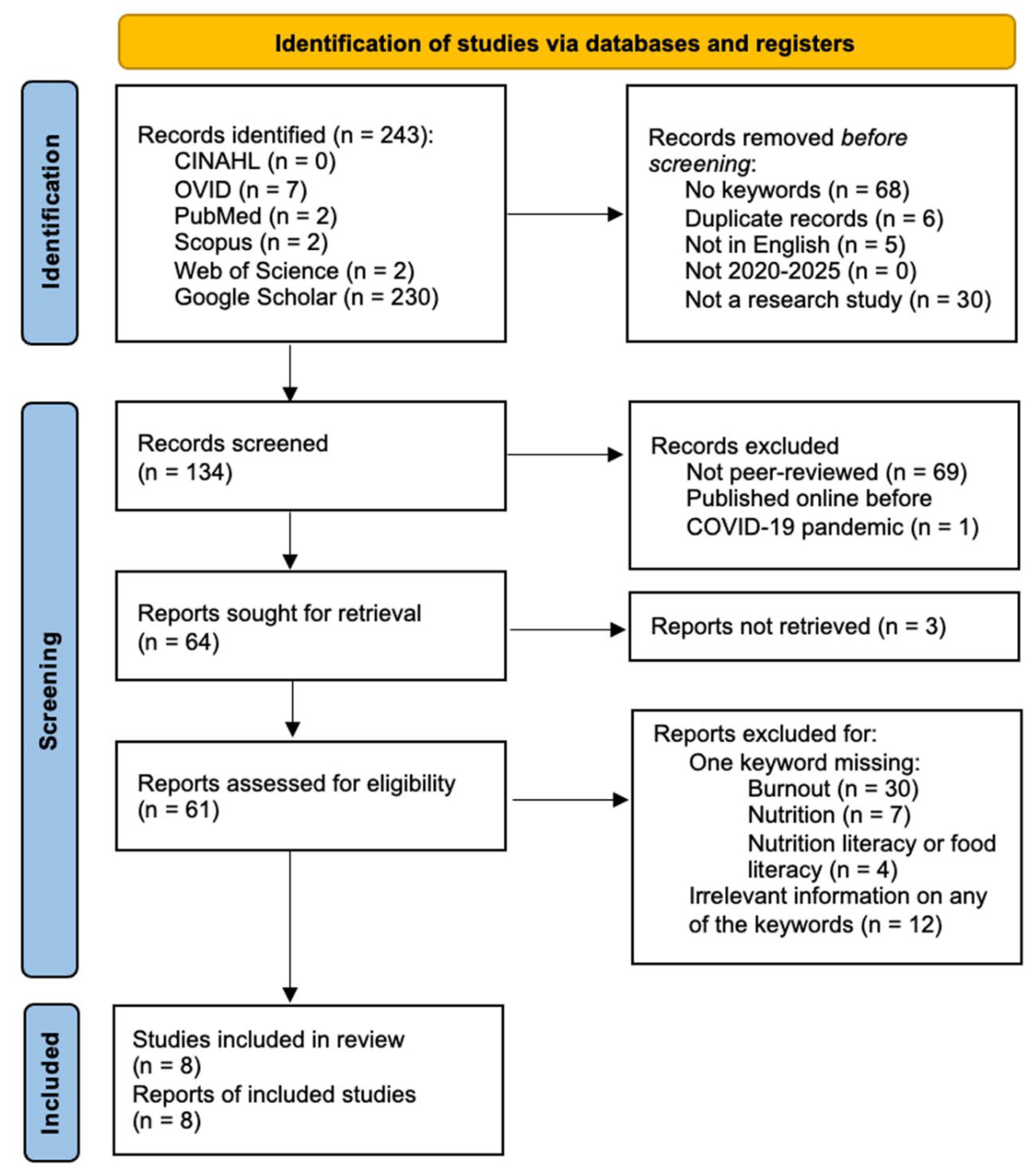
Figure 2.
Graphical representation of the number of reports excluded based on one of nine reasons for exclusion for the 3 June 2025 Google Scholar search for “burnout AND nutrition AND (nutrition literacy OR food literacy)” plus the included in the order of the 230 reports returned. For the details, see Supplementary S1.
Figure 2.
Graphical representation of the number of reports excluded based on one of nine reasons for exclusion for the 3 June 2025 Google Scholar search for “burnout AND nutrition AND (nutrition literacy OR food literacy)” plus the included in the order of the 230 reports returned. For the details, see Supplementary S1.
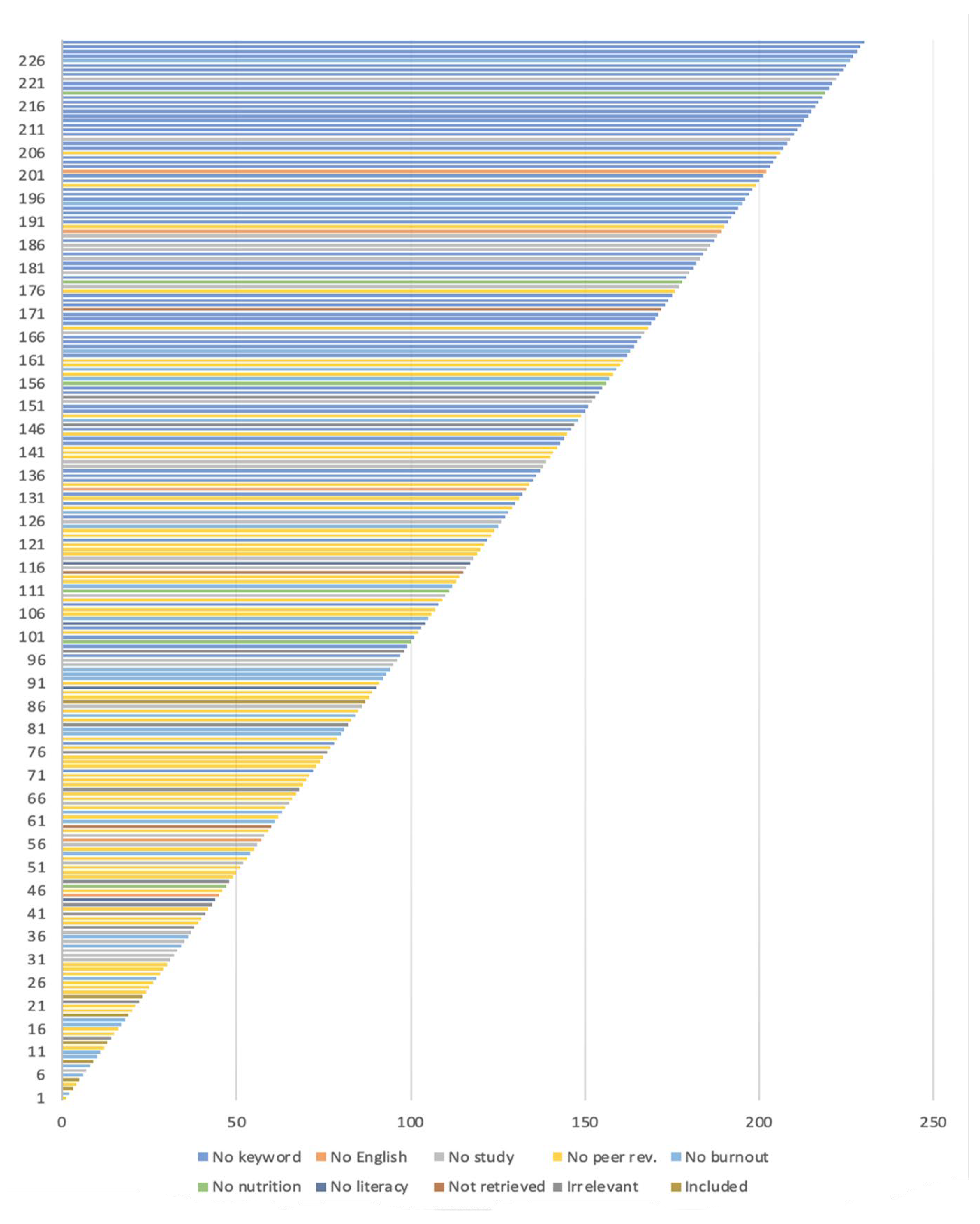

Table 1.
Databases searched on 3 June 2025, the search parameters, and # (the number of returns) regarding searches of the keywords “burnout AND nutrition AND (nutrition literacy OR food literacy)” in the order searched. The demonstration for this topic is that the supplementary database, Google Scholar, returned the most results.
Table 1.
Databases searched on 3 June 2025, the search parameters, and # (the number of returns) regarding searches of the keywords “burnout AND nutrition AND (nutrition literacy OR food literacy)” in the order searched. The demonstration for this topic is that the supplementary database, Google Scholar, returned the most results.
| Database | Search Parameters | # |
|---|---|---|
| CINAHL | Keywords: “burnout” AND “nutrition” AND “(“nutrition literacy” OR “food literacy”)”, “Find all my search terms”, “English Language”, “Peer Reviewed”, “Research Article”, “Start month: March Start year: 2020—End month: June End year: 2025” |
0 |
| OVID | Databases included: Embase Classic+Embase 1947 to 2025 June 02 APA PsycInfo 1806 to May 2025 Week 4 Ovid Healthstar 1966 to April 2025 AMED (Allied and Complementary Medicine) 1985 to April 2025 JBI EBP Database Current to May 28, 2025 Health and Psychosocial Instruments 1985 to May 2025 Journals@Ovid Full Text June 03, 2025 Ovid MEDLINE® ALL 1946 to June 02, 2025 Keywords: “burnout” AND “nutrition” AND “(“nutrition literacy” OR “food literacy”)”, “English Language”, “2020–2025” |
7 |
| PubMed | Keywords: “burnout” AND “nutrition” AND “(“nutrition literacy” OR “food literacy”)” | 2 |
| Scopus | Keywords: “burnout” AND “nutrition” AND “(“nutrition literacy” OR “food literacy”)” | 2 |
| Web of Science | Keywords: “burnout” AND “nutrition” AND “(“nutrition literacy” OR “food literacy”)”, “2020-01-01 to 2025-06-03” | 2 |
| Google Scholar | Keywords: “burnout” AND “nutrition” AND “(“nutrition literacy” OR “food literacy”)”, “2020 to 2025” | 230 |
Table 2.
2020 PRISMA data items [46] of the 3 June 2025 search of “burnout AND nutrition AND (nutrition literacy OR food literacy)” for the six databases searched.
Table 2.
2020 PRISMA data items [46] of the 3 June 2025 search of “burnout AND nutrition AND (nutrition literacy OR food literacy)” for the six databases searched.
| OVID | PubMed | Scopus | Web of Science | Google Scholar | |
|---|---|---|---|---|---|
| No Keywords | 68 | ||||
| Duplicate Records | 3 | 2 | 1 | ||
| Not in English | 5 | ||||
| Not 2020-2025 | |||||
| Not a Research Study | 1 | 29 | |||
| Not Peer Reviewed | 2 | 67 | |||
| Published PreCOVID-19 | 1 | ||||
| Not Retrieved | 3 | ||||
| No Burnout | 1 | 29 | |||
| No Nutrition | 1 | 6 | |||
| No Literacy (Nutrition/Food) | 4 | ||||
| Irrelevant information | 12 | ||||
| Included | 1 | 7 | |||
| Total Results per Database | 7 | 2 | 2 | 2 | 230 |
Table 3.
Bibliographic details (# (citation number), article title, authors, publication journal, and publication year) of the 3 June 2025 search of “burnout AND nutrition AND (nutrition literacy OR food literacy)” resulting from the reports included for two databases (OVID and Google Scholar), listed in the order of the searches and their returns.
Table 3.
Bibliographic details (# (citation number), article title, authors, publication journal, and publication year) of the 3 June 2025 search of “burnout AND nutrition AND (nutrition literacy OR food literacy)” resulting from the reports included for two databases (OVID and Google Scholar), listed in the order of the searches and their returns.
| # | Title | Authors | Journal | Year |
|---|---|---|---|---|
| [47] | Exploring the role of dietitians in mental health services and the perceived barriers and enablers to service delivery: a cross-sectional study | Teasdale et al. | Journal of Human Nutrition and Dietetics |
2023 |
| [48] | Content validation of the teacher food and nutrition-related health and wellbeing questionnaire, a Delphi study | Jakstas et al. | BMC Public Health | 2025 |
| [49] | Burnout status among health and non-health sciences students during the COVID-19 pandemic: a nutritional perspective | Karaagac et al. | Revista de Nutrição | 2024 |
| [50] | Nutrition literacy: what are young adults with type-1 diabetes missing? | Abrams et al. | Cureus | 2023 |
| [51] | Fruit and vegetable intake, food security, barriers to healthy eating, and empowerment among dietetic interns and physician assistant interns: a cross-sectional pilot study | Campbell et al. | Nutrients | 2024 |
| [52] | Development of Master Chef: a curriculum to promote nutrition and mindful eating among college students | Parsons et al. | International Journal of Environmental Research and Public Health | 2024 |
| [53] | Survey of nutrition education among medical students | Duggan et al. | Journal of Wellness | 2023 |
| [54] | Treat yourself: food delivery apps and the interplay between justification for use and food well-being | Capito and Pergelova | The Journal of Consumer Affairs | 2023 |
Table 4.
Study details (# (citation number), study aim, type of participants and their number, study date, and study location) of the 3 June 2025 search of “burnout AND nutrition AND (nutrition literacy OR food literacy)” resulting from the reports included for the appraisal of two databases (OVID and Google Scholar) listed in the order of the searches and their returns.
Table 4.
Study details (# (citation number), study aim, type of participants and their number, study date, and study location) of the 3 June 2025 search of “burnout AND nutrition AND (nutrition literacy OR food literacy)” resulting from the reports included for the appraisal of two databases (OVID and Google Scholar) listed in the order of the searches and their returns.
| Study Aim | Participants | Study Date | Location | |
|---|---|---|---|---|
| [47] | Exploring the dietitian’s role in mental health services, as well as identifying barriers and enablers to service delivery |
48 respondents between 23–67 years | March to April 2022 | Australia |
| [48] | Evaluate the content validity of the Teacher Food and Nutrition-Related Health and Wellbeing Questionnaire (TFNQ) | 23 experts from six countries | 2022 | Australia, Canada, Switzerland, UK, NZ, and USA |
| [49] | Assessing the factors associated with burnout among university students studying online during the COVID-19 lockdown, with a focus on nutrition and lifestyle habits |
747 university students | October and November 2021 | Türkiye |
| [50] | Evaluating the nutrition literacy and perceived emotional burden of disease in young adults with type-1 diabetes | 42 young adults with type-1 diabetes |
January and February 2021 | USA |
| [51] | Comparing dietetic interns’ fruit and physician assistant interns’ fruit and vegetable intake, food security, barriers to healthy eating, and empowerment for making healthy dietary choices during an internship. | 81 dietetic interns, 79 physician assistant interns | January and February 2023 | USA |
| [52] | Reviewing the development of Master Chef, a mindful eating curriculum, and assessing its feasibility through an online expert review. | 16 experts of the 100 recruited | Spring 2023 | USA |
| [53] | Providing medical students’ perspectives on the degree and necessity of nutrition education during medical school. | 1182 medical students | January 2021 | USA |
| [54] | Examining the relationship between justification for use and well-being regarding mobile food delivery apps (FDAs) | 30 unique participants | June–November 2020 | Canada |
Table 5.
Methodological details (# (citation number), study outcomes regarding the aim, study type, and whether the results were statistically significant) of the 3 June 2025 search of “burnout AND nutrition AND (nutrition literacy OR food literacy)” resulting from the reports included for the appraisal of two databases (OVID and Google Scholar) listed in the order of the searches and their returns.
Table 5.
Methodological details (# (citation number), study outcomes regarding the aim, study type, and whether the results were statistically significant) of the 3 June 2025 search of “burnout AND nutrition AND (nutrition literacy OR food literacy)” resulting from the reports included for the appraisal of two databases (OVID and Google Scholar) listed in the order of the searches and their returns.
| Outcomes Regarding Aim | Study Type | Significance | |
|---|---|---|---|
| [47] | Dietitians, as members of collaborative mental healthcare teams, can improve the health and quality of life of individuals with mental illness. | Fixed response questions plus voluntary open-ended questions | Small sample size, results not generalizable |
| [48] | 10 out of 17 achieved consensus to approve item phrasing and scale style, selected scale suitability was assessed with 15 out of 17 achieving consensus, and questionnaire flow received 86% consensus | E-Delphi consensus vote | Not tested |
| [49] | Use of dietary supplements, dietary habits, and physical activity changes during the pandemic were more common in health sciences students than in other students | Cross-sectional web-based survey | Statistical |
| [50] | Young adults living with type-1 diabetes report higher HbA1c levels compared to other age groups | 40-question survey on Google Forms | Statistical |
| [51] | Dietetic interns had a higher vegetable intake than physician assistant interns, and physician assistant interns lacked nutrition-related knowledge | Cross-sectional pilot study | Statistical; however, small sample size. |
| [52] | Feedback was on the curriculum’s educational content, lesson objectives, and perceived feasibility, with most reviewers positively perceiving the overall curriculum | Qualitative and quantitative | Not tested, sample size too small |
| [53] | Most medical students in this multi-institutional study believe that their understanding of nutrition is vital to maximizing patient care | Observational cohort study | Statistical |
| [54] | Licensing effects of FDAs can have a positive or negative influence on consumers’ well-being, depending on consumers’ self-regulation, awareness, and conscious management of their food relationship |
Interpretivist qualitative | Not tested |
Table 6.
Results regarding study focus (# (citation number), burnout, nutrition, and literacy (nutrition or food)) of the 3 June 2025 search of “burnout AND nutrition AND (nutrition literacy OR food literacy)” resulting from the reports included for the appraisal of two databases (OVID and Google Scholar) listed in the order of the searches and their returns.
Table 6.
Results regarding study focus (# (citation number), burnout, nutrition, and literacy (nutrition or food)) of the 3 June 2025 search of “burnout AND nutrition AND (nutrition literacy OR food literacy)” resulting from the reports included for the appraisal of two databases (OVID and Google Scholar) listed in the order of the searches and their returns.
| Burnout | Nutrition | Nutrition Literacy, or Food Literacy |
|
|---|---|---|---|
| [47] | Formalized supervision arrangements enable better working practices, improve knowledge and skills, address issues objectively, and can minimize stress and burnout for dietitians, particularly those regularly encountering patients with high degrees of psychological distress | Barriers included a lack of awareness from others regarding the dietitian’s role in mental health, and a lack of specific tools for nutrition screening | With a higher prevalence of lifestyle diseases (e.g., diabetes, metabolic syndrome, cardiovascular disease, and obesity) among individuals with mental illness, increasing nutrition literacy and the promotion of healthy behaviors, via group education or individual consultation, is essential to help improve physical health outcomes |
| [48] | While the Work-related Burnout construct achieved a consensus vote among experts through an identification of the rank questions for potential removal with Teacher Work-related Wellness, the decision was that it should remain based on emerging research showing associations between burnout and nutrition | That food consumption can influence well-being beyond just nutrition is an integrated approach that allows consideration and inclusion of the many determinants influencing healthy eating practices, as research evolves that evaluates potential relationships between diet quality, cooking confidence, and mental health outcomes | Some constructs applied to the TFNQ were sub-scales drawn from larger measurement tools, such as Food Skills Confidence, Cooking Attitudes, and Self-efficacy from within the cooking and food provisioning action scale, and the Resilience and Resistance Eating Practices from the self-perceived food literacy scale |
| [49] | Faculty, years of education, COVID-19-related thoughts, and precautions, paying attention to diet, and consuming milk, dairy products, meat, eggs, and legumes at least once a day were identified as factors influencing burnout in university students during the pandemic, demonstrating that adopting healthy eating habits was beneficial | Noteworthy correlation between being attentive to nutrition, dietary habits, and burnout in line with the existing literature— specifically, meat-egg and legumes consumption was associated with all sub-dimensions of burnout, and milk and dairy consumption were negatively related to emotional exhaustion and cynicism | The recommendation is to improve the health and nutrition literacy levels of not only health education students, but also non-health science university students |
| [50] | Significantly higher HbA1c levels of young adults living with type-1 diabetes compared to other age groups might be due to disease burnout rather than a lack of proper understanding of how nutrition can influence blood sugar |
Diabetes is a multidimensional component, and for the literature to reduce poor management to nutrition alone is counterproductive to patient outcomes | The findings indicate that the elevation of HbA1c levels in these ages might not necessarily be due to a lack of nutrition literacy but emotional burnout from the disease burden |
| [51] | Food insecurity is a concern for dietetic and physician assistant interns, where the ramifications of food insecurity could impact other goals related to healthcare professions, including the ability to prevent burnout and sustain a diverse pool of practitioners | Dietetic interns had higher vegetable intake than physician assistant interns, and a lack of nutrition-related knowledge for physician assistant interns may lead to both poor nutrition-related behaviors long term and a lack of ability to provide accurate nutrition-related education to the patients they serve | Physician assistant interns had a higher prevalence of food, housing, and transportation insecurity than dietetic interns, such that higher food literacy among physician assistant interns could play a role in helping them avoid food insecurity |
| [52] | Master Chef will be implemented as part of WellNurse: a Holistic Multidimensional Intervention, aiming to address systematic burnout and increase resilience among baccalaureate nursing students | This intervention is interdisciplinary, with initiatives in mindfulness, such as Mindfulness-Based Stress Reduction, mindful physical activity, mindful eating, and nutrition education, alongside a system-wide promotion of a culture that exhibits resilience and community | Included in the curriculum are the promotion of culinary skill self-efficacy, nutrition literacy, body appreciation, and mindful eating, while also addressing potential limiting factors of the college environment itself |
| [53] | Medicine in Motion (MM) is a non-profit student-run Organization, founded in 2018, that aims to address burnout in medicine through physical activity, community service, and philanthropy |
Most medical students in this cohort believe that understanding nutrition is vital to maximizing patient care | Physicians who have undergone health literacy training regarding nutrition are more likely to implement strategies and materials that improve the health literacy of their patients |
| [54] | Once the individual becomes exhausted or reaches burnout, they seek comfort by making easy life choices. | While previous research has examined implications related to food labeling and nutrition policy, the need is to consider consumer choices regarding new technology options and their relationship to consumer well-being | Food well-being considers not only the aspect of eating food—it includes shopping for ingredients, preparation, cooking (knowledge/food literacy), sharing/social context, and the resulting emotions and mood all of which impact consumer well-being |
Disclaimer/Publisher’s Note: The statements, opinions and data contained in all publications are solely those of the individual author(s) and contributor(s) and not of MDPI and/or the editor(s). MDPI and/or the editor(s) disclaim responsibility for any injury to people or property resulting from any ideas, methods, instructions or products referred to in the content. |
© 2025 by the author. Licensee MDPI, Basel, Switzerland. This article is an open access article distributed under the terms and conditions of the Creative Commons Attribution (CC BY) license (http://creativecommons.org/licenses/by/4.0/).
Copyright: This open access article is published under a Creative Commons CC BY 4.0 license, which permit the free download, distribution, and reuse, provided that the author and preprint are cited in any reuse.


