

Submitted:
25 November 2025
Posted:
28 November 2025
You are already at the latest version
Abstract
This study examines how destination personality, visitor experience, and destination loyalty jointly contribute to tourism resilience in Osaka-Kansai, particularly in the context of Expo 2025. A key aim is to develop a sustainability perspective lens for understanding destination loyalty and perceived destination resilience. Using Korean travelers as the empirical focus given that Osaka-Kansai is one of their most favored destinations the research investigates whether the region can sustain tourism after the mega-event concludes. The study's significance is heightened by examining traveler’s perceived destination resilience under conditions of change and adversity in the Osaka-Kansai area, including post-pandemic recovery, economic fluctuations, and the transition from mega-event excitement to sustained visitor interest. The structural model tests how destination personality shapes visitor experience, which influences destination loyalty, ultimately determining the area's capacity for post-Expo resilience. This empirical research with Korean travelers provides a sustainability-oriented framework for analyzing these interrelationships, offering critical insights for destinations navigating uncertainty and transformation, with both theoretical and practical implications for destination management.
Keywords:
1. Introduction
2. Literature Review
2.1. Destination Personality
2.2. Destination Experience
2.3. Destination Loyalty
2.4. Perceived Destination Resilience
3. Conceptual Framework
3.1. H1: Destination Personality Positively Affects Destination Loyalty.
3.2. H2: Destination Personality Positively Affects Destination Experience.
3.3. H3: Destination Experiences Positively Affect Destination Loyalty.
3.4. H4: Destination Experiences Mediate the Relationship Between Destination Personality and Destination Loyalty.
3.5. H5: Destination Loyalty Positively Affects Perceived Destination Resilience.
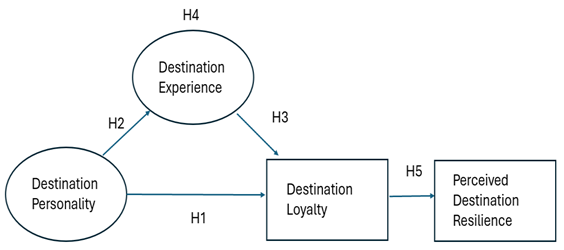
4. Research Method
4.1. Data Collection
4.2. Descriptive Statistics
4.3. Preliminary Data Analysis
4.1. Data Collection
5. Results
5.1. Measurement Model Validation

| Indicator | Standardized loading | z-value |
|---|---|---|
| q9. Osaka and the Kansai region are generally sincere and honest. | 0.7609 | 21.54 |
| q10. Osaka and the Kansai region are safe and trustworthy. | 0.7997 | 25.29 |
| q11. Osaka and the Kansai region are peaceful and relaxing. | 0.8281 | 28.63 |
| q14. Osaka and the Kansai region are adventurous and bold. | 0.4528 | 7.32 |
| q15. Osaka and the Kansai region preserve tradition. | 0.6295 | 13.24 |
| q16. Osaka and the Kansai region offer unique experiences that cannot be found elsewhere. | 0.6252 | 12.7 |
| Indicator | Standardized loading | z-value |
| q18. I feel an emotional attachment to Osaka and the Kansai region. | 0.8161 | 25.1 |
| q19. I feel that Osaka and the Kansai region are like my second hometown. | 0.7206 | 17.37 |
| q23. My trip to Osaka and the Kansai region sparked my curiosity about Japanese culture. | 0.8134 | 25.45 |
| q24. I actively participated in tourism activities in Osaka and the Kansai region. | 0.6727 | 14.97 |
| Indicator | Standardized loading | z-value |
| q26. My trip to Osaka and the Kansai region met my overall expectations. | 0.8843 | 51.67 |
| q27. I was satisfied with the overall service quality in Osaka and the Kansai region. | 0.8039 | 30.22 |
| q28. My overall impression and image of Osaka and the Kansai region are positive. | 0.9115 | 66.04 |
| q29. I am satisfied with my overall travel experience in Osaka and the Kansai region. | 0.921 | 73.02 |
| q30. I would recommend Osaka and the Kansai region to others planning a trip. | 0.8913 | 54.58 |
| q31. I will revisit Osaka and the Kansai region. | 0.8479 | 39.17 |
| q32. I prefer to travel in Osaka and the Kansai region with at least one overnight stay. | 0.8143 | 32.03 |
| Indicator | Standardized loading | z-value |
| q33. Osaka and the Kansai region can recover quickly after crises. | 0.8228 | 29.87 |
| q34. Osaka and the Kansai region have well-established safety and disaster response systems. | 0.8463 | 33.47 |
| q35. Local merchants and residents in Osaka and the Kansai region adapt well to changes. | 0.8356 | 32.2 |
| q36. I feel safe visiting Osaka and the Kansai region even during uncertain times. | 0.7487 | 20.61 |
| q37. Osaka and the Kansai region remain attractive travel destinations during difficult times. | 0.7835 | 23.91 |
| Fit Index | Value |
| Chi-square (χ²) | 626.47 |
| Degrees of freedom (df) | 205 |
| χ²/df | 3.06 |
| Comparative Fit Index (CFI) | 0.9 |
| Normed Fit Index (NFI) | 0.88 |
| Incremental Fit Index (IFI) | 0.91 |
| RMSEA | 0.102 |
- 2)
- SEM Hypothesis testing
6. Discussion and Implication
References
- Aaker, D. A. (1991). Managing brand equity: Capitalizing on the value of a brand name. Free Press.
- Aaker, J. L., Benet-Martínez, V., & Garolera, J. (2001). [Study on brand personality across individuals, product categories, and cultural contexts]. [Incomplete reference—publication details not provided].
- ABC News. (2025, July). Japanese disaster claim impacting tourism as deadline approaches. ABC News.
- Ankers, P. (1997). [Study on brand and product personality]. [Incomplete reference—publication details not provided].
- Baloglu, S., Henthorne, T. L., & Sahin, Ş. (2014). Destination image and brand personality of Jamaica: A model of tourist behavior. Journal of Travel & Tourism Marketing, 31(8), 1057-1070. [CrossRef]
- Bentler, P. M., & Bonett, D. G. (1980). Significance tests and goodness of fit in the analysis of covariance structures. Psychological Bulletin, 88(3), 588–606. [CrossRef]
- Benet-Martínez, V., & Garolera, J. (2001). [Study on cultural influences in brand personality]. [Incomplete reference—publication details not provided].
- Bigné, J. E., Sánchez, M. I., & Sánchez, J. (2001). Tourism image, evaluation variables and after-purchase behaviour: Inter-relationship. Tourism Management, 22, 607-616. [CrossRef]
- Biggs, D., Hall, C. M., & Stoeckl, N. (2012). The resilience of formal and informal tourism enterprises to disasters: Reef tourism in Phuket, Thailand. Journal of Sustainable Tourism, 20(5), 645–665.
- Chen, C. F., & Phou, S. (2013). A closer look at destination: Image, personality, relationship and loyalty. Tourism Management, 36, 269-278. [CrossRef]
- Chen, C., & Tsai, M., (2008). Perceived value, satisfaction, and loyalty of TV travel product shopping: Involvement as a moderator. Tourism Management, Volume 29, Issue 6.
- Chi, C. G.-Q., & Qu, H. (2008). Examining the structural relationships of destination image, tourist satisfaction and destination loyalty: An integrated approach. Tourism Management, 29(4), 624-636. [CrossRef]
- Cossío-Silva, F.-J., Revilla-Camacho, M.-Á., & Vega-Vázquez, M. (2019). The tourist loyalty index: A new indicator for measuring tourist destination loyalty? Journal of Innovation & Knowledge, 4(2), 71-77. [CrossRef]
- Cruz-Milán, O. (2023). Loyalty in the time of COVID-19: A review of the literature in tourism destination settings. Frontiers in Psychology, 14, 1119737. [CrossRef]
- Ekinci, Y., & Hosany, S. (2006). Destination personality: An application of brand personality to tourism destinations. Journal of Travel Research, 45(2), 127–139. [CrossRef]
- Hall, C. M., Prayag, G., & Amore, A. (2017). Tourism and Resilience: Individual, organisational and destination perspectives. Channel View Publications.
- Hu, L., & Bentler, P. M. (1999). Cutoff criteria for fit indexes in covariance structure analysis: Conventional criteria versus new alternatives. Structural Equation Modeling: A Multidisciplinary Journal, 6(1), 1–55. [CrossRef]
- Jeong, Y., Kim, E., & Kim, S.-K. (2020). Understanding active sport tourist behaviors in small-scale sports events: Stimulus-organism-response approach. Sustainability, 12(19), 8192. https://www.mdpi.com/2071-1050/12/19/8192/pdf.
- Japan National Tourism Organization. (2025, September). Japan tourism statistics. Data list | Japan Tourism Statistics.
- Japan Today. (2025, August). Osaka anticipates steady growth, but serious bottlenecks remain in Japan's tourist infrastructure. Japan Today.
- Kim, H., & Stepchenkova, S. (2017). Understanding destination personality through visitors’ experience: A cross-cultural perspective. Journal of Destination Marketing & Management, 6(4), 416–425. [CrossRef]
- Kim, J.-H., Ritchie, J. R. B., & McCormick, B. (2010). Development of a Scale to Measure Memorable Tourism Experiences. Journal of Travel Research, 51(1), 12-25. (Original work published 2012). [CrossRef]
- Kim, S., & Lehto, X. Y. (2012). Projected and perceived destination brand personalities: The case of South Korea. Journal of Travel Research, 52(1), 117–130. [CrossRef]
- Kumar, V., & Nayak, J. K. (2016). Destination personality and self-congruity in predicting tourist behaviour. Journal of Destination Marketing & Management, 6(4), 363–372.
- Murphy, L., Benckendorff, P., & Moscardo, G. (2007). Linking Travel Motivation, Tourist Self-Image and Destination Brand Personality. Journal of Travel & Tourism Marketing, 22(2), 45–59. [CrossRef]
- Nikkei News. (2025, July). 大阪府のインバウンド客、25年1〜6月は最多の847万人 高額消費は減少 [Osaka Prefecture’s inbound visitors hit record 8.47 million in Jan–Jun 2025, but high spending declines]. 日本経済新聞 (The Nikkei).
- Oppermann, M. (2000). Tourism destination loyalty. Journal of Travel Research, 39 (1), 78-84. [CrossRef]
- Prayag, G., Hosany, S., Muskat, B., & Chiappa, G. (2016). Understanding the Relationships between Tourists’ Emotional Experiences, Perceived Overall Image, Satisfaction, and Intention to Recommend. Journal of Travel Research. https://journals.sagepub.com/doi/10.1177/0047287515620567.
- Pullman, M. E., & Gross, M. A. (2004). Ability of experience design elements to elicit emotions and loyalty behaviors. Decision Sciences, 35(3), 551–578.
- Ritchie, J. R. B., & Ritchie, R. J. B. (1998, September). The branding of tourism destinations: Past achievements and future challenges. In P. Keller (Ed.), Destination marketing: Scope and limitations – Proceedings of the 48th Annual Congress of the International Association of Scientific Experts in Tourism (AIEST), Marrakech, Morocco (pp. 89-116).
- Rojas-Méndez, J. I., Erenchun Podlech, I., & Silva-Olave, E. (2004). [Study on brand personality in cultural contexts]. [Incomplete reference—publication details not provided].
- Seabra, C., Dolnicar, S., & Abrantes, J. (2020). Risk perception and travel behavior: What have we learned? Tourism Management.
- Sharma, P., & Nayak, J. K. (2019). Understanding memorable tourism experiences as the determinants of tourists' behaviour. International Journal of Tourism Research, 21(4), 504-518.
- Stylos, N., Bellou, V., Andronikidis, A., & Vassiliadis, C. A. (2017). Linking the dots among destination image, place attachment and revisit intentions: A study among British and Russian tourists. Journal of Travel Research, 54(3), 302-315.
- Tešin, A., Kovačić, S., & Obradović, S. (2023). The experience I will remember: The role of tourist personality, motivation, and destination personality. Journal of Vacation Marketing, 29(3), 13567667231164768.
- Usakli, A., & Baloglu, S. (2011). Brand personality of tourist destinations: An application of self-congruity theory. Journal of Travel Research, 50(5), 501–514.
- Yoon, Y., & Uysal, M. (2005). An examination of the effects of motivation and satisfaction on destination loyalty: A structural model. Tourism Management, 26(1),4556. [CrossRef]
- Zeugner-Roth, K. P., Žabkar, V., & Diamantopoulos, A. (2015). Consumer ethnocentrism, national identity, and consumer cosmopolitanism as drivers of consumer behavior: A social identity theory perspective. Journal of International Marketing, 23(2), 25-54. [CrossRef]
| Variable | Category | Number & Distribution (%) |
|---|---|---|
| Gender Age (years) Purpose of visit Average length of stay Annual household income (KRW) |
Male Female 18–24 25–34 35–44 45–54 55–64 ≥ 65 Leisure/tourism Business Visiting friends/relatives Osaka Expo 2025 (planned) Other (e.g., education, fieldwork, group tours) None Once 2–3 times ≥ 4 times Day trip–1 night 2–3 nights 4–5 nights ≥ 6 nights < 20 million 20–39.9 million 40–59.9 million 60–79.9 million 80–99.9 million ≥ 100 million |
93 (47.0) 105 (53.0) 12 (6.1) 31 (15.7) 43 (21.7) 59 (29.8) 25 (12.6) 28 (14.1) 137 (69.0) 22 (11.0) 15 (7.6) 10 (5.0) 14 (7.4) 43 (21.7) 97 (49.0) 49 (24.7) 9 (4.5) 6 (3.0) 113 (57.0) 65 (33.0) 12 (6.0) 26 (13.0) 36 (18.0) 36 (18.0) 30 (15.0) 28 (14.0) 42 (22.0) |
| Paths | Path | Standardized β | SE | z | p-value | Hypothesis |
|---|---|---|---|---|---|---|
| H1 | DP → DL | 0.49 | 0.083 | 5.88 | < .001 | supported |
| H2 | DP → DE | 0.74 | 0.046 | 15.96 | < .001 | supported |
| H3 | DE→DL | 0.4 | 0.085 | 4.69 | < .001 | supported |
| H5 | DL → PDR | 0.734 | 0.038 | 19.22 | < .001 | supported |
| Indirect Path H4 | Standardized β | SE | z | p-value | 95% CI | |
| DP →DE→DL | 0.306 | 0.306 | 2.89 | 0.004 | [.098, .514] | supported (partial mediation) |
Disclaimer/Publisher’s Note: The statements, opinions and data contained in all publications are solely those of the individual author(s) and contributor(s) and not of MDPI and/or the editor(s). MDPI and/or the editor(s) disclaim responsibility for any injury to people or property resulting from any ideas, methods, instructions or products referred to in the content. |
© 2025 by the authors. Licensee MDPI, Basel, Switzerland. This article is an open access article distributed under the terms and conditions of the Creative Commons Attribution (CC BY) license (https://creativecommons.org/licenses/by/4.0/).


