

Submitted:
26 November 2025
Posted:
26 November 2025
You are already at the latest version
Abstract
Human civilization has advanced through a sequence of profound transitions—from foraging bands to agricultural societies, industrial economies, information networks, and the emerging era of machine intelligence. Yet existing explanatory frameworks remain fragmented across disciplinary boundaries. This study proposes a transdisciplinary model that identifies cognitive breakthroughs as the primary driver of civilization evolution. These breakthroughs trigger two co-evolving mechanisms: paradigm substitution, which restructures technological and institutional orders, and efficiency intensification, which deepens the potential of the new paradigm. Together, they form an upward spiral—the Cognition-Substitution-Intensification (CSI) model—that governs long-run antihistorical dynamics. By integrating insights from complex systems theory, energy history, information theory, and innovation studies, the CSI model provides a unified explanation of past civilization transitions and offers a forward-looking framework for understanding the rise of intelligent civilization. The model further suggests that artificial intelligence, bio-computation, and quantum systems may constitute the next major cognitive breakthrough, reshaping the trajectory of human societies.
Keywords:
civilization evolution
; transmissibility
; complex systems
; cognitive breakthroughs
; paradigm substitution
; efficiency intensification
; unified model
1. Introduction: From Transdisciplinary Inquiry to a Unified Model
The long arc of human civilization—from small bands of foragers to globally interconnected societies—has inspired extensive scholarly inquiry across history, sociology, economics, archaeology, and the philosophy of science. Yet these disciplines often illuminate only discrete fragments of the civilizational process [1]. Historians emphasize empirical contingencies [1];sociologists focus on structural differentiation; economists model growth dynamics [2];and historians of technology trace internal technological trajectories [3,4].
Such disciplinary perspectives operate like narrow spotlights—each illuminating a portion of civilization’s structural landscape, but rarely revealing the underlying generative mechanisms. A transdisciplinary approach is therefore required, one capable of synthesizing insights across energy flows, information processing, technological paradigms, and institutional change [5,6,7].
Complex systems research conceptualizes civilization as an energy-processing and informatic processing system [8]. Information theory further demonstrates that increases in encoding and processing capacity strongly correlate with increased system complexity [9]. Historical evidence also points to long-wave structural transitions such as agrarian, industrial, and informational revolutions, each triggered by fundamental changes in epistemic capacity [10,11,12].
These observations motivate a deeper question: Is there a primary first-principles mechanism that governs civilization evolution?
We argue that the answer lies in cognitive breakthroughs—transformations in collective information-processing architectures that alter energy use, technological paradigms, and institutional ordering. These breakthroughs initiate two coupled mechanisms: (1) paradigm substitution, characterized by structural rupture and creative destruction [13], and (2) efficiency intensification, corresponding to long periods of optimization following paradigm stabilization [14,15,16].
These processes form a positive-feedback spiral: the Cognition-Substitution-Intensification (CSI) model.
2. The Core Framework: The Cognition-Substitution-Intensification Spiral
This section presents the complete theoretical foundation of the Cognition-Substitution-Intensific. (CSI) model by integrating conceptual analysis with a formal mathematical structure. The CSI spiral proposes that civilization evolution is driven by recursive interactions among (1) cognitive breakthroughs, (2) paradigm substitution, and (3) efficiency intensification. The following subsections provide a unified conceptual-mathematical exposition.
2.1. Cognitive Breakthroughs as Primary Drivers
Cognitive breakthroughs refer to qualitative expansions in a civilization’s collective information-processing capacity. These breakthroughs include the emergence of symbolic systems (language, writing), epistemic frameworks (scientific method), computational architectures (digital computing), and algorithmic cognition (machine learning). Each breakthrough re-structures the cognitive boundary conditions of civilization and increases its ability to manage complexity [12,17].
Formally, cognitive capacity evolves as:
where: denotes accumulated knowledge stock, denotes technological complexity, denotes information-processing efficiency, is a knowledge-creation function, is the cognitive acceleration coefficient.
This formulation aligns with information-centric theories of civilization development [8].
2.2. Paradigm Substitution: Mechanism of Revolutionary Change
Paradigm substitution describes discontinuous structural transformations, such as:
- energy regime shifts (biomass → fossil fuels → renewable),
- technological revolutions (mechanization, electrification, digitization),
- institutional transitions (sheikdoms → bureaucratic states).
These transitions are triggered when systemic complexity exceeds cognitive capacity, generating a cognitive bottleneck.
Formally:
where: is substitution intensity, is cognitive load (systemic complexity), is the cognitive threshold, is the substitution sensitivity coefficient.
2.3. Efficiency Intensification: Deepening the Paradigm
Once a new paradigm stabilizes, the system enters a long phase of optimization and refinement. Efficiency intensification includes:
- energy efficiency gains,
- spatial intensification (urban density, agricultural yield),
- temporal intensification (communication and transport speed),
- informational intensification (Moore’s law [16]),
- organizational intensification (lean systems, bureaucratic rationalization).
Formally:
where measures intensification efficacy and reflects the magnitude of substitution-induced potential.
2.4. Unified Spiral Dynamics of Civilizational Evolution
The overall civilization potential emerges from interactions among cognition, intensification, and energy availability:
where denotes accessible energy resources.
The system evolves along a self-reinforcing spiral:
This dynamic captures the empirical structure of civilization history: each cognitive breakthrough triggers new paradigms, which are subsequently intensified until new bottlenecks appear [14,18,19]. The result is a cyclical yet upward evolutionary trajectory.
Figure 1.
The Cognition-Substitution-Intensification Spiral.
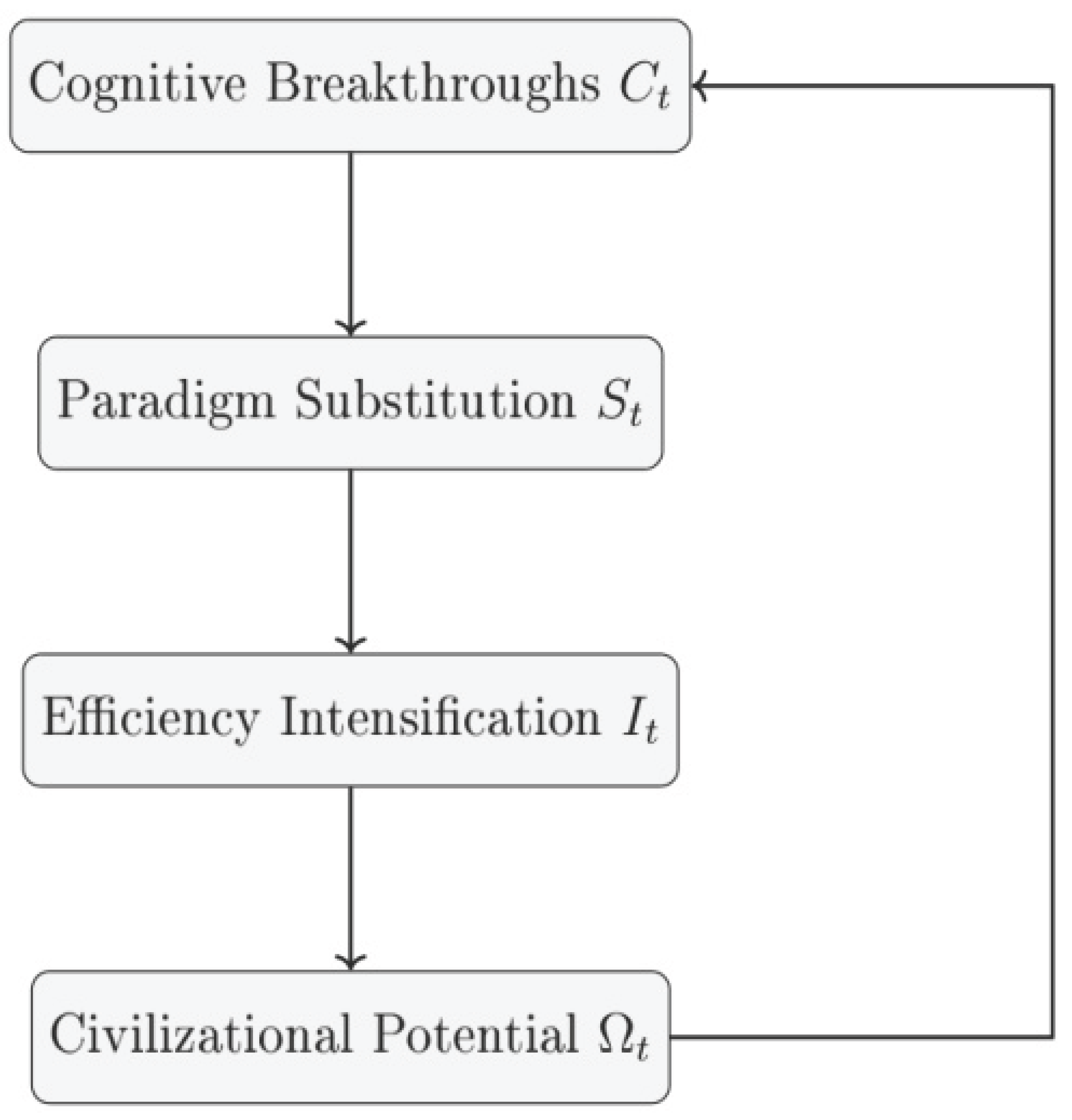
This schematic illustrates the recursive and self-reinforcing structure underlying antihistorical civilization dynamics.
3. Case Studies: Historical Evidence for the CSI Model
To substantiate the CSI model, we examine four major civilization transitions: the emergence of agriculture, the rise of industrial civilization, the digital revolution, and the ongoing shift toward intelligent civilization. This approach aligns with Big History and long-cycle studies [1,20].
Each transition reflects a pattern: cognitive breakthroughs precede structural substitutions, followed by prolonged intensification phases. For example, the Industrial Revolution relied not simply on machinery but on the epistemic revolution of scientific reasoning [17].
The digital revolution exhibits similar patterns. The invention of the transistor and integrated circuits produced rapid substitution of analog systems, while decades of Moore’s law represent intensification [16].
These processes support the model’s claim that civilization evolves through alternating cycles of disruption and optimization [20].

Table 1.
Historical Validation of the CSI Model.
| Civilization Stage | Cognitive Breakthrough | Paradigm | Substitution | Efficiency | Intensification | Outcome |
| Hunter-Gatherer → Agricultural | language; domestication knowledge | nomadism agriculture | to settled agriculture | irrigation; fertilized tools | calendars; refined tools | rise in population and complexity |
| Agricultural → Industrial | scientific method; chemical reasoning | mechanization; fuels | fossil fuels | steam engine optimization; networks | engine engine | productivity explosion |
| Industrial → Informational | computation; information theory | analog → digital | Moore’s law; global internet | global data-driven systems | ||
| Informational → Intelligent | AI; machine cognition | algorithmic making | decision-making | smart grids; automated governance | auto-mated governance | systemic automation |
4. Discussion: Theoretical Advantages of the CSI Model
This section places the cognition-substitution-intensification model within the existing theoretical framework of civilization evolution for comparison, demonstrating its theoretical advantages in terms of integration, dynamics, and predictability.
4.1. Integrative and Transdisciplinary Nature
Traditional explanatory paths of civilization often exhibit biases:
However, these perspectives often illuminate only parts of civilization” and lack a unified framework. The cognition” concept proposed in this study not only encompasses the above elements, but also reveals the internal logic among these variables—energy utilization, institutional forms, and technological systems are, in essence, outward manifestations of cognitive capacity; they are concrete implementations of a civilization’s information-processing architecture.
This view is highly consistent with complex adaptive systems (CAS) theory: a system’s structure and function are expressions of its “cognitive architecture” [23]. Therefore, this model possesses a natural advantage in disciplinary integration and can explain the convolution of technology, institutions, and culture in civilization evolution, rather than remaining at the level of single-variable explanations.
4.2. Dynamic Character and Explanatory Power
The Substitution-Intensification spiral provides a unified dynamic model for civilization evolution:
- The substitution phase corresponds to short-cycle paradigm revolutions, technological mutations, and institutional reconstruction;
- The intensification phase corresponds to long-cycle optimization, expansion, and deepening of efficiency;
This structure is highly consistent with Trumpeter’s mechanism of creative destruction [15], and it aligns with the macro fluctuation patterns of Gurnets long waves and Operative cycles [14].
Therefore, the model can explain the following phenomena:
- Why civilization development is not continuous and smooth but exhibits leap-like transitions;
- Why technological revolutions are often accompanied by institutional turbulence and cultural reconfiguration;
- Why each new paradigm, once established, enters a prolonged period of efficiency improvement.
This endows the model not only with macro-historical explanatory power, but also with the ability to reveal micro-level mechanisms.
4.3. Predictive and Forward-Looking Power
Global civilization is currently in the early stage of transitionary from an information civilization to an intelligence civilization. Numerous studies indicate that human society is approaching the limits of traditional human cognitive capacity (decision-making complexity, data scale, system coupling degree) [25]. This “cognitive bottleneck” will trigger the next large-scale civilization leap, marked by:
According to this model, the early signals of an “intelligence civilization” are as follows:
- Cognitive breakthroughs — AI, foundation models, cognitive augmentation technologies;
- Paradigm substitution — human-centered decision-making → human-AI collaborative decision-making;
- Efficiency intensification — comprehensive improvement in algorithmic efficiency, energy dispatch efficiency, and organizational efficiency.
These trends are highly consistent with the predictions of the civilization cycle school regarding the age of knowledge civilization [22], and they accord with contemporary histories of science and technology that point to an intelligent paradigm shift.
Thus, the model possesses strong forward-looking predictive capacity: it not only explains the past, but also extrapolates the possible trajectories of future civilization.
5. Conclusions
The Cognition-Substitution-Intensification spiral model proposed in this paper provides a genuinely transdisciplinary unified framework for understanding the evolution of civilization. It views human civilization as a cognition-driven, complex self-organizing system: every civilization leap is the outcome of an upgrade in its cognitive architecture, while technological revolutions, institutional innovations, and changes in energy utilization are outward manifestations of this upgrade.
From the discussion and case analysis of the four major historical civilization transitions, we observe:
- Cognitive breakthroughs are the prime mover: they reshape the information-processing architecture of civilization and its capacity for energy regulation.
- Paradigm substitution is the transition mechanism: it triggers structural reorganization and creative destruction.
- Efficiency intensification is the process of paradigm deepening: it unlocks the potential of the new paradigm and ushers civilization into a steady phase of expansion.
The Cognition-Substitution-Intensification spiral not only depicts the past of civilization but also illuminates possible future trajectories. In the context of rapid advances in intelligent technologies and rising global system complexity, the model underscores the looming cognitive bottleneck and the potential for an “intelligence breakthrough, offering substantial theoretical significance and strategic insight.
Author Contributions
Conceptualization, X.Z. and H.L.; methodology, X.Z. and H.L.; formal analysis, X.Z.; writing—original draft preparation, X.Z.; writing—review and editing, X.Z. and H.L.; visualization, X.Z. All authors have read and agreed to the published version of the manuscript.
Funding
This research received no external funding.
Acknowledgments
The authors would like to express their gratitude to multiple AI models (such as ChatGPT, DeepSeek, TRAE, etc.) for their assistance. Their assistance has enhanced the depth and comprehensiveness of their thinking, the speed of paper writing, and the verification of some test results.
Conflicts of Interest
The authors declare no conflict of interest.
References
- Morris, I. (2010). Why the West Rules–for Now: The Patterns of History and What They Reveal About the Future. Farrar, Straus, and Giroux, 2010.
- Ayres, R. U. and Warr, B. (2009). The economic growth engine: how energy and work drive material prosperity. In The Economic Growth Engine. Edward Elgar Publishing.
- Mokyr, J. (1990). The Lever of Riches. Oxford University Press.
- Perez, C. (2002). Technological Revolutions and Financial Capital. Edward Elgar. [CrossRef]
- Odum, H. T. (2007). Environment, power, and society for the twenty-first century: the hierarchy of energy. Columbia University Press..
- Hidalgo, C. (2015). Why information grows: The evolution of order, from atoms to economies. Basic Books.
- North, D. (1990). Institutions, Institutional Change and Economic Performance. Cambridge University Press.
- Chaisson, E. (2002). Cosmic Evolution: The Rise of Complexity in Nature. Harvard University Press.
- Shannon, C. E. (1948). A mathematical theory of communication. The Bell system technical journal, 27(3), 379-423.
- Kuhn, T. (1962). The Structure of Scientific Revolutions. University of Chicago Press.
- Diamond, J., & Guns, G. (1997). Steel: The fates of human societies.
- Freeman, C., & Louça, F. (2001). As time goes by: the information revolution and the industrial revolutions in historical perspective. Oxford University Press, Inc..
- Schumpeter, J. A. (2013). Capitalism, socialism and democracy. Routledge.
- Moore, G. E. (1998). Cramming more components onto integrated circuits. Proceedings of the IEEE, 86(1), 82-85. [CrossRef]
- Arthur, W. B. (2009). The nature of technology: What it is and how it evolves. Simon and Schuster.
- Xinqi,Z., Chunlu X. and Zhiyuan Y., (2014).Intensive Variable and Its Application, Springer Berlin.
- LeCun, Y., Bengio, Y., & Hinton, G. (2015). Deep learning. nature, 521(7553), 436-444.
- Grinin, L., Korotayev, A., Tausch, A. (2016). Kondratieff Waves in the World System Perspective. In: Economic Cycles, Crises, and the Global Periphery. International Perspectives on Social Policy, Administration, and Practice. Springer, Cham.
- Kurzweil, R. (2005). The singularity is near. In Ethics and emerging technologies. Palgrave Macmillan UK.
- Turchin, P. and Nefedov, S. (2009). Secular Cycles. Princeton University Press.
- Smil, V. (2018). Energy and civilization: a history. MIT press.
- Patterson, D., Gonzalez, J., Le, Q., Liang, C., Munguia, L. M., Rothchild, D., ... & Dean, J. (2021). Carbon emissions and large neural network training. arXiv preprint arXiv:2104.10350.
- Holland, J. H. (1995). Hidden order: how adaptation builds complexity.Mass.
- Allen, R. C. (2009). The British industrial revolution in global perspective. Cambridge University Press.
- Helbing, D. (2013). Globally networked risks and how to respond. Nature, 497(7447), 51-59. [CrossRef]
- Arute, F., Arya, K., Babbush, R., Bacon, D., Bardin, J. C., Barends, R., ... & Martinis, J. M. (2019). Quantum supremacy using a programmable superconducting processor. Nature, 574(7779), 505-510. [CrossRef]
Disclaimer/Publisher’s Note: The statements, opinions and data contained in all publications are solely those of the individual author(s) and contributor(s) and not of MDPI and/or the editor(s). MDPI and/or the editor(s) disclaim responsibility for any injury to people or property resulting from any ideas, methods, instructions or products referred to in the content. |
© 2025 by the authors. Licensee MDPI, Basel, Switzerland. This article is an open access article distributed under the terms and conditions of the Creative Commons Attribution (CC BY) license (http://creativecommons.org/licenses/by/4.0/).
Copyright: This open access article is published under a Creative Commons CC BY 4.0 license, which permit the free download, distribution, and reuse, provided that the author and preprint are cited in any reuse.


