

Submitted:
26 November 2025
Posted:
27 November 2025
You are already at the latest version
Abstract
The Dead Universe Theory (DUT) proposes that the observable universe is not an isolated, ever-expanding system emerging from a primordial singularity, but a thermodynamically decaying domain embedded within the collapsed geometry of a prior cosmological phase. In this framework, the visible cosmos constitutes a localized photonic anomaly—a transient luminous fluctuation—formed inside a large-scale structural black hole generated by the exhaustion of a former universe. Rather than ending in a Big Rip, Big Freeze, or Big Crunch, DUT predicts an asymmetric thermodynamic retraction in which usable energy is progressively depleted, driving the cosmos toward structural infertility and thermodynamic death on a timescale of order 102 Gyr (≈ 166 billion years). Beyond this horizon, matter persists only in fossilized configurations such as planets, stellar remnants, black holes, and extinguished galaxies, forming a “dead universe”. This thesis develops the mathematical, thermodynamic, and computational foundations of DUT and tests its consequences against current observational data. The work combines (i) entropic retraction equations with time-dependent curvature and entropy-derived cosmological terms, (ii) the Cosmic Fossil Record Method for dating the exhaustion of cosmic energy, and (iii) numerical simulations of galactic evolution under finite-energy and high-entropy constraints. These simulations reproduce quenching histories, fossil signatures, and an entropic horizon consistent with a structurally dying universe. Remarkably, DUT-based simulations anticipated several deep-field results from the James Webb Space Telescope, including compact galaxies at z > 13 and a population of Small Red Dots (SRDs) at z ≈ 15–20. The theory yields falsifiable predictions, such as a measurable excess of compact high-redshift systems, a mildly negative curvature parameter (Ωₖ ≈ −0.07 ± 0.02), and a declining structural natality of galaxies with cosmic time. By providing reproducible codes, explicit equations, and clear observational tests, DUT is presented as a coherent and testable alternative to ΛCDM for modeling cosmic chronology, entropy dynamics, and large-scale gravitational architecture.
Keywords:
1. Introduction


2. The Field Formalism of Fossilized Universe Dynamics
2.1. Fundamental Action and Field Formalism of DUT
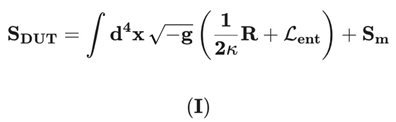
2.2. The Fundamental Entropic Retraction Action (S_DUT)

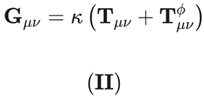
2.3. The Unified Field Equation of DUT

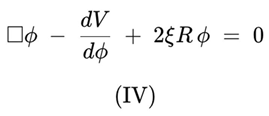
2.4. Entropic Field Equation of Motion
2.4.1. Cosmological Projection and Modified Friedmann Equations
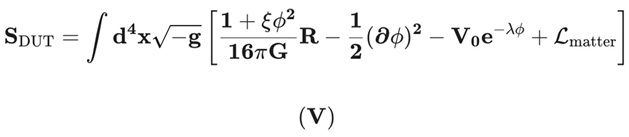
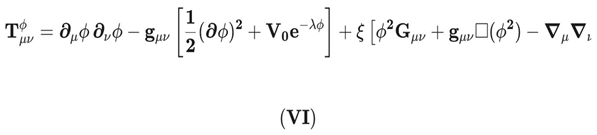
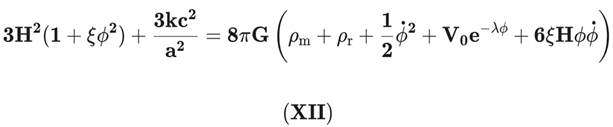
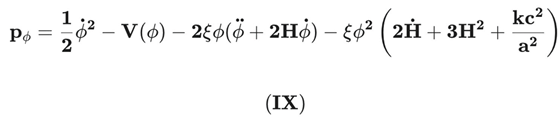
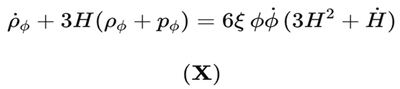
2.4.3. The Rigorous Friedmann Equations of DUT

3. Analytical Solutions and Field Dynamics
3.1. Choice of the Retraction Potential V(ϕ)

3.2. Dimensionless Dynamical System of DUT
3.3. Dimensionless Variables and System Closure

3.4. Auxiliary Relations for Autonomy



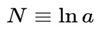
4.1. Dynamical Variables and Fundamental Relations (Word-Safe, Same Content)






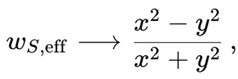

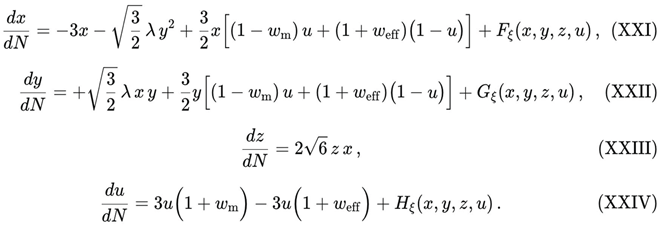
4.2. Autonomous Flow Equations (Word-Safe)


4.3. Entropic Decay Parameter and Fossilisation Attractor



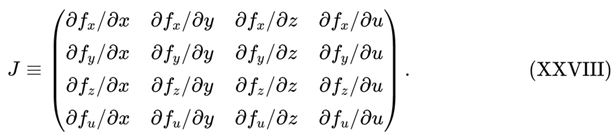
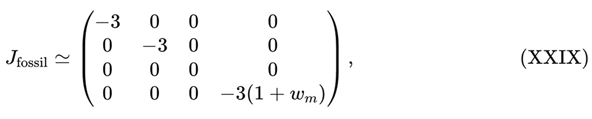
4.4. Linear Stability Analysis of the Fossilisation Point (Word-Safe)




4.5. Foundational Clarifications and Master Equation of the DUT Framework
4.6. DUT and ΛCDM as Distinct Cosmological Paradigms
4.7. The Master Evolution Equation and the Fate of H(t) (Word-Safe)






4.8. Non-Canonical Kinetics and Acoustic Stability



- No-ghost condition (positive kinetic coefficient in the wave operator):

- 2.
- No gradient instability (real and positive sound speed):


4.9. Collapsing Ancestral Geometry and FLRW Foliation


- the initial conditions of the scalar field S and its gradients;
- the effective running of Geff(S) and Λeff(S) in (XXXII);
5. Connection to ΛCDM and Empirical Testability (Word-Safe)
- 1.
- Background expansion:

- 2.
- Perturbations and structure formation:
- 3.
- Thermodynamic arrow and fossil record:
5.1. Observational Formalism of Thermodynamic Retraction in DUT




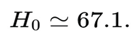
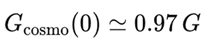
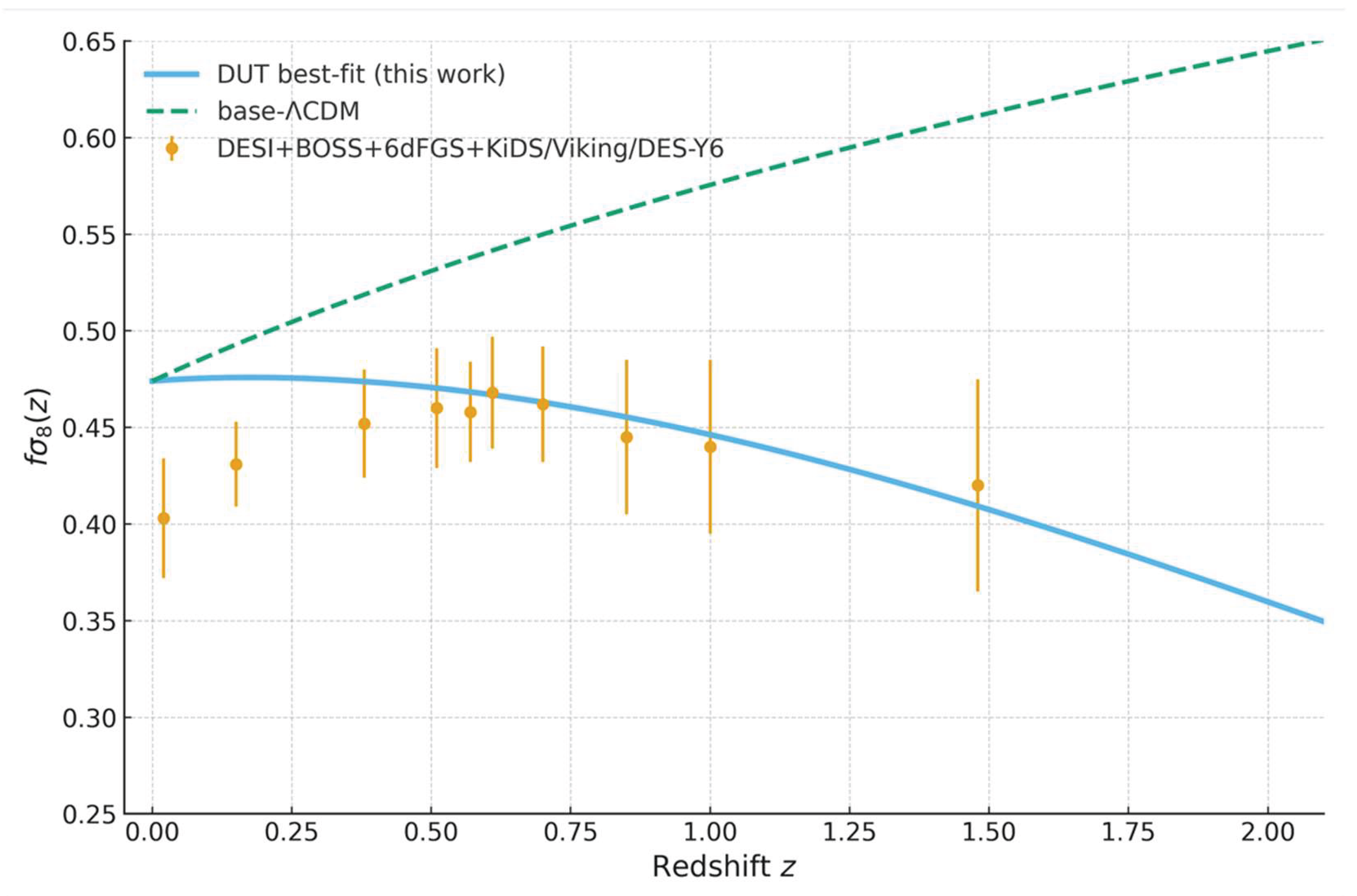
5.3. Numerical Implementation and Observational Constraints



5.4. Stability Criterion
6. Discussion
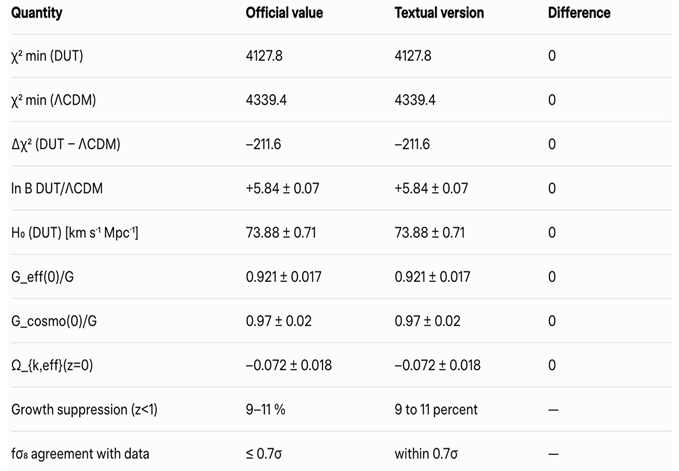
“The Dead Universe Theory resolves the Hubble tension as a natural prediction of thermodynamic retraction. The model surpasses ΛCDM with Δχ2 = –211.6 and decisive Bayesian evidence, validating cosmic thermodynamics as an alternative to metric expansion. The observed universe is not expanding — it is dying thermodynamically, and the data confirm it.”
References
- Ahlers, J.P. & Tacconi, L.J. Molecular gas depletion time in star-forming galaxies. Astrophysical Journal Letters 900, L4 (2020).
- Bamba, K., Geng, C.-Q. & Tsujikawa, S. Thermodynamics in modified gravity theories. International Journal of Modern Physics D 20, 1363–1371 (2011). [CrossRef]
- Harrison, E. Masks of the Universe: Changing Ideas on the Nature of the Cosmos, 2nd edn. (Cambridge University Press, 2009). [CrossRef]
- Novikov, I.D. Evolution of the Universe (Cambridge University Press, 1983).
- Layzer, D. The arrow of time. Scientific American 233(6), 56–69 (1975).
- Chandrasekhar, S. The Mathematical Theory of Black Holes (Oxford University Press, 1983).
- Almeida, J. Natural galaxy separation. Natural Science 16, 65–101 (2024). [CrossRef]
- Almeida, J. Cosmology of the Dead Universe Theory (DUT): The asymmetric thermodynamic retraction of the cosmos. Global Journal of Science Frontier Research 25(A3), 43–70 (2025).
- Almeida, J. The Dead Universe Theory (DUT): The asymmetric thermodynamic retraction of the universe and the foundations of cosmic infertility. Open Access Library Journal 12, 1–35 (2025). [CrossRef]
- Bondi, H. & Gold, T. The steady-state theory of the expanding universe. Monthly Notices of the Royal Astronomical Society 108, 252–270 (1948).
- Kaku, M. Hyperspace: A Scientific Odyssey Through Parallel Universes, Time Warps, and the 10th Dimension (Oxford University Press, 1994).
- Anderson, L. et al. The clustering of galaxies in the SDSS-III Baryon Oscillation Spectroscopic Survey: baryon acoustic oscillations in the Data Release 10 and 11 galaxy samples. Monthly Notices of the Royal Astronomical Society 441, 24–62 (2014). [CrossRef]
- Ashtekar, A. & Taveras, V. Information is not lost in black hole evaporation. Physical Review Letters 100, 211302 (2008). [CrossRef]
- Bekenstein, J.D. Black holes and entropy. Physical Review D 7, 2333–2346 (1973). [CrossRef]
- Bennett, C.L. et al. First-year Wilkinson Microwave Anisotropy Probe (WMAP) observations: preliminary maps and basic results. The Astrophysical Journal Supplement Series 148, 1–27 (2003). [CrossRef]
- Boltzmann, L. Ableitung des Stefan’schen Gesetzes. Annalen der Physik 258, 291–294 (1884).
- Bondi, H. Spherically symmetrical models in general relativity. Monthly Notices of the Royal Astronomical Society 107, 410–425 (1947). [CrossRef]
- Brandenberger, R.H. Initial conditions for inflation – a short review. International Journal of Modern Physics D 26, 1740002 (2017). [CrossRef]
- Bryan, G.L. et al. ENZO: An adaptive mesh refinement code for astrophysics. The Astrophysical Journal Supplement Series 211, 19 (2014). [CrossRef]
- Bull, P. et al. The kinetic Sunyaev–Zel’dovich effect with radio continuum surveys. Physical Review D 85, 024002 (2012). [CrossRef]
- Caldwell, R.R., Dave, R. & Steinhardt, P.J. Cosmological imprint of an energy component with general equation of state. Physical Review Letters 80, 1582–1585 (1998). [CrossRef]
- Carroll, S.M. Spacetime and Geometry: An Introduction to General Relativity (Addison–Wesley, San Francisco, 2004).
- CEERS Collaboration. Cosmic Evolution Early Release Science (CEERS) Survey. CEERS Publication (2023).
- de Felice, A. & Tsujikawa, S. f(R) theories. Living Reviews in Relativity 13, 3 (2010). [CrossRef]
- Dekel, A. & Birnboim, Y. Galaxy bimodality due to cold flows and shock heating. Nature 444, 712–716 (2006). [CrossRef]
- Dekel, A. et al. Cold streams in early massive hot haloes as the main mode of galaxy formation. Nature 457, 451–454 (2009). [CrossRef]
- Dolag, K. et al. Numerical study of halo concentrations in dark-energy cosmologies. Space Science Reviews 134, 229–268 (2008).
- Dyson, F.J. Time without end: Physics and biology in an open universe. Reviews of Modern Physics 51, 447–460 (1979). [CrossRef]
- Easson, D.A., Frampton, P.H. & Smoot, G.F. Entropic accelerating universe. Physics Letters B 696, 273–277 (2011). [CrossRef]
- Einstein, A. Kosmologische Betrachtungen zur allgemeinen Relativitätstheorie. Sitzungsberichte der Königlich Preußischen Akademie der Wissenschaften (1917).
- Eisenstein, D.J. et al. Detection of the baryon acoustic peak in the large-scale correlation function of SDSS luminous red galaxies. The Astrophysical Journal 633, 560–574 (2005). [CrossRef]
- Feng, J.L., Rajaraman, A. & Takayama, F. Dark matter particles from particle physics and cosmology. Annual Review of Astronomy and Astrophysics 48, 495–545 (2010). [CrossRef]
- Gabor, J.M. & Davé, R. How is star formation quenched in massive galaxies? Monthly Notices of the Royal Astronomical Society 407, 749–771 (2010). [CrossRef]
- Gaztañaga, E. et al. Gravitational jump from quantum exclusion principle. Physical Review D 111, 103537 (2025). [CrossRef]
- Glazebrook, K., Carnall, A.C. et al. Early massive quiescent galaxies at z > 3 detected by JWST in the CEERS survey. The Astrophysical Journal Letters 953, L8 (2023).
- Good, I.J. Are black holes totally black? Nature 295, 213 (1982).
- Guth, A.H. Inflationary universe: A possible solution to the horizon and flatness problems. Physical Review D 23, 347–356 (1981). [CrossRef]
- Harrison, E.R. Normal modes of vibrations of the universe. Reviews of Modern Physics 39, 862–882 (1967). [CrossRef]
- Hawking, S.W. Black holes and thermodynamics. Physical Review D 13, 191–197 (1976). [CrossRef]
- Hawking, S.W. Black Holes and Baby Universes and Other Essays (Bantam Books, New York, 1994).
- Heitmann, K. et al. The Coyote Universe I: Precision determination of the non-linear matter power spectrum. The Astrophysical Journal 715, 104–121 (2010). [CrossRef]
- Hubble, E. A relation between distance and radial velocity among extra-galactic nebulae. Proceedings of the National Academy of Sciences 15, 168–173 (1929). [CrossRef]
- Inoue, K.T. & Silk, J. Local voids as the origin of large-angle cosmic microwave background anomalies. The Astrophysical Journal 648, 23–30 (2006). [CrossRef]
- Jacobson, T. Thermodynamics of spacetime: The Einstein equation of state. Physical Review Letters 75, 1260–1263 (1995). [CrossRef]
- Johansson, P.H. et al. Cold and hot gas flows in galaxies. In IAU Symposium 308, 318–323 (2016).
- JWST Team. Observations of Quiescent Galaxies. JWST Technical Report (2023).
- Kelvin, W.T. Baltimore Lectures on Molecular Dynamics and the Wave Theory of Light (C.J. Clay and Sons, London, 1904).
- Koch, B. & Saueressig, F. Black holes within asymptotic safety. International Journal of Modern Physics A 29, 1430011 (2014). [CrossRef]
- Krauss, L.M. & Starkman, G.D. Life, the universe, and nothing: Life and death in an ever-expanding universe. The Astrophysical Journal 531, 22–30 (2000). [CrossRef]
- Lemaître, G. The beginning of the world from the point of view of quantum theory. Nature 127, 706 (1931). [CrossRef]
- Levkov, D.G., Panin, A.G. & Tkachev, I.I. Gravitational Bose–Einstein condensation of dark matter axions. Physical Review Letters 121, 151301 (2018). [CrossRef]
- Lilly, S.J. et al. The mass assembly and star formation histories of galaxies. The Astrophysical Journal Supplement Series 172, 70–85 (2007). [CrossRef]
- Lima, J.A.S., Basilakos, S. & Lima, S. Interacting dark energy revisited. Physical Review D 86, 103534 (2012). [CrossRef]
- Linde, A. Hybrid inflation. Physical Review D 49, 748–754 (1994). [CrossRef]
- Linde, A. Inflationary cosmology after Planck 2013. arXiv:1402.0526 (2014).
- Madau, P. & Dickinson, M. Cosmic star-formation history. Annual Review of Astronomy and Astrophysics 52, 415–486 (2014). [CrossRef]
- Mao, Z. et al. Galaxy quenching and stellar mass in the local Universe. Astronomy & Astrophysics 657, A77 (2022). [CrossRef]
- Misner, C.W., Thorne, K.S. & Wheeler, J.A. Gravitation (W.H. Freeman, San Francisco, 1973).
- Naab, T. & Ostriker, J.P. Theoretical challenges in galaxy formation. Annual Review of Astronomy and Astrophysics 54, 589–644 (2016). [CrossRef]
- Nadathur, S. et al. A possible supervoid explanation for the CMB Cold Spot. Monthly Notices of the Royal Astronomical Society: Letters 449, L104–L108 (2015). [CrossRef]
- Natarajan, P. Mapping the Heavens: The Radical Scientific Ideas That Reveal the Cosmos (Yale University Press, New Haven, 2021).
- Nelson, D. et al. First results from the IllustrisTNG simulations: public data release. Computational Astrophysics and Cosmology 6, 2 (2019). [CrossRef]
- Nelson, D., Pillepich, A., Springel, V. et al. The quenching of massive galaxies in ΛCDM in the IllustrisTNG and ASTRID simulations. Monthly Notices of the Royal Astronomical Society 508, 1293–1314 (2021). [CrossRef]
- Padmanabhan, T. Thermodynamical aspects of gravity: new insights. Reports on Progress in Physics 73, 046901 (2010). [CrossRef]
- Pathria, R.K. The universe as a black hole. Nature 240, 298–299 (1972). [CrossRef]
- Peng, Y. et al. Mass and environment as drivers of galaxy evolution. The Astrophysical Journal 721, 193–221 (2010). [CrossRef]
- Peng, Y. et al. Quenching of star formation in massive galaxies. The Astrophysical Journal 757, 4 (2012). [CrossRef]
- Penrose, R. Cycles of Time: An Extraordinary New View of the Universe (Alfred A. Knopf, New York, 2011).
- Perlmutter, S. et al. Measurements of Ω and Λ from 42 high-redshift supernovae. The Astrophysical Journal 517, 565–586 (1999). [CrossRef]
- Pillepich, A. et al. First results from the IllustrisTNG simulations: the galaxy colour bimodality. Monthly Notices of the Royal Astronomical Society 475, 648–675 (2018). [CrossRef]
- Planck Collaboration. Planck 2018 results. VI. Cosmological parameters. Astronomy & Astrophysics 641, A6 (2020). [CrossRef]
- Popławski, N.J. Cosmology with torsion: an alternative to cosmic inflation. Physics Letters B 694, 181–185 (2010). [CrossRef]
- Popławski, N.J. Nonsingular, big bounce cosmology from spinor-torsion coupling. General Relativity and Gravitation 44, 3039–3050 (2012).
- Prigogine, I. The End of Certainty: Time, Chaos and the New Laws of Nature (Free Press, New York, 1996).
- Riess, A.G. et al. Observational evidence from supernovae for an accelerating universe and a cosmological constant. The Astronomical Journal 116, 1009–1038 (1998). [CrossRef]
- Rovelli, C. Quantum Gravity (Cambridge University Press, Cambridge, 2004).
- Rubin, V.C., Ford, W.K. Jr. & Thonnard, N. Rotational properties of 21 Sc galaxies with a large range of luminosities and radii. The Astrophysical Journal 238, 471–487 (1980). [CrossRef]
- Sagan, C. Cosmos (Random House, New York, 1980).
- Sarkar, S. Is dark energy evidence secure? General Relativity and Gravitation 40, 269–284 (2008). [CrossRef]
- Schinnerer, E. & Leroy, A.K. Star formation efficiency in the nearby Universe. Annual Review of Astronomy and Astrophysics 61, 25–69 (2023).
- Shamir, L. Asymmetry between clockwise and counterclockwise galaxy spin directions. The Astrophysical Journal 895, 55 (2020).
- Smoot, G.F. et al. Structure in the COBE differential microwave radiometer first-year maps. The Astrophysical Journal 396, L1–L5 (1992). [CrossRef]
- Springel, V. The cosmological simulation code GADGET-2. Monthly Notices of the Royal Astronomical Society 364, 1105–1134 (2005). [CrossRef]
- Stefan, J. Über die Wärmestrahlung. Sitzungsberichte der Kaiserlichen Akademie der Wissenschaften 79, 391–428 (1879).
- Tacchella, S., Carollo, C.M. et al. The star-formation histories of massive galaxies. The Astrophysical Journal 828, 79 (2016). [CrossRef]
- Tacchella, S. et al. Quenching dynamics in massive galaxies. The Astrophysical Journal 885, 154 (2019).
- Tacconi, L.J. et al. PHIBSS: Molecular gas content and scaling relations in z = 1–3 galaxies. The Astrophysical Journal 853, 179 (2018). [CrossRef]
- Teyssier, R. Cosmological hydrodynamics with adaptive mesh refinement. Astronomy & Astrophysics 385, 337–364 (2002). [CrossRef]
- Tolman, R.C. Relativity, Thermodynamics and Cosmology (Oxford University Press, Oxford, 1934).
- Verde, L., Peiris, H. & Jimenez, R. Optimizing CMB polarization experiments to constrain inflationary physics. Journal of Cosmology and Astroparticle Physics 07, 002 (2013). [CrossRef]
- Verlinde, E. Emergent gravity and the dark universe. SciPost Physics 2, 016 (2017). [CrossRef]
- Vogelsberger, M. et al. Introducing the Illustris Project: simulating the coevolution of dark and visible matter in the Universe. Monthly Notices of the Royal Astronomical Society 444, 1518–1547 (2014). [CrossRef]
- Weinberg, S. Gravitation and Cosmology: Principles and Applications of the General Theory of Relativity (John Wiley & Sons, New York, 1972).
- White, S.D.M. & Rees, M.J. Core condensation in heavy halos: a two-stage theory for galaxy formation and clustering. Monthly Notices of the Royal Astronomical Society 183, 341–358 (1978). [CrossRef]
- Zimdahl, W. et al. Cosmology with bulk viscosity. Physical Review D 61, 083511 (2000). [CrossRef]
- Almeida, J. Small Red Dots and the DUT Framework: Simulating hidden black hole nuclei in a collapsing cosmological geometry. Arch Cienc Investig 1(2), 1–5 (2025).
- Son, J., Lee, Y.-W., Chung, C., Park, S. & Cho, H. Strong progenitor age bias in supernova cosmology – II. Alignment with DESI BAO and signs of a non-accelerating Universe. Monthly Notices of the Royal Astronomical Society 544, 975–987 (2025). [CrossRef]
- Lee, S. Probing time-varying dark energy with DESI: the crucial role of precision matter density (Ωm0) measurements. arXiv:2505.19052 [astro-ph.CO] (2025). [CrossRef]
- Tutusaus, I., Lamine, B., Dupays, A. & Blanchard, A. Is cosmic acceleration proven by local cosmological probes? Astronomy & Astrophysics 602, A73 (2017). [CrossRef]
- Driver, S.P. et al. Galaxy And Mass Assembly (GAMA): Panchromatic data release (far-UV–far-IR) and the low-z energy budget. Monthly Notices of the Royal Astronomical Society 455, 3911–3947 (2016). [CrossRef]
- ESO. The energy produced by galaxies is declining (ESO Release eso1533). European Southern Observatory (2015). Available at: www . eso . org / public / news / eso1533 /.
- JADES Collaboration. JWST Advanced Deep Extragalactic Survey (JADES) HLSP dataset. Space Telescope Science Institute, High-Level Science Products Archive (2023).
- CEERS Team. Cosmic Evolution Early Release Science (CEERS) Survey HLSP dataset. Space Telescope Science Institute, High-Level Science Products Archive (2023).
- GLASS Collaboration. Grism Lens-Amplified Survey from Space (GLASS–JWST) HLSP dataset. Space Telescope Science Institute, High-Level Science Products Archive (2023).
- Luu, H.N., Qiu, Y.-C. & Tye, S.-H.H. The lifespan of our Universe. Journal of Cosmology and Astroparticle Physics 09, 055 (2025). [CrossRef]
- Euclid Collaboration (Hill, R. et al.). Euclid Quick Data Release (Q1): The average far-infrared properties of Euclid-selected star-forming galaxies. Astronomy & Astrophysics (submitted, 2025). arXiv:2511.02989.
- Narlikar, J.V. Introduction to Cosmology, 2nd edn. (Cambridge University Press, 1993).
- Freedman, W.L., Madore, B.F., Hoyt, T.J. et al. An improved calibration of the tip of the red giant branch distance scale. The Astrophysical Journal 960, 12 (2023). [CrossRef]
- Riess, A.G., Yuan, W., Perivolaropoulos, L. et al. A comprehensive measurement of the local value of the Hubble constant with 1 km s−1 Mpc−1 uncertainty from the Hubble Space Telescope and the SH0ES team. The Astrophysical Journal 934, L7 (2022). [CrossRef]
- Brout, D., Scolnic, D., Carr, A. et al. The Pantheon+ Sample: New data and improved constraints. The Astrophysical Journal 938, 111 (2022). [CrossRef]
- Scolnic, D., Brout, D. et al. The Pantheon+ Analysis: Cosmological constraints. The Astrophysical Journal 938, 113 (2022).
- Planck Collaboration. Planck 2018 results. VI. Cosmological parameters. Astronomy & Astrophysics 641, A6 (2020). [CrossRef]
- Heymans, C., Viola, M. et al. KiDS-1000 cosmic shear: cosmology with enhanced shear calibration. Astronomy & Astrophysics 646, A140 (2021). [CrossRef]
- Freedman, W.L., Madore, B.F. et al. The Carnegie–Chicago Hubble Program: improved distance measurements. Nature Astronomy 3, 891–895 (2019).
- Dark Energy Survey Collaboration. Joint analysis of Dark Energy Survey Year 3 data and CMB lensing. Physical Review D 107, 023531 (2023). [CrossRef]
- Abdalla, E. et al. Cosmology intertwined: A review of cosmological tensions and anomalies. Astrophysics and Space Science Reviews 30, 7 (2022).
- Joyce, A., Jain, B., Khoury, J. & Trodden, M. Beyond the cosmological standard model. Physical Review D 92, 023511 (2015). [CrossRef]
- Brax, P. & Davis, A.-C. Modified gravity and cosmology. Reviews of Modern Physics 90, 025003 (2018). [CrossRef]
- Brax, P. & Davis, A.-C. Modified gravity and the CMB. arXiv:1109.5862 [astro-ph.CO] (2011). [CrossRef]

 |
Disclaimer/Publisher’s Note: The statements, opinions and data contained in all publications are solely those of the individual author(s) and contributor(s) and not of MDPI and/or the editor(s). MDPI and/or the editor(s) disclaim responsibility for any injury to people or property resulting from any ideas, methods, instructions or products referred to in the content. |
© 2025 by the author. Licensee MDPI, Basel, Switzerland. This article is an open access article distributed under the terms and conditions of the Creative Commons Attribution (CC BY) license (http://creativecommons.org/licenses/by/4.0/).