

Submitted:
23 November 2025
Posted:
26 November 2025
You are already at the latest version
Abstract
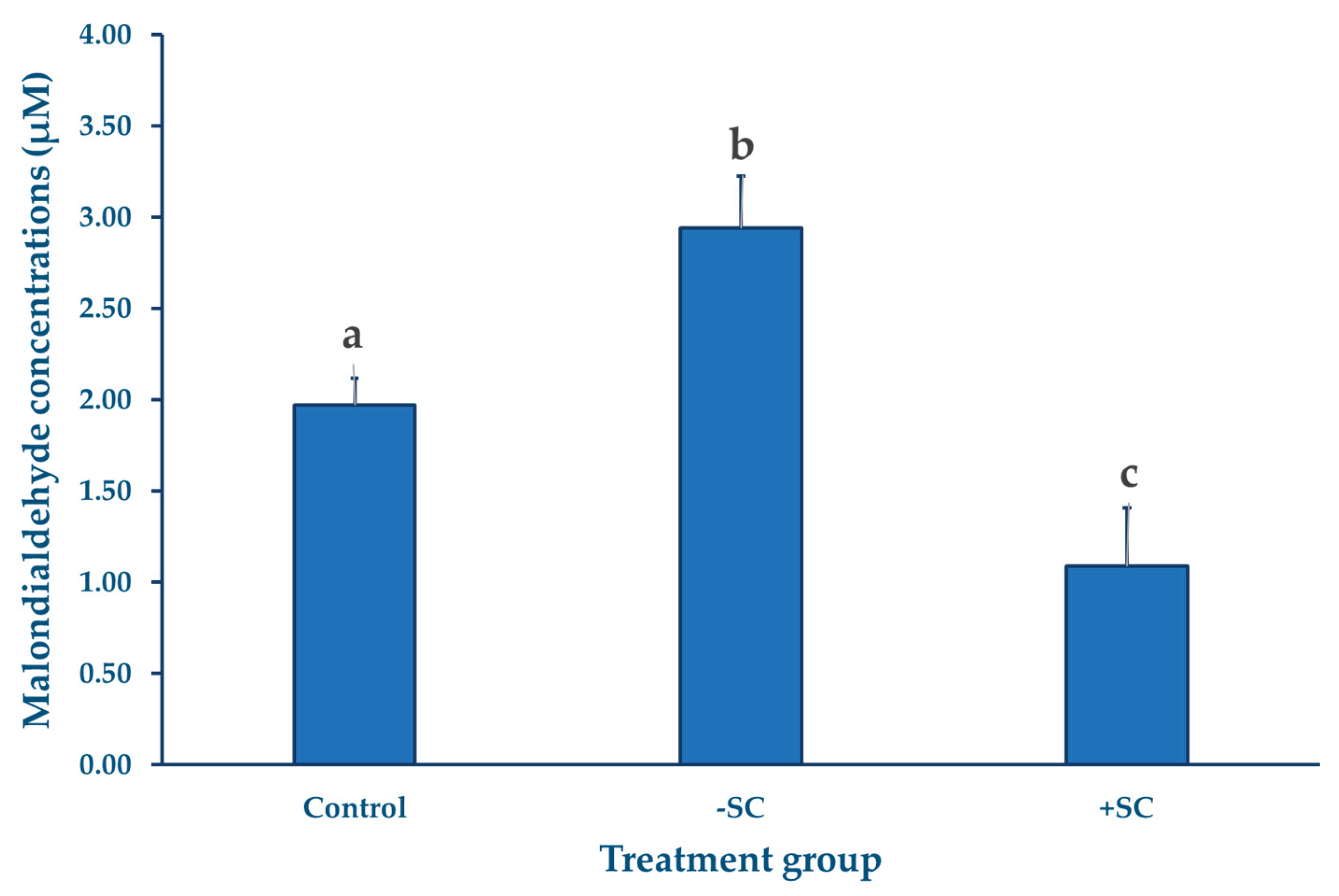
This study investigated the protective effects of sericin during both pre-IVM and IVM phases in bovine oocytes. All oocytes were cultured in tissue culture medium (TCM-199) at 38.5 °C under 5% CO₂ and allocated into three groups: (1) the control group, without H₂O₂ induction and without sericin (control); (2) the oxidative stress group, exposed to 100 µM H₂O₂ for 1 h in collecting media and subsequently cultured in standard medium, (-SC); and (3) the sericin-supplemented group, exposed to H₂O₂ under the same condition as –SC group but supplemented with 0.1% sericin in the collecting medium and 0.05% sericin in the maturation medium (+SC). After culture, two parameters were assessed: nuclear maturation to the metaphase II (MII) stage, evaluated by aceto-orcein staining, and malondialdehyde (MDA) levels, as an indicator of lipid peroxidation. The maturation rates were 70.36 ± 3.94%, 32.62 ± 5.89%, and 74.56 ± 6.05% for the control, -SC, and +SC groups, respectively, with significant differences observed between the -SC group and the control and +SC groups (p < 0.001). The corresponding MDA levels were 1.97 ± 0.14, 2.94 ± 0.28, and 1.09 ± 0.32 µM, with the +SC group showing significantly lower MDA levels than both the control (p < 0.05) and the -SC groups (p < 0.001). These findings demonstrated that sericin supplementation effectively reduced oxidative damage and improved nuclear maturation rates to levels comparable to or exceeding those of the control group, suggesting its potential as a valuable additive for enhancing in vitro culture systems in animal reproductive biotechnology.
Keywords:
1. Introduction
2. Materials and Methods
2.1. Ovaries Collection and Handling
2.2. Cumulus-Oocyte Complexes Recovery and Selection
2.3. Induction of Oxidative Stress and Grouping
2.4. In Vitro Maturation
2.5. Aceto-Orcein Staining
2.6. TBARS (Thiobarbituric Acid Reactive Substances)
2.7. Data Analysis
3. Results
3.1. Oocyte Maturation Assessment
3.2. Measurement of TBARS Levels
4. Discussion
5. Conclusions
Author Contributions
Funding
Institutional Review Board Statement
Informed Consent Statement
Data Availability Statement
Conflicts of Interest
Abbreviations
| ATP | Adenosine Triphosphate |
| COCs | Cumulus–oocyte complexes |
| GJC | Gap junction communication |
| GSH | Glutathione |
| GV | Germinal vesicle |
| GVBD | Germinal vesicle breakdown |
| H₂O₂ | Hydrogen peroxide |
| IETS | International Embryo Technology Society |
| IVC | In vitro culture |
| IVEP | In vitro embryo production |
| IVF | In vitro fertilization |
| IVM | In vitro maturation |
| MI | Metaphase I |
| MII | Metaphase II |
| MDA | malondialdehyde |
| OPU | Ovum pick-up |
| ROS | reactive oxygen species |
| SC | Sericin |
| TBARs | Thiobarbituric Acid Reactive Substances |
| TZPs | Transzonal projections |
References
- Ferré, L.; Kjelland, M.; Strøbech, L.; Hyttel, P.; Mermillod, P.; Ross, P. Recent advances in bovine in vitro embryo production: reproductive biotechnology history and methods. Animal 2020, 14, 991–1004. [Google Scholar] [CrossRef]
- Merton, J.; De Roos, A.; Mullaart, E.; De Ruigh, L.; Kaal, L.; Vos, P.; Dieleman, S. Factors affecting oocyte quality and quantity in commercial application of embryo technologies in the cattle breeding industry. Theriogenology 2003, 59, 651–674. [Google Scholar] [CrossRef]
- Takahashi, M. Oxidative stress and redox regulation on in vitro development of mammalian embryos. Journal of Reproduction and Development 2012, 58, 1–9. [Google Scholar] [CrossRef]
- Guerin, P.; El Mouatassim, S.; Menezo, Y. Oxidative stress and protection against reactive oxygen species in the pre-implantation embryo and its surroundings. Human reproduction update 2001, 7, 175–189. [Google Scholar] [CrossRef]
- Combelles, C.M.; Gupta, S.; Agarwal, A. Could oxidative stress influence the in-vitro maturation of oocytes? Reproductive biomedicine online 2009, 18, 864–880. [Google Scholar] [PubMed]
- Soto-Heras, S.; Paramio, M.-T. Impact of oxidative stress on oocyte competence for in vitro embryo production programs. Research in Veterinary Science 2020, 132, 342–350. [Google Scholar] [CrossRef] [PubMed]
- Zhu, X.; Zuo, L. Characterization of oxygen radical formation mechanism at early cardiac ischemia. Cell Death & Disease 2013, 4, e787–e787. [Google Scholar] [CrossRef] [PubMed]
- Agarwal, A.; Durairajanayagam, D.; Du Plessis, S.S. Utility of antioxidants during assisted reproductive techniques: an evidence based review. Reproductive Biology and Endocrinology 2014, 12, 112. [Google Scholar] [CrossRef]
- Morado, S.A.; Cetica, P.D.; Beconi, M.T.; Dalvit, G.C. Reactive oxygen species in bovine oocyte maturation in vitro. Reproduction, Fertility and Development 2009, 21, 608–614. [Google Scholar] [CrossRef]
- Chappel, S. The role of mitochondria from mature oocyte to viable blastocyst. Obstetrics and gynecology international 2013, 2013, 183024. [Google Scholar] [CrossRef]
- Abd El, H.A.H.M. Lipid peroxidation end-products as a key of oxidative stress: effect of antioxidant on their production and transfer of free radicals. In Lipid peroxidation; IntechOpen, 2012. [Google Scholar]
- Zhang, Y.-Q. Applications of natural silk protein sericin in biomaterials. Biotechnology Advances 2002. [Google Scholar] [CrossRef]
- Aramwit, P.; Kanokpanont, S.; De-Eknamkul, W.; Kamei, K.; Srichana, T. The effect of sericin with variable amino-acid content from different silk strains on the production of collagen and nitric oxide. Journal of Biomaterials Science, Polymer Edition 2009, 20, 1295–1306. [Google Scholar] [CrossRef]
- Gustina, S.; Karja, N.; Hasbi, H.; Setiadi, M.; Supriatna, I. Hydrogen peroxide concentration and DNA fragmentation of buffalo oocytes matured in sericin-supplemented maturation medium. South African Journal of Animal Science 2019, 49, 227–234. [Google Scholar] [CrossRef]
- Satrio, F.; Karja, N.; Setiadi, M.; Kaiin, E.; Gunawan, M.; Memili, E.; Purwantara, B. Improved maturation rate of bovine oocytes following sericin supplementation in collection and maturation media. Tropical Animal Science Journal 2022, 45, 24–29. [Google Scholar] [CrossRef]
- Isobe, T.; Ikebata, Y.; Onitsuka, T.; Wittayarat, M.; Sato, Y.; Taniguchi, M.; Otoi, T. Effect of sericin on preimplantation development of bovine embryos cultured individually. Theriogenology 2012, 78, 747–752. [Google Scholar] [CrossRef] [PubMed]
- Yindeetrakul, S.; Triwutanon, S.; Sangmalee, A.; Rukkwamsuk, T. Optimization of Hydrogen Peroxide Concentrations for Inducing Oxidative Stress in Bovine Oocytes Prior to In vitro Maturation. Animals 2025, 3304. [Google Scholar] [CrossRef] [PubMed]
- Aramwit, P.; Kanokpanont, S.; Nakpheng, T.; Srichana, T. The effect of sericin from various extraction methods on cell viability and collagen production. International Journal of Molecular Sciences 2010, 11, 2200–2211. [Google Scholar] [CrossRef] [PubMed]
- Khatun, H.; Yamanaka, K.-i.; Sugimura, S. Antioxidant sericin averts the disruption of oocyte–follicular cell communication triggered by oxidative stress. Molecular Human Reproduction 2024, 30, gaae001. [Google Scholar] [CrossRef]
- Zhang, X.; Wu, X.Q.; Lu, S.; Guo, Y.L.; Ma, X. Deficit of mitochondria-derived ATP during oxidative stress impairs mouse MII oocyte spindles. Cell research 2006, 16, 841–850. [Google Scholar] [CrossRef]
- Ashibe, S.; Kobayashi, Y.; Toishikawa, S.; Nagao, Y. Effects of maternal liver abnormality on in vitro maturation of bovine oocytes. Zygote 2025, 33, 32–37. [Google Scholar] [CrossRef]
- Tilia, L.; Chapman, M.; Kilani, S.; Cooke, S.; Venetis, C. Oocyte meiotic spindle morphology is a predictive marker of blastocyst ploidy—a prospective cohort study. Fertility and Sterility 2020, 113, 105–113. e101. [Google Scholar] [CrossRef] [PubMed]

| H₂O₂ exposed | Medium | Number of oocytes examined |
Percentage of oocyte at each stage | ||||
| Collection | IVM | GV | GVBD | MI | MII | ||
| 0 µM | 0% SC | 0% SC | 118 | 0 a | 11.77 ± 6.75 a | 17.86 ± 7.71 a | 70.36 ± 3.94 a |
| 100 µM | 0% SCr | 0% SC | 127 | 21.59 ± 5.21 b | 25.76 ± 9.71 b | 20.02 ± 6.46 a | 32.62 ± 5.89 b |
| 100 µM | 0.1% SC | 0.05% SC | 122 | 4.10 ± 0.10 a | 7.40 ± 1.90 a | 13.93 ± 4.57 a | 74.56 ± 6.05 a |
| p-value | < 0.001 | < 0.05 | > 0.05 | < 0.001 | |||
Disclaimer/Publisher’s Note: The statements, opinions and data contained in all publications are solely those of the individual author(s) and contributor(s) and not of MDPI and/or the editor(s). MDPI and/or the editor(s) disclaim responsibility for any injury to people or property resulting from any ideas, methods, instructions or products referred to in the content. |
© 2025 by the authors. Licensee MDPI, Basel, Switzerland. This article is an open access article distributed under the terms and conditions of the Creative Commons Attribution (CC BY) license (http://creativecommons.org/licenses/by/4.0/).