

Submitted:
13 December 2025
Posted:
16 December 2025
You are already at the latest version
Abstract
The undeniable scientific fact is that time is information about the numerical order of changes that occur in the time-invariant space that we experience as the Now. Nothing could have happened in some distant physical past because it doesn't exist. We do not have single experimental evidence that time is a dimension in which the universe exists. That’s why the origin of the universe in some distant past is a philosophical-religious research topic. Appropriate scientific research methodology is how the universe we observe works. Astronomical observations confirm that SMBHs in the centre of galaxies throw into intergalactic space fresh energy for the formation of new stars in the form of astrophysical jets. SMBHs are rejuvenating systems of the universe. Evidence-based cosmology research methodology is superior to the Big Bang cosmology research methodology because it has no theoretical assumptions and is strictly empirical. It confirms that the observable universe rejuvenates itself.
Keywords:
Big Bang cosmology
; time
; black holes
; astrophysical jets
1. Introduction
In the Introduction is represented Evidence-based cosmology (EBC) which is based only on astronomical observations. In section two, Initial singularity and inflation are irrational models it is shown that initial singularity and inflation period contradict the first law of thermodynamics. In the section three CMB is the radiation of dark energy it is shown that CMB is the radiation of dark energy. No signal could remain from some physical past of the recombination period because the physical past does not exist. In section four Cosmological redshift model has no theoretical and experimental basis it is proven that the observed redshift of distant galaxies is a gravitational redshift. In section five Gravitational field and gravitational redshift are presented, the new model of gravity and gravitational redshift. In section six, Evidence-based cosmology versus Big Bang cosmology, are compared Big Bang model and the Evidence-based cosmology model.
EBC builds a cosmology model on astronomical observations; EBC has no theoretical standpoints. For EBC, the most fascinating astronomical observations are astrophysical jets, which are produced in AGNs [1]. Astrophysical jets are fresh energy for the formation of new stars. Supermassive black holes in the center of galaxies transform their own old matter into fresh energy in the form of astrophysical jets. In EBC, SMBHs represent the rejuvenating systems of the universe [2].
EBC categorically denies the existence of a physical entity named the physical past in which the universe could have started [3]. The only universe that has physical existence is the one we can observe. Ideas about the beginning of the universe in some distant physical past, are not rational scientific thinking, but irrational dogmatic speculation. EBC is built on astronomical observations. EBC is Evidence-based cosmology. EBC is not mathematical cosmology; in EBC, mathematics serves as a tool. What makes sense in mathematics, does not always make sense in physics. EBC prioritizes the results of astronomical observations over theoretical mathematical constructs.
2. Initial Singularity and Inflation Are Irrational Models
The Big Bang cosmology model scenario of the universe is that before everything started, there was nothing. The universe exploded out of a mathematical point, where pressure, temperature, and density were infinite [4,5]. The empirical methodology of science is the observation of a phenomenon, then the mathematical description, and finally the testing of the model by experiment. In the Big Bang theory, this established character methodology is not taken into account. The initial explosion model and the inflation model are beyond the rational perception and experience of the world because they do not obey the first law of thermodynamics. Epistemologically, they can be said to be irrational, see Figure 1.
To solve inflationary irrationality, Hawking speculated that the energy of matter is positive and the energy of gravity is negative, and their sum is always zero. In the inflation, they multiply What in mathematics is rational, namely, becomes in physics irrational. The energy of matter and the energy of gravity cannot be positive or negative; their values are absolute: , . Hawkin's mathematical solution to the inflation puzzle is a deceptive trick, not a physical solution that satisfies the first law of thermodynamics [2].
In Big Bang cosmology, after the initial explosion, time started running. Before the explosion, there was no time, no space; there was only a mathematical singularity that miraculously exploded. I do not see rationality here; this is dogmatic irrational thinking. Time in the universe exists only as information. In the universe, changes take place, and time is information about the numerical order of the flow of changes that run in space. Universal space is time-invariant; we experience it as Now [3]. The only universe that exists is the one we observe in Now. The initial explosion and the emergence of energy from scratch are human imagination. Not a single quantum has been created in the entire universe, and no quantum will ever be lost.
The emergence of the universe from scratch is not a scientific thought; this is a religious thought. The cosmology of the Big Bang is designed to require a Creator. Before the initial explosion, there was only God, who gave an initial kick that started the universe. The Creator is hidden in the Hawking mathematical trick, which tries to explain how energy may appear from nothing. I'm surprised that today's scientific community of cosmologists hasn't yet made it clear to the lay public that the Big Bang theory doesn't have the scientific realism to be called "science”.
3. CMB Is the Radiation of Dark Energy
The dark energy model has several similarities with the model of superfluid space [6], the model of quantum vacuum [7], and the old model of ether [8]. These are different terms that describe the energy substrate of space, which is 67% of the energy of the universe. 28% of energy represents hypothetical dark matter, and 5% ordinary matter.
The idea that CMB is the radiation from the recombination period about 380000 years after the initial explosion has no scientific validity, because today we know that universal space is time-invariant and nothing could happen in some remote physical past. Yes, events in the universe have numerical order; they follow each other: when change X+1 enters existence, change X no longer exists. When change X+2 enters existence, change X+1 no longer exists. The change that we observe in the present space is the only one that exists. This means that CMB cannot have a source in some physical past, because there is no such past. CMB is the radiation of something that exists in the present space, and this is dark energy. CMB 160.2 GHz is the radiation of dark energy that builds the universal space [2].
In physics textbooks, we can read that the CMB is proof of Big Bang cosmology and that the CMB proves the existence of the recombination period. This is not the truth. The fact is that the CMB discovery proves that universal space radiates this type of radiation. CMB is proving only itself; it cannot prove anything else. The official interpretation of CMB is not scientific. In science, we don’t make such theoretical assumptions, namely, that a given radiation we observe in the present is proof for the existence of some events in the physical past that were never seen. We measure CMB always in the present moment because it is the only one that exists.
In the 21st century, seeing the evolution of the universe in some linear physical past is no longer acceptable; it can be said that it is unscientific. The undisputable scientific fact is that time is merely the information of changes that run in time-invariant space that we experience as Now [3]. Linear temporal perspective in cosmology belongs to history. Today's cosmology is aware that the universal changes run in the Now. A given signal only moves in space and time is its duration. The idea that we see with telescopes in some remote physical past is false. The universe is homogeneous in space and also homogeneous from the perspective of the flow of universal change. This means that after generations, our descendant’s will see the universe the same as we see it today. Homogeneity of the universe is not only spatial-invariant but also time-invariant in the old meaning of the term “time”; it was always as it is today and will look as such forever. Seeing the universe from a gardener's perspective, where a seed develops into a plant, is not appropriate. The universe is not something that evolves. The universe is uncreated, eternal [2]. The right scientific orientation in the study of the universe is to discover how it functions – functional cosmology; the origin of the universe is a religious research perspective.
The common understanding of the majority of physicists today is that material changes run in space-time continuum which is composed of Now’s that follow each other, see Figure 2.
The truth is the opposite. The material changes follow each other in the same Now. With this understanding, we step out of the linear temporal cosmology into the EBC cosmology of Now. This is the radical, inevitable step based on the empirical fact that there is no experimental evidence for a physical past. Imagine that you go to the laboratory for several days and conduct an experiment that you have to repeat several times. The fact is that you run the experiment every day in the same time-invariant space that you experience as Now. Every morning, we wake up in the same Now, but we believe that yesterday we woke up in the previous Now. This is because we experience material changes in the flow of psychological time that runs in our brain [3].
4. Cosmological Redshift Model Has no Theoretical and no Experimental Basis
The Doppler effect is a well-known physical phenomenon. The Doppler effect has never been observed in expanding space. The idea that we have a redshift of light from galaxies because the universe is expanding has no scientific basis. There is no theoretical model of how the frequency of light would change in expanding space. All Doppler effect experiments on Earth have been done in non-expanding space. The claim that the shift of light from galaxies to the red spectrum proves that the universe is expanding has no scientific basis. Redshift proves that light, when moving in the opposite direction of gravity, has a loss of energy. This was predicted by Einstein [9] and measured on the Earth’s surface by Pound and Rebka in 1959 [10]. Claiming that the observed redshift has its origin in the Doppler effect because the universal space expansion is not a scientific way of reasoning. Scientific reasoning is that the observed redshift is well known phenomenon we call gravitational redshift, see Figure 3.
Today, high-precision distance measurement technology makes it possible to measure the hypothetical expansion of the universe on the Earth's surface: “If universal space expands this means that also distances on Earth are expanding. The only question is if these small dilations are measurable. At a distance of 113 km, the velocity of space expansion is 2.665975305E-13 m/s. In one year, this yields 0.0000084132 m. The distance of 0.0000084132 m is 8413 nm. If the universe expands at the declared rate of 72,8 km per Mps, the distance of 113 km will increase by 23 nm per day” [11]. The real motion of galaxies is caused by gravity, the fundamental force of the dynamics of the universe that governs the motion of entire galaxy clusters, including the local supercluster Laniakea, towards the Great Attractor [12,13].
5. Gravitational Field and Gravitational Redshift
The physical origin of gravitational field is variable energy density of dark energy. In intergalactic space, the energy density of dark energy is at its maximum ; in the centre of a stellar objects, the energy density of dark energy diminishes accordingly to the mass of a stellar object , see Eq. (1).
where m is the mass of the black hole and V is its volume. Gravitational mass of a given stellar object can be expressed by the diminished energy density of dark energy in its center, see Eq. (2).
where is the gravitational mass of a stellar object, is the volume of the stelar object, and is the energy density of dark energy in the centre of a stellar object. Gravitational force between two physical objects as follows in Eq. (3).
The Eq. (4) describes gravitational redshift [12]:
where z is the redshift, Δλ is the change
in wavelength, λ is the original wavelength, G is the gravitational
constant, m is the mass of the celestial body, r is the radius from
the center of the mass to the point of emission, c is the speed of light
in a vacuum.
We can combine Eq. (3) and Eq. (4) and we get:
Eq. (5) confirms that the gravitational redshift of a stellar object depends on the energy density of dark energy in its center and at its radius. When the radius gets short, the mass density increases, and the energy density of dark energy in the centre decreases. Imagine we have two stars with the same mass, and one has 1/2 of the radius of the other. The smaller star will have a bigger gravitational redshift. In gravitational blueshift, a photon gains energy from the gravitational field. In gravitational redshift, a photon loses energy because of the gravitational field, see Figure 4.
In gravitational redshift, a photon gains energy from the gravitational field because it moves in the direction of the gravitational vector, see Eq. (6).
In gravitational redshift and blueshift photon exchanges energy with the gravitational field. When a physical object is in free fall, it gains gravitational energy from the gravitational field that turns into kinetic energy of the falling object. When a physical object is thrown in the opposite direction of the gravitational vector, it will experience a loss of its kinetic energy.
The cosmological redshift model lacks a physical explanation for how the expansion of space reduces the energy of the photon: “The dark lines of an absorption spectrum are shifted toward the right or red end of the spectrum. This shift is the result of the expanding universe. As light travels from great distances to Hubble's mirrors, it is stretched to longer and longer red wavelengths, or cosmologically redshifted, as the universe expands. Astronomers can look for known features in an object's spectrum, like these absorption lines, to see if they are shifted from their normal position on the spectrum. The difference between their normal position and their new position is called their cosmological redshift” [16]. The explanation that space expands, thereby extending the wave of the photon, is metaphysical; it is not empirical, because no experiment has been carried out in the laboratory to confirm that space can expand and that expansion increases the wavelength of a photon. On the other hand, gravitational redshift is observed in the laboratory, it is real physics. In Figure 4, we see how the photon moves in the opposite direction of the gravitational vector, resulting in a loss of energy; gravitational redshift has a physical explanation. By contrast, the cosmological redshift has no physical explanation for how a space that stretches takes energy away from a photon; cosmological redshift is a metaphysical idea.
The cosmological redshift is represented by a rubber band on which a sine wave is drawn. When the band is stretched, the sine wave is stretched [17]. This presentation is not appropriate, since the stretching of the rubber band has nothing to do with the decrease in photon energy. The redshifts that are proven by experiments are the Doppler redshift and the gravitational redshift. Cosmological redshift is a metaphysical speculation, and the expansion of the universe is also a metaphysical speculation. In 2023, Sean Yuxiang Wu published the results of his research that Hubble's law can be derived without expanding space [18].
The physicality of the Doppler effect of light is well understood [19], the physicality of gravitational redshift is well understood [10], and cosmological redshift is a metaphysical speculation without empirical evidence. Cosmology cannot be built on metaphysical speculations.
- -
- metaphysical reasoning: universe is expanding (1) expansion causes cosmological redshift (2)
- -
- physical reasoning: we measure gravitational redshift of light from galaxies () → universe is not expanding ().
We see that (1) it is not an empirical scientific fact, and therefore (2) it is not a scientific fact either. On the other hand, () is a scientific fact, and so is () a scientific fact. Metaphysical conclusions can be based on speculation, whereas scientific conclusions are always based solely on empirical data.
5.1. Dark Energy Has no Antigravitational Properties
In the EBC model, dark energy has no antigravitational properties, variable energy density of dark energy carries gravity. In today's physics, dark energy is deeply related to Einstein’s cosmological constant Λ [20]. Einstein introduced a cosmological constant in his model of a static, finite universe in 1917 to prevent expansion or gravitational collapse [21]. After the misinterpretation of gravitational redshift, the model of expanding of the universe model officially accepted in 1929. Einstein renounced his cosmological constant [22]. Until the late 1990s, the prevailing idea was that the cosmological constant is zero. With the idea that the acceleration of the universe might accelerate, the idea arises that the cosmological constant may have a positive value [23]. The puzzle of dark energy as the cause of the expansion of the universe is that there is no clear physical model of how dark energy could cause the expansion of space. The concept of dark energy is closely related to Einstein's cosmological constant and the assumptions of whether its value is zero or whether it has a positive or negative mathematical sign. The author argues that we can’t speculate about the dark energy's antigravitational effects based on the misinterpretation of gravitational redshift and on speculations about the value of the cosmological constant. Traunmüller Hartmut also exposed the empirical weakness of dark energy causing the universe acceleration: “Dark energy is an unpredicted, fictitious form of energy with anti-gravitational properties. It is an embodiment of the cosmological constant Λ, which Einstein introduced as a fudge factor (in the form of an integration constant) when he still believed that the universe ought to be static. This Λ was reintroduced in order to make the observed magnitude versus redshift relation of distant type Ia supernovae compatible with the BB paradigm [24]. The antigravity properties of dark energy have been introduced without a valid theoretical model and without experimental evidence in the lab. In EBC, the variable energy density of the dark energy is the carrier of gravity.
6. Evidence-Based Cosmology Versus Big Bang Cosmology
The ideas of the origin and the initial explosion are not scientific; they are religious and should not be the subject of science. The EBC does not need a Creator. EBC is falsifiable, and the Big Bang cosmology is not falsifiable. Initial explosion is a matter of belief, of faith. The EBC has a huge advantage over the Big Bang cosmology. Supermassive black holes in the centre of galaxies transform old matter into fresh energy in the form of astrophysical jets [1,2]. This process has no beginning and will have no end. The universe is recreating itself; its entropy is constant. It has no irrational theoretical premises and is completely Evidence-based. EBC cosmology is based on direct reading of astronomical data:
- -
- Time is the duration of motion of stars in time-invariant space
- -
- Astrophysical jets are the fresh energy for the formation of new stars
- -
- CMB is the radiation of the universe space
- -
- Gravitational redshift is caused by galaxies gravity.
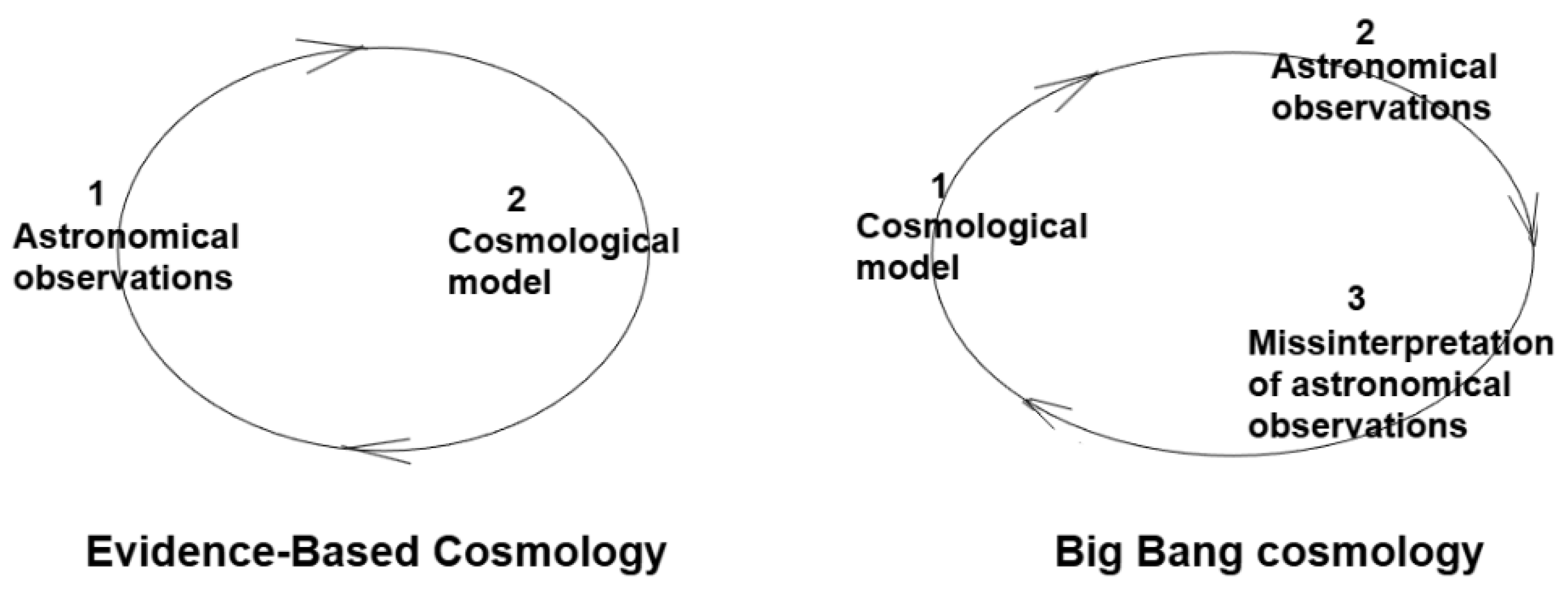
Big Bang cosmology is based on misinterpretation of CMB and gravitational redshift. The adoption of the Big Bang model in science is a sign that the scientific method of the 20th century has succumbed to the methodology of religion. The history of religions shows us that the religious method develops a story that is not rational; it cannot be comprehended with logic and empiricism. Religious stories are a matter of belief. This is also the case with the initial explosion of the Big Bang cosmology. 21st-century science needs to take a critical stance in regard to philosophical-religious methodology. This is the only way to progress cosmology. Big Bang cosmology research methodology is not scientific; it is religious simply because the beginning and creation of energy cannot be explained by empirical scientific means. The initial explosion and inflation belong to the domain of philosophical-religious thought. Evidence-based cosmology research methodology is scientific, see Figure 5.
Evidence-based cosmology uses a bijective research methodology, where the universe is a set of X, and the model of the universe is a set of Y. Each element in the model Y has exactly one correspondent model in the set Y. The set X and the set Y are related to the bijective function. The Big Bang cosmology is an extension of biblical cosmology, where the Creator creates the universe in 6 days. In Big Bang cosmology, six days are stretched over several billion years. The cosmology of the Big Bang does not have a direct reading of astronomical observations. To fit the model, they need a misinterpretation. The research methodology of Big Bang cosmology is philosophical-religious: we have the myth of the initial explosion, and we have to believe in it. If you don't believe it, you're labelled a science dissident.
NASA measured in 2014 that the universal space has a shape of Euclidean geometry: “Recent measurements (c. 2001) by a number of ground-based and balloon-based experiments, including MAT/TOCO, Boomerang, Maxima, and DASI, have shown that the brightest spots are about 1 degree across. Thus, the universe was known to be flat to within about 15% accuracy prior to the WMAP results. WMAP has confirmed this result with very high accuracy and precision. We now know (as of 2013) that the universe is flat with only a 0.4% margin of error. This suggests that the Universe is infinite in extent; however, since the Universe has a finite age, we can only observe a finite volume of the Universe” [25]. NASA's discovery confirms that only Euclidean geometry is suitable for describing the universe. Riemann's finite geometry is not suitable. Einstein's 1917 idea of describing the universe with a finite Riemann space [26] was incorrect. The Euclidean space metric is such that it cannot expand; the distance between two points of the space is constant [2].
The infinity of universal space gives the solution to Olbers’ paradox. The sky is dark at night because the light of stars that are in a finite area of the universe is not bright enough. The light of the infinitely distant stars will never reach us. NASA's discovery confirms that the universe is infinite in terms of volume, the amount of dark energy, and the amount of matter. These are real infinities that make the universe a mystery. The initial singularity of Hawking and gravitational Penrose exist only as mathematical models. The idea that the universe expanded from a mathematical point into an infinite universe exceeds the scope of empirically supported scientific imagination and is philosophical in nature. Gravitational singularities are also outside of scientific empiricism, belonging to the field of philosophy of physics [8,27,28].
Big Bang cosmology is very rarely criticized in peer-reviewed scientific journals, despite its religious research method, which is the antithesis of empirical science. Empirical science conceives that a phenomenon is real only when it is observed and measured. This is not the case with the Big Bang cosmology. An excellent article on the empirical weakness of Big Bang cosmology is the article written by Traunmüller Hartmut published in 2018 [24]. The cosmology of the 20th century has introduced several models (the recombination period is the source of CMB, cosmological redshift, and dark energy, which expands the universe), that have never been proved in the lab or directly observed in astronomical observations. If I paraphrase historian Arnold J. Toynbee: “Cosmology history of the 20th century is one damn thing after another”. An objective epistemological revelation about cosmology is expressed in a quote in an article of Peter V. Grujić: “Cosmology is a continuation of mythology by mathematical means. P. G” [29].
7. Conclusions
If the scientific theory is correct, it can be improved and sharpened. If it is wrong, it can also lead to the development of science when it is recognized as wrong. The Big Bang Theory inevitably awaits this fate. When it will be time for her to be declared a model that belongs to the history of physics, however, is a question of the sincerity of the scientific community of cosmologists and their willingness to acknowledge that the philosophical-religious idea of the initial explosion from nothing has no place in today's cosmology. Evidence-based cosmology searches how the universe functions in the observable finite area and predicts that the entire universe follows the same physical laws.
References
- Nizamov, B.A., Pshirkov, M.S. Can Observations of 511 keV Line from the M31 Galaxy Shed Light on the AGN Jet Composition?, Astron. Lett., 49 (2023), 9– 17. [CrossRef]
- Sorli A., Jafari. S., Fiscaletti D., Gorjup N., Gorjup R. Makovec T., Evidence-based Cosmology – Black holes are rejuvenating systems of the universe, Reports in Advances of Physical Sciences, 7 (2023), 2350012. [CrossRef]
- Sorli, Amrit Srečko and Saroj, Akash and Fiscaletti, Davide, Presentism and Time as Information (November 30, 2025). Available at SSRN: https://ssrn.com/abstract=5832942 or http://dx.doi.org/10.2139/ssrn.5832942. [CrossRef]
- B. Hartle and S. W. Hawking, Wave function of the Universe, Phys. Rev. D 28 (1983) 2960, . [CrossRef]
- S. Hawking, L. Mlodinow, The Great Design (Bantam Books, 2010) https://www.amazon.com/Grand-Design-Stephen-Hawking/dp/055338466X.
- Amrit Sorli, Niko Gorjup, Rado Gorjup, Dark energy, superfluid space, ether, and missing dark matter, Advanced Studies in Theoretical Physics, Vol. 17, 2023, no. 1, 31-42 (2024) https://www.m-hikari.com/astp/astp2023/astp1-4-2023/91995.html.
- Fiscaletti, D., Sorli, A. Generalized uncertainty relations, particles, black holes, and Casimir effect in the three-dimensional quantum vacuum. Theor Math Phys 214, 132–151 (2023). [CrossRef]
- Amrit S. Sorli, Einstein Legacy: Ether Relativity and Cosmology, International Journal of Quantum Foundations, Volume 11, Issue 4, pages 527-559 (2025) https://ijqf.org/archives/7583.
- A. Einstein, On the infuence of gravitation on the propagation of light, in The Collected Papers of Albert Einstein. Volume 3: Writings 1909-1911 (English translation supplement), eds. M. Klein, A. J. Kox, J. Renn and R. Schulman, Translated by A. Beck (Princeton University Press, 1911), p. 485. 45. http://eotvos.dm.unipi.it/documents/EinsteinPapers/Einstein1911English.pdf.
- R. V. Pound and G. A. Rebka Jr., Gravitational red-shift in nuclear resonance, Phys. Rev. Lett. 3(9) (1959) 439–441. [CrossRef]
- Amrit Sorli, Gravity as a vector of superfluid space and universe expansion, Advanced Studies in Theoretical Physics, Vol. 19, 2025, no. 1, 21-29 https://www.m-hikari.com/astp/astp2025/astp1-4-2025/92245.html.
- H. M. Courtois, J. Mould, A. M. Hollinger, A. Dupuy and C. P. Zhang, In search of the Local Universe dynamical homogeneity scale with CF4++ peculiar velocities A&A, 701 (2025) A187 . [CrossRef]
- 100 Facts about the Laniakea Supercluster, JWST (2025 https://www.jameswebbdiscovery.com/universe/100-facts-about-the-laniakea-supercluster.
- Sorli, N., & Gorjup, R. G. (2023a). Replacement of space-time with superfluid space and restoration of Newton's dynamic ether. Rep. Adv. Phys. Sci., 7(2023), 2350005. [CrossRef]
- Gravitational redshift, Modern Physics (2025) https://modern-physics.org/gravitational-redshift/.
- NASA, Cosmological redshift https://science.nasa.gov/mission/hubble/science/science-behind-the-discoveries/hubble-cosmological-redshift/ (2025).
- Paul Doherti, Stretching light, LIGO, https://www.ligo.caltech.edu/LA/system/media_files/binaries/324/original/stretching_light.pdf?1501856290 (2001).
- Sean Yuxiang Wu, We Proof: 1. Hubble’s Law Opposes to Big Bang Theory; 2. Hubble’s Law Can Be Deduced With No Space Expansion, Applied Physics Research; Vol. 15, No. 2; (2023) https://ccsenet.org/journal/index.php/apr/article/view/0/49388.
- Fang L, Wan Z, Forbes A, Wang J. Vectorial Doppler metrology. Nat Commun. 2021 Jul 7;12(1):4186. https://www.nature.com/articles/s41467-021-24406-z.
- Peebles, P. J. E.; Ratra, B. (2003). "The Cosmological Constant and Dark Energy". Reviews of Modern Physics. 75 (2): 559–606. arXiv:astro-ph/0207347. [CrossRef]
- Albert Einstein, Cosmological Considerations in the General Theory of Relativity, Sitzungsber.Preuss.Akad.Wiss.Berlin (Math.Phys.) (1917) 142-152.
- Nussbaumer, Harry; O'Keeffe, Michael; Nahm, Werner; Mitton, Simon (2014). "Einstein's conversion from his static to an expanding universe". European Physical Journal H. 39 (1): 37-62. arXiv:1311.2763. doi:10.1140/epjh/e2013-40037-6. S2CID 122011477. [CrossRef]
- Weinberg, S. "The Cosmological Constant Problem", Reviews of Modern Physics. 61 (1): 1–23. (1989). [CrossRef]
- Traunmüller, Hartmut. "Towards a More Well-Founded Cosmology" Zeitschrift für Naturforschung A, vol. 73, no. 11, 2018, pp. 1005-1023. [CrossRef]
- NASA, Our Universe (2014) https://wmap.gsfc.nasa.gov/universe/uni_shape.html.
- Kragh, Helge, 'Albert Einstein’s Finite Universe', Masters of the Universe: Conversations with Cosmologists of the Past (Oxford, 2014; Oxford Academic, 19 Mar. 2015), https://doi.org/10.1093/acprof:oso/9780198722892.003.0005, accessed 13 Dec. 2025. [CrossRef]
- Amrit Sorli et al. Re-examination of Penrose's and Kerr's singularities and the origin of protons in astrophysical jets. Advanced Studies in Theoretical Physics, 18(2), 61-82. Retrieved from https://www.m-hikari.com/astp/astp2024/astp1-4-2024/92117.html.
- Sorli, Amrit Srečko, Post-Newtonian physics of black holes and replacement of gravitational collapse with electromagnetic collapse (November, 2025). Available at SSRN: https://ssrn.com/abstract=5804362 or http://dx.doi.org/10.2139/ssrn.5804362. [CrossRef]
- Petar V. Grujic, Some epistemic questions of cosmology (2007) https://arxiv.org/abs/0709.3191.
Figure 1.
Irrational and rational part of the Big Bang cosmology.
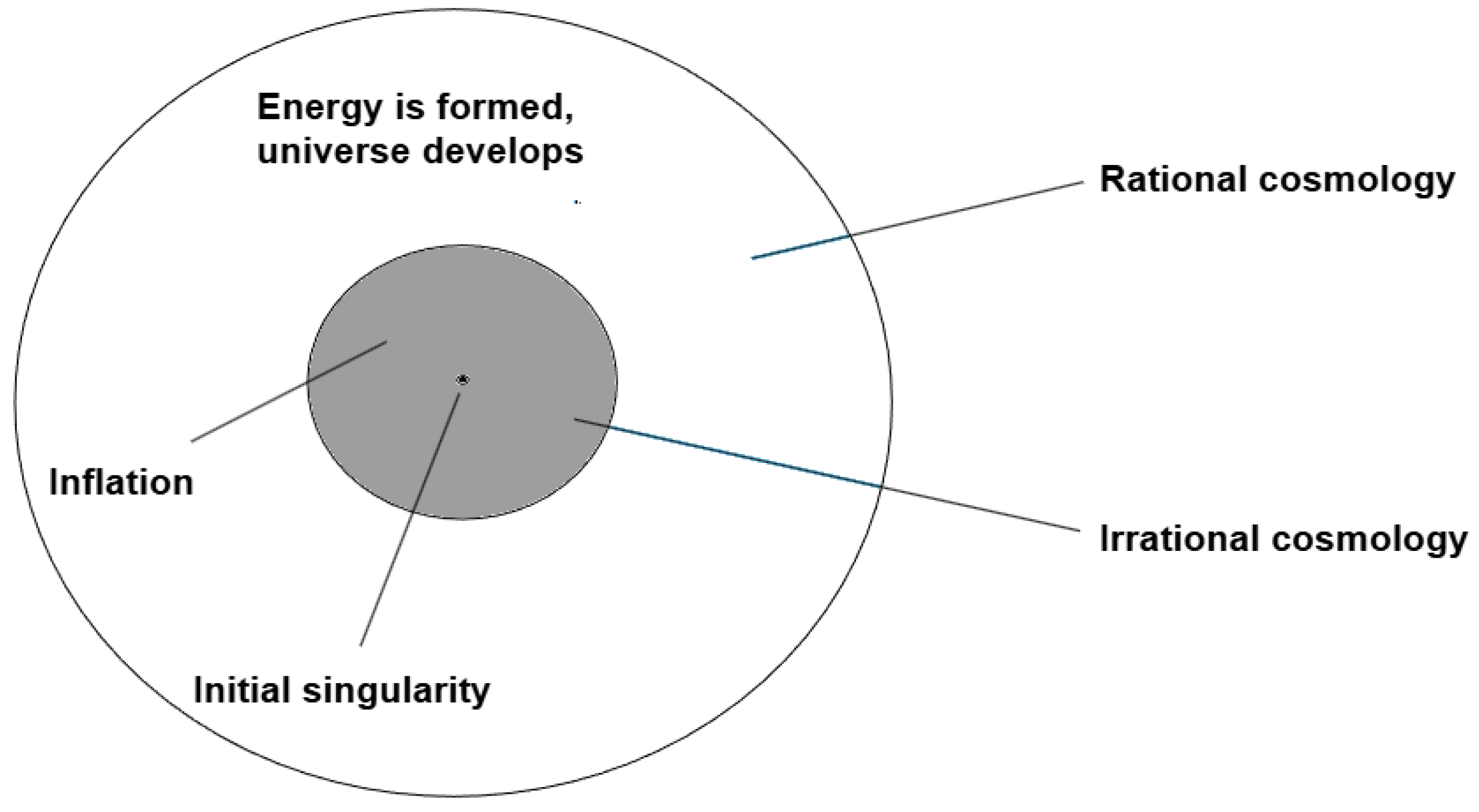
Figure 2.
Slices of Nov’s.
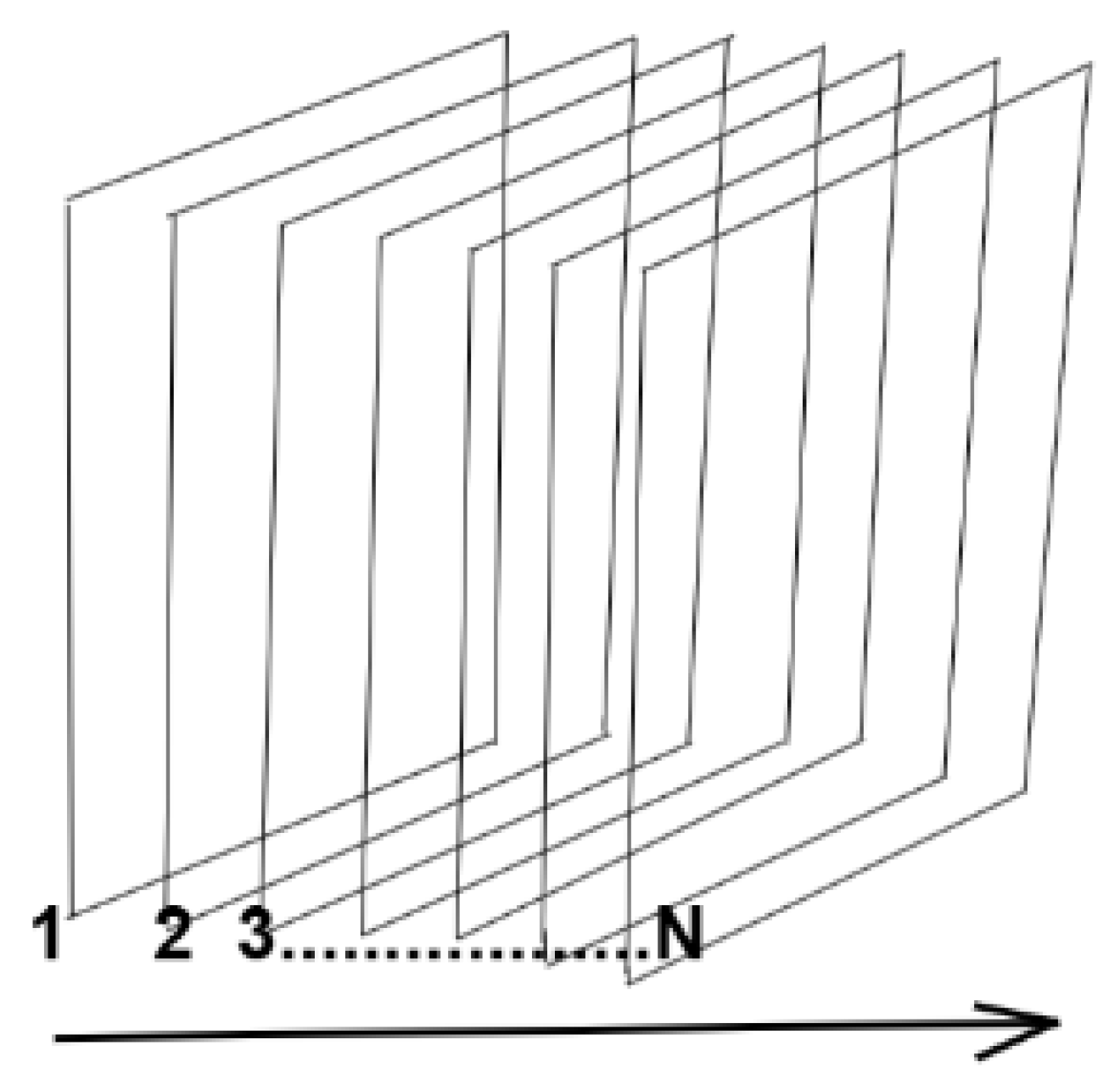
Figure 3.
Real Doppler effect and hypothetical effect of cosmological redshift.
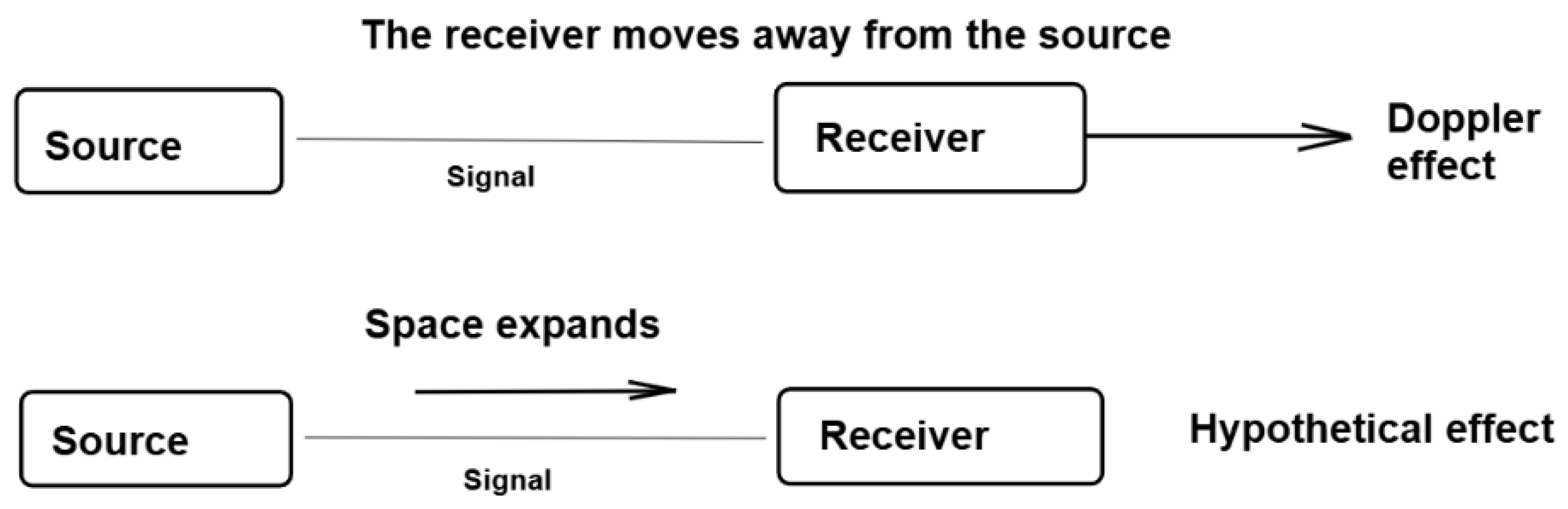
Figure 4.
Gravitational redshift.
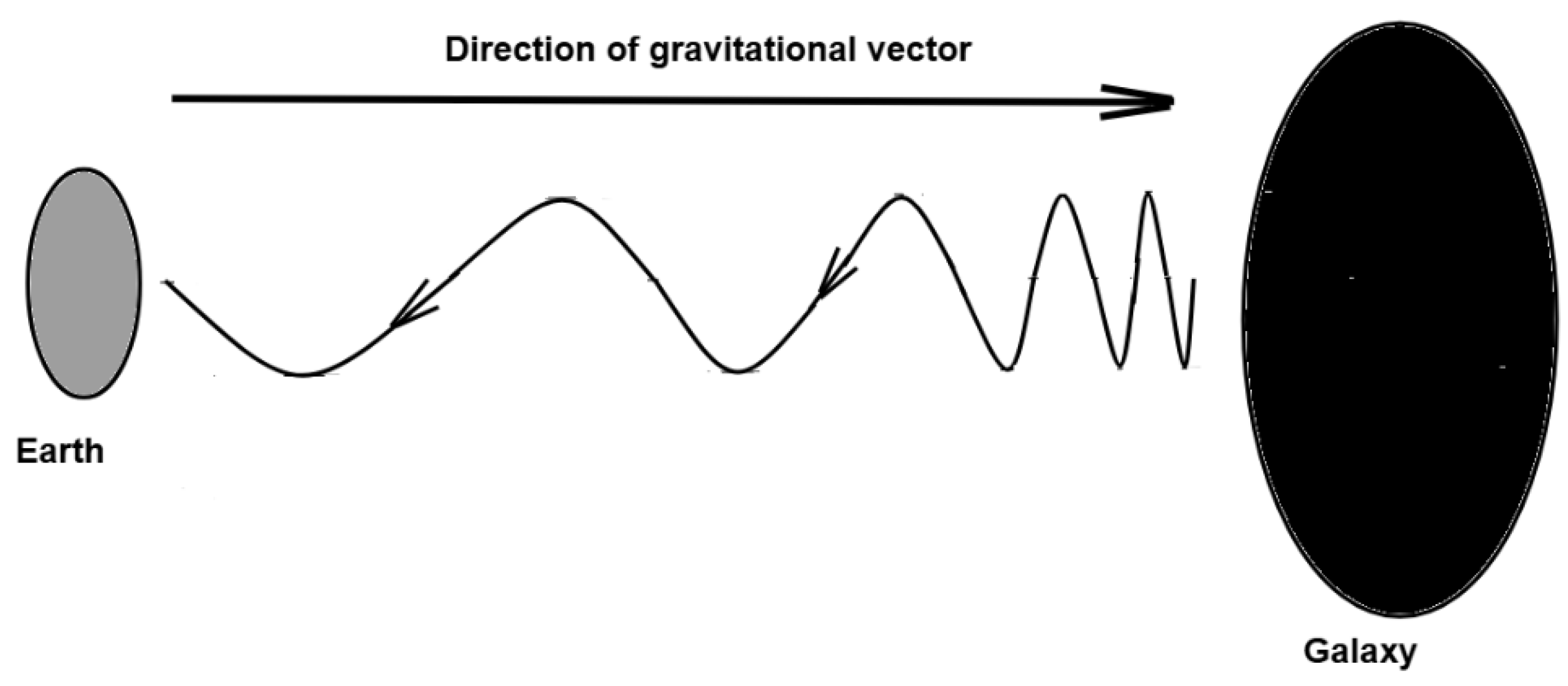
Figure 5.
Evidence-based Cosmology methodology and Big Bang cosmology methodology.
Disclaimer/Publisher’s Note: The statements, opinions and data contained in all publications are solely those of the individual author(s) and contributor(s) and not of MDPI and/or the editor(s). MDPI and/or the editor(s) disclaim responsibility for any injury to people or property resulting from any ideas, methods, instructions or products referred to in the content. |
© 2025 by the authors. Licensee MDPI, Basel, Switzerland. This article is an open access article distributed under the terms and conditions of the Creative Commons Attribution (CC BY) license (http://creativecommons.org/licenses/by/4.0/).
Copyright: This open access article is published under a Creative Commons CC BY 4.0 license, which permit the free download, distribution, and reuse, provided that the author and preprint are cited in any reuse.


