

Submitted:
23 November 2025
Posted:
25 November 2025
Read the latest preprint version here
Abstract
We present a local, experimentally testable mechanism in which the mode demand of an electromagnetic U(1) field is balanced against a locally defined, quantized holographic upper bound on classical bit capacity. We call this principle Holographic Bit–Mode Balance (HBMB). The HBMB does not operate at a preselected length scale; instead, it identifies a stable fixed point: a local, quantized horizon of radius R∗ where the number of horizon-allowed bits equals the number of redundancy-free U(1) modes realizable under given local boundary data. The fine-structure constant α is not an input parameter in this framework. It appears only after R∗ stabilizes, as the value of natural dimensionless electromagnetic ratios evaluated at the fixed point, such as the impedance–quantum-resistance ratio α = Z0/(2RK ). This provides a microscopic explanation for the observed spatiotemporal stability of α, and offers a minimal mathematical bridge between local holographic horizons and an α-fixpoint emerging from U(1) boundary physics and area-law information bounds.
Keywords:
holographic principle
; local holographic horizons
; Holographic Bit–Mode Balance (HBMB)
; U(1) gauge theory
; edge modes/boundary degrees of freedom
; entanglement entropy in gauge theories
; membrane paradigm
; fine-structure constant α
; vacuum impedance Z0
; von Klitzing constant RK
; information bounds/area law
; fixed point/attractor
1. Introduction and Motivation
A central lesson of holographic thinking is that the number of physically accessible degrees of freedom in a gravitating region scales not with its volume, but with an associated boundary or horizon area. Black-hole thermodynamics makes this explicit through the entropy–area relation, and modern quantum-informational approaches refine it into a sharp statement: a geometrically fixed upper bound exists on the amount of independent classical information (bits) that can be stored on a horizon assigned to a given region [1,2,3].
In parallel, the fine-structure constant is known with extraordinary precision and, within observational bounds, appears strikingly stable across space and time. Yet in the Standard Model it remains a free dimensionless parameter. Its unit-independence and robustness strongly suggest that may be fixed by a geometric and information-based mechanism rather than by contingent microphysics alone [9].
My previous work approached this question from two complementary directions. First, I showed that can naturally emerge from a holographic bit–mode equilibrium [10]: at an appropriately selected horizon scale, the maximal bit capacity implied by area information bounds matches the number of electromagnetic degrees of freedom, producing as an output. Second, in quantized-horizon settings [11] I explored how physically relevant effective quantities become boundary- or horizon-neighborhood objects rather than volume averages, emphasizing the operational role of horizons in organizing accessible states. These results point to a shared theme: horizon information constraints are not merely global but may also be physically meaningful in local contexts.
The present paper develops this idea into a systematic local mechanism. Our guiding question is:
Can there exist a local, quantized horizon whose radius is not arbitrary but is selected as a fixed point of balance between the local mode demand and a holographic bit-capacity bound, and such that evaluating natural dimensionless electromagnetic ratios on that fixed point yields the observed fine-structure constant α?
We answer in the affirmative by introducing the Holographic Bit–Mode Balance (HBMB) principle. In a locally defined region of radius R, two independent quantities compete. The first is the horizon bit capacity implied by a local area-law bound and quantized at the Planck scale. The second is the number of redundancy-free, physically occupiable eigenmodes , determined by local boundary data (impedances, material response, spectral window, etc.). HBMB asserts that mode realization is capped by the boundary information capacity. The stable realized state sits at a radius where
and this fixed point is locally stable against small perturbations in R.
The main claim of this paper is that the HBMB fixed point simultaneously defines an -fixpoint: at the stabilized local horizon , natural dimensionless electromagnetic combinations—in particular the ratio of the vacuum impedance to the quantum Hall resistance scale (von Klitzing constant) —return the measured fine-structure constant [14]. Crucially, enters neither the definition of nor that of ; it appears solely as an output after stabilization. The spatiotemporal constancy of is then a consequence of the robustness of the HBMB attractor, as long as the local environment and the quantized horizon structure are not dramatically altered.
We now outline the boundary-physics ingredients that motivate HBMB and make local holographic horizons natural.
1.1. Boundary Degrees of Freedom in Gauge Theories (Edge Modes)
In gauge theories, the raw counting of bulk modes is not physical: gauge redundancy identifies many mathematical configurations as the same physical state. When a region is defined by cutting space with a boundary, part of the gauge structure cannot be eliminated purely by bulk constraints. Instead, additional, physically relevant degrees of freedom appear on the boundary. These are the edge modes. For Maxwell theory they resolve the long-standing contact-term puzzle in entanglement entropy and provide an explicit statistical interpretation: edge modes are classical solutions labeled by boundary electric flux that contribute a genuine boundary entropy [4,5].
Operationally, edge modes therefore encode the information capacity associated with a local cut. They quantify how many distinct, physically distinguishable configurations within a region can become classically accessible. This boundary information viewpoint is essential for treating a local horizon not as a passive geometric surface but as an information-limiting object constraining realizable states.
1.2. Horizon as a Physical Boundary: Membrane/Impedance and Soft Hair
Modern horizon physics reinforces that boundaries are dynamical. In the membrane paradigm, a (local) horizon behaves effectively like a physical surface endowed with electromagnetic response: surface currents and dissipative boundary conditions encode the interaction of fields with the horizon. A key operational imprint is that the horizon’s surface resistivity is of order the vacuum impedance, linking horizon electrodynamics directly to [6].
Complementarily, soft-hair perspectives show that horizons carry nontrivial boundary charges and “soft” configurations tied to large gauge transformations. For black holes, soft photon hair represents degrees of freedom living on the horizon and storing information on a holographic plate [7]. Thus, from the standpoint, horizons are active boundaries that both constrain and encode the physically realizable configuration space. HBMB formalizes precisely this interplay: local mode demand is regulated by boundary capacity.
1.3. Why a Universal Dimensionless Ratio Is Expected
If two independent principles—(i) the redundancy-free mode count admitted by the local environment and (ii) the holographic bit capacity implied by a local area-law bound—are forced into equality at a stable fixed point, then any natural electromagnetic ratios evaluated there must be dimensionless and universal. The HBMB fixed point is not a tuned scale; follows entirely from measurable local boundary data and the area-law information bound. Consequently, emerges not as numerology but as the scheme-independent imprint of a stable information-theoretic attractor set by boundary physics and holography.
In the next sections we formalize the HBMB principle, prove fixed-point existence and stability, and derive falsifiable plateau–jump phenomenology implied by the quantized bit–mode structure.
2. Related Work and Background
This section summarizes the theoretical lines that connect most directly to (i) locally interpreted holographic horizons and area-law information bounds, (ii) existing approaches to the origin of the fine-structure constant , and (iii) configuration-space constructions that resemble holographic reasoning. The aim is not a full literature review, but a focused positioning of the present work within three background pillars, and then within my own already published results.
2.1. Holographic Entropy and an Upper Bound on Bits
The holographic principle historically emerged from black-hole thermodynamics and the entropy–area relation. In its canonical form, the maximal entropy that a gravitating region can store scales with an associated boundary or horizon area rather than with its volume [1,2,3]. In natural units this area law reads
where is the boundary area for a region of characteristic radius R (for a sphere ) and is the Planck length. Hence, for a spherical surface one has
When one wishes to measure information explicitly in bits rather than in natural-log units, the conversion introduces a factor :
Operationally, is the maximal number of independent classical records that can be stored on the boundary/horizon.
Different formulations of holography—Bekenstein–Hawking entropy, QFT in curved spacetime with UV cutoffs, and modern quantum-informational treatments of entanglement entropy—all converge on the same message: the accessible state-space capacity of a region cannot be increased arbitrarily; a geometric boundary provides a hard upper constraint [1,2,3].
In this paper we adopt a local reading of the area law. We do not assume a global cosmological horizon, but rather a physically relevant, locally defined spatial domain bounded by a closed surface. To that surface we attach (or in bit units ), and compare it with the number of locally realizable electromagnetic modes. A key conceptual point is that area scaling does not imply that the underlying dynamics inside the region becomes two-dimensional. Instead, it states that the upper bound on classically accessible information is controlled by a two-dimensional geometric quantity, the boundary area. The electromagnetic modes still live in a three-dimensional volume. The symmetry is an internal (gauge) symmetry of the field phase space, not a statement about spatial dimensionality; therefore there is no tension between 3D bulk field dynamics and a 2D area-controlled information bound.
2.2. On the Origin of the Fine-Structure Constant
The fine-structure constant is the central dimensionless coupling of quantum electrodynamics. In its standard form it measures the strength of electromagnetic interaction:
with e the elementary charge, the vacuum permittivity, ℏ Planck’s constant, and c the speed of light. In the Standard Model is an input parameter; no internal mechanism fixes its numerical value or explains its remarkable spatiotemporal stability. Precisely this stability and dimensionless nature suggest that may be fixed by a geometric or information-theoretic attractor [9].
A wide spectrum of ideas has been proposed for deriving from first principles, ranging from dimensional-analysis constructions built from fundamental constants, to grand-unification and running-coupling perspectives, and to closed-form numerical approximations based on special numbers (such as , e, zeta-values, etc.). These approaches typically suffer from strong model dependence, sensitivity to regularization/normalization choices, or lack a clear physical principle that selects the relevant scale where should be evaluated.
A long-known but often treated as a metrological identity rewrites as a purely electromagnetic impedance ratio:
where is the vacuum impedance and is the von Klitzing constant of the quantum Hall effect. This form strongly hints that measures a ratio between a classical vacuum boundary response () and a universal quantum-transport scale (). However, by itself it is not yet an explanation: one still needs a physical mechanism that selects the local boundary/horizon scale where such a ratio becomes a stable fixed point. The HBMB framework introduced here supplies precisely this missing step, by interpreting not as an assumed normalization, but as a consequence of a local holographic bit–mode equilibrium.
2.3. Configuration-Space Geometry and “Bare ”
A partially independent but thematically related direction aims to derive from the geometry of configuration space. In these constructions the space of physical configurations (gauge-equivalence classes) is embedded into a compact higher-dimensional domain, and a dimensionless coupling is defined as a measure ratio between an “interior” region and its boundary. This yields a closed-form “bare ” which is then related to the experimental value via QED dressing.
The conceptual value of this line lies in showing that a symmetry combined with a compact configuration space can naturally generate dimensionless couplings, and that interior-to-boundary projection plays a central role—an intuition closely aligned with holography [12]. Technically, however, the outcome is strongly choice-dependent: it is sensitive to the configuration-space measure and metric, the normalization chosen for the boundary projection, and the specific way interior and boundary quantities are combined into a dimensionless coupling. Consequently, the numerical result is not scheme-independent. The present work differs in that normalization is not a free choice: it is fixed by a local equilibrium (HBMB) attractor, hence has an operational physical status.
2.4. My Earlier Results on Quantized Horizons, HBMB, and
The current paper should be viewed as a local synthesis of two already published lines. First, in my work on quantized horizons and holographic vacuum energy, I argued that when horizon information capacity is quantized at the Planck scale, physically relevant effective quantities acquire their scale not from bulk volume averages but from an operationally selected horizon-neighborhood domain [11]. This provides motivation to treat horizons as information-organizing boundaries also in a local sense.
Second, the direct predecessor is my holographic derivation of via the Holographic Bit–Mode Balance (HBMB) principle [10]. There I compared the maximal surface-bit capacity of a local micro-horizon,
to the total redundancy-free degeneracy of interior Dirac-field modes under MIT boundary conditions. The latter decomposes into four nested contributions: (i) the base degeneracy of the lowest Dirac modes , (ii) a curvature-sensitive logarithmic Seeley–DeWitt correction , and (iii) a uniform-WKB, zeta-regularized high-ℓ tail capturing large-angular-momentum, boundary-grazing modes. Their sum yields , and the fixed-point ratio
reproducing the observed value within uncertainties [10].
It is important to note that while the micro-horizon radius (or the associated local-horizon scale) was already derived and physically motivated there, it could still appear partly hypothetical to the reader. The present work makes this point strict: the local horizon radius is not an assumed input, but emerges as the HBMB fixed point set by the equality between the redundancy-free mode count and the area-law bit capacity. Therefore is operationally definable from measurable local boundary data, and the micro-scale used in the previous derivation gains a substantially stronger physical status through the –holography balance mechanism developed here.
With this background established, the next section fixes the necessary definitions and notation: the local quantized horizon and its fixed-point radius , the precise surface-bit capacity (and ), the effective redundancy-free mode number , and the local electromagnetic boundary/environment parameter package . These provide the formal basis for the HBMB mechanism and the derivation of the -fixpoint.
3. Core Definitions and Notation: Local Quantized Horizon and HBMB
This section fixes the formal framework of the paper. We will compare two quantities defined on a locally selected spatial domain: (i) the maximal classical information capacity (bit capacity) allowed by the boundary/horizon, and (ii) the redundancy-free number of physically realizable electromagnetic modes within that domain. The Holographic Bit–Mode Balance (HBMB) principle states that these two quantities equalize at a stable fixed point, which dynamically selects the radius of the local horizon.
3.1. Local Quantized Horizon (Definition)
By a local quantized horizon we mean a closed, physically relevant boundary surface that encloses a region of characteristic radius R, and to which a local reading of the holographic area law assigns a maximal information capacity. The adjective “local” emphasizes that we are not invoking a global cosmological event horizon, but rather an operationally chosen domain boundary. The adjective “quantized” indicates that this capacity is naturally measured in Planck-scale bits, so that changes in the boundary area correspond to discrete information steps.
For transparency, we take the horizon geometry to be spherical in the first pass, so that is an R-sphere with area . None of the later conclusions rely on spherical symmetry itself; the sphere merely provides the cleanest model for scale selection under an area-controlled capacity.
3.2. Holographic Bit Capacity
We define the local horizon information capacity by the local area law. In entropy units (natural-log units) the maximal capacity reads [1,2,3]
For a spherical surface this becomes
When the capacity is measured explicitly in bits, one divides by :
Operationally, is the maximal number of independent classical records that can be made accessible on the boundary.
A conceptual clarification is important here. Area scaling does not claim that the bulk field dynamics becomes two-dimensional. Rather, it asserts that the upper bound on classically accessible information is controlled by a two-dimensional geometric quantity, the boundary area. Electromagnetic modes still live in a three-dimensional volume; holography constrains how many of them can become simultaneously classical and distinguishable.
3.3. Mode Demand and Redundancy-Free Mode Number
The second core quantity is the number of physically realizable degrees of freedom of the electromagnetic field in the local region. In gauge theories raw mode counts are not physical because gauge redundancy identifies many mathematical configurations as the same state. When space is cut by a boundary, part of the gauge structure cannot be eliminated purely by bulk constraints, and physically relevant boundary data (edge degrees of freedom) appear [4,5]. Accordingly, the meaningful quantity is not the naive mode number but the redundancy-free count of distinct, occupiable modes compatible with local boundary data.
We denote this by
where is a local boundary/environment package encoding, for example: the effective boundary impedance or material response, the relevant spectral window, geometric cutoffs and UV regularization scales, and any other experimentally fixed data that determine the physical spectrum in the region. Crucially, is not a fitting freedom; it represents measurable or operationally specified properties of the local electromagnetic environment.
3.4. HBMB Principle and Fixed Point
The Holographic Bit–Mode Balance (HBMB) principle asserts that the physically accessible mode content of a local region cannot exceed the boundary bit capacity allowed by the local area law. The realized state is driven toward a stable equilibrium where the two quantities match:
Equation (13) defines the fixed-point radius of the local quantized horizon. Stability means that small perturbations in R are counteracted: if R increases, the bit capacity grows faster than the redundancy-free mode demand and the system relaxes back; if R decreases, mode demand dominates and the system again flows toward . This will later be formalized by the sign change and derivative structure of an effective balance function.
3.5. as a fixed-point output
Within this framework is not an input parameter. It appears only after the fixed point has stabilized, as the value of natural, dimensionless electromagnetic ratios evaluated at . The key operational identity is the impedance form [9]
where is the vacuum impedance and is the universal quantum Hall resistance scale (von Klitzing constant). The central claim of this paper is that at the HBMB fixed point these ratios settle to the observed value of without inserting by hand.
4. Boundary/Edge Entropy as Information Capacity
This section develops the “ side” of the HBMB mechanism in an explicitly information-theoretic way. The key point is that cutting out a local region in a gauge theory does not merely select a volume: it necessarily introduces physical boundary degrees of freedom (edge modes). Their entropy defines a genuine boundary information capacity. We then show that the leading edge entropy scales as , i.e. opposite to , and finally define a dimensionless “physically accessible fraction” on the boundary side.
4.1. Maxwell Edge Modes and Electric-Center Entropy
In gauge theories the naive count of field modes is not physical, because gauge equivalence identifies many mathematical configurations as the same state. When a region is separated from its complement by a closed boundary , the Gauss constraint cannot eliminate all boundary data: a residual physical sector appears on the cut. These are the edge modes [4,5].
We start from Maxwell theory with coupling,
where is the field strength, the gauge potential, and e the electromagnetic coupling.
The canonical momentum conjugate to the spatial potential is
where is the canonical momentum density and the electric field. The Gauss law in Hamiltonian form reads
Integrating (17) over and using the divergence theorem gives
with the normal component of the canonical momentum on the boundary and the outward unit normal. Equation (18) shows that the boundary-normal flux (equivalently via (16)) is not pure gauge once the boundary is held fixed: distinct normal-flux profiles label distinct physical sectors. These boundary sectors constitute the Maxwell edge Hilbert space [4,5].
The electric-center choice treats as the natural commuting boundary data. The reduced density matrix of a cut state becomes block-diagonal in flux sectors, and the associated Shannon-type entropy of the flux distribution is the edge entropy [5,8]. Crucially, this surface contribution is not a bookkeeping artifact: it is precisely the physical term that resolves the previously puzzling surface piece of Maxwell entanglement entropy [4,5].
4.2. Scaling of Boundary Entropy:
The leading contribution to Maxwell edge entropy on a smooth boundary takes the form
where is a dimensionless geometric constant depending on the boundary shape, e is the electromagnetic coupling, L is an IR scale typically set by the region size (for a sphere ), and is a UV cutoff representing the minimal boundary resolution [5,8].
The origin of the scaling is immediate from the canonical structure. The boundary data left free by the Gauss constraint are the normal components of , not of . Using (16),
Thus, the measure on the edge configuration space is naturally expressed in . When rewriting the flux distribution in terms of , the Jacobian introduces a factor in the effective boundary phase-space volume. Since entropy is the logarithm of this volume, the coefficient of the leading surface term in (19) must scale as .
Physically, weaker coupling (smaller e) enlarges the distinguishable boundary-flux configuration space, increasing ; stronger coupling compresses it. This is the opposite of the fine-structure scaling , strongly suggesting that a balance between a boundary capacity and a redundancy-free mode demand will select an -proportional dimensionless fixed point.
4.3. Physically Accessible Boundary Fraction
To implement HBMB we need a dimensionless quantity describing what fraction of the total boundary configuration space can be made classically accessible under a given local environment. Let denote the measure (volume) of all boundary configurations permitted by the gauge structure for a fixed cut, and let denote the physically accessible subset under the local boundary/environment data (impedance, spectral window, material response, UV cutoff, temperature, etc.). We define the accessible boundary fraction as
Equivalently, since entropy is logarithmic in measure, one may write
where is the full edge entropy dictated by the gauge structure and is the portion that can be rendered classical in the given local setting.
This dimensionless fraction is the boundary-side object that will be matched to the holographic bit capacity in the HBMB fixed-point condition. In the next section the membrane/impedance viewpoint of horizons will provide a scheme-independent link that pins the universal fixed-point value of to the fine-structure constant.
5. Membrane Paradigm and the Impedance Identity
This section develops the second pillar of the HBMB fixed-point picture: the interpretation of a local (Rindler-type) horizon as a physical boundary for the electromagnetic U(1) field. The goal is to relate the boundary-side accessibility fraction introduced in Sec. 4 to a scheme-independent, experimentally anchored electromagnetic ratio. The key input is the membrane paradigm, according to which a causal horizon can be replaced—from the viewpoint of an exterior observer—by an effective dissipative “stretched” surface that reproduces the same electromagnetic response as the true horizon [6,15,16]. In this language the horizon behaves as a conductor with a universal surface impedance, which turns out to coincide with the vacuum impedance. When this is compared to the universal quantum of resistance (von Klitzing constant), the dimensionless ratio
emerges not merely as a metrological identity, but as the physically selected fixed-point fraction of boundary-accessible U(1) configurations.
5.1. Stretched-Horizon Ohm Law and
In the membrane paradigm a causal horizon is replaced by a timelike “stretched horizon” located a microscopic proper distance outside the true null surface. For electromagnetic fields, this stretched surface carries effective surface currents and dissipation such that the exterior Maxwell equations with a boundary condition at the membrane are equivalent to the full horizon problem [6,13].
Operationally, the membrane enforces an Ohm-type boundary condition on tangential fields:
Here and are the tangential electric and magnetic fields evaluated on the stretched horizon, is the outward unit normal to the surface, and is the effective surface impedance (surface resistivity) of the membrane.
A central result of the paradigm is that this impedance is universal and equals the vacuum impedance:
The physical meaning is that, for an exterior observer, a local horizon acts as a conducting boundary whose resistive response is fixed by empty-space electrodynamics, not by any material microphysics. This identification is robust across derivations (e.g. near-horizon Rindler limits and black-hole “stretched” surfaces) and provides a direct way to anchor boundary physics in measurable quantities [6,15].
Within HBMB this is crucial: the boundary-side U(1) accessibility fraction defined in Sec. 4 is not an abstract counting ratio, but an operationally measurable property of how the local U(1) sector couples to, and is filtered by, the horizon boundary. Equation (23) supplies that physical coupling in impedance form.
5.2. Quantum Conductance and the Von Klitzing Constant
The second universal scale entering the fixed-point bridge is the quantum of resistance that characterizes U(1) transport in quantum Hall systems and related topological channels. The von Klitzing constant is
where h is Planck’s constant and e is the elementary charge. is universal in the strict sense: it is independent of sample material, geometry, or microscopic details, and depends only on the quantization of U(1) charge and phase coherence [14,17].
Conceptually, is the canonical quantum-electrodynamic resistance scale of a U(1) channel. In the present context it provides the natural quantum counterpart to the classical boundary impedance fixed by the membrane paradigm.
5.3. The Scheme-Independent Bridge
Combining Eqs. (24) and (25) yields a dimensionless ratio,
The factor of 2 follows the standard QED normalization of the fine-structure constant. One recovers the well-known impedance form of ,
where ℏ is the reduced Planck constant and c is the speed of light [9,18].
What matters here is not the numerical agreement by itself, but the physical interpretation within the HBMB mechanism. The two ingredients in (27) have disjoint origins: is the classical impedance characterizing an EM boundary/horizon response (Sec. 5.1), while is the quantum resistance scale of U(1) channels (Sec. 5.2). Their ratio is therefore a scheme-independent measure of how classical boundary capacity matches quantum U(1) accessibility.
This provides the operational content of the fixed point: the boundary-side fraction of physically accessible U(1) configurations,
must coincide, at a stable local HBMB horizon , with the unique dimensionless impedance ratio that the horizon and the U(1) channel jointly define. Hence the HBMB fixed point enforces
In this reading is not inserted as an input parameter: it appears as the universal outcome of matching a horizon boundary (membrane impedance) to a quantum U(1) channel (resistance quantum) at the locally selected radius . This is the classical–quantum bridge required for the HBMB fixed point developed in the following sections.
6. HBMB Fixed-Point Mechanism and the Derivation of the Fixed Point
In this section we assemble the two pillars developed in Section 4 and Section 5 into a single local, -driven balance mechanism. The core idea is that a locally selected, quantized boundary is not chosen ad hoc: its radius is dynamically fixed by equating (i) the maximal holographic bit-capacity of the boundary and (ii) the redundancy-free mode demand of the enclosed region. The resulting equilibrium is stable, selects a characteristic micro-horizon scale, and yields the fine-structure constant as a fixed-point output rather than an input.
6.1. Equilibrium Condition: Bit Capacity vs. Redundancy-Free Mode Demand
Section 3 defined the two central quantities:
(i) the maximal boundary information capacity in bits,
so for a spherical boundary one has ;
(ii) the redundancy-free electromagnetic mode demand,
with denoting the local boundary/environment package (impedance, spectral window, UV cutoff, etc.).
The HBMB fixed-point condition is the equality
Define the balance function
The fixed point satisfies . Stability requires that small perturbations in R relax back to , which is captured by
For the redundancy-free mode demand grows faster than the bit capacity, so and the balance is driven back toward . For the boundary bit capacity dominates, hence and the system again relaxes toward . Therefore is a stable fixed point.
6.2. Role of the Boundary-Accessible Fraction
Section 4 introduced the physically accessible boundary fraction
or equivalently in entropy language,
This dimensionless ratio measures which fraction of the full gauge-permitted boundary configuration space is renderable as classical records under the local environment . The HBMB condition (31) implies that, at the locally selected horizon , this fraction must settle to a universal fixed-point value. Section 5 provides a scheme-independent anchoring of that value through impedance matching.
6.3. The Local Horizon Radius from an Impedance-Matching Fixed Point (A Concrete Example)
We now give an explicit, calculable example showing how is selected from boundary physics without inserting .
(i) Horizon as an EM boundary.
(ii) Spherical region and the lowest radiative mode.
Consider a spherical local boundary of radius R and focus on the lowest radiative dipole mode () of the electromagnetic field. The impedance matching is performed for the lowest radiative spherical channel, the dipole mode (). This mode is the first one to become radiative at the relevant frequencies and therefore controls the leading reflection/absorption balance at the boundary. Higher-ℓ channels contribute only subleading corrections to the matching constant and do not modify the Compton-scale selection of . The effective surface impedance of an outgoing spherical TM1 wave at the boundary admits the standard approximation [19]
(iii) Minimal-reflection matching.
A local horizon is optimally transparent to the enclosed sector when the real part of the modal boundary impedance matches the membrane value,
Using (37), this reduces to a purely dimensionless equation,
Its first positive root is
(iv) Natural driving scale: the Compton frequency.
For a charged quantum excitation, the natural local driving scale is the Compton angular frequency,
with the Compton wavelength. The matching fixed point then yields
Substituting (40),
This is the same micro-horizon scale obtained in your earlier HBMB-based derivation, now fixed directly by local horizon matching, not by assuming [10].
6.4. The Fixed Point as an Output
Section 5 established the scheme-independent bridge
where is the von Klitzing constant. At the HBMB-selected horizon , the boundary-accessible fraction must coincide with that unique impedance ratio:
Hence the HBMB fixed point closes as
with dynamically selected and emerging as the universal fixed-point fraction of classically accessible boundary configurations.
7. Connection to the Earlier HBMB-Based Derivation and to the Present -Driven Local Horizon
In this section we make explicit the point raised in the discussion: the present –boundary/horizon framework carries the same logical core as our earlier HBMB-based derivation of the fine-structure constant, and it can be mapped unambiguously onto the four building blocks that previously yielded . In short, the present work does not replace that HBMB mechanism; rather, it provides a sharper physical underpinning and a genuinely local (operational) definition of the horizon that renders the earlier construction more robust.
7.1. HBMB Structure of the Earlier Derivation (Formal Reminder)
In the earlier paper the fine-structure constant appeared not as an input, but as the fixed-point output of a holographic bit–mode balance. The construction combined four conceptually separated contributions: (i) the Bekenstein–Hawking surface bit capacity [1,2]; (ii) the degeneracy of the lowest Dirac modes under MIT boundary conditions [20,21]; (iii) a curvature-sensitive logarithmic Seeley–DeWitt correction [22,23]; and (iv) a zeta-regularised high-ℓ WKB tail capturing large angular-momentum modes [24,25]. The HBMB ratio was written in the compact form
where collects the three mode-side contributions, and the full construction closes as a self-consistent fixed point [10].
The surface bit capacity was evaluated on the electron micro-horizon scale,
numerically bits in SI units [10]. The micro-horizon radius itself was obtained by balancing electrostatic self-pressure, spinor Casimir pressure (MIT bag), and a holographic surface-tension term, leading to
with the Compton wavelength [10]. Importantly, in that derivation entered only symbolically in intermediate normalisations; its numerical value was not inserted by hand, and the fixed-point closure of the bit/mode ratio removes any circularity [10].
7.2. What the Present -Driven Local Horizon Adds
In the present paper the HBMB equation is structurally the same, but the mode-side is built not from a Dirac bag spectrum but from electromagnetic boundary physics. Formally,
where is the same area-law bit capacity as above, and is the redundancy-free physical eigenmode count in the given local boundary/environment package .
The decisive refinement is that the selected radius is no longer a motivated microscale but follows directly from the local horizon boundary condition. The membrane paradigm fixes the electromagnetic surface impedance of a local (Rindler-type) horizon to . Matching this boundary to the lowest radiative spherical TM1 mode yields a purely dimensionless impedance equation for , whose first physical root gives
and at the Compton driving scale this implies
Thus the present boundary matching closes on the same micro-horizon radius as the earlier HBMB energy-minimisation route, now derived from a local and operational horizon condition [10].
Consequently, the earlier definition is manifestly identical to the present evaluated at the locally selected horizon, with the only change being that the horizon is now defined through boundary physics rather than through a model-specific micro-balance [10].
7.3. Unambiguous Mapping and Strengthened Content
The common logical core of the two works is unchanged:
- The boundary information capacity is an area-law quantity, written as or .
- The redundancy-free interior demand is a computable mode count, .
- The dimensionless coupling emerges as the fixed-point ratio between the two sides, rather than being assumed.
In the earlier paper the interior side was built from a spinor (Dirac) spectrum; here it is built from the redundancy-reduced electromagnetic spectrum. In both cases the same HBMB principle is enforced: the number of classically accessible degrees of freedom cannot exceed the boundary bit capacity.
What is specifically strengthened by the present work is threefold:
- The notion of a local horizon acquires a physical and operational definition. In the earlier paper arose as an energy minimum and could appear model-dependent from the outside. Here we show that the same scale follows from boundary matching and membrane impedance, turning the “why this horizon?” question into a calculable statement.
- The fixed-point value is tied scheme-independently to an impedance ratio. The present work yields not only as but as the universal electromagnetic ratio , linking classical boundary response to quantum transport.
- The HBMB mechanism becomes explicitly local. While the earlier paper already implemented HBMB at a microscale, the present framework shows that the same balance functions as a general local-horizon mechanism driven by boundary physics, i.e. beyond any particular bag-model realisation.
In summary, the present paper provides an independent, purely -based foundation for the same HBMB fixed-point logic that underpinned the earlier derivation. Both routes select the same micro-horizon scale and close on the same dimensionless output, but they “grip” the physics from complementary sides: there the spinor spectrum dominates the mode count, while here the boundary/impedance structure is the controlling input [10].
8. Multi-Scale Consistency and Falsifiable Predictions
This section serves two purposes. First, we show that the local horizon → HBMB fixed-point mechanism developed in Section 4, Section 5 and Section 6 is not tied to a single special scale: the same information-capacity structure reappears consistently at micro-, meso-, and macro/analogue levels. Second, we extract concrete, platform-agnostic phenomenological signatures that render the framework falsifiable without invoking any specific cosmological implementation.
8.1. Microscale: Boundary DOF, Edge Entropy, and the Local Fixed Point
At microscopic scales the key feature is that gauge cutting prevents naive volume-counting of degrees of freedom. In Maxwell theory physical state counting necessarily includes a boundary-coded sector: the electric edge modes arising from gauge invariance on a cut surface [4,5]. For a compact boundary the leading contribution to the edge entropy reads
where is an dimensionless geometric prefactor depending on the shape of the boundary and on regularisation details; e is the elementary charge (the coupling) entering the Maxwell action as a prefactor; L is an infrared (IR) length scale of the region, with for a sphere of radius R; is a UV cutoff setting the microscopic resolution of the gauge cut near the boundary; and the ellipsis denotes subleading curvature- and scheme-dependent corrections. The essential scaling is therefore .
Two immediate consequences follow. (1) From the perspective the boundary capacity is naturally “overstoring”: weaker coupling allows more distinguishable edge records. (2) Dimensionless couplings are expected to appear as boundary fractions, because redundancy removal is intrinsically surface-based.
The fixed-point picture of Sec. 6 then states that a stable local horizon forms at the radius where boundary classical capacity and redundancy-free mode demand just cover each other. Impedance matching of the local membrane boundary condition to the lowest radiative mode selects the Compton scale, yielding
as a consequence of boundary physics rather than a hypothesis. At the same fixed point the accessible boundary fraction stabilises scheme-independently as
where is the vacuum impedance and the von Klitzing constant [6,14,17]. Thus, microscopically, the number of physically accessible states is set by boundary information capacity, and its fixed point yields .
8.2. Mesoscale: Boundary Reduction from Gauge Redundancy
At mesoscale resolution (lattice or effective-field descriptions) the same phenomenon reappears operationally: gauge fixing reduces naive bulk DOF to boundary-type scaling. A minimal lattice axial-gauge toy demonstration is provided in Appendix J; it shows explicitly that the fraction of physically free configurations follows boundary rather than volume growth. The mesoscopic statement is therefore that the distinguishable configuration count is controlled by boundary capacity, providing a direct pre-image of the HBMB principle at a local horizon: redundancy-free mode demand saturates against a surface (bit) bound.
8.3. Macro/Analogue Level: The Local Horizon as an Information Threshold
At macroscopic or analogue levels the same structure manifests as a threshold-like boundary behaviour. Without assuming any particular cosmological model, the operational claim is that the ratio between boundary capacity and mode accessibility seeks a fixed point. Hence whenever a system develops a local boundary/horizon-like interface (geometric, impedance, or spectral), the accessible mode density is not expected to vary smoothly. Instead it generically exhibits plateau segments (boundary overcapacity) punctuated by “click-like” transitions when a new bundle of modes becomes accessible. This qualitative pattern is a general consequence of HBMB-type boundary coding rather than a platform-specific artefact.
8.4. Platform-Agnostic Falsifiable Predictions
We list three concrete predictions that can be tested.
(P1) Emergence of the ratio in impedance-based boundary analogues.
Consider a system with a edge channel (e.g. quantum Hall or topological boundary transport) and a horizon-analogue electromagnetic boundary condition characterised by an effective surface impedance . HBMB predicts that the equilibrium accessible fraction locks to the universal impedance ratio,
where is the quantum resistance [14,17]. Failure of convergence to at stable equilibrium would falsify the mechanism.
(P2) Running and scale dependence: no new universal constant.
The fixed-point mechanism does not introduce new dimensionless constants: scale dependence of the boundary sector can only parameterise the known QED running [26]. Hence if a local horizon analogue settles to a stable dimensionless value unrelated to the standard running behaviour, the framework is contradicted. Although the detailed derivation of the running electromagnetic coupling from the geometric spectrum is presented in the author’s previous work [10], it is important to stress that within the present HBMB setup the logarithmic scaling of the edge entropy, Eq. 53 , naturally mirrors the logarithmic behaviour of the QED beta function. In this sense the model does not only fix the low-energy value of the coupling at the HBMB fixed point, but also implies a qualitatively correct scale dependence for , without introducing any new universal parameter.
(P3) Plateau–click pattern of redundancy-free mode density under parameter sweeps.
Under continuous sweeps of boundary data (geometry, impedance, cutoff scale), the redundancy-free mode density is predicted to show segmented plateaus with sharp threshold transitions, reflecting HBMB boundary coding. If relevant boundary-dominated systems exhibit only smooth, threshold-free dependence, the local HBMB picture fails.
8.5. Scheme Dependence and Risk Control
A natural criticism is that boundary entropies and mode counts depend on regularisation choices. The present framework has three stabilising anchors: (1) the bridge via impedances is scheme-independent because compares two independently measurable universal quantities; (2) radius selection follows from a dimensionless boundary-matching root (e.g. ), not from a scheme-dependent subtraction; and (3) the predicted threshold signatures (plateau–click behaviour and impedance locking) are qualitative fingerprints that cannot be removed by redefinitions.
In summary, the same boundary-capacity versus redundancy-free mode-demand logic appears consistently across scales, yielding sharp, testable signatures. If any of (P1)–(P3) is robustly absent in relevant boundary-dominated systems, the local HBMB framework is falsified; if they are observed, the evidence becomes strongly supportive.
9. Conclusion
In this paper we developed a local, -driven holographic-horizon mechanism in which the fine-structure constant is not an input parameter but emerges as a stable information-theoretic fixed point. Our starting premise was that the boundary physics of electromagnetic gauge theory and holographic information bounds are two complementary expressions of the same capacity-limiting structure, and that this relationship can be formulated not only for global horizons but also for operationally defined local horizons.
The construction rested on three pillars.
(1) Boundary degrees of freedom and edge entropy.
Gauge cutting in Maxwell theory necessarily produces an electric edge sector. These boundary modes are physical degrees of freedom and contribute a genuine entanglement entropy [4,5]. For a compact boundary the leading edge entropy takes the form
where is an dimensionless geometric prefactor, e is the elementary charge, L an IR scale (with for a sphere of radius R), a UV cutoff, and the ellipsis denotes subleading curvature- and scheme-dependent corrections. The decisive content is the scaling : boundary information capacity grows with the inverse square of the coupling.
(2) Horizon as a physical boundary: membrane/impedance bridge.
The membrane paradigm identifies a local (Rindler-like) horizon as an effective electromagnetic boundary with surface impedance [6]. Matching this physical boundary condition to the lowest radiative spherical mode yields a purely dimensionless impedance equation whose first physical root fixes
so that the local horizon radius is selected at the Compton scale,
This local micro-horizon scale is therefore not a hypothesis but a consequence of boundary matching.
(3) HBMB fixed point and the output value of .
At the selected local horizon, the holographic bit capacity and the redundancy-free mode demand equilibrate through the HBMB condition,
and the accessible boundary fraction stabilises in a scheme-independent way as
where is the vacuum impedance and the von Klitzing constant [14,17]. Thus acquires an operational meaning as a ratio between classical boundary capacity and quantum transport, rather than an externally imposed coupling.
We further argued that the same boundary-capacity versus redundancy-free mode-demand logic is consistent across micro-, meso-, and macro/analogue levels, and we extracted three platform-agnostic falsifiable signatures: (P1) impedance-ratio locking to in boundary analogues; (P2) no new universal constant beyond the standard running ; and (P3) a plateau–click pattern in redundancy-free mode density under continuous boundary parameter sweeps.
Overall, the paper provides a self-contained local extension of holographic reasoning rooted in boundary physics, and assigns a concrete boundary-information meaning to the fixed point. The next steps are targeted analogue tests of the fixed-point predictions and an assessment of how far the local horizon definition can be carried beyond abelian gauge sectors.
Appendix J A Lattice U(1) Toy Model for Boundary Scaling (Axial Gauge)
This appendix gives a minimal configuration-space demonstration showing that gauge redundancy can reduce naive bulk degree counting to boundary-type scaling. The toy model is not meant as a full dynamical lattice simulation; it is a transparent counting argument in the lowest (flat/zero-flux) sector, included to support the mesoscopic statement in Sec. 8.2. Standard lattice notation follows [27].
Appendix J.1 A.1. Lattice and Link Variables
Consider a two-dimensional discrete torus with periodic boundary conditions. The gauge field is represented by link variables
where labels lattice sites. Each link is a phase, . The naive number of link degrees of freedom is therefore
Appendix J.2 A.2. Gauge Transformations and Axial Gauge Fixing
A local gauge transformation acts on links as
In axial gauge we choose recursively such that
This fixes almost all local gauge freedom. A torus retains possible global holonomies, which we ignore here by restricting to the simplest configuration sector relevant for the present counting argument.
Appendix J.3 A.3. Zero-Flux Sector and Boundary-Type Free DOF
We focus on the lowest (flat/zero-flux) sector. The discrete plaquette condition reads
With from axial gauge, Equation (A68) reduces to
Hence within each row j, all y-links are identical. Denoting the row phase by , we have
Removing one residual global redundancy leaves approximately
independent physical degrees of freedom in this sector. Crucially, physical configuration growth is linear in N, not quadratic.
Appendix J.4 A.4. Accessible Fraction and Boundary Scaling
Define the toy accessible fraction as
Thus even in this minimal lattice sector the physically free configuration fraction scales in a boundary-like manner, , rather than remaining volumetric.
Appendix J.5 A.5. Interpretation
The toy model does not claim that all dynamical sectors of gauge theory are counted this way. It demonstrates that once gauge redundancy is removed, even the simplest configuration sector shows: (i) distinguishable states do not scale with bulk volume, (ii) free data reduce to boundary-type information, and (iii) an accessible fraction naturally appears as a surface ratio. This is the operational “holographic pre-image” motivating the local HBMB fixed-point picture in the main text.
Appendix J.6 A.6. Numerical Check and Figure
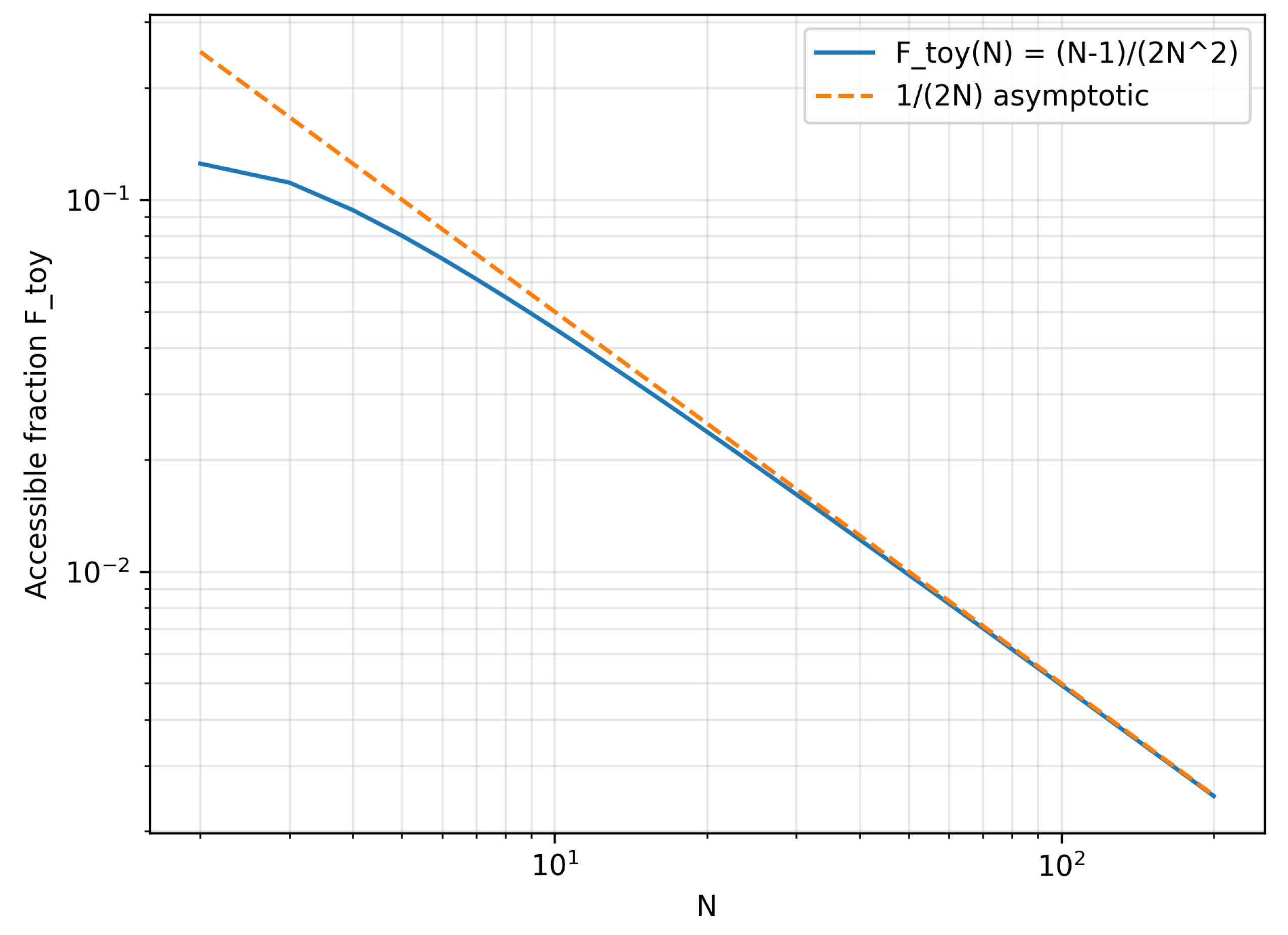
A simple numerical script confirms Equation (A72) and illustrates the asymptotic boundary scaling. The log–log plot in Figure A1 shows that rapidly approaches the asymptote.
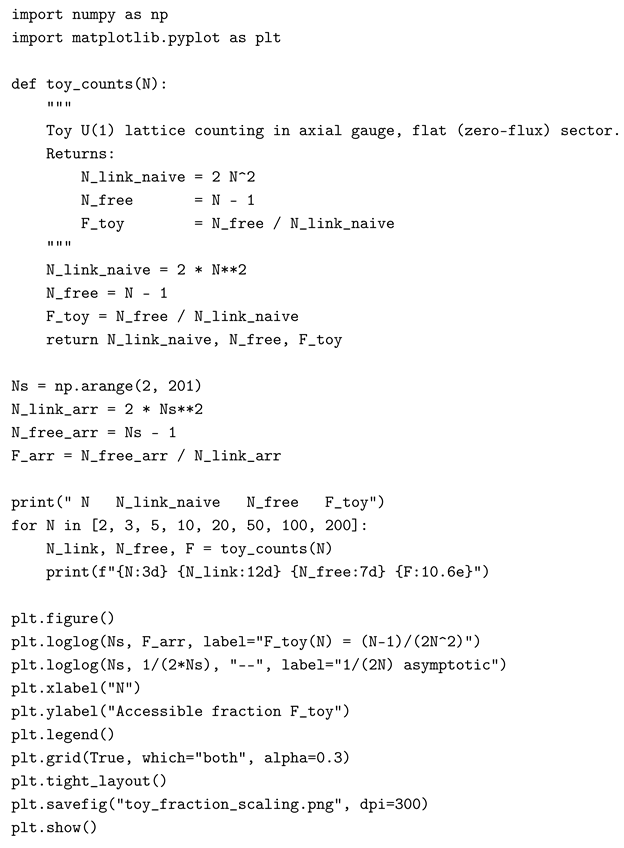
Figure A1.
Toy accessible fraction in the axial-gauge zero-flux sector: . The log–log plot demonstrates convergence to the boundary-type asymptotic scaling for large N.
References
- J. D. Bekenstein, “Black Holes and Entropy,” Phys. Rev. D 7, 2333 (1973).
- S. W. Hawking, “Particle Creation by Black Holes,” Commun. Math. Phys. 43, 199 (1975).
- R. M. Wald, “Jacob Bekenstein and the Development of Black Hole Thermodynamics,” arXiv:1805.02302 [gr-qc] (2018).
- W. Donnelly and A. C. Wall, “Entanglement Entropy of Electromagnetic Edge Modes,” Phys. Rev. Lett. 114, 111603 (2015), arXiv:1412.1895 [hep-th]. [CrossRef]
- W. Donnelly and A. C. Wall, “Geometric Entropy and Edge Modes of the Electromagnetic Field,” arXiv:1506.05792 [hep-th] (2015). [CrossRef]
- K. S. Thorne, R. H. Price, and D. A. Macdonald (eds.), Black Holes: The Membrane Paradigm, Yale University Press (1986). [CrossRef]
- S. W. Hawking, M. J. Perry, and A. Strominger, “Soft Hair on Black Holes,” Phys. Rev. Lett. 116, 231301 (2016), arXiv:1601.00921 [hep-th]. [CrossRef]
- H. Casini, M. Huerta and J. A. Rosabal, “Remarks on entanglement entropy for gauge fields,” Phys. Rev. D 89, no.8, 085012 (2014), arXiv:1312.1183 [hep-th]. [CrossRef]
- CODATA 2018 recommended values of the fundamental physical constants, see NIST/CODATA summary tables (2018).
- D. Nagy, “A First-Principles Derivation of the Fine-Structure Constant from Holographic Bit–Mode Balance,” preprint (2025). https://osf.io/preprints/osf/hw2je.
- D. Nagy, “Holographic Vacuum Energy from Quantized Horizons,” preprint (2025). https://osf.io/preprints/osf/m8t6h.
- A. J. Murphy, “Closed-Form Derivation of the Fine-Structure Constant from U(1) Configuration Space Geometry,” preprint (2025). 10.5281/zenodo.15426464.
- M. K. Parikh and F. Wilczek, “An action for black hole membranes,” Phys. Rev. D 58, 064011 (1998). [CrossRef]
- K. von Klitzing, G. Dorda, and M. Pepper, “New method for high-accuracy determination of the fine-structure constant based on quantized Hall resistance,” Phys. Rev. Lett. 45, 494–497 (1980). [CrossRef]
- T. Damour, “Black-hole eddy currents,” Phys. Rev. D 18, 3598 (1978). [CrossRef]
- R. L. Znajek, “The electric and magnetic conductivity of a Kerr hole,” Mon. Not. R. Astron. Soc. 185, 833–840 (1978). [CrossRef]
- B. Jeckelmann and B. Jeanneret, “The quantum Hall effect as an electrical resistance standard,” Rep. Prog. Phys. 64, 1603–1655 (2001). [CrossRef]
- P. J. Mohr, D. B. Newell, and B. N. Taylor, “CODATA recommended values of the fundamental physical constants: 2014,” Rev. Mod. Phys. 88, 035009 (2016). [CrossRef]
- J. D. Jackson, Classical Electrodynamics, 3rd ed., John Wiley & Sons, New York (1999).
- A. Chodos, R. L. Jaffe, K. Johnson, C. B. Thorn, and V. F. Weisskopf, “New extended model of hadrons,” Phys. Rev. D 9, 3471 (1974). [CrossRef]
- R. Camporesi and A. Higuchi, “On the eigenfunctions of the Dirac operator on spheres and real hyperbolic spaces,” J. Geom. Phys. 20, 1–18 (1996). [CrossRef]
- D. V. Vassilevich, “Heat kernel expansion: user’s manual,” Phys. Rept. 388, 279–360 (2003). [CrossRef]
- P. B. Gilkey, Invariance Theory, the Heat Equation, and the Atiyah–Singer Index Theorem, 2nd ed., CRC Press (1995).
- K. Kirsten and A. J. McKane, “Functional determinants by contour integration methods”, Ann. Phys. 308, 502 (2003). [CrossRef]
- G. V. Dunne and K. Kirsten, “Functional Determinants for Radial Operators,” arXiv:0812.0620. [CrossRef]
- M. E. Peskin and D. V. Schroeder, An Introduction to Quantum Field Theory, Addison–Wesley, Reading, MA (1995).
- J. B. Kogut, “An Introduction to Lattice Gauge Theory and Spin Systems,” Rev. Mod. Phys. 51, 659 (1979). [CrossRef]
Disclaimer/Publisher’s Note: The statements, opinions and data contained in all publications are solely those of the individual author(s) and contributor(s) and not of MDPI and/or the editor(s). MDPI and/or the editor(s) disclaim responsibility for any injury to people or property resulting from any ideas, methods, instructions or products referred to in the content. |
© 2025 by the author. Licensee MDPI, Basel, Switzerland. This article is an open access article distributed under the terms and conditions of the Creative Commons Attribution (CC BY) license (https://creativecommons.org/licenses/by/4.0/).
Copyright: This open access article is published under a Creative Commons CC BY 4.0 license, which permit the free download, distribution, and reuse, provided that the author and preprint are cited in any reuse.


