

Submitted:
21 November 2025
Posted:
24 November 2025
You are already at the latest version
Abstract
Europe is warming faster than the global average, placing climate change adaptation at the centre of urban policy and planning. This article develops and applies a framework to diagnose the maturity of multilevel adaptation governance across European Union Member States in 2025. Governance is operationalised through eight dimensions: (i) National Adaptation Strategies/Plans; (ii) Regional Adaptation Plans; (iii) Local Adaptation Plans; (iv) Sectoral Adaptation Plans; (v) integration in National Urban Policies; (vi) adaptive content in Long-Term Strategies; (vii) adaptation relevance in climate laws; and (viii) participation in the Covenant of Mayors. Results show pronounced heterogeneity: many systems have up-to-date national strategies but incomplete territorial diffusion, thin legal anchoring, or limited urban-policy standards. By linking auditable rules to urban-facing instruments, the study provides a practical tool for benchmarking capabilities, prioritising reforms, and tracking progress towards integrated, multilevel adaptation systems that support resilient urban development across the European Union.
Keywords:
climate change
; multilevel governance
; national urban policy
; Covenant of Mayors
; local adaptation
; spatial governance
; adaptation policies
1. Introduction
Climate risks in Europe are becoming more frequent, severe and widespread, generating uneven impacts across sectors and territories and intensifying pressure on public institutions to organise effective responses [1,2,3]. A consistent message from the literature is that effective adaptation depends on the alignment of responsibilities, resources and information across administrative levels and policy areas. Foundational and applied research on barriers, enabling conditions and multilevel coordination, particularly in European settings, with corroborating international evidence, reaches similar conclusions [2,4,5,6,7,8,9,10,11]. City networks likewise emphasise the importance of vertical and horizontal coordination, including capacity building, information sharing, strategic guidance and tailored finance, to empower subnational action [8,39]. Comparative analyses further confirm recurring role ambiguity, capacity gaps and coordination deficits, alongside corrective approaches and toolkits documented across OECD countries [10,11].
The EU policy framework provides direction and expectations. The EU Strategy on Adaptation to Climate Change and the European Climate Law consolidate requirements for systematic monitoring, cross-sectoral coherence and long-term planning, extending the strategic horizon of the European Green Deal [12,13,20]. Comparative studies and EU stocktake suggest that these instruments have acted as agenda-setters and coordination devices, prompting initial waves of national strategies, standardising core components (risk assessments, cross-sectoral objectives, coordination bodies), and introducing monitoring and reporting expectations that encouraged periodic updates [12,13,20,21,25]. From a theoretical perspective, the major analytical models for climate change adaptation illustrate how adaptation planning can proceed under conditions of uncertainty by integrating the twin considerations of exposure, sensitivity, and adaptive capacity into decision-making [14,15]. Subsequent scholarship shows that effective implementation is closely linked to processes of transformational change and to governance dynamics operating across scales, involving governance interventions, the allocation of responsibilities, and network-based forms of coordination [16,17,18,19]. Comparative analyses between Member States reveal markedly different adaptation pathways and highly uneven policy uptake across territories [21,22,23,24]. Simultaneously, reviews of reported actions highlight that successful implementation relies on clear mandates, a purpose-fit institutional setup, and effective coordination mechanisms that function in practice, not just in theory [25]. Shared evidence infrastructures—such as EEA reporting and Climate-ADAPT—alongside legal/policy databases enable harmonised evidence gathering and comparative analysis [26,27,28,29,30]. Urban and planning scholarship complements this picture by detailing municipal instruments and ecosystem-based approaches, and by examining their interactions with national frameworks [31,32]. In parallel, the Sendai Framework provides a complementary risk-reduction lens [33]. Beyond Europe, international assessments indicate that similar multilevel design levers—such as legal anchoring, periodic review, and information systems that connect national priorities to local delivery—recur in North America and Asia [50,51,52,53,54,55,56,57].
Against this backdrop, the paper examines the extent of multilevel adaptation-governance maturity across EU Member States and how a transparent, theory-aligned diagnostic framework can inform differentiated capacity building and policy design across governance levels. The guiding question of this research is: how do national adaptation governance arrangements differ in their capacity to enable coherent multilevel implementation, and what maturity patterns emerge from these differences? The contribution is threefold. First, a governance-maturity framework grounded in established adaptation and public-policy scholarship is articulated, clarifying why specific governance aspects matter for implementation [14,15,16,17,18,19]. Second, this framework is applied to the Member States using official documentary evidence, enabling a cross-national comparison under consistent criteria aligned with EU expectations for resilience and accountability [12,13,20,25]. Third, comparative diagnostics are translated into rule-anchored, near-term policy guidance for legislation, budgeting and oversight—particularly on legal mandates, territorial diffusion and urban integration—offering practical pathways for capacity building at national, regional and local levels [12,13,20,35,36]. The remainder of the article is structured as follows: Section 2 reviews the literature and develops the theoretical framework for multilevel adaptation governance, including a concise perspective on the USA and Asia; Section 3 details Materials and Methods; Section 4 presents Results for the European Union Member States; Section 5 discusses implications for policy design and capacity building; Section 6 concludes with key takeaways and immediate operational guidance.
2. Literature Review and Theoretical Framework
Despite notable progress in European adaptation policy, systematic, maturity-based comparisons of how national frameworks support local delivery remain limited, even where national strategies are formally in place [21,25]. This paper addresses that gap by operationalising a governance-maturity lens for the European Union and, using official documentary evidence, organises countries into archetypes based on the configuration of roles, coordination, monitoring, and municipal support [2,22]. The approach is anchored in contemporary EU expectations for resilience and accountability—the European Green Deal, the EU Adaptation Strategy and the European Climate Law—which emphasise demonstrable progress, multilevel coherence and review cycles [12,13,20]. The guiding research question is therefore: how do national adaptation governance arrangements differ in their capacity to enable coherent multilevel implementation, and what maturity patterns emerge from these differences? The theoretical starting point treats adaptation as a governance challenge that spans multiple levels and sectors: authority and problem-solving capacity are dispersed, so effectiveness hinges on coordination instruments, role clarity and institutional fit rather than hierarchy alone [4,10,47,48]. Foundational analyses of adaptation decision-making under uncertainty motivate iterative learning, proportionality and the transparent articulation of objectives, options and criteria, thereby avoiding technocratic framings detached from feasibility [2,14,15]. Comparative studies repeatedly document barriers—ambiguous mandates, fragmented responsibilities, weak vertical–horizontal coordination and capability constraints—and show that clear legal bases, reliable information infrastructures and alignment across tiers act as enabling conditions [7,10]. Evidence from urban governance further demonstrates that role clarity and coordination tools are decisive for translating national ambitions into local action. At the same time, gaps tend to open at the national–local interface [17,22]. Legal analyses of flood-risk management illustrate how fragmentation undermines coherence unless bridged by integrative instruments and explicit allocation of duties [11].
Within Europe, policy evolution has raised the bar for coherence and traceability. The Adaptation Strategy clarifies expectations for mainstreaming, monitoring and multilevel coordination, while the Climate Law codifies long-term objectives and review obligations [12,13]. However, EU stocktakes still find convergence in formal strategies but divergence in institutional design, sectoral integration and local enablement [25]. A shared knowledge backbone—EEA reporting and the Climate-ADAPT platform—offers harmonised access to strategies, laws and indicators, enabling cross-country comparison of governance conditions and reported actions [1,26]. Complementary databases such as Climate Change Laws of the World and Climate Watch add structured legal/policy metadata and target trajectories to triangulate documentary evidence [27,30]. Network standards, notably the Global Covenant of Mayors’ Playbook and Common Reporting Framework, define reporting fields that align municipal data with national backbones and EU expectations, thereby strengthening the comparability of local planning and monitoring [8,39]. At the city scale, the JRC’s analyses of SECAP practice and the wider urban policy literature document how guidance, finance and templates condition the quality and diffusion of plans [32,38].
A brief extra-European perspective clarifies how multilevel arrangements shape adaptation in federal and unitary settings. For North America, the IPCC AR6 assessment documents a dense but uneven patchwork of measures across federal, state/provincial and municipal levels, with significant progress in city and state planning but persistent coordination and capacity gaps that affect vertical coherence and monitoring under uncertainty [50]. Reviews of United States adaptation law and practice similarly show that much implementation occurs at sub-national scales—especially in municipalities and counties—while federal frameworks and finance remain crucial for setting standards, gathering information and tracking progress [51,52]. Recent syntheses of local-level policies highlight advances alongside gaps in equity, metrics and enforceability, again pointing to the need for clearer roles and learning cycles across levels of government [53]. Across Asia, the IPCC AR6 regional chapter reports rapid growth in national strategies and subnational initiatives, yet emphasises the barriers of finance, capacity, and cross-scale coordination that hinder mainstreaming and monitoring [54]. OECD guidance on climate-risk management reinforces the case for transparent rulesets and periodic review—design features directly relevant to multilevel systems in the region [55]. World Bank diagnostics for South Asia echo these points, underlining the importance of place-based data architectures and institutional arrangements that link national priorities to local delivery and private co-investment [56]. Beyond these regional syntheses, comparative work on multilevel governance and sub-national finance in Asia and the Pacific (OECD/ADB) details how intergovernmental mandates, fiscal frameworks and reporting systems condition the scalability of local plans—especially where national urban policy and planning codes provide binding hooks [57]. Country-focused analyses illustrate the mechanisms: in Japan, the Adaptation Act’s national-to-local architecture, including Local Climate Change Adaptation Centres, creates structured interfaces between knowledge infrastructures and municipal planning, while revealing heterogeneity in local capacities that must be addressed through standards and support [58,59]; in the Republic of Korea, studies of national adaptation planning and governance identify both the consolidation of cross-ministerial roles and the persistence of implementation barriers that impede iterative monitoring and territorial diffusion [60,61]. Region-wide, UNFCCC and multilateral assessments converge on the same levers—legal anchoring, periodic review, vertical coordination and robust information systems—while also documenting a substantial adaptation-finance gap that undermines local execution unless domestic public finance and MDB support are aligned with clear, auditable standards [62,63]. Taken together, these sources support the stance adopted here: robust national backbones (law/strategy), explicit territorial mandates and monitored local standards are complementary; without their alignment, voluntary local activity rarely aggregates into integrated multilevel systems [55,56,57].
On this conceptual basis, the framework used here draws on four lenses that the literature repeatedly associates with multilevel performance: adaptation governance (roles and coordination), barriers and enablers, diffusion and territorial/urban implementation at the national–local interface, as well as monitoring and learning when outcomes are partial or lagged [4,7,22,32]. From these lenses derive eight governance aspects that are both conceptually central and documentable in pan-European comparison: (1) strategic–legal foundation—existence/recency of NAS/NAP and legal anchoring—conditioning authority, durability and accountability [12,13,21]; (2) risk knowledge—national climate-risk assessments and sector diagnostics—for proportionate prioritisation aligned with the IPCC [1,2,3]; (3) vertical coordination and role clarity—explicit mechanisms across national–regional–local tiers—to reduce overlaps and gaps [10,25]; (4) local enablement and capacity—guidance, finance and technical assistance for municipalities—determinants of plan quality and feasibility [17,38]; (5) mainstreaming and cross-sectoral integration—in spatial planning, infrastructure and sector policies—for coherence and uptake [7,12,32]; (6) monitoring, evaluation and learning (MEL)—feedback loops, review cycles and reporting—for adaptive management and transparency [34,35,36]; (7) multi-stakeholder participation—inclusive and coproductive processes—for legitimacy and implementability [9,16]; (8) finance and resource mobilisation—dedicated lines and budget tagging—to connect plans and delivery continuously [35,46]. To operationalise these concepts comparatively—without entering appraisal or measurement detail—this study follows comparative policy analysis and content-analysis standards: explicit constructs and level descriptors; scale choices consistent with ordinal information; transparent coding rules; and a documented audit trail [40,41,42,43,44,45]. On these foundations, the five archetypes used in this research—Lagging/Fragmented, Top-Down Centralised, Region-Driven, Local Bottom-Up and Integrated Multilevel—are not a single ladder but recurring configurations anticipated by multilevel governance theory, in which the relative strength of national core, territorial mandates and urban–local density varies [4,19,47,48]. The literature suggests, in particular, that: (i) strong legal mandates with review cycles and indicators institutionalise action, but without territorial obligations remain top-down [12,13,35]; (ii) regional strength can bridge part of the gap, yet rarely delivers integration without binding local coverage and shared risk methods [18,25]; (iii) local/urban density rises when adaptation is embedded in planning instruments and supported by networks and common standards, but remains fragile if not linked to predictable finance and a national legal core [8,32,38,39]; (iv) integrated systems emerge when these three pillars co-evolve and are supported by credible information infrastructures and MEL, in line with the EU agenda and with Sendai/UNFCCC [1,12,33,36]. In sum, this theoretical framework explains why the eight aspects selected are predictive of governance maturity, and why the paper’s empirical outcomes organise into five non-overlapping archetypes: they reflect the mechanisms—legal mandate, territorialisation, urban integration, monitoring and finance—that European and international literatures identify as decisive for a state’s capacity to orchestrate multilevel implementation [25,35,37,46,50,51,52,53,55,56,57,58,59,60,61,62,63].
3. Materials and Methods
This study employs a documentary, rule-based comparative design to analyse and classify multilevel adaptation governance across the Member States as of July 2025. The framework operationalises governance by connecting (i) the national strategic–legal backbone, (ii) territorial mandates at regional and local levels, and (iii) local urban diffusion and network mobilisation, then categorises Member States into five theoretically grounded archetypes (K1–K5) using deterministic, rule-based criteria based on the indicator levels. The eight governance aspects were retained based on: (i) pan-European relevance, established by EEA syntheses and EU policy scaffolding [1,2,3,12,13,20,21,25]; (ii) documentary traceability in national and sub-national strategies (NAS/NAP/RAP) and legal instruments, supported by reporting repositories and policy databases [26,27,28,29,30,31,39]; (iii) cross-country comparability, aligned with comparative policy analysis and content-analysis standards [34,35,36]; and (iv) adequate data coverage to ensure reproducible coding and interpretable results [1,2,3,25,26,27,28,29,30,31,34,35,36,39,40,41]. Evidence includes official national strategies and plans (NAS/NAP), climate framework laws, long-term strategies (LTS), regional adaptation plans (RAP), local adaptation plans (LAP; stand-alone or within SECAPs), sectoral adaptation plans (SAPs), national urban policies (NUP), and monitoring, evaluation and finance annexes where available. A comprehensive, country-by-country list of all analysed documents (title, issuing authority, year, language, source/URL, access date) is provided in Appendix A, Table A1. Identification and cross-checks are based on EEA reporting and Climate-ADAPT [1,3,25,26,27], supplemented by the Climate Change Laws of the World, the Covenant of Mayors (CoM) platform, the Urban Policy Platform, and Climate Watch [28,29,30,31]. In cases of a conflict between repositories and national sources, the original national legal or policy text takes precedence (laws > decrees > plans > portals), in line with content-analysis standards on source precedence and traceability [42]. Instruments that are adopted but not yet in force are marked as adopted; draft instruments under consultation and not yet adopted are excluded. For CoM coverage (tiered classification), the population cut-off date is 30 June 2025, and SECAPs are considered only if adaptation is included in the adopted plan [29,38,39,44].
Non-English policy and legal texts were translated using DeepL (2025 version) solely to facilitate screening and coding. No formal intercoder reliability testing was conducted on translated passages. To reduce the risk of translation-induced bias in the coding, three safeguards were applied: (i) precedence of the original national legal/policy text over summaries or repositories whenever discrepancies were detected; (ii) targeted manual checks of decision-relevant clauses (e.g., mandates, review cycles, finance provisions, indicator requirements), with particular attention to legal modality (e.g., shall/must vs may/should) and binding force; and (iii) conservative, descriptor-anchored coding rules that rely on explicit, documentable features (e.g., the presence of a review article or a dedicated budget line) rather than nuanced wording alone. Where wording remained ambiguous after re-reading the source-language text, the code defaulted to the lower descriptor level, and the case was flagged in the coding log. A detailed codebook defines inclusion/exclusion rules, extraction units (strategy clauses, legal provisions, programme measures) and anchor descriptors for the descriptor levels, with illustrative coded excerpts; the full document inventory (URLs and access dates) is reported in Appendix A, Table A1.
Eight dimensions (B–I) are coded on an ordinal scale from 0 to 4, using indicator-specific documentary anchors (defined in Table 1) that align with international guidance on adaptation monitoring and learning [33,35,36] and with European Union policy expectations for periodic review and accountability [12,13]. Anchors prioritise verifiable features such as mandates, indicators/KPIs, periodic review and finance [12,13,21,33,34,35,36,37,38,39,40,41,43,47,48]. The indicators are: (B) NAS/NAP robustness; (C) RAPs; (D) LAPs; (E) SAPs; (F) adaptation content in the LTS; (G) integration in NUP; (H) adaptation provisions in the climate framework law; and (I) CoM coverage. Table 1 details definitions, decision rules, common evidence sources, and anchor rationales for each indicator. Ordinal coding is employed for clear, evidence-traceable classification and does not involve composite scoring or compensatory aggregation. When repository summaries and national texts differ, the national text takes precedence [1,3,26,27,28,42].
Coverage of indicator I is classified on an ordinal scale from 0 to 4, consistent with JRC coverage tiers and the GCoM reporting framework [38,39,44]: 0 < 1.00% (Very Low); 1 = 1.00–4.99% (Low); 2 = 5.00–9.99% (Medium); 3 = 10.00–14.99% (High); 4 ≥ 15.00% (Very High) (see Table 2).
Derived indices (J–P) are calculated from the base indicators (B–I) to summarise vertical and horizontal coordination patterns (definitions and formulae in Table 3). These indices are used to develop the classification rules for dividing the countries into the clusters (K1-K5) (see 3.1 subsection). The indices O and P represent directional diagnostics (centre-heavy vs. local-heavy); they are included for interpretive transparency but do not influence class assignment. As a sensitivity check, a zero-penalty adjustment was applied to N (subtracting 0.25 whenever any base indicator equals 0). Supplementary visual summaries, archetype listings, and level distributions are provided in Appendix B.
3.1. Rationale for the Five Clusters and Rule Order
The five archetypes reflect recurrent multilevel governance configurations anticipated by the theory [9,47,48]. Their empirical recurrence is documented in comparative studies and in European stocktakes [4,10,21,22,25]. Each class is specified to be diagnostic (clear signal), non-compensatory (no single pillar offsets deficits elsewhere), and replicable (descriptor-anchored thresholds). The rule order reflects increasing degrees of vertical balance and legal–strategic consolidation, consistent with European Union expectations on periodic review and accountability [12,13,21,34,35,43].
- K1 – Lagging/Fragmented. Several foundational pillars are low; neither regional nor local tiers are consolidated, and the national core is not steering multilevel diffusion. Rule: count {B..I ≤ 1} ≥ 4, M ≤ 0.25, J < 2.5, C ≤ 2, D ≤ 2, L ≤ 2, and not higher classes.
- K2 – Top-Down Centralised. Robust national strategic–legal backbone with incomplete territorial diffusion and local collaboration; not yet integrated. Residual rule (after excluding K5/K3/K4/K1): J ≥ 2.5 and N < 3.
- K3 – Region-Driven. Territorial (regional) leadership precedes full national consolidation; the local tier is present but not yet scaled. Rule: C ≥ 3, D ≥ 1, K ≥ 2, J < 3, and not K5.
- K4 – Local/Urban Bottom-Up. City-led mobilisation and urban policy instruments lead, while the regional tier remains weak and the national core is moderate. Rule: L > 2 driven by at least one advanced local lever (D ≥ 3 or G ≥ 2 or I ≥ 2), C ≤ 2, J < 3, and not K5/K3.
- K5 – Integrated (Multilevel). Balanced, mature multilevel architecture in which a strong national core is coupled with mandatory or widely institutionalised sub-national layers and active local/urban integration. Rule: (i) vertical balance N ≥ 2.5; (ii) advanced local tier D ≥ 3 and urban integration G ≥ 2; (iii) regional presence C ≥ 2; (iv) advanced climate law H ≥ 3; (v) functional NAS/NAP B ≥ 2.
Descriptor-anchored cut-offs (e.g., D ≥ 3 = “mandatory/reporting with ≥50% population and ≤6-year update”) tie each rule to observable features in laws and plans. Balance thresholds on N (≥ 2.5) prevent compensation across tiers, while exclusion predicates (e.g., “not K5/K3”) avoid ambiguous assignments. Sensitivity checks for threshold choices and alternative partitions are documented in Appendix B; visual diagnostics (heatmaps and colour-coded membership tables) are provided for transparency and remain descriptive and subordinate to the rules [34,35,38,39]. For transparent replication, the rule-based cluster assignment can be implemented as a single nested Excel formula in en-US and it-IT locales. The expressions directly operationalise the deterministic rules and do not imply any statistical modelling. For readability, the complete formulas are provided in Appendix B.1.
3.2. Coding and Verification Protocol
The complete document inventory (by Member State, including URLs and access dates) is included in Appendix A, Table A1. Where repository summaries and national sources diverged, the official national legal or policy text took precedence (laws > decrees > plans > portals). Non-English texts were translated with DeepL (2025) solely to support screening and coding; to minimise translation bias, we: (i) prioritised the original national text in case of discrepancies; (ii) re-checked decision-relevant clauses with attention to legal modality; and (iii) applied conservative, descriptor-anchored coding rules (defaulting to the lower level under unresolved) ambiguity) [34,35,36,42,43].
Coverage rules: C at the statutory regional level (highest binding tier in mixed arrangements); D from national inventories and/or mandates with population thresholds; I (CoM) as the proportion of residents in municipalities with an adopted SECAP including adaptation, as of 30 June 2025, classified per Table 2 (numerator: CoM; denominator: Eurostat 2024 provisional [49]). Given the ordinal (0–4) nature of B–I, results are reported as level distributions and presence/status tables; derived indices (J–P) support the deterministic rules only and are not treated as cardinal measures. The Excel implementation is reported in Appendix B.1, while the sensitivity checks and robustness tests are presented in Appendix C.
3.3. Limitations
This study acknowledges several limitations. First, compressing heterogeneous national evidence onto an ordinal 0–4 scale prioritises cross-Member-State comparability over within-level nuance. The resulting summaries are treated as interpretive signposts rather than cardinal measures. To limit spurious compensation across pillars, we employ a non-compensatory breadth check and apply a zero-penalty adjustment to the integration index N (subtracting 0.25 whenever any base indicator equals 0); these probes reduce—but cannot eliminate—threshold and compensability effects [34,35].
Second, many source documents were not in English and required machine translation (DeepL, 2025) for screening/coding. Translation can obscure legal nuance and institutional terminology. We mitigated this risk by (i) prioritising the original national text whenever discrepancies arose, (ii) manually re-checking decision-relevant clauses (mandates, review cycles, finance, indicators) with attention to legal modality (shall/must vs may/should), and (iii) applying conservative, descriptor-anchored coding rules that default to the lower level when ambiguity persisted. Residual translation error cannot be ruled out; however, the non-compensatory and threshold-sensitivity checks did not change any class assignments, suggesting that the comparative patterns are stable to plausible translation noise [42].
Third, the focus on documentable features enhances auditability but does not directly assess implementation quality or effectiveness (e.g., the Covenant of Mayors indicator captures the extent of SECAP adoption, including adaptation, not its outcomes) [38,39,44]. Fourth, timing and availability constraints may yield conservative coding, with very recent sub-national instruments not yet reflected in European repositories or national portals [26,27,28,29,30,31].
Thresholds are theory-informed and policy-grounded (European governance cycles; monitoring and learning guidance), and sensitivity analyses are reported in the appendices to make any boundary effects explicit [12,13,21,34,35]. To support transparency and reuse, the data inventory, codebook, coded excerpts, and replication spreadsheets are provided as supplementary materials, consistent with international guidance on adaptation monitoring/learning and NAP good practices [36,43,46].
4. Results
4.1. Aggregate Patterns and Descriptive Statistics
The comparison of the eight governance dimensions across the European Member States (reference date: July 2025) confirms a marked asymmetry between a relatively consolidated national strategic–legal backbone and much weaker regional and local layers. This pattern is visible in the complete numerical distributions and heatmaps (Appendix B.2, Appendix B.3 and Appendix B.4), which make explicit the heterogeneity otherwise concealed by the ordinal scales.
At the national level, adaptation strategies and plans (B, NAS/NAP) cluster towards the upper end of the spectrum, with a median of 3.0 (IQR = 1.0): almost half of the Member States reach levels 3–4 (44.4%), while none score 0 and only 14.8% remain at level 1. By contrast, regional adaptation plans (C, RAPs) and local adaptation plans (D, LAPs) are concentrated in the lower categories. RAPs display a median of 1.0 (IQR = 2.0), with 59.2% of countries at levels 0–1 and no case at level 4, indicating that regional mandates are either absent or only partially developed. LAPs also have a median of 1.0 (IQR = 1.0), and two-thirds of the Member States (66.7%) are at level 1, with only 22.2% reaching levels 3–4. Sectoral adaptation plans (E, SAPs) are even more weakly developed: the distribution is heavily skewed towards level 1 (70.4%), the median is 1.0 (IQR = 1.0), and very few countries have either no sectoral planning (22.2% at level 0) or fully institutionalised sectoral frameworks (3.7% at level 4).
The adaptive components of long-term strategies (F, LTS) and the integration of adaptation into national urban policies (G, NUP) occupy a more intermediate position. Both record a median of 2.0 (IQR = 1.0), with a majority of Member States distributed between levels 1 and 2 (89.0% for F and 77.7% for G), and no country reaching level 4, suggesting that long-term and urban policy integration is present but rarely fully mature. Climate laws with explicit adaptation provisions (H) reveal a more polarised picture: the median is 1.0 (IQR = 2.0), with 22.2% of Member States lacking any specific climate law (level 0) and 37.0% reaching levels 3–4, pointing to significant divergence in the legal consolidation of adaptation. Local engagement through the Covenant of Mayors (I) remains modest overall: the median is 1.0 (IQR = 1.0), with 74.0% of Member States at levels 0–1 and only 7.4% at levels 3–4, indicating limited national coverage of CoM signatories with adaptation commitments in many countries.
Simple arithmetic summaries used as internal diagnostics reinforce this structurally unbalanced configuration. The national core index (J, NAT_CORE) has a median of 1.70 (IQR = 1.00), slightly higher than the territorial mandate index (K, TERR_MAN; median = 1.50, IQR = 1.00) and the local synergy index (L; median = 1.30, IQR = 1.00). Advanced governance scores (M, ADV_SCORE – share of pillars at level ≥3/8) are generally low, with a median of 0.10 (IQR = 0.25), underscoring that highly integrated, mature systems are rare. The multilevel integration index (N, MULTI_INT) clusters around intermediate values (median = 1.70, IQR = 0.73), consistent with partial but incomplete alignment between national, regional, and local tiers. Directional differentials are modest but systematic: the median for O is +0.30, while P is −0.30, suggesting a slight but widespread tendency for national instruments to be more developed than their subnational counterparts.
The co-occurrence patterns visible in the heatmaps and distributional diagnostics (Appendix B.4) help qualify these aggregate tendencies. First, the heatmap reveals that, while some Member States combine relatively advanced national strategies (B at level 3) with strong climate-law provisions (H ≥ 3), a majority of this group still display low values for climate laws (H = 0–1), pointing to a recurrent strategic–legal asymmetry within the national layer. Second, combinations in which both regional and local mandates are weak (C = 1 and D = 1) are common, highlighting the dependence of subnational adaptation capacity on national initiatives; within these, the rule-based classification distinguishes “regional-first” (K3) and “local-first” (K4) trajectories. Third, higher local synergy (L), primarily driven by stronger LAPs (D), more systematic NUP integration (G), and broader Covenant of Mayors participation (I), tends to co-occur with the more synergistic configurations (K4–K5). These combine stronger, more balanced territorial mandates with more even centre–local dynamics (O closer to zero, with K4 slightly bottom-heavy and K5 mildly centre-heavy) and comparatively high multilevel integration scores (N). Taken together, these results depict a governance landscape in which national frameworks are comparatively consolidated, yet the territorial diffusion of adaptation responsibilities remains uneven, and upward–downward integration varies substantially across the Member States.
4.2. Country Archetypes
Applying the deterministic rules defined in Materials and Methods, five mutually exclusive archetypes (rule-based clusters K1-K5) were identified (Table 4; Figure 1). Memberships are invariant under the zero-penalty stress test on N (subtracting 0.25 when any base indicator equals 0) and remain stable under reasonable non-compensatory adjustments [34,35,38,39,40,41].
For each cluster, Table 4 reports the number of Member States, the member list, and the cluster-level medians and IQRs for the composite signposts J (NAT_CORE), K (TERR_MAN), L (Local synergy), M (Advanced breadth) and N (Multilevel integration). These ordinal summaries allow a concise verification of the rule logic (e.g., K5 exhibits higher vertical balance—median N around 3—and higher territorial/local pillars—median K and L ≳ 2.5—whereas K1 shows simultaneously lower J, K, L).
-
K1—Lagging/Fragmented (14 MS): AT, BG, CY, CZ, EE, HU, IT, LV, LT, MT, PL, RO, SK, SI.Profiles combine multiple low pillars (≥ 4 bases ≤ 1), weak national cores (J < 2.5) and thin territorial layers (C ≤ 2, D ≤ 2, L ≤ 2). N typically ≤ 1.7; positive TOP_DOWN indicates centre-led yet shallow systems. Sub-national obligations are often non-binding or absent; sectoral institutionalisation is at an early stage; LTS content tends to be narrative rather than KPI-based; urban integration is at the guidance level; and CoM leverage is generally low. These profiles do not satisfy the gates for other archetypes (not K2/K3/K4/K5 for the stated reasons). Policy priorities follow directly: mandate RAP/LAP with coverage and review clauses; upgrade LTS/NUP to binding hooks; issue stand-alone SAPs in key sectors; and scale network leverage—consistent with the non-compensatory design.
-
K2—Top-Down Centralised (3 MS): FI, LU, ES.Robust national cores (J ≥ 2.5) coexist with N < 2.5 and at least one territorial gate below K5 (often D < 3 and/or C < 2–3), typically with O = J − L > 0. Finland and Luxembourg pair strong legal backbones with voluntary or thin territorial layers; Spain is closest to K5 but remains below D ≥ 3 and N ≥ 2.5. Trajectories: convert voluntary regional/local activity into mandated RAP/LAP with coverage and review, embed binding urban-planning standards (G ≥ 3), and consolidate local ecosystem density so that N crosses 2.5.
-
K3—Region-Driven (5 MS): BE, HR, DE, EL, SE.Regional institutions are the primary engine (C ≥ 3, K ≥ 2), while the national core is non-dominant (J < 3) and N ≈ 1.7–1.9; local synergy is present but uneven (L ≈ 2.0). Progression requires binding local coverage (D ≥ 3), a stronger national legal backbone (H ≥ 3, with J rising) and tighter urban-policy mandates (G), which together move N beyond 2.5.
-
K4—Local/Urban Bottom-Up (1 MS): DK.High local synergy (L > 2) driven by mandatory LAPs with full population coverage (D = 4), weak/absent regional tier (C ≤ 2) and a non-dominant national core (J < 3), yielding N = 2.0. Progress toward K5: codify national adaptation duties (H, J), strengthen monitored urban standards (G) and consider a functional regional coordination layer (C/K).
-
K5—Integrated (Multilevel) (4 MS): FR, IE, NL, PT.Membership requires all high bars—B ≥ 2, C ≥ 2, D ≥ 3, G ≥ 2, H ≥ 3, N ≥ 2.5—so neither strong laws nor dense local activity alone suffice. These systems exhibit convergent medians across J, K, and L, and at high N, indicating balanced pillars rather than single-lever dominance. Differences at the margin (sectoral articulation E, network mobilisation I) are secondary to the rule gates.
The mapped distribution of archetypes across the Member States shows recognisable geographical groupings. K1 is prevalent in parts of Central and Eastern Europe; K2 combines strong national backbones with limited downward diffusion; K3 displays region-led configurations with uneven local mobilisation; K4 is a local-first configuration; K5 shows vertically aligned systems with broader coverage. These descriptions summarise observed memberships and do not imply causal interpretation.
4.3. Robustness and Sensitivity
We assessed the stability of the rule-based cluster memberships through three stress-test scenarios: (i) a non-compensatory “zero-penalty” adjustment to the integration index N (subtracting 0.25 when any base indicator equals 0), (ii) moderate shifts of the high-bar threshold for N (±0.25 around the reference value of 2.50), and (iii) an inverted ordering of the tiebreaker variables. Across all four scenarios, no Member State changed cluster, indicating full invariance of the classification to alternative threshold and tie-breaking assumptions. The detailed scenario definitions and outputs are reported in Appendix C (Table C1).
4.4. Typologies of Adaptation Governance (Five Country Clusters)
4.4.1. Cluster 1: Lagging / Fragmented
This cluster groups Member States where adaptation governance is simultaneously weak at the centre and thin across subnational tiers. Assignment follows non-compensatory, descriptor-anchored rules. Countries fall here when the national core is modest (J < 2.5), territorial mandates are low (K ≲ 1.5; typically, RAP ≤ 1 and LAP ≤ 1–2), and the local/urban ecosystem remains underdeveloped (L ≤ approx. 1.7). These conditions also depress vertical balance (N ≤ approx. 1.3) and yield O = J − L > 0 (centre-heavy yet shallow).
Across AT, BG, CY, CZ, EE, HU, IT, LV, LT, MT, PL, RO, SK, SI, standard features include non-binding or absent subnational obligations, early-stage sectoral institutionalisation, narrative (rather than KPI-based) LTS content, weak integration into national urban policy, and limited network leverage via the Covenant of Mayors.
Illustrative country examples:
- Austria: mature NAS/NAP, but no adaptation clauses in the Klimaschutzgesetz and voluntary Länder instruments (RAP = 1; SAP = 1; G = 1; I very low).
- Czechia: comprehensive NAS/NAP, no climate act; RAP recommendations are voluntary (RAP = 1) and LAP/CoM uptake is extremely low (LAP = 0; I ≈ 0.37%).
- Estonia: solid NAS and an LTS chapter (F = 2), but no mandated RAP/LAP/SAP and I = 0.
- Hungary: county-level strategies in the 2014–2020 EU-funding window (temporarily RAP = 2), but no binding framework at present (LAP = 1; H = 0).
- Romania, Latvia, Lithuania: adaptation embedded narratively in LTS/NUP (F ≈ 2; G ≈ 1–2), without enforceable subnational duties and with low CoM coverage.
- Italy: updated PNACC, no framework climate law; regional/local diffusion remains voluntary, and CoM coverage is moderate (approx. 8%).
- Malta: H = 4 (strong law) yet no RAP/LAP/SAP and I = 0; non-compensatory gates keep the profile in K1.
Stand-alone, binding SAPs are uncommon (most E = 0–1; SK/SI = 2 only). LTS content is largely qualitative (F = 0–2). NUP integration is typically guidance-level (G = 0–2). CoM engagement is generally very low to low, with a few medium cases and isolated higher values; detailed percentages are reported with the country codes (see Appendix B). Profiles do not meet the alternative gates: not K2 (no consistently high J together with sufficient N), not K3 (regional mandates generally below C = 3), not K4 (local coverage not mandatory nor ≥ 50%, i.e., D < 3), and not K5 (integration gates—N ≥ 2.5, D ≥ 3, C ≥ 2, H ≥ 3, B ≥ 2, G ≥ 2—are not jointly satisfied).
4.4.2. Cluster 2: Top-Down Centralised
This cluster includes Finland, Luxembourg and Spain, where a strong, legally anchored national core coexists with incomplete vertical diffusion to regional and local tiers. Assignment follows the descriptor-anchored, non-compensatory rules: high J (≥ 2.5)—typically reflecting up-to-date NAS/NAP, adaptation-relevant climate law (H ≥ 3), and adaptive content in the LTS—combined with sub-threshold multilevel balance (N < 2.5) and at least one unmet territorial gate for K5 (notably D < 3 and/or C < 2–3), usually with O = J − L > 0 (centre-heavy).
Illustrative country profiles:
- Finland: the 2022 Climate Act includes a whole adaptation chapter (H = 4) and NAS/NAP are current (B = 4); RAPs are voluntary with < 50% coverage (C = 1), LAPs are voluntary with limited diffusion (D = 1), and NUP integration is reference-level (G = 1). The result is J = 3.3, N = 1.9 and L = 1.3—insufficient for K5.
- Luxembourg: a robust Climate Law (H = 4), an operational national plan, and a strong strategy (B = 3) coexist with an absent regional tier (C = 0) and non-mandated LAPs (D = 1); despite a coherent central policy (J = 3.0), both N = 1.7 and L = 1.7 remain low.
- Spain: a consolidated NAS/NAP cycle codified in Law 7/2021 (H = 3; B = 4) and structured monitoring is accompanied by widespread yet voluntary regional/local engagement (C = 2; D = 2), G = 2, and N = 2.4—closest to K5, but still below the D ≥ 3 and N ≥ 2.5 gates.
- These profiles do not meet:
- K3 (Region-Driven): regions are not the primary engine (FI C = 1; LU C = 0; ES C = 2 with voluntary diffusion);
- K4 (Local/Urban Bottom-Up): LAPs are not mandatory with ≥ 50% coverage (D < 3) and L is moderate;
- K5 (Integrated): the joint non-compensatory gates—N ≥ 2.5 together with D ≥ 3 (and C ≥ 2, H ≥ 3, B ≥ 2, G ≥ 2)—are not simultaneously satisfied (all three cases fall short on N and D, and FI/LU also on C).
Overall, K2 systems exhibit clear national legal backbones and strategy cycles (elevating J/H/F), alongside incomplete territorial mandates and local coverage (constraining K, L, N). The rationale clarifies why high J alone does not yield K5 membership under non-compensatory, descriptor-anchored rules.
4.4.3. Cluster 3: Region-Driven
Cluster 3 comprises systems where regional institutions serve as the primary engine of adaptation, while the national core remains non-dominant. Assignment follows the descriptor-anchored, non-compensatory rules: strong territorial mandates, operationalised by RAP = 3-4 and K≥ 2.0, coexist with a non-dominant national core (J < 3) and intermediate multilevel balance (N ≈ 1.7–1.9), with local synergy present but uneven (L ≈ 2.0). These conditions distinguish K3 from K2 (high J ≥ 2.5 but voluntary C/D and moderate L), K4 (requires D ≥ 3, i.e., legally mandated LAP coverage ≥ 50%), and K5 (requires the full set of non-compensatory gates: N ≥ 2.5, D ≥ 3, C ≥ 2, H ≥ 3, B ≥ 2, G ≥ 2). Illustrative country profiles:
- Belgium exemplifies a constitutionally decentralised model: each Region has an autonomous, up-to-date RAP (C = 3; K = 2.5), CoM participation is very high (I = 4; L = 2.3), yet the federal core is weak (J = 1.3) and there is no national climate law on adaptation (H = 0).
- Croatia and Greece display asymmetric profiles: statutory or fully rolled-out regional planning (EL C = 4; HR C = 3; both K ≥ 2) compensates for under-powered national cores (HR J = 1.3, H = 2; EL J = 1.0, H = 1) and non-mandatory LAPs (D = 1), with mid-range N (≈ 1.7–1.8).
- Germany’s Länder drive adaptation (C = 3; K = 2.0), but the federal layer remains largely strategic (J = 1.7), with no binding national adaptation law (H = 1), no stand-alone SAPs (E = 0), limited LAP diffusion (D = 1) and very low CoM coverage (I = 0)—all of which cap L (= 1.3) and N (= 1.7).
- Sweden combines mandatory regional assignments (C = 3; K = 2.5) and strong sectoral agency plans (E = 4) with integration in urban planning (G = 3; D = 2); nonetheless, the national core is non-dominant (J = 1.3; H = 1) and N (= 1.9) remains below the integrated threshold.
Two cross-cutting implications follow. (i) Strong regional mandates alone do not produce K5 membership in a non-compensatory design: without D ≥ 3, H ≥ 3 (with J rising), and N ≥ 2.5, high C/K cannot offset lower J/L/H. (ii) Descriptor gates set the boundary between K3 and adjacent archetypes: K3 differs from K2 by territorial strength (C/D), from K4 by the absence of legally mandated local coverage at or above 50% (D < 3), and from K5 by not meeting all simultaneous integration gates.
4.4.4. Cluster 4: Local Bottom-Up
This cluster is exemplified by Denmark, where legally mandated local instruments—rather than regional mandates—are the primary drivers of adaptation. Rule-based assignment reflects the non-compensatory gates: high local synergy (L = 2.3) underpinned by mandatory LAPs with full population coverage (D = 4), a weak/absent regional tier (C = 0), a non-dominant national core (J = 1.7 < 3; H = 0), and intermediate multilevel balance (N = 2.0 < 2.5). This configuration differentiates K4 from (i) K3, where regional mandates are strong (C ≥ 3), and (ii) K5, which requires all high bars to be met simultaneously (N ≥ 2.5, D ≥ 3, C ≥ 2, H ≥ 3, B ≥ 2, G ≥ 2). Denmark’s country values (C = 0, D = 4, E = 1, F = 3, G = 2, H = 0, I = 1; J = 1.7, K = 2.0, L = 2.3, M = 0.3, N = 2.0) are reported in Appendix B.2 and meet the K4 criteria by design.
A city-led model was operationalised via the 2012 national initiative requiring all 98 municipalities to prepare climate-adaptation plans and embed them in statutory spatial planning, later reinforced by cloudburst planning duties. These obligations yielded universal LAP coverage (D = 4), systematic risk mapping and actionable measures, generating the dense local ecosystem captured by L > 2. The regional layer is not used as a planning instrument (C = 0) following county reform, so the territorial-mandate pillar remains modest (K = 2.0) despite strong municipal implementation.
Denmark’s NAS (2008) and NAP (2012) provide direction but have not been recently refreshed with binding, review-backed duties; the Climate Act (2020) is mitigation-centred and does not codify adaptation mandates (H = 0). Adaptive content is present in the long-term strategy (F = 3), which references governance arrangements and mainstreaming, lifting J above the lowest band without establishing a legal core. Urban policy integration is prescriptive but not fully binding (G = 2): adaptation is woven into guidance and flood-risk provisions but not enforced through national KPI-based standards. Sectoral articulation is limited (E = 1), reflecting reliance on integration through water, spatial and infrastructure regimes rather than stand-alone SAPs. Network mobilisation via the Covenant of Mayors is modest (I = 1; ≈ 4% population coverage), partly offset by a national technical backbone (e.g., guidance portals, coastal/flood tools and templates) that standardises local practice outside CoM channels.
Denmark clearly fits K4: local legal mandates and planning integration deliver high L and D in the absence of regional RAPs and a binding national adaptation law, producing a bottom-up but not yet fully integrated multilevel system (N = 2.0). To progress towards K5, the rule checks point to three levers: (i) legally codify national adaptation duties (raising H and J), (ii) strengthen urban-policy requirements with monitored standards and finance (raising G and L), and (iii) consider a functional regional coordination layer (raising C and K)—without diluting the proven municipal backbone that defines this archetype.
Inizio modulo
Fine modulo
4.4.5. Cluster 5: Integrated (Multilevel)
Assignment follows the non-compensatory gates defined in Section 3 and documented in Appendix B.2: membership requires that all high bars be met (B ≥ 2, C ≥ 2, D ≥ 3, G ≥ 2, H ≥ 3, N ≥ 2.5). Thus, neither strong framework laws nor dense local activity alone suffice. All four members satisfy these conditions with headroom and display convergent medians (J ≈ 2.9–3.0; K ≈ 2.5–3.0; L ≈ 2.7–3.0; N ≈ 2.7–3.1; see also Table 4), indicating balanced pillars rather than single-lever dominance.
France implements the rule set through mandatory regional planning and local obligations (C=3; D=3) embedded in SRADDET and PCAET cycles, legal codification (H=3), urban integration (G=3), and an updated strategic–legal core (B=2; F=4), resulting in N=2.7, J=3.0, K=3.0, and L=2.0. Its sectoral plans remain embedded, not standalone (E=0), and network leverage via CoM is very low (I=0); however, these do not affect assignment because the gates are driven by legal mandates and multilevel balance, rather than voluntary networks.
Ireland exemplifies statutory local activation through legal LAP/LCAP obligations (D=4), sectoral plans issued by ministries (E=3), urban policy coherence (G=4), and climate law anchoring (H=4). Although it lacks classic RAP PDFs, the CARO hubs and the National Planning Framework deliver functional regional coordination (C=2), sufficient for the rule, and the system achieves N=3.0, with J=2.7, K=3.0, and L=3.3—the highest L in the cluster. CoM uptake is moderate (I=2), again non-determinant given the legal gates.
The Netherlands meets and often exceeds the thresholds through the Delta Programme/Act and the Environment & Planning Act: universal stress tests → risk dialogues → spatial embedding produce de facto mandatory subnational coverage (C=4; D=4; G=3; H=4; B=4), delivering N=3.1 and J=3.0/K=4.0/L=2.3. Like France, standalone SAPs are not used (E=0), and CoM is marginal (I=0); however, the legally enforced hydrological–spatial regime achieves the required multilevel integration without relying on CoM.
Portugal combines an updated NAS/NAP (B=3) with statutory local obligations under the Climate Framework Law (D=3; H=4) and expanding regional coverage (C=2), supported by urban policy integration (G=3). This configuration yields N = 2.7, J = 2.7/K = 2.5/L = 3.0, with comparatively high CoM engagement (I = 3). Sectoral content is still embedded (E=1), but the legal gates are nonetheless satisfied.
Across K5, the defining ingredient is the simultaneous presence of (i) a legal core, (ii) territorial mandates, and (iii) urban integration, jointly raising N above the 2.5 balance threshold. Differences at the margins—sectoral articulation (E ranges from 0 in FR/NL to 3 in IE) and network mobilisation (I spans 0–3)—are secondary to the rule-based gates. Policy priorities that follow directly from the indicators include: (1) consolidating sectoral specificity where SAPs are still embedded (FR, NL, PT); (2) expanding indicator and monitoring frameworks that link local obligations to measurable outcomes (especially where L outpaces J or K); and (3) strengthening dedicated finance to stabilise implementation cycles across tiers. In short, K5 systems illustrate how top-down legal certainty and bottom-up capacity can co-evolve, offering credible templates for durable, system-wide climate-resilience governance.
5. Discussion
Revisiting the research question—how national arrangements enable coherent multilevel implementation and what maturity patterns emerge—the results offer a practical lens for urban and territorial governance. By translating policy and legal instruments into transparent, ordinal indicators and combining them through non-compensatory rules and sensitivity probes, the framework provides reproducible evidence on the capabilities that enable climate adaptation across Member States [34,35,36]. In line with European expectations on accountability and periodic review, the outputs—rule-based archetypes, descriptive summaries and visual diagnostics—support policy design, the standardisation of local planning templates, the use of conditional funding, and cyclical review/learning at national, regional and local levels [1,2,3,12,13,35].
The comparative reading shows that the European landscape concentrates maturity at the national tier, while territorial diffusion remains uneven. Five recurrent equilibria—Lagging/Fragmented, Top-Down Centralised, Region-Driven, Local Bottom-Up, and Integrated (Multilevel)—capture this heterogeneity and reflect administrative traditions, path dependence and resource endowments more than policy diffusion alone [4,5,6,21,22,23,24,47,48]. Formal mandates are necessary but not sufficient for vertical coherence: unless legal obligations are coupled with capacity, monitoring and finance, national ambition stalls before it translates into territorial coverage and durable implementation [7,10,11,12,13,16,35].
Two simple mechanisms help explain cross-country differences. First, networks mobilise, while laws and budgets institutionalise. Participation in city networks (notably the Covenant of Mayors) co-occurs with a proliferation of local plans and denser reporting. Still, the magnitude of this effect depends on domestic enablers: statutory hooks in planning law, routine review cycles, and predictable sub-national finance [8,9,22,23,28,38,39]. Where these enablers are weak, extensive municipal activity remains voluntary and fails to raise multilevel integration above the thresholds set by the rules. Conversely, when legal codification and monitored standards are present—especially where embedded in spatial planning—implementation accelerates and becomes durable [31,32,33,37]. Spain illustrates this nuance: widespread municipal practice does not raise the local indicator beyond voluntariness unless majority population coverage is both mandated and monitored (D ≥ 3), by design keeping L and the balance index below the integrated gate even amid vibrant local activity [12,13,28,38,39,44,49].
The typology clarifies which levers dominate in each equilibrium. Top-Down Centralised systems pair strong national cores with limited downward diffusion, underscoring that statutory ambition must be matched by territorial mandates and financing instruments [12,13,20,35]. Region-Driven systems show that robust regional agency and planning can compensate for a moderate national core but rarely deliver full integration without binding local coverage and nationally coherent risk methodologies [18,19,25,26,31,32,33]. Local Bottom-Up profiles demonstrate the power of embedding adaptation into municipal land-use instruments. Yet, a lack of an intermediate tier complicates coordination of hazards that overcome administrative boundaries (e.g., river-basin flooding, coastal erosion) [31,32,33]. Integrated (Multilevel) systems perform best where legal frameworks, territorial mandates and urban integration co-evolve through iterative monitoring and shared knowledge infrastructures [1,2,3,12,25,26,35].
Three operational takeaways generalise across clusters:
Methodologically, the design addresses the pitfalls of short ordinal scales. Descriptor-anchored cut-offs, non-compensatory rules and targeted sensitivity probes substitute for arithmetic aggregation, reducing spurious compensation and threshold artefacts in line with composite-indicator and maturity-model guidance [34,35,36,40,41,42]. Indicators are tied to recognised instruments (NAS/NAP, RAP, LAP, SAP, LTS, NUP, climate law, Covenant of Mayors), supporting a portfolio perspective in which integration depends on the co-evolution of legal clarity, financial incentives and interoperable data/reporting systems rather than achievement of any single score [14,15,16,17,36]. Where means are shown for comparability, interpretation relies on medians, IQRs and level distributions, with conclusions invariant under sensitivity checks.
Policy implications follow directly from the rule gates. Lagging/Fragmented systems benefit from statutory RAP/LAP requirements with five-year reviews, national technical hubs for standardised risk data, conditional grants and initial binding sector plans in priority domains (e.g., health, water). Top-Down Centralised systems should convert voluntary regional/local plans into mandates, embed binding urban standards and expand monitored municipal coverage to cross the integration threshold [12,13,20,35]. Region-Driven settings require national minimum coherence standards for risk assessment and indicators, plus legal local obligations aligned to regional strategies and pooled regional funds to reduce project dependency [18,19,25,26,31,32,33]. Local Bottom-Up profiles should add functional regional coordination (e.g., basin-scale consortia) and codify national adaptation duties without diluting municipal leadership. Integrated (Multilevel) systems can deepen sectoral mainstreaming (by binding SAPs or KPIs), broaden participation, and link local obligations to outcome-oriented metrics supported by stable sub-national finance (e.g., revolving funds, climate bonds) [1,2,3,12,13,31,32,33,35,37].
Finally, because the framework is explicitly non-compensatory, progress requires moving the binding constraints rather than adding strength where it is already high. In practice, near-term commitments can be expressed as small, verifiable level shifts: e.g., converting voluntary LAPs to mandatory with majority population coverage and a five-year review (D → 3), upgrading planning guidance to monitored standards (G → 3), and ensuring that these moves lift L and, in turn, N beyond 2.5. In top-down profiles, the path to integration is not further fortifying the centre (J) but raising D and G so that L catches up. In region-driven settings, high C alone is insufficient; adding national legal hooks (H ≥ 3) and binding local coverage (D ≥ 3) prevents regional capacity from remaining stranded. In local bottom-up systems, dense municipal practice (high D) should be balanced by a functional regional tier (C to 2–3) and national recognition (H ≥ 3), so that improvements register as vertical balance rather than local exceptionalism. Financing and monitoring can be tied to these same indicator movements, with disbursement triggered when D and G reach their monitored thresholds, and progress tracked transparently through L and N [28,34,35,36,38,39,44,49].
6. Conclusions
Europe is experiencing rapid warming, with temperatures increasing faster than the global average; climate change adaptation (CCA) has therefore become integral to European policy to anticipate and manage unavoidable impacts [1,2,3]. This study assesses the maturity of CCA arrangements across the 27 Member States in 2025, updating earlier stocktakes. Using eight dimensions—(i) National Adaptation Strategies/Plans; (ii) Regional Adaptation Plans; (iii) Local Adaptation Plans; (iv) Sectoral Adaptation Plans; (v) integration in National Urban Policies; (vi) adaptive content in Long-Term Strategies; (vii) adaptation relevance in climate framework laws; and (viii) adhesion to the Covenant of Mayors—we identify five governance clusters: Integrated Multilevel, Top-Down Centralised, Region-Driven, Local Bottom-Up, and Lagging/Fragmented. These clusters derive from descriptor-anchored, non-compensatory rules and reveal substantial variability across the European Union, underscoring the need for integrated multilevel systems [12,13,34,35,36].
The maturity framework operationalises policy and legal instruments into transparent, ordinal indicators, uses non-compensatory synthesis and sensitivity probes, and supports accountability, comparability, and implementation monitoring consistent with European adaptation agendas [12,13,34,35,36]. It addresses the research aims by (i) developing and applying a governance-maturity framework and (ii) interpreting implementation implications through rule-based archetypes that reveal where—and why—systems stall or advance.
Recent evidence of escalating climate risks highlights the need for institutional designs that align legal mandates, territorial diffusion, and urban integration rather than relying on a single territorial level effort [1,2,3]. Entry to an integrated multilevel regime requires that all high thresholds are met simultaneously—at minimum B ≥ 2, C ≥ 2, D ≥ 3, G ≥ 2, H ≥ 3, and N ≥ 2.5—so strong performance in one tier cannot compensate for weak statutory or territorial foundations elsewhere [12,13,34,35,36]. In practice, networks mobilise, while laws and budgets institutionalise municipal activity scales and persist when embedded in planning codes, monitored review cycles, and predictable subnational finance; without these, practice remains fragmented despite local dynamism [8,9,22,23,28,37,38,39].
Immediate, operational guidance follows directly from the evidence:
The usefulness of this assessment lies in converting comparative diagnostics into indicator-based commitments that align with current planning and budget cycles. Since the framework is non-compensatory, systems only progress when the gate conditions that define integration are collectively met—at a minimum, B ≥ 2, C ≥ 2, D ≥ 3, G ≥ 2, H ≥ 3, and N ≥ 2.5. Short-term priorities should therefore be articulated as clear progress on binding pillars: require majority-coverage local plans with periodic reviews (D → 3), elevate urban provisions from guidance to monitored standards (G → 3), and incorporate adaptation duties into climate-framework law (H → 3). These measures align legal design, territorial spread, and urban practice and are immediately observable through changes in L and N. When capacities are uneven, equity-focused sequencing—using targeted technical support and grants—can help ensure that compliance with D and G thresholds reduces, rather than increases, territorial inequalities [37,46].
Limitations remain. The indicators measure institutional readiness rather than actual risk reduction; brief ordinal scales and document-based coding may misclassify edge cases despite descriptor anchors and sensitivity checks. Translation of source documents introduces uncertainty; future work will triangulate with expert review and sample-based cross-validation, expand coverage of finance and private actors, and link institutional maturity to quantitative outcomes (e.g., losses avoided, excess-heat mortality) [34,35,36]. Applying and benchmarking the same ruleset outside Europe—especially in the United States and Asia, where state–local agreements vary—will assess external validity and improve transferability [2,37].
Advancing climate-resilient governance in Europe ultimately depends on the coevolution of statutory mandates, multilevel coordination platforms, interoperable data/reporting, and stable subnational finance. Aligning these elements with the European Green Deal, the EU Adaptation Strategy, and the Sendai Framework provides a credible pathway to accelerate implementation while ensuring equity and effectiveness [12,20,33,35].
Author Contributions
Conceptualisation, G.B.; methodology, M.C. and G.B.; formal analysis, M.C.; investigation, M.C.; resources, M.C.; data curation, M.C.; writing—original draft preparation, M.C. and G.B; writing—review and editing, G.B.; visualisation, M.C.; supervision, G.B. M.C. conducted the research and drafted the manuscript under the guidance and supervision of G.B., who provided overall conceptual leadership, methodological oversight, and critical revision of the text. All authors have read and agreed to the published version of the manuscript.
Funding
This research received no external funding.
Institutional Review Board Statement
Not applicable.
Informed Consent Statement
Not applicable.
Data Availability Statement
Data Availability Statement. The data used are publicly available from institutional repositories and official sources: the European Environment Agency (EEA) [1]; Climate-ADAPT [26]; Climate Change Laws of the World [27]; the Covenant of Mayors [28]; the UN-Habitat Urban Policy Platform [29]; and Climate Watch [30]. All sources are listed in the References; URLs and access dates for each national/sub-national document are reported in Appendix A, Table A1.
Conflicts of Interest
The authors declare no conflicts of interest.
Abbreviations
The following abbreviations are used in this manuscript:
| NAS | National Adaptation Strategy |
| NAP | National Adaptation Plan |
| RAP | Regional Adaptation Plan |
| LAP | Local Adaptation Plan |
| LTS | Long-Term Strategy |
| NUP | National Urban Policy |
| CoM | Covenant of Mayors |
| EEA | European Environment Agency |
| EU | European Union |
| IPCC | Intergovernmental Panel on Climate Change |
Appendix A
Appendix A.1. Document Inventory by Member State
This appendix lists, for each EU Member State, the policy and legal documents analysed in this study (title, type, issuing authority, year, language, and source). When an official document was not publicly available or only partially accessible, reliance was placed on authoritative European and international platforms and institutional reports to verify the instrument’s status and content, specifically: EEA reports and Climate-ADAPT [1,3,25,26], Climate Change Laws of the World [27], the Covenant of Mayors (MyCovenant) platform and related JRC/Commission guidance [28,38,44], the UN-Habitat Urban Policy Platform [29], Climate Watch [30], UNFCCC materials (glossaries/guidance; NAP and M&E papers) [36,43,45], and Eurostat for population denominators used in CoM coverage calculations [49].
All entries were accessed between May and July 2025. Full URLs and access dates are provided in Table A1 to ensure traceability and reproducibility.

Table A1.
National and sub-national adaptation-related documents analysed. Note: Document types follow the taxonomy used in the Methods (NAS/NAP, RAP, LAP/SECAP, SAP, LTS, NUP, Climate Law, Other), and sources are limited to official government publications or the institutional platforms listed above [1,3,25,26,27,28,29,30,36,38,43,44,45,49].
Table A1.
National and sub-national adaptation-related documents analysed. Note: Document types follow the taxonomy used in the Methods (NAS/NAP, RAP, LAP/SECAP, SAP, LTS, NUP, Climate Law, Other), and sources are limited to official government publications or the institutional platforms listed above [1,3,25,26,27,28,29,30,36,38,43,44,45,49].
| Country | Document type | Full citation | Year (as stated in file) | Language |
|---|---|---|---|---|
| Austria | NAS | Die Österreichische Strategie zur Anpassung an den Klimawandel. Teil 1 – Kontext. Bundesministerium für Klimaschutz, Umwelt, Energie, Mobilität, Innovation und Technologie (BMK), Wien. Stand: 18. März 2024. | 2024 | German |
| NAP | Die Österreichische Strategie zur Anpassung an den Klimawandel. Teil 2 – Aktionsplan. Handlungsempfehlungen für die Umsetzung. BMK, Wien. Stand: 18. März 2024. | 2024 | German | |
| LTS | Langfriststrategie – Österreich. Periode bis 2050. Bundesministerium für Nachhaltigkeit und Tourismus, Wien, Dezember 2019. | 2019 | English | |
| LTS | Long-Term Strategy 2050 – Austria. Period through to 2050. Federal Ministry for Sustainability and Tourism, Vienna, December 2019 (As of: 1 December 2020). | 2019 | German | |
| Belgium | NAS | Belgian National Climate Change Adaptation Strategy. National Climate Commission, December 2010. | 2010 | English |
| LTS | Stratégie à long terme de la Belgique. Document fédéral, décembre 2019. | 2019 | French | |
| LTS | Belgische Langetermijnstrategie. Federaal document, december 2019. | 2019 | Dutch | |
| Federal adaptation measures (FAP) | Federale adaptatiemaatregelen 2023–2026 – Naar een klimaatbestendige samenleving in 2050. Federaal niveau. | 2023 | Dutch | |
| RAP (Flanders) | Vlaams Klimaatadaptatieplan – Vlaanderen wapenen tegen de klimaatverandering. Vlaamse overheid, depotnummer D/2022/3241/266. | 2022 | Dutch | |
| RAP (Brussels) | Plan régional Air-Climat-Énergie (PRACE). Bruxelles Environnement, Juin 2016 – Axe 7 « Adaptation ». | 2016 | French | |
| Bulgaria | NAS & NAP (strategy + action plan) | Ministry of Environment and Water (Republic of Bulgaria). National Climate Change Adaptation Strategy and Action Plan. “Final Report …” (text references 2018 context and adoption pathway). | 2018 | English |
| LTS (Long-Term Strategy) | Republic of Bulgaria. Long-term Strategy for Mobilizing Investments for Climate-friendly, Competitive and Secure Economy in the Republic of Bulgaria 2050. (document header indicates 2022). | 2022 | English | |
| Croatia | Climate law | Republic of Croatia. Zakon o klimatskim promjenama i zaštiti ozonskog sloja (Official Gazette NN 127/2019, 27.12.2019). | 2019 | Croatian |
| LTS (Long-Term Strategy / Low-carbon strategy) | Republika Hrvatska, Ministarstvo gospodarstva i održivog razvoja. Strategija niskougljičnog razvoja Republike Hrvatske do 2030. s pogledom na 2050. godinu (nacrt, Zagreb, lipanj 2021). | 2021 | Croatian | |
| NUP (National Urban Policy / Spatial planning strategy) | Republic of Croatia. Spatial Development Strategy of the Republic of Croatia (Zagreb, 2017). | 2017 | English | |
| Cyprus | NAS (National Adaptation Strategy) | Republic of Cyprus, Department of Environment, Ministry of Agriculture, Rural Development and Environment. National Adaptation Strategy to Climate Change. Nicosia, 2017. | 2017 | English |
| NAP (National Adaptation Plan) | Υπουργείο Γεωργίας, Aγροτικής Aνάπτυξης και Περιβάλλοντος. Σχέδιο Δράσης Προσαρμογής στην Κλιματική Aλλαγή (Παράρτημα ΙΙ του CYPADAPT). Λευκωσία, 2017. | 2017 | Greek | |
| LTS (Long-Term Low GHG Emission Development Strategy) | Department of Environment, Ministry of Agriculture, Rural Development and Environment. Cyprus’ Long-Term Low Greenhouse Gas Emission Development Strategy – 2022 Update. Nicosia, September 2022. | 2022 | English | |
| Czechia | NAS (National Adaptation Strategy) | Ministerstvo životního prostředí České republiky. Strategie přizpůsobení se změně klimatu v podmínkách České republiky – 1. aktualizace pro období 2021–2030. Prague: Ministerstvo životního prostředí, 2021. | 2021 | Czech |
| NAP (National Adaptation Plan) | Ministerstvo životního prostředí České republiky. Národní akční plán adaptace na změnu klimatu – 1. aktualizace pro období 2021–2025. Prague: Ministerstvo životního prostředí, 2021. | 2021 | Czech | |
| NUP (National Urban Policy) | Ministerstvo pro místní rozvoj České republiky. Zásady urbánní politiky – Aktualizace 2017. Prague: MMR ČR, 2017. | 2017 | Czech | |
| LTS (Long-Term Strategy / Low-Emission Strategy) | Ministerstvo životního prostředí České republiky. Politika ochrany klimatu v České republice. Prague: Ministerstvo životního prostředí, 2017. | 2017 | Czech | |
| Denmark | NAS (National Adaptation Strategy) | Regeringen. Strategi for tilpasning til klimaændringer i Danmark. Copenhagen: Energistyrelsen, March 2008. ISBN 978-87-7844-719-7. | 2008 | Danish |
| NAP (National Adaptation Plan) | Regeringen, Miljøministeriet. Handlingsplan for klimatilpasning i Danmark. Copenhagen, 2012. | 2012 | Danish | |
| LTS (Long-Term Strategy / Low GHG Emission Development Strategy) | Ministry of Climate, Energy and Utilities. Denmark’s Long-Term Strategy for Reducing Greenhouse Gas Emissions. Copenhagen, 2020. | 2020 | English | |
| NUP (National Urban Policy / Spatial Planning Act) | Ministry of the Environment. The Planning Act in Denmark: Consolidated Act No. 813 of 21 June 2007. Copenhagen: Ministry of the Environment, 2007. ISBN 978-87-7279-795-3. | 2007 | English | |
| Estonia | LTS | Government of the Republic of Estonia. General Principles of Climate Policy until 2050. English version (LTS submitted to the EU). | 2017 | English |
| NAS/NAP | Ministry of the Environment (Republic of Estonia). Development Plan for Climate Change Adaptation until 2030 (with Implementation Plan 2017–2020). | 2017 | English | |
| NUP (National Urban Policy / Territorial Development Plan) | Republic of Estonia, Ministry of Finance. Territoriaalse tegevuskava 2030 atlas – Euroopa territoriaalse arengu kaardid. Tallinn: Ministry of Finance, 2021. Source: www.bmi.bund.de (European Territorial Development Atlas). | 2021 | Estonian | |
| Finland | NAS | Ministry of Agriculture and Forestry. Finland’s National Strategy for Adaptation to Climate Change. Helsinki: Ministry of Agriculture and Forestry, 2005. | 2005 | English |
| NAP | Ministry of Agriculture and Forestry. Finland’s National Climate Change Adaptation Plan 2022. Government Resolution 20 November 2014. Publications of the Ministry of Agriculture and Forestry 5b/2014. ISBN 978-952-453-862-6. | 2014 | English | |
| LTS | Työ- ja elinkeinoministeriö (Ministry of Economic Affairs and Employment). Suomen pitkän aikavälin strategia kasvihuonekaasujen vähentämiseksi. Helsinki, 2020. | 2020 | Finnish | |
| CRA (Climate Risk Assessment) | Finnish Meteorological Institute. National Climate Change Risk Assessment for Finland – 2022 Update. Helsinki: FMI, 2022. | 2022 | English | |
| RAP | Centre for Economic Development, Transport and the Environment (ELY Centres). Regional Adaptation Plans for Climate Change – Finland’s Regional Climate Work Framework. Helsinki, 2022. | 2022 | English | |
| Climate Law | Parliament of Finland. Ilmastolaki (Climate Act) 423/2022. Helsinki: Finlex Data Bank. Available online: https://www.finlex.fi/fi/laki/alkup/2022/20220423. | 2022 | Finnish | |
| France | LTS | Ministère de la Transition Écologique. Stratégie Nationale Bas-Carbone (SNBC). Mars 2020. | 2020 | French |
| NAS | ONERC – Observatoire national sur les effets du réchauffement climatique. Stratégie nationale d’adaptation au changement climatique. (La stratégie et ses éclairages sectoriels.) | 2007 | French | |
| NAP | Ministère de la Transition Écologique et Solidaire. Plan national d’adaptation au changement climatique 2018–2022 (PNACC-2). | 2018 | French | |
| Germany | NAS | Federal Government of Germany. Deutsche Anpassungsstrategie an den Klimawandel (German Strategy for Adaptation to Climate Change). Adopted by the Federal Cabinet on 17 December 2008. | 2008 | German |
| NAP | Federal Government of Germany. Aktionsplan Anpassung der Deutschen Anpassungsstrategie an den Klimawandel (Action Plan for the German Strategy for Adaptation to Climate Change). Adopted by the Federal Cabinet on 31 August 2011. | 2011 | German | |
| LTS | Federal Ministry for the Environment, Nature Conservation and Nuclear Safety (BMU). Langfristige Klimaschutzstrategie Deutschlands (Long-Term Climate Strategy of Germany). Submitted to the European Commission, Berlin. | 2020 | German | |
| Progress Report | Bundesministerium für Umwelt, Naturschutz und nukleare Sicherheit. Fortschrittsbericht zur Deutschen Anpassungsstrategie an den Klimawandel (Progress Report on the German Adaptation Strategy to Climate Change). Berlin: BMU, 2015. | 2015 | German | |
| NUP | Bundesministerium des Innern, für Bau und Heimat. Nationales Umsetzungsprogramm zur Territorialen Agenda 2030. Berlin: BMI, 2021. | 2021 | German | |
| Greece | NAS | Ministry of Environment and Energy (MEEN). National Climate Change Adaptation Strategy (NAS) of Greece. Athens: MEEN, 2016. | 2016 | Greek |
| LTS | Ministry of Environment and Energy. Long-Term Strategy for 2050 (LTS) – National Energy and Climate Plan. Athens, 2019. | 2019 | Greek | |
| NC / BR | Hellenic Republic, Ministry of Environment and Energy. 8th National Communication and 5th Biennial Report under the UNFCCC. Athens: MEEN, December 2022. | 2022 | English | |
| NUP | Ministry of Environment and Energy. National Implementation Programme for the Territorial Agenda 2030. Athens, 2021. | 2021 | Greek | |
| Hungary | NAS | Ministry of Agriculture. Nemzeti Alkalmazkodási Stratégia (National Adaptation Strategy) 2018–2030, with Outlook to 2050. Budapest: Ministry of Agriculture, 2018. | 2018 | Hungarian |
| LTS | Ministry for Innovation and Technology (ITM). Nemzeti Tiszta Fejlődési Stratégia 2020–2050 (National Clean Development Strategy 2020–2050). Budapest: ITM, 2021. | 2021 | Hungarian | |
| Ireland | NAS/NAP | Department of the Environment, Climate and Communications. National Adaptation Framework – Planning for a Climate Resilient Ireland. Dublin: DECC, 2024. | 2024 | English |
| LTS | Government of Ireland. Ireland’s Long-Term Strategy on Greenhouse Gas Emissions Reduction. Dublin: DECC, 2024. | 2024 | English | |
| Climate Law | Government of Ireland. Climate Action and Low Carbon Development Act 2015 (No. 46 of 2015); Amendment Act 2021 (No. 32 of 2021). Dublin: Government Publications. | 2015 / 2021 | English | |
| NUP | Government of Ireland, Department of Housing, Local Government and Heritage. National Planning Framework – First Revision. Dublin: DHLGH, April 2025. | 2025 | English | |
| Italy | NAS/NAP | Ministero dell’Ambiente e della Tutela del Territorio e del Mare (MATTM). Strategia Nazionale di Adattamento ai Cambiamenti Climatici (SNAC). Rome: MATTM, 2015. | 2015 | Italian |
| LTS | Ministero dell’Ambiente e della Tutela del Territorio e del Mare, Ministero dello Sviluppo Economico, Ministero delle Infrastrutture e dei Trasporti, Ministero delle Politiche Agricole, Alimentari e Forestali. Strategia Italiana di Lungo Termine sulla Riduzione delle Emissioni dei Gas a Effetto Serra. Rome: Governo Italiano, 2021. | 2021 | Italian | |
| National Report (NC/BR) | Government of Italy. Seventh National Communication and Third Biennial Report under the UNFCCC. Rome: Ministry for the Environment, Land and Sea, 2021. | 2021 | English | |
| Technical Report | SNPA – Sistema Nazionale per la Protezione dell’Ambiente. Rapporto sugli Indicatori di Impatto dei Cambiamenti Climatici – Edizione 2021 (Report SNPA 21/2021). Rome: ISPRA, 2021. | 2021 | Italian | |
| Latvia | NAS/NAP | Ministry of Environmental Protection and Regional Development (VARAM). Latvian National Plan for Adaptation to Climate Change until 2030. Riga: VARAM, 2019. | 2019 | English |
| LTS | Vides aizsardzības un reģionālās attīstības ministrija (VARAM). Latvijas stratēģija klimatneitralitātes sasniegšanai līdz 2050. gadam (Latvia’s Strategy for Achieving Climate Neutrality by 2050). Riga: Ministry of Environmental Protection and Regional Development, 2019. | 2019 | Latvian | |
| NUP | Ministry of Environmental Protection and Regional Development (VARAM). National Development Plan of Latvia for 2021–2027. Riga: VARAM, 2020. | 2020 | English | |
| Lithuania | NAS/NAP | Ministry of Environment of the Republic of Lithuania. National Strategy for Climate Change Management Policy (Nacionalinė klimato kaitos valdymo politikos strategija). Vilnius: Ministry of Environment, 2012 (updated 2019). | 2019 | Lithuanian |
| NECP | Government of the Republic of Lithuania. National Energy and Climate Action Plan for 2021–2030. Vilnius: Ministry of Energy, 2019. | 2019 | English | |
| LTS | Lietuvos Respublikos Energetikos Ministerija. Lietuvos ilgos trukmės strategija iki 2050 m. dėl mažai anglies dioksido išskiriančios ekonomikos (Lithuania’s Long-Term Strategy for a Low-Carbon Economy until 2050). Vilnius: Ministry of Energy, 2021. | 2021 | Lithuanian | |
| NUP | Government of the Republic of Lithuania. National Progress Plan for 2021–2030 (Nacionalinis pažangos planas). Vilnius: Government of Lithuania, 2020. | 2020 | Lithuanian | |
| Luxembourg | NAS/NAP | Ministère de l’Environnement, du Climat et du Développement durable. Stratégie et plan d’action pour l’adaptation aux effets du changement climatique au Luxembourg 2018–2023. Luxembourg: Gouvernement du Grand-Duché de Luxembourg, 2018. | 2018 | French |
| LTS | Gouvernement du Grand-Duché de Luxembourg. Stratégie nationale à long terme en matière d’action climat « Vers la neutralité climatique en 2050 ». Octobre 2021. | 2021 | French | |
| Climate Law | Journal officiel du Grand-Duché de Luxembourg. Loi du 15 décembre 2020 relative au climat (modifiant la loi modifiée du 31 mai 1999 instituant un fonds pour la protection de l’environnement), A994, Luxembourg: Gouvernement du Grand-Duché de Luxembourg, 2020. | 2020 | French | |
| Malta | LTS | Government of Malta. Long-Term Strategy for Malta’s Climate Neutrality by 2050, Valletta: Ministry for the Environment, Energy and Enterprise, 2023. | 2023 | English |
| Climate Law | Government of Malta. Climate Action Act (CAP. 543), Laws of Malta, Ministry for the Environment, Sustainable Development and Climate Change, Valletta, 2015. | 2015 | English | |
| National Spatial/Planning Strategy | Government of Malta. Strategic Plan for the Environment and Development (SPED), Planning Authority, Valletta, 2015. | 2015 | English | |
| Netherlands | LTS | Government of the Netherlands. Langetermijnstrategie Klimaat (Long-Term Strategy). The Hague: Government of the Netherlands, 2019. | 2019 | Dutch |
| Other (Adaptation Communication) | Government of the Netherlands, Ministry of Infrastructure and Water Management. Adaptation Communication of the Netherlands. The Hague, 2021. Submission date: October 2021. | 2021 | English | |
| Poland | NAS/NAP | Ministry of the Environment of the Republic of Poland. Strategic Adaptation Plan for Sectors and Areas Vulnerable to Climate Change in Poland until 2020, with a perspective until 2030 (SPA 2020). Warsaw: Ministry of the Environment, 2013. | 2013 | Polish / English (summary available) |
| Portugal | NAS/NAP | Government of Portugal. Resolução do Conselho de Ministros n.º 56/2015 — Quadro Estratégico para a Política Climática (QEPiC), Programa Nacional para as Alterações Climáticas 2020/2030 (PNAC 2020/2030) e Estratégia Nacional de Adaptação às Alterações Climáticas (ENAAC 2020). Diário da República, 1.ª série, n.º 147, 30 July 2015. | 2015 | Portuguese |
| LTS | Government of Portugal, Ministry of the Environment and Energy Transition. Roadmap for Carbon Neutrality 2050 (RNC2050): Long-Term Strategy for Carbon Neutrality of the Portuguese Economy by 2050. Lisbon, 2019. | 2019 | English | |
| Climate Law | Government of Portugal. Lei de Bases do Clima (Climate Framework Law). Lei n.º 98/2021, Diário da República, 1.ª série, n.º 239, 10 December 2021. | 2021 | Portuguese | |
| NUP | Government of Portugal, Direção-Geral do Território. Programa Nacional da Política de Ordenamento do Território (PNPOT). Lisbon, 2019. | 2019 | Portuguese | |
| Romania | LTS | Long Term Strategy of Romania. Prepared for the Ministry of Energy and the Ministry of Environment, Waters and Forests by PwC; current version elaborated 23 Apr 2023 and presented to CISC 24 Apr 2023 (public consultation launched 18 Apr 2023).. | 2023 | English |
| Slovakia | NUP | The Urban Development Policy of the Slovak Republic by 2030 (short version). Ministry of Transport and Construction; Government Resolution no. 5/2018 of 10 January 2018. | 2018 | English |
| LTS | Low-Carbon Development Strategy of the Slovak Republic until 2030 with a View to 2050. Ministry of Environment of the Slovak Republic (draft, November 2019). | 2019 | English | |
| NAP | Akčný plán pre implementáciu Stratégie adaptácie SR na zmenu klímy. Ministerstvo životného prostredia SR, August 2021. | 2021 | Slovak | |
| LTS | Resolucija o dolgoročni podnebni strategiji Slovenije do leta 2050 (ReDPS50). Državni zbor, sprejeta 13. julija 2021. | 2021 | Slovenian | |
| NAS | Strateški okvir prilagajanja podnebnim spremembam. Vlada Republike Slovenije, december 2016. | 2016 | English | |
| NUP | Spatial Management Policy of the Republic of Slovenia. Government of the Republic of Slovenia, adopted December 20, 2001. | 2001 | English | |
| Spain | Climate Law | Government of Spain. Law 7/2021, of 20 May, on Climate Change and Energy Transition. | 2021 | Spanish |
| NAS | Ministerio para la Transición Ecológica y el Reto Demográfico (MITECO). Plan Nacional de Adaptación al Cambio Climático 2021–2030 (PNACC 2021–2030). | 2021 | Spanish | |
| NAP | Ministerio para la Transición Ecológica y el Reto Demográfico (MITECO). Climate Change Adaptation: Work Programme 2021–2025 (Programa de Trabajo 2021–2025 del PNACC). | 2021 | Spanish | |
| SAP | ADIF – Administrador de Infraestructuras Ferroviarias. Climate Change Plan 2018–2030 (Plan de Cambio Climático 2018–2030). | 2018 | Spanish | |
| SAP | Ministerio para la Transición Ecológica y el Reto Demográfico (MITECO). Adaptation Strategy for the Spanish Coast (Estrategia de Adaptación de la Costa al Cambio Climático). | NA | Spanish | |
| SAP | Ministerio para la Transición Ecológica y el Reto Demográfico (MITECO). Strategic Guidelines on Water and Climate Change (Directrices Estratégicas en materia de agua y cambio climático). | NA | Spanish | |
| Sweden | NAS | Nationell strategi för klimatanpassning (Prop. 2017/18:163). Government of Sweden. | 2018 | Swedish |
| LTS | Sveriges långsiktiga strategi för minskning av växthusgasutsläppen. Ministry of the Environment. | 2019 | Swedish | |
| NUP | Voluntary National Review – New Urban Agenda (Sweden). Ministry of Finance; Boverket. | 2021 | Swedish | |
| SAP | Handlingsplan för klimatanpassning 2022–2025. Socialstyrelsen. | 2022 | Swedish | |
| RAP | Regional plan för klimatanpassning i Dalarna (Rapport 2021:09). Länsstyrelsen Dalarnas län. | 2021 | Swedish | |
| RAP | Regional handlingsplan för klimatanpassning i Västernorrlands län (Rapport 2018:01). Länsstyrelsen Västernorrland. | 2018 | Swedish | |
| RAP | Anpassning till ett förändrat klimat – Blekinges regionala handlingsplan (2014:12). Länsstyrelsen Blekinge län. | 2014 | Swedish | |
| RAP | Regional handlingsplan för klimatanpassning i Gotlands län 2018–2020 (uppdaterad 2019-04-04). Länsstyrelsen Gotlands län. | 2018 (upd. 2019) | Swedish | |
| RAP | Regional handlingsplan för klimatanpassning i Gävleborgs län (2014:11). Länsstyrelsen Gävleborg. | 2014 | Swedish |
Appendix B. Data, Descriptive Statistics and Diagnostic Visualisations
This appendix collates the operational rules, Excel implementations and descriptive statistics underpinning the classification of Member States into governance clusters. It complements Section 3.3 by (i) reporting the nested Excel formulas used to implement the rule set, (ii) presenting summary distributions for the base indicators (B–I) and composite indices (J–P), and (iii) providing diagnostic visualisations (heatmaps) at the country–indicator level. All calculations refer to the reference date of July 2025 and apply the descriptor-anchored thresholds defined in the Methods.
Appendix B.1. Excel Implementation of the Rule-Based Classifier
The following formulas reproduce the cluster allocation algorithm described in Section 3.3. Each case is sequentially assigned to one of five mutually exclusive categories (K1–K5) based on descriptor thresholds. The rule structure ensures non-compensatory evaluation, meaning that all high bars must be met simultaneously to reach the most integrated cluster (K5). In both locale versions, the terminal flag “Review” safeguards borderline or anomalous country profiles for manual inspection.
Excel (en-US locale; commas, IF/AND/OR, decimal point):
=IF(AND(B>=2,C>=2,D>=3,G>=2,H>=3,N>=2.5),”K5”,
IF(AND(C>=3,D>=1,K>=2,J<3),”K3”,
IF(AND(OR(D>=3,G>=2,I>=2),L>2,C<=2,J<3),”K4”,
IF(AND((B<=1)+(C<=1)+(D<=1)+(E<=1)+(F<=1)+(G<=1)+(H<=1)+(I<=1)>=4,
M<=0.25,J<2.5,C<=2,D<=2,L<=2),”K1”,
IF(AND(J>=2.5,N<3),”K2”,”Review”)))))
Excel (it-IT locale; semicolons, SE/E/O, decimal comma):
=SE(E(B>=2;C>=2;D>=3;G>=2;H>=3;N>=2,5);”K5”;
SE(E(C>=3;D>=1;K>=2;J<3);”K3”;
SE(E(O(D>=3;G>=2;I>=2);L>2;C<=2;J<3);”K4”;
SE(E(((B<=1)+(C<=1)+(D<=1)+(E<=1)+(F<=1)+(G<=1)+(H<=1)+(I<=1))>=4;
M<=0,25;J<2,5;C<=2;D<=2;L<=2);”K1”;
SE(E(J>=2,5;N<3);”K2”;”Review”)))))
Appendix B.2. Descriptive Statistics for Base Indicators (B–I)
Table B2 summarises the distribution of base indicators across the 27 Member States, reporting medians, interquartile ranges, and the share of observations at each ordinal level (0–4). These indicators capture the structural maturity of national, regional, local, sectoral, and legal instruments forming the basis of the governance framework.
Table B2.
Descriptive statistics for base indicators (B–I). For each indicator (B–I), the table reports the number of countries (N), the median, the IQR, and the percentage of observations at levels 0–4 (EU-27, reference July 2025).
Table B2.
Descriptive statistics for base indicators (B–I). For each indicator (B–I), the table reports the number of countries (N), the median, the IQR, and the percentage of observations at levels 0–4 (EU-27, reference July 2025).
| Indicator | N (countries) | Median | IQR | 0 (%) | 1 (%) | 2 (%) | 3 (%) | 4 (%) |
|---|---|---|---|---|---|---|---|---|
| B (NAS/NAP) | 27 | 3.0 | 1.0 | 0.0 | 14.8 | 40.7 | 37.0 | 7.4 |
| C (RAPs) | 27 | 1.0 | 2.0 | 25.9 | 33.3 | 22.2 | 18.5 | 0.0 |
| D (LAPs) | 27 | 1.0 | 1.0 | 0.0 | 66.7 | 11.1 | 18.5 | 3.7 |
| E (SAPs) | 27 | 1.0 | 1.0 | 22.2 | 70.4 | 3.7 | 0.0 | 3.7 |
| F (LTS, adaptive) | 27 | 2.0 | 1.0 | 3.7 | 33.3 | 55.6 | 7.4 | 0.0 |
| G (NUP integration) | 27 | 2.0 | 1.0 | 3.7 | 37.0 | 40.7 | 18.5 | 0.0 |
| H (Climate Law, adaptation) | 27 | 1.0 | 2.0 | 22.2 | 25.9 | 14.8 | 18.5 | 18.5 |
| I (CoM coverage) | 27 | 1.0 | 1.0 | 33.3 | 40.7 | 18.5 | 3.7 | 3.7 |
Appendix B.3. Descriptive Statistics for Composite Indices (J–P)
Table B3 presents descriptive summaries of derived indices that synthesise base indicators into composite signposts of governance maturity. These indices—such as NAT_CORE, MULTI_INT, and ADV_SCORE—capture systemic characteristics including national coordination, territorial mandate, local collaboration, and overall integration.
Table B3.
Descriptive statistics for composite signposts (J–P) (EU-27, reference July 2025).
| Code | Index (short name) | Theoretical range | N | Median | IQR | Observed min | Observed max |
|---|---|---|---|---|---|---|---|
| J | NAT_CORE (National core strength) | 0–4 | 27 | 1.70 | 1.00 | 0.70 | 3.30 |
| K | TERR_MAN (Territorial mandate) | 0–4 | 27 | 1.50 | 1.00 | 0.50 | 4.00 |
| L | LSS / URB_SYNERGY (Local collaboration) | 0–4 | 27 | 1.30 | 1.00 | 0.30 | 3.30 |
| M | ADV_SCORE (Share of pillars ≥ 3) | 0–1 | 27 | 0.10 | 0.25 | 0.00 | 0.60 |
| N | MULTI_INT (Multilevel integration) | 0–4 | 27 | 1.70 | 0.73 | 0.80 | 3.10 |
| O | TOP_DOWN (J − L) | −4 to 4 | 27 | +0.30 | — | −1.70 | +2.00 |
| P | BOTTOM_UP (L − J) | −4 to 4 | 27 | −0.30 | — | −2.00 | +1.00 |
Appendix B.4. Country-by-Indicator Heatmaps
This heatmap visualises cross-national patterns across the eight structural indicators. It is provided in the Appendix for readability, as the figure is intended for diagnostic inspection rather than narrative interpretation in the main text.
Figure B4.
Heatmap of the eight base indicators across the Member States. Territorial distribution of adaptation-governance clusters across the EU (K1–K5). Authors’ production using Microsoft Excel for data handling and Adobe Photoshop for composition/layout.
Figure B4.
Heatmap of the eight base indicators across the Member States. Territorial distribution of adaptation-governance clusters across the EU (K1–K5). Authors’ production using Microsoft Excel for data handling and Adobe Photoshop for composition/layout.
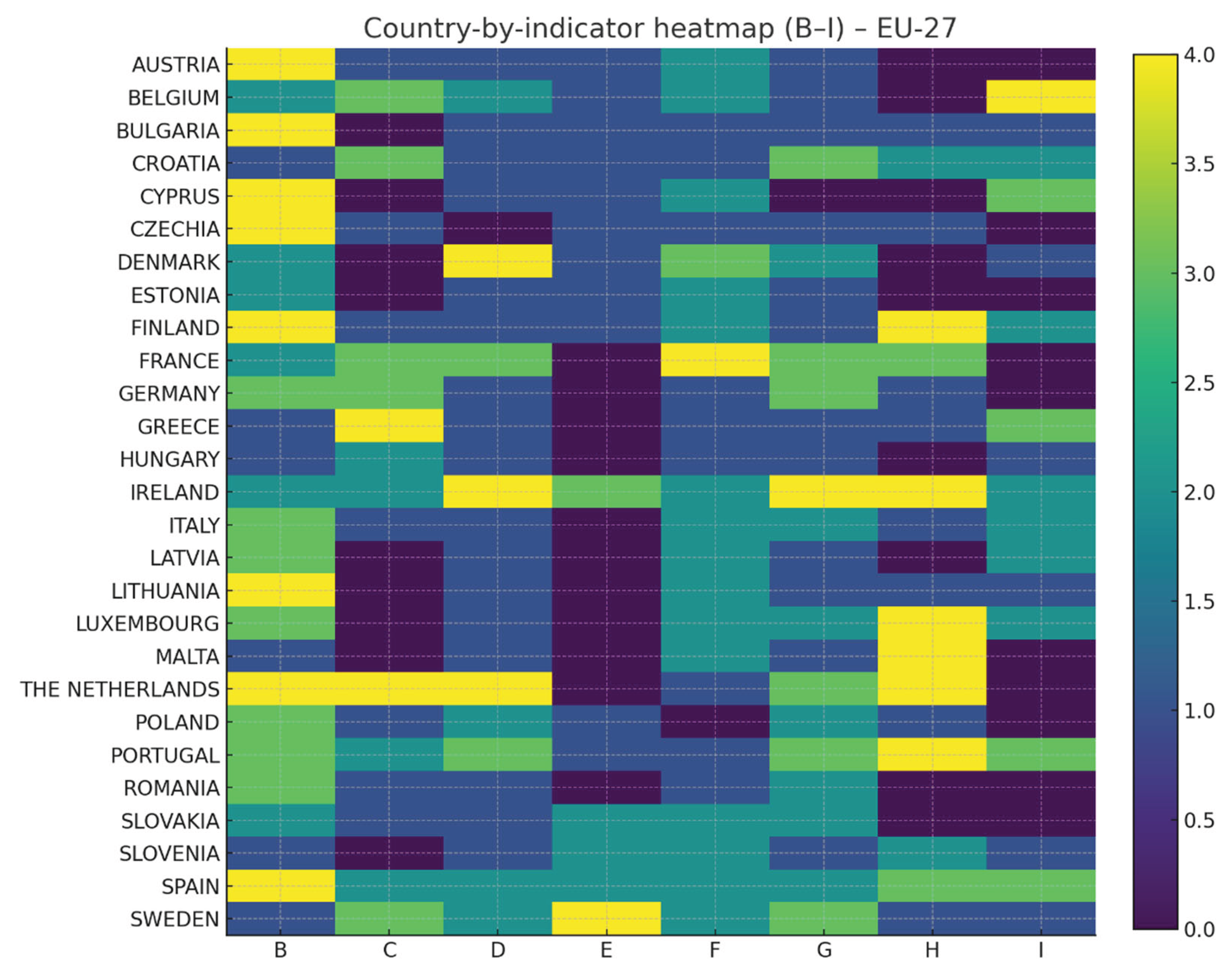
Appendix C. Robustness and Sensitivity Analysis
This appendix examines the stability of the rule-based classification system under alternative threshold and tie-breaking assumptions. Four stress-test scenarios (S1–S4) were evaluated to confirm that the resulting clusters are not artefacts of arbitrary cut-offs but reflect descriptor-anchored structural differences among countries.
Scenario S1 confirms that isolated zeros in base indicators do not affect cluster membership, since descriptor gates dominate arithmetic adjustments to N. Scenarios S2–S3 show that moderate threshold shifts do not alter classifications unless all high-bar conditions are simultaneously met. Scenario S4 reveals that no tied cases required alternate ordering, confirming invariance to the tiebreaker sequence.
Appendix C.1. Document Inventory by Member State
The analysis tests (i) a zero-penalty adjustment on the integration index N (subtract 0.25 when any base indicator B–I = 0), (ii) ±0.25 shifts in the integration threshold around 2.50, and (iii) an inverted tiebreaker order (J before N). These probes follow established composite-indicator practice for ordinal data [34,35,38,39,40,41].
Table C1.
Sensitivity of rule-based cluster assignments to alternative thresholds and tiebreakers (EU-27, reference July 2025).
Table C1.
Sensitivity of rule-based cluster assignments to alternative thresholds and tiebreakers (EU-27, reference July 2025).
| Scenario ID | Change vs. baseline | Rationale tested | Countries reclassified (n) | Reclassification details | Adjusted Rand Index vs. baseline | % stable |
|---|---|---|---|---|---|---|
| S1 | Zero-penalty on N (−0.25 if any base = 0) | Non-compensatory stress (penalises zero pillars) | 0 | — | 1.00 | 100 |
| S2 | N threshold stricter: 2.75 (vs. 2.50) | Tougher integration bar for K5 | 0 | — | 1.00 | 100 |
| S3 | N threshold loser: 2.25 (vs. 2.50) | Easier integration bar for K5 | 0 | — | 1.00 | 100 |
| S4 | Tiebreakers inverted (J before N) | Sensitivity to tie resolution | 0 | — | 1.00 | 100 |
References
- European Environment Agency (EEA). Europe’s Changing Climate Hazards: State of Play 2023; EEA Report No. 04/2023; Publications Office of the European Union: Luxembourg, Luxembourg, 2023.
- IPCC. Climate Change 2022: Impacts, Adaptation and Vulnerability. Contribution of Working Group II to the Sixth Assessment Report of the Intergovernmental Panel on Climate Change; Cambridge University Press: Cambridge, United Kingdom, 2022. Available online: https://www.ipcc.ch/report/ar6/wg2/ (accessed in July 2024).
- European Environment Agency (EEA). Urban Adaptation in Europe: How Cities and Towns Respond to Climate Change; EEA Report No. 12/2020; Publications Office of the European Union: Luxembourg, Luxembourg, 2020.
- Amundsen, H.; Berglund, F.; Westskog, H. Overcoming barriers to climate change adaptation: A question of multilevel governance? Environment and Planning C: Government and Policy 2010, 28, 276–289. [CrossRef]
- Rayner, T. Adaptation to climate change: EU policy on a Mission towards transformation? npj Climate Action 2023, 2, 36. [CrossRef]
- Adger, W.N. Scales of governance and environmental justice for adaptation to climate change. Global Environmental Change 2001, 11, 379–389.
- Clar, C.; Prutsch, A.; Steurer, R. Barriers and guidelines for public policies on climate change adaptation: A missed opportunity of scientific knowledge-brokerage. Natural Resources Forum 2013, 37, 1–18. [CrossRef]
- Global Covenant of Mayors for Climate & Energy. The Multilevel Climate Action Playbook for Local and Regional Governments: Second Edition; Global Covenant of Mayors for Climate & Energy: Brussels, Belgium, 2023. Available online: https://www.globalcovenantofmayors.org/multilevel-climate-action-playbook-second-edition/ (accessed on 25 May 2024).
- Betsill, M.M.; Bulkeley, H. Cities and the multilevel governance of global climate change. Global Governance 2006, 12, 141–159. [CrossRef]
- Bauer, A.; Feichtinger, J.; Steurer, R. The governance of climate change adaptation in ten OECD countries: Challenges and approaches. Journal of Environmental Policy & Planning 2012, 14, 279–304. [CrossRef]
- Gilissen, H.K.; Alexander, M.; Beyers, J.-C.; Chmielewski, P.; Matczak, P.; Schellenberger, T.; Suykens, C. Bridges over troubled waters: An interdisciplinary framework for evaluating the interconnectedness within fragmented domestic flood risk management systems. Journal of Water Law 2016, 25(1), 12–26.
- European Commission. Forging a Climate-Resilient Europe: The New EU Strategy on Adaptation to Climate Change; COM(2021) 82 final; European Commission: Brussels, Belgium, 2021.
- European Union. Regulation (EU) 2021/1119 of the European Parliament and of the Council of 30 June 2021 establishing the framework for achieving climate neutrality (European Climate Law). Official Journal of the European Union 2021, L243/1 (9 July 2021).
- Füssel, H.-M. Adaptation planning for climate change: Concepts, assessment approaches, and key lessons. Sustainability Science 2007, 2, 265–275. [CrossRef]
- Smit, B.; Burton, I.; Klein, R.J.T.; Street, R. The science of adaptation: A framework for assessment. Mitigation and Adaptation Strategies for Global Change 2000, 4, 199–213. [CrossRef]
- Termeer, C.J.A.M.; Dewulf, A.; Biesbroek, R. Transformational change: Governance interventions for climate change adaptation from a continuous change perspective. Journal of Environmental Planning and Management 2017, 60, 558–576. [CrossRef]
- Mees, H.L.P. Local governments in the driving seat? A comparative analysis of public and private responsibilities for adaptation to climate change in European and North American cities. Journal of Environmental Policy & Planning 2017, 19, 374–390. [CrossRef]
- Runhaar, H.A.C.; Uittenbroek, C.J.; van Rijswick, H.F.M.W.; Mees, H.L.P.; Driessen, P.P.J.; Gilissen, H.K. Prepared for climate change? A method for the ex-ante assessment of formal responsibilities for climate adaptation in specific sectors. Regional Environmental Change 2016, 16, 1389–1400. [CrossRef]
- Juhola, S.; Westerhoff, L. Challenges of adaptation to climate change across multiple scales: A case study of network governance in two European countries. Environmental Science & Policy 2011, 14, 239–247. [CrossRef]
- European Commission. The European Green Deal; COM(2019) 640 final; European Commission: Brussels, Belgium, 2019.
- Biesbroek, G.R.; Swart, R.J.; Carter, T.R.; Cowan, C.; Henrichs, T.; Mela, H.; Morecroft, M.D.; Rey, D. Europe adapts to climate change: Comparing national adaptation strategies. Global Environmental Change 2010, 20, 440–450. [CrossRef]
- Reckien, D.; Salvia, M.; Heidrich, O.; Church, J.M.; Pietrapertosa, F.; De Gregorio-Hurtado, S.; D’Alonzo, V.; Foley, A.; Simões, S.G.; Krkoška Lorencová, E. How are cities planning to respond to climate change? Assessment of local climate plans from 885 cities in the EU-28. Journal of Cleaner Production 2018, 191, 207–219. [CrossRef]
- Massey, E.; Biesbroek, R.; Huitema, D.; Jordan, A. Climate policy innovation: The adoption and diffusion of adaptation policies across Europe. Global Environmental Change 2014, 29, 434–443. [CrossRef]
- Termeer, C.J.A.M.; van Buuren, A.; Dewulf, A.; Huitema, D.; Mees, H.L.P.; Meijerink, S.; van Rijswick, M. Governance arrangements for the adaptation to climate change. In Oxford Research Encyclopedia of Climate Science; Oxford University Press: Oxford, United Kingdom, 2017.
- European Environment Agency (EEA). Advancing towards Climate Resilience in Europe: Status of Reported National Adaptation Actions in 2021; EEA Report No. 11/2022; European Environment Agency: Copenhagen, Denmark, 2022. [CrossRef]
- European Commission; European Environment Agency (EEA). Climate-ADAPT Platform: Sharing Knowledge for a Climate-Resilient Europe. Available online: https://climate-adapt.eea.europa.eu (accessed in July 2024).
- Grantham Research Institute on Climate Change and the Environment; London School of Economics (LSE). Climate Change Laws of the World Database. Available online: https://climate-laws.org (accessed in July 2024).
- Covenant of Mayors for Climate and Energy. Covenant of Mayors Official Website. Available online: https://www.covenantofmayors.eu (accessed in July 2024).
- UN-Habitat. Urban Policy Platform. Available online: https://urbanpolicyplatform.org (accessed in July 2024).
- World Resources Institute; Climate Watch. Climate Watch Platform. Available online: https://www.climatewatchdata.org (accessed in July 2024).
- Rauken, T.; Mydske, P.K.; Winsvold, M. Climate change adaptation through municipal planning in Norway: The importance of reforming the planning system. Local Environment 2015, 20, 408–423. [CrossRef]
- Wamsler, C. Mainstreaming ecosystem-based adaptation: Transformation toward sustainability in urban governance and planning. Ecology and Society 2015, 20(2), 30. [CrossRef]
- United Nations Office for Disaster Risk Reduction (UNDRR). Sendai Framework for Disaster Risk Reduction 2015–2030; United Nations: Geneva, Switzerland, 2015.
- OECD; Joint Research Centre (JRC). Handbook on Constructing Composite Indicators: Methodology and User Guide; OECD Publishing: Paris, France, 2008.
- OECD. Measuring Progress in Adapting to a Changing Climate; OECD Publishing: Paris, France, 2024.
- UNFCCC Adaptation Committee. Monitoring and Evaluation of Adaptation at the National and Subnational Levels: Technical Paper; UNFCCC: Bonn, Germany, 2023.
- OECD; UN-Habitat; Cities Alliance. Global State of National Urban Policy 2021: Achieving Sustainable Development Goals and Delivering Climate Action; OECD Publishing: Paris, France, 2021.
- Melica, G.; Treville, A.; Franco De Los Rios, C.; Palermo, V.; Monforti-Ferrario, F.; Baldi, M.G.; Ulpiani, G.; Ortega Hortelano, A.; Barbosa, P.; Bertoldi, P. Covenant of Mayors: 2022 Assessment – Climate Change Mitigation and Adaptation at Local Level; EUR 31291 EN; Publications Office of the European Union: Luxembourg, 2022. [CrossRef]
- Global Covenant of Mayors for Climate & Energy (GCoM). Common Reporting Framework – Guidance Note; GCoM: Brussels, Belgium, 2019.
- Becker, J.; Knackstedt, R.; Pöppelbuß, J. Developing maturity models for IT management: A procedure model and its application. Business & Information Systems Engineering 2009, 1(3), 213–222. [CrossRef]
- Pöppelbuß, J.; Röglinger, M. What makes a useful maturity model? A framework of general design principles for maturity models and its demonstration in BPM. In Proceedings of the 19th European Conference on Information Systems (ECIS 2011); Helsinki, Finland, 2011.
- Neuendorf, K.A. The Content Analysis Guidebook, 2nd ed.; SAGE Publications: Thousand Oaks, CA, USA, 2017.
- UNFCCC. Updated Technical Guidelines for National Adaptation Plans (NAPs) (Draft, July 2025); UNFCCC secretariat: Bonn, Germany, 2025.
- Davide, M.; Bastos, J.; Bezerra, P.; Hernandez Moral, G.; Palermo, V.; et al. How to Develop a Sustainable Energy and Climate Action Plan (SECAP) – Covenant of Mayors Guidebook – Main Document; Publications Office of the European Union: Luxembourg, 2025. [CrossRef]
- United Nations Framework Convention on Climate Change (UNFCCC). Glossary of Climate Change Terms. Available online: https://unfccc.int (accessed in July 2024).
- Global Green Growth Institute (GGGI). Identifying Good Practices in National Adaptation Plans: A Global Review (GGGI Technical Report No. 36); Global Green Growth Institute: Seoul, Republic of Korea, 2024.
- Hooghe, L.; Marks, G. Unravelling the central state, but how? Types of multi-level governance. American Political Science Review 2003, 97(2), 233–243. [CrossRef]
- Bache, I.; Flinders, M. (Eds.). Multi-level Governance; Oxford University Press: Oxford, UK, 2004.
- Eurostat. Population on 1 January by Age and Sex (Provisional 2024). Available online: https://ec.europa.eu/eurostat (accessed in July 2025).
- IPCC. Climate Change 2022: Impacts, Adaptation and Vulnerability. Chapter 14 — North America; Cambridge University Press: Cambridge, UK, 2022. Available online: https://www.ipcc.ch/report/ar6/wg2/chapter/chapter-14/ (accessed in October 2025).
- Craig, R.K. Climate adaptation law and policy in the United States. Frontiers in Marine Science 2022, 9, 1059734. [CrossRef]
- Kim, H. Multilevel climate governance, anticipatory adaptation, and county-level resilience in the United States. Review of Policy Research 2021, 38, 675–697. [CrossRef]
- Tietjen, B.; et al. Progress and gaps in U.S. adaptation policy at the local level. Global Environmental Change 2024, 84, 102912. [CrossRef]
- IPCC. Climate Change 2022: Impacts, Adaptation and Vulnerability. Chapter 10 — Asia; Cambridge University Press: Cambridge, UK, 2022. Available online (PDF): https://www.ipcc.ch/report/ar6/wg2/downloads/report/IPCC_AR6_WGII_Chapter10.pdf (accessed in October 2025).
- OECD. Climate Change Risks and Adaptation: Linking Policy and Economics; OECD Publishing: Paris, France, 2015. [CrossRef]
- World Bank. From Risk to Resilience: Helping People and Firms Adapt in South Asia; World Bank: Washington, DC, USA, 2025. Available online: https://www.worldbank.org/en/region/sar/publication/from-risk-to-resilience-helping-people-and-firms-adapt-in-south-asia (accessed in October 2025).
- OECD; Asian Development Bank (ADB). Multi-Level Governance and Subnational Finance in Asia and the Pacific; OECD Publishing: Paris, France, 2023.
- Fujita, T.; et al. Unravelling the challenges of Japanese Local Climate Change Adaptation Centres. Urban Climate 2023, 49, 101464. [CrossRef]
- OECD. A Territorial Approach to Climate Action and Resilience in Japan (TACAR); OECD Publishing: Paris, France, 2025. [CrossRef]
- Lee, S.; et al. Deeper understanding of the barriers to national climate adaptation policy in South Korea. Mitigation and Adaptation Strategies for Global Change 2023, 28, 97. [CrossRef]
- United Nations Office for Disaster Risk Reduction (UNDRR). Republic of Korea: Adaptation Strategy to Climate Change (Country Overview); UNDRR/PreventionWeb, 2022. Available online: https://www.preventionweb.net/ (accessed in October 2025).
- UNEP. Adaptation Gap Report 2023: Under-financed. Under-prepared. United Nations Environment Programme: Nairobi, Kenya, 2023. Available online (PDF): https://www.unep.org/resources/adaptation-gap-report-2023 (accessed in October 2025).
- European Investment Bank (EIB); World Bank; Asian Development Bank; et al. Joint Report on Multilateral Development Banks’ Climate Finance 2022; 2023. Available online: https://www.eib.org/en/publications/mdb-joint-report-2022 (accessed in October 2025).
Figure 1.
Territorial distribution of adaptation-governance archetypes (K1–K5) across the Member States. Authors’ production (data handling in Microsoft Excel; composition/layout as specified).
Figure 1.
Territorial distribution of adaptation-governance archetypes (K1–K5) across the Member States. Authors’ production (data handling in Microsoft Excel; composition/layout as specified).
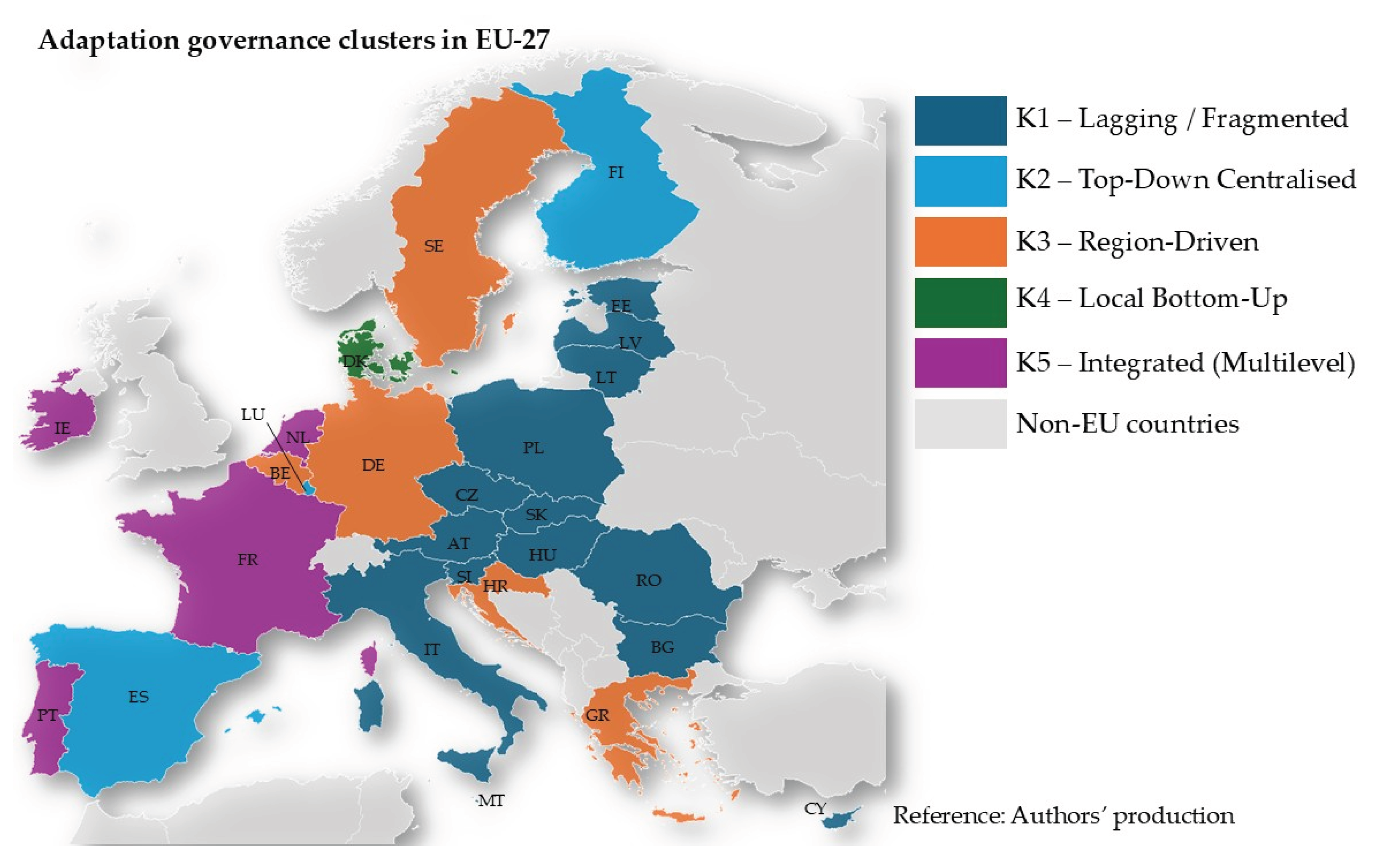
Table 1.
Base indicators (B–I): definitions, scales (0–4), typical evidence sources, and key sources for thresholds.
Table 1.
Base indicators (B–I): definitions, scales (0–4), typical evidence sources, and key sources for thresholds.
| Code | Indicator | Scale and decision rule (0–4) | Typical evidence sources | Key sources for thresholds |
|---|---|---|---|---|
| B | National Adaptation Strategy / Plan (NAS / NAP) | 0: none. 1: only NAS, or NAS/NAP obsolete (≥10 years). 2: NAS+NAP exists but are outdated (7–9 years) or lack indicators/costing. 3: revised ≤6 years, formally adopted, with indicators and responsibility mapping. 4: revision ≤5 years, dedicated budget/finance lines, a monitoring framework, and a mandatory review cycle. | Official NAS/NAP texts and adoption decrees (national gazette/official journal); consolidated versions on competent ministry portals; Climate-ADAPT country profiles and document library (for version cross-checks). | Anchoring on iterative NAP design, M&E features (indicators, finance, review) and EU governance cycles: UNFCCC NAP guidance [43]; UNFCCC AC M&E [36]; OECD measurement/monitoring principles [35]; EU Adaptation Strategy & Climate Law [12,13]. |
| C | Regional Adaptation Plans (RAPs) | 0: none. 1: voluntary/pilots in <50% of regions. 2: stand-alone RAPs with ≥50% coverage but non-binding or outdated. 3: mandatory RAP in all regions or ≥50% with funding conditionality; updated ≤6 years. 4: mandatory, budgeted, monitored, explicitly aligned with NAS/NAP (vertical link). | Regional laws/strategies and implementing decrees (regional official bulletins); regional budget/monitoring provisions; national framework decrees on RAP mandates; Climate-ADAPT country pages (coverage cross-check). | Territorialisation and vertical coherence; mandate, resourcing and monitoring: EEA evidence on regionalisation [1,3,25]; EU strategic framing [12]; OECD & UNFCCC M&E guidance [35,36]. |
| D | Local Adaptation Plans (LAPs) | 0: none. 1: voluntary/pilot in <25% of municipalities. 2: stand-alone but non-binding or 25–50% population coverage. 3: mandatory with reporting; ≥50% population; updated ≤6 years. 4: mandatory; ≥75% population; KPIs + dedicated finance. | Municipal council resolutions and plan texts; national inventories of municipal climate plans (where available); SECAPs on the Covenant of Mayors platform; guidance/mandates from the national urban ministry. | Local planning standards, reporting architecture and diffusion tiers: Global State of National Urban Policy [37]; GCoM Common Reporting Framework & 2025 SECAP Guidebook [39,44]; JRC assessment of CoM diffusion [38]; OECD & UNFCCC M&E features [35,36]. |
| E | Sectoral Adaptation Plans (SAPs) | 0: none. 1: voluntary SAP in <2 sectors. 2: ≥2 stand-alone SAPs, non-binding. 3: binding SAP in key sectors or comprehensive sector updates ≤6 years with KPIs. 4: binding in ≥4 sectors with KPIs, resources, and periodic review. | Sector-ministry strategies/ordinances (water, health, agriculture, transport, infrastructure, coastal); parliamentary acts and implementing regulations (official journal); national adaptation M&E reports and budget laws/appropriations. | Sectoral breadth, binding force, KPIs and review cycles: EEA status of sectoral adaptation [25] (with document corroboration via Climate-ADAPT where relevant [26]); GGGI NAP good practices [46]; OECD & UNFCCC on resourcing and periodic review [35,36] |
| F | Adaptive content in Long--Term Strategy (LTS) | 0: no LTS / mitigation-only. 1: passing mention of adaptation. 2: dedicated chapter, no KPIs. 3: targets/timeline + explicit linkage to NAS/NAP. 4: monitoring, five-year review cycle, budget, and explicit multilevel coordination. | UNFCCC LTS registry and EU submissions under Reg. (EU) 2018/1999; government climate/energy strategy portals (latest version); legal instruments integrating LTS provisions (where applicable). | Iterative long-term planning, institutional capacity and EU cyclic governance: UNFCCC NAP/LTS guidance [43]; OECD on review cycles and capability [35]; EU Adaptation Strategy & Climate Law [12,13]. |
| G | Integration in National Urban Policy (NUP) | 0: no NUP / mitigation-only. 1: brief reference. 2: clear adaptation section. 3: binding guidance/standards for local plans. 4: mandatory standards + monitoring & finance for resilient urban projects. | National urban/spatial planning acts and policy white papers (official journal); implementation guidelines/circulars of the competent ministry; UN-Habitat Urban Policy Platform entries (policy metadata and texts). | Instrument ladder/mainstreaming and measurement principles: Global State of National Urban Policy [37]; OECD composite/measurement guidance [35]. |
| H | Adaptation Relevance in Climate Law | 0: no climate law / mitigation-only. 1: principle-level mention. 2: dedicated article/chapter on adaptation. 3: law mandates NAP/RAP/LAP, governance and reporting. 4: level 3 plus finance provisions, five-year review, and indicators. | Framework climate acts and amendments (consolidated in the national gazette/official journal); implementing decrees and reporting clauses; Climate Change Laws of the World database (cross-reference). | Legal embedding of adaptation, accountability cycles, indicators and finance: EU Climate Law/strategy [12,13]; OECD & UNFCCC on monitoring and finance provisions [35,36]. |
| I | Covenant of Mayors adhesion (CoM) % | Share of national population in municipalities with an adopted SECAP, including adaptation (cut-off 30 June 2025). For the CoM indicator, coverage is defined as the share of national residents living in municipalities with an adopted SECAP including adaptation as at 30 June 2025, using the CoM platform for the numerator [29] and Eurostat 2024 provisional population for the denominator [49]. CoM coverage (%) = (Population in municipalities with adopted SECAP (mitigation + adaptation) / National resident population) × 100. | Covenant of Mayors (MyCovenant) reporting platform and SECAP documents (numerator); Eurostat national resident population (2024 provisional) (denominator); JRC CoM assessment (methodological cross-check). | Coverage tiers and reporting scope for SECAPs, including adaptation: JRC CoM assessment [38]; GCoM CRF [39]; 2025 SECAP Guidebook [44]. |
Table 2.
CoM coverage in municipalities with an adopted SECAP addressing both mitigation and adaptation (cut-off 30 June 2025): scoring scheme for indicator I.
Table 2.
CoM coverage in municipalities with an adopted SECAP addressing both mitigation and adaptation (cut-off 30 June 2025): scoring scheme for indicator I.
| Coverage (%) | Score (I) | Label |
|---|---|---|
| ≥15.00 | 4 | Very High |
| 10.00–14.99 | 3 | High |
| 5.00–9.99 | 2 | Medium |
| 1.00–4.99 | 1 | Low |
| <1.00 | 0 | Very Low |
Table 3.
Composite and derived indices (J–P): definitions, formulae, ranges and interpretation.
| Code | Index (short name) | Formula | Range | Conceptual meaning | Interpretation/use |
|---|---|---|---|---|---|
| J | NAT_CORE (National Core Strength) | ((B + F + H) / 3) | 0–4 | Robustness of the national strategic–legal backbone (NAS/NAP, LTS, climate law). | Higher = stronger national architecture. Threshold: (J ≥ 2.5) interpreted as “strong”. Used in clustering rules and differentials. |
| K | TERR_MAN (Territorial Mandate) | ((C + D) / 2) | 0–4 | Institutionalisation of regional and local mandates (RAPs, LAPs). | Higher = deeper, more formalised sub-national mandates. |
| L | LSS / URB_SYNERGY (Local Synergy Score) | ((D + G + I) / 3) | 0–4 | Density/coherence of the local–urban ecosystem (plans, national urban integration, network mobilisation). | Higher = stronger local/urban mobilisation and integration. |
| M | ADV_SCORE (Advanced breadth) | (#{B..I ≥ 3} / 8) | 0–1 | Non-compensatory breadth of advanced pillars. | Higher = more pillars at “advanced” (≥3). Prevents single-pillar compensation. |
| N | MULTI_INT (Multilevel Integration Index) | ((J + K + L) / 3) | 0–4 | Vertical balance across national core, territorial mandates and local collaboration. | Higher = more integrated multilevel system. Rule use: (N ≥ 2.5) as the minimum balance for K5. |
| O | TOP_DOWN (directional differential) | (J - L) | −4 to 4 | Directional strength of the centre relative to the local tier. | Positive = centre > local; negative = local > centre. Diagnostic only. |
| P | BOTTOM_UP (directional differential) | (L - J) | −4 to 4 | Directional strength of the local tier relative to the centre. | Positive = local > centre. Note (P = -O). Diagnostic only. |
Table 4.
Cluster synopsis (membership, medians and IQR for composite signposts). Medians and IQRs are computed from country-level values and serve as ordinal summaries; cluster assignment follows the deterministic rules in Section 3.
Table 4.
Cluster synopsis (membership, medians and IQR for composite signposts). Medians and IQRs are computed from country-level values and serve as ordinal summaries; cluster assignment follows the deterministic rules in Section 3.
| Cluster | No. of countries | Members | Median J (IQR) | Median K (IQR) | Median L (IQR) | Median M (IQR) | Median N (IQR) |
|---|---|---|---|---|---|---|---|
| K1 — Lagging / Fragmented | 14 | AT, BG, CY, CZ, EE, HU, IT, LV, LT, MT, PL, RO, SK, SI | 1.5–1.8 (≈0.7–1.0) | 1.0 (≈0.5–1.0) | 1.0 (≈0.7–1.3) | 0.1 (≈0.0–0.1) | 1.2 (≈1.1–1.3) |
| K2 — Top-Down Centralised | 3 | FI, LU, ES | 3.0 (≈0.3) | 1.0 (≈0.5–1.0) | 1.7 (≈1.3–2.3) | 0.3 (≈0.3–0.4) | 1.9–2.4 (≈0.3–0.5) |
| K3 — Region-Driven | 5 | BE, HR, DE, EL, SE | 1.3 (≈0.4) | 2.0–2.5 (≈0.5–1.0) | 2.0 (≈0.7) | 0.3–0.4 (≈0.1) | 1.7–1.9 (≈0.2–0.3) |
| K4 — Local / Urban Bottom-Up | 1 | DK | 1.7 (–) | 2.0 (–) | 2.3 (–) | 0.3 (–) | 2.0 (–) |
| K5 — Integrated (Multilevel) | 4 | FR, IE, NL, PT | 2.9–3.0 (≈0.3) | 2.5–3.0 (≈0.5–1.0) | 2.7–3.0 (≈0.7–1.0) | 0.6 (≈0.5–0.6) | 2.7–3.1 (≈0.3–0.6) |
Disclaimer/Publisher’s Note: The statements, opinions and data contained in all publications are solely those of the individual author(s) and contributor(s) and not of MDPI and/or the editor(s). MDPI and/or the editor(s) disclaim responsibility for any injury to people or property resulting from any ideas, methods, instructions or products referred to in the content. |
© 2025 by the authors. Licensee MDPI, Basel, Switzerland. This article is an open access article distributed under the terms and conditions of the Creative Commons Attribution (CC BY) license (http://creativecommons.org/licenses/by/4.0/).
Copyright: This open access article is published under a Creative Commons CC BY 4.0 license, which permit the free download, distribution, and reuse, provided that the author and preprint are cited in any reuse.


