

Submitted:
21 November 2025
Posted:
25 November 2025
You are already at the latest version
Abstract
The aim of this paper is to present a more complete analysis of the theoretical concepts and experimental aspects of the physics of photoproduction interactions involving nuclei. We thus determine the relative contributions of excited nucleon, pπ, pππ resonances and ρ,η, ω and K production and the subsequent decay channels leading to neutrino and γ-ray production. This treatment is based in large part on the most recent and extensive empirical data on particle photoproduction interactions off protons and He nuclei. It is shown that in astrophysical sources with steep proton energy spectra the Δ(1232) resonance channel clearly dominates. However, a blend of N* resonances at ∼1400 GeV can contribute as much as 20% to the neutrino flux. It is further found that γ-He interactions, assuming the cosmological abundance of He, produce approximately 10% of the pions as compared with γρ interactions.
Keywords:
neutrinos
; gamma-rays
; astrophysical sources
1. Introduction
Among the most important consequences of studies if the physics of the interactions of -rays with nucleons are their implications for high energy astrophysics. It is primarily for this reason that a more complete analysis of the theoretical concepts and experimental aspects of the subject are considered here. Astrophysical processes that lead to the production of photopions have been recognized for a considerable period and have been discussed in numerous prior studies [1,2,3,4,5,6,7,8,9].
In particular, photoproduction processes that lead to neutrinos and -rays in the vicinity of astrophysical objects containing black holes are of significant interest [10,11], as is the production of ultrahigh energy neutrinos from interactions of ultrahigh energy cosmic rays with photons of the cosmic background radiation [5,12].
In 2013 the first announcement of high energy astrophysical neutrinos was published by the IceCube Collaboration [13]. Since then large numbers of astrophysical neutrinos have been detected by the IceCube neutrino telescope [14]. A few -ray sources have also been identified as neutrino sources [15,16]. However, in general, individual -ray sources do not correlate with sources of neutrinos. Thus at present the vast majority of astrophysical neutrinos are of unknown origin. This has lead to the hypothesis that most neutrino sources are “hidden” [17,18].
Such recent developments have provided a motivation to carefully reexamine the particle physics processes involved in high energy interactions leading to significant and -ray production off nuclei. To this end it is important to use an extensive, up-to-date collection of accelerator data on the production cross sections for channels that can lead to astrophycially significant and -ray production.
Previous work on photoproduction since 2000 has relied on the SOPHIA code [19]. That code was based on various assumptions to make up for the lack of quality data being used at the time. Among other conclusions, the SOPHIA code predicts a significant amount of -ray production from interactions of higher energy than those producing the resonance. Many other works have also relied upon Monte Carlo simulation codes such as GEANT4. Such simulations are optimized for higher accelerator energies, as are other existing numerical packages.
On the contrary, the approach here is to directly utilize and to rely on the presently available data, which are much more reliable and direct than numerical simulations. This approach allows for a more accurate treatment for considering the -ray and neutrino spectra fluxes resulting from astrophysical sources and processes.
The present study makes use of a library of detailed energy dependent cross section data for a large number of production channels that either were not available at the time when the SOPHIA code was written or not used at the time. This library includes all of the particle production channels resulting from interactions, including empirical cross section data obtained from both cloud chamber experiments and particle accelerator experiments. The result of this approach will be a reliable determination of the relative significance of the particle production channels involved. It will also show the importance of symmetry in neutrino production by nucleon resonances rather than multipion production.
2. Differences Between p and pp Interactions
Because of the electromagnetic nature of the photon, interactions with nucleons are of a different nature than that of interactions [20,21]. Empirically, as will be discussed, photon-nucleon interactions typically involve the generation of one particle or resonance. (See e.g., [22]). Such a particle or resonance can decay in a chain of two-body decays. This process can result in the production of one, two, or three pions. The charged pions then decay leading to neutrino production. The neutral pions decay into -rays.
Nucleon-nucleon interactions are of a strong-interaction, QCD nature. These interactions obey various conservation laws, and thus symmetries. Quantum chromodynamics interactions among the various quarks and gluons (partons) that make up the nucleons determine the production of observed particles in such interactions [23]. Nucleon-nucleon interactions can therefore generate a multiplicity of particles, mainly pions, whose number rises with energy, e.g., [4]. The cross section is typically two-to-three orders of magnitude higher than the cross section, except in the case of resonance production, as we shall discuss.
Various theoretical models have been proposed to describe and explain interactions in terms of a hadronic nature for the photon. For example, in one such model the photon can convert into a virtual meson that interacts with partons in the nucleon [24]. Since the first vertex of photoproduction interactions is a QED vertex (see, e.g., Fig.3), in all such models the interaction cross section is reduced by a factor of order or more, as compared to the cross section.
3. Kinematics
The threshold energy for production of one or more particles in interactions by -rays of lab energy interacting with protons at rest is given by
where the quantity represents the difference between the mass or masses of the particle(s) produced in the interaction and the mass of the target particle [3,53]. It follows from equation (1) that the threshold energy for producing a neutral pion is 145 MeV; for a charged pion it is 150 MeV. The energy required for producing an meson is 708 MeV; that for producing a meson is 1086 MeV and for an meson it is 1110 MeV, etc.
The situation is somewhat different for the production of a strange particle such as the kaon. The explanation of the relatively long lifetime of these particles is the symmetry principle known as the conservation of strangeness in strong interactions, by [54] and also in [55]. The decays of strange particles into non-strange particles violates this conservation law, so that the decays must be weak, thereby accounting for their longevity.
Because of conservation of strangeness, since the system has a strangeness number of 0, any strange particles produced in a interaction must be produced in associated pairs of equal and opposite strangeness. Such interactions, viz., the production of , and pairs have been studied and we have plotted the measured cross sections for these processes in Figure 1. We note that, unsurprisingly, the production of strange particles is insignificant compared with that of non-strange particles.
Almost all decay chains that finally produce pions (and thus -rays and neutrinos are the of result of chains of two body decays. This simplifies the kinematics considerably.
If we label the particles produced a and b, then the energies of the particles are exactly determined through conservation of energy and momentum. In the rest frame of the decaying particle of mass M they and are given by
[see 51, chap. 1].
For our analysis, we start with the measured cross section data for a -ray of laboratory energy interacting with target protons at rest in the laboratory system. The total energy of the system as measured in its center of mass, will be denoted by W. The value of W in the photon-proton interaction system is given by
The variable W is equal to , where the Mandlestam variable s (and therefore W) is Lorentz invariant, i.e., the square of the total four-momentum of the photon-proton system [3].
We can make use of the Lorentz invariance of s in order to transform to a system where the proton is not at rest, but is relativistic in the rest frame of an astrophysical source.
In that case, s, is given by
where and denote the photon and proton energy in the laboratory system, and is the angle between the relativistic proton ( and a photon in the lab system. Quantities in the center-of-momentum system (cms) are denoted by an asterisk. For an isotropic photon source we take .
Thus, e.g., for a pion produced by two-body decay according to equation (2), its energy in the lab system would be given by
where we take for the relativistic proton and we take , assuming isotropic or quasi-isotropic decay in the cms of the interaction.
For a two-body decay of a resonance of mass , with the energy of the pion and nucleon products given by equation(2), the energy of the secondary pion is given by
4. Cross Sections
Figure 1 shows the cross section data for channels leading to the production of neutral pions and, ultimately, -rays The data is shown from experiments where high energy -rays interact with protons at rest in the laboratory system.
Figure 2 shows the corresponding cross section data for channels lead to the production of charged pions and, ultimately, neutrinos.
4.1. Single Pion Production
At low laboratory photon energies the single pion production channels (see Section on single pion production) are the most important ones. It follows from equation (1) that the threshold energy for photopion production is GeV [3]. At photon energies 0.145 GeV GeV, production is dominant. In the energy range around 1.2 GeV GeV, the resonance dominates the cross section.
The existence of the resonance (or isobar) has been known since the 1950s [56]. It follows from isospin conservation that the decays 2/3 of the time into and 1/3 of the time into , with the single pion decay modes having a total branching ratio of 99.4 %. Thus, in this energy range production dominates over production. This interaction is diagrammed in Figure 3.
xs
The main channels for single and production via the resonance are:
immediately followed by
The cross sections of the resonance and higher mass resonances can be fit with Breit-Wigner type three-parameter distributions of the form
where is the peak in , is the mass of the resonance and is the width of the resonance.
Figure 1 shows the cross section data for channels leading to the production of neutral pions and ultimately -rays. The data is given from experiments where high energy -rays interact with protons at rest in the laboratory system.
Figure 2 shows the photoabsorption cross sections for the channels leading to charged pion production. The data is given from experiments where high energy -rays interact with protons at rest in the laboratory system. Decay of charged pions then leads to neutrino production.
4.2. Single Pion Production
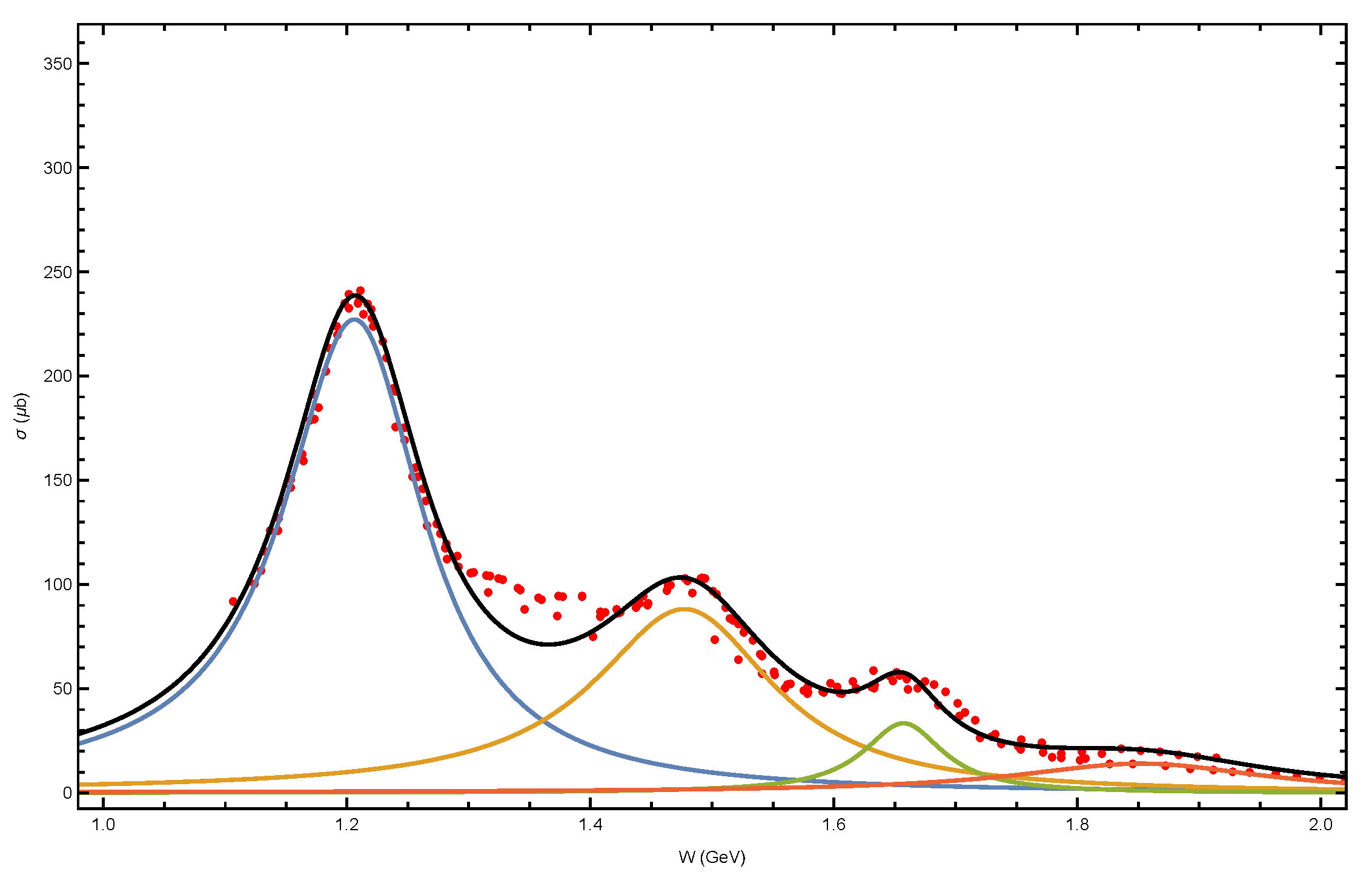
Figure 4 shows the fit obtained by using a combination of several Breit-Wigner type distribution functions with the three parameters shown in eq. (8) to fit the single cross section data. Figure 5 shows our fit using three-parameter distribution functions to fit the single cross section data.
Note that the data indicate the importance of the (1232) resonance that appears to contribute to the pion production even at low energies.
Tables 1 and 2 show the values of , , and for the first four resonance peaks obtained by fitting the single pion data shown in Figure 3 and 4 to eq. (8).

Table 1.
Breit-Wigner parameter fits for each of the first four resonances for single production.
| peak | ) | ||
|---|---|---|---|
| 1st | 1.217 | 52.9 | 0.110 |
| 2nd | 1.516 | 4.35 | 0.100 |
| 3rd | 1.675 | 3.55 | 0.110 |
| 4th | 1.900 | 3.70 | 0.250 |
Table 2.
Breit-Wigner parameter fits for each of the first four resonances for single production.
| peak | ) | ||
|---|---|---|---|
| 1st | 1.206 | 49.7 | 0.140 |
| 2nd | 1.477 | 24.8 | 0.180 |
| 3rd | 1.655 | 4.80 | 0.090 |
| 4th | 1.852 | 5.00 | 0.250 |
In the data and fits shown in both Figure 4 and Figure 5, the first peak (counting from low to high energy) is almost entirely produced by the decay of the (1232) resonance. This clearly shows the importance of the (1232) resonance that appears to contribute to single pion production even at low energies. This is particularly important in analyzing models of relativistic protons with a power-law spectrum interacting with photons of the cosmic microwave background and those in the ultraviolet and X-ray range [1,2,3,4,5].
Both Figure 4 and Figure 5 show at three resonance peaks at higher energy. The secondary peaks are from excited nucleon (N*) resonances. The process can be diagramed as in Figure 3 with the replaced by the symbol .
In Figure 4 the second peak is primarily a blend of the N(1520) and N(1535) resonance. The third peak is primarily a blend of the N(1650), N(1680) and resonances. The fourth peak is primarily a blend of the and resonances [27].
The second, third and fourth peaks are more pronounced in the single cross section data than in the single cross section data. Also, in particular, the second peak in the single production cross section appears at a lower energy (∼1480 MeV) than in the single data (∼1530 MeV). The location of this peak could be caused by a blending of the N(1520) and N(1535) resonances with the Roper resonance, N(1440) [57]. The Roper resonance, which is a minor channel in single production, is the only resonance found in the energy range between the resonance and the N(1520) resonance.
It should be noted that the positions of the resonance masses can vary from one experiment to another.
The resonances can decay into particles of lighter mass to produce pions. This can include lower mass resonances. For example, we can have three allowed decays of N(1440) Roper resonance:
immediately followed by
Note that both Fig. Figure 4 and Fig. Figure 5 automatically take all of the resonances and decays and branching ratios into account. Furthermore, they break up the cross section data into single production and single production respectively. The following section treats the double pion decay chains.
4.3. Two Pion Production
The second most significant process that leads to the production of charged pions, as illustrated in Figure 2, is the production of . The production process proceeds through the channels:
At photon energies below 1.0 GeV the cross section for is dominated by production, viz., [52,58]. This interaction is followed 100% of the time by the decay . At photon energies ranging from 1.0 GeV to 1.4 GeV, a Breit-Wigner distribution provides satisfactory fits to the data, suggesting that these energies are also dominated by the resonance. However, it also includes some production above the threshold, followed by the decay with a 100% efficiency [31,59]. It’s worth noting that, unlike the single-pion production process, in the two double-production processes discussed above, the pion energy is approximately evenly distributed between the two pions. The kinematics is therefore greatly simplified as per equation (2).
Figure 1 and Figure 2 both show the total cross section for photoproduction. The cross section indicates the presence of the second resonance peak with a chain decay proceeding through a blend of higher N baryon resonances. It also contains a channel for the production mesons, followed by the decay .
4.4. Three Pion and Gamma-Ray Line Production
The most important processes for three pion production are the decays
with a branching ratio of 89%,
and
item with a branching ratio of 24%. In these cases we can safely assume that each pion takes away 1/3 of the energy. In addition, the meson can decay into a -ray line
with a branching of 28%, with each -ray carrying off 1/2 of the energy of the meson.
5. Application for Highly Relativistic Protons in Astrophysical Sources
The logarithmic cross section data shown in Figure 1 and Figure 2 show that, for the most part single pion production via resonances dominates, particularly at the lower energies that are most important in considering interactions involving high energy relativistic protons (a.k.a."cosmic rays") that characteristically have a steep ( where ).
For highly relativistic protons interacting with low energy photons, eq.(4) becomes
If we set
we can then take as an approximation the spectral relation for the pion flux
where " here designates the well-known function. For a power-law proton spectrum of the form
eq. (19) gives the result
Let us compare the relative fluxes of pions from the and the next resonance at N(1500). Denoting the cross sections of these two resonances by and respectively and denoting their masses by and The ratio of of the pion fluxes from their decay that lead to neutrinos and would be given by
With and taking the ratios and for and from Table 1 and Table 2 respectively, taking , we then find that the ratio of -ray fluxes from the first two resonances is and the ratio for neutrino fluxes from the first two resonsnces is . It follows that for cosmic-ray proton spectra steeper than , the R values will be correspondingly smaller.
The contributions of the the other particle species and resonance modes are correspondingly negligible for four reasons: (A) their cross sections are significantly smaller, (B) their production thresholds are higher as discussed previously (See Figure 1 and Figure 2), (C) the steepness of the highly relativistic proton spectra accentuates the threshold effects, and (D) thr effect of multipion decay of the higher mass mesons shown in Figure 1 and 2 splits the energy among the daughter pions produced, as discussed in Section 4.2 and 4.3 .
6. Heavier Nuclei
Photon induced reactions also occur for nucleons of higher mass number. Several experiments have probed the nuclear response to photons with total photon absorption measurements having been made from nuclei with mass numbers ranging through to 238U. In general, nuclear cross sections are very similar to those resulting from interactions, when scaled by the atomic mass number to some power ≤ 1, with the exception that the cross section data for nuclei heavier than hydrogen show no resonance structure in the resonance regions higher than the resonance. The shape of the resonance is also broadened. These differences from cross section measurements can be explained by taking into account the cooperative effect of the collision broadening and the interference in the two-pion photoproduction process inside the nuclei [60].
It follows from equation (1) that the threshold energy for photopion production off helium nuclei is GeV for and GeV for . The cross section for photons of energies MeV interacting with He nuclei at rest for both and production have been taken from the measurements of [61]. In interactions low laboratory photon energies single pion production from the resonance decay channel is again dominant.
Given the astrophysical abundances of the elements, only helium makes any significant contribution to photomeson production in astrophysical sources and only in the region dominated by the resonance. By incorporating an additional cosmological helium component that constitutes 25% by mass [62], and by using the cross section data for helium [61], one can estimate the magnitudes of -ray and neutrino fluxes from photoproduction off He as compared with those from interactions. Using the proton and He cross sections at the resonance energy to give an estimate of the He contribution, one finds that the flux from He interactions is ∼10% of that from interactions.
7. Discussion of Results
We have shown how and why there is a fundamental difference between the physics of interactions and that of interactions. In high energy interactions the multipion production (pionization) that results from QCD physics plays a significant role in -ray production [53,63]. However, in interactions it is the production of single particles and resonances that plays the major role. This is evidenced by the library of cross section data compiled here. We delineate a list of our new conclusions as follows:
- By use of this collection of empirical cross section data one can determine the relative role of particle production channels in interactions leading to neutrino and -ray production in various astrophysical contexts. By compiling the cross sections for all of the channels that result in the production of -rays and neutrinos as a result of interactions, we have determined that only the single pion resonance channels are significant for astrophysical considerations. We have fitted the nucleon resonance data with a series of three-parameter Breit-Wigner type functions.The cross section data compiled here show that, contrary to the assertion of the SOPHIA collaboration [64], multiparticle production channels are not significant in producing -rays in interactions.
- We further find that two and three pion production is actually only the result of decay chains following from single particle photoproduction. There is no monotonic increase in multiplicity with energy as in the case of interctions. This is especially important when one takes account of the steep proton spectra, e.g., or steeper, expected for astrophysical sources of high energy protons.
- As shown in our Figure 4 and 5, there are significant differences between the production of charged and neutral pions (see point 5). This leads to significant differences between -ray and neutrino production that are not accounted for in SOPHIA-based models.
- As opposed to the case of pp interactions, and some speculation about interactions, owing to the small production cross sections and high threshold energy for kaons (see Section 3.) K production is negligible compared with pion production. This is abundantly clear from the data shown in Figs 1 and 2.
- As expected, among the single pion production channels, the channel dominates, even among the higher resonance channels. However, in the case of charged pion decay we find that the second resonance peak, made up of a blend on resonances, can give an additional contribution of as much as 20% to the resulting production of neutrinos. On the contrary, we find that the second resonance makes a negligible contribution to neutral pion production and subsequently to -ray production.
- For the first time, we have considered photoproduction of particles off heavier nuclei. As expected, only helium is important for astrophysical sources, given the relative cosmological abundances of the heavier elements. For helium, as for hydrogen, photoproduction is important only the region dominated by the Delta(1232) resonance. We find that the -ray and neutrino fluxes resulting from interactions is ∼10% of that from interactions.
- The use of a delta function approximation to simulate the production of -ray and neutrinos [4,5,14] is quite adequate for most calculations, given the present state of -ray and neutrino astronomy. However, a detailed knowledge the physics of photopion production may be more importance in the future as given advances in observational instrumentation and source modeling.
Funding
This research received no external funding.
Conflicts of Interest
The author declares no conflicts of interest.
Appendix A Particle Spectra
Appendix A.1. Gamma-Ray Spectra
Given a production function of neutral pions, , the -ray source spectrum that results is given by
where [53].
Appendix B Neutrino spectra
Neutrinos are produced in two stages of pion decay. The first stage of the decay
is a two particle decay. So as in eq. (2) we find that the neutrino energy in the rest system of the pion is
[66]. It follows from eq. (A3) that the maximum energy of the neutrino is then given by
and the minimum energy is approximately zero. The average energy for isotropic decay is then . This is close to the 25% expected if the pion decays into four very light fermions. Then, for isotropic decay of a relativistic pion, the source function for neutrinos from the first stage of the decay only is
The second stage of the process is the decay of the ,
and the equivalent process for decay. In these decays, since the three leptons produced are much lighter than the muon, each lepton will get an average of a third of the muon energy or about 26% of the pion energy. In fact, one can assume that all of the neutrinos each get about a quarter of the pion energy.
References
- K. Greisen, End to the Cosmic-Ray Spectrum?, Physical Review Letters 16 (17) (1966) 748–750. [CrossRef]
- G. T. Zatsepin, V. A. Kuz’min, Upper Limit of the Spectrum of Cosmic Rays, Soviet Journal of Experimental and Theoretical Physics Letters 4 (1966) 78.
- F. W. Stecker, Effect of photomeson production by the universal radiation field on high-energy cosmic rays, Phys. Rev. Lett. 21 (1968) 1016–1018.
- F. W. Stecker, Ultrahigh energy photons, electrons, and neutrinos, the microwave background, and the universal cosmic-ray hypothesis, Astrophysics and Space Science 20 (1) (1973) 47–57. [CrossRef]
- F. W. Stecker, Diffuse fluxes of cosmic high-energy neutrinos., The Astrophysical Journal 228 (1979) 919–927. [CrossRef]
- S. R. Kelner, F. A. Aharonian, Energy spectra of gamma rays, electrons, and neutrinos produced at interactions of relativistic protons with low energy radiation, Physical Review D 78 (3) (2008) 034013. [CrossRef]
- S. Hümmer, M. Rüger, F. Spanier, W. Winter, SIMPLIFIED MODELS FOR PHOTOHADRONIC INTERACTIONS IN COSMIC ACCELERATORS, The Astrophysical Journal 721 (1) (2010) 630. [CrossRef]
- F. W. Stecker (Ed.), The Encyclopedia of Cosmology: Volume 2: Neutrino Physics and Astrophysics, World Scientific, 2023. [CrossRef]
- F. W. Stecker, Chapter 1: Neutrino Physics and Astrophysics Overview (2023) 1–8http://arxiv.org/abs/2301.02935 arXiv:2301.02935. [CrossRef]
- F. W. Stecker, C. Done, M. H. Salamon, P. Sommers, High-energy neutrinos from active galactic nuclei, Physical Review Letters 66 (21) (1991) 2697–2700. [CrossRef]
- K. Murase, F. W. Stecker, Chapter 10: High-Energy Neutrinos from Active Galactic Nuclei, World Scientific Press, 2023, pp. 483–540. [CrossRef]
- V. S. Berezinsky, G. T. Zatsepin, Cosmic rays at ultrahigh-energies (neutrino?), Phys. Lett. B 28 (1969) 423–424. [CrossRef]
- IceCube Collaboration, First Observation of PeV-Energy Neutrinos with IceCube, Physical Review Letters 111 (2) (2013) 021103. [CrossRef]
- F. Halzen, A. Kheirandish, Chapter 5: IceCube and High-Energy Cosmic Neutrinos, World Scientific Press, 2023, pp. 107–235. http://arxiv.org/abs/2202.00694. [CrossRef]
- IceCube Collaboration, Neutrino emission from the direction of the blazar TXS 0506+056 prior to the IceCube-170922A alert, Science 361 (6398) (2018) 147–151. [CrossRef]
- IceCube Collaboration, Evidence for neutrino emission from the nearby active galaxy NGC 1068, Science (Nov. 2022). [CrossRef]
- F. W. Stecker, PeV neutrinos observed by IceCube from cores of active galactic nuclei, Physical Review D 88 (4) (2013) 047301. [CrossRef]
- K. Murase, D. Guetta, M. Ahlers, Hidden Cosmic-Ray Accelerators as an Origin of TeV-PeV Cosmic Neutrinos, Physical Review Letters 116 (7) (2016) 071101. [CrossRef]
- A. e. a. Mueecke, Monte Carlo Simulations of Phothadronic Processes and their Astrophysical Implications, Comp.Phys.Comm. 124 (2000) 290–314.
- G. F. Chew, F. E. Low, Theory of Photomeson Production at Low Energies, Phys. Rev. 101 (1956) 1579–1587. [CrossRef]
- G. F. Chew, M. L. Goldberger, F. E. Low, Y. Nambu, Relativistic dispersion relation approach to photomeson production, Phys. Rev. 106 (1957) 1345–1355. [CrossRef]
- D. Drechsel, L. Tiator, Threshold pion photoproduction on nucleons, J. Phys. G 18 (1992) 449–497. [CrossRef]
- K. Geiger, Particle production in high-energy nuclear collisions: A Parton cascade cluster hadronization model, Phys. Rev. D 47 (1993) 133–159. [CrossRef]
- S. Gevorkyan, Hadronic properties of the photon, EPJ Web Conf. 204 (2019) 05012. 05012. [CrossRef]
- H. Genzel, P. Joos, W. Pfeil, Photoproduction of Elementary Particles / Photoproduktion von Elementarteilchen, Springer Berlin Heidelberg, 1973.
- F. Härter, J. Ahrens, R. Beck, B. Krusche, V. Metag, M. Schmitz, H. Ströher, Th. Walcher, M. Wolf, Two neutral pion photoproduction off the proton between threshold and 800 MeV, Physics Letters B 401 (3) (1997) 229–233. [CrossRef]
- CB-ELSA Collaboration, O. Bartholomy, V. Credé, H. van Pee, A. V. Anisovich, G. Anton, R. Bantes, Yu. Beloglazov, R. Bogendörfer, R. Castelijns, A. Ehmanns, J. Ernst, I. Fabry, H. Flemming, A. Fösel, H. Freiesleben, M. Fuchs, Ch. Funke, R. Gothe, A. Gridnev, E. Gutz, S. K. Höffgen, I. Horn, J. Hößl, R. Joosten, J. Junkersfeld, H. Kalinowsky, F. Klein, E. Klempt, H. Koch, M. Konrad, B. Kopf, B. Krusche, J. Langheinrich, H. Löhner, I. Lopatin, J. Lotz, H. Matthäy, D. Menze, J. Messchendorp, C. Morales, D. Novinski, M. Ostrick, A. Radkov, J. Reinnarth, A. V. Sarantsev, S. Schadmand, Ch. Schmidt, H. Schmieden, B. Schoch, G. Suft, V. Sumachev, T. Szczepanek, U. Thoma, D. Walther, Ch. Weinheimer, Neutral Pion Photoproduction off Protons in the Energy Range 0.3. [CrossRef]
- S. Schumann, B. Boillat, E. J. Downie, P. Aguar-Bartolomé, J. Ahrens, J. R. M. Annand, H. J. Arends, R. Beck, V. Bekrenev, A. Braghieri, D. Branford, W. J. Briscoe, J. W. Brudvik, S. Cherepnya, R. Codling, P. Drexler, L. V. Fil’kov, D. I. Glazier, R. Gregor, E. Heid, D. Hornidge, O. Jahn, V. L. Kashevarov, R. Kondratiev, M. Korolija, M. Kotulla, D. Krambrich, B. Krusche, M. Lang, V. Lisin, K. Livingston, S. Lugert, I. J. D. MacGregor, D. M. Manley, M. Martinez-Fabregate, J. C. McGeorge, D. Mekterovic, V. Metag, B. M. K. Nefkens, A. Nikolaev, R. Novotny, M. Ostrick, R. O. Owens, P. Pedroni, A. Polonski, S. N. Prakhov, J. W. Price, G. Rosner, M. Rost, T. Rostomyan, D. Sober, A. Starostin, I. Supek, C. M. Tarbert, A. Thomas, M. Unverzagt, Th. Walcher, D. P. Watts, F. Zehr, T. a. A. C. The Crystal Ball at MAMI, Radiative Π0 photoproduction on protons in the Δ+ (1232) region, The European Physical Journal A 43 (3) (2010) 269–282. [CrossRef]
- A2 Collaboration at MAMI, P. Adlarson, F. Afzal, C. S. Akondi, J. R. M. Annand, H. J. Arends, Ya. I. Azimov, R. Beck, N. Borisov, A. Braghieri, W. J. Briscoe, S. Cherepnya, F. Cividini, C. Collicott, S. Costanza, A. Denig, E. J. Downie, M. Dieterle, M. I. Ferretti Bondy, L. V. Fil’kov, A. Fix, S. Gardner, S. Garni, D. I. Glazier, D. Glowa, W. Gradl, G. Gurevich, D. J. Hamilton, D. Hornidge, G. M. Huber, A. Käser, V. L. Kashevarov, S. Kay, I. Keshelashvili, R. Kondratiev, M. Korolija, B. Krusche, V. V. Kulikov, A. Lazarev, J. Linturi, V. Lisin, K. Livingston, I. J. D. MacGregor, D. M. Manley, P. P. Martel, M. Martemianov, J. C. McGeorge, W. Meyer, D. G. Middleton, R. Miskimen, A. Mushkarenkov, A. Neganov, A. Neiser, M. Oberle, M. Ostrick, P. Ott, P. B. Otte, B. Oussena, D. Paudyal, P. Pedroni, A. Polonski, V. V. Polyanski, S. Prakhov, A. Rajabi, G. Reicherz, G. Ron, T. Rostomyan, A. Sarty, D. M. Schott, S. Schumann, C. Sfienti, V. Sokhoyan, K. Spieker, O. Steffen, I. I. Strakovsky, Th. Strub, I. Supek, M. F. Taragin, A. Thiel, M. Thiel, L. Tiator, A. Thomas, M. Unverzagt, Yu. A. Usov, S. Wagner, D. P. Watts, D. Werthmüller, J. Wettig, L. Witthauer, M. Wolfes, R. L. Workman, L. A. Zana, Measurement of ${\ensuremath{\pi}}⌃{0}$ photoproduction on the proton at MAMI C, Physical Review C 92 (2) (2015) 024617. [CrossRef]
- A. Braghieri, L. Y. Murphy, J. Ahrens, G. Audit, N. d’Hose, V. Isbert, S. Kerhoas, M. Mac Cormick, P. Pedroni, T. Pinelli, G. Tamas, A. Zabrodin, Total cross section measurement for the three double pion photoproduction channels on the proton, Physics Letters B 363 (1) (1995) 46–50. [CrossRef]
- W. Langgärtner, J. Ahrens, R. Beck, V. Hejny, M. Kotulla, B. Krusche, V. Kuhr, R. Leukel, J. D. McGregor, J. G. Messchendorp, V. Metag, R. Novotny, V. Olmos de Léon, R. O. Owens, F. Rambo, S. Schadmand, A. Schmidt, U. Siodlaczek, H. Ströher, J. Weiß, F. Wissmann, M. Wolf, Physical Review Letters 87 (5) (2001) 052001. [CrossRef]
- J. Ahrens, The Total Absorption of Photons by Nuclei, Nucl. Phys. A 446 (1985) 229C–239C. [CrossRef]
- O. Bartalini, V. Bellini, J. P. Bocquet, P. Calvat, A. D’Angelo, J. P. Didelez, R. Di Salvo, A. Fantini, F. Ghio, B. Girolami, M. Guidal, A. Giusa, E. Hourany, A. S. Ignatov, R. Kunne, A. M. Lapik, P. L. Sandri, A. Lleres, D. Moricciani, A. N. Mushkarenkov, V. G. Nedorezov, C. Perrin, D. Rebreyend, F. Renard, N. V. Rudnev, T. Russew, G. Russo, C. Schaerf, M. L. Sperduto, M. C. Sutera, A. A. Turinge, Measurement of the total photoabsorption cross section on a proton in the energy range 600–1500 MeV at the GRAAL, Physics of Atomic Nuclei 71 (1) (2008) 75–82. [CrossRef]
- F. Zehr, B. Krusche, P. Aguar, J. Ahrens, J. R. M. Annand, H. J. Arends, R. Beck, V. Bekrenev, B. Boillat, A. Braghieri, D. Branford, W. J. Briscoe, J. Brudvik, S. Cherepnya, R. F. B. Codling, E. J. Downie, P. Drexler, D. I. Glazier, L. V. Fil’kov, A. Fix, R. Gregor, E. Heid, D. Hornidge, I. Jaegle, O. Jahn, V. L. Kashevarov, A. Knezevic, R. Kondratiev, M. Korolija, M. Kotulla, D. Krambrich, A. Kulbardis, M. Lang, V. Lisin, K. Livingston, S. Lugert, I. J. D. MacGregor, D. M. Manley, Y. Maghrbi, M. Martinez, J. C. McGeorge, D. Mekterovic, V. Metag, B. M. K. Nefkens, A. Nikolaev, M. Ostrick, P. Pedroni, F. Pheron, A. Polonski, S. Prakhov, J. W. Price, G. Rosner, M. Rost, T. Rostomyan, S. Schumann, D. Sober, A. Starostin, I. Supek, C. M. Tarbert, A. Thomas, M. Unverzagt, Th. Walcher, D. P. Watts, Photoproduction of Π0π0 - and Π0π+ -pairs off the proton from threshold to the second resonance region, The European Physical Journal A 48 (7) (2012) 98. [CrossRef]
- Y. Assafiri, O. Bartalini, V. Bellini, J. P. Bocquet, S. Bouchigny, M. Capogni, M. Castoldi, A. D’Angelo, J. P. Didelez, R. Di Salvo, A. Fantini, L. Fichen, G. Gervino, F. Ghio, B. Girolami, A. Giusa, M. Guidal, E. Hourany, V. Kouznetsov, R. Kunne, J.-M. Laget, A. Lapik, P. L. Sandri, A. Lleres, D. Moricciani, V. Nedorezov, D. Rebreyend, C. Randieri, F. Renard, N. Rudnev, C. Schaerf, M. Sperduto, M. Sutera, A. Turinge, A. Zucchiatti, Double ${\ensuremath{\pi}}⌃{0}$ Photoproduction on the Proton at GRAAL, Physical Review Letters 90 (22) (2003) 222001. [CrossRef]
- U. Thoma, et al., N* and Delta* decays into N pi0 pi0, Phys. Lett. B 659 (2008) 87–93. http://arxiv.org/abs/0707.3592 arXiv:0707.3592. [CrossRef]
- A. V. Sarantsev, M. Fuchs, M. Kotulla, U. Thoma, J. Ahrens, J. R. M. Annand, A. V. Anisovich, G. Anton, R. Bantes, O. Bartholomy, R. Beck, Yu. Beloglazov, R. Castelijns, V. Crede, A. Ehmanns, J. Ernst, I. Fabry, H. Flemming, A. Fösel, Chr. Funke, R. Gothe, A. Gridnev, E. Gutz, St. Höffgen, I. Horn, J. Hößl, D. Hornidge, S. Janssen, J. Junkersfeld, H. Kalinowsky, F. Klein, E. Klempt, H. Koch, M. Konrad, B. Kopf, B. Krusche, J. Langheinrich, H. Löhner, I. Lopatin, J. Lotz, J. C. McGeorge, I. J. D. MacGregor, H. Matthäy, D. Menze, J. G. Messchendorp, V. Metag, V. A. Nikonov, D. Novinski, R. Novotny, M. Ostrick, H. van Pee, M. Pfeiffer, A. Radkov, G. Rosner, M. Rost, C. Schmidt, B. Schoch, G. Suft, V. Sumachev, T. Szczepanek, D. Walther, D. P. Watts, Chr. Weinheimer, New results on the roper resonance and the p11 partial wave, Physics Letters B 659 (1) (2008) 94–100. [CrossRef]
- J. Barth, W. Braun, J. Ernst, K.-H. Glander, J. Hannappel, N. Jöpen, H. Kalinowsky, F. J. Klein, F. Klein, E. Klempt, R. Lawall, J. Link, D. Menze, W. Neuerburg, M. Ostrick, E. Paul, H. van Pee, I. Schulday, W. J. Schwille, B. Wiegers, F. W. Wieland, J. Wißkirchen, C. Wu, Low-energy photoproduction of ω-mesons, The European Physical Journal A - Hadrons and Nuclei 18 (1) (2003) 117–127. [CrossRef]
- CLAS Collaboration, M. Williams, D. Applegate, M. Bellis, C. A. Meyer, K. P. Adhikari, M. Anghinolfi, H. Baghdasaryan, J. Ball, M. Battaglieri, I. Bedlinskiy, B. L. Berman, A. S. Biselli, W. J. Briscoe, W. K. Brooks, V. D. Burkert, S. L. Careccia, D. S. Carman, P. L. Cole, P. Collins, V. Crede, A. D’Angelo, A. Daniel, R. De Vita, E. De Sanctis, A. Deur, B. Dey, S. Dhamija, R. Dickson, C. Djalali, G. E. Dodge, D. Doughty, M. Dugger, R. Dupre, A. E. Alaoui, L. Elouadrhiri, P. Eugenio, G. Fedotov, S. Fegan, A. Fradi, M. Y. Gabrielyan, M. Garçon, G. P. Gilfoyle, K. L. Giovanetti, F. X. Girod, W. Gohn, E. Golovatch, R. W. Gothe, K. A. Griffioen, M. Guidal, N. Guler, L. Guo, K. Hafidi, H. Hakobyan, C. Hanretty, N. Hassall, K. Hicks, M. Holtrop, Y. Ilieva, D. G. Ireland, B. S. Ishkhanov, E. L. Isupov, S. S. Jawalkar, H. S. Jo, J. R. Johnstone, K. Joo, D. Keller, M. Khandaker, P. Khetarpal, W. Kim, A. Klein, F. J. Klein, Z. Krahn, V. Kubarovsky, S. V. Kuleshov, V. Kuznetsov, K. Livingston, H. Y. Lu, M. Mayer, J. McAndrew, M. E. McCracken, B. McKinnon, M. Mirazita, V. Mokeev, B. Moreno, K. Moriya, B. Morrison, E. Munevar, P. Nadel-Turonski, C. S. Nepali, S. Niccolai, G. Niculescu, I. Niculescu, M. R. Niroula, R. A. Niyazov, M. Osipenko, A. I. Ostrovidov, M. Paris, K. Park, S. Park, E. Pasyuk, S. A. Pereira, Y. Perrin, S. Pisano, O. Pogorelko, S. Pozdniakov, J. W. Price, S. Procureur, D. Protopopescu, G. Ricco, M. Ripani, B. G. Ritchie, G. Rosner, P. Rossi, F. Sabatié, M. S. Saini, J. Salamanca, C. Salgado, D. Schott, R. A. Schumacher, H. Seraydaryan, Y. G. Sharabian, E. S. Smith, D. I. Sober, D. Sokhan, S. S. Stepanyan, P. Stoler, I. I. Strakovsky, S. Strauch, M. Taiuti, D. J. Tedeschi, S. Tkachenko, M. Ungaro, M. F. Vineyard, E. Voutier, D. P. Watts, D. P. Weygand, M. H. Wood, J. Zhang, B. Zhao, Partial wave analysis of the reaction γp→pω and the search for nucleon resonances, Physical Review C 80 (6) (2009) 065209. [CrossRef]
- A2 Collaboration at MAMI, I. I. Strakovsky, S. Prakhov, Ya. I. Azimov, P. Aguar-Bartolomé, J. R. M. Annand, H. J. Arends, K. Bantawa, R. Beck, V. Bekrenev, H. Berghäuser, A. Braghieri, W. J. Briscoe, J. Brudvik, S. Cherepnya, R. F. B. Codling, C. Collicott, S. Costanza, B. T. Demissie, E. J. Downie, P. Drexler, L. V. Fil’kov, D. I. Glazier, R. Gregor, D. J. Hamilton, E. Heid, D. Hornidge, I. Jaegle, O. Jahn, T. C. Jude, V. L. Kashevarov, I. Keshelashvili, R. Kondratiev, M. Korolija, M. Kotulla, A. Koulbardis, S. Kruglov, B. Krusche, V. Lisin, K. Livingston, I. J. D. MacGregor, Y. Maghrbi, D. M. Manley, Z. Marinides, J. C. McGeorge, E. F. McNicoll, D. Mekterovic, V. Metag, D. G. Middleton, A. Mushkarenkov, B. M. K. Nefkens, A. Nikolaev, R. Novotny, H. Ortega, M. Ostrick, P. B. Otte, B. Oussena, P. Pedroni, F. Pheron, A. Polonski, J. Robinson, G. Rosner, T. Rostomyan, S. Schumann, M. H. Sikora, A. Starostin, I. Supek, M. F. Taragin, C. M. Tarbert, M. Thiel, A. Thomas, M. Unverzagt, D. P. Watts, D. Werthmüller, F. Zehr, Photoproduction of the $\ensuremath{\omega}$ meson on the proton near threshold, Physical Review C 91 (4) (2015) 045207. [CrossRef]
- B. Krusche, J. Ahrens, G. Anton, R. Beck, M. Fuchs, A. R. Gabler, F. Härter, S. Hall, P. Harty, S. Hlavac, D. MacGregor, C. McGeorge, V. Metag, R. Owens, J. Peise, M. Röbig-Landau, A. Schubert, R. S. Simon, H. Ströher, V. Tries, Near Threshold Photoproduction of $\mathit{\ensuremath{\eta}}$ Mesons off the Proton, Physical Review Letters 74 (19) (1995) 3736–3739. [CrossRef]
- F. Renard, M. Anghinolfi, O. Bartalini, V. Bellini, J. P. Bocquet, M. Capogni, M. Castoldi, P. Corvisiero, A. D’Angelo, J. P. Didelez, R. Di Salvo, C. Gaulard, G. Gervino, F. Ghio, B. Girolami, M. Guidal, E. Hourany, V. Kouznetsov, R. Kunne, A. Lapik, P. Levi Sandri, A. Lleres, D. Morriciani, V. Nedorezov, L. Nicoletti, D. Rebreyend, N. Rudnev, M. Sanzone, C. Schaerf, M. L. Sperduto, M. C. Sutera, M. Taiuti, A. Turinge, Q. Zhao, A. Zucchiatti, Differential cross section measurement of η photoproduction on the proton from threshold to 1100 MeV, Physics Letters B 528 (3) (2002) 215–220. [CrossRef]
- M. Q. Tran, J. Barth, C. Bennhold, M. Bockhorst, W. Braun, A. Budzanowski, G. Burbach, R. Burgwinkel, J. Ernst, K. H. Glander, S. Goers, B. Guse, K. M. Haas, J. Hannappel, K. Heinloth, K. Honscheid, T. Jahnen, N. Jöpen, H. Jüngst, H. Kalinowsky, U. Kirch, F. J. Klein, F. Klein, E. Klempt, D. Kostrewa, A. Kozela, R. Lawall, L. Lindemann, J. Link, J. Manns, T. Mart, D. Menze, H. Merkel, R. Merkel, W. Neuerburg, M. Paganetti, E. Paul, R. Plötzke, U. Schenk, J. Scholmann, I. Schulday, M. Schumacher, P. Schütz, W. J. Schwille, F. Smend, J. Smyrski, W. Speth, H. N. Tran, H. van Pee, W. Vogl, R. Wedemeyer, F. Wehnes, B. Wiegers, F. W. Wieland, J. Wißkirchen, A. Wolf, Measurement of γp→K+Λ and γp→K+Σ0 at photon energies up to 2 GeV 1, Physics Letters B 445 (1) (1998) 20–26. [CrossRef]
- K.-H. Glander, J. Barth, W. Braun, J. Hannappel, N. Jöpen, F. Klein, E. Klempt, R. Lawall, J. Link, D. Menze, W. Neuerburg, M. Ostrick, E. Paul, I. Schulday, W. J. Schwille, H. v. Pee, F. W. Wieland, J. Wißkirchen, C. Wu, Measurement of $\gamma p \rightarrow K \Lambda$and $\gamma p \rightarrow K \Sigma$at photon energies up to 2.6 GeV, The European Physical Journal A - Hadrons and Nuclei 19 (2) (2004) 251–273. [CrossRef]
- F. J. Klein, Photoproduction of K0 Sigma+ with CLAS, Nucl. Phys. A 754 (2005) 321–326. [CrossRef]
- . Lawall, J. Barth, C. Bennhold, K. H. Glander, S. Goers, J. Hannappel, N. Jöpen, F. Klein, E. Klempt, T. Mart, D. Menze, M. Ostrick, E. Paul, I. Schulday, W. J. Schwille, F. W. Wieland, C. Wu, Measurement of the reaction Γp → K0Σat photon energies up to 2.6 GeV★, The European Physical Journal A - Hadrons and Nuclei 24 (2) (2005) 275–285. [CrossRef]
- R. Castelijns, A. V. Anisovich, J. C. S. Bacelar, B. Bantes, O. Bartholomy, D. Bayadilov, Y. A. Beloglazov, V. Crede, H. Dutz, A. Ehmanns, D. Elsner, K. Essig, R. Ewald, I. Fabry, K. Fornet-Ponse, M. Fuchs, C. Funke, R. Gothe, R. Gregor, A. B. Gridnev, E. Gutz, S. Höffgen, P. Hoffmeister, I. Horn, I. Jaegle, J. Junkersfeld, H. Kalinowsky, S. Kammer, F. Klein, F. Klein, E. Klempt, M. Konrad, M. Kotulla, B. Krusche, J. Langheinrich, H. Löhner, I. V. Lopatin, J. Lotz, S. Lugert, D. Menze, T. Mertens, J. G. Messchendorp, V. Metag, C. Morales, M. Nanova, V. A. Nikonov, D. Novinski, R. Novotny, M. Ostrick, L. M. Pant, H. van Pee, M. Pfeiffer, A. Roy, A. Radkov, A. V. Sarantsev, S. Schadmand, C. Schmidt, H. Schmieden, B. Schoch, S. Shende, A. Süle, V. V. Sumachev, T. Szczepanek, U. Thoma, D. Trnka, R. Varma, D. Walther, C. Weinheimer, C. Wendel, The CBELSA/TAPS Collaboration, Nucleon resonance decay by the K0Σchannel, The European Physical Journal A 35 (1) (2008) 39–45. [CrossRef]
- K. Büchler, K. H. Althoff, G. Anton, J. Arends, W. Beulertz, M. Breuer, P. Detemple, H. Dutz, E. Kohlgarth, D. Krämer, W. Meyer, G. Nöldeke, W. Schneider, W. Thiel, B. Zucht, Photoproduction of positive pions from hydrogen with PHOENICS at ELSA, Nuclear Physics A 570 (3) (1994) 580–598. [CrossRef]
- Total photoabsorption cross sections for H andHe from 200 to 800 MeV, author = MacCormick, M. and Audit, G. and d’Hose, N. and Ghedira, L. and Isbert, V. and Kerhoas, S. and Murphy, L. Y. and Tamas, G. and Wallace, P. A. and Altieri, S. and Braghieri, A. and Pedroni, P. and Pinelli, T. and Ahrens, J. and Beck, R. and Annand, J. R. M. and Crawford, R. A. and Kellie, J. D. and MacGregor, I. J. D. and Dolbilkin, B. and Zabrodin, A., year = 1996, month = jan, journal = Physical Review C, volume = 53, number = 1, pages = 41–49, publisher = American Physical Society, doi = 10.1103/PhysRevC.53.41, urldate = 2024-01-08, abstract = The total photoabsorption cross sections for 1H, 2H, and 3He have been measured for incident photon energies ranging from 200 to 800 MeV. The 3He data are the first for this nucleus. By using the large acceptance detector DAPHNE in conjunction with the tagged photon beam facility of the MAMI accelerator in Mainz, cross sections of high precision have been obtained. The results show clearly the changes in the nucleon resonances in going from 1H to 3He. In particular, for the D13 region the behavior for 3He is intermediate between that for 1H, 2H, and heavier nuclei. This will provide a strong constraint to the theories that are presently being developed with a view to explaining the apparent “damping” of higher resonances in heavy nuclei. © 1996 The American Physical Society., file = /Users/scullyst/Zotero/storage/SR88CNID/MacCormick et al. - 1996 - Total photoabsorption cross sections for 1mathrmH, 2mathrmH, and 3mathrmHe f.pdf;/Users/scullyst/Zotero/storage/YT472IPH/PhysRevC.53.html.
- Aachen-Berlin-Bonn-Hamburg-Heidelberg-München Collaboration, Photoproduction of Meson and Baryon Resonances at Energies up to 5.8 GeV, Physical Review 175 (5) (1968) 1669–1696. [CrossRef]
- J. Ballam, G. B. Chadwick, R. Gearhart, Z. G. T. Guiragossián, J. J. Murray, P. Seyboth, C. K. Sinclair, I. O. Skillicorn, H. Spitzer, G. Wolf, H. H. Bingham, W. B. Fretter, K. C. Moffeit, W. J. Podolsky, M. S. Rabin, A. H. Rosenfeld, R. Windmolders, R. H. Milburn, Bubble-Chamber Study of Photoproduction by 2.8- and 4.7-GeV Polarized Photons. I. Cross-Section Determinations and Production of ρ0 and Δ++ in the Reaction γp→pπ+π-, Physical Review D 5 (3) (1972) 545–589. [CrossRef]
- C. Wu, J. Barth, W. Braun, J. Ernst, K. H. Glander, J. Hannappel, N. Jöpen, H. Kalinowsky, F. J. Klein, F. Klein, E. Klempt, R. Lawall, J. Link, D. Menze, W. Neuerburg, M. Ostrick, E. Paul, H. van Pee, I. Schulday, W. J. Schwille, B. Wiegers, F. W. Wieland, J. Wißkirchen, Photoproduction of Pmesons and Δ-baryons in the reaction Γp → pπ+π- at energies up to $ \sqrt{{s}}$= 2.6 GeV, The European Physical Journal A - Hadrons and Nuclei 23 (2) (2005) 317–344. [CrossRef]
- F. W. Stecker, Cosmic Gamma Rays, U.S. Govt. Printing Office, NASA-SP249,19710015288.pdf, 1971.
- M. Gell-Mann, Isotopic Spin and New Unstable Particles, Phys. Rev. 92 (1953) 833–834. [CrossRef]
- T. Nakano, K. Nishijima, Charge Independence for V-particles, Prog. Theor. Phys. 10 (1953) 581–582. [CrossRef]
- R. R. Wilson, Possible New Isobaric State of the Proton, Phys. Rev. 110 (1958) 1212–1213. 1212–1213. [CrossRef]
- L. D. Roper, Evidence for a P-11 Pion-Nucleon Resonance at 556 MeV, Phys. Rev. Lett. 12 (1964) 340–342. [CrossRef]
- D. Lüke, P. Söding, Multiple pion photoproduction in the s channel resonance region, Springer Tracts Mod. Phys. 59 (1971) 39–76.
- M. Hirata, K. Ochi, T. Takaki, Effect of rho N channel in the gamma N —> pi pi N reactions (11 1997). http://arxiv.org/abs/nucl-th/9711031 arXiv:nucl-th/9711031.
- M. Hirata, N. Katagiri, K. Ochi, T. Takaki, Nuclear photoabsorption at photon energies between 300-MeV and 850-MeV, Phys. Rev. C 66 (2002) 014612. http://arxiv.org/abs/nucl-th/0112079. [CrossRef]
- M. MacCormick, J. Habermann, J. Ahrens, G. Audit, R. Beck, A. Braghieri, G. Galler, N. d’Hose, V. Isbert, P. Pedroni, T. Pinelli, G. Tamas, S. Wartenberg, A. Zabrodin, Total photoabsorption cross section for 4 He from 200 to 800 MeV, Physical Review C 55 (3) (1997) 1033–1038. [CrossRef]
- E. W. Kolb, M. S. Turner, The Early Universe, Vol. 69, Taylor and Francis, 2019. [CrossRef]
- W. Stecker, The Cosmic gamma-ray spectrum from secondary particle production in cosmic ray interactions, Astrophys. Space Sci. 6 (1970) 377–389. [CrossRef]
- A. Mücke, R. Engel, J. P. Rachen, R. J. Protheroe, T. Stanev, Monte Carlo simulations of photohadronic processes in astrophysics, Computer Physics Communications 124 (2) (2000) 290–314. [CrossRef]
Figure 1.
Photoabsorption cross sections for the channels leading to neutral pions and other -producing particles. The lower scale shows the photon energy in the laboratory system where the target proton is at rest. The upper scale shows the Lorentz invariant cms energy, W, as given by equation (3). Single production is shown in black. The data are from [25] (right pointing open triangles), [26] (small solid circles), the [27] (open circles), [28] (solid circles), and the [29] (open hearts). The cross section is indicated in red. The data are from [30] (open upward triangles), [31] (open diamonds), [32] (solid diamonds), [33] (solid upward triangles), and [34] (solid downward triangles). Double production is shown in blue with data from [35] (dashed open squares), [36] (open squares), [37] (closed squares), and [28] (open diamonds). The cross section data are shown in orange and are from [38] (+’s), the [39] (open squares), and the [40] (x’s). The cross section data are shown in green and are from [41] (open circles), [42] (closed circles), and [33] (small closed circles). production is shown in purple with data from [43] (large *’s) and [44] (open inverted triangles). production is shown in cyan with data from [43] (closed diamonds) and [44] (closed small circles). production is shown in magenta with data from [45] (+’s), [46] (*’s), and [47] (open right-pointing triangles).
Figure 1.
Photoabsorption cross sections for the channels leading to neutral pions and other -producing particles. The lower scale shows the photon energy in the laboratory system where the target proton is at rest. The upper scale shows the Lorentz invariant cms energy, W, as given by equation (3). Single production is shown in black. The data are from [25] (right pointing open triangles), [26] (small solid circles), the [27] (open circles), [28] (solid circles), and the [29] (open hearts). The cross section is indicated in red. The data are from [30] (open upward triangles), [31] (open diamonds), [32] (solid diamonds), [33] (solid upward triangles), and [34] (solid downward triangles). Double production is shown in blue with data from [35] (dashed open squares), [36] (open squares), [37] (closed squares), and [28] (open diamonds). The cross section data are shown in orange and are from [38] (+’s), the [39] (open squares), and the [40] (x’s). The cross section data are shown in green and are from [41] (open circles), [42] (closed circles), and [33] (small closed circles). production is shown in purple with data from [43] (large *’s) and [44] (open inverted triangles). production is shown in cyan with data from [43] (closed diamonds) and [44] (closed small circles). production is shown in magenta with data from [45] (+’s), [46] (*’s), and [47] (open right-pointing triangles).
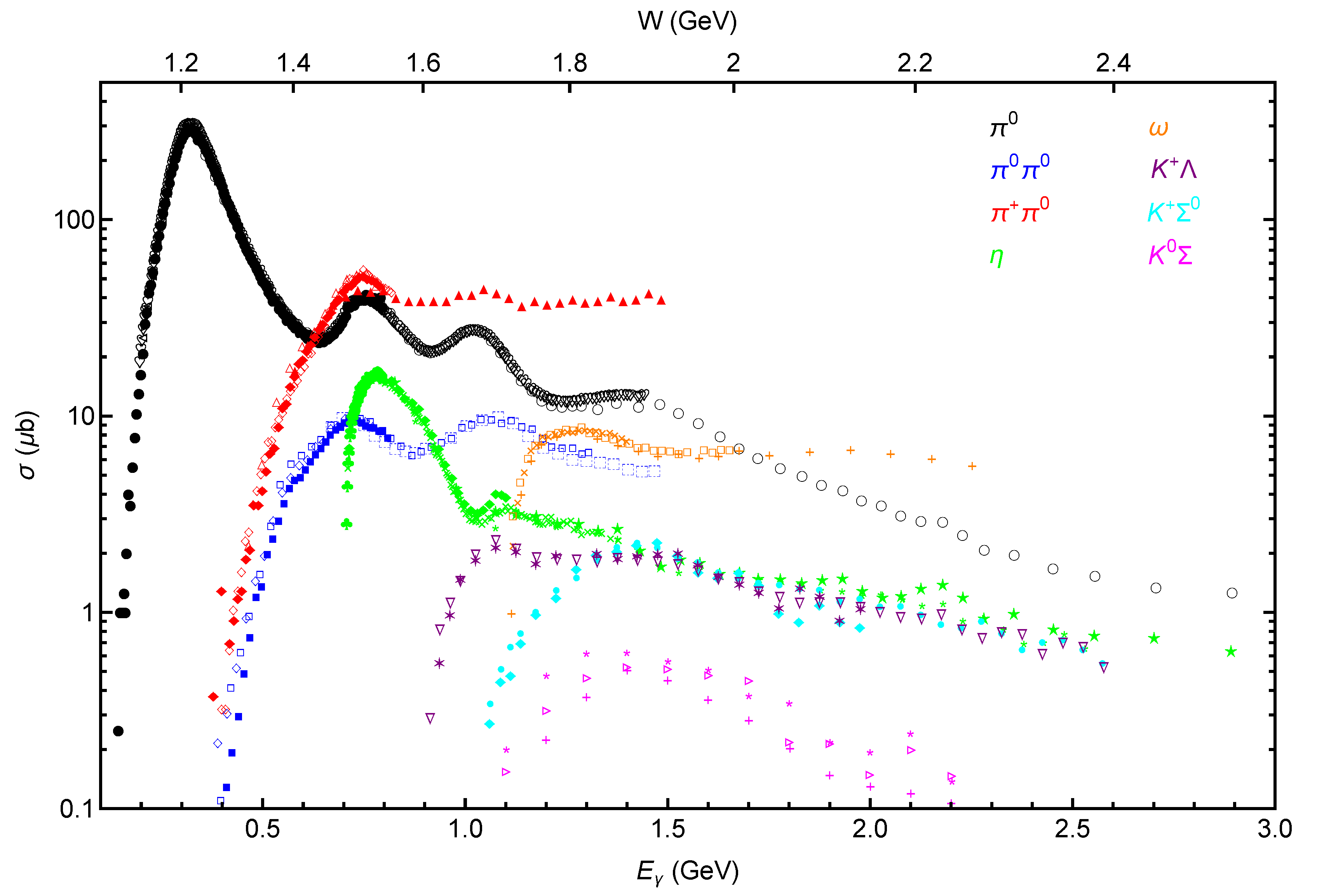
Figure 2.
Photoabsorption cross sections for the channels leading to charged pion and other -producing particles. The scales are those as in Fig.Figure 1. Single production is in black with data from [25] (open upward triangles), [48] (open diamonds), [49] (solid squares), and [33] (solid diamonds). Double pion data is shown in blue with data from the [50] (small open circles), [51] (small solid circles), [30] (solid circles), and [52] (open circles). Data references for , , , , and can be found in the caption of Figure 1.
Figure 2.
Photoabsorption cross sections for the channels leading to charged pion and other -producing particles. The scales are those as in Fig.Figure 1. Single production is in black with data from [25] (open upward triangles), [48] (open diamonds), [49] (solid squares), and [33] (solid diamonds). Double pion data is shown in blue with data from the [50] (small open circles), [51] (small solid circles), [30] (solid circles), and [52] (open circles). Data references for , , , , and can be found in the caption of Figure 1.
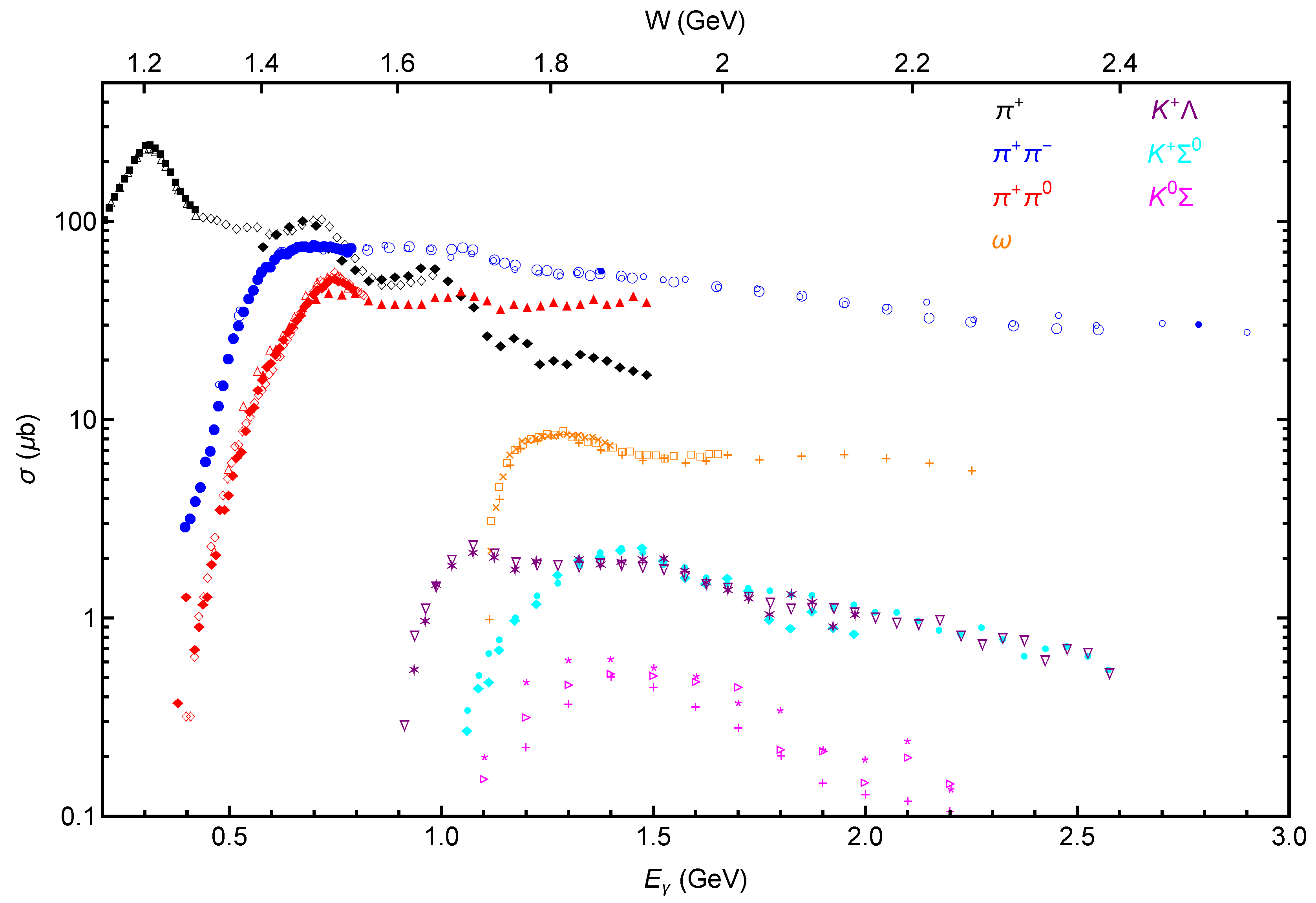
Figure 3.
Feyman diagram of the most important channel for single pion production.
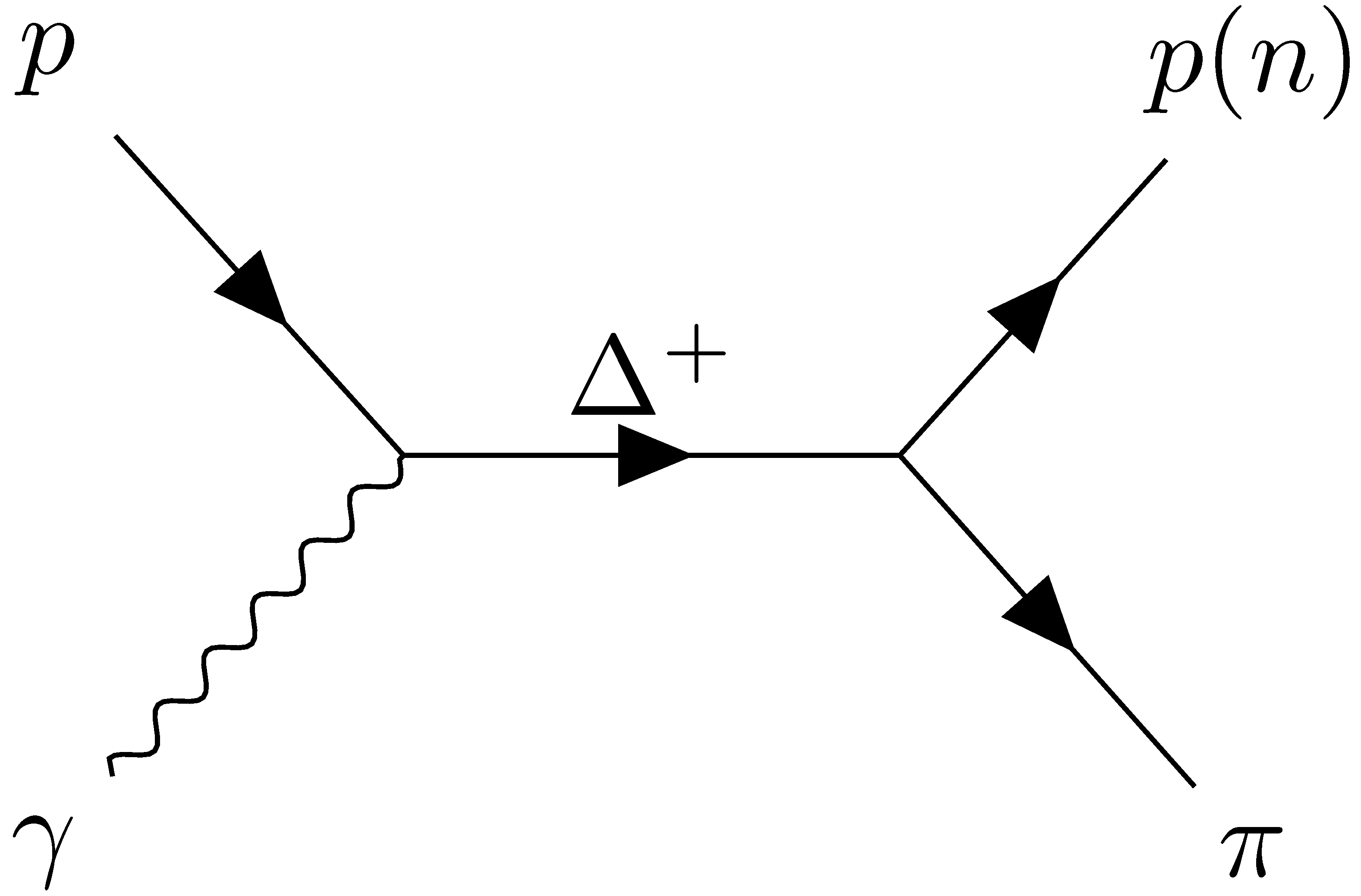
Figure 4.
A linear plot of the cross sections contributing to single production showing the fits to Breit-Wigner type functions and the total cross section compared with the data.
Figure 4.
A linear plot of the cross sections contributing to single production showing the fits to Breit-Wigner type functions and the total cross section compared with the data.
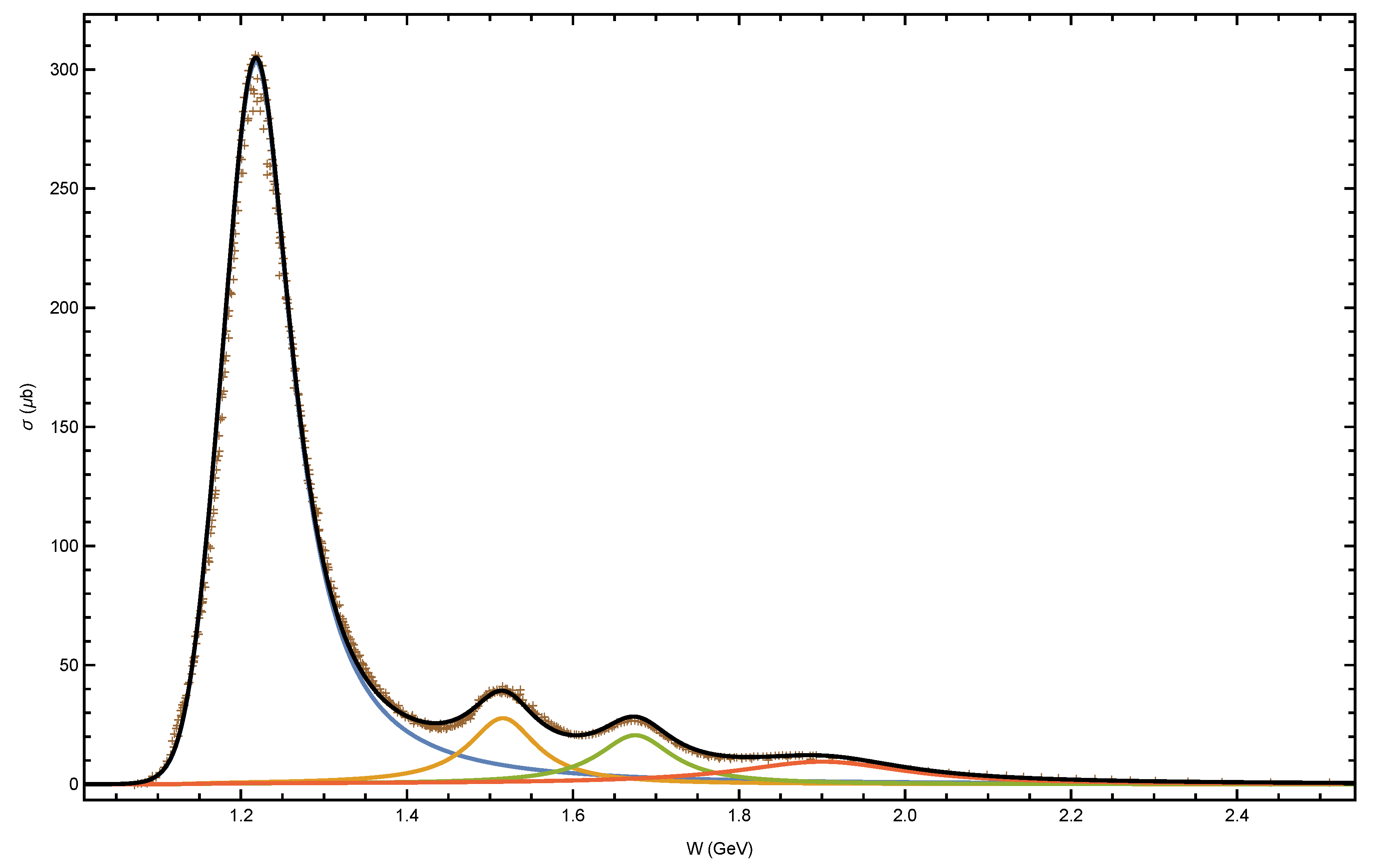
Figure 5.
A linear plot of the cross sections contributing to single production showing the fits to Breit-Wigner type functions and the total cross section compared with the data.
Figure 5.
A linear plot of the cross sections contributing to single production showing the fits to Breit-Wigner type functions and the total cross section compared with the data.
Disclaimer/Publisher’s Note: The statements, opinions and data contained in all publications are solely those of the individual author(s) and contributor(s) and not of MDPI and/or the editor(s). MDPI and/or the editor(s) disclaim responsibility for any injury to people or property resulting from any ideas, methods, instructions or products referred to in the content. |
© 2025 by the authors. Licensee MDPI, Basel, Switzerland. This article is an open access article distributed under the terms and conditions of the Creative Commons Attribution (CC BY) license (http://creativecommons.org/licenses/by/4.0/).
Copyright: This open access article is published under a Creative Commons CC BY 4.0 license, which permit the free download, distribution, and reuse, provided that the author and preprint are cited in any reuse.


