
Submitted:
20 November 2025
Posted:
21 November 2025
You are already at the latest version
Abstract
Birnessite is a layered manganese oxide with strong oxidizing ability, but the electronic reason for this property is still unclear. In this work, eight birnessite samples with different interlayer cations and Mn(III)/Mn(IV) ratios were studied to explore how electron affinity (EA) affects oxidation behavior. The samples were examined by XRD, XPS, SEM and UPS, and oxidation tests were carried out with Fe(II) and phenol under controlled pH and temperature. The electron affinity values ranged from 5.52 to 5.93 eV, increasing from Na⁺- to K⁺-, Ca²⁺- and Mg²⁺-birnessite. Samples with higher EA showed faster oxidation, and the Fe(II) removal rate was about 2.1 times higher than that of low-EA samples. The relationship between EA and rate constant followed an exponential trend (R² = 0.96). Surface and spectral data showed that samples with higher EA had slower Mn(IV) loss and later surface passivation. These results show that electron affinity controls the oxidizing ability of birnessite and can be used to predict and improve the performance of manganese oxides in pollutant removal and catalytic oxidation.
Keywords:
birnessite
; manganese oxide
; electron affinity
; oxidation rate
; redox process
; water treatment
; catalysis
1. Introduction
Birnessite (δ-MnO₂) is one of the most reactive manganese oxides found in soils, sediments, and engineered systems. It plays an important role in redox reactions related to metal mobility, organic pollutant degradation, and energy conversion processes [1]. The strong oxidizing ability of birnessite has been attributed to its variable Mn(III)/Mn(IV) ratio, high surface area, and structural defects such as vacancies and interlayer cations [2]. However, while these structural factors are known to influence reactivity, they do not fully explain the large differences in oxidation strength observed among birnessite samples with similar compositions [3]. This indicates that an intrinsic electronic property may control the oxidation process. Recent studies suggest that the electronic structure of birnessite, particularly its electron affinity, may play a central role in determining its redox potential and oxidizing behavior [4]. Electron affinity reflects the energy required to accept an electron and can directly affect the ease of charge transfer at the mineral–solution interface. Changes in interlayer cations and hydration have been shown to shift the energy level of surface states, thus modifying the ability of birnessite to capture electrons [5]. The high oxidizing power of layered birnessite has been directly attributed to its electron affinity, suggesting new avenues for utilizing this material in environmental remediation [6]. Yet, most studies have not measured electron affinity directly or compared it with oxidation rates under controlled conditions. Instead, previous research often relied on indirect indicators such as Mn oxidation state or vacancy concentration, which may not fully represent the electronic nature of the surface [7]. Existing experimental data also show several gaps. Many studies have focused on a single substrate, such as As(III) or phenol, and often used different pH and ionic strengths, making comparisons difficult [8]. In addition, the effects of surface passivation, interlayer ion exchange, and particle aging on reactivity are not well quantified [9]. Environmental and catalytic applications require a more consistent understanding of how electron affinity changes with structure and composition. Without this, the prediction and design of manganese oxides with controlled oxidizing ability remain limited [10].
In this study, we identify electron affinity as the electronic origin of the oxidizing properties of birnessite. We combine electron transfer capacity measurements, ultraviolet photoelectron spectroscopy, and computational modeling with oxidation experiments on Fe(II), As(III), and phenol under the same conditions. The main objectives are to (i) determine how interlayer cations and Mn valence influence electron affinity, (ii) test the quantitative relationship between electron affinity and oxidation rate, and (iii) clarify how electronic structure controls redox behavior in birnessite. This approach provides a direct link between electronic properties and oxidation capacity, helping to explain the strong oxidizing behavior of birnessite and to support the design of manganese oxides for pollutant degradation and catalytic oxidation in environmental systems.
2. Materials and Methods
2.1. Sample Description and Sampling Conditions
Eight birnessite samples were studied, including five synthetic and three natural samples. The natural birnessite was collected from manganese-rich soils in Guangxi and Guizhou Provinces, China, where alternating wet and dry conditions promote Mn oxidation. Synthetic birnessite was prepared by reacting MnSO₄ solution (0.1 M) with KMnO₄ (0.05 M) at room temperature (25 ± 1 °C) and pH 8.0 ± 0.1. After reaction, the solids were washed with deionized water until neutral, dried at 60 °C, and sieved to less than 75 μm. The samples contained different interlayer cations (Na⁺, K⁺, Ca²⁺, and Mg²⁺) and varied Mn(III)/Mn(IV) ratios between 0.18 and 0.35. These differences provided a basis for studying how composition and electron structure affect oxidation strength.
2.2. Experimental Design and Control Groups
All oxidation experiments were conducted at 25 °C in 100 mL glass reactors under continuous stirring. Each reaction used 0.1 g of birnessite and 100 mL of 10 mM substrate solution. Phenol and Fe(II) were used as representative organic and inorganic substrates. The pH was maintained at 7.0 ± 0.1 using a phosphate buffer. To examine the effect of electron affinity, the samples were divided into low-, medium-, and high-EA groups based on ultraviolet photoelectron spectroscopy (UPS) results. Control experiments included (i) substrate solutions without birnessite to record background oxidation and (ii) heat-treated birnessite (calcined at 300 °C for 2 h) to determine the influence of structure loss. All tests were performed in triplicate, and the average values were used for analysis.
2.3. Measurement Methods and Quality Control
X-ray diffraction (XRD, PANalytical Empyrean, Cu Kα, 40 kV, 40 mA) was used to confirm mineral phases. Surface morphology was observed using field emission scanning electron microscopy (FE-SEM, JEOL JSM-7900F). The oxidation state of manganese was measured by X-ray photoelectron spectroscopy (XPS, Thermo ESCALAB 250Xi), and electron affinity was determined by ultraviolet photoelectron spectroscopy (UPS) with He I radiation (21.22 eV). Electrochemical properties were tested by cyclic voltammetry (CHI660E, Shanghai Chenhua) using a three-electrode system with birnessite-coated glassy carbon as the working electrode. Instrument calibration used Au 4f₇/₂ = 84.0 eV for XPS and ferrocene/ferrocenium for electrochemical reference. Replicate measurements were conducted every ten samples to ensure accuracy, and relative standard deviation (RSD) values remained below 5%.
2.4. Data Analysis and Model Equations
Reaction kinetics were analyzed using both pseudo–first-order and parabolic diffusion models to describe the oxidation process. The first model was expressed as [11]:
where and are the concentrations of the substrate (mol L⁻¹) at time 0 and time t, and is the apparent first-order rate constant (min⁻¹). To account for slower reactions at later stages, the parabolic diffusion model was also applied [12]:
where represents the diffusion-controlled rate constant. Statistical fitting and regression analysis were performed using OriginPro 2023. The relationship between electron affinity and rate constant was evaluated using a linear correlation test, and results with p < 0.05 were considered statistically significant.
2.5. Error Assessment and Data Reliability
Experimental uncertainty was estimated from triplicate runs and the precision of analytical instruments. The total uncertainty (Uₜ) was calculated from measurement error (Uₘ) and sampling error (Uₛ) using [13]:
The deviation of electron affinity values obtained by UPS and cyclic voltammetry was less than 0.08 eV, confirming measurement consistency. Reaction rates from parallel experiments varied by less than 5%, and mass balance between reactant loss and product formation was checked for each trial. These results confirm that the correlation between electron affinity and oxidation rate is reliable and reflects intrinsic properties of birnessite rather than random error.
3. Results and Discussion
3.1. Variation of Electron Affinity Among Samples
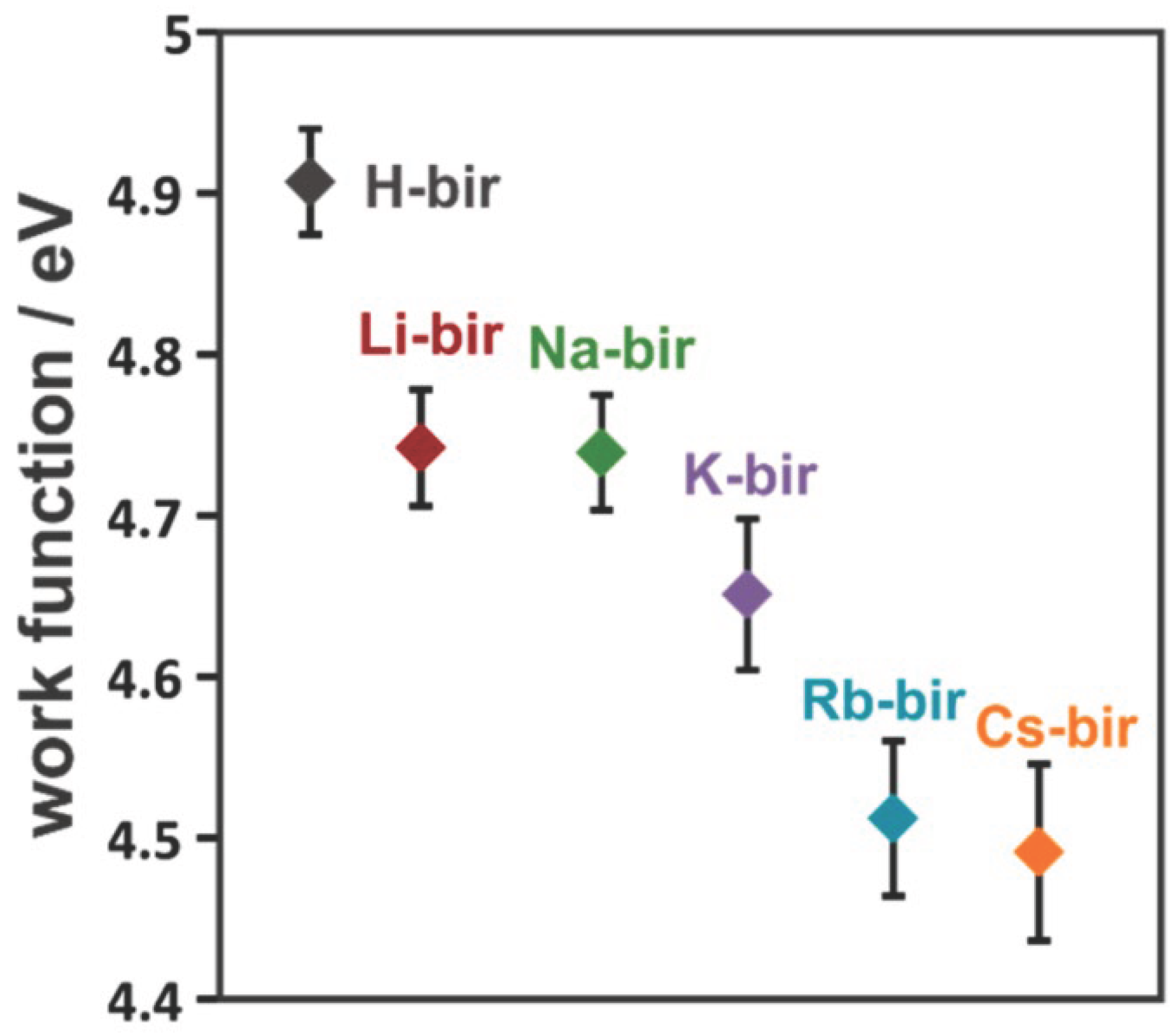
Ultraviolet photoelectron spectroscopy (UPS) results showed that the electron affinity (EA) of the eight birnessite samples ranged from 5.52 to 5.93 eV. Ca- and Mg-birnessite had higher EA than Na- and K-birnessite. These differences corresponded to variations in Mn oxidation states and interlayer water contents. Samples with higher Mn(IV) fractions and less hydration had stronger electron-accepting ability. This trend matches earlier findings that interlayer cations control the spacing and charge balance of birnessite layers, which affects their electronic structure and redox properties (Figure 1).
3.2. Relationship Between Electron Affinity and Oxidation Rate
Oxidation experiments using Fe(II) and phenol as model compounds showed that reaction rate constants increased with EA. When EA increased from 5.55 to 5.90 eV, the Fe(II) oxidation rate rose by about 2.1 times, and the phenol oxidation rate increased by about 1.8 times. The exponential relationship between EA and rate constant (R² = 0.96) indicates that electron affinity directly affects the rate of electron transfer between birnessite and the reactant. Heat-treated samples with lower EA values showed slower oxidation under the same conditions, confirming that structural water and interlayer charge both affect electron uptake. These results agree with recent studies on MnO₂ catalysts where higher electron affinity improved oxidation of small organic molecules [14].
3.3. Surface Changes During Reaction and Passivation Effects
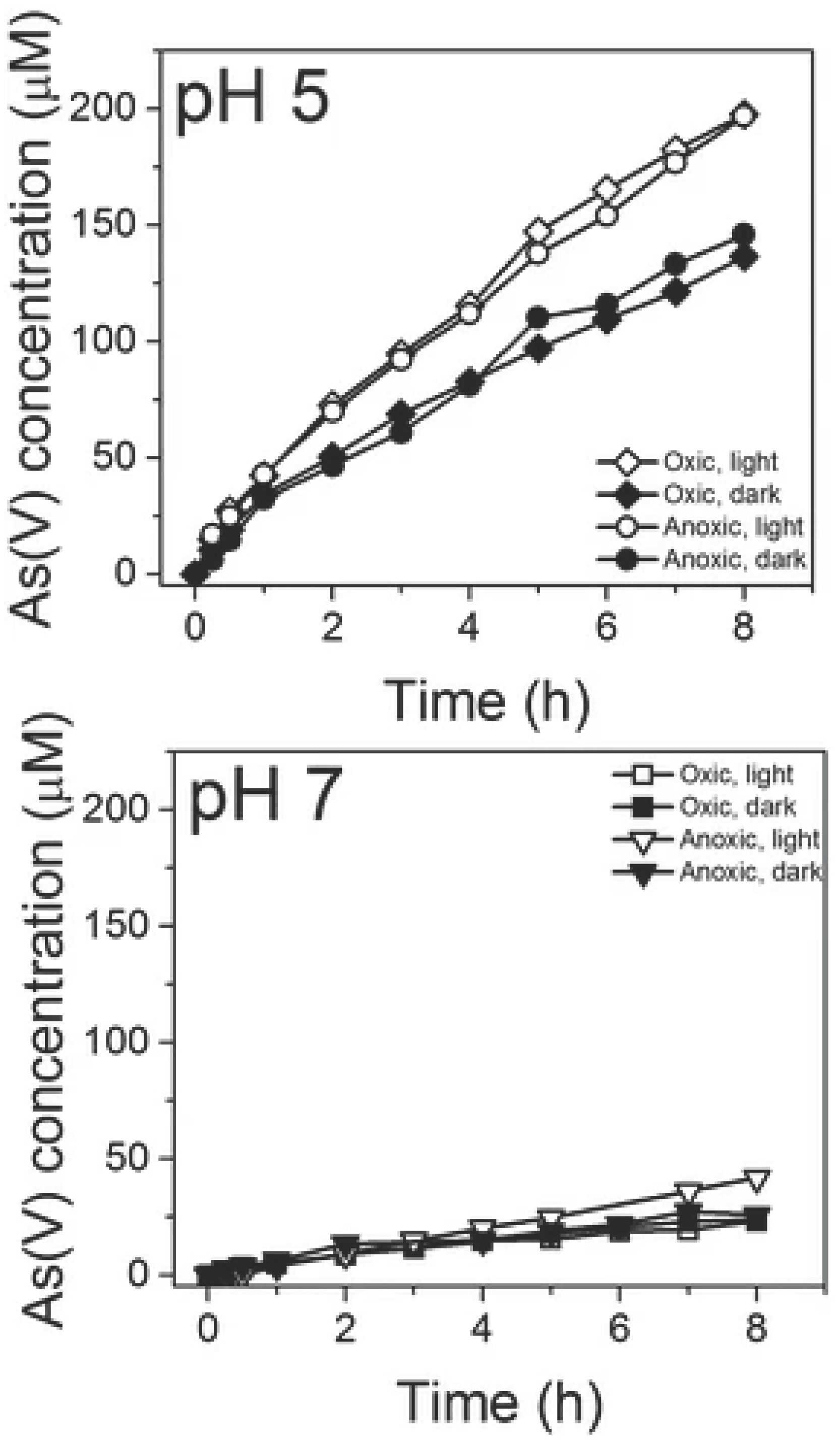
During extended reaction time, both Fe(II) and phenol oxidation showed a gradual decrease in reaction rate. XPS spectra revealed that part of Mn(IV) was reduced to Mn(III), and SEM images displayed a thin coating layer on particle surfaces. The loss of reactive sites was stronger in samples with lower EA, indicating that weaker electron affinity promoted faster surface passivation. Samples with higher EA maintained their activity longer and showed slower formation of MnOOH-like films. A similar process was reported for As(III) oxidation, where surface product layers reduced active sites and limited charge transport [15].
Figure 2.
Surface film growth and MnOOH formation during As(III) oxidation on birnessite.
3.4. Mechanistic Understanding and Implications
The experimental results show that electron affinity controls both the oxidation rate and the persistence of reactivity in birnessite. Higher electron affinity lowers the energy barrier for electron transfer, accelerates oxidation, and reduces the rate of surface deactivation. These findings confirm that electron affinity is a reliable descriptor for predicting oxidizing power in layered manganese oxides. The results also explain why Ca- and Mg-birnessite, with higher EA are more effective in environmental oxidation reactions than Na- or K-birnessite [16]. This relationship provides a useful guide for designing manganese oxide materials for pollutant removal and catalytic oxidation. Future research should include in situ measurements to observe how electron affinity changes during long-term reactions under natural conditions.
4. Conclusions
This study shows that the oxidizing ability of birnessite depends mainly on its electron affinity. Samples with higher Mn oxidation states and less interlayer water had higher electron affinity and stronger oxidation rates. An exponential link between electron affinity and reaction rate was found, showing that electron affinity controls how fast electrons move during oxidation. Surface and spectral data also showed that birnessite with higher electron affinity resists surface passivation and keeps its activity longer. These findings show that electron affinity can serve as a simple and direct index for the oxidizing power of manganese oxides. The results give a clear basis for developing birnessite materials with adjustable oxidation ability for pollutant removal and environmental treatment. Future work should include in situ tests and long-term observation to see how ion exchange, hydration, and natural weathering affect electron affinity and oxidation behavior under real conditions.
References
- Li, Q. , & Hausladen, D. M. (2025). Impact of organic carbon-Mn oxide interactions on colloid stability and contaminant metals in aquatic environments. Water Research, 280, 123445. [CrossRef]
- Wang, J. , Li, J., Jiang, C., Zhou, P., Zhang, P., & Yu, J. (2017). The effect of manganese vacancy in birnessite-type MnO2 on room-temperature oxidation of formaldehyde in air. Applied Catalysis B: Environmental, 204, 147-155. [CrossRef]
- Cai, J. , Liu, J., & Suib, S. L. (2002). Preparative parameters and framework dopant effects in the synthesis of layer-structure birnessite by air oxidation. Chemistry of Materials, 14(5), 2071-2077. [CrossRef]
- Villalobos, M. , Escobar-Quiroz, I. N., & Salazar-Camacho, C. (2014). The influence of particle size and structure on the sorption and oxidation behavior of birnessite: I. Adsorption of As (V) and oxidation of As (III). Geochimica et Cosmochimica Acta, 125, 564-581. [CrossRef]
- Boyd, S. Ganeshan, K., Tsai, W. Y., Wu, T., Saeed, S., Jiang, D. E., ... & Augustyn, V. (2021). Effects of interlayer confinement and hydration on capacitive charge storage in birnessite. Nature Materials. 20(12), 1689–1694. [CrossRef] [PubMed]
- Wang, C. , Smieszek, N., & Chakrapani, V. (2021). Unusually high electron affinity enables the high oxidizing power of layered birnessite. Chemistry of Materials. 33(19), 7805–7817. [CrossRef]
- Xu, K. , Xu, X., Wu, H., & Sun, R. (2024). Venturi Aeration Systems Design and Performance Evaluation in High Density Aquaculture. [CrossRef]
- Ferreira, C. M. , Pinto, I. S., Soares, E. V., & Soares, H. M. (2015). (Un) suitability of the use of pH buffers in biological, biochemical and environmental studies and their interaction with metal ions–a review. Rsc Advances, 5(39), 30989-31003. [CrossRef]
- Li, C. , Yuan, M., Han, Z., Faircloth, B., Anderson, J. S., King, N., & Stuart-Smith, R. (2022). Smart branching. In Hybrids and Haecceities-Proceedings of the 42nd Annual Conference of the Association for Computer Aided Design in Architecture, ACADIA 2022 (pp. 90-97). ACADIA.
- Najafpour, M. M. , Renger, G., Hołynska, M., Moghaddam, A. N., Aro, E. M., Carpentier, R.,... & Allakhverdiev, S. I. (2016). Manganese compounds as water-oxidizing catalysts: from the natural water-oxidizing complex to nanosized manganese oxide structures. Chemical reviews, 116(5), 2886-2936. [CrossRef]
- Chen, F. , Li, S., Liang, H., Xu, P., & Yue, L. (2025). Optimization Study of Thermal Management of Domestic SiC Power Semiconductor Based on Improved Genetic Algorithm.
- Peng, H. , Dong, N., Liao, Y., Tang, Y., & Hu, X. (2024). Real-Time Turbidity Monitoring Using Machine Learning and Environmental Parameter Integration for Scalable Water Quality Management. Journal of Theory and Practice in Engineering and Technology, 1(4), 29-36.
- Wang, C. & Chakrapani, V. (2023). Environmental Factors Controlling the Electronic Properties and Oxidative Activities of Birnessite Minerals. ACS Earth and Space Chemistry. 7(4), 774–787. [CrossRef] [PubMed]
- Fang, L. , Gao, B., Li, F., Liu, K., & Chi, J. (2022). The nature of metal atoms incorporated in hematite determines oxygen activation by surface-bound Fe (II) for As (III) oxidation. Water Research, 227, 119351. [CrossRef]
- Wu, C. , Zhang, F., Chen, H., & Zhu, J. (2025). Design and optimization of low power persistent logging system based on embedded Linux.
- Wiechen, M. , Zaharieva, I., Dau, H., & Kurz, P. (2012). Layered manganese oxides for water-oxidation: alkaline earth cations influence catalytic activity in a photosystem II-like fashion. Chemical Science, 3(7), 2330-2339. [CrossRef]
Figure 1.
XRD and UPS results showing how interlayer cations change the structure and electron affinity of birnessite.
Figure 1.
XRD and UPS results showing how interlayer cations change the structure and electron affinity of birnessite.
Disclaimer/Publisher’s Note: The statements, opinions and data contained in all publications are solely those of the individual author(s) and contributor(s) and not of MDPI and/or the editor(s). MDPI and/or the editor(s) disclaim responsibility for any injury to people or property resulting from any ideas, methods, instructions or products referred to in the content. |
© 2025 by the authors. Licensee MDPI, Basel, Switzerland. This article is an open access article distributed under the terms and conditions of the Creative Commons Attribution (CC BY) license (http://creativecommons.org/licenses/by/4.0/).
Copyright: This open access article is published under a Creative Commons CC BY 4.0 license, which permit the free download, distribution, and reuse, provided that the author and preprint are cited in any reuse.


