

Submitted:
19 November 2025
Posted:
20 November 2025
You are already at the latest version
Abstract
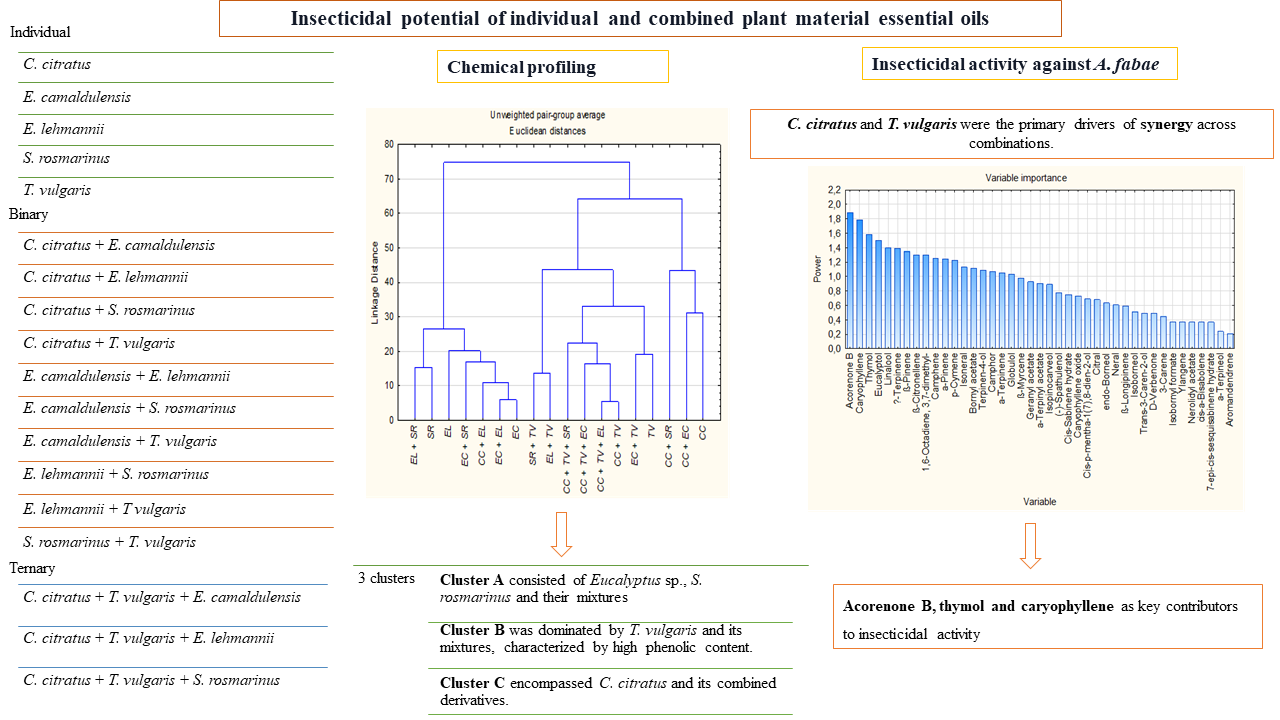
Essential oils (EOs) obtained from combined plant materials offer a promising alternative to conventional extraction by enhancing chemical diversity and bioactivity through synergistic interactions. Given the growing interest in insecticidal EOs activity and use in agriculture, the chemical composition and insecticidal properties of individual and combined plant EOs from Cymbopogon citratus, Eucalyptus camaldulensis, Eucalyptus lehmannii, Salvia rosmarinus and Thymus vulgaris were evaluated against aphids. Plant materials were mixed in equal proportions prior to hydrodistillation to produce binary and ternary combinations. GC-MS analysis revealed significant compositional shifts in EOs from combined plant materials. Major compounds in individual oils included citral (53.11%) and neral (29.14%) in C. citratus, thymol (70.84%) in T. vulgaris, and eucalyptol as the predominant compound in E. camaldulensis (66.51%), E. lehmannii (56.99%) and S. rosmarinus (46.56%), respectively. In the combined oils, the relative abundance of these constituents was altered, and new minor constituents were introduced. Principal Component Analysis (PCA) and Hierarchical Cluster Analysis (HCA) revealed that combined plant EOs clustered close to their parental oils, indicating compositional inheritance rather than entirely novel profiles. Insecticidal assays conducted against Aphis fabae demonstrated enhanced efficacy of the combined oils, as evidenced by reduced LC₅₀ values (1.39 µL mL-1 for E. camaldulensis + T. vulgaris) and pronounced synergistic interactions, indicated by a co-toxicity coefficient (CTC) of 221.58) and elevated synergistic factors. Pearson correlation analysis and Partial Least Squares (PLS) regression jointly identified Acorenone B, thymol and caryophyllene as principal contributors to insecticidal activity, each exhibiting distinct correlation directions. These three compounds ranked highest among the 18 compounds with a Variable Importance in Projection (VIP) scores exceeding 1.0. The integration of these statistical approaches substantiates the insecticidal potential of combined plant-derived EOS and underscores their relevance in advancing sustainable crop protection strategies.
Keywords:
essential oils
; combined plant material
; insecticidal activity
; synergism
; additivity
; multivariate analysis
1. Introduction
The combination of essential oils (EOs) from different plant species, either through conventional blending of extracted oils, or through the distillation of combined plant materials, introduces a complex chemical matrix that can profoundly influence their biological activities [1,2]. These combinations can lead to various types of interactions among the constituent compounds [3]. Additive effects occur when the combined bioactivity matches the cumulative activity of the individual oils [4]. In contrast, antagonistic interactions happen when one or more components reduce the overall efficacy of the mixture [5]. Synergistic effects are particularly interesting because they produce a combined activity that surpasses the predicted sum of the individual parts [6]. The nature of these interactions depends on several factors, including chemical composition, concentration ratios, and the method used to combine the oils [7]. The distillation of combined plant materials, entailing the simultaneous extraction of multiple botanical sources, can uniquely promote interactions among volatile compounds during the extraction process [8]. This approach has the potential to yield novel chemical profiles exhibiting enhanced antimicrobial activity [9]. Despite its promise, the mechanisms underlying such interactions remain complex and insufficiently elucidated, thereby highlighting the need for further investigation [10].
The global search for environmentally sustainable and effective alternatives to synthetic pesticides has intensified interest in EOs due to their broad-spectrum antimicrobial properties and multifaceted modes of action [11]. Composed mainly of monoterpenes, sesquiterpenes, and oxygenated derivatives, EOs target multiple biological pathways [12]. This complexity reduces the risk of resistance development in pests and pathogens [13]. While extensive research has focused on individual EOs, there is comparatively less information on the chemical and biological impacts of EO combinations, particularly those produced via the distillation of combined plant materials [14,15].
Aromatic and medicinal plants such as C. citratus, S. rosmarinus, T. vulgaris and Eucalyptus species are globally distributed and have been traditionally used for their medicinal and pesticidal properties [16,17]. These species have demonstrated significant antimicrobial and insecticidal potential individually [18]. However, the properties of their combined plant material EOs (CPM-EOs) remain underexplored [19]. Leveraging the synergistic potential of these plants species presents promising opportunities for the development of versatile and sustainable biopesticides, tailored to the diverse requirements of contemporary agricultural systems [20]. Agricultural production across many regions faces serious threats from insect pests including A. fabae, a major pest of legumes that imposes additional pressures on crop health and productivity [21]. A. fabae is also an important vector of viruses on potato, pepper and faba bean in Tunisia [22]. Effective biocontrol agents targeting such pests are crucial components of integrated pest management strategies that could include the use of EOS, representing a more sustainable approach to pest control with minimal environmental impact [23,24].
This study investigates EOs extracted from five aromatic species, C. citratus, E. camaldulensis, E. lehmannii, S. rosmarinus and T. vulgaris. The research focuses on both individual oils and selected binary and ternary combinations, aiming to evaluate how distillation of combined plant materials influences their chemical profiles and biological activities. Chemical composition was analyzed using gas chromatography–mass spectrometry (GC–MS). Insecticidal efficacy was evaluated against A. fabae through contact toxicity testing. Principal Component Analysis (PCA) and Hierarchical Cluster Analysis (HCA) were performed on the chemical composition data to evaluate the compositional patterns. In addition, Pearson correlation and Partial Least Squares (PLS) regression were performed to identify the main constituents associated with insecticidal activity based on LC50 values. These results contribute to a better understanding of the chemical basis of the bioactivity of combined EOs and support their potential role in sustainable crop protection.
2. Results
2.1. Chemical Composition of Individual and Combined Plant Material Essential Oils
The chemical analysis of individual and CPM-EOs from C. citratus, E. camaldulensis, E. lehmannii, S. rosmarinus, and T. vulgaris, as well as their binary and ternary mixtures, led to the identification of 41 compounds, representing 98.46% to 99.99% of the total oil composition. The identified constituents were grouped into four major chemical classes: monoterpene hydrocarbons, oxygenated monoterpenes, sesquiterpene hydrocarbons, and oxygenated sesquiterpenes. All EOs, whether individual or combined, were dominated by oxygenated monoterpenes, ranging from 63.12% to 87.28%, followed by monoterpene hydrocarbons (10.01% to 33.6%) (Table 1).
In C. citratus EO, six chemical components, accounting for 99.98% of the total composition were identified. The oil was primarily composed of oxygenated monoterpenes (86.68%) and monoterpene hydrocarbons (13.3%), with citral (53.11%), neral (29.14%) and β-myrcene (9.59%) as the most abundant compounds. E. camaldulensis EO contained seven constituents (99.92%), dominated by oxygenated monoterpenes (70.79%) and monoterpene hydrocarbons (26.04%), particularly eucalyptol (66.51%) and α-pinene (24.38%). Similarly, in E. lehmannii EO oxygenated monoterpenes (74.45%) and monoterpene hydrocarbons (24.78%) were the most abundant compounds with six major chemicals representing the 99.6% of the total composition, with eucalyptol (56.99%) and α-pinene (24.18%) as key components. In S. rosmarinus EO, ten chemical constituents were identified (99.98%), comprising oxygenated monoterpenes (68.72%) and monoterpene hydrocarbons (22.92%), where eucalyptol (46.56%), endo-borneol (11.35%), and α-pinene (9.06%) were predominant. Finally, T. vulgaris EO contained nine components (99.99%), rich in oxygenated monoterpenes (76.56%) and monoterpene hydrocarbons (22.07%), with thymol (70.84%), p-cymene (11.01%), and γ-terpinene (7.73%) as the major compounds.
Binary combinations involving C. citratus resulted in notable shifts in chemical profiles, reflecting both synergistic interactions and selective transformations depending on the companion species. In the C. citratus + E. camaldulensis oil, citral (33.2%) and neral (17.23%) were the main constituents, indicating partial retention of the citrus profile, whereas eucalyptol, characteristic of E. camaldulensis, was completely absent. Remarkably, p-cymene (19.14%) appeared as a newly formed compound, indicating possible chemical transformation during the distillation process. In the blend with E. lehmannii, eucalyptol became the dominant compound (73.62%), a level exceeding that of E. lehmannii alone (56.99%), while citral and neral dropped sharply to 5.11% and 2.69%, respectively. Additionally, α-pinene declined from 24.18% to 16.9%, reflecting rebalancing of the volatile fraction. The C. citratus + S. rosmarinus mixture showed a moderate retention of citral (21.45%) and neral (9.8%), while camphor increased from 7.44% to 9.39%. In contrast, other major S. rosmarinus volatiles such as eucalyptol, α-pinene, camphene, and β-pinene were reduced to 26.13%, 3.5%, 2.28%, and 2.9%, respectively. In the C. citratus + T. vulgaris blend, thymol became the dominant constituent (45.78%), underscoring the strong phenolic imprint of T. vulgaris, while citral (24.12%) and neral (12.34%) were well retained. The appearance of isoneral (2.45%) alongside reduced levels of p-cymene (2.92%) and γ-terpinene (3.57%), further highlights the emergence of new volatiles and reorganization of the monoterpene fraction during distillation.
Binary blends containing E. camaldulensis exhibited distinct compositional behaviors, ranging from preservation to transformation of key constituents depending on the combined species. Thus, in the E. camaldulensis + E. lehmannii oil, the major components, eucalyptol (71.27%) and α-pinene (23.39%) were largely retained, indicating compositional stability and chemical compatibility between the two species. Conversely, combination with S. rosmarinus led to a profile still dominated by eucalyptol (64.35%) and α-pinene (9.0%), alongside camphor (4.04%), while camphene (2.95%) and β-pinene (2.78%) were preserved at low levels, reflecting moderate rebalancing without major loss of original markers. In contrast, the blend with T. vulgaris revealed marked compositional shifts: thymol emerged as the dominant compound (55.69%), slightly reduced from its original concentration in T. vulgaris (70.84%). Notably, eucalyptol, originally the primary component of E. camaldulensis (66.51%) was no longer detectable, indicating possible chemical transformation. Monoterpene hydrocarbons, including α-pinene and β-pinene were also drastically reduced from 24.38% and 1.21% to 1.88% and undetectable levels, respectively. Meanwhile, p-cymene and γ-terpinene present in T. vulgaris at 11.01% and 7.73% were enriched to 20.52% and 10.11% respectively. These compositional modifications reflect a clear shift toward the phenolic and aromatic profile of T. vulgaris accompanied by a complete attenuation of the eucalyptol-rich signature characteristic of E. camaldulensis.
Combinations with E. lehmannii resulted in compositional changes influenced by the accompanying species. In the E. lehmannii + S. rosmarinus blend, eucalyptol remained the predominant compound at 49.62%, reflecting substantial retention from both original oils (56.99% and 46.56% respectively). Camphor, a key constituent of S. rosmarinus (7.44%), was slightly reduced to 6.28%, while α-pinene initially abundant in both oils (24.18% and 9.06% respectively) appeared at an intermediate level of 13.77%, indicating a compositional balance between the two sources. In contrast, the combination of E. lehmannii with T. vulgaris yielded an oil dominated by thymol (35.77%) and eucalyptol (35.09%), both substantially reduced from their original concentrations. p-Cymene was completely eliminated, α-pinene declined to 11.97%, while γ-terpinene increased slightly from 7.73 to 7.96%, demonstrating a partial merging of the two oils.
Similar compositional patterns were observed in the combination of S. rosmarinus with T. vulgaris, where thymol (33.56%) and eucalyptol (29.02%) emerged as the predominant compounds shaping the blend’s chemical profile. p-Cymene was completely eliminated, and α-pinene decreased to 5.09%, reflecting selective changes that enhance the blend’s chemical diversity.
Regarding ternary CPM-EOs, eucalyptol was detected exclusively in C. citratus + T. vulgaris + S. rosmarinus, where it accounted for 10.67%. Thymol, the principal phenolic compound of T. vulgaris, consistently dominated all ternary blends, with concentrations varying from 37.64% to 50.46%. p-Cymene, another major compound from T. vulgaris, was present at 16.81% and 3.68% in blends containing E. camaldulensis and E. lehmannii, respectively, but was entirely absent in S. rosmarinus blend. Citral (15.95–20.9%) and neral (6.43–10.7%) characteristic of C. citratus were well preserved across all blends, contributing to their distinctive citrus aroma. Camphor, a marker compound of S. rosmarinus, was detected only in its corresponding ternary blend at 3.99%. These compositional variations illustrate the complex interactions occurring in ternary CPM-EOs, where the phenolic dominance of thymol is balanced by the citrus freshness of citral and neral, while other compounds such as eucalyptol, p-cymene, and camphor modulate the aroma profile and potentially the biological activity of the oils.
2.2. Multivariate Analysis of Essential Oil Compositions
2.2.1. Principal Component Analysis (PCA)
PCA was performed to explore patterns in the chemical composition of individual and CPM-EOs. The scree plot indicated that the first three principal components account for approximately 95.9% of the total variance, with PC1 explaining 47.53%, PC2 explaining 34.87%, and PC3 contributing an additional 13.65%. Given the sharp decline in eigenvalues after the third component, only PC1 and PC2, together explaining 82.4% of the variance, were considered for graphical representation.
The PCA score plot (Figure 1) revealed distinct groupings driven by the distribution of key chemical constituents in individual and CPM-EOs. Detailed PCA loadings (PC1, PC2 and PC3) for all individual, binary, and ternary CPM-EOs are provided in Supplementary Table S1. E. camaldulensis and E. lehmannii exhibited strong negative loadings on PC1 (–0.90 and –0.89, respectively), primarily influenced by eucalyptol, a dominant compound strongly correlated with this axis. Similarly, S. rosmarinus also loads strongly negatively on PC1 (–0.87) but displays a moderate positive loading on PC2 (0.40), suggesting some chemical similarity with the Eucalyptus species while being differentiated by compounds such as camphor, which contributes to its unique profile. T. vulgaris showed a strong negative loading on PC2 (–0.88), primarily associated with thymol, underscoring its distinct chemical signature. In contrast, C. citratus exhibited moderate loadings near the origin for both PC1 (–0.06) and PC2 (–0.28), indicating a balanced distribution across these components. However, it was primarily characterized by its high loading on PC3 (0.94).
The binary and ternary CPM-EOs exhibited clear spatial distributions in the PCA space, shaped by the dominant constituents of their parent oils. Binary combinations involving Eucalyptus species, including pairings within the genus and with other plants such as C. citratus + E. lehmannii and E. camaldulensis + S. rosmarinus, showed strong negative loadings on PC1, reflecting high levels of eucalyptol and α-pinene. Mixtures involving T. vulgaris, such as C. citratus + T. vulgaris and E. camaldulensis + T. vulgaris were positioned along PC2 due to thymol content. Combinations with C. citratus, especially C. citratus + E. camaldulensis and C. citratus + S. rosmarinus, exhibited strong positive loadings on PC3, indicating a distinct citral-driven profile. Ternary mixtures, such as C. citratus + T. vulgaris + E. camaldulensis and C. citratus + T. vulgaris + E. lehmannii, loaded strongly on PC2 (thymol-driven), with moderate PC3 contributions reflecting citral influence. Similarly, C. citratus + T. vulgaris + S. rosmarinus showed strong negative loadings on both PC1 and PC2, indicating a combined influence of eucalyptol, α-pinene, and thymol, with minor citral input. These spatial patterns illustrate the compositional interplay and synergistic effects emerging from plant material combinations.
2.2.2. Hierarchical Cluster Analysis (HCA)
The hierarchical cluster analysis (HCA) dendrogram, constructed using Euclidean distances and the UPGMA method, revealed clear groupings among the EOs and their combinations, in agreement with the patterns observed in the PCA. Three primary clusters emerged based on compositional similarity (Figure 2).
Cluster A consisted of Eucalyptus species, S. rosmarinus and their mixtures. The close proximity between E. camaldulensis and E. lehmannii (distance = 16.2) reflects a high degree of shared constituents, further emphasized by the even closer distance between E. camaldulensis and its blend with E. lehmannii (distance = 5.9). Additionally, E. camaldulensis + S. rosmarinus (distance = 17.5 from E. camaldulensis and 22.3 from E. lehmannii) supports a trend of compositional alignment within this cluster, likely driven by common oxygenated monoterpenes such as eucalyptol and α-pinene. Cluster B was dominated by T. vulgaris and its mixtures, characterized by high phenolic content. While T. vulgaris alone was chemically distinct from E. camaldulensis (distance = 101.1), their combination showed a greatly reduced distance of 19.18, indicating a closer chemical relationship. Mixtures involving C. citratus and T. vulgaris also exhibited strong chemical affinity. For instance, C. citratus + T. vulgaris and C. citratus + T. vulgaris + E. lehmannii displayed a very low inter-sample distance of 5.4, while C. citratus + T. vulgaris + E. camaldulensis showed a slightly higher but still close distance of 17.9. These shifts suggest enhanced chemical integration, likely driven by synergistic interactions between thymol and citral components. The mixture E. lehmannii + T. vulgaris (distance = 45.9) also supports the potential for moderate compositional blending between phenolic-rich and monoterpene-based oils. Cluster C encompassed C. citratus and its combined derivatives. Although C. citratus alone was chemically distant from most other oils (distance > 90 from E. camaldulensis and T. vulgaris), its mixtures consistently reduced inter-sample distances and frequently occupied intermediate positions between Clusters A and B. Notable examples include C. citratus + E. camaldulensis (distance = 31.2 from C. citratus), C. citratus + S. rosmarinus (48.1) all suggesting partial compositional blending. These results indicate that combining plant material modifies the volatile profile in a manner that reduces chemical distances between initially dissimilar oils.
2.3. Insecticidal Activity
2.3.1. Probit Analysis of Individual and Combined Plant Material Essential Oils
Probit regression analysis revealed notable variation in the insecticidal efficacy of both individual and CPM-EOs against A. fabae after 24 h of exposure. Among the individual oils tested, E. camaldulensis demonstrated the highest insecticidal potency, with the lowest LC50 value of 2.45 µL mL−1, indicating its efficiency was obtained with the smallest concentration to kill 50% of the aphid population. This was followed by E. lehmannii with LC50 of 2.90 µL mL−1, C. citratus at 3.24 µL mL−1, and T. vulgaris at 3.71 µL mL−1. The least effective individual oil was S. a rosmarinus, which exhibited the highest LC50 value of 4.41 µL mL−1, reflecting lower toxicity (Table 3).
When evaluating CPM-EOs, binary mixtures generally lead to enhanced insecticidal activity compared to individual ones. The binary combination of E. camaldulensis + T. vulgaris was the most potent, achieving an LC50 of 1.39 µL mL−1, indicating good synergy between components inducing a strong increase in toxicity. Other binary mixtures involving C. citratus also showed substantial improvements, with LC50 values ranging from 1.75 to 2.38 µL mL−1, demonstrating a relative synergistic or additive effect. Ternary combinations resulted in complete mortality (100%) at the lowest tested concentration of 2 µL mL−1, which precluded fitting dose–response models but strongly suggests powerful synergistic effects among the three oils.
2.3.2. Assessment of Synergistic Interactions Using Co-Toxicity Coefficient and Synergistic Factors
The evaluation of CPM-EOs against A. fabae revealed a spectrum of interaction types, ranging from strong synergism to additive or slight antagonism. C. citratus stood out as a key synergistic component. Its binary combinations with E. camaldulensis, E. lehmannii, S. rosmarinus, and T. vulgaris consistently exhibited strong synergistic effects, with co-toxicity coefficients (CTC) ranging from 130.64 to 198.57 and synergistic factors (SF) exceeding 1.2 in all cases (Table 4).
T. vulgaris also contributed significantly to enhanced efficacy when paired with other species. Combinations with E. camaldulensis, E. lehmannii, and S. rosmarinus demonstrated particularly strong synergy, reflected by CTC values greater than 218 and SF values above 2, indicating substantial improvement in insecticidal activity. S. rosmarinus, despite being the least toxic as a single oil, displayed notable synergistic effects in combinations. When paired with C. citratus or T. vulgaris, the mixtures achieved high CTC values (up to 249.08) and strong SF values (>2.2), underscoring its supportive role in enhancing toxicity. However, in combination with E. camaldulensis, the interaction was weaker, classified as additive to moderate synergism (CTC = 119.52), and showed uneven SF values (0.85 and 1.54), suggesting variable contribution depending on the pairing. In contrast, the mixture of E. camaldulensis and E. lehmannii showed the weakest interaction, classified as additive to slight antagonism. This combination yielded a CTC of 81.58 and SF values of 0.75 and 0.88, indicating little to no enhancement and potential interference in insecticidal action.
Ternary mixtures comprising C. citratus, T. vulgaris, and either S. rosmarinus or, an Eucalyptus species caused complete mortality at the lowest tested dose (2 µL mL−1). This prevented LC50 estimation but clearly indicated potent synergistic interactions. In summary, C. citratus and T. vulgaris were the primary drivers of synergy across combinations, while S. rosmarinus enhanced their effects significantly. Conversely, pairings involving only Eucalyptus species provided limited or even slightly antagonistic results, emphasizing the importance of strategic plant material selection for optimal insecticidal efficacy.
2.3.3. Correlation and Regression Analysis Based on LC50
To identify the chemical constituents most strongly associated with insecticidal activity, correlation and regression analyses were performed using LC50 values as indicators of toxicity. Pearson correlation analysis provided insight into the strength and direction of linear relationships between key constituents and bioactivity. To further explore these associations in a multivariate context and account for potential interactions between compounds, partial least squares (PLS) regression was applied. This approach allowed the development of a predictive model and highlighted the key constituents contributing to the overall insecticidal effect of EOs.
Pearson Correlation Between Major Constituents and LC50 Values
Among the 41 EOs constituents analyzed, three exhibited statistically significant correlations with LC50 values. Thymol (r = –0.5018, p = 0.034) and Acorenone B (r = –0.5119, p = 0.030) were negatively correlated, indicating that higher concentrations of these compounds corresponded to lower LC50 values and therefore greater insecticidal activity. Caryophyllene was positively correlated with LC50 (r = 0.5267, p = 0.025), suggesting that higher concentrations of this compound were associated with higher LC50 values and, therefore, reduced insecticidal potency. No other constituent of the EOs showed a statistically significant correlation with LC50 values. The complete list of correlation coefficients and p values for all analyzed compounds is provided in Table 5.
Partial Least Square Regression Modeling
The PLS regression model extracted two components, which together explained 59.39% of the variance in insecticidal activity (LC50). Detailed statistics for each component, including R2X, R2Y, eigenvalues, Q2, and the number of iterations, are presented in Supplementary Table S2. The first component explained 19.44% of the variance in the predictor variables (R2X) and 42.09% of the variance in the response variable (R2Y), with an eigenvalue of 6.96. The associated Q2 value was 0.15, indicating moderate predictive accuracy. This component was statistically significant. The second component contributed 11.77% to R2X, bringing the cumulative R2X to 31.21% and R2Y to 59.39%. Its eigenvalue was 2.45, but the Q2 value was negative (-0.63) and the component was not statistically significant. Although the cumulative R2Y increased with the addition of the second component, the corresponding decrease in Q2 suggests limited predictive contribution beyond the first component. The overall performance of the model is summarized in Figure 3.
The VIP scores from the PLS regression model were used to assess the relative importance of the 41 identified compounds in predicting insecticidal activity. VIP scores quantify the contribution of each chemical constituent used as a predictor variable to explain variation in the response variable, and compounds with VIP scores greater than 1 are considered significant contributors to the model. As shown in Figure 4, 18 compounds exceeded the commonly used threshold of VIP > 1, indicating a significant contribution to the model. These 18 compounds are summarized in Table 6, ranked according to their VIP scores. The complete list of compounds and their associated VIP scores are presented in Supplementary Table S3.
The top 18 compounds ranked by their variable importance in projection (VIP). Variable numbers correspond to those used in the chemical composition table (Table 2). Compounds with identical VIP scores share the same rank.
Acorenone B (VIP =1.886), caryophyllene (VIP =1.785) and thymol (VIP =1.580) were identified as the compounds with the highest VIP scores, indicating their dominant influence on the PLS regression model. It is noteworthy that these same compounds also showed statistically significant correlations with insecticidal activity in the Pearson correlation analysis presented previously. The convergence of the results of these two independent statistical approaches reinforces their biological relevance and underlines their role as main contributors to the observed insecticidal effect. Besides these compounds, several other compounds with VIP greater than 1, such as eucalyptol, linalool, and γ-terpinene, also showed notable importance in the model and could contribute through additive or synergistic interactions. This observation supports the notion that insecticidal activity arises from the collective contribution of multiple constituents, rather than being solely driven by a single dominant compound.
3. Discussion
The chemical composition of EOs is a primary determinant of their biological activity, and in this study, the profiles of the tested EOs largely conformed to established chemotypes. Citral is the primary component of EOs derived from Cymbopogon species. In the present study, C. citratus was rich in citral (53.11%) and neral (29.14%), closely aligning with values observed in the Brasilian (citral 55.48%, neral 35.40%) and Egyptian (citral 31.57%, neral 13.42%) chemotypes [25,26]. Similar citral-dominant profiles have also been reported in Indonesian [27], Indian [28], and Vietnamese [29] C. citratus oils, further confirming the consistency of this chemotype across diverse geographical regions. E. camaldulensis and E. lehmannii were both dominated by eucalyptol, which is consistent with previous findings, where eucalyptol typically ranges from 20 to 40% [30,31]. However, our results showed a higher relative abundance of eucalyptol, ranging from 50 to 70%. Previous studies have demonstrated significant variability in the chemical composition of Eucalpytus EOs depending on factors such as geographic origin, climate, soil conditions, harvesting time, and extraction method [32,33]. S. rosmarinus EO was mainly composed of eucalyptol (46.56%) followed by endo-borneol, and α-pinene. This composition indicates a predominance of eucalyptol chemotype, consistent with typical profiles previously reported for this species [34,35,36]. Other chemotypes have been also described including camphor [37], verbenone [38], α-pinene [39] and myrcene [40]. The T. vulgaris EO was characterized by a predominance of thymol, indicating that the studied oil belongs to the thymol chemotype, in agreement with the literature [41,42]. However, the relative proportion of thymol in our samples was notably higher (reaching 70%) than that reported in previous studies, where values generally remained close to 40% [43,44,45]. In addition to the thymol chemotype observed in the present study, other chemotypes of T. vulgaris EO were reported including carvacrol [46], linalool [47] and α-terpineol [48].
Upon combining and distilling plant materials, the resulting EOs showed strong compositional inheritance from their respective parent profiles, as indicated by the clustering of major components. However, consistent and notable differences were observed, including suppression of certain constituents, emergence of new minor compounds, and significant shifts in relative abundance. In particular, combinations involving C. citratus with Eucalyptus species showed distinct profiles, likely due to the interaction of citral and eucalyptol during the distillation process, which may enhance or suppress certain volatiles. In contrast, blends with T. vulgaris revealed that thymol emerged as the dominant compound, underscoring the strong phenolic imprint of T. vulgaris. On the other hand, combinations of chemically similar oils, such as E. camaldulensis, E. lehmannii and S. rosmarinus, showed less differentiation, indicating limited synergy in their volatile profiles. These observations highlight the importance of strategic EO selection in combined distillation to achieve both compositional and functional diversity. Similar transformations were previously observed during the combined plant material distillation of C. citratus and Hyptis suaveolens, where the resulting oil showed new major constituents, piperitone (40.8%) and p-menth-4(8)-ene (13.2%) being absent in the individual oils. In contrast, key compounds such as β-pinene and sabinene (from Hyptis suaveolens), and neral and geranial (from C. citratus) disappeared, while limonene and α-pinene, present only in Hyptis suaveolens, increased markedly in the combined oil. These changes were attributed to thermal and acid-catalyzed reactions, including cyclization, isomerization, and dehydration, leading to the conversion of citral isomers (neral and geranial) to piperitone, rearrangement of sabinene to p-menth-4(8)-ene and the transformation of myrcene and β-pinene into limonene [2]. Additionally, Sánchez-Velandia et al. [49] reported that in situ chemical reactions can occur during distillation, for example, α-pinene undergoes acid-catalyzed rearrangement to camphene, which is further oxidized to camphor, while myrcene, formed via β-pinene pyrolysis, can be converted to d-citronellal and ultimately cyclized to produce l-menthol. These transformations demonstrate how naturally occurring compounds can undergo significant structural changes during extraction and processing, influencing both their physical characteristics and biological activity [50]. These reactions may also produce artefacts, compounds not present in the original biomass, which can contribute to the complexity and sometimes unpredictability of the resulting EO [51]. Moreover, such transformations may influence not only aroma but also the oil’s biological activity, with potential implications for therapeutic, antimicrobial, or preservative efficacy [52].
These compositional changes are attributable to a range of interacting factors, both chemical and physical, inherent to the distillation process [53,54]. Hydrodistillation exposes EO constituents to elevated temperatures, prolonged contact with water, and oxygen, creating conditions favorable for a variety of chemical transformations [55,56]. Thermal degradation is a primary factor, especially affecting heat-sensitive compounds like monoterpenes and sesquiterpenes, which can volatilize, decompose, or rearrange into different structures under high temperatures [57,58]. Simultaneously, hydrolysis reactions in the aqueous environment can cleave esters and glycosides, generating corresponding alcohols and acids, which have different volatilities and polarities, affecting both extraction efficiency and oil composition [59,60]. Oxidative reactions, driven by the presence of dissolved oxygen or trace catalytic metals, may further transform reactive aldehydes, phenolics, or unsaturated compounds into oxidized derivatives, including peroxides or epoxides, that are not present in the raw plant material [61,63]. Physical factors such as differences in vapor pressure cause more volatile compounds to distill preferentially, potentially suppressing less volatile components or causing uneven release [64]. Moreover, the extraction procedure can influence physical properties such as viscosity, coloring, and odor, which may affect EOs quality [65]. When different plant matrices are combined, their anatomical and microstructural differences, such as trichome density, oil gland structure, and moisture content, can influence the release kinetics of EO constituents, leading to suppression or enhancement of certain compounds [66].
The insecticidal assay against A. fabae revealed variable toxicity levels among the tested oils. Among the individual ones, E. camaldulensis exhibited the highest toxicity, followed by E. lehmannii consistent with literature attributing strong insecticidal activity to eucalyptol-rich oils [67]. For instance, Khedhri et al. [68] demonstrated potent toxicity of four Eucalyptus species against A. fabae with LC50 ranging from 0.264 to 0.39 mg mL−1. C. citratus EO also showed considerable activity, likely due to its high content in citral and neral, which have been reported to be strong insecticidal and repellent compounds against A. fabae [69]. Comparable efficacy was observed against related species including A. gossypii, A. citricola and M. persicae, further supporting the broad-spectrum activity of these oxygenated monoterpenes against the Aphididae family [69,70,71,72]. Similarly, T. vulgaris EO exhibited notable insecticidal activity which is attributed to its high thymol content, a monoterpene phenol with well-documented neurotoxic effects on insects [73]. In aphid species, several mechanisms have been described for thymol, including modulation of GABA-gated chloride channels and interference with the tyramine–octopamine signaling pathway, both of which are crucial for neural transmission and behavioral regulation in insects [74]. In the present study, S. rosmarinus EO exhibited the lowest activity, with LC50 value of 4.41 µL mL−1. These results are consistent with those obtained by Casas et al. [75] who reported a similar LC50 value (4.61 µL mL−1) against Myzus persicae.
When EOs were combined, they generally exhibited enhanced toxicity when compared to individual oils. For instance, E. camaldulensis + T. vulgaris mixture demonstrated the lowest LC50 value of 1.39 µL mL−1. The co-toxicity coefficient (CTC) and synergistic factor (SF) analyses further confirmed strong synergy in combinations involving C. citratus, T. vulgaris, and S. rosmarinus. Statistical analyses identified acorenone B, thymol and caryophyllene as key contributors to insecticidal activity observed in this study. In agreement, acorenone B has been reported to inhibit both acetylcholinesterase and butyrylcholinesterase, with IC50 values of 40.8 µg mL−1 and 10.9 µg mL−1 respectively, indicating a neuroinhibitory mode of action that disrupts cholinergic neurotransmission and leads to paralysis and death in insects. Consistently, acorenone-rich EOs exhibited high ecotoxicity, further supporting the contribution of acorenone-type sesquiterpenes to EO-mediated toxicity [76]. These results are in line with the findings of Bora et al. [77], who reported that using multi-component EO blends with different mechanism of action, can significantly improve pest control efficiency and delay resistance development. In line with these observations, a study on Sitophilus zeamais demonstrated that optimized mixtures of plant volatile compounds, including thymol, carvacrol, phellandrene, γ-terpinene, pulegone, and δ-3-carene, exhibit synergistic insecticidal activity through multitarget effects, impacting neurotransmission and reducing detoxification enzyme activities [78].These findings are consistent with previous study showing strong synergism among the major constituents (Eucalyptol, carvacrol, pulegone, and eugenol) of Rosmarinus officinalis, Origanum compactum, Mentha pulegium, Thymus satureioides, Myrtus communis and Eugenia aromatica against Callosobruchus maculatus, which can enhance insecticidal activity through improved stability, absorption, cuticular penetration and multi-target neurophysiological effects [79]. Similarly, binary mixtures of thymol and eucalyptol demonstrated synergistic toxicity against Helicoverpa armigera, inhibiting detoxification and neurophysiological enzymes more effectively than single compounds [80]. Recent modeling-based research on Musca domestica demonstrated that the insecticidal activity of thyme EOs is primarily attributed to thymol, p-cymene and γ-terpinene, identified as the main active constituents through component effect analysis. Mixture modeling confirmed synergistic interactions among all binary combinations of these compounds, with the optimal ternary ratio (p-cymene: γ-terpinene: thymol = 32:23:45) achieving the highest mortality rate of 87.5%. This optimized blend significantly outperformed individual components, underscoring the crucial role of compositional optimization and synergistic interactions among terpenoid constituents in enhancing the efficacy and consistency of EO-based insecticides [81]. Several reports have highlighted the insecticidal potential of caryophyllene [82,83,84]. For example, Sun et al. [85] demonstrated that caryophyllene, α-pinene and β-myrcene act as major bioactive components responsible for the insecticidal and repellent activity of Peucedanum terebinthinaceum EO. Additionally, Chohan et al. [86] reported that β-caryophyllene and α-pinene exhibit strong fumigant toxicity against Myzus persicae, significantly affecting genes responsible for reproduction, dispersion, and insect growth. Moreover, β-caryophyllene-rich leaf EO of Psidium guajava showed strong contact toxicity against Sitophilus zeamais, highlighting the eco-friendly potential of this compound as natural insecticide and control agent [87].
4. Materials and Methods
4.1. Plant Material
During the spring of 2025 (March-April), five plant species (C. citratus, E. camaldulensis, E. lehmannii, S. rosmarinus and T. vulgaris) were collected from various regions across Tunisia. For C. citratus, E. camaldulensis and E. lehmannii, leaves were harvested, while the aerial parts were gathered for S. rosmarinus and T. vulgaris. To ensure representative sampling, plant materials were randomly harvested from several individual plants or trees within each species. The samples were then combined to form homogenized samples, as summarized in Table 7 After collection, the plant materials were placed in a glass greenhouse and air-dried under ambient conditions for five days. Once dried, they were stored in paper bags at room temperature until further analysis. All plant species were taxonomically identified by Professor Lamia Hamrouni following standard procedures. Corresponding voucher specimens have been deposited in the herbarium division of the National Institute of Researches on Rural Engineering, Water and Forests (INRGREF).
4.2. Essential oil Extraction and Combinations
EOs were extracted by hydro-distillation of dried plant material using a clevenger-type apparatus (SAF Wärmetechnik LabHEAT® KM-ME, 1000 mL, SAF GmbH, Hamm, Germany) for 3 h. Extractions were performed on individual species (C. citratus, E. camaldulensis, E. lehmannii, S. rosmarinus, and T. vulgaris) as well as on binary (1:1) and ternary (1:1:1) mixtures, prepared by mixing the dried materials in equal weight ratios prior to distillation. The extracted oils were dried over anhydrous sodium sulfate and stored at 4 °C in amber glass vials until further use.
4.3. Gas Chromatography Mass Spectrometric (GC-MS) Analysis
The GC-MS analysis was conducted using an HP 8890 gas chromatograph coupled to an HP 5977B mass spectrometer equipped with an HP-5MS UI column (30 m×0.25 mm; 0.25 µm) (Agilent Technologies, Santa Clara, CA, USA). The injector and the detector temperatures were set at 250 °C and 280 °C, respectively. The oven temperature was programmed from 45 °C (held 1 min) to 250 °C (held 6 min) at a rate of 5 °C/min, for a total runtime of 48 min. Helium was used as the carrier gas at a constant flow rate of 1 mL min−1. Samples (1 µL) were injected in split mode with a 1:100 ratio. Mass spectrometry data were acquired in scan mode over a mass range of m/z 30 to 600. Components were identified by comparing their retention times with those of pure reference samples and by comparing their linear retention indices (LRI) relative to the n-alkane series. Mass spectra were compared to those present in commercial libraries (Wiley 7, NIST 05) and/or reported in the literature [88].
4.4. Insecticidal Activity
4.4.1. Aphid Sampling and Rearing
Pathogen-free apterous parthenogenetic populations of A. fabae were collected from faba bean (Vicia faba) crops in the Cap Bon region (36.69° N, 10.49° E). Colonies were maintained on potted faba bean plants in a controlled-environment growth chamber at 23 °C ± 1, a relative humidity 60 ± 5%, and a 16:8 h light:dark photoperiod. Aphids and host plants were kept in insect-proof cages equipped with fine mesh vents to ensure proper ventilation and prevent contamination.
4.4.2. Contact Toxicity Bioassay
The insecticidal activity of individual and CPM-EOs was evaluated against A. fabae using a direct contact toxicity test. The assays were conducted using concentrations of 2, 4, 6, 8, 10, and 12 μL mL−1. For each treatment, an emulsion was prepared by mixing the appropriate volume of EO with 1% (v/v) Tween 20 solution. Ten wingless adult aphids were gently transferred into a fresh faba bean leaf placed on Whatman filter paper discs inside a sterile 90 mm petri dish. Each group was then sprayed with 1 mL of the prepared EO emulsion, ensuring even coverage of both aphids and the leaf surface. Control groups were treated with 1 mL of 1% Tween 20 solution without EOs. All treatments, including the control, were replicated five times. Mortality was assessed 24 h post-application. Aphids were considered dead if they showed no movement of legs or antennae upon gentle probing with a fine brush. Lethal concentration value (LC50) with 95% confidence interval was estimated using PROBIT analysis.
4.4.3. Interaction Assessment
The co-toxicity coefficient (CTC) was calculated to evaluate the interaction effects of CPM-EOs on A. fabae toxicity. For each mixture, the expected LC50 was determined by averaging the LC50 values of the individual EOs. The CTC was then calculated by dividing the expected LC50 by the observed LC50 of the mixture and multiplying by 100. A CTC value greater than 120 was considered indicative of strong synergism, values between 80 and 120 indicated additive (cumulative) effects, and values less than 80 suggested antagonism [89]. Additionally, the synergistic factor (SF) was calculated to assess further the interaction between EOs mixtures [90]. The SF was determined separately for each component of the mixture by dividing the LC50 of the individual EO by the LC50 of the corresponding mixture. Specifically, SF vs. A = LC50 of EO A/LC50 of the mixture, and SF vs. B = LC50 of EO B/LC50 of the mixture. An SF value greater than 1 indicated synergism, a value equal to 1 indicated an additive effect, and a value less than 1 suggested antagonism. Both CTC and SF were used together to comprehensively assess the nature of interactions between EOs in the toxicity bioassays against A. fabae.
4.5. Statistical and Chemometric Analysis
All experiments were conducted in triplicate, and the results are presented as mean ± standard deviation. Statistical analyses were performed using STATISTICA software version 10. Probit analysis was performed to estimate lethal concentration (LC50) with 95% confidence interval. Principal Component Analysis (PCA) and Hierarchical Cluster Analysis (HCA) were conducted to examine patterns in the chemical composition of individual and CPM-EOs. HCA was based on Euclidean distance and clustering was performed using the Unweighted Pair Group Method with Arithmetic Mean (UPGMA). To study the relationship between EO composition and insecticidal activity, chemometric approaches were used. Pearson correlation analysis identified significant linear associations between the abundance of individual compounds and their insecticidal effects based on LC50 values. In addition, partial least squares (PLS) regression was used to determine the main bioactive constituents contributing to insecticidal activity. The VIP (Variable Importance in Projection) scores of the PLS model highlighted the most influential compounds. These multivariate chemometric analyses provided a better understanding of the associations between the chemical profiles of EOs and their insecticidal efficacy.
5. Conclusions
The combination of plant material facilitates effective compositional blending, as evidenced by multivariate analyses that revealed distinct chemical profiles predominantly influenced by key constituents such as eucalyptol, thymol, and citral. These compositional alterations were mirrored in the observed biological activities. In insecticidal bioassay against A. fabae, E. camaldulensis exhibited the highest toxicity among the individual essential oils tested. Notably, combinations involving C. citratus, Eucalyptus species and T. vulgaris demonstrated pronounced synergistic effects, significantly increasing toxicity and reducing LC50 values. The mixture of E. camaldulensis + T. vulgaris proved to be the most potent. Althought, S. rosmarinus displayed the lowest individual toxicity, its inclusion in blends contributed positively to overall insecticidal efficacy. In contrast, combinations composed solely of Eucalyptus species exhibited limited or mildly antagonistic interactions, underscoring the importance of selecting chemically complementary oils. Multivariate analysis further identified acorenone B, thymol and caryophyllene as principal contributors to the insecticidal activity observed. These compounds exhibited potent toxicity against A. fabae, likely through mechanisms involving neurophysiological disruption and interference with reproductive, developmental, and behavioral processes. Their effects appear to be enhanced through synergistic interactions, thereby amplifying overall efficacy. These findings underscore the potential of essential oils enriched in these bioactive constituents as environmentally sustainable alternatives to conventional synthetic insecticides. Further research is warranted to optimize formulation strategies, assess field-level applications, and elucidate the molecular mechanisms underpinning their bioactivity.
Author Contributions
Conceptualization, I.H., S.B.B., I.A., M.L., A.B., J.J.R.C. and L.H; writing—original draft preparation, I.H..; writing—review and editing, I.H., S.B.B., M.L., A.B., J.J.R.C. and L.H..; funding acquisition., J.J.R.C. and L.H. All authors have read and agreed to the published version of the manuscript.
Funding
This research was funded by a PRIMA grant (Section 2-2021). J.J.R.C. was supported by the Ministry of Science and Innovation (MCIN), the State Investigation Agency (AEI) (DOI/10.13039/501100011033) and by the European Union “NextGenerationEU”/Recovery Plant, Transformation and Resilience (PRTR) (Project PCI2022-132966). L.H was supported by PRIMA grant (Section 2-2021) and was funded by Ministry of Higher Education and Scientific Research (MHESR) Tunisia and the APC was funded by PRIMA grant (Section 2-2021), National Institute of Researches on Rural Engineering, Water and Forests (INRGREF) and Ministry of Higher Education and Scientific Research (MHESR) Tunisia.
Conflicts of Interest
The authors declare no conflicts of interest.
References
- Loukili, E.H. , Fadil, M., Elrherabi, A., Er-Rajy, M., Taibi, M., Azzaoui, K., Salghi, R., Sabbahi, R., Alanazi, M.M., Rhazi, L., Széchenyi, A., Siaj, M., Hammouti, B. Inhibition of carbohydrate digestive enzymes by a complementary essential oil blend: in silico and mixture design approaches. Front. Pharmacol. 2025, 16, 1522124. [Google Scholar]
- Nebié, B. , Dabiré, C.M., Bationo, R.K., Soma, D.D., Namountougou, M., Sosso, S., Nebié, R.C.H., Dabiré, R.K., Palé, E., Duez, P. Investigation on chemical composition and insecticidal activity against Anopheles gambiae of essential oil obtained by co-distillation of Cymbopogon citratus and Hyptis suaveolens from western Burkina Faso. Malar. J. 2024, 23, 339. [Google Scholar] [PubMed]
- Soulaimani, B. Comprehensive review of the combined antimicrobial activity of essential oil mixtures and synergism with conventional antimicrobials. Nat. Prod. Commun. 2025, 20, 1934578 × 251328241. [Google Scholar] [CrossRef]
- Chaachouay, N. Synergy, additive effects, and antagonism of drugs with plant bioactive compounds. Drugs and Drug Candidates 2025, 4, 4. [Google Scholar] [CrossRef]
- Seukep, A.J. , Ojong, O.C.G., Mbuntcha, H.G., Matieta, V.Y., Zeuko’o, E.M., Kouam, A.F., Kuete, V., Ndip, L.A. In vitro antibacterial potential of herbal beverage extracts from cinnamon, clove, and thyme and their interactive antimicrobial profile with selected antibiotics against drug-resistant clinical pathogens. J. Trop. Med. 2025, 9916282. [Google Scholar]
- Shahin, H.H. , Baroudi, M., Dabboussi, F., Ismail, B., Salma, R., Osman, M., El Omari, K. Synergistic Antibacterial Effects of Plant Extracts and Essential Oils Against Drug-Resistant Bacteria of Clinical Interest. Pathogens 2025, 14, 348. [Google Scholar] [CrossRef]
- Elaissi, A. , Moumni, S., Derbali, Y., Khouja, M., Abid, N., Jlasssi, I., Khaloud, M.A., Frederic, L., Khouja, M.L. Chemical compositions of Eucalyptus sp. essential oils and the evaluation of their combinations as a promising treatment against ear bacterial infections. BMC Complement. Med. Ther. 2024, 24, 220. [Google Scholar]
- Nebié, B. , Dabire, C.M., Bonzi, S., Soma, D.D., Bationo, R.K., Sosso, S., Namountougou, M., Nebie, R.C.H., Somda, I., Pale, E., Dabire, R.K., Duez, P. Chemical constituents and pesticide efficacy of two essential oil combinations of Cymbopogon citratus (DC.) Stapf and Mentha piperita L. from western Burkina Faso. Mediterr. J. Chem. 2024, 14, 79–87. [Google Scholar]
- Nebié, B. , Dabiré, C.M., Bonzi, S., Bationo, R.K., Sosso, S., Nebi, R.C. Chemical composition and antifungal activity of the essential oil obtained by co-distillation of Cymbopogon citratus and Eucalyptus camaldulensis from Burkina Faso. J Pharmacogn Phytochem 2023, 12, 43–8. [Google Scholar]
- Danzi, D. , Thomas, M., Cremonesi, S., Sadeghian, F., Staniscia, G., Andreolli, M., Bovi, M., Polverari, A., Tosi, L., Bonaconsa, M., Lampis, S., Spinelli, F., Vandelle, E. Essential oil-based emulsions reduce bacterial canker on kiwifruit plants acting as antimicrobial and antivirulence agents against Pseudomonas syringae pv. actinidiae. Chem. biol. technol. agric. 2025, 12, 23. [Google Scholar]
- Nafis, A. , Kasrati, A., Jamali, C.A., Custódio, L., Vitalini, S., Iriti, M., Hassani, L. A comparative study of the in vitro antimicrobial and synergistic effect of essential oils from Laurus nobilis L. and Prunus armeniaca L. from Morocco with antimicrobial drugs: New approach for health promoting products. Antibiotics 2020, 9, 140. [Google Scholar]
- Kachkoul, R. , Benjelloun Touimi, G., Bennani, B., El Habbani, R., El Mouhri, G., Mohim, M., Houssaini T.S., Chebaibi, M., Koulou, A., Lahrichi, A. The synergistic effect of three essential oils against bacteria responsible for the development of Lithiasis infection: An optimization by the mixture design. Evid. Based Complement Alternat. Med. 2021, 1305264. [Google Scholar]
- Mihaylova, S. , Tsvetkova, A., Stamova, S., Ermenlieva, N., Tsankova, G., Georgieva, E., Peycheva, K.; Panayotova, V.; Voynikov, Y. Antibacterial effects of Bulgarian oregano and thyme essential oils alone and in combination with antibiotics against Klebsiella pneumoniae and Pseudomonas aeruginosa. Microorganisms 2025, 13, 843. [Google Scholar]
- Khan, N. , Fatima, S., Sadiq, M.B. Innovative antifungal and food preservation potential of Eucalyptus citriodora essential oil in combination with modified potato Peel starch. Foods 2025, 14, 602. [Google Scholar] [CrossRef]
- Fratini, F. , Pecorini, C., Resci, I., Copelotti, E., Nocera, F.P., Najar, B., Mancini, S. Evaluation of the synergistic antimicrobial activity of essential oils and cecropin a natural peptide on gram-negative bacteria. Animals 2025, 15, 282. [Google Scholar] [CrossRef]
- Aungtikun, J. , Soonwera, M., Sittichok, S. Insecticidal synergy of essential oils from Cymbopogon citratus (Stapf.), Myristica fragrans (Houtt.), and Illicium verum Hook. f. and their major active constituents. Ind. Crop. Prod. 2021, 164, 113386. [Google Scholar] [CrossRef]
- Bejenaru, L.E. , Segneanu, A.E., Bejenaru, C., Biţă, A., Tuţulescu, F., Radu, A., Ciocîlteu, M.V.; Mogosanu, G.D. Seasonal variations in chemical composition and antibacterial and antioxidant activities of Rosmarinus officinalis L. essential oil from southwestern Romania. Appl. Sci. 2025, 15, 681. [Google Scholar] [CrossRef]
- Xia, N. , Wang, J., Jia, Y., Duan, J., Wang, X., Li, J., Zhou, P., Xie, Y., Shi, H., Zhao, C., Zou, J., Guo, D., Shi, Y., Li, H., Wu, Z., Yang, M., Chang, X., Sun, J., Zhang, X. Optimization of the process of extracting essential oil of rosemary by hydro distillation with different auxiliary methods. LWT 2025, 215, 117266. [Google Scholar]
- Khodaei, N. , Houde, M., Bayen, S., Karboune, S. Exploring the synergistic effects of essential oil and plant extract combinations to extend the shelf life and the sensory acceptance of meat products: multi-antioxidant systems. J. Food Sci. Technol. 2023, 60, 679–691. [Google Scholar] [CrossRef] [PubMed]
- Alami, A. , Ez zoubi, Y., Fadil, M., Annemer, S., Bassouya, M., Moustaid, W., Farah, A. Exploring ternary essential oil mixtures of Moroccan Artemisia species for larvicidal effectiveness against Culex pipiens mosquitoes: A mixture design approach. J. Parasitol. Res. 2025, 2025, 2379638. [Google Scholar] [CrossRef]
- Meradsi, F. , Lekbir, A., Bensaci, O. A., Tifferent, A., Abbasi, A., Djemoui, A., Rebouh, N.Y., Hashem, A., Avila-Quezada, G.D., Almutairi, K.F., Abd Allah, E.F. Detection of the early sensitive stage and natural resistance of broad bean (Vicia faba L.) against black bean and cowpea aphids. Insects 2025, 16, 817. [Google Scholar]
- Boukhris-Bouhachem, S. , Souissi, R., Turpeau, E., Rouzé-Jouan, J., Fahem, M., Brahim, N.B., Hulle, M. Aphid (Hemiptera: Aphidoidea) diversity in Tunisia in relation to seed potato production. In Annales de la Société Entomologique de France; Taylor & Francis Group, 2007; p. 311–318.
- Baş, F.H. , Özgökçe, M.S. Life tables and predation rates of Hippodamia variegata (Goeze) and Adalia fasciatopunctata revelieri (Mulstant) (Coleoptera: Coccinellidae) on Aphis fabae (Scopoli) (Hemiptera: Aphididae). Phytoparasitica 2025, 53, 6. [Google Scholar] [CrossRef]
- Shaili, S.J. , Kabiraj, U.K., Mahedi, M. Fungal biocontrol in agriculture: A sustainable alternative to chemical pesticides–A comprehensive review. World J. Adv. Res. Rev. 2025, 26, 2305–2316. [Google Scholar] [CrossRef]
- Mohamed, N.A. , Mohamed, A.M., Sharaky, M., Diab, Y.M., Abdelbaky, A.S. Evaluation of antioxidant, antimicrobial, and cytotoxic effects of Cymbopogon citratus essential oil. Fayoum j. Agr. res. dev. 2025, 39, 372–382. [Google Scholar]
- Sousa, D.L.D. , Bandeira, M.A.M., Soares, I.L., Duque, B.R., Costa, M.D.R.D., Viana, G.D.A., Magalhães, E.P., de Menezes R.R.P.P.B., Sampaio, T.L., Marinho, M.M., Martins, A.M.C. Cymbopogon citratus essential oil protects tubular renal cells against Ischemia/Reoxygenation injury-involvement Nrf2/Keap1 pathway. Braz. Arch. Biol. Technol. 2025, 68, e25240758. [Google Scholar]
- Khasanah, L.U. , Ariviani, S., Purwanto, E., Praseptiangga, D. Chemical composition and citral content of essential oil of lemongrass (Cymbopogon citratus (DC.) Stapf) leaf waste prepared with various production methods. J. Agric. Food Res. 2025, 19, 101570. [Google Scholar]
- Schneider, G. , Schweitzer, B., Steinbach, A.S., Hodován, Á.S., Horváth, M., Bakó, E., Mayer, A.; Pál, S. The therapeutic potential of west indian Lemongrass (Cymbopogon citratus) essential oil-based ointment in the treatment of pitted Keratolysis. Antibiotics 2025, 14, 241. [Google Scholar] [CrossRef]
- Margarita, V. , Nguyen, T.H.T., Petretto, G.L., Congiargiu, A., Ligas, A., Diaz, N., Ton Nu, P.A., Pintore, G., Rappelli, P. Effect of essential oils from Cymbopogon citratus, Citrus grandis, and Mentha arvensis on Trichomonas vaginalis and role of its symbionts Mycoplasma hominis and Ca. Mycoplasma girerdii. Front. parasitol. 2025, 4, 1610965. [Google Scholar]
- Ammar, H. , M’Rabet, Y., Hassan, S., Chahine, M., de Haro-Marti, M., Soufan, W., Andres, S., López, S., Hosni, K. Chemodiversity and antimicrobial activities of Eucalyptus spp. essential oils. Cogent Food Agric. 2024, 10, 2383318. [Google Scholar] [CrossRef]
- Rocha-Pimienta, J. , Espino, J., Martillanes, S., Delgado-Adámez, J. Essential oils as nature’s dual powerhouses for agroindustry and medicine: Volatile composition and bioactivities—Antioxidant, antimicrobial, and cytotoxic. Separations 2025, 12, 145. [Google Scholar] [CrossRef]
- Khedhri, S. , Polito, F., Caputo, L., Khammassi, M., Dhaouadi, F., Amri, I., Hamrouni, L., Mabrouk, Y., Fratianni, F., Nazzaro, F., De Feo, V. Antimicrobial, herbicidal and pesticidal potential of Tunisian Eucalyptus species: Chemoprofiling and biological evaluation. Heliyon 2024, 10, e29905. [Google Scholar] [CrossRef]
- Rodrigues, M. , Mazzafera, P. Essential oils from Eucalyptus species: a review of their activities, applications, and the Brazilian market. Acta Bot. Bras. 2025, 39, e20240111. [Google Scholar] [CrossRef]
- Ivanova, S. , Nalbantova, V., Benbassat, N., Dzhoglova, V., Dzhakova, Z., Koleva, N., Vasilev, V., Grekova-Kafalova, D., Ivanov, K. Comparison between the chemical composition of essential oils isolated from biocultivated Salvia rosmarinus Spenn. (Rosmarinus officinalis L.) and some commercial products. Pharmacia 2025, 72, 1–13. [Google Scholar]
- Jaïdi, A. , Boukhris, M., Aydın, B., Aytar, E. C., Ayouni, W., Salem, R. B., & Rigane, G. Chemical Composition, antioxidant activities, and molecular docking analysis of essential oils and hydrolates from two varieties of Salvia rosmarinus (laxiflorus and troglodytorum) growing in southern Tunisia. Chem. Biodiversity. 2025, e01266. [Google Scholar]
- Nasraoui, S. , Mechergui, K., Chargui, A., Kammoun, M., Ameur, M., Melki, M., Fauconnier, M.L., Ammari, Y. Comparative analysis of essential oils, phenolic compounds, and bioactivity in wild and cultivated Salvia rosmarinus, Thymbra capitata, and Artemisia herba-alba under semi-arid Tunisian conditions. Chemoecology 2025, 1–15. [Google Scholar]
- Khan, N.F. , Sofi, A.B., Ganaie, K.A., Shah, S.Q., Nazir, R., Shakir, P.S., Qazi, P.H. Chemical composition and antimicrobial potential of essential oils from morphologically distinct Salvia rosmarinus (Spenn.) cultivars from Kashmir, India. Front. Microbiol. 2025, 16, 1579383. [Google Scholar] [CrossRef]
- Liu, H. , Wang, Y.M., Yu, G.F., Chen, Z.H., Ma, M.M., Zhang, K.Y., Zhang, Y.F., Che, Z.P., Hu, Z.J., Chen, G.Q., Liu, S.M., Deng, S.Z. Exploitation of Rosmarinus officinalis ct. verbenone essential oil as potential and eco-friendly attractant for Bactrocera dorsalis (Hendel). Ecotoxicol. Environ. Saf. 2025, 300, 118452. [Google Scholar]
- Giordano, T. , Cerasa, G., Marotta, I., Conte, M., Orlando, S., Salamone, A., Mammano, M.M., Greco C., Tsolakis, H. Toxicity of essential oils of Origanum vulgare, Salvia rosmarinus, and Salvia officinalis Against Aculops lycopersici. Plants 2025, 14, 1462. [Google Scholar] [CrossRef]
- Toso, F. , Buldain, D., Retta, D., Di Leo Lira, P., Marchetti, M. L., & Mestorino, N. Antimicrobial activity of Origanum vulgare L. And Salvia rosmarinus Spenn (syn Rosmarinus officinalis L.) essential oil combinations against Escherichia coli and Salmonella typhimurium isolated from poultry. Processes 2025, 13, 2856. [Google Scholar]
- Ait Melloul, A. , Abbad, I. , Barakate, M. Efficacy of Thymus vulgaris, Syzygium aromaticum, and Marrubium vulgare essential oils against multi-drug resistant uropathogenic bacteria. In. E3S Web of Conferences 2025, 632, 01001. [Google Scholar]
- Alibeigi, Z. , Rakhshandehroo, E., Saharkhiz, M. J., Alavi, A. M. The acaricidal and repellent activity of the essential and nano essential oil of Thymus vulgaris against the larval and engorged adult stages of the brown dog tick, Rhipicephalus sanguineus (Acari: Ixodidae). BMC Vet. Res. 2025, 21, 135. [Google Scholar]
- Veshareh, A.A. , Mohammadi, P., Ahmadi, S. Hydrogels containing Thymus vulgaris essential oil as a novel approach for cleaning monument glazed tiles. Herit. Sci. 2025, 13, 130. [Google Scholar] [CrossRef]
- Galgano, M. , Pellegrini, F., Mrenoshki, D., Addante, L., Sposato, A., Del Sambro, L., Capozzi, L., Catalano, E., Solito, M., D’Amico, F., Messina, D., Parisi, A., Pratelli, A., Capozza, P. Inhibition of biofilm production and determination of in vitro time-kill Thymus vulgaris L. essential oil (TEO) for the control of Mastitis in small ruminants. Pathogens 2025, 14, 412. [Google Scholar] [PubMed]
- Yaovi, A.B. , Das, A., Behera, R.N., Azokpota, P., Farougou, S., Baba-Moussa, L., Michels, F., Fauconnier M.L., Ambatipudi, K., Sessou, P. Antibacterial activity of Cinnamomum verum and Thymus vulgaris essential oils on multidrug-resistant zoonotic bacteria isolated from dogs in southern Benin. Access Microbiol. 2025, 7, 000975–v3. [Google Scholar]
- Jilani, S. , Ferjeni, M., Al-Shammery, K., Rashid Mohammed AlTamimi, H., Besbes, M., Ahmed Lotfi, S., Farouk, A., Ben Selma, W. The synergistic effect of Thymus vulgaris essential oil and carvacrol with imipenem against carbapenem-resistant Acinetobacter baumannii: In vitro, molecular docking, and molecular dynamics studies. Front. Pharmacol. 2025, 16, 1582102. [Google Scholar]
- Capdevila, S. , Grau, D., Cristóbal, R., Moré, E., & De las Heras, X. Chemical composition of wild populations of Thymus vulgaris and Satureja montana in central Catalonia, Spain. JSFA reports 2025, 5, 234–246. [Google Scholar]
- Taibi, M. , Elbouzidi, A., Bentouhami, N.E., Haddou, M., Baraich, A., Hammouti, Y., Belbachir, Y., Bellaouchi, R., Mothana, R.A., Hawwal M.F., Asehraou, A., Karboune, S., Addi, M., El Guerrouj, B., Chaabane, K., Chaabane, K. Evaluation of the dermatoprotective properties of Clinopodium nepeta and Thymus vulgaris Essential Oils: Phytochemical analysis, anti-elastase, anti-tyrosinase, photoprotective activities, and antimicrobial potential against dermatopathogenic strains. Ski. Res. Technol. 2025, 31, e70191. [Google Scholar]
- Sánchez-Velandia, J.E. , Gallego-Villada, L.A., Mäki-Arvela, P., Sidorenko, A., Murzin, D.Y. Upgrading biomass to high-added value chemicals: Synthesis of monoterpenes-based compounds using catalytic green chemical pathways. Catal. Rev. 2025, 67, 371–496. [Google Scholar] [CrossRef]
- Sell, C. Chemistry of essential oils. In Handbook of essential oils; CRC Press, 2020, pp. 161–189.
- Sadgrove, N.J. , Padilla-González, G.F., Phumthum, M. Fundamental chemistry of essential oils and volatile organic compounds, methods of analysis and authentication. Plants 2022, 11, 789. [Google Scholar] [CrossRef]
- da Cruz, E.P. , Souza, E.J.D., Pail, G.L., Siebeneichler, T.J., Fonseca, L.M., Rombaldi, C.V., Zavareze, E.R., Dias, A.R.G. Sweet orange and sour orange essential oils: A review of extraction methods, chemical composition, antioxidant and antimicrobial activities, and applications in innovative food technologies. Food Biophys. 2025, 20, 1–25. [Google Scholar]
- Mugao, L. Factors influencing yield, chemical composition and efficacy of essential oils. Int. J. Multidiscip. Res. Growth Eval 2024, 5, 169–178. [Google Scholar] [CrossRef]
- Hedayati, S. , Tarahi, M., Madani, A., Mazloomi, S.M., Hashempur, M.H. Towards a greener future: Sustainable innovations in the extraction of lavender (Lavandula spp.) essential oil. Foods 2025, 14, 100. [Google Scholar] [CrossRef] [PubMed]
- Abdelmohsen, U.R. , Elmaidomy, A.H. Exploring the therapeutic potential of essential oils: A review of composition and influencing factors. Front. Nat. Prod. 2025, 4, 1490511. [Google Scholar] [CrossRef]
- Sah, H., Joshi, P. Conventional techniques for extracting essential Oil: Steam distillation and hydrodistillation. In Essential oil extraction from food by-products; Humana: New York, NY, 2025; pp. 21–41.
- Akdağ, A. , Öztürk, E. Distillation methods of essential oils. S.U.F.E.F.D. 2019, 45, 22–31. [Google Scholar]
- Rani, N. , Kumar, V., Chauhan, A. Exploring essential oils: Extraction, biological roles, and food applications. J. Food Qual. 2025, 2025, 9985753. [Google Scholar] [CrossRef]
- Souiy, Z. Essential oil extraction process. In Essential oils-recent advances, new perspectives and applications; IntechOpen, 2023.
- Fatima, A. , Ayub, M.A., Choobkar, N., Zubair, M., Thomspon, K.D., Hussain, A. The effect of different extraction techniques on the bioactive characteristics of dill (Anethum graveolens) essential oil. Food Sci. Nutr. 2025, 13, e70089. [Google Scholar] [CrossRef]
- Jakab, E. , Blazsó, M., Barta-Rajnai, E., Babinszki, B., Sebestyén, Z., Czégény, Z., Nicol, J.; Clayton, P., McAdam, K., Liu, C. Thermo-oxidative decomposition of lime, bergamot and cardamom essential oils. J. Anal. Appl. Pyrolysis 2018, 134, 552–561. [Google Scholar] [CrossRef]
- Soltanbeigi, E. , Maral, H. Volatile oil content and composition in fresh and dried Lavandula species: The impact of distillation time. Biochemical Systematics and Ecology 2025, 123, 105066. [Google Scholar] [CrossRef]
- Xie, Y. , Zhang, L., Wu, W., Xie, J., Gao, B., Xiao, Y., & Zhu, D. Sustainable and green extraction of citrus peel essential oil using intermittent solvent-free microwave technology. B.I.O.B. 2025, 12, 48. [Google Scholar]
- Almeida, R.N. , Soares, R.D.P., Cassel, E. Fractionation process of essential oils by batch distillation. Braz. J. Chem. Eng. 2018, 35, 1129–1140. [Google Scholar] [CrossRef]
- Nabi, M.H.B. , Ahmed, M.M., Mia, M.S., Islam, S., Zzaman, W. Essential oils: Advances in extraction techniques, chemical composition, bioactivities, and emerging applications. Food Chem. Adv. 2025, 8, 101048. [Google Scholar] [CrossRef]
- Lainez-Cerón, E. , Jiménez-Munguía, M.T., López-Malo, A., Ramírez-Corona, N. Effect of process variables on heating profiles and extraction mechanisms during hydrodistillation of Eucalyptus essential oil. Heliyon 2021, 7, e08234. [Google Scholar] [CrossRef]
- Khedhri, S. , Khammassi, M., Boukhris, B.S., Pieracci, Y., Flamini, G., Gargouri, S., Amri, I., Hamrouni, L. Tunisian Eucalyptus essential oils: exploring their potential for biological applications. Plant Biosyst. 2024, 158, 40–50. [Google Scholar] [CrossRef]
- Khedhri, S. , Khammassi, M., Boukhris, B.S., Pieracci, Y., Mabrouk, Y., Seçer, E., Amri, I., Flamini, G., Hamrouni, L. Metabolite profiling of four Tunisian Eucalyptus essential oils and assessment of their insecticidal and antifungal activities. Heliyon 2023, 9, e22713. [Google Scholar] [CrossRef]
- Khaled-Gasmi, W. , Hamouda, A.B., Chaieb, I., Souissi, R., Ascrizzi, R., Flamini, G., Boukhris, B.S. Natural repellents based on three botanical species essential oils as an eco-friendly approach against aphids. S. Afr. J. Bot. 2021, 141, 133–141. [Google Scholar] [CrossRef]
- Costa, A.V. , Pinheiro, P.F., Rondelli, V.M., de QUEIROZ, V.T., Tuler, A.C., Brito, K.B., Stinguel P., Pratissoli, D. Cymbopogon citratus (poaceae) essential oil on frankliniella schultzei (Thysanoptera: Thripidae) and Myzus persicae (Hemiptera: Aphididae). Biosci. J. 2013, 29, 1840–1847. [Google Scholar]
- Zhang, C. , Liu, R., He, J., Ma, Z., Zhang, X. Chemical compositions of Ligusticum chuanxiong oil and lemongrass oil and their joint action against Aphis citricola Van Der Goot (Hemiptera: Aphididae). Molecules 2016, 21, 1359. [Google Scholar] [CrossRef] [PubMed]
- Sjam, S. , Dewi, V.S., Pujiati, W. Mortality and repellency of aphids (Aphis gossypii G) to orange peel extract (Citrus sinensis L.) and lemongrass emulsion oil (Cymbopogon citratus). In IOP Conference Series: Earth and Environmental Science, IOP Publishing, 2025; p. 012029.
- Jan, A. , Ali, T., Chirag, S., Ahmed, S., Ali, M., Wali, S., Basit, A., Ibrahim, M., Ullah, K. Eco-friendly management of insect pests and plant diseases using botanical extracts. G.R.J.N.S.T. 2025.
- Ouknin, M. , Alahyane, H., Ait Aabd, N., Elgadi, S., Lghazi, Y., Majidi, L. Comparative analysis of five Moroccan thyme species: Insights into chemical composition, antioxidant potential, anti-enzymatic properties, and insecticidal effects. Plants 2025, 14, 116. [Google Scholar] [CrossRef]
- Casas, J.L. , López Santos-Olmo, M., Sagarduy-Cabrera, A., Marcos-García, M.Á. Evaluation of selected plant essential oils for aphid pest control in integrated pest management. Insects 2025, 16, 353. [Google Scholar] [CrossRef]
- Celaya, L.S. , Le Vraux, M.A., Heit, C.I., Viturro, C.I., Martina, P.F. Phytochemical and biological profile of essential oils of Elionurus muticus (Spreng.) growing in Northeastern Argentina. Chem. Biodiversity 2023, 20, e202201105. [Google Scholar] [CrossRef] [PubMed]
- Bora, D. , Agrahari, J., Phukan, A., Kakoti, B., Chhetry, S., Puzari, K., Saikia, I., Bardhan, S., Borah, H. Synergistic action of essential oil of Ageratum conyzoides, Cymbopogon citratus, Eucalyptus globulus, and synthetic insecticides against the mosquito vector, Aedes albopictus Skuse (Diptera: Culicidae). J Basic Appl Zool. 2025, 86, 24. [Google Scholar]
- Galeano, L.J.N. , Prieto-Rodríguez, J. A., Patiño-Ladino, O.J. Synergistic insecticidal activity of plant volatile compounds: Impact on neurotransmission and detoxification enzymes in Sitophilus zeamais. Insects 2025, 16, 609. [Google Scholar] [CrossRef] [PubMed]
- Et-Tazy, L. , Lamiri, A., Krimi Bencheqroun, S., Errati, H., Hashem, A., Avila-Quezada, G. D., Abd-Allah E.F., Satrani, B., Essahli, M., Satia, L. Exploring synergistic insecticidal effects of binary mixtures of major compounds from six essential oils against Callosobruchus maculatus. Sci. Rep. 2025, 15, 15180. [Google Scholar]
- Afrazeh, Z. , Sendi, J.J. Eco-friendly control of Helicoverpa armigera using synergistic mixtures of thymol and eucalyptol. Sci. Rep. 2025, 15, 26974. [Google Scholar] [CrossRef]
- Yoon, J. , Tak, J. H. Utilization and validation of the polynomial models to predict insecticidal synergy in the essential oils of Thymus vulgaris L. and Thymus zygis L. against Musca domestica L. Ind. Crop. Prod. 2025, 233, 121405. [Google Scholar] [CrossRef]
- Guarino, S. , Abbate, L., Arif, M.A., Peri, E. Insecticidal activity of single essential oil constituents against two stored-products insect pests. Int. J. Trop. Insect Sci. 2025, 45, 185–191. [Google Scholar] [CrossRef]
- Jamunkar, R. , Sinha, D., Shrivas, K., Patle, T. K., Kumar, A., Tandey, K., Singh, T. Ultrasound-assisted extraction and RP-HPLC quantification of β-caryophyllene in plant essential oils: Separation efficiency and insecticidal activity. J. Mol. Struct. 2025, 1335, 141882. [Google Scholar] [CrossRef]
- Lhaosudto, S. , Sathantriphop, S., Kongmee, M., Karpkird, T., Leepasert, T., Ngoen-Klan, R., Chareonviriyaphap, T. Comparative behavioral responses of β-caryophyllene against Anopheles mosquito species, potential vectors of malaria in Thailand. J. Am. Mosq. Control. Assoc. 2025, 41, 156–159. [Google Scholar] [CrossRef]
- Sun, J.S. , Feng, Y., Wang, Y., Li, J., Zou, K., Liu, H., Hu Y., Xue, Y., Yang, L., Du, S., Wu, Y. α-Pinene, caryophyllene and β-myrcene from Peucedanum terebinthaceum essential oil: Insecticidal and repellent effects on three stored-product insects. Rec. Nat. Prod. 2020, 14, 189. [Google Scholar] [CrossRef]
- Chohan, T.A. , Chohan, T.A., Mumtaz, M.Z., Alam, M.W., Naseer, I., Riaz, A., Tayyeba, N., Areeba, I., Ali, N., Dur, E., Mubashir, H., Ali, H.M. Insecticidal Potential of α-Pinene and β-caryophyllene against Myzus persicae and their impacts on gene expression. Phyton 2023, 92. [Google Scholar]
- Usman, L.A. , Akpan, E.D., Ojumoola, O.A., Ismaeel, R.O., Simbiat, A.B. Phytochemical profile and insecticidal potential of leaf essential oil of Psidium guajava growing in north central Nigeria. J. Mex. Chem. Soc. 2025, 480–488. [Google Scholar] [CrossRef]
- Sadgrove, N.J. , Padilla-González, G.F., Phumthum, M. Fundamental chemistry of essential oils and volatile organic compounds, methods of analysis and authentication. Plants 2022, 11, 789. [Google Scholar] [CrossRef]
- Wei, Q.Y. A method for evaluating the toxicity interaction of binary mixtures. MethodsX 2020, 7, 101029. [Google Scholar] [CrossRef]
- Kalyanasundaram, M. , Das, P.K. Larvicidal and synergistic activity of plant extracts for mosquito control. Indian J. Med. Res. 1985, 82, 19–23. [Google Scholar]
Figure 1.
Principal component analysis (PCA) of EOs composition: Projection on PC1 and PC2.
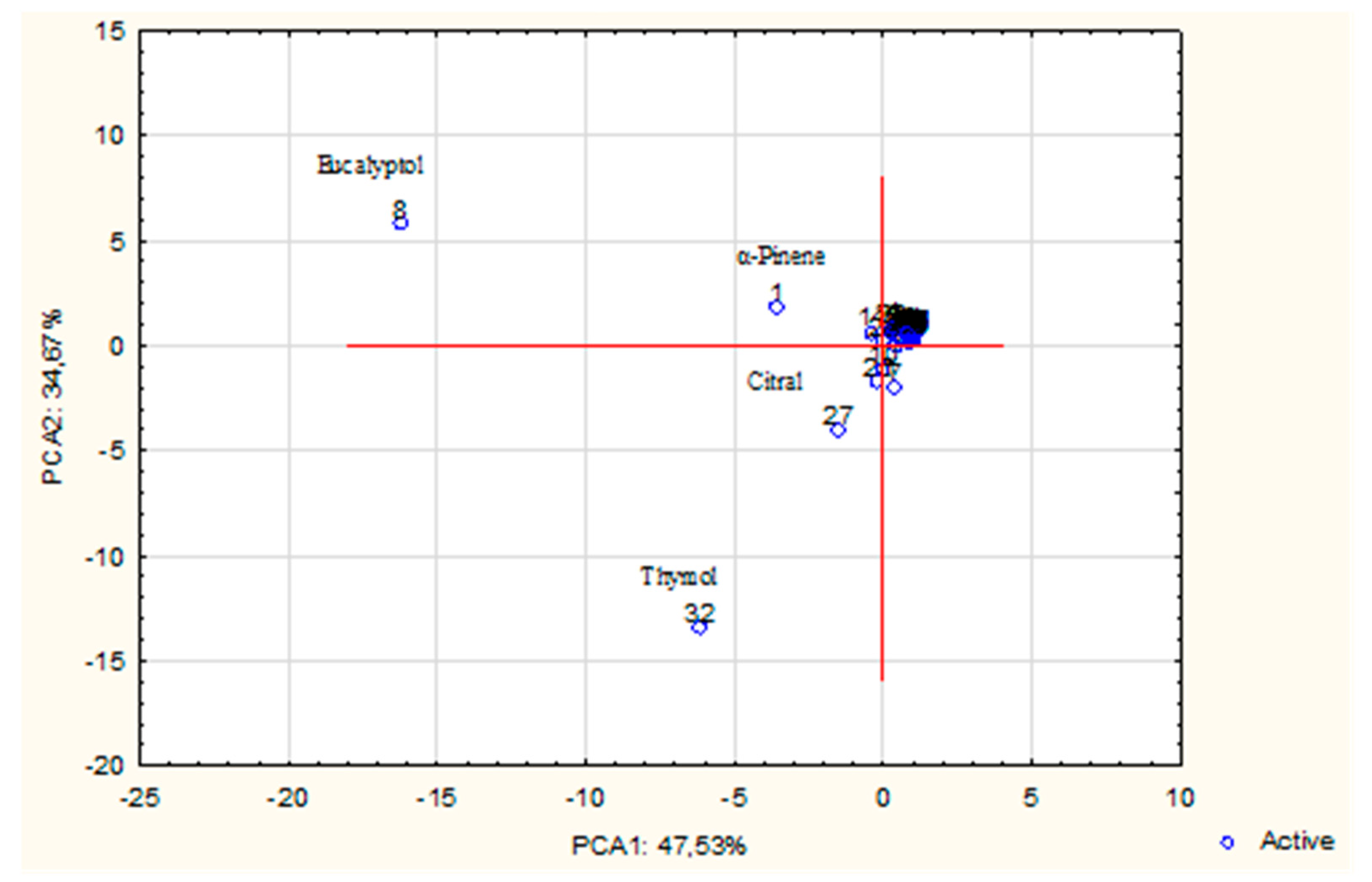
Figure 2.
Hierarchical clustering dendrogram of individual and CPM-EOs of C. citratus (CC), E. camaldulensis (EC), E. lehmannii (EL), S. rosmarinus (SR), and T. vulgaris (TV) based on their chemical composition. Clustering was performed using Euclidean distances and the UPGMA method.
Figure 2.
Hierarchical clustering dendrogram of individual and CPM-EOs of C. citratus (CC), E. camaldulensis (EC), E. lehmannii (EL), S. rosmarinus (SR), and T. vulgaris (TV) based on their chemical composition. Clustering was performed using Euclidean distances and the UPGMA method.
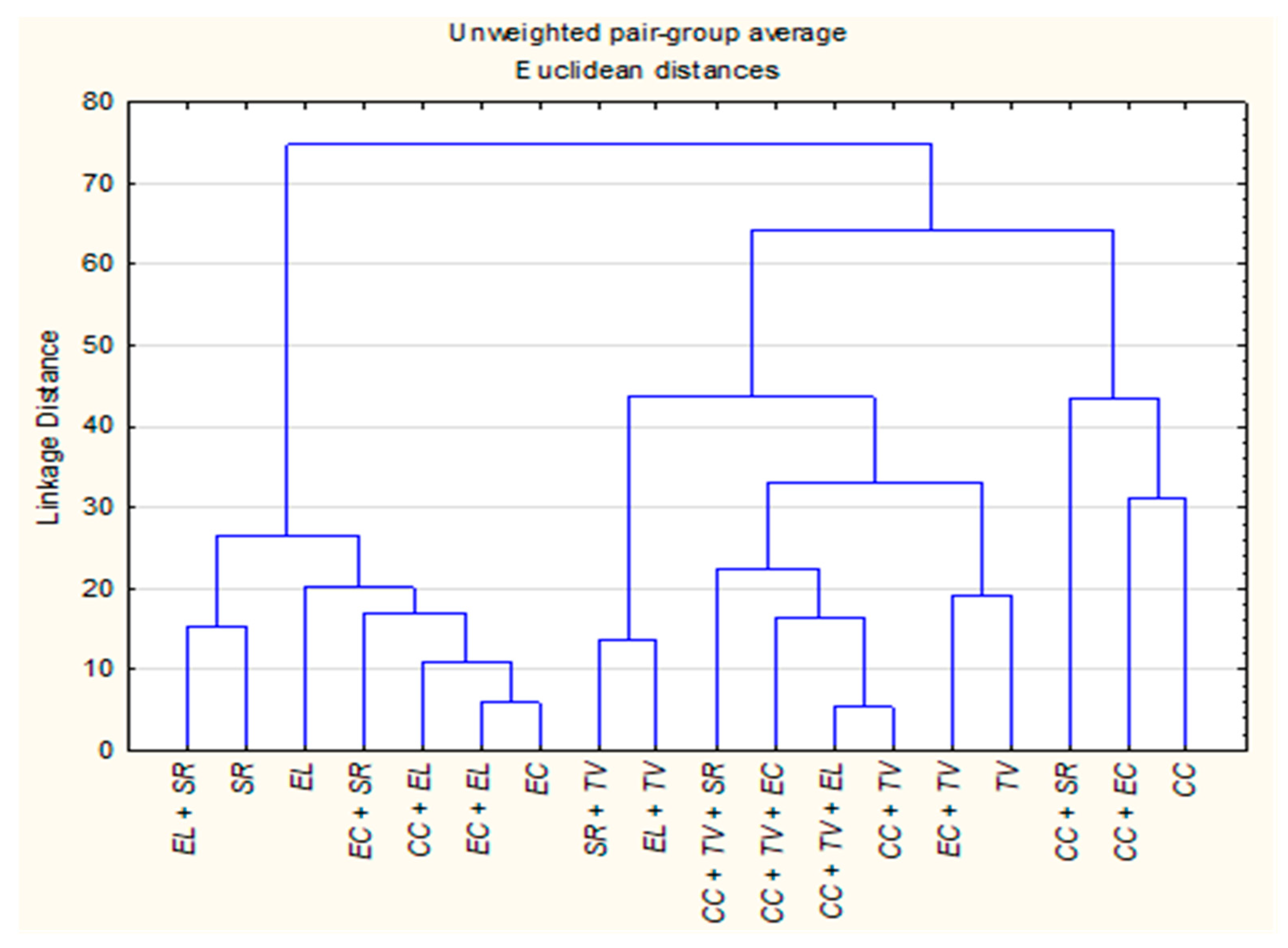
Figure 3.
Cumulative R2Y and Q2 statistics of the two PLS components explaining variance in LC50.
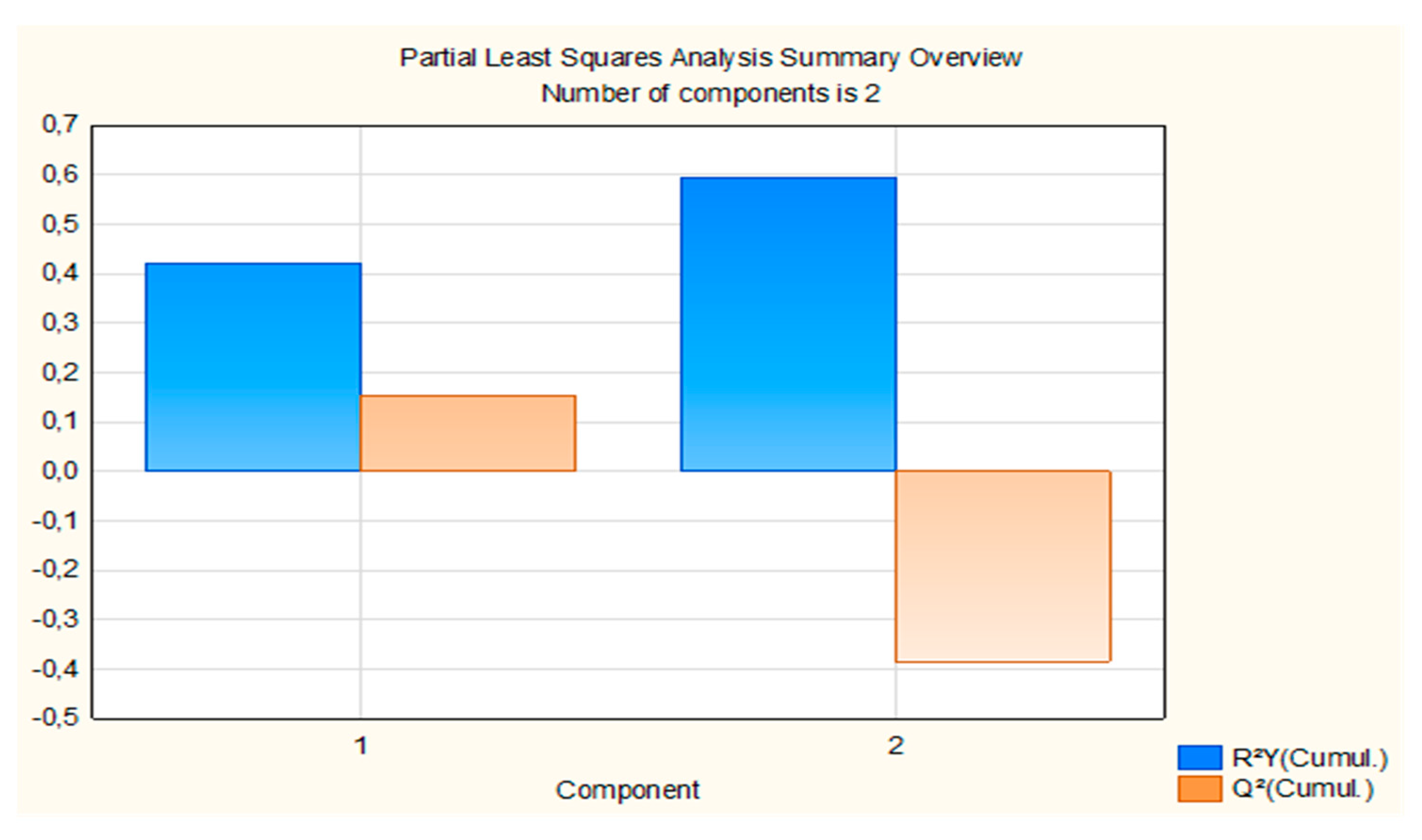
Figure 4.
VIP scores of all identified chemical compounds from PLS regression analysis.
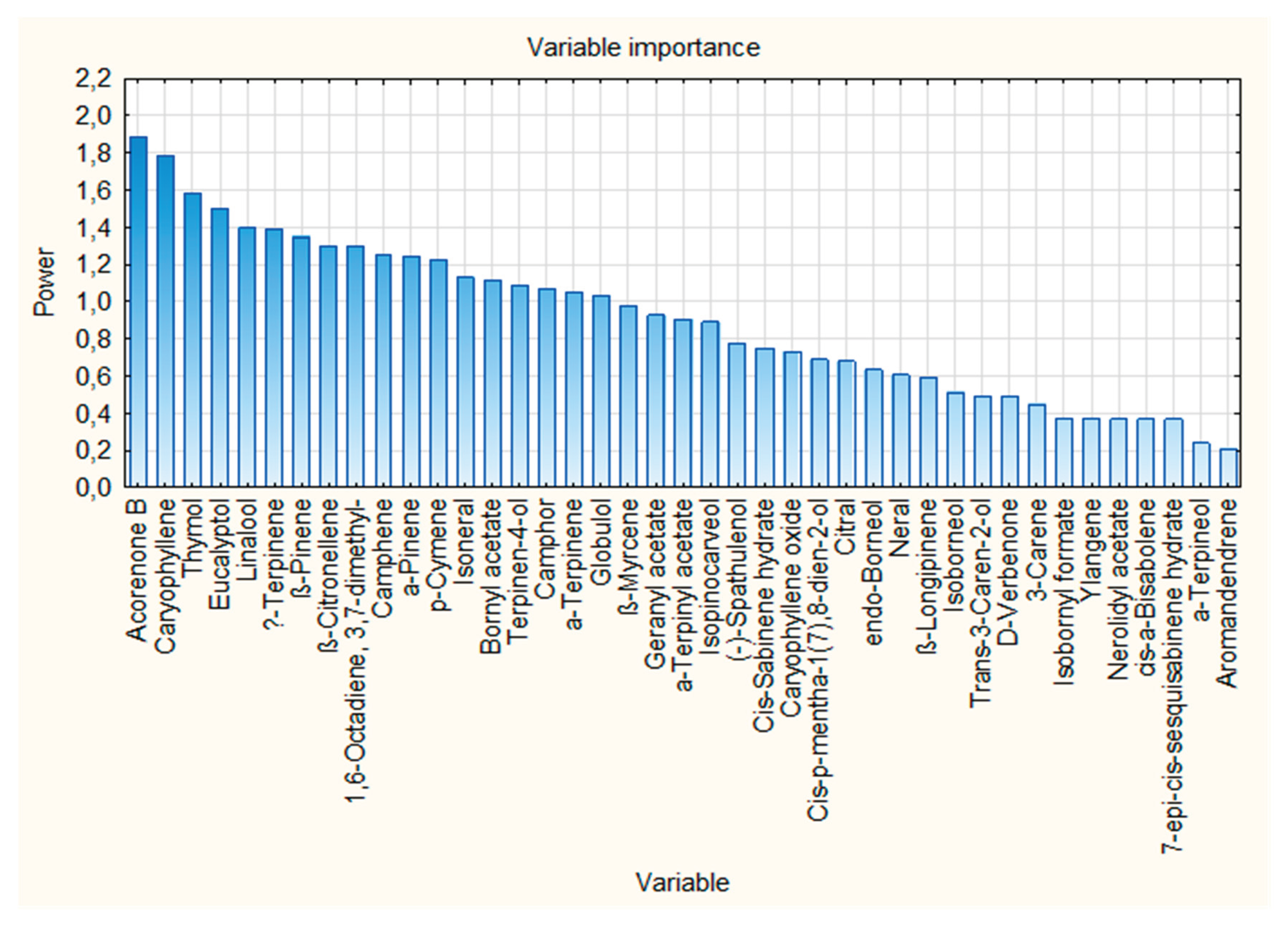

Table 1.
Chemical composition (%) of individual and CPM-EOs of C. citratus (CC), E. camaldulensis (EC), E. lehmannii (EL), S. rosmarinus (SR), and T. vulgaris (TV) identified by GC-MS analysis.
Table 1.
Chemical composition (%) of individual and CPM-EOs of C. citratus (CC), E. camaldulensis (EC), E. lehmannii (EL), S. rosmarinus (SR), and T. vulgaris (TV) identified by GC-MS analysis.
| Yield (%) | CPM-EOs | ||||||||||||||||||||
|---|---|---|---|---|---|---|---|---|---|---|---|---|---|---|---|---|---|---|---|---|---|
| Individual | Binary | Ternary | |||||||||||||||||||
| No | Compounds | RI* | Formula | CC | EC | EL | SR | TV |
CC + EC |
CC + EL |
CC + SR |
CC + TV |
EC + EL |
EC + SR |
EC + TV |
EL + SR |
EL + TV |
SR + TV |
CC + TV + EC |
CC + TV + EL |
CC + TV + SR |
| 1 | α-Pinene | 7.796 | C10H16 | - | 24.38 | 24.18 | 9.06 | 1.11 | 0.8 | 16.9 | 3.5 | 0.66 | 23.39 | 9 | 1.88 | 13.77 | 11.97 | 5.09 | 0.77 | 0.71 | 1.57 |
| 2 | Camphene | 8.241 | C10H16 | - | - | - | 4.85 | - | - | - | 2.28 | - | - | 2.95 | - | 4.54 | - | 3.09 | - | - | 0.82 |
| 3 | β-Pinene | 9.095 | C10H16 | - | 1.21 | - | 6.64 | - | - | - | 2.9 | - | - | 2.78 | - | 2.98 | 0.39 | 3.37 | - | - | 0.98 |
| 4 | β-Myrcene | 9.582 | C10H16 | 9.59 | - | - | 2.39 | 1.25 | 5.91 | - | 2.93 | 2.34 | - | 0.9 | 1.09 | 1.51 | 0.75 | 2.23 | 1.03 | 2.19 | 1.7 |
| 5 | 3-Carene | 10.102 | C10H16 | - | 0.45 | - | - | - | - | - | - | - | - | - | - | - | - | - | - | - | - |
| 6 | α-Terpinene | 10.462 | C10H16 | - | - | - | - | 0.97 | - | - | - | 0.53 | - | - | - | - | - | 0.79 | - | 0.54 | - |
| 7 | p-Cymene | 10.847 | C10H14 | - | - | - | - | 11.01 | 19.14 | - | - | 2.92 | - | - | 20.52 | - | - | - | 16.81 | 3.68 | - |
| 8 | Eucalyptol | 10.856 | C10H18O | - | 66.51 | 56.99 | 46.56 | - | - | 73.62 | 26.13 | - | 71.27 | 64.35 | - | 49.62 | 35.09 | 29.02 | - | - | 10.67 |
| 9 | Trans-3-Caren-2-ol | 11.755 | C10H16O | - | - | - | - | - | 4.07 | - | - | - | - | - | - | - | - | - | - | - | - |
| 10 | γ-Terpinene | 11.825 | C10H16 | - | - | - | - | 7.73 | - | - | - | 3.57 | - | - | 10.11 | - | 7.96 | 6.01 | 3.38 | 3.85 | 4.94 |
| 11 | Cis-Sabinene hydrate | 12.610 | C10H18O | - | - | 12.39 | 1.25 | - | - | - | 0.52 | - | - | - | - | 9.42 | 0.78 | 1.18 | - | - | - |
| 12 | D-Verbenone | 13.115 | C10H14O | - | - | - | - | - | 0.73 | - | - | - | - | - | - | - | - | - | - | - | - |
| 13 | Linalool | 13.642 | C10H18O | - | - | - | - | 2.71 | 0.92 | - | 1.31 | 2.01 | - | - | 1.27 | - | - | - | 0.57 | 1.84 | 1.22 |
| 14 | Camphor | 14.587 | C10H16O | - | - | - | 7.44 | - | - | - | 9.39 | - | - | 4.04 | - | 6.28 | - | 5.99 | - | - | 3.99 |
| 15 | Cis-p-mentha-1(7),8-dien-2-ol | 14.636 | C10H16O | - | - | - | - | - | - | - | - | - | - | - | 0.83 | - | - | - | - | - | - |
| 16 | Isopinocarveol | 15.142 | C10H16O | - | 0.72 | - | - | - | - | - | - | - | - | - | - | - | 1.06 | - | - | - | - |
| 17 | β-Citronellene | 15.245 | C10H18 | 0.91 | - | - | - | - | - | - | - | - | - | - | - | - | - | - | - | - | - |
| 18 | 1,6-Octadiene, 3,7-dimethyl- | 15.693 | C10H18 | 2.8 | - | - | - | - | - | - | - | - | - | - | - | - | - | - | - | - | - |
| 19 | Isoneral | 15.859 | C10H16O | - | - | - | - | - | 2.68 | - | - | 2.45 | - | - | - | - | - | - | - | 2.45 | - |
| 20 | endo-Borneol | 15.972 | C10H18O | - | - | - | 11.35 | - | - | - | - | - | - | - | - | 2.41 | - | 4.93 | - | - | 10.13 |
| 21 | Terpinen-4-ol | 16.045 | C10H18O | - | - | - | - | - | - | - | - | - | - | - | 1.52 | - | - | - | 0.72 | - | - |
| 22 | Isoborneol | 16.084 | C10H18O | - | - | - | - | 3.01 | - | - | 5.02 | - | - | 2.79 | - | - | 1.46 | 2.82 | - | - | - |
| 23 | Isobornyl formate | 16.621 | C11H18O2 | - | - | - | - | - | - | - | 3.23 | - | - | - | - | - | - | - | - | - | - |
| 24 | α-Terpineol | 16.853 | C10H18O | - | - | 2.66 | - | - | 2.57 | 0.59 | - | - | 1.9 | 3.9 | 3.81 | 3.59 | 2.29 | - | 1.49 | - | - |
| 25 | Neral | 17.741 | C10H16O | 29.14 | - | - | - | - | 17.23 | 2.69 | 9.8 | 12.34 | - | - | - | - | - | - | 6.43 | 10.7 | 7.68 |
| 26 | Bornyl acetate | 18.429 | C12H20O2 | - | - | - | 2.12 | - | - | - | - | - | - | 0.88 | - | 0.68 | - | 1.9 | - | ||
| 27 | Citral | 18.699 | C10H16O | 53.11 | - | - | - | - | 33.2 | 5.11 | 21.45 | 24.12 | - | - | - | - | - | - | 16.97 | 20.9 | 15.95 |
| 28 | α-Terpinyl acetate | 20.403 | C12H20O2 | - | 3.56 | 2.41 | - | - | - | 1 | - | - | 1.65 | 1.63 | - | 1.36 | 1.36 | - | - | - | - |
| 29 | Ylangene | 20.838 | C15H24 | - | - | - | - | - | - | - | 0.33 | - | - | - | - | - | - | - | - | - | - |
| 30 | Nerolidyl acetate | 21.165 | C17H28O2 | - | - | - | - | - | - | - | 1.99 | - | - | - | - | - | - | - | - | - | - |
| 31 | Geranyl acetate | 21.213 | C12H20O2 | 4.43 | - | - | - | - | 6.84 | - | - | - | - | - | - | - | - | - | - | - | - |
| 32 | Thymol | 21.69 | C10H14O | - | - | - | - | 70.84 | - | - | - | 45.78 | - | - | 55.69 | - | 35.77 | 33.56 | 50.46 | 49.67 | 37.64 |
| 33 | Caryophyllene | 22.122 | C15H24 | - | - | - | 8.34 | - | - | - | 4.35 | - | - | 2.88 | - | 3.17 | - | - | - | - | - |
| 34 | Aromandendrene | 22.665 | C15H24 | - | - | - | - | - | 1.4 | - | - | - | - | 0.85 | - | - | - | - | - | - | - |
| 35 | cis-α-Bisabolene | 23.041 | C15H24 | - | - | - | - | - | - | - | 1.75 | - | - | - | - | - | - | - | - | - | - |
| 36 | β-Longipinene | 23.121 | C15H24 | - | - | - | - | - | - | - | - | - | - | - | 0.63 | - | - | - | - | - | |
| 37 | 7-epi-cis-sesquisabinene hydrate | 23.631 | C15H26O | - | - | - | - | - | - | - | 0.69 | - | - | - | - | - | - | - | - | - | - |
| 38 | Acorenone B | 24.174 | C15H24O | - | - | - | - | - | - | - | - | 1.76 | - | - | - | - | - | - | - | 1.9 | 1.24 |
| 39 | Caryophyllene oxide | 26.789 | C15H24O | - | - | - | - | 1.36 | - | - | 2.42 | 1.5 | - | - | - | - | 1.1 | - | - | 1.5 | 1.46 |
| 40 | Globulol | 26.989 | C15H26O | - | - | - | - | - | 2.97 | - | - | - | - | - | 3.2 | - | - | - | 1.3 | - | - |
| 41 | (-)-Spathulenol | 27.064 | C15H24O | - | 3.09 | 0.37 | - | - | - | - | - | - | 1.77 | 3.02 | - | - | - | - | - | - | - |
| Monoterpene hydrocarbons % | 13.3 | 26.04 | 24.78 | 22.92 | 22.07 | 25.85 | 16.9 | 11.6 | 10.02 | 23.39 | 15.63 | 33.6 | 22.8 | 21.07 | 20.58 | 21.99 | 10.97 | 10.01 | |||
| Oxygenated monoterpenes % | 86.68 | 70.79 | 74.45 | 68.72 | 76.56 | 68.24 | 83.01 | 76.85 | 86.7 | 74.82 | 77.59 | 63.12 | 73.36 | 77.81 | 79.4 | 76.64 | 85.56 | 87.28 | |||
| Sesquiterpene hydrocarbons % | 0 | 0 | 0 | 8.34 | 0 | 1.4 | 0 | 6.43 | 0 | 0 | 3.73 | 0 | 3.8 | 0 | 0 | 0 | 0 | 0 | |||
| Oxygenated sesquiterpenes % | 0 | 3.09 | 0.37 | 0 | 1.36 | 2.97 | 0 | 5.1 | 3.26 | 1.77 | 3.02 | 3.2 | 0 | 1.1 | 0 | 1.3 | 3.4 | 2.7 | |||
| Total identified % | 99.98 | 99.92 | 99.6 | 99.98 | 99.99 | 98.46 | 99.91 | 99.98 | 99.98 | 99.98 | 99.97 | 99.92 | 99.96 | 99.98 | 99.98 | 99.93 | 99.93 | 99.99 | |||
*: Retention index on the HP-5MS capillary column.
Table 3.
Probit regression results of individual and CPM-EOs against A. fabae (24 h post-treatment).
Table 3.
Probit regression results of individual and CPM-EOs against A. fabae (24 h post-treatment).
| EO Species/Combinations | LC50 (µL mL−1) | Intercept ± SE | Slope ± SE | χ2 | p-value |
|---|---|---|---|---|---|
| C. citratus | 3.24 | 2.044 ± 0.463 | –0.631 ± 0.126 | 25.24 | 0.000001 |
| E. camaldulensis | 2.45 | 0.333 ± 0.229 | –0.136 ± 0.035 | 14.90 | 0.000114 |
| E. lehmannii | 2.90 | 0.580 ± 0.240 | –0.200 ± 0.041 | 24.32 | 0.000001 |
| S. rosmarinus | 4.41 | 1.122 ± 0.257 | –0.133 ± 0.034 | 15.24 | 0.000095 |
| T. vulgaris | 3.71 | 0.837 ± 0.250 | –0.226 ± 0.042 | 29.19 | <0.000001 |
| C. citratus + E. camaldulensis | 1.75 | 1.608 ± 0.468 | –0.917 ± 0.220 | 17.32 | 0.000032 |
| C. citratus + E. lehmannii | 2.35 | 2.307 ± 0.627 | –0.981 ± 0.240 | 16.64 | 0.000045 |
| C. citratus + S. rosmarinus | 2.38 | 1.494 ± 0.389 | –0.628 ± 0.131 | 23.01 | 0.000002 |
| C. citratus + T. vulgaris | 1.75 | 1.608 ± 0.468 | –0.917 ± 0.22 | 17.32 | 0.000032 |
| E. camaldulensis + E. lehmannii | 3.28 | 0.905 ± 0.263 | –0.276 ± 0.050 | 30.88 | <0.000001 |
| E. camaldulensis + S. rosmarinus | 2.87 | 1.243 ± 0.320 | –0.433 ± 0.082 | 28.09 | <0.000001 |
| E. camaldulensis + T. vulgaris | 1.39 | 1.352 ± 0.435 | –0.972 ± 0.242 | 16.12 | 0.000060 |
| E. lehmannii + S. rosmarinus | 2.82 | 0.777 ± 0.260 | –0.276 ± 0.052 | 28.61 | <0.000001 |
| E. lehmannii + T. vulgaris | 1.51 | 1.430 ± 0.443 | –0.945 ± 0.232 | 16.54 | 0.000048 |
| S. rosmarinus + T. vulgaris | 1.63 | 1.515 ± 0.454 | –0.927 ± 0.225 | 16.97 | 0.000038 |
| C. citratus + T. vulgaris + E. camaldulensis | - | - | - | - | - |
| C. citratus + T. vulgaris + E. lehmannii | - | - | - | - | - |
| C. citratus + T. vulgaris + S. rosmarinus | - | - | - | - | - |
- :Ternary combinations were not subjected to Probit regression analysis, as they caused 100% mortality at the lowest concentration tested (2 µL mL-1), making it impossible to fit a dose–response model.
Table 4.
Lethal concentration value (LC50), co-toxicity coefficient (CTC) and synergistic factors (SF) of CPM-EOs against A. fabae (24 h post-treatment).
Table 4.
Lethal concentration value (LC50), co-toxicity coefficient (CTC) and synergistic factors (SF) of CPM-EOs against A. fabae (24 h post-treatment).
| EO Species/Combination | LC50 (µL mL−1) | Expected LC50 (µL mL−1) | CTC | SF vs. A | SF vs. B | Effect Interpretation |
|---|---|---|---|---|---|---|
| C. citratus + E. camaldulensis | 1.75 | 2.85 | 162.57 | 1.85 | 1.40 | Strong synergism |
| C. citratus + E. lehmannii | 2.35 | 3.07 | 130.64 | 1.38 | 1.23 | Strong synergism |
| C. citratus + S. rosmarinus | 2.38 | 3.83 | 160.71 | 1.36 | 1.85 | Strong synergism |
| C. citratus + T. vulgaris | 1.75 | 3.48 | 198.57 | 1.85 | 2.12 | Strong synergism |
| E. camaldulensis + E. lehmannii | 3.28 | 2.68 | 81.58 | 0.75 | 0.88 | Additive/Slight antagonism |
| E. camaldulensis + S. rosmarinus | 2.87 | 3.43 | 119.52 | 0.85 | 1.54 | Additive to moderate synergism |
| E. camaldulensis + T. vulgaris | 1.39 | 3.08 | 221.58 | 1.76 | 2.67 | Strong synergism |
| E. lehmannii + S. rosmarinus | 2.82 | 3.66 | 129.47 | 1.03 | 1.56 | Strong synergism |
| E. lehmannii + T. vulgaris | 1.51 | 3.31 | 218.81 | 1.92 | 2.46 | Strong synergism |
| S. rosmarinus + T. vulgaris | 1.63 | 4.06 | 249.08 | 2.71 | 2.27 | Strong synergism |
| C. citratus + T. vulgaris + E. camaldulensis | - | - | - | - | - | Strong synergism* |
| C. citratus + T. vulgaris + E. lehmannii | - | - | - | - | - | Strong synergism* |
| C. citratus + T. vulgaris + S. rosmarinus | - | - | - | - | - | Strong synergism* |
Interaction types were interpreted using both the co-toxicity coefficient (CTC) and the synergistic factor (SF). A CTC value > 120 indicates synergism, 80–120 indicates an additive effect, and < 80 indicates antagonism. Similarly, an SF > 1 suggests synergism, SF = 1 indicates additivity, and SF < 1 suggests antagonism. *: The inability to estimate LC50 values due to 100% mortality at minimal doses (2 µL mL−1), indicating strong synergistic effects.
Table 5.
Pearson correlation coefficients (r) and p-values between EOs compounds and LC50 values.
| Chemical Compound | r | p-value | Signifiance |
|---|---|---|---|
| α-Pinene | 0.3942 | 0.105 | NS |
| Camphene | 0.3829 | 0.117 | NS |
| β-Pinene | 0.4248 | 0.079 | NS |
| β-Myrcene | 0.0837 | 0.741 | NS |
| 3-Carene | 0.0514 | 0.839 | NS |
| α-Terpinene | -0.0325 | 0.898 | NS |
| p-Cymene | -0.3312 | 0.179 | NS |
| Eucalyptol | 0.4664 | 0.051 | NS |
| Trans-3-Caren-2-ol | -0.1043 | 0.680 | NS |
| γ-Terpinene | -0.4387 | 0.069 | NS |
| Cis-Sabinene hydrate | 0.2340 | 0.350 | NS |
| D-Verbenone | -0.1043 | 0.680 | NS |
| Linalool | -0.2652 | 0.287 | NS |
| Camphor | 0.2265 | 0.366 | NS |
| Cis-p-mentha-1(7),8-dien-2-ol | -0.1845 | 0.464 | NS |
| Isopinocarveol | -0.1045 | 0.680 | NS |
| β-Citronellene | 0.2272 | 0.364 | NS |
| 1,6-Octadiene, 3,7-dimethyl- | 0.2272 | 0.364 | NS |
| Isoneral | -0.3578 | 0.145 | NS |
| endo-Borneol | 0.0884 | 0.727 | NS |
| Terpinen-4-ol | -0.3383 | 0.170 | NS |
| Isoborneol | 0.1521 | 0.547 | NS |
| Isobornyl formate | 0.0359 | 0.888 | NS |
| α-Terpineol | 0.0019 | 0.994 | NS |
| Neral | -0.1616 | 0.522 | NS |
| Bornyl acetate | 0.3534 | 0.150 | NS |
| Citral | -0.2101 | 0.403 | NS |
| α-Terpinyl acetate | 0.2596 | 0.298 | NS |
| Ylangene | 0.0359 | 0.888 | NS |
| Nerolidyl acetate | 0.0359 | 0.888 | NS |
| Geranyl acetate | 0.0370 | 0.884 | NS |
| Thymol | -0.5018 | 0.034 | * |
| Caryophyllene | 0.5267 | 0.025 | * |
| Aromandendrene | -0.0144 | 0.955 | NS |
| cis-α-Bisabolene | 0.0359 | 0.888 | NS |
| β-Longipinene | 0.1338 | 0.597 | NS |
| 7-epi-cis-Sesquisabinene hydrate | 0.0359 | 0.888 | NS |
| Acorenone B | -0.5119 | 0.030 | * |
| Caryophyllene oxide | -0.2312 | 0.356 | NS |
| Globulol | -0.3233 | 0.191 | NS |
| (-)-Spathulenol | 0.2442 | 0.329 | NS |
* Indicates statistically significant correlation (p < 0.05); NS = not significant.
Table 6.
Compounds with VIP scores greater than 1 in the PLS regression analysis.
| Rank | Variable number | Chemical compound | VIP score |
|---|---|---|---|
| 1 | 38 | Acorenone B | 1.886 |
| 2 | 33 | Caryophyllene | 1.785 |
| 3 | 32 | Thymol | 1.580 |
| 4 | 8 | Eucalyptol | 1.498 |
| 5 | 13 | Linalool | 1.394 |
| 6 | 10 | γ-Terpinene | 1.388 |
| 7 | 3 | ß-Pinene | 1.345 |
| 9 | 17 | ß-Citronellene | 1.297 |
| 9 | 18 | 1,6-Octadiene, 3,7-dimethyl- | 1.297 |
| 10 | 2 | Camphene | 1.249 |
| 11 | 1 | α-Pinene | 1.243 |
| 12 | 7 | p-Cymene | 1.224 |
| 13 | 19 | Isoneral | 1.127 |
| 14 | 26 | Bornyl acetate | 1.114 |
| 15 | 21 | Terpinen-4-ol | 1.085 |
| 16 | 14 | Camphor | 1.069 |
| 17 | 6 | α-Terpinene | 1.045 |
| 18 | 40 | Globulol | 1.028 |
Table 7.
Plant species, used part, period and harvesting sites.
| Species | Used part | Harvesting period | Location |
|---|---|---|---|
| C. citratus | Leaves | March-April/2025 |
Kairouan |
| E. camaldulensis | Leaves | Zarniza arboreta | |
| E. lehmannii | Leaves | Babbouche, Ain drahem | |
| S. rosmarinus | Aerial parts | Tborsok, Beja |
|
| T. vulgaris | Aerial parts |
Disclaimer/Publisher’s Note: The statements, opinions and data contained in all publications are solely those of the individual author(s) and contributor(s) and not of MDPI and/or the editor(s). MDPI and/or the editor(s) disclaim responsibility for any injury to people or property resulting from any ideas, methods, instructions or products referred to in the content. |
© 2025 by the authors. Licensee MDPI, Basel, Switzerland. This article is an open access article distributed under the terms and conditions of the Creative Commons Attribution (CC BY) license (http://creativecommons.org/licenses/by/4.0/).
Copyright: This open access article is published under a Creative Commons CC BY 4.0 license, which permit the free download, distribution, and reuse, provided that the author and preprint are cited in any reuse.


