

Submitted:
19 November 2025
Posted:
20 November 2025
You are already at the latest version
Abstract
Numerous studies have been conducted to reveal the diversity of mammals in Türkiye, primarily including biodiversity projects carried out nationwide by the Ministry of Agriculture and Forestry. Understanding the geographical distribution of species is crucial for biodiversity conservation, and the mammal diversity in each studied region will play a significant role. The data from this study were compared with literature data from various fields, especially regarding geographical and climatic differences; statistical analyses were conducted on species richness, Shannon entropy, and the Jaccard index. Thirty-six species were evaluated, with two new records (Dryomys nitedula and Felis silvestris) from Ağrı province. Total differences in species composition (βjac) between Ağrı and other regions ranged between 0,22-0,62 for medium and large-sized mammals, 0.62–0.92 for small mammals, and 0.53–0.80 for all mammals. The findings suggest that the distribution of mammal species in Ağrı is highly similar to that of Eastern Anatolian provinces such as Van and Bingöl. Conversely, when compared with studies from the Mediterranean and Aegean regions, significant differences in species diversity and composition are evident. This study aims to contribute to regional biodiversity knowledge and global conservation efforts by filling existing data gaps.
Keywords:
anatolian diagonal
; conservation
; species richness
; Shannon entropy
; Jaccard index
1. Introduction
Türkiye's unique geographical position at the intersection of Asia, Europe, and Africa, combined with its diverse ecosystems, renders it one of the most biologically rich regions in the Palearctic [1,2]. Mammals play a critical role in this biodiversity, serving as indicators of ecosystem health and as focal points for conservation initiatives [3,4]. Nevertheless, increasing anthropogenic pressures, including intensive hunting, habitat loss, and fragmentation, pose significant threats to mammal populations [5,6,7,8].
The baseline knowledge of Türkiye’s mammalian fauna was shaped by pioneering studies [9,10,11,12,13,14]. Later research improved understanding of species richness and conservation, but notable gaps persist, especially among understudied groups like Chiroptera. Türkiye hosts about 177 wild mammal species [15]. Since the mid-2010s, mammalian diversity research has expanded rapidly [16,17,18,19,20,21,22], yet more regional-scale studies are needed for a complete understanding. Within this context, Ağrı Province holds special biogeographical significance. Positioned along the Anatolian Diagonal, it serves as a transition zone where different faunal elements converge: Siberian and cold steppe taxa enter through the Erzurum–Kars Plateau, while desert-adapted species disperse via the Iğdır–Aralık lowlands and the Van–Hakkari uplands [9,11,14]. This convergence fosters a diverse mammalian community, establishing Ağrı as a priority region for biodiversity assessment.
Since most wild mammals are found across large areas across multiple countries, the IUCN Red Lists, which provide information on the conservation status of these species, generally require collaboration among scientists and conservation experts from many countries. In addition, the geographical distribution of species is a key question for biodiversity conservation, since it underlies the context in which conservation actions are planned or implemented [23,24]. Beta diversity is a key concept in ecosystem management and biodiversity conservation. Many scientists use beta diversity in ecological research and conservation plans [25,26,27,28,29]. Monitoring data can inform the status of mammal β-diversity at the site and species levels, and environmental uniqueness metrics can guide conservation strategies in protected areas [30].
Therefore, the mammal diversity in each region studied will significantly contribute to this. This study aims to document and assess the diversity and distribution of wild mammal species in Ağrı Province, focusing on the impact of its unique geographic location and environmental conditions, and to fill the gaps in local contributions to Beta diversity by comparing it with terrestrial mammal communities identified in studies carried out in various ecological regions of Türkiye. The study seeks to enhance understanding of regional biodiversity and support global conservation efforts by addressing existing data gaps.
2. Materials and Methods
2.1. Study Area
This study was carried out in Ağrı, covering an area of 11,376 km² between 39.05–40.07° N and 42.20–44.30° E, at an elevation of 1,640 meters, during 2014 and 2015. Its landforms primarily consist of mountains (46%), followed by plains (29%), plateaus (18%), and uplands (7%). Among the entry points for animals into Anatolia and east of the Anatolian diagonal, this region experiences one of the most severe continental climates in Türkiye, with long, harsh winters and hot summers, which significantly affect species distribution and survival. According to the EUNIS habitat classification, Ağrı Province mainly consists of grasslands and cultivated areas. Forested regions are almost non-existent (Figure 1).
2.2. Methods
The study covers 251 localities within 92 plots in Ağrı province, mapped at a 1/25,000 scale. Fieldwork was carried out on these plots over 73 days across various seasons between 2014 and 2015 (Figure 1). Wild mammal species were identified using direct and indirect methods. Direct observations used tools such as binoculars, video cameras, and DSLR cameras, while indirect methods involved recording signs such as footprints, feces, peeling bark, food remains, and scratching marks. Observations were conducted at sunrise and sunset to include a variety of habitats—mountains, forests, moorlands, wetlands, dunes, agricultural areas, and settlements, including the city, districts, and village centres.
2.2. Data Analyses
Using data on mammals identified in the Ağrı region from our research, we compared previously recorded wild mammal data from various sources. We updated them in accordance with the latest taxonomic revisions. The conservation statuses of the species were obtained from the latest 2025 data from the CITES, BERN, IUCN, and MAKK lists. Additionally, in the statistical analyses, wild mammals were examined in two groups: medium- and large-sized mammals and small-sized mammals. These distinctions were based on the study by Agebo and Tekalign [7], which classified species according to body weight. Species richness was determined by the total number of recorded species. Relative abundance was calculated as the ratio of the number of individuals per species to the total number of observed individuals.
We compared species composition across all studied areas for the region's wild mammals, including medium— and large-sized mammals and all species. The total species diversity was analysed using the Jaccard index (βjac) and its two components, species turnover (βjtu) and nestedness (βjne), following the method of Baselga and Orme [31].
In the formula used here, “a” represents the number of shared species between two sites, “b” is the number of species unique to the less diverse region, and “c” is the number of species unique to the more diverse region. Additionally, mammal diversity was measured using the Shannon-Wiener diversity index (H′) and the Simpson diversity index (1-D) calculated with the BİÇEP software. To evaluate relative variability in species richness across sampling areas, the coefficient of variation (CV) and 95% confidence intervals (CIs) were calculated for diversity indices and abundance estimates to assess the statistical reliability of the observed patterns.
3. Results
This initial study on the diversity of wild mammals in Ağrı Province identified 36 species across 251 localities in 92 parcels (Table 1). Of these 36 species, which belong to six orders and nine families, 16 are medium and large-sized mammals (Canis lupus, Canis aureus, Vulpes vulpes, Martes martes, Mustela nivalis, Felis silvestris, Lynx lynx, Lutra lutra, Meles meles, Ursus arctos, Sus scrofa, Capra aegagrus, Sciurus anomalus, Spermophilus xanthophrymnus, Lepus europaeus, and Erinaceus concolor), mostly identified through direct observation methods. The remaining 20 small mammals are mainly identified through less direct methods. In this survey, two species (Dryomys nitedula and F. silvestris) not included in the previous preliminary report have been recorded as new findings.
According to the IUCN, Capra aegagrus and Ursus arctos are classified as Vulnerable (VU), while Lutra lutra, Lynx lynx, Spermophilus xanthophrymnus, Scarturus williamsi, Mesocricetus brandti, Rhinolophus hipposideros, Rhinolophus ferrumequinum, and Myotis blythii are listed as Near Threatened (NT). The remaining 26 species identified in the study are listed as Least Concern (LC) (Table 1).
Under the Bern Convention, 11 species are listed in Appendix II and 8 in Appendix III. Similarly, according to CITES, one species (Lutra lutra) is listed in Appendix I, and four are listed in Appendix II. When evaluated nationally, the mammal species identified in the study area are considered Near Threatened (NT), including the brown bear (Ursus arctos) and wolf (Canis lupus). Additionally, according to the Central Hunting Commission Decisions published annually in the Official Gazette by the Ministry of Agriculture and Forestry, four species are listed in Appendix I, and two in Appendix II (Table 1).
Surveys at these localities revealed that rodents (44.73%), an essential link in the food pyramid represented by sixteen species from six families, constituted the most diverse mammalian order in the study area. Secondly, species belonging to the order Carnivora (28.95%) that feed on rodents were also detected. The study identified five bat species. Pipistrellus pipistrellus was recorded from 13 different localities, followed by Myotis blythii, with records from 7 different localities. However, among all mammals, Vulpes vulpes has the highest number of recorded sites, with 84 (16.73%), followed by Nannospalax xanthodon, with 67 (13.35%). However, in terms of individual counts, the wild boar Sus scrofa ranks first with 237 individuals (23.42%), followed by Capra aegagrus with 148 individuals (14.62%) and the V. vulpes with 92 individuals (9.09%) (Table 1). For the new registration in the study area, Felis silvestris has been recorded with one individual from two localities, and Dryomys nitedula with only one individual from a single locality. Some photographs of wild mammals displayed during the study are shown in Figure 2.
4. Discussion
The data from this study were compared with various literature sources [6,16,21,22,32,33,34,35] from different regions of Türkiye, particularly concerning geographical and climatic differences (Table 2). Ninety species were evaluated, including 36 with two new records from Ağrı province (Table S1). Of the 90 species, 63 (70.0%) were classified as least concern, 4 (4.44%) as data deficient, 6 (6.67%) as vulnerable, 15 (16.67%) as near threatened, and 1 (1.11%) as endangered (Table S1).
The most frequently identified species in the dataset across the nine key areas are Mustela nivalis, Sciurus anomalus, Sus scrofa, Lepus europaeus, Erinaceus concolor, Ursus arctos, Canis lupus, Vulpes vulpes, Lutra lutra, Meles meles, Mus musculus, and Pipistrellus pipistrellus. The dominance of these species is consistent and has been reported in previous studies [17,36,37,38,39,40,41] in Anatolia, reflecting their high adaptability to a wide range of habitats. Their presence across all study areas highlights their ecological plasticity and potential role as keystone mammals.
This study's findings show that the 36 mammal species identified in Ağrı Province are largely consistent, particularly regarding medium and large-sized mammals, aligning with results from mammal fauna studies in other regions documented in the literature. Statistically, Bursa exhibited the highest species richness with 57 species, followed by Yozgat with 56. Although Ağrı has fewer species than Sinop, Kazdağı, Bursa, Yozgat, and Muğla, it surpasses Bingöl, Van, and Batman in species richness (Table 2). Based on the data from this study, the wild mammals identified in Ağrı represent 21.82% of the 165 terrestrial mammal species found across Türkiye [15], accounting for 40% of the 40 medium- and large-sized terrestrial mammals in the region.
Given that the notable variations in species richness (ranging from 25 to 57) are primarily due to the small mammal number, mammals were grouped into three categories for statistical comparison: A) medium and large-sized mammals, B) small mammals, and C) all mammals.
Based on the BİÇEP software results, Bursa (H′=4.043) and Yozgat (H′=4.025) provinces have the highest Shannon Wiener indices on the list. The lowest index is in Van (H′=3.219) province (Table 2). Compared to Ağrı province, which has an H′ value of 3.586, Bursa and Yozgat exhibit higher diversity regarding species richness and species distribution across areas. Meanwhile, Bingöl, Van, and Batman have lower diversity than Ağrı. However, the high values across all nine regions and the minor numerical differences between them suggest that the areas are quite rich and balanced, and further analysis is necessary to determine the statistical significance of these slight differences.
Total differences in species composition (βjac) between Ağrı and the other eight regions ranged between 0,22-0,62 for medium and large-sized mammals (Table 3A; Figure 3A), 0.62–0.92 for small mammals (Table 3B; Figure 3B), and 0.53–0.80 for all mammals (Table 3C; Figure 2C). Ağrı province's mammal species in the study area are most similar to those in the Van region, with a 78% overlap, and least similar to the Kazdağı region, with only 38% similarity (Table 3 and Figure 3).
According to species differences, the most significant variation in the composition of medium- and large-sized mammal species was observed between the Kazdağı and Sinop provinces (βjac = 0.75; Table 3A). For small and all mammal species, the most notable differences occurred between Van and Bursa (βjac = 0.98 and βjac = 0.92, respectively; Table 3B, C). The most minor differences in medium and large-sized mammal composition were found between Batman and Muğla (βjac = 0.19 in all cases; Table 3A). For small mammals, the most minor differences were between Bursa and Yozgat (βjac = 0.62; Table 3B). Regarding all mammal species, the smallest differences were between Bingöl and Batman (βjac = 0.42; Table 3C)
The findings indicate that the distribution of mammal species in Ağrı shows a high degree of similarity with that of Eastern Anatolian provinces such as Van and Bingöl. This high similarity is due to the region's similar ecological and biogeographical characteristics. Species such as Canis lupus, Vulpes vulpes, Martes foina, Meles meles, Lutra lutra, and Ursus arctos have been widely reported both in this study and in the literature in other provinces of Eastern Anatolia [21,22,38]. This also demonstrates that the region's mammal fauna responds to similar environmental conditions.
On the other hand, when compared with studies conducted in the Mediterranean and Aegean Regions [26,42], significant differences in species diversity and composition have been observed. Beta diversity is lower in the eastern regions of the Anatolian Diagonal than in its western regions. Notably, higher beta diversity was found in areas farther from Ağrı, such as Kazdağı and Bursa. Most species identified in Ağrı are adapted to cold climates and mountainous areas. In contrast, species adapted to hot, arid climates are prominent in the Mediterranean and Aegean regions. Additionally, the absence of some species in Ağrı indicates that the regional distribution is directly related to climate and habitat conditions.
5. Conclusions
The wild mammals in Ağrı Province, which accounts for 0.8% of Türkiye's land area, comprise approximately 21.82% of our country's 165 terrestrial mammal species. This shows us how significant the region's mammal diversity is. Defining and assessing a region's mammal fauna will also bring efforts to protect the mammal species. Ağrı Province, located in the Anatolian Diagonal, hosts unique habitats for wild animals; therefore, understanding the mammal species of this region and comparing them with those of areas with similar and different ecological features will facilitate the development of conservation strategies for indicator and target species. In conclusion, public awareness will increase, and an ecological approach focused on wildlife will develop. In conclusion, the statistical data presented in this study document current mammalian diversity across nine regions and provide a basis for understanding ecological dynamics and conservation priorities. The findings corroborate earlier research highlighting Anatolia's biodiversity significance while drawing attention to the vulnerability of rare mammals and the dominance of human-adapted species. Long-term monitoring and habitat-specific management strategies will safeguard common and rare taxa in these landscapes.
Supplementary Materials
The following supporting information can be downloaded at: https://www.mdpi.com/article/doi/s1. Table S1: The wild mammals of Ağrı Province and the eight comparison areas, along with their national and global conservation statuses and related statistical analyses. N - Total number of areas, O - Number of occurrence, RF - Frequency of occurrence, L - Large-sized mammals, M - Medium-sized mammals, S - Small-sized mammals, IUCN - International Union for Conservation of Nature, BERN - Biological and Industry Reporting Network, CITES - Convention on International Trade in Endangered Species of Wild Fauna and Flora, MAKK - Central Hunting Commission Decisions, DD - Data Deficient, LC - Least Concern, NT - Near Threatened, VU - Vulnerable, SD - Standard Deviation, SE - Standard Error, CI - Confidence Intervals, CV - Coefficient of Variation, Bingöl (Karatay & Ulutürk, 2026), Van (Ulutürk & Yürümez, 2022), Batman (UBENIS, 2018), Bursa (Gözütok, 2017), Yozgat (Yorulmaz & Arslan, 2020), Muğla (İlemin, 2020), Kazdağı (Yiğit et al., 2005), and Sinop (Çam & Ölmez, 2015).
Funding
This research was funded by the General Directorate of Nature Conservation and National Parks of the Ministry of Agriculture and Forestry through the project titled 'Inventory and Monitoring of the Terrestrial and Freshwater Ecosystems Biodiversity in Ağrı Province.
Data Availability Statement
All data generated or analysed during this study are included in this published article (and its Supplementary Information Files).
Acknowledgments
I want to thank the employees of the Provincial Directorate of Nature Conservation and National Parks of Ağrı Province for their support during the field studies.
Conflicts of Interest
The author declares no conflicts of interest.
Abbreviations
The following abbreviations are used in this manuscript:
| IUCN | International Union for Conservation of Nature and Natural Resources |
| BERN | Bern Convention |
| CITES | Convention on the International Trade in Endangered Species of Wild Flora and Fauna |
| MAKK | Central Board of Supervision Decision |
| DSLR | Digital Single Lens Reflex Camera |
| EUNIS | European Nature Information System |
| BİÇEP | Biodiversity Component Calculation Software |
| UBENIS | National Biodiversity Inventory and Monitoring Project |
References
- Eken, G.; Bozdoğan, M.; İsfendiyaroğlu, S.; Kılıç, D.T.; Lise, Y. Türkiye’nin Önemli Doğa Alanları. Doğa Derneği, Ankara, 2006; pp. 1–640, ISBN: 9789759890131.
- Ambarlı, D.; Zeydanlı, U.S.; Balkız, Ö.; Aslan, S.; Karaçetin, E.; Sözen, M.; Ilgaz, Ç.; Ergen, A.G.; Lise, Y.; Caglayan, S.D.; Welch, H.J.; Welch, G.; Turak, A.S.; Bilgin, C.C.; Özkil, A.; Vural, M. An overview of biodiversity and conservation status of steppes of the Anatolian Biogeographical Region. Biodivers. Conserv. 2016, 1–95. [Google Scholar] [CrossRef]
- Gebo, B.; Takele, S.; Shibru, S. Perception and attitude of the local people toward carnivore population and conservation in the Faragosa-Fura landscape of the Southern Rift Valley, Ethiopia. Conserv. Sci. Pract. 2022, 4, 1–15. [Google Scholar] [CrossRef]
- Plön, S.; Andra, K.; Auditore, L.; Gegout, C.; Hale, P.J.; Hampe, O.; Ramilo-Henry, M.; Burkhardt-Holm, P.; Jaigirdar, A.M.; Klein, L.; Maewashe, M.K.; Müssig, J.; Ramsarup, N.; Roussouw, N.; Sabin, R.; Shongwe, T.C.; Tuddenham, P. Marine mammals as indicators of Anthropocene Ocean Health. NPJ Biodivers. 2024, 3, 1–24. [Google Scholar] [CrossRef] [PubMed]
- Ambarlı, H.; Ertürk, A.; and Soyumert, A. Current status, distribution, and conservation of brown bear (Ursidae) and wild canids (gray wolf, golden jackal, and red fox; Canidae) in Turkey. Turk J Zool. 2016, 40, 944–956. [Google Scholar] [CrossRef]
- İlemin, Y. Contributions to the Mammalian Fauna of Muğla Province. bitlisfen, 2020, 9, 1153–1165. [Google Scholar] [CrossRef]
- Agebo, A.; Tekalign, W. Terrestrial medium and large-sized mammalian species diversity in Michole Community Protected Forest, southern Ethiopia. BMC Zool. 2022, 7, 1–10. [Google Scholar] [CrossRef]
- Uzun, G.; Evcin, Ö. Determination of Dispersal Corridors Used by Large Mammals Between Close Habitats. Diversity 2025, 17, 1–165. [Google Scholar] [CrossRef]
- Demirsoy, A. Yaşamın Temel Kuralları, Omurgalılar / Amniyota (Sürgünler, Kuşlar ve Memeliler), 1st ed.; Meteksan A.Ş.: Ankara, 1992; Volume III, pp. 1–942. ISBN 975-7746-08-8. [Google Scholar]
- Kryštufek, B.; Vohralík, V. Mammals of Turkey and Cyprus: Introduction, Checklist, Insectivora. Knjižnica Annales Majora: Koper, Republic of Slovenia, 2001; ISBN 961-6033-36-0. [Google Scholar]
- Kryštufek, B.; Vohralík, V. Mammals of Turkey and Cyprus. Rodentia I: Sciuridae, Dipodidae, Gliridae, Arvicolinae. Koper: Zgodovinsko društvo za južno Primorsko, 2005; ISBN 961-6033-60-3. [Google Scholar]
- Kryštufek, B.; Vohralík, V. Mammals of Turkey and Cyprus. Rodentia II: Cricetinae, Muridae, Spalacidae, Calomyscidae, Capromyidae, Hystricidae, Castoridae. 961-6033-60-3: Zgodovinsko društvo za južno Primorsko, 2009; ISBN 978-961-6732-11-6. [Google Scholar]
- Yiğit, N. , Çolak, E., Sözen, M., & Karataş, A. Rodents of Türkiye. Meteksan A.Ş. 1st ed.; Demirsoy, A. Eds.; Meteksan A.Ş., Ankara, 2006, pp. 1–154, ISBN: 9944-5560-0-9.
- Kuru, M. Omurgalı Hayvanlar. 11st ed.; Palme Yayıncılık, Ankara, 2006, pp.1–841, ISBN 9789757477525.
- Sözen, M.; Çolak, F. An updated checklist of the mammals of Türkiye. Turk J Zool. 2025, 49, 252–280. [Google Scholar] [CrossRef]
- Gözütok, S. Mammalian Fauna of Bursa Province and Conservation Status of Species (Classis: Mammalia). Ijaws, 2017, 3, 120–130. [Google Scholar] [CrossRef]
- Çoğal, M.; Sözen, M. Camera trapping of medium and large-sized mammals in western Black Sea deciduous forests in Turkey. Turk J Zool. 2020, 44, 181–188. [Google Scholar] [CrossRef]
- Karataş, A.; Bulut, Ş.; Akbaba, B. Camera trap records confirm the survival of the Leopard (Panthera pardus L., 1758) in eastern Turkey (Mammalia: Felidae). Zool. Middle East 2021, 67, 198–205. [Google Scholar] [CrossRef]
- Karataş, A.; Filiz, H.; Yavuz, K.; Özeren, S.C.; Tok, C.V. The Vertebrate Biodiversity of Turkey. In Biodiversity, Conservation and Sustainability in Asia, Öztürk, M.; Altay, V.; Efe, R. Eds.; Springer; 2021, pp. 175–274. [CrossRef]
- Seyfi, E.; Bulut, Ş.; Karataş, A. Türkiye’nin Tehlike Altındaki Memeli Türleri. Doğanın Sesi, 2021, 7, 54–72. [Google Scholar]
- Ulutürk, S.; Yürümez, G. The threat analysis and conservation needs of wild mammals around Van province, Eastern Anatolia of Turkey. Commagene J. Biol. 2022, 6, 33–38. [Google Scholar] [CrossRef]
- Karatay, M.; Ulutürk, S. Effectiveness of Protected Areas in Conserving Mammalian Wildlife Diversity: A Case Study from Türkiye. KSU J. Agric. Nat. 2026, in press. [Google Scholar]
- Johnson, J.C.; Gillingham, P.M. An evaluation of mapped species distribution models used for conservation planning. Environ. Cons. 2005, 32, 1–12. [Google Scholar] [CrossRef]
- Villero, D.; Pla, M.; Camps, D.; Ruiz-Olmo, J.; Brotons, L. Integrating species distribution modelling into decision-making to inform conservation actions. Biodivers. Conserv. 2017, 26, 251–271. [Google Scholar] [CrossRef]
- Koleff, P.; Gaston, K.J.; Lennon, J.J. Measuring Beta Diversity for Presence -Absence Data. J. Anim. Ecol. 2003, 72, 367–382. [Google Scholar] [CrossRef]
- Legendre, P. Studying Beta Diversity: Ecological Variation Partitioning by Multiple Regression and Canonical Analysis. J. Plant Ecol. 2008, 1, 1–8. [Google Scholar] [CrossRef]
- Jurasinski, G.; Retzer, V.; Beierkuhnlein, C. Inventory, Differentiation, and Proportional Diversity: a Consistent Terminology for Quantifying Species Diversity. Oecologia, 2008, 159, 15–26. [Google Scholar] [CrossRef]
- Gülsoy, S.; Özkan, K. Importance of Biodiversity from the Ecological Standpoint and Some Diversity Indexes. SDÜ Orman Fakültesi Dergisi, 2008, 1, 168–178. [Google Scholar] [CrossRef]
- Qian, H. Global comparisons of beta diversity among mammals, birds, reptiles, and amphibians across spatial scales and taxonomic ranks. J. Syst. Evol. 2009, 47, 509–514. [Google Scholar] [CrossRef]
- Santos, F.; Lima, M.G.M.; Espinosa, S.; Ahumada, J.A.; Jansen, P.A.; Spironello, W.R.; Hurtado, J.; Juen, L. , Peres, C.A. Site and species contribution to β-diversity in terrestrial mammal communities: Evidence from multiple Neotropical forest sites. Sci. Total Environ. 2021, 789, 147946. [Google Scholar] [CrossRef]
- Baselga, A.; Orme, C.D.L. Betapart: An R package for the study of beta diversity. Methods Ecol. Evol. 2012, 3, 808–812. [Google Scholar] [CrossRef]
- Yiğit, N.; Demirsoy, A.; Karataş, A.; Özkurt, Ş.; Çolak, E. Notes on the Mammals Found in Kazdağı National Park and Its Environs. Turk J Zool. 2006, 30, 73–82. [Google Scholar]
- Çam, P.; Ölmez, İ. Sinop İli Memeli Hayvan Faunasının Değerlendirilmesi. JIST, 2015, 5, 9–16. [Google Scholar]
- UBENIS. Noah's Ark, National Biodiversity Inventory and Monitoring Project of Batman Province. https://nuhungemisi.tarimorman.gov.tr/public/istatistik (2018).
- Yorulmaz, T.; Arslan, N. Yozgat ili Memeli Faunası (Classis: Mammalia). BEU Journal of Science, 2020, 9, 194–203. [Google Scholar] [CrossRef]
- De Marinis, A.; Masseti, M. Mammalian fauna of the Temessos National Park, Turkey. ZooKeys, 2009, 31, 221–228. [Google Scholar] [CrossRef]
- İlemin, Y.; Gürkan, B. Status and activity patterns of the Caracal, Caracal caracal (Schreber, 1776), in Datça and Bozburun Peninsulas, Southwestern Turkey. Zool. Middle East, 2010, 50, 3–10. [Google Scholar] [CrossRef]
- Toyran, K. Predatory Mammal Species of Bitlis Province (Mammalia: Carnivora). JIST, 2016, 6, 27–32. [Google Scholar] [CrossRef]
- Özkazanç, N.K.; Horasan, M.; Ateşoğlu, İ. Large wild mammals detected by camera trap in Sökü Wildlife Reservoir Area. BAROFD, 2017, 19, 290–300. [Google Scholar] [CrossRef]
- Çoğal, M.; Sözen, M. The status and distribution of Gazella gazella (Artiodactyla: Mammalia), and other mammals of the Hatay province in southern Turkey. Isr. J. Ecol. Evol. 2017, 1–6. [Google Scholar] [CrossRef]
- Mengüloğlu, D.; Ambarlı, H. Assessing caracal-prey interactions by spatial and temporal analyses. Eur J Wildl Res. 2020, 65, 1–10. [Google Scholar] [CrossRef]
- Albayrak, İ.; Giannatos, G.; Kabasakal, B. Carnivore and Ungulate Populations in the Beydağları Mountains (Antalya, Turkey): Border Region Between Asia and Europe. Pol. J. Ecol. 2012, 60, 419–428. [Google Scholar]
Figure 1.
Map showing the EUNIS habitat types of the study area, its location in Türkiye, and the regions it is compared with.
Figure 1.
Map showing the EUNIS habitat types of the study area, its location in Türkiye, and the regions it is compared with.
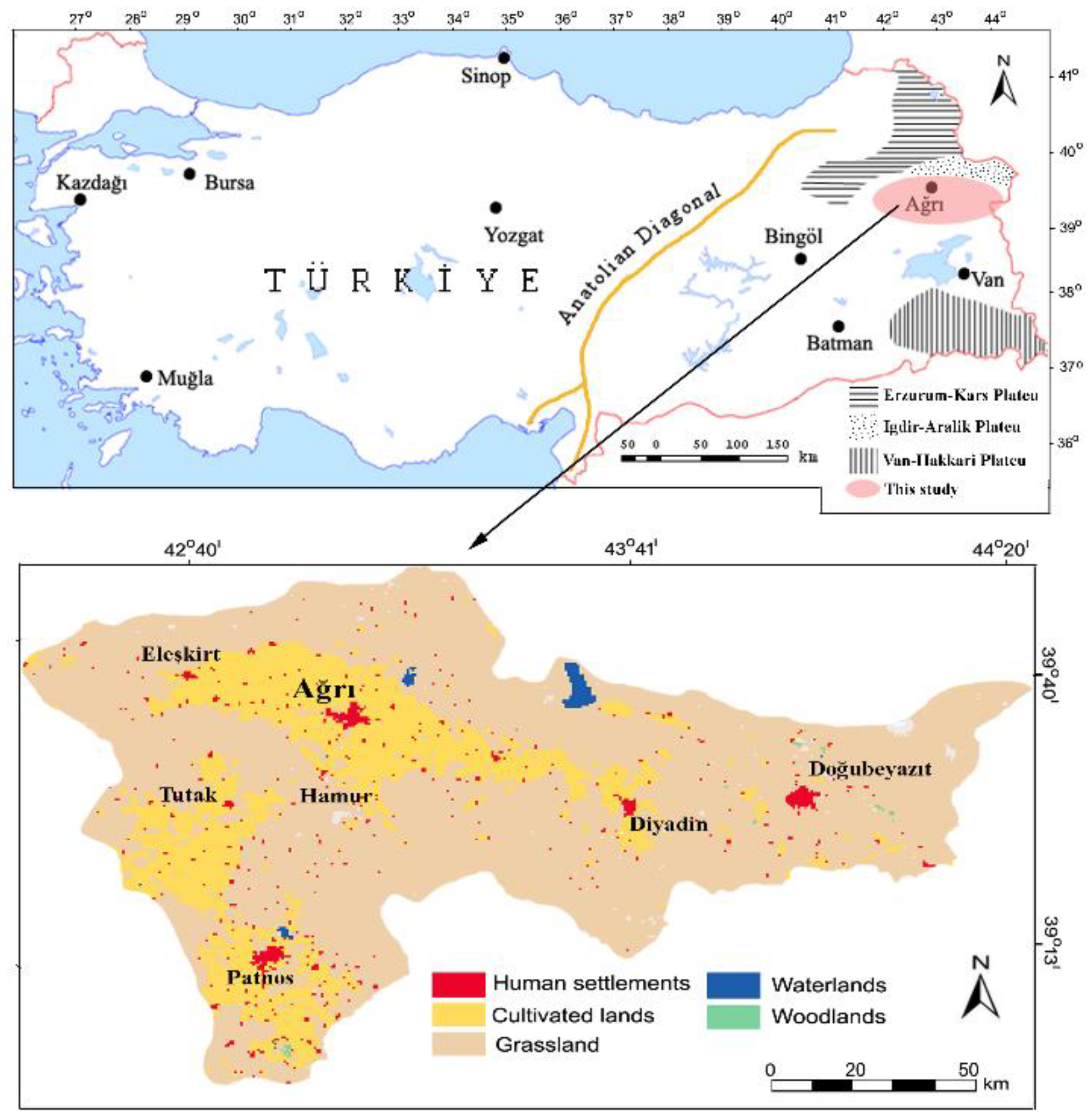
Figure 2.
Photographs of wild mammal species recorded in the Ağrı region (a-Canis aureus, b-Vulpes vulpes, c-Mustela nivalis, d-Scarturus williamsi, e-Spermophilus xanthoprymnus, f-Sciurus anomalus, g-Sus scrofa, h-Erinaceus concolor, i-Nannospalax xanthodon, j-Miniopterus schreibersii, k-Myotis myotis, and l-Pipistrellus pipistrellus).
Figure 2.
Photographs of wild mammal species recorded in the Ağrı region (a-Canis aureus, b-Vulpes vulpes, c-Mustela nivalis, d-Scarturus williamsi, e-Spermophilus xanthoprymnus, f-Sciurus anomalus, g-Sus scrofa, h-Erinaceus concolor, i-Nannospalax xanthodon, j-Miniopterus schreibersii, k-Myotis myotis, and l-Pipistrellus pipistrellus).
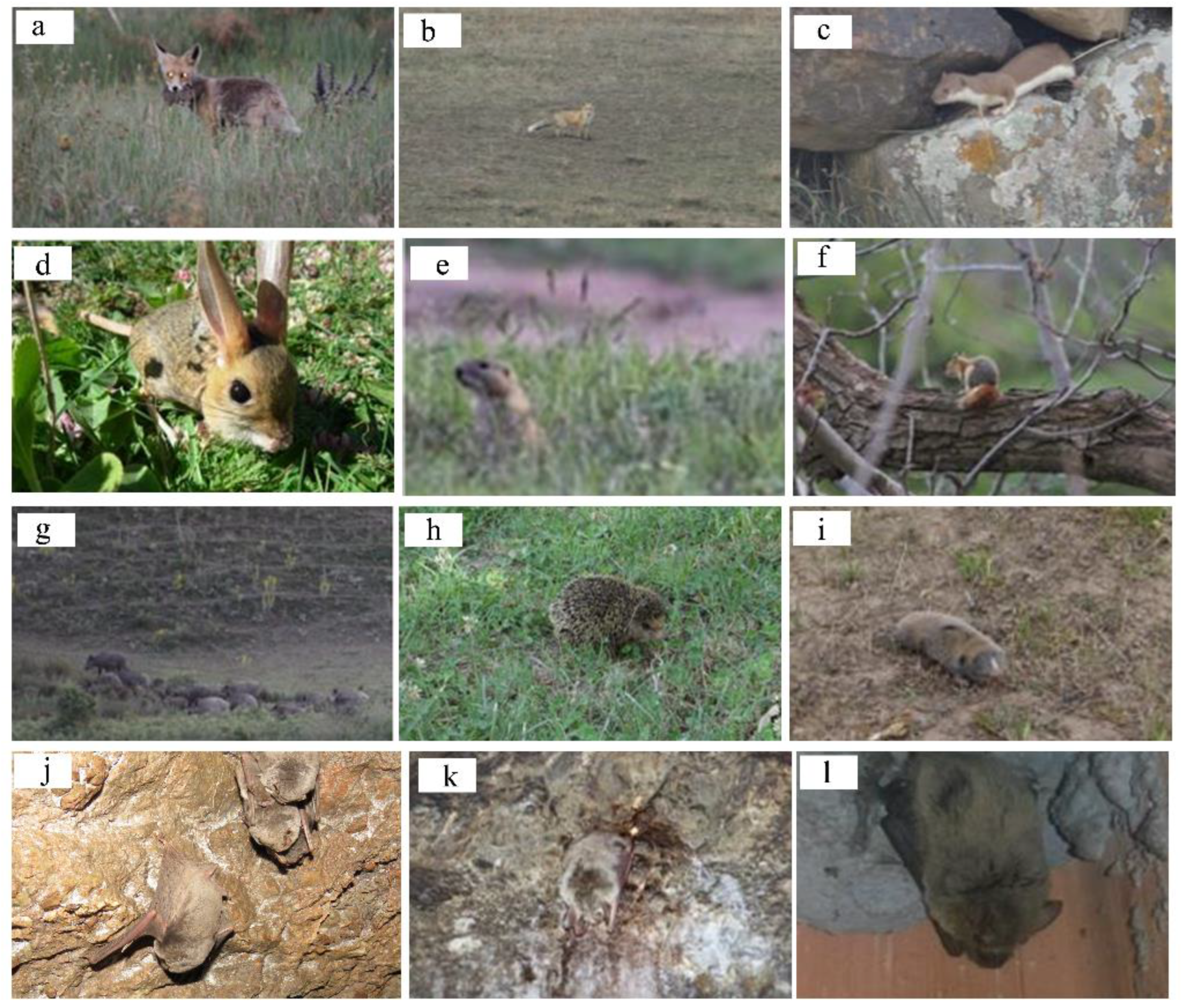
Figure 3.
Differences in species composition between Ağrı Province and the other eight areas: A) Medium and large-sized mammals, B) Small-sized mammals, and C) All Terrestrial mammals. Total difference in species composition (βjac; complete bar), proportion of the difference due to species turnover (βjtu; blue portion of bar), and proportion of the difference due to nestedness (βjne; brown portion of bar).
Figure 3.
Differences in species composition between Ağrı Province and the other eight areas: A) Medium and large-sized mammals, B) Small-sized mammals, and C) All Terrestrial mammals. Total difference in species composition (βjac; complete bar), proportion of the difference due to species turnover (βjtu; blue portion of bar), and proportion of the difference due to nestedness (βjne; brown portion of bar).
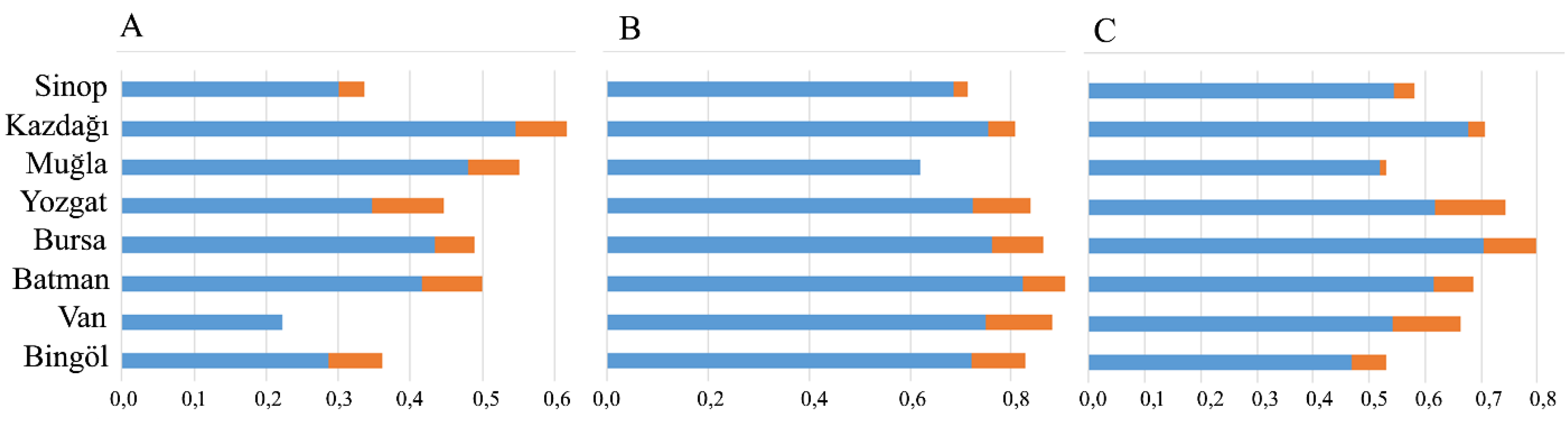

Table 1.
Detection and individual numbers of wild mammals from Ağrı and their relative frequencies and conservation status (VU, vulnerable; NT, near-threatened; LC, least concern; D, Number of detection; RFD, relative frequency of detection; N, Number of individuals; RFN, relative frequency of individuals).
Table 1.
Detection and individual numbers of wild mammals from Ağrı and their relative frequencies and conservation status (VU, vulnerable; NT, near-threatened; LC, least concern; D, Number of detection; RFD, relative frequency of detection; N, Number of individuals; RFN, relative frequency of individuals).
| Order / Family / Species | IUCN | BERN | CITES | MAKK | D | RFD (%) | N | RFN (%) |
| Order ARTIODACTYLA | ||||||||
| Bovidae | ||||||||
| Capra aegagrus Erxleben, 1777 | VU | II | 13 | 2,59 | 148 | 14,62 | ||
| Suidae | ||||||||
| Sus scrofa Linnaeus, 1758 | LC | I | 26 | 5,18 | 237 | 23,42 | ||
| Order LAGOMORPHA | ||||||||
| Leporidae | ||||||||
| Lepus europaeus Pallas, 1778 | LC | I | 34 | 6,77 | 53 | 5,24 | ||
| Order EULIPOTYPHLA | ||||||||
| Erinaceidae | ||||||||
| Erinaceus concolor Martin, 1837 | LC | 16 | 3,19 | 22 | 2,17 | |||
| Soricidae | ||||||||
| Crocidura leucodon Dukelsky, 1930 | LC | III | 1 | 0,20 | 1 | 0,10 | ||
| Order CARNIVORA | ||||||||
| Ursidae | ||||||||
| Ursus arctos Linnaeus, 1758 | VU | II | II | 18 | 3,59 | 26 | 2,57 | |
| Canidae | ||||||||
| Canis aureus Linnaeus, 1758 | LC | I | 16 | 3,19 | 19 | 1,88 | ||
| Canis lupus Linnaeus, 1758 | LC | III | II | 30 | 5,98 | 35 | 3,46 | |
| Vulpes vulpes (Linnaeus, 1758) | LC | I | 84 | 16,73 | 92 | 9,09 | ||
| Felidae | ||||||||
| Lynx lynx (Linnaeus, 1758) | NT | III | II | 3 | 0,60 | 3 | 0,30 | |
| Felis silvestris Schreber, 1777 | LC | II | II | 2 | 0,40 | 2 | 0,20 | |
| Mustelidae | ||||||||
| Lutra lutra (Linnaeus, 1758) | NT | II | I | 7 | 1,39 | 7 | 0,69 | |
| Martes martes (Linnaeus, 1758) | LC | III | 2 | 0,40 | 3 | 0,30 | ||
| Meles meles (Linnaeus, 1758) | LC | III | II | 14 | 2,79 | 14 | 1,38 | |
| Mustela nivalis Linnaeus, 1766 | LC | III | II | 14 | 2,79 | 16 | 1,58 | |
| Order RODENTIA | ||||||||
| Sciuridae | ||||||||
| Sciurus anomalus Gmelin, 1778 | LC | II | 2 | 0,40 | 7 | 0,69 | ||
| Spermophilus xanthoprymnus (Bennett, 1835) | NT | II | 14 | 2,79 | 35 | 3,46 | ||
| Dipodidae | ||||||||
| Scarturus williamsi Thomas, 1897 | NT | 10 | 1,99 | 11 | 1,09 | |||
| Gliridae | ||||||||
| Dryomys nitedula (Pallas, 1778) | LC | III | 1 | 0,20 | 1 | 0,10 | ||
| Cricetidae | ||||||||
| Mesocricetus brandti (Nehring, 1898) | NT | II | 3 | 0,60 | 3 | 0,30 | ||
| Nothocricetulus migratorius (Pallas, 1773) | LC | 3 | 0,60 | 3 | 0,30 | |||
| Microtus socialis (Pallas, 1773) | LC | 19 | 3,78 | 19 | 1,88 | |||
| Chionomys syriacus (Brants, 1827) | LC | 2 | 0,40 | 2 | 0,20 | |||
| Muridae | ||||||||
| Meriones persicus (Blanford, 1875) | LC | 19 | 3,78 | 19 | 1,88 | |||
| Apodemus mystacinus (Danford & Alston, 1880) | LC | 1 | 0,20 | 1 | 0,10 | |||
| Apodemus sylvaticus (Linnaeus, 1758) | LC | 2 | 0,40 | 2 | 0,20 | |||
| Apodemus flavicollis (Melchior, 1834) | LC | 3 | 0,60 | 3 | 0,30 | |||
| Mus musculus Linnaeus, 1758 | LC | 26 | 5,18 | 26 | 2,57 | |||
| Rattus norvegicus (Berkenhout, 1769) | LC | 6 | 1,20 | 6 | 0,59 | |||
| Rattus rattus (Linnaeus, 1758) | LC | 12 | 2,39 | 12 | 1,19 | |||
| Spalacidae | ||||||||
| Nannospalax nehringi | LC | 67 | 13,35 | 67 | 6,62 | |||
| Order Chiroptera | ||||||||
| Vespertilionidae | ||||||||
| Pipistrellus pipistrellus (Schreber, 1774) | LC | III | 13 | 2,59 | 21 | 2,08 | ||
| Myotis blythii (Tomes, 1857) | NT | II | 7 | 1,39 | 58 | 5,73 | ||
| Myotis myotis (Borkhausen, 1797) | LC | II | 1 | 0,20 | 16 | 1,58 | ||
| Rhinolophidae | ||||||||
| Rhinolophus hipposideros (Bechstein, 1800) | NT | II | 2 | 0,40 | 9 | 0,89 | ||
| Rhinolophus ferrumequinum (Schreber, 1774) | NT | II | 2 | 0,40 | 5 | 0,49 |
Table 2.
This Statistical data on wild mammals identified in Ağrı Province and the compared areas. A) Large and medium-sized mammals, B) Small mammals, and C) all mammals (N - Species Richness, Rf - Relative detection frequencies (%), H' - Shannon-Wiener entropy, and D - Simpson index).
Table 2.
This Statistical data on wild mammals identified in Ağrı Province and the compared areas. A) Large and medium-sized mammals, B) Small mammals, and C) all mammals (N - Species Richness, Rf - Relative detection frequencies (%), H' - Shannon-Wiener entropy, and D - Simpson index).
| A | B | C | ||||||||||
| N | Rf | H' | D | N | Rf | H' | D | N | Rf | H' | D | |
| Ağrı (This Study) | 16 | 40,00 | 2.773 | 0,937 | 20 | 16,00 | 2,996 | 0,950 | 36 | 21,82 | 3,586 | 0,971 |
| Bingöl (Karatay & Ulutürk, 2026) | 18 | 45,00 | 2.890 | 0,944 | 13 | 10,40 | 2,565 | 0,923 | 31 | 18,79 | 3,344 | 0,968 |
| Van (Ulutürk & Yürümez, 2022) | 16 | 40,00 | 2,773 | 0,937 | 9 | 7,20 | 2,197 | 0,889 | 25 | 15,15 | 3,219 | 0,960 |
| Batman (UBENIS, 2018) | 19 | 47,50 | 2,944 | 0,947 | 9 | 7,20 | 2,364 | 0,889 | 28 | 16,97 | 3,332 | 0,964 |
| Bursa (Gözütok, 2017) | 18 | 45,00 | 2,890 | 0,944 | 39 | 31,20 | 2,663 | 0,974 | 57 | 34,55 | 4,043 | 0,983 |
| Yozgat (Yorulmaz & Arslan, 2020) | 19 | 47,50 | 2,944 | 0,947 | 37 | 29,60 | 2,611 | 0,972 | 56 | 33,94 | 4,025 | 0,982 |
| Muğla (İlemin, 2020) | 19 | 47,50 | 2,944 | 0,947 | 18 | 14,40 | 2,890 | 0,944 | 37 | 22,42 | 3,611 | 0,973 |
| Kazdağı (Yiğit et al., 2005) | 13 | 32,50 | 2,565 | 0,923 | 28 | 22,40 | 3,332 | 0,964 | 41 | 24,85 | 3,713 | 0,976 |
| Sinop (Çam & Ölmez, 2015) | 17 | 42,50 | 2,833 | 0,941 | 23 | 18,40 | 3,135 | 0,956 | 40 | 24,24 | 3,689 | 0,975 |
Table 3.
Differences in species composition between pairs of sites. A) Medium and large-sized mammals, B) Small-sized mammals, and C) All Terrestrial mammals. The values outside the parentheses correspond to the total difference in species composition (βjac), the first value inside the parentheses indicates the difference due to species turnover (βjtu), and the second value indicates the proportion due to nestedness (βjne).
Table 3.
Differences in species composition between pairs of sites. A) Medium and large-sized mammals, B) Small-sized mammals, and C) All Terrestrial mammals. The values outside the parentheses correspond to the total difference in species composition (βjac), the first value inside the parentheses indicates the difference due to species turnover (βjtu), and the second value indicates the proportion due to nestedness (βjne).
| Ağrı | Bingöl | Van | Batman | Bursa | Yozgat | Muğla | Kazdağı | |
| A) | ||||||||
| Bingöl | 0,36 (0,29+0,07) | |||||||
| Van | 0,22 (0,22+0,00) | 0,65 (0,32+0,03) | ||||||
| Batman | 0,50 (0,42+0,08) | 0,56 (0,54+0,02) | 0,55 (0,48+0,07) | |||||
| Bursa | 0,49 (0,44+0,05) | 0,56 (0,56+0,00) | 0,60 (0,56+0,04) | 0,44 (0,42+0,02) | ||||
| Yozgat | 0,45 (0,35+0,10) | 0,38 (0,35+0,03) | 0,45 (0,35+0,10) | 0,35 (0,35+0,00) | 0,31 (0,27+0,04) | |||
| Muğla | 0,55 (0,48+0,07) | 0,50 (0,48+0,02) | 0,55 (0,48+0,07) | 0,19 (0,19+0,00) | 0,50 (0,48+0,02) | 0,42 (0,42+0,00) | ||
| Kazdağı | 0,62 (0,55+0,07) | 0,67 (0,56+0,11) | 0,62 (0,55+0,07) | 0,68 (0,54+0,14) | 0,63 (0,50+0,13) | 0,64 (0,48+0,16) | 0,68 (0,54+0,14) | |
| Sinop | 0,34 (0,30+0,04) | 0,46 (0,43+0,03) | 0,48 (0,45+0,03) | 0,47 (0,42+0,05) | 0,24 (0,20+0,04) | 0,28 (0,19+0,09) | 0,53 (0,48+0,05) | 0,75 (0,69+0,06) |
| B) | ||||||||
| Bingöl | 0,83(0,72+0,11) | |||||||
| Van | 0,88(0,75+0,13) | 0,89(0,76+0,06) | ||||||
| Batman | 0,91(0,82+0,09) | 0,77(0,70+0,07) | 0,80(0,80+0,00) | |||||
| Bursa | 0,86(0,76+0,10) | 0,95(0,87+0,08) | 0,99(0,95+0,04) | 0,98(0,93+0,05) | ||||
| Yozgat | 0,84(0,72+0,12) | 0,94(0,84+0,09) | 0,98(0,94+0,04) | 0,98(0,94+0,04) | 0,62(0,61+0,01) | |||
| Muğla | 0,62(0,62+0,00) | 0,84(0,80+0,04) | 0,94(0,91+0,03) | 0,94(0,91+0,03) | 0,92(0,85+0,07) | 0,96(0,94+0,02) | ||
| Kazdağı | 0,81(0,76+0,05) | 0,91(0,83+0,08) | 0,97(0,93+0,04) | 0,97(0,94+0,03) | 0,75(0,68+0,07) | 0,77(0,72+0,05) | 0,77(0,67+0,10) | |
| Sinop | 0,72(0,69+0,03) | 0,92(0,88+0,04) | 0,95(0,92+0,03) | 0,95(0,90+0,05) | 0,92(0,89+0,03) | 0,80(0,70+0,10) | 0,71(0,65+0,06) | 0,68(0,63+0,05) |
| C) | ||||||||
| Bingöl | 0,53(0,47+0,06) | |||||||
| Van | 0,66(0,54+0,12) | 0,63(0,56+0,07) | ||||||
| Batman | 0,69(0,61+0,07) | 0,42(0,37+0,05) | 0,57(0,53+0,04) | |||||
| Bursa | 0,80(0,71+0,09) | 0,84(0,73+0,11) | 0,92(0,84+0,08) | 0,88(0,77+0,10) | ||||
| Yozgat | 0,74(0,62+0,12) | 0,81(0,68+0,13) | 0,90(0,80+0,10) | 0,87(0,76+0,11) | 0,53(0,52+0,01) | |||
| Muğla | 0,53(0,52+0,01) | 0,63(0,58+0,05) | 0,80(0,72+0,07) | 0,72(0,65+0,07) | 0,75(0,64+0,11) | 0,63(0,56+0,07) | ||
| Kazdağı | 0,71(0,68+0,03) | 0,74(0,68+0,06) | 0,86(0,79+0,06) | 0,83(0,78+0,05) | 0,70(0,61+0,09) | 0,65(0,65+0,00) | 0,54(0,46+0,08) | |
| Sinop | 0,58(0,54+0,04) | 0,71(0,64+0,07) | 0,84(0,77+0,07) | 0,78(0,71+0,07) | 0,67(0,54+0,13) | 0,69(0,58+0,11) | 0,58(0,54+0,04) | 0,52(0,51+0,01) |
Disclaimer/Publisher’s Note: The statements, opinions and data contained in all publications are solely those of the individual author(s) and contributor(s) and not of MDPI and/or the editor(s). MDPI and/or the editor(s) disclaim responsibility for any injury to people or property resulting from any ideas, methods, instructions or products referred to in the content. |
© 2025 by the authors. Licensee MDPI, Basel, Switzerland. This article is an open access article distributed under the terms and conditions of the Creative Commons Attribution (CC BY) license (http://creativecommons.org/licenses/by/4.0/).
Copyright: This open access article is published under a Creative Commons CC BY 4.0 license, which permit the free download, distribution, and reuse, provided that the author and preprint are cited in any reuse.