

Submitted:
19 November 2025
Posted:
19 November 2025
Read the latest preprint version here
Abstract
We present a comprehensive, timeless framework in which the observable three-dimensional (3-D) world is a \emph{shadow}---a projection---of a single four-dimensional (4-D) \textbf{counterspace} (\(\Ccal\)) that contains the full content of all ``time stages.'' In this ontology, time is not fundamental; apparent evolution is a foliation artifact. All observables (geometry, ``matter,'' and biological complexity) on the 3-D shadow are pullbacks of one global 4-D structure $(\Ccal, G, \Psi)$. We formalize this structure using a strict metamathematical analogy: the 4-D counterspace serves as the Tarskian ``truth'' (the Territory), while the 3-D shadow constitutes the syntactic ``provability'' (the Map). This duality redefines scientific inquiry not as falsification, but as an incompletable cartographic process akin to Gödelian numbering. A central \emph{identity-of-source} principle asserts that every singularity registered in the shadow derives from a unique origin point \(p_0\in\Ccal\). The framework recovers General Relativity (GR) as a high-gradient/trivial-projection limit, while apparent ``dark'' phenomena emerge from a single extrinsic constitutive law that modifies the weak-field response without introducing novel particles or fluids. Finally, we demonstrate the framework's conceptual coherence by identifying ``Dark Matter'' (in physics) and ``Darwinian Chance'' (in biology) as homologous projection artifacts.
Keywords:
timeless counterspace
; 4-D counterspace
; shadow manifold
; shadow gravity
; projection geometry
; embedding geometry
; foliation artifact
; gauge time
; identity-of-source axiom
; conserved singularities
; instanton p0p0p0
; origin set S=Orb(p0)S = Orb(p0)S=Orb(p0)
; whole content axiom
; extrinsic constitutive law
; parsimony axiom
; non-ontic time
; pullback geometry
; content field Ψ
; counterspace metric GABGABGAB
; immersion map X:Σ→CX : Σ to CX:Σ→C
; shadow realization
; geometric projection limit
; high-gradient limit
; trivial-projection limit
; relational limit
; 3-geometry dynamics
; emergent lapse and shift
1. Introduction
Modern cosmology and theoretical physics face an accumulation of anomalies that are increasingly addressed by adding baroque “dark sectors” or parallel conceptual universes. Popular expositions drift toward “mirror worlds” and multiverse speculations. This paper takes the opposite route: change ontology, not entities. We posit that the 3-D world is a shadow manifold embedded in a 4-D counterspace that contains the full content of reality. Time is not ontic; it is the parameterization of a comparison between admissible projections of one 4-D whole. “Motion” is how changes in the source layer register as geometry/inertia in the shadow.
This manuscript provides the definitive formulation of the “Timeless Counterspace & Shadow Gravity” (TCGS) framework. Beyond the physical derivations, we explicate the metamathematical logic that underpins the theory. By adopting a “cartographic, not falsificationist” methodology, we align the physical problem of dark matter with the logical problem of incompleteness. We argue that the 3-D observable universe is to the 4-D counterspace what a formal system is to a standard model in logic: capable of internal consistency but inherently unable to define its own truth [15,17].
1.0.0.1. Contributions
We: (i) codify and justify the axioms, including identity-of-source (one origin for all singularities), (ii) formalize the metamathematical boundary between the 4-D “Territory” and the 3-D “Map,” (iii) establish the homology between physical and biological artifacts (Sequention), (iv) derive GR as a relational, timeless limit, (v) introduce a single extrinsic response law replacing dark halos, and (vi) supply explicit constraints for cartographic validation.
2. Ontology and Axioms: Justification of the TCGS-SEQUENTION Framework
The TCGS framework is built upon four foundational axioms that invert the standard cosmological ontology. The central argument is that the observable three-dimensional () world is fundamentally incomplete and must be understood as a geometric projection of a higher-dimensional, static source manifold ().
2.1. Axiom A1: The Whole Content () and the Necessity of Counterspace
A1 (Whole Content): There exists a smooth 4-D counterspace with metric G and global content field(s) , containing the full content of all “time stages” simultaneously.
The proposal of a counter-spatial dimension is not merely natural but necessary; it emerges from an elementary analysis of three-dimensional phenomenology, its constraints, and its internal dynamics. The existence of is the non-metaphysical resolution to a topological inconsistency within the observable 3D manifold .
2.1.0.2. The Topological Inconsistency of
The reference literature associated with the theory, specifically the Lineweaver-Patel mass-radius cartography, demonstrates that the space of all physical entities in is rigidly bounded by two antagonistic geometric limits:
- (1)
- The Schwarzschild Boundary (): The region forbidden by gravitation ().
- (1)
- The Compton Boundary (): The region forbidden by quantum uncertainty ().
A truly fundamental, self-contained 3D space should be scale-invariant, lacking such rigid internal boundaries. The presence of these boundaries (see Figure 1) is the definitive geometric signature of an embedding. The observable 3D world is the "cone of admissibility" defined by the constraints imposed by the higher-dimensional source . These forbidden regions are not empty parameter spaces, but the projective limits of the immersion map .
2.1.0.3. Measurement, Waves, and the Reverse Side
The necessity of is further confirmed by the nature of measurement. When we discuss waves, we are not referring to "things" but to properties. The fact that a measurement is never identical to the object it seeks to characterize suggests the object’s fundamental geometry is richer than the 3D measurement apparatus can capture. The “reverse side” of a wave alludes to the configuration of fields required for a measurement to acquire physical meaning. This reverse side is precisely the segment of the 4D content field in that remains inaccessible during the instantaneous 3D slice .
2.1.0.4. Counterspace is Necessary, Not Metaphysical
Those who assume that this component introduces a metaphysical inflection into the system misinterpret its nature. The metaphysical tint does not arise from the model, but rather from the impossibility of denying or dismissing the properties of Counterspace. Everything is reduced, by necessity, to the observation of its shadow (science as we know it): what can be parametrically measured.
2.2. Axiom A2: Identity of Source and Conserved Singularities
A2 (Identity of Source): There is a distinguished point and an automorphism group such that is the fundamental singular set; all shadow singularities descend from .
This axiom establishes the deep coherence of the framework by proposing a single, unified geometric origin (, the Instanton) for all extreme gravitational phenomena. In General Relativity, a singularity is a physical breakdown. In TCGS, it is a conserved geometric feature. The formation of a black hole in the shadow is the critical event where the projection map X intersects the fundamental geometric boundary S within . It is entirely feasible that singularities are extreme manifestations of this counter-space, transforming catastrophic physical failure into a predictable geometric trace of the fixed 4D source.
2.3. Axiom A3: Shadow Realization () and Gauge Time
A3 (Shadow Realization): The observable world is a 3-manifold embedded by ; observables are pullbacks . “Time” is gauge (no ontic status).
This axiom is the geometric definition of the shadow: the observed 3D metric g and fields are simply the pullbacks of the 4D source G and . The key implication is the re-classification of time.
2.3.0.5. Time as a Foliation Artifact
If is a static, complete 4D content, then apparent evolution is a foliation artifact—the result of slicing a fixed block. Time is merely the label parameterizing the comparison between admissible 3-geometries (). This position is secured mathematically by the BSW (Baierlein–Sharp–Wheeler) action [4], which recovers the dynamics of GR not from a fundamental time, but from the reparameterization invariance of the 3-geometries.
2.4. Axiom A4: Parsimony and Extrinsic Response
A4 (Parsimony): No dark species; apparent dark effects arise from projection geometry encoded by one constitutive law.
This axiom enforces geometric parsimony. The observed phenomena attributed to “dark matter” are not new particles or fluids, but an informational deficit arising from describing a 4D geometry using a constrained 3D manifold. This deficit is encoded by a single, non-linear Extrinsic Constitutive Law (detailed in Section 6) that modifies the weak-field gravitational response on the shadow , replacing dark halos with the projection operator .
3. The Metamathematical Lens: Truth vs. Provability
A defining feature of the TCGS framework is its explicit alignment with the limitative theorems of mathematical logic. To fully explain the axiomatic system, we must define the conceptual boundary between the framework’s ontology and its epistemology.
3.1. The Gödelian Gap as a Physical Analogy
We posit a structural isomorphism between the physical TCGS system and the logical systems defined by Gödel and Tarski [15,17].
- The “Territory” (4D Counterspace ): This corresponds to Tarskian Semantic Truth or the standard model . It contains the “Whole Content” and is the domain of “what is,” independent of observation.
- The “Map” (3D Shadow & Predictions): This corresponds to Syntactic Provability within a formal system T. It is the computable, accessible domain of scientific laws and observations.
Just as Tarski’s Undefinability Theorem states that a system cannot define its own truth [16], Axiom A3 implies that the 3D shadow cannot fully define the 4D counterspace. The “truth” of the 4D geometry is transcendent to the 3D “object language.”
3.2. Cartography vs. Falsification
This analogy creates a non-Popperian, “cartographic” epistemology. Since the 3D map is a projection of a richer 4D truth, any specific mathematical map (like the -function) is formally incomplete. A prediction failure (e.g., a mismatch in lensing offsets) does not falsify the territory (the existence of ); rather, it is a “Gödel sentence”—a discovery of a geometric truth that the current map could not prove. Science is thus redefined as the infinite, incompletable process of mapping the complexity of the Counterspace.
4. The Unified Ontology: Physics and Biology Homology
The axiomatic rigor of TCGS extends beyond physics. By adhering to the Identity of Source (A2) and Parsimony (A4), the framework reveals a deep homology between "Dark Matter" in physics and "Teleology" or "Chance" in biology. Both are identified as artifacts of projecting a 4D static structure onto a 3D evolving slice.
Table 1 formalizes this unified ontology, demonstrating how the Extrinsic Constitutive Law operates identically across domains.
In the biological sector (SEQUENTION), “Darwinian chance” is re-defined as a "foliation artifact." Just as the weak-field regime in physics creates the illusion of dark matter, the "time-elapsed" regime in biology creates the illusion of random selection. The framework asserts that biological forms are 3D cross-sections of invariant 4D geometric structures, governed by rather than historical contingency.
5. Geometry of the Shadow and Holography
5.1. Reconstruction
On , the content field obeys a source equation with singular support on S,
with invariant under . Observables are uniquely fixed by .
5.2. Space Has no Intrinsic Properties
All geometric structure on the shadow is inherited from ; the shadow has no independent ontic degrees of freedom. This aligns with the metamathematical view that syntactic theorems have no meaning without a semantic model.
6. GR as a Relational Limit (BSW/ADM Without Ontic Time)
We use the BSW Jacobi action to recover dynamics without assuming time as a fundamental variable [4,6].
with , . Variation yields the ADM constraints and an emergent lapse , reconstructing a 4-metric that obeys Einstein’s equations [5].
Theorem 1.
Assuming locality, ultralocal kinetic metric, and scalar potential , reparameterization invariance on 3-geometries yields the ADM/Hamilton constraints and Einstein equations.
This derivation is crucial: it proves that "gravity" is the method by which the 3D shadow maintains consistency as it evolves through the 4D block.
7. Projection Geometry: The Extrinsic Constitutive Law
8. Model Calibration: The Foundational Scale
The phenomenological success of TCGS hinges on the calibration of .

Table 2.
Minimal Calibration and Foundational Scales of the Extrinsic Response.
| Parameter / Function | Value / Form | Contextual Justification |
|---|---|---|
| Invariant Scale () | Universal transition acceleration determined by galactic kinematics. | |
| Response Function () | Simplest form satisfying asymptotic limits for GR and BTFR. | |
| Dimensionless Variable (y) | Ratio of observed acceleration to global geometric scale. |
8.1. Justification of the Form
The chosen function is selected based on Axiom A4 (Parsimony).
- High-Acceleration Limit ():. We recover standard GR.
- Low-Acceleration Limit ():. This yields , directly producing the Baryonic Tully-Fisher Law () and the Radial Acceleration Relation (RAR).
This calibration is the "Map" which we test against the "Territory."
9. Foundational Consistency
9.1. Constraint Algebra Closure
9.2. PPN/Solar-System Bounds
In regions where , and the metric perturbations obey GR. Linearizing yields Post-Newtonian parameters ; tight bounds follow wherever .
9.3. PDE Well-Posedness
Let be , strictly increasing, with and bounded. Then the operator is uniformly elliptic; Lax–Milgram yields existence/uniqueness.
10. Worked Profiles and Figures
10.1. Galaxy-Scale: RAR and BTFR
For spherical symmetry, , producing the branches and ; hence (BTFR) and the RAR. See Figure 2.
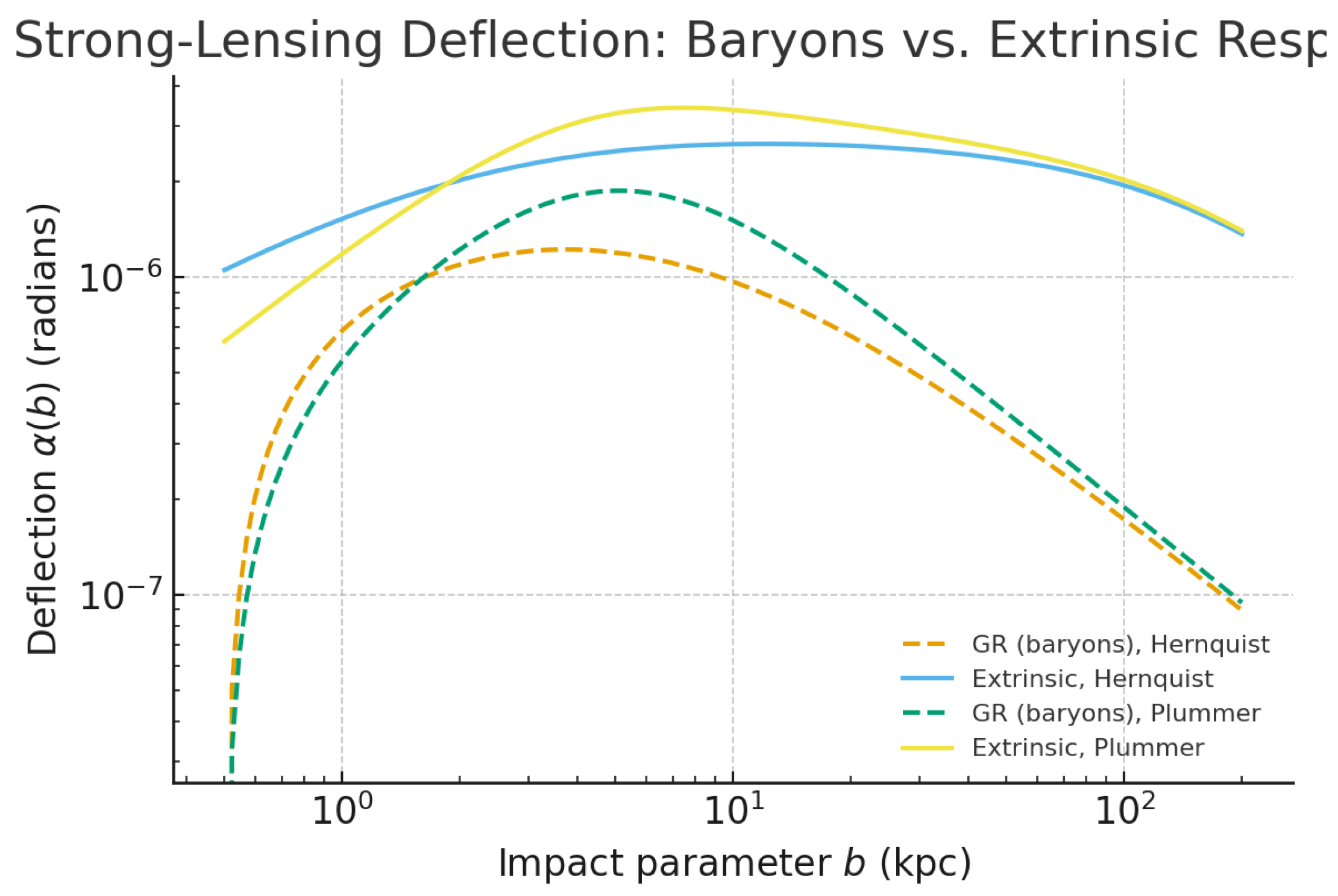
10.2. Strong Lensing: Hernquist and Plummer Baryons
The deflection in the extrinsic regime is . fig:lens contrasts the prediction with GR (baryons only).
Figure 3.
Deflection profiles for Hernquist and Plummer baryons (, kpc). Dashed: GR with baryons only; solid: extrinsic response with the same . The extrinsic model yields a quasi-constant tail, enabling strong lensing without dark halos.
Figure 3.
Deflection profiles for Hernquist and Plummer baryons (, kpc). Dashed: GR with baryons only; solid: extrinsic response with the same . The extrinsic model yields a quasi-constant tail, enabling strong lensing without dark halos.
11. Cosmology Without Time
Cosmological observables are re-expressed as slice invariants of (acoustic scales, BBN yields) [2,3]. Late-time “acceleration” is a foliation artifact of slicing a fixed content, not a fluid. This applies equally to the biological history; the apparent "evolution" of complexity is a slice invariant of the 4D biological content field.
12. Empirical Program: A Cartographic Survey
This program is cartographic, not falsificationist. In line with the Gödelian logic formalized in Section 3, a mismatch between prediction and observation does not falsify the core axioms (A1-A3) or the parsimony axiom (A4). Instead, it proves our mathematicalmap(the specific -function) is incomplete, and we must draw a new one to match the “geometric complexity” of the territory.
The survey tasks are: (1) Single-scale galaxy fits for ; (2) joint kinematics–lensing without halo parameters; (3) merging-cluster offset morphology; (4) large-scale gravitational slip; (5) cosmological slice-invariant checks.
13. Conclusions
A timeless, identity-of-source framework yields GR as a limit and replaces dark sectors with a single, well-posed extrinsic response. We have demonstrated that this physical structure is formally analogous to the Tarskian distinction between semantic truth and syntactic provability. The program is empirically mappable and, through its parallel structure with SEQUENTION, offers a unified geometric resolution to the problems of Dark Matter and Darwinian Chance.
Appendix A. Constraint Algebra (Sketch)
Closure of the hypersurface-deformation algebra follows from the BSW variational principle with best matching. The emergent lapse/shift ensure , , as in ADM.
Appendix B. PPN Estimates
In regions with one recovers ; Solar-system bounds imply locally, easily satisfied for any galactic-scale .
References
- Arellano-Peña, H. (2025). SEQUENTION: A Timeless Biological Framework for Further Evolution (Draft v2.0 Cartographic Edition).
- Arellano, H. (2025). Gravito-Capillary Foams in a 4-D Source Manifold: Projection Geometry for TCGS-SEQUENTION and Applications.
- Arellano, H. (2025). Gravito-Capillary Foams in a 4-D Source Manifold (v2.0 Cartographic Edition).
- R. F. Baierlein, D. H. Sharp, J. A. Wheeler, Three-Dimensional Geometry as Carrier of Information about Time, Phys. Rev. 126, 1864 (1962).
- R. Arnowitt, S. Deser, C. W. Misner, The Dynamics of General Relativity, in Gravitation: An Introduction to Current Research, ed. L. Witten (Wiley, 1962).
- S. A. Hojman, K. Kuchař, C. Teitelboim, Geometrodynamics Regained, Ann. Phys. 96, 88–135 (1976).
- T. Regge, C. Teitelboim, General Relativity à la String: a Progress Report, Proc. 1st Marcel Grossmann Meeting (1977).
- M. P. do Carmo, Differential Geometry of Curves and Surfaces, Prentice Hall (1976).
- M. Milgrom, A Modification of the Newtonian Dynamics, Astrophys. J. 270, 365–370 (1983).
- J. D. Bekenstein, Relativistic Gravitation Theory for the MOND Paradigm, Phys. Rev. D 70, 083509 (2004).
- B. Famaey, S. S. McGaugh, Modified Newtonian Dynamics (MOND): Observational Phenomenology and Relativistic Extensions, Living Rev. Relativ. 15, 10 (2012).
- T. Jacobson, Thermodynamics of Spacetime: The Einstein Equation of State, Phys. Rev. Lett. 75, 1260 (1995).
- E. Verlinde, Emergent Gravity and the Dark Universe, SciPost Phys. 2, 016 (2017).
- C. H. Lineweaver and V. M. Patel, All objects and some questions, Am. J. Phys. 91, 819–825 (2023).
- Tarski, A. (1944). The Semantic Conception of Truth: and the Foundations of Semantics. Philosophy and Phenomenological Research, 4(3), 341-376.
- Tarski, A. (1956). The Concept of Truth in Formalized Languages. In Logic, Semantics and Metamathematics (tr. J.H. Woodger). Oxford University Press.
- Smith, P. (2020). An Introduction to Gödel’s Theorems (Second ed.). Logic Matters.
- Smith, P. (2022). Gödel Without (Too Many) Tears (Second ed.). Logic Matters.
- Kashtan, D. (2019). Alfred Tarski and the "Concept of Truth in Formalized Languages". History and Philosophy of Logic, 40(3), 303-305.
- Sher, G. (1999). What is Tarski’s Theory of Truth?. Topoi, 18(2).
- Woleński, J. Semantics and Truth. Logic, Epistemology, and the Unity of Science, Vol. 45. Springer.
- [Book Review] (1958). Review of: Wilson, J. (1956). Language and the Pursuit of Truth.
Figure 1.
The Mass-Radius Cartography of the Universe. This comprehensive plot illustrates the “forbidden regions” imposed by General Relativity (Schwarzschild boundary) and Quantum Uncertainty (Compton boundary). The observable universe exists within the wedge allowed by these fundamental constraints. The existence of these rigid geometric boundaries suggests that the 3D world is a subspace embedded in a higher-dimensional structure. Note: This figure is a modified version from Lineweaver & Patel, Am. J. Phys. 91, 819 (2023) [14], to illustrate the topological inconsistency discussed in Axiom A1.
Figure 1.
The Mass-Radius Cartography of the Universe. This comprehensive plot illustrates the “forbidden regions” imposed by General Relativity (Schwarzschild boundary) and Quantum Uncertainty (Compton boundary). The observable universe exists within the wedge allowed by these fundamental constraints. The existence of these rigid geometric boundaries suggests that the 3D world is a subspace embedded in a higher-dimensional structure. Note: This figure is a modified version from Lineweaver & Patel, Am. J. Phys. 91, 819 (2023) [14], to illustrate the topological inconsistency discussed in Axiom A1.
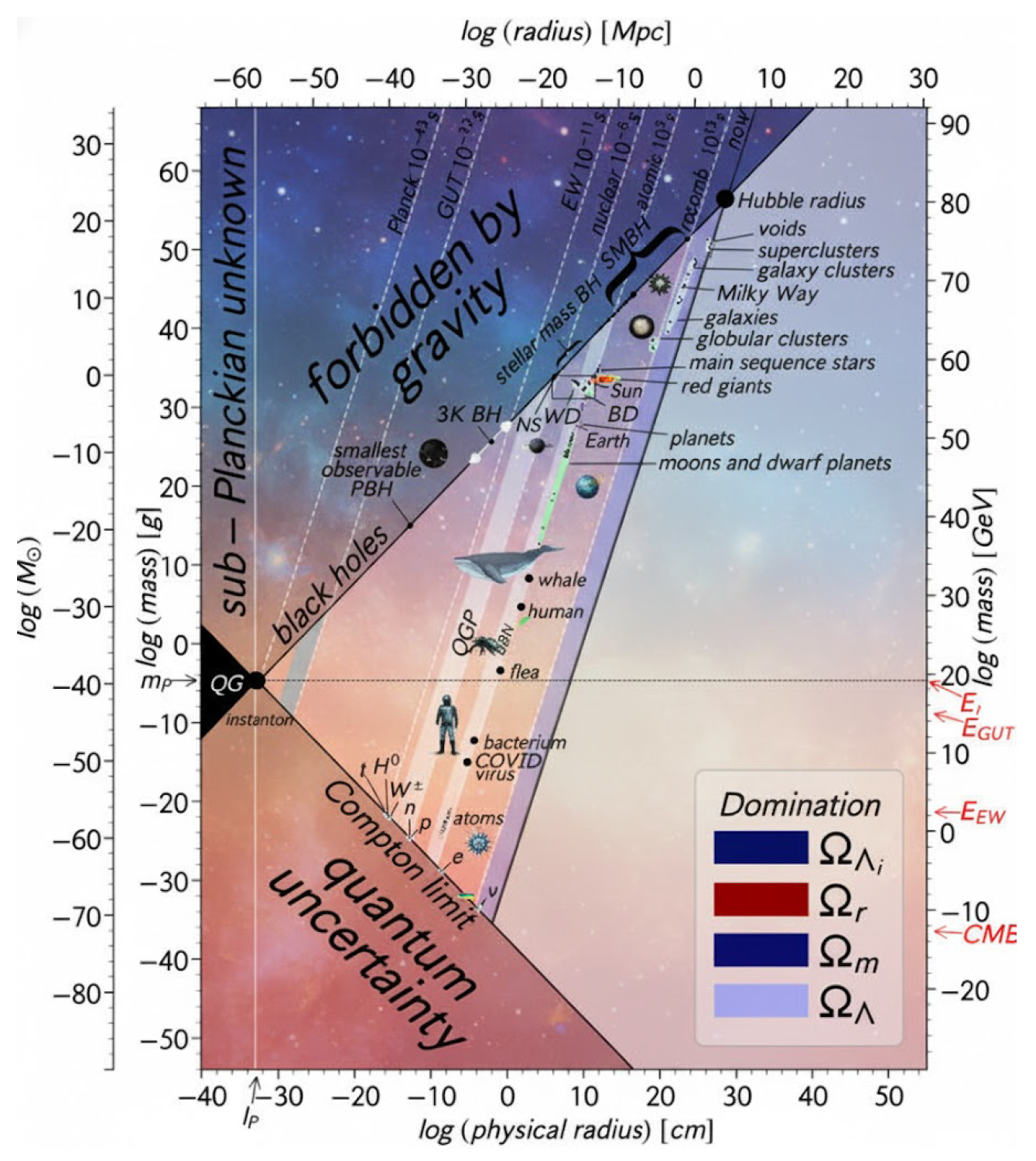
Figure 2.
Schematic RAR prediction with a single geometric scale (calibrated in Table 2). Dashed: Newtonian branch; dotted: deep extrinsic branch; solid: prediction for the family.
Figure 2.
Schematic RAR prediction with a single geometric scale (calibrated in Table 2). Dashed: Newtonian branch; dotted: deep extrinsic branch; solid: prediction for the family.
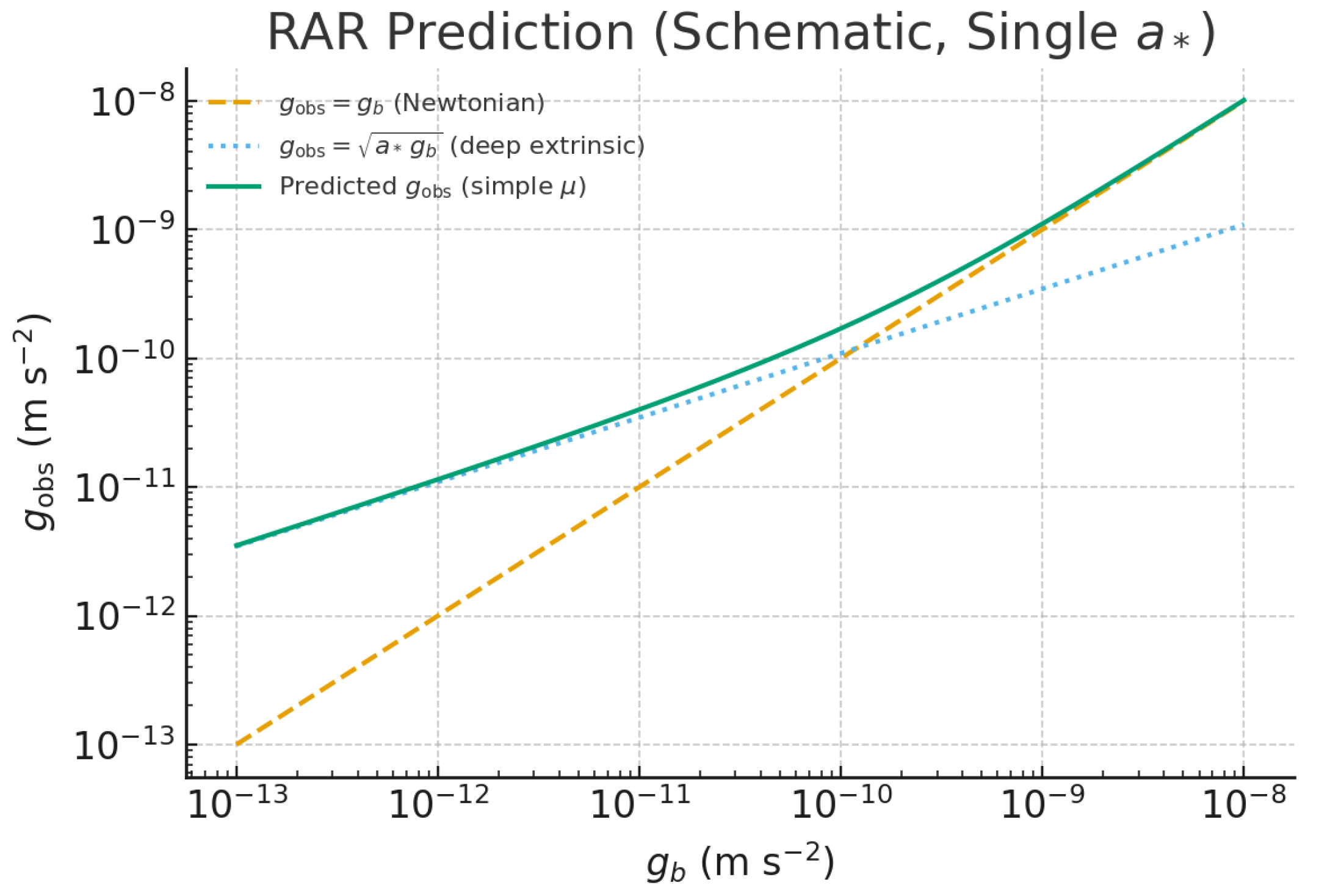
Table 1.
Parallel Ontology and Extrinsic Laws in TCGS (Physics) and SEQUENTION (Biology). Adapted from [1].
Table 1.
Parallel Ontology and Extrinsic Laws in TCGS (Physics) and SEQUENTION (Biology). Adapted from [1].
| Concept | Physics (TCGS) | Biology (SEQUENTION) |
|---|---|---|
| Core Manifold | 4-D Counterspace | 4-D Counterspace |
| Shadow Manifold | 3-D Physical “Shadow” () | 3-D “Biosphere Shadow” () |
| Core Law (Map) | Extrinsic Constitutive Law | Extrinsic Constitutive Law (Informational Flux Law) |
| Source Term | Baryonic Mass () | Informational Gradients () |
| Apparent Artifact | “Dark Matter” (e.g., RAR, lensing) | “Teleology” / “Directionality” |
| Eliminated Concept | “Dark Species” / “Novel Fluids” | “Chance” / “Historical Selection” |
Disclaimer/Publisher’s Note: The statements, opinions and data contained in all publications are solely those of the individual author(s) and contributor(s) and not of MDPI and/or the editor(s). MDPI and/or the editor(s) disclaim responsibility for any injury to people or property resulting from any ideas, methods, instructions or products referred to in the content. |
© 2025 by the authors. Licensee MDPI, Basel, Switzerland. This article is an open access article distributed under the terms and conditions of the Creative Commons Attribution (CC BY) license (http://creativecommons.org/licenses/by/4.0/).
Copyright: This open access article is published under a Creative Commons CC BY 4.0 license, which permit the free download, distribution, and reuse, provided that the author and preprint are cited in any reuse.